



Archive for the 'UW Film Studies' Category
RAINING IN THE MOUNTAIN at UW Cinematheque!
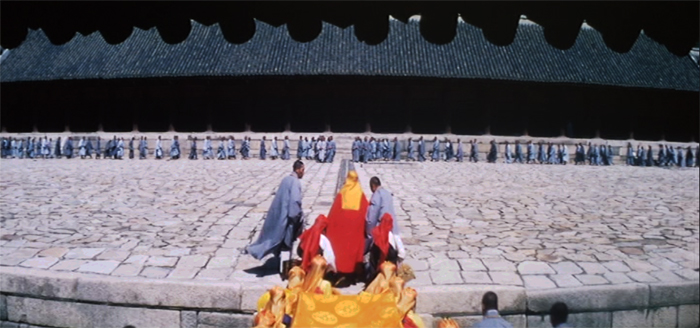
Raining in the Mountain (Hu Jinquan/King Hu, 1979).
DB here:
Thanks to friendly distributors, our University of Wisconsin–Madison Cinematheque has sustained itself with virtual screenings every week. Coming up is one of King Hu’s most marvelous movies, Raining in the Mountain. In tribute, I joined Mike King to talk about it in the Cinematheque’s ongoing podcast series.
Best of all, thanks to Film Movement, you can watch the film through our Cinematheque’s virtual cinema!
For a limited time, the Cinematheque offers a limited number of opportunities to view Raining in the Mountain at home for free. To receive instructions, send an email to info@cinema.wisc.edu and simply include the word RAINING in the subject line. No further message is necessary.
Now, why should you watch it?
Well, it’s one of the most visually splendid Chinese films ever made. The Buddhist monastery that serves as the setting was actually assembled by editing together several South Korean locations, all majestic. Add in the brilliant color design and costumes of vibrant splendor, and you get a spectacle that David Lean would kill for.
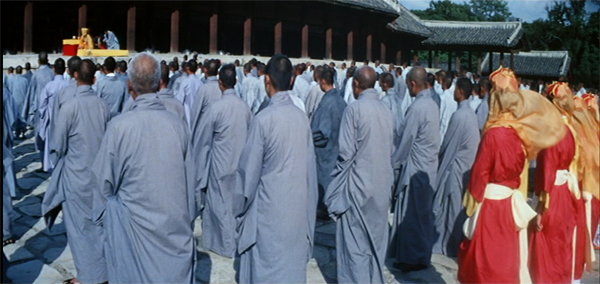
Among this pageantry we find a cast of rogues, supple-spined thieves, selfish and lustful monks, and a couple of wise elders who see through the vanities of this world. A splashy finish is provided by a bevy of cascading courtesans wielding dazzling crimson and gold sashes–handy for trussing up a thief who has anger issues.
Key scenes take place in the monastery library, but the filmmakers were forbidden to shoot there. In a weird echo of the movie’s plot, the monk in charge was bribed and the crew stole the shots they needed. The footage was whisked off to Seoul, but the stratagem cost the producers a few days in custody.
The plot, as Mike and I discuss, is really three stories in one. There’s a heist scheme, in which a plutocrat and a general compete to steal a rare scroll. There’s a political intrigue, as monks jockey to succeed the retiring abbot of the monastery. And there’s a redemption arc, centering on an unjustly convicted prisoner who struggles to get on the path of righteousness. Much of the film is an attack on worldly selfishness. Even in the monastery, the monks are obsessed with money and have to be forced to do honest work. It’s a film about who deserves power, and right now, in our America, it’s welcome to see pragmatic humility rewarded.
King Hu didn’t finish that many films. He took months to research his projects, and his meticulous planning of costumes and sets made him a slow worker. Unlike many Hong Kong directors, he prepared storyboards and worked out his compositions carefully. As he completed his shots, he checked them off with an “OK,” like the American filmmakers of the silent era.
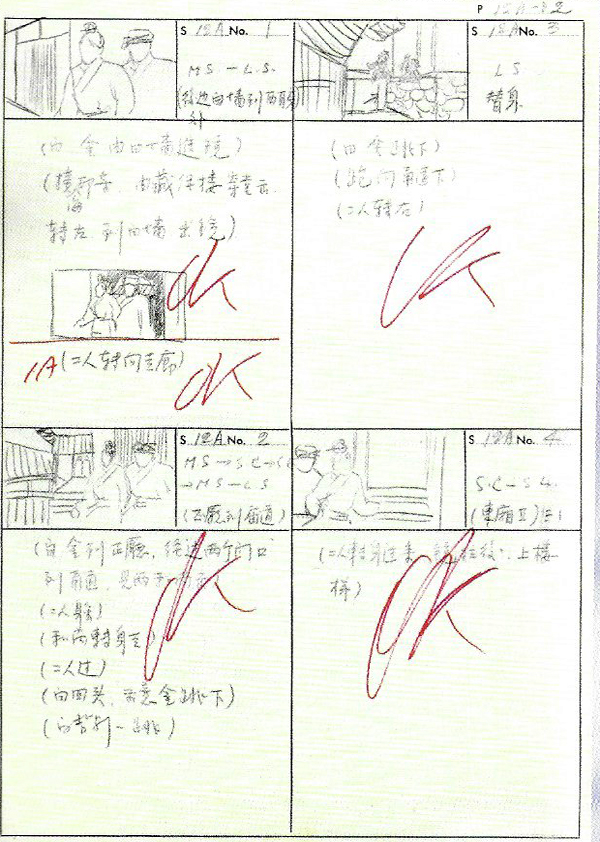
The connection isn’t accidental. Like a silent filmmaker, Hu had a pictorial intelligence that conceived scenes shot by shot, without the pointless flourishes (arcing camera, slow track-ins) that today’s filmmakers are addicted to. He’s a fast cutter, but his locked-down compositions give you time to see everything.
As a result, Raining in the Mountain is not your typical martial-arts movie. For one thing, what usually counts as action–an aggressive fight, involving punches and kicks–doesn’t come along for an hour. In our conversation, I argue that King Hu replaces fights with zigzag chases, evasions, and hide-and-seek maneuvers. The geography of the monastery gave him vast opportunities for booby-trapped compositions. Figures and faces pop in and out of doorways, corridors, and windows.
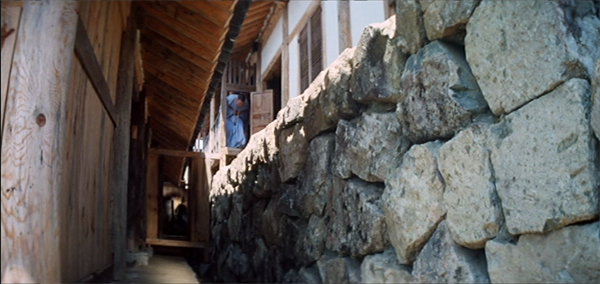
The film is designed for the big screen, where details can blossom in distant crannies. So on a monitor (forget the tablet, the laptop, and the phone), you have keep your eyes peeled. While the two thieves drop into a passageway and race into the distance. . .
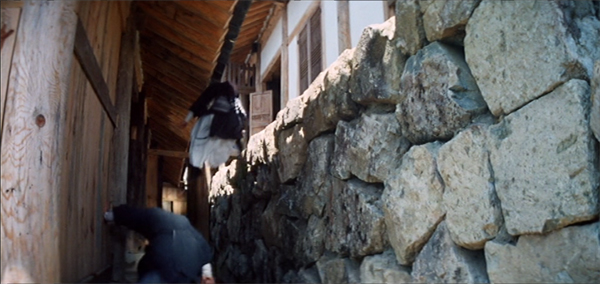
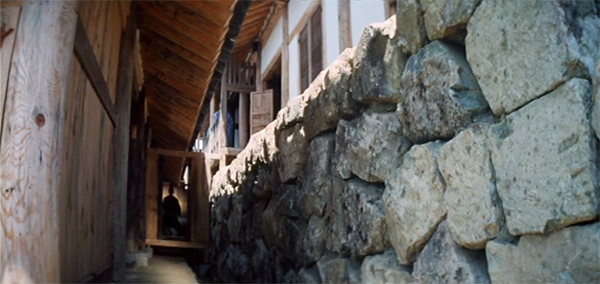
…a peekaboo framing gradually reveals why they’re hiding: a monk in blue emerges (tiny) in the ledge above them,
The spaciousness of the setting seems to have nudged Hu to try leading our attention to tiny bits of action in the anamorphic frame. Watch how he stages Chang’s preparation for a knife attack in a long shot. Gold Lock is crouching on the left, watching, like us, for the glint of Chang’s blade.
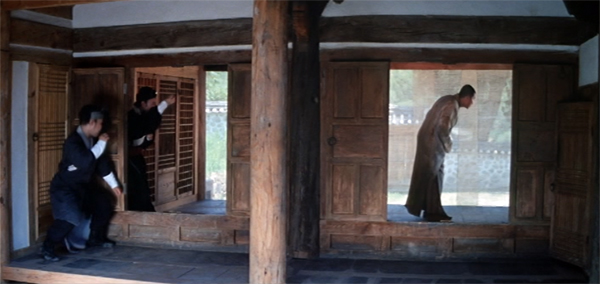
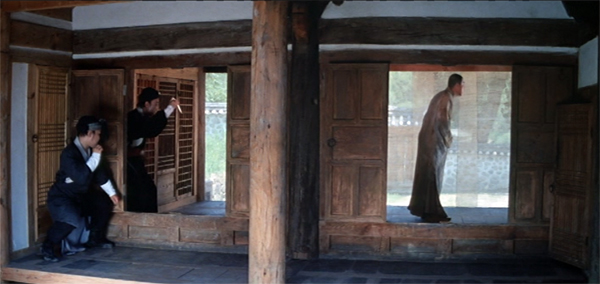
No close-ups are necessary. Hu trusts that we’ll keep up.
As usual in King Hu, there’s a quiet jubilation in watching the calm confidence of fighters leaping from room to room, hopping into a niche, or backflipping under a porch. Hu favors a slow buildup, capped by percussive bursts of action in rhythms recalling Beijing Opera. He cares less about traditional martial arts than about finding ways to create uniquely kinetic dramas of honor, heroism, and protection of the innocent. For him, combat is a staccato dance, and conflict is a test of moral rectitude.
As Mike points out in our conversation, King Hu looms ever larger in film history. A firm line runs from A Touch of Zen to Crouching Tiger, Hidden Dragon (2000) and Hero (2002), and on to Goodbye, Dragon Inn (2003). Tsui Hark’s swordplay films, especially The Blade (1995), owe a great deal to King Hu. (Not to mention John Zorn’s ear-bleeding album dedicated to the director and his incandescent female star Xu Feng.) King Hu remains one of the most original and engaging filmmakers in world cinema.
Film Movement’s site provides a trailer for Raining in the Mountain.
Thanks to Mike King and Ben Reiser for arranging the podcast, and Jim Healy and Pauline Lampert for coordinating so many superb programs under difficult conditions.
A Touch of Zen (1971-1972), which took three years to make, is King Hu’s official classic, and it displays many of his virtues. It’s now easy to see. (There’s a splendid Criterion disc, and it streams on Criterion and on Amazon Prime.) But don’t neglect his breakthrough Come Drink with Me (1966) and his other “inn films,” Dragon Inn (1968; also Criterion Channel ) and The Fate of Lee Khan (1973; streaming here). Perhaps his most dazzling experiment in action cinema is The Valiant Ones (1975), but I don’t know of any good copies on disc or elsewhere. I’m less enamored of Legend of the Mountain (1975), a ghost story, and All the King’s Men (1982), a tale of court intrigue, but it’s possible I’d like them more if I saw them now.
For more on King Hu, precious documents, essays, and recollections are available in Transcending the Times: King Hu and Eileen Chang (Hong Kong International Film Festival, 1998) and King Hu: The Renaissance Man (Taipei: Museum of Contemporary Art, 2012). The storyboards above come from the Hong Kong volume. I recommend Steven Teo’s deeply informed books on Chinese film, particularly Hong Kong Cinema: The Extra Dimensions, Chinese Martial Arts Cinema: The Wuxia Tradition, and his monograph King Hu’s A Touch of Zen. Hubert Niogret’s fine biographical study of King Hu is on the Criterion Channel.
I discuss King Hu’s work in Planet Hong Kong: Popular Cinema and the Art of Entertainment, in the essay “Richness through Imperfection: King Hu and the Glimpse,” in Poetics of Cinema, and in other entries on this site. In the podcast with Mike, I mention Hu’s ingenious method of making swordfighters disappear and reappear; this entry explains how he does it and includes a clip.
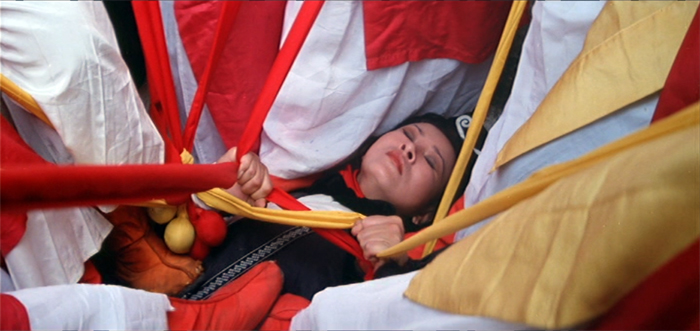
Raining in the Mountain (1979).
Hunting Deplorables, gathering themes
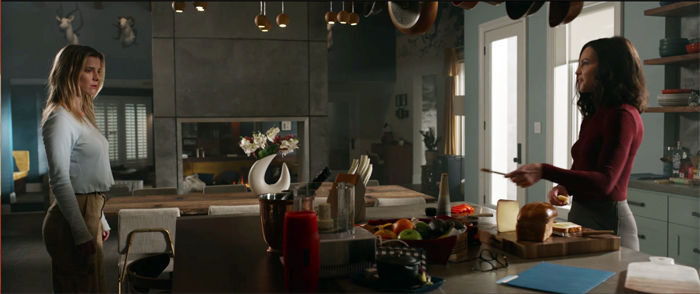
The Hunt (2020).
DB here:
I recently participated in a Film Comment podcast with Nic Rapold and Imogen Sarah Smith. It was fun. Yes, The Hunt was involved.
And last month I posted a “blog lecture” for my seminar on Poetics of Cinema. Because it included references to classroom material, I thought it was too insular for general consumption, so I posted it privately. Encouragingly, some of our regular readers wrote to ask about accessing it, so today I’m putting up a more broadly-aimed version. Again, yes, The Hunt is involved.
We like to watch (and listen)
First and fast, some foundations. As Paul Krugman might say, wonkish ones.
Most basically, I’m interested in two questions: How do films work? How do they work on us? The first question, I think, can productively start with filmmaking craft and the norms that filmmakers work with in their historical situation. Within and against those norms, filmmakers create work that blends tradition and innovation. I’m interested in conventions–the conventional side of “unconventional” works, and the unconventional side of more apparently rule-abiding ones. I sometimes say I want to know filmmakers’ secrets, even the secrets they don’t know they know.
But asking how films work on us has driven me to posit a conception of spectators’ activities. After all, in any art it’s legitimate to try to explain how the design features of a work are shaped to elicit effects, ranging from perceptual and emotional ones to broader effects of comprehension and what I call appropriation. I assume that in every sphere “the beholder’s share” in watching movies is considerable, and active.
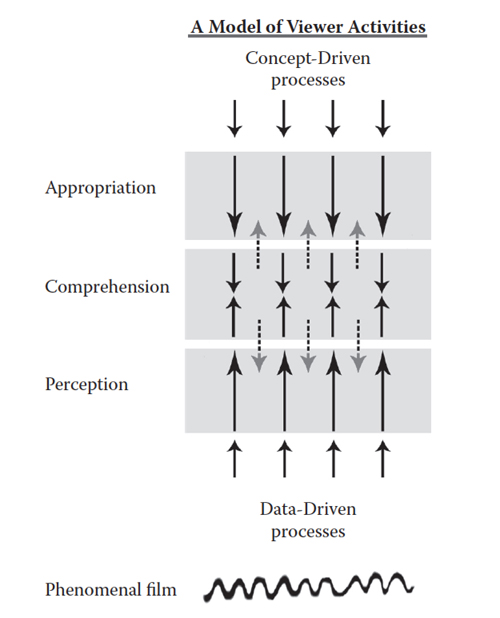
Using a common psychological distinction, I’ve argued we can roughly understand this process with a diagram, above.
The activity proceeds both “from the bottom up” via the fast, mandatory, specialized activities of visual and auditory perception. The process works as well as from the “top down” via more deliberative mental acts. Comprehension, typically of story patterns, operates in the middle. So you “just see” a man in tights walking across the shot. Thanks to story comprehension skills you “just see” Batman striding to face off against a crook. Thanks to your wider conceptual schemes, you can appropriate that as patriarchy in action, or the pain of vigilante justice, or a template for an action figure you might buy, or whatever. Where’s emotion? At all stages, I think.
And all these processes seem to me inference-based to some degree. In grasping artworks, even perception has an inferential dimension, going beyond the information given. Patches and contours on the screen are grasped as people, places, and things; sound waves are grasped as speech and music. The process is inferential because these perceptual conclusions are defeasible, as most illusions are. Things might be otherwise than they seem; we bet (fast, unreflectingly) that things are as they seem until other information pulls us up short. Similarly, story comprehension relies on skills of inference we’ve developed since childhood, built partly upon our social intelligence. And appropriation is obviously inferential, building hypotheses about the meanings and uses we can ascribe to film.
Perception and comprehension are strongly shaped by the film’s form and style. But as we go up from perception, the filmmaker’s power decreases and the viewer’s power increases. Viewers wield most power in appropriation, those top-down, concept-driven inferences that pull the film, or at least the viewer’s construct of the film, into wider projects.
Let’s think of appropriation as most basically using the film for myriad personal or social ends. That activity involves, for want of a better term, themes–ideas, categories, dualities, pop-culture memes, right up to wider beliefs about the world. Cultural processes, affecting the lower levels to some degree, are at work here most explicitly.
At this moment, when many people are sheltering at home, they are appropriating films for many purposes–to distract them, to entertain the kids, to learn more about health policy or the effects of pandemics. Fans, I assume, are seizing the pretext to binge on a saga they love, or check out a series they’ve put off. Online critics, pressed to turn in copy, are mustering their new listicles, recommendations of films to watch while we’re in lockdown.
This situation is just a special case of appropriation, of finding aspects of the film that can be recruited for purposes that may or may not accord with the filmmakers’ original intentions. No producer planned for Outbreak (1995) or Contagion (2011) to serve as audiovisual aids during a plague.
As my Batman example indicates, interpretation is a rich instance of appropriation, displaying how resourceful people can be in their inferential elaborations.
I wrote the book Making Meaning: Inference and Rhetoric in the Interpretation of Cinema (1989) as an attempt to spell out my ideas. I concentrated on two critical institutions, journalistic criticism and academic interpretation. But I think my claims could be applied to “amateur” critics and fandoms too. (This blog entry on Room 237 gestures in these directions.) Another article on this site, “Film Interpretation Revisited,” is a summary of the book, as well as a reply to critics.
So much for “the beholder’s share.” Can we go back to the “maker”? In a later section I’ll float some ideas about the place of thematics in relation to form and style. I’ll also consider how artists can anticipate and manipulate the appropriation process–a sort of meta-strategy to grab control higher up the chain.
Yes, spoilers for The Hunt are involved.
Interpretation, whys and wherefores
Interpretation seems to me to involve two tasks. First, there’s problem-solving: How should I interpret this film (or show, or whatever?) Second, there’s argument, or rhetoric: How should I make the case that this interpretation is worthwhile? Making Meaning has a lot to say about critical rhetoric, but I’ll concentrate on the problems interpreters set themselves.
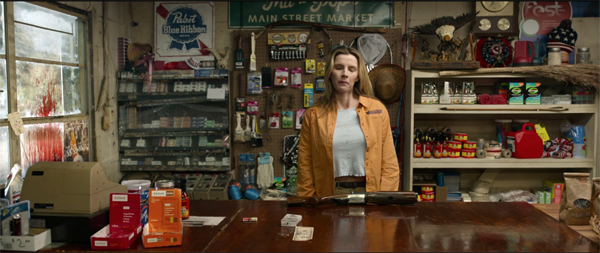
I assume that interpretation ascribes meanings to films. What sorts? I start with referential meanings (a big category including building the story world as well as tapping into real-world information, like specific times and places). In The Hunt, recurring TV images of polar bears struggling on melting ice floes nudge us to remember the climate crisis.
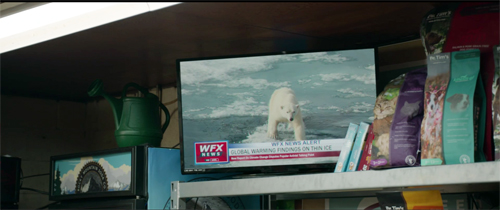
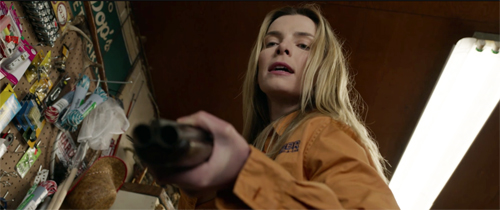
There’s an extra referential layer in the chyron, which expresses Fox-News style skepticism about climate change. That line helps confirm the right-wing ideology that supposedly permeates the quickee mart.
The other sorts of meaning I identify are more abstract. They include explicit meaning, usually given in language. In The Hunt, Athena expresses her disdain for the Deplorables whom she has gathered her friends to kill. She articulates a part of the film’s explicit meaning: The elite treat their social inferiors as prey.
There’s also implicit meaning, suggested through many cues, not just verbal ones. Crystal, the fierce fighter who confronts Athena at the end, is too laconic to speechify, and she never asserts that the underclass can be resilient and pitiless. But we are to grasp that meaning through her behavior–as the prey fighting the predator. Story comprehension feeds our interpretive move. By the end of the film we may take the polar-bear footage as implying that the Politically Correct hunters care more for these beasts than their vulnerable fellow humans.
Referential meaning, explicit meaning, and implicit meaning are typically under the control of the filmmakers. Clearly Craig Zobel, Damon Lindelof, Nick Cuse, and their colleagues want us to make the inferences I just made, along with many others. But it wouldn’t be a stretch to say that some implicit meanings escape the filmmakers. I’ll try to show later that filmmakers sometimes try to back up and frame their films to cover those unintended implications.
We can argue about some of these meanings. In The Hunt, Crystal recalls a childhood story of a race between a rabbit and a turtle. The rabbit lost through laziness, but he took revenge on the turtle by killing him and his family. The tale becomes part of a motif: Early in the film we see a video of a turtle humping a boot, while at the end we see a bunny hop into a gory kitchen.

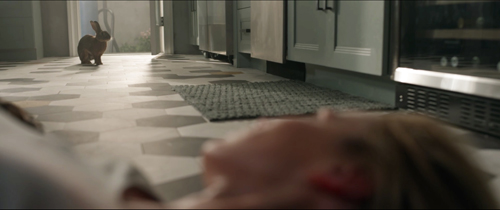
After telling the story, Crystal declares she’s not sure whether she’s the rabbit or the turtle in the hunt. I think we’re supposed to think about whether the underclass (if it’s the turtle) can ever win more than a temporary victory. This sort of equivocation about implicit meaning is common in artworks. Indeed, the clash of implications encourages us to interpret them. The tactic might seem designed only for “difficult” films, but it’s surprisingly frequent in mainstream movies, as I’ll suggest later.
A fourth sort of meaning, I think, is what people have come to call symptomatic meaning. Here the film says more than it intends. It reveals, like a psychoanalytical symptom, an “unconscious” problem with the explicit and implicit dimensions put forth. (This is the “hermeneutics of suspicion,” which Susan Sontag discusses in “Against Interpretation” in relation to Marx and Freud.)
Critics may say that cheerful Eisenhower-era comedies betray anxieties about gender and identity. Some consider superhero franchises as unwittingly betraying a commitment to fascistic authority. From this perspective, Indiana Jones is less an adventurer than an imperialist. Symptomatic meanings leak out and can’t be contained. If implicit meaning is the filmmaker being more or less subtle, symptomatic meaning works behind the filmmaker’s back.
The Hunt is of course ripe for symptomatic interpretation, as I’ll mention below. However much its sympathies may seem to lie with the prey, it seems unable to avoid double-edged gags at their expense.
For all of these types of meaning, the process I posit is the same. The viewer maps, from the top down, concepts onto cues and patterns found in the film. Given the results of perception and comprehension, the viewer selects certain items to bear the meanings we bring to the task.
For example, I said that Athena articulates the predatory view of the oligarchy. Why did I pay attention to her and her words rather than, say, the layout of comestibles on the kitchen island? Because I have a rough but well-practiced mental schema for personhood. That’s more salient in building up a narrative than spotting bits and pieces of scenery. (These details can become salient, as the cheese-slicer will eventually, but the filmmaker has to make them so, as hand props or in close-ups or whatever.)
Making movies mean (but not like Zahler does)
The information in a film is most simply a flow of images and sounds. Perceptually I go beyond that information to recognize a person. Given that my person schema is furnished with properties like beliefs, desires, consciousness, and so on, I can build up a sense that Athena is stating her views on late capitalism.

Similarly, my repertoire of person schemas enables me to build up a sense of Crystal’s character, based on her appearance, speech, and actions. She too has beliefs (she’s being hunted), desires (she wants to survive), plans (she will fight), and attitudes (she scorns the sissified elites). She has character traits. In certain relevant respects, she’s like us and the people we know.
Filmmakers are practical psychologists. They know, from having consumed films as well as made them, how to highlight information and make it vivid and salient, so that we’ll lock in our concepts easily. For lots of reasons, we’re interested in other people, so that gives film artists an immediate purchase on using characters and their actions to convey abstract or general meanings.
For symptomatic interpretation, the same process holds. Character recognition and construction will be important for finding the flaws and failings of the film’s primary meanings. Of course, the symptomatic critic may “read against the grain” and look for less salient items that betray the film’s unconscious meanings. The fact that the climactic confrontation takes place in a kitchen could suggest that the filmmakers, for all their flaunting of strong women, are assuming a patriarchal ideology: Woman’s place, even as a killer, is in the home.
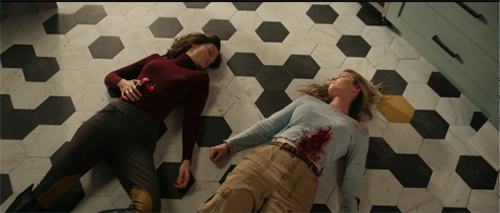
And the very end of the film, with Crystal strutting out as a fashionista, suggests that she has bought into the shallow values of the elite.
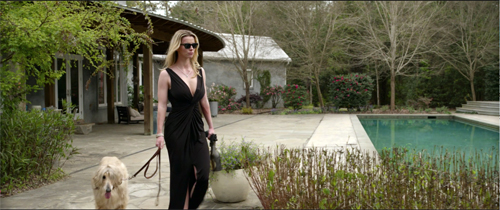
She’s not leading a revolution but killing her way to upward mobility.
I emphasize character as a site of interpretive elaboration because it’s so central to all critical schools, from fandom and journalism to the upper reaches of Academe. It’s not the only set of cues that get mobilized, though. Small details dropped in can serve too. A jar of Pickled Pigs Lips in a fake quickee mart reveals the sneering disdain of the hunters who’ve set up the display, but some viewers may find that it nudges us to mock trailer-trash taste.
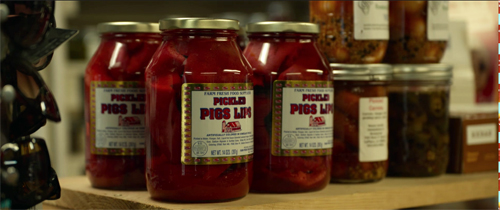
The glimpse we get of the jars before the camera pans away seems to be the sort of cue aimed at “committed viewers,” willing to freeze the frame in playback to look for touches like this.
In Making Meaning, I talk about structural patterns as well, like journeys and character relationships, which prompt us to assign interpretations. There are stylistic cues too–not just the soundtrack with its dialogue and not just written language, but also camera movements, cutting, lighting, and so on. All these can be recruited to bear meanings. Critics often interpret a low angle as conferring power on a figure. Style, at bottom aimed at guiding attention and creating emphasis through the line of least resistance, can sometimes come forward and fill less concrete and fundamental functions–that of suggesting implicit or symptomatic meanings.
To wax wonkish again, Making Meaning suggests that the abstract meanings critics map onto cues are organized as semantic fields,which are in turn processed by assumptions and hypotheses. All that machinery is put into motion through schemas (prototypes and mental models) and heuristics (short-cut reasoning routines provided by social milieu or personal proclivity). The result is a “model film,” the film as interpreted by the critic.
You need lose no sleep over these matters. I simply argue that interpretation is a rational, fairly systematic process of informal reasoning operating within institutions that reward certain activities. Academics reward novel “readings,” while arts journalism does less elaborate versions as well. Even the “male gaze,” though stripped of its Lacanian baggage, has found its way into mainstream criticism (and the film industry).
Themes are memes, sometimes

“Themes come cheap,” I said one night in the seminar, rather flippantly. “They’re practically free.”
What I was suggesting was that themes are often obvious in a way style and overall form aren’t. They rise out at us unbidden. Before people watched The Hunt, they had been alerted to look for certain meanings. Mass media, critics, and the filmmakers had primed us to catch the big ideas the film was laying out.
That’s because films take meanings not only as effects but also materials. Films are made out of images and sounds, but they’re organized through form and style . . . and themes. If we look at it from the filmmaker’s standpoint, themes (like subject matter) can be treated as stuff to be worked on through technique. Like subject matter, they can float “obviously” on the surface, protruding a bit but still tugged by the flow of form and style.
In the Poetics Aristotle posited the category of “thought” as a component of tragedy. This term appears to mean something rather special. “Thought” isn’t what characters in drama think, or even what the playwright thinks. Rather, it’s what the characters say: their efforts to crystallize ideas and feelings in statements. The functions of thought in this sense “are demonstration, refutation, the arousal of emotions such as pity, fear, anger, and such like, and arguing for the importance or unimportance of things.”
The plot, Aristotle says, must create its effects through events and their patterning, “but these must appear without explicit statement, whereas in the spoken language it is the speaker and his words which produce the effect.” Thought in Ari’s sense spells out what action leaves tacit.
The Hunt does both. Ideas, images, and stereotypes circulating in US society have been taken by the filmmakers as already-fairly-processed material to be reworked into images and sounds and story. The explicit and implicit meanings critics build out from the film are the result of form and style shaping all this stuff into a perceptible, comprehensible experience. At moments, though, the oligarchs and the Deplorables state their sociopolitical views pretty frankly, as in the text message above. As Ari puts it, “they argue for the importance and unimportance of things.” Thought-as-theme is a prime cue for interpretation.
Themes can become not only material but also pattern. Certain genres of narrative are heavily “thematized” in that their organization is based on explicit or implicit meanings. Allegory is a classic instance. The Pilgrim’s Progress has a thematic armature, crystallized in the journey of Pilgrim to the Heavenly City. Ditto Animal Farm, which is usually taken as an allegory of the Russian Revolution. (Interestingly, The Hunt cites Animal Farm.) I expect that right now some grad students are writing papers about The Hunt as an allegory of working-class resistance.
Other heavily thematic genres are parables, fables, and the like. Crystal’s childhood story of the rabbit and the turtle becomes a parable of social injustice.
There are lots of ways that themes provide formal architecture. Some early films, like One Is Business, the Other Crime (1912), depend on thematic contrast. Here the fate of a poor man forced into thievery is juxtaposed with the law’s ignoral of a rich man’s transgressions. (Class resentment didn’t start with The Hunt.) Griffith’s Intolerance (1916) tries for a four-way thematic comparison/contrast of prejudice through the ages.
We also have “social cross-section” films, where stages of the narrative enact encounters with various institutions. As critics have noted, in The Bicycle Thieves(1948), Ricci’s search for his stolen bike brings him into contact with the labor union, the government, the church, and the bourgeoisie–none of whom are of help. A similar cross-sectional dynamic suggests social critique in Mizoguchi’s Life of Oharu (1952) and Fellini’s La Dolce Vita (1960).
Granted, in such modes, the film’s thematic skeleton can seem obvious. Other films leave meaning more free-floating, and even allegories can be less clear-cut than they may seem. (Think of Kafka.) I just want to signal, for the sake of comprehensive coverage, that filmmakers, like other artists, draw upon abstract ideas and meanings as materials to be reworked by their art.
To be good critics, we ought to be aware of both the materials and the transformations that come from them. I suggest this in a piece I’ve flagged before, “Zip. Zero. Zeitgeist.”
The filmmakers fight the power (of viewers)
The filmmaker’s power wanes as we move toward appropriation. But not completely. Filmmakers can use themes to manage a film’s reception.
For example, the Russian Formalist literary theorists floated the idea of the “biographical legend.” This is a public version of the artist’s life that can guide interpretations of the work. Boris Eichenbaum suggested that the Americans had one biographical legend for O. Henry, but the Russians built up a different one.
Critics and commentators build up the biographical legend in order to support interpretations, but the artist can contribute to the process. When Christopher Nolan tells us that as a youth he loved Star Wars, noir movies, and experimental fiction, he’s inviting us to put his own “intellectual blockbusters” in a certain perspective. He’s flagging certain cues, inviting certain mental sets, coaxing us toward certain inferences.
It’s not news. Contemporary critics took Douglas Sirk’s 1950s melodramas as glossy reflections of the superficial values of Eisenhower America. But when he was interviewed by Jon Halliday, he presented himself as offering a Brechtian critique of those values. Later critics eagerly started scanning the films for narrative and stylistic cues that suggested implicit meanings that subverted the suburban bourgeoisie. Chabrol, typically jaundiced, put it this way:
I need a degree of critical support for my films to succeed: without that they can fall flat on their faces. So, what do you have to do? You have to help the critics with their notices, right? So, I give them a hand. “Try with Eliot and see if you find me there.” Or “How do you fancy Racine?” I give them some little things to grasp at. In Le Boucher I stuck Balzac there in the middle, and they threw themselves on it like poverty upon the world. It’s not good to leave them staring at a blank sheet of paper, not knowing how to begin. . . . “This film is definitely Balzacian,” and there you are; after that they can go on to say whatever they want.
If critics can use the artist to interpret the film, why can’t the artist use the critics to steer us toward preferred interpretations?
It isn’t just the filmmaker doing this. Auteur personas created by the filmmaker, the industry, and critical discourse can be seen as pushing us toward certain thematic interpretations.
Now to finish with a point I suggested above. It’s often in a filmmaker’s interest to avoid consistent and clear presentation of themes. I’ve come to think that many ambitious Hollywood films are systematically ambivalent about what they are “saying.” Rather than make a weighted, compact statement of “thought” in Ari’s sense, they scuttle and shuttle between alternate thematic possibilities. Or rather, they shuffle several disparate “thought” statements to counterbalance one another.
This has many benefits. It can stoke controversies. Is The Dark Knight in favor of vigilantism, or does it celebrate anarchy, or does it hold out hope of noble self-sacrifice? Nolan says:
We throw a lot of things against the wall to see if it sticks. We put a lot of interesting questions in the air, but that’s simply a backdrop for the story. . . . We’re going to get wildly different interpretations of what the film is supporting and not supporting, but it’s not doing any of those things. It’s just telling a story.
Another benefit: If someone objects to one piece of thematic material, you can always say, “But look, we offset that with this…” It’s a way of widening the film’s appeal to many lines of thinking, while marketing the film as complex.
The creators of The Hunt claim to have aimed the film at smugly woke people like themselves in an effort to humanize the Other.
So we heightened the reality as much as we could. Some of the people who are being hunted are literally the guy with the tiki torch or a guy posing next to a dead animal; they’re two-dimensional stereotypical representations of what liberals see conservatives as. And then we had to do the same thing with the liberals. But there had to be one character in the movie, the hero who defied the conventions of stereotyping, who when you look at her you basically say, “Oh, she has an accent like this. She wears clothes like this. This is who she is.” And let’s be wrong about her. Let’s let the movie be about the cautionary tale of, here’s what happens when you get it wrong.
I think that the idea the audience wants Athena to be wrong about Crystal is maybe our own interior desire to say, “Maybe I’m wrong about my uncle who I’m screaming at at Thanksgiving. Maybe there’s a little bit more to him than meets the eye. Maybe I’m trying to put him in this specific lane because we have to choose a side, but maybe there’s many sides and there’s a little bit more nuance in the conversation.”
The caricaturing of the woke characters allows woke viewers to recognize the satire (and since woke viewers are likely to be educated, they know that satire exaggerates). Presentation of the Deplorables is exaggerated too, confirming that “There’s many sides.”
But there’s a kink for a symptomatic reading: Crystal may not be an actual Deplorable. We never learn her politics. She has been kidnapped in error, mistaken for a fierce Trumpist with the same name. So again the film manages to have it many ways. “Getting it wrong” here doesn’t mean disparaging a right-winger but rather not knowing whether somebody is right-wing or not. The real conversation is postponed because of a mistake. (No mistakes, no stories.)
I don’t mean to sound cynical about this. Art is opportunistic. We just ought to be aware that filmmakers can make the meta-move, using whatever means they can to close off interpretations that they might not prefer. Ultimately, since appropriation is top-down, they can’t control everything we might ascribe to the film. (See Room 237 again.) But there is a bit of a struggle there. Filmmakers will always try to join and constrain the hunt for meaning in their movies.
There’s a lot more to be said about interpretation, but I hope that readers will find something worth considering here. I may redo other Private seminar entries as public ones when time permits.
Thanks to Nic Rapold of Film Comment and Imogen Sarah Smith for a pleasant discussion. My citation of Aristotle on “thought” is from Stephen Halliwell, The Poetics of Aristotle: Translation and Commentary (Chapel Hill, 1987), 53. The reinterpretation of Sirk’s melodramas was undertaken in Jon Halliday’s interview book Sirk on Sirk (Secker and Warburg, 1971). The Chabrol quote is from Making Meaning (Harvard University Press, 1989), 210.
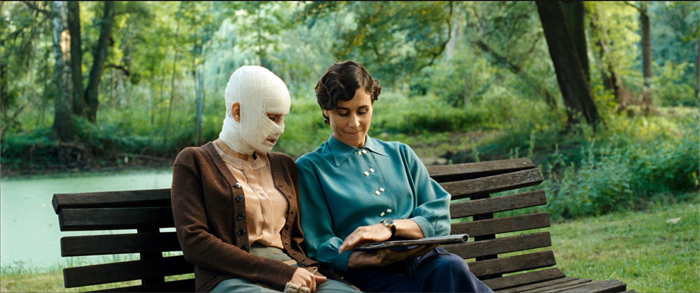
Phoenix (2014), one of the Christian Petzold films discussed in the Film Comment “At Home” podcast.
Last Modified: Monday | March 30, 2020 @ 16:51  open printable version
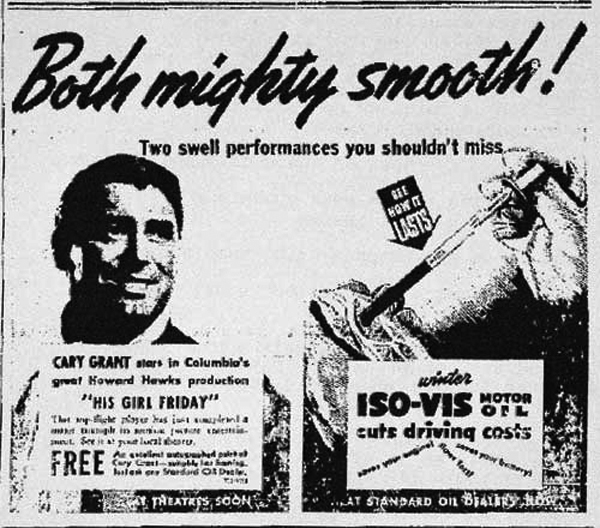
Light up with Hildy Johnson: The NYT viewing party for HIS GIRL FRIDAY
DB here:
Manohla Dargis and A. O. Scott have had the excellent idea of picking a film for readers to watch over the weekend and inviting them to write about it. Here’s the viral viewing scheme.
I’ll be keen to read what the multitudes have to say.
If you’re interested, our site has paid homage to this classic several times. First I rehearsed a bit of history about how it snuck into university courses. Then I wrote an appreciation of it to accompany the release of the packed Criterion disc. (Find out why it’s called His Girl Friday!)
That disc release included a video essay in which I analyzed some things that fascinate me about this endless enjoyable movie. The video now accompanies the film on the Criterion Channel. There’s a vast trove of Hawksiana there as well, with expert comments and background information.
From its first edition in 1979, our textbook Film Art: An Introduction has used the film as a prime example of classical Hollywood storytelling. My colleagues Lea Jacobs and Vance Kepley have written a lot about it too. It’s the movie of our whole Wisconsin film studies program.
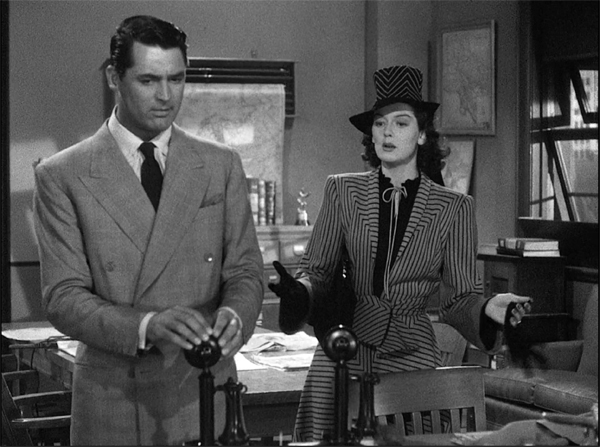
What more do you want? The 1940s. Hawks. Grant, Russell, the sublimely sincere Ralph Bellamy. His Girl Friday draws breakneck comedy out of how the fast-talking and quick-witted can trounce the fumblers and boobs. (Would that it happened in real life.) The whole carnival is played out by one of the greatest scramble of sharp-edged character actors in Hollywood history.
And thanks for reading the second paragraph.
Thanks to Peter Becker, Kim Hendrickson, Curtis Tsui, and all their colleagues at Criterion for making this Hawksapalooza possible.