







Archive for the 'Narrative strategies' Category
DIE HARD revived: An entry revisited
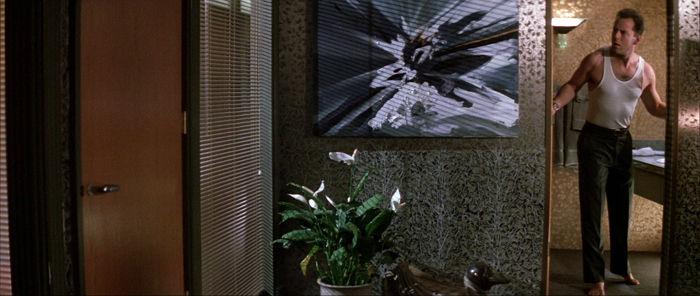
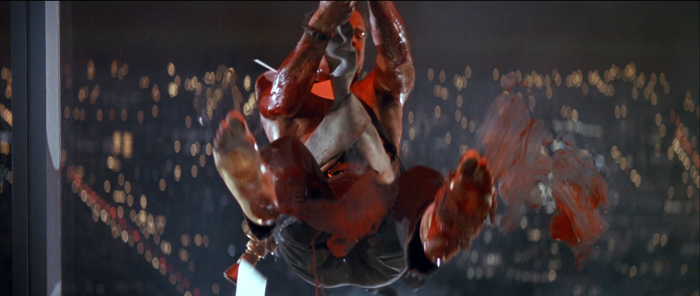
Die Hard (1988).
David’s health situation has made it difficult for our household to maintain this blog. We don’t want it to fade away, though, so we’ve decided to select previous entries from our backlist to republish. These are items that chime with current developments or that we think might languish undiscovered among our 1094 entries over now 17 years (!). We hope that we will introduce new readers to our efforts and remind loyal readers of entries they may have once enjoyed.
Today’s revival responds to the return of Die Hard to theater screens in time for Christmas. Since our original posting in 2019 (“Not just a Christmas movie”), this supreme action picture has further cemented its reputation as a yuletide favorite (although it was originally released in July). Happy holidays from the Nakatomi Corporation!
DB here:
It’s been quite a fall season for UW–Madison film culture. There were visits from avant-garde legend Larry Gottheim, New York Times co-chief film critic Manohla Dargis, Schawn Belston (Senior VP of Mastering at Disney), and Julia Reichert, whose American Factory is now routinely turning up on ten-best lists. The semester’s first screening at our Cinematheque was Kiril Mkhanosvsky’s Give Me Liberty, a Milwaukee movie also gracing year-end best lists. Our programs included restored films by African pioneer Paulin Soumanou Vieyra, retrospectives of Reichert and Kiarostami, a 3D double feature of Revenge of the Creature and Parasite (no, the other one), a program of early women directors in America, a selection of films conserved by the Chicago Film Society, and a miscellany ranging from Olivia and Near Dark to Tropical Malady and Red Rock West.
Travels to festivals, partly covered in our blog entries, forced us to miss too many of these shows. But we couldn’t miss the final one: Die Hard (1988).
It’s a film I’ve admired since I first saw it in summer of 1988. I’ve taught it in many classes, but never written about it. Seeing it again, in a pretty 35mm print from the Chicago Film Society, has made me want to say a few things as my final blog entry for this busy year.
The man between
Think-piece pundits like to say that Hollywood movies are about good guys versus bad guys. But usually things are more complicated. Very often the good guy is an outsider caught between two large-scale forces, good or bad or both–the cattle ranchers versus the townspeople, or the mob versus the cops. Often the protagonist is an outlier, forced to solve the problem using means that respectable social forces can’t.
Call it the problem of the House Democrats. When the lawbreaker can’t be brought to justice, how do you make him pay? The answer is one that William S. Hart movies provided in the 1910s. We need a “good bad man,” a rogue agent who knows the scheme from the inside but is willing to do the right thing. Which means that he has to be flawed too, a little or a lot, and that he can eventually reform.
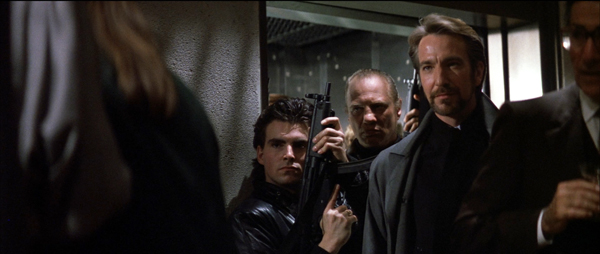
In Die Hard, the forces of law and order line up as the Los Angeles police and the FBI. The threat is Hans Gruber’s gang, posing as terrorists but actually planning to rob the Nakatomi Corporation of $640 million in bearer bonds and kill lots of hostages in the process. The naive TV broadcasters support both, recycling official scenarios of how hostage-taking works and reinforcing the gang’s masquerade as a terrorist group.
The contrasts are marked. The forces of order are American, in alliance with a Japanese company, while the attackers are Europeans. At the start, we hear American music (the rap played by the limo driver Argyle), but Hans hums Beethoven. The cops’ technology notably fails, as when the assault vehicle and a helicopter are consumed by firepower. But the gang’s hi-tech expert Theo can crack the vault, assisted by Hans’ plan to push the Feds to cut the building power.
Above all, the forces of social order are strikingly inept, while the gang is ruthlessly efficient. Unlike the police, who “run the terrorist playbook,” Hans boasts that he has left nothing to chance. The cops can’t imagine an adversary that exploits the official by-the-book procedures. As for the business types, Takagi’s calm bluff and Ellis’s freewheeling jargon can’t cope with a gang leader who doesn’t get the Art of the Deal.
Clearly, America and Japan need help. That appears in the form of John McClane, the cop from the East Coast trapped in Nakatomi Plaza.
McClane is the man between, spatially and strategically. He witnesses the action from inside the skyscraper, and bit by bit he figures out the gang’s real scenario. And he’s caught between both forces. The gang tries to find and kill him, while the cops refuse to recognize him as an ally. Confronting Karl’s brother early on teaches McClane that he can’t play by procedure. (“There are rules for policemen,” says a thug who doesn’t believe in rules.) The LAPD’s ineptitude shows that McClane can’t expect help on that front. So he must become almost as reckless as his adversary, though in a virtuous cause. This principally means blowing stuff up.
McClane isn’t totally without resources. He has as helpers Al, the desk cop who comes on the scene and sustains his morale, and Argyle, who’s there to play a crucial role at the climax. But mostly he’s alone in facing problems. He needs weapons. He needs shoes. He needs to protect the hostages, most of all his wife Holly, who has climbed up the corporate ladder. (In another movie, she would be the in-between protagonist.) To keep Holly from becoming a bargaining chip, McClane needs to hide his identity. And he needs to figure out the gang’s ultimate plan, of seeding the rooftop with explosives that will destroy the building and cover their escape.
John’s solutions are notably low-tech. While the police and the gang depend on advanced firepower and computer finagling, McClane lashes an explosive to a desk chair and uses a fire hose as a rope. He has to improvise shoes by taping a maxi-pad to a bleeding foot. No holster for your automatic? How about some Christmas wrapping tape? And don’t forget to taunt your adversaries with Yankee wisecracks.
In the course of this drama, the very physical McClane becomes a model for his allies. Holly punches the reporter who revealed John’s identity, and Argyle cold-cocks Theo at the point of getaway. Most dramatically Al kills the revived Karl when he’s about to plug McClane. The people in between take up arms.
McClane and his allies solve the House Democrats’ problem. Law can’t be lawless, even in protecting itself. Business, always aiming at the bottom line, has to give up principles. (“Pearl Harbor didn’t work out, so we got you with tape decks.”) These forces of social order are inefficient, trusting, and superficial. They can’t stand up to sheer brutal onslaught. In a crisis they will fold, or simply choose the nuclear option: agents Johnson and Johnson are ready to lose a big chunk of hostages.
McClane is a mediating figure that permits the film to show you can be strategically lawless for the sake of lawfulness. The fly in the ointment, the monkey in the wrench, screws up plans on both sides, but for the benefit of everyone else.
The Big Dumb Action Picture isn’t so dumb
This thick array of thematic parallels would be interesting in itself, but it gets worked out through precise storytelling. There was a time when critics knocked action movies as simply ragbag assortments of fights, chases, and explosions. Die Hard, I think, changed ideas of just how well-wrought an action picture could be. About 53 minutes of it consist of physical action (including people sneaking around), leaving almost 70 minutes for other stuff: suspense, changing goals, surprise information, attention to parallel plotlines, and little moments like the thief pilfering candy just before an ambush.
The film typifies tidy classical Hollywood construction, beginning with an arrival (the jet) and ending with a departure (the McClanes in a limo). In between we get a big dose of the classic double plotline, romance and work. Holly’s job at Nakatomi threatens their marriage, and John takes on a temp job, that of fighting the gang, which also endangers the couple’s efforts to reconcile.
For every Superman, there’s a Kryptonite, and here the protagonist’s flaws include his fear of heights (set up in the second shot, reiterated throughout) and, more importantly, his resistance to Holly’s independence. By the end, he’s learned a lesson. The film’s streak of male sentimentality allows John to ask his wife’s forgiveness for blocking her career ambition. She’s ready to compromise too, reassuming his last name when she meets Al. The characters we care about change, at least a little. That could be the motto of most classical Hollywood plots.
As usual, we get crosscutting among several lines of action. John’s arrival is crosscut with Holly at work fending off Ellis, and in the rest of the film the gang’s stratagems are intercut with the cops’ plans and McClane’s efforts. At various points, five or six actions are alternating with one another.
All these escalating situations cluster into distinct parts, the four that Kristin has argued for as typical of Hollywood architecture.
The Setup runs about 33 minutes, culminating in the murder of Takagi and Hans’s promise that he can open the vault.
The Complicating Action, a counter-setup, coalesces around John’s goals of communicating with outsiders, avoiding capture, and attacking the thieves when he can. Through many chases and fights, the gang seeks to block all these efforts. The lines converge when John shoots Marco and tosses his body onto Al’s car. He gains the bag with the detonators, giving him the upper hand. Then the TV reporter gets involved, the cops arrive, and John is ordered to wait. Things seem to be stabilized.
After this midpoint, the Development supplies what Kristin calls “action, suspense, and delay.” Officer Dwayne Robinson arrives, pitting himself against Al and McClane. We can regard the police assault, Ellis’s clumsy attempt to broker a deal, and the arrival of the FBI men as a series of delays that endanger the stability of the standoff. At the end of this section, John meets Hans (posing as an escaped hostage): now both men know each other. And in the firefight that follows, John loses the detonators. Hans declares, “We’re back in business,” and the original plan can go forward.
The last twenty-five minutes constitute the Climax, launched by McClane’s “darkest moment.” He seems utterly beaten. Picking glass shards out of his feet, he gives Al a message for Holly over the CB radio. Al tells of his own burden, the accidental shooting of a child. The stakes are now very high.
Rapid crosscutting shows John finding the bombs on the roof and fighting with Karl, while the FBI helicopter attacks the building and Hans discovers that Holly is John’s wife. John stampedes the hostages down the stairs off the roof and escapes the strafing from the chopper before it blows. Argyle dispatches Theo, while John finds the surviving gang members in the atrium and shoots Hans, who falls to his death.
In the Epilogue, Al and John meet, Al dispatches Karl, Holly socks the newsman, and John and Holly drive off with Argyle.
These parts present a tight, logically building plot composed of swiftly changing situations. Along the way we encounter a great many motifs that create echoes or contrasts. Everyone notices the Rolex, at first a symbol of Holly’s talents but also of corporate swagger; only by unfastening it can they let Hans drop from the window. When Argyle floats the possibility that Holly will rush back into John’s arms for a movie ending, John murmurs: “I can live with that.” Agent Johnson speaks the same line, but for him it means an acceptable level of civilian casualties.
Holly’s unmarried name, Gennero, shows how a motif can develop in relation to the drama. At first it’s a sign of pride in her own identity (typical corporation, Nakatomi has misspelled it on the touch screen). Her name-change triggers the couple’s quarrel, but it has another narrative use: It conceals John’s identity from Hans. And at the end he introduces her to Al as Gennero but she reasserts her love by correcting him: “Holly McClane.”
Then there are differences of class and country. Hans reads Forbes, but McClane the US boomer references Roy Rogers and Jeopardy. (Hans is so unplugged from pop culture he thinks John Wayne was in High Noon.) Argyle the former cab driver and Al the cop know the downside of city life, but so does John the New York detective, who adapts Roy’s trademark phrase to the mean streets: “Yippee-ki-yay, motherfucker.”
Even a conventional Hollywood gesture, that of attacking a picture of a loved one, acquires a nifty plot function. Annoyed at John, Holly slaps down the family portrait on her shelf. Good thing too, because otherwise Hans would have seen it during the invasion. We’re reminded of that picture when in a moment of quiet John looks at the same snapshot in his wallet. Only after Hans has encountered John is he able to flip the portrait back up and realize that Holly is the “someone you do care about.”
There are lots more felicities like these–so many that I’d consider Die Hard a “hyperclassical film,” a movie that’s more classically constructed than it needs to be. It spills out all these links and echoes in a fever of virtuosity. Hard to believe that the makers started shooting without a finished script.
Intensified continuity, personalized
Die Hard is a good example of a stylistic approach I’ve called “intensified continuity.” It’s a modification of the classical method of staging, shooting, and cutting scenes. Here director John McTiernan and DP Jan de Bont tweak that approach in distinctive and powerful ways. You can find examples all the way through the movie, but I’ll draw most of my illustrations from the first hour, when the stylistic premises get laid out for us.
Cutting speeds accelerated sharply in Hollywood films from the 1960s onward, and for its time, Die Hard was a rapidly-cut movie. The average shot runs just under five seconds, about what you’d get in a 1920s silent film. By today’s standards, which fall more in the 3-4 second range (even for movies outside the action genre), it’s a bit sedate.
One factor that increases the cutting pace is a greater reliance on singles and close-ups. These are tighter than we’d expect in most studio films of the classic era.
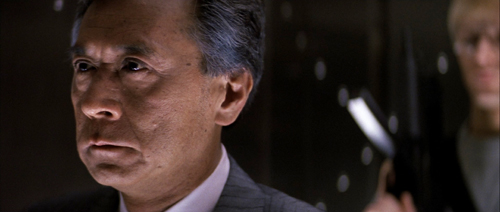
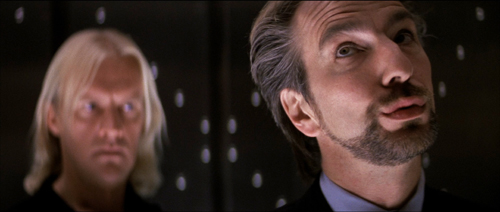
Even in close-up, the shots aren’t snipped free of their surroundings, thanks to the wide frame and layers of focus–both important in the film’s overall style, as we’ll see.
Likewise, intensified continuity exploits a greater range of lens lengths than we’d find in studio films of the classic era. We get wide-angle shots like those above along with telephoto shots throughout. Here the long lens is used to pile up people around Holly, and an even longer lens shows her optical viewpoint on the bandits in the office.
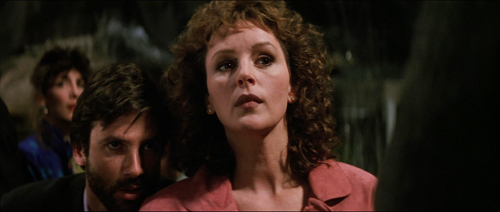
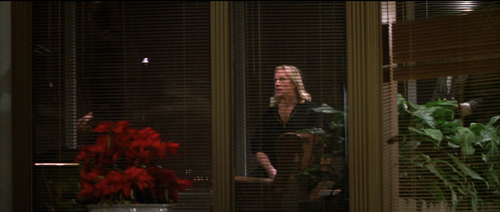
And there’s a free-roaming camera, thanks chiefly to Steadicam technology. But interestingly, Die Hard avoids some of today’s most common camera movements, such as shooting a fixed conversation with a sidewise or circular tracking shot. These would become more common in the 1990s.
McTiernan thought a lot about his camera movements, as he explains in interviews and the commentary track on the DVD. He wanted to shape spectators’ attention, to use camera movement to nudge things into view. “The audience’s eye wants to go with you.” Accordingly, more than in many contemporary films, Die Hard‘s camera movements have a shape: they end on a point of information.
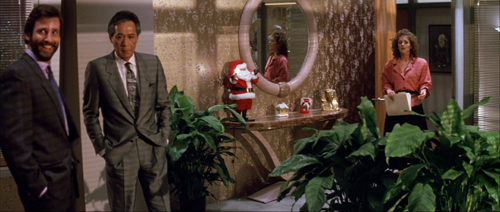
Sometimes it’s just a quick pan, doing duty for a cut. At other times, the reframing is a gentle nudge that prepares for a new scenic element, as when Holly enters her office.
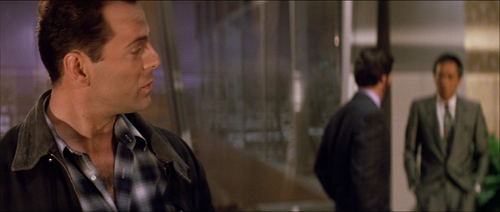
In shooting Predator (1987), McTiernan wanted to cut moving shots together, but his editor resisted. For Die Hard, he refilmed his camera movements at different rates so that two would match. A good example is when Karl’s brother strides carefully into an area under construction. The camera tracks with him, but when he turns to find the source of a whining noise, the arcing movement at the end of one shot is picked up in the next as the framing circles to reveal the saw.
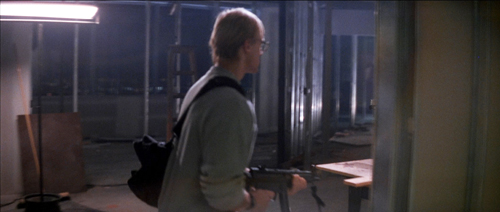
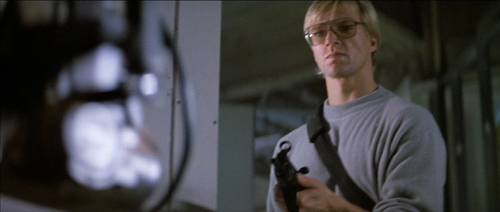
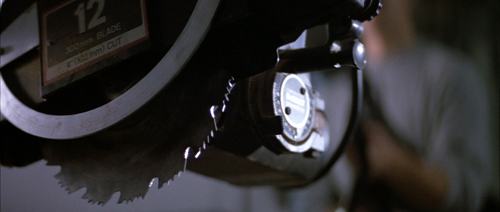
That reveal is given, characteristically, in rack focus. I could have added rack focus as another featured technique of intensified continuity. McTiernan and de Bont take it very far, making Die Hard one of the great rack-focus movies. The image is constantly shifting focus to guide our attention to the changing layers of the scene.

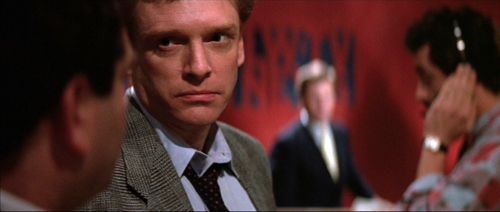
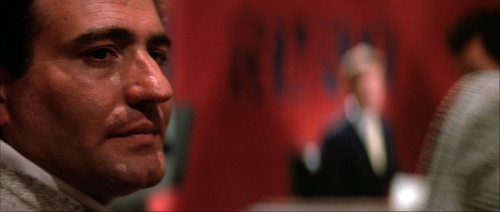
This neat, compact presentation not only preserves the commitment to long-lens close-ups we find in intensified continuity. The technique also gives each rack focus the snapping force of a cut. (And you don’t need to build big sets.) Needless to say, the rack-focusing wouldn’t work if McTiernan hadn’t committed himself to staging his action in depth. More on this below.
Staging in ‘Scope
Die Hard finds ingenious ways to “let the audience’s eye go with you” in the widescreen format. Sometimes it’s a matter of classic edge framing. Thanks to a low angle, John and Holly converse along a wide-angle diagonal.
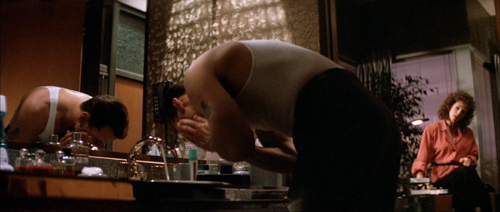
Sometimes McTiernan reverts to a technique not enough directors use nowadays: blocking and revealing. In classic cinema that was usually a technique reserved for long shots, when actors could move aside as part of ensemble. Die Hard applies blocking and revealing to the tight framings of intensified continuity.
A thug in an elevator checks his weapon, pivots for an instant, and then moves aside to show the elevator arriving at the target floor.
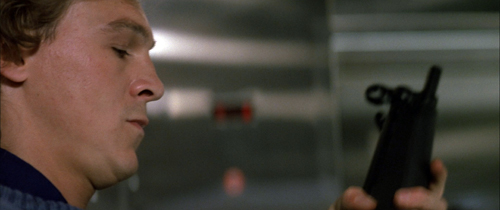
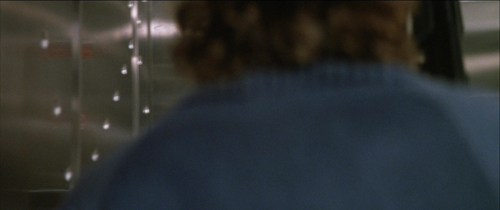
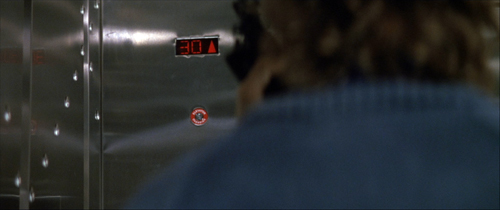
Here again a rack focus helps. The moment reiterates the importance of the thirtieth floor in the skyscraper’s geography.
When Hans finds the body of Karl’s brother, we can study his expression. He flips the victim’s head to reveal a gunman, who looks to Hans before he says his line.
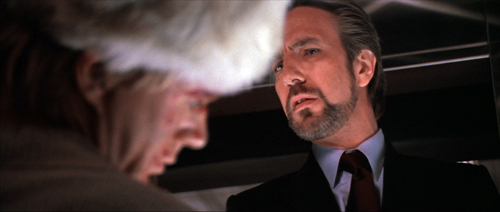
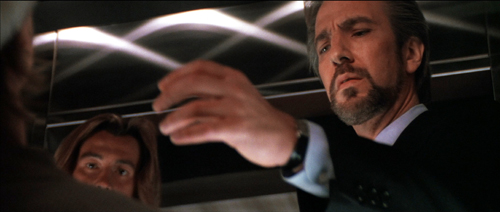
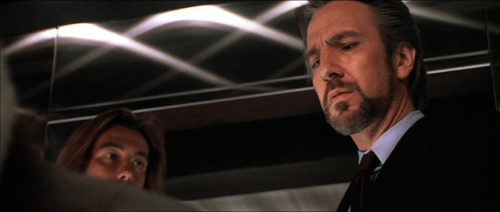
In a neat touch, the thug’s mouth isn’t shown. Today a director would probably show his whole face, but, really, who cares? The careful framing keeps him a secondary character, and a future target of McClane. And no need to rack focus on him, which would give him unwonted importance. All we need to remember him is that he’s the thug with long hair.
I can’t refrain from using one audacious example from late in the film. John and Hans have met, and Hans has revealed himself by targeting John with the pistol McClane has given him. In reverse shot, John reveals that it has no bullets and grabs it away from Hans.
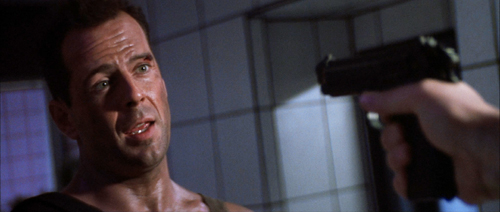
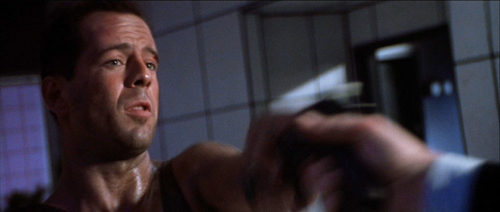
But the pistol, and that gesture, have concealed the elevator behind them. When the pistol is knocked down, the elevator light pops on in the background. Our attention snaps to it, aided by that characteristic ping we hear throughout the movie (another motif).
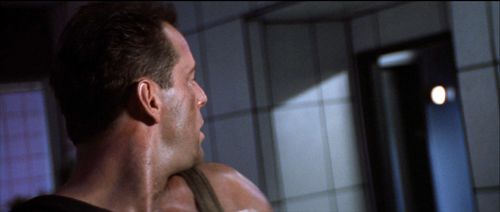
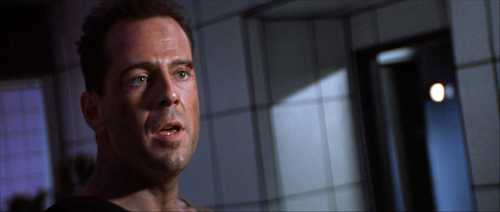
The crisp turn of events, given visually and sonically, gets ampified by the acting. McClane’s cockiness turns to panic and Hans gets the upper hand. (“Think I’m fucking stupid, Hans?” Ping. “You vere saying?”)
The most bravura rack-focus comes during the climax, when the firehose reel whizzes down behind McClane and he realizes that he’s being dragged through the shattered window.
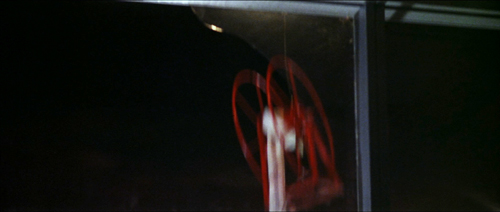
The coordination of the long lens, camera movement, staging, and racking focus is especially rich when Hans drifts among the hostages searching for the man in charge. He recites Takagi’s life history as he passes from one possibility to another (including, comically, Ellis).
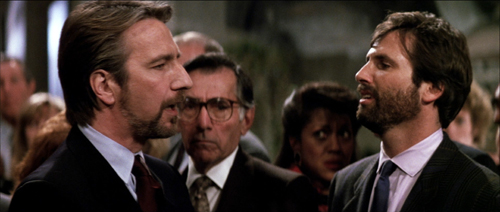
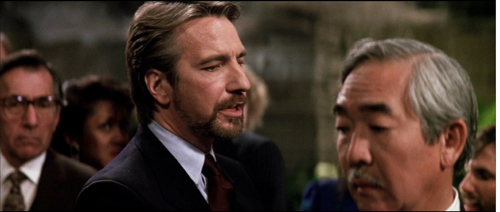
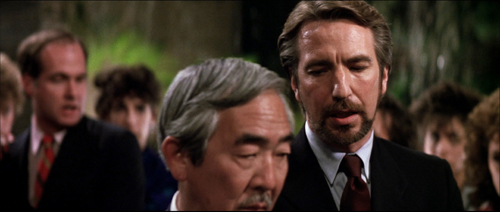
At the climax of the passage, McTiernan’s staging-in-layers sets up Takagi, Karl, and Holly before Takagi takes charge. Briefly blocked by Hans, he admits his identity by stepping out from behind and into focus.
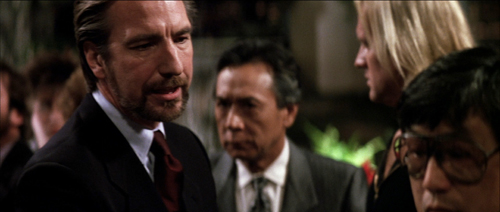
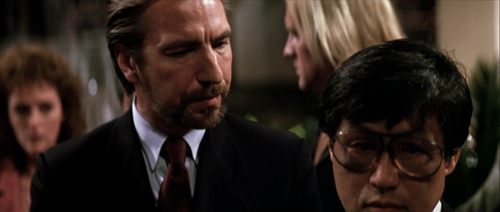
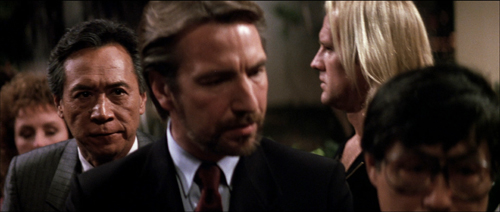
McTiernan isn’t done. A reverse shot of Hans finishing his spiel (“…and father of five”) punctuates the suspense. McTiernan buttons up this passage by returning to his “moving master” shot and having Karl shove Takagi out.
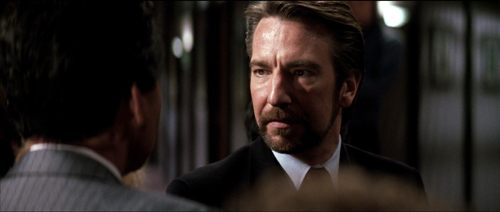
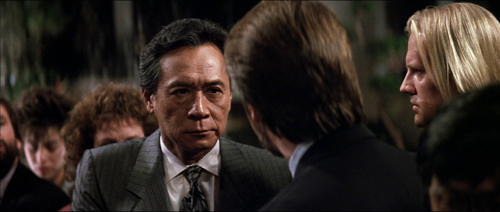
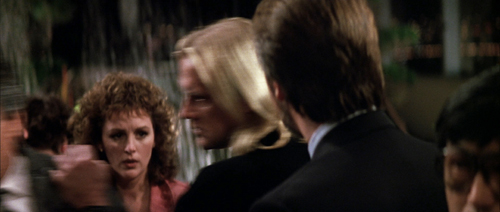
That clears the way for us to see Holly’s reaction. A beat dwells on her as she shifts her eyes to Hans, foreshadowing her conflict with him at the climax.
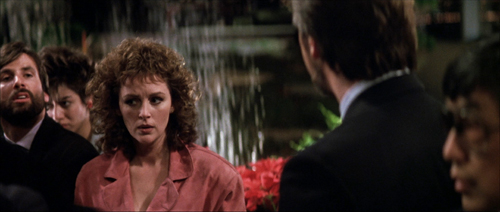
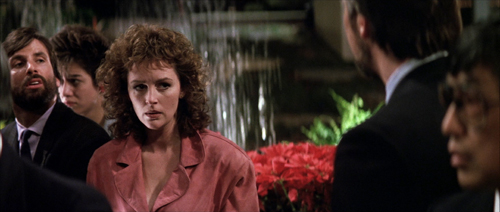
This sort of layering of faces popping in and out of visibility has precedents in earlier cinema, chiefly of the “tableau” period of the 1910s. McTiernan has, I think, spontaneously rediscovered for modern times what William C. de Mille was up to in the party scene in The Heir to the Hoorah (1916). (For more on that, go here.)
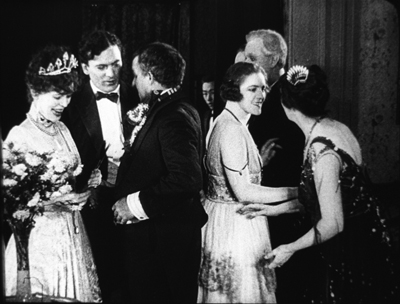
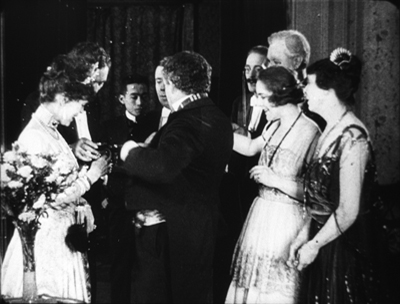
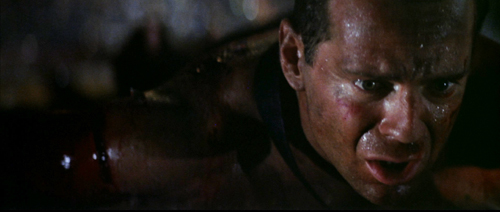
Of course McTiernan also has to work with the 2.35:1 anamorphic format, which enables him to spread his layers out more. That format also allows some remarkable compositions, such as the one surmounting today’s entry. The cut to the shot of John in Holly’s office uses the abstract splash painting (seen here for the first time) as a visual analogy for the explosion of gunfire offscreen at the same time.
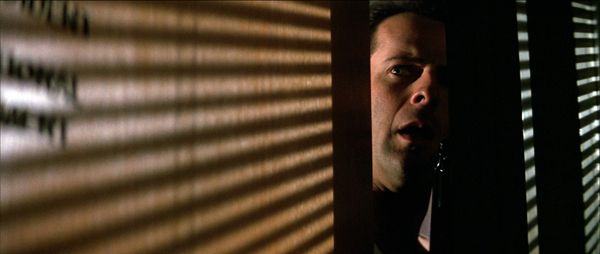
McTiernan and de Bont constantly find striking but cogent images, thanks to lighting as well as color and format. Here’s McClane on top of an elevator peering through the perforated grille; his POV is a striking but still informative composition. the cut between the two provides a little punch of contrasting light and shade.
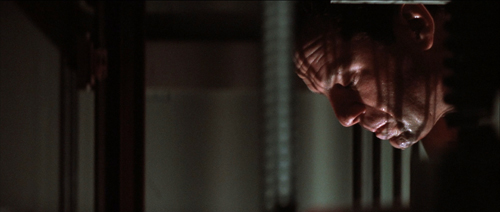
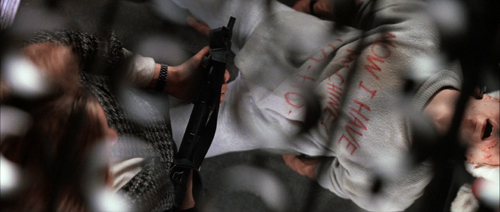
There are felicities like these feathered all through this remarkable movie, but the momentum of storytelling never flags. This remains a masterpiece of Hollywood filmmaking.
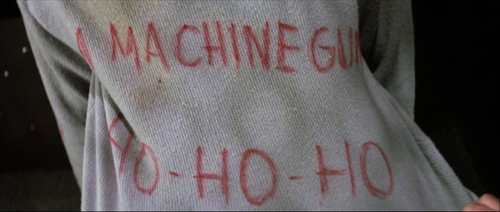
Thanks to our readers for following us this year. Kristin will be weighing in soon with her annual list of best films from ninety years ago. In the meantime, HO-HO-HO.
Madison owes an enormous debt to our Cinematheque team: programmers Jim Healy, Mike King, Ben Reiser, and Zach Zahos, as well as veteran projectionist Roch Gersbach. Santa should reward them. You can too by visiting the Cinematheque’s Podcast, Cinematalk. There you’ll find conversations with Manohla Dargis, Schawn Belston, and James Runde.
For lots of background on the making of this film and the four sequels, there’s Die Hard: The Ultimate Visual History by Ronald Mottram and David S. Cohen. At rogerebert.com, Matt Zoller Seitz has a discerning appreciation on the occasion of the film’s twenty-fifth anniversary.
Jake Tapper has provided the definitive analysis of Die Hard as a bona fide Christmas movie.
McTiernan (with whom I share an alma mater) provides very good DVD commentaries (even for Basic). Prison also seems to have given him some pronounced political views. Alas, the website he created as a platform for them is apparently no longer available. Word is that McTiernan is preparing a new film, Tau Ceti 4, with Uma Thurman. A videogame promo is purportedly signed by him.
Of other McTiernan films, I also much admire The Hunt for Red October (1990). The Thomas Crown Affair (1999) seems to me better directed than the original, and The 13th Warrior (1999), despite being taken out of his hands, remains a pretty interesting film. (Name another Hollywood movie in which a Muslim poet visiting Northern Europe is justly appalled at its barbarism.) Nomads (1986) also has its good points.
I discuss the issues of narrative and style raised here at greater length in The Way Hollywood Tells It: Story and Style in Modern Movies. You can also search “intensified continuity” for blog entries hereabouts. On CinemaScope aesthetics, see this entry and this video.
Die Hard (1988).
Crime spree

Patricia Highsmith (from Loving Highsmith, 2022).
DB here:
Crime fiction, whether in words or pictures, is a bigger category than we might initially think. There are whodunits, hardboiled detective stories, police procedurals, suspense thrillers, and stories of gangsters, professional crooks, and petty scoundrels (e.g., Elmore Leonard’s world). That’s a lot in itself. But since every plot of any interest depends on some disruption of a stable situation, an illegal transgression can do the trick. So we can get bank robbery in a comedy (e.g., Take the Money and Run, 1969), or murder and extortion in a family melodrama (The Little Foxes, play 1939, film 1941), or authorial disputes about plagiarism (Secret Window, 2004). Even romantic comedy has room for a crime or two (Date Night, 2010).
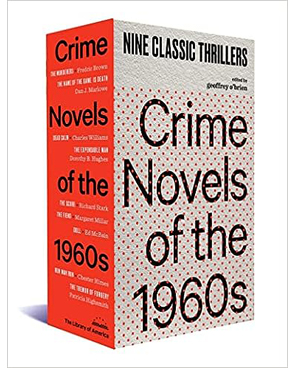 Geoffrey O’Brien is a polymath. He’s written poetry, evocative memoirs (Sonata for Jukebox, 2004), experimental fiction (the recent lyrical “fantasia,” Arabian Nights of 1934), and outstanding literary and film criticism (Castaways of the Image Planet, 2002). He’s also an expert in crime fiction (Hardboiled America, 1997), so he’s ideal for editing the new Library of America collection Crime Novels of the 1960s. His choices, all unimpeachable, cover a lot of the central creative options. There are crook stories, suspense thrillers, a police procedural, several strains of whodunit, psychological studies, and at least one crime novel possibly lacking a crime. In style they vary between pitiless hardboiled narration and more delicate but still forceful dissection of middle-class mores. As you might expect from books of their era, racial prejudice, urban upheavals, and the folkways of the counterculture are seldom far away.
Taking pulp mainstream
The nightmarish plots and staccato vernacular of O’Brien’s hardboiled sampling are vestiges of the pulp magazines, where Hammett and Chandler developed their technique in the 1920s and 1930s. But the classic crime pulps were long gone by the 1960s. What replaced them were the massive paperback originals pouring from presses from the Forties onward. A first paperback printing of a novel would routinely run to 150,000 copies. The success of cheap reprints of hardcover titles impelled publishers to capitalize on the new market with novels written specifically for paperback distribution. The most popular genre was crime fiction. Originals tended to be short, running 60,000 to 80,000 words, with plenty of blank space for laconic dialogues. A dedicated pro could turn out one in a month or two, at a fee of a few hundred dollars.
 A vivid example in this collection is Dan J. Marlowe’s The Name of the Game Is Death, which first appeared as a Fawcett Gold Medal paperback in 1962. It starts with three thieves executing a bank robbery. The opening plunges us into the crossfire of pulp narration.
Bunny went through the front door in a sliding skid. The kid took one look at my face and started to run back in front of the Olds. Across the street something went ker-blam!! The kid whinnied like a horse with the colic. He ran in a circle for three seconds and then fell down in front of the Olds, his white cottom gloves in the dirty street and his legs still on the sidewalk. The left side of his head was gone.
Bunny dropped the sack and scrambled for the wheel. I was halfway into the back seat when I heard the car stall out as he tried to give it gas too fast. It was quite a feeling. I backed out again and faced the bank, tried to have eyes in the back of my head for the unseen shotgunner across the street, and listened to Bunny mash down on the starter. The motor caught, finally. I breathed again, but a fat guard galloped out the bank’s front doors, his gun hand high over his head.
I swear both his feet were off the ground when he fired at me.
Bunny flees with most of the loot, and our nameless narrator escapes alone. He waits for news that Bunny has found sanctuary and is ready to divide the take. When the narrator hears nothing, he worries that Bunny is in trouble and sets out to find him. In his travels from Phoenix to Florida he encounters several problems that demand violent solutions. Across his trip, it becomes evident that our protagonist is a borderline sociopath.
His journey gives Marlowe’s plot a linear trajectory that is studded with flashbacks to his childhood, including a traumatic incident with his beloved cat. The episodes build a degree of understanding of his damaged personality, only to have that mitigated by a savage climax. Hardboiled to the end.
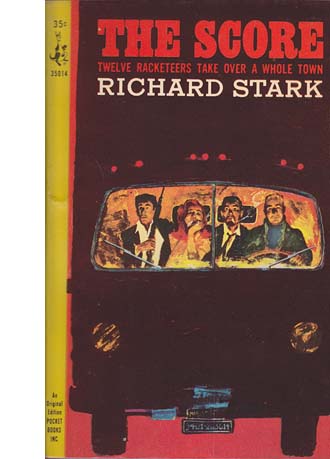 Donald E. Westlake, a favorite of this blog, was endlessly prolific, cranking out erotica, science fiction, comic fiction, psychological thrillers, and hard-core crime stories under several pseudonyms. He created two long-running series, both based on heist plots. A comic one centered on John Dortmunder, a hapless down-at-heel thief. The other series was dead serious (though with some light touches) focused on Parker, an impassive, nearly amoral robber specializing in organizing big capers. The Score (1964) is one of Parker’s most ambitious projects. With a large team, he ransacks an entire town.
Westlake broke nearly all his Parker novels into four parts, and within them he enjoyed mixing flashbacks and shifting viewpoints. Part 3 of The Score is a virtuoso panorama of the entire raid, played out in short scenes in different parts of town. It provides a careful layout of how the takeover is engineered. Most scenes are devoted to the robber in charge and provide us characterization that enlivens the action. As usual, the perfect heist goes badly wrong, and Westlake’s anatomy of the scheme forces us to admire its precision up until the final catastrophe.
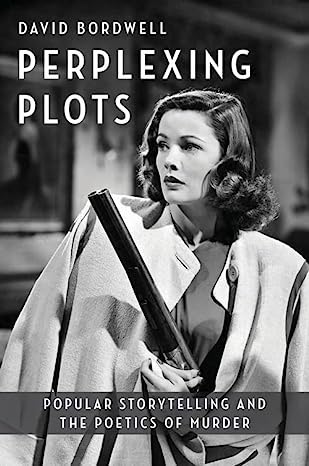
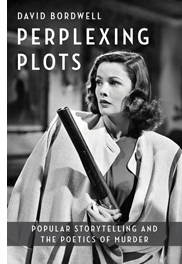
Westlake exemplifies how the hardboiled tradition could be exciting without being sensationalistic. Avoiding the near-hysteria of Marlowe (no double exclamation points here) and the florid metaphors of Chandler, Westlake is close to Hammett in his understated but elegant style. He playfully references books and movies, as when Parker’s colleague Grofield imagines his thieving days as a long film with a musical score and swooping camera angles. I devoted a chapter of Perplexing Plots to the rigorous intricacy and captivating style of the Parker books. (For online instances, go here and here.)
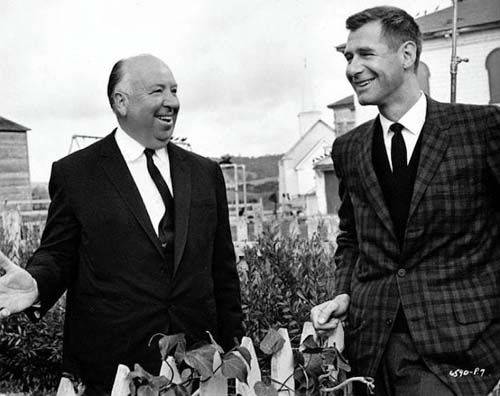
Hitchcock and Evan Hunter (Ed McBain), who wrote the screenplay for The Birds.
The Score was a paperback original for Pocket Books, which also initiated Ed McBain’s 87th Precinct series. McBain’s police procedurals mixed a realistic treatment of procedures (printed-out lab reports, fingerprint files, and the like) with a slangy dialogue redolent of the hardboiled pulps. Doll (1965) includes not only a gory murder but a series of punishing scenes in which a killer repeatedly injects a captive cop with heroin.
McBain sought to capture the protocols of investigation through the “conglomerate hero” formed by an entire squad. Although Steve Carella is the first among equals, inquiries get split up among his colleagues. In Doll Carella is reluctantly partnered with the troubled Bert Kling. But Carella soon disappears and is believed dead. Kling continues solo until he’s replaced by Meyer Meyer, who’s aided by colleagues Hal Willis and Arthur Brown. Eventually Kling rejoins the hunt and partners with Meyer to resolve the case. In other books, cases run in parallel or are revealed as connected. This sort of plotting, popularized in Hill Street Blues, is common in modern procedurals. McBain complained that others swiped his idea.
Another McBain innovation was an intrusive authorial voice. The action is typically recounted in the third person and through shifting viewpoints in a moving-spotlight manner, but the narration injects digressions and ventures into sheer chattiness. The opening of Doll interrupts the scene of a grisly murder with a lengthy reflection on how police cope with unimaginable crime scenes. This meditation isn’t attributed to Carella or anyone else. McBain, who was an English major in college, deliberately flouted the demand for neutral narration.
I know that in these books I frequently commit the unpardonable sin of author intrusion. Somebody will suddenly start talking or thinking or commenting and it won’t be any of the cops or crooks, it’ll just be this faceless, anonymous “someone” sticking his nose into the proceedings. Sorry. That’s me. Or rather, it’s Ed McBain.
McBain’s string of police procedurals quickly graduated to hardcover publication by Delacorte Press. His success exemplifies the new respectability of the pulp tradition.
The insanely prolific Fredric Brown gets some respectful mentions in Perplexing Plots for eccentric experiments like The Far Cry (1951). Echoes of the hardboiled school show up more mutedly in his The Murderers (1961). The protagonist, a shiftless would-be actor, drifts through Hollywood trying to pick up commercial gigs or small parts in an ongoing TV series. Mostly he’s interested in drinking and hanging out with hippies and pliable women. He gets attached to a businessman’s wife, and together they fumble into a murder scheme. There’s more than a passing resemblance to Double Indemnity, and the hero is a softer, semi-comic descendant of James M. Cain’s doomed fools for passion. Overall, Brown presents a cooler, more laid-back vision of Cain’s sunbaked California car culture and killing fields. As a bonus, Brown merges his murder scheme with another swiped ingeniously from the most prominent woman writer of psychological thrillers.
Murder with gravity
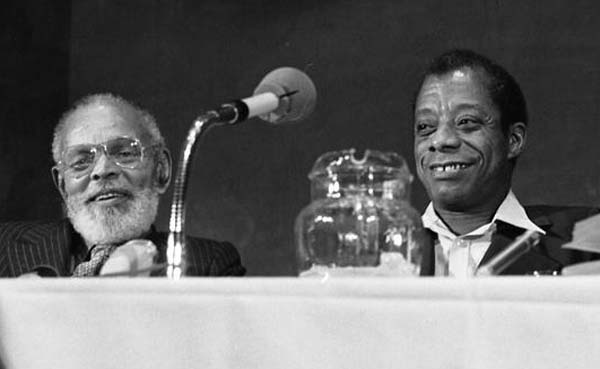
Chester Himes and James Baldwin, 1973. From Stars and Stripes.
Late one night a drunken, psychopathic cop shoots and kills a restaurant’s two kitchen cleaners. A third man witnesses the crimes and escapes. The cop uses all the authority of the law to pursue him. Moving-spotlight narration switches us rapidly from one man to the other as the tension builds and the cop closes in.
Sounds like pure pulp, no?
What if the cop is a racist, and his two victims and third target are Black?
That’s the premise of Chester Himes’ Run Man Run (1966). Himes was one of several Black artists and writers who found sanctuary in Paris after confronting postwar bigotry at home. He won fame in France, and belatedly in the U.S., with a series of hardboiled detective novels (some as paperback originals) centering on Gravedigger Jones and Coffin Ed Johnson. The best-known is Cotton Comes to Harlem (1966), which also became a lively movie.
His marquee cops are absent from Run Man Run, but the book is filled out by evocative descriptions of the Harlem milieu and sharp portrayals of the secondary characters, particularly the pursued man’s morally equivocal girlfriend and a cop who’s not as racist as his peers. The density of detail and the psychological probing of hunter and hunted give the book the gravity of a “serious” novel like Himes’ excellent If He Hollers Let Him Go (1945).
Gravity of a comparable sort dominates Charles Williams’ Dead Calm (1963). The situation merges two long-lasting schemas: the woman menaced by the sociopathic killer, and the man trapped aboard a sinking ship. A couple honeymooning in a yacht come to the aid of an apparent castaway and get far more than they expected. Williams gives unremitting apprehension by crosscutting the two situations while also filling in the backstory in ways that add layers of understanding and misunderstanding. It’s a model blend of mystery and suspense.
It’s also a lesson in another, frequently forgotten side of the hardboiled tradition. The tough guy isn’t just a mindless thug; he’s often the master of a delicate craft. Stark’s Parker is a virtuoso in breaking and entering, but also in calmly managing the problems that come up. He works with his hands but also his mind. So does the central male of Dead Calm. John Ingram must draw on his expertise in professional sailing to stay alive in a crisis, and Williams freely lets us understand the minutiae of survival to make us admire his resourcefulness. More significant, Ingram’s wife has absorbed many of the same skills, and her shrewd use of them renders her as no less tough an adversary.
Williams’ rich vocabulary yields the pleasure of watching neat, efficient intelligence in a crisis. Another sort of literary gravity, then, makes this book as evocative as any piece of straight fiction, and more gripping than most. No wonder that Philip Noyce and Terry Hayes were able to adapt it to the screen in 1989 with trim economy.
Ladies of crime
Women writers have been prominent in crime fiction virtually from the start. Anna Katherine Green’s bestselling detective story The Leavenworth Case (1878) predates Conan Doyle’s Sherlock Holmes series. Agatha Christie, Dorothy Sayers, Marjorie Allingham and others became famous for their mystery novels. In the 1930s and 1940s, Charlotte Armstrong, Elizabeth Sanxay Holding, Vera Caspary, and many others contributed both whodunits and psychological thrillers. Sarah Weinman has collected some of these authors’ outstanding suspense novels in a fine Library of America set, which I discuss in another entry.
 Among these admirable artisans was Dorothy B. Hughes, whose Ride the Pink Horse (1946) and In a Lonely Place (1947) were adapted to films that became prime examples of what was later called film noir. Hughes also wrote a discerning critical biography of Erle Stanley Gardner. She reflected thoughtfully on the conventions of crime fiction, reviewing books and even teaching a course at UCLA in the 1960s.
Perhaps her acute awareness of how thrillers manipulate viewpoint to maximize anxiety and to build up mystery led her to The Expendable Man (1963). It’s a wrong-man plot. Out of a spurt of kindness Dr. Hugh Densmore picks up a hitchhiking teenage girl on a lonely desert highway. She turns out to be reckless, manipulative, and obviously dangerous. Densmore lets her out at several points on the way, only to find her waiting for him further along. In Phoenix, where he’s come for his niece’s wedding, the young doctor learns that the girl has been murdered. He’s a prime suspect.
During his first police interrogation, Hughes casually drops in a shock that makes the reader reevaluate everything that’s led up to it–and feel not a little shame in the bargain. After this tour de force, Densmore’s struggle to prove himself innocent takes on a new pressure that adds enormously to the growing tension. Sorry to be so cryptic, but you have to read it in innocence to feel the diabolical force of Hughes’s scheme.

Margaret Millar, Santa Barbara. From “Margaret Millar Rediscovered,” Bay Area Reporter.
The Expendable Man locks us tightly to Densmore’s consciousness, while another book by a queen of suspense uses a wider-ranging narration. In Margaret Millar’s The Fiend (1964), a moving-spotlight narration reveals sharp criticism of how wives chafe under suburban routine.
Charlie Gowen spends his lunch hour sitting in his green coupé watching children in a playground. He becomes worried that one little girl takes risks on the jungle gym, and he fears that her parents are neglecting her. This concern grows to the point that he sends an anonymous letter to her mother. But he sends it to the wrong family. From this festers a plot of intricate lies, revelations, misunderstandings, and accusations that pulls in an entire neighborhood–friends, other kids, librarians, a lawyer, a pharmacist, Charlie’s caretaker brother, a would-be romantic partner, and of course the police.
Millar was a major crime novelist recognized in her day but now little-known. (Her fame was eventually surpassed by that of her husband Kenneth Millar, aka Ross Macdonald. I think she’s the better writer.) Her many first-rate suspense novels include A Demon in My View (1955) and Do Evil in Return (1950), a sensitive probing of a female doctor deciding whether to perform an illegal abortion. The Fiend sustains suspense to the very last page while offering portraits of children’s efforts to understand adult hypocrisy, and the various ways women cope with suffocating domesticity–not least, the obliteration of their identities. All this is given in a rich evocation of the milieu, down to the redwood picnic tables at a backyard barbecue and chipmunks scampering up lemon trees.
Unlike Millar, Patricia Highsmith was often underrated by American genre fans, while highbrow critics mostly ignored her. Fame has come to her more recently, thanks largely to popular film adaptations of her books (especially The Talented Mr. Ripley, 1999) and her tumultuous life as a Lesbian. Her personality, alternately fascinating and repelling, has too often distracted commentators from the power of her plotting and style. I try in Perplexing Plots to provide an analysis of some of her major storytelling strategies.
Her other books do not fully prepare you for The Tremor of Forgery (1969). It’s a crime novel in which the crime has the haziness of a mirage. Howard Ingham is in Tunisia starting to prepare a screenplay when his progress halts after the death of his producer in New York. He decides to linger and work on his next novel. That centers on an amoral, Ripleyesque bank executive stealing funds from accounts. In the real world, Ingham loiters, tours Tunisia, and strikes up friendships with a gay neighbor and a peculiar American propagandist. He also broods on whether his producer was having an affair with Ina, a woman he might marry. All this takes place against the background of the six-day Arab-Israeli war and the ongoing war in Vietnam.
Eighty pages in, Ingham takes a hasty action that may have resulted in a man’s death. By utterly limiting the viewpoint to Ingham, Highsmith keeps us in uncertainty about the consequences. The rest of the book plumbs Ingham’s mind as he tries to discover what he may have done and reacts to the responses of those around him. Highsmith’s finesse in keeping us in suspense about the exact contours of the incident releases her from what Henry James called “weak specification.” Instead she puts at the center of our attention Ingham’s fluctuating uncertainties about what he has done and should do.
The title refers to the telltale tremor in the sort of forgeries that Ingham’s embezzler Dennison commits. If it’s a symptom of guilt, it’s also a trace of Highsmith’s perennial theme of the instability of a person’s identity. Sometimes Ingham feels that he’s no more than all the opinions about him others hold. The Tremor of Forgery asks to what extent all our momentary roles are forgeries, and whether our moments of guilt and indecision betray a fundamental emptiness. At one moment, Ingham considers the possibility that “One was nothing anywhere, ever.”
As usual for the Library of America, these nine powerhouses are presented in elegant editions, filled out with plenty of authorial background and bibliographical sources. Just as important, this publishing initiative does a lot to dissolve that boundary between art and entertainment I objected to in an earlier entry.
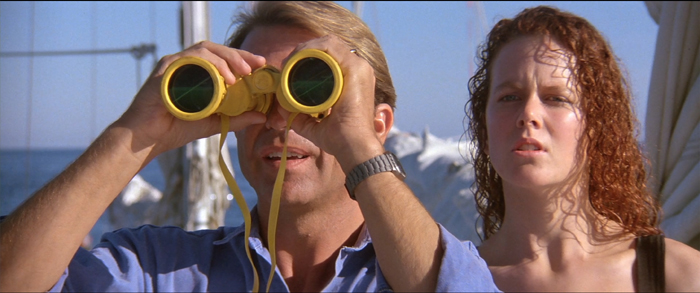
Dead Calm (1989).
Art, entertainment, and the hard-boiled mystique
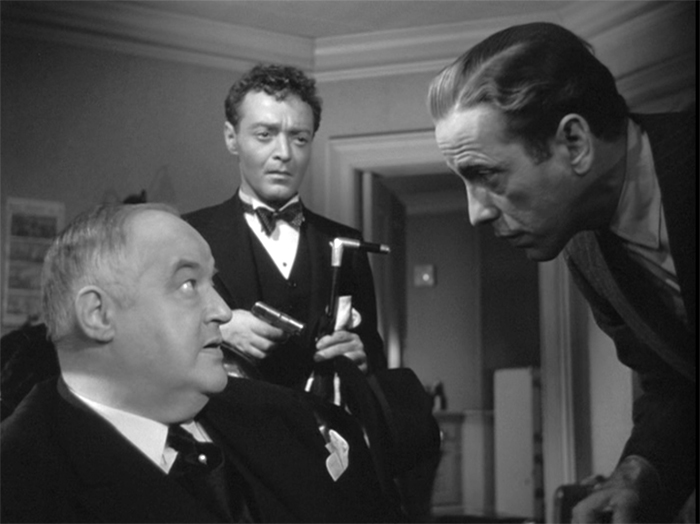
The Maltese Falcon (1941).
DB here:
The traditional opposition between Art and Entertainment still holds some sway. Art, some believe, is the realm of higher significance and profound emotion, while entertainment yields mere diversion and superficial engagement. Art embodies wisdom and technical breakthroughs, while at best entertainment is home to talent and cleverness. Art harbors genius, entertainment offers ingenuity. Art expresses the creator’s personal vision, entertainment recycles collective fantasy (or the Zeitgeist). There’s usually an implied hierarchy of quality and of appeal: art is for a sensitive elite, entertainment is popular (read vulgar).
One problem, though, is that for long stretches of history much art has been thoroughly entertaining. Mozart, Shakespeare, Dickens, Hiroshige, Austen, and many other major artists have found wide popularity. They provide pleasure aplenty. But with urbanization and the rise of capitalism, mass production created a huge public, and tastemakers have tended to treat art as a realm apart. For a hundred years or more, entertainment has been equated with mass culture, and art with high culture, most notably with modernism and its successors.
Another problem is cultural endurance. In a recent column, Michael Dirda points out that genre fiction often outlasts prestigious literary fiction of its era.
Take fantasy and science fiction: In 1997, I praised William Gibson’s “Neuromancer,” John Crowley’s “Little, Big,” Gene Wolfe’s “Book of the New Sun” and the works of Ursula K. Le Guin — all remain vital to contemporary writers and readers.
Similarly, classics of mystery fiction by Conan Doyle, Agatha Christie, and Patricia Highsmith still attract readers, while “mainstream” novels of their eras are forgotten. Dirda’s second point is no less valid.
More generally, American novelists have wholly embraced the energy and potential of fantasy in its various forms. We are all fabulists now. This century revels in comics, graphic novels, manga and superhero movies. Authors as varied as Colson Whitehead, Walter Mosley, Kelly Link, Jonathan Lethem, Elizabeth Hand and Michael Chabon, to name a few prominent figures, all grew up loving fantasy and science fiction.
Genre appeals have infiltrated prestige literature, as in the crime plots of Graham Greene, Joyce Carol Oates, and Richard Price. (I consider Colson Whitehead’s and Richard Wright’s contributions here.) Likewise, we have horror-infused tales like George Saunders’ Lincoln in the Bardo and Lorrie Moore’s I Am Homeless if This Is Not My Home .
Creators of entertainment have felt the distinction keenly. “A wedge has been driven into the industry,” says Christopher MacQuarrie, director of the latest Mission: Impossible installment. “Are you an artist or an entertainer? Tom doesn’t see them as mutually exclusive.” But some creators have seen a forking path. Rex Stout, after several “serious” novels failed, came to two conclusions:
First—that I was a good storyteller, and second—that I would never be a great novelist. I’d never be a Tolstoy, or a Dickens, or a Balzac…. So since that wasn’t going to happen, to hell with sweating out another twenty novels when I’d have a lot of fun telling stories which I could do well and make some money on it.
The Art/ Entertainment distinction runs through my recent book, Perplexing Plots, because many mystery writers have aimed at “elevating” their work to the level of prestige literature. This urge drives them to experiment with the norms of plotting and writing. Even when the genre limits remain in force, there’s a chance that skillful exponents can accept them and still yield “literary” pleasures. A good example is what happened to hard-boiled detective fiction in the hands of Dashiell Hammett and Raymond Chandler.
The Op
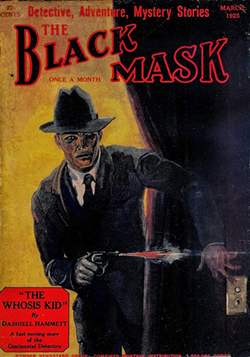 Hammett launched his fame with a series of crime stories mostly published in the pulp magazine Black Mask from 1923 to 1930. His protagonist is a nameless investigator for the Continental Detective Agency. The Continental Op, as he came to be called, is a pudgy but tough middle-aged detective who values camaraderie, crafty stratagems, and a good cheap steak. Women flirt with him, but he sees through their schemes. The Op’s drabness and humility give him a realism that is amplified by the milieu Hammett depicts. He had been a Pinkerton agent and larded the stories with underworld argot and tips on investigative technique.
Black Mask stories put a premium on action, so the Op was often at the center of violence perpetrated by crooks, sociopaths, and corrupt cops. Unlike other hard-boiled detectives, the Op isn’t a swaggering sadist. Violence is his last resort; he favors obstinate everyday professionalism. Sometimes he’s fooled by the grifters and has to wriggle his way out. At other times, he can set crooks against one another and watch the mutual destruction.
Hammett wrote the stories in the first person, giving the Op a telegraphic, visceral style laced with sour humor. A 1923 story shows his American vernacular already in place.
Just at the wrong minute Henderson decided to look over his shoulder at us–an unevenness in the road twisted his wheels–his machine swayed–skidded–went over on its side. Almost immediately, from the heart of the tangle, came a flash and a bullet moaned past my ear. Another. And then, while I was still hunting for something to shoot at in the pile of junk we were drawing down upon, McClump’s ancient and battered revolver roared in my other ear.
Henderson was dead when we got to him–McClump’s bullet had taken him over one eye.
McClump spoke to me over the body.
“I ain’t an inquisitive sort of fellow, but I hope you don’t mind telling me why I shot this lad.” (“Arson Plus”)
In 1929, the publisher Knopf issued two Hammett novels, Red Harvest and The Dain Curse, based on Black Mask serials. The Op had not lost his wit or his gift for staccato narration. Here are three excerpts.
I didn’t think he was funny, though he may have been.
He stood at the foot of the bed and looked at me with solemn eyes. I sat on the bed and looked at him with whatever kind of eyes I had at the time. We did this for nearly three minutes.
The latch clicked. I plunged in with the door.
Across the street a dozen guns emptied themselves. Glass shot from door and windows tinkled around us.
Somebody tripped me. Fear gave me three brains and half a dozen eyes. I was in a tough spot. Noonan had slipped me a pretty dose. These birds couldn’t help thinking I was playing his game.
I tumbled down, twisting around to face the door. My gun was in my hand by the time I hit the floor.
Across the street, burly Nick had stepped out of a doorway to pump slugs at us with both hands. I steadied my gun-arm on the floor. Nick’s body showed over the front sight. I squeezed the gun. Nick stopped shooting. He crossed his guns on his chest and went down in a pile on the sidewalk.
Hands on my ankles dragged me back. The floor scraped pieces off my chin. The door slammed shut. Some comedian said:
“Uh-huh, people don’t like you.”
As he was finishing The Dain Curse, Hammett wrote to Blanche Knopf confessing that in future work he wanted to go beyond Entertainment to Art.
I’m one of the few—if there are any more—people moderately literate who take the detective story seriously. I don’t mean that I necessarily take my own or anybody else’s seriously—but the detective story as a form. Some day somebody’s going to make “literature” of it (Ford’s Good Soldier wouldn’t have needed much altering to have been a detective story), and I’m selfish enough to have my hopes, however slight the evident justification may be.
The question is: How to do this?
Inside and outside
Hammett proposed an answer in his letter to Blanche Knopf. He wanted to try that he wanted to try out modernist technique in a third novel.
I want to try adapting the stream-of-consciousness method, conveniently modified, to the detective story, carrying the reader along with the detective, showing him everything as it is found, giving him the detective’s conclusions as they are reached, letting the solution break on both of them together. I don’t know whether I’ve made that very clear, but it’s something altogether different from the method employed in “Poisonville [Red Harvest],” for instance, where, though the reader goes along with the detective, he seldom sees deeper into the detective’s mind than dialogue and action let him.
His mention of stream of consciousness may mislead us about his intentions. In that technique the verbal narration seeks to mimic the flow of the mind as it flits across sensory impressions, memories, and fantasies. The process is often rendered as sentence fragments, often introduced by a sentence indicating the behavior of the character.
Here’s an example from Joyce’s Ulysses (1922), the most famous showcase of stream of consciousness. Mr. Bloom is in a Catholic church.
He saw the priest stow the communion cup away, well in, and kneel an instant before it, showing a large grey bootsole from under the lace affair he had on. Suppose he lost the pin of his. He wouldn’t know what to do to. Bald spot behind. Letters on his back I.N.R.I? No: I.H.S. Molly told me one time I asked her. I have sinned: or no: I have suffered, it is. And the other one? Iron nails ran in.
Sometimes the images and phrases are separated by commas and periods, but sometimes they simply pile up. In the book’s last chapter, Molly Bloom’s drowsy imaginings are given in an unpunctuated, sparsely paragraphed flow.
It’s likely that Hammett didn’t want his usage to be as fragmentary as what we encounter in Joyce and others. His invocation of Ford Madox Ford’s The Good Soldier (1915) suggests something closer to what many now call inner monologue. (Ford called it “impressionism.”) Here the flow of thought is given as a sort of soliloquy, a flow of more or less cogent and coherent ideas and impressions. What makes it a modernist technique is that inner monologue may not respect story chronology and it’s likely to be biased, uncertain, equivocal, and subject to revision. Ford’s narrator, John Dowell, tells a rambling, out-of-order tale of marital infidelity and suicide, in which flashbacks are analyzed and re-analyzed.
Looking over what I have written, I see that I have unintentionally misled you when I said that Florence was never out of my sight. Yet that was the impression that I really had until just now. When I come to think of it she was out of my sight most of the time.
At the climax, Dowell makes a provisional sense of what the characters knew and why they acted as they did.
The problem in importing this to the detective story is evident. How can the detective’s ongoing reasoning, bristling with mistaken inferences and reconstructed impressions, be passed along to the reader without causing confusion? For this reason, detective story narration, whether first-person or third-person, suppresses most of the protagonist’s reasoning. The Watson figure and the dumb authorities exist to be baffled and play with misleading possibilities while the detective holds back even a partial solution.
By convention, the climax of the tale is the revelation of the truth–not when the detective discerns it, but at the moment when it can be announced with decisive impact (often in a gathering of suspects with the police present). Raymond Chandler noted that the delayed revelation was a serious constraint of the genre, even when the detective, like the Op, is telling the story. “The first person story is assumed to tell all but it doesn’t. There is always a point at which the hero stops taking the reader into his confidence.” The detective “stops thinking out loud and ever so gently closes the door of his mind in the reader’s face.” This prevents the public announcement of the solution from being anticlimactic.
Worse, Ford’s protagonist Dowell is an unreliable narrator, as the above passage suggests. To make the detective’s first-person account unreliable would be more than a “convenient modification” of the standard plot schema. It would push toward the experiments seen in Cameron McCabe’s The Face on the Cutting-Room Floor (1937) and later “anti-mysteries.”
Hammett admitted in a later letter that he would put the “stream-of-consciousness” experiment on hold while he wrote material for Hollywood in “more objective and filmable forms.” (That would include his script for City Streets of 1931, which does include a subjective auditory flashback rare in films of the time.) But in his next novels Hammett turned sharply away from the interiority he had considered. Instead, he went toward extreme objectivity, almost completely shutting us out from his protagonists’ inner lives.
The action of The Maltese Falcon (1930) and The Glass Key (1930) attach us closely to his protagonist, scene by scene. We’re confined to his activity and his range of knowledge. But this doesn’t get us into his mind. For these books Hammett switched to third-person narration and made it radically objective, sticking almost completely to reporting dialogue and character interaction.
In Perplexing Plots, I explore how this strategy works, but here’s an example from The Glass Key.
At Madison Avenue a green taxicab, turning against the light, ran full tilt into Ned Beaumont’s maroon one, driving it over against a car that was parked by the curb, hurling him into a corner in a shower of broken glass.
He pulled himself upright and climbed out into the gathering crowd. He was not hurt, he said. He answered a policeman’s question. He found the hat that did not quite fit him and put it on his head. He had his bags transferred to another taxicab, gave the hotel’s name to the second driver, and huddled back in a corner, white-faced and shivering, while the ride lasted.
The narration presents what a third-person observer would have seen and heard, and it won’t venture into Beaumont’s thinking. The cues are behavioral: he seems cool enough in slipping out of the crash, but his true reaction is given through his nervous reaction while riding back to the hotel.
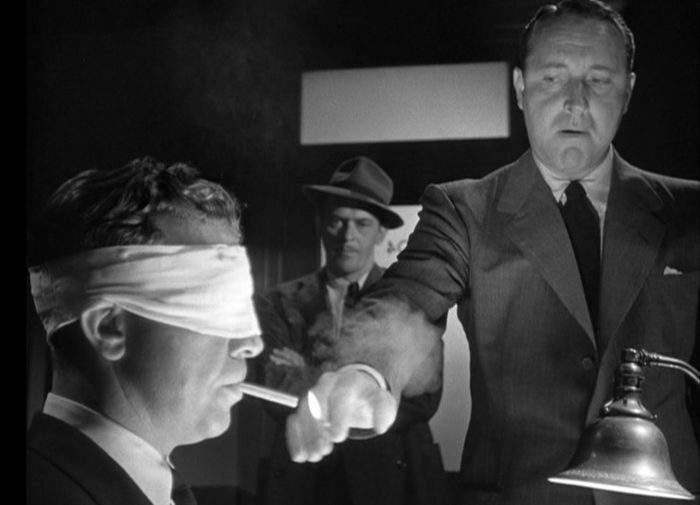
As Hammett’s second letter to Blanche Knopf suggests, this flat objectivity would seem an ideal novelistic basis for a “filmable” treatment. John Huston’s screen adaptation of The Maltese Falcon confines us almost completely to Spade’s range of knowledge. (The big exception is that we see his partner Miles Archer shot by an unknown killer.) The film’s visual narration mostly follows Hammett’s impassive neutrality. But when Casper Gutman drugs Spade, we get Spade’s clouded optical viewpoint.
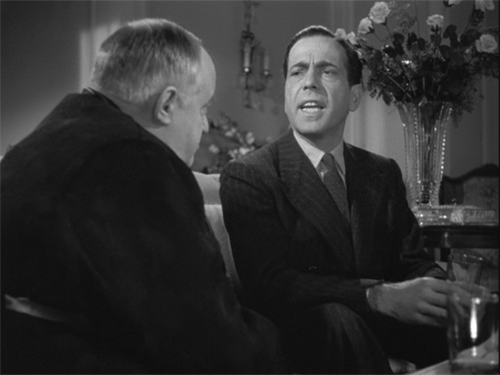
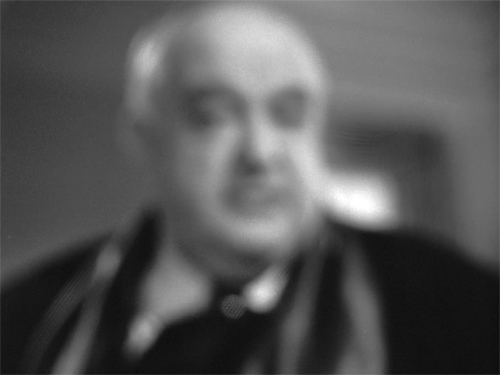
In the novel the narration reports that Spade’s eyes seemed to muddy over. When he says, “And the maximum?” we’re told that “An unmistakable sh followed the x in maximum as he said it.” This isn’t Spade’s experience but rather what an observer would register, an “unmistakable” impression confirmed when we’re told that “a sharp frightened gleam awoke in his eyes.” As Spade tries to walk, he’s tripped by Wilmer. He falls and Wilmer kicks him. “Once more he tried to get up, could not, and went to sleep.” The whole scene is rendered externally.
So instead of giving the detective story a modernist subjectivity, Hammett went to the other extreme. Did he intuitively recognize the problem of revealing the detective’s inferences too soon? Maybe, although his increasing involvement with Hollywood may have kept him on the objective, “filmable” path. The Thin Man (1934), his last novel, is a fascinating effort to return to first-person narration while incorporating the dry objectivity of the two previous books.
Perhaps inadvertently, Hammett’s radicalization of the objective method yielded what he had hoped for. The Maltese Falcon was greeted as a serious work of literature and was soon incorporated into the prestigious Modern Library series. His works have become part of the canon of American letters enshrined in the Library of America collection. The convention of delaying the detective’s solution didn’t prevent the genre from becoming accepted as a legitimate literary form–at least as practiced by Hammett, and his most prominent successor.
Overtones, echoes, images
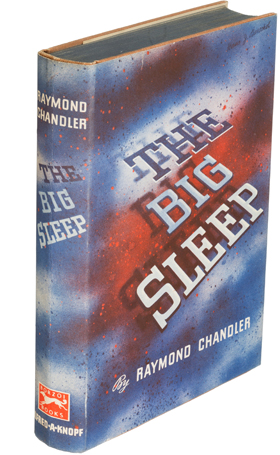 That successor was, of course, Raymond Chandler. Ten years after Hammett wrote to Blanche Knopf with his hopes of elevating the whodunit, Chandler wrote to Alfred Knopf about his plans for The Big Sleep (1939) and the novels that followed. It has an echo of Hammett: “I was more intrigued by a situation where the mystery is solved by the exposition and understanding of a single character, always well in evidence, rather than by the slow and sometimes long-winded concatenation of circumstances.”
But what Chandler means by “understanding” doesn’t include full-blown reasoning. First-person narration, he explains in a 1949 note, must “suppress the detective’s ratiocination while giving a clear account of his words and acts and many of his emotional reactions.” This seems a response to the detached reportage of late Hammett prose. Chandler also rejects the Op’s streetwise patter by explaining to Knopf that his method will use “a very vivid and pungent style, but not slangy or overtly vernacular.” He wants “to acquire delicacy without losing power.”
Hammett, while a voracious reader, learned a good deal of his craft from actually investigating crimes. Chandler, who began writing mysteries as Hammett’s productivity tailed off, owed his knowledge of the mystery genre to reading. He studied crime fiction of all sorts with almost academic passion and became one of the most nuanced commentators on the tradition. He claimed to have learned plotting from outlining pulp stories by Erle Stanley Gardner. His literary tastes didn’t run to modernism. He admired the Greek and Roman classics, Flaubert, James, and Conrad and thought highly of Fitzgerald’s The Great Gatsby. Hammett imagined elevating the genre by “conveniently modifying” modernist technique, but Chandler sought to make the hard-boiled detective story more like the ambitious mainstream novel.
He believed he could do that through style. In his crucial essay, “The Simple Art of Murder (1944/1946),” he praises Hammett’s prose but objects that “it had no overtones, left no echo, evoked no image beyond a distant hill.” Chandler sought to give style a greater novelistic richness not only through probing his protagonist’s mind but also through fairly dense descriptions colored by the protagonist’s emotions and judgments.
Hammett sketches characters in quick strokes and he merely indicates settings. But Chandler dwells on his characters and their surroundings. The opening of The Big Sleep devotes a page and a half to Philip Marlowe’s impressions of the Sternwood mansion (stained-glass window of a knight rescuing a lady, plush chairs, a mysterious portrait) and another page and a half to his meeting with the coy Carmen. These are filtered through Marlowe’s running commentary. The knight doesn’t really seem to be trying. The chairs appear to never have been sat in. The portrait looks threatening. Carmen’s infantile flirtation reveals that “thinking was always going to be a bother to her.” Here are the overtones and echoes that Chandler finds lacking in Hammett. This is an ominous household–as Marlowe will later say, this will be “no game for knights.”
Chandler would pursue this method in the following novels. Yet at times the narration plunged deeper into subjectivity. In Farewell, My Lovely (1940) Marlowe is repeatedly knocked out in tussles, and in the second passage Chandler writes:
The man in the back seat made a sudden flashing movement that I sensed rather than saw. A pool of darkness opened at my feet and was far, far deeper than the blackest night.
I dived into it. It had no bottom.
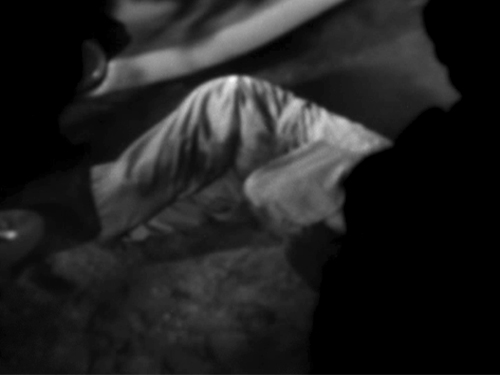
The film adaptation, titled Murder, My Sweet (1944), uses this subjective device in every knockdown. Marlowe’s voice-over narration runs through the film, and after the first assault we hear:
I caught the blackjack right behind my ear. A black pool opened up at my feet. I dived in. It had no bottom.
Onscreen we see Marlowe’s crumpled body blotted out by a miasma that leads to a black frame.
In a later sequence, a knockout of Marlowe is rendered as wild optical exaggerations before following the novel’s report of Marlowe seeing a room full of smoke. That’s translated as wispy superimpositions over the shots, with explanatory voice-over.
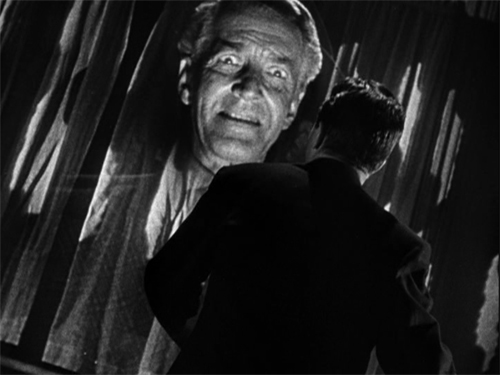
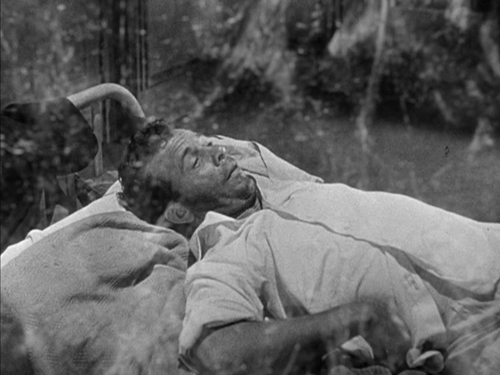
The film tries a bit too hard, but its use of voice-over and delirious visual subjectivity would become common in film noirs of the period.
In Farewell, My Lovely, Marlowe’s recovery from his first knockout is rendered with vigorous subjectivity across two pages, as Marlowe realizes that the voice he hears reviewing what happened is his own. “I was talking to myself, coming out of it. I was trying to figure the thing out subconsciously.”
Marlowe is able to reconstruct bits of the crime through this process, but it’s a provisional solution, not the decisive one. That one he keeps from the reader until the climax. By then, as per convention, the door to his mind has shut in the reader’s face.
Hammett’s novels were published when most crime fiction consisted of genteel whodunits and gangster sagas, so he had the advantage of novelty. By the time Chandler published The Big Sleep, he was competing with many book-length stories of hard-boiled investigators. Aware of the need to establish a distinctive presence, he presented work that stood apart by its social criticism and the romanticized realism of a righteous avenger alone on the mean streets of a corrupt city–sure-fire attractions to intellectuals then and since. Just as important was his self-consciously literary style. “In the long run, however little you talk or even think about it, the most durable thing in writing is style, and style is the most valuable investment a writer can make with his time.”
Through concern with language’s echoes and overtones, he established himself as Hammett’s successor. The literati followed his lead and declared him a significant novelist. His books, along with “The Simple Art of Murder,” provided an enduring rationale for the tough detective story. While adhering to the conventions of the classic puzzle (clues, faked deaths, false identities, least-likely culprit), he acquired lasting prominence. Like Hammett he has found a home in the Library of America.
Arguably Hammett and Chandler also elevated their genre. Their achievements encouraged other ambitious writers and stimulated critics and readers to look more closely at the possibilities of the murder novel. No wonder that prestigious writers have turned to mystery plots. Fans still labor to make a case for Golden Age puzzles as art rather than entertainment, but most critics and readers assume the hard-boiled mystery to be at least potentially serious literature–especially when it goes under the alias “noir.”
Nowadays the Art/ Entertainment duality has weakened its hold. If, as Dirda suggests, we are all fabulists now, we’re also probably mystery fans to some degree. It’s likely that film played a role in dissolving the duality. Intellectuals began to understand that films by Ozu, Hitchcock, and other popular directors were of high quality. More and more, I think, people aren’t as eager to see the split as absolute. Instead of a hierarchy, we have more of a spectrum.
In harmony with this, Perplexing Plots argues that culture offers us a plenitude of individual works with varied appeals, all of which can be realized with, to use Chandler’s terms, delicacy and power. Some works rely on subtlety, others on immediate impact. We have the refinements of Baroque music and the direct force of The Rite of Spring. If Treasure Island is a masterpiece as well as a rousing yarn, so is Die Hard. There is heavy art and light art, brooding art and and diverting art, intellectual density and emotional charm. None of these qualities is simple or easy to achieve; all can repay analysis. The slogan might be: “There’s valuable work at all levels. And there are no levels.”
One source of value, not always acknowledged, is the role of entertainment in revealing fresh expressive possibilities in the medium. For example, the martial arts cinemas of Japan and Hong Kong opened up new vistas of cinema. And yes, as Hammett and Chandler indicated, a lot of the freshness lies in style. This is why Perplexing Plots spends time looking closely at how mystery fiction and film work, word by word or shot by shot. Even Agatha Christie’s supposedly bland verbal texture points up ways in which language can mislead us.
So Hammett and Chandler didn’t “elevate” the hard-boiled story so much as blur the line between genre fiction and the “legitimate” novel. Ambler and Le Carré did the same for the spy story, as did Highsmith for the psychological thriller. For such reasons, Perplexing Plots discusses hard-boiled detection extensively. I explore the Art/ Entertainment distinction because it has obsessed critics and creators. But I try not to buy into the split, opting instead for the looser idea of “crossover.” It’s a swap meet, with storytellers ransacking works “high” and “low” for subjects, forms, techniques, whatever.
I wanted to put up this entry on 23 July, Raymond Chandler’s birthday. It happens to be mine too. No cheerleading here, though. I prefer Hammett, as maybe you can tell.
My quotations from Hammett’s letters come from Selected Letters of Dashiell Hammett, 1921-1960, ed. Richard Layman and Julie Rivett (2002). I take Chandler’s remarks on mystery fiction from Selected Letters of Raymond Chandler, ed. Frank MacShane (1981) and Raymond Chandler Speaking, ed. Dorothy Gardiner and Katherine Sorley Walker (1962).
Michael Dirda, as my mentions of him should lead you to expect, has written an admirable example of taking popular storytelling seriously but not solemnly: On Conan Doyle, or the Whole Art of Storytelling (2014). Kristin does something similar in her Wooster Proposes, Jeeves Disposes, or Le Mot Juste (1992), available here and here. Her immensely popular subject, P. G. Wodehouse, was regarded as a master of English prose by Martin Amis, Evelyn Waugh, and many other literary celebrities.
What about the third celebrated hard-boiled pioneer, Ross Macdonald? Read Perplexing Plots to find out!
Murder My Sweet (1944).
P.S. 11 October 2023: In a Slate essay, Dan Sinykin shows that the merging of “genre fiction” and “literary fiction” has causes in the economics of the publishing industry. A fine analysis I wish I’d had available for Perplexing Plots.
POKER FACE: Detective off the grid

Poker Face, Ep. 10 (“The Hook”).
DB here:
Charlie Cale, an easygoing but tough young woman from New Jersey, has a unique gift. She can detect when someone is lying. She has exploited this in a career as an itinerant poker player, but after the word gets out about her ability, she winds up working as a waitress in a Las Vegas casino. A free spirit, she enjoys living from paycheck to paycheck, sharing beers and smokes with other staff. But the casino boss Stirling Ford Sr. learns of her gift and recruits her for a scheme targeting a rich patron.
That scheme collapses, and Charlie winds up having to flee across the United States. Driving the backroads, trying to stay off the grid, she keeps running into crimes in a wide range of settings. She stops at a Nevada Subway shop, a Texas barbecue joint, a stock-car race, a dinner theatre, a special-effects movie company, the venues of a touring heavy-metal band, a care facility for the elderly, and a remote mountain motel. We come to know each of these with remarkable specificity, noting details like lottery tickets and music amplifiers and Steenbeck flatbeds.
Charlie has the common touch. When she spots a lie, she’s likely to blurt out, “Bullshit!” She can freely talk and eat with working stiffs and is naturally suspicious of the plutocrats she keeps running into. She’s ready to deploy her ability to expose the less wealthy who want to exploit others. Eventually we come to learn that her sympathy for virtuous innocents may be compensation for her frosty relations with her family.
 Charlie is the protagonist of Poker Face, a ten-episode series designed by Rian Johnson. Johnson is an admirer of classic mysteries. Earlier I’ve tried to chart his debt to Golden Age whodunits, as seen in Knives Out and Glass Onion. Unsurprisingly, he planned Poker Face as an homage and an updating of the TV show Columbo.
Apart from enjoying Poker Face on its own terms, I’ve admired its efforts to innovate. In my book Perplexing Plots: Popular Storytelling and the Poetics of Murder I argue that we have three useful tools for understanding plots. We can ask about the sequence of events in time; the way point of view structures our access to those events; and the way the events are broken into distinct parts. Noting how the plot handles time, viewpoint, and segmentation can help us grasp the ways Johnson has revivified the classic mystery–in ways that shape our experience.
I’ve had to indulge in spoilers, but I decided to confine those wholly to the first episode. Later episodes would justify a similar depth of analysis. And even in the first episode, I’ve tried to conceal major plot points when I could. In any event, I hope that people who haven’t yet seen the show (streaming on Peacock) might be intrigued enough to try it. It’s free although interrupted by commercials, but in a nifty use of segmentation Johnson manages to turn their timing to his advantage.
The inverted plot
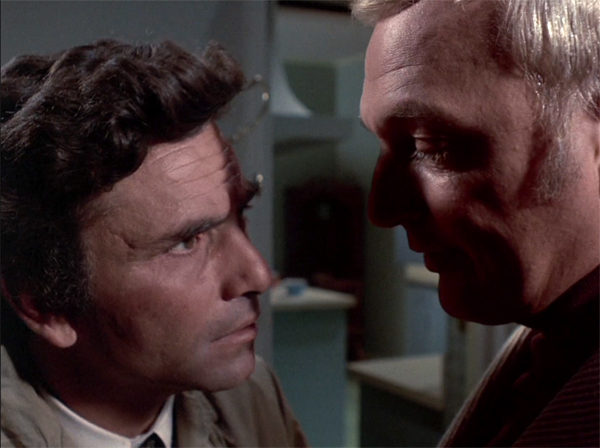
Columbo, Ep. 1 (“Murder by the Book,” 1971).
The typical investigation plot begins with the crime already committed. The detective proceeds to unearth earlier events that led up to it. The alternative is, unreasonably, called the “inverted” plot. Here we witness the crime committed and perhaps are shown the motives involved. Then the detective arrives on the scene and we watch the investigator try to discover what we already know. We watch for slip-ups in what initially seems a foolproof scheme.
The inverted schema was developed most vividly in the Golden Age by F. Austin Freeman in a series of short stories. His sleuth, Dr. Thorndyke, arrives on the scene only after we have watched the culprit do the deed. The puzzle comes in trying to grasp how Thorndyke, using reasoning and scientific analysis, solves the mystery. In the process, he sometimes calls our attention to betraying details that we didn’t notice on the first pass.
This pattern of action comes off well in the short-story format, but it can be difficult to sustain in a longer tale. So the author may have the culprit resort to trying to impede or confuse the ongoing investigation, or to committing other crimes that need solution as well. These techniques come into play in Freeman’s novel Mr. Pottermack’s Oversight, which devolves into a battle of wits between Thorndyke and Pottermack.
A similar sort of stretching was common in Columbo, whose reliance on inverted plots inspired Johnson for Poker Face. The first episode broadcast, “Murder by the Book” (directed by Steven Spielberg), starts with disgruntled author Ken Franklin shooting his collaborator. Columbo, in his rumpled raincoat, doesn’t show up for the first eighteen minutes, and even after that he’s offstage during Franklin’s further schemings. These include creating a false trail for the crime and killing a witness who threatens him with blackmail.
We get some access to Columbo’s investigation behind the scenes, but the high points are his visits to Franklin. We enjoy the clash of slob versus snob when this obtuse flatfoot peppers the wealthy author with maddening questions–and always seems to accept a lie in reply. Eventually, when Franklin is trapped, Columbo reveals that he suspected him from the start; he just needed more evidence.
Despite its name, the inverted plot is usually linear. It traces events chronologically from crime to punishment, though flashbacks may provide chunks of backstory. This is where Johnson saw an opportunity to try something new. Assuming that viewers are familiar with the inverted plot schema, he juggles the sequence of events in unusual ways–exploring a different time layout in each episode.
A matter of timing
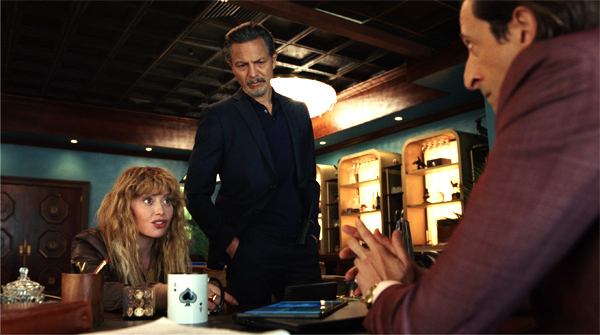
Poker Face, Ep. 1 (“Dead Man’s Hand,” 2023).
Except for the final installment, Poker Face follows the inverted schema: crime first, then investigation. But after we see the crime committed, the episode’s narration typically skips back and even “sideways” to show us circumstances leading up to the deed. Eventually the crime will be take its place in the chronological sequence–perhaps through a brief replay, or at least by reference in dialogue. Put another way, the crime segment is a kind of flashforward.
The first episode, “Dead Man’s Hand,” provides a tutorial in method. In a Las Vegas casino, the housekeeper Natalie finds horrific pornography on the open laptop of Kasimir Caine, a millionaire guest. She reports it to the boss, Sterling Frost Junior, and his fixer Cliff. They send her home. Cliff follows and shoots Natalie in her living room. He’s already shot her husband Jerry and he arranges the scene to look like a murder-suicide.
This block of brief scenes is followed by a linear story starting a few days earlier. Charlie works at the casino as a waitress, and she offers Natalie a place to stay after her drunken husband Jerry has raised a ruckus in the gaming room. In the meantime, Frost Jr. has learned of Charlie’s lie-detection talent and recruited her to watch Caine’s clandestine poker game by remote transmission. Frost will use her information about who’s bluffing in order to fleece Caine, while proving to his father that he’s a good manager.
Frost’s scheming with Charlie is interrupted by Natalie’s visit to report Caine’s pornography, so now the lead-in sequence falls into place. While Charlie is briefed further by Frost, Cliff is offstage killing Natalie and Jerry. The pivot is signaled by repeated dialogue: Cliff phones Frost (“It’s done”) and Frost resumes his explanation (“Where were we?”). The sequence of events is firmed up the next morning, when Charlie sees an online report of Natalie’s death.
The rest follows chronologically. Charlie feels guilty for not returning Natalie’s call, made shortly before her death.

Her phone record leads her to notice disparities in the timeline and investigate, while she and Frost Jr. are preparing for the Caine scam. A slip of the tongue allows her to spot Frost’s lie about Cliff’s call, and he realizes she’s on to him. The result is Frost’s death and his father’s demand that Cliff capture Charlie. She flees and begins her backroads odyssey across America.
Later Poker Face episodes elaborate this template. Sometimes the crime is embedded in a large block of consecutive scenes, with all the backstory shown (ep. 2, “The Night Shift”). After that we skip back to still earlier events centering on Charlie’s travels leading up to the night of the murder, which takes place while she is next door in a tavern. That’s why I said that some of the scenes move sideways, showing incidents near her. This “proximity principle” is pushed further in ep. 3, “The Stall,” when Charlie is hovering just offscreen in the opening scene, as the murder conditions are laid out; the replay will reveal that.
Another variant: The leadup to the crime is extended for much longer than in the earlier episodes, with the murder coming a third of the way through the show’s running time (ep. 4, “Rest in Metal”) and the replay witnessed by Charlie over halfway through. Later episodes adopt mixed strategies. They still start with the crime, or at least the planning, and skip back in time, but they seed the later blocks with ellipses, brief flashbacks, and replays. It’s as if the series were teaching us week by week to accept an increasing flexibility in moving forward and backward and sideways, while still adhering to the basic convention of the inverted plot. We’re also helped, of course, by dialogue and intertitles telling us where we are in the timeline.
The exception to these pyrotechnics is the last episode, “The Hook.” It’s stubbornly linear in tracing Cliff’s pursuit of Charlie. It starts ab initio, with Frost Sr. ordering him to find her, and following that with scenes from earlier episodes in which Cliff misses her. In a way, this entire prologue is a kind of flashback that ends with him seizing her as she leaves a Colorado hospital. The final episode is the most conventionally readable because it isn’t an inverted plot. The crime is missing from the opening but is saved, as is common, for a climactic revelation.
What makes all this variation possible is a coordination of segmentation, viewpoint, and causal-chronological order. The blocks of time are dictated by attachment to the killer (s) or to Charlie. Typically the lead-up to the crime keeps us with the culprits. The flashbacks following the first statement of the crime are motivated because they’re attached to Charlie, who is just getting involved with the situation. The later segments are either purely tied to her, or (as in the Columbo episode) devoted to the culprit’s efforts to thwart her inquiry. In “Dead Man’s Hand,” for instance, scenes of her investigation are garnished with moments in which Frost Jr. and Cliff plan ways to circumvent her. In all, these maneuvers create pretty clever plots, their segments accented by the way that the end of a block tends to initiate a commercial break . . . just as in old network TV.
Charlie’s little gray cells
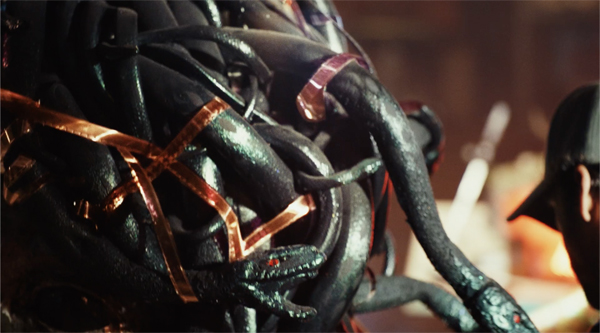
Poker Face, Ep. 8 (“The Orpheus Syndrome, 2022).
How good a detective is Charlie? Given her gift, shouldn’t sleuthing be utterly easy? Johnson has engineered his series to give her several handicaps that require her to sweat as much as any hardboiled dick.
For one thing, as a working-class woman of fairly slight stature, she starts by facing a bias in favor of the bulky, wealthy men (mostly) whom she challenges. In addition, after the first episode, she’s on the run and has to be discreet. Going to the police about anything would inevitably reveal her whereabouts to Frost Sr. Moreover, during her flight she’s deprived of what helped her crack the first case: her cellphone access to the internet. After Frost Sr. threatens that he will find her, she destroys her phone so she can’t be tracked. But now she’s got to rely on other sources of information.
Even her gift proves problematic. Unless a suspect explicitly denies committing the crim, her bullshit detector can’t know the person is guilty. Not incidentally, this condition puts a fruitful constraint on the screenwriters. They have to make sure the culprit’s dialogue circumvents the sort of declaration that Charlie would see through.
Confronted by all these obstacles, Charlie is obliged to act like a classic detective. Let’s count the ways.
For all the pledges to strict reasoning, the traditional sleuth is often triggered by intuition, the sense that something is just not right here. (The prototype is Chesterton’s Father Brown, but even logicians like Ellery Queen and Hercule Poirot are sensitive to “atmosphere.”) Charlie’s gift is an extravagant form of intuition, since it’s both illogical and impossible to explain scientifically, so even when it doesn’t expose the killer it can set off a minor alarm. In the season’s first episode, her suspicion is aroused when Frost Jr. lies about his phone conversation with Cliff.
The classic detective spots or unearths clues, traces of the criminal’s action and pointers to identity. Charlie’s case against Frost Jr. and Cliff in “Dead Man’s Hand” is built out of such traditional clues as a problematic timetable, uncharacteristic behavior (Natalie didn’t sign out when she left work), and hand dominance (would a leftie wield a pistol with his right?). Later episodes of Poker Face are packed with physical clues, from wood splinters to discarded candy wrappers. As Jacques Barzun puts it, in the classic detective story “bits of matter matter.”
Charlie is especially good at spotting the absent clue, the dog that didn’t bark in the night-time. In the first episode, she notices that video footage of Jerry hustled out of the casino shows him passing through Security unscathed.
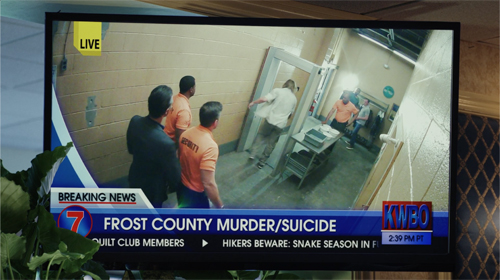
But if he had his pistol with him, that would have been detected–which implies that Cliff kept it. Yet Golden Age conventions demand fair play: we must have access to all the clues the detective has. In his films Johnson has adhered to this, and he has in Poker Face. So we are shown the Security station in the casino twice earlier. Early on, Cliff breezes through, counting on the staff’s recognizing him and letting him pass.
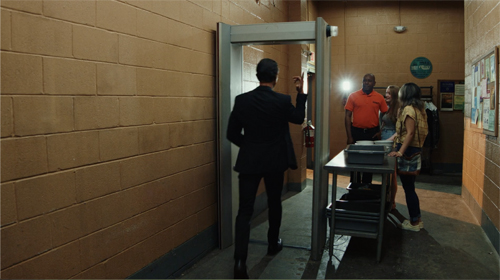
Later, Charlie is stopped because her phone sets off the scanner.
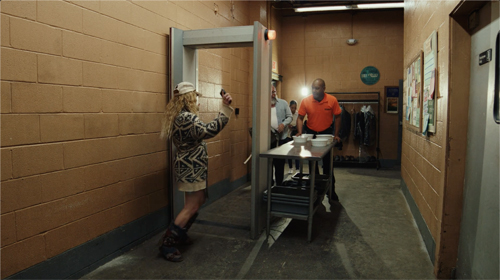
Consequently, when Jerry doesn’t set off the alarm as Charlie had, he can’t be packing the gun.
Reasoning puts the clues together, but sheer reasoning isn’t enough to justify arresting somebody. There must be evidence. Charlie often finds herself convinced of the killer’s guilt but lacking something that would stand up in court. And without a cellphone she can’t resort to tricking the killer into confessing on a hot mic. Yet some solid evidence is needed to clinch the case. The screenwriters have been ingenious in finding other damning records. Episodes recruit heart-monitor charts, 16mm film, CCTV footage, and digital audio and video captured by Charlie’s helpers or the culprits themselves.
In a classic whodunit, as we approach the climax, the detective is often blessed with a stroke of good luck that advances the solution of the puzzle. It’s often something apparently trivial–an overheard conversation or a slip of the tongue, or an irrelevant detail that inspires the detective to reinterpret a clue. In “Dead Man’s Hand,” Charlie spots the TV report of Jerry passing through Security not by diligent research but by sheer accident. She’s just dropped by the bar when the broadcast appears.
One more convention, one that the series adopts gradually: an alliance between detective and law enforcement. The classic detective cooperates to some extent with the police, either wholeheartedly (Queen, Poirot, Lord Peter Wimsey) or grudgingly (Nero Wolfe). Even tough guys like Sam Spade, Nick Charles, and Philip Marlowe may exchange information with their friends on the force. At the start of Poker Face Charlie is a loner, but as the series proceeds, she gain an ally in the FBI, and because she helps him crack cases he comes to her aid on occasion. “At this rate, if I stick with you I’ll be head of the Bureau in a year.”
In all, Poker Face has engagingly modernized the inverted plot schema while benefiting from classic principles. Those permit the detective to show off powerful intuition, systematic reasoning, and Machiavellian cleverness in trapping the prey. In addition, the series has added to the gallery of admirable sleuths a hard-boiled but compassionate wise-guy woman. And it’s done with a strong dose of social criticism. This have-not from Jersey wreaks vengeance on those who victimize innocents.
Poker Face is scheduled for a second season, with Charlie once more on the run across America. We may expect that it will continue to show how ingenious play with time, viewpoint, and segmentation can revivify conventions of the whodunit. Keen fans learned to ask not only How will Charlie discover the crime we’ve seen committed? but also ask, with a teasing meta-curiosity: What ellipses and time jumps and hidden clues will we get this episode? Johnson seems unlikely to give up the game any time soon.
In Deadline, Antonia Blyth provides a very informative interview with Rian Johnson and Natasha Lyonne about Poker Face.
Martin Edwards discusses the inverted plot schema as part of a broader trend toward empirical, scientific investigation techniques in The Life of Crime (2022), Chapter 10. For a thorough survey of Freeman’s work, see Mike Grost’s discussion. Jacques Barzun emphasizes the role of physical clues in his superb essay, “Detection and Literature,” The Energies of Art: Studies of Authors Classic and Modern (1956), 313.
I discuss the inverted plot in more detail in Chapter 5 of Perplexing Plots, considering it as a hybrid of the pure investigation plot and the psychological thriller.
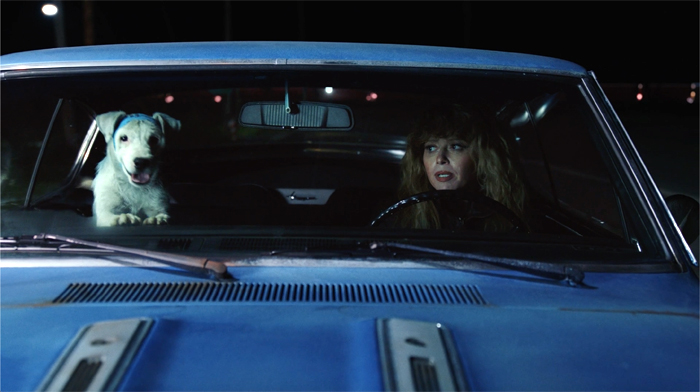
Poker Face, Ep. 3 (“The Stall,” 2023).



