






Archive for the 'Independent American film' Category
A24: the studio as auteur
Kristin here:
Regular readers of this blog may remember that back in early May I posted an entry trying to answer, at least to my own satisfaction, the question “How did ‘prestige horror’ come about?” As I wrote at the time, the piece wasn’t motivated by any particular interest in the horror genre. Instead it resulted from the confluence of three films considered to be in that category being released during the summer season: The Northman, Men, and Nope, all by interesting directors. That’s when I discovered the phenomenon of prestige horror as a trope among reviewers. I also discovered that the indie producer-distributor A24 has been a major contributor to the small group of films usually mentioned when anyone writes about prestige horror. (For a good summary of A24’s impact on the horror genre, see here.)
Later, having seen A24’s next release, Alex Garland’s Men and quite liked it, I read some uncomprehending and dismissive reviews of it. (These were largely from mainstream critics; horror buffs who wrote about it tended to “get it.”) I decided to analyze this challenging film and posted the result here.
Two days before Men was released on May 20, Variety Intelligence Platform posted an article by Kaare Eriksen, “Can A24 sustain its box office boom?” (This specialty wing of Variety is behind a pay wall; for those who subscribe, find it here.) Everything Everywhere All at Once was already about six weeks into its unexpectedly lucrative run. Eriksen commented of A24, “Its next film, ‘Men,’ which releases nationwide on Friday, may extend this momentum.”
Not surprisingly, Men did not extend that momentum. As Eriksen points out, it was made on a small budget–though how small we don’t know, as I have seen no figures on the cost of the production. Its worldwide gross of a little over $11 million seems unlikely to have made it even slightly profitable. It appeared on streaming services not long after the film went out of theatrical circulation, which was not typical of A24’s approach. Ordinarily they have left a longer window between theatrical and streaming. Men quickly became available as VOD from several services. How much it made in that fashion is unknown.
I wondered how much impact the failure of Men would have on A24’s financial well-being and decided to find out. It turns out, not much. Perhaps the studio’s head will move away from prestige horror a bit, but A24 was never a specialist in horror in the way Blumhouse is. A24’s films have ranged from high-profile Oscar winners like Room and Moonlight to the modest animated feature Marcel the Shell with Shoes on (bottom). It isn’t shying away from more conventional horror films as the recent releases of X, Bodies, Bodies, Bodies, and Pearl show.
[October 31: Will Pearl boost Ti West’s series into the prestige horror category? (The series will become a trilogy with MaXXXine.) As with Ari Astra’s films, Martin Scorsese has again gained A24 attention by describing his reaction to Pearl: “I was enthralled, then disturbed, then so unsettled that I had trouble getting to sleep. But I couldn’t stop watching.” Several news outlets covered his laudatory remarks.]
Festivals and awards
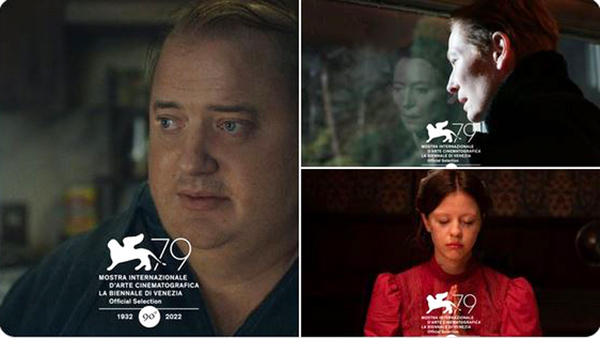
There’s nothing like a premiere at a major film festival or the bestowal of a big award to signal prestige. I mentioned in my prestige-horror piece that A24 had films in that sub-genre premiere at SXSW (Ex Machina, which also won a visual effects Oscar) and Sundance (The Witch). This year the studio took a leap upward with three films premiering at the Venice International Film Festival (above, from A24’s twitter page). Two were in competition: The Whale, by Darren Aronofsky, and The Eternal Daughter, by Joanna Hogg. One premiered out of competition: Pearl, by Ti West, an origin story for and sequel to X (2022).
Festival director Alberto Barbera, asked about blockbuster films at this year’s festival, said: “We had discussions with all the studios. There wasn’t really a blockbuster similar to Joker or Dune, but we still have great presence from the U.S. studios: WB, Sony, Searchlight, Universal, Netflix, Amazon. And for the first time we have two films from A24. I’m really glad we could make it work with them and hope it’s the first of many collaborations.” Barbera is presumably talking about the number of films in competition. Apparently he is anticipating future A24 films on upcoming programs. None of A24’s films won an award at the festival, though one result was that Brendan Fraser has joined the Oscar buzz for a best-actor nomination.
A24’s The Inspection, a film about a gay Black man determined to join the Marines, was chosen as the closing film at the New York Film Festival on October 14.
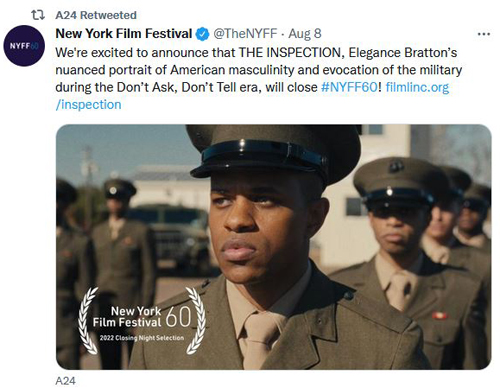
It has already played at the Toronto Film Festival.
Will A24 feature among the Oscar nominees? “In Hollywood it’s never too early to start thinking about the Oscars,” as Clayton Davis wrote in a July 28, 2022 article, “Award Season Preview: Despite Industry Changes, Winning Oscars Remains Top Studio Priority.” Studio by studio, he comments on their chances for nominations:
There’s already a pair of populist contenders in Paramount’s blockbuster “Top Gun: Maverick” and A24’s metaverse action-dramedy “Everything Everywhere All at Once,” which have cemented themselves in the best picture discussion.[…] With “Everything Everywhere All at Once” becoming the highest-grossing film in the history of independent studio A24, they may have more capital to play with to get Michelle Yeoh an overdue nomination for best actress. They’ll also give a qualifying run to “The Whale” from “Black Swan” (2010) by Oscar-nominated director Darren Aronofsky, said to have the comeback performance of the year from Brendan Fraser. They’re also partnering with Apple Original Films once again for “Causeway,” formerly “Red, White and Water” from Lila Neugebauer and starring Jennifer Lawrence, who also produces.
Having already started lists of predictions for the top Oscar contenders, Davis puts Everything Everywhere All at Once at number 6 for best picture. (Davis includes films yet to premiere, especially at Toronto.) Michelle Yeoh tops his best-actress category.
[November 4, 2022: Variety‘s Cynthia Littleton has this to say in a recent story on The Whale‘s Oscar chances: “A24, which is releasing ‘The Whale’ in theaters, is known for the NYC swagger that befits a top indie distributor.”]
[December 3, 2022 A24’s films won four awards from the New York Film Critics Circle awards, the highest number won by any studio.]
Other signs of continued prestige include a brief weekly series called “Post-Horror Summer Nights” that recently ran at the Barbicon in London. Two of the four films were from A24: The Witch and Hereditary. Also, A24 has picked up the North American distribution for Close, Lukas Ohont’s Grand Prix winner at Cannes this year.
The brand
A24 probably is the most widely recognized indie studio. It has its own devoted fans, many of them in that younger demographic so beloved of movie producers and exhibitors. It works hard to maintain that brand recognition. Naturally it has its own Facebook and twitter pages and is undoubtedly elsewhere on social media sites I ignore. It also has a podcast. It re-designs its logo in eye-catching ways to fit each film, as with the Green Knight opener above.
A24 has its own line of merchandising, selling limited-edition items. Some bear its logo and others relate to specific films.


As the notes in these examples indicate, the majority of items on the shop page are sold out.
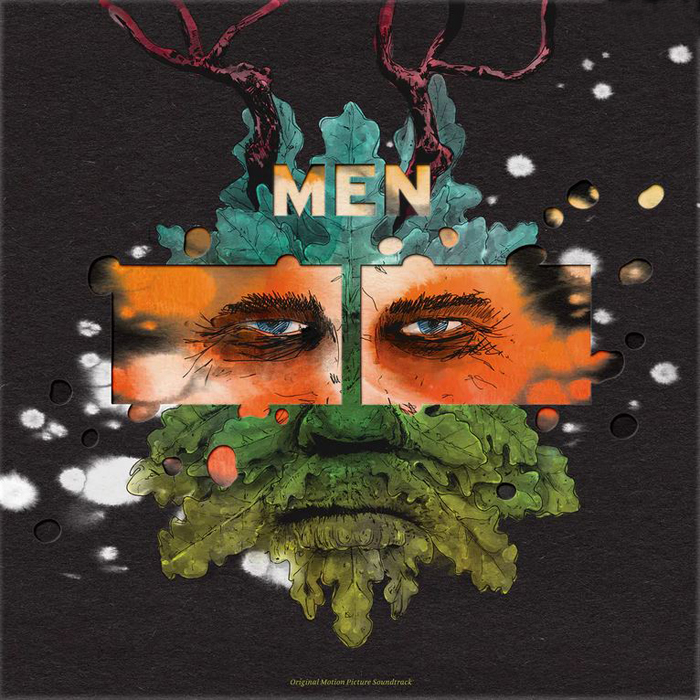
Blu-rays of some of their films, often in fancy collectors’ editions, are available. There are soundtracks as well, only on vinyl. A red-vinyl release of the Men soundtrack with a slipcase “featuring six interchangeable covers with watercolors by Julian Gross” (top). It is not shipping until December, so it’s an iffy choice for a Christmas gift. It’s also apparently the only option if you want the soundtrack on physical media; it is otherwise available only for download.
The items are fairly pricey, though I doubt they affect the studio’s bottom line much. Nevertheless, I suspect that they give fans a feeling of connection with A24 and endow it with a quirky aura that fixes it in people’s minds.
Since they are only sold through the studio’s own shop, at least all the income goes to A24 and not to amazon. Theoretically, that is. Someone bought up a batch of the Green Knight vinyl track (green, naturally), which is now sold out on A24’s shop. That entrepreneur is currently selling them through amazon for $99. The soundtracks originally cost $35 from A24. I guess this is another indication of prestige or at least fan devotion among people potentially willing to purchase a copy despite the considerable markup.
The devotion seems genuinely to be there. In a conversation about “The A24 Effect,” Sam Sanders and Nate Jones are discussing the studio’s skill at marketing films and creating a brand through merchandising:
SS: How much of that is the merch? I don’t think I’ve ever experienced a movie studio in which people in my circles are actually excited about the merch. One of my friends yesterday was raving about his A24 fleece. […] What is that?
NJ: That’s a very big part of it. No one’s walking around in a Focus Features hoodie the way that they are in A24 stuff. It goes back to the marketing, the realization that plugging into these downtown fashion circles is another way to cut through the noise. And they do these limited-edition drops that create this sense of exclusivity that mirrors the way that these films are so treated in the cultural conversation.
Sanders calls A24 “the coolest movie studio around.” The “special recipe” they detect consists of three strands: youth culture, horror, and “auteur-prestige cinema,” such as Room, Lady Bird, and Moonlight.
The finances

Despite the unfortunate failure of Men, A24 is doing quite well.
For one thing, on August 1, HBO Max recently added 28 films from A24 to its offerings, mostly films the company only distributed in its early years. Variety predicts that this list will grow as the studio’s deals with Apple+ and Showtime expire.
More importantly, A24 is expanding based on new investments. On September 1, The Economist took note in an article entitled “The Rise and Rise of A24” (behind a pay wall):
The bosses of A24 declined to talk on the record, coyly hoping their output speaks for itself. It has proved persuasive to financiers as well as awards juries. In March the company was valued at $2.5bn as it took in $225m in investment; the lead investor is Stripes, a private-equity firm that helps businesses grow. The funds will let A24 boost its production capacity. It has opened an office in London (and poached two BBC commissioners); it hopes to make films and TV programmes in other territories soon, possibly in foreign languages.
In Erikson’s “Can A24 Sustain Its Box Office Boom?” (linked above), he mentioned “A24’s reported exploration of a $2.5 billion to $3 billion sale last year, with newer streaming entrant Apple apparently interested at one point. This apparently was a result of the pandemic-related slump rather than any underlying vulnerability on A24’s part.
In another symptom of financial health, in October 2021, A24 signed a 15-year lease on four floors of a major new office building at 1245 Broadway. This building was just finished last month. I presume the studio will soon transfer its headquarters from its current modest headquarters, one floor in 31 West 27th Street, to which it moved in 2015 (above). Given the rather bare-bones appearance of the current office, I presume this is a considerable expansion and a more prestigious location. A24 seems confident that it will be around for quite some time.
I am not a fan of the studio itself, only some of the films it has made. Apparently a common accusation leveled against A24 is that it is pretentious, or its films are, or its fans are. But “pretentious” is a word used freely, depending on the tastes of the person using it. Many of the great filmmakers of cinema history are thought of as pretentious by some. The strengths of A24 are that it is surviving in an industry context where films with modest budgets are struggling in the theatrical market and franchise films dominate. In the same “The A24 Effect” podcast linked above, critic Alison Willmore points out that the studio owns no intellectual property that has generated a franchise and that its films are mostly originals or based on fairly obscure literary sources. This helps account for the considerable variety in the types of films A24 releases. It is good to see an indie studio managing to survive and even thrive these days.

Marcell the Shell with Shoes on (2022)
Figuring out MEN
Men (2022).
In an earlier entry I considered films identified as “prestige horror” and traced how the idea developed among critics and journalists in the mid-2010s. That entry was written just after I saw The Northman, Robert Eggers’ next film after The Lighthouse; it was also the first of four films being released this year and early next year, each directed by one of the four directors generally identified with the trend.
Now Alex Garland’s Men has quietly come and gone, at least in theaters. I write this a few days after distributor A24 showed a double feature of Men and Ex Machina, available for one day only, on their occasional “Screening Room” streaming series, which was launched in response to the pandemic with Minari on February 12, 2021.
Seeing Men a second time made it possible for me to take notes and get a better grasp on the complex and oblique narrative of the film. That narrative has apparently perplexed most critics and audiences, resulting in considerable annoyance. I could follow it reasonably well, and I understood what happened at the end on first viewing–a particularly annoying section for the perplexed. This second viewing confirmed that I had been right about the ending, though I find that it was set up even more carefully than I had noticed.
At first I thought I should wait until Men arrived in a more conventional continuous streaming fashion. In preparing this entry, though, I learned that the DVD and Blu-ray release date has been announced as August 9. No subscription streaming date has been announced, although one can now buy the film from several providers for $19.99. Kudos to A24 for committing (so far) to bringing out all its films on physical media as well as streaming.
So my timing may not be too premature, but I realize that many will not have had a chance to see the film yet. I should emphasize that there are major spoilers ahead. I am going to reveal what happens at the end in some detail, as well as analyzing the imagery in the film and making a stab at what it’s all about.
Challenging films
Before I launch in, I would like to say something about highly unconventional films that defy our expectations. Increasingly I read adverse reviews of such films. They seem to have upset the writer by not turning out to be what he or she expected upon entering the theater. I first noticed this response in watching László Nemes’s Sunset (2018) for the first time. Within ten minutes I was baffled but excited at the prospect of what was obviously a masterpiece. Despite my puzzlement, I think I got the gist of it and certainly sensed what Nemes was doing stylistically. I was startled to read the professional reviewers’ mostly negative notices, seemingly based on annoyance at being puzzled. Having the chance to see Sunset a second time on a screener, I understood it better and wrote up an analysis of it.
I’ve seen this sort of thing happen occasionally since, notably with Leos Carax’s Annette last year. I don’t think it’s Carax’s best film or as challenging as Sunset or even Men, but it deserved better than it got from a lot of reviewers.
I would assume that the duty of anyone writing about a film for publication, particularly one who gets paid to do so, is not to judge a film by whether it conforms to the expectations he or she brought into theater. If a film is challenging in the way these examples are, the obvious strategy is to try and figure out what the film is trying to do. How and why is it puzzling or unconventional? I remember that one professional critic who shall remain nameless wrote that she wanted to like Annette but wasn’t able to. I would say that the critic’s duty is not to like or dislike a film. That’s the realm of buffs reviewing on Facebook or Google or wherever. The critic’s duty is to understand it, to figure it out, or at least to make the attempt. I realize that such films really need to be watched a second time to get a better grasp on their strangeness, but even on a first viewing one can usually discern that a second viewing is worthwhile, and why.
Of course, trying to figure a film out may lead one to conclude that it really is bad. Maybe it’s not experimenting in original ways or it’s using flashy style gratuitously. But if the viewer does figure it out and it’s good, even a masterpiece, he or she has discovered something–a process that I find rewarding and pleasurable, whether or not I ultimately don’t much like the film.
I’m not claiming that Men is an undying masterpiece, though I do admire it more than many do. The point is that a significant number of adverse reviews reflect the same sort of unwillingness to engage with the film’s unconventionality.
This unwillingness makes me wonder what happened to the sort of openness to originality and even occasional experimentation that existed from the late 1940s, for several decades, when such films as Voyage to Italy, Hiroshima mon amour, 8 1/2, Pickpocket, Persona, Death by Hanging, and other unconventional films of the golden age of art houses. Would such challenging films be hailed and become long-treasured classics? I hope so, but …
The final and only girl
Again, I’m not going to point to particular reviewers, but many have gone for the obvious and describe the film solely in terms of the misogynistic males. Are all men misogynistic?
I do think that the title was a big mistake, inevitably egging critics on to batten onto the toxic masculinity displayed by all the male characters as the the obvious, straightforward point of the film. In that case it would be pretty simple and overly obvious. I think the form and style of the film make it more complex than that. I suspect that critics thought of the film as a sort of social commentary first and a horror film second. This may be one of the disadvantages of prestige horror. To some extent the films can be seen as art cinema rather than regular horror pictures, and therefore ripe for interpretation rather than analysis as horror films. In fact they seem to be a combination of art and genre types.
But however arty, Men is a horror film. The villains of horror and especially slasher films tend to be grotesque, often wearing masks and wielding chainsaws and the like. It’s a well-established convention. From at least Psycho on, these villains are seen as madmen, deviants, not representatives of the traits of an entire gender. They are basically monsters, some endowed with supernatural traits, as are the male characters in Men.
In struggling to figure what Garland was up to in Men, about halfway through it dawned on me that he had neatly reversed the “final girl” plot. This common structure in the slasher sub-genre of horror films was formulated by Carol Clover in her Men, Women, and Chainsaws: Gender in the Modern Horror Film (1992). Her insights have become common currency in the field, with “final girl” having its own Wikipedia entry. A crazed killer picks off a group of victims, often a bunch of male and female teenagers, in a shooting-gallery narrative. Clover points out that typically only one, usually a girl or woman, manages to survive and kill the group’s nemesis.
Men does exactly the opposite. There is a set of male villains, mostly characterized as simply obnoxious at first and becoming increasingly dangerous until they are revealed as murderous, supernatural monsters. (Samuel’s incongruous blonde female mask may be a reference to those worn by such villains.) There is no group of victims, no final girl, just the only girl, who manages to wipe them all out.
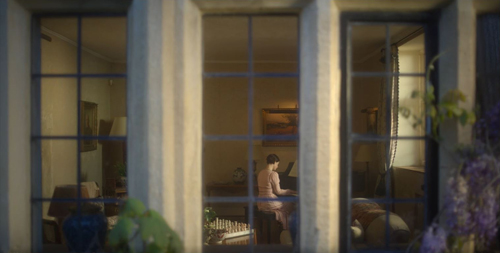
Harper is, to be sure, initially seen as a victim, pursued by the Naked Man early on and ultimately by Geoffrey, who tries to run her down in her own car before crashing it. (None of the village men apart from Geoffrey and the little boy, Samuel, is given a name. “Naked Man” seems to be what people use for him.) She is terrified in many scenes and forced to retreat to her rented house, which proves inadequate to keep these guys out. Occasional shots of her in the house are seen through the large windows, as if from a lurking villain’s point of view–a common convention of slasher films.
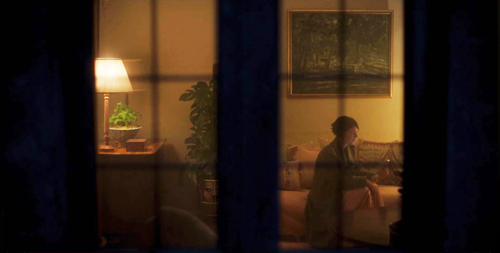
At one point she is nearly defeated, declaring to her friend Riley that she will give up her vacation and leave, though she seems more angry than frightened. Riley urges her to stay, however, and Harper fights back–ultimately successfully.
I’m not sure Garland is the only filmmaker to create such a reversal of this widespread convention. David and I happened to watch Edgar Wright’s Last Night in Soho (2021) recently, and one might say that something vaguely similar is going on. Again one woman wreaks her revenge on a series of monstrous males. There may be other such films, but I think Men is a particularly original and clever example.
They don’t call it Mother Nature for nothing
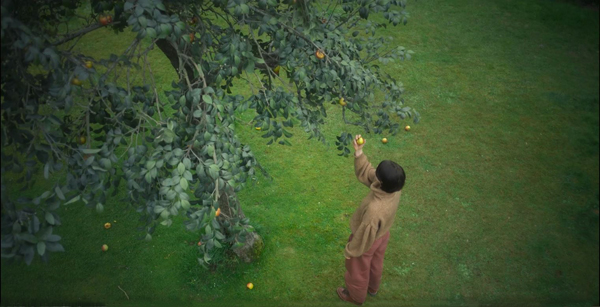
I obviously haven’t been able to read all the reviews, professional and amateur, of Men. I’ve read quite few, though, and I have yet to find one that deals with the motif of nature in the film, though some refer to the Green Man motif. The gender politics are obvious, however one interprets them, but they are bound up with the treatment of the natural world in the film. It’s a combination that both make the film more complex and give some depth and originality to the treatment of the dreadful men.
The early parts of the film stress the beauty of the English countryside, a major factor in Harper’s search for a place to recover from the grief and guilt she feels in the wake of her husband’s suicide. She rents a luxurious country house for two weeks. Upon arriving, she plucks and eats an apple from a tree in the front yard. Geoffrey, the landlord, takes the occasion to pretend that there is a rule against “stealing” the apples, and after Harper confusedly apologizes, he reveals it was a joke–albeit a mildly cruel one that suggests he isn’t entirely the jovial if awkward fellow he seems at first.
In the morning she seems not to know what to do in the house, and in a long sequence she takes a walk that gradually undermines the sense of the bucolic, restful countryside.
Harper enters a forest, the beauty of which is emphasized by the lush cinematography. The exteriors in this part of the film are dominated by bright spring greens and occasional flowers.

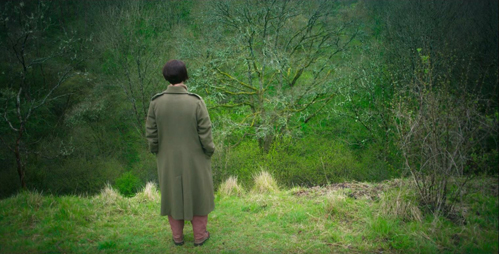
At one point she pauses, staring down into a valley at a tree. There seems to be nothing remarkable about it, apart from perhaps the fact that some of its branches are entirely green because of a thick coating of moss–something that appears on other trees as well. Her pause should cue us to pay attention to the forest as a possibly significant motif. This imagery of moss-covered trees appears in a cutaway outside the house in a later scene.
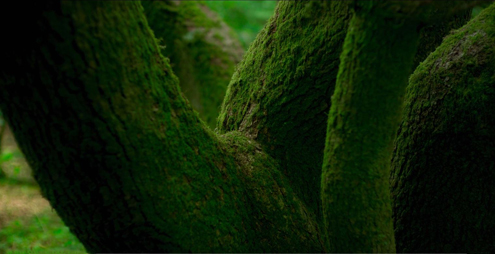
As Harper walks along a path, a gentle rain begins, and she stands delightedly listening to distant thunder and the patter of the rain. The moment is a sample of how this contact with nature delights this city dweller and could have a calming effect on her. The freedom to commune with nature in safety, however, is soon to be taken from her.
Harper approaches a tunnel that is the setting for the most widely praised scene of the film, one that will change the direction of the action radically. Again it takes place amid bright green foliage, which creates a sharp contrast with the darkness of the tunnel. As she calls out and moves into the tunnels, singing to hear the repeated echoes (which she does not notice do not always match her voice exactly), a cut takes us deep into the tunnel, with the darkness swallowing up the green forest, almost like an iris-out.
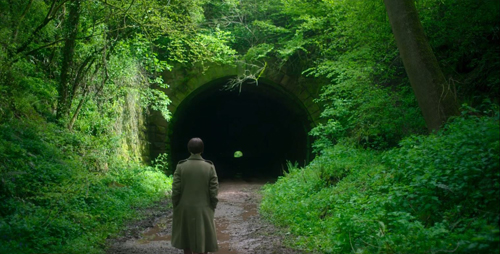
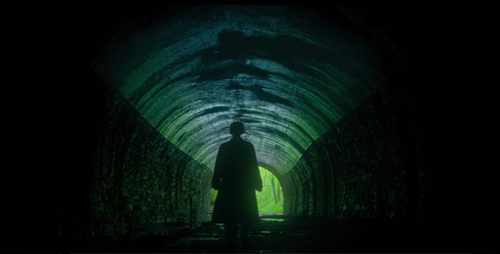
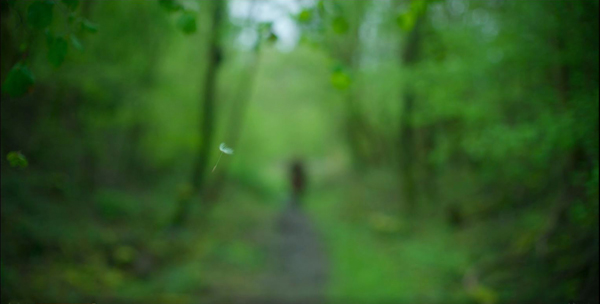
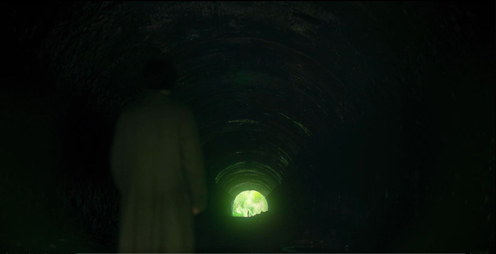
Another reverse shows an even smaller spot of green as Harper sees the silhouette of a man at the other stand up and run toward her. As she flees through the forest, there is a mysterious shot of the pursuing man, unidentifiable in the unfocused depth, while a single fluffy white seed drifts past in focus in the foreground (see image at the top of “Challenging Films.”) This sort of seed will itself become a minor, and mysterious, motif.
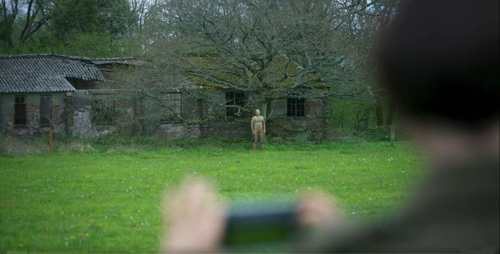
Hurrying out of the forest, Harper pauses to photograph a deserted house and spots a naked man. He apparently is not the man who pursued her; from the glimpses we get of him, he appears to be clothed.
Harper returns home, and this scene puts an end to her hopes to take walks in the countryside, something she does not do again. The bright greens become far less prominent, and later scenes tend to take place at night.
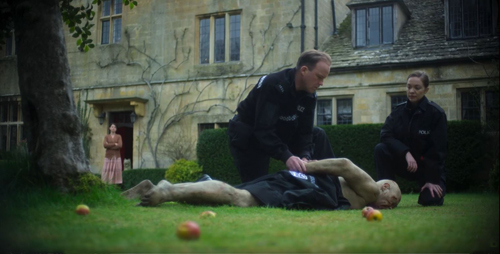
The next morning the Naked Man walks around outside the house and tries to break in. The Constable and his partner (the only local woman in the film) arrest him. The scene makes the intruder both threatening and pathetic, with his grubby skin and open sores.
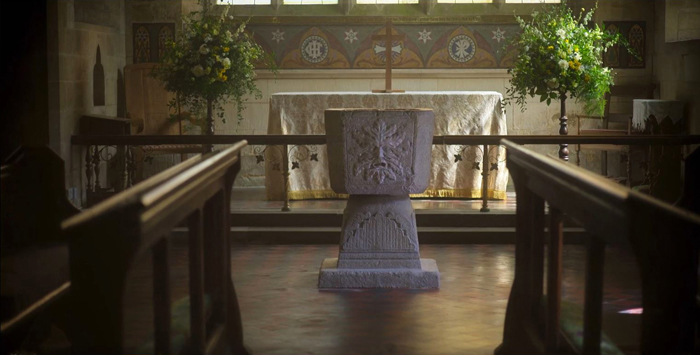
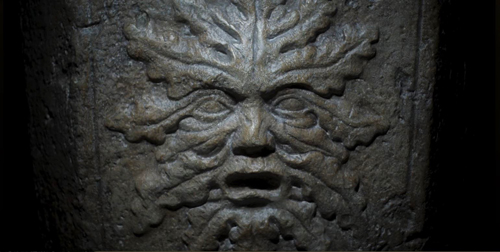
The Naked Man will become linked to a motif introduced in the next scene. Harper goes to visit the nearby village, planning to see the church and try the local pub. In the church there is a carving on the front of a marble font (top image): the Green Man, an ancient, widespread medieval pagan figure associated with rebirth. It faces Harper as she walks forward along the central aisle.
We then see what she does not. On the opposite side of the font, invisible from the pews, is a female figure, a Sheela na gig, a sort of traditional pagan counterpart to the Green Man. She is invariably a seated women with spread legs pulling open her exaggeratedly large vagina. Despite both being of pagan origin, these two mythical characters have been part of the decoration of many churches in Ireland, the United Kingdom, and Europe, and quite a few still survive.
The Sheela na gig figure is framed in the foreground as Harper sits weeping at the memory of her husband’s suicide and the local Vicar appears dimly in the background.
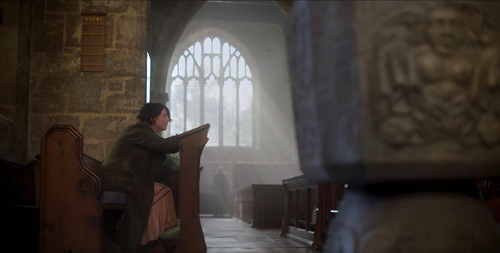
There follows a scene in which the Vicar pretends to comfort Harper, initially seeming sympathetic but then suggesting that her refusal to forgive her husband when he struck her drove him suicide. She leaves indignantly, while he sits stroking the bench where she had been sitting.
There follows an enigmatic scene in the forest with none of the characters present. In extreme close-up, a fuzzy seed drifts into the hollow eye-socket of a decaying deer. A cut that seems to follow it into darkness leads to a shot of the Sheela na gig relief. In the light of what happens later, we should keep in mind that this relief is on the surface facing away from the congregation and into the space occupied by the Vicar for all the time he has worked in this church.
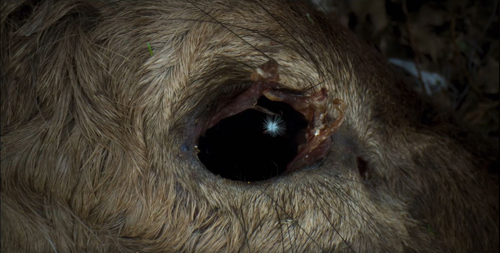
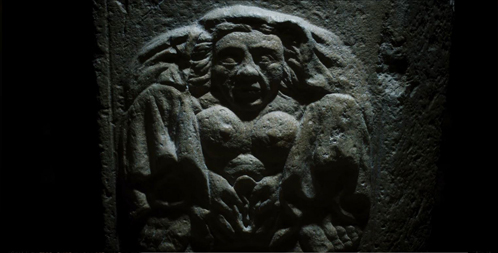
The next shot shows the Green Man face, made, as such figures are, of foliage. A brief series of shots of the Naked Man in a strange sort of den or cell, culminating in a close-up in which he peels some skin from his forehead and sticks a leave into his raw flesh. The camera then rises slowly from the carcass of the deer.
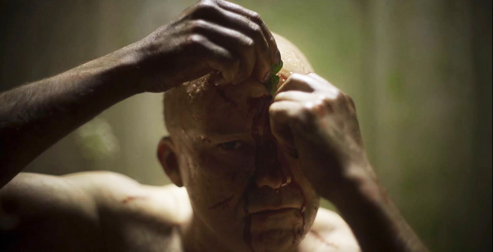
This interlude has not been any character’s subjective vision or dream. It is part of the motivic commentary on the action of the film and will come to make sense later on.
Immediately after this scene comes Harper’s visit to the pub where she learns from the Constable that the Naked Man has been released. At that point she calls Riley, saying she is leaving. But her friend urges her to stay and says she will drive to join her in defying the aggressive village men (and boy).
That ending
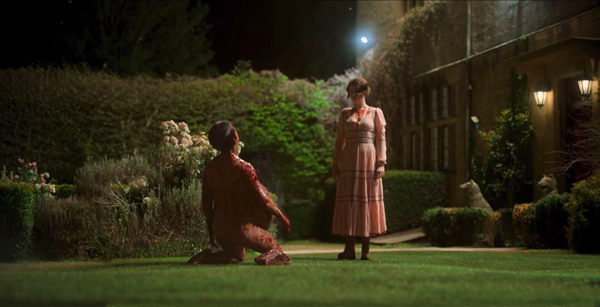
The ending seems to baffle most viewers.
All of the male characters show up at the house. Most threatening is the Vicar, who corners Harper in the large bathroom and declares his lust for her. He describes her in lewd terms that are based on the Sheela na gig figure–open legs, cave-like vagina, and an open mouth.
After this series of threats and attacks by the main male characters, Harper tries to flee in her car. She fails when she hits Geoffrey, who steals the car and tries to run her down. She takes refuge, if one can put it that way, in the garden in front of the house as Geoffrey crashes her car into wall outside, cutting off that method of escape.
At that point the Naked Man, now fully transformed into a semblance of the Green Man, enters. Now finally covered with leaves and twigs, he resembles the figure carved in the church. He is not a genuine Green Man, however, not being made of vegetation but having pressed all these leaves and twigs into his body.
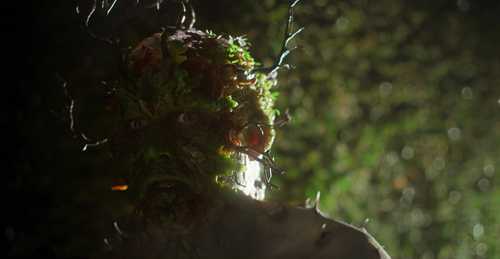
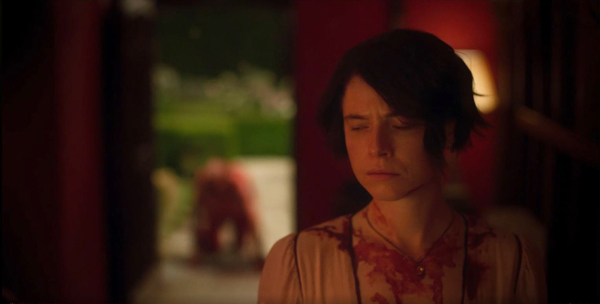
Launching an impressively intense foray into body horror, the Naked Man lies down and gives birth to Samuel, who kneels before Harper, his belly swelling (above) until he gives birth to the Vicar, who crawls feebly into the hallway as Harper turns away in contempt (frame atop the “Only Girl” section). He then gives birth to Geoffrey, who gives birth (or vomits?) Harper’s husband James through his mouth.
Unlike the others, James is not covered in blood and does not continue the male-birthing chain. He sits down and blames Harper for the injuries incurred during his suicide, which he still bears despite his “rebirth.” Nevertheless, he demands her love. She turns away, wearily sighing, “Yeah.” Cut to a large red title against black: MEN.
An epilogue follows immediately, with Riley arriving to find the door standing open and signs of bloody objects being dragged (see bottom). Ironically, she is revealed as pregnant, and the flowers return as she approaches the house (see bottom). She spots Harper sitting calmly on a stone stairway in the garden and joins her. The two women reunite happily.
That’s quite an ellipsis. What happened “during” the scene elided by the MEN title? It seemed obvious to me on first viewing that Harper killed James and any of the others who might still be living, though my impression is that each died after giving birth. What happened to the corpses? No idea. Maybe they magically disappeared, as they had magically arrived. After all, earlier we had seen two characters, the Constable and Geoffrey, instantly disappear into thin air. If that happened, why the bloodstains remain is a mystery. Still, one thing I was sure of: James and the others are all dead and gone.
How do we know this? The signals are clear, but one needs to watch carefully. Chekhov famously wrote several times in different variants that “If in the first act you have hung a pistol on the wall, then in the following one it should be fired. Otherwise don’t put it there.” The principal is known as “Chekhov’s gun.”
Garland follows this guideline and prepares for the final elided murder.
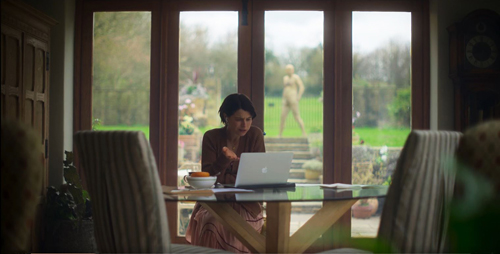
First, during the morning scene when Harper is working remotely and fails at first to notice the Naked Man outside, she goes to the kitchen and a close-up emphasizes her hand plucking one of three knives from a holder to cut an orange. Immediately afterward we see the Naked Man again as she resumes work, the orange beside her–reminding us that she does have a means of defense. He tries to come in, but she successfully locks the door and simply calls the police.
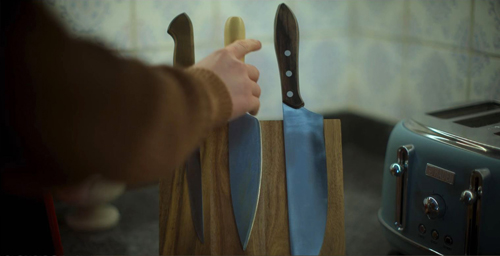
After Harper learns at the pub that the police have just given the Naked Man a bath and clothes and released him, she calls her friend Riley to report the various nasty encounters with the Vicar, Samuel, and the Constable. Riley offers to join her at the vacation house, adding, “If that fucking weirdo comes back, I’m gonna take that axe and chop his dick off, and he can fucking choke on it.”
Harper asks, “What axe?” and Riley says it’s behind her. As indeed it is. (The fireplace beside which it sits has been seen and mentioned already. Not that it’s ever lit, but it’s where the axe is.)
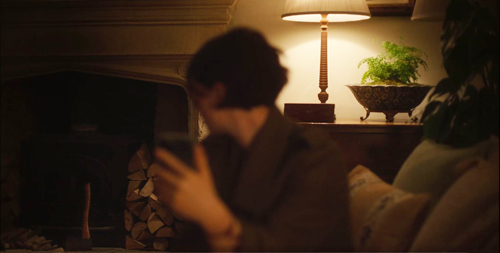
Now we’ve had two potentially deadly blades called to our attention. Knowing Chekhov’s rule, from this point on I was assuming Harper would use that axe in a climactic fight.
But since we don’t actually see the axe used with deadly force, Garland needs to show that she would kill someone with it if necessary. Hence the return of the knife.
At about sixty minutes in, the attacks on Harper in her house begin. The mysterious Constable who had released the Naked Man appears on the lawn and then vanishes instantly. Immediately one of the thugs from the pub tries to get into the house. Harper grabs the same knife and hides in the kitchen, where Samuel enters. She refuses to use it on a child, and when Geoffrey appears, she still trusts him. He pretends to search the garden before suddenly disappearing, as the Constable had done.
At that point the Naked Man returns and blows a handful of fluffy seeds into Harper’s face, seen from her POV. He has visibly made some progress toward turning himself into a Green Man.
The seeds seem to send Harper into a trance. She falls backward in slow motion and has a vision of herself possibly drowning. A quick montage of earlier scenes follows, but she recovers and manages again to slam and lock the door to keep him out.
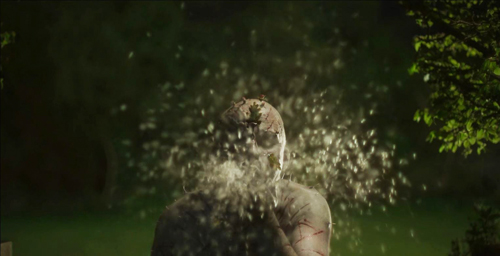
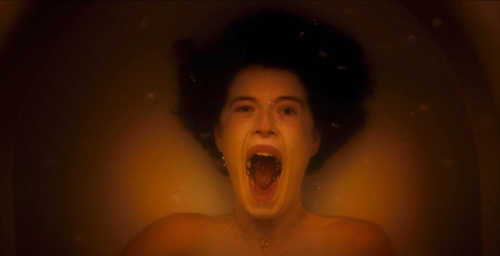
At this point the Grand Guignol aspects of the action ramp up as the Naked Man sticks his arm through the mail slot and grabs Harper’s wrist. In a dramatic shot from below, she stabs his arm.
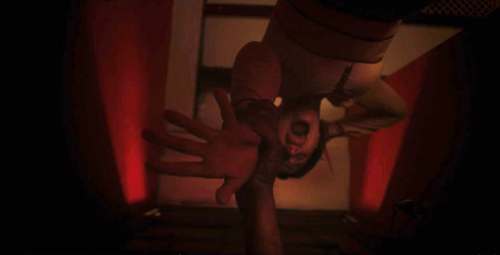
As Harper watches the Green Man withdraw his arm through the slot, its edges pull the knife through his forearm and hand, splitting them in two down the middle. (This horrendous wound is transferred to the other men who have harassed or endangered Harper.) Shortly thereafter, when the Vicar arrives (with the split arm), he accuses her of trying to control him with her carnal powers and nearly rapes her. She uses the knife again, this time to kill him.
By this point we should be thoroughly convinced that she would be equally capable of wielding an axe. Indeed, part of the suspense during the “rebirth” scene is when she will finally go and pick it up. She does so as Geoffrey “gives birth” to James. Garland emphasizes it with a low framing of it and the door through which James enters.
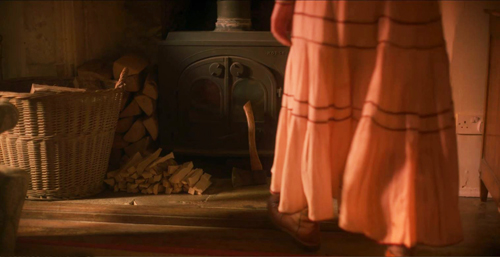
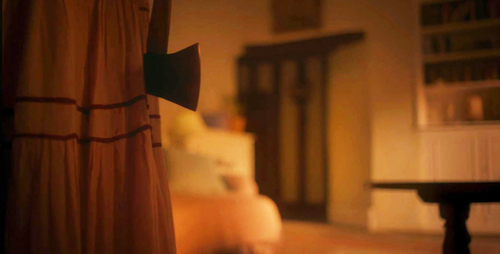
James collapses on the sofa, and Harper crosses to sit beside him. She doesn’t put down the axe, as we might expect her to do if she is considering admitting that she still loves him. It should be noted that he still has his broken leg (which is also shared with all the other males in the rebirth scene) and his other wounds from his suicide. He is not her real husband James but some simulacrum of a human, like the bloody monsters we have seen emerge during the rebirths. That has to be understood if we are to accept what is implied to happen next. In the last shot of the scene, Harper does not tell James she loves him or that she is sorry for having contributed to his suicide. She just sits fingering the blade of the axe. Cut to the “Men” title.
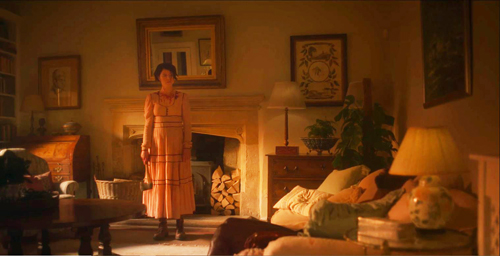
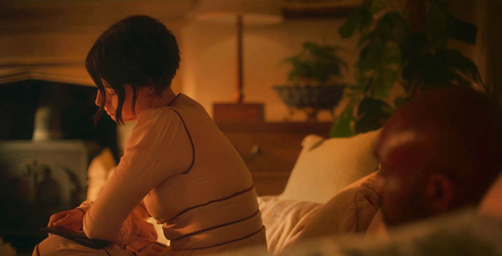
I think there’s no doubt that, unseen by us, that axe gets used. Chekhov was right. Clearly Garland, although he made us cheer on Harper as a strong woman, doesn’t want us to see her chopping up her husband, dead though he may actually be already, and we don’t want that either.
How hard is this to grasp when watching the film? Hard, maybe, but not impossible. Christen Warrington-Broxton posted a piece on Google’s page for amateur film reviews. She offers a cogent analysis of the film, including a response to those who claim that the final scene of the climax does not resolve the action. She points out that “our heroine is clearly calculating how she will dismantle that mess with the axe.” During the rebirth segment of the scene, “the modern woman walks away from the inevitable and pathetic rebirth of toxic masculinity that comes for her: the ex. She goes to wait to prepare herself emotionally, and physically with the weapon her female friend pointed out to her. She must destroy this presence in her life.” (Ms Warrington-Broxton also identifies the Sheela na gig, a figure I had not been aware of.)
Oddly enough, though, the Vanity Fair review presents a pretty cogent summary of the action and does not even speculate about what happened between James and Harper after that cut to the title. No mention of the axe or the possibility that violence occurred. Particularly odd for a piece entitled “Men: Let’s Unpack that Disturbing, Disgusting Ending.”
Finally, why bring in the Green Man and Sheela na gig imagery? What is the point of having all the males apart from James played by the same actor? Why make all the village males bear the same horrific wounds, even though only each wound was inflicted on only one man? And why do those wounds echo those of James as he lands impaled on an iron fence and with a grotesquely broken leg after his suicide jump? (Geoffrey suffers a similar leg wound when hit by Harper’s car.)
To be brief, Garland reverses the usual associations of the two mythical figures, who are generally regarded as positive forces–the Green Man as a emblem of rebirth and the Sheela na gig as a protector against evil and, not surprisingly, a fecundity symbol. The film presents them as grotesque and threatening or lewd. The males in the film are linked to them as if to the archaic beliefs, especially about women, of a long-gone time.
The similarities among the male villagers might simply be seen as a blanket condemnation of all men simply as misogynists. Since this is a horror film, however, the point is to make them all monstrous and grotesque in a similar way, sharing the atavistic instinct that drives their behavior toward Harper. The casting of Rory Kinnear as all of these men emphasizes this shared instinct. It also sets them apart from James, who is a classic domineering, guilt-tripping husband but not a literal monster until he joins in the chain of rebirth at the end.
Prestige horror going forward
The two films released since I wrote my first piece have not done well. As of July 18, Box Office Mojo listed Men as having earned $10,304,884, about three-quarters of which came from the North American market. The budget isn’t known, but it’s hard to imagine one so low that Men could come close to making a profit, even given that various forms of home-video are yet to come.
The Northman has been streaming for some time now, but again, with a budget estimated at $80-90 million, it does not look like a hit.
One thing is interesting to note, though. I pointed out in my first entry that the “prestige horror” films by the four directors discussed have all scored higher on Rotten Tomatoes among critics than among audiences. By contrast, more conventional horror films nearly always had higher marks from audiences than from critics. Men did worse on Rotten Tomatoes than any of the earlier prestige films listed in the previous entry had, with a 69% positive critical response and a 40% audience one. It’s quite a come-down, but the critics’ score fits the pattern by remaining higher. Last Night in Soho upheld my claim that more conventional horror films did better with audiences; it scored 76% with critics and 90% with viewers.
Whatever the outcome of Men‘s streaming life for A24’s bottom line, Garland apparently wants to quit directing and go back to writing. He has been saying this in interview after interview (too many to link–just Google “‘Alex Garland’ quitting directing,” and you’ll find pages of results). The first time was in an interview with the New York Times (behind a pay wall) on May 16, four days before the American release of Men. Thus the financial failure of the film was not the direct cause of this decision, but one cannot help but suspect he knew what was coming:
It’s the sort of movie that will leave people arguing about its intent, and about what it’s trying to say. You once told me that with “Ex Machina,” you wanted at least 50 percent of the film to be subject to the viewer’s interpretation.
Over the years, I have been consciously putting more and more into the hands of the viewer. There’s probably another element to it, too, if I’m honest, which is that it’s making the viewer complicit. This is another reason to pull back, because there’s a part of me which is really subversive and aggressive and is kind of [messing] with people. At times, I felt with “Men” that I’ve gone so far that it’s borderline delinquent.
The caption for the portrait of Garland atop the interview says that That could be discouraging, though if one makes a deliberately “subversive and aggressive film,” one shouldn’t be surprised.
In the wake of The Northman‘s release and financial disappointment, Eggers told interviewers that he was going to back off from epics on that scale and return to smaller films. In one conversation, he said, “I need to restrategize in terms of what I’m pitching to a studio. Like, how do I be me and survive in this environment? Because while they wouldn’t have me anyway, I wouldn’t want to direct a Marvel movie, and I’m also not going to try to get the rights to Spawn or something either.” This follows from what I wrote in my previous entry, that one interesting thing about these four directors is that none has followed the common pattern of using low-budget horror films as springboards to working in big franchises. Apparently this still holds. So far.
[August 6, 2024: Eggers latest film, Nosferatu, is most definitely in the horror genre; oddly, its American release by Focus is scheduled for Christmas day, 2024. An example of counterprogramming, I guess.]
Today the third “prestige horror” director’s film of the year, Jordan Peele’s Nope, goes into wide release. Box Office Mojo is predicting that “In all likelihood, Nope will become the top domestic grossing original film since the start of the pandemic.” That, added to the financial successes of Peele’s previous films, plus his links with Universal and Imax suggest that he may go in a different direction from the other three auteurs in this small group.
[July 24, 2022] I haven’t seen Nope yet, but Justin Chang’s positive review in the Los Angeles Times suggests that Peele remains true, at least for now, to prestige horror: “an unusually well-made and imaginative thriller that’s sometimes tripped up by its own high-mindedness.”
Ali Aster’s Disappointment Blvd., rumored to be a comic horror film in the region of four hours long, was announced as a 2022 release. Recently, however, that was put off until 2023, with possible hopes for a Cannes debut. We shall have to wait a while to see if the old gang is breaking up.
Film websites focusing on horror, fantasy, and/or sci fi tended to give Men far more positive notices. See, for example, Meagan Navarro’s piece on Bloody Disgusting, which catches the fertility imagery and the Grand Guignol quality of the ending, though she doesn’t mention the implication of what happens after the last shot of the climax.
A short time after my piece on Sunset was posted, a friend of ours in Hungary, who teaches and has many contacts in the film industry, told me that Nemes had asked him who this Kristin Thompson was. I assume our friend gave me a good report. I like to think that, among the many negative reviews, mine gave him some indication that he had accomplished what he intended in the film.
Rather to my surprise, Sunset is available for streaming on virtually every service that exists, Netflix, Amazon Prime, Hulu, etc. I hate to recommend seeing this beautiful widescreen film on a TV screen, but I suppose it’s better than nothing.
[August 6, 2024: Aster’s Disappointment Blvd. was renamed Beau Is Afraid (2023). Produced and distributed by A24, it was the studio’s most expensive film before Civil War; it did poorly at the box-office.]
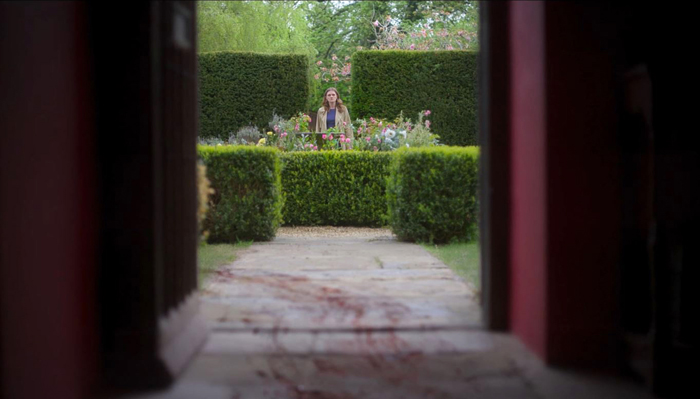
Men (2022).
How did “prestige horror” come about?
Trailer, The Northman (2022).
Kristin here:
Ever since last August I have been venturing into our local multiplexes to see movies. Fully vaccinated, twice boosterized, wearing a mask, and attending weekday matinees in the company of maybe four to ten other people, I have felt safe. It’s great to see movies on the big screen again, and I’ve seen nearly twenty, starting with Annette in August and not counting the five I saw at the Wisconsin Film Festival.
The latest was The Northman, on April 25, a Monday. I had seen the trailer for it three or four times before I realized that it was by Robert Eggers, director of The Witch, which I liked well enough, and of The Lighthouse, which I admire very much.
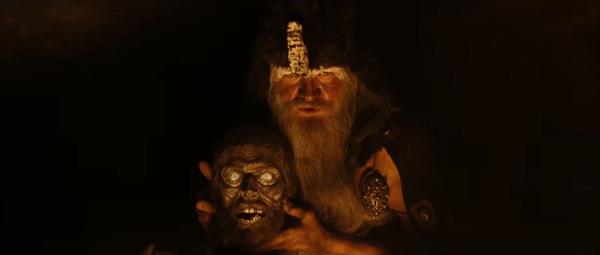
Before the film there was the usual flood of trailers, including ones for Nope, Men, and The Black Telephone. It struck me as I watched them that despite the fact that I am not particularly fond of the horror genre, there I was, waiting to see a horror film–at least I’m classifying it as such under the rather casual criteria I’m using here. And if you doubt it’s a horror film, I present you with a frame of the character identified in the credits as the He Witch, holding the mummified head of Heimar the Fool. (The story is based on an ancient Scandinavian myth, the same one whence Hamlet was derived. This may be the equivalent of the Yorick scene.)
Not only was I there to see a horror film, but I was looking forward to seeing two of the three such films previewed: Jordan Peele’s Nope and Alex Garland’s Men. (Apparently these succinct titles are designed to avoid even the faintest whiff of a spoiler.) Later, musing on that confluence of horror films coming out this spring, it occurred to me that all three of these directors had concentrated exclusively on the genre in the features they have made so far–three apiece, coincidentally. And while all three had had some degree of critical, popular, and/or financial success, none of the directors has so far moved into the world of franchise blockbusters. It’s so common these days for indie directors to be swept from the world of low-budget art-house filmmaking to to heady heights of franchise series that I suspect one or more of the three have received nibbles from the studios.
One or more may eventually succumb to the blandishments that have attracted such indie directors as Taika Waititi, Guillermo del Toro, and Chloe Zhao into the world of Hollywood blockbusters. For now, though, it’s remarkable to find three directors with such similar careers in many ways who have stuck to the modest genre that brought them success when they probably had other options. It’s so common these days for an aspiring filmmaker to break into the industry with a low-budget horror film that becomes a hit and then immediately to be helming an epic with a budget distinctly into nine figures. (For a list of superhero-film directors who started in horror, see here; for a more general one of indie directors who jumped to blockbusters, here.)
There’s a fourth director who belongs with this group. I haven’t yet seen a trailer for Ari Aster’s Disappointment Blvd., which is being kept under wraps but is due out this year. It is described as a comic horror film. Gamerant has the fullest information on it that I’ve found. Excerpts:
Following the tradition of his previous movies, Aster will serve as both writer and director of Disappointment Blvd. While the movie is shrouded in mystery and doesn’t have a trailer yet, it will be a decades-spanning horror-comedy about a famously successful entrepreneur. And if Hereditary and Midsommar are anything to go by, it will be a genre-bending horror-comedy at that. In conversation with UC Santa Barbara students, Aster described Disappointment Blvd. as a 4-hour long “nightmare comedy,” though whether he was joking about its length remains to be seen.
A24 will distribute Disappointment Blvd. as well as co-produce it with Square Pegs: Ari Aster and producer Lars Knudsen’s production company. Disappointment Blvd. began production in June last year and is set for release later this year, though no official date has been given yet.
There is speculation that the movie will have its world premiere at the Cannes Film Festival due to take place from 17 to 28 May 2022. Fortunately, the festival announces its lineup on the 14th, so fans won’t have to wait long to find out.
Eggers, Peele, Garland, and Aster all unquestionably belong to a trend that has recently been given a name–in fact, two: “elevated horror” and “prestige horror.” Elevated horror as a concept began to gain currency after the release of Eggers’ first feature, The Witch, in 2015. I suspect that Garland’s Ex Machina, which came out in 2014, had something to do with that. Many would count it as science-fiction, but under my loose criteria here, it counts as horror–especially since Garland’s two subsequent films undeniably fall into the horror genre. Elevated horror, according to The Hollywood Reporter, is a treatment of films as quasi-art cinema, as well as a focus more on psychological dramas than gore.
I don’t care for the term “elevated horror,” since it could imply simply a ratcheting up of the level of horror included in the film. This is far from what these directors are doing, although The Northman has little interest in psychology and contains plenty of graphic dismemberment.
In recent years there has come to be a vituperative reaction against “elevated horror” among fans, who claim it implies that the rest of the genre is trivial, trash, whatever. I have no interest in the resulting debate, but google “elevated horror,” and you’ll find it.
The same basic debate simmers concerning the term “prestige horror,” with fans claiming that treating prestige as something new to horror films dismisses the many classics of the genre that have gained critical respect, awards, and status as classics. Yet The Exorcist, Rosemary’s Baby, Jaws, Children of Men, Bram Stoker’s Dracula, and others have been and remain well-respected. They have, in fact, prestige, as do the films of this younger group of filmmakers who have stuck to the horror genre. But the classics just listed were directed by people who worked in a variety of genres and did not stick to horror. I’ll use “prestige horror” here, since it seems to me to accurately describe what distinguishes the work of these four directors and other films (e.g., A Quiet Place, Saint Maud) from more conventional mainstream horror films. The term basically, I think, is a suggestion of something more respectable emerging from an era in which “torture porn” seemed to dominate the genre.
This entry doesn’t aim to present an overview of prestige horror. I have simply been intrigued to see what these four filmmakers, who have made a body of work which could be considered the core of the current prestige-horror trend, have in common and how those commonalities have helped create this new perception of a trend within the larger genre.
My interest arises from the fact that within a short period these directors have each made multiple reasonably successful feature-length horror films that have attracted favorable attention from critics, film festivals, fans, and institutions dishing out awards.
The Films
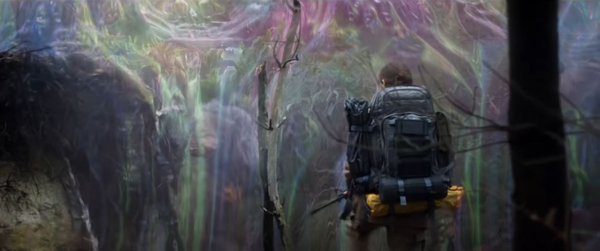
Annilhilation
Here is a chronology of the four directors’ films, with information relevant to explaining their prestige status.
2014
EX MACHINA (Alex Garland) Dist. A24
Budget: $15,000,000
Worldwide Gross: $36,869,414
Rotten Tomatoes: 92% critics 86% audience (6 points difference)
2015
THE WITCH (Roger Eggers) Dist. A24
Budget: $4,000,000
Worldwide gross: $40,423,945
Rotten Tomatoes: 90% critics 59% audience (31 points difference)
2016
None
2017
GET OUT (Jordan Peele) Prod. Blumhouse and Dist. Universal
Budget $4,500,000
Worldwide gross $255,407,969
Rotten Tomatoes: 98% critics 86% audience (12 points difference)
2018
ANNIHILATION (Alex Garland) Prod. Skydance Media and Dist. Paramount
Budget: $40,000,000
Worldwide gross: $43,070,915
Rotten Tomatoes: 88% critics 66% audience (22 points difference)
HEREDITARY (Ari Aster) Prod. and Dist. A24
Budget: $10,000,000
Worldwide gross $80,200,936
Rotten Tomatoes: 89% critics 68% audience (21 points difference)
2019
THE LIGHTHOUSE (Robert Eggers) Prod. and Dist. A24
Budget: est. $11,000,000
Worldwide BO $18,177,614
Rotten Tomatoes: 90% critics 72% audience (18 points difference)
MIDSOMMAR (Ari Aster) Prod. and Dist. A24
Budget: $9,000,000
Worldwide gross: $47,967,636
Rotten Tomatoes: 83% critics 63% audience (20 points difference)
US (Jordan Peele) Prod. Monkeypaw Productions and Dist. Universal
Budget $20,000,000
Worldwide gross $255,184,580
Rotten Tomatoes: 93% on RT, 60% audience (33 points difference)
2020
None
[DEVS, Alex Garland, 8-episode mini-series for Hulu]
2021
None
2022
THE NORTHMAN (Robert Eggers) Prod. by Regency and Dist. By Focus (specialty wing of Universal)
Budget: est. $70-90,000,000
Worldwide gross to May 4: $43,934,635
Rotten Tomatoes: 89% critics 66% audiences (23 points difference)
MEN (Alex Garland) Prod. and Dist. A24
Budget: Unknown. Collider refers to it as “a low-budget horror film.”
NOPE (Jordan Peele) Prod. Monkeypaw Productions and Dist. Universal
Budget: Unknown [July 23, 2022. Variety now reports the budget as $68 million.]
DISAPPOINTMENT BLVD. (Ali Aster) Prod. and Dist. A24
Budget: Unknown
Clearly the pandemic has delayed the completion and release of horror films, as it has with other genres, resulting in a rush of releases by all four directors in the same year. There might have been films by all four directors in 2019, but Garland was presumably busy producing, writing. and directing all eight episodes of the FX series Devs, which premiered on March 5, 2020. The series could be described as being a combination of the sci-fi and horror genres, rather like Ex Machina.
The prestige
Reviews, professional and amateur
These days, one indicator of public prestige, albeit a crude one, is the critical aggregator site, Rotten Tomatoes. It is striking that every film in this group has been rated more highly by professional critics than by audience members. Other films mentioned in discussions of prestige horror also see a similar split, as with Saint Maud (2019, Rose Glass, distributed by A24), which had a 93% critical rating versus 64% audience approval. On the other hand, Saw (2004, James Wan, distributed by Lions Gate), which is definitely not in the prestige category, had a 51% critics rating and 84% audience approval.
Festivals and Awards
It is perhaps going a bit far to call these art-house horror, since they usually play multiplexes. Still, some premiere at prestigious festivals dedicated mostly to indie films that do play art houses. These include Sundance for The Witch, Get Out, and Hereditary. Ex Machina and Us were first shown at SXSW, the latter as the opening night film–a position held by A Quiet Place the year before. The Lighthouse premiered out of competition at Cannes, and Men will do so later this month (and possibly Disappointment Blvd., see above). Announcing the latter, Deadline commented, “The non-competitive independent sidebar to the main Cannes festival has grown in reputation in recent years, having premiered pics such as Robert Eggers’ The Lighthouse, Sean Baker’s The Florida Project and The Rider by Oscar winner Chloé Zhao.”
For Nope, Peele took a more mainstream approach, revealing an extended trailer at Cinemacon on April 27, 2022.
Obviously awards signal prestige. To name some of the most notable, Eggers won for best director of a dramatic film for The Witch at Sundance. The Lighthouse won the critics’ FIPRESCI prize at Cannes, was nominated for an Oscar for best cinematography, and won the cinematography prize from the American Society of Cinematographers. Peele’s Get Out was nominated for four Oscars, winning best original screenplay. Peele made Time‘s list of the 100 most influential people in the world and the top-ten lists of the National Board of Review, the AFI, Time, and others. (He was also nominated as a producer of BlacKkKlansman.) Ex Machina surprised just about everyone by winning the Visual Effects Oscar in competition with Mad Max: Fury Road, The Martian, Star Wars: The Force Awakens, and The Revenant. The Hollywood Reporter considered its win “arguably the night’s biggest upset.”
These are some of the highly prestigious prizes. Festivals and prizes have proliferated in recent years. Local critics’ associations and proliferating specialist sci-fi/horror/fantasy festivals give out hundreds of awards, most of which never come to the general public’s attention. They do, however, stimulate interest among the core audience for horror films. (Extensive lists of such festival’s nominees and winners are provided on IMDB.)
Production and Distribution
The first three films on the above list made impressive profits on small budgets–especially Get Out. Ex Machina and The Witch were financed by cobbling together money from small, obscure companies and then picked up for distribution by A24. Both films came out one and two years respectively after A24 had released its first film in 2013, so relatively early in the company’s existence. They were among the many that have made A24 the most successful, admired producer and distributor of independent and foreign films. Ex Machina provided A24 with its first Oscar win.
The third, Get Out, made a spectacular amount of money on its modest budget.
These successes may have encourage Paramount to pick up the fourth, Annihilation, in the expectation of a similar success. Despite being one of the best films of the group (in my opinion), it was not popular and is the biggest money-loser of the group (though the final grosses for The Northman are yet to come).
The sub-genre bounced back with Heredity, which was (and may still be) A24’s biggest money-maker. The company then bankrolled Aster’s follow-up, Midsommar, which was profitable, if less so than Heredity. A24 also produced both films, so it was able to keep the entire take. These successes were perhaps some consolation for The Lighthouse‘s probable failure to break even. (A24 also produced it.) Eggers departed A24 for Regency, with an estimated $70-90,000,000 budget for The Northman–far and away the largest of any of the films released so far. Its worldwide gross as of May 4, two weeks after its release, is a bit under $44 million, making a profitable result unlikely.
The importance of A24 to the prestige horror film should be obvious. It has distributed six of the eleven films and produced three of those six.
A24 was formed in 2012. Today, the company’s astonishing list of films includes many indies of all types, including Moonlight, Minari, First Cow, The Florida Project, The Tragedy of Macbeth, and most recently Everything Everywhere All at Once.
A24 seems committed to Alex Garland, having announced that they will produce and release his next film beyond Men, entitled Civil War. That doesn’t sound like a horror film, but who knows?
A24 has clearly been crucial to the careers of Garland, Eggers, and Aster, but Peele has followed a different path to success. In 2002 he began as a stand-up comic and soon was appearing in occasional episodes of such shows as The Mindy Project and Fargo. He gained fame in the comedy series Keye & Peele, which ran from 2012 to 2015. He also produced it, forming his own production company, Monkeypaw Productions in 2012. Coincidentally this was the same year that A24 was formed, perhaps helping explain why the careers of these directors have progressed in parallel. He has continued to produce shows like Twilight Zone and Lovecraft Country. He turned to filmmaking in 2017 with Get Out, which was produced by Blumhouse, known for its low-budget, ordinarily less prestigious horror films. Universal distributed what became the most profitable film of the entire group, compared to its original budget, and soon formed a closer relationship with Peele.
In an interview with Indiewire, Peele described being cautious about asking for a larger budget for his next film, Us.
When he sat down with Universal, the studio that distributed “Get Out,” to pitch his sophomore feature, “the cards were kind of in my hands,” Peele said. “It didn’t feel like an audition. It was me telling them, ‘This is what I want to do, this is where I want to do it, how’s that sound?’” […]
“I had about five times the budget on this one, which by movie standards is still not that expensive of a film,” he said. “That was the key for me. Otherwise, I may not have had my freedom. As a filmmaker, I also thrive with a certain restriction. I didn’t want to overreach with the budget and all of a sudden have a studio being responsible on me.” He laughed. “There’s never been a point where they’ve expressed anything but wanting to make this.” When Universal gave Peele the green light to make “Us,” it also signed a first-look deal with his Monkeypaw Productions.
Universal financed and released the film, sending it to SXSW for its premiere. Remarkably, it and Get Out generated almost identical worldwide grosses. Indeed, they are far and away the top earners among this set of films. In 2019, the year Us came out, Universal signed Peele to a five-film contract, reportedly worth $300-400,000,000.
As a result of all this, Peele stands out from the rest of the group by being a very rich man. His worth in 2021 was widely estimated at $50,000,000.
This deal presumably included the recent remake of serial-killer film Candyman (2021), produced and written by Peele and directed by Nia DaCosta.
How much higher the budgets will be for these future films is impossible to predict. It is notable, however, that Nope was shot by Hoyte van Hoytema, cinematographer of Christopher Nolan’s Interstellar, Dunkirk, Tenet, and upcoming Oppenheimer. It was made on film and had sequences done in 65mm. It will be shown in Imax theaters, an obvious step up from the previous two films.
Moreover, Peele is among top Hollywood directors collaborating on Imax’s development of its next generation of cameras. Indiewire reports:
The new models are expected to be an improvement over IMAX’s current offering of cameras that utilize their proprietary 65mm film. The new cameras will be quieter, with a series of new features added to enhance usability. In addition to the four new cameras, many existing IMAX cameras and lenses are expected to be updated and improved.
If that was not exciting enough, the company will be collaborating with some of Hollywood’s top visual artists on the camera designs. Major directors including Christopher Nolan and Jordan Peele will weigh in on the new film cameras, as will top cinematographers including Hoyte van Hoytema (“Tenet”), Linus Sandgren (“No Time To Die”), Rachel Morrison (“Black Panther”), Bradford Young (“Arrival”), and Dan Mindel (“Star Trek”). Combined, those filmmakers account for many of the most acclaimed large-scale movies shot on film in recent years, in addition to even more that were shot digitally.
If Nope is a success, as Forbes is predicting it will be, will Peele branch out into other genres or continue to make prestige horror films on a bigger budget? His enthusiasm about Imax technology may hint at an inclination to break out of his current pattern for other effects-heavy genres. Still, perhaps a clue comes from the name he gave his production company, Monkeypaw Productions, invoking the classic Le Fanu horror story.
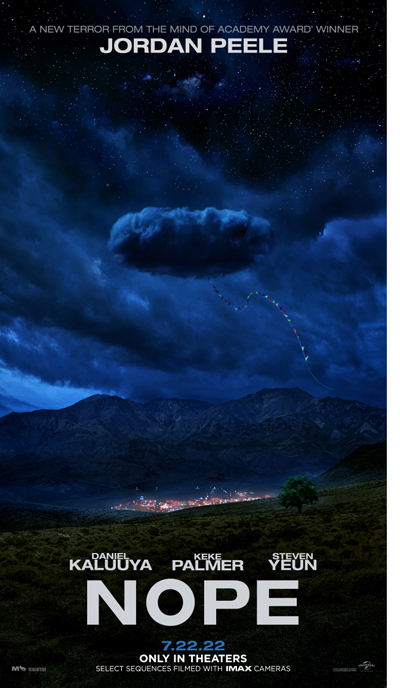
The distributors, and in the case of A24 producers, of these films have turned these directors into brand names elevated above most directors of horror films. The trailer for The Northman touted Eggers as “visionary” (top) while Paramount combined the signs of prestige in its poster: “new terror,” emphasizing Peele’s consistency as a director of horror; his “mind,” suggesting his genius for this sort of filmmaking; and naturally his record as an Oscar winner (above left).
Midsommar madness
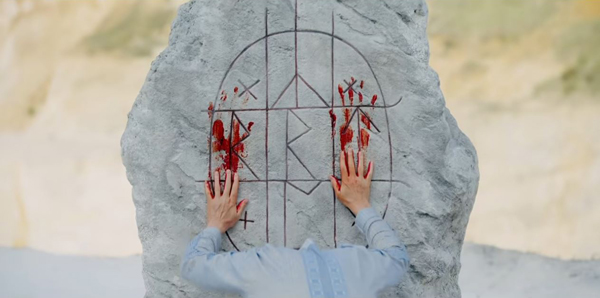
Midsommar has emerged as one of the most admired films of the cycle, despite having had the lowest Rotten Tomatoes critics score and third lowest audience score. Its move toward prestige began quickly when less than two months after the film’s July, 2019 release, Aster appeared at the Scary Movies Festival at Film at Lincoln Center, introducing the Director’s Cut of the film. The length was increased from 148 to 171 minutes.
Martin Scorsese unexpectedly helped to raise Aster’s profile. Readers will remember his infamous remarks about MCU films not being cinema and his subsequent explanation of what he meant in The New York Times. There he listed some directors whose films exemplify genuine cinema:
Another way of putting it would be that they are everything that the films of Paul Thomas Anderson or Claire Denis or Spike Lee or Ari Aster or Kathryn Bigelow or Wes Anderson are not. When I watch a movie by any of those filmmakers, I know I’m going to see something absolutely new and be taken to unexpected and maybe even unnameable areas of experience. My sense of what is possible in telling stories with moving images and sounds is going to be expanded.
That’s pretty heady company for a director of horror films who has made two features, but there was more to come.
Scorsese followed up by writing an introduction to a book accompanying A24’s release of the Director’s Cut on Standard Blu-ray and 4K Ultra HD, available only directly from the company and packaged in jewel boxes charming enough that they could grace a Wes Anderson film. It shipped on July 20, 2020, about a year after the film’s release.
In early 2020, there was a considerable expectation among critics and fans that that the film would be nominated for Oscars. When that failed to happen, journalists’ lists of snubbed films often mentioned it indignantly. The Washington Post ran a story entitled, “The Oscars should get over their fear of horror films,” mentioning Midsommar, Us, and Heredity and especially Florence Pugh’s and Toni Colette’s performances. Indiewire listed Midsommar alongside The Farewell, Her Smell, Portrait of a Lady on Fire, Booksmart, and Uncut Gems as films unfairly receiving no nominations.
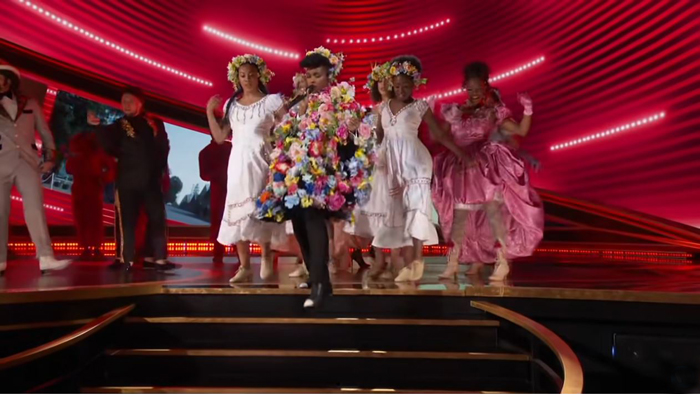
Remarkably, a protest of sorts against Midsommar‘s lack of nominations was mounted during the opening musical number of the 2020 Oscars show, on February 9. Janelle Monáe headlined and staged it, including a group of backup dancers, some of whom were dressed as various characters from some of the year’s best-picture nominees: Joker, Jojo Rabbit, and Little Women. Prominent among them, however, are four women in white Midsommar costumes, and to make the point completely clear, Monáe herself donned a copy of the protagonist’s floral May Queen dress for the last part of the number (see bottom). Pugh was in fact nominated for Best Supporting Actress that year, but it was for Little Women. She didn’t win, but she managed to get an implicit shout-out in the opener.
The extensive press coverage of the number suggested that the content was Monáe’s idea, but the Academy of Motion Picture Arts and Sciences must have approved and cooperated to some extent, given that it presumably provided the costumes and would have been aware during rehearsals that the film references in the song and dance gave the snubbed films equal or even greater attention than the nominated ones. The number inspired considerable coverage in the press, and many upset Midsommar fans posted tweets that suggested they were somewhat placated by the number.
The Academy made further amends two months later, when on May 9 the Academy Museum announced that it had put in the winning bid ($65,000) for the original May Queen dress from the film, which was sold in one of A24’s series of real movie props-and-costumes auctions for Covid-related charities (FDNYFoundation being the Fire Department of New York).

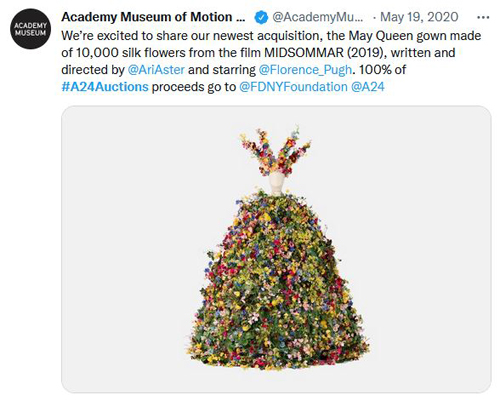
The dress was put on display in the Museum in time for the September 30, 2021 opening.

Based on a preview tour for journalists, on September 22 Timeout declared the dress one of the eleven coolest things to see at the Museum, a list which also included Judy Garland’s ruby slippers and the shark from Jaws. The first “prestige horror” film to be represented in the Academy Museum (I presume) had brought the genre a new level of respect. Maybe next year Alexander Skarsgård or Steven Yuen or Jessie Buckley or Rory Kinnear might actually receive actor nominations, not to mention some best-picture nods for the new films.
One final observation. The prestige phenomenon has been happening for some time now with foreign films seeking release in North American market. Making inexpensive horror films occasionally works as a way for unknown directors to break into an otherwise difficult market for unknown directors. Examples would include the Swedish film Let the Right One In (2008, Tomas Alfredson), the Icelandic Lamb (2021, the first feature of Valdimar Jóhannsson), which premiered at Cannes and was nominated for best international film this year, and currently the Finnish Hatching (2022, the first feature of Hanna Bergholm). Interestingly, the pattern of critics rating the films higher than audiences as measured by Rotten Tomatoes holds true for such films as well, with the three titles scoring respectively: 98%/90%, 86%/61%, and 92%/59%. Their distributors were, respectively: Magnolia Pictures (under its genre label, Magnet Releasing), A24, and IFC Midnight (ICF Films‘s genre label).
A few notes.
[Oct 31, 2022: for more on prestige horror and A24 see my analysis of Men and discussion of A24 as an “auteur studios.”
Scott Derrickson is an interesting case where a director has specialized in mainstream horror films before moving on to a MCU franchise blockbuster, Doctor Strange (2016). He was at work on the sequel when a disagreement of some sort with Marvel led to his departure. He has returned to horror with the upcoming serial-killer film The Black Phone (distributed by Blumhouse) which I mentioned seeing the trailer for. His announced projects appear to be mainstream horror and fantasy.
The prestigious horror films of the past that I mentioned all received Oscar nominations, with some wins (in bold), mainly in below-the-line categories. The Exorcist: adapted screenplay, sound, picture, actress, supporting actor, supporting actress, director cinematography, art direction, editing; Rosemary’s Baby: adapted screenplay, supporting actress; Jaws: sound, editing, musical score, picture; Children of Men: adapted screenplay, cinematography, editing; and Bram Stoker’s Dracula: costume, sound effects editing, makeup, set design.
Directors of modest horror films do sometimes return to the fold after making a blockbuster. After a string of horror films, Scott Derrickson directed Doctor Strange (2016) but now returns with The Black Phone. From the trailer referenced above, this looks like a conventional serial-killer film, apart from having Ethan Hawke as its villain. Guillermo del Toro returned to his more comfortable indie roots after Pacific Rim, and Taika Waititi apparently is keeping his word about alternating big projects (Thor: Ragnarok and an upcoming Thor film) and personal ones (Jojo Rabbit); among his many announced films are several franchise films, but also Tower of Terror, apparently a horror film.
[May 17, 2022] Alex Garland seems to be abandoning the horror genre, at least for his next film. As its title, Civil War, suggests, its an action film about that conflict. As he says in a recent interview, he’s even contemplating giving up directing and sticking to screenwriting.
[May 22, 2022] Collider‘s Chase Hutchinson has posted a list ranking A24’s twenty-one horror films from worst to best. (I don’t know when it was originally posted, but it was updated yesterday, presumably to include Garland’s Men.) As I said, I’m not a big horror fan, so I had never heard of most of these, so I’m obviously not one to quibble with the ranking–apart from the fact that I would put The Lighthouse higher than Midsommar and The Witch. I haven’t seen Jonathan Glazer’s Under the Skin, which tops the list, so I have no idea whether it really deserves to be number one.]
Un-Marry me a little: MARRIAGE STORY and LITTLE WOMEN
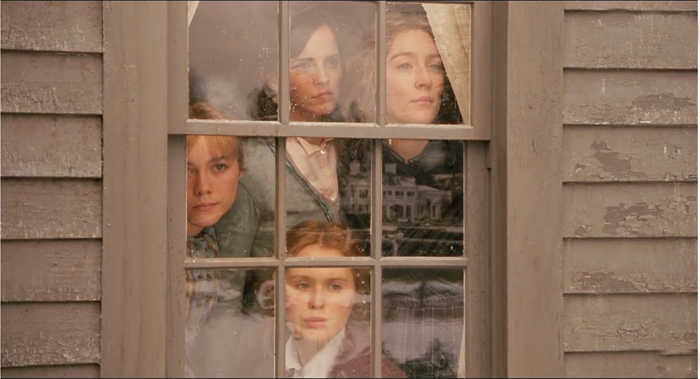
Little Women (2019).
DB here:
For a while The Blog conducted an annual ritual of analyzing storytelling techniques in year-end releases. I wrote entries from early in 2016, in 2017, and in 2018. Last year I muffed it, largely because of time spent revising our Christopher Nolan book. (Yes, we’re also looking forward to Tenet, especially after that hellah trailer.)
This time I’m trying an alternative. Instead of surveying a range of releases, I’ll focus on two that I think encapsulate some robust variants on familiar narrative strategies. Those strategies include choice of protagonist, linearity versus nonlinearity in time, and manipulation of viewpoint. While I’m concentrating on Marriage Story and Little Women, I’ll draw out some comparisons with other films.
Many spoilers follow, but of course you’ve probably seen all the new films. Except maybe Cats.
Protagonists, dual and dueling
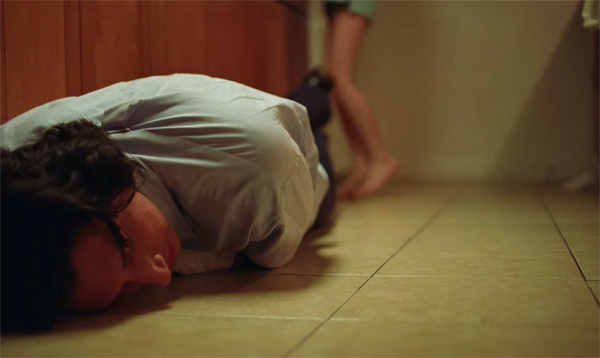
Human nature is not given to a protagonist/antagonist three-act structure. Human nature is just one damn thing after another in which the only thing that matters is what went on today because yesterday is gone. And that is contrary to a lot of the business that we’re in, which makes sure that everybody understands the story by page 30 and is involved in the conflict.
You’re plotting a film. What sort of options do you face? A basic choice involves protagonists.
You might build the film around one character who pursues a cluster of goals. Examples this season would include Dark Waters, Motherless Brooklyn, Uncut Gems, and Harriet. The protagonist can have helpers, and will certainly have adversaries, but her or his initiatives, decisions, and responses propel the action. In addition, we’re usually attached to the protagonist’s point of view, which limits us to what she or he knows. Judicious widening of the horizon often takes place to enhance tension. In Uncut Gems we’re briefly attached to Arno’s thugs when they’re tailing Howard, and the climax crosscuts Howard in his office with Julia placing his big bet.
You could center the action on two characters, giving us a dual-protagonist plot. Here the goals may be shared or at least compatible. In The Aeronauts, a lady balloonist and a male meteorologist cooperate, with frictions, to break ascension records, while Ford v. Ferrari unites two men working together to win at Le Mans.
More rarely, a dual-protagonist plot can shift the protagonist in the course of the action. Good examples are Red River (1948) and The Killers (1946). I’d argue that Don Corleone functions as protagonist in the early sections of The Godfather (1972), while Michael takes up that role later. Similarly, Waves initially concentrates on Tyler, but he largely drops out of the plot and his sister Emily drives the film’s second half.
Alternatively, the plot can present two protagonists in competition. This season we’ve had The Current War, centering on the struggle between Edison and Morgan to transmit electrical power. The narrational weight is largely with Edison, but I think Morgan is characterized enough and we’re attached to his viewpoint frequently enough to present a counterweight. Morgan isn’t simply an antagonist but rather what Kristin calls a parallel protagonist, like Salieri in Amadeus or Captain Ramius in The Hunt for Red October. As these examples indicate, parallel protagonists, although they’re trying to figure out each one’s aims and stratagems, often become fascinated with each other and recognize their affinities.
Paired protagonists are common in romantic comedies, which often consist of friction between the couple (due to clashing goals) but end in harmony and union. What’s striking about Marriage Story is that here the end, not the start, of a romantic alliance is treated through the dual-protagonist strategy. Charlie and Nicole struggle over the terms of their divorce, particularly the handling of custody of their son Henry. Unlike Kramer vs. Kramer (1979), which is organized chiefly around the husband’s viewpoint, this gives weight to both spouses.
Director Noah Baumbach achieves this balance through a cunning parallel block construction. The film opens with two montages of roughly equal running time. One surveys Nicole’s habits and accomplishments with Charlie’s voice-over praising her. (“She’s my favorite actress.”) Then we get a montage illustrating what Nicole loves about Charlie, with other incidents stitched together by her voice-over. Both montages weave in scenes of Nicole in rehearsal while Charlie, the director, makes suggestions.
Baumbach has compared these montages to an overture in musical theatre. The film’s score sets out themes associated with each protagonist, and the quirks and routines that rush by establish important motifs, like haircutting, Monopoly games, and Henry’s urge to sleep with his parents. With the he said/she said duality, the montages prepare us for the film’s strategy of parallelism, a compare-and-contrast attitude.
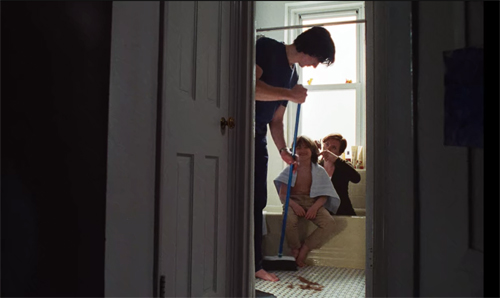
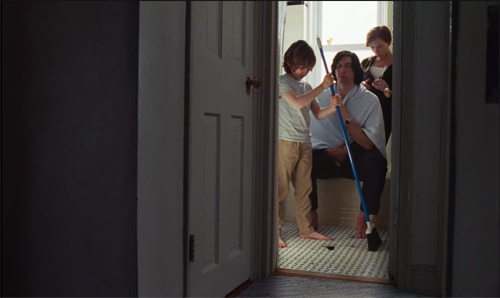
The montages are revealed as visualizations of two memoirs the couple have written for a mediator.
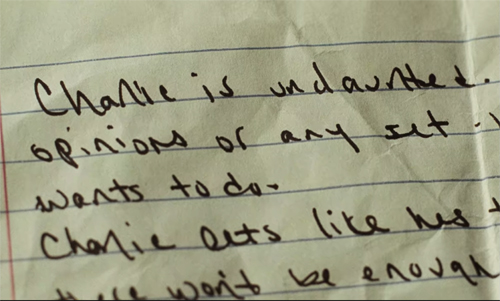
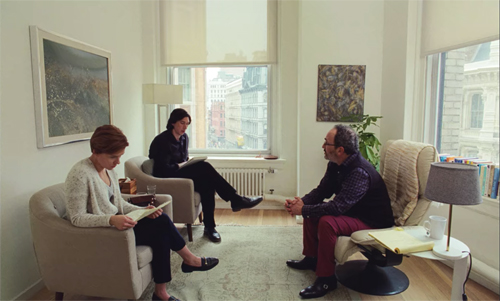
They’re planning to divorce, and he’s asked them to recall what they loved about each other. Charlie is willing to share his notes with Nicole, but Nicole won’t show hers. This hints that he’s more reluctant to separate than she is, planting a question about why she seems determined to pursue the divorce.
Just as important, we’ve been given privileged access to both characters’ minds, and this sort of alternating omniscience will proceed throughout the film. There won’t be any more plunges this deep into subjectivity, but we’ll always know more than either does, because after they separate we’ll be attached to one or the other in large stretches.
For a time, though, we’re with both. In the mediator’s office, and then during the play’s performance, in the bar with the troupe after the show, and in the family apartment, they interact as a couple. (True, Charlie sleeps on the sofa.) But once Nicole moves to California, the first block of action ends and we are attached to her and Henry as she launches her new project, a TV pilot.
Not until Charlie comes to visit Nicole, her mother, and her sister does the narration bring him back. There he’s officially served the divorce papers. This scene launches a discreet viewpoint pivot from her to him. The family cuddle ends when Henry banishes Charlie from bed, foreshadowing how marginal his father will be to him from now on.
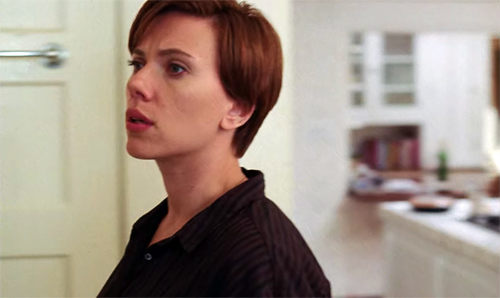
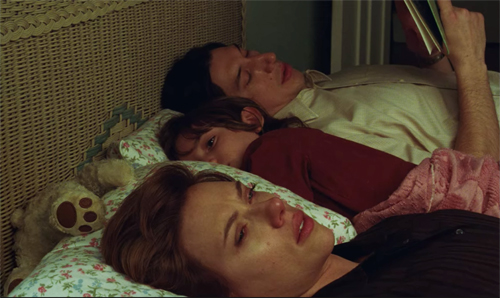
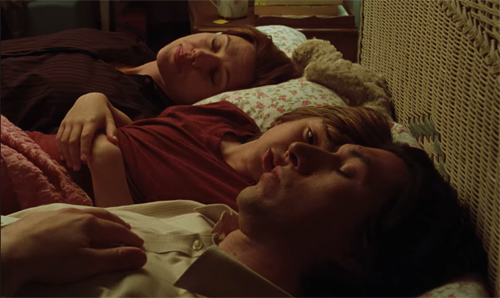
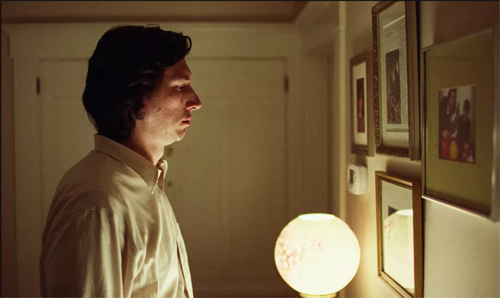
The film’s next block attaches us to Charlie as he seeks out a lawyer, takes Henry on outings, and clashes with Nicole about how to celebrate Halloween. The couple wind up giving Henry two trick-or-treating trips, in different costumes, which reiterates the duplex structure of action we’ve been presented with since the start.
The alternation between Nicole and Charlie’s viewpoints quickens as their negotiations get more fraught. Their first legal meeting ends with Charlie’s losing faith in his easygoing attorney. The next meeting is an escalating confrontation between Charlie’s new hard-charging lawyer and Nicole’s equally tough Nora. In the courtroom exchange, the he said/she said pattern becomes vicious as each lawyer weaponizes minor incidents from scenes we’ve seen to cast shame on the opposing side.
The nastiness of the custody battle comes to a crisis in a ten-minute duologue in Charlie’s apartment, an all-out fight between Nicole and Charlie. They run through a repertoire of reactions, from assurance of mutual admiration to declarations of annoyance, unhappiness, frustration, and complaints. By the end they’re screaming insults. Charlie rages and then, as if aware of how monstrous he’s being, collapses sobbing at Nicole’s feet.
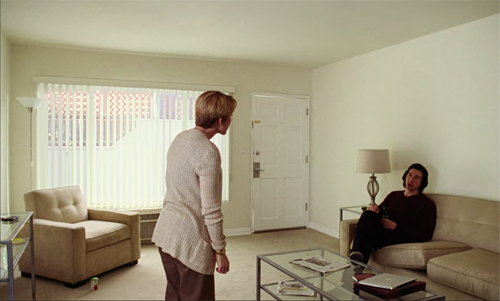
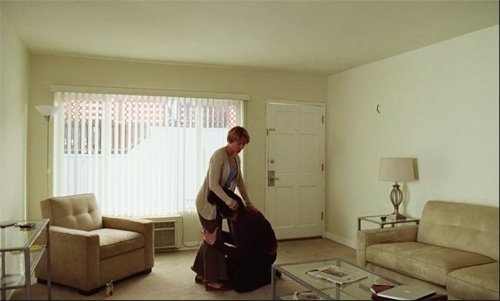
Most classically constructed films follow the pattern Kristin identified back when. The plot consists of a setup, a complicating action redefining the setup, a development section consisting largely of delay and backstory, and a climax that resolves the situation. An epilogue asserts a stable, if changed state of affairs. The four main parts are roughly equal in running time, with the climax tending to be a bit shorter and the epilogue being only a few minutes.
Up to a point, Marriage Story conforms to this architecture. The first thirty minutes set up the split in the family before focusing on Nicole’s new life in California. Both Charlie and Nicole had hoped to separate amicably, with no need for lawyers. But thirty minutes in Nicole hires Nora and sets in motion a more severe legal battle than the couple had expected. The complicating action is triggered by serving Charlie the divorce papers.
There’s no turning back, and the new situation centers on figuring out how to handle access to Henry. Charlie wants Henry to spend time in New York (“We’re a New York family”) but Nicole wants him with her, and as he was born in California the law inclines to her side. Hence the triple thrust of the Charlie block: visiting lawyers, trying to keep his Broadway production on track, and winning some loyalty from Henry.
The development section consists of characterizing stretches (Nicole indulges in a quick sexual encounter) and delays: the unsatisfactory first lawyer session, a power outage at Nicole’s house, and the courtroom showdown. What happens next, though, seems to me quite original.
Between theatre and TV
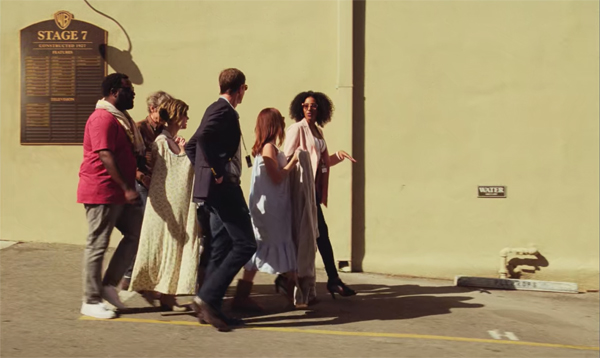
To determine custody, both Nicole and Charlie must let an evaluator visit to observe each one’s treatment of Henry. In a more ordinary film, this stretch would initiate the climax. The visit from the evaluator would furnish a deadline for determining how custody would be handled. Then the film’s peak could be the vicious, trembling argument between Charlie and Nicole. This would be the explosion that reveals both their love and the impossibility of their staying together.
From this angle, Charlie’s guilt-ridden collapse would be the resolution–his realization of how he stunted Nicole’s life. A courtroom finale settling the terms of custody (a little more for Nicole than Charlie) would fill out the climax and lead to an epilogue, perhaps on the courthouse steps.
Excuse me for rewriting the film. I do it to show that Baumbach’s script does something daring. The big argument comes before the evaluator’s testing. After that brutal clash, we see Nicole rehearsing her answers in Nora’s office. Moreover, the blundering efforts of Charlie to convince the stiff evaluator he’s a good father play out in a lengthy comic scene with some gory sight gags.
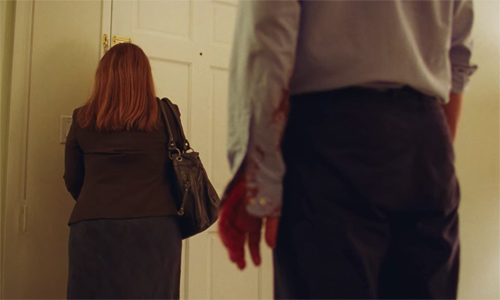
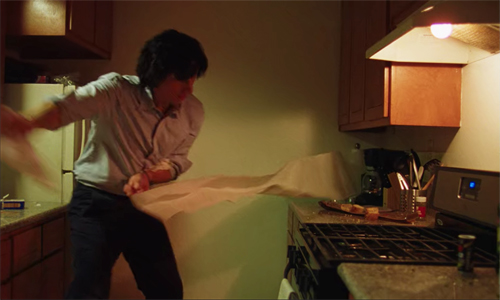
A certain amount of suspense remains, I think, but the final cascade of gags works against the emotional pitch of the couple’s quarrel. Baumbach has, in effect, risked using an anticlimax to round out the normal climax section of the film. It also serves as a good-natured punishment for Charlie’s self-centeredness.
The same daring informs an unusually lengthy epilogue. It’s built out of the sort of modules we’ve seen already. Nicole and her friends and family celebrate her divorce with a party, while Charlie mopes around Manhattan and morosely salutes his play’s closing with his troupe in a bar. We might stop there, but Baumbach again does something original (though highly motivated). Charlie, now relocated for a teaching gig in LA, comes to pick up Henry and discovers the boy reading the note about Charlie that Nicole had prepared for the mediator session.
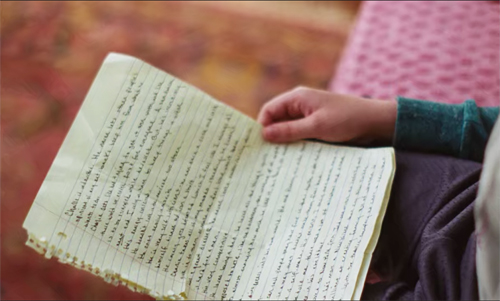
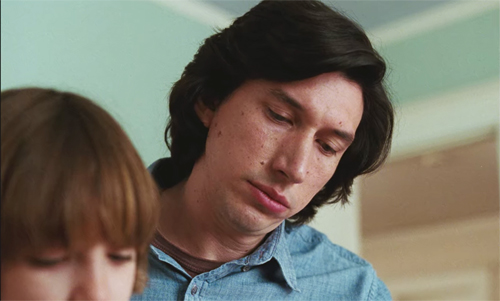
Not only does it reveal the feelings she had suppressed during the session, but the fact that she kept it shows she still harbors affection for that part of her life. Other films surprise us in the epilogue (Citizen Kane, for instance), but Baumbach’s use of the memoir in the film’s final moments remains a pretty bold, and moving, choice. This stretched and packed epilogue shows Charlie how much Nicole loved him, while also suggesting things that contributed to stifling her. Lines like “He’s very competitive” and “He loves being a dad” have a new impact now that we’ve seen his battle for his son.
In telling this story, Baumbach exploits a larger strategy of what theatre people call continuous exposition. Instead of giving the necessary backstory in a lump at the beginning or middle, major information is sprinkled through the ongoing plot. We’re familiar with this device in films that trigger fragmentary flashbacks, filling in backstory bit by bit. Baumbach goes with a more “theatrical” strategy using dialogue to invoke things that happened before the first scenes..
One of the major instances involves Nicole, who breaks down in an embrace with Nora, sobbing that Charlie slept with his assistant. Coming half an hour into the movie, it explains Nicole’s bitterness in the mediation session, as well as her larger reappraisal of her life with Charlie. At other points we learn of big events, like Nicole’s show taking off and Charlie’s long-term settling in LA, in casual conversation, not in extended scenes.
Crucially, in their climactic quarrel, Charlie justifies his affair by accusing Nicole of withholding sex for a year. We can’t appraise the truth of this, but it at least fills in a motive that more conventional exposition would have put into the setup. Resisting the temptation to supply flashbacks for all these revelations, Baumbach trusts our memory. That way the new data can color our ongoing understanding of the characters. The opening montages were generous but one-sided, chunks of incomplete exposition that suppressed important motives and behavior.
Continuous exposition is associated with Ibsen and playwrights who followed, but the theatrical patron hovering over the film is Stephen Sondheim. Greta Gerwig’s Lady Bird had used Sondheim as a touchstone for ambitious high-school players, but the parallel structure of Marriage Story makes more explicit references, this time to Sondheim’s Company. Nicole’s party features her and her mother and sister performing “You Could Drive a Person Crazy,” a saucy song about dumping a weak man. Soon in the bar Charlie is singing the yearning “Being Alive.”
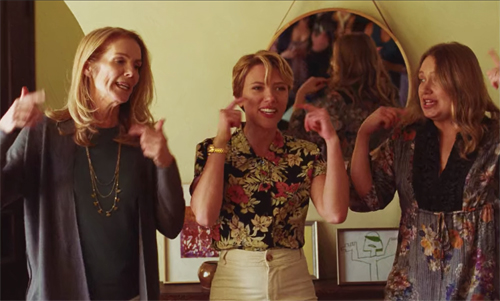
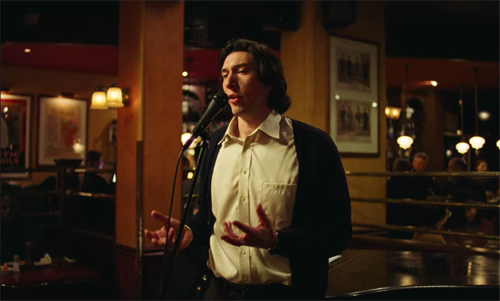
Maybe a little on the nose (like the movie’s title), these citations seem true to the tastes of these show-biz mavens, while suggesting that at least some of Manhattan clings to Nicole in her exile.
Another parallel reminds us of a perennial Hollywood motif. Nicole began her career in a raunchy teen movie but thanks to Charlie’s stage shows she became a respected performer. Yet to establish her own identity more fully she agrees to shoot a TV pilot. Marriage Story positions itself between theatre (a little pretentious, but nobly struggling) and TV (dumb and superficial, but high-tech and well-financed). Worse, TV literally defaces Nicole.
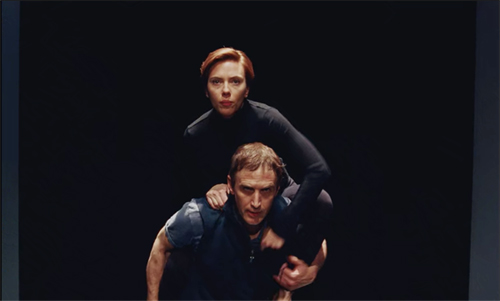
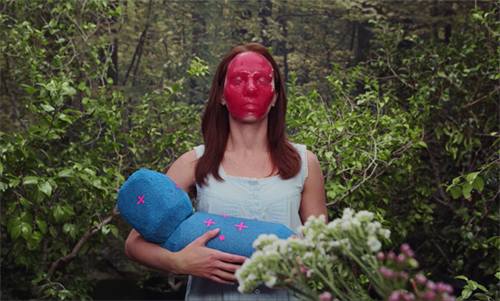
Theatre, TV: what about film?
In this story about show-biz LA, movies and references to them are sparse. (I didn’t spot any.) So maybe we should take this film itself as standing in for righteous cinema, rather than the teenpic trash Nicole was in. Perhaps Marriage Story offers itself as its own example of the subtlety and risk-taking that cinema can embody. Even when streaming on Netflix.
Muses in the family
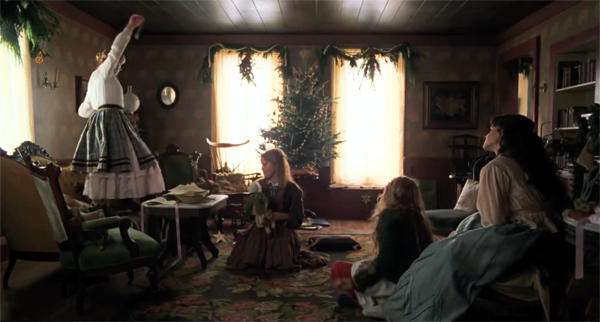
The family saga is one Hollywood genre that doesn’t get enough respect. We tend nowadays to celebrate the tough, not tender side of studio cinema. The cult of noir, the abundance of hard-edged action pictures, and the idolatry that trails Tarantino all tend to make us prefer force to gentleness. When families gather, we expect big trouble, if not outright murder (Knives Out). We decry weepies of any sort, and family sagas are often felt to be soft, schmaltzy, womanish. A male friend tells me that Little Women is “a movie about hugs.” When NPR devotes a whole show to it, panelists ponder how to convince men to see it. No wonder the family film has migrated to daytime cable TV.
Yet the family saga is one of the nicest things American cinema does. Two of our greatest masterpieces, How Green Was My Valley (1941) and Meet Me in St. Louis (1944), are prime examples. The Forties were rich in such efforts, including Forever and a Day (1943), Life with Father (1947), I Remember Mama (1948), The Human Comedy (1943), and Since You Went Away (1944). We ought to recognize as well the strength of later entries like The Joy Luck Club (1993), How to Make an American Quilt (1995), and Soul Food (1997), all trying out some of the fresh approaches to storytelling that were emerging in the 1990s.
And the sentiments informing domestic sagas seep into other genres. The Fast and Furious team, we’re told, come to be a family, as do the Avengers. The coming-of-age story, that perennial of indie cinema, inherits the aura of cozy warmth that is central to the family saga. I’d add one of my favorites, We Bought a Zoo (2011), which isn’t really a saga but does radiate a comparable warmth.
Although there are probably earlier examples (I think of Vidor’s 1924 Wine of Youth), it seems likely that the 1933 MGM production of Little Women furnished an important template. The four March sisters, each drawn to a different art form, are a model for the musically gifted sisters in the fine Four Daughters (1938).
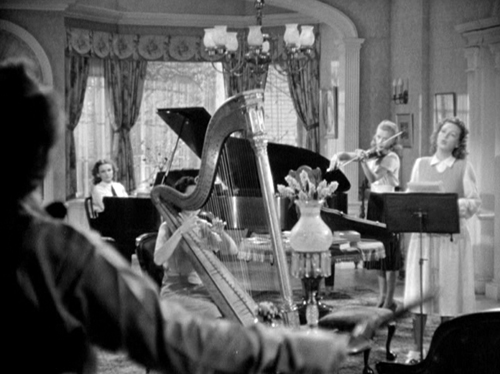
And surely the fact that Katrin in I Remember Mama chronicles the family’s daily lives owes a lot to the example of Jo March, aspiring novelist.
The family saga poses at least three creative problems for the filmmaker. Since each family member is likely to confront personal problems (romance, finance, school, job) how do you weave and weight multiple storylines? How do you provide conflict to propel the action? And, since the “saga” comparison suggests development over years or even generations, how do you handle long spans of time cinematically?
Greta Gerwig handles all these problems adroitly in her version of Little Women. I’m going to concentrate on the film, but I’m aware that some of the narrative strategies are taken from Louisa May Alcott’s original novel. But much of what’s ingenious about Gerwig’s adaptation is of her own devising.
Start with storylines. In most such films, the trick is to create a group but then produce a scale of emphasis running from minor figures to the most important one typically, the “first among equals.” In How Green, that is Huw, also our narrator; in Meet Me in St. Louis, it’s Esther. But the doings of other characters shape the family’s destiny and the decisions made by the spotlighted figure. So the activities intertwine.
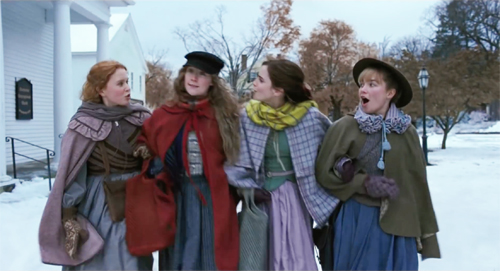
In Little Women, characters shape one another’s development. Jo, the first among equals, is nonconformist and self-reliant. Yet she needs steering–from Friedrich, the professor who tries to turn her away from sensation fiction, and more importantly from Beth, who in her sickness urges her to write “our story.” They give her the strength to persist and trust her sense of what her writing can be.
On the romance front, Jo’s rejection of Laurie’s proposal of marriage opens the field for sister Amy, who has already supplanted Jo in the role of amanuensis to Aunt March. When Jo, out of loneliness, decides to welcome Laurie’s offer, it’s too late: he’s married to Amy. The tangled alliances of melodrama get tightly bound in the family saga.
The other sisters contribute to the causal weave of the plot, with Meg’s decision to abandon the stage reinforcing Jo’s stubborn attachment to her art. More generally, the fates of the sisters dramatize the tension between creative impulse and the social demands of domesticity. Meg wants a family more than fame. Amy, the indifferent painter, can hope only for a good marriage (the same prospect Aunt March makes explicit to Jo).
In family sagas, the siblings are put in parallel. Huw’s brothers leave the household, but he loyally stays, and Rose, the mature sister, has more trouble attracting men than the vivacious Esther. Here, Jo’s kindred spirit is Beth the pianist, whose playing gives solace to Mr. Laurence in his grief. But illness keeps Beth from fulfilling herself either as artist or grown woman. As for Marmee, we’re allowed to catch a glint of Jo’s defiance behind the older woman’s warmth when she confesses that she’s angry every day.
Jo’s main contrast is with Amy. Amy has done nasty things, but she accepts the burden, laid down by Aunt March, of marrying for money, not love, in order to benefit her loved ones. She does this even though, as she reveals in a key scene, she has always loved Laurie and has always felt herself overshadowed by Jo. (Those revelations are also suggested as what leads Laurie to fall in love with her, and not simply as a substitute for Jo.) Even the various suitors get ranged along comparative dimensions of class, strength of will, and temperament.
The need to provide a dense social milieu also creates parallels–here, in terms of good deeds. The Marches are lower middle-class, living on a parson’s income, but they share their Christmas dinner with a more deprived family. The primary family is constantly compared to the wealthy Laurences, who are generous and good-hearted. Even Aunt March, who married well and embraced hardheaded principles, wills her mansion to Jo. The contrast with the flinty publishing house and the imperious Dashwood is softened when we learn, surprise, that he has a batch of daughters himself.
What about conflict in the family saga? There’s often an external threat–predatory capitalism in How Green Was My Valley, the war in The Human Comedy–but not always a personified antagonist. Often these films have no straightforward villains. Parental error can move the plot, as when in Meet Me in St. Louis Alonzo Smith announces that he’s taking a job in New York. And crises are created by misunderstandings or happenstance, most commonly illness. Somebody almost always gets hurt (here, Meg’s twisted ankle, Amy’s plunge through the ice) or sick (Beth’s scarlet fever).
By and large, the conflicts come through romance and sibling rivalry. In Little Women, Meg loves John only somewhat more than she loves fine clothes, so their impoverished marriage nags at her heart. Amy, enraged at not going to the theatre, burns Jo’s manuscripts. Jo responds with hatred–until Amy falls through the ice and needs rescuing. Amy later considers marrying a rich nonentity, and instead acknowledges her long love for Laurie–who in turn loves Jo. As in most melodramas, we know more than any one character, so we watch as characters’ hopes rise against forces they don’t yet realize.
Even without a clear-cut antagonist, the family members can have goals. The March girls start out as aspiring artists, and stretches of the plot are devoted to them developing their abilities. As their goals change, swerving two of them to marriage and maternity, Jo keeps striving toward what we see her doing in the film’s very first scene: selling her stories. Her burning desire to write is a major through-line, and it encounters obstacles of many sorts, from the harrumphing Dashwood to the destruction of her manuscripts by Amy. And even Jo, as we’ve seen, recasts her goals: in offering solace to the dying Beth, she will write “all about us.”
That means writing about the family as it changes over time. Our third narrative problem, in other words.
“If I were a girl in a book, this would all be so easy”
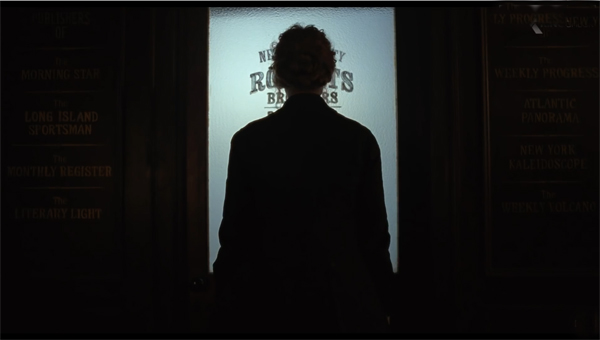
Marriage Story‘s avoidance of flashbacks makes it unusual nowadays. It’s hard to find a movie without at least a few flashbacks. As mysteries, Motherless Brooklyn and Knives Out resort to them to replay scenes with new information. Other films make time shifts basic to their architecture. The Aeronauts uses flashbacks to supply the backstory to an unfolding crisis situation, while Hustlers switches between a contemporary interview and stages in the career of the woman questioned.
The Irishman goes for deeper embedding. The overall frame shows elderly Frank Sheeran in the care facility; the next frame is Frank’s trip with Russell Bufalino and their wives to upstate New York, where Frank will kill Hoffa. That trip in turn flashes back to the central story of Frank’s career with the mob. I try to show in Reinventing Hollywood that this sort of Russian-doll structure comes to be a major option in American film during the 1940s.
In Little Women, the years of change in the March family are given through alternating blocks. We start in the present, with Jo in New York struggling to get published. She’s summoned back to Concord because Beth is ill. Meg is living in poverty with husband John, and Amy is in Paris with Aunt March. For about eleven minutes, crosscutting carries us among the sisters.
This block of exposition is followed by a title, “7 Years Earlier,” that sets up the time oscillations we’ll get for the rest of the film. In chronological order we follow the sisters growing up. Chunks of scenes from the past, shifting viewpoint among several characters, alternate with briefer scenes of the ongoing present showing Jo’s settling back into the family. Sometimes the cuts break the blocks into smaller, interlocking bits, as when we shuttle quickly between Beth’s childhood illness and her death one year later.
Why split a linear story into two intercut strands? Flashbacks often create a specific sort of anticipation: Not just What will happen next? but What caused the outcome I already more or less know? In the first ten minutes we learn that Laurie proposed to Jo and she refused him; that Amy, not Jo, became Aunt March’s traveling companion; that Meg married John, the impoverished tutor. We’ll witness the development of all these turning points, and more. We must watch the rise and fall of characters’ hopes, knowing they will be dashed. But we also know, from Jo’s initial visit to the publishing house, that she will gain some success. This time-jumping gives us another level of omniscience, one that lets us savor the details of emotional scenes whose outcomes we roughly know. We’re in the theatre, after all, to enjoy the rapture of pathos.
Instead of tagging each time shift with a date, Gerwig expects us to keep track of the double-entry storylines. She assists us by making story motifs visual hooks between past and present. Silk for a dress, a key, Jo seen writing at a window–these link scenes but also carry dramatic weight in the ongoing action. Other echoes are longer-range. We’re invited to remember contrasting dance scenes (tavern, ballroom, porch), scorched dresses, and piano pieces.
Eventually the past scenes catch up with the present. The fusion comes with the burial of Beth and one more clutch of flashbacks, to Meg’s wedding. I take this as the end of the development section. “Childhood is over,” Jo says. Back in the present, Jo vows to abandon writing.
Now the present-time action dominates the climax. Grieving for Beth, distraught at Meg’s leaving the household, and crushed by the marriage of Laurie and Amy, Jo burns her manuscripts–except for the stories she wrote for Beth. She starts to assemble them and write more.
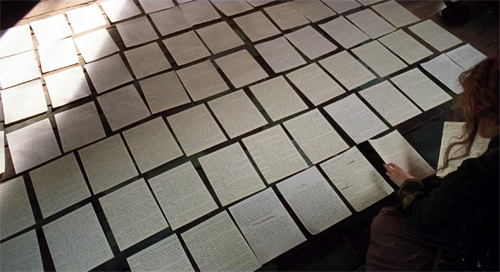
After a glimpse of Dashwood refusing the manuscript, we see Friedrich come to visit the Marches on his way to California. After he’s left for the station, the family claims that Jo obviously loves him.
At this point, in her most daring creative choice, Gerwig retains the crosscutting technique in a way that seems to continue the present/past alternation. Dashwood’s daughters have urged him to publish Jo’s manuscript. In New York, in a scene that rhymes with the opening passage, Jo negotiates with Dashwood.
Their conversation is intercut with views of Jo rushing to the station to catch Friedrich and ask him to stay.
The epilogue consists of more alternations. We see Jo watching Little Women being printed, crosscut with a party at the school Jo has founded in Aunt March’s mansion. There John, Friedrich, and Laurie can be glimpsed as Meg and Amy teach children the arts they had practiced. The celebration ends with a birthday cake presented to Marmee.
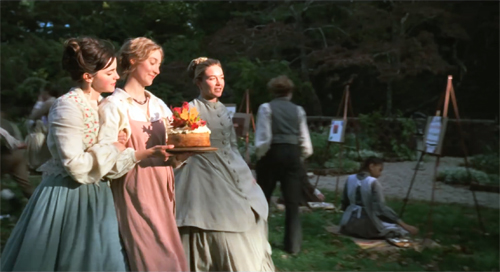
But there’s another way to take the final minutes. The alternation isn’t tracking two points in time–Jo’s rush to Friedrich and a later session with Dashwood–but rather a split between fiction and reality.
We’re coaxed to take scene of Jo’s pursuit of Friedrich as representing not her own action but the changes that Dashwood demands in Jo’s novel. “Who does she marry?” he asks, explaining that a book sells only if there’s a marriage. Jo reluctantly agrees. “I suppose marriage has always been an economic proposition, even in fiction.” Cut to Jo racing to the station. After the shots of her embracing Friedrich under an umbrella, we’re back in the office. Dashwood suggests the chapter title, “Under the Umbrella,” and Jo agrees. But in turn she makes demands: “You keep your five hundred dollars and I’ll keep the copyright. . . . I want to own my own book.”
We’ve assumed throughout that Jo’s book is highly autobiographical, but we’ve taken what we see and hear as actual events, the living source of a literary text. Instead, the crosscut climax allows a parallel reality to burst forth, a road not taken. The epilogue yields another ambivalent passage of crosscutting. The school party might be veridical; certainly the family would likely gather for Marmee’s birthday. But the scene could as well serve as the fictional epilogue in Jo’s book (as it does in the Alcott original).
The true epilogue of Jo’s story would then be the moment when she sees her book printed, action that’s crosscut with the celebration. Jo gets the first copy. In the last shot, pleasure, apprehension, and determination play across her features. And she’s framed in a window, an approximate reverse shot to the image that opened the film (see image at the top of this section).
From the start Gerwig has shrewdly foreshadowed the turn to fiction by presenting the film’s title, after Jo has made her first sale, not as an inscription on the screen but as the physical book itself. That book is signed by L. M. Alcott. The apparently identical volume that comes off the printing press at the end bears the name J. L. March. Gerwig has let Jo appropriate Alcott’s story.
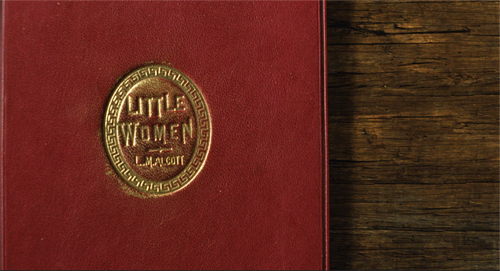
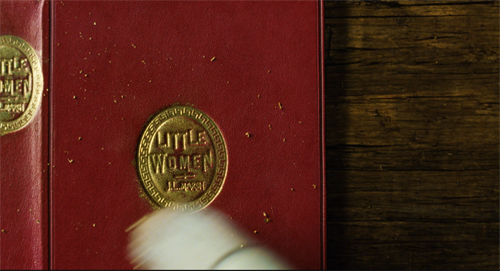
By giving us a double-voiced ending, Gerwig does something quite bold. Little Women becomes something of a “what-if” movie, positing two paths for her heroine. Alcott’s Jo had given up a literary career, whereas Gerwig’s Jo finds one by writing her own life and adding an optional ending. We’re free to think that Jo and Friedrich married and the family became a harmonious whole, as in Alcott’s book. A happy ending, we might say, for those who want one. But this film about hugs ends with the heroine hugging not a husband but her novel.
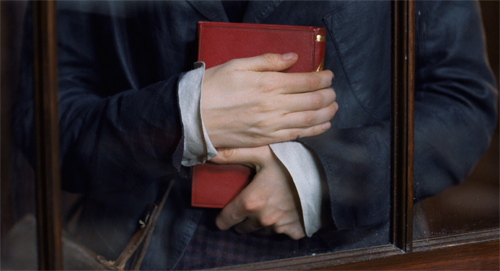
Unmarried in life, Jo can marry in fiction, and Gerwig can have it both ways. Narrative lets you do things like that.
I haven’t been able to do justice to the intriguing choices made in other films of the season. I appreciate, for instance, the nonlinearity in Kasi Lemmons’ Harriet, where the interruptions of present-time action offer Harriet’s premonitions of future scenes. This sort of “prophetic” flashforward is rare; usually such passages are presented as omniscient narration, not assigned to characters. But the device does establish Harriet as a sensitive, almost angelic figure, and suggests that her quest to guide slaves to freedom is sustained not just by faith but by holiness.
Still, looking in a little depth at just two major films can make us aware of several choices available to filmmakers at this point in history. As Wölfflin said, “Not everything is possible at all times.” But film researchers can usefully trace the flexible menu of options that filmmakers work with, and film viewers come to master.
Gerwig has kindly made available a version of the screenplay, which I discovered only after I wrote this. (Thanks, Kristin.) The notations for the final sequences are pretty interesting. The most wide-ranging discussion I’ve seen of the ending, with plenty of links, is the conversation between Marissa Martinelli and Heather Schwedel in Slate. Among several perceptive reviews, I’d single out the one in Time by Stephanie Zacharek and Richard Brody’s review in The New Yorker.
I can’t help but think how central crosscutting, that technique pioneered by early filmmakers, is to both of these films. Techniques endure because they open up a lot of expressive possibilities.
Kristin elaborates on arguments for four-part plot structure in Storytelling in the New Hollywood: Understanding Classical Narrative Technique. Extended examples on this site are here and here. I discuss family sagas of the 1940s, along with flashbacks, protagonists, and other narrative techniques in Reinventing Hollywood: How 1940s Filmmakers Changed Movie Storytelling. On 1990s revival of these techniques, see The Way Hollywood Tells It: Story and Style in Modern Movies.
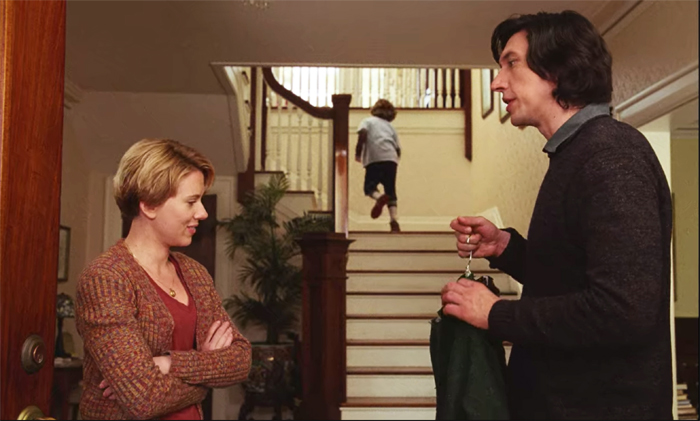
Marriage Story (2019). Is this why the film includes few standing two-shots of Nicole and Charlie?