





Archive for the 'Festivals: Hong Kong' Category
Genre ≠ Generic
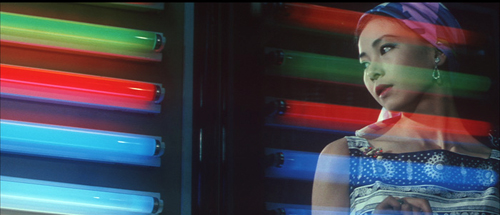
The Shape of Night (Nakamuro Noboru, 1964).
DB here:
I didn’t plan it that way, but it turns out that a great many films I saw at this year’s Hong Kong International Film Festival would have to be categorized as genre pictures. Not, admittedly, Shu Kei’s episode of Beautiful 2014, which interweaves flashbacks and erotic reveries in a purely poetic fashion. And not Tsai Ming-liang’s “sequel” to Walker (2012, made for HKIFF), called, whimsically, Journey to the West. Here again, Lee Kang-sheng, robed as a Buddhist monk, steps slowly through landscapes, some so vast or opaque that you must play a sort of Where’s-Waldo game to find him. (You have plenty of time: there are only 14 shots in 53 minutes.)
But there were plenty of other films that counted as genre exercises. Yet they mixed their familiar features with local flavors and fresh treatment, reminding me that conventions can always be quickened by imaginative film artists.
Keeping the peace, in pieces
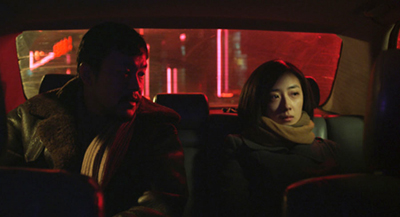
Black Coal, Thin Ice (2014).
Take, for instance, The Shape of Night, a 1966 street-crime movie from Shochiku, directed by Nakamura Noburo. Nakamura was the subject of a small retrospective at Tokyo’s FilmEx last year, and this item certainly makes one want to see more of his work. A more or less innocent girl falls in love with a yakuza, who forces her to become a prostitute. In abrupt, sometimes very brief flashbacks, she tells her life to a client who wants to rescue her. The film makes characteristically Japanese use of bold widescreen compositions, disjointed close-ups, and mixed voice-overs from her and the men in her life. In retrospect, everything we’ve seen has been seen in other movies, but Nakamura’s handling kept me continually gripped and often surprised.
Or take That Demon Within, a Hong Kong cop film that premiered at the festival’s close. Dante Lam has made several solid urban action pictures, especially Jiang Hu: The Triad Zone (2000), Beast Stalker (2008), Fire of Conscience (2010), and The Stool Pigeon (2010). They’re characterized by wild visuals and exceptionally brutal violence, and That Demon Within fits smoothly into his style. The new wrinkle is that a boy traumatized by the sight of police violence himself becomes a cop. He’s then haunted by the image of the cop from his past, while he’s also caught up in a search for a take-no-prisoners robber.
His hallucinations and disorientation are rendered through nearly every damn trick in the book, from upside-down shots and blurry color and focus to voices bouncing around the multichannel mix.
There are dreams, too (seems like almost every new film I saw had a dream sequence), and scenes under hypnosis, and men bursting into flame, and action sequences that are visceral in their shock value. I thought the movie careened out of control pretty early, and its nihilism wasn’t redeemed by an epilogue that assured us that this possessed policeman was, at moments, friendly and helpful. In this case, the storytelling innovations generated some confusion about exactly how the hero’s breakdown infused what was happening around him.
More consistent, largely because it didn’t try for the subjectivity of Lam’s film, was the Chinese cop movie Black Coal, Thin Ice. My friend Mike Walsh of Australia pointed out that the mainland cinema’s bleak realism seems to be starting to blend with traditional genre material. Director Diao Yinan explained, “My aim was not only to investigate a mystery and find out the truth about the people involved, but also to create a true representation of our new reality.” The opening crosscuts the grubby detail of bloody parcels churning through coal conveyors with a couple entwined in a final copulation before breaking off their relationship.
The mystery revolves around body parts that are showing up in coal shipments around one region. After a startling shootout in a hairdressing salon, the case remains unsolved for several years. The surviving detective, a shabby drunk, returns to track down the culprit, but in the meantime he runs into a frosty femme fatale. “He killed,” she says, “every man who loved me.” Needless to say, the detective falls for her too, especially after ice-skating with her. Diao’s film reminds us that you can create a neo-noir in two ways: By taking a mystery and dirtying it up, or taking concrete reality and probing the mysteries lurking in it.
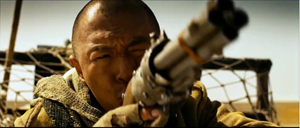
There were even two Westerns. Another mainland movie, No Man’s Land, was unexpectedly savage coming from the director of the super-slick satires Crazy Stone (2006) and Crazy Racer (2009). Now Ning Hao has given us a bleakly farcical, Road-Warrior account of life on the Chinese prairie.
A wealthy lawyer brought out to the wasteland to negotiate a criminal case becomes embroiled in primal passions involving men with very large guns, very large trucks, impassive faces, and almost no sense of humor. It’s a black comedy of escalating payback (involving spitting and pissing), and it exudes sheer masculine nastiness. Completed four years ago, it found release only after extensive reshoots demanded by censors. Yet even in its milder state it remains true to the spirit of Sergio Leone’s jaunty grimness, bleached in umber sand and light.
Itching to see a Kurdish feminist political Western? You’ll find Hiner Saleem’s My Sweet Pepperland welcome. A tough policeman (= sheriff) is dispatched to a remote village in Kurdistan to keep order (= clean up the town). A young teacher (= schoolmarm) leaves her oppressive family to teach there as well. A warlord (= town boss) and his minions (= paid killers) have terrorized the locals, while marauding female guerillas (= outlaws) bring their fight into town.
These time-honored conventions shape a story of stubborn courage taking on complacent viciousness. In key scenes, our sheriff faces down big, hairy, scary killers.
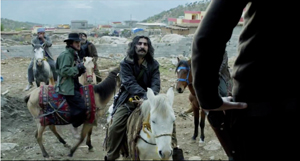
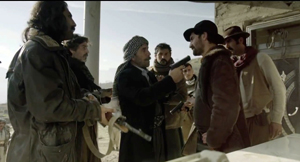
USA frontier conventions, it turns out, work pretty well in a Muslim society too. The Hollywood Western’s continued embodiment of American values transfers easily to the former Iraq. “Our weapons are our honor,” the chief thug says, in a line that resonates through our history right up to now. Yet things we take for granted bring modern change to the wasteland. The sheriff assigns himself to the village in order to escape an arranged marriage, as the woman he finds there has done. She is vilified by both the locals and her male relatives, who would prefer death (hers) to dishonor (theirs). In the process, both he and she become heroic in a righteous, old-fashioned way.
A killer proposes a compromise while sneakily drawing his pistol. The cop shoots him and remarks: “I don’t do compromise.” Neither does My Sweet Pepperland.
Gangs of New York, and elsewhere
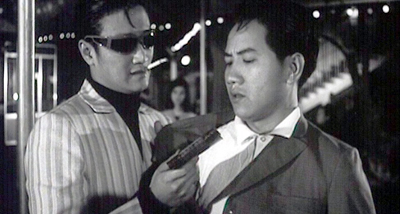
The Dreadnaught (1966).
From March to May, the Hong Kong Film Archive has been running a series, “Ways of the Underworld: Hong Kong Gangster Film as Genre.” It’s packed with classics (The Teahouse, To Be No. 1, City on Fire, Infernal Affairs) as well as several rarities (Absolute Monarch, Bald-Headed Betty, Lonely 15). I managed to catch three titles, all previously unknown to me.
The Dreadnaught (1966) has a familiar premise. Two orphan boys indulge in petty theft after the war. One, Chow, is caught but gets adopted by a policeman. He turns out a solid young citizen. Lee, the boy who escapes, grows up to be a triad. When the two re-meet, Lee is attracted to Chow’s stepsister. Some years later, Chow is now a cop and vows to smash Lee’s gang. After a struggle with his conscience, Lee agrees to help.
The film’s main attraction is the shamelessly flashy performance of Patrick Tse Yin. Tse would make his fame in the following year in Lung Kong’s Story of a Discharged Prisoner, famous as a primary source for A Better Tomorrow. With his sidelong smile, his endlessly waving cigarette, and the dark glasses he wears at all times, Tse in The Dreadnaught looks forward to Chow Yun-fat’s charismatic role as Mark in Woo’s masterpiece.
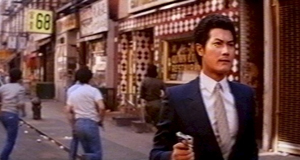
Another icon of the period is Alan Tang Kwong-wing. He played in over 100 films, mostly romances and triad dramas made in Taiwan. Westerners probably know him best as the producer of Wong Kar-wai’s first two features, As Tears Go By and Days of Being Wild. Wong had worked as a screenwriter for Tang. Onscreen, Tang had a suave, polished presence marked by his perfect coiffure; he was known as the Alain Delon of Hong Kong. His company, Wing-Scope, specialized in mob films during the late 1970s and early 1980s.
New York Chinatown (1982) shows Tang as a young hood whose ambitions to dominate the neighborhood are blocked by a rival gang. Eventually the police decide to let the two gangs decimate each other. This leads to an enjoyable, all-out showdown involving surprisingly heavy armaments. Shot quickly on location (passersby sometimes glance into the lens), the movie gives a rawer sense of street life than you get from most Hollywood films. There’s also a scene in which Tang, apparently attending Columbia part time, corrects a history professor lecturing on Western imperialism in China. Although the film circulates on cheap DVD in 1.33 format, it’s a widescreen production, and it was a pleasure to watch a fine 35mm print at the Archive.
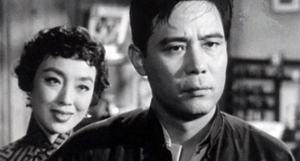
The biggest revelation of the series for me was Tradition (1955), a Mandarin release. This is considered one of the earliest pure gangster films in local cinema. It’s a fascinating plot about a boy raised by a triad kingpin in the 1930s. When the godfather dies, the young Xiang is given power over the gang and the master’s household. Trying to be faithful to the old man’s principles, Xiang finds himself unable to control his master’s widow and daughter, who are led astray by the widow’s worldly, greedy sister. At the same time, Xiang must ally with other triads to smuggle aid to the forces fighting the invading Japanese. He is torn between devotion to tradition and the need to adapt to modern materialism and the impending world war.
 Tradition is redolent of film noir, not only in the sister-in-law’s fatal ways (she seduces the old master’s weak son) but also in the film’s flashback construction. Tracking back from a ticking clock, the movie begins with Xiang meeting the master’s daughter after his gang has been decimated in a shootout. The film skips back to Xiang’s childhood and takes us up through the main action before a final bloody confrontation with police and the corrupt family members. At the end, the camera tracks up to the clock, closing off the whole action.
Even more tightly buckled up are director Tang Huang’s obsessive hooks between scenes. A final line of dialogue is answered or echoed by the first line of the next scene; a closing door or character gesture links sequences in the manner of Lang’s M. Most daringly, when sister San starts to light a cigarette in one scene, we cut to her puffing on it in a tight close-up—a gesture that takes place in a new scene hours later. This and other admittedly gimmicky links look forward to Resnais’s elliptical matches on action in Muriel.
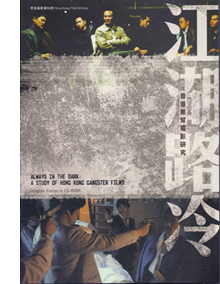
Fortunately for us, the Archive has published Always in the Dark: A Study of Hong Kong Gangster Films. Edited and partly written by Po Fung, it is an excellent collection of essays and interviews. It is in Chinese, but it includes a CD-ROM version in English. It’s available from the Archive’s Publications office.
Behind the scenes at Milkyway
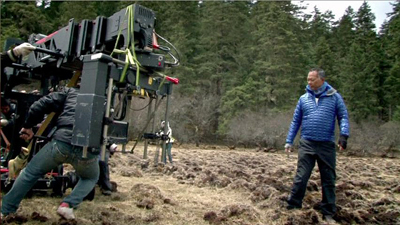
Johnnie To and a recalcitrant crane during the shooting of Romancing in Thin Air.
Sometimes a genre film becomes a prestige picture. This happened, in spades, with The Grandmaster. If awards matter, Wong Kar-wai’s film has become the official best Asian film of 2013. I missed the Asian Film Awards in Macau (was watching early Farhadi films), but the event was a virtual sweep: seven top awards for The Grandmaster, including Best Picture and Best Director. After I got back home, the Hong Kong Film Awards gave the picture a staggering twelve prizes, everything from Best Picture to Best Sound.
Unhappily, nothing in either contest went to the other outstanding Hong Kong film I saw last year, Johnnie To Kei-fung’s Drug War. It lacked the obvious ambitions and surface sheen of Wong’s film. Many probably took it as merely a solid, efficient genre picture. I believe it’s an innovative and subtle piece of storytelling, as I tried to show here.
Mr. To presses on, as prolific as usual. He has finished shooting a sequel to Don’t Go Breaking My Heart, a rom-com that found success in the Mainland, and he’s currently filming a more unusual project in Canton. More on that shortly.
During the festival only one recent To/Milkway film was screened, The Blind Detective (I wrote about that here). But Ferris Lin, a young director from the Academy for Performing Arts, presented a very informative documentary feature on To and his Milkyway company. Boundless takes us behind the scenes on several productions, particularly Life without Principle, Romancing in Thin Air, and Drug War. It also incorporates interviews with To, his collaborators, and critics like Shu Kei.
Sitting at the monitor with his cigar, To may seem distant, but actually he is wholly engaged. We see him help push a crane out of the mud and shout commands to his staff. To confesses that he may scold too much, but the dedicated cooperation he gets confirms his demands. The team gives its all, as we learn when they explain the tension ruling the three days of rehearsal for the sequence-shot at the start of Breaking News. For The Mission, made at the time of Milkyway’s biggest slump, the actors supplied their own cars and costumes.
To remains a complete professional who has perfected his craft, albeit in the Hong Kong tradition of “just do it.” He doesn’t rely on storyboards or even shot-lists, only outlines of the action, and he adjusts to the demands of the locations. The Mission had no script, but the entire story and shot layout were in his head. For Exiled, he didn’t even have that much and simply began thinking when he stepped onto the set each day. It’s hard to believe that precise shot design and sly dramatic undercurrents can emerge from such an apparently unplanned approach. In its recording of To’s unique creative process, Boundless provides a vivid portrait of one of the world’s finest contemporary directors.
To continues to challenge himself. He is currently trying something else again, shooting a musical wholly in the studio. Its source, the 2009 play Design for Living, was written by and for the timeless Sylvia Chang Ai-chia. It won success in Hong Kong, Taiwan, and the Mainland. In the film Sylvia is joined by Chow Yun-fat, thus reuniting the stars of To’s 1989 breakout film All About Ah-Long. The project also indulges the director’s long-felt admiration for Jacques Demy. There is no 2014 film I’m looking forward to more keenly.
Special thanks to Shu Kei and Ferris Lin of the Hong Kong Academy for Performing Arts. Thanks as well to Li Cheuk-to, Roger Garcia, and Crystal Yau, as well as all the staff and interns of HKIFF, and to Winnie Fu of the Hong Kong Film Archive.
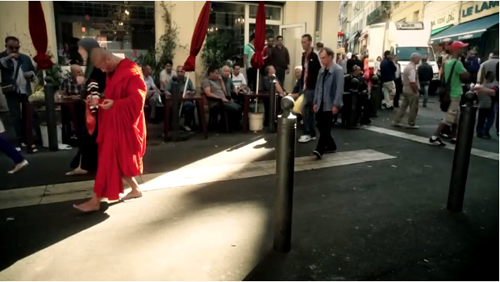
Journey to the West (Tsai Ming-liang, 2014).
HKIFF: Firebirds soar and MOTHER returns
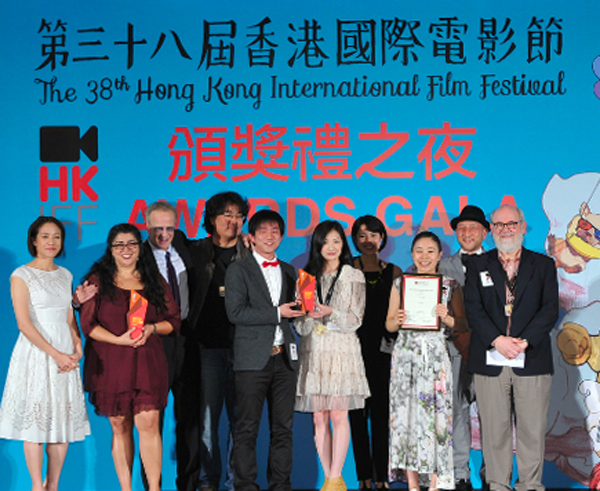
Firebird Young Cinema Award winners and jury members, Hong Kong International Film Festival, 2014. For photos of all winners and jurors, go here.
DB here:
As my Hong Kong trip nears its end, I realize I’ve been too busy to blog properly. So when the wobbly net connections in my hotel permit, I’ll offer some quick entries on things I’ve seen and done.
Prizing movies
First, the big news. The festival hosts several annual awards. There are prizes from SIGNIS, the World Catholic Association for Communication, and FIPRESCI, the International Federation of Film Critics. The festival has established its own prizes as well: for best documentary, best short film, and for young filmmakers. The complete list of winners is here.
The jury for the Firebird Young Cinema Competition consisted of Bong Joon-ho, Karena Lam Ka Yan, Christopher Lambert, and me. We faced some hard choices, but we finally settled on three winners.
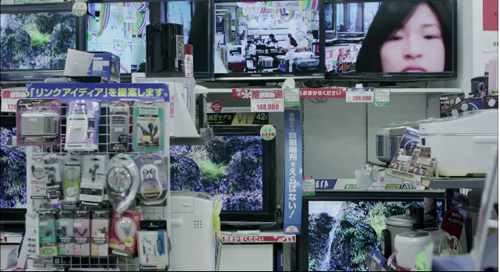
Special Mention went to Forma, by Ayumi Sakamoto. It’s a slow-burning thriller shot in mostly distant long takes and displaying a backward-looping time scheme that makes you rethink the first half. It also displays one virtue of video production: its crucial scene consists of a single shot, only apparently haphazardly composed, that lasts over 22 minutes!
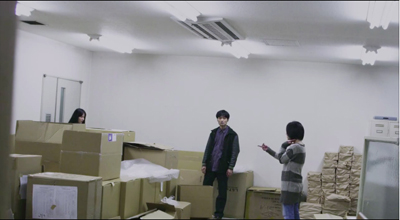
We gave the Jury Prize to Tsuto Tetsuichiro’s Tale of Iya. It’s an extraordinarily ambitious film shot in 35mm Scope in a great variety of locales and weather conditions. It’s about the rigors of rural life, the need for ecological understanding, and a young woman’s growing awareness of her duties to her past. Some scenes recalled the great Japanese widescreen films of the 1950s and 1960s.
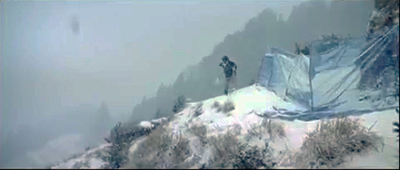
The top prize, the Firebird Award, went to Macondo, a very assured job of storytelling from Sudabeh Mortezai. The plot concerns Chechen refugees in Vienna struggling to get asylum status. At the film’s center is the remarkable performance of Ramasan Minkailov as a shrewd boy who has lost his father in the Chechin war. It’s a coming-of-age film, I suppose, but it also touches on issues of responsibility and loyalty without moralizing.
Serving on the jury was a treat for me, and I learned a lot from talking with my fellow jurors. Karena is famous for her roles in July Rhapsody and Inner Senses. More recently she has published Voyages, a remarkable book of Polaroid photographs. Christopher, as both actor and producer, has several new projects, including Electric Slide, coming to Tribeca. Joon-ho’s Snowpiercer will be released on 27 June in the US; after prolonged wrangling with Harvey Weinstein, this will be the director’s cut. The release will be limited, but it will pass to VOD thereafter.
Black and white is the new black
While finishing Snowpiercer, Bong took on a pretty intriguing side project. He told his cinematographer, Hong Kyung-pyo, that he’d always wanted to make a black-and-white film but that no producers would finance one nowadays. Hong suggested that they remake Mother (2009) in black-and-white. So during postproduction on the big film, they used spare days to redo the color data from the older one. It wasn’t simply a matter of hitting a button. They performed color correction shot by shot so as to control the exact degree of tonality and contrast.
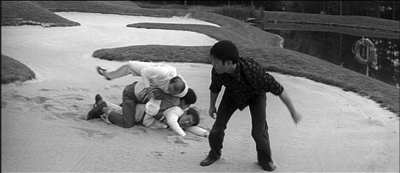
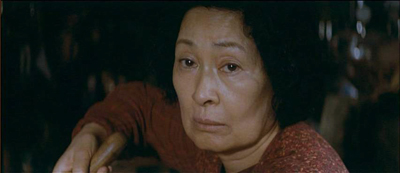
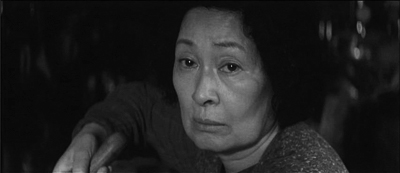
The result, already released on Blu-ray in South Korea and world-premiered at Mar del Plata, had its Asian premiere here in Hong Kong. It is exactly the same film, but without full color. Punning aside, it really does become more of a film noir–harsher, bleaker, and more somber.
The original film has a fairly muted palette, with lots of grays, beiges, soft blues, and earthy browns. In black and white you lose the nicely distinguished grayish-blues of a shot like this. (My monochrome frames are rough approximations derived from Photoshopping the color DVD; I don’t yet have the Blu-ray.)
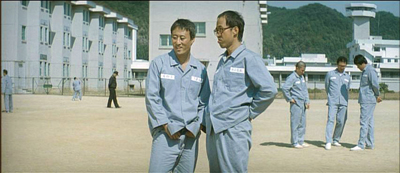
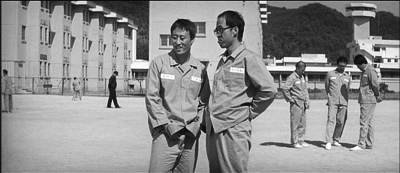
At the same time, the performances seem more highlighted in the new version. Bong noted that certain colors, such as the green on the golf course, were a little opulent in the original. In the new version they don’t overwhelm the characters, and the abstract elements of the composition become a bit more apparent.
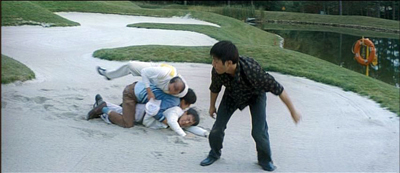
Bong also observed that some viewers have said that the characters’ eyes—pure black—are more prominent in black and white. I had never thought about it, but in old films the actors’ gazes do seem more gripping. At times, the mother’s face becomes more haunted, and haunting.
Just as striking, a clue (I’d hate to call it a red herring) depends on a crimson smear on a golf club. Rendered in black-and-white it becomes even more ambivalent.
Bong said in the Q & A that the project satisfied an urge he discovered while watching Nosferatu at an archive screening without any music. “It was a very purified experience.” He wondered if he could go back to “a very pure state of film, like a salmon swimming upstream.” Yet the new version still harbors one visual surprise.
The monochroming of Mother seems to me a rewarding experiment; I look forward to comparing the two versions and seeing how each can suggest different sides of a scene or summon up different expressive qualities. At the moment, I prefer the black-and-white version, and Bong suggested that he was starting to do the same. After Nebraska and Mother, maybe filmmakers will rediscover what black-and-white can do—and producers and audiences will let them.
Forma (2013).
Arthouse suspense, in big and small doses
Le Quattro Volte.
DB here:
As happened last year, I had to flee Hong Kong for medical reasons. Beset by a wracking cough, I took off three days early and upon returning to Madison wound up in hospital. Current diagnosis: pneumonia. Duration of stay: six nights and counting. A drag. But I’m lucky: no disorderly orderlies, no homicidal doctors injecting me with mind-control drugs (“You will watch only Brett Ratner films for the rest of your life. Sleep, sleep…”). I’m taken care of by expert, calm, and good-natured people. Expect no less from the best city for men’s health and care.
So I’ve been tardy in writing this final HK blog. I just wanted to talk about two extraordinary films I saw in my final days and bring up a scrap of news for followers of Chinese film.
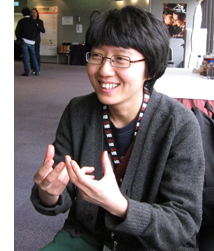 First, the news. Liu Jiayin, of Oxhide fame, was in Hong Kong briefly to accept an Asian Film Financing Forum award for her screenplay Clean and Bright. The other winner was Li Ruijun, for his project Where Is My Home? Liu was about to visit the US for screenings at Redcat, under the sponsorship of the tireless Bérénice Reynaud, and at Cinema Pacific in Portland. I had a chance to talk briefly with her just before she departed.
Regular readers of this blog know my admiration for Liu’s two Oxhide films. The good news is that she is at work on Oxhide III. She wouldn’t say much about it, except that she is still reworking the script, but it sounded quite far along. In addition, she hopes to shoot Clean and Bright, a more orthodox film about a family, fairly soon as well. Oxhide IV is also planned, with the series running up to perhaps eight installments.
For more on Oxhide, including purchase information for the DVD, check Kevin Lee’s dGenerate Films website.
Leaving us hanging
Too often we think of suspense as specific to certain genres, but it’s actually a fundamental resource of all storytelling. Creating expectations about an upcoming event, sharpening them, and delaying their fulfillment–all these strategies are basic, I think, to narrative experience in general. Although some plots emphasize suspense more than others, even most “character-centered” tales wouldn’t engage us without a dose of it.
True, sometimes there’s a sort of bait-and-switch, as when suspense is conjured up but eventually dissolved. Sooner or later we realize Godot isn’t going to show up, or that Anna in L’Avventura is likely not to be found. In those cases, suspense has led us to another terrain, usually thematic, in which we’re invited to consider something more significant than learning the outcome of events. (Sometimes, though, snuffing out suspense is just a sign of slack, or Slacker, storytelling.)
Suspense is usually associated with popular plotting, so many people expect Serious Films to be lacking in suspense. Which makes it all the more interesting that Iran, one of the most-favored nations on the festival circuit, has made something of a specialty of suspenseful art movies.
We don’t recognize often enough that Kiarostami’s early films are often structured as suspenseful quests, from the boy’s attempt to return his schoolmate’s notebook in Where Is the Friend’s Home? to the final shot of Through the Olive Trees. His scripts for other directors convey this quality even more clearly. The Key is almost Griffithian in showing how a four-year-old boy struggles to rescue his younger brother when they’re locked in a kitchen with a gas leak. The Journey (Safar) is positively Ruth Rendellian: A headstrong middle-class father leaving Tehran with his family forces another car off the road and flees the scene. Instead of resting at a summer retreat, he returns obsessively to the place of the accident to check the progress of the investigation: Will he give himself away? And it isn’t just Kiarostami. Look at the suspense structure in Makhmalbaf’s Moment of Innocence, or Reza Mir-Karimi’s The Child and the Soldier, or Panahi’s The Circle.
What gives Iranian suspense films their weight is partly the fact that they don’t rely so much on the old standbys (chases, stalkings, cliffhanging rescues) but rather on psychological maneuvers, carried out largely through dialogue. Characters in these movies tend to talk a lot, pushing their concerns forward with a stubbornness that we seldom see in other national cinemas. People stick up for themselves, and the suspense comes from a clash of testimonies, pleas, and self-justifications. But it also comes from a moral dimension. My earlier examples depend on our assessing what we ought to happen (the hero of the Journey should be punished) versus what we might want to happen (he should escape). Add a dash of mystery, as we have in Through the Olive Trees (what is Tehereh thinking?) and A Taste of Cherry (what is the job Mr. Badi is hiring for?), and you have artistically ambitious filmmaking that exploits some very traditional resources of the art form.
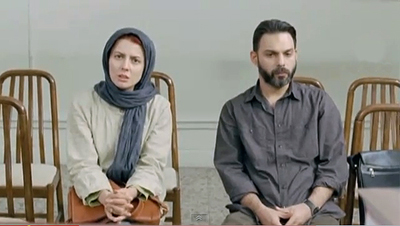
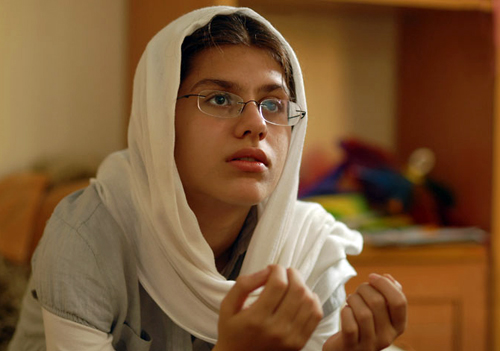
These resources were on display in Asgar Farhadi’s earlier About Elly, which I praised in these pages two years ago. Nader and Simin, A Separation has a comparable power to seize and hold our interest. A wife fails to get a divorce and leaves the household, which includes not only her husband Nader but his Alzheimer’s-addled father and their daughter Termeh. Without Simin to care for his father, Nader hires Razieh, a working-class woman who must bring her little girl with her. Soon the job overwhelms Razieh and, for reasons not disclosed till later, she goes missing. Nader and Termeh find the old man tied to the bed, unconscious.
For this early stretch of the film, the helper Razieh trembles on the verge of hysteria, and only later do we learn why. When she returns to the apartment, she confronts Nader’s wrath, which leads to yet another turning point, but one whose significance we realize only later. To complicate matters, Razieh’s hot-headed husband becomes furious with everyone. As in About Elly, a great deal turns on what characters know at one precise moment, and our memory of when they learned something can be as elusive as theirs. And as in Henry James’ novels, much of the action is registered through the reactions of onlookers, notably the pensive daughter Termeh (below), who turns out in the final scene to be as important as any other figure in the film.
The suspense builds on many levels: the progress of the divorce, the decline of the old man, the court case that involves Razieh’s place in the household (did she steal money?), and above all the responsibility for a death. Some of these lines of action are shown resolved; a crucial one remains suspended. And that does, as often happens, oblige us to think more broadly about the film’s treatment of parent/ child relationships. We are left with an exceptionally rich film, one reflecting on class differences, religious ones, and the effects of adult problems on the children around them. Suspense not only feeds our hunger for story; it can also tease us to moral reflection, and Nader and Simin does just that.
No suspense?
How much can you purge suspense from a movie? And if you play it down, what do you put in its place to hold our interest?
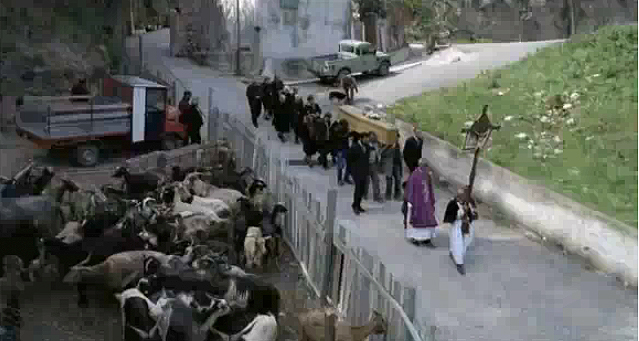
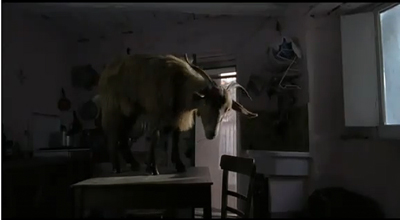
One answer to these questions comes in Michelangelo Frammartino’s Le Quattro Volte. It is one of those sedate observational pieces that covers a year in the life of a village, with not much discernible dialogue but lots of lovely landscape shots. It has a cyclical rather than linear structure, beginning and ending with smoldering wood turned into charcoal–itself a metaphor for the inevitable transmutations that govern plants, animals, and men. We follow an old goatherd who eventually dies; his goats pay homage by climbing precariously to his tiny home and occupying it. A young goat is born soon after the old man’s death. The townsfolk erect an enormous Christmas tree, which at the end of the holiday is chopped down into bits, which will in turn becomes charcoal. If Nader and Simin exists largely in medium-shot, here the extreme long-shot dominates. There are no psychological interactions or dramatic issues of the sort we find in Fahradi’s films. In the rustic spirit of Rouquier’s Farrebique, we get the sheer successiveness of things, the fact that life is one damned, or placid, moment after another.
So suspense can be replaced by sheer consecutiveness, but the task then becomes to make things interesting. Frammartino does so through careful framing, evocative sound, and crisp storytelling technique. The goats pick their way up to the old man’s hillside apartment; they jostle around inside; cut to a shot of the old man’s head as he lies dead; cut to the church, with people filing out as the bell tolls. In addition , you can find suspense at more micro-levels, working not at the level of plot action as a whole but rather within and across particular scenes. After the goatherd’s death, we see another kid born: this is familiar, even clichéd, the rhythm of nature. We follow the kid’s efforts to assimilate to the herd. But as winter comes, the kid strays off, becomes isolated, and ends up lost and shivering. We must assume that he dies. So much for the great cycle of life.
At a still more microscopic level comes the shot that everyone remembers from Le Quattro Volte. It’s so salient that critics who seldom notice imagery can’t help but mention it. I won’t describe it in detail, so as not spoil the surprises, but suffice it to say that it involves a church procession, some intransigent goats, a pickup truck, and a resourceful dog. Reminiscent of Tati or Suleiman, this long shot depends on ratcheting up our expectations about how several converging events might develop, onscreen or off, and then fulfilling those expectations in startling ways. We might call the result spatial suspense: How will this composition-in-time finally resolve itself?
We should, then, never underestimate the power of suspense, even in those films which might seem to forswear it. Melodrama or pastoral, any genre can find a way to excite us by asking what can come next.
Catching up: By leaving Hong Kong early I missed the second screening of The Turin Horse; my first impressions are here. Since I wrote that, I learned that Cinema Scope has published Robert Koehler’s sensitive appreciation of the film and his enlightening interview with the cinematographer Fred Kelemen.
Nader and Sinin, A Separation.
A matter of ‘Scope
Killer Constable.
DB here:
Like most cinephiles of my vintage, I love anamorphic widescreen, especially in its early years. Even though CinemaScope as a trademarked format is long gone, its aspect ratio of 2.35 or 2.40 to 1 became the standard, and we tend to call any widescreen film of those proportions a “‘Scope” production.
Nowadays many films are in ‘Scope; it’s sensed as a cool ratio. Too cool, actually: I’m not sure that Cop Out and The Hangover needed to be in ‘Scope. Things were quite different in Asian cinema during the 1960s and 1970s, where directors had to learn how to master and exploit the new acreage available to them. I was reminded of their problems, and some of their dazzling solutions, when I visited films that were part of two big retrospectives at the Hong Kong Film Festival this year.
The Shochiku touch
Festival goers tend to ignore their cities’ round-the-year programming. We’ve shown films at our Cinematheque that would have drawn more strongly if they had been presented under the umbrella of a festival. A festival is a big, ballyhooed event, and people set aside time to plunge into it. They take it as an occasion to explore cinema. But that impulse isn’t as strong, I think, in other seasons.
Accordingly, the HKIFF has developed a smart strategy. It often launches a retrospective during the festival period but then continues it after the festival is finished. This enables the festival to spotlight the series more vividly and to engage viewers to return in the weeks to come. The drawback is that the strategy tantalizes us visitors, who wish we could stay on to get a full dose of Shimizu Hiroshi (subject of a 2004 roundup) or Kinoshita Keisuke (2005) or Nakagawa Nobuo (2006). This year’s hors d’oeuvres were even more scanty: only two of the films of Shibuya Minoru played during the festival, which ended Tuesday. The rest come later in April.
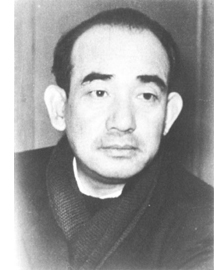 At the venerable Shochiku studio, after assisting Naruse Mikio and Gosho Heinosuke, Shibuya worked with Ozu on What Did the Lady Forget? (1937) before launching his own directing career. He made over forty films, the last one released in 1966. My own awareness of Shibuya before my visit was limited to the family dramas A New Family (Atarashiki Kazoku, 1939) and Cherry Country (Sakura no kuni, 1941), both in a mildly, though not rigorously, Ozuian vein.
The earlier film in the partial Shibuya retrospective was Righteousness (1957), an ensemble piece about a neighborhood still laboring under postwar hardships. The young Seitaro is in love with Michiko, but her mother offers her in marriage to her more prosperous roomer. Seitaro works as a mechanic for a bus company, where Fujita is a driver. Fujita has just married a young woman against his father’s wishes. The characters are introduced through the peripatetic Okyo, Seitaro’s mother, who peddles black-market goods to her neighbors. Fujita’s troubles mount up when his bus hits a child, and Seitaro must decide whether to reveal what he knows about the accident. The film builds well to two climaxes, the consequences suffered by Seitaro after he makes his painful decision and then Okyo’s denunciation of her neighbors. On the other side of the ledger, Fujita’s domestic troubles are resolved rather abruptly and implausibly. Still, Righteousness exemplifies the classic Shochiku formula of smiles mixed with tears, capped by a more-or-less upbeat resolution.
Shibuya was shadowed by Ozu even after the master’s death, for he was assigned to make a memorial film based on the last project planned by Ozu and screenwriter Noda Kogo. This was the film now circulating as Mr. Radish and Mr. Carrot (1965).
Chris Fujiwara has provided us an enlightening account of how Shibuya turned what would probably have been another subtle Ozu meditation on generational strife, in the manner of An Autumn Afternoon, into a more raucous comic melodrama. Yamaki is an executive who lives by strict routine, but he’s also pestered by his four daughters and his lothario brother. When a friend comes down with cancer and the brother reveals himself as an embezzler, Yamaki flees without warning. As his family fret about him, and quarrel among themselves, he settles in among working people, notably some prostitutes and a swindler selling Chinese medicine.
No one in the family displays much virtue, and even Yamaki is seen as cranky and oblivious to the needs of his wife and children. Radish and Carrot’s cynicism seemed to me too easy, and the physical comedy, such as Ryu Chishu’s bodily contortions, struck me as forced and overplayed. Stylistically, the film is eclectic and almost casual. It begins with a zoom and a whip pan. Thereafter, we get flash cuts, canted setups, and a fashion show. Unlike Righteousness, this film justifies Fujiwara’s claim, in a HKIFF catalogue essay not available online, that Shibuya sometimes embraced “visual excess.”
Ozu refused widescreen filming; he compared the ‘Scope frame to a roll of toilet paper. He may have realized that it would pose problems for his graphically matched cuts, deep and subtly imbalanced compositions, and other techniques he had refined over decades. Similarly, Radish and Carrot made me wonder if Shibuya was comfortable working in ‘Scope. He drops in some Ozuian corridor images, but at other times he mounts the sort of packed wide-angle shots common in 1960s Japanese anamorphic films.
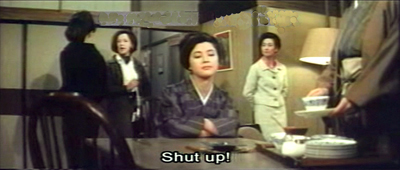
When Ozu fills up his 4×3 frames, he gives us more to look at, along with more daring placement of figures. This is not your typical establishing shot.
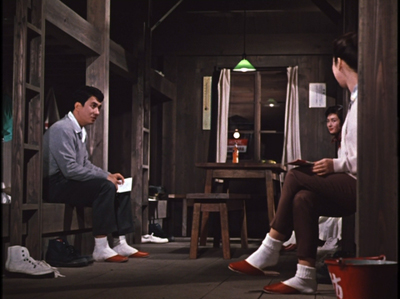
Ozu’s signature shot is at a low height but seldom at a low angle. Shibuya’s compositions remind you what a real low-angle image looks like, with the camera tipped up considerably.
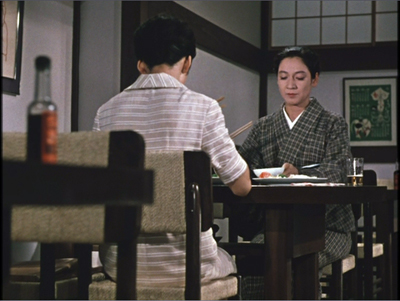
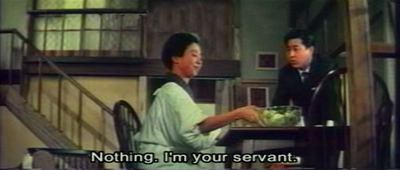
I know, it’s unfair to judge Shibuya’s film by the exalted standards of Late Autumn (1960), and we risk saddling him with purposes he didn’t have. He probably didn’t set out to make an Ozu pastiche. Yet we can, I think, fault Radish and Carrot sheerly on craft grounds. Two party scenes, one gathering men and one among wives, seemed to me almost haphazard in their spatial development. This cut, for instance, is more careless than anything I noticed in Righteousness.
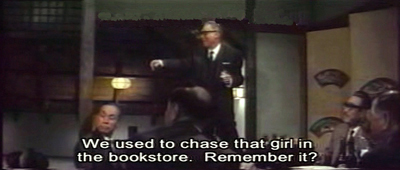
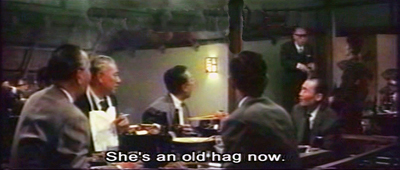
In the second shot, on the far right side, a waitress is now in the frame next to the old man, and he has already turned and is talking to her instead of his classmates at the other table. When this film was made, younger directors, like Suzuki Seijun and Oshima Nagisa, were already handling ‘Scope with much more assurance. I look forward to seeing more Shibuya widescreen entries to learn if they made more polished use of the format.
Elegance and vulgarity
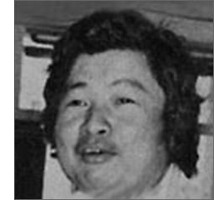 The other retrospective in question was devoted to Kuei Chih-hung (in Cantonese, Gwei Chi-hung), a Shaws director who has been overshadowed by the more famous Chang Cheh and Li Han-hsiang (here and here on this site). Kuei worked in several genres, including the sex movie and the horror film, and he was able to supply cheap items in quantity. But he stands out partly because he moved outside the opulent Shaw studio to shoot on locations. Working with an efficient crew and a lightweight camera, Kuei produced some films, like The Delinquent (1973) and The Teahouse (1974), that look forward to the social realism of the New Wave that followed. Like some New Wavers as well, Kuei highlighted the cruelty of class warfare in Hong Kong both past and present. Ironically, he ceased directing when he felt that the young generation had pushed things further than he could go.
The crime-centered plots of The Delinquent, The Teahouse, and Big Brother Cheng (1975) manage a fair amount of outrage at policing and justice in Hong Kong, as do Kuei’s contributions to a series of omnibus films called The Criminals. His excursions into exploitation fare with Bamboo House of Dolls (1973), Killer Snakes (1974), and the Hex cycle (1980 and after) show, if nothing else, how anxious Shaws was to retain market share in the face of the thrusting popularity of Golden Harvest releases. Obliged to go gross, the man didn’t flinch. The Boxer’s Omen (1983), a supernatural kickboxing yarn, features one rite that demands that celebrants chew food, spit it out, and pass it along to be eaten by others. (No fakery, everything done in one shot.) My tastes run more to something like Killer Constable (1980).
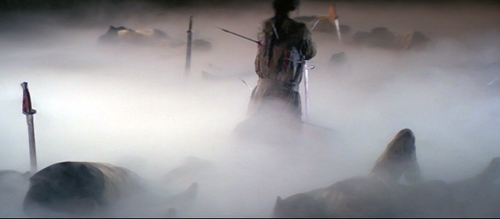
It’s a shooting-gallery plot. Constable Leng and his team are sent to recover gold stolen from the Empress’s palace, and one by one the fighters are eliminated in skirmishes with the thieves. Kuei pointed proudly to the social criticism in the film: “I simply wanted to depict how insignificant commoners are and how, under totalitarian rule, they turn out to be the victims.” Leng, preferring to kill lawbreakers rather than bring them to trial, pursues the bandits with unblinking ferocity. When he finds a miller who helped the gang, he decapitates the man in front of his wife and squalling baby. But Leng’s brutality meets its match in the bandits, who devise comparably sadistic ways to decimate his posse.
Killer Constable comes near the tail end of the Shaws output, just a few years before the company largely abandoned theatrical film production in favor of television. Kuei is thus able to absorb and advance some of the studio’s signature techniques. His film starts out in the splendor of high-key lighting and saturated color typical of Shaws court epics, but soon enough, sword battles play out by torchlight or in semidarkness.
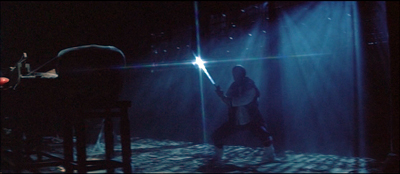
As for ‘Scope, Kuei had the benefit of a strong tradition. In action films, both Japanese and Hong Kong directors cultivated a “precisionist” use of the ratio that made parts of the composition–sometimes widely distant parts–click into place one by one, at a staccato pace. Here are phases of an early fight in Killer Constable.
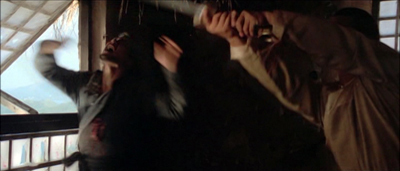
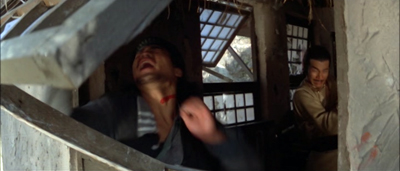
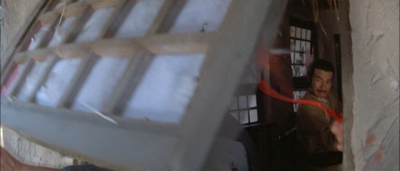
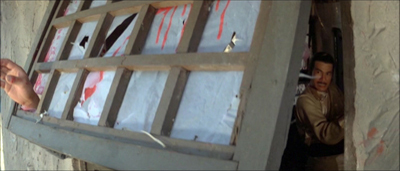
The rhythm builds, from the cut to the new angle, then the peekaboo flip of the window, then the spotlighting of Leng in the lower right, and finally the thrusting hand of his victim in the extreme left, at which point the shot comes to rest.
‘Scope felicities like this may stem as much from the power of the tradition as from Kuei’s individual talent. In any case, his retrospective, like the Shibuya one, shows that we haven’t fully charted the range of expressive possibilities opened by popular Asian cinema in their early encounters with widescreen.
Chris Fujiwara’s survey essay, “Irony, Disenchantment, and Visual Excess: The Style of Shibuya Minoru,” appears in the HKIFF catalogue, available here. In Chapter 12 of Poetics of Cinema, I illustrate Japanese filmmakers’ relative laxity about the 180-degree matching system with a couple of shots from Shibuya’s A New Family. The passage in question may be one-off borrowing from Ozu.
The Hong Kong Film Archive book devoted to Kuei Chih-hung provides precious information not only on the director but also on the Shaws studio system. For more on widescreen style at Shaws see my online essay, “Another Shaw Production: Anamorphic Adventures in Hong Kong.” I discuss the rhythmic resources of Hong Kong combat in Chapter 8 of Planet Hong Kong.
Other continuing retrospectives at this year’s HKIFF are devoted to Abbas Kiarostami and Vietnamese cinema from 1962-1989. If you’re passing through town, you could do worse than check them out.
Thanks to Li Cheuk-to for correcting some information.
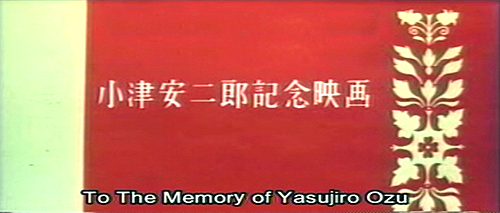
Opening title for Mr. Radish and Mr. Carrot.