







Archive for the 'Directors: Hitchcock' Category
Little things
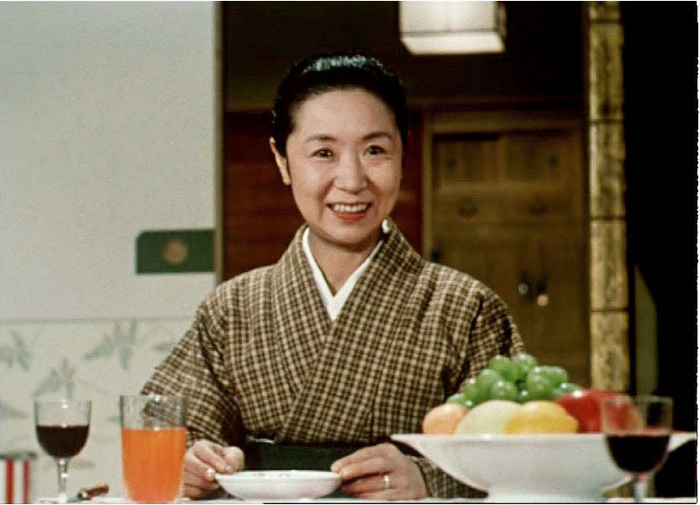
Equinox Flower (Ozu, 1958).
DB here:
Academic critics and fans share a passion for looking closely at the movies we admire. A lot of film critics enjoy spiraling out from the film to ponder Big Ideas, which is okay, I guess. But I confess I particularly enjoy digging in for trouvailles (great word), lucky discoveries that passed me by on earlier encounters.
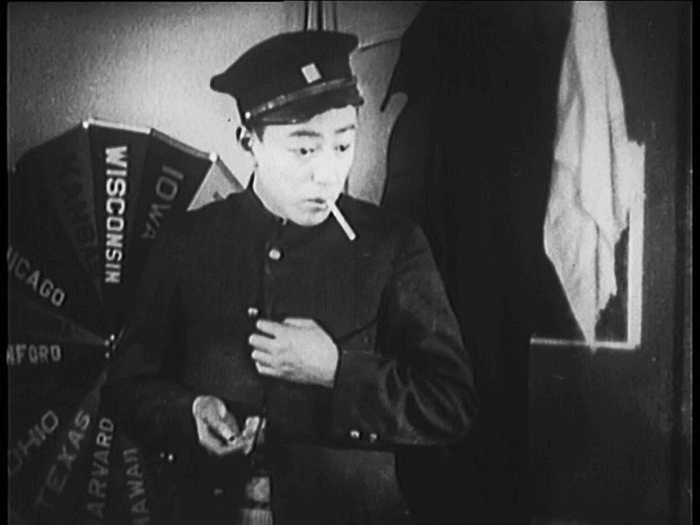
Across my career, many of the directors I admire seem to have tucked in little things just for me (or you). They don’t necessarily carry meanings; they’re quietly decorative, subtly off-center to the narrative. Tati slipped peculiar items into the corners of the frame. Sturges offered gags that only people with his sense of humor will find funny. A successful crowdsourcing enterprise exposed Welles’ homages to early film. Above all, Ozu nudged me toward red teakettles and surprising details. Who else lines up the levels of beverages in a table setting, and then matches that plane to the edge of a fruit bowl?
If you care enough about my movie, the director seems to say, I’ll reward you with a trouvaille. Here are two I found recently.
Showing the stitches
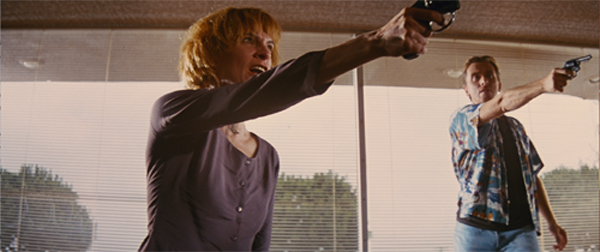
Sometimes a trouvaille is a felicity of craft. The director quietly shows off his virtuosity to those in the know. While studying Pulp Fiction for a book I’m finishing, I noticed that Tarantino sets up the ending in a sidelong way.
You’ll remember that the opening shows Honey Bunny and Pumpkin discussing how a restaurant is one of the safest robbery targets. Abruptly they launch an assault on the diner. Then they drop out of the film for a couple of hours.
Very likely we’ve forgotten about them when Jules and Vincent settle down for breakfast in a diner. After discussing the virtues of pork products and the prospects for Jules’ future, Vincent rises to go to the toilet. As he pauses, it’s possible, but not easy, to discern the larcenous couple out of focus in their booth behind him. Given their peripheral status and the centrality of Travolta’s performance, I suspect that almost no one notices them on a first viewing.
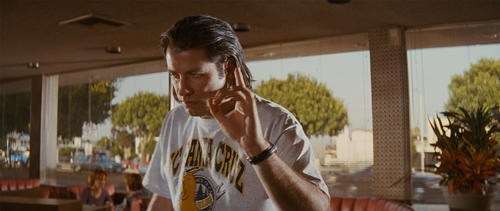
Soon after Vincent has left, we’ll hear a repetition of the final bits of the couple’s conversation and we’ll see a replay of their leaping up to announce the robbery. Tarantino has rewarded the sharp-eyed viewer with a slight anticipation of the replay, and a hint at how his film will fold back on its opening sequence.
But this echo is matched by a “pre-echo” during the opening sequence. As Pumpkin and Honey Bunny plan their heist, a close view of her includes a bulky man in a t-shirt walking into the distance.
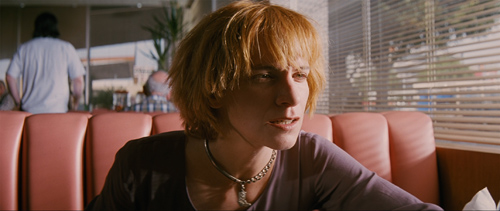
At this point, a first-time viewer hasn’t been introduced to Vincent, so the t-shirt guy is just part of the scenery. Only in retrospect do we realize that here Tarantino is anticipating, and overlapping, the portion of the robbery that we’ll see in the final moments of the film.
Here the critic/fan is invited to appreciate how carefully made the film is. It’s a quality we don’t sufficiently recognize in Tarantino: a delight in fine-grained formal niceties.
Easter Egg, avant la lettre
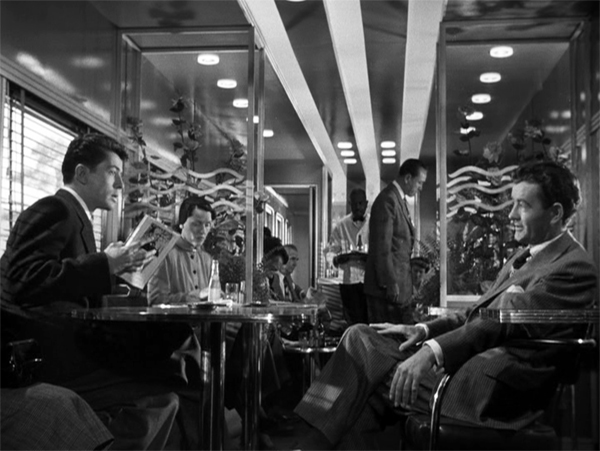
In Hitchcock’s Strangers on a Train (1950), tennis pro Guy Haines is introduced (implausibly) reading a book on his trip. Soon he’s accosted by the spoiled, marginally nuts Bruno Anthony, and the plot gets under way. Only a fan, or a critic, will want to know: What’s Guy reading?
It’s not easy to tell. We don’t get a close-up of the book. The best we can tell, from above, is that it’s a hardcover, with a photo on the back of the dust jacket. Later, after Guy and Bruno have shared a meal in a compartment, we can glimpse the spine.
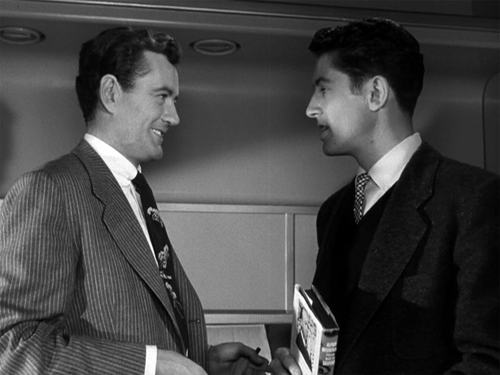
Blown up, thanks to the glory of Blu-ray, the spine looks like this.
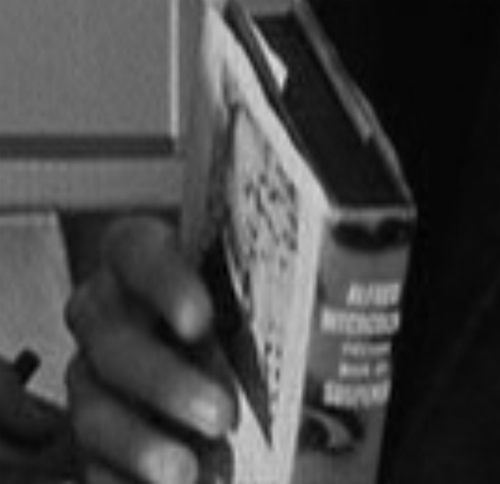
A little research reveals that the volume is Hitchcock’s collection of stories published in 1947 by Simon and Schuster.
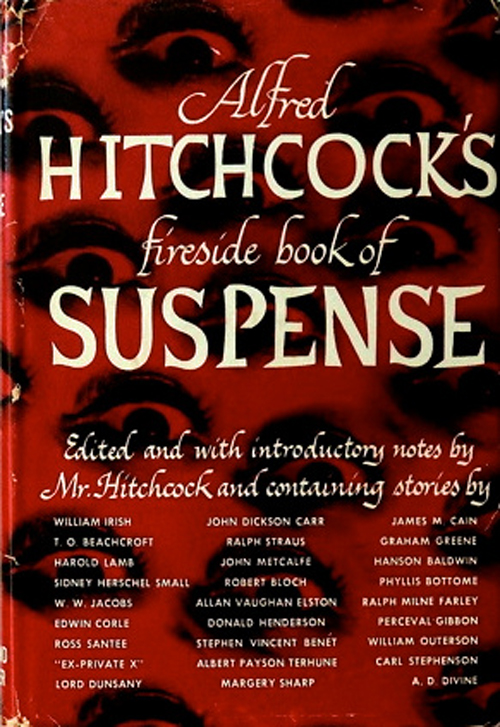
Several anthologies were published under Hitchcock’s name from the 1940s onward, but most were in paperback. This was a more prestigious item, and I suspect it helped the branding effort that was underway during his Hollywood career. The picture on the back is of Hitchcock, of course. (My copy lacks a dust jacket, so I can’t supply that.) But the resonance comes from the fact that I was reading this very book as part of preparation for my own study of 1940s mystery culture.
It’s not exactly product placement; the book’s presence is too fleeting to register with audiences, surely. Including the book seems more in the nature of a private joke among Hitch and his team. Guy is a man of good taste, reading a book by the man directing the film he’s in.
Today we’re familiar with Easter Eggs, those bonus materials that establish a complicity between filmmmaker and viewer. Is this an early example? It could be a prize for fan connoisseurship. The book isn’t emphasized, being buried in the mise-en-scene, and so it encourages the devout to poke and probe. It also points outside the film to the production context. Still, how many 1950 viewers, lacking our ability to freeze and magnify the frame, could have spotted it? Perhaps only the devotion of a modern fan, aided by new technology, can bring this trouvaille to light. An incipient Easter Egg, then, awaiting digital technology to be discovered?
Once we’re down this rabbit hole, let’s scramble further. What stories might Guy be reading? There are two hints. We have the placement of the jacket flap in the shot above, and an earlier shot showing the book open.
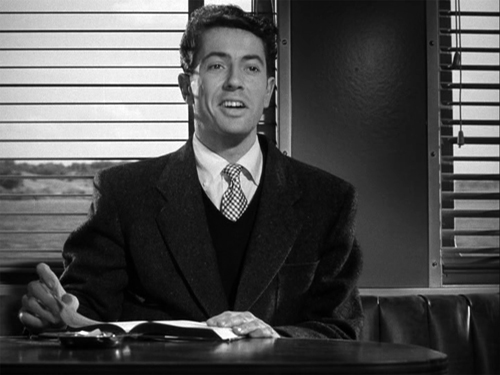
As best I can tell, the story Guy’s reading is likely to be “Yours Truly, Jack the Ripper.” It tells of a psychiatrist who meets an Englishman called “Guy Hollis.” Sir Guy believes that Jack the Ripper has migrated to the US and is at large in Chicago. With the aid of the psychiatrist, Sir Guy finds him. Apart from the name Guy, the correspondence to Strangers it would seem to involve a peculiar bond between two men, one of whom is a psychopathic killer.
But there’s another, stranger affinity.
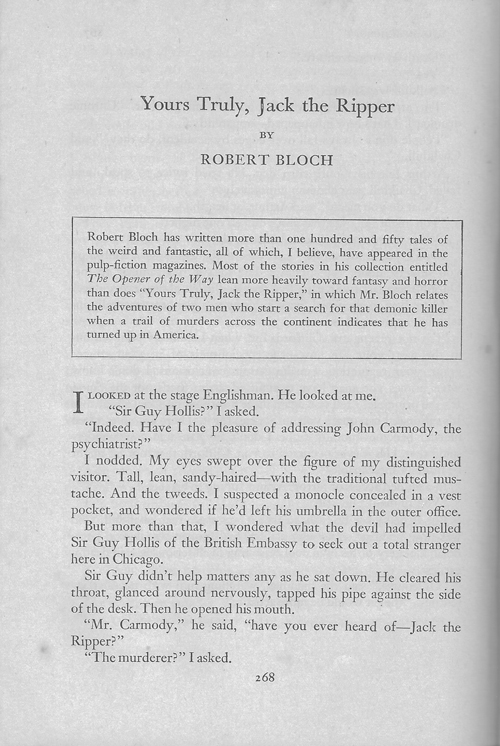
The author of “Yours Truly, Jack the Ripper” is Robert Bloch., whose novel Psycho would furnish Sir Alfred his 1960 film. Coincidence? In the land of trouvailles, are there any coincidences?
Fans have raked over these movies assiduously, so I can’t imagine I’m the first to notice these fine touches. No matter. When you discover them on your own, you still feel a tiny thrill of communicating with the filmmaker, behind the backs of all those folks who didn’t notice. Ozu, I often feel, is making movies especially addressed to me. It’s an illusion, of course, but I refuse to give it up.
Thanks to the University of Wisconsin–Madison Filmies listserv for helping me understand what counts as Easter Eggs, and for a reality check on my sanity.
This site includes lots more on Hitchcock, Ozu, Sturges, and Tarantino. My book on Ozu is available from the University of Michigan. It takes time to download, so be patient.
P.S. 15 August 2021: As I thought, I’m not the first. A mere twenty-one years ago, Dana Polan in his monograph on Pulp Fiction (British Film Institute) noticed the pre-echo of Vincent headed toward the toilet. Good going, Dana! Film analysis wins again.
Days of Youth (Ozu, 1929).
Learning to watch a film, while watching a film
The Hand That Rocks the Cradle (1992).
DB here:
“Every film trains its spectator,” I wrote a long time ago. In other words: A movie teaches us how to watch it.
But how can we give that idea some heft? How do movies do it? And what are we doing?
Many menus
Tinker, Tailor, Soldier, Spy (2011).
In my research, I’ve found the idea of norms a useful guide to understanding how filmmakers work and how we follow stories on the screen. A norm isn’t a law or even a rule; it’s, as they say in Pirates of the Caribbean, more of a guideline. But it’s a pretty strong guideline. Norms exert pressure on filmmakers, and they steer viewers in specific directions.
Genre conventions offer a good example. The norms of the espionage film include certain sorts of characters (secret agents, helpers, traitors, moles, master minds, innocent bystanders) and situations (tailing targets, pursuits, betrayal, codebreaking, and the like). The genre also has some characteristic storytelling methods, like titles specifying time and place, or POV shots through binoculars and gunsights.
But there are other sorts of norms than genre-driven ones. There are broader narrative norms, like Hollywood’s “three-act” (actually four-part) plot structure, or the ticking-clock climax (as common in romcoms and family dramas as in action films). There are also stylistic norms, such as the shoulder-level camera height and classic continuity editing, the strategy of carving a scene into shots that match eyelines, movements, and other visual information.
Thinking along these lines leads you to some realizations. First, any film will instantiate many types of norms (genre, narrative, stylistic, et al.). Second, norms are likely to vary across history and filmmaking cultures. The norms of Hollywood are not the same as the norms of American Structural Film. There are interesting questions to be asked about how widespread certain norms are, and how they vary in different contexts.
Third, some norms are quite rigid, as in sonnet form or in the commercial breaks mandated by network TV series. Other norms are flexible and roomy (as guidelines tend to be). There are plenty of mismatched over-the-shoulder cuts in most movies we see, and nobody but me seems bothered.
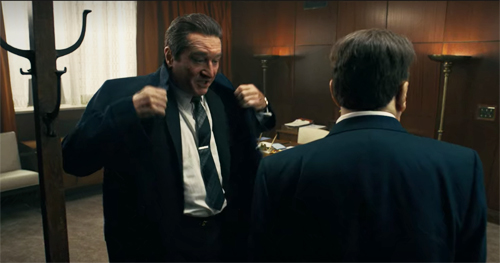
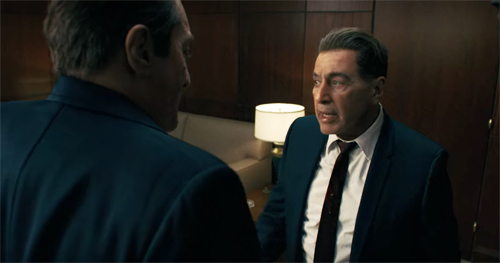
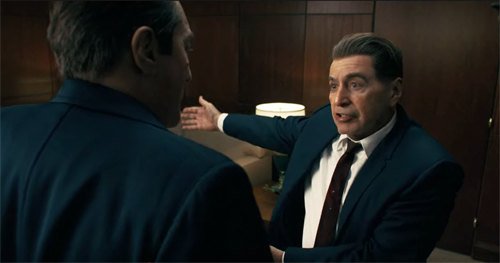
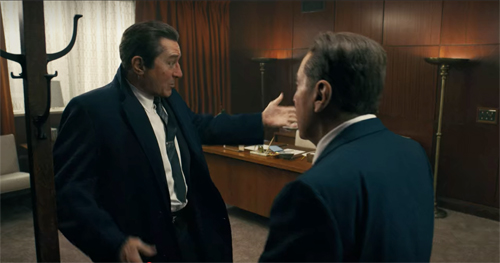
More broadly, norms exist as options within a range of more or less acceptable alternatives. Norms form something of a menu. In the spy film, the woman who helps the hero might be trustworthy, or not. The apparent master mind could turn out to be taking orders from somebody higher up, perhaps somebody supposedly on your side. One scene might avoid continuity editing and instead be presented in a single long take.
Norms provide alternatives, but they weight them. Certain options are more likely to be chosen than others; they are defaults. (Facing a menu: “The chicken soup is always safe.”) An action film might present a fight or a chase in a single take (Widows, Atomic Blonde), but it would be unusual if every scene in the film were played out this way. Not forbidden, but rare. Avoiding the default option makes the alternative stand out as a vivid, willed choice.
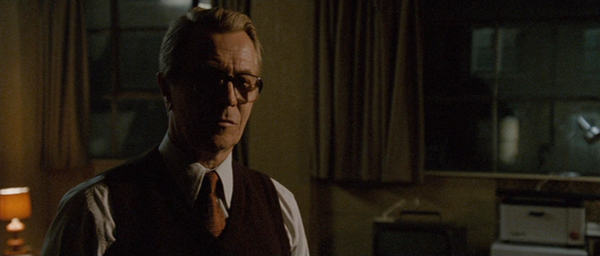
Very often, critics take most of the norms involved for granted and focus on the unusual choices that the filmmakers have made. One of our most popular entries, the entry on Tinker, Tailor, Soldier, Spy, discusses how the film creates a demanding espionage movie by its manipulations of story order, characterization, character parallels, and viewpoint. It isn’t a radically “abnormal” film, but it treats the genre norms in fresh ways that challenge the viewer.
Because, after all, viewers have some sense of norms too. Norms are part of the tacit contract that binds the audience to creators. And the viewer, like the critic, looks out for new wrinkles and revisions or rejections of the norm–in other words, originality.
Picking from the menu
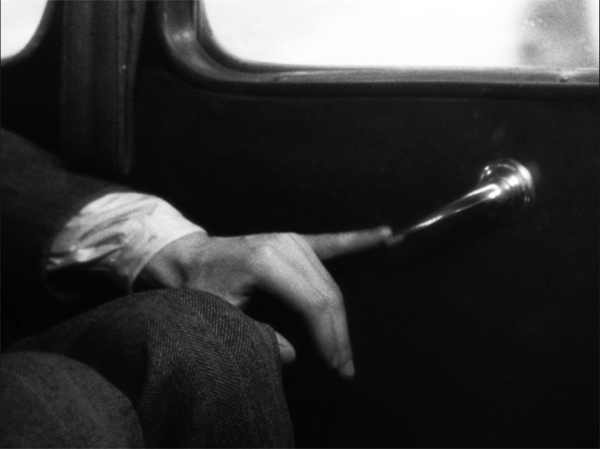
Norms of genre, narrative, and style are shared among many films in a tradition or at a certain moment. We can think of them as “extrinsic norms,” the more or less bounded menu of options available to any filmmaker. By knowing the relevant extrinsic norms, we’re able to begin letting the movie teach us how to watch it.
The process starts early. Publicity, critical commentary, streaming recommendations, and other institutional factors point up genre norms, and sometimes frame the film in additional ways–as an entry in a current social controversy (In the Heights, The Underground Railroad), or as the work of an auteur. You probably already have some expectations about Wes Anderson’s The French Dispatch.
Then, as we get into the film, norms quickly click into place. The film signals its commitment to genre conventions, plot patterning, and style. At this point, the film’s “teaching” consists largely of just activating what we already know. To learn anything, you have to know a lot already. If the movie begins with a character recalling the past, we immediately understand that the relevant extrinsic norm isn’t at that point a 1-2-3 progression of story events, but rather the more uncommon norm of flashback construction, which rearranges chronology for purposes of mystery or suspense. Within that flashback, though, it’s likely that the 1-2-3 default will operate.
As the film goes on, it continues to signal its commitment to extrinsic norms. An action scene might be accompanied by a thunderous musical score, or it might not; either way, we can roll with the result. The characters might let us into their thinking, through voice-over or dream sequences, or we might, as in Tinker, Tailor, be confronted with an unusually opaque protagonist whose motives are cloudy. The extrinsic norms get, so to speak, narrowed and specified by the moment-by-moment working out of the film. Items from the menu are picked for this particular meal.
That process creates what we can call “intrinsic norms,” the emerging guidelines for the film’s design. In most cases, the film’s intrinsic norms will be replications or mild revisions of extrinsic ones. For all its distinctiveness, in most respects Tinker, Tailor adheres to the conventions of the spy story. And as we get accustomed to the film’s norms, we focus more on the unfolding action. We’ve become expert film watchers. We learn quickly, and our “overlearned” skills of comprehension allow us to ignore the norms and, as we stay, get into the story.
Narration, the patterned flow of story information, is crucial to this quick pickup. Even if the film’s world is new to us, the narration helps us to adjust through its own intrinsic norms. The primary default would seem to be “moving spotlight” narration. Here a “limited omniscience” attaches us to one character, then another, within a scene or from scene to scene. We come to expect some (not total) access to what every character is up to.
In Curtis Hanson’s Hand That Rocks the Cradle, we’re initially attached to the pregnant Claire Bartel, who has moved to Seattle with her husband Michael and daughter Emma. When Claire is molested by her gynecologist Dr. Mott, she reports him. The scandal drives him to suicide, and his distraught wife miscarries. She vows vengeance on Claire. Thereafter, the plot shuttles us among the activities of Claire, Mrs. Mott, Michael, the household handyman Solomon, and family friends like Michael’s former girlfriend Marlene. The result is a typical “hierarchy of knowledge”–here, with Claire usually at the bottom and Mrs. Mott near the top. We don’t know everything (characters still harbor secrets, and the narration has some of its own), but we typically know more about motives, plans, and ongoing action than any one character does.
More rarely, instead of a moving spotlight, the film may limit us to only one character’s range of knowledge. Again, scene after scene will reiterate the “lesson” of this singular narrational norm. That repetition will make variations in the norm stand out more strongly. Hitchcock’s North by Northwest is almost completely restricted to Roger Thornhill, but it “doses” that attachment with brief asides giving us key information he doesn’t have. Rear Window and The Wrong Man, largely confined to a single character’s experience, do something similar at crucial points.
Sometimes, however, a film’s opening boldly announces that it has an unusual intrinsic norm. Thanks to framing, cutting, performance, and sound, nearly all of Bresson’s A Man Escaped rigorously restricts us to the experience of one political prisoner. We don’t get access to the jailers planning his fate, or to men in other cells–except when he communicates with them or participates in communal activities, like washing up or emptying slop buckets.
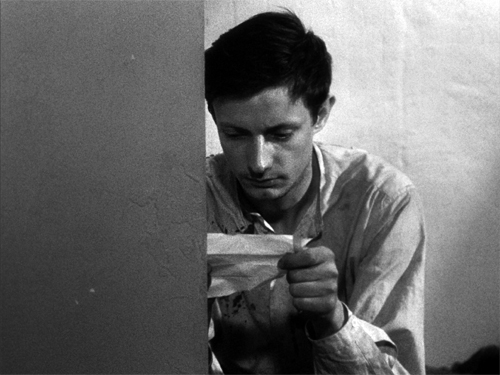
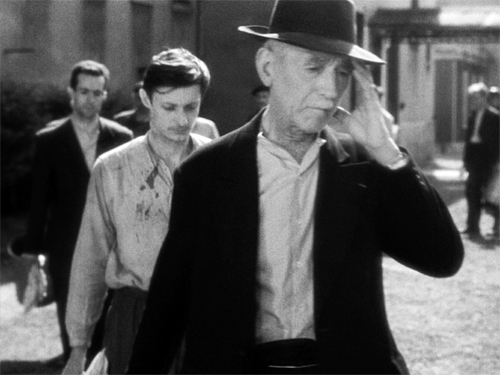
The apparent exception: The film’s opening announces its intrinsic norm in an almost abstract way. First, we get firm restriction. There are fairly standard cues for Fontaine’s effort to escape from the police car that’s carrying him. Through his optical POV, we see him grab his chance when the driver stops for a passing tram.
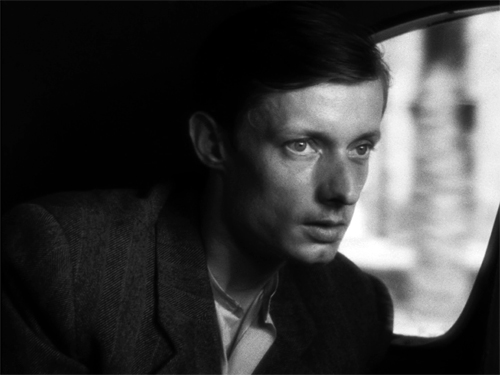
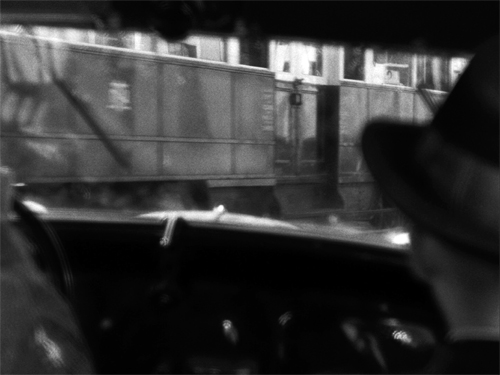
The film’s title and the initial situation let us lock onto one extrinsic norm of the prison genre: the protagonist will try to escape. Knowing that we know this, Bresson can risk a remarkable revision of a stylistic norm.
Fontaine bolts, but Bresson’s visual narration doesn’t follow him. The camera stays stubbornly in the car with the other prisoner while Fontaine’s aborted escape is “dedramatized,” barely visible in the background and shoved to the far right frame edge. He is run down and brought back to be handcuffed and beaten.
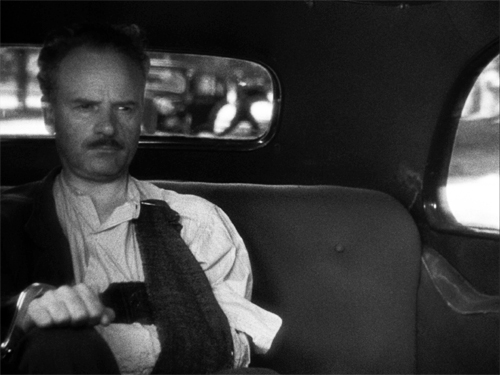
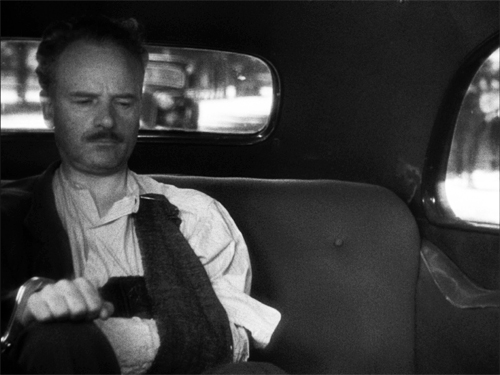
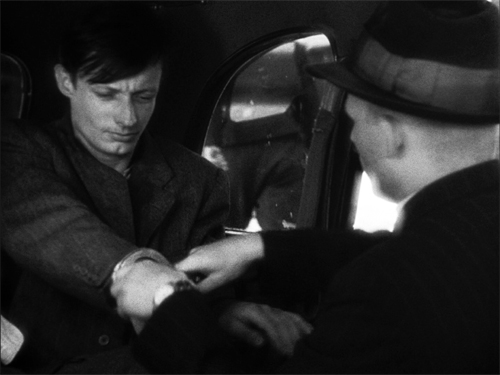
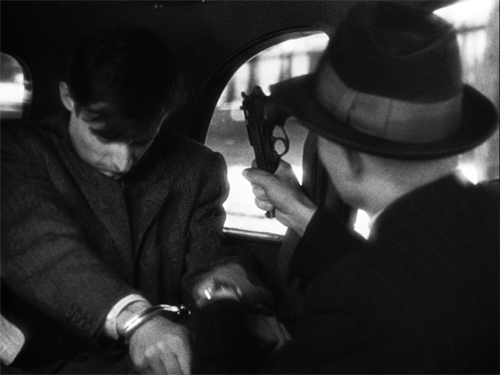
The shot announces the premise of spatial confinement that will dominate the rest of the film. The narration “knows” Fontaine can’t escape and waits patiently for him to be dragged back. In effect, the idea of “restricted narration” has been decoupled from the character we’ll be restricted to. This is the film’s first, most unpredictable lesson in stylistic claustrophobia.
Got a light?
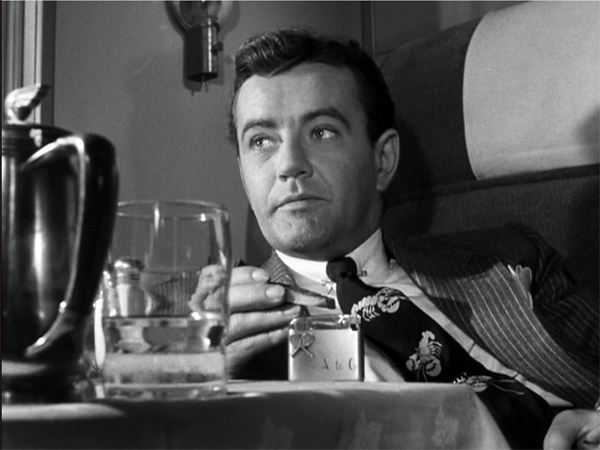
Most intrinsic norms aren’t laid out as boldly as the opening of A Man Escaped, but ingenious filmmakers may provide some variants. Take a fairly conventional piece of action in a suspense movie. A miscreant needs to plant evidence that incriminates some innocent soul.
In Strangers on a Train, that evidence is a cigarette lighter. Tennis star Guy Haines shares a meal with pampered sociopath Bruno Antony, whose tie sports colorful lobsters. Bruno steals Guy’s distinctive cigarette lighter.
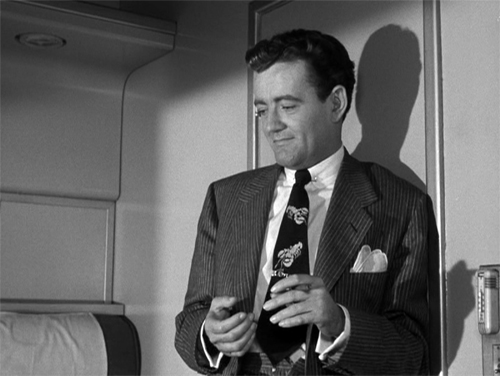
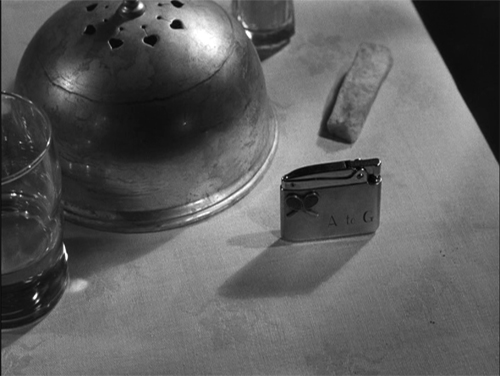
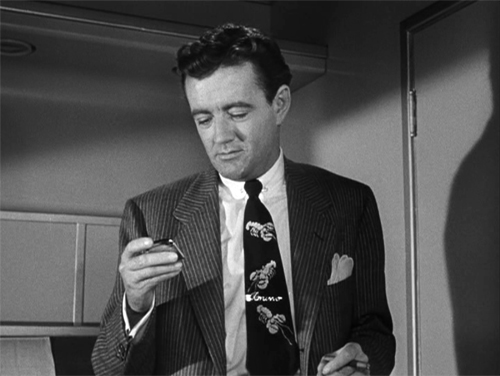
Bruno has proposed that they exchange murders: He will kill Guy’s wife Miriam, who’s resisting divorce, and Guy will kill Bruno’s father. Bruno cheerfully strangles Miriam at a carnival, aided by the lighter.
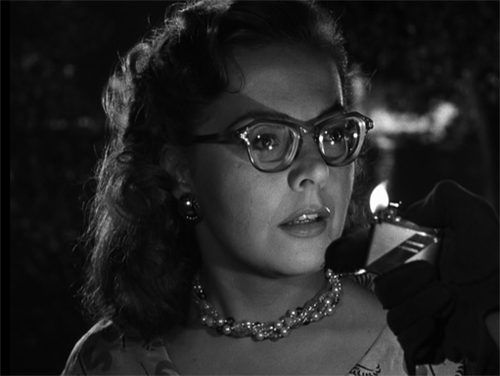
When Guy doesn’t go through with his side of the deal, Bruno resolves to return to the scene of Miriam’s death and leave the lighter to incriminate Guy. The film’s climax consists of the two men fighting on a merry-go-round gone berserk. Although Bruno dies asserting Guy’s guilt, the lighter is revealed in his hand. Guy is exonerated.
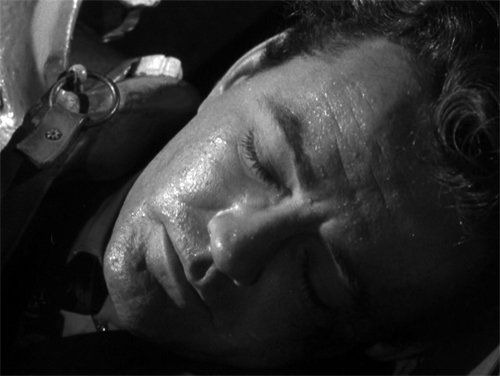
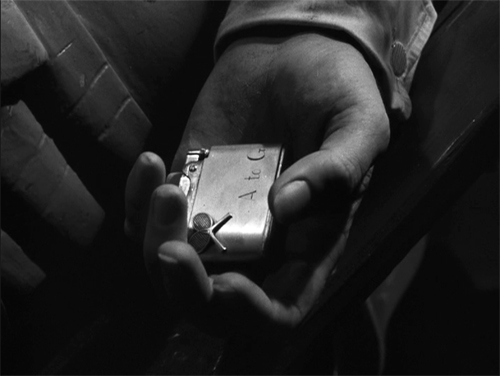
Once the lighter is introduced in the early scenes, it comes to dominate the last stretch of the film. In scene after scene, Hitchcock emphasizes Bruno’s possession of it. Sometimes it’s only mentioned in dialogue, but often we get a close-up of it as Bruno looks at it thoughtfully–here, brazenly, while Guy’s girlfriend Ann is calling on him.
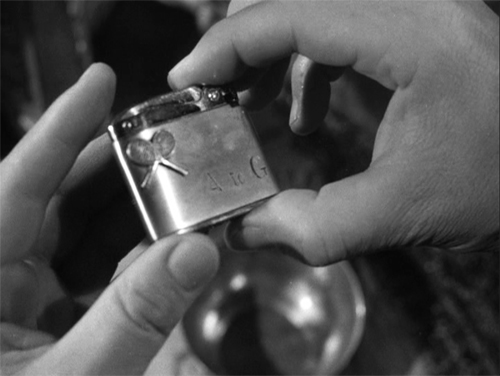
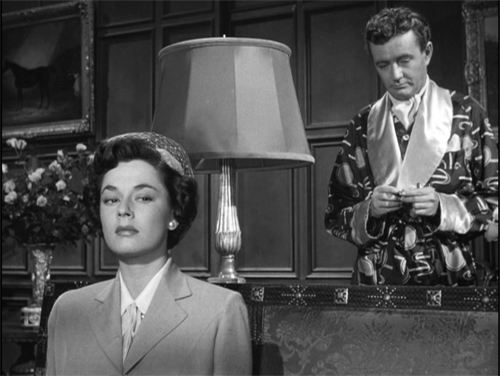
When Bruno picks up a cheroot or a cigarette, we expect to see the lighter.
One of the film’s most famous set-pieces involves Bruno straining to retrieve the lighter after it has fallen through a sidewalk grating.
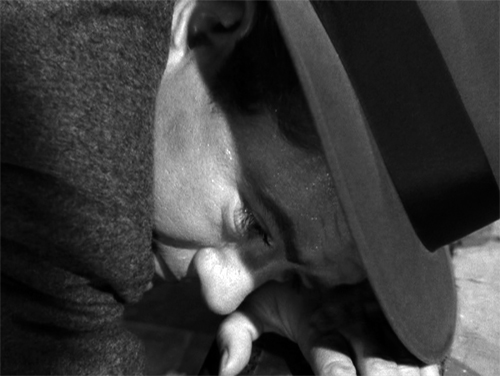
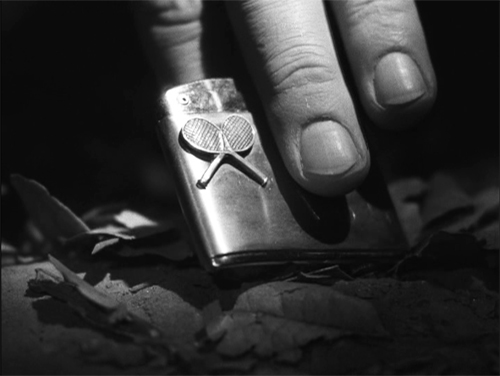
Bruno has dropped it before, during Miriam’s murder, but then he notices and retrieves it. It’s as if this error has shown him how he might frame Guy if necessary. The image of the lighter in the grass previews for us what he plans to do with it later.
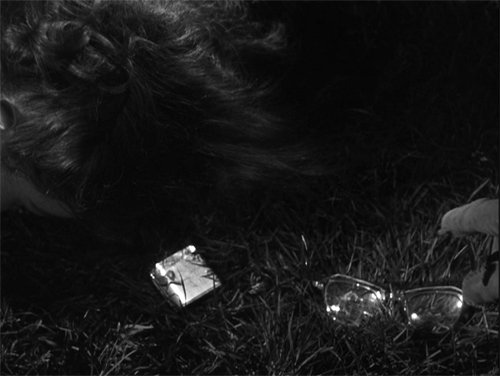
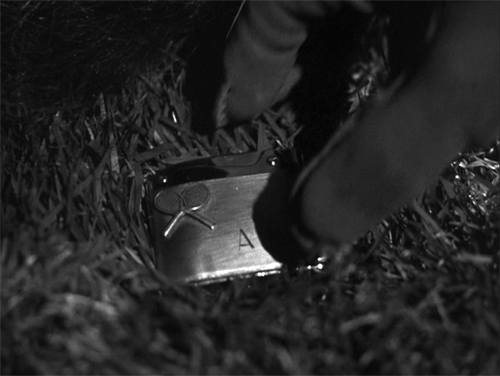
What does the lighter have to do with norms? Most obviously, Strangers on a Train teaches us to watch for its significance as a plot element. It’s not only a potential threat, but also Bruno’s intimate bond to Guy, as if Bruno has replaced Ann, who gave Guy the lighter. The film also invokes a normalized pattern of action–a character has an object he has stolen and will plant to make trouble–and treats it in a repeated pattern of visual narration. The character looks at the object; cut to the object; cut back to the character in possession of the object, waiting to use it at the right moment. Our ongoing understanding of the lighter depends on the norm-driven presentation of it.
Once we’re fully trained, Hitchcock no longer needs to show us the lighter at all. En route to the carnival to plant the lighter, Bruno lights a cigarette with the lighter, although his hands conceal it. But then the train passenger beside him asks for a light.
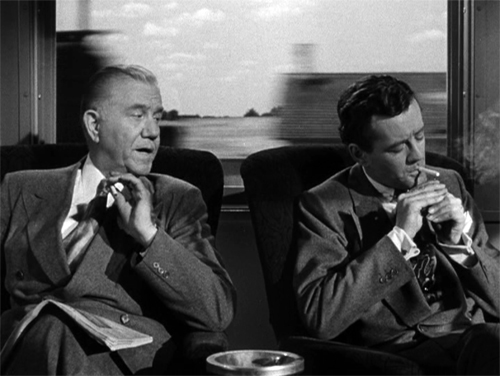
In order to hide the lighter, Bruno laboriously pockets it and fetches out a book of matches.
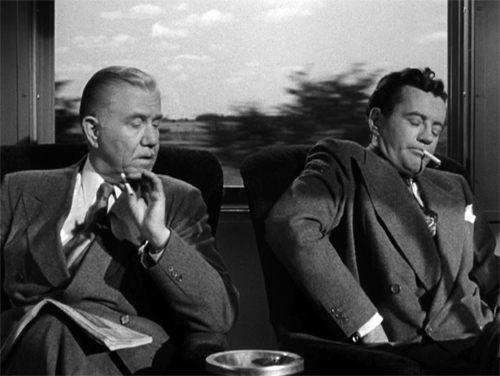
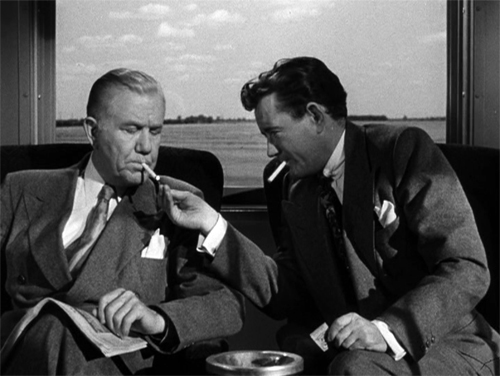
If we saw only this scene, we might not have realized what’s going on, but it comes long after the narrational norm has been established. We can fill out the pattern and make the right inference. Bruno wants no witness to see this lighter.
The hand that cradles the rock
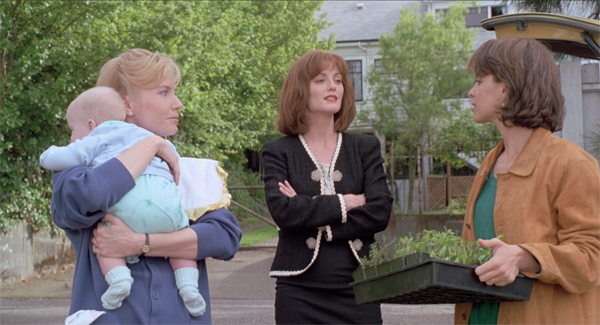
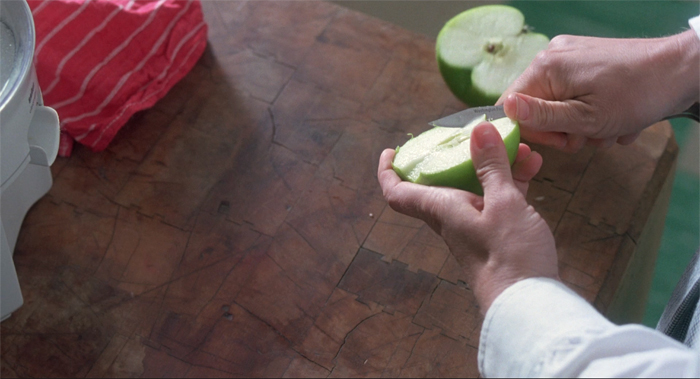
In The Hand That Rocks the Cradle, under the name Peyton Flanders, Mrs. Mott becomes nanny to Claire’s daughter and infant son. Pretending to be a friendly helper, she subverts Claire’s daily routines and her trusting relationship with Michael. As in most domestic thrillers, the accoutrements of upper-middle-class lifestyle–a baby monitor, a Fed Ex parcel, expensive cigarette lighters, asthma inhalers, wind chimes–get swept up in the suspense. Peyton weaponizes these conveniences, and through a somewhat unusual narrational norm the film trains us to give her almost magical powers.
We get Peyton’s early days in household filtered through her point of view. Classic POV cutting is activated during her job interview. She notices that Claire’s pin-like earring drops off and she hands it back to her.
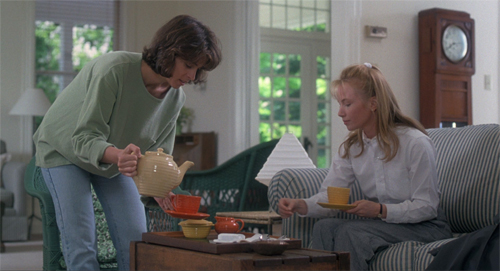
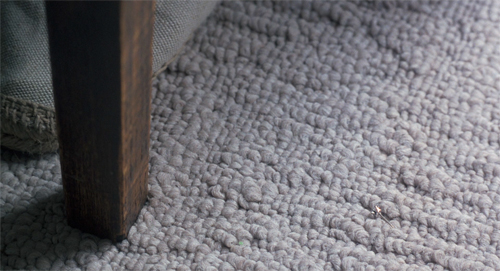
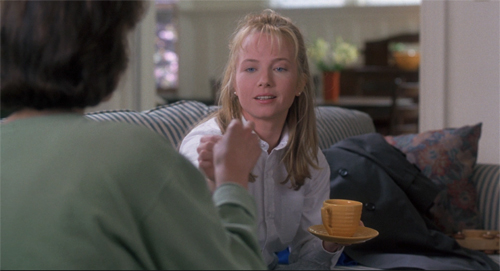
Attachment to Peyton gets more intense when she sees the baby monitor and then fixates on the baby.
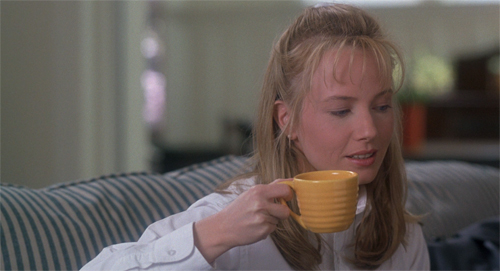
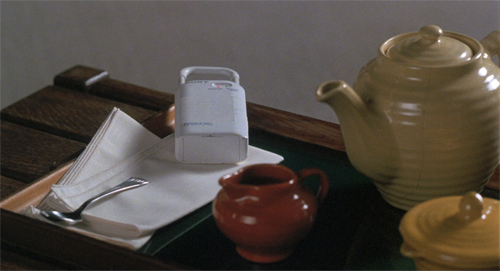
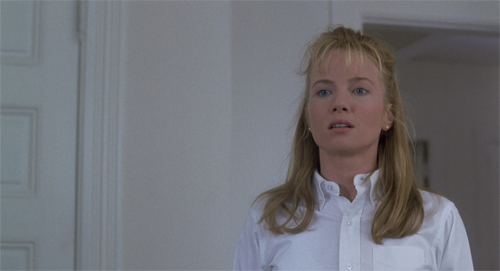
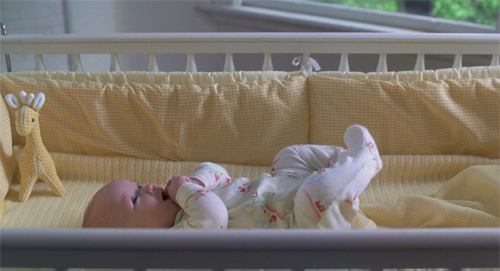
We’re then initiated into her tactics, and to the film’s way of presenting them. Serving supper, Claire doesn’t notice that her earring drops off again. Peyton does.
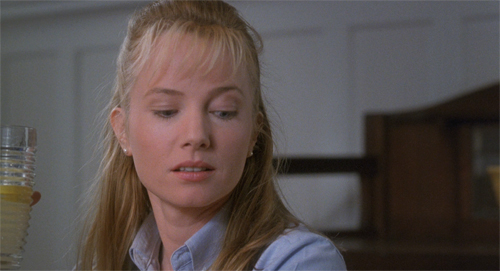
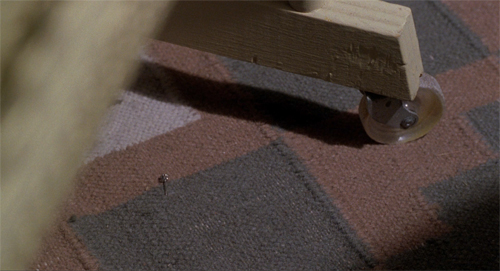
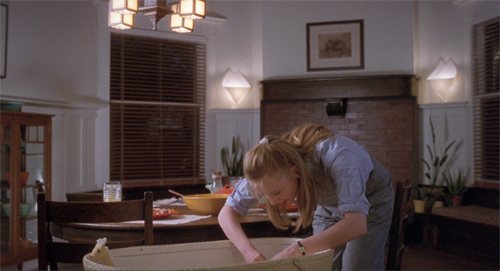
Breaking with her POV, the narration shifts to Claire and Michael talking about hiring her. But this cutaway to them has skipped over a crucial bit of action: Peyton has picked up the earring. Unlike Hitchcock, director Curtis Hanson doesn’t give us a close-up of the important object in the antagonist’s hand. In a long shot we simply see Peyton studying her fingers. Some of us will infer what she’s up to; the rest of us will have to wait for the payoff.
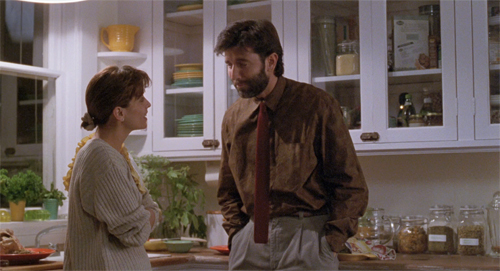
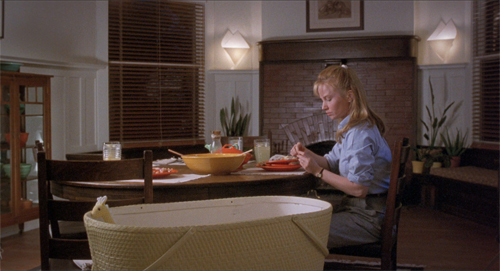
After another cutaway to the couple, Peyton “discovers” the earring in the baby’s crib. Her show of concern for his safety seals the hiring deal and begins her long campaign to prove that Claire is an unfit mother.
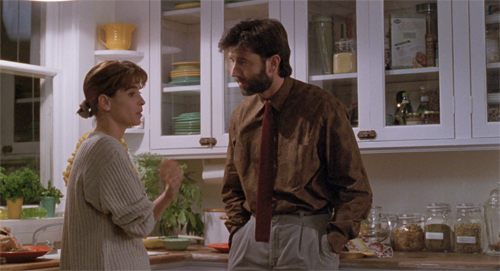
This elliptical presentation of Peyton’s subterfuges rules the middle section of the film. Selective POV shots suggest what she might do, but we aren’t shown her doing it–only the results. For instance, Claire lays out a red dress for a night out. Peyton sees it, then sees some perfume bottles.
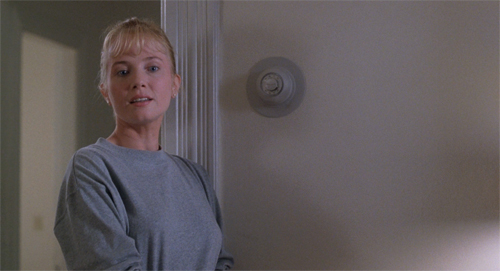
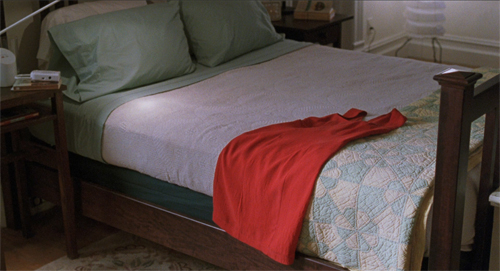
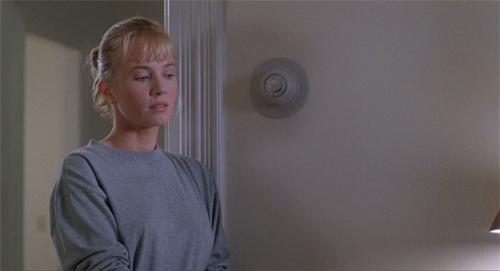
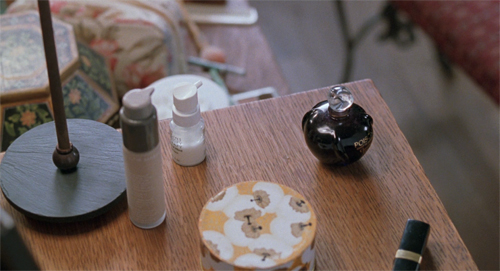
Cut to Claire and then to an arriving guest, and presto. When she returns to the mirror, her dress is suddenly revealed as having a stain.
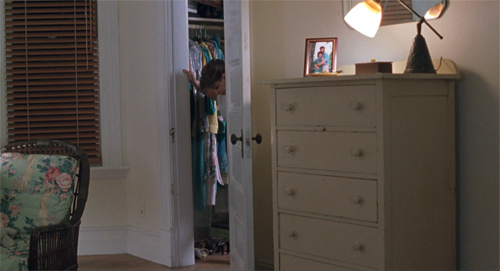
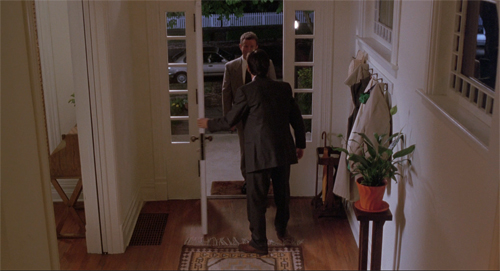
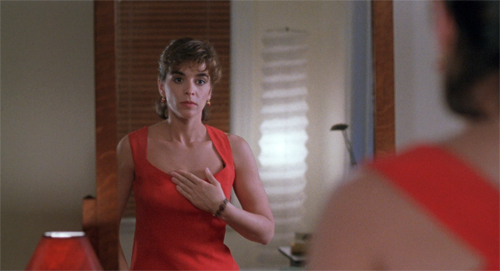
Later, Claire agrees to send off Michael’s grant application during her round of errands. Once she gets to the Fed Ex office, she will discover the missing envelope. Before that, though, we get another variant of the intrinsic norm showing Peyton’s trickery.
In the greenhouse, while Claire is watering plants, Peyton spots the envelope in her bag. We don’t see her take it, and there’s even a hint that she hasn’t done so. A nifty shot lets us glimpse her yanking her arm away as Claire approaches. It’s not clear that she has anything in her hand.
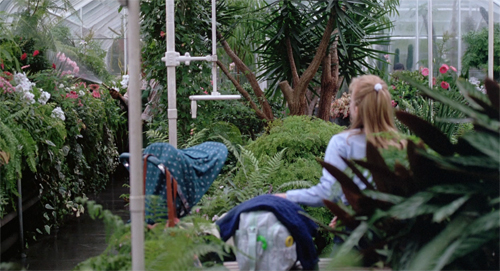
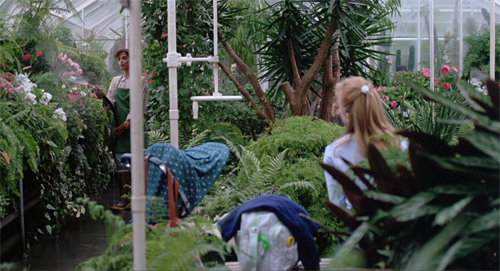
In what follows, the narration confirms Peyton’s theft while building up the threat level.
If she’s caught, this woman will not go away quietly.
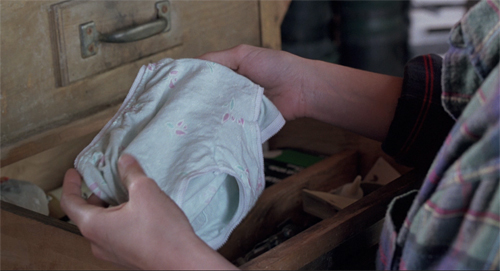
While cozying up to the children–Peyton cuddles with Emma and even secretly breast-feeds baby Joe–Peyton eliminates all of Claire’s allies. By now we know her strategy, so after she suggests to Claire that the handyman Solomon has been molesting little Emma, all the narration needs is to show us Claire discovering a pair of Emma’s underwear in his toolbox. As with Bruno’s pocketing the lighter in Strangers on a Train, we’re now prepared to fill in even more of what’s not shown: here, Peyton framing Solomon.
Michael, a furtive smoker, sometimes shares a cigarette with Marlene. So it’s easy for Peyton to plant Marlene’s lighter in Michael’s sport coat for Claire to discover. Again, the moment of the theft has given her quasi-magical powers. She sees Marlene’s lighter in her handbag in the front seat.
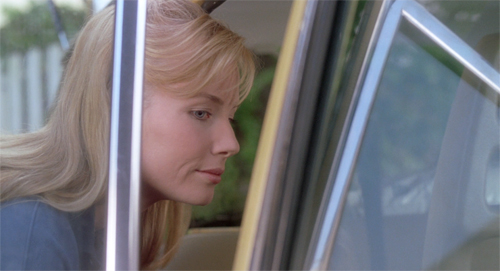
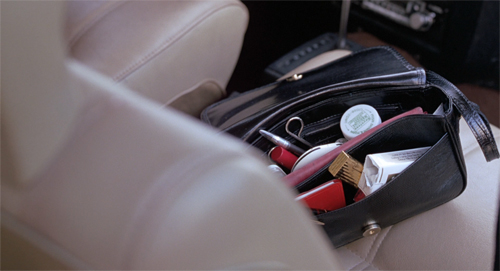
Again thanks to a cutaway, we don’t see her take it. Indeed, it’s hard to see how she could have; she comes out of the back seat with an armload of plants.
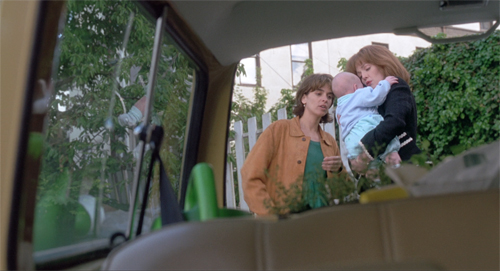
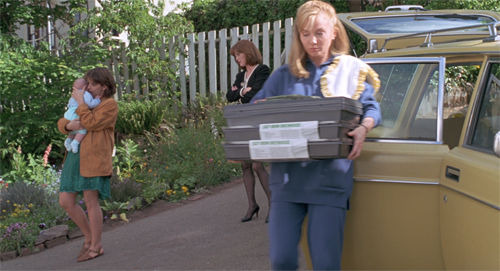
But later Marlene will tell Michael (i.e., us) that she’s lost her lighter, and a dry cleaner will find it and show it to Claire.
The attacks have escalated, with Claire now suspecting Michael of infidelity. She confronts him without knowing that Michael has invited friends to a surprise party for her. Her angry accusations are overheard by the guests, and this public display of her anxieties takes her to a new low.
Peyton’s revenge plan is almost wholly consummated, so we stop getting the elliptical POV treatment of her thefts. Instead, the plot shifts to investigations: first Marlene discovers Peyton’s real identity, with unhappy results, and at the climax Claire does. Her POV exploration of the empty Mott house counterbalances Peyton’s early probing of Claire’s household. When she sees Mrs. Ott’s breast pump–another domestic object now invested with dread–she realizes why baby Joe no longer wants her milk.
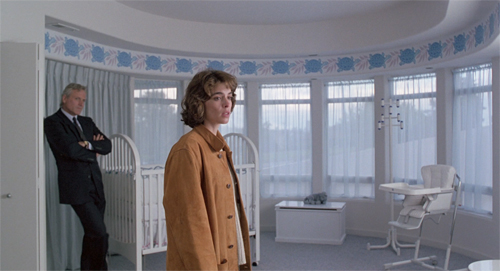
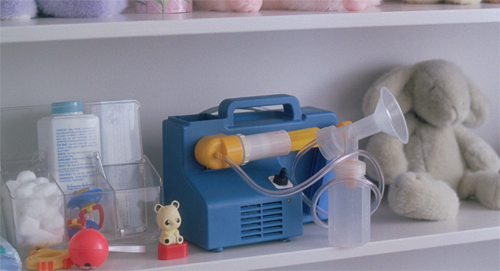
This is the point, fairly common in the thriller, when the targeted victim turns and fights back.
In The Hand That Rocks the Cradle, a familiar action scheme–someone swipes something and plants it elsewhere–is handled through an unusual narrational norm. The scenes showing Peyton’s pilfering skip a step, and they momentarily let us think like her, nuts though she is. Thanks to editing that deletes one stage of the standard shot pattern, the film trains us to see how banal domestic items, deployed as weapons, can destroy a family. In the course of learning this, maybe the movie makes us feel smart.
Arguably, we’re able to fill in the POV pattern in The Hand That Rocks the Cradle because we’ve learned from encounters with movies that used the standard action scheme, including Strangers on a Train. This is one reason film style has a history. Dissolves get replaced by fades, exposition becomes more roundabout, endings become more open. As audiences learn technical devices, intrinsic norms recast extrinsic ones and some movies become more elliptical, or ambiguous, or misleading. All I’d suggest is that we get accustomed to such changes because films teach us how to understand them. And we enjoy it.
The passage about training us comes from my Narration in the Fiction Film (University of Wisconsin Press, 1985), 45. I discuss norms in blog entries on Summer 85, on Moonrise Kingdom, on Nightmare Alley, and elsewhere. A book I’m finishing applies the concept to novels as well as films.
The example of mismatched reverse angles comes from The Irishman (2019) In the first cut, Frank is starting to settle his coat collar, but in the second, his arms are down and the collar is smooth. In a later portion of that second shot, Hoffa gestures freely with his right hand, but in the over-the-shoulder reverse, his arm is at his side and it’s Frank who gets to make a similar gesture. To be fair, I should say that I found some striking reverse-angle mismatches in Strangers on a Train too.
For more on conventions of the domestic thriller, go to the essay “Murder Culture.”
Radomir D. Kokeš offers an analysis of how Kristin and I have used the concept of norm. We are grateful for his careful discussion of our work and his exposition of the achievement of literary theorist Jan Mukarovský. See “Norms, Forms and Roles: Notes on the Concept of Norm (not just) in Neoformalist Poetics of Cinema,” in Panoptikum (December 2019), available here.
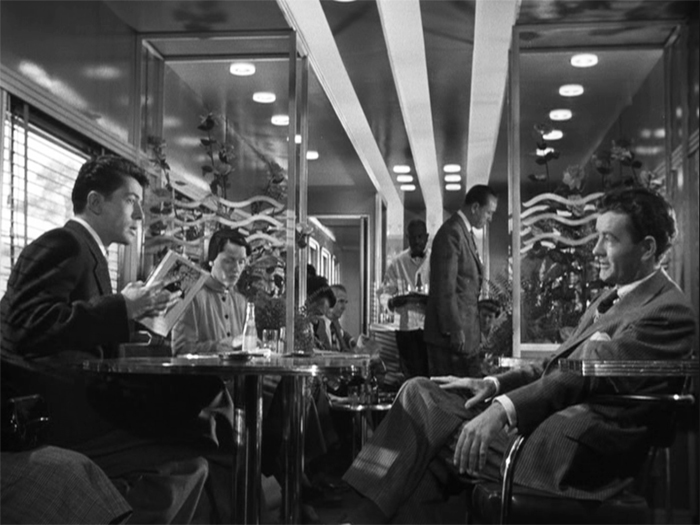
Strangers on a Train (1951).
Can the science of mirror neurons explain the power of camera movement? A guest post by Malcolm Turvey
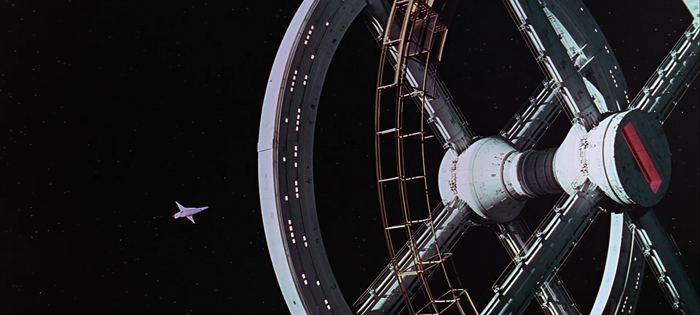
2001: A Space Odyssey (1968).
DB here:
Over the years we’ve brought you several guest posts from friends whose research we admire. The list includes Matthew Bernstein, Kelley Conway, Leslie Midkiff DeBauche, Eric Dienstfrey, Rory Kelly, Tim Smith, Amanda McQueen, Jim Udden, David Vanden Bossche, and our regular collaborator Jeff Smith (most recently, on Once Upon a Time in Hollywood…).
Today our guest is Malcolm Turvey, Sol Gittleman Professor in Film and Media Studies at Tufts University. Malcolm has long been a voice calling for rigorous humanistic study of film. His books include Doubting Vision: Film and the Revelationist Tradition (2008) and The Filming of Modern Life: European Avant-Garde Film of the 1920s (2011). Just this year he published Play Time: Jacques Tati and Comedic Modernism. (More on this in a future blog entry.) Among his many specialties, Malcolm applies the philosophical tools of conceptual analysis to problems of film criticism and theory.
My previous entry discussed some ways psychological research has helped me understand how films work, and I touched on the recent efforts to invoke mirror neurons to explain some effects that movies have on us. Today Malcolm takes a deeper plunge into this line of thinking, and the result is an exciting instance of how careful intellectual debate can be carried out in film studies. It’s also a cautionary tale about relying on scientific research to explain the appeal of artworks. A more extensive version of this piece is slated for publication in Projections: The Journal of Movies and Mind.
In Alfred Hitchcock’s Notorious (1946), Alex Sebastian (Claude Rains) is one of a group of Nazis who have relocated to Brazil after WWII. He has unwittingly married Alicia Hubermann (Ingrid Bergman), an undercover American agent seeking his circle. When Alicia learns that their scheme somehow involves the wine bottles locked in her husband’s cellar, she decides to procure the key so that she and her handler (and lover), Devlin (Cary Grant), can investigate.
Her opportunity comes in a characteristically suspenseful scene. Alicia nervously contemplates her husband’s keychain lying on a bureau as he finishes taking a shower nearby. She bravely steals the key and barely escapes discovery as Alex emerges from the bathroom. But what is the source of the scene’s suspense?
In a provocative new book titled The Empathic Screen, Vittorio Gallese and Michele Guerra claim the suspense should be attributed primarily to a brief, “human-like” camera movement toward the keys that occurs as Alicia looks at them. Moreover, they draw on neuroscience, specifically the science of mirror neurons, to make their case.
Here is the scene.
Are Gallese and Guerra right about the role played by the camera movement? For reasons I’ll give shortly, I doubt they are. More importantly, I question whether the neuroscientific evidence they lean on supports their case. This may seem like nit-picking, but I think their appeal to neuroscience contains valuable lessons about how students of film should–and shouldn’t–engage with scientific research.
Science and film studies
Readers of this blog are likely familiar with the idea that science has an important role to play in film studies. Since 1985, David Bordwell has drawn on contemporary cognitive psychology to answer questions about perceiving and understanding narrative films, thereby launching a new paradigm in film theory that has come to be known as cognitivism. In his previous entry, David offers an overview of his current thinking about cognition and movies.
Cognitivism has generated much heat in academic film studies. But at its heart is what should be an uncontroversial principle: that those who wish to understand the perceptual, cognitive, and affective capacities with which we engage with art should turn to the work of those who know something about these capacities, namely, the psychologists and other scientists who study them empirically and propose theories about them in light of their findings.
This is because our pre-scientific, “folk” understanding of our psychological capacities is usually non-existent or flawed. It is, for instance, hard to explain why we see still frames as moving images when they are projected above a certain speed merely by reflecting on our “phenomenological” experience of watching movies.
Perceptual psychologists, however, have studied this phenomenon empirically and have proposed explanations for it, such as critical flicker fusion frequency and the phi phenomenon (although like all scientific explanations, these are open to revision and even falsification in the light of new evidence and theorizing). The same is true of other features of our experience of films, and cognitive film scholars have built on David’s work by drawing on contemporary scientific knowledge of emotion, music, moral psychology and much else.
This does not mean that film studies is or should be a science. As David and Kristin’s blog entries repeatedly demonstrate, many of the things we want to know about cinema and the other arts can be discovered through non-scientific, humanistic methods such as analyzing films and researching the context in which they were made. In other words, our methods should be tailored to the questions we ask. Cognitivism argues that some important questions about the cinema can be answered by science, not that all or even most can.
The deceptive authority of Science
That said, I worry that engaging with science in a responsible manner is much more difficult than some of my cognitivist colleagues acknowledge. That difficulty is due, in part, to the “authority” of science.
Because of this authority, many non-scientists might assume that science is more settled than it often is, especially in a human science such as psychology. Those of us who aren’t scientists could be tempted to think that a scientific argument must be true because, well, there are scientific data to support it.
But as the recent “repligate” controversy in psychology and elsewhere shows, just because a scientist can present evidence for their views does not make them true. Data can be unreliable and the conclusions drawn from themunwarranted, as we are witnessing on a daily basis during the coronavirus pandemic.
Although there are occasional scientific revolutions, if science makes progress, something that some ph0ilosophers have questioned, it usually does so incrementally through trial and error, and there is much more failure than success. Those of us who don’t participate in this dialectical process might be apt to forget the provisional, tenuous status of much scientific research and accord it more certainty than it warrants.
Mirror neurons: The controversy
This has happened, I believe, with mirror neurons, a new scientific paradigm that has emerged over the past few decades and that some film scholars have started to draw on to explain some of our responses to films, such as empathizing with characters.
Mirror neurons are neurons that fire both when a subject executes a movement and when the subject sees the same movement executed by another. They were first discovered in the early 1990s in the motor cortex of pigtail macaque monkeys by a group of neuroscientists in Parma, Italy, and they have been invoked to explain a wide array of human behaviors such as language, imitation, empathy, art appreciation, and autism.
This is because mirror neurons appear to provide an explanation for how macaques and human beings understand the actions of their conspecifics. Researchers speculate that, if the same neurons fire when a subject reaches for an object, say food, and when the subject observes another agent reaching for food, the subject must be simulating the observed reaching-for-food action in its brain without actually executing it.
By simulating the observed reaching-for-food movement in its neurons, the subject knows the meaning of the movement–reaching for food–because it has performed the movement itself in the past, and attributes that meaning to the action being executed by the agent it observes, thereby comprehending it. As Marco Iacoboni puts it in a popular treatment of the subject:
To see . . . athletes perform is to perform ourselves. Some of the same neurons that fire when we watch a player catch a ball also fire when we catch a ball ourselves. It is as if by watching, we are also playing the game. We understand the players’ actions because we have a template in our brains for that action, a template based on our own movements.
Yet within neuroscience, mirror-neuron explanations of human behavior are controversial and contested, and no less an authority than Steven Pinker has referred to them as “an extraordinary bubble of hype.” Meanwhile, cognitive scientist Gregory Hickock has written an exhaustive book on the subject with a title that says it all: The Myth of Mirror Neurons.
Film scholars who appeal to the mirror neuron paradigm have not engaged with criticisms of it. Hence, their neural explanations of cinema appear to be supported by a scientific consensus that is in fact lacking, and they may not be drawing on the best current science.
For example, the philosopher of film Dan Shaw maintains that “The discovery of the existence and emotive function of mirror neurons confirms that we simulate other people’s emotions in a variety of ways, even in cinematic contexts,” and he views mirror neurons as the neurophysiological foundation for cinematic empathy. Notice how Shaw makes a strong claim here by using the word “confirms.”
Yet, although Shaw writes that “it is a cliché that monkeys are good imitators,” Pinker suggests that macaques do not imitate and they have “no discernible trace of empathy.” This is despite their possession of mirror neurons. Thus, the mere presence of mirror neurons or a mirror system in a creature cannot be evidence, in and of itself, for the creature’s capacity for empathy. While it might provide one of the neural foundations for empathy or contribute to its realization in some way, much more is needed than mirror neurons or a mirror system for a creature to empathize. Their presence certainly doesn’t “confirm” that we empathize with characters in film.
It is, however, a different, equally pernicious consequence of the authority of science that I wish to highlight here using mirror neurons. The apparent authority of a scientific paradigm can lead scholars to cherry-pick and mischaracterize our artistic practices in order to fit the science. This brings us back to Gallese, one of the co-discoverers of mirror neurons, and Guerra, and their claims about camera movement.
Camera movement and mirror neurons
Gallese and Guerra argue that our mirror neurons not only simulate the emotions of film characters but also the anthropomorphic movements of the camera recording them.
We maintain that the functional mechanism of embodied simulation expressed by the activation of the diverse forms of resonance or neural mirroring discovered in the human brain play an important role in our experience as spectators. Our ability to share attitudes, sensations, and emotions with the actors, and also with the mechanical movements of a camera simulating a human presence, stems from embodied bases that can contribute to clarifying the corporeal representation of the filmic experience. [My emphasis.]
In support of their contention that the mirror neurons of film viewers simulate human-like camera movements, Gallese and Guerra cite an experiment they participated in. This measured the motor cortex activation of nineteen subjects who were shown short video clips of a person grasping an object. The action was filmed in four different ways: with a still camera, a zoom, a dolly, and a Steadicam.
“The results were positive,” Gallese and Guerra conclude. “Shortening the distance between the participant and the scene by moving the camera closer to the actor or actress resulted in a stronger activation of the motor simulation mechanism expressed by the mirror neurons” relative to the clips shot with a still camera. Moreover, the subjects rated those scenes filmed with a moving camera as more “involving.”
Gallese and Guerra rely on this single experiment to make a bold argument about the role of camera movement in the design of films and its effect on the experience of film viewers. “The involvement of the average spectator [in a film] is directly proportional to the intensity of camera movements.” This is because “the sense of participation in the camera action is undoubtedly enhanced by the fact that its behavior is interpreted by both filmmakers and spectators according to evident and automatic anthropomorphological analogies.”
When scenes are recorded with human-like camera movements, they seem to be suggesting, our mirror neurons simulate these camera movements because they are like actions we ourselves have performed. This in turn results in a feeling of “involvement” or “participation” in the scene on the part of the film spectator.
There is much one could question about this experiment and the conclusions Gallese and Guerra draw from it. For example, if it is camera movement that elicits mirror neuron simulation which in turn gives rise to a sense of immersion, viewers should feel involved in the camera movement, not the sceneit films. Indeed, what is depicted in the scene should be irrelevant to the viewer’s feeling of involvement if it is the camera movement that gives rise to this feeling by eliciting mirror neuron simulation.
Making the art fit the science
It is, however, the theory’s cherry-picking and mischaracterization of the artistic practice of cinema that most concern me here. According to this theory, as we have seen, “the involvement of the average spectator [in a film] is directly proportional to the intensity of camera movements.” The explanatory claim is that anthropomorphic camera movements, in other words those that resemble the human action of walking through space, elicit the mirror neuron simulation that gives rise to the viewer’s immersion in the film.
This is a strong claim, and if it were true it would have profound implications for both the study of film and filmmaking. It would mean that the more anthropomorphic camera movements that films contain, the more involving they would be for viewers. It would also mean that scenes filmed with human-like camera movements would be more involving than those shot with a still camera, and that scenes filmed with non-anthropomorphic camera movements would be less involving than those shot with anthropomorphic ones.
The latter is due to the mirror neuron simulation theory’s argument that we can only simulate movements we ourselves have performed. Hence, camera movements must be like ones we have executed ourselves in order for our mirror neurons to simulate them and produce the requisite sense of immersion.
Before assessing this claim, one question needs to be answered. What, exactly, is meant by involvement, participation and immersion? After all, there are a number of different kinds of possible involvement in a film.
We can be cognitively immersed in a film when we are intensely interested in the outcome of the plot or the revelations of a documentary. We can also be emotionally involved, as when we feel strong emotions toward the people or events depicted in the film. There is also aesthetic involvement when we pay close attention to and evaluate the design properties of a film. Then there’s physical or corporeal involvement, as when we are physically impacted by film techniques, such as the startle effect or bright lights and loud sounds. Doubtless there are other kinds of involvement too.
Gallese and Guerra never explicitly define what they mean by involvement, although on occasion they mention a “sensation of immersion in the spatiotemporal dimension of film.” In an earlier text they claimed that, by using the camera to mimic bodily movement, filmmakers make audiences feel that “we are inside the diegetic world, we experience the movie from a sensory-motor perspective and we behave ‘as if’ we were experiencing a real life situation.”
Personally, I am not sure what they mean by this. I have never felt immersed in the space and time of a film in the sense of somehow thinking or feeling that I am actually inside it. More importantly, it is not clear that the subjects of the experiment on which their theory is based meant spatiotemporal involvement as opposed to cognitive, emotive, aesthetic or other kinds of immersion when they rated how involved they felt in the clips they were shown. Thus, Gallese and Guerra’s experiment may provide no empirical evidence at all for their occasional references to spatiotemporal participation.
Confusingly, however, Gallese and Guerra sometimes seem to mean involvement in another sense of the term I have clarified. Regarding the brief camera movement toward the keychain in the scene from Notorious of Alicia stealing the key, they contend that “The problem that Hitchcock had to solve in this complex sequence was how to bring the spectator to an almost unbearable level of suspense.” They suggest that if Hitchcock had only used “classical editing” to film the scene, “our level of involvement would not be nearly so high.” They conclude: “This is why Hitchcock uses camera movement; it is this movement that creates the overpowering tension.”
Here, Gallese and Guerra seem to be using “involvement” in the emotive sense of feeling strong emotions such as “tension” and “suspense” about the characters and events in the scene, and they make no mention of “spatiotemporal immersion.” Either way, Gallese and Guerra provide no evidence at all that it is this brief camera movement “that creates the overpowering tension” in the scene. While the camera movement is certainly effective in drawing our attention to the keys and conveying Alicia’s anxious focus on them, I conjecture that there is a far more obvious, broadly “cognitive” reason for the scene’s suspense.
This is the possibility that Alicia, with whom we sympathize, will be caught stealing the key by her husband, who is a ruthless Nazi. Gallese and Guerra, however, discount such a narrative-based explanation for the suspense. They argue that “What strikes us most in films like Notorious is Hitchcock’s almost complete indifference to the plot” and that “the state of suspense in which we find ourselves at every viewing of Notorious has nothing whatsoever to do with the story.”
Yet, according to Hitchcock biographer Donald Spoto, Hitchcock himself wrote the outline for Notorious in late 1944, and then spent three weeks closeted with Ben Hecht writing the script, which was further modified in late-night script sessions with David O. Selznick before the project was eventually sold to RKO and filming began in October 1945. While it may be true that Hitchcock tended to see the plots of his films as merely a means to creating the arresting images and eliciting the strong emotions from his audiences that truly interested him, this does not mean he was “indifferent” to plot. He spent considerable time developing his scripts, and he was keen to work with talented screenwriters such as Hecht.
Nor is it plausible that the suspense in Notorious “has nothing whatsoever to do with the story.” Indeed, suspense is usually defined as a state of anxious uncertainty about what will happen in the story. If suspense has nothing to do with the story, it is hard to know what viewers feel suspense about. In the key-stealing scene in Notorious, it is surely the case that we are anxious about the possibility that Alicia will be caught in the act of stealing the key by her husband, an event that might happen in the narrative. If not, what else might the suspense be directed at?
Of course, the suspense in this scene is not solely dependent on the story but also on the scene’s style. But there are other stylistic techniques that play a much bigger role than the camera movement in the creation of suspense in the scene. For example, Alex’s shadow is visible on his partially open door as he towels himself dry and moves around the shower room.
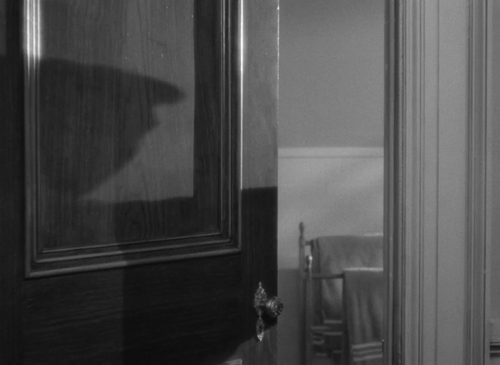
This activity suggests that he has finished his shower and will emerge at any second. It starts to seem more likely that Alicia will be caught stealing the key, thereby intensifying the suspense. Meanwhile, other than delaying the scene’s outcome by a few seconds, it is not clear how the camera movement toward the keychain itself intensifies the scene’s suspense.
What is happening in the narrative and what is conveyed by other stylistic techniques, such as Alex’s shadow on the door and the music on the soundtrack, are the factors that intensify the scene’s tension. It seems highly unlikely that “our level of involvement would not be nearly so high” in the absence of the camera movement, in the sense of feeling tension and suspense about the scene’s outcome. Certainly, Gallese and Guerra provide no evidence to this effect.
Furthermore, as I’ve already mentioned, Gallese and Guerra’s theory at best explains our sense of involvement in the camera movement, not the scene it films. Recall that it is the camera movement itself that our mirror neurons simulate. It is unclear from their theory, therefore, how our putative feeling of immersion in the camera movement, if indeed we do feel immersed in it, can yield suspense about the concrete actions being filmed.
The category of human-like camera movement, if such a category is functionally relevant to cinema, comprises many fine-grained variations with different effects. Camera movements, for example, can elicit curiosity by making us wonder what they will reveal, as well as surprise when they come to rest on something unexpected. They can startle through their rapidity, as when swish pans suddenly disclose something off-screen, or they can uncover information at an agonizingly slow pace. They can reveal characters’ mental states through push-ins that show us that a character is concentrating hard on something, or they can hide information from us by moving away from it. They can also be aesthetically pleasing, as when we marvel at their gracefulness or the intricacy with which their movements are coordinated with those of the characters. None of these sources of the power of camera movement are explained by arguing that mirror neurons fire in response to anthropomorphic camera movements, if indeed they do.
Most broadly, as David points out in his previous entry, there is much that their theory cannot capture or explain about the power of framing. A static camera can evoke tremendous suspense, as David’s example from Hou’s Summer at Grandpa’s illustrates. It is hard to see what a tracking shot would add at such a moment.
The lessons of film history
Of course, just as damaging to the theory are the countless examples from the rich history of film of highly suspenseful, tension-filled, and in other ways involving scenes that lack anthropomorphic camera movements or that contain non-anthropomorphic ones.
In Notorious, right after the scene in which Alicia steals the key and is nearly caught by Alex, there is a crane shot in which the camera, having panned across the party in the hallway below from a first-floor landing, glides smoothly down toward Alicia talking to Alex and some guests in the hallway and ends in a close-up on her hand holding the key to the cellar.
Given that no human being could perform this movement, our mirror neurons shouldn’t be able to simulate it and produce a feeling of involvement in it. Yet, I hypothesize that, for most viewers, this camera movement creates a strong sense of cognitive, emotive, aesthetic, and other forms of engagement in the scene.
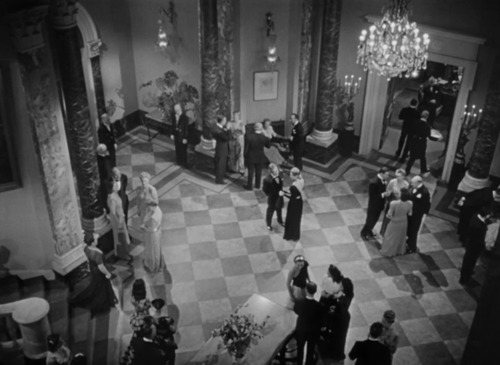
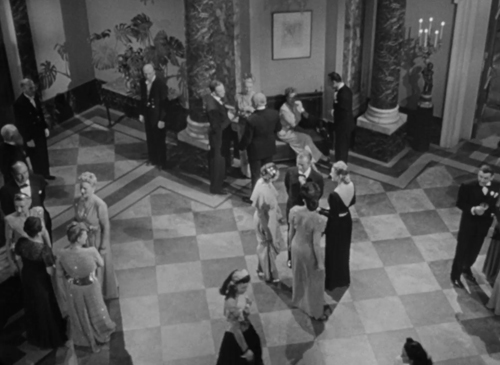
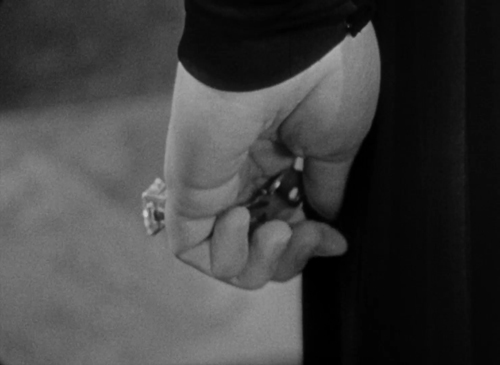
Among other things, this movement prompts us to wonder how Alicia is going to gain entry to the wine cellar without her husband noticing, thereby intensifying our sympathetic concern for her and our suspense about whether she will be caught. And in its overtness, it might make us think about Hitchcock’s choice of technique and the reasons behind it. For some, it might even induce that sense of “spatiotemporal immersion” that Gallese and Guerra mention given that it brings our perceptual perspective close to Alicia’s in the midst of the party, although I personally don’t feel this.
Either way, in this case, it cannot be due to mirror neuron simulation that we experience these forms of immersion. This is a non-anthropomorphic camera movement that human beings cannot execute themselves and therefore cannot simulate with their mirror neurons.
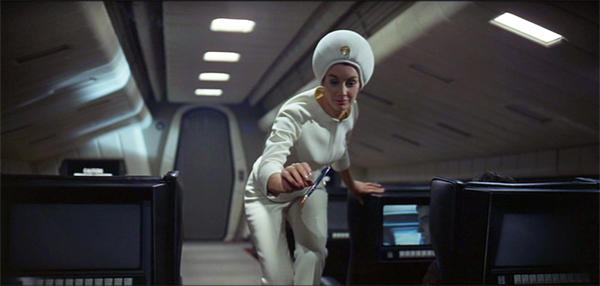
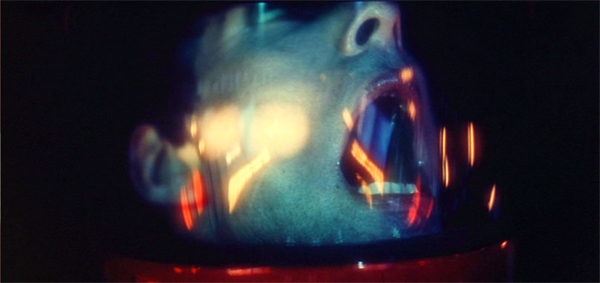
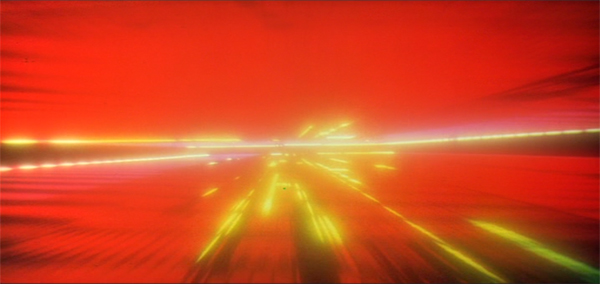
An example from a film by a different director would be the shots in 2001: A Space Odyssey (Stanley Kubrick, 1968) of Dr Floyd (William Sylvester)’s ship docking with a space station while Strauss’s Blue Danubewaltz plays on the soundtrack. (See image surmounting today’s entry.) For many, the smooth camera movements through space in this sequence evoke an intense sense of weightlessness, thereby creating a physical or corporeal form of involvement in the film. Yet, very few of us have moved in space or have experienced weightlessness, meaning that our mirror neurons should not be able to simulate these camera movements.
Then there are the copious examples of involving scenes that lack camera movement. Hitchcock’s oeuvre contains many, such as the infamous shower scene in Psycho (1960), which is devoid of camera movement during the 20 seconds or so in which the stabbing of Marion Crane takes place. Another example is the highly suspenseful sequence in Strangers on a Train (1951) in which Bruno (Robert Walker) drops Guy (Farley Granger)’s cigarette lighter down a drain while he is on his way to plant the lighter at the amusement park where he murdered Guy’s wife, Miriam (Kasey Rogers). Bruno wishes to implicate Guy in the murder, and Guy, who is a professional tennis player, has guessed Bruno’s plan and is trying to complete a tennis match in time to stop him from planting the lighter. Hitchcock cuts back and forth between the tennis match and Bruno’s efforts to reach down into the drain and retrieve the lighter.
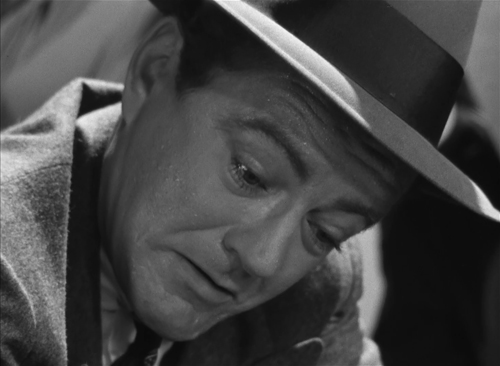
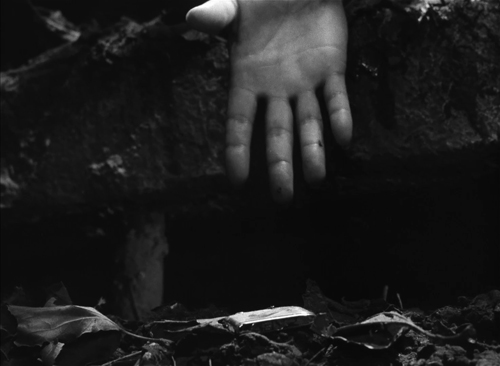
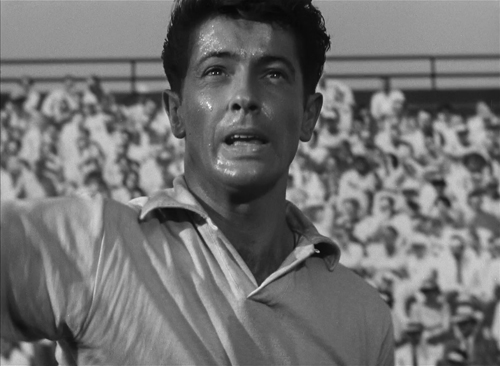
Interestingly, while there is some camera movement at the beginning of the sequence, as the suspense builds, the camera movement lessens. Hitchcock relies largely on still shots of Bruno’s grimacing face as he reaches into the grate, his hand inside the grate and the lighter below it, and the faces of the referees and spectators at the tennis match. Only the shots of Guy and the other tennis player contain a little movement when the camera slightly reframes them as they move to hit the tennis ball.
This sequence is considered one of the most suspenseful (and thereby emotionally involving) in Hitchcock’s oeuvre, yet it defies Gallese and Guerra’s prediction that “The involvement of the average spectator [in a film] is directly proportional to the intensity of camera movements.”
So does the astonishing sequence in William Wyler’s The Little Foxes (1941) in which Horace (Herbert Marshall), having told his estranged wife, Regina (Bette Davis), of his plans to leave his fortune to their daughter, begins experiencing painful symptoms of his heart disease as she tells him how much she despises him.
Horace reaches for his heart medication but knocks over the bottle and its contents and begs his wife to fetch another bottle of medication from upstairs. She, however, sits immobile while Horace, realizing she will not help him and wants him to die, staggers around her, clinging to the wall, and stumbles upstairs before collapsing on the staircase. An agonizing long take lasting about forty seconds shows Regina in medium shot sitting while her husband, who is out of focus, moves toward the stairs, and the shot is immobile except for slight reframings to keep Horace partly visible in the shot.
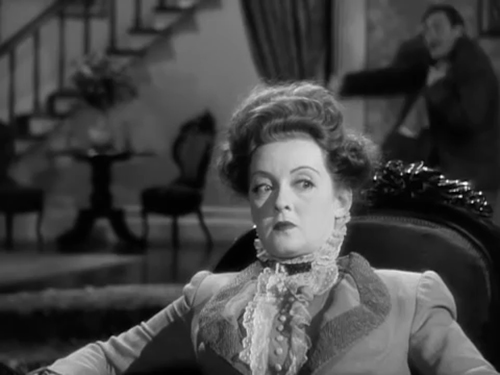
This is an intensely suspenseful, emotionally involving moment as we wonder whether Horace will reach his medication in time, or Regina or someone else will take action to help him. Yet, there is no anthropomorphic camera movement to elicit our sense of involvement in the scene. On the contrary, according to many critics, it is precisely the lack of camera movement that contributes to its emotional intensity. As André Bazin noted, “Nothing could better heighten the dramatic power of this scene than the absolute immobility of the camera,” in part because it mirrors and emphasizes the “criminal inaction” of Horace’s wife, Regina, who is hoping he will fail to reach his medication and die so that she can be rid of him and claim his fortune.
Gallese and Guerra could perhaps protest that I have misconstrued their theory. Although their claim that “The involvement of the average spectator [in a film] is directly proportional to the intensity of camera movements” seems to suggest that anthropomorphic camera movement is both a necessary and sufficient condition for occasioning involvement in a film, they might admit that immersion can be elicited in other ways. Instead, they could allow, human-like camera movement is merely a sufficient condition for involvement, not a necessary one. When it is present, we feel immersed in films, although this is not the only route to immersion.
However, it is not difficult to think of films containing lots of camera movement of both the anthropomorphic and non-anthropomorphic kinds that fail to engage viewers. An example is Kenneth Branagh’s Mary Shelley’s Frankenstein (1994), a film in which, as David Ansen of Newsweek put it, “The camera, and the actors, are always in a mad dash from here to there” (Ansen 1994). Nevertheless critics, who according to Gallese and Guerra “usually get much more excited” when camera movement is present, largely panned the film. (For what it’s worth, the film has a critics’ score of 38% and audience score of 49% on Rotten Tomatoes.) As Ansen put it:
What we get is Romanticism for short attention spans; a lavishly decorated horror movie with excellent elocution. [Branagh’s] strategy undermines itself–there’s a lot of sound and fury, but all the grand passions are indicated rather than felt. Watching the movie work itself into an operatic frenzy, one remains curiously detached: the grand gestures are there, but where’s the music? [My emphasis.]
Anthropomorphic camera movements do not, therefore, even appear to be a sufficient condition for immersion in a film, let alone a necessary one.
The way forward?
Gallese and Guerra, it seems to me, cherry-pick examples from films that appear to support their theory, and ignore obvious counterexamples even in the films they examine. They also mischaracterize scenes such as the one in which Alicia steals the keys, overlooking other evident sources of “involvement,” a term they fail to define consistently. They do, I suspect, because they are in thrall to the mirror neuron theory, and they therefore force the art to fit the theory.
None of this means that cognitivism should be abandoned and that film scholars shouldn’t be turning to science. Nor does it mean that camera movement doesn’t sometimes elicit and intensify emotions such as suspense. Moreover, neuroscience may well be able to shed light on some of the reasons why this happens, although many more experiments are needed to demonstrate this than the single one relied on by Gallese and Guerra.
But it does suggest that our engagement with the sciences should be governed by two principles.
First, when drawing on a scientific theory, it is crucial that film scholars also consider criticisms of it. Despite its authority, scientific research is typically provisional. Those of us in the humanities are not usually in a position to determine who is right in a scientific debate. So we should entertain criticisms of the scientific theory, in case they reveal pitfalls and other problems in applying the theory to cinema, or show the theory to be on far less secure ground than it may seem to be.
Second, those of us who are humanistic scholars of film should trust the knowledge we have gleaned from decades of work on the cinema. We shouldn’t simply accept conclusions that contradict this knowledge because they are supposedly scientific. We should not, in other words, be cowed by the authority of science. While we haven’t gotten everything right, most of us know from a little reflection, for example, that anthropomorphic camera movements aren’t required for greater “involvement” in a film.
Of course, we should allow for the possibility that our assumptions about these and other matters are incorrect. But given the weight of experience and knowledge behind them, the evidentiary bar should be set very high for their disconfirmation by empirical scientific research.
Thanks to Malcolm for all his work in preparing this version of his paper for our blog. Another essay of his along these lines is “Can Scientific Models of Theorizing Help Film Theory?” in Philosophy of Film: Introductory Texts and Readings, ed. Angela Curran and Tom Wartenberg (Blackwell, 2004), 21-32
Quotations from Vittorio Gallese and Michele Guerra’s Empathic Screen come from pp. 68, 111, 91, 94, and 114. Their claims about Notorious are found on pp. 53-58. The quotation from their earlier piece can be found in “Embodying Movies: Embodied Simulation and Film Studies,” Cinema: Journal of Philosophy and the Moving Image (2012) 3: 188.
The crucial experiment is documented in Katrin Heimann et al., “Moving Mirrors: A High-Density EEG Study Investigating the Effect of Camera Movements on Motor Cortex Activation during Action Observation,” The Journal of Cognitive Neuroscience (2014), 26,9: 2087-2101. with the discussion of involvement coming on p. 2097. The Marco Iacobobi citation comes from Mirroring People: The New Science of How We Connect with Others (Farrar, Straus and Giroux, 2008), 5.
Pinker’s remarks about mirror neurons and empathy are to be found in The Better Angels of Our Nature: Why Violence Has Declined (Penguin, 2011), 577. The quotations from Dan Shaw are from “Mirror Neurons and Simulation Theory: A Neurophysiological Foundation for Cinematic Empathy,” in Current Controversies in Philosophy of Film, ed. Katherine Thomson-Jones (Routledge, 2016), 148, 151.
André Bazin discusses The Little Foxes in “William Wyler, or the Jansenist of Directing,” in Bazin at Work, ed. Bert Cardullo (Routledge, 1997) 3, 4. A blog entry here supplies further thoughts on the famous scene, which DB also analyzes in On the History of Film Style.
Donald Spoto discusses Hitchcock’s working methods in The Dark Side of Genius: The Life of Alfred Hitchcock (Da Capo, 1999; Centennial Edition), 284-287. David Ansen’s strictures on Mary Shelley’s Frankenstein appeared in “Monster Mush,” Newsweek (6 November 1994). More on Notorious is here.
During the current health crisis, Berghahn has made all issues of Projections: The Journal of Movies and Mind freely available. Several articles over the years debate issues around cognitive film theory and brain-based explanations of media effects. Malcolm Turvey has made many contributions to Projections; see especially his book review here.
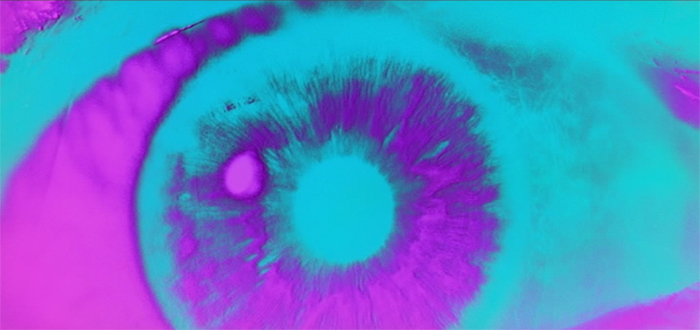
2001: A Space Odyssey.
Stuck inside these four walls: Chamber cinema for a plague year
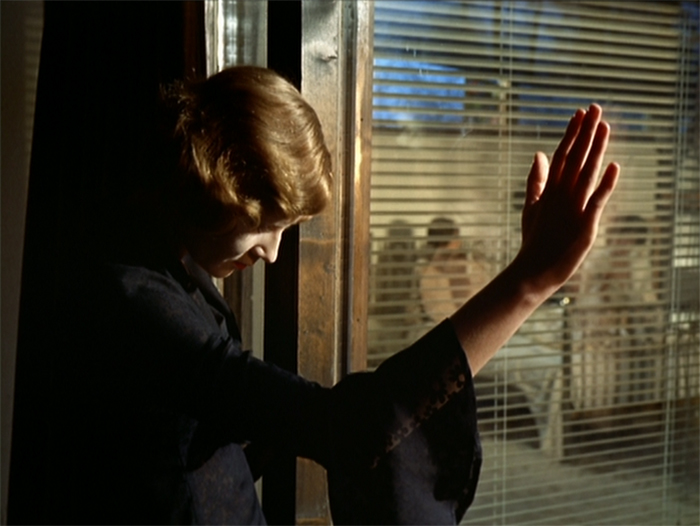
The Bitter Tears of Petra von Kant (1972).
Privacy is the seat of Contemplation, though sometimes made the recluse of Tentation… Be you in your Chambers or priuate Closets; be you retired from the eyes of men; thinke how the eyes of God are on you. Doe not say, the walls encompasse mee, darknesse o’re-shadowes mee, the Curtaine of night secures me… doe nothing priuately, which you would not doe publickly. There is no retire from the eyes of God.
Richard Brathwaite, The English Gentlewoman (1631)
DB here:
We’re in the midst of a wondrous national experiment: What will Americans do without sports? Movies come to fill the void, and websites teem with recommendations for lockdown viewing. Among them are movies about pandemics, about personal relationships, and of course about all those vistas, urban or rural, that we can no longer visit in person. (“Craving Wide Open Spaces? Watch a Western.”)
Cinema loves to span spaces. Filmmakers have long celebrated the medium’s power to take us anywhere. So it’s natural, in a time of enforced hermitage, for people to long for Westerns, sword and sandal epics, and other genres that evoke grandeur.
But we’re now forced to pay more attention to more scaled-down surroundings. We’re scrutinizing our rooms and corridors and closets. We’re scrubbing the surfaces we bustle past every day. This new alertness to our immediate surroundings may sensitize us to a kind of cinema turned resolutely inward.
Long ago, when I was writing a book on Carl Dreyer, I was struck by a cross-media tradition that explored what you could express through purified interiors. I called it “chamber art.” In Western painting you can trace it back to Dutch genre works (supremely, Vermeer). It persisted through centuries, notably in Dreyer’s countryman Vilhelm Hammershøi (below).
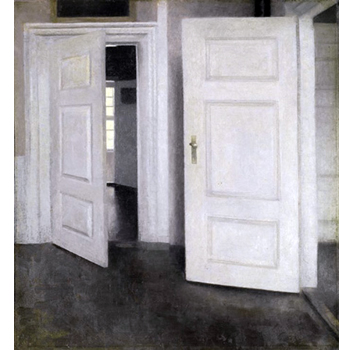
Plays were often set in single rooms, of course, but the confinement was made especially salient by Strindberg, who even designed an intimate auditorium. For cinema, the major development was the Kammerspielfilm, as exemplified in Hintertreppe (1921), Scherben (1921), Sylvester (1924), and other silent German classics. Kristin and I talk about this trend here and here.
In the book I argued that Dreyer developed a “chamber cinema,” in piecemeal form, in his first features before eventually committing to it in Mikael (1924) and The Master of the House (1925). Two People (1945) is the purest case in the Dreyer oeuvre: A couple faces a crisis in their marriage over the course of a few hours in their apartment. (Unfortunately, it doesn’t seem available with English subtitles.) But you can see, thanks to Criterion, how spatial dynamics formed a powerful premise of his later masterpieces Vampyr (1932), Day of Wrath (1943), Ordet (1955), and Gertrud (1964).
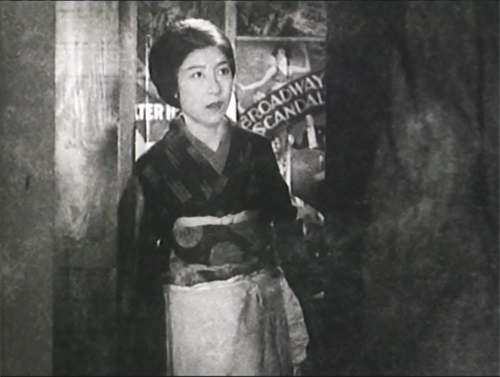
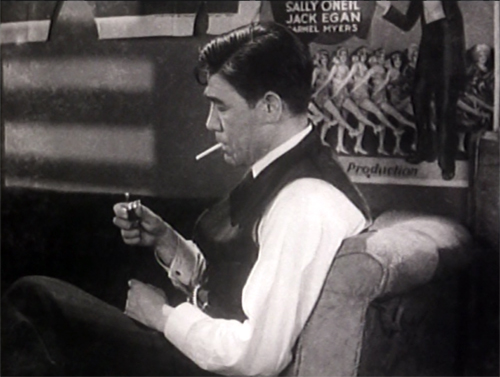
Dreyer wasn’t alone. Ozu tried out the format in That Night’s Wife (1930), swaddling a husband, wife, child, and detective in a clutter of dripping laundry and American movie posters.
Bergman exploited the premise too, in films like Brink of Life (1958), Waiting Women (1952), his 1961-1963 trilogy, and Persona (1966). (All can be streamed on Criterion.)
Chamber cinema became an important, if rare expressive option for many filmmaking traditions. Writers and directors set themselves a crisp problem–how to tell a story under such constraints?
The challenge is finding “infinite riches in a little room.” How? Well, you can exploit the spatial restrictiveness by confining us to what the inhabitants of the space know. Limiting story information can build curiosity, suspense, and surprise. You can also create a kind of mundane superrealism that charges everyday objects with new force.
On the other hand, you need to maintain variety by strategies of drama and stylistic handling. Chamber cinema–wherever it turns up–offers some unique filmic effects, and maybe sheltering in place is a good time to sample it.
Herewith a by no means comprehensive list of some interesting cinematic chamber pieces. For each title, I link to streaming services supplying it.
Bottles of different sizes
From David Koepp I learned that screenwriters call confined-space movies “bottle” plots. There’s a tacit rule: The audience understands that by and large the action won’t stray from a single defined interior. In a commentary track for the “Blowback” episode of the (excellent) TV show Justified, Graham Yost and Ben Cavell discuss how TV series plan an occasional bottle episode, and not just because it affords dramatic concentration. It can save time and money in production.
Usually the bottle consists of more than a single room. The classic Kammerspielfilms roam a bit within a household and sometimes stray outdoors. But their manner of shooting provides a variety of angles that suggest continuing confinement. Dreyer went further in The Master of the House. He built a more or less functioning apartment as the set, then installed wild walls that let him flank the action from any side. Then editing could provide a sense of wraparound space.
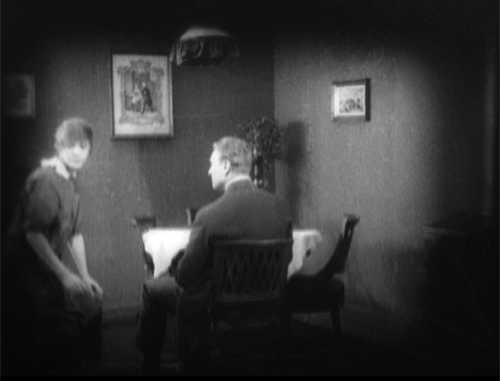
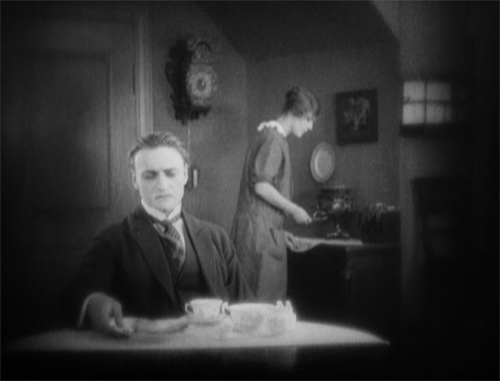
The variations in camera setups throughout the film are extraordinary. Dreyer would create more radically fragmentary chamber spaces in La Passion de Jeanne d’Arc (1928), while his later films would use solemn, arcing camera movements to achieve a smoother immersive effect. (For more on Dreyer’s unique spatial experimentation, here’s a link to my Criterion contribution on Master of the House. I talk about the tricks Dreyer plays with chamber space in Vampyr in an “Observations” supplement on the Criterion Channel.)
Likewise, Koepp’s screenplay for Panic Room allows David Fincher to move 360 degrees through several areas of a Manhattan brownstone. The film also offers a fine example of how our awareness of domestic details gets sharpened by a creeping camera.
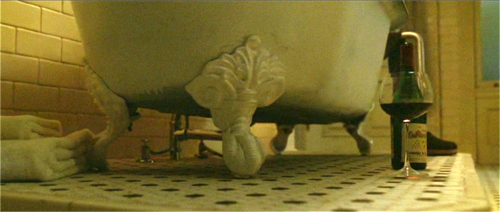
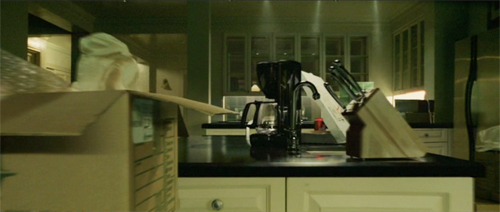
Trust Fincher to find sinister possibilities in a dripping bathtub leg and a kitchen island.
Confined to quarters
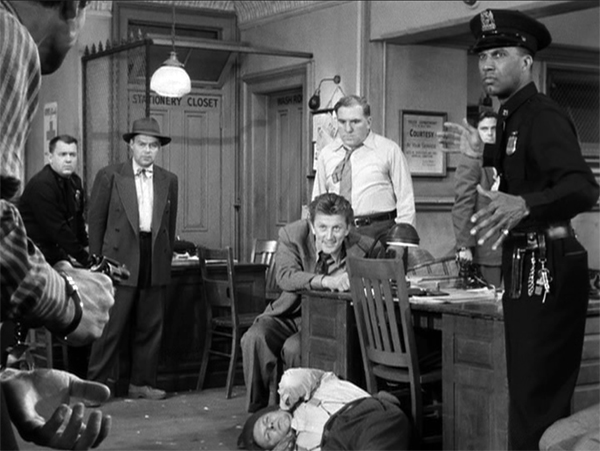
Detective Story (1951).
Many chamber movies are based on plays, as you’d expect. Unlike most adaptations, though, they don’t try to “ventilate” the play by expanding the field of action. Or rather, as André Bazin pointed out, the expansion is itself fairly rigorous. They don’t go as far afield as they might.
Bazin praised Cocteau’s 1948 version of his play Les parents terribles (aka “The Storm Within”) for opening up the stage version only a little, expanding beyond a single room to encompass other areas of the apartment. This retained the claustrophobia, and the sense of theatrical artifice, but it spread action out in a way that suited cinema’s urge to push beyond the frame. The freedom of staging and camera placement is thoroughly “cinematic” within the “theatrical” premise.
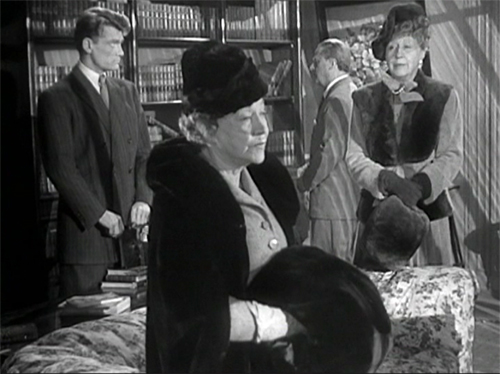
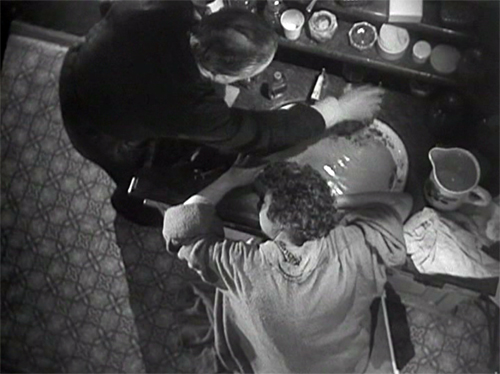
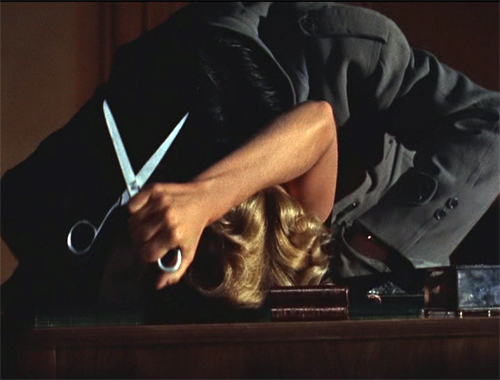
Depending on how you count, Hitchcock expanded things a bit in his adaptation of Dial M for Murder. Apart from cutting away to Tony at his club, Hitchcock moved beyond the parlor to the adjacent bedroom, the building’s entryway, and the terrace.
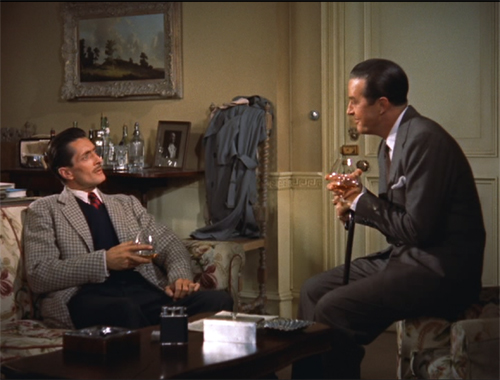
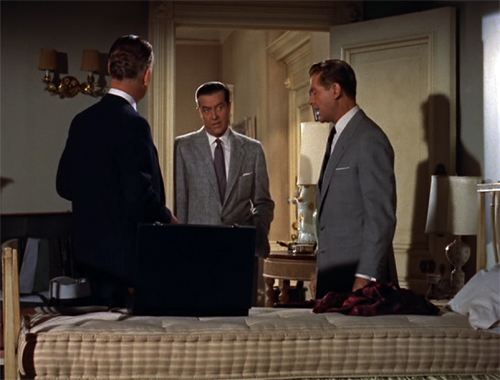
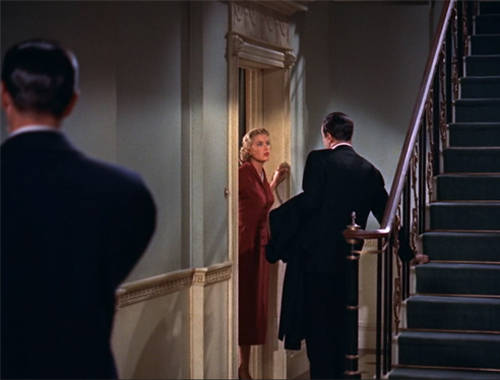
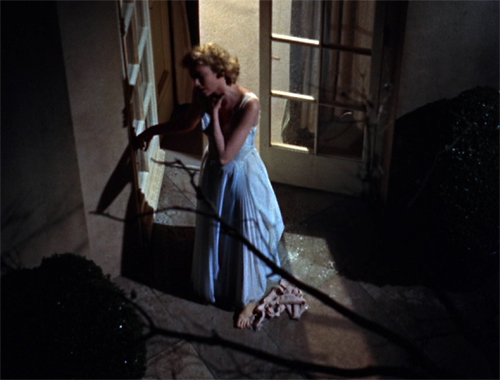
An earlier entry on this site talks about how 3D let Sir Alfred give an ominous accent to props: a particularly large pair of scissors, and a more minor item like the bedside clock.
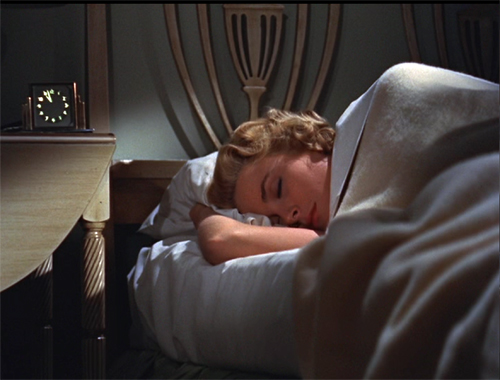
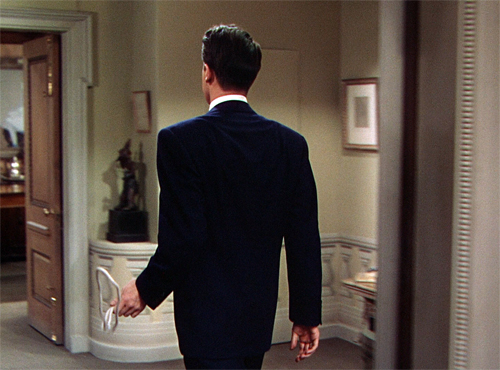
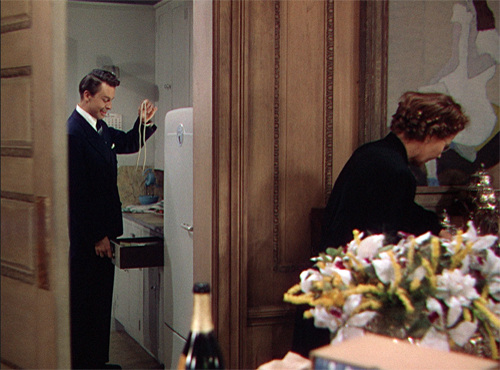
Hitchcock gave us a parlor and a hallway in Rope (1948), but when Brandon flourishes the murder weapon, the framing audaciously reminds us that we aren’t allowed to go into the kitchen.
Bazin did not wholly admire William Wyler’s Detective Story (1951), despite its skill in editing and performances; he found it too obedient to a mediocre play. True, the film doesn’t creatively transform its source to the degree that Wyler’s earlier adaptation of The Little Foxes (1941) did; Bazin wrote a penetrating analysis of that film’s remarkable turning point. Detective Story is more obedient to the classic unities, confining nearly all of the action to the precinct station. Although I don’t think Wyler ever shows the missing fourth wall, he creates a dazzling array of spatial variants by layering and spreading out zones of the room. In his prime, the man could stage anything fluently.
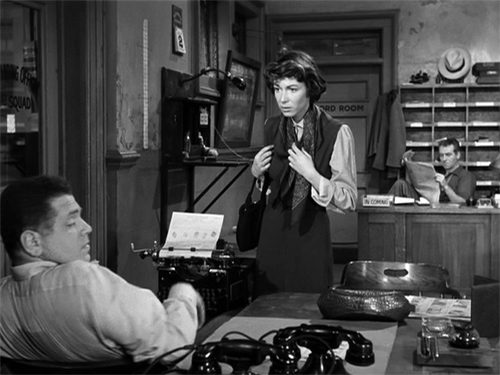
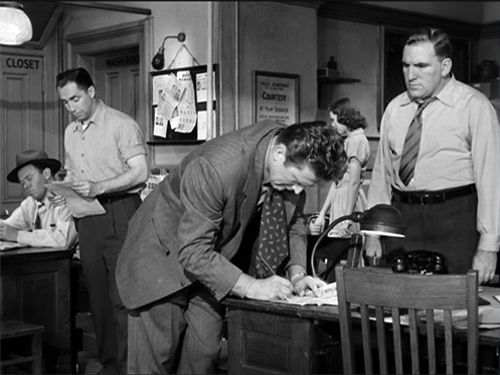
As Bazin puts it: “One has to admire the unequaled mastery of the mise-en-scène, the extraordinary exactness of its details, the dexterity with which Wyler interweaves the secondary story lines into the main action, sustaining and stressing each without ever losing the thread.”
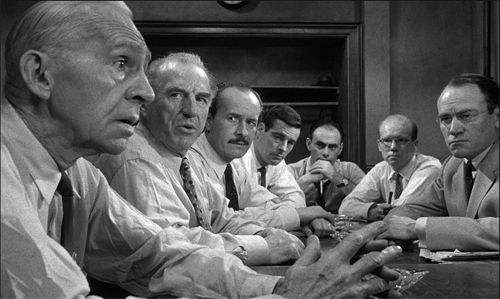
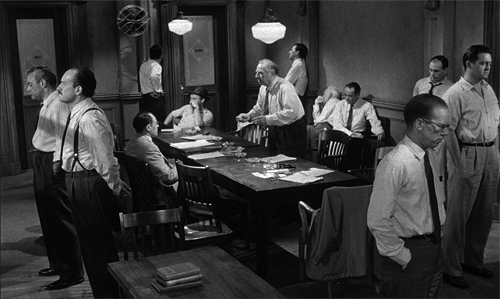
Some films are even more constrained. 12 Angry Men (1957), adapted from a teleplay, is a famous example. Once the jury leaves the courtroom, the bulk of the film drills down on their deliberation. Again, the director wrings stylistic variations out of the situation; Lumet claims he systematically ran across a spectrum of lens lengths as the drama developed.
But you don’t need a theatrical alibi to draw tight boundaries around the action. Rear Window (1954), adapted from a fairly daring Cornell Woolrich short story, is as rigorous an instance of chamber cinema as Rope. Here Hitchcock firmly anchors us in an apartment, but he uses optical POV to “open out” the private space.
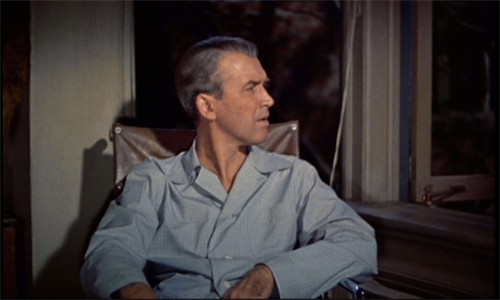
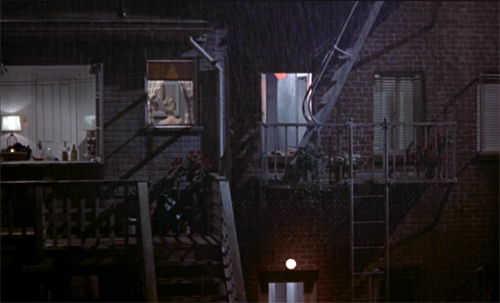
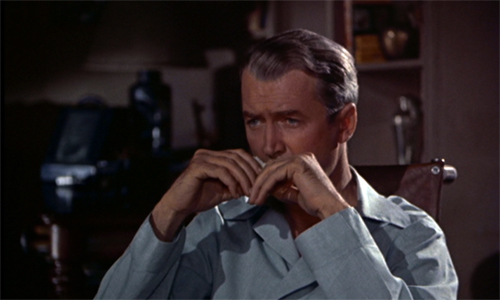
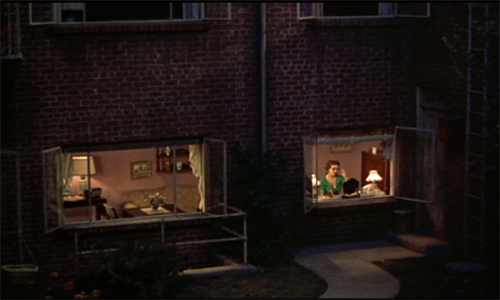
With all its apertures the courtyard view becomes a sinister/comic/melancholy Advent calendar.
Fassbinder’s Bitter Tears of Petra von Kant (1972) denies us this wide vantage point on the outside world. This space seems almost completely enclosed. But Fassbinder finds a remarkable number of ways to vary the set, the camera angles, and the costumes. We’re immersed in the flamboyant flotsam of several women’s lives. The result is a cascade of goofily decadent pictorial splendors.
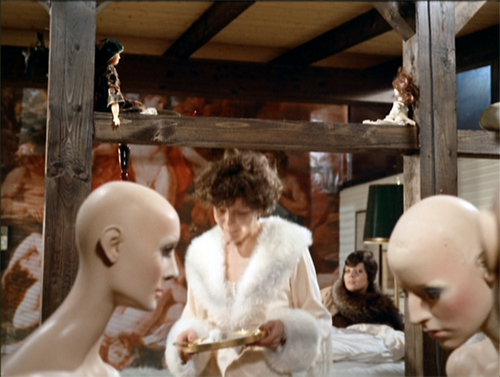
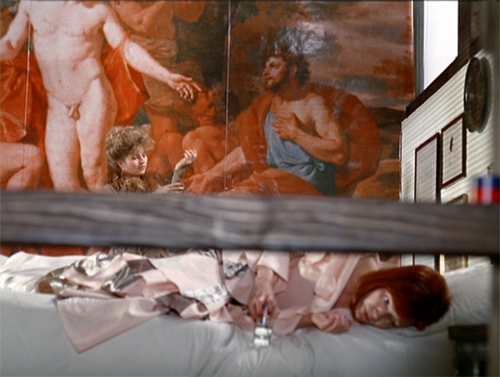
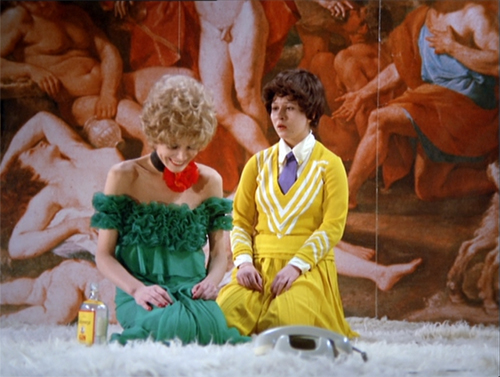
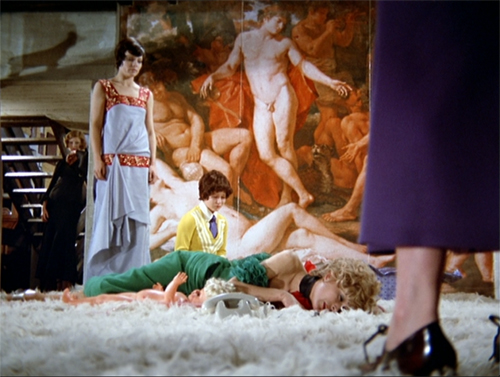
It’s virtually a convention of these films to include a few shots not tied to the interiors. At the end, we often get a sense of release when finally the characters move outside. That happens in 12 Angry Men, in Panic Room, in Polanski’s Carnage (2011) , and many of my other examples. Without offering too many spoilers, let’s say Room (2015) makes architectural use of this option.
On the road and on the line
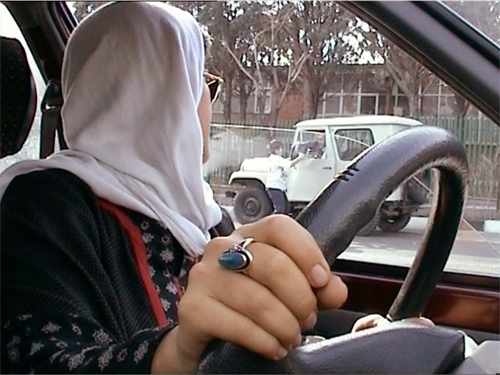
Filmmakers have willingly extended the bottle concept to cars. The most famous example is probably Kiarostami’s Ten (2002), which secures each scene in a vehicle and mixes and matches the passengers across episodes. The strictness of Kiarostami’s camera setups exploit the square video frame and always yield angular shot/reverse shots. They reveal how crisp depth relations can be activated through the passing landscape or in story elements that show up in through the window.
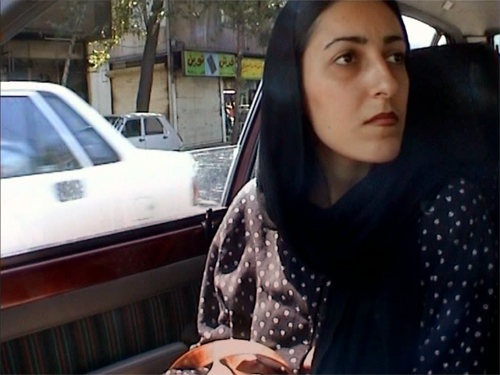
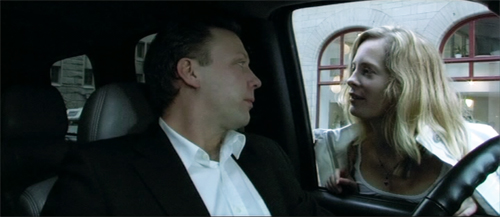
Perhaps Kiarstami’s example inspired Danish-Swedish filmmaker Simon Staho. His Day and Night (2004) traces a man visiting key people on the last day of his life, and we are stuck obstinately in the car throughout. This provides some nifty restriction, most radically when we have to peer at action taking place outside.
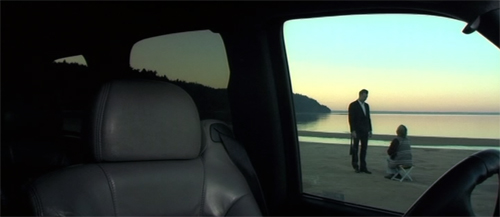
Staho’s Bang Bang Orangutang (2005), a portrait of a seething racist, takes up the same premise but isn’t quite so rigorous. We do get out a bit, but the camera stays pretty close to the car. I discuss Staho’s films a little in a very old entry.
Like autos, telephones provide a nice motivation for the bottle, as Lucille Fletcher discovered when she wrote the perennial radio hit, “Sorry, Wrong Number.” The plot consists of a series of calls placed by the bedridden woman, who overhears a murder plot. The film wasn’t quite so stringently limited, but the effect is of the protagonist at the center of several crisscrossed intrigues.
A purer case is the Rossellini film Una voce umana (1948), in which a desperate woman frantically talks with her lover. It relies on intense close-ups of its one player, Anna Magnani.
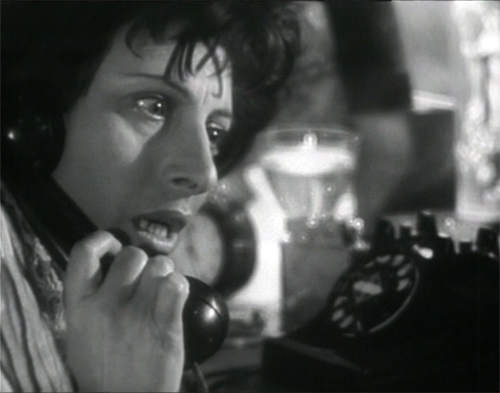
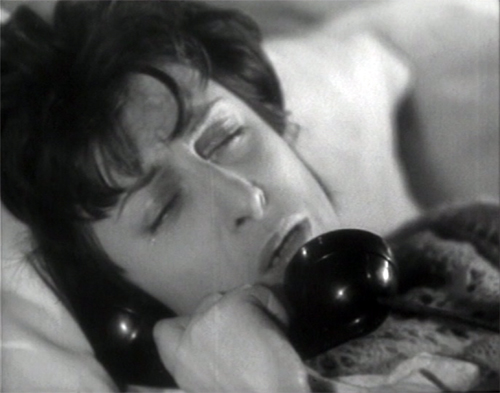
It’s an adaptation of a Cocteau play, which Poulenc turned into a one-act opera. In all, the duration of the story action is the same as the running time.
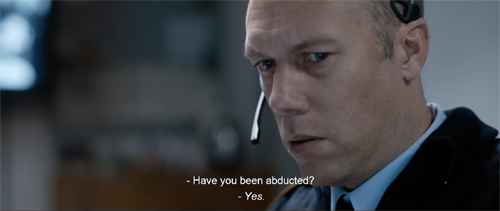
I wish Larry Cohen’s Phone Booth displayed a similarly obsessive concentration, but we do have the Danish thriller The Guilty, where a police dispatcher gets involved in more than one ongoing crime. We enjoyed seeing it at the 2018 Wisconsin Film Festival.
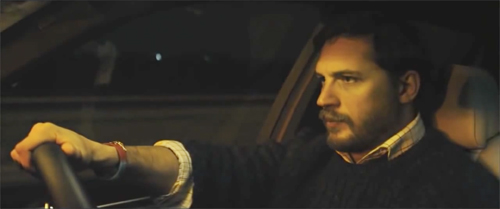
And of course car and phone can be combined, as they are in Locke (2013)–another play adaptation. Tom Hardy plays a spookily calm businessman driving to a deal while taking calls from his family and his distraught mistress. Those characters remain voices on the line while he tries to contend with the pressures of his mistakes.
House arrest, arresting houses
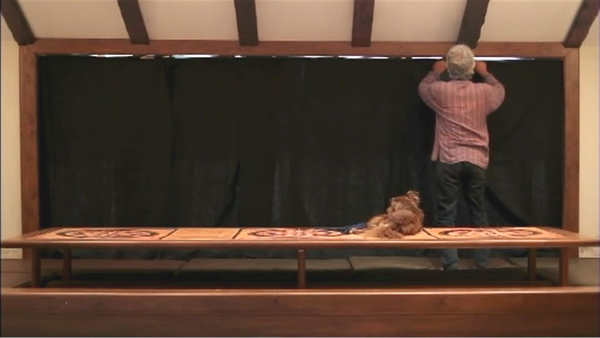
Sometimes you must embrace the chamber aesthetic. In 2010 the fine Iranian director Jafar Panahi was forbidden to make films and subjected to house arrest. Yet he continued to produce–well, what? This Is Not a Film (2012) was shot partially on a cellphone within (mostly) his apartment.
Wittily, he tapes out a chamber space within his apartment. Then he reads a script to indicate how absent actors could play it and how an imaginary camera could shoot it.
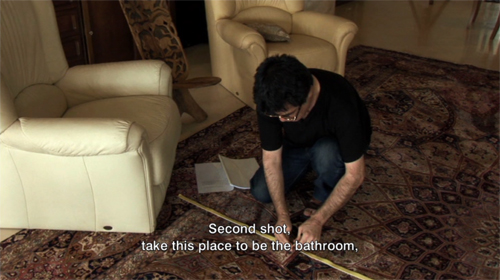
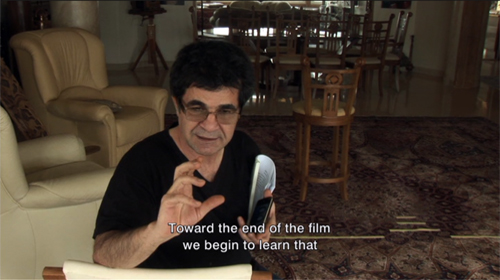
But his imaginary film still isn’t an actual film, so he hasn’t violated the ban. So perhaps what we have is rather a memoir, or a diary, or a home video? Panahi’s virtual film (that isn’t a film) exists within another film that isn’t a film. Yet it played festivals and circulates on disc and streaming. The absurdity, at once touching and pointed, suggests that through playful imagination, the artist can challenge censorship.
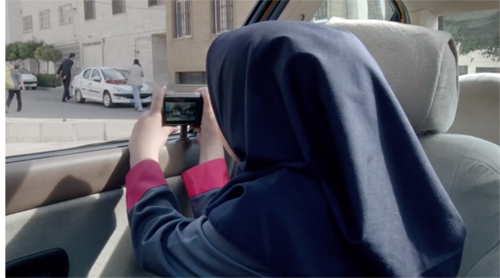
Panahi slyly pushed against the boundaries again with Closed Curtain (2013, above). Shot in his beach house, it strays occasionally outside. Next came Taxi (2015), in which Panahi took up the auto-enclosed chamber movie, with largely comic results.
More recently, he has somehow managed to make a more orthodox film, 3 Faces (2018), which considers the situation of people in a remote village.
The chamber-based premise needn’t furnish a whole movie. As in Room, Kurosawa’s High and Low (1963) is tightly concentrated in its first half. We are in two enclosures, a house and a train. The film then bursts out into a rushed, wide-ranging investigation. Large-scale or less, the chamber strategy remains a potent cinematic force.
They say that the last creatures to discover water will be fish. We move through our world taking our niche for granted. Cinema, like the other arts, can refocus our attention on weight and pattern, texture and stubborn objecthood. We can find rich rewards in glimpses, partial views, and little details. Chamber art has an intimacy that’s at once cozy and discomfiting. Seeing familiar things in intensely circumscribed ways can lift up our senses.
So take a break from the crisis and enjoy some art. But return to the world knowing that for Americans this catastrophe is the result of forty years of monstrous, gleeful Republican dismantling of our civil society. Rebuilding such a society will require the elimination of that party, and the career criminal at its head, as a political force. This pandemic must not become our Reichstag fire.
Yeah, I went there.
Thanks to the John Bennett, Pauline Lampert, Lei Lin, Thomas McPherson, Dillon Mitchell, Erica Moulton, Nathan Mulder, Kat Pan, Will Quade, Lance St. Laurent, Anthony Twaurog, David Vanden Bossche, and Zach Zahos. They’re students in my seminar, and they suggested many titles for this blog entry.
Bazin’s comments on Detective Story come in his 1952 Cannes reportage, published as items 1031-1033, and as a review (item 1180), in Écrits complets vol. I, ed. Hervé Joubert-Laurencin (Paris: Macula, 2018), pp. 918-922, 1059. My quotation comes come from the review, where he does grant that Wyler is the Hollywood filmmaker “who knows his craft best. . . . the master of the psychological film.”
The tableau style of the 1910s probably helped shift Dreyer toward the chamber model, which he learned to modify through editing. I discuss Dreyer’s relation to that style in “The Dreyer Generation” on the Danish Film Institute website. Also related is the web essay, “Nordisk and the Tableau Aesthetic.”
Some other examples could be mentioned, but I didn’t find them on streaming services in the US. It would be nifty if you could see the tricks with chamber space in Dangerous Corner (1934); fortunately it plays fairly often on TCM. There’s also Duvivier’s Marie-Octobre (1959), a tense drama about the reunion of old partisans.
I especially like the 1983 Iranian film, The Key, directed by Ebrahim Forouzesh and scripted by Kiarostami. It’s a charming, nearly wordless story of how a little boy tries to manage household crises when Mother is away. It has the gripping suspense that is characteristic of much Iranian cinema, and the boy emerges as resourceful and heroic (though kind of messy). Kids would like it, I think.
Also, I’ve neglected Asian instances. Maybe I’ll revisit this topic after a while.
P.S. 1 April 2020: Thanks to Casper Tybjerg, outstanding Dreyer scholar, for corrections about the nationality of The Guilty and the Staho films.
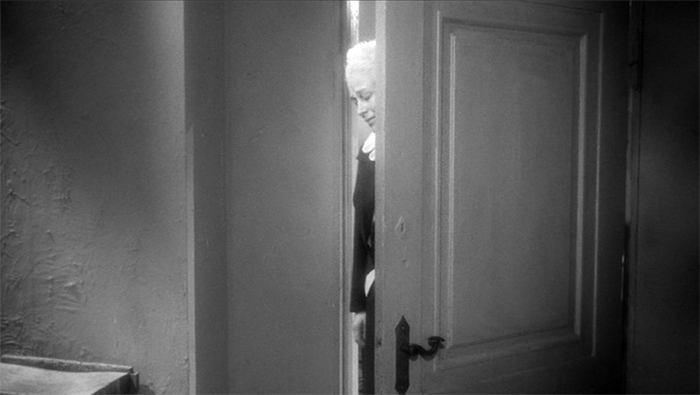
Gertrud (1964).