Monday | June 6, 2016
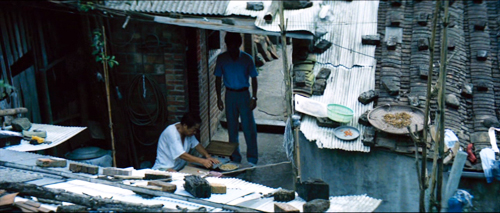
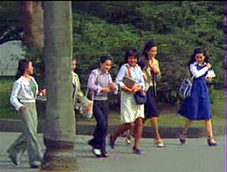
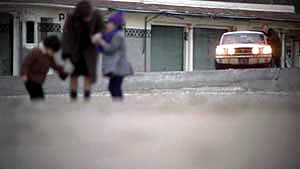
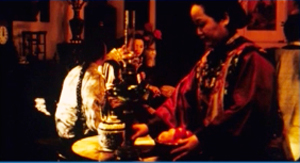
The Green, Green Grass of Home (1982).
For today, let’s call “film culture” that loose agglomeration of institutions around non-mainstream cinema. Film culture includes art house screening venues, festivals, magazines like Film Comment, Cinema Scope, and Cineaste, distribution companies (Janus/Criterion, Milestone, Kino Lorber et al.), critical websites, and not least the new channels of distribution and exhibition like Fandor, Mubi, and the impending FilmStruck.
Although the system is decentralized, there’s usually a fairly predictable flow of films through it. A film is shown at festivals, written up by critics, and picked up by distributors. Then it gains some exposure in theatres or more festivals, and it eventually becomes available on DVD, cable, and streaming services. And now we expect the process to move fairly quickly. Mustang played Cannes and many festivals through summer of 2015; it moved to theatres in the US and elsewhere in the fall. Only a year after its premiere, you can buy it on disc.
We’ve also been aided by the emergence of multi-standard video players and the willingness of some disc-publishing companies to release versions with subtitles in several languages. All too often, though, “film culture” displays gaps and delays. It took six years for Asgar Farhadi’s wonderful About Elly (2009) to make its way to minimal visibility in the US. Fans of Godard have been prepared to wait years to see his many films that didn’t get even video release in English-speaking territories. (Soigne ta droite! played Toronto in 1987, never got a theatrical release in America, and showed up on US DVD in 2002; the Blu-ray came out eleven years after that.) Two of the most egregious examples of this time lag involve the works of the outstanding Taiwanese filmmakers of the 1980s and 1990s: Hou Hsiao-hsien and Edward Yang.
 Most of Hou’s films had no proper US release. When they were available for booking, as from Wendy Lidell’s heroic International Film Circuit, they circulated for one-off screenings. Some of his major films, such as City of Sadness (1989), still remain difficult to see. Edward Yang’s work was similarly obscure. When we ran a retrospective at our UW Cinematheque in 1998, we had to borrow prints from his family. Most of Hou’s films had no proper US release. When they were available for booking, as from Wendy Lidell’s heroic International Film Circuit, they circulated for one-off screenings. Some of his major films, such as City of Sadness (1989), still remain difficult to see. Edward Yang’s work was similarly obscure. When we ran a retrospective at our UW Cinematheque in 1998, we had to borrow prints from his family.
Both of these extraordinary filmmakers had to wait many years for the exposure that is standard for European arthouse releases. After six features in seventeen years, Yang found a Western audience with Yi Yi (2000). Hou took even longer; twenty-seven years after his first feature, he gained some recognition with The Flight of the Red Balloon (2007) and last year, The Assassin. Meanwhile, many of these directors’ early films remain largely unknown, prey to ancient distribution contracts and the belief that the films would cost too much to revive and market.
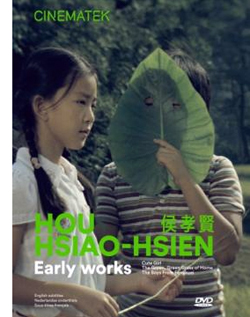
Today’s entry and the next one celebrate the welcome news that important works by these two filmmakers are at last available on the disc format. Today I’ll concentrate on the three early Hou films from the Cinematek of Belgium: Cute Girl (1980), The Green, Green Grass of Home (1982), and The Boys from Fengkei (1983). Next time, I’ll consider Criterion’s release of Edward Yang’s masterpiece A Brighter Summer Day (1992).
Hou, early and late
Hou’s films are no stranger to this site. Among the first things I posted, back in 2005, was one of a batch of supplemental essays to my book, Figures Traced in Light: On Cinematic Staging (2005). That book devoted a chapter to Hou’s staging principles, with background on what I took to be the evolution of his technique. It was, I think, the first sustained view of Hou’s style, and it included discussion of his earliest films. These were scarcely known in the West and not considered in relation to his more famous work.
The online essay expanded my treatment of those titles. Because that essay is more or less buried elsewhere on the site, and it’s somewhat clunkily laid out by today’s standards, I’m reprinting it, with revisions, here, along with some bits from Figures. But first some background on these early works.
Hou began in the commercial, mainstream Taiwanese-language industry. Most local films had a strong genre identity: martial-arts movies, romantic comedies, or melodramas of family crises. Hou’s first directorial effort, Cute Girl, centered on a romance between two city dwellers who re-meet when the man is called to a surveying task in the countryside. Cheerful Wind (1981) reunites the two stars, Kenny Bee and Feng Fei-fe, in a more serious story of how he, a blind man, wins her love. In the pastorale The Green, Green Grass of Home, Kenny plays a schoolteacher brought to a village, where he meets another teacher and a romance blossoms. This film, however, expands to include dramas, big and small, involving several families; it also incorporates an ecological theme by encourage safe fishing policies.
In making these early films Hou discovered techniques that not only suited the stories he had to tell but also suggested more unusual possibilities of staging. He pushed those techniques further in his later films, with powerful results. The charming early films show him developing, in almost casual ways, techniques of staging and shooting that will become his artistic hallmarks. One basis of his approach, I argue, is his adoption of the telephoto lens.
How long is your lens?
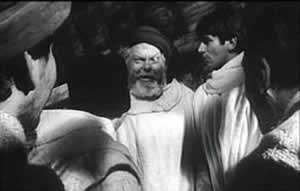
Around the world, from the late 1930s through the 1960s, many films relied on wide-angle lenses—those short focal-length lenses that allowed filmmakers to stage action in vivid depth. One figure or object might be quite close to the camera, while another could be placed much further in the recesses of the shot. The wide-angle lens allowed filmmakers to keep several planes in more or less sharp focus throughout, and this led to compact, sharply diagonal compositions, as in Welles’ Chimes at Midnight (1966).
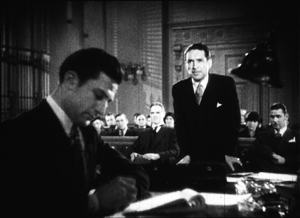
Although Citizen Kane (1941) probably drew the most attention to this technique, it was occasionally used in several 1920s and 1930s films made throughout the world. The great French critic André Bazin was the most eloquent analyst of the wide-angle aesthetic, and his discussion of Kane, The Magnificent Ambersons (1942), The Little Foxes (1941), and The Best Years of Our Lives (1946) has strongly shaped our understanding of this technique.
The 1960s saw the development of an alternative approach, what we might call the telephoto aesthetic. Improvements in long focal-length lenses, encouraged by the growing use of location shooting, led to a very different sort of imagery. Instead of exaggerating the distances between foreground and background, long lenses tend to reduce them, making figures quite far apart seem close in size.
In shooting a baseball game for television, the telephoto lens positioned behind the catcher presents catcher, batter, and pitcher as oddly close to one another. Planes seem to be stacked or pushed together in a way that seems to make the space “flatter,” the objects and figures more like cardboard cutouts. The style was popularized by films like A Man and a Woman (1966).
The telephoto look quickly spread, employed by directors as diverse as Sam Peckinpah and Robert Altman, whose 1970s films also use the long lens, controlled by zooming, to squeeze a crowd of characters (M*A*S*H, 1972; Nashville, 1975) into the fresco of the anamorphic frame.
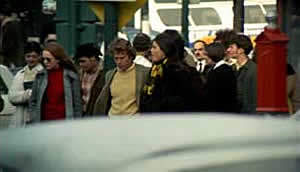
Hou Hsiao‑hsien came to filmmaking via the romance films so common in Taiwan in the 1970s, and this genre employed the long lens extensively. Working with low budgets, most filmmakers relied on location shooting. The telephoto allowed the camera to be set far off and to cover characters in conversation for fairly lengthy shots (as in Diary of Didi, 1978, below). In this respect, the directors were not so far from their Hollywood contemporaries; Love Story (1970) employs these techniques on a bigger budget.
Indeed, Love Story (a big hit in Taiwan) may have pushed local filmmakers toward using this technique in their own romantic melodramas; sometime the influence seems quite direct (Love Story and Love Love Love, 1974)
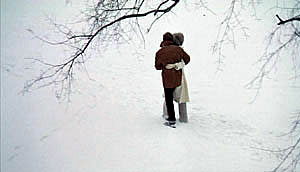 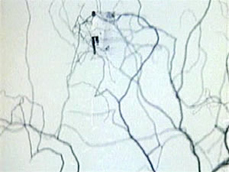
With these norms in place, Hou’s inclination toward location shooting and the use of nonactors, along with his attention to the concrete details of everyday life, allowed him to see the power of a technique that put character and context, action and milieu, on the same plane. His crowded compositions are organized with great finesse in order to highlight, successively, small aspects of behavior or setting, and these enrich the unfolding story, as Figures tries to show in his masterpieces of the 1980s and 1990s. Using a long lens (usually 75mm–150mm) he began to exploit some “just-noticeable differences” that the lens creates as byproducts.
Hou saw unusual pictorial and dramatic possibilities of the telephoto lens, and they became central to his distinctive way of handling scenes. A current norm of production practice yielded artistic prospects which he could explore in nuanced ways. Figures provides the detailed argument, but let me highlight three points here.
Exploiting the flaws
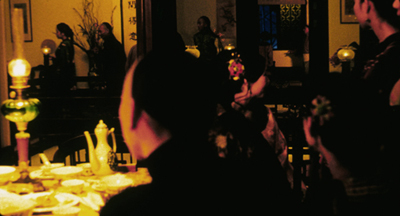
Flowers of Shanghai (1998).
One byproduct of the long lens is a shallow focus, as we can see in the examples above. Because the lens has little depth of field, one step forward or backward can carry a character out of focus. Hou stages in depth–and at a distance–but allows the layers to slip out of focus gradually.
Savoring the effects of gently graded focus is a common feature of Hou’s later work. The masher at the train station in Dust in the Wind (1987) moves eerily in and out of focus in the distance. In Daughter of the Nile (1988), there’s an astonishing shot showing gangsters approaching a victim’s SUV outside a nightclub: at first they’re only barely discernible blobs (seen through the vehicle’s narrow windows) but then they gradually come into ominously sharp focus in the foreground, preparing to attack one of the boys inside. The slight changes of focus train us to watch tiny compositional elements for what they may contribute to the drama. More recent examples abound in Flowers of Shanghai (1998), above, where it’s the foreground planes that dissolve.
Hou’s three first films don’t use the option quite so daringly; here the degrees of focus concentrate on the principal players but still allow us to register the teeming life around them (Cute Girl; Green, Green Grass).
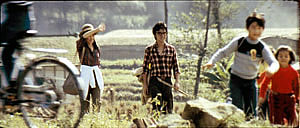 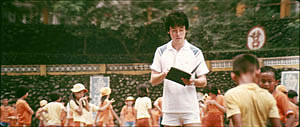
Hou can put sharply different dramatic situations on different layers. In Green, Green Grass, the departure of the little girl, saying farewell to her host family, plays out slightly closer to the camera than the departure of the eccentric teacher.
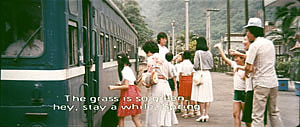
This principle operates as well in the creatively distracting street and train-platform scenes of Café Lumière (2004).
Secondly, the long lens yields a flatter-looking space. It has depth, but the cues for depth that it employs are things like focus, placement in the picture format (higher tends to be further away), and what psychologists call “familiar size”—our knowledge that, say, children are smaller than adults, even if the image makes them both of equal size. One favorite Hou image schema is the characters stretched in rows perpendicular to the camera, and the telephoto lens, by compressing space, creates this “clothesline” look more vividly. We can find the clothesline staging schema in the early Hou films (Cute Girl, Cheerful Wind).
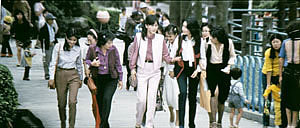 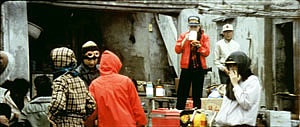
Another favorite schema is the “stacking” of several faces lined up along a diagonal (Cute Girl). This can be seen as a refinement of a schema that was in wider use, as an example from Love Story indicates.
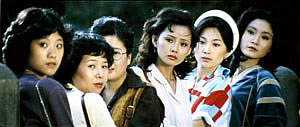 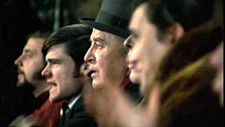
But Hou uses this sort of image more subtly. The telephoto lens lets him stack faces in ways that encourage us to catch a cascade of slight differences (Millennium Mambo (2000)). In many scenes of Flowers of Shanghai (1998) this principle is carried to a degree of exquisite refinement without parallel in any other cinema I know. In one shot, the faces are stacked in the distance, behind a lantern, and a slightly shifting camera reveals slivers of them.
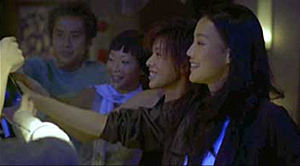 
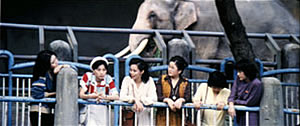
In general, because Hou is committed to a great density of information in the shot, the compression yielded by the long lens tends to equalize everything we see. Minor characters, or just passing strangers, become slightly more prominent, while details of environment can get pushed forward as well. The zoo scenes of Cute Girl enjoy showing us our characters in relation to the creatures around them.
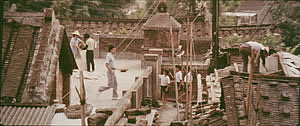
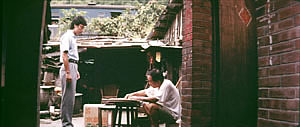
In the shot surmounting today’s entry, the tile rooftops of The Green, Green Grass of Home, secured by bricks and pails and tires and baskets, become just as important as the figures below them.
In Green, Green Grass, Hou develops the equalized-environment option in one particular scene. A long-lens distant view catches the teacher coming to the father’s house along a corridor of rooftops.
 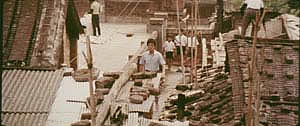
When the teacher confronts the father, instead of tight framings on each man, Hou cuts to another angle that activates yet another range of environmental elements—principally the train passing in the background, prefiguring the trip that the man’s son and daughter will take in an effort to find their mother.
Because the long lens has a very narrow angle of view (the opposite of a “wide-angle” lens), it affects the image in a third major way. If you use a long lens in a space containing several moving figures, people passing in the foreground will block the main figures: they pass between the camera and the lens. Hou elevates this blocking-and-revealing tendency to a level of high art.
In Figures Traced in Light, I argue that many great directors, from the silent era forward, have staged action in the shot so as to block and reveal key pieces of information, calling items to our attention at just the right moment with unobtrusive changes of figure position. The possibility of blocking and revealing arises from the “optical pyramid” created by any camera lens. (Lots more on that pyramid in Figures and in this video lecture.)
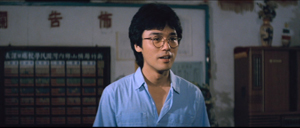
Hou showed himself capable of using the blocking-and-revealing tactic in traditional ways. Take this simple encounter in Green, Green Grass, when the new teacher Da-nian meets Su-yun, the young teacher with whom he’ll fall in love. The scene begins on him, then cuts to a reverse angle as he’s introduced to the principal.
 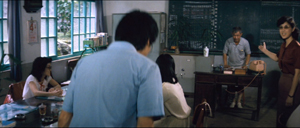
The others are turned toward the principal in the background; the whole composition pushes our eye toward him. Then the teacher steps left to judiciously block the principal. The woman on the far left turns her head and we’re nudged to look at her. Da-nian swivels slightly too.
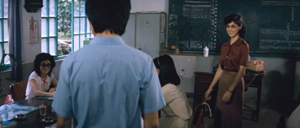
Then the key introduction: Da-nian shifts aside a little, the teacher continues to block the principal, and the central woman turns toward us.
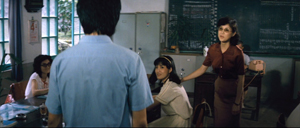
The climax (quiet, nifty) of this shot comes when Su-yun rises to meet Da-nian. She commands the center of the frame, frontal and radiant. Like any good classical director, Hou then gives us a reaction shot mirroring the first shot of this “simple” sequence: Da-nian is more than happy to meet her.
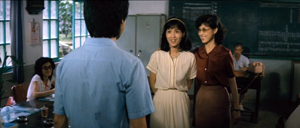 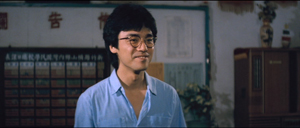
Imagine how a contemporary Hollywood director would handle this–lots of cuts, everybody in singles and close-ups, transfixing track-in to Su-yun, maybe a boingo music track–and count yourself lucky to have encountered, for once, an unfussy craftsman.
Hide and seek
The Green, Green Grass introduction scene involves a wide-angle lens, but Hou’s skill with slight character movement shows up in long-lens images too. In fact, I suspect that using the telephoto lens on location made him sensitive to the resources of masking and unmasking bits of the shot.
The loveliest example I know in the early films is the Cute Girl shot I analyze in Figures, when Fei‑Fei confronts the surveyors and the man in the red shirt serves as a pivot for our attention; the staging shifts our eye back and forth across the frame, according to small changes of character glance.
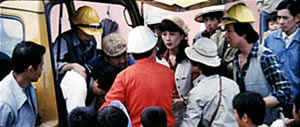 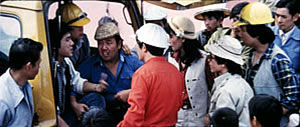
A less drastic example occurs when the surveying team starts quarrelling with the locals around a walled gate: The team’s blocking of the gate gives way to movement into depth and a struggle there between them and the townsfolk.
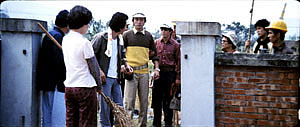 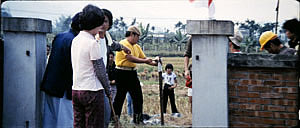 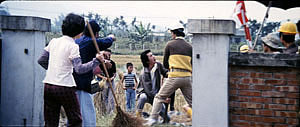
In all, it seems to me that these three resources of the long lens—the shallow focus, the compressed space, and the narrow angle of view—supplied artistic premises for Hou’s shooting and staging in the later films. This is not to ignore his use of the wide-angle lens on occasion, particularly interiors, as in the schoolteachers’ introduction scene. Once the lessons of the long lens had been absorbed, Hou could apply the staging principles that he’d developed to other kinds of shots and story situations. Sometimes he kept his style smooth and limpid, but at other times he offered the viewer some unusual challenges.
Peekaboo pictures
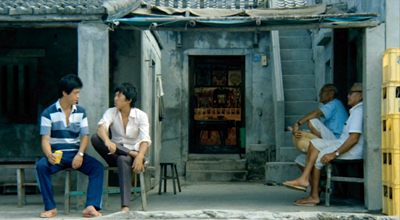
The Boys from Fengkuei (1983).
Presumably Hou could have kept making good-natured, crowd-pleasing movies for many years, but changes in his professional milieu gave him new opportunities. In the early 1980s Taiwan film attendance declined sharply, and Hong Kong films began to command more attention than the local product. The rash of independent companies had concentrated on speculation, not long-term investment, so only the government’s Central Motion Picture Company could initiate recovery. Ambitious government officials launched a “newcomer” program that offered support for cheap films by fresh talents. Even if the new films could not win back the local audience, they might gain renown at foreign film festivals. At the same period, a local film culture began to emerge, relying upon critics who were sympathetic to the creation of a New Taiwanese Cinema.
Hou was no newcomer, but working within the New Cinema framework he could reconceive his practice. The key question for all directors, he recalls, was: What is it to be Taiwanese? His New Cinema films would focus on political and cultural identity, and they did it through an approach to cinematic storytelling that in many respects ran against the conventions of his earlier films. His first New Cinema feature, The Boys from Fengkuei (1983; included in the Cinematek set) reminds us of how “young cinemas” have often represented a return to Neorealism.
Instead of introducing us to clear-cut protagonists and a dramatic situation, the film immerses us in a milieu, that of the small town of Fengkuei. The first fifteen minutes are episodic, casually showing a gang of teenage boys playing pool, lounging about, playing pranks, and above all getting in fights. Initially, the one who’ll become the main figure is minimally characterized; the emphasis, as the title indicates, is really on the group. The boys drift to the big city, where they try to get by and meet others their age. Throughout, local color and everyday routines drive the action more than character goals and traditional drama do.
This somewhat diffuse approach to narrative, in various countries, has proven well-suited for filmmakers who want to explore psychological development and social-cultural commentary. So it accords with the impulse toward understanding national identities that animated New Taiwanese Cinema. In addition, I think that this looser conception of storytelling allowed Hou to refine some of the stylistic options he had already explored. Now the extended, fixed telephoto shot with varying planes of focus appears as a more indeterminate pictorial field, as in our rather oblique introduction to the boys–partial framed figures drifting in and out of the frame–and their poolroom hangout. Emphasizing incomplete views and vague figures outside the door, Hou gives us a more precise array of balls on the table than he does of his characters in space.
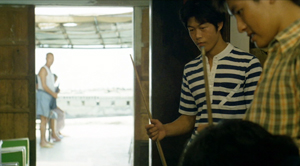 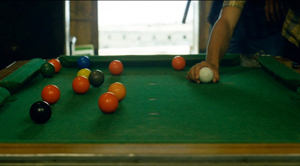
Likewise, even though Hou has surrendered his very wide anamorphic frame, he finds ways to balance human action and tangible surroundings in the ways he did with city landscapes and village rooftops in the earlier films. The bullying of a motorcyclist and a pursuit by a rival gang aren’t rendered with the aggressive cuts and angles we’d expect in violent scenes in the Hong Kong action pictures then ruling Taiwanese screens. It’s as if Hou, along with his colleagues, is rejecting that other Chinese-language tradition.
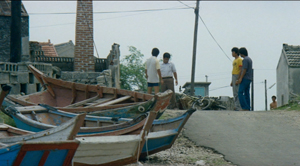 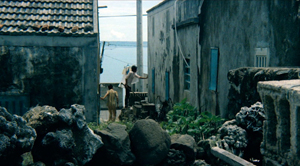
Which is to say that when conflict comes, Hou turns to “dedramatization,” that tendency (again related to Italian Neorealism and its successors) of tamping down peaks of action. Now his characteristic long lens creates detached shots, sometimes with planimetric flatness, sometimes with tunnel vision. These images play out chases and fights in a way that minimizes their physical impact but reminds us of the design and details of the characters’ world.
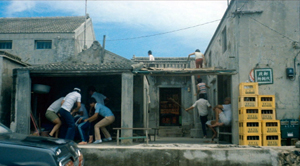 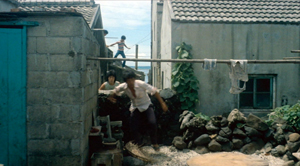
Hou’s insistence on the fixed, distant telephoto take is now put in the service of obscured vision. The people who passed through the frame in the earlier films, blocking and revealing the action judiciously, may become more salient than the action itself–which is itself often offscreen, or swathed in shadow, or shielded by aspects of setting. The early films’ fixed long take enabled us to see story action fully, but, now, in its refusal to cut away, the camera can suppress story information.
Early in the film, a street fight passes in and out of a far-off intersection among stalls. The dust-up stirs only slight interest from passersby, before bursting back into the alleyway and coming to the camera.
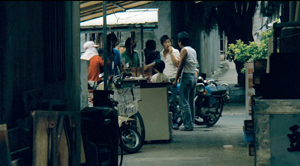 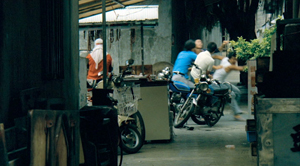 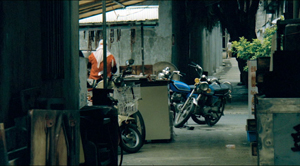
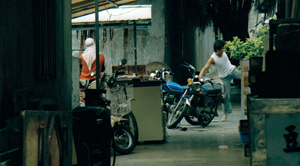 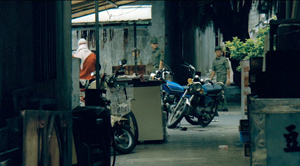 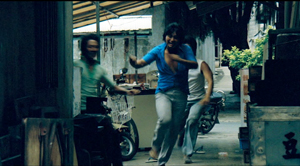
The masking of the fight by the setting can be seen as an extension of the way the walls in the Cute Girl surveying quarrel intermittently cut off our vision, but here it’s far more drastic and sustained.
I’ve drawn my examples from the early stretches of The Boys from Fengkuei, so as not to preempt your own discoveries as the plot carries the gang to the big city. In these scenes Hou in effect teaches us how to watch his movie. But I think I’ve said enough to suggest how Hou’s fresh conception of narrative, born of a renewed interest in local culture (already present in another register in the first three films), allowed him to carry his stylistic explorations to new levels.
Hou saw certain pictorial possibilities in the long lens, and after developing them to a certain point in popular musicals, he recast them when he took up another kind of storytelling. He realized that leisurely, contemplative narratives permitted him to refine these visual possibilities, and they could become powerful, nuanced stylistic devices. And he didn’t stop, as the films following his New Cinema works vividly show. His visual imagination seems unlimited.
A more general lesson follows from this. Norms of form and style are resources for artists. Some artists follow the schemas that they inherit, while others probe them for fresh possibilities. A few can even make a handful of schemas the basis of a rich, comprehensive style. Ozu did this with the techniques of classical Hollywood editing; Mizoguchi did it with depth staging in the long shot. Like these other Asian masters, Hou reveals how much nuance a few techniques can yield, even when deployed in crowd-pleasing, mass-market movies. And now, thanks to the vagaries of film culture, more viewers can come to appreciate his achievement.
The frames from Diary of Didi and Love, Love, Love are, alas, cropped video versions, but that condition doesn’t keep us from recognizing the telephoto lensing in the originals.
The Cinematek collection also includes sensitive English-language introductions to the films by Tom Paulus and enlightening audiovideo essays by Cristina Álvarez López and Adrian Martin.
The indispensable English-language sources on Hou are James Udden’s in-depth career survey, Richard Suchenski’s monumental anthology, Emilie Yeh and Darryl Davis’ study of New Taiwanese Cinema, and two monographs on City of Sadness, one by Bérénice Reynaud, the other by Abe Markus Nornes and Emilie Yeh.
The fullest account I’ve offered of Hou’s style are in Figures Traced in Light and in a video lecture, “Hou Hsiao-hsien: Constraints, traditions, and trends.” See also the several blog entries touching on his work. A broader account of the historical tradition to which he belongs can be found in both Figures and On the History of Film Style, as well as in entries under Tableau staging and in the video lecture mentioned already.
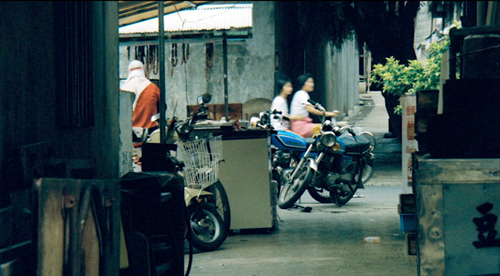
The Boys from Fengkuei.
Posted in Directors: Hou Hsiao-hsien, Film technique: Cinematography, Film technique: Staging, National cinemas: Taiwan, Tableau staging |  open printable version
| No Comments » open printable version
| No Comments »
Wednesday | May 11, 2016
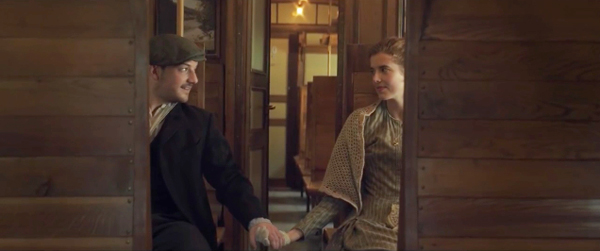
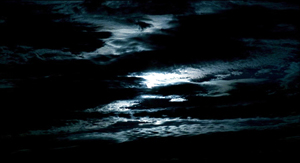
Sunset Song (2015).
DB here:
A career retrospective brought director Terence Davies to Astoria’s always enterprising Museum of the Moving Image. On Sunday MoMI ran a handsome 35mm copy of The Long Day Closes (1992), introduced by Sony Pictures Classics Co-President Michael Barker (who originally distributed the movie). The film was followed by Davies’ informative discussion with Michael Koresky, author of a fine critical study of Davies. On Tuesday, there was an avant-premiere of Sunset Song (2015) with Agyness Deyn, the principal player, joining Davies and Koresky. The first screening featured one of the greatest films of the 1990s, while the second showcased the literary adaptation that Davies had sought to make for several years.
The two evenings left me with renewed respect for the power of this audiovisual art we call cinema. They also set me thinking about Davies’ unique contributions to that art, particularly in his first two features.
MGM in Liverpool
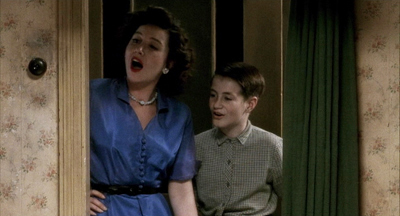
The Long Day Closes.
If you needed proof of the unpredictable, zigzag influence of Hollywood cinema, look no farther than the films of Terence Davies. When he saw his first film, Singin’ in the Rain (1952), he knew utter rapture, and his early years were illuminated by visits to the local movie house. But unlike other cinephile directors, he didn’t turn retro. His first two masterpieces, Distant Voices, Still Lives (1988) and The Long Day Closes (1992), decant the splendors of American musicals into vessels more severe and melancholy. The brooding lyricism of these films, presented in a stringently geometrical pictorial style, makes them almost unrecognizable cousins of the 1950s films that nourished him.
Davies understood, as so many postwar critics of mass culture didn’t, that Hollywood, for all its formulas and conventions, captured genuine feeling; indeed, those very formulas and conventions released that feeling. In Davies’ hands, however, the feelings gain a rougher texture. In tales of patriarchal power and everyday betrayals, echoes of the yearning of Judy Garland and the vibrato of Doris Day seem distant and distorted. Davies finds the evanescence hidden in Yankee exuberance, and he takes it very personally.
That’s partly because popular song is filtered through a sensibility deeply committed to classical musical expression. Nobody but Davies would accompany an image of urban squalor with the arching final melody of Vaughan Williams’ Pastoral symphony, or the soft run of George Butterworth’s “Shropshire Lad” tune over the tan rug in The Long Day Closes. The soaring Barber violin concerto accompanies, for an astonishing eleven minutes, the opening images of The Deep Blue Sea (2011); it’s practically a cinematic tone poem. One of those directors who’s unthinkable outside the sound cinema, Davies dissolves any barrier between popular song and art music. The American Song Book, he says, is the country’s greatest gift to the world, and Stephen Sondheim is our Schubert.
Music is tied, in intricate ways, to family. These films are openly autobiographical. The first part of Distant Voices is a terrifying portrait of domestic life with a madman; the second part treats the radiant moments without him. The father is absent in The Long Day Closes, and so life in the household, with Mum and brothers and sister and visiting chums, is blissful. (Surely Davies is the great filmmaker of sibling devotion.) Now the threat lies beyond the threshold; school bullies, sadistic teachers, and a Church that seems indifferent to the suffering of a boy vaguely sensing his homosexuality.
Yet by a kind of benevolent contagion, the joy of American cinema transfigures the grubby side of daily life–through communal singsongs in parlor or pub, through impromptu performances at parties, through hit-parade tunes hummed during daily routines. There are line-readings too; in The Long Day Closes the Boccherini minuet from the ball in The Magnificent Ambersons is matched by quick borrowings from Welles’ voice-over narrator. In one of the great sequences of modern cinema, a survey of the boy Bud’s world is shot from straight-down framings that roll by like scenes in a picture scroll. Birds’-eye views of street, cinema, church, and school are wrapped in the throbbing voice of Debbie Reynolds singing “Tammy.”
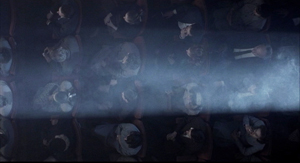 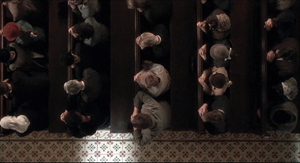
Cinema wins on the soundtrack. Take away the music and the snippet from Kind Hearts and Coronets and you have a grim topography. With movies, life’s miseries become bearable.
Chamber pieces
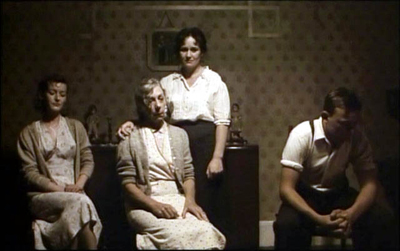
Distant Voices, Still Lives.
Distant Voices and The Long Day Closes balance social realism with a first-person quality shot through with feeling. Davies remembers everything about his childhood, and he can present unsentimentally the gray-brown wallpaper and the bulky furnishings. (He remarked that period films always forget that people didn’t have the most up-to-date things; nobody in 1950 Liverpool owned 1950 furniture.) Even realistic detail is saturated with memory and expression. Similarly, Davies’ reliance on planimetric shooting, dominant in Distant Voices and still strong in The Long Day Closes, creates at once rigid formality and a curious intimacy, as if we were looking at family portraits.
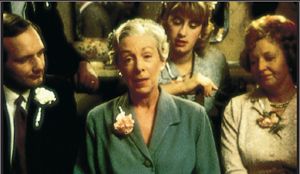 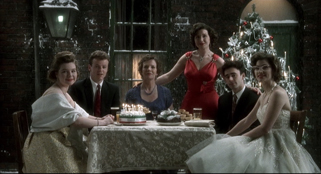
When capturing moments of serenity, the perpendicular shots evoke utter honesty; characters face us frankly, hiding nothing. But confronted with a schoolyard beating or a psychopath thrashing his wife, this curiously impassive camera–no wild handheld bursts or jagged cutting–only accentuates the pain. The camera’s unearthly calm takes on a kind of ruthlessness, as if nothing awful that happens in this world can make it flinch, just as nothing rapturous can make it go giddy. Davies seems fairly Wordsworthian: his poetry is “a spontaneous overflow of powerful feeling,” but the overflow is “recollected in tranquility.” The scene’s situation and the music, we might say, supply the feeling, while the framing supplies the tranquility and suggests the distance of memory.
These tableaus remind us that Davies is one of the few masters of cinematic chamber art. The exteriors, very few in these two features, are treated in the same rectilinear framings as the rooms are, as if one could never escape the carpentered contours of a house. More often, we’re indoors, and the human figures in are caught, nearly frozen, in a parlor or kitchen or hallway or schoolroom. No wonder his favorite painter is Vermeer.
Like Dreyer, Davies finds drama in the nearly closed room, the space slashed by light and opening onto somewhere else: in Davies’ case the doorway and the stoop and the street. These are the little theatres of human relaxation, of sharing, good times, and of course song. All the more jolting, then, when the father in Distant Voices turns up at the door, released from the hospital, or when Bud in The Long Day Closes sees his pal Albie go off to the pictures without him. As Michael Koresky notes in his book, the face at the windowpane looking out at the world is a recurring image for Davies: the edge between two arenas of experience, both harboring pain and exaltation.
 Davies is famous for laying out each film with a draftsman’s precision: shot by shot, line by line, musical extract by musical extract. These films are absolutely through-composed. Their strict rhymes channel the feelings of the characters–or rather, the feeling of a scene as a whole–into determinate shapes that we can grasp. The sound is as important as the images; Hollywood musicals taught him the tight coordination of image and phrasing that pattern his song sequences and pictorial cadenzas. Davies is famous for laying out each film with a draftsman’s precision: shot by shot, line by line, musical extract by musical extract. These films are absolutely through-composed. Their strict rhymes channel the feelings of the characters–or rather, the feeling of a scene as a whole–into determinate shapes that we can grasp. The sound is as important as the images; Hollywood musicals taught him the tight coordination of image and phrasing that pattern his song sequences and pictorial cadenzas.
No surprise, then, that Davies loves music and poetry, to which he constantly compares cinema. And no wonder he admires T. S. Eliot’s Four Quartets, that poem that takes its title from chamber music. In both music and verse, powerful feelings flow through rigorous forms. The chock-a-block construction of Distant Voices sets up poetic parallels and contrasts between the two parts. More boldly, The Long Day Closes offers a narrative that’s barely there: a suite of situations, a flow of anecdotes that gathers symphonic force. It recalls Pather Panchali and other films about a child coming to understand that whatever happens, painful or exhilarating, is transitory when seen against the backdrop of eternity.
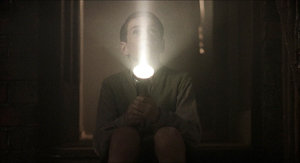
Davies is after, he said in conversation, “the intensity of the moment,” and what happens before or after may seem of little account. Sound, light, color, movement: all become focused on the poignancy of the felt instant. Yet in another echo of Romanticism, that instant isn’t trivial when it’s seen in a cosmic context. Left alone by his brothers and sister, Bud thrusts his flashlight to the sky, creating a movie-projector’s beam as a demonstration that light goes on forever.
 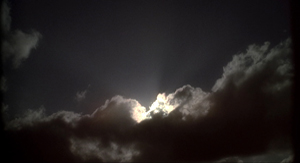
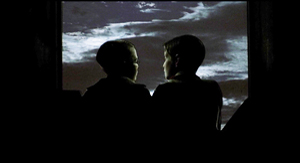
In an echo of this moment, Bud’s long days close with a merger of the momentary and the infinite. Two boys sit (in the balcony?) poised against the sky. Their movie becomes a majestic sunset, wrapped in the plangent song that gives the film its title. The light from the stars dates from Jesus’ day, Bud tells Albie, as the sacred chambers of his world open onto the universe.
Daughter of the earth

Terence Davies and Agyness Deyn.
A sadistic, baleful father; a mother bearing the brunt of his demands; a brother and sister as tender with one another as sweethearts; gentle friends who sustain the household with music–with Sunset Song we seem to be back in the world of Davies’ early films. But instead of the grubby city streets we’re in a glorious green-gold landscape of rolling fields, and instead of postwar London we’re in Scotland on the eve of World War I.
Sunset Song, drawn from the 1932 novel by Lewis Grassic Gibbon, exemplifies Davies’ later interest in adapting literary works (The Neon Bible, 1995; The House of Mirth, 2000; The Deep Blue Sea). In all of these, Davies tries to respect the spirit of the original while finding affinities with his own sensibility.
Sunset Song centers on Chris Guthrie, the dutiful daughter of a farm household. For the early stretches of the film she’s a cautious observer, but her voice-over, presented in the third person and past tense, prepares for her to take over the action. At first she’s inclined to run away with her brother, but duty keeps her home. When she comes into ownership of the farm, she realizes that she is rooted in the place. The earth, more eternally solid than sea or sky, gives her strength. If she cannot forgive what her father has done, she can learn to understand and forgive another man’s betrayal.
At first glance, we might seem to be snugly settled in British Cinema of Quality. But Davies has always made “costume pictures,” and his take isn’t in tune with Masterpiece-Theatre fashion shows. The clothes, as Davies always demands, look lived in, worked in, slept in. Agyness Deyn explained that for wardrobe they gladly took the worn leftovers of tonier productions.
Despite the eye-filling landscapes shot in 65mm, Davies hasn’t played false to his intimate aesthetic; this remains a chamber drama, with few primary characters. Like Bud in The Long Day Closes, Chris is our focal consciousness; apart from a substantial flashback to war-torn France, we’re confined chiefly to what happens around her. A few years of history unfold in a rhythm tuned to her growing awareness of her options and decisions, good and bad.
The style is far more mainstream than in the first two features. We get continuity editing (often in its constructive vein), smooth reframings as actors move around sets, and not many images recalling the tableau-vivant look of the earlier work. Chris is introduced in one of those twirling camera movements that are de rigueur nowadays, though Davies refreshes the convention by the visual metaphor of her rising up from the wheat, as if from sprung from the soil, and tipping her face to the sun, like a flower.
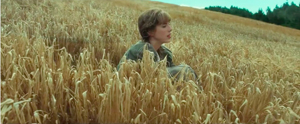 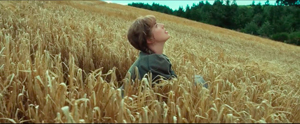
But Davies insisted on both evenings that for him, form springs from content. I take that to mean that the brick-by-brick shot assemblage of the first films suits the episodic, memory-driven nature of those tales. Here we have a novelistic saga (the original book is part of a trilogy), and so we must stay engaged with a chronologically unfolding plot. Davies has opted for less stylization, the better to rivet us to the powerful story of his protagonist’s blossoming to maturity.
Again, music yields a model. He urges young filmmakers to study symphonic cycles, like those of Bruckner and Sibelius, in order to appreciate scale and balance and variety in a large-scale structure. The relaxed flow of Sunset Song–and what power the title must have had for him–is like that of a full-scale orchestral essay. If Distant Voices, with its shifting, decentered viewpoint, is a chamber piece and The Long Day Closes is something like a song cycle for voice and quartet, this latest work is perhaps a concerto, with Chris’s sturdy presence an instrument of commanding range set against the massive landscape and a choir of family, friends, and neighbors.
Normally we must wait years between Davies’ films, but A Quiet Passion, his biography of Emily Dickinson, is beginning its career in worldwide distribution now. One feature in 2015, another in 2016. “I’m in danger of becoming prolific.”
Back in 2001, Kristin and I met Terence and his assistant John Taylor (loyal Packers fan) at Belgium’s summer film college. They were good company then, and still are. The MoMI screenings provided a wonderful occasion to see them and the films once more. If you’re in the vicinity, start queueing now for the follow-up items in the series. And Sunset Song opens this Friday at Film Forum, with Terence present. From there it will make its way across the US. You couldn’t spend your time more fruitfully. These movies will last a very long time.
Thanks to David Schwartz and his colleagues at MoMI. The Long Day Closes is available on DVD and Blu-ray from the Criterion Collection; thanks to Kim Hendrickson for her assistance. And thanks to George Nicholis of Magnolia Pictures, which is releasing Sunset Song.
For more on the stylistic tradition that early Davies films work within, you can consult Chapter Six of On the History of Film Style and these entries.
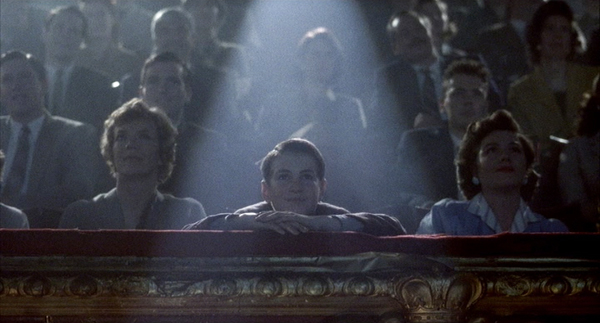
The Long Day Closes (1992).
Posted in Directors: Davies, Tableau staging | open printable version
| No Comments »
Friday | May 6, 2016
DB here:
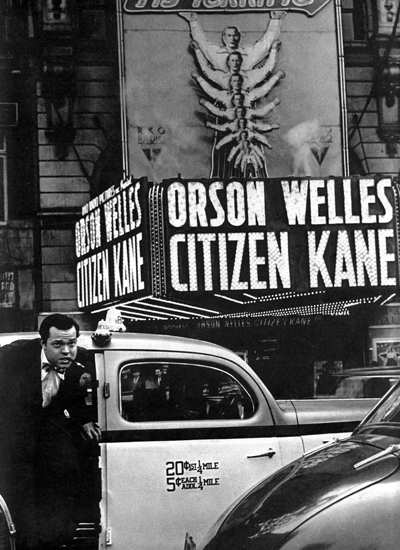
Kristin and I are one-third through our New York stay, and blogging has suffered. There have been talks to give, old friends to visit, new friends to meet, and movies and exhibitions to see. And there’ll be more activities of these sorts to come. But I can’t let 6 May pass without some acknowledgment of Orson Welles.
That’s partly because I just finished a draft of the Welles section of my 40s Hollywood manuscript. (Yeah, that beast was another distraction from blogging. All 158,000 rough-hewn words of it are now dispatched to some unwary readers.) So Welles was on my mind already when the anniversary of the “official” Citizen Kane release came up on 1 May.
Actually, by the time Kane had that roadshow release, it had been widely seen by the Hollywood community. In the face of the Hearst press’s attacks, RKO head George Schaefer held invitational screenings in early 1941 to build up support for the film. Variety estimated that by late March 1,200 producers, directors, writers, actors, and agents had seen the picture. The number was so big that RKO dispensed with a splashy Hollywood opening. (The article title is pure Varietyese: “So Many Cuffo Gloms at ‘Kane’ It Kayoes Idea of a $5.50 Preem,” Variety, 2 April 1941, 2, 20.) As a result, I think, Kane‘s influence began to be registered some months before its New York premiere, as the look of The Maltese Falcon (shot June and July of 1941) might suggest.
What I offer today, on the Boy Wonder’s birthday, is a consideration of that movie from an unusual angle looking not just at its originality but also at its shrewd consolidation of a variety of techniques.
Wellesapoppin’
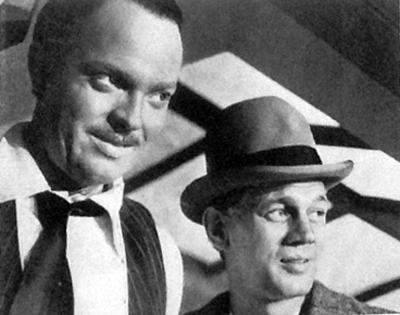
We’re so used to considering Kane powerfully original that it’s worth remembering that it synthesizes a lot of traditions. I’m not thinking of Pauline Kael’s claim that it’s a culmination of the 1930s newspaper genre; as so often, she fails to persuade me. I’m thinking instead of the look and sound of the movie, as well as its storytelling strategies.
Depth staging and deep-focus cinematography are two techniques not always kept distinct in critical discussion. 1930s Jean Renoir films have plenty of depth staging but usually not so much deep focus. Citizen Kane won attention partly because it has plenty of both, and in exaggerated form. The figures often stretch very far back, someone or something is often rather close to the camera, and often all of them are sharply focused.
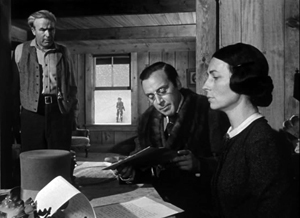
Without taking anything away from the boldness of Welles and cinematographer Gregg Toland, we should recognize that they reworked visual patterns—what I’ll call schemas—that were already circulating in filmmaking. Framings with big foregrounds, distant planes, and low angles weren’t unknown in silent films (Opium, 1919; Greed, 1925; A Woman of Affairs, 1928) and some early talkies (No Other Woman, 1933).
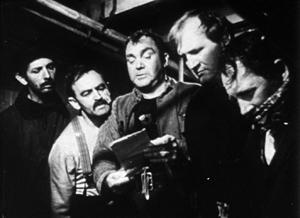
There was a sort of fad for such deep staging, especially with wide-angle lenses, during the late 1930s, though all the planes weren’t usually kept in focus. Some directors, such as John Ford (here and here) and William Wyler, favored deep images, while art director William Cameron Menzies (see here and here) made them part of his artistic signature. Below: Ford’s Long Voyage Home (1940), shot by Toland, and Menzies’ Our Town (1940), directed by Sam Wood.
 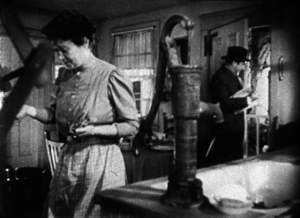
It’s now acknowledged that many of Kane’s deepest shots weren’t actually made in the camera, but by means of special effects, particularly matte shots. Interestingly, this too wasn’t utterly original; compare the composite shot from Kane with the one from Mr. Moto’s Gamble (1935), which has an even more aggressive foreground.
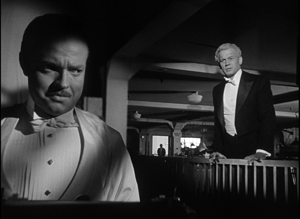 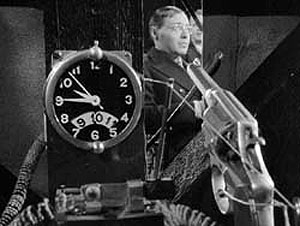
Welles and Toland called attention to these techniques by a radical gesture: many of these deep shots are long takes from a fixed camera position. Most filmmakers who used these depth schemas inserted them into passages of orthodox scene dissection. The depth shots might establish a locale, or they might be inserted into a series of analytical cuts, or they might be part of a shot/ reverse shot pattern. But in Kane you’re forced to notice the Baroque plunge of space because the lengthy take rubs your nose in the flashy composition.
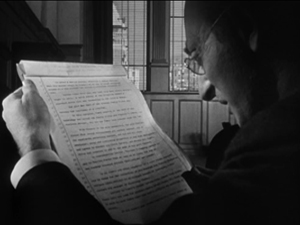 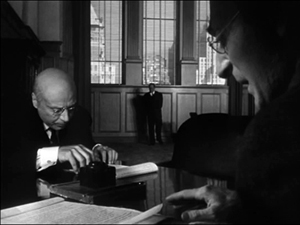
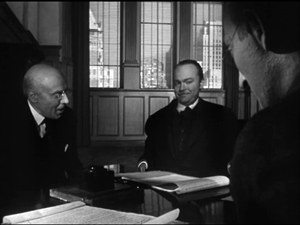
It’s clear that Kane crystallized a certain look that was picked up by John Huston, Anthony Mann with or without his DP John Alton, and many other directors. The Welles/Toland version of depth consolidated a visual style that dominated American black-and-white filmmaking into the 1960s. Typically, though, filmmakers didn’t rely on the fixed long take as much as Welles did in Kane. Even Welles gave up that option in favor of dynamic editing of deep-focus shots, as in The Lady from Shanghai (1948) and Othello (1952/1955).
Not everything is long takes and depth. The pictorial variety of the film is, I think, unprecedented. The “News on the March” sequence becomes a virtuoso exercise in all the techniques that the rest of the film won’t be using. For perhaps the first time in history, Welles artificially distresses his staged scenes to make them match archival footage. He adds scratches and light flares.
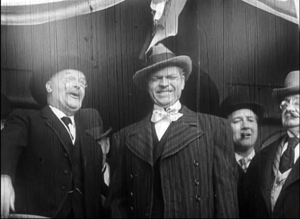
This newsreel is so film-savvy that it can build in jump cuts and fast-motion as guarantors of fake authenticity. One passage mimics two-camera reportage, allowing us to imagine paparazzi crouched and perched at a fence to grab clandestine shots of an elderly Kane.
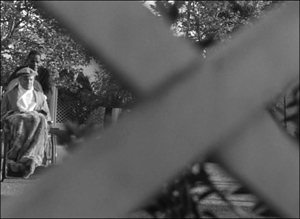 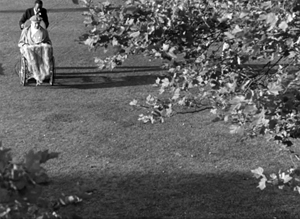
Here the schemas that are borrowed come from archival and documentary traditions, repurposed to add realism to this fictional biography. Welles, as we’ve seen in the Great Ambersons Poster Mystery (here and here and here), was a smart-alec cinephile: your disobedient servant.
What about sound? Back in 1994, Rick Altman wrote a pioneering article showing how Kane manipulates our sense of auditory space, and he connected that to Welles’ use of radio conventions. Contrary to what we might expect, Welles’s soundtrack doesn’t create much “deep-focus sound”; Altman shows that our impression of that is created chiefly by an overall reverberation rather than precise placement of sonic events. Altman also stresses Welles’ use of sudden, loud sound events to start or end a scene–another radio technique.
Today we’re lucky to have a great many of Welles’ radio programs available on the Web, and we can appreciate how his rich soundscapes mingle noises, dialogue, and voice-over narration. These shows remain very gripping. Listening to Kane in the same spirit, I’ve been impressed with how talky it is, how sounds crash in on you, and how even bursts of silence can be startling. Welles told one biographer that he aimed to create spiky transitions, both visual and sonic, because he thought most films of the period were dull.
He had already made his stage reputation on “shock effects,” those stunning high points in particular productions: the death of Macbeth in the Harlem production (1936), an actor’s headfirst tumble into the orchestra pit in Horse Eats Hat (1936), the mob’s murder of Cinna the Poet in Caesar (1937), the guillotine scenes in Danton’s Death (1938), and police agents firing from the audience in Native Son (1941). He became known as a director of thrilling moments, ever willing to sacrifice steady buildup to anything that would astonish. Forties theatre critics had a name for it: “Wellesapoppin’.” That quality dominates Kane’s images and sounds.
Remembering, recounting, replays
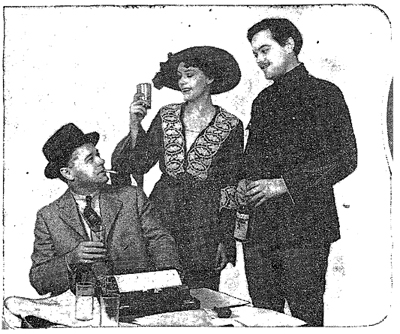
Otto Hullet, Barbara O’Neill, and Orson Welles in Sidney Kingsley’s Ten Million Ghosts (1936).
Just as Kane amplifies visual and auditory schemas already in circulation, the film does somewhat the same thing to narrative strategies. The key innovation here involves flashbacks and point of view.
Flashbacks were rare in the 1930s, but the early 1940s began a flashback craze that continued throughout the decade. Between August 1940 and December 1941, every top studio tried out flashbacks in a major release: The Great McGinty (Paramount), Kitty Foyle (RKO), I Wake Up Screaming (Fox), H. M. Pulham, Esq. (MGM), and Strawberry Blonde (Warners). A reviewer claimed that the “retrospective viewpoint” technique in A Woman’s Face, released the same month as Kane, “had of late become commonplace.” By September 1941 the Los Angeles Times critic considered the technique overused.
Even though the trend was already launched, Kane probably strengthened Hollywood’s inclination toward time-shifting. Again, it crystallizes in an influential way possibilities opened up in film, radio, theatre, and other media.
Kane’s central premise—a dead man recalled by one or more survivors—had been rehearsed in earlier films. The Power and the Glory (1933), scripted by Preston Sturges, was probably the most noted experiment in that vein. (For more, see this long-ago entry.) Another example was The Life of Vergie Winters (1934), which begins with a funeral procession and flashes back to the start of a backstreet love affair. (See this entry.) The Escape (1939) centers on a doctor who tells a crime reporter about a recently deceased neighborhood gangster, and flashbacks enact his tale.
These earlier examples stick to a single teller, while Kane offers reports on its dead man from five characters. Here again, however, there are precedents. In fiction and drama, trials have long served as motivation for flashbacks from multiple viewpoints. A major example, perhaps the first, is Robert Browning’s verse novel The Ring and the Book (1868-1869). Multiple tellers recounting events in flashback were staples of Hollywood courtroom dramas too. Beyond the trial-based format, Welles’ radio programs had welcomed multiple storytellers, sometimes embedding them within one another’s tales, sometimes letting them banter with each other.

Kane assembles views on a person rather than evidence of a crime, but even this is not completely unknown. Some playwrights had tried out what Kane screenwriter Herman Mankiewicz had called the “prismatic” approach to an absent central character. Sophie Treadwell’s play Eye of the Beholder (1919) portrays an offstage woman as seen through the eyes of her former husband, her lover, her lover’s mother, and her own mother. The play These Few Ashes (1928) presents the life of a (supposedly) dead roué through the recollections of three women, each of whom sees him quite differently.
Then there’s reporter Thompson’s investigation. The Power and the Glory’s exhumation of the tycoon’s past is presented simply as his old friend’s recounting; it’s not the investigation of a mystery. Kane innovated in the biographical film genre by creating curiosity based on the dying man’s last word, “Rosebud.” That device shifts us to the terrain of the detective story. The dying message had become a mystery-tale convention from Conan Doyle onward, and Welles and Mankiewicz shrewdly recruited it for their purposes (although it’s not clear exactly who hears Kane say the crucial word).
In blending conventions of several genres, Kane motivates the flashbacks on diverse grounds. The film’s detective-story side is anticipated by The Phantom of Crestwood and Affairs of a Gentleman (1934); in both, flashbacks represent the suspects’ answers under questioning. Like The Escape, Kane uses a reporter’s search for a story to justify its flashbacks, and the reporter isn’t the protagonist (as he’d be in a typical newsman movie). And being something of a biopic, Welles’s film can trace the rise of a great man from the vantage point of old age, as in Edison, the Man (1940). By the way, that’s another film of the era using a journalist’s questioning to launch flashbacks to a person’s life.
Another wrinkle: Kane’s flashback organization skips around in the past. Episodes of Kane’s life are not presented in 1-2-3 order. Plays set in courtrooms, such as Elmer Rice’s On Trial (1914), had rendered flashbacks out of sequential order, and so had radio dramas. Welles’ 1938 radio adaptation of Dracula shuffles episodes in the manner of the source novel. Non-chronological strings of flashbacks weren’t common in film, but The Trial of Vivienne Ware (1932) and The Power and the Glory used them significantly.
Even rarer is the replayed flashback, the scene from earlier in the film that is repeated, usually to reveal something we hadn’t caught on the first pass. Kane has occasion to present a brief replay from differing character viewpoints. Susan’s opera premiere is first treated curtly, as the object of the stagehands’ scorn. Later, in her flashback, the same scene registers the central characters’ reactions: a severe Kane, a bored Leland, the harried singing master, and above all the panicked Susan.
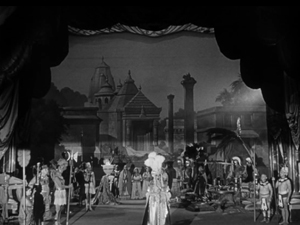 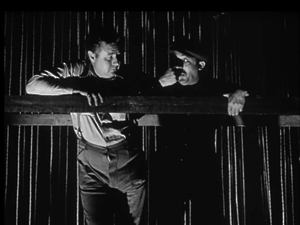
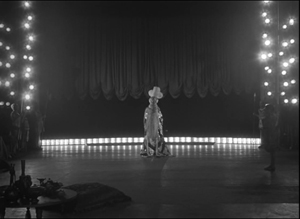 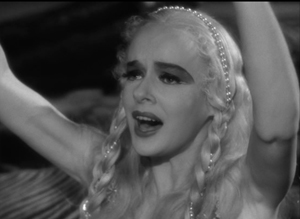
Replay flashbacks were rare in the 1930s, but The Witness Chair (1936) provides one example. After Kane, they would become more common, with Mildred Pierce (1945) offering one of the period’s most complex examples. (I discuss it here and here, with a video here.)
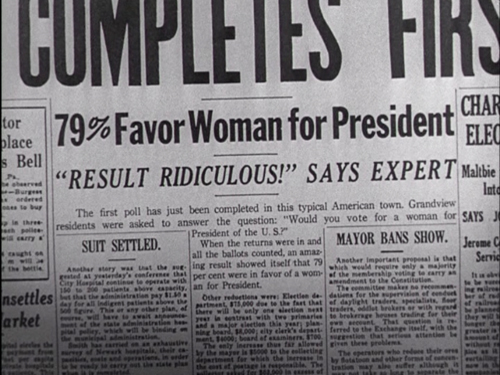
Even the coup de théâtre of following Kane’s death with a newsreel can be seen as revising a schema. “News on the March” isn’t exactly a flashback, but it provides exposition by shuttling among time periods in a manner characteristic of the film to come. Projected headlines and documentary footage, faked or actual, had found their way into 1930s theatre practice, notably in the WPA Living Newspaper productions. Many 1930s films opened with montage sequences using headlines, stock footage, and voice-overs like those in newsreels; The Roaring Twenties (1939) is a bold example. Gabriel over the White House (1933), with its mix of library footage and staged shots, anticipates Kane somewhat, as does Welles’ script for an uncompleted 1939 RKO project, The Smiler with a Knife, which includes a newsreel surveying the career of the fascist villain.
Another, less proximate source may be Sidney Kingsley’s 1936 Broadway play Ten Million Ghosts. This strident antiwar tract lasted only eleven performances and was never published; I took a look at a copy of the script last week. In the original production Welles played the naïve young poet André in love with the daughter of a munitions magnate during World War I.
Ten Million Ghosts includes a scene in which arms makers spend an evening watching a battlefront newsreel in their parlor. Kingsley’s purpose is to show the capitalists as utterly indifferent to the slaughter that the camera records.
They watch in silence for a while. Then there are technical comments on the explosives, shells, etc. as we see them hurl geysers of earth and men into the sky.
Was this embedded newsreel an early source for News on the March? Scholars have wondered. And there’s more.
As the film unwinds, André, who has learned that his family has been killed in the war, cries out in protest. Madeleine is torn between him and her father. To win her over her father angrily defends his double-dealing between both sides in the war. It’s all just business, he insists. Then we get this piece of action:
De Kruif rises, intercepting the beam of the projecting machine, his face highly lighted, his shadow, black and ominously magnified, thrown on the screen superimposed over the pictures of men writhing in bloody destruction.
Was De Kruif’s moment in the play a visual idea that inspired Kane’s projection-room scene? If so, Welles and Toland revised the premise of the play. Instead of the rather obvious looming shadow cast on the screen, the story editor is a silhouette against the blank white rectangle, and then, in a reversed setup, he becomes another silhouette, this time splitting the projector beam.
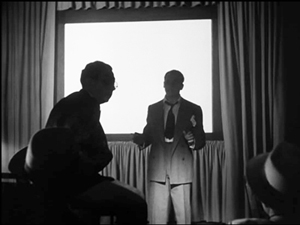 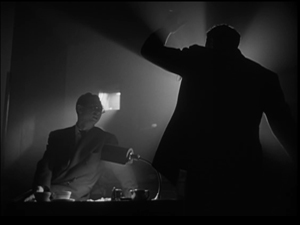
Welles told Peter Bogdanovich that he never saw the projection scene in Kingsley’s play because he was always back in his dressing room at that point. But as Pat McGilligan points out in his new biography Young Orson, Welles could hardly have been unaware of the film-within-the-play; many critics commented on it. More decisively, in the playscript, André is clearly onstage during the screening. He cries out against the carnage: “Look, look! Those are only pictures. . . Out there it’s real. . .” Peter Noble’s 1956 biography The Fabulous Orson Welles quotes Welles as declaring that this scene left a strong impression on him.
It’s not enough just to mention some sources. If you practice historically-slanted criticism, you need to ask not only “Where from?” but “What for?” In other words, you have to ask how elements that a filmmaker inherits get repurposed for the particular movie.
So, for instance, Kane’s depth-designed images held in long takes allow a more “theatrical” shift of attention within a visual field (driven largely by following who’s speaking). They also create contrasts of scale and visual weight. And each scene will have its specific demands that the depth technique fulfills. A depth shot can present cause and effect in the same frame, and it can build suspense by letting us await Kane’s interference in a foreground situation.
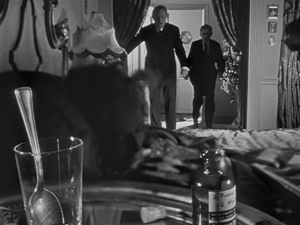 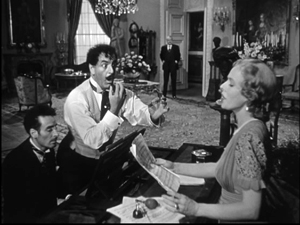
Similarly, Kane’s narrative strategies, synthesizing so many earlier efforts, blend to create a mystery that isn’t about whodunit but rather “why’d he do it?”
I’m not exactly saying that everything is a mashup. But that slogan does capture the fact that in art nothing comes from nothing. Kane blends several options that had been circulating in popular culture and high culture for some years. Like others before and since, Welles revised schemas tried out earlier; he combined some, exaggerated some, and infused many of them with new force. Because of his film’s prestige, he gave thrusting imagery, bold sonic manipulations, and complicated time shifts a new prominence in Hollywood filmmaking. The Forties had begun.
There are a several essential Welles sources. Apart from the many fine critical studies (see especially Jim Naremore’s Magic World of Orson Welles and Joe McBride’s What Ever Happened to Orson Welles?), the biographical surveys I habitually turn to are Welles and Peter Bogdanovich, This Is Orson Welles (Da Capo rev. ed., 1998), with a painstaking chronology by Jonathan Rosenbaum; the three-volume Simon Callow biography; Bret Wood’s Orson Welles: A Bio-Bibliography (Greenwood, 1990); Barbara Leaming’s Orson Welles: A Biography (Viking, 1985; my reference to shock effects is from p. 338); Frank Brady’s Citizen Welles (Scribners, 1990); and most recently Pat McGilligan, Young Orson: The Years of Luck and Genius on the Path to Citizen Kane (Harper, 2015). Pat’s discussion of Ten Million Ghosts is on pp. 366-367; Welles’ misremembering of the production is on p. 78 of This Is Orson Welles. A typescript of Kingsley’s play is held in the New York Public Library, at the Lincoln Center Library for the Performing Arts.
Rick Altman’s study is “Deep-Focus Sound: Citizen Kane and the Radio Aesthetic,” Quarterly Review of Film & Video 15, 3 (1994): 1-33. If it’s available without cost online, I haven’t found it. The programs “Dracula” (1938), “The Hurricane” (1939), and “The Adventures of Huckleberry Finn” (1940) provide vivid examples of multiple narrators and embedded flashbacks. For a comprehensive account of Welles’ radio work, see Paul Heyer, The Medium and the Magician: Orson Welles, the Radio Years 1935-1952 (Lanham, MD: Rowman and Littlefield, 2005). As for prismatic flashbacks, in the mid-1930s, Mankiewicz had built the plot of an unfinished play around the memories of people who had known John Dillinger. See Richard Meryman, Mank: The Wit, World, and Life of Herman Mankiewicz (New York: Morrow, 1978), 247, 258.
On Kane‘s visual style and its place in film history, see my accounts in The Classical Hollywood Cinema (1985) and On the History of Film Style (1997), as well as on this site (here and here especially). A detailed analysis of Kane‘s narrative strategies is in Chapter Three of Film Art: An Introduction, 11 ed., (New York: McGraw-Hill, 2016). The distinction between depth staging and deep cinematography is explored in Chapters Four and Five.
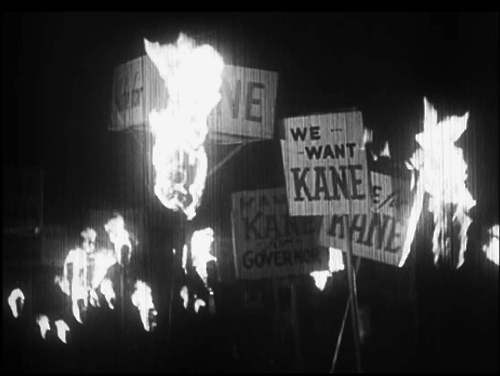
Posted in 1940s Hollywood, Directors: Welles, Film technique: Cinematography, Film technique: Sound, Film technique: Staging, Narrative strategies | open printable version
| No Comments »
|