

David Bordwell's website on cinema   click for CV

Home

Blog

Books

Perplexing Plots: Popular Storytelling and the Poetics of Murder

On the History of Film Style pdf online

Reinventing Hollywood: How 1940s Filmmakers Changed Movie Storytelling

Film Art: An Introduction

Christopher Nolan: A Labyrinth of Linkages pdf online

Pandora’s Digital Box: Films, Files, and the Future of Movies pdf online

Planet Hong Kong, second edition pdf online

The Way Hollywood Tells It pdf online

Poetics of Cinema pdf online

Figures Traced In Light

Ozu and the Poetics of Cinema pdf online

Exporting Entertainment: America in the World Film Market 1907–1934 pdf online

Video

Hou Hsiao-hsien: A new video lecture!

CinemaScope: The Modern Miracle You See Without Glasses

How Motion Pictures Became the Movies

Constructive editing in Pickpocket: A video essay

Essays

Rex Stout: Logomachizing

Lessons with Bazin: Six Paths to a Poetics

A Celestial Cinémathèque? or, Film Archives and Me: A Semi-Personal History

Shklovsky and His “Monument to a Scientific Error”

Murder Culture: Adventures in 1940s Suspense

The Viewer’s Share: Models of Mind in Explaining Film

Common Sense + Film Theory = Common-Sense Film Theory?

Mad Detective: Doubling Down

The Classical Hollywood Cinema Twenty-Five Years Along

Nordisk and the Tableau Aesthetic

William Cameron Menzies: One Forceful, Impressive Idea

Another Shaw Production: Anamorphic Adventures in Hong Kong

Paolo Gioli’s Vertical Cinema

(Re)Discovering Charles Dekeukeleire

Doing Film History

The Hook: Scene Transitions in Classical Cinema

Anatomy of the Action Picture

Hearing Voices

Preface, Croatian edition, On the History of Film Style

Slavoj Žižek: Say Anything

Film and the Historical Return

Studying Cinema

Articles

Book Reports

Observations on film art

Film educators no longer criminals

Saturday | December 2, 2006

Kristin here—


The rise of digital media has made the unauthorized copying of intellectual property easy. That, of course, drives the producers of that material crazy. We all know that the entertainment industry is said to be losing billions of dollars world wide from various sorts of piracy, from the sale of bootleg DVDs in southeast Asia to the downloading of sounds and images from the internet.

Much of this activity is undoubtedly illegal and undoubtedly violates entertainment producers’ copyright. But in trying to stem the tide of piracy, the industry hasn’t just gone after the wrongdoers. It has encouraged Congress to make more and more uses of intellectual property illegal, in the process riding roughshod over the Fair Use provision in the United States Code. A brilliant way to stamp out crime: make more activities into crimes and hence have more criminals to pursue. You’d think they have enough problems just going after the real pirates. But people like educators and scholars who try to use clips from movies in their classes or frame enlargements as illustrations in articles and books were thrown into the general mix of copyright violators.

That happened in 1998, when the Digital Millennium Copyright Act was signed into law by Bill Clinton. It essentially made any copying of visual or sonic material that involved breaking a digital encryption code illegal. All sorts of means exist to break these codes. Programs exist to grab frames from movies on DVD. Fans can post images on their websites (thereby offering the studios free publicity). Professors can import frames into their Powerpoint-based lectures. Scholars can illustrate their articles and books with reasonably high-quality images. The devising of such programs and the activities just mentioned were all illegal under the DMCA.

(For the Copyright Office’s own summary of the act, go here; for the Wikipedia summary, here.)

In the 1970s, when David and I were setting out to write Film Art and our other early books, we faced a similar issue, though at that time the copyright law concerning the use of frame enlargements was far less clear. Film studies was still a young field. Most publications on cinema, whether textbook or scholarly article, used studio-generated publicity photos as illustrations. We reasoned that such images did not reflect what really appeared in the film, since they were still photos taken on the set, often with different poses, lighting, and camera position. They were useless for the sort of close analysis we wanted to do.

Film Art thus became the first introductory film text to use frame enlargements extensively. Our publishers accepted the idea that such illustrations fell under fair use. Other publishers, however, were nervous about the idea. Did reproducing frames violate copyright? Editors weren’t always willing to risk finding out the hard way. Some authors paid large “permissions” fees to reproduce frames. Others gave up and settled for production stills.

Around 1990 I was asked by the Society for Cinema Studies (now the Society for Film and Media Studies) to chair a committee to investigate the validity of Fair Use as applied to film images. The result was the “Report of the Ad Hoc Committee of the Society For Cinema Studies, ’Fair Usage Publication of Film Stills’” (1993). This report established that fair use most probably applied to film frames, and educators and scholars were not violating copyright when they used slides or illustrations photographed from the original film. Several presses changed their policies as a result of the report, no longer requiring their authors to obtain unnecessary permissions for frame reproductions. The use of frame enlargements in scholarly publications spread, and film studies benefited as more authentic and useful images were employed by scholars.

Happy ending, right? Certainly the studios never sued over frame enlargements, before or after the report. In fact, relatively few authors were using frame enlargements. It took special equipment to photograph such frames: expensive camera attachments, color-balanced light sources, and the expertise to use both. Those of us publishing extensively illustrated books on Ozu or Eisenstein weren’t exactly a concern to the film industry. In fact, studio executives probably didn’t know that we existed and wouldn’t care if they had.

Then along came DVDs, which made frame grabbing easy. Scholars who had never bothered to get the special equipment or learn how to photograph film frames suddenly could quickly pull images for use in their publications. The reliance on publicity stills declined further. Frames were everywhere, all presumably covered by the same Fair Use law that 1993 report had opined applied to the reproduction of film frames. Legitimate users of frames had to get around the encryption codes, but like millions of DVD users around the world, most of them were savvy enough to do so.

I’m sure that the DMCA was not envisioned as applying to film scholars seizing frames for their publications or professors using visual examples in classes. Still, the provisions of the act were so broad that suddenly scholars and educators were criminalized for doing what they needed to do to foster knowledge: show clips from DVDs in lectures and use frame enlargements from DVDs in books and articles. They had to get around the studios’ codes that prevented piracy. Many of us went ahead and broke the codes and published DVD-derived illustrations in our books or compiled discs containing clips from films to show in lectures. The studios didn’t seem to care, since to the best of my knowledge no teacher or scholar had ever been prosecuted for violating the DMCA.

Finally the recognition of this ludicrous state of affairs has been partially remedied. The Librarian of Congress, James Billington, himself a fine scholar in the area of Russian and Soviet studies, recommended a series of exemptions to the DMCA. The first one relates to film: “Audiovisual works included in the educational library of a college or university’s film or media studies department, when circumvention is accomplished for the purpose of making compilations of portions of those works for educational use in the classroom by media studies or film professors.” (“Circumvention” is described as “circumvention of technical measures that control access to copyrighted works.”)

This is specific to classroom situations and only applies to DVDs owned by an educational institution. What if the teacher copies clips from his/her own DVDs to use in class? (All too frequent, given the tight budgets of universities and high schools.) Nevertheless, the general implication of this exemption is that the same Fair Use principle that applied to film clips and frames duplicated from analogue copies of films (i.e., 35mm and 16mm prints) should apply even if the educator or scholar is breaking a code to do that duplication. If clips are OK, why wouldn’t single frames be?

The exemption is a small step in chipping away at the monolithic laws protecting intellectual property that the studios are determined to put in place even when it goes against their own interests. Lectures, articles, and books do not damage the studios’ ability to exploit their own films commercially (one of requirements for Fair Use to apply). Quite the contrary. Film professors show clips and still images that publicize films and possibly inspire students to rent or buy DVDs. Articles and books similarly publicize films, even though their contribution to the attention paid to any given title is minuscule.

Making an exception in the DMCA as originally passed to allow for the educational/scholarly use of digital film images would never have occurred to the studios as they lobbied for this sweeping legislation. Few movers and shakers within the industry know there is such a thing as film scholarship, much less understand what we do. Fortunately people like Billington understand. His recommended exemptions went into force November 27.

So, film educator, the next time you prepare a lecture involving clips, you don’t need to pull the curtains, lock the doors, and glance nervously over your shoulder as you copy a tracking shot from Grand Illusion and another from The Magnificent Ambersons. You are no longer a thief.

We’re back on the grid

Thursday | November 30, 2006

ea-1.jpg

ea-2.jpg

Yes, we’ve been away for the last 12 days, 8 of them in Easter Island (aka Rapa Nui). The figures above are sort of the opposite of moving images, though there is a lot of controversy about how they got shifted around the island. These are at the quarry of Rano Raraku.
We had a great time and hope to chat about it at intervals in upcoming blogs. No movies playing theatrically there, though there is a video rental shop; a local restaurant runs Rapa Nui several times weekly on DVD. All I saw, courtesy of iPod, were episodes of Naked City and The Wire.

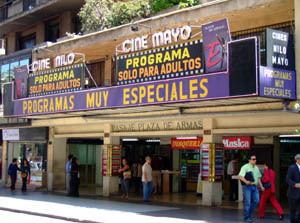
En route, we spent a little time in Santiago, itself a very intriguing city. On the pretext of keeping the film thread going, I’ll just mention that it still has genuine porno movie theatres. They boast big screens and Dolby sound, so we assume that they’re screening DVDs.

santiago-theatre.jpg

If this doesn’t get us a lot of hits, or at least a lot of spam, we’ll be surprised.

We have lots more to blog about, from James Mottram’s new book The Sundance Kids to ideas about how the media industry plans to pressure the new Congress to further tighten laws on intellectual property. But we need to get caught up with correspondence and to recover from travel fatigue. And we need to get caught up on all the new movies, including The Fountain, Bobby, and the like.

In our absence, Andy Adams has been enhancing other features of the site. Very soon we’ll be adding pdf files of film analyses cut from various editions of Film Art, as well as hard-to-find articles of mine that people have asked me about.

–DB

Lessons from BABEL

Monday | November 27, 2006

Whatever its faults or virtues, Babel seems to me to typify several trends in current cinema.

1) Network Narratives

Variety‘s critics call them criss-crossers, others call them thread structures or interwoven stories. I call them network narratives. In an essay called “Mutual Friends and Chronologies of Chance,” forthcoming in the book Poetics of Cinema, I tried to lay out the conventions of this increasingly common (maybe too common) storytelling strategy.

The central formal principle is that several protagonists are given more or less the same weight as they participate in intertwining plotlines. Usually these lines affect one another to some degree. The characters might be strangers, slight acquaintances, friends, or kinfolk. The film aims to show a larger pattern underlying their individual trajectories.

Several directors have specialized in this structure, from Altman and Claude Lelouch to Iosseliani and Rodrigo Garcia (most recently, Nine Lives). I found over a hundred such films, some going back quite far (e.g., Grand Hotel) but most made since the 1980s. Do they reflect some social Zeitgeist? Are we seeking connections with one another? Nope, I don’t think so. The most proximate and pertinent causes lie elsewhere. (Where? Check out the book!)

Alejandro González Iñárritu has made the network idea a signature element of his films. The first feature, Amores Perros, used a common convention, the traffic accident, to tie together three characters. We follow their story lines leading up to or away from the car crash. 21 Grams had a smaller cast but a more scrambled structure. Now, with Babel, we have something easier to follow than the previous films. But it compensates by filling a broader canvas: action on several continents, themes heavy with significance about what Pico Iyer calls the Global Soul.

We know how to read criss-crossers now, and so directors can push the boundaries on several fronts–more intricate plotting, portentous themes, spatial distance (critics called Babel an “epic”). Yet to keep audiences on track, filmmakers remain committed to the basic conventions as well, such as the notion of chance as hidden fate, or the Chaos idea that the flapping of a butterfly’s wings in Chile can . . .

Lesson 1: Once a formal tradition gets established, artists compete within that, seeking out ways to innovate…within tested boundaries. Fresh narrative strategies push the filmmaker to balance the novelty with familiarity.

2) Trilogies

The arthouse cinema has long traded on the appeal of a series of films, more or less loosely joined. Satayajit Ray had his Apu trilogy, which was at least about the same character, but at about the same period there was Antonioni’s tryptich L’Avventura, La Notte, and L’Eclisse. Not to be outdone, Bergman gave us two trilogies, one on the crisis of faith (Through a Glass Darkly, Winter Light, and The Silence), the other on, perhaps, the failure of human relationships under pressure (Persona, Shame, and Hour of the Wolf). More recently we’ve had Fassbinder’s BRD trilogy and Kiarostami’s threesome centered on the village of Koker.

Labeling a trio of films a trilogy plays an important role in the festival-arthouse market. Art films often lack established stars and don’t belong to clear-cut genres (though most turn out to be melodramas or historical dramas). The big selling point is usually the director, whose body of work promises something of interest. If the body of work falls into neat periods or groupings, then that automatically creates opportunities for long-term funding and “product differentiation” from film to film. This may seem a crass way to talk about what many people regard as personal expressions of artists, but filmmakers who want to keep making films know that funding and festivals rely on marketable components like the stature of the director and her or his broader creative ambitions.

So it’s not surprising that now directors are explicitly conceiving trilogies. Most of the earlier trilogies I mentioned were created ex post facto, by critics recognizing thematic links among works. It’s not clear that Antonioni or Bergman or Kiarostami planned to make trilogies from the start. Often the idea of a trilogy hits the director after the first film (von Trier’s Dogville) or the second. But now directors can launch a trilogy, as Kieslowski did with Blue. Angelopoulos has announced that The Weeping Meadow is the first film in a trilogy that will survey the troubled history of the twentieth century. Lucas Belvaux took the step of simultaneously making three features centered on one batch of characters, calling the overall result, of course, Trilogy.

On the festival circuit filmmakers have to explain themselves to critics, and Iñárritu has understood this well. He tells us that he decided to create a trilogy while making 21 Grams, and he points out how the films are similar (network structure, overlapping time schemes) and different (degrees of linearity, changes in theme). He helps critics and viewers understand his work–at least, in the way he prefers it to be understood.

Lesson 2: Festival cinema discovered the trilogy before Hollywood did (Star Wars, The Godfather, Pirates of the Caribbean), and the three-movie cluster may well be the art movies’ answer to a franchise.

3) Hyperrefined technique

In The Way Hollywood Tells It, I comment on the tendency of contemporary American filmmakers to develop subtle, maybe unnoticeable patterns of technique that run alongside the film’s story. So the three acts of Ron Howard’s The Paper were planned to employ three different sorts of camera movement. The same tendency can be found in independent filmmaking; Darren Aronofsky’s Requiem for a Dream coordinated its color scheme and seasons to mirror the film’s act structure.

Such refinement is especially tempting in network narratives, in which every line of action can be given its signature look. The obvious example is Soderbergh’s Traffic, which flaunts vivid color and texture differences among the plotlines.

Iñárritu has taken this tactic to a new level of complexity, as revealed in an article in the November American Cinematographer (Rachel K. Bosley, “Forging Connections,” AC 87, 11, 36-49). For this project Iñárritu and his cinematographer Rodrigo Prieto distinguished different story threads through color, grain, film stock, film gauge, lab processing, and even aspect ratio. (They shot the Japanese sequences in anamorphic but then extracted a 1.85:1 frame out of them.) For example we’re supposed to register, albeit unconsciously, a shift when the Morocco story, shot in 16mm shifts to 35mm when the helicopter arrives to rescue the wounded wife.

A harsher critic might claim that the ingenuity expended on these minutiae might better have been spent sharpening and deepening the plotlines themselves. But put evaluation aside. I just want to note that this commitment to “visual arcs” and subliminal tonal shifts echoing the drama shows that Hollywood is as committed to an aesthetic of unity as it ever was–maybe even more committed. This is a level of fanatical detail that supreme fussbudgets like Hitchcock, Sternberg, and (outside Hollywood), Ozu never sought to reach.

I also have to wonder: Does anybody register, let alone notice, such hyperrefinements? In my multiplex, and primed by having read the AC article, I could spot almost none of this finesse on the screen. In the release print I saw, all the stories looked pretty much the same, and most images had the consistency of oatmeal. Prieto says that “the grain was the most important visual element of the story” (p. 42). In this respect, he got his wish; grain was about all I could see.

Lesson 3: Those who think that modern Hollywood has entered a mannerist phase can find confirmation in Babel.

Postscript: It would be worthwhile building a symptomatic interpretation of Babel. My hunch is that despite Iñárritu’s claim that the film is about family and personal communication, something else is going on. After all, the drama is fundamentally about how prosperous white people have to suffer because Asian, Mexican, and North African men have guns.

But that’s a whole other blog.

Good Actors spell Good Acting

Friday | November 24, 2006

Kristin here–

I suppose all movie-lovers have favorite quotations that become part of their everyday conversation. Norman Bates’s “One by one you drop the formalities” fits a surprising number of situations. The film-studies professors here in Madison often communicate with each other using lines from Howard Hawks films, especially Rio Bravo. “Let’s take a turn around the town,” “We’ll remember you said that,” and, of course, “It’s nice to see a smart kid for a change.” Any time David or I get a particularly small royalty check, we echo Hildie Johnson’s sour “Buy yourself an annuity.”

One of our favorite everyday-life quotations comes not from a movie but from the endlessly hilarious SCTV series. It’s a skit in which Steve Roman (played by John Candy) promotes his new TV show, Juan Cortez, Courtroom Judge. He explains part of its appeal: “It’s got good actors, and that spells good acting.” (Fifth season, episode 110, for you SCTV buffs.)

Almost invariably we use this line when we come across one of those films that receive highly positive reviews largely because of one great performance. You know the kind: Charlize Theron in Monster, Halle Berry in Monster’s Ball, Hillary Swank in Boys Don’t Cry, and more recently Forest Whitaker in The Last King of Scotland and Helen Mirren in The Queen.

Usually I avoid such films, because the reviews tend to plant the idea that they are primarily actors’ vehicles. I enjoy good acting as much as the next person, but I want the rest of the film to be interesting as well.

Are there any film classics that are truly great solely for the acting? It’s hard to think of any. Maybe The Gold Rush, which is stylistically fairly pedestrian but which is redeemed by Chaplin’s inspired performance. Maybe Duck Soup, also quite undistinguished for much of anything other than the Marx Brothers cutting loose without being saddled with the sort of plots involving young, singing lovers that MGM would soon foist upon them. Maybe a few others. Usually, though, we tend not to think of a performance, however dazzling, as adding up to a great film.

Still, when I think of some of the finest performances ever put on film, I think of Falconetti in La Passion de Jeanne d’Arc by Carl Dreyer. There her luminous portrayal of determination and religious devotion is embedded in an equally extraordinary film, with its minimalist sets by Herman Warm, its insistently tight framings on faces, and its vertiginous camera movements. Similarly, Nicolai Cherkasov as Ivan the Terrible in Eisenstein’s film poses against the shapes of the settings, moves to the music of Prokofiev, and casts great shadows on the walls. Buster Keaton, though not as popular in his day as Chaplin, had an instinctive feel for both the flat space of the screen and the depth of the represented image, and his films are exciting in themselves and not simply as backgrounds to his clowning.

We’re now well into the time of year when the studios bring out the films they hope will garner Oscar nominations and even wins. Journalists covering film, reviewers and feature writers alike, can get some copy out of speculating about the Oscars. That speculation seems to start earlier and earlier each year, like Christmas shopping. Given that the public is a lot more interested in acting than cinematography or screenwriting, perhaps it’s not surprising that reviewers focus so much on star turns. But in doing so, do they slight other aspects of those films? Do they unfairly scare off those of us who are wary of Oscar bait?

I decided to do my part for the good of the blog and see The Queen. I’m not a huge fan of Stephen Frears, but My Beautiful Launderette is a good film, with an early sympathetic, non-sensationalized view of homosexuality in London. Mary Reilly is not exactly a masterpiece, but it’s worth watching and has been underrated. Its failure may have been due in part to the fact that most reviewers focused in on whether Julia Roberts could handle a dramatic role in a thriller and then found her wanting.

Anyway, The Queen turned out to be an entertaining, well-made film. Yes, Helen Mirren is remarkable as Queen Elizabeth II, and she may well win an Oscar for her performance. Yet equally interesting is the fact that Frears almost entirely avoids the “intensified continuity” style that David has analysed in The Way Hollywood Tells It.

The film is basically pretty simple, moving back and forth between the royal family and the newly elected Tony Blair surrounded by his wife and staff. The royals notoriously reacted to the death of ex-Princess Diana with stony silence despite the huge outpouring of public grief. It’s clear from the indifference and even hostility toward Diana that the members of family’s older generations voice in private, they do not feel a comparable grief. But Blair strives to maneuver the Queen into going public and expressing a sense of loss.

Frears set out to contrast the two worlds stylistically. The scenes with the royals are shot in a classical, non-intensified style. Distant shots to establish space, two shots for face-to-face conversations, over-the-shoulder shot/reverse shots as the dialogue unfolds. The framing seldom goes in for the tight close-up but stays in medium shot or medium close-up. The cutting is slow relative to the current norm, as befits both the subject and the style. One reason people are so impressed with Mirren’s performance may be that it is not made up of a bunch of different shots stitched together. She has shots that allow her to develop a reaction or attitude slowly.

And best of all, the camera doesn’t glide toward or around the characters. It stays put unless it needs to perform one of its traditional roles: reframing to keep characters balanced, and following the characters as they move from one room to another or walk along a country track. The lighting is suitably subdued and directional, another reversion to a more classical age.

A great deal is currently being made of Steven Soderbergh’s reversion to 1940s Hollywood style in The Good German. Frears isn’t quite as systematic, perhaps, but the royal-family scenes in The Queen look very 1950s to me.

In contrast, the Tony Blair scenes were shot with a handheld camera, to convey the bustle of his staff and the more casual situation. Even so, the camera movement is not obtrusive, and Frears still doesn’t constantly cut in for the tight close-up. Here, too, he keeps his camera back a bit, framing groups as they talk. The lighting tends to be brighter and more diffuse. The contrast works well, and yet Frears never pushes it in our faces and asks us to be impressed.

The narrative seems a little thin, mostly because, unlike most classical films, The Queen has only one plot line. There’s no subsidiary crisis, no romance, no other conflict. It’s just the royals versus the liberal prime minister’s team until one side cracks. Even the potential conflict that could have easily arisen from Blair’s wife’s anti-royalty position never goes anywhere. She’s mainly there as a sounding-board for him. And if the plot is thin, it is also refreshingly elegant in its simplicity.

One remarkable aspect of the plot is that none of the characters is treated as a villain. Blair’s position is held up as the wise one, yet the film goes to great lengths to suggest that the Queen and her family have reasons for behaving the way they do. Not excuses, but reasons. Fittingly, the film concludes with the Queen and her new prime minister walking out into the palace gardens for a stroll and a chat.

At the end, I didn’t feel that I had sat through a great performance. I had seen a good, entertaining, somewhat unusual, and skillfully made film that had a great performance in it. Indeed, it has a second from Michael Sheen as Blair, and the supporting players are fine as well.

But good directors spell good directing, and good cinematographers spell … You get the idea. Variety’s reviewers, it must be said, seem to have a mandate to mention style, since ever review comments at least briefly on the film’s techniques. But most critics give you no sense of the film as a whole—its narrative construction (apart from a plot synopsis) or its stylistic texture. It would be nice to see more rounded reviews.

David Bordwell
top of page

have comments about the state of this website? go here