David Bordwell's website on cinema   click for CV

Home

Blog

Books

Perplexing Plots: Popular Storytelling and the Poetics of Murder

On the History of Film Style pdf online

Reinventing Hollywood: How 1940s Filmmakers Changed Movie Storytelling

Film Art: An Introduction

Christopher Nolan: A Labyrinth of Linkages pdf online

Pandora’s Digital Box: Films, Files, and the Future of Movies pdf online

Planet Hong Kong, second edition pdf online

The Way Hollywood Tells It pdf online

Poetics of Cinema pdf online

Figures Traced In Light

Ozu and the Poetics of Cinema pdf online

Exporting Entertainment: America in the World Film Market 1907–1934 pdf online

Video

Hou Hsiao-hsien: A new video lecture!

CinemaScope: The Modern Miracle You See Without Glasses

How Motion Pictures Became the Movies

Constructive editing in Pickpocket: A video essay

Essays

Rex Stout: Logomachizing

Lessons with Bazin: Six Paths to a Poetics

A Celestial Cinémathèque? or, Film Archives and Me: A Semi-Personal History

Shklovsky and His “Monument to a Scientific Error”

Murder Culture: Adventures in 1940s Suspense

The Viewer’s Share: Models of Mind in Explaining Film

Common Sense + Film Theory = Common-Sense Film Theory?

Mad Detective: Doubling Down

The Classical Hollywood Cinema Twenty-Five Years Along

Nordisk and the Tableau Aesthetic

William Cameron Menzies: One Forceful, Impressive Idea

Another Shaw Production: Anamorphic Adventures in Hong Kong

Paolo Gioli’s Vertical Cinema

(Re)Discovering Charles Dekeukeleire

Doing Film History

The Hook: Scene Transitions in Classical Cinema

Anatomy of the Action Picture

Hearing Voices

Preface, Croatian edition, On the History of Film Style

Slavoj Žižek: Say Anything

Film and the Historical Return

Studying Cinema

Articles

Book Reports

Observations on film art

By Annie standards

Sunday | December 10, 2006

Kristin here—

Way back in 1979, I published a theoretical essay on animation.* It explored how animation is different from live-action because it can mix types of perspective cues within the same image. That was basically the only original idea I have ever had about animation, and I never followed it up by writing more on the subject.

At that point, animation studies were lagging behind film studies in general. A single essay in the area was enough to brand one as an expert. Ever since people have thought of me as an expert on animation. By now, though, animation studies have grown into a healthy area of scholarship, with its own journals and conferences. There are many people studying animation who know far more about it than I. My only work in this area since 1979 has been to write most of the sections on animation in Film Art and Film History.

Still, that leaves me the resident animation expert on this blog, and since I seem to end up writing about the subject occasionally, we’re adding it as a new category as of this entry.

Among the new films I’ve seen in the past couple of years, I find that a significant proportion are animated. I don’t think that’s because I prefer animated films but because these days they are among the best work being created by the mainstream industry.

Why would that be? There are probably a lot of reasons, but let me offer a few.

Animated films, whether executed with CGI or drawings, demand meticulous planning in a way that live-action films don’t. David has written here about directors’ heavy dependence on coverage in contemporary shooting. Coverage means that many filmmakers don’t really know until they get into the editing room how many shots a scene will contain, which angles will be used, when the cuts will come, and other fairly crucial components of the final style. This is true even despite the fact that filmmakers increasingly have storyboarded their films (mainly for big action scenes) or created animatics using relatively simple computer animation.

People planning animated films don’t have the luxury of lots of coverage, and that’s probably a good thing. Storyboards for animated films mean a lot more, because it’s a big deal to depart from them. Every shot and cut has to be thought out in advance, because whole teams of people have to create images that fit together—and they don’t create coverage. There aren’t many directors in Hollywood who think their scenes out that carefully. Steven Spielberg, yes, and maybe a few others.

A similar thing happens with the soundtrack. In animated films, the voices are recorded before the creation of the images. That’s been true since sound was innovated in the late 1920s. Pre-recording means that images of moving lips can be matched to the dialogue far more precisely than if actors watched finished images and tried to speak at exactly the right time to mesh with their characters’ mouths. The lengthy fiddling possible with ADR isn’t an option. Most stars are used to recording their entire performances within a few days, picking up their fees, and moving on to more time-consuming live-action shooting.

[Added December 11: Jason Mittell, who teaches at Middlebury College, has pointed out to me other factors closely related to the thorough storyboarding of animated films and to the pre-recording of dialogue.

Live-action projects often go into the shooting phase with the script still being tinkered with. The main writers are long gone, script doctors have taken over, and stars may request, nay demand, changes in their dialogue. But for animated films the script, like the editing, is in finished form at the move from preproduction to production.

Jason also points out makers of animated films very carefully distinguish the characters by distinctive dialogue and voices. In contrast, do planners of live-action films think much about the combination of vocal tones that the actors will bring to the project? It’s indicative of the difference, I think, that the Annies have a category for best vocal performance and the Oscars don’t. Ian McKellen has been nominated for an Annie in that category for his contribution of the Toad’s dialogue in Flushed Away–completely tailored to the role and totally unrecognizable from his usual voice.

As Jason concludes, “Live-action filmmakers should try to emulate Pixar’s pre-production strategies to raise the quality bar.”]

In The Way Hollywood Tells It and Film Art, David has briefly discussed the modern vogue for muted tones, usually brown and blue, of many modern features. (Remember what a big deal it was when Dick Tracy used bright, comic-book colors in its sets?) The old vibrant tones of the Technicolor days are largely absent, at least from dramas and thriller. Not so in animated films. Most animated films are full of bright colors. (Some tales, like Tim Burton’s Corpse Bride and Happy Feet, call for the elimination of color, but they’re exceptional.) Think of Monsters, Inc. and, say, any David Fincher film, like Se7en. (Yes, Se7en is dark in its subject matter, but I’ve illustrated the two early getting-ready-for-work scenes in each film, before the nastiness starts in Fincher’s film.) For those of us who like some variety in our movie-going, an animated film can be visually pleasing in ways that few other films are.
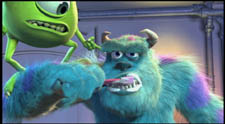
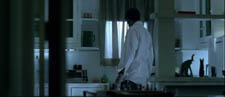
monsters225.jpg se7en225.jpg

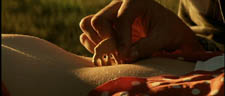
Makers of animated films aren’t obligated to drag in sex scenes or to undress the lead actress. Maybe such scenes inarma225.jpg live-action films really do draw in some viewers, but they can be hokey and definitely slow down the action. (Remember Ben Affleck rubbing animal crackers on Liv Tyler’s bare midriff in Armageddon?) Animated films tend to have romances and sometimes even mildly raunchy innuendo, but it doesn’t slow down the plot. The romances in Flushed Away and Cars are very much like the ones in Hollywood comedies of the 1930 and 1940s, flowing along with the narrative in a more logical way.
Animated films don’t have to be tailored to the egos and ambitions of their stars to the degree that many live-action features are. Indeed, often stars bring film projects to studios or produce their own films. The growing number of stars providing voices for mice and penguins and spiders don’t have that sort of investment, emotional or financial.

Some of the best directors working today are in animation. Pixar’s John Lasseter hasn’t let us down in any of his Pixar films, whether he personally directs them or supervises others. Nick Park’s shorts and features, especially Creature Comforts and The Wrong Trousers, are the works of a genius, and other director/animators at Aardman aren’t bad either. Then there’s Hayao Miyazaki (Spirited Away, to mention only one). There aren’t many live-action directors working in commercial cinema today with such track records.

Despite all this, studio executives and commentators continue to debate whether there are now too many CGI films coming out. Indeed, the November 24 issue of Screen International says, “Much has been made this year of the seeming over-saturation of studios’computer-generated titles, with critics and analysts pointing to growing movie-goer apathy.” Of course to most people don’t notice any difference between CGI 3D films and those made with claymation (Parks) or puppets (Burton), so SI’s article talks about the successes and failures among the family-friendly animated films of 2006, including 2D Curious George.

This debate over a possible saturation of the market with CGI films seems bizarre. As a proportion among the total number of films made, CGI’s box-office successes seem fairly high compared to live-action films. Yet one doesn’t see execs and pundits mulling over whether audiences are tired of those.

Certainly success or failure isn’t based on quality. Wallace & Gromit: The Curse of the Were-rabbit, last year’s winner of the Oscar as Best Animated Feature, was a commercial disappointment (in the U.S., not elsewhere). Monster House got a lot of highly favorable reviews, but similarly had a mediocre reception by ticket-buyers.

This week the nominations for the Annie Awards, given out by the International Animated Film Society, were announced. The Best Animated Feature competition is among Cars, Happy Feet, Monster House, Open Season, and Over the Hedge. But in the “what’s the logic behind that?!” world of awards, Cars and Flushed Away got the highest number of individual nominations, nine each, followed by Over the Hedge with eight.

I’ll confess right now that I’ve only seen three CGI-animated films this year, because, as I say, I’m not an animation specialist. I go to animated films for specific reasons. One, Cars, is a Pixar film. Two, Flushed Away, is an Aardman film. Three, Happy Feet, is directed by George (Road Warrior) Miller.

On the other hand, Over the Hedge was advertised as being “from the creators of Shrek.” Shrek was an entertaining film, but I think it has been overrated. Besides, a check through the main credits of Over the Hedge reveals no one who had worked on Shrek. “Creators” here must mean Dreamworks. That, by itself, is not enough to draw me in.

Of the three I’ve seen, I would rate Cars the best, Flushed Away a not too distant second, and Happy Feet a distinct third. (More about Happy Feet later.) So how come Flushed Away didn’t get nominated for Best Animated Feature?

A cynic might point out that, on a list of the ten highest-grossing animated features of 2006, by year’s end the five nominees will end up among the top six. Ice Age: The Meltdown, currently at number two, received four nominations, but not one for best feature. Flushed Away is at number nine and likely to remain so. I’m sure that’s not the only factor, but as with many other awards nominations, hits tend to maintain a high profile through the year. I suspect that Cars will end up becoming the fourth Pixar film to win the Annie for Best Animated Feature during the seven-year period since Toy Story, the first totally CGI feature, won.

Quality apart, though, why do industry people doubt the wide appeal of CGI animation? Why do they think rising above an indeterminate number of such features per year causes CGI-fatigue among moviegoers? They certainly go on releasing far more live-action films than could possibly all become hits.

As I suggested in my earlier entry on Flushed Away, most of companies releasing animated films don’t know how to market them very well. Let me offer a couple of suggestions as to why everyone but Pixar often seems so clueless.

First, although animated features seem like the ideal family-friendly audience, they’re quite different from the family-friendly live-action film. Every studio wants films that appeal “to all ages” (i.e., to everyone but small kids), preferably with a PG-13 rating. Think Pirates of the Caribbean: Dead Man’s Chest, The Lord of the Rings: The Return of the King, and Titanic, in ascending order the three top international grossers of all time (in unadjusted dollars).

With most animated features, however, there’s a big gap in that family audience: teenagers. Animated films (“cartoons”) are still perceived as largely for children. Sure, savvy filmmakers like the people at Pixar and Aardman are putting more sophisticated references and jokes into their films, things that are more entertaining to adults than to children. The assumption is that parents who take their kids to the movies might be more likely to pick a film if they think they’ll have something to engage their attention, as opposed to sitting tolerantly waiting for the thing to be over.

This, by the way, is another reason why some animated films are among the best products of the mainstream film industry these days. They’ve got a wit and visual sophistication that is sorely lacking in many live-action films. (That’s certainly not true of all of them. I thought Madagascar and the first Ice Age had simple plots that would be engaging mainly to small children.)

So the grown-up humor may please the adults, many of whom, like me, go to them without children in tow. Kids, of course, will watch just about anything animated that’s put in front of them. But suppose a bunch of high-school kids on a Saturday are trying to decide which film to attend. Would any of them nominate Cars or Happy Feet? Maybe I’m behind the times, but I find it hard to imagine. Most teen-agers among themselves, after all, would do anything to avoid seeming not to be grown-up, and watching cartoons is just too childish. (Even the CGI film most obviously aimed at teens, Final Fantasy, was a flop.)

This is not to say that teen-agers don’t see or enjoy Cars and Happy Feet, but I’m guessing they probably go with their families on holidays or see them at home on DVD.

The second big problem that stymies the industry when it comes to promoting animated features is that they usually can’t be branded by director or star, the way “regular” films are. Pixar, as usual, is the exception. John Lassetter is sort of the Steven Spielberg of animation—one of the few directors with wide popular name-recognition. Pixar quickly became a brand in the world of animation, even more than Disney was at that point. Now they’re under the same roof. But Dreamworks really isn’t a high-profile brand, and the newer Sony Pictures Animation certainly isn’t. Their films succeed and become franchises in a hit or miss way. “From the people who brought you Shrek” is a feeble way of branding a film. Mostly I think distributors market animated films to kids and hope the adults will be there, too. Maybe they don’t even think about the teenage audience, considering it a lost cause.

More and more famous actors are doing voices for animated films, but that’s far from the same thing as appearing in a live-action one. Hugh Jackman was a big selling point for the X-Men movies, but who would go to see Flushed Away just because he voices the lead character?

So what can the studios do to integrate CGI and other types of animated films into their flow of regular releases, comparable to live-action films?

One solution is obvious: Make the characters into stars. Disney created the prototype with Mickey Mouse. Buzz Lightyear and Woody would be stars with or without Tim Allen’s and Tom Hanks’s voices. Shrek is a star. Wallace and Gromit are beloved stars outside the U.S. It might have occurred to Paramount to lead up to its release of The Curse of the Were-rabbit by circulating a package of the three earlier shorts, in order to familiarize Americans with the duo. (That was done in European theaters years ago.) Roger Ebert’s review of the feature opined that “Wallace and Gromit are arguably the two most delightful characters in the history of animation.” A pity the American public have not yet been given much of a chance to discover that.

Another possibility is doing what Hollywood is slowly doing for live-action films: Publicize award nominations other than the Oscars. More awards ceremonies are being broadcast on TV as time goes by, and audiences seemingly love these contests. Why not tout an animated film’s garnering of Annie nominations?

Of course companies use Oscar nominations in their ads, but under Academy rules, only three animated features can be nominated in any year unless sixteen or more such features are released that year. Then the number of nominations jumps to five, as has happened only once so far–in 2002, for the 2021 releases. It may become more common, as animated films become more common.

One might object that the general public doesn’t know or care about the Annies. But it’s a vicious circle. They don’t know about them because the industry doesn’t bother to publicize them, and the industry doesn’t publicize them … well, you can see where this is going. If the industry promoted the Annies as signs of quality animation, the public might know and possibly care about them. They’ve learned to be interested in the Golden Globes, because those have been increasingly covered by the infotainment section of the media. And the infotainment industry largely covers the “news” that the industry’s publicity departments want it to (star scandals excepted).

And then there’s the Internet, where fans often do a better job (and for free) of publicizing films than their distributors do. Case in point, Lyz’s WallaceAndGromit.net. I can’t get into online publicity here, or this entry would balloon out of control. Still, there seems an obvious link between people who spend time on the internet and those who are interested in CGI animation.

Epilogue: On Happy Feet (Spoilers!)
happy-feet-2001.jpg

I went to Happy Feet with high expectations, based both on reviews and on my liking for previous George Miller films like The Road Warrior and Babe: Pig in the City. I saw it under ideal conditions, in an Imax auditorium.

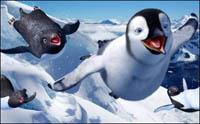
I enjoyed it but was somewhat disappointed. For one thing, much of the time the images seemed to be going by in fast-forward. The swishing movements of figures combined with rapid-fire editing occupied a lot of screen time. The story has its penguin hero, Mumble, shunned by his vast flock as having dancing rather than the conventional singing talents. The plot hinges on Mumble’s two goals: to win the love of talented singer Gloria and to gain respect by finding out why the supply of fish has dwindled recently.

Both of these goals are, however, put on hold for great stretches of the film’s middle. Miller seems so caught up in Mumble’s escape from a seal or his encounters with a nearby troop of Puerto Rican-accented penguin hipsters that the plot gets sidetracked. Once the search for the “aliens” who are decimating the fish supply reveals that they are humans on huge ships, the scenes that resolve that plot-line seem perfunctory.

The animation itself is dazzling, the vocal talent excellent, the ecological message unobjectionable, and the wild mix of musical styles amusing. I just wish I hadn’t spent much of the movie wondering where it was all heading.

*Kristin Thompson, “Implications of the Cel Animation Technique,” in The Cinematic Apparatus, eds., Stephen Heath and Teresa de Lauretis. St. Martin’s Press, 1980, pp. 106-120.

Lotsa pictures, lotsa fun

Friday | December 8, 2006

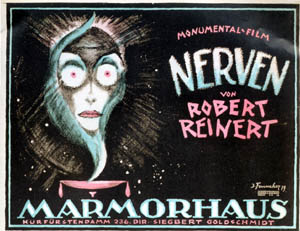
nerven-poster-small.jpg

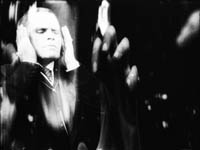
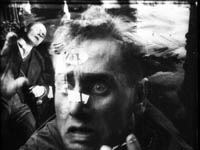
1. “It hypnotizes the viewer,” writes Paul van Yperen of the Nerven poster he printed in the new issue of the Dutch journal Skrien. Paul sent it to me because I wrote about Robert Reinert’s film in my forthcoming collection of essays, Poetics of Cinema. Nerven is a disorienting, highly experimental work. Released in 1919, before The Cabinet of Dr. Caligari (early 1920), it might have become a prototype of German Expressionist cinema if it had been widely seen and preserved by archives. Nerven, along with Reinert’s other major film Opium (1919) would make a wonderful twofer on a DVD release.

nerven-2-200.jpg nerven-3-200.jpg

2. We’ve set up an archival supplement to our textbook, Film Art: An Introduction elsewhere on this site. It includes analyses that appeared in earlier editions but were cut for reasons of space or film availability.

The pieces discuss Stagecoach, Hannah and Her Sisters, Desperately Seeking Susan, Day of Wrath, Last Year at Marienbad, Innocence Unprotected, Disney’s Clock Cleaners, Tout va bien, High School, and Hitchcock’s first Man Who Knew Too Much. DVD has made nearly all of these films easily accessible, so we hope reviving the essays will be of use to students and free-ranging viewers.

swarte.jpg

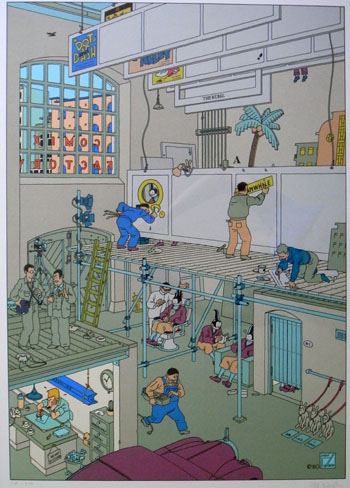
3. Check out the nifty interview with Joost Swarte in the new issue of The Comics Journal. Excerpts are here.

Swarte is the greatest heir to the Belgian-Dutch “clear-line” style, and his witty cartoons have become worldwide classics. Kristin and I have been collecting Swarte books and posters since the 1980s, although as his projects have expanded to building design his output of images has waned (except for the occasional item for The New Yorker).

Swarte has much to say about Hergé’s mastery of visual storytelling, claiming that the Tintin tales are like little movies.

He was very much influenced by cinematographic laws. Where do you place your camera? Is the hero always coming from the left? What’s the relation between foreground and background? All sorts of terms that he used come from cinema.

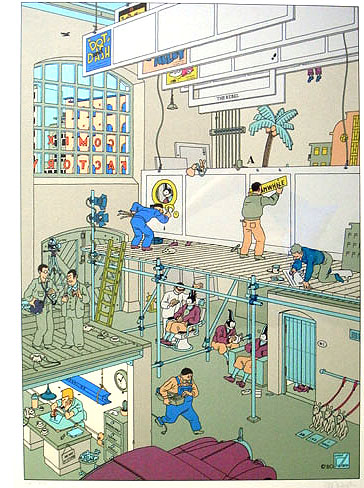
Swarte too has an affinity for film. One of his best pictures, Comic Factory, treats cartooning as if it were moviemaking. Our cartoonist labors in lower left, the girder of a deadline hanging above him, while a producer (with cigar) seems to be telling the photographer how to shoot the panels. Jopo de Pojo gets spruced up for his close-up while his doubles (or clones) lounge around. Set designers and scene painters labor over the panels.

Swarte’s teeming street scenes, usually including dog turds, are filled with glimpsed gags in the manner of Tati. Not surprising, then, that under the skilful questioning of David Peniston, he confesses his admiration for Play Time. New collections of Swarte’s comics are apparently forthcoming, in several languages, in 2007. By the way, the same issue of the Journal has a nice appreciation of Cliff Sterrett, another comics genius, creator of the amiable, lovely, and quite nuts Polly and Her Pals. Click here for a nice blow-up sample.
4. Speaking of cinema in still images: One of Eisenstein’s favorite pastimes was to find anticipations of film in earlier media. He loved the fact that Myron’s discus thrower was portrayed in an impossible position, with the limbs indicating different phases of the action.

This and similar items were inspirations for the plate-smashing scene in Potemkin.

pot-1.jpg pot-2.jpg

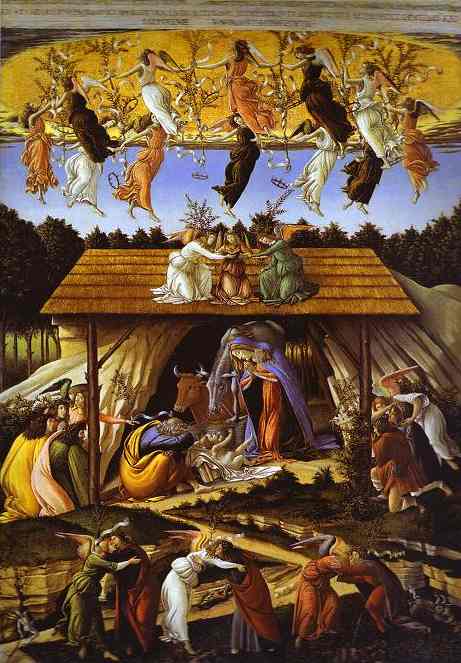
So in a holiday spirit, I’d ask: what would Eisenstein have made of this painting, which I saw again last summer in London’s National Gallery–Botticelli’s Mystic Nativity of 1501?

Reproduction, especially this tiny, doesn’t do the picture justice, but you should be able to see how the symmetry of the composition is broken by the slope up to the central scene of Mary and the mule bending over the baby. As with Swarte cityscapes, there’s a lot to dig for. Angels on left and right of the manger direct the Magi to the main action, and in the lower section angels kiss men while devils dive into the fissures of the earth.

Key for students of cinema, though, is the whirling dance of the angels in the upper third of the picture. Strictly speaking, they all seem out of step, no two in sync. But then you notice that each is executing a slightly different phase of one continuous movement, as if Muybridge had captured a single dancer’s circling trajectory with his early stop-motion photography. Angel Locomotion, he might have called it; but Botticelli got there before him.

Word by word

Wednesday | December 6, 2006

DB here:

This year two prominent fiction writers opened their workshops to us. Jane Smiley’s Thirteen Ways of Looking at the Novel, published by Knopf last spring, is a compendium of information and wisdom, offering thirteen substantial chapters on technique followed by lively essays on 101 novels. Written in the aftermath of 9/11, the book is a testament to the joys and consolations of literature.

smiley_jane_13ways.jpg

Smiley offers a feast of ideas and examples. She observes that in a novel, the protagonist tends to contrast his or her fate with those of others. She shows how a novel’s rhythm is created by alternating passages of action and reflection, with each shaping the other. She also remarks on the novel as a type of game:

The game quality of the novel gives it meaning and form, because all games begin, have a playing time, and end. It also gives the novel at least a rudimentary raison d’etre, since games are a recognized form of learning for young mammals. The author sets up the game and is required to signal to the reader early in the narrative what the rules are.

With her top-101 list, Smiley isn’t proposing a canon. Her inspiring essays are at once historical (moving from The Tale of Genji to Jennifer Egan’s Look at Me) and very pluralistic. On her list we find both Dickens and Wilkie Collins, Scott Fitzgerald and P. G. Wodehouse, Muriel Spark and Garrison Keillor.

reading-like.jpg

Now we have Francine Prose’s Reading Like a Writer: A Guide for People Who Love Books and for Those Who Want to Write Them (HarperCollins). This too is wonderful, but in a rather different way. Smiley’s book is a doorstop, Prose’s can be slipped into a carry-on. Although Prose discusses several novels, she seems most at home with the short story. Smiley is happy to generalize, exploring broad claims in a reassuring but rigorous way. Prose, a child of New Criticism and the practices of close reading, backs away from generalizations and relies on abundant quotation to develop her points. It’s a conservatory approach. We study the masterworks (high and low–you’ll find Chandler and John Le Carré here) and through delicate discrimination we learn to admire good writing and see how we might develop a supple style ourselves.

Jane Smiley believes that fiction rests on some basic precepts (not rules): craft premises, tacit contracts with readers, assumptions about how genres work. In one chapter she sweeps across theories of fiction from Aristotle to Henry James, harvesting the enduring ideas. Prose’s book is more tentative; she treats even craft precepts as loose guidelines, always subject to revision.

In her skin-prickling penultimate chapter, Prose recounts a series of craft tips that she gave her students. Motivate your characters’ action! Don’t give two of them similar names! Then she shows how reading Chekhov made her doubt each homily.

And this is what I’ve come to think about what I learned and what I taught and what I should have taught. Wait! I should have said to the class. Come back! I’ve made a mistake. Forget observation, consciousness, clear-sightedness. Forget about life. Read Chekhov, read the stories straight through. Admit that you understand nothing of life, nothing of what you see. Then go out and look at the world.

With her admiration for Chekhov, Babel, and Nabokov, Prose advances the case that exacting attention to style isn’t a flight into artifice but the best way of teasing out the nuances of human life.

Every writer should read her first few chapters. In “Words” she lays down the book’s premise: “It’s essential to slow down and read every word. . . Ask yourself what sort of information each word–each word choice–is conveying.” She warns against reading fiction in order to skim off themes or psychological insights, especially when “crucial revelations are in the spaces between words, in what has been left out.”

The next chapter, on sentences, is one of the best statements I’ve ever read about the craft of writing. A young writer, Prose reports, once told his agent that he wanted above all to write “really great sentences.” She raises the curtain on professional gossip: it turns out that writers love to talk about sentences. (How many writers of academic prose even think about their sentences, let alone discuss them with others?) She champions the lost skill of sentence diagramming, and I was happy to learn that she encourages a habit of mine, that of keeping close at hand books by writers who compose admirable sentences.

plot_it_yourself_2_med.jpgThe following chapter was especially enlightening to me because I’m struggling to find more varied ways to paragraph my writing. Prose examines the killer moment in Rex Stout’s Plot It Yourself when Nero Wolfe explains that the pattern of a writer’s paragraphs is a stylistic fingerprint. She fastens on a passage I’ve always loved, in which the narrator, Archie Goodwin, enacts in print what his boss has proposed. Across a long paragraph, Archie spends “about half an hour studying paragraphing,” while recapping the routines of the Wolfe household. He ends:

The next sentence is to be, “But the table-load of paper, being in the office, was clearly up to me,” and I have to decide whether to put it here or start a new paragraph with it. You see how subtle it is. Paragraph it yourself.

I stood surveying the stacks of paper.

(Robbe-Grillet, eat your heart out.) Prose goes on to explore various ways in which Archie might have broken up his long stretch of description. For now and hereafter, she is my Goddess of the Paragraph Break. Or should I have made that last sentence a separate paragraph?

The rest of the book, covering detail, narration, and other techniques, is no less enlightening. Reading Like a Writer winds to a conclusion in which, after the encomium to Chekhov, Prose asks all writers to summon the courage to avoid easy tricks, to treat their work with integrity, and to follow language where it leads. Her last extract, revealingly, comes from verse. Her insistence on the words on the page, I came to see, amounts to treating prose as if it were poetry.

One moment of doubt, though. It’s generally realized that many writers are story people rather than style people. Dreiser and Stephen King have a penchant for awkward writing. Often their style records their struggles to find the right phrase. Yet once you’re hooked, you’re hooked and their stories carry you forward. Maybe Prose would argue that their books would be even better if they wrote better; or maybe the novel is a more forgiving genre than the short story. Anyhow, neither writer is Chekhov. Still, it’s indicative that unlike Smiley’s 13 Ways and virtually every other writing manual, Prose’s book offers no guidance on plot or structure. This is a book about style–its techniques and its ethics.

Why bring these considerations into this blog? For one thing, students of cinema should always be open to learning about form and style in other arts. Reflections on literary point of view can alert us to how filmmakers manage it. Prose suggests that point of view is subtler than “who speaks?” and “who sees?” Word choice and sentence rhythm can tip a scene from one character to another without any use of I said or she noticed. That set me thinking. Does cinema have something similar? In film, if we show one character in longer-held shots than others, does that help weight the scene to her? Or might we have her advance toward the camera when the others stay behind? Or could we modulate the sound levels to bring her voice into prominence? Reading about techniques in the other arts can sharpen our awareness of parallels or non-equivalences between other media and film.

Prose’s book is also part of a heartening trend in the humanities. The growing success of literary-appreciation books for a general audience over the last few years may signal the flagging of the sort of Grand Theory promoted by Structuralism, Post-Structuralism, and other movements. Smiley the pluralist flirts with some academic terminology, but Prose is uneasy with academic theory. When she went to graduate school

I soon found that my love for books was unshared by many of my classmates and professors. I found it hard to understand what they did love. . . . That was when literary academia split into warring camps of deconstructionists, Marxists, feminists, and so forth, all battling for the right to tell students that they were reading “texts” in which ideas and politics trumped what the writer had actually written.

On the whole, I think, Prose’s skepticism has been borne out. The fact that Harold Bloom, Stephen Greenblatt, and other eminences of High Theory are now writing books teaching general readers to, well, enjoy great literature shows that radical ideas have been dialed back quite a bit. The very title of Marjorie Garber’s Shakespeare After All seems, against all worries about canonization, to resurrect the idea of The Greatest Writer Who Ever Lived.

There are more practical reasons to consider books like Smiley’s and Prose’s in this forum. Many readers of the Internets are writers. They write school essays, journalistic pieces, professional papers, blogs, and all manner of things. Most of us are artisans of language, and we ought to welcome coaching from experts. I used to tell my graduate students that whatever they thought they were going to be–scholars, researchers, archivists, teachers–they would all be professional writers. We ought to be as mindful about the craft and duties of writing as we are about any other aspect of our calling.

jevoussaluemed.jpgFinally, Prose indirectly reminds us of the importance of peering closely at the texture of movies. It’s not only strong stories and provocative themes that draw us to cinema. The moment-by-moment fluctuations of what we see and hear on the screen also shape our experience.

One important thing that we can learn by reading slowly is the seemingly obvious but oddly underappreciated fact that language is the medium we use in much the same way a composer uses notes, the way a painter uses paint. I realize it may seem obvious, but it’s surprising how easily we lose sight of the fact that words are the raw material out of which literature is crafted.

In the last sentence, substitute images and sounds for words, and cinema for literature, and you have an earnest reminder that we should look and listen closely to movies.

Despite all we know about film technique, the systematic study of film style is really just beginning. By reading literature as Prose recommends, we not only get more out of great books; we cultivate skills that can enrich our understanding of film.

Lewis Klahr X 3, X 4

Monday | December 4, 2006

trilogy-4.jpg

DB here:

Last Saturday Lewis Klahr came to Madison, brought by the Starlight Cinema group of the University’s Student Union. He showed two sets of films: The Two Minutes to Zero Trilogy (2003-2004) and Daylight Moon (A Quartet) (2002-2004). He’s one of the most gifted collage animators in the American avant-garde, surely the most accomplished since Larry Jordan. Both filmmakers work in the Surrealist tradition, but Jordan seems more drawn to images from nineteenth-century illustration, while Klahr loves US pop culture. As a baby boomer who came of age in the 1970s, he recycles magazine ads, comic books, and book illustrations in lyrical and sometimes aggressive ways.

Tipped off by Tom Gunning, I first encountered Klahr’s work in The Pharoah’s Belt (1993), his most famous film. I also enjoyed seeing his film-within-a-film in Miguel Almereyda’s imaginative Hamlet (2000). At a recent Hong Kong International Film Festival I saw The Two Minutes to Zero Trilogy and decided to study it a bit. I contacted Klahr and he kindly sent me the film, along with Daylight Moon, and some lovely work by Janie Geiser, an accomplished filmmaker in her own right. You can get examples of their work on this DVD from Craig Baldwin (himself an extraordinary filmmaker).

Seeing the Trilogy again, I was even more impressed by it. Each of its three parts consists of images snipped out of old 77 Sunset Strip comic books, with each part implying a bank holdup and a chase, but each time the events are compressed more and more. The last episode runs only one minute. “A feature length narrative compressed 3 different times into 3 separate films of diminishing duration until the synoptic is synopsized,” as Klahr puts it.

Don’t try to find a plot. Each episode uses just enough cops-and-crooks iconography to tease us into trying to create a coherent narrative, but it frustrates that in several ways. The images refuse to settle down, slipping and snicking past your eye in an imitation of saccadic glances. The microscopically short snippets recall multitrack sampling. In the Madison Q and A, Klahr called it a “pan and scan aesthetic.”

Sometimes the cartoon panels jerking past the camera create a weird effect of motion. A man dodging into a car with a valise seems to be whizzing off, a woman seems–for only one frame–to wave a sheaf of bills.

trilogy-2-150.jpg trilogy-3.jpg

The cutting is rapid-fire as well. I’d thought that Klahr had edited in the camera, but he spliced everything. A certain maniacal precision becomes evident when you can actually look at the images on the strip and see the bold shot-changes, like the one crowning this post. The trilogy evokes the rush of a heist film without ever giving us more than glimpses of what the narrative might be. The sense of action hurtling toward chaos is cranked up by soundtracks using roaring guitar music from Rhys Chatham and Glenn Branca.

Daylight Moon (A Quartet) was far more relaxed. I saw it as a meditation on childhood and its sensitivities, fears, and moments of awe and mystery. (A touch of Joseph Cornell, maybe.) Valise is dominated by the vastness of our planet and the cosmos; Hard Green gives us comic-book imagery of military combat. Soft Ticket was a lyrical remembrance of baseball cards, and the finale, Daylight Moon blended imagery of kid culture and suburban utopias with the soundtrack of Night of the Hunter.

Klahr talked about the quartet as “the best film I’m ever likely to make,” largely because it achieved his aim of a “democracy of subjectivity.” He meant by this the poetic power of the juxtapositions he creates, which invite viewers to connect the material in unpredictable ways. Hollywood films, he remarked, try to get us all to experience the material in a single way, and that’s suitable for a mass audience. But collage films like his have a “signal to noise ratio” that allows viewers to tune in to something, drop out for a few moments, and then tune in again.

For each viewer, the high-information moments will be different, and if a viewer returns to the film, he or she will probably find new images to focus on. This time through the Quartet, I noticed that each of the first three films had a recurring male figure–a sea diver/ astronaut, a soldier, baseball players–until Daylight Moon ends with a man stretched out on a used car. This would seem to be a reverie about a boy’s childhood.

Klahr is a warm, unpretentious speaker and he engaged the audience in a lively dialogue. His work deserves to be more widely known. I can’t imagine watching the Trilogy on DVD; could digital sampling capture the REM effects of the blurring pans? Still, a release on that format would surely expand his circle of admirers.

David Bordwell
top of page

have comments about the state of this website? go here