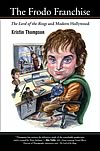
by Kristin Thompson. Berkeley: University of California
Press, 2007.
400 pages, 6 × 9 inches, 12 color illustrations;
36 b/w illustrations.
[go
to Amazon | go to The Frodo Franchise blog]
Whatever its faults or virtues, Babel seems to me to typify several trends in current cinema.
1) Network Narratives
Variety‘s critics call them criss-crossers, others call them thread structures or interwoven stories. I call them network narratives. In an essay called “Mutual Friends and Chronologies of Chance,” forthcoming in the book Poetics of Cinema, I tried to lay out the conventions of this increasingly common (maybe too common) storytelling strategy.
The central formal principle is that several protagonists are given more or less the same weight as they participate in intertwining plotlines. Usually these lines affect one another to some degree. The characters might be strangers, slight acquaintances, friends, or kinfolk. The film aims to show a larger pattern underlying their individual trajectories.
Several directors have specialized in this structure, from Altman and Claude Lelouch to Iosseliani and Rodrigo Garcia (most recently, Nine Lives). I found over a hundred such films, some going back quite far (e.g., Grand Hotel) but most made since the 1980s. Do they reflect some social Zeitgeist? Are we seeking connections with one another? Nope, I don’t think so. The most proximate and pertinent causes lie elsewhere. (Where? Check out the book!)
Alejandro González Iñárritu has made the network idea a signature element of his films. The first feature, Amores Perros, used a common convention, the traffic accident, to tie together three characters. We follow their story lines leading up to or away from the car crash. 21 Grams had a smaller cast but a more scrambled structure. Now, with Babel, we have something easier to follow than the previous films. But it compensates by filling a broader canvas: action on several continents, themes heavy with significance about what Pico Iyer calls the Global Soul.
We know how to read criss-crossers now, and so directors can push the boundaries on several fronts–more intricate plotting, portentous themes, spatial distance (critics called Babel an “epic”). Yet to keep audiences on track, filmmakers remain committed to the basic conventions as well, such as the notion of chance as hidden fate, or the Chaos idea that the flapping of a butterfly’s wings in Chile can . . .
Lesson 1: Once a formal tradition gets established, artists compete within that, seeking out ways to innovate…within tested boundaries. Fresh narrative strategies push the filmmaker to balance the novelty with familiarity.
2) Trilogies
The arthouse cinema has long traded on the appeal of a series of films, more or less loosely joined. Satayajit Ray had his Apu trilogy, which was at least about the same character, but at about the same period there was Antonioni’s tryptich L’Avventura, La Notte, and L’Eclisse. Not to be outdone, Bergman gave us two trilogies, one on the crisis of faith (Through a Glass Darkly, Winter Light, and The Silence), the other on, perhaps, the failure of human relationships under pressure (Persona, Shame, and Hour of the Wolf). More recently we’ve had Fassbinder’s BRD trilogy and Kiarostami’s threesome centered on the village of Koker.
Labeling a trio of films a trilogy plays an important role in the festival-arthouse market. Art films often lack established stars and don’t belong to clear-cut genres (though most turn out to be melodramas or historical dramas). The big selling point is usually the director, whose body of work promises something of interest. If the body of work falls into neat periods or groupings, then that automatically creates opportunities for long-term funding and “product differentiation” from film to film. This may seem a crass way to talk about what many people regard as personal expressions of artists, but filmmakers who want to keep making films know that funding and festivals rely on marketable components like the stature of the director and her or his broader creative ambitions.
So it’s not surprising that now directors are explicitly conceiving trilogies. Most of the earlier trilogies I mentioned were created ex post facto, by critics recognizing thematic links among works. It’s not clear that Antonioni or Bergman or Kiarostami planned to make trilogies from the start. Often the idea of a trilogy hits the director after the first film (von Trier’s Dogville) or the second. But now directors can launch a trilogy, as Kieslowski did with Blue. Angelopoulos has announced that The Weeping Meadow is the first film in a trilogy that will survey the troubled history of the twentieth century. Lucas Belvaux took the step of simultaneously making three features centered on one batch of characters, calling the overall result, of course, Trilogy.
On the festival circuit filmmakers have to explain themselves to critics, and Iñárritu has understood this well. He tells us that he decided to create a trilogy while making 21 Grams, and he points out how the films are similar (network structure, overlapping time schemes) and different (degrees of linearity, changes in theme). He helps critics and viewers understand his work–at least, in the way he prefers it to be understood.
Lesson 2: Festival cinema discovered the trilogy before Hollywood did (Star Wars, The Godfather, Pirates of the Caribbean), and the three-movie cluster may well be the art movies’ answer to a franchise.
3) Hyperrefined technique
In The Way Hollywood Tells It, I comment on the tendency of contemporary American filmmakers to develop subtle, maybe unnoticeable patterns of technique that run alongside the film’s story. So the three acts of Ron Howard’s The Paper were planned to employ three different sorts of camera movement. The same tendency can be found in independent filmmaking; Darren Aronofsky’s Requiem for a Dream coordinated its color scheme and seasons to mirror the film’s act structure.
Such refinement is especially tempting in network narratives, in which every line of action can be given its signature look. The obvious example is Soderbergh’s Traffic, which flaunts vivid color and texture differences among the plotlines.
Iñárritu has taken this tactic to a new level of complexity, as revealed in an article in the November American Cinematographer (Rachel K. Bosley, “Forging Connections,” AC 87, 11, 36-49). For this project Iñárritu and his cinematographer Rodrigo Prieto distinguished different story threads through color, grain, film stock, film gauge, lab processing, and even aspect ratio. (They shot the Japanese sequences in anamorphic but then extracted a 1.85:1 frame out of them.) For example we’re supposed to register, albeit unconsciously, a shift when the Morocco story, shot in 16mm shifts to 35mm when the helicopter arrives to rescue the wounded wife.
A harsher critic might claim that the ingenuity expended on these minutiae might better have been spent sharpening and deepening the plotlines themselves. But put evaluation aside. I just want to note that this commitment to “visual arcs” and subliminal tonal shifts echoing the drama shows that Hollywood is as committed to an aesthetic of unity as it ever was–maybe even more committed. This is a level of fanatical detail that supreme fussbudgets like Hitchcock, Sternberg, and (outside Hollywood), Ozu never sought to reach.
I also have to wonder: Does anybody register, let alone notice, such hyperrefinements? In my multiplex, and primed by having read the AC article, I could spot almost none of this finesse on the screen. In the release print I saw, all the stories looked pretty much the same, and most images had the consistency of oatmeal. Prieto says that “the grain was the most important visual element of the story” (p. 42). In this respect, he got his wish; grain was about all I could see.
Lesson 3: Those who think that modern Hollywood has entered a mannerist phase can find confirmation in Babel.
Postscript: It would be worthwhile building a symptomatic interpretation of Babel. My hunch is that despite Iñárritu’s claim that the film is about family and personal communication, something else is going on. After all, the drama is fundamentally about how prosperous white people have to suffer because Asian, Mexican, and North African men have guns.
I suppose all movie-lovers have favorite quotations that become part of their everyday conversation. Norman Bates’s “One by one you drop the formalities” fits a surprising number of situations. The film-studies professors here in Madison often communicate with each other using lines from Howard Hawks films, especially Rio Bravo. “Let’s take a turn around the town,” “We’ll remember you said that,” and, of course, “It’s nice to see a smart kid for a change.” Any time David or I get a particularly small royalty check, we echo Hildie Johnson’s sour “Buy yourself an annuity.”
One of our favorite everyday-life quotations comes not from a movie but from the endlessly hilarious SCTV series. It’s a skit in which Steve Roman (played by John Candy) promotes his new TV show, Juan Cortez, Courtroom Judge. He explains part of its appeal: “It’s got good actors, and that spells good acting.” (Fifth season, episode 110, for you SCTV buffs.)
Almost invariably we use this line when we come across one of those films that receive highly positive reviews largely because of one great performance. You know the kind: Charlize Theron in Monster, Halle Berry in Monster’s Ball, Hillary Swank in Boys Don’t Cry, and more recently Forest Whitaker in The Last King of Scotland and Helen Mirren in The Queen.
Usually I avoid such films, because the reviews tend to plant the idea that they are primarily actors’ vehicles. I enjoy good acting as much as the next person, but I want the rest of the film to be interesting as well.
Are there any film classics that are truly great solely for the acting? It’s hard to think of any. Maybe The Gold Rush, which is stylistically fairly pedestrian but which is redeemed by Chaplin’s inspired performance. Maybe Duck Soup, also quite undistinguished for much of anything other than the Marx Brothers cutting loose without being saddled with the sort of plots involving young, singing lovers that MGM would soon foist upon them. Maybe a few others. Usually, though, we tend not to think of a performance, however dazzling, as adding up to a great film.
Still, when I think of some of the finest performances ever put on film, I think of Falconetti in La Passion de Jeanne d’Arc by Carl Dreyer. There her luminous portrayal of determination and religious devotion is embedded in an equally extraordinary film, with its minimalist sets by Herman Warm, its insistently tight framings on faces, and its vertiginous camera movements. Similarly, Nicolai Cherkasov as Ivan the Terrible in Eisenstein’s film poses against the shapes of the settings, moves to the music of Prokofiev, and casts great shadows on the walls. Buster Keaton, though not as popular in his day as Chaplin, had an instinctive feel for both the flat space of the screen and the depth of the represented image, and his films are exciting in themselves and not simply as backgrounds to his clowning.
We’re now well into the time of year when the studios bring out the films they hope will garner Oscar nominations and even wins. Journalists covering film, reviewers and feature writers alike, can get some copy out of speculating about the Oscars. That speculation seems to start earlier and earlier each year, like Christmas shopping. Given that the public is a lot more interested in acting than cinematography or screenwriting, perhaps it’s not surprising that reviewers focus so much on star turns. But in doing so, do they slight other aspects of those films? Do they unfairly scare off those of us who are wary of Oscar bait?
I decided to do my part for the good of the blog and see The Queen. I’m not a huge fan of Stephen Frears, but My Beautiful Launderette is a good film, with an early sympathetic, non-sensationalized view of homosexuality in London. Mary Reilly is not exactly a masterpiece, but it’s worth watching and has been underrated. Its failure may have been due in part to the fact that most reviewers focused in on whether Julia Roberts could handle a dramatic role in a thriller and then found her wanting.
Anyway, The Queen turned out to be an entertaining, well-made film. Yes, Helen Mirren is remarkable as Queen Elizabeth II, and she may well win an Oscar for her performance. Yet equally interesting is the fact that Frears almost entirely avoids the “intensified continuity” style that David has analysed in The Way Hollywood Tells It.
The film is basically pretty simple, moving back and forth between the royal family and the newly elected Tony Blair surrounded by his wife and staff. The royals notoriously reacted to the death of ex-Princess Diana with stony silence despite the huge outpouring of public grief. It’s clear from the indifference and even hostility toward Diana that the members of family’s older generations voice in private, they do not feel a comparable grief. But Blair strives to maneuver the Queen into going public and expressing a sense of loss.
Frears set out to contrast the two worlds stylistically. The scenes with the royals are shot in a classical, non-intensified style. Distant shots to establish space, two shots for face-to-face conversations, over-the-shoulder shot/reverse shots as the dialogue unfolds. The framing seldom goes in for the tight close-up but stays in medium shot or medium close-up. The cutting is slow relative to the current norm, as befits both the subject and the style. One reason people are so impressed with Mirren’s performance may be that it is not made up of a bunch of different shots stitched together. She has shots that allow her to develop a reaction or attitude slowly.
And best of all, the camera doesn’t glide toward or around the characters. It stays put unless it needs to perform one of its traditional roles: reframing to keep characters balanced, and following the characters as they move from one room to another or walk along a country track. The lighting is suitably subdued and directional, another reversion to a more classical age.
A great deal is currently being made of Steven Soderbergh’s reversion to 1940s Hollywood style in The Good German. Frears isn’t quite as systematic, perhaps, but the royal-family scenes in The Queen look very 1950s to me.
In contrast, the Tony Blair scenes were shot with a handheld camera, to convey the bustle of his staff and the more casual situation. Even so, the camera movement is not obtrusive, and Frears still doesn’t constantly cut in for the tight close-up. Here, too, he keeps his camera back a bit, framing groups as they talk. The lighting tends to be brighter and more diffuse. The contrast works well, and yet Frears never pushes it in our faces and asks us to be impressed.
The narrative seems a little thin, mostly because, unlike most classical films, The Queen has only one plot line. There’s no subsidiary crisis, no romance, no other conflict. It’s just the royals versus the liberal prime minister’s team until one side cracks. Even the potential conflict that could have easily arisen from Blair’s wife’s anti-royalty position never goes anywhere. She’s mainly there as a sounding-board for him. And if the plot is thin, it is also refreshingly elegant in its simplicity.
One remarkable aspect of the plot is that none of the characters is treated as a villain. Blair’s position is held up as the wise one, yet the film goes to great lengths to suggest that the Queen and her family have reasons for behaving the way they do. Not excuses, but reasons. Fittingly, the film concludes with the Queen and her new prime minister walking out into the palace gardens for a stroll and a chat.
At the end, I didn’t feel that I had sat through a great performance. I had seen a good, entertaining, somewhat unusual, and skillfully made film that had a great performance in it. Indeed, it has a second from Michael Sheen as Blair, and the supporting players are fine as well.
But good directors spell good directing, and good cinematographers spell … You get the idea. Variety’s reviewers, it must be said, seem to have a mandate to mention style, since ever review comments at least briefly on the film’s techniques. But most critics give you no sense of the film as a whole—its narrative construction (apart from a plot synopsis) or its stylistic texture. It would be nice to see more rounded reviews.
Over at the Scanners site, Jim Emerson is running a fascinating thread. He invites readers to write about their favorite first shots.
I haven’t joined in, largely because, as with all lists, I have too many favorites and I get tangled up in comparisons. What intrigues me is the idea behind Jim’s proposal.
We all accept that first shots are important. We often analyze films by comparing the beginning to the end, and I routinely ask my students to note the first and last shots of a movie we’ll discuss. But were first shots always as important as we now take them to be? The historian in me thinks that this is a fruitful question.
Consider the films most frequently listed on Sight and Sound magazine’s Ten Best lists from 1952 to 2002. All are classics. But can you recall the first shot of very many of them?
Battleship Potemkin, The Rules of the Game, Citizen Kane, L’Avventura, 8 1/2, The Passion of Joan of Arc, Vertigo, L’Atalante, The Bicycle Thief,The General, Greed, The Magnificent Ambersons, The Searchers, Singin’ in the Rain, Tokyo Story, 2001: A Space Odyssey, and Ugetsu Monogatari.
Now if you’re a keen fan of any of these, you doubtless know the first shots well. But for most of those you’ve seen but not fetishized, I have the hunch that the first shot may not be particularly memorable.
Yet what about the first shot of A Hard Day’s Night or The Conversation or The Player? You’re likely to recall those first shots after a single viewing, and they will stay with you. Nowadays we may even remember the first shots of certain movies that we don’t particularly like.
If you recall only one curtain-raiser on the Sight and Sound list, I suspect it will be that of 2001. As my friend said as we walked out of a Manhattan screening back in 1968, “The sun rises like you’ve never seen it before!” This makes me wonder if there’s a historical breaking point somewhere here.
Was there a moment when directors started to feel that they had to weight the first shot heavily, to treat it as a dense moment that the viewer should savor? The first shot of a film could be as vivid and bristling with implication as the first sentence of a novel. When might directors have begun to think along these lines? Did it start, like so much else in cinema, in the 1960s, and Kubrick entered the first-shot sweepstakes?
Historically, it seems that many first shots serve simply to set up the locale for the first scene. This might be the central function of opening shots inr many classics I just mentioned. No larger implications may hover around the first image.
Sometimes, though, the first shot cunningly plants a story element that seems unimportant at the moment but will become crucial later. My favorite example is the first shot of Harold Lloyd’s wonderful The Kid Brother (1927). (If you haven’t seen this film, go rent it immediately. Better yet, buy the box set, because everything on it is very fine; Lloyd is one of the great, underrated American filmmakers.)
Before I suggest a possible answer to the question of when first shots became attention-getters, here are some speculations about what such shots can do.
*The first shot can present a sort of Ultimate Cause, the basis for everything that follows. In The Birth of a Nation, the first shot shows black slaves brought to America from Africa.
*Sometimes the first shot, however brief, has emblematic significance. The first shot of Battleship Potemkin portrays waves breaking on shore, symbolizing the force of revolutionary consciousness. Eisenstein’s Ivan the Terrible starts with a shot of the tsar’s crown as the coronation is about to start: the whole film will be about the struggle for power. The “No Trespassing” sign at the start of Kane has been widely interpreted as urging us not to judge Kane too simplistically.
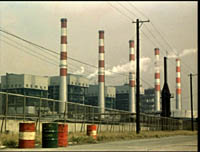
*Several of Jim’s contributors have pointed out how thematic elements get set up in an opening shot. Rules of the Game might be another instance: The long tracking shot that follows a radio cable plunges us into a world in which the naïve pilot is a celebrity, and it sets up a mechanical world (radio broadcast, the plane) that will be echoed in the Marquis’s music boxes later. In Play Time, it’s impossible to know what sort of building we see in the first shot–establishing not only the looming anonymity of modern architecture but the sort of games Tati intends to play with our perception. It also introduces the motif of reflections, an important source of the film’s themes of how old Paris has been spoiled by modern technology.
*Likewise, the First Shot Project contributors have mentioned how the initial image can establish the film’s tone. A good example is the direct-address prologues of The Girl Can’t Help It and Will Success Spoil Rock Hunter? Another is the dissolve from the Paramount logo to the jungle mountaintop in Raiders of the Lost Ark, which signals the sort of tongue-in-cheek homage we’re about to get.
*Sometimes a fairly mundane initial shot becomes salient not in the film that follows but in the context of the director’s other works. In the case of The Passion of Joan of Arc, the book that is opened in the first shot links to all the other books that feature so prominently in Dreyer’s films. Long ago I argued that the book, and the act of writing in it, become important structural principles of how his films tell their stories.
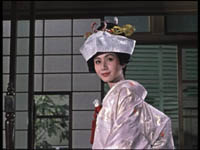
*The first shot can set up a visual-design motif that will get developed in the course of the film. The most famous example is probably the opening door that starts The Searchers. As with Kane‘s “No Trespassing” this motif will serve to bookend the film, recurring not only at intervals but also in the very last shot. Ozu’s Autumn Afternoon opening–surely one of the greatest first shots in cinema–sets up red, white, and silver color elements that will be picked up in the daughter’s wedding dress at the climax.
Nowadays, many directors seem to think that they have to start the film with a dazzling long take with complicated camera movements. One example is De Palma’s Bonfire of the Vanities, which he seemed to try to top in Snake Eyes. P. T. Anderson goes all out for virtuoso camera movement at the start of Boogie Nights but then settles on a static long take for Punch-Drunk Love. As in the early sound era, a fancy opening shot can crop up in a more or less ordinary film too, such as the SkyCam- and CGI-driven introduction of the nightclub in The Birdcage. The convention of the flashy first shot is so widespread that The Player‘s opening can satirize it.
Actually, it isn’t that new an idea. Fairly far back in film history, directors seem to have realized that first shots should be freighted with implication. There probably isn’t only one moment when this strategy arises, but I’d suggest looking first at the period when synchronized sound comes in. Most films at the time were pretty static and theatrical in their reliance on dialogue, so a flashy opening shot or sequence could reassert “This is cinema.” The bravura tracking shot was a common way directors chose to draw the viewer into the film’s world, as at the start of Threepenny Opera or of Scarface. Maybe this is a key moment in which filmmakers began to realize that the opening shot of a film should grab or puzzle the viewer and let us reflect a little on the fact that it’s doing so.
Things that seem to us to be current innovations can go pretty far back. There’s a more general implication too. As critics and cinéphiles, we tend to notice particulars–this sequence, this film. But we can also study the history of film forms and styles. We can try to map out the broader principles and patterns, the sources and trends–the items on the menu, we might say–that shape filmmakers’ individual choices.
Coincidentally, the day before I was planning to see Flushed Away, the latest feature from the brilliant English animation studio, the new Variety arrived with a relevant story. “An Aard-Knock Life,” reveals that “After the second commercial disappointment in as many years from the quirky British claymation studio, insiders say DreamWorks Animation is unlikely to put any more Aardman toons on its sked. Instead, the Blighty company is believed to be looking for a new theatrical partner—likely one that doesn’t have ‘Shrek’-sized expectations for its releases.”
If that happens, maybe Aardman should also make sure that its next studio knows how to sell a movie.
The first “disappointment” for DreamWorks was Wallace & Gromit in the Curse of the Were-Rabbit. That film was so disappointing that it won the 2005 Oscar as best animated feature and was a hit virtually everywhere in the world except the USA.
I’m irresistibly reminded of Disney/Buena Vista’s releases of a few films by Hayao Miyazaki. Not really knowing what to do with these complex, poetic masterpieces, they essentially gave up on the first, Princess Mononoke (American release, 1997), doing almost nothing to publicize it and letting it play to nearly empty theaters in a relatively limited release. Spirited Away (2001) got a lackluster release from Disney, who at least had the decency to make both dubbed and subtitled prints available. Once the movie won the 2002 animated-feature Oscar, the studio gave it a half-hearted re-release. Howl’s Moving Castle (dubbed, 2005) must have gotten most of its business as a result of sterling reviews rather than publicity.
One thing DreamWorks and Disney have in common in these cases: both of them seem not to have noticed that they didn’t make these films. That does matter when you’re trying to find an audience for them.
You could argue that three of the greatest sources of animation, at least theatrical feature-length animation, are Pixar, Aardman, and Studio Ghibli, Miyazaki’s company. (On this level of brilliance, it’s hard to choose among them.) Buena Vista distributes both Pixar and Ghibli films. Pixar films clean up at the box office; Ghibli films pick up rave reviews and awards. (Outside North America they set box-office records.) Distributing Aardman films has been an iffy undertaking for DreamWorks. Chicken Run succeeded, Curse of the Wererabbit didn’t, and, if Variety is right, DreamWorks hopes for no better from Flushed Away.
Why the disparity, when these three studios have walked off with the past four best animated picture Oscars? I’d suggest it’s because Disney and DreamWorks have made no attempt to make their imported films into recognizable brands. They sell them as if they were their own products. Then they wonder why people are mystified when they see “Disney’s” Spirited Away or “DreamWork’s” Flushed Away and find that these films are not what they’re used to from those studios.
Pixar, on the other hand, succeeds in the U.S. partly because it’s a brand. These aren’t Disney films, they’re Pixar films, with the cute little lamp that jumps around in the logo. Even now that Pixar has been bought by Disney, you can bet that the films will go out under the name “Pixar” and have that little lamp.
Disney has never really tried to establish Ghibli as a brand. I think Miyazaki’s films are awkward for the American market. They’e too grown up for the kids who usually go to animated features, too much “cartoons” for adults. Still, given Miyazaki’s reputation—the reviews, the awards, the success in other markets—I suspect Disney could succeed by stressing the Ghibli name and reputation and marketing them as art-house films. They get trampled in the multiplexes.
Similarly, DreamWorks keeps trying to market Aardman films as DreamWorks films. Flushed Away is, according to the ads, “From the creators of Shrek and Madagascar.” If you lure people into the theaters with that claim, of course they’re going to be baffled when they get sophisticated, witty tales instead of broad, obvious comedy. (I enjoyed Shrek, but it’s been considerably overrated. That it rather than Monsters Inc. should have won the first best animated feature Oscar shows why hype and box office can do.)
If DreamWorks instead had made any effort to make Aardman into a brand as recognizable here as in Britain (well, nearly as recognizable), these films would undoubtedly have a bigger success here in the States. Releasing the three Wallace & Gromit shorts as a feature-length program, as was done in Europe, could have won a devoted following for them and things Aardman. Such a release would have cost very little and could have prepared the way for Curse of the Wererabbit and others.
So, back to Flushed Away and its supposed failure. From my reading of the box-office figures over the mere 12 days the film has been in release, it looks like a moderate success. If DreamWorks is ready to write it off already, then Hollywood really has become so focused on opening-weekend grosses as to be blinkered to all other indicators.
As everyone noted, when Flushed Away opened on November 3, it split the family audience with The Santa Clause 3: The Escape Clause. With Borat’s “surprise” success (a surprise only to Twentieth Century Fox and a few pundits), taking in $26 million in 827 theaters and grabbing the Monday infotainment coverage, the Santa Clause came in second at $19, 504,038 and Flushed Away a close third at $18,814,323. After 12 days, those two are still bringing in similar grosses: Santa Clause totaling $42,312,847 and Flushed Away $41,017,254.
But, as I suggested in my piece on Borat, the top three films of the November 3 weekend looked like they would have legs and hold up remarkably well on their second weekend. Sure enough, Santa Clause dropped off a mere 13.2% and Flushed Away only 11.7%. These days, a drop-off of significantly below 50% on the second weekend is considered good. These two drop-offs are very, very low.
If DreamWorks can accept a modest success rather than a Shrek-size result, they may emphasize Flushed Away as a hit, let it play through the holidays, and see what happens when kids are out of school.
DreamWorks also might look at its own history with Aardman. Chicken Run’s opening weekend gross was $17,506,162. (Given inflation, that’s probably comparable to Flushed Away’s opening). Its domestic total was $106,843,564. Not a smash, but good enough to put it twentieth on the box-office chart for that year. Moreover, Chicken Run’s opening weekend was 16.4% of its eventual domestic gross. These days some films take in half their total on the first weekend. Let’s compare it with another long-legged film. The Fellowship of the Ring (a December 2001 release which was still in theaters in August 2002, two weeks after its DVD came out), made 15.1% of its domestic gross during its opening weekend.
Maybe DreamWorks is doing what I suggested not to do: looking on Monday morning at what won the horse race and jumping to conclusions.
So, what did I think of Flushed Away? I thoroughly enjoyed it. I kind of miss the thumbprints you could sometimes spot in the clay of previous Aardman films, but otherwise this first venture into CGI looks very similar. (The studio says they went to CGI in order to make the many water effects seem realistic.) Like the Pixar features and other Aardman films, it has a clear, tight storyline structured around goals, the primary one being that of the hero, a pet mouse, trying to get home after being flushed down the toilet to the sewers.
The world under London’s pavement is dense with the usual clever references and puns and bizarre characters that populate Aardman’s features. More so than usual, in fact: a whole city full of shops, advertisements, and miniature objects that have been put to new uses. In fact, there’s so much to see that I frequently felt the pace was too fast, whipping you past sets before you could do more than glimpse the details. The references to other films, from Finding Nemo to The Two Towers, come thick and fast.
The movie also benefits from the trend of recent years toward all-star vocal casts in animated films. With Hugh Jackman for the hero, Kate Winslet for the heroine, and Ian McKellen for the main villain, the characterizations are wonderful.
And as for the singing chorus of slugs that wanders through the film … well, it has to be seen and heard to be believed. As with other Aardman films, stick around for the credits.









 instance: The long tracking shot that follows a radio cable plunges us into a world in which the naïve pilot is a celebrity, and it sets up a mechanical world (radio broadcast, the plane) that will be echoed in the Marquis’s music boxes later. In Play Time, it’s impossible to know what sort of building we see in the first shot–establishing not only the looming anonymity of modern architecture but the sort of games Tati intends to play with our perception. It also introduces the motif of reflections, an important source of the film’s themes of how old Paris has been spoiled by modern technology.