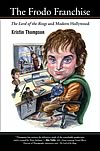
by Kristin Thompson. Berkeley: University of California
Press, 2007.
400 pages, 6 × 9 inches, 12 color illustrations;
36 b/w illustrations.
[go
to Amazon | go to The Frodo Franchise blog]
First, a little background. In the new edition of Film Art, we have added a new feature. At the end of each chapter we recommend DVD supplements that tie in with the respective subject matter. The task of watching lots of supplements—around 60 films’ worth—devolved upon me. That wasn’t always as fun as it might sound. There were some informative sets of extras, but all too many were mutually congratulatory fests, with directors praising actors, actors praising directors, actors praising other actors, and so on. “X was just perfect for that role. I can’t imagine anyone else playing the part.” You know the kind.
Film Art’s new edition is finished, but I keep looking for supplements we can recommend here or in the ninth edition. One promising-sounding DVD set was the recent “Special Edition” of The Da Vinci Code, with 90 minutes worth of extras.
I know The Da Vinci Code has a so-so reputation based on the reviewers’ responses. I went to it during its first run and was pleasantly surprised. It’s no masterpiece, but the idea that it is dull or slow seems very odd. It was entertaining and reasonably well-made, and I enjoyed it. It’s certainly miles above the overly long Dan Brown novel, which has a tendency to have information revealed in the dialogue and then redundantly summarized in the third-person narration. It also has those thudding cliff-hanger sentences at the end of just about every one of its choppy little chapters. The movie positively races along in comparison. And the washed-out historical flashbacks during the Grail explanations have a loony, experimental feel to them that appeals to me. It’s startling to see such epic scenes tossed in briefly in the midst of a modern thriller. I can see, though, where others might dismiss them as silly.
I don’t know how it happens, but sometimes a film comes along that all the critics simultaneously decide to trash, whether it deserves it or not. Some sort of telepathic thing, maybe, or perhaps in this case they all consulted each other during the famous long press junket on a special chartered train traveling from London to Cannes this past spring. (Ian McKellen has posted an amusing account of answering the same questions over and over during this journey.) The Da Vinci Code was the opening-night film at Cannes, and that’s where the lukewarm critical response began. The reviews were completely ignored by moviegoers, who made The Da Vinci Code the second highest grossing film of 2006 internationally.
Anyway, having enjoyed the film and knowing that its DVD was laden with supplements, I set out to purchase it. Investigation on the internet turned up the surprising news that there was an “extended version” available. That was news to me, and no wonder. When I searched further, I discovered that this longer cut was not available in the U.S. While the familiar 149-minute theatrical version can be had here—complete with a replica cryptex if you buy the deluxe version—the unknown 168-minute version cannot. Not only that, but though I Googled as hard as I could, I could find no explanation as to why there would be an extended version at all and why we Yanks have no access to it.
There’s a Region 2 French edition, as advertised on Amazon’s French site. The Germans seem to have the best selection, with the extended version available on a simple two-disc set, a deluxe edition that throws in a cryptex, and a boxed set of the two DVDs with six CDs containing the audiobook. The long version is also available on Region 4 DVDs in New Zealand and Australia. I have not been able to locate any Region 1 (U.S. standard) DVDs of this version. By the way, all the DVDs, regular, extended, fullscreen, and widescreen seem to have an identical set of supplements.
Perhaps an extended Da Vinci Code is not at the top of everyone’s Christmas list, but the lack of availability or even knowledge of this version in the States is puzzling. Was there something in this longer version that would bore, offend, or otherwise put off American viewers? Which version would one write about in doing some sort of analytical essay on The Da Vinci Code? Aided by eBay and a multi-standard DVD player, I set out to investigate.
The copy I bought, an Australian one, doesn’t have a list of where the extra footage comes. I didn’t sit down with two DVD players and two monitors side-by-side, so I can’t pinpoint every single difference. I had seen the film in a theater in June, and upon watching the extended version, I was able to spot ten additions, ranging from a couple of shots at the beginning of a scene to five new sequences. I don’t think these add up to an extra 26 minutes, so there are presumably some I missed. Those who are interested can have the pleasure of ferreting out all the details of the extra footage for themselves. (It does make one appreciate the Lord of the Rings extended-edition menus, where changes are marked with asterisks.)
One can understand why a longish film would be trimmed by 25 minutes. It’s enough to reduce by one the number of times it could be screened per day, which is clearly a significant obstacle. Still, the extra scenes and bits do make a difference, though it’s often minor. In the scene at Teabing’s (Ian McKellen) country house where the group moves from the kitchen to the study to look at the Last Supper slides, the establishing shot of the new setting has an oil painting of a woman framed prominently in the foreground. It presumably was meant to hint at a backstory for Teabing, some great lost love whose absence may have contributed to the man’s obsession with the Grail. The painting is clearly visible in one shot of the shortened version, but since it comes during the invasion of the house by Silas (Paul Bettany), the viewer is not likely to notice it.
Later, in the conversation between Fache (Jean Reno) and his assistant at the airport, Fache asks whom he has betrayed in using his ruthless means to pursue Langdon. In the release print, the assistant simply tells Fache that Teabing’s plane has changed course and is going to London. In the longer version, he goes on to say that he will bribe the airport official that Fache has beaten up. Thus rather than simply doing his duty and giving Fache information, the assistant firmly allies himself with his boss in his illegal doings.
Another brief extra moment comes in the second scene of Silas flagellating himself. The theatrical version cuts away from the action rather abruptly. In the extended version we see a quick series of flashbacks to previous murders that he has committed, presumably all at the behest of Bishop Aringarosa. Not really necessary to the plot, but it does make it clear that Silas realizes that his actions are reprehensible.
These are mere nuances, but the longer added scenes contribute more significant material. Two brief conversations show Aringarosa alone with the head of the Opus Dei council, basically establishing their collusion outside the council meeting itself.
Another new scene takes place aboard Teabing’s plane. It is a conversation in shot/reverse shot, with Sophie (Audrey Tautou) despairing and telling Langdon (Tom Hanks) to go to the U.S. embassy once they reach London, ending his efforts to help her. She suggests that she will simply throw the cryptex away. His insistence that he will stick with her creates one of the most emotionally charged moments between the two. Many critics complained that the Sophie-Langdon relationship lacks chemistry, but this scene’s restoration helps by showing a warm exchange between them. (Not that a lack of chemistry is a problem, given that the two are not supposed to be forming a romantic couple, just a friendship born of necessity.)
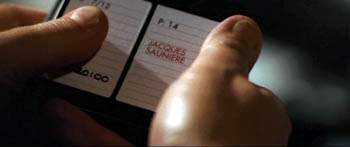
The second added sequence comes after the scene in the Temple Church, with a cut back to Teabing’s château. Fache’s assistant inspects an elaborate surveillance post in the barn, including recordings marked with the names of the four men killed by Silas. This event makes it quite clear why in the climactic scene at Westminster Abbey Fache arrests Teabing rather than Langdon and Sophie. In the shorter version, his change of quarry is rather fuzzily motivated by his realization that Aringarosa has duped him. (Maybe I missed some other plot point, but the surveillance-post scene certainly makes things clearer.)
Finally, a new scene follows Fache’s arrest of Teabing. The detective meets with Langdon and Sophie in an office and expresses his regret over having wrongly pursued them: “I should have been smarter.” Although not necessary to the plot, this scene does give more prominence to Fache’s character, making him a more sympathetic figure.
It presumably made sense to cut these sections to allow for more screenings in theaters, but the question remains, why was the extended version not released in the U.S.? Along with all the commentaries and supplements that the studio added on, surely the words “extended edition” would have added some appeal to the DVD set. After all, the longer version was made and released elsewhere, so presumably the added expense wasn’t an issue.
The only reason I can think of is that the added scenes weren’t considered obvious or flashy enough for American audiences. Extended editions on the Lord of the Rings model tend to be done for fantasy and sci-fi films or other genre pictures that might be assumed to have a fan audience eager for any little extras they can get. Maybe that’s not assumed to be the case for other types of films. But then why bother to do such a version for the rest of the world? I’m baffled.
For those living in Region 1 territory who like The Da Vinci Code and who have a multi-standard DVD player, you might want to take the extra trouble to track down the extended version. There always seem to be a few on eBay (though watch out for the bootleg copies someone in Asia is selling there!), and they can be had through the big internet sellers in Europe and Australia.
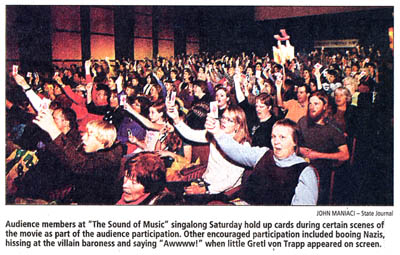
The Hilldale Theatre of Madison, Wisconsin opened its doors in spring of 1966 roadshowing The Sound of Music, and last weekend the theatre closed. To celebrate its passing, the management held a Sound of Music Sing Along, complete with subtitles to help with the lyrics. (No, not “How do you hold a moonbeam in your hand?” but the really tough ones.)
People came dressed as Maria, nuns, and the frog that was slipped into Maria’s pocket. There were cues for audience interaction, including saying “Awwww!” when Gretl appears on screen. This brought back memories of The Rocky Horror Picture Show, which ran at midnight shows at the now departed Majestic Theatre from 1976 through the mid-1990s. For a report on that, and the connubial bliss it brought, have a look here.
Kristin and I came to Madison in fall of 1973, prime time. The campus boasted 22 film societies: Wisconsin Film Society, Fertile Valley, Green Lantern, Hal-9000, and all the rest. Members of the Union Film Committee, overseeing the only campus 35mm venue, were passionately debating whether to show Godard, or Jancso, or a John Ford retrospective. I convinced them to show The Young Girls of Rochefort, which hurt my reputation,and Play Time, which I think helped it.
The Wisconsin Center for Film and Theater Research had just acquired several thousand Warners and RKO films. The Majestic Theatre ran double and triple bills (kung-fu, Leone’s Dollars trilogy). The Velvet Light Trap magazine was going strong, run wholly by students and semi-students.
In those days, before home video, it was glorious to be in Mad City. We had 6-10 movies to see every night, apart from course screenings. We didn’t even own a TV. Who needed one?
Not to mention the cast of characters, all colorful. In the late 1960s-early 1970s the film community included:
The late Mark Bergman, premiere projectionist, fan of Phil Karlson, and gentle soul.
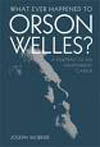
Joe McBride, critic (Variety), screenwriter (Rock and Roll High School), actor (The Other Side of the Wind), and excellent biographer (Spielberg, Capra, Ford, now Welles; What Ever Happened to OW? is very engaging).
Mike Wilmington, one of America’s top film critics, a mainstay of the Chicago Tribune.
Gerry Peary, enterprising critic, screenwriter, and film professor.
Danny Peary, most famous for his series of Cult Movies books.
John Davis, co-founder of the Light Trap and creator of Capital City Comics.
Susan Dalton, another co-founder of the Light Trap and archivist at the American Film Institute.
Pat McGilligan, prolific critic, interviewer, and biographer.
Tom Flinn, the other co-founder of the Light Trap, pop-culture encyclopedist, and expert on Germans in Hollywood.
Bill Banning, founder of Roxie Releasing and operator of San Francisco’s Roxie Cinema.
Reid Rosefelt, publicist, producer’s rep, and filmmaker.
Many of these worthies ran film societies, so their ideas and passions showed through the films they screened. For more on the Madison Movie Mafia, go here.
Also present and active in late 1960s-early 1970s:
Filmmakers Erroll Morris, Stewart Gordon, Jim Benning, Bette Gordon, Michelle Citron, Karyn Kay.
Scholars-in-training James Naremore, Doug Gomery, Maureen Turim, Fina Bathrick, Marilyn Campbell, Diane Waldman, Ed Branigan, Vance Kepley, Peter Lehman, Brian Rose, Peter Brunette, Frank Scheide, and many more.
Great days, and nights…Mike Wilmington has written a fond appreciation of the whole scene here.
But this isn’t just an exercise in baby-boomer nostalgia. The Madison Cinema Juggernaut rolls on. The Light Trap just published its 58th issue. The Onion, founded by Madison students, continues to be America’s finest news source. Dan Fuller makes silent films with his students, using cameras from the 1920s, and the results have played at Pordenone. And not least, the Cinematheque, founded by faculty and students in the Communication Arts Department, carries on the spirit of the old film societies.
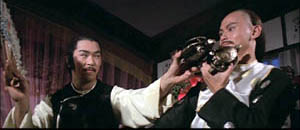
In sync with the closing of Hilldale, our Cinematheque ended the semester last weekend. (Crowd starting to gather above.) An outstanding schedule (S. Ray, Tarr, Godard, Sjostrom.) wound up with Lau Kar-leung’s Dirty Ho, the last of our string of Shaw Brothers classics. It was, of course, a delight, full of flamboyant, good-humored, and downright weird kung-fu.
A lot of it was close-quarter work, as warriors examining pottery or sampling wine disguise their deadly thrusts as elaborate courtesy. Lau is arguably Hong Kong’s top martial arts choreographer, but he’s a fine moviemaker as well, and Dirty Ho is one of his best. Even the shabby state of the print, an original from 1979 complete with curious purple splotches, seemed to pay tribute to three decades of campus film fanaticism. It could have played the Majestic.
Even with the loss of the two Hilldale screens, Madison has five commercial screens dedicated to foreign and independent films, not counting the Cinematheque and the Play Circle in the Student Union. Come spring with Sundance, we’ll get six more. And our Wisconsin Film Festival (April 12-15) comes hard on the heels of the Sundance complex. Wisconsin Movie Madness lives on.
DB
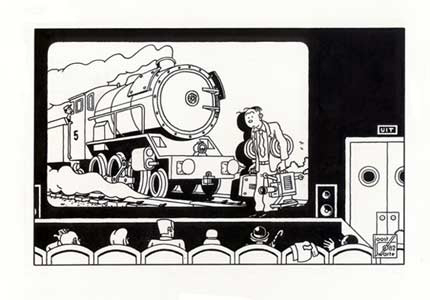
PS: Thanks to Ivo Blom for the Swarte illustration up top.
PPS 21 December: Today’s Isthmus has a nice story on Dan Fuller and the Wisconsin Bioscope company. I played a small role in their last film of the semester, and despite the need to wear eye shadow, this gave me an even greater appreciation of their efforts. They’ll have a screening of recent work some time next term.
David and I seem to be swimming against the stream of end-of-year blog entries. No ten-best lists, no predictions about Oscar nominations.
Instead, I’ll develop on the theme I introduced in my entry concerning the over-emphasis on star turns in reviews of films that contain an obviously outstanding performance. It’s interesting that quotes from such reviews are now routinely used in the “For Your Consideration” ads in show-business trade journals like Variety and The Hollywood Reporter when a studio is pushing a performance for award nominations.
There are a lot of good performances in any given year. We’ve all seen reviews that call a performance “Oscar-worthy” without the actor ending up getting nominated or even mentioned by pundits at year’s end predicting those nominations. Some types of performances just seem more like Oscar bait than others. What makes them that way?
Some of the reasons are apparent to almost anyone who pays any attention during the awards season. Notoriously, the Academy of Motion Picture Arts and Sciences members prefer to honor dramatic roles rather than comic or musical ones. In 1985, a good deal of outrage was expressed—and rightly so–over the fact that Steve Martin was not nominated for his hilarious turn in All of Me. Conversely, the nomination of Johnny Depp for a comic role in Pirates of the Caribbean: The Curse of the Black Pearl created a stir, though few probably thought that he would actually win. (Remember, just being nominated is an honor, as nominees—and who would know better?—often point out.)
So, actors tend to be nominated for serious roles. Not just any kind of serious roles, though. History teaches us that playing a real person gives one’s chances for a “nod” (as nominations are for some reason now called). From Paul Muni in The Story of Louis Pasteur to George C. Scott in Patton to Ben Kingsley in Gandhi to Phillip Seymour Hoffman in Capote, it’s a familiar pattern. In the television age, when famous people’s appearances and behaviors are often familiar to the public, performances can become in part a matter of impersonation, and a skill at mimicry becomes a strong signal of “good acting.” Undoubtedly a performance like Helen Mirren’s as Elizabeth II in The Queen adds subtleties that go beyond the imitation of appearance and speech patterns and other obvious characteristics, but it’s the impersonation that gets talked about more.
Even when we’re not familiar with the person a character represents, for some reason it helps to have “based on a true story” attached to a title. Publicity often stresses that the actor met and spent time with the real person in order to craft an authentic performance.
Obviously making oneself less attractive to play a role gets Brownie points in a big way: Robert DeNiro gaining 60 pounds to play boxer Jake La Motta in Raging Bull, Charlize Theron sacrificing glamor in Monster, Nicole Kidman sporting an unflattering fake nose as Virginia Woolf in The Hours.
Characters with disabilities can definitely put an actor into the Oscar-bait realm: Cliff Robertson in Charly, John Mills in Ryan’s Daughter, Daniel Day Lewis in My Left Foot, or Jack Nicholson in One Flew over the Cuckoo’s Nest.
Presumably the implication of playing a real person or gaining weight for a role or simulating a disability all imply work, harder work than “just” playing a healthy, good-looking fictional person.
There are other indicators for nomination likelihood.
It helps to be old. Think Helen Hayes in Airport or Art Carney in Harry and Tonto. Their best performances? This year Peter O’Toole may finally get a non-honorary acting statuette.
It helps to be English and to have doneShakespeare.
For that matter, it helps to speak English. We’ll see if Penélope Cruz ends up being one of the very few to succeed without doing so. She did get nominated for a Golden Globe for Volver, but foreign-language films are definitely an afterthought when it comes to Academy Awards.
It helps to be Meryl Streep, whose performances don’t even have to fit any of these tendencies.
Oddly enough, most of these generalizations don’t seem to apply as much to the supporting-actor categories. Presumably “supporting” implies a less bravura turn that doesn’t compete with the stars.
Of course there are all sorts of reasons why actors get Oscars. A lot of people were surprised in 1997 when Juliette Binoche (The English Patient) beat out Lauren Bacall (The Mirror Has Two Faces) as Best Supporting Actress. It helps to recall that three years earlier, through a technicality, Binoche had been judged ineligible to be nominated for Best Actress in Three Colors: Blue. The injustice of that clearly rankled Academy members (the majority of whom are actors), and the first time they had a chance to make it up to Binoche, they did. Both Jimmy Stewart and Denzel Washington supposedly won their Best Actor awards because voters felt they had deserved them for previous roles.
On Thursday the Golden Globes nominations were announced. Reporting on the Globes tends to center around their predictive powers for the later Academy Awards. (See “And … They’re Off!” in the new Entertainment Weekly.) The Globes are just as interesting, though, for the fact that they divide the main film-acting awards into two categories: “Drama” and “Musical or Comedy.” (Two parallel best-picture awards are given in these categories as well, but for some reason the supporting-actor awards aren’t divided by genre.) So Sacha Baron Cohen and Johnny Depp can get nominated for comedies and not have to compete against Will Smith and Forest Whitaker in dramas.
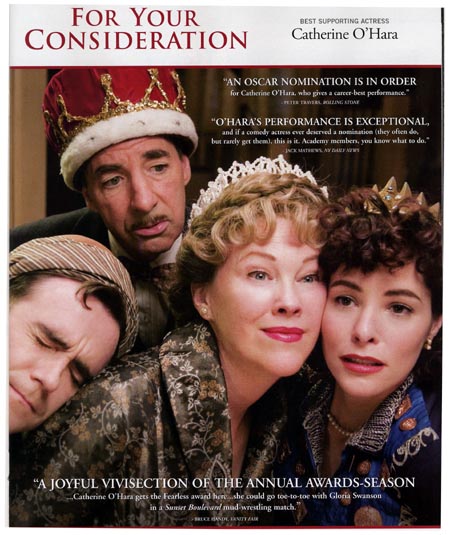
If you like endless speculation on nominees-to-be, check out the December 2006 Hollywood Reporter issue “The Actor.” In it Stephen Galloway talks about actors playing real people: “Whether a story surrounding a character is biographical or fictionalized, actors are determined to find the truth behind their real-life role models” (“As a Matter of Fact”). Part of the reason that the trade press devotes so much space to awards speculation is because these special issues sell lots of “For Your Consideration” ads. This year my favorite one touts Catherine O’Hara as best supporting actress. They don’t even have to tell us the title.
In the wake of discussions of The Good German, on this site and elsewhere, the idea of a retro-looking movie has surfaced again. American Cinematographer‘s coverage of Casino Royale is very intriguing.
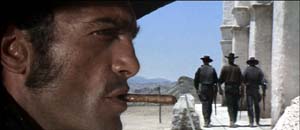
Phil Méheux, the cinematographer, decided that the opening sequence, a black-and-white passage showing Bond earning his 00 status, would pay homage to 1960s Techniscope. Techniscope was an optical process that produced 2.35:1 images without anamorphic lenses. It allowed great depth of field because it could take advantage of the wide-angle lenses available for non-anamorphic cinematography. The most familiar Techniscope images are probably those in Sergio Leone’s westerns.
For a Few Dollars More.
Mehaux explains what he wanted for Casino Royale:
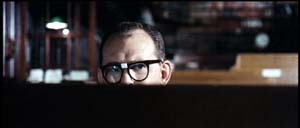
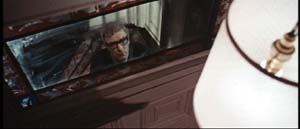
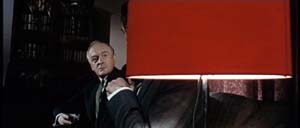
With Techniscope, the increased depth of field meant they were able to put things like lampshades and telephone boxes in the foreground, and they didn’t appear amoebic–you could actually see depth in them. In The Ipcress File, there’s a shot where a table lamp is huge in the frame and a man’s face is in the top right-hand corner. I really like that look. Part of the dialogue in our opening sequence was done with very carefully controlled shots that have huge things in the foreground and faces pushed to the corners of the frame. Little things like that echo the Cold War period of spy films.
But, but….
1. In the print of Casino Royale I saw in my local, the opening office scene didn’t really exploit sharp-focus foregrounds. There weren’t that many objects in the foreground, and they weren’t in discernible focus. Of course the cutting was so rapid that it was hard to concentrate on foreground/ background relations.
2. It’s fall of 1965, in Albany, New York. A film geek literally fresh off the farm is in his freshman year of college and goes to every movie in town. He sees The Ipcress File not once but three times. He’s fascinated by its flamboyant technique. He’s just seen Citizen Kane, so he’s impressed by deep staging and big foregrounds in this unheralded spy pic.
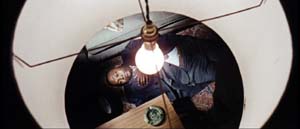
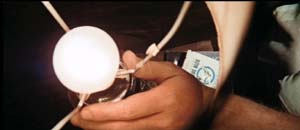
There’s even wilder stuff: a murder victim seen through a hanging lamp, for example.
The Geek reads up on long lenses, wide-angle lenses, and so on. Knowing nothing about Techniscope, he wonders how these extravagant shots got made. Just as important, why are they here (apart from looking cool)?
(Spoilers coming up. Skip to 3 if want to retain your innocence.)
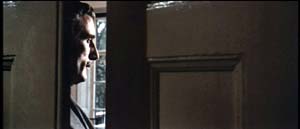
After a couple viewings, the Geek begins to get a hunch about what those lampshades are doing there. Throughout the movie, actors are shot in juxtaposition to looming shapes–doors, lecterns, tabletops–which mask large stretches of the set.
And sometimes those blocking objects are lampshades.
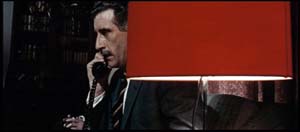
At a climactic moment, our hero escapes from torture and calls his superior officer, who’s framed in the usual off-center way, with a lampshade dominating the shot. It works as a sheer (and pretty) block of solid color.
Turns out, however, that this time the shade actually conceals something important. The officer withdraws behind the shade and out pops a guest sitting alongside him.
The guest is the arch-villain. Now we know the officer is a traitor.
The Geek dimly realizes three things.
*A movie sets up visual “rules” it will follow or violate. (Later the Geek will call these intrinsic norms.)
*Visual motifs build up across a film, sometimes asking the viewer to notice them.
*A motif can seem gratuitous but that very gratuitousness can be exploited for storytelling purposes. When we see the red lampshade, we assume that it’s another decorative flourish, not a way of hiding information. Earlier sequences suggest that the device is a mannered tic but at the climax it helps spring a surprise. Motifs, the Geek would realize eventually, can fulfill narrational functions–that is, motifs can shape the ongoing flow of story information.
3. Sidney J. Furie was considered a showoffish filmmaker. Michael Caine said he belonged to the look-Ma-I’m-directing school. Certainly the outrageous compositions involving Marlon Brando’s sombrero in The Appaloosa back up that charge.
But like Richard Lester, Ken Russell, and other fancy-pants pictorialists, Furie can at least get us to notice technique. Not bad to cut your cinephile teeth on. Or at least so the Geek thinks, forty years afterward.
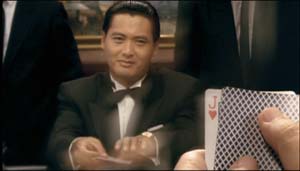
4. The AC article also talks about the problem of making poker games interesting. Hong Kong filmmakers figured this out long ago. Martin Campbell, director of the new 007 adventure, should study the crisp card sequences in Wong Jing’s God of Gamblers series. Filmed on a minuscule budget, they put the strained and blandly shot poker scenes of Casino Royale to shame. Incidentally, Wong’s use of diopters yields the sort of nifty depth that Meheux liked in Ipcress.
God of Gamblers.
PS: Casino Royale didn’t learn the lessons of the 1960s well enough, in my view. After the sparkling opening credits, it was all downhill. The usual problems: overcut scenes, overcloseupped acting, incoherent chases and fights, uninspired dialogue you recite just before the actor says the line. One landing-strip truck fracas amalgamates Road Warrior, Raiders of the Lost Ark, and Die Hard 2. The makers have indeed updated the Bond franchise. After a series of lame 1970s-looking movies, the franchise has given us a lame contemporary-looking movie.
Granted, I never cared much for the Bond pictures. The Geek liked From Russia and Goldfinger, and Diamonds Are Forever is enjoyable in its wacko way. But for Machiavellian intrigue, Fritz Lang’s Spies remains the gold standard. No one can make ’em like he used to.






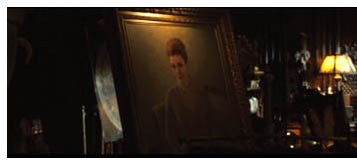 Still, the extra scenes and bits do make a difference, though it’s often minor. In the scene at Teabing’s (Ian McKellen) country house where the group moves from the kitchen to the study to look at the Last Supper slides, the establishing shot of the new setting has an oil painting of a woman framed prominently in the foreground. It presumably was meant to hint at a backstory for Teabing, some great lost love whose absence may have contributed to the man’s obsession with the Grail. The painting is clearly visible in one shot of the shortened version, but since it comes during the invasion of the house by Silas (Paul Bettany), the viewer is not likely to notice it.
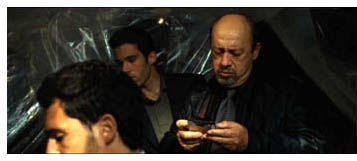 inspects an elaborate surveillance post in the barn, including recordings marked with the names of the four men killed by Silas. This event makes it quite clear why in the climactic scene at Westminster Abbey Fache arrests Teabing rather than Langdon and Sophie. In the shorter version, his change of quarry is rather fuzzily motivated by his realization that Aringarosa has duped him. (Maybe I missed some other plot point, but the surveillance-post scene certainly makes things clearer.)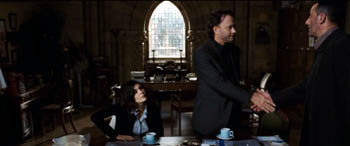
 Not to mention the cast of characters, all colorful. In the late 1960s-early 1970s the film community included: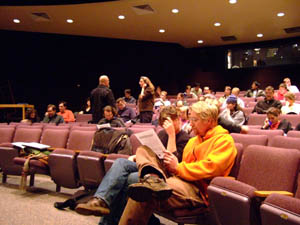

 For a Few Dollars More.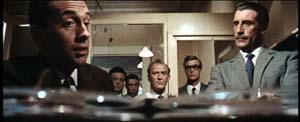
 God of Gamblers.
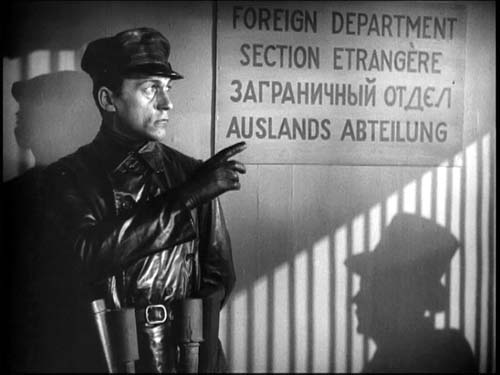 Spies
Spies