by Kristin Thompson. Berkeley: University of California
Press, 2007.
400 pages, 6 × 9 inches, 12 color illustrations;
36 b/w illustrations.
[go
to Amazon | go to The Frodo Franchise blog]
Why, asks Sharon Waxman in the New York Times, have the much-touted directors of the 1990s slowed their output so drastically? Kimberly Peirce released Boys Don’t Cry in 1999; her second film, Stop-Loss, will come out this spring. Darren Aronofsky followed Requiem for a Dream (2000) with The Fountain, which hit screens last fall. Paul Thomas Anderson’s Punch-Drunk Love is over four years old. David O. Russell, Spike Jonze, David Fincher, Baz Luhrmann, and several others of their generation have, Waxman points out, “taken long hiatuses before stepping back up to the plate.”
Immediately, exceptions spring to mind. Some filmmakers who built their careers in the 90s are pretty prolific. Soderbergh is the prime instance; he sometimes releases two movies a year. Christopher Nolan has given us several one-two punches: Memento in 2000 and Insomnia in 2002, Batman Begins in 2005 and The Prestige in 2006. James Mangold is now doing postproduction on 3:10 to Yuma, his seventh movie since 1995. Kent Jones reminds me that Richard Linklater has finished twelve features in under 16 years!
Still, the slow pace of some heralded filmmakers is noteworthy. Waxman’s explanations, culled from interviews with Hollywood cognoscenti, intrigue me. Probably no one explanation will provide the answer, but it’s worth thinking about the many forces at work. I’ll run through Waxman’s five main points, commenting on each. Then I’ll toss in a few of my own.
1. Filmmakers undergo closer scrutiny and quicker judgments than at earlier times.Critics, audiences, and studios pounce on every failure, and with investments becoming more precarious, a single weak showing can push the director down the list.
Seems plausible to me, given the dumping of Shyamalan after Lady in the Water. Shyamalan is ambitious in his storytelling aims, trying to turn genre movies into art movies/ event movies à la Kubrick. Unlike Kubrick, he’s not winning a secure place as a person you want to be in business with. Strange as it sounds, a director who has earned over a billion dollars at the global box office is making the rounds trying to sell his newest idea.
2. Filmmakers are pressured to write lucrative scripts rather than direct questionable projects, or to direct sure-fire franchise hits(e.g., Bryan Singer and Superman and X-Men).
Partly true. But a producer friend commented to me that a lot of indie filmmakers whom he meets sincerely want to direct big films. Bryan Singer, who admires Spielberg, hasn’t made a secret of his desire to be a mainstream filmmaker. Aronofsky was long involved with Frank Miller on a new Batman, and Karyn Kusama moved from Girlfight (2000) to Aeon Flux (2005).
3. An overindulgent studio culture lacks strong executives who would challenge precocious filmmakers to extend themselves.
Put aside the fact that this explanation is somewhat opposite to the previous one.It’s hard to claim that today’s executives are too complaisant; surely one reason for the delays in output is resistance from the studios’ to directors’ ideas. If executives might be reluctant to derail a project, certainly stars are willing to do so. Once a picture enters production, however, it is more difficult for today’s executives to curtail the pricey directors to the extent that classic studio-era moguls could. The director’s demand for final cut, for instance, is still a powerful chip in the game.
4. The 90s directors might not be capable of dealing with the big issues of a post-9/11 world. Waxman writes: “Perhaps Quentin Tarantino, child of the video culture, feels at a loss when faced with the war in Iraq and global terrorism.”
It might be too early, though, for filmmakers to come to an initial understanding of this ongoing crisis. The major films treating Vietnam appeared some years after we pulled out: Twilight’s Last Gleaming, Coming Home, The Deer Hunter, Apocalypse Now, and so on. Moreover, not all films need to deal with big issues, at least directly. What aspects of American politics did Pulp Fiction and Memento address?
5. There’s no shared creative community, in which filmmakers help and compete with one another. Three currently successful directors from Mexico, Alejandro Gonzalez Inarritu, Guillermo del Toro, and Alfonso Cuaron exemplify how a cadre of friends can offer frank criticism and spur one another on.
Oddly enough, James Mottram’s book The Sundance Kids: How the Mavericks Took Back Hollywood maintains that just this sort of community exists among several 90s directors. The book opens with a meeting of the Pizza Knights, a cadre of young filmmakers who gather every month to watch 70s classics. The group includes Fincher, Jonze, Anderson, Peirce, and Payne (p. xv)—the very directors whom Waxman lists as surprisingly unproductive. They may not bond with older directors, but according to Mottram they constitute a pretty tight group.
Some other possibilities strike me.
*Maybe this particular batch of directors is just an easygoing demographic. Tarantino took his time moving from Jackie Brown (1997) to Kill Bill: Volume 1 (2003). The Virgin Suicides came out in 1999; does Lost in Translation (2003) look like a movie it took four years to make? They don’t call it Gen X for nothing.
*We should consider the possibility of burnout. Dwight Macdonald once remarked that the stress of making one film is much more intense than painting a picture or even writing a novel. It’s deeply exhausting on many levels. MacDonald speculated that across their careers filmmakers are likely to slow down or burn out or just make weaker films. We can all think of exceptions (Manoel de Oliveira is still turning out extraordinary films at age 98), but filmmaking does require a lot of energy. This might be especially the case if a director achieves early success, because the demands of each new project can escalate before the director finds her or his comfort level.
*Making just one film takes a long time. Aronofsky’s years of effort to produce The Fountain are well-known, as are Luhrmann’s problems with a life of Alexander the Great. Even a midrange project might be years in preparation before it finds backing. Once the project is approved, there can be months of preproduction, several months of shooting, and over a year of editing. To launch any big film, the director and stars will be meeting the press, traveling to foreign markets for promotional events, and preparing the DVD supplements. A lot of this will be happening just before or soon after the film’s release, slowing progress on the next project. The avalanche of such demands can only increase your respect for the stamina and multitasking abilities of Spielberg and Soderbergh.
Hong Kong and Japanese directors can be more prolific because the industry is more small-scale and there isn’t the same demand to promote the film afterward. Johnnie To turns out two films a year, Miike Takeshi more than that. They get to develop a body of work that, despite its ups and downs, has a texture lacking in one- or two- or three-shot wonders.
*The market has consolidated. An earlier wave of indie directors like John Sayles, Spike Lee, Gus Van Sant, Oliver Stone, and the Coens faced a fairly diverse marketplace. Their films benefited from the emergence of home video, overseas television outlets, mini-majors, and small but fairly well-funded distributors. They quickly built up individual identities–brands, if you like–that still give them some clout with studios and make them more productive than the group Waxman profiles. Although there are many distributors on today’s landscape, most are tiny. The younger indie auteurs, I think, face a more homogeneous system, with studios and their boutique divisions controlling a larger share of funding and more distribution outlets. There are fewer cozy niches for small, quick projects.
*Finally, there’s critics’ hype. Perhaps too much was expected of these rather untried directors. If you’re called a genius on your first or second outing, how can you top that? Consider these heroic descriptions:
With their films, the rebels of the 1990s shattered the status quo, set new boundaries in the art of moviemaking, and managed to bend the risk-averse studio structure to their will. They created a new cinematic language, recast audience expectations, and surprised us—and one another.
Quentin Tarantino, the rabble-rousing writer-director of Reservoir Dogs and Pulp Fiction . . . very early in the decade broke every rule in moviedom.
The movies of the new rebel auteurs . . . played with structure, wreaked havoc with traditional narrative form, fiddled with the film stock, and ushered in the whiplash editing style true to a generation of video game children.
In the perspective of film history, these claims are sheer nonsense. (I try to show why in The Way Hollywood Tells It.) They aren’t good prophecy either. I ♥ Huckabees and The Life Aquatic with Steve Zissou didn’t exactly bend the studios to their directors’ will. In any event, such guff overheats the creative climate. Filmmakers aren’t granted a more gradual and modest exploration of their strengths and limits. When they fail, they may fail spectacularly.
By the way: the author of the souped-up passages I just quoted? None other than Sharon Waxman. (1)
(1) Sharon Waxman, Rebels on the Backlot: Six Maverick Directors and How They Conquered the Hollywood Studio System (New York: HarperCollins, 2005), x-xi.
PS Monday: Based on some intriguing box-office data, Karina Longworth gives a sharper-tongued rebuke to Waxman in her lively post here.
Perhaps the most enduring legacy of The Blair Witch Project was the idea of promoting the film through a faux website that treated the lore around the Witch as genuine. Later, the promotion for Spielberg’s A.I. created an alternate reality game (ARG) by scattering clues to a murder among many websites. The murder wasn’t part of A.I.‘s plot, but it did take place in the film’s fictional world, and online participants pursued an elaborate para-narrative that connected obliquely to the movie. A key character in the ARG, researcher Jeanine Salla, was listed as an actor in the film’s final credits. Ms. Salla evidently died a grisly death herself, as the autopsy report above indicates. She led other lives in fanfiction and online comic strips.
Now, for The Great World of Sound, director Craig Zobel has created a website. Nothing new in that. But Zobel also provides a website for a fictional companyin the film. Here’s Screen International’s take (19-25 January 2007, print ed., p. 36):
It’s the 21st century equivalent of the film within the film—the fictional website of the shark-like record company in the movie. It’s everything you’d expect from a shady music company—flashing primary colors, bad clip art, typos and scrolling fonts, all to the sound of a soul-killing MIDI song file.
It starts well (banner reading, “You’re ad here”) but I found it not as wild as the SI description implies. Still, the idea is good, the execution diverting. Visit it here.
In a parallel thrust from Bookland, Jacquelyn Mitchard’s forthcoming young adult novel Now You See Her is being promoted by a series of YouTube video diaries purportedly made by the heroine, Hope Shay. The first one is up, and already at least one viewer thinks it’s the McCoy. (1)
We can probably expect to see more extensions of fictional worlds to the webworld. Are Hannibal Lecter podcasts next? Or an online university for which reading Special Topics in Calamity Physics is a prerequisite? See Henry Jenkins’ fine Convergence Culture for more on the A. I. puzzle ARG (pp. 123-128) and reflections on cross-media storytelling in general.
(1) Full disclosure: Hope is played by Lauren Peterson, the daughter of old friends Sue Collins and Jim Peterson. They also live down the street from us. Jim, now an attorney, took a Ph. D. in film studies here at UW. He’s the author of Dreams of Chaos, Visions of Order, an outstanding study of American avant-garde film.
PS Monday morning: I don’t watch much TV; The Simpsons, Olbermann, Ebert & Roeper, and the movie channels are pretty much it. So I’m grateful to Olli Sulopuisto for telling me that Lost has created its own ARG, The Lost Experience and that there’s a website for the fictional Hanso corporation. Much, much more can be found on the fansite.
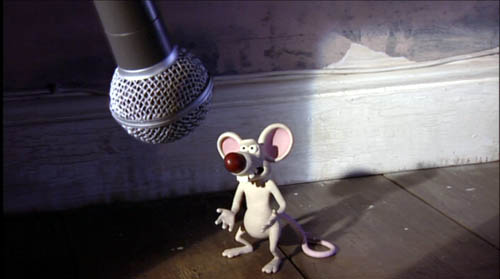
On December 6, 2006, I commented on a Variety article which suggested that DreamWorks was probably going to sever its distribution pact with the British animation firm Aardman. The reason was the poor box-office performances of Wallace & Gromit in the Curse of the Were-Rabbit and Flushed Away.
At the time I claimed that DreamWorks had not done a good job promoting either film, despite its earlier success with its first Aardman release, Chicken Run.
Now, as Variety predicted, on January 30 Aardman announced that they would no longer be distributing through DreamWorks. The official press release on the firm’s site states:
“We’ve enjoyed a hugely successful and creative relationship with Jeffrey and DreamWorks Animation,” stated Peter Lord and David Sproxton, co-owners of Aardman Animations, “but both companies are aware that our ambitions have moved apart, and it feels like the right time to move on. Aardman has an ambitious slate of feature film projects in development and will announce their future production and distribution plans shortly.”
Variety’s coverage of the split quotes another Aardman spokesman, Arthur Sheriff: “The business model of DreamWorks no longer suits Aardman and vice versa, but the split couldn’t have been more amicable.”
The report notes that Aardman is currently making a series of seven episodes of an American version of its hit British TV show Creature Comforts. (The two seasons of the British series are available on DVD.) CBS ordered the episodes but has not yet announced when they will be aired.
Variety’s article remarks, “Skein could be another test of whether U.S. auds have cooled on Aardman’s claymation style and quirky British humor, which stands in sharp contrast to the fast-paced, jokey CG toons of DreamWorks and most other American animation studios.
This looks like a case of blame the victim. American audiences haven’t had much of a chance to warm up to Aardman’s style. DreamWorks made little or no attempt to promote Aardman as a brand or to make the signature characters, Wallace and Gromit into stars as familiar as Shrek. (I’ll take the penguin in The Wrong Trousers over the ones in Madagascarany day.) Maybe DreamWorks subscribes to the peculiar notion that there may be too many 3D animated features in the market. Or maybe becoming a subsidiary of Paramount has made its executives determined to stick to the tried and true and exploit the Shrek franchise until it drops below its target income. Or both.
I suppose the ideal would be for Pixar/Disney to pick up the American distribution of Aardman’s future films. John Lasseter and company know how to sell a toon.
David and I just saw Pan’s Labyrinth at our local multiplex. It was an unusual experience. Subtitled films don’t often make it out of the art-houses and into the more popularly oriented theaters. It happened in 2000 with the surprise success of Crouching Tiger, Hidden Dragon, which made $128 million domestically on a $17 million budget. That’s a huge crossover, and it had people who had never seen a foreign film reading subtitles for the first time in their lives.
Many of those subtitle novices said that after a short time they got used to reading the dialogue and weren’t bothered by them. At the time it seemed as though Crouching Tiger might have broken down a barrier, and other foreign-language films would find similarly large audiences. Alas, it did not happen.
True, directors nowadays feel able to use sub-titles occasionally. Steven Soderbergh made Traffic with Spanish-language scenes, and Alejandro Gonzáles Iñárritu uses the appropriate languages for the various settings of his network narrative, Babel. Clint Eastwood, who doesn’t even speak Japanese, managed to make a whole film in that language—one that became a hit at the Japanese box office.
A new distributor specializing in art films, Picturehouse (a division of New Line) acquired Pan’s Labyrinth for U.S. distribution fully a year ago. (The film has played in most other countries before being coming out here.) Picturehouse has successfully marketed it to the large Hispanic-American audience and to fantasy fans. It also timed the release to position the film prominently for Academy of Motion Picture Arts and Sciences voters just as nominations voting was underway. The result was six Oscar nominations: Cinematography, Art Direction, Musical Score, Makeup, Original Screenplay, and Foreign Language Film (from Mexico).
Pan’s Labyrinth is a wonderful film, with highly imaginative fantasy scenes and two major characters with whom the audience comes to strongly identify. It’s absorbing and not at all the pretentious art film of popular stereotyping. It’s a pity that anyone would miss seeing it because they believe that reading subtitles is a chore and a significant distraction.
(I ask myself, can a generation used to learning elaborate strategies for videogames and reading the various icons that appear during their fast action really be so unable to deal with some words on a movie screen?)
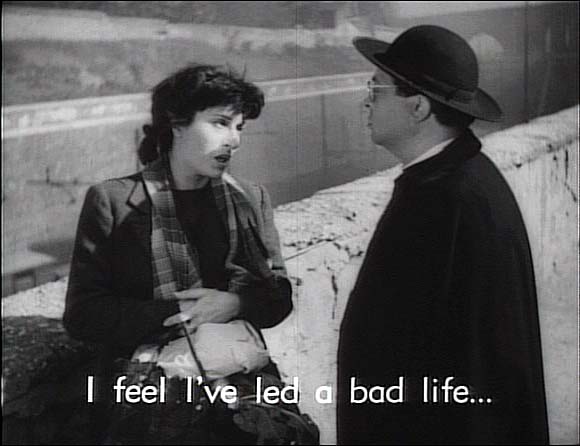
“Observations on film art and Film Art” has come to have a gratifyingly broad readership during its short existence, and many people who visit us no doubt regard subtitles as a familiar and painless part of filmgoing. Still, seeing Pan’s Labyrinth reminded me that we are now at the beginning of the spring semester in many colleges and universities. Almost any professor teaching introductory film courses is no doubt hearing some familiar complaints. Why do we have to watch films with subtitles? Why do we have to watch black-and-white films? Why do we have to watch silent films?
We discuss such issues in Film Art, mainly in relation to subtitles versus dubbing. Substituting different actors’ voices for the original ones destroys an important part of the original film’s style and appeal. And as everyone knows, even the best dubbing job fails to make the words we hear synchronize convincingly with the lips movements we see. Is reading subtitles really more distracting than listening to dialogue that’s clearly not coming from the people on the screen?
What we don’t discuss much in the book is the more important reason for watching films with subtitles, shot in black-and-white, and made in the era before sound was introduced. It’s simple. Avoid those films, and you deny yourself access to a vast potential for exciting movie-going experiences. The approach we took to choosing examples for Film Art reflects that fact. We mentioned as many types of films as we could, drawing on a wide range of national cinemas and periods.
I suspect that a lot of students come into their first film course thinking they know a lot about the cinema. This was certainly the case for me. During the 1960s, when I was in high school, I had lived in Miami, so there were a number of art-houses that I could get to on my own, thanks to my new driver’s license.
I saw a lot of films that I suspect my classmates would have thought of as esoteric. One repertory house ran 1950s and 1960s Alec Guinness and Peter Sellers comedies. Another had more recent imports: Georgy Girl, The Knack, and Darling from swinging England, Zorba the Greek (which, though from Greece, was in English), and Marriage Italian Style, with actual subtitles.
I was also naive enough to think that the Oscars really went to the best films of the year. (I’ll be posting on that topic next week.) I tried to see as many of them as I could, which meant that if I wanted to see the older ones in those pre-home-video days, I had to catch them on TV. I also saw The Pawnbroker, Who’s Afraid of Virginia Woolf, A Man for All Seasons, Bonnie and Clyde, and other prestigious films when they first came out, and I thought myself very sophisticated for doing so. The only auteur whose name I recognized was Hitchcock, so I saw Torn Curtain in first run. I couldn’t figure out what all the fuss was about, and it wasn’t until I started taking film classes that I found out.
I don’t recall that reading subtitles ever caused me any problems in those days. They never bother me, except of course when they’re printed white-on-white—or when they’re in French, which I can’t read quickly enough to keep up.
So when I went off to the University of Iowa in 1967 to study theater design, I had seen black-and-white films and subtitled films. I had never seen silent ones, except for maybe a few Chaplin shorts run at sound speed on TV. There weren’t all that many silent films around in those days. The great revival in the study of silent cinema was just starting, and it really got rolling in the 1970s. So vague was my knowledge of film history that I thought The Birth of a Nation was the first film ever made.
I took my first film course in the spring semester of 1970s. It was an introductory film history class, taught by Dudley Andrew. (The University of Iowa had been offering a Ph.D in cinema for only a few years, and Dudley himself was a graduate student at the time. Three years later I was his teaching assistant for that same course.) I took it because I had a busy schedule working on theater productions, and it was literally the only course in the whole department (film and theater were in the same department in those days) that didn’t conflict with my other commitments.
I had kept going to films at art-houses during my undergraduate career, and as the semester began I still thought that I knew quite a bit about the cinema.
Early that semester two things happened that changed that belief. First, someone from the Library of Congress came and gave a talk, which I attended. He showed some recent restorations: a very early French comedy with hand-stenciled color and George Méliès’s 1905 film Le Raid Paris-Monte Carlo en 2 heures (which for years I thought of as From Paris to Monte Carlo). In the latter, the miraculous car that made the journey in an impossible two hours was hand-painted red. It wasn’t the neat hand-painting that used stencils, though. It was blobs of paint daubed onto each frame in the general area of the car, with the rest of the image left in black and white.
The result was a wavering red patch that moved about in the general vicinity of the car, overlapping its outlines, as if the car were on fire. It was quite unlike anything I had ever seen. The film itself is quite funny, but the alien color utterly charmed me. I began to suspect that the cinema held treasures that I had never dreamed of.
A short time later, Dudley showed Das Cabinet des Dr. Caligari for the film-history class. It’s a 1920 German Expressionist film, a classic that shows up on the screening schedule for many courses. This time I was bowled over. Again, it was totally different from anything I had encountered before, and I gave up my idea that I knew anything significant about the cinema. From that point, I cut way back on my theater-production activities and took film classes, going on to graduate school in that subject. I had embarked on a lifelong project of learning about the cornucopia that was the cinema, past and present, American and foreign. It has been a wonderful journey, and it is still going on.
Obviously not everyone going into a film class will have this sort of life-changing experience. Still, it could be an experience that has a lasting impact by broadening and enriching the experience of filmgoing.
This is why students should welcome the chance to watch subtitled films, black-and-white films, and silent films. After all, what is the point of taking a film course, especially if it’s an elective class, if we reject unfamiliar sorts of movies? If professors taught only recent English-language color films, they would only be doing half the job. Yes, students could learn all the formal principles and cinematic techniques we lay out in Film Art, and they would probably go away with an enhanced ability to watch a film. They still wouldn’t have any idea of all that the cinema, as it has existed from the 1890s on, has to offer.
I believe that some of the reluctance to experience new sorts of films comes from two faulty perceptions. First, people still tend to think of the cinema as a lesser art form than classical music or painting or theater or literature. Second, people often think that because they’ve been watching movies all their lives, they know more about them than they do about classical music or painting or theater or literature.
Neither is true. The cinema has produced films that are great works of art. One can’t just look at modern blockbusters and conclude that the cinema is doomed to be puerile entertainment. A disturbing number of educated people who do know something about classical music and painting and theater and literature have never heard of Jean Renoir and Sergei Eisenstein, let alone Yasujiro Ozu and Jacques Tati.
Would the same students who don’t like the idea of watching black-and-white films go to the professor in a course on art history and complain about being shown engravings by Rembrandt rather than his paintings? Would they listen to an opera in a music class and complain because it’s in Italian? Would they read a Shakespeare play and complain that the language is just too weird? I suppose a few would, but students going into such classes usually understand that they are going to be confronted with artworks of a type they’re not familiar with.
And for those who feel they know a lot about films, they would do well to adopt a little of the humility that I felt after seeing that strange little red car and the bizarre style of Das Cabinet des Dr. Caligari. I realized that going to a lot of current American movies barely scratches the surface.