Hero.
Kristin here—
Note: This entry was written for Jim Emerson’s Contrarian Blog-a-Thon (III).
When David and I got into film studies in the late 1960s and early 1970s, an era of Hollywood’s history was drawing to a close. Many of the great directors who had defined the classical studio era from the period of World War I to the early age of television were at or approaching retirement. Andrew Sarris’s pivotal book, The American Cinema: Directors and Directions 1929-1968 (1968) came out just in time to elevate their reputations by dubbing them with the fashionable French term auteur.
John Ford and Howard Hawks made their last films in this period (7 Women, 1966, and Rio Lobo, 1970). Alfred Hitchcock, Otto Preminger, and Vincente Minnelli kept driecting into the 1970s, though few would say their late films stacked up to their earlier ones. (Preminger did manage to struggle back after a string of turkeys to make a very creditable final film, The Human Factor, in 1980.) Sam Fuller kept working through the 1980s, but he had to go to France to do it. Billy Wilder’s last film came out in 1981, though most of us wish he had stopped with The Private Life of Sherlock Holmes in 1970.
The decline of these greats coincided with the rise of the New Hollywood generation, whose directors, originally dubbed “the movie brats,” have become the grand old men of the current cinema. It also coincided with the early rumblings of the blockbuster (Jaws, 1975) and franchise (Star Wars, 1977) age that we know today. Definitely a shift took place in the 1970s, but to what?
Many film historians have claimed that the films that have come out of Hollywood since roughly the end of the 1980s are radically different from those of the classical “Golden Age.” Factors like television, videogames, spectacular special effects, moviegoers with short attention spans, the internet, the acquisition of the old studios by multi-national corporations, and the resulting rise of franchises have all putatively given rise to a “post-classical” cinema. This phenomenon is sometimes also referred to as the “post-Hollywood” or “post-modern” era.
I’m suspicious of the “post” terms, vague as they are. Usually stylistic labels describe what something is, not what it follows. Do we speak of “post-silent” or “post black-and-white” cinema?
Post-classical films supposedly jettison the old norms of style and storytelling. Frenetic editing, constant camera movement, product placement, juggled time-schemes—these and other tropes of recent cinema have replaced the continuity system, the carefully structured screenplay, and the character-based storytelling of the classical era. Computer-generated imagery has enabled filmmakers to create action scenes, spectacular settings, and fantastical creatures that hold our attention so thoroughly that the plot ceases to matter.
Or not. David and I have spent much of our professional careers studying the norms of classical filmmaking. We’ve swum against the stream by claiming that, despite many changes in style and technique, the fundamental norms of classical storytelling have remained intact. The classical cinema is with us still, precisely because it enables filmmakers to present us with absorbing plots and characters. It also is a flexible filmmaking approach that can absorb new technologies and new influences from other media and bend them to its own uses.
It’s less seductive to proclaim a long-term stability in Hollywood than to trumpet revolutionary, transformational, epochal changes. Still, some things just work so well that people want to keep them going as is. American films have dominated world screens since 1915. Why tinker with an approach that works so well?
It’s amazing to think of it now, but back in the late 1970s, virtually no one had studied the traditional norms of Hollywood filmmaking. We all knew what the distinctive traits of the great auteurs were, but distinctive as opposed to what? Academics kept saying that someone should figure out just what the cinema of the classical studio era consisted of. What principles guided filmmakers? What assumptions did they share? Not realizing how much material was available on Hollywood cinema, we and our colleague Janet Staiger set out to document the norms of style, technology, and mode of production that composed the “classical Hollywood cinema.”
The result was a much larger tome than we had expected, The Classical Hollywood Cinema: Film Style and Mode of Production to 1960 (1985). After finishing it, David and I dusted off our hands, figuring that we had dealt with that topic. We went back to studying non-classical directors like Ozu, Eisenstein, Tati, Godard, Bresson, and Hou, confident that we had the knowledge to show exactly how and why their work differed from standard filmmaking.
Then claims about post-classical filmmaking started to appear. In our book, we had limited our survey to pre-1960 cinema because the breakdown of the studio structure and the competition from television led to a different situation in Hollywood. We did not, however, say that classical filmmaking died then. Quite the contrary; we said that it had endured through those changes in the industry.
Those favoring the post-classical explanation obviously disagreed with that. Bypassing our claims for the endurance of classical filmmaking, they borrowed our cut-off date of 1960, as if we had intended that year to signal the end of all aspects of the classical cinema—style, storytelling, mode of production, technology, the whole thing.
During the 1990s it became apparent that claims about post-classical cinema were becoming one very common way of dealing with modern Hollywood films. We decided to move well beyond 1960 and show that classical norms still prevail in American mainstream cinema. I wrote Storytelling in the New Hollywood (1999), which analyzes ten successful films of the 1980s and 1990s to show that they use narrative principles that are virtually the same as those that were standard in the 1930s and 1940s. Goal-oriented characters, dangling causes, appointments, double plot-lines, carefully timed turning points, redundancy—all these classical devices are still very much with us. The claim was not that every single film coming out of Hollywood adhered to classical norms, only that the vast majority did.
David went on to make a similar argument in The Way Hollywood Tells It (2006), though he deals with visual style as well as narrative. There he examines some of the new norms of storytelling, showing how they are variants of the older classical system. He discusses, for example, “intensified continuity,” where tighter framings on actors, faster cutting, and prowling camera movements have modified but not replaced the standard continuity approach to presenting a conversation scene.
One of the most persistent claims by proponents of a post-classical era is the spectacle made possible by CGI. With the thrilling fight sequences of The Matrix, the vast battles of The Lord of the Rings, the extensive recreation of historical places of Gladiator, and the fantastical creatures and places of The Chronicles of Narnia: The Lion, the Witch and the Wardrobe, the individual scene supposedly becomes more spellbinding than the story in which it is embedded.
David and I have tried to refute this claim to some extent. I talk about Terminator 2 in the first chapter of Storytelling, showing that it has a tightly constructed, character-based narrative. David has a chapter section called “A Certain Amount of Plot: Tentpoles, Locomotives, Blockbusters, Megapictures, and the Action Movie,” where he examines films like Judge Dredd and The Rock. He demonstrates that they, too, have plots that adhere to traditional Hollywood norms. He puts forth a more detailed analysis in this online essay.
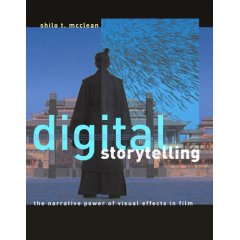 We’ve never really dealt much, however, with the issue of how CGI may or may not have elevated spectacle over narrative interest. Luckily now a new book does that and does it very well. Shilo T. McClean, in her Digital Storytelling: The Narrative Power of Visual Effects in Film (MIT Press, 2007), agrees with much of what we have claimed about the survival of classical filmmaking (though The Way Hollywood Tells It came out too late for her to have seen it). She builds upon our case by examining systematically and imaginatively the question of whether digital special effects support narrative interest. McClean convincingly demonstrates that DVFx (digital visual effects), as she terms them, are used in an enormous variety of ways, and most of these help to tell classically constructed stories.
McClean’s basic points are two. First, DVFx are not used just in the more obvious ways, for big action scenes or elaborate fantasy and science fiction settings. They are applied for a wide range of purposes, from dustbusting (removing dust and other minor flaws from frames) to spectacular scenes. Far from being inevitably spectacular, DVFx are often invisible. (1)
Second, McClean claims that whether modest or spectacular, DVFx usually serve the narrative in some way—and she points out that practitioners in the industry invariably make that same claim.
Digital Storytelling started out as McClean’s dissertation at the University of Technology Sydney. It betrays its origins in a survey of the literature that takes up the first two chapters. There the author is somewhat too conciliatory, for my taste anyway, to a number of theorists’ claims about the breakdown of narrative in the digital-effects age. She tries to find something useful in each writer’s position, even though some of those positions are irreconcilable with the general standpoint she adopts.
Chapter 3 sketches the history of computer graphics and how they came to be used in films. McClean points out that DVFx are perfectly suited to the three criteria for the adoption of new technology that David and Janet formulated in their sections of The Classical Hollywood Cinema: greater efficiency, product differentiation, and support for achieving standards of quality. Like sound and color, DVFx have marked a major technological shift for the film industry, but like them, DVFx have been readily integrated into the existing division of labor. A modern digital studio, as she says, functions in much the same way as a physical one does. Indeed, in watching the credits of a modern film, we see lighting, matte paintings, and so on listed as the specialties for the digital craftspeople.
In these early chapters, McClean points out that in many ways DVFx simply replaces the traditional special effects of the pre-digital age. Most of Citizen Kane’s many effects are not supposed to be noticeable, and indeed for years historians were unaware of just how many it contained. In cases where DVFx create a flashy effect, as in the virtual camera movements through walls in Panic Room, the function is to inform the viewer of the locations of various characters and create suspense. Probably the most vital lesson one could take away from this book is that techniques can serve multiple purposes in a film. Spectacularity, as McClean calls it, and storytelling can co-exist in the same digital images.
The author also explains that, unlike what many writers say about DVFx, they are not simply a post-production technique used to ramp up the visual appeal of a film. Computer imagery is used from the pre-production stages onward, and the mise-en-scene and camera movements must be planned around them.
After this setup, the author systematically explores the factors that might influence the storytelling—or merely spectacular—use of DVFx. As we did in The Classical Hollywood Cinema, McClean samples a large number of films, 500 including shorts. Any film using DVFx, however unobtrusively, qualified.
On this basis, the author has distinguished eight types of DVFx usage. Documentary is one, as in films where computer reconstructions of ancient buildings are shown. Such usage comes into films when information is presented as part of the mise-en-scene, as with the educational film that is screened in Jurassic Park. The second type of DVFx usage, Invisible, is fairly self-explanatory. We are not supposed to notice when buildings are extended, clouds are added to skies, or smudges on actors’ faces disappear.
Seamless DVFx are those we know must be faked, even though the results look photorealistic. The recreation of ancient cities, as with Rome in Gladiator or giant storms, as in Master and Commander, are of this type. Exaggerated effects involves actions or things posited to be real but created in a stylized fashion. McClean cites the comic effects in Steven Chow comedies, and puts wire-erasure for stunts into this category. I assume The Hudsucker Proxy would be another instance.
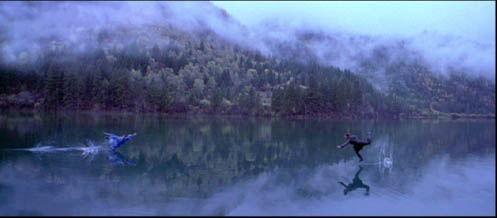
Fantastical DVXs obviously involve impossible beings like dragons, cave trolls, and a wide variety of X-Men. McClean also finds them in non-fantasy, non-sci fic films like Forrest Gump, Big Fish, and Hero. Surrealist uses of effects can include mental representations, as in Eternal Sunshine of the Spotless Mind and American Beauty, or a bizarre but objective world, as in Amélie.
Finally, there are New Traditionalist uses of DVFx, exemplified by Pixar’s films, and HypeRealist ones, like Final Fantasy.
Armed with this typology, McClean studies various approaches to film studies, testing what each one reveals about the use of DVFx. Since classical Hollywood cinema is based on character traits and goals, she begins by showing convincingly how DVFx can “establish, realize, and enhance” character. For example, films often use effects to put the protagonist in greater danger than would be safe to do in reality. The staged fights in Gladiator, the author argues, create a greater emotional engagement with the main character and make plausible the heroism that allows him to defeat his enemy in the end.
Next McClean tests how DVFx can change the impact of a film by analyzing a pre-digital film and its remake in the computer age. (As a method, this is similar to what David does in The Way Hollywood Tells It when he examines framing, editing, and other techniques in the two versions of The Thomas Crown Affair.) The case study chosen is the 1963 Robert Wise version of The Haunting and the Jan De Bont remake (1999). McClean presents considerable evidence that the inferiority of the later film has nothing to do with its expensive DVFx supernatural effects. Instead, she locates the problem partly in the removal of all the creepy ambiguity of the earlier version. De Bont also changes the heroine from a guilt-ridden, virtually suicidal woman (too wimpy in this politically-correct age?) to a strong, determined savior. The result is a conventional super-woman versus evil monster film where the digital effects stand out simply because the original story was stripped of its most intriguing elements.
McClean moves on to genre, an important subject given the apparent concentration of DVFx (the ones we notice, that is) in fantasy and sci-fi films. She rightly points out, “For all the many assertions that special effects are an emerging narrative form, no one has proposed the narrative structure that this new form demonstrates.” The author makes up for that lack herself, concocting an outline of a film based around a string of effects-laden action scenes. Her outline fits the descriptions of films as given by proponents of post-classicism. The result, however, doesn’t resemble any film I’ve ever seen.
In the genre chapter McClean uses an obvious research resource, but one that the post-classicists largely ignore. She has gone through the entire run of the special-effects journal Cinefex, on the assumption that the films it covers are those assumed to be most significant in terms of their DVFx. McClean lists the 291 films by genre, showing that sci-fi films and horror do not have a monopoly on DVFx. For example, thirty-three period and dramatic movies feature in her list.
To gauge the impact of the rise of franchises in modern Hollywood, McClean surveys the four Alien films, which begin in the pre-digital and move into the digital era. As with remakes, the author demonstrates through analysis that the decline in the series after its two first films had to do with a thematic shift and a change in the character of Ripley.
McClean does not overlook the auteur theory, tracing the work of Steven Spielberg during that same transition from pre-digital to digital cinema. Unlike the other effects-oriented giants of Hollywood, George Lucas and James Cameron, Spielberg has worked in many genres. As soon as DVFx became available, he used them in nearly all the ways listed in McClean’s typology, from the Invisible creation of the swooping airplanes in Empire of the Sun to the Exaggerated in the Flesh Fair setting in A.I. to the Fantastical Martians in War of the Worlds. Always in the service of the narrative.
Along the way McClean offers a number of astute observations. One of these is a novel argument against the “DVFx equals non-narrative spectacle” position. She points out that “In many instances technically weak DVFx will be forgiven if they are narratively congruent; it is the strength of the narrative that will carry them, rather than the other way round.” This claim is plausible when we consider how in the pre-digital age we tried to overlook the obvious back-projections and matte-work in Hitchcock films like The Birds and Marnie.
She also suggests some plausible reasons why bad films might be heavy with DVFx. In some cases the effects create a publicity hook that makes up for the lack of other production values. In others, an inexperienced director, carried away with the “cool” possibilities of DVFx, uses them to excess.
And finally someone has come out strongly against the use of the term “cinema of attractions” to describe modern films. Historian Tom Gunning originally coined this phrase in describing very early cinema, where magic acts with stop-motion disappearances and elaborately hand-colored dances were as common as narrative films. For that period, the label worked and was useful. Applying it to later eras just because films have spectacular sequences has rendered the term much less meaningful.
One thing that I particularly like about McClean’s book is that she shows respect for the films she discusses. She actually seems to enjoy both watching and writing about them. McClean asks questions of aesthetic import, and she treats films as artworks—some good, some bad, but all to be taken seriously as evidence for her case.
Her final chapter provides an excellent conclusion: “While DVFx have completely reequipped the storyteller’s toolbox, they have not rewritten the storyteller’s rulebook entirely.” Yes, classical cinema lives, and Digital Storytelling provides vital new evidence to bolster that claim.
(1) In Film Art, we have touched on this range in the section “From Monsters to the Mundane: Computer-Generated Imagery in The Lord of the Rings” (pp.249-251 in the 7th edition, pp. 179-181 in the 8th). McLean treats the topic in far more depth.












 Suo has been very quiet for the last decade, but now he’s back. I Just Didn’t Do It is arousing keen local interest, partly because of its controversial subject matter. Japan is known as a low-crime society, but gradually questions of police brutality have emerged. Suspects can be kept in custody for up to 23 days, and unique among industrial nations, 95% of all people arrested confess!