





Film forgery
Sunday | March 25, 2007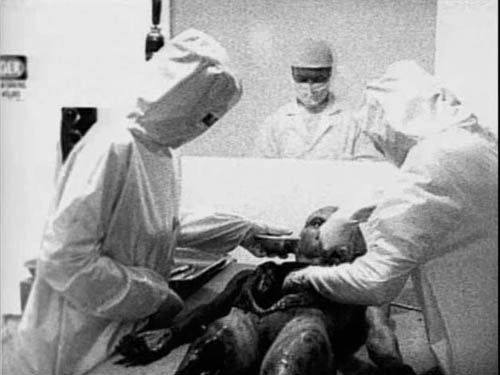
DB here:
In early July 1947, about two weeks before I was born, an alien spacecraft crashed near Roswell, New Mexico. Local ranchers found scattered debris, and soon the US government had cordoned off the area. At the crash site was a flying saucer.
Around it lay several alien creatures. They were small and slender, with large heads, dark slanted eyes, and only four fingers. They were clutching small, flat control boxes. One creature was still alive, and it was taken to an Air Force base in Texas, where it lived for a few more years. The dead bodies were autopsied, and at least one autopsy was filmed.
The US government tried to keep the Roswell incident a secret, but dogged researchers have brought to light eyewitness testimony, official documents, and leaks. There is but one conclusion to draw. We have encountered beings from another planet.
Everything I have just said is almost certainly untrue, except for that part about my being born.
Artistic crimes
Although I’ve been interested in UFOs since I was a kid, what triggered this blog was the recent scandal around pianist Joyce Hatto. Her husband has confessed that her many CD performances of classical pieces were actually digital copies of other pianists’ releases. Critics who praised her virtuosity now have red faces. Denis Dutton, a philosopher of art specializing in what he calls “artistic crimes,” has written a lively essay about the mess.
Summing up what is now a pretty well-established position in aesthetics, Dutton writes that our full understanding of an artwork depends on a general sense of how the work came to be what it is. We may say that all that matters are the words on the page or the paint on the canvas or the sounds in our ear. But our understanding of those sensory features depends upon assumptions about the origins and authenticity of the work.
Here’s Dutton:
The Joyce Hatto episode is a stern reminder of the importance of framing and background in criticism. Music isn’t just about sound; it is about achievement in a larger human sense. If you think an interpretation is by a 74-year-old pianist at the end of her life, it won’t sound quite the same to you as if you think it’s by a 24-year-old piano-competition winner who is just starting out. Beyond all the pretty notes, we want creative engagement and communication from music; we want music to be a bridge to another personality. Otherwise, we might as well feed Chopin scores into a computer.
Dutton has written many subtle and enjoyable pieces on what he calls aesthetic crimes—plagiarism, forgery, and the like. (See his website for many of these, along with continuing updates on his Hatto comments.)
Both plagiarism and forgery present a false history of how a work came into being. You commit plagiarism when you claim as your own something that somebody else created. The Hatto case is plagiarism, just as much as if one college student submits a paper that her roommate has already submitted for another course. A forgery is in a way the reverse: You make the artwork but claim that it was actually created by somebody else, typically somebody famous.
It’s interesting to speculate about what a plagiarized film would be. You can plagiarize somebody’s script by passing it off as your own. Periodically there are lawsuits from aspiring screenwriters claiming that producers ripped off spec scripts. But can you plagiarize a movie itself?
I suppose you can try, but it would be very hard to pull off. I might swipe a finished film’s negative from the lab and then make new credit sequences that replace the director’s name with mine. But I could hardly expect to get away with it, since nearly everybody involved would notice. Perhaps I could find an old forgotten film and then stick my name in there somewhere. Again, though, I’d have to explain how I could have been around to make that 1930s Monogram musical or 1960s Taiwanese kung-fu film. As Dutton points out, I’d have to tell a plausible story about how the work came to be.
What if I just swipe bits? Recall that a plagiarism can be partial or total. Even if you pluck just a paragraph or two from your roommate’s term paper and write the rest of yours unaided, that still counts as plagiarism. But if your roommate makes a film, and you lift a sequence from it for your own, the case for plagiarism seems to me less clear—especially if she gives you the same sort of permission she might grant for a paper.
Does Bruce Conner’s use of stock footage in A Movie constitute plagiarism? We assume that he didn’t shoot all this material, yet he doesn’t give credit to any of his sources. Indeed, as he once wrote to Kristin and me, “Only the splices are mine.”
We’d now be inclined to say that Conner appropriated the shots, something a great deal of contemporary art does. Rappers, samplers, and electronic artists like Moby are clearly seizing work without acknowledgment. Perhaps entertainment companies are in effect complaining that YouTube downloads and Web mashups are plagiarism. Yet there’s no intent to deceive the viewer about the source, so plagiarism doesn’t seem the right concept for these instances.
What about cases in which one director replaces another on a film project and assimilates material that the first one shot? Did Richard Lester plagiarize Richard Donner’s footage for Superman II? It sounds weird to say that; Lester just used parts of what Donner left.
Literary plagiarism can involve stealing not only exact wording but also original ideas. This is a fuzzy area, obviously, since ideas can’t be copyrighted. But it’s even fuzzier in filmmaking, where such swiping is pretty common. All those copies and unauthorized remakes of Hollywood films, like Hong Kong Pretty Woman and Kaante, the Bollywood version of Reservoir Dogs, might count as plagiarism. (The producer of Kaante calls it an homage.) Still, my inclination is to say that plagiarism is a difficult concept to transfer to the visual/moving image arts; its core application may be literary and, as the Hatto case reveals, musical performance.
Anyhow, today I’m interested in the other major aesthetic crime, forgery. The question is: Can you forge a film?
Forgery and pastiche
Nowadays, especially after Forrest Gump, we’re accustomed to seeing simulated documentary footage in fictional films. The earliest example I can recall is Citizen Kane, in which the newsreel fakes old footage showing Kane campaigning with Teddy Roosevelt or standing beside Hitler.
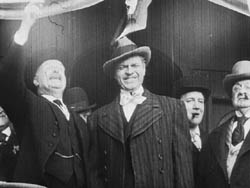
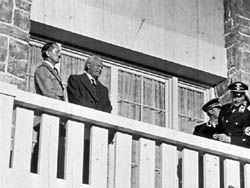
Such shots don’t claim to be factual. No matter how realistic the shot looks, the presence of the protagonist tells us that it’s functioning within a fictional tale. There is, in other words, no question of deceit. It’s a case of artistic license, somewhat like dressing contemporary actors in period costume. Had Welles claimed that he had discovered old newsreel clips containing a mysterious man who resembled him, that would be a different story.
I’d suggest that such frank efforts to mimic the look and feel of older footage fall into the category of pastiche. Pastiche is the acknowledged copying of techniques of recognized art styles. In Stravinsky’s neoclassical period, he composed Pulcinella, an overt pastiche of Pergolesi.
It’s a separate but interesting question about how accurate a filmic pastiche is. The Good German, I suggested in previous posts, tries to be a pastiche, but it isn’t very skilful. Indeed, most aren’t. Bergman’s TV film The Last Scream (1995) includes a pastiche of the great 1910s filmmaker Georg af Klercker, but it’s not faithful to af Klercker’s style. (The mock silent film in Prison and Persona is somewhat better.) Welles’ pastiche of old footage in Kane‘s “News on the March” segment is more carefully done, especially for its time. The movement is convincingly jerky for silent film shown at sound speed, and Welles cleverly scratched and mis-exposed some of the staged footage, anticipating a technique often used today.
The most convincing film pastiche I know since Kane comes in the Japanese film To Sleep so as to Dream (Yume miruyoni nemuritai, 1986). The plot involves two detectives trying to find a lost silent film, and at intervals we see clips of it, a swordplay movie (chambara). The shooting style is very close to the flashy technique we see in films from the era; obviously the director Hayashi Kaizo studied surviving chambara carefully. In one scene, a swordfighter pauses in a doorway, and we see him over the shoulder of his adversary (first image below). As the fighter makes a hurling movement, we cut in a bit closer. Suddenly the foreground figure’s arm jerks up, revealing a dagger jabbed into his wrist (second image below).
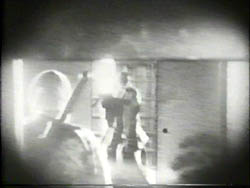
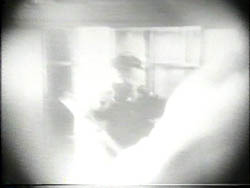
Hayashi has also faded and flared the imagery, as if our print had degraded through duping and ill use.
Pastiches aren’t forgeries because there’s no intent to deceive. Just as important, the history of their production tells us that they aren’t genuine. As Dutton points out, it’s not enough for a forgery to look like an old artwork; to succeed, it needs a provenance, a false history of creation and subsequent ownership. I can think of two well-known films that can be considered forgeries to some degree.
With typical Scottish pragmatism
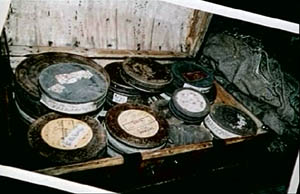
Peter Jackson and Costa Botes’ Forgotten Silver (1995) tells the story of the neglected New Zealand filmmaker Colin McKenzie. McKenzie started making films around the turn of the century, and in the course of his career he built his own camera, manufactured his own film stock, invented talking pictures and color cinematography, shot the first close-up, and erected a gigantic set in the New Zealand bush. Many experts, including Leonard Maltin and various archivists, attest to McKenzie as a visionary filmmaker on a par with D. W. Griffith.
Of course he never existed. But in the straight-faced manner of This is Spinal Tap, Forgotten Silver pretends that he did. The result is a brilliant parody of the filmmaker documentary as practiced above all by Kevin Brownlow. We get the talking-heads experts, the search for lost footage and locations, the pan-and-zoom coverage of old stills, and the terse journalistic voice-over. (“With typical Scottish pragmatism he built his farm the hard way.”) The film makes fun of nationalistic film history (we did it before the others) and the biographical convention that treats the artist as a rebellious, suffering soul.
The silliness of the enterprise is pretty apparent. The resourceful McKenzie is a one-man film industry. He devises a projector driven by steam power, he manufactures film emulsion from eggs, he builds his Salome city single-handed, and a Russian woman named Alexandra Nevsky tells us about Stalin’s interest in our hero. To anybody who knows Harvey Weinstein’s tendency to slice up the films he distributes, his remark about taking an hour out of McKenzie’s masterwork gives the whole game away.
There are clips as well. The passages from McKenzie’s Griffithian feature Salome are fair approximations of 1920s international style, a bit à la Guy Maddin, while the oldest shots look remarkably accurate.
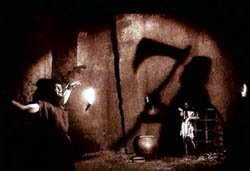
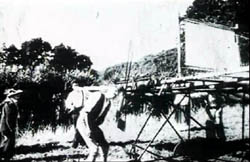
But Jackson and Botes decided to go Spinal Tap one better. Before Forgotten Silver aired on Kiwi television, they let a journalist publish a story suggesting that McKenzie really existed. The mockumentary was taken for truth, and McKenzie immediately became a new national hero. Startled, the filmmakers quickly confessed their chicanery. Some people enjoyed the laugh, but others felt cheated and muttered about artists who fool around at the taxpayers’ expense. The fullest account I know is in Brian Sibley’s biography Peter Jackson: A Film-Maker’s Journey (Hammersmith: HarperCollins, 2006), 280-302. On the web, have a look here.
Because of the Jackson/Botes hoax concerning the “rediscovered” footage, the faked McKenzie scenes became forgeries, at least for a little while. When the mischief was discovered, the clips stood revealed as parodies or pastiches of silent film. If we have reason to believe that the footage is authentic, we think of McKenzie as a pioneer filmmaker. If we’re told it’s all faked, we congratulate our adept contemporaries.
In the spirit of Forgotten Silver are other nonexistent but rediscovered filmmakers. Most recently we have J. X. Williams, conjured up by Craig Baldwin and Noel Lawrence. Williams’ Peep Show was presented as an authentic 1965 movie, although many had their doubts when they saw footage lifted from The Man with the Golden Arm and other pictures. Lawrence insists that Williams existed and has set up a website dedicated to him, but one has to believe that it’s less an effort to deceive than a PoMo performance exercise.
The Gray’s anatomy
The grandest film forgery I know is Alien Autopsy. This has been a favorite of mine since I saw the Fox TV program, Alien Autopsy: Fact or Fiction?, broadcast in the summer of 1995. Kristin and I were especially pleased to see our old friend Paolo Cherchi Usai, then of Eastman House, as a talking head in it. I got the movie on laserdisc, hoping to use it in a film theory class. I never did, but now I get a chance to blog about it! The show is available on DVD, including the full “original” footage. A useful Wikipedia overview is here.
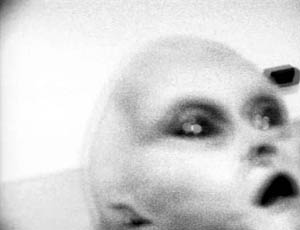
The film shows an autopsy performed on one of the saucer creatures, known in UFO parlance as a Gray. The grainy black-and-white footage presented to the public runs about 16 minutes, but it’s supposedly drawn from much more material. There seem to me three central issues in establishing its authenticity: what we are shown, how we are shown it, and when it was made.
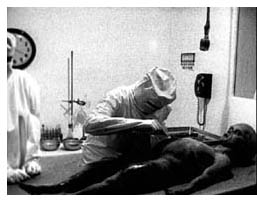 What we see is a sterile white room with a stiff Gray stretched out on a lab table. Two figures in decontamination suits move around the table, cut into the body, and remove various organs. A third, rather creepy figure can occasionally be glimpsed in a window watching. The furnishings are pretty sparse, but you can see a clock, a wall phone, a microphone, and an instrument tray.
As you can imagine, what we see has been intently scrutinized. Is the Gray an organic body or a dummy? Do the surgeons follow proper autopsy procedures? Are the clothes and furnishings faithful to the period around 1947? Special-effects experts have talked about how difficult it would be to design a fake creature, physicians have assessed the surgical techniques, and researchers have tried to establish when wall phones with coiled cords came into use. The Fox special includes some of these debates.
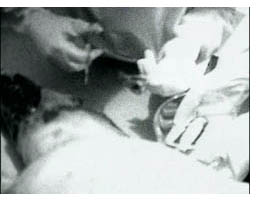 How we’re shown the autopsy has also become a matter of controversy. The film was shot with a handheld 16mm camera, and the cinematographer constantly shifts position. The camera stays quite close, circling the surgeons and moving toward and away from the corpse. As the camera draws closer to the body, the shot often goes out of focus.
Some experts on combat cinematography have claimed that this is a plausible way to cover the action. The camera weaves around because the operator is trying to stay out of the way of the doctors, and the fixed-focus lenses can’t sustain focus in the natural light of the room. Other experts have said that the authorities would have handled this momentous event in a far more careful way, employing several fixed cameras, color film, and brilliant lighting. Skeptics point out that the monochrome imagery, bobbing camerawork, and loss of focus on details all conveniently make the event harder to see.
So it’s rather hard to determine the autopsy’s authenticity just by looking at the footage. We need external information about its provenance.
Funny thing . . . that’s just what’s lacking.
When was the film made? Well, does it employ 1947 film stock? Answer: Not clear. Eastman Kodak representatives have verified that the pieces of film they were shown could have come from 1947, or from 1927, or 1967. But were the pieces of film that the experts examined taken from the footage showing the dead Gray? Not clear. Moreover, the owner of the footage steadfastly refused to submit the film to a chemical analysis that would determine its age. Big problem here.
Further, what was the chain of custody for the footage? Again, not clear.
Roswell Incident eyewitnesses tend to hang onto physical evidence for decades. One man who nabbed a debris fragment kept it on top of his TV set. But when inquiring minds ask to have a look, the artifacts suddenly go missing.
That makes it remarkable that a former military photographer identified as Jack B. came forward claiming to hold several hundred reels of autopsy footage. In the early 1990s Jack offered to sell the material to TV producer Ray Santilli. But Jack didn’t want his real name divulged. That yields another problem with establishing provenance.
Things get wilder. Michael Hesemann and Philip Mantle, in Beyond Roswell (1997), argue that the creature on the table isn’t a Roswell victim at all but a corpse recovered from one of many other crashes that took place at the time. Hesemann and Mantle have also deciphered the markings on the debris shown in Santilli’s film. The text turns out to be similar to ancient Hebrew, classical Greek, and other ancient languages. Did the Grays teach our ancestors their culture? To read this literature is truly to plunge down the rabbit hole. (That’s why I like it.)
So the when question seems to be as murky as the others.
Skeptics have torn into this movie along all three dimensions. The most convincing demolitions of it seem to me the very early piece by Joe Nickell, in the Skeptical Inquirer of November/ December 1995 and Joe Longo’s 1997 dissection on the Society of Operating Cameramen’s website. Longo, president of the International Combat Camera Association, offers a detailed critique of the case. For what it’s worth, many who believe in UFOs also immediately took the film to be bogus.
So is Alien Autopsy a forgery? Yes. Last spring Santilli admitted faking the film, but he offered a new explanation. He maintains that there was a genuine autopsy film, but after he bought it, he found that 95% of it had “oxidized,” whatever that means. So he staged and shot a film that would replicate what the mysterious Jack B. had originally shown him. Santilli explained: “It’s no different from someone restoring a work of art like the Mona Lisa or the Sistine Chapel.”
A special-effects specialist has acknowledged making the dummy Gray. Santilli also faked the inscribed debris shown in the film. At this point Philip Mantle, who had written yet another book claiming that the film might be genuine, denounced the entire affair as a hoax.
In sum, we have the intent to deceive coupled with the wrong provenance. As Dutton would point out, we see the film differently when we know what sort of achievement it is: a middling piece of fakery.
In a remarkable piece of timing, a British feature film was released just as Rick Santilli admitted his duplicity. It was called Alien Autopsy, and it shows two lads setting out to film a faked Gray autopsy. Santilli was credited as a producer. I leave it to you to decide if that movie is an adaptation, a forgery, a plagiarism, a pastiche, or just the extension of a brand.
Thanks to Paisley Livingston, Mette Hjort, and Bérénice Reynaud for discussing many of these matters with me. Paisley in particular gave me helpful pointers and showed me the af Klercker pastiche by Bergman. Thanks also to George Thomas for a factual correction.
P.S. 27 March 2007: Nate Dorward writes to remind me of First on the Moon, a 2005 mockumentary that was taken by the press as a faithful record of Russia’s space program. I haven’t seen it, but it sounds like a Forgotten Silver case: a pastiche or parody that became, inadvertently, a forgery.
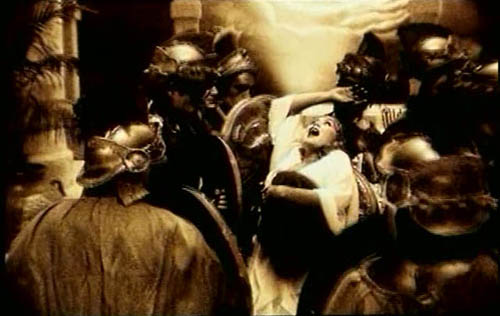
Salome crushed by the guards’ shields in Colin McKenzie’s 1920s epic Salome.
Posted in Directors: Jackson, Film and other media, Film comments, Film theory, Readers' Favorite Entries |  open printable version
| No Comments »
open printable version
| No Comments »