David Bordwell's website on cinema   click for CV

Home

Blog

Books

Perplexing Plots: Popular Storytelling and the Poetics of Murder

On the History of Film Style pdf online

Reinventing Hollywood: How 1940s Filmmakers Changed Movie Storytelling

Film Art: An Introduction

Christopher Nolan: A Labyrinth of Linkages pdf online

Pandora’s Digital Box: Films, Files, and the Future of Movies pdf online

Planet Hong Kong, second edition pdf online

The Way Hollywood Tells It pdf online

Poetics of Cinema pdf online

Figures Traced In Light

Ozu and the Poetics of Cinema pdf online

Exporting Entertainment: America in the World Film Market 1907–1934 pdf online

Video

Hou Hsiao-hsien: A new video lecture!

CinemaScope: The Modern Miracle You See Without Glasses

How Motion Pictures Became the Movies

Constructive editing in Pickpocket: A video essay

Essays

Rex Stout: Logomachizing

Lessons with Bazin: Six Paths to a Poetics

A Celestial Cinémathèque? or, Film Archives and Me: A Semi-Personal History

Shklovsky and His “Monument to a Scientific Error”

Murder Culture: Adventures in 1940s Suspense

The Viewer’s Share: Models of Mind in Explaining Film

Common Sense + Film Theory = Common-Sense Film Theory?

Mad Detective: Doubling Down

The Classical Hollywood Cinema Twenty-Five Years Along

Nordisk and the Tableau Aesthetic

William Cameron Menzies: One Forceful, Impressive Idea

Another Shaw Production: Anamorphic Adventures in Hong Kong

Paolo Gioli’s Vertical Cinema

(Re)Discovering Charles Dekeukeleire

Doing Film History

The Hook: Scene Transitions in Classical Cinema

Anatomy of the Action Picture

Hearing Voices

Preface, Croatian edition, On the History of Film Style

Slavoj Žižek: Say Anything

Film and the Historical Return

Studying Cinema

Articles

Book Reports

Observations on film art

A many-splendored thing 7: Li Han-hsiang

Monday | April 2, 2007

enchanting-shadow-2-500.jpg

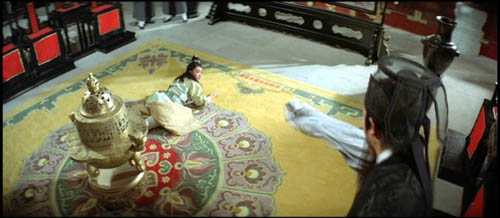
Enchanting Shadow.

A classic storyteller, in suitable surroundings

Film director Li Han-hsiang didn’t benefit from the 1980s-1990s explosion of interest in Hong Kong cinema. For one thing, most of his films were for Shaw Brothers, and those were hard to find on video. For another, Li worked in genres that didn’t attract many fanboys and fangirls. As a result, he’s not as well known as his Shaws compadres Chang Cheh, King Hu, and Lau Kar-leung.

Although opinions about his directorial skills vary, there’s no denying his historical importance. Besides making over 100 films, Li both shaped and reflected several trends in local cinema. A massive retrospective of his work has begun at the Hong Kong Film Archive during the festival, and it will continue well into May.

While several of Li’s films are now available on DVD through the Celestial library, the retrospective features many titles that are hard to see, and it samples the range of this important director’s career.

Li’s breakthrough came in the huangmei diao genre, the “yellow plum” opera. These operetta-like films tended to center on romantic tales of court life, often involving ill-fated lovers. Li’s Diau Charn (1958), The Kingdom and the Beauty (1959), and The Love Eterne (1963) helped define the huangmei picture. The films became flagship Shaws vehicles, showcasing vast sets, eye-searing color, and sweet music, and they won praise at Asian film festivals. Spurred by his success, Li went independent. He relocated to Taiwan and continued to make lavish costume dramas, most notably the two-part Beauty of Beauties (1966).

His gamble failed, and Li returned to Shaws to make The Warlord (1972), with Michael Hui. As Shaws began to pursue more sensational fare, Li proved surprisingly adept at erotic films and films about gambling. He returned to the costume drama too, as in The Dream of the Red Chamber (1977), with Brigitte Lin playing a male role (heard that before?). Li’s biopic of Emperor Puyi, titled The Last Emperor (1986), beat Bertolucci’s project to the screen.

Li also made small-scale films about local neighborhood life, like Rear Entrance (1960), and during his Taiwan stay he explored understated melodrama too. Clearly, a retrospective is overdue, and the Archive has done it up right.

The screenings run until 25 May. Along with the films, there’s a handsome book, Li Han-hsiang, Storyteller. It features in-depth essays, many interviews, and an annotated filmography. (I don’t find the book listed for sale on the Archive’s website, but its price is HK$128, and general ordering information is here.) The archive is presenting an exhibition of costumes and props from the films, including lingerie worn by one female star.

red-chamber-1-500.jpg

The Dream of the Red Chamber (1977).

I had little to say about Li in Planet Hong Kong because in the late 1990s the Shaws collection was inaccessible and I was able to see only a few of Li’s works properly. The titles shown at earlier editions of the HKIFF were certainly impressive, notably Enchanting Shadow (1960), based on the same story that is the source for A Chinese Ghost Story (1987), and the costume extravaganza Beauty of Beauties. Still, I thought that Li lacked the filmmaking élan of his friend King Hu.

I’ve now seen several more Li titles, and though I see no reason to revise my first impression, I’ve come to appreciate his distinctive virtues more. He’s by and large a woman-centered filmmaker, and his female protagonists tend to be energetic and enterprising. The Love Eterne is particularly interesting in its endorsement of women’s ambitions. I haven’t seen evidence that Li has a distinctive approach to staging or cutting, as some other Shaws directors do. His emphasis falls upon settings and costumes, presented in vivid color schemes and captured in graceful widescreen compositions.

Here are some thoughts on what I’ve watched in the series here.

Flower Drums of Fung Yang (1967): One of Li’s Taiwan pictures, this centers a young woman who, after being raped by bandits, takes up street performing. Trouble comes in the form of her husband, who resents her ability to support the two of them, and a rival singing troupe. The musical score consists of a single song played in a variety of moods. The standard conceit of a woman pretending to be a man enhances a sad tale of the hopelessness of women’s lot—a common Li theme.

The Winter (1969): The best of the Li’s I’ve seen in this go-round. Our hero is a shy restaurant-owner who can’t bring himself to admit he loves the girl next door. Simple and poignant, shot largely on location in a teeming street market, the film is unusually quiet for Li, and he displays resourceful use of the anamorphic ratio. The film has become a classic of Taiwanese cinema, and Tony Rayns tells me that its understated realism influenced Hong Kong’s New Wave generation of the 1970s.

Four Moods (1970): An episode film. I had seen the King Hu contribution, Anger, several times before, and it’s still the best in the quartet. Li’s own contribution, Happiness, is a story about a miller and the ghost he meets while fishing. Amiable, somewhat confusing in its attitude toward the miller’s daughter, this wouldn’t convince you that Li was a good director.

The Burning of the Imperial Palace (1982): Li was given the rare opportunity to film in Beijing’s Forbidden City, and he took full advantage of it: The pageantry of his splendid long shots makes today’s greenscreen vistas look insubstantial. But as Wallace Kwong explains in his essay in the Archive anthology, Li’s mainland collaborators demnded many changes in the storyline.

The film traces the rise to power of the girl Cixi, recruited to the young emperor’s harem and eventually becoming a rival to his wife. In elaborate, rapidly edited sequences, Li tells a captivating story of a weak ruler (played by a very young Tony Leung Ka-fai) and the strong women behind him, who are ready to strike deals with Western imperialists.

Reign behind the Curtain (1983): A continuation of Burning, and another engaging palace intrigue. The emperor fritters his kingdom away while Cixi produces a male heir and enters into a tactical alliance with the empress. After his death, the two women struggle with the eight-man advisory council, and eventually with each other. Cixi has turned from an innocent girl into a Machiavellian power-broker, all adding to the woes of China. Like its prequel, a gripping story and skilful performances.

Five rather different films! I look forward to more.

archive-exterior-1-400.jpg

A home for Hong Kong films

When I first came to Hong Kong in 1995, the Archive was housed in a trailer. Now it has a lovely building in the tranquil neighborhood of Sai Wan Ho. The light, airy lobby boasts posters and an exhibition hall, currently illustrating the Li retrospective.

archive-interior-400.jpg

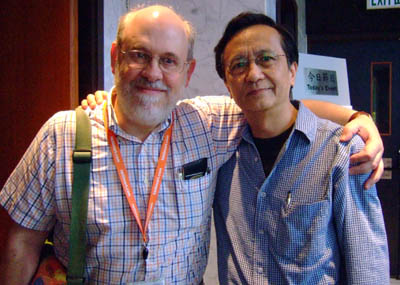
Law Kar has been a key player in preserving and interpreting the local film heritage. He went to school with John Woo and founded some of the first local university film societies. An important critic, he oversaw many of the festival publications that provided gweilos like me precious information. He has also written a fine book with Frank Bren on early HK film history. Recently retired as the archive’s Head Programmer, he still turns out for events, and I’m always happy to see him.

law-kar-and-me-400.jpg

There’s a hiatus in the Li screenings for a couple of days, so I’ll post this now and catch up with other films in a later entry.

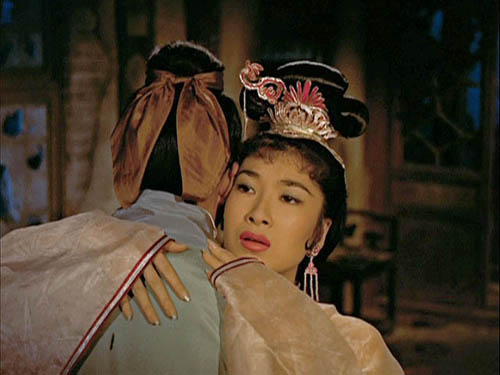
enchanting-shadow-1-500.jpg

Betty Lo Tih in Enchanting Shadow.

A many-splendored thing 6: Tourist interlude

Sunday | April 1, 2007

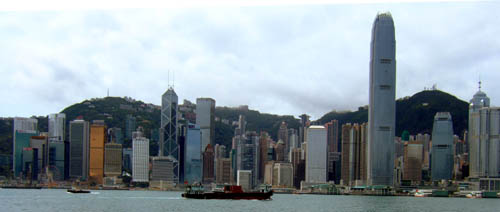
harbor-at-daycropped-500.jpg

Hong Kong island, seen from the harbor.

Tourist images, plus a tribute to Gor-Gor

I thought I’d use one blog to squeeze together some tourist views that I snapped since my arrival for the Hong Kong International Film Festival on 17 March. I never get tired of looking at, and photographing, this amazing city. For you film geeks, I’ve added a coda on a sad movie topic.

Hong Kong consists of Hong Kong island, some other outlying islands, and the Kowloon peninsula, plus the New Territories north of Kowloon. You can shuttle between the main island and the peninsula by taxi, by subway, or by ferry. Like many locals and most tourists, I prefer the ferry because it yields gorgeous views like the one above.

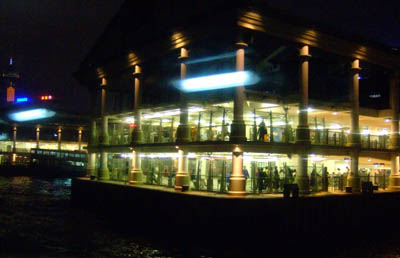
But the ferry to the Central area of Hong Kong island has been redirected. The old terminal has been closed so that more land can be reclaimed from the harbor for highways and skyscrapers. A new, Disneyfied terminal has been erected in its place further down the shore. It looks like cardboard in daylight but can be pretty at night.

new-ferry-terminal-400.jpg

Still, the old terminal wasn’t given up without protest.

old-ferry-terminal-400.jpg

In front of the old terminal, where City Hall stands, there used to be lots of people hanging out. Now the place is largely empty because of all the construction. What remains are the metal silhouettes sitting, mobilephoning, and practicing tai chi.

city-hall-silhouettes-cropped-400.jpg

A city devoted to shopping, Hong Kong has its own equivalent of the medieval cathedral: the shopping mall. Festival Walk, one of the biggest, has a large ice rink. Here’s one of my favorites, some of the twelve floors of the Times Square mall. But why is Lane Crawford everywhere here? What is Lane Crawford?

times-square-1-400.jpg

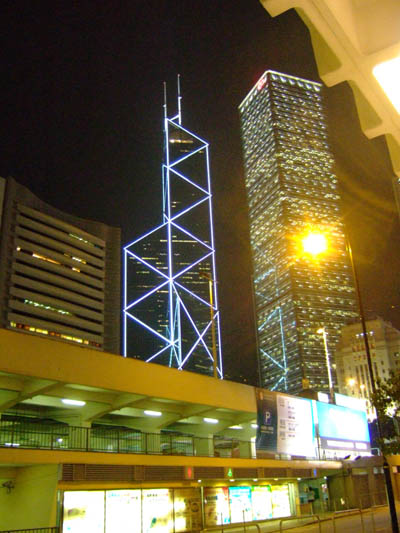
Grandiosity doesn’t afflict only mall architecture. The Bank of China, designed by I. M. Pei, was the biggest thing going when I first came in 1995. Now it’s dwarfed by Two International Finance Centre (in the right foreground at top of entry), which looks like the box the Bank came in. Pei’s zigzag symmetries and asymmetries are still mighty impressive, though.

bank-of-china-at-night-400.jpg

In my neighborhood, Yau Ma Tei in Kowloon, the new construction thrusts ever higher. This is a view from the twelfth floor of my hotel.

buildings-and-rooftops-400.jpg

Later this year west Kowloon will house a building 60 meters higher than the International Finance Centre. It will be, at least for a time, the tallest building in the world. Even multi-bean snacks start to look monumental here.

snack-400.jpg

On the bus, things shrink to a more human scale. This is from my daily ride down Nathan Road to the Cultural Centre and the ferry. Two International Finance Centre is dimly visible in the left distance.

boy-on-bus-cropped-2x-400.jpg

One movie note: Today was the fourth anniversary of the death of Leslie Cheung Kwok-wing, who committed suicide at the Mandarin Hotel in Central. He was one of Hong Kong’s most popular stars, seen in Days of Being Wild, Happy Together, A Chinese Ghost Story, He’s a Woman She’s a Man, and many other classics. Every year fans erect floral tributes along the sidewalk.

leslie-tribute-1-cropped-400.jpg

leslie-tribute-2-400.jpg

Thanks to Akiko Tetsuya and Yvonne Teh for guiding me to this moving display.

So much for tourism. Next time, back to the festival.

hk-island-night-500.jpg

A many-splendored thing 5: Sampling

Friday | March 30, 2007

sakuran-500.jpg

Sakuran.

From DB:

While I’ve been here, Hong Kong has been embroiled in two big stories. First is the runup to the election for chief executive. Hong Kong has indirect elections, whereby groups purportedly representing constituencies, chiefly various business interests, are in turn represented by electors. On the day of the vote, I saw several demonstrations demanding both new environmental policies and universal suffrage. So much for the myth that Hong Kong people don’t participate in politics.

Current chief executive Donald Tsang Yam-kuen, Beijing’s appointee, won the election, with 649 votes out of 789 voting members. Tsang has promised to introduce direct voting and universal suffrage by 2012. We’ll see.

The other big story has been the aftermath of a 2006 shootout involving police constable Tsui Po-ko. The latter has the confusing intricacy of a Hong Kong cop movie. Some years ago Tsui allegedly killed another cop and stole his pistol; a year later he robbed a bank. (The Economist offers a summary here.) An inquest has been under way. Wednesday’s South China Morning Post (not available free online) reports on the contents of Constable Tsui’s notebooks. There are indications that he was tailing political figures and calculating how an ambush might be carried out beneath traffic underpasses.

The media have gone wild over this and even replayed the episode of the local version of Who Wants to Be a Millionaire? on which Tsui appeared as a contestant. Today’s edition of the SCMP reports an even weirder turn. An FBI expert has testified that Tsui suffered from schizotypal personality disorder. This is characterized by “social isolation, odd behavior and thinking, and often unconventional beliefs.” Sound like you or me?

Moving to the more comforting world of cinema, let me catch up on some of the films I’ve seen at Filmart and the Hong Kong International Film Festival.

Ying Liang’s The Other Half: A shrewdly constructed story about a young woman with marital troubles who becomes a legal stenographer. Ying interweaves her life crises with the monologues of locals who come to seek action from the lawyer. These incidents were derived, Ying explained in the Q & A, from actual cases the non-actors knew. Ying collected over 100 law cases and then showed his script to lawyers and legal professionals, some of whom appeared in the film. Single-take scenes predominate, making good use of the deep-focus capacities of digital video. A vivid angle into ordinary life in China, with insights as well into problems of industrial pollution.

Li Yu’s Lost in Beijing: Less interesting, I thought. A fairly traditional melodrama involving an innocent woman caught between two macho men, husband and boss, and the boss’s scheming wife. The glimpses of life in Beijing were more valuable than the supposedly scandalous sex scenes that feature heavily in the early reels.

Derek Yee’s Protégé: Yee is a mid-range Hong Kong director who can turn out solid entertainment and sometimes, as with One Nite in Mongkok, some social criticism. In Protégé, you know you’re in for a rough time from the start. A smack-addled mom staggers onto a sofa to die, and her little girl waddles over to yank out the needle and drop it carefully into a wastebin. Whether you love or hate The Departed, Protégé reminds us that Hong Kong film can chop closer to the bone than anything from our purportedly hard-edged directors.

Daniel Wu plays an undercover cop who’s taken years to become virtually a son to drug kingpin Andy Lau. Their intriguing relationship counterbalances Yu’s efforts to wean an addicted mother off the stuff. There are some fascinating quasi-documentary scenes of cooking heroin and harvesting Thai poppies. The parallels between the drug addicts whom Andy despises and his own need for shots of insulin are insinuated, not slammed home. Yee mixes grim realism with some showy melodrama, adding an explosive drug bust. (That sequence contains a startling shot that in itself justifies the existence of CGI.) Despite an overlong denouement and a few loose ends, the film seems to me better than the average local genre fare.

Ninagawa Mika’s Sakuran: Anachronism has a field day in this story of a cunning girl’s rise to be top geisha. Riotous sets and costumes, along with big-band swing music, create the suffocating but ravishing world of courtesans and their patrons. A sentimental ending telegraphed far in advance, but no less welcome for that.

Nicole Garcia’s Selon Charlie: Screened in Filmart, this 2005 pic seemed to me a solid if somewhat academic drama. A network narrative about a fugitive archaeologist in a town full of philandering husbands and bored wives, it’s your basic bourgeois life-crisis tale, decorated with parallels to a mysterious hominid found at a dig site. It has the usual Eurofilm tact and shows how the French have adapted Hollywood’s screenplay structure to fit the well-upholstered stories they like to tell.

Benoît Delépine and Gustave Kervern’s Avida: Black and white almost throughout, in 35mm that looks like muddy 16, this surrealist pastiche starts strong. Early scenes offer a new riff on Tati’s Mon Oncle, in which a toff returns to his cyberautomated mansion and encounters problems with dogs and plate glass. Then we’re in Buñuel-Carrière territory (Carrière is in the movie), as a dognapping leads to an amazing scene of pooch decapitation. Things seemed to me to drag as the episodes got sillier and less visually expressive. Rhinos, lions, elephants, big beetles, and a highly diverse sampling of the human species do walk-ons. Not so much metaphysical as pataphysical.

Iran: A Cinematographic Revolution: A documentary on the pre-1990s Iranian cinema. It’s informative, cautious about the role of the mullahs, and filled with intriguing clips from Hollywood-style melodramas and the neorealist-flavored efforts of the 1970s. Good talking heads too (though no Kiarostami). The film reaffirms how single-mindedly the cinema agencies pursued film festivals as a way of increasing the profile of the nation’s culture; the motto was “No festival without an Iranian film.” But can Iran really have trained a total of 90,000 film-related workers, as the docu says?

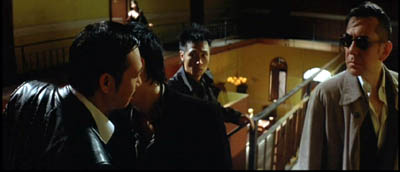
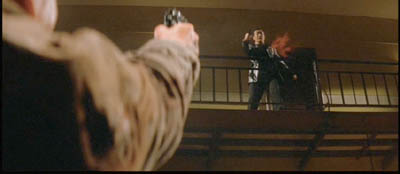
Johnnie To’s Exiled: I hadn’t yet seen it on the big screen. That’s where it belongs. The first sequence evokes Once Upon a Time in the West‘s opening, and it’s followed by an exhilarating, utterly implausible gun battle. Watch out for that spinning door!

When Mr. To previewed this opening for me last spring, I didn’t think he could top it, but he does. The later scene in the underground clinic will rank with one of the great action sequences of all time. I won’t spoil it for those who haven’t seen it by previewing a still. Let’s just say that To finds fresh compositional tactics in close quarters, as in the hotel climax.

exiled-2-400.jpg

exiled-extra-400.jpg

Full of visual invention and neat character bits, Exiled shows that To keeps trying new things. I wrote a little about To’s style in an earlier post, and some backstory on the Exiled rooftop sets can be found here.

Cheang Pou-soi’s Dog Bite Dog: This tale of a hired killer from Thailand and the raging young cop who pursues him presents a world in Hobbesian frenzy, with all against all. The most unrelentingly violent Hong Kong film I’ve seen in years, Dog Bite Dog starts with imagery of the killer hiding in the bowels of a ship, scraping up flecks of rice from the floor. After consummating his hit, he moves through a landscape of garbage, hiding out in a landfill and rummaging in a recycle bin for scraps to doctor a girl’s wounded foot. I don’t know any film that insists so intently on the textures of urban offal.

The cop trembles under the pressure of his own torments, and the parallels between the two men climax in a knife fight in a crumbling Thai temple. As is often the case in local cinema, Father is to blame. This visceral movie surely couldn’t be released theatrically in the US. Even the most jaded action aficionado is likely to flinch from certain scenes.

Cheang’s previous film is the suspenseful Love Battlefield. Of Dog Bite Dog he remarked, “I wanted to show [the audience] this Hong Kong film that does not have choreographed action.” For more, see Grady Hendrix’s coverage here and Twitchfilm’s longish review.

Otar Iosseliani’s Gardens in Autumn: The first shot, in which old men quarrel over which one gets to buy a cheap coffin, puts us firmly in Iosseliani’s parallel universe. As often, he speaks for those who just opt out. A minister of agriculture loses his post and drifts among ne’er-do-well pals, hookers, and girlfriends. A film about drinking, eating, smoking, rollerblading, music-making, and middle-aged sex, Gardens in Autumn also satirizes the rich, who are just as lazy as our heroes but waste their lives shopping. There are also prop gags, including the pictures of heifers and boars that show up in quite unexpected places.

jardins_08-400.jpg

Iosseliani casts himself as an easygoing gardener who draws cartoons on a cafe wall. Some of these images recall people and shots we see in the movie, as if we’re watching the old buzzard create the film between swigs of vodka. An elegiac poem to the subversive force of idleness, with a final scene celebrating women.

jardins_01-400.jpg

Over the next couple of weeks, more frequent posts, I hope, including glimpses of this highly photogenic city. For the moment, this from a double-decker bus must suffice.

bus-tv.jpg

The Celestial Multiplex

Tuesday | March 27, 2007

celestial-multiplex-image.jpg

Kristin here—

The Internet is mind-bogglingly huge, and a lot of people seem to think that most of the texts and images and sound-recordings ever created are now available on it—or will be soon. In relation to music downloading, the idea got termed “The Celestial Jukebox,” and a lot of people believe in it. University libraries are noticeably emptier than they were in my graduate-school days, since students assume they can find all the research materials they need by Googling comfortably in their own rooms.

A lot depends what you’re working on. For The Frodo Franchise, studying the ongoing Lord of the Rings phenomenon would have been impossible without the Internet. A big portion of its endnotes are citations to URLs. On the other hand, my previous book, Herr Lubitsch Goes to Hollywood, a monograph on the stylistic and technical aspects of Ernst Lubitsch’s silent features, has not a single Internet reference. Lubitsch can only be investigated in archives and libraries, where one finds the films and the old books and periodicals vital to such a project.

Vast though it is, the Internet is tiny in comparison with the real world. Only a minuscule fraction of all the books, paintings, music, photographs, etc. is online. Belief in a Celestial Jukebox usually works only because people tend to think about the types of texts and images and sounds that they know about and want access to. Yes, more is being put into digital form at a great rate, but more new stuff is being made and old stuff being discovered. There will never come a time when everything is available.

Even so, every now and then someone proclaims that in the not too distant future all the movies ever made will be downloadable for a small fee, a sort of Celestial Multiplex. A. O. Scott declared this in “The Shape of Cinema, Transformed at the Click of a Mouse” (New York Times, March 18): “It is now possible to imagine—to expect—that before too long the entire surviving history of movies will be open for browsing and sampling at the click of a mouse for a few PayPal dollars.”

Not only that, but Scott goes on, “This aspect of the online viewing experience is not, in itself, especially revolutionary.” He’s more interested in the idea that online distribution will allow filmmakers to sell their creations directly to viewers. That would be significant, no doubt, but as a film historian, I’m still gaping at that line about “the entire surviving history of movies.” Such availability would not only be “revolutionary,” it would be downright miraculous. It’s impossible. It just isn’t going to happen.

(The image above was generated to publicize the “Search inside the Music” program that is an important part of the Celestial Jukebox. Imagine movie screens with actors’ faces in those little boxes, and you’ve got the Celestial Multiplex.)

I will give Scott credit for specifying “surviving” films. Other pundits tend to say “all films,” ignoring the sad fact that great swathes of our cinematic heritage, especially in hot, humid climates like that of India, have deteriorated and are irretrievably lost.

Dave Kehr has already briefly pointed out some of the problems with Scott’s claims, mainly the overwhelming financial support that would be needed: “Tony Scott’s optimism struck me as, well, a little optimistic.” On the line about “the entire surviving history of movies,” Kehr suggests, “That’s reckoning without the cost of preparing a film for digital distribution — the same mistake made by the author of the recent vogue book ‘The Long Tail’ — which, depending on how much restoration is necessary, can run up to $50,000 a title. None of the studios is likely to pay that much money to put anything other than the most popular titles in their libraries on line.” As Kehr says, the numbers of films awaiting restoration and scanning isn’t in the hundreds, as Scott casually says. No, it’s in the tens of thousands even if we just count features. It’s more like hundreds of thousands or more likely millions if we count all the surviving shorts, instructional films, ads, porn, everything made in every country of the world. To see how elaborate the preservation of even one short medical teaching film can be, go here.

Putting aside the need for restoration, newer films present a daunting prospect. To help put the situation in perspective, let’s glance over the total number of feature films produced worldwide during some representative years from recent decades (culled from Screen Digest‘s “World Film Production/Distribution” reports, which it publishes each June): 1970, 3,512; 1980, 3710; 1990, 4,645; 2000, 3,782; and 2005, 4,603. For me the numbers conjure up the last shot of Raiders of the Lost Ark, only with just stack upon stack, row upon row of film cans.

Scott isn’t the first commentator to prophesy that all films will eventually be on the Internet. It’s an idea that crops up now and then, and it would be useful to look more closely at why it’s a wild exaggeration. It’s not just the money or the huge volume of film involved, though either of those factors would be prohibitive in itself. There are all sorts of other reasons why the advent of practical digital downloading of films will never come close to providing us with the entire history of cinema.

Coincidentally, two experts on this subject, Michael Pogorzelski, Director of the Film Archive of the Academy of Motion Picture Arts and Sciences, and Schawn Belston, Vice President, Film Preservation and Asset Management for Twentieth Century Fox, visited Madison this past week. Mike got his MA here in the Dept. of Communication Arts and now returns about once a year to show off the latest restored print that he has worked on. Schawn isn’t an alum, but he has also visited often enough that most students probably think he is. The two brought us the superb new print of Leave Her to Heaven that Fox and the Academy have recently collaborated on.

I figured it would be very enlightening to sit down with these two and talk about why the Internet is never going to allow us to watch just anything our hearts desire. They kindly agreed, and with my trusty recorder in tow we went for burgers—and fried cheese curds, a commodity not available in Los Angeles—at the Plaza Tavern. I’m grateful for the fascinating insights they provided into some of the less obvious obstacles to putting films on the Internet en masse.

No Coordinating Body

Before we launch in, though, one point needs to be made: there is no single leader or group or entity out there organizing some giant program to systematically put all surviving movies on the Internet. There isn’t a set of guidelines or principles. There’s no list of all surviving films. How would we even know if the goal of putting them all up had been achieved? When the last archivist to leave turned out the light, locked the door, and went looking for a new line of work?

Most of the physical prints that would be the basis for such transfers are sitting in the libraries of the studios that own them or in the collections of public and private archives (including many individuals). The studios would make films available online for profit. The archives might be non-profit organizations, but they still would need to fund their online projects in some fashion, either by government support, from private grants, or by charging a fee for downloads. Most archives are more concerned about getting the money to conserve or restore aging, unique prints than about making them widely available. Preservation is an urgent matter, and making the resulting copies universally available for public entertainment or education is decidedly a secondary consideration.

Mike works for a non-profit archive, Schawn for a studio, so together they provide a good overview of some key problems facing the creation of an ideal, comprehensive collection of movies for download.

Money

People who claim that all surviving films could simply be put on the Internet don’t go into the technology and expenses of how that could be done.

Of course, Schawn says, studios want to “digitize the library.” That phrase is highly imprecise, however. He specifies, “For the purposes of this idea of media being online, available, downloadable, streamable, whatever, that’s something that we’re dealing with now using existing video masters. So there isn’t an extra cost to quote, unquote digitize. But there is a cost to make the compression master, what we’re calling at Fox a ‘mezzanine file,’ which is basically a 50 megabit file. That’s the highest-quality ‘low’ quality version of the content from which you can derive all of the different flavors of compression for the various websites that have downloadable media.

“There’s a huge problem with this, in that Amazon, iTunes, and Google all have a slightly different technical specification of how they need the files delivered to them. If you don’t have this kind of mezzanine file, you have to make a different compressed version for each one of these, which costs something, certainly. It’s not incredibly expensive, but it’s not free.

“So why? What’s the motivation to us to compress at Fox the entire library? I don’t know. Are we going to sell enough copies of Lucky Nick Cain [a 1951 George Raft film] compressed on iTunes to cover the costs of making the compression? I don’t think so.”

Compatibility and the Onrush of Technology

Schawn’s mention of the variety of files needed by the big download services raises the problem of compatibility. It’s not just a matter of supplying the files and then forgetting about the whole thing, assuming that the film is available to anybody forever. What about new standards and formats?

Shawn: “Just as with consumer video, the standard changes, so what used to be acceptable yesterday isn’t acceptable now in terms of technical quality.” As time passes, plug-ins make access faster and cheaper, and eventually the original files don’t look good enough. He points out that currently iTunes can’t download HD. If it becomes possible later, “If you want to get 24 in HD, what Fox will have to do is go and re-deliver all the files in HD.” And presumably re-deliver again when the next big format revolution occurs.

Mike explains further, “Using the mezzanine file, you would just have to continue to reformat it to whatever the players demand. The lowest of the low quality will keep going up as people have broadband and can handle larger chunks of data faster.”

What about the film you’ve already downloaded? You acquire films using plug-ins, which change. Think how often you’re told that an update is now available. If you go ahead and keep updating, the changes accumulate. Eventually you may not be able to play the download you paid for. Quicktime will have moved way beyond what the technology was when you made your purchase.

Schawn and Mike both point out that at this stage in the history of downloading, the level of quality is still pretty bad in comparison with prints of films in theaters or on DVDs. It would be nice to think that the virtual film archive could provide sounds and images worthy of the movies themselves, but that will take a long, long time–not the “before too long” that Scott envisions.

Copyright

I raised another matter: “But what about copyright? Every time I hear something about restoration or bringing something out on DVD, it’s, ‘Well, there are rights problems.’ And some of those rights problems don’t get resolved. I assume that quite a few films that they blithely believe can be slapped up for downloading can’t be slapped up.”

Schawn: “Sure, and there are often not any kinds of provisions in the contract about Internet distribution—obviously! So you’re right, how do you deal with that?”

He pointed to Viva Zapata as a film that Fox has restored but can’t make available due to rights issues. The potential sales are not thought to warrant paying to resolve those issues. “I’m sure there are lots of titles in everybody’s libraries that you can’t just pop up on the Internet and start selling.”

The copyright barrier is worse for archives, which seldom own the exhibition or distribution rights to the films they protect. Usually—though not invariably–the studios do not object to archives owning and preserving prints. Making money through showing them or selling copies would be quite another matter.

Mike described the online presence of archival prints. “On a much smaller scale, this is being attempted in the archive world already, like on Rick Prelinger’s site [Prelinger Archives] or on the Library of Congress’s site, where they’ve put up dozens of moving-image files. True, it’s not independent cinema and it’s mostly commercials and the paper prints that have recently been restored. On Prelinger’s site it’s all the industrial films that he’s collected over the years. That has seen a good amount of traffic, but it hasn’t created new audiences for these films, I would argue. At least, not on a huge scale.”

Prelinger’s site contains only public-domain items, including the ever-popular Duck and Cover, allowing him to avoid the problem of copyright. Similarly, the Library of Congress gives access primarily to films in the pre-1915 era.

Suppose an archive and a film studio both have good-quality prints of a minor American film made in the 1940s. The archive does not have the legal right to put it online, and if the studio decides that it does not have the financial incentive to do so, that film will not be made available for downloading. A private collector might possibly create a file and make it available, but he or she would risk being threatened by the copyright-holder.

Piracy

We briefly discussed the methods used to prevent pirated copies being made from downloaded films. Like DVDs, downloads can be pirated, with people sending copies to their friends or even offering downloads for a fee in competition with the copyright holder. Copy-protection codes might make it necessary for a purchaser to keep a downloaded copy only on a hard-drive without being able to burn it onto a DVD. Another type of code could erase the file once the film had been viewed once or twice. That’s not exactly conducive to the ideal archive of world cinema, where we would hope to be able to study a film in detail if we so choose.

One might think that piracy protection mainly applies to studios, with their need to make money. Mike points out, though, that the need for such protection “even applies to the archival model, too. For films that you mention that have gone out of copyright, there’s still the same costs associated with putting a silent film that no one owns–digitizing it, creating the compressed master that goes on the Web—and they aren’t the kinds of subjects that people are going to get rich on at all, so there isn’t a lot of piracy. You don’t hear many archivists complaining, ‘Hey, you took my 1911 Lubin film, damn you! You can’t put that on your Website. That belongs on the archive’s Website.’ But that scenario becomes more of a likelihood for more popular titles. The obscure 1911 Lubin film is on one extreme, but Birth of a Nation, a well-known silent film a lot more people would like to see, is on the other. Let’s say the highest-quality copy is on the Museum of Modern Art’s Website and can be easily lifted and posted on your own site. And even if you just say, ‘Oh, I’ll charge 99 cents or I’ll charge 50 cents to stream it,’ it’s still going to be someone taking over something that the archive put all of the high-end effort and money into doing. Frankly, I think unless it’s an archive with a national mandate and a little bit higher budget to digitize and to put the contents of their archives online, there’s not going to be any motivation to make that high-end investment up front.”

Thus an archive may simply not bother to put a film on the internet because it can’t guarantee recouping the costs that would be generated.

Language and Cultural Barriers

Scott’s notion of easy access to all of surviving world cinema implicitly depends on an idea that all these films are either English-language or already subtitled or dubbed for English-speaking users.

That’s not true for a start, so there would remain a great deal of work to translate films that have never been released in English-language markets. That’s another huge, expensive task.

Then there’s the opposite side of that coin. For truly complete access, everyone in the world, whatever language they speak, would be able to download and appreciate every film. Of course, there are billions of people without computers or Internet access, and it looks unlikely that being able to go online will become universal anytime soon. (For figures on numbers of people with internet access, check here; percentages can be calculated by clicking on each country and finding the total population. In Tajikistan, for example, .07% of the population was online in 2005. One has to assume that a lot of connections in some of those countries are dial-up, so downloading films would be virtually impossible. [June 21, 2010: In 2008, Tajikistan’s online population has grown to .08%.])

So let’s just say that for the foreseeable future downloadable films would “only” need to be subtitled in the languages of countries or regions where significant numbers of people subscribe to PayPal.

In our conversation, Schawn pointed out that digital compression files mean that there can be huge numbers of versions, with different soundtracks dubbed in or different subtitles added. Technically it’s possible to do all that translation. Still, “it’s very complicated. So for worldwide distribution of anything, like you’re talking about your silent film. If you’re in Pakistan, do you get the American version of the movie or do you get the version of the movie with the intertitles appropriate to wherever it is that you’re showing it? If so, that quickly compounds the amount of stuff that’s digitized.”

I responded, “Yeah, or a 1930s Japanese film put on the Internet for downloading, subtitled in every language where there are people that can pay for it. The more you think about it, the more absurd it becomes.”

Scott must be implying as well that there is some single “original” version of a film and that that version would be the one available in this ideal collection in cyberspace. Yet any archivist or film historian knows that multiple versions of a given film are typically made, depending partly on the censorship laws of the different countries where it is originally shown. In making downloadable files available, does a studio or archive use only the original version of a film made for its country of origin and thus risk having it include material offensive to viewers in some places where it might be downloaded? Or does a whole slew of different versions, one acceptable in, say, Iran, another inoffensive to the Danes, and still another compatible with Senegalese social mores, get put online? How could one even gather all such versions and digitize them? National film archives tend to have government mandates to concentrate primarily on preserving their own countries’ films. Not every version of every film gets saved.

The Bottom Line

For all the reasons noted here and others as well, film availability for download will follow pretty much the same economic principles that have governed film sales in other media. Mike’s opinion is, “Whether they’re from an archive or a studio, I think things’ll start going online in the same pace that they came onto DVD, in an eight to ten-year cycle. And there still will be large gaps.”

Schawn interjects, “Just as there are on DVD.”

Mike concludes, “There’s stuff that will never go online. Yeah, just as on DVD.”

*

A truly celestial screening: a restored 35mm print of Bertolucci’s 1900 projected free, under the stars in the Piazza Maggiore, Bologna, summer of 2006
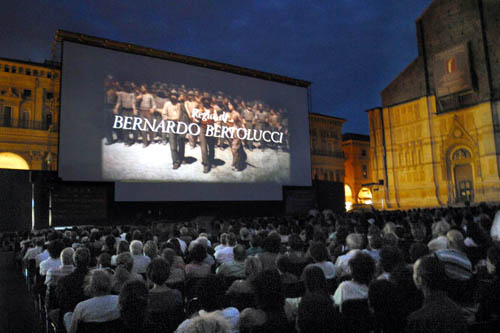

bologna1900-500.jpg

David Bordwell
top of page

have comments about the state of this website? go here