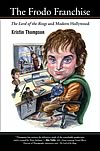
by Kristin Thompson. Berkeley: University of California
Press, 2007.
400 pages, 6 × 9 inches, 12 color illustrations;
36 b/w illustrations.
[go
to Amazon | go to The Frodo Franchise blog]
As a writer and even more as a reader, I am frequently baffled when an author with a fascinating, innately dramatic story to tell feels it necessary to ratchet up its appeal with hype. I’m an amateur Egyptologist and sometimes watch the documentaries made by the Discovery Channel, National Geographic, and the other educational TV outlets. Now, a great many people are fascinated by ancient Egypt in a way that they aren’t by virtually any other period of history. So many events and aspects of that society are at least intriguing, at most amazing. The building of the pyramids, the process of mummification, the distinctive artworks–all of these could sustain straightforward presentation.
Instead, the filmmakers responsible for these documentaries feel it necessary to beef up their ancient subject matter. The factual scenes are interspersed with shots of actors dressed in pharaonic costumes driving chariots across the desert, accompanied by overblown music. Archaeologists hover outside supposedly sealed tombs or chambers, speculating breathlessly as to what might be inside. Artificial mysteries are overly prolonged, when all along the filmmakers know the answers. Since the channels producing these documentaries are often subsidizing the archaeologists’ work, there is pressure for these scholars to make more glorious claims for their findings than the facts warrant.
Similarly, film history contains innumerable stories that are both educational and entertaining, if told in a straightforward, factual way. Any major film’s making yields many facts and anecdotes that are in themselves interesting. Yet here, too, many authors—especially journalistic ones—seem to feel the need to inject an artificial drama into their tale. This can be harmless, but if an author tries too hard, the facts get obscured or distorted.
In the case of big box-office successes, journalists tend to find one over-arching claim that can seem to explain a film while giving it an extra dose of drama. There was one such concerning The Lord of the Rings that I encountered over and over when I was researching The Frodo Franchise. Despite all the twists and turns that the progress of the film took—the unlikely move from Miramax to New Line, the last-minute casting of Viggo Mortensen, the struggles to reach remote filming locations, the third part’s winning eleven Oscars, and many, many more—somehow there wasn’t enough drama. In this case, the big claim was that Rings was an immense gamble on the part of New Line’s founder and co-president, Bob Shaye. Some have believed, both before and after the trilogy’s release, that its failure would have meant the end of New Line. The independent firm would have been absorbed into parent company Time Warner, and Shaye would have been stripped of power.
My book was written after all three parts of Rings had gone into the box-office record books. New Line had grown considerably and was in no danger. During my research I questioned people involved in the film’s production and people in the industry who would have reason to know whether New Line really stood in such a precarious position in 2001. Opinions were divided, but few thought that New Line would have disappeared had the trilogy flopped. A gamble, yes, but ones where the stakes were lower and the odds more in New Line’s favor than most accounts would suggest.
Boffo! by Bart
I can see why journalists, even in trade papers like Variety and Hollywood Reporter, would find it convenient to fall back on this gamble motif when writing copy on a short deadline. Now, however, the familiar claim has reappeared in Peter Bart’s book, Boffo! How I Learned to Love the Blockbuster and Fear the Bomb (Miramax Books, 2006). Bart deals with extremely successful films, plays, and TV shows. The Lord of the Rings occupies one chapter.
When the first anniversary of this blog rolled around, David wrote about some of our goals as film scholars and bloggers. One of them was this:
We’ve tried to deflate some clichés of mainstream film journalism. Writers of feature articles are pressed to hit deadlines and fill column inches, so they sometimes reiterate ideas that don’t rest on much evidence. Again and again we hear that sequels are crowding out quality films, action movies are terrible, people are no longer going to the movies, the industry is falling on hard times, audiences want escape, New Media are killing traditional media, indie films are worthwhile because they’re edgy, some day all movies will be available on the Internet, and so on. Too many writers fall back on received wisdom. If the coverage of film in the popular press is ever to be as solid as, say, science journalism or even the best arts journalism, writers have to be pushed to think more originally and skeptically.
The same goes, only more so, for books written in the same spirit. Journalistic writing is at least somewhat ephemeral. Books, though, stay on the shelf, and they automatically command a certain respect.
As I said, the story of Rings, told straightforwardly, is immensely dramatic. What better story could a film historian possibly have to tell? All through the researching and writing processes, I tried simply to discover, convey, and interpret that story without adding hype.
Bart adds the hype. His chapter on Rings not only revives the old gamble angle but goes further, asking, “What was the bravest gamble in the history of filmmaking?” Arguably, he answers, the trilogy.
Why? First, it was risky to make all three films at once. Granted, though as Bart acknowledges, there were enormous cost benefits from doing so. Second, the initial budget of $130 million, according to Bart, ballooned to $330 million. Now the problems start. $130 million was the budget when Rings was still a two-part project at Miramax. Taking over the film, New Line provisionally kept the existing budget until a three-part script could be written and the costs estimated on a firm basis. The estimate then grew to $270 million, which we should count as the budget the studio was really working from. The success of Fellowship of the Ring led New Line to agree to requests for more money in making the second and third parts. Costs did not run wildly over expectations.
What else was so risky? According to Bart, New Line earmarked “virtually its entire production budget to support the effort.” If Bart has evidence for this claim, he doesn’t share it. Without access to New Line’s accounts, we can’t be absolutely certain. Still, there is considerable evidence to the contrary. New Line executives have consistently pointed out that, spread over the three years of the trilogy’s release, their own annual investment was relatively small. Co-president Michael Lynne has said in a number of interviews that most of the budget was covered by other companies. In a recent issue of Screen International, he declared, “The foreign distribution rights alone were responsible for close to 70%” (Mike Goodridge, “The Ringleaders,” October 26, 2007, p. 23).
There were 26 foreign distributors, several of whom paid visits to the Wellington facilities during the production. I have talked with some of the filmmakers who took those distributors on tours. My book includes a case study of the Danish distribution company based on a two-hour interview with one of its executives (Chapter 9). During the years of the trilogy’s release, the trade journals, including Variety, ran stories about these distributors. The 70% figure, by the way, doesn’t count the merchandising licenses, many of which had been sold in 2000, helping to finance the trilogy. New Line was gambling, but largely with other people’s money.
Further, Bart declares, Shaye’s decision was a gamble because the narrative of Tolkien’s novel was so complex that it had previously scared off Spielberg, Kubrick, Harvey Weinstein, Saul Zaentz, and the Beatles (p. 51). Again, my research points in other directions. I have never heard that Spielberg was in the running to make Rings at any point. Stanley Kubrick was approached by Apple, the Beatles’ company, back in the late 1960s, when the Fab Four were interested in starring in a film adaptation of Rings. I suspect that it wasn’t the novel’s complexity that made Kubrick decline. (The Beatles got interested in transcendental meditation and went off to the Far East.) Bart says that Saul Zaentz “did little” with the production rights once he acquired them (p. 54). But in 1978 Zaentz produced an unsuccessful animated version of the first half of the book and decided not to make the sequel. Harvey Weinstein very much wanted to keep the Rings project at Miramax, but he was forced by parent company Disney’s head, Michael Eisner, to scale it back to a single two-hour feature. Peter Jackson refused to accept that condition and took the project to New Line.
Finally, Bart points out that Jackson was then a little-known director with not a hit to his name. True, but as I point out in my book, for the short time the Rings was in turnaround from Miramax, Jackson alone had the power to bring the project to New Line. Shaye undoubtedly wanted the rights to Rings, believing that it would make a successful franchise. Jackson came along with those rights.
Late in the chapter, Bart offers another reason why taking on the trilogy flew in the face of conventional wisdom: New Zealand is very remote from Hollywood (p. 63). Perhaps the distance caused some troubles, but it saved a huge amount of money—enough to make the difference between the trilogy getting made or not. In The Frodo Franchise I calculate (based on costs for a comparable effects-heavy epic, Titanic) that Rings might have cost roughly $544 million if made in North America (or $700 million if one includes the 120 minutes of extended-edition footage). Jackson undertook a similar estimate based on Pearl Harbor and came up with a figure of $180 million for Fellowship—and three times that is $540 million. The difference between those figures and $330 million pays for a lot of airline tickets.
Shaye’s “Gambler” Reputation
One of Bart’s conclusions is, “For those who, like Bob Shaye and Michael Lynne, believed that big returns emanate from big risks, Lord of the Rings provided a unique and generous validation” (pp. 63-64). This is peculiar indeed. I don’t think either Shaye or Lynne would agree with that assessment of their approach to production. Shaye was known for running a tight fiscal ship at New Line. His company became famous for turning miniscule investments into massive hits and franchises: most notably, Nightmare on Elm Street and Teenage Mutant Ninja Turtles. Shaye has a sign on his office wall that reads “Prudent Aggression.” That, I would say, is the attitude with which he approached the Rings decision.
Neither Shaye nor Lynne has generally encouraged the notion of the Rings deal as a gamble. (See my first chapter for more on this.) In the Screen International piece cited above, the interviewer asks that very question: “Do you agree that the trilogy was the riskiest venture that any film company has tried to date?” Shaye responds, “We had hedged somewhere between 70%-80% of our investment.” Lynne adds, “If it had broken even, nobody would have been happy. The company wouldn’t have gone out of business, but it definitely would have been a problematic issue for people who had invested with us, and for Time Warner itself.” (The investors were the international distributors who had pre-bought the entire trilogy.)
In an interview on The Charlie Rose Show earlier this year, Lynne said something similar: “The problem was, if the first film didn’t work, the next two were certainly not going to work, that these films would at best break even. Well, no one at Time Warner was going to be thrilled that we invested the three hundred million dollars and just got our money back! So although we weren’t betting the ranch, we certainly were betting our credibility.”
The gambler image no doubt redounds to Shaye’s advantage in some ways. He was the only one in Hollywood willing to take on the immense project when Jackson was shopping it around the studios. He was famously the one who told the director that he should make three films, not two. Despite occasional tensions between the filmmakers and studio executives, Shaye and Lynne not only stuck with the project but acceded to requests for tens of millions in additional spending. Shaye’s resulting image is that of a savvy maverick who outguessed the heads of the other studios.
On the other hand, it can’t be to his advantage to be perceived as reckless. If people think that Rings really was the biggest gamble in the history of Hollywood and that Shaye risked $330 million of his own firm’s money, blithely taking a chance on a director of splatter films, then he risks coming across as irresponsible. Hence, I suspect, his and Lynne’s care in informing interviewers that they had found investors and licensees to cover the bulk of the trilogy’s budget. Shaye has also pointed out that the trilogy stretched over three fiscal years, as I mentioned, making the annual investment in Jackson’s film modest relative to its epic qualities.
Of course the trilogy was a gamble. As Shaye said in the Charlie Rose interview, “But every film commitment is a gamble to some extent.” The size of this particular gamble, however, has been considerably exaggerated. Shaye and Lynne knew what they were doing. They saw the savings to be had by filming in New Zealand and by committing the cast members up front to all three films—hence obviating the possibility of ballooning salary demands if the first part was successful.
I’m sure there were many moments of worry and doubt in the years between New Line’s official announcement of the project on August 24, 1998 and the triumphant preview screenings at Cannes in May, 2001—when journalists and foreign distributors alike realized that the studio had, as Harvey Weinstein put it at the time, “another ‘Star Wars’ on their hands.” Still, I would place a small bet that during those same years the disastrous Town & Country (filmed in 1998 and released in late April, 2001) was giving Shaye and Lynne at least as much anxiety. That long-delayed film cost $90 million, with a publicity budget of $15 million. It grossed $10 million worldwide.
Above all, Shaye saw the likelihood of the trilogy’s success in a way that no one else did. My favorite statement of his was quoted in a Time article in late 2002, shortly before the release of The Two Towers. Asked why he had wanted three films instead of two, Shaye replied: “It was so wonderfully presold. It was like Superman or Batman.” Juxtaposing Tolkien’s novel with those comic-book superheroes might bring a smile—but he was right. If we can just set aside the persistent notion that Rings was a huge gamble, we can see that Shaye was remarkable for his foresight, not his recklessness.
Last month I visited the University of Texas at Austin. I had a great time, with wonderful people and conversation. The food was tasty too. There was a lot of talk, and one question in particular set me thinking.
In his Film History seminar, Professor Charles Ramirez Berg asked me what movie made me decide to study film. Before I knew what I was saying, I admitted that unlike most people who write about movies, no single movie, nor even a handful of movies, pushed me in this direction. I had no cinematic epiphany.
Nor did I have the sort of childhood that seems archetypal for film geeks. You know the tale. I grew up in New York/ Chicago/ LA and went to the movies every day, sometimes twice or more. I practically lived at the [insert colorful but rundown movie house here]. When I wasn’t at the movies I was watching little-known film noirs/ Monograms/ Budd Boettichers on TV into the night. By the time I could vote, I’d seen thousands of movies, and King Kong at least five times.
This wasn’t me. I grew up on a farm. I saw at most one or two movies a week on those Saturday afternoons when my family went to the town ten miles away. I saw what every kid saw—Disney, Martin and Lewis, Francis the Talking Mule. I did sometimes watch Charlie Chan and Mr. Moto movies on the couple of TV channels we could pull in, but I didn’t saturate myself. About age thirteen I started to get interested in film by reading about it, in books like Arthur Knight’s The Liveliest Art and Paul Rotha’s The Film Till Now. These were my guides to what to watch on TV. So yes, I did stay up late occasionally, but to see bona fide classics like Citizen Kane and The Magnificent Ambersons. The joys of Joseph H. Lewis and Robert Siodmak had to wait until in 1963 my hands closed around the Film Culture issue devoted to Andrew Sarris’ American Directors survey.
So I became a film wonk through years of accretion, gradually seeing more and more in high school (once I could drive a car) and college (running the film society) and then deciding to go to graduate school.
But I did find an answer to Charles’ question. I said that my childhood was far more steeped in TV and radio than in movies. Afterward I realized that certain books and magazines had a big influence on me as well.
What follows may seem narcissistic nostalgia, but I do have a general point. It’s the Law of the Adolescent Window:
Between the ages of 13 and 18, a window opens for each of us. The cultural pastimes that attract us then, the ones we find ourselves drawn to and even obsessive about, will always have a powerful hold. We may broaden our tastes as we grow out of those years—we should, anyhow—but the sports, hobbies, books, TV, movies, and music that we loved then we will always love.
The corollary is the Law of the Midlife/ Latelife Return:
As we age, and especially after we hit 40, we find it worthwhile to return to the adolescent window. Despite all the changes you’ve undergone, those things are usually as enjoyable as they were then. You may even see more in them than you realized was there. Just as important, you start to realize how the ways you passed your idle hours shaped your view of the world—the way you think and feel, important parts of your very identity.
Let me get specific.
The view from my window
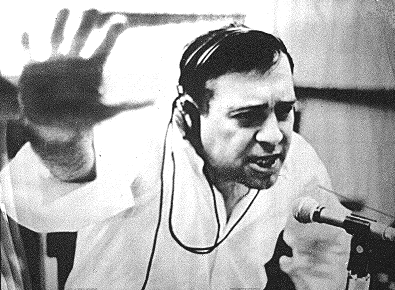
Jean Shepherd. Photo by Fred W. McDarrah.
I was born in 1947 and graduated from high school in 1965. What was my angle of view onto the pop-culture landscape in 1960-1965?
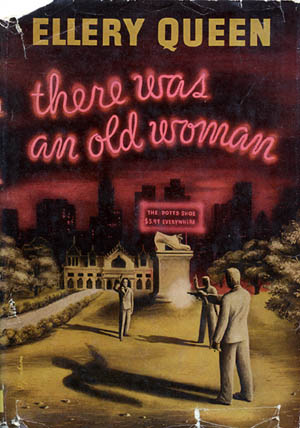
Reading: I read a lot of classic and contemporary American literature, especially Twain and Faulkner. Also a lot of nonfiction, especially Barzun, Orwell, and Kenneth Burke. But more eagerly I soaked up detective stories. Not the hardboiled ones, though I loved Hammett’s Red Harvest. My favorites were Sherlock Holmes, Wilkie Collins, and the Golden Age classics: Agatha Christie, Margery Allingham, John Dickson Carr/ Carter Dickson, Ellery Queen, and Rex Stout. I now realize that from these skilful storytellers I was absorbing lessons in narrative construction, as well as a taste for artifice.
More specifically, I was learning something I could only much later make explicit: Popular culture undertakes formal experimentation as intriguing as anything in the official avant-garde. Ellery Queen’s openly fabulist novels take a central motif—a nursery rhyme, a pun, the Ten Commandments—and then show how it informs action, character psychology, even chapter breaks. John Dickson Carr’s books are like conjuring tricks, with the magician brandishing the clues and steering you away from the trap doors and collapsable top hats. Who else but Carr would call a novel The Reader Is Warned? Among the moderns, perhaps only Ed McBain has the Golden Age flair for creating a multilayered plot based on a central image like ice or a wedge, and he does it within the frame of the most purportedly realistic mode, the police procedural.
Or take a book I’ve probably read twenty times, Anthony Berkeley’s The Poisoned Chocolates Case (1929). Six eminent lawyers, writers, and amateur sleuths have formed a club, the Crimes Circle. They’re presented with a current murder case and challenged to crack it. At six nights of Circle meetings, each one fields a solution, only to have it shot down. Sort of a grad seminar in homicide.
Admirers of film noir and the hardboiled school, who are in the majority now, would complain that this is just the sort of airless exercise that turned the detective story into a crossword puzzle. Yet there is tension whenever we play off competing answers to a question; anyone who thinks that empirical reasoning is bloodless should read a scientist’s biography. Out of a handful of clues and three or four suspects, The Poisoned Chocolates Case conjures up six detailed but mutually exclusive solutions. At the end, there’s a purely aesthetic pleasure in watching the puzzle snap into a surprising whole that integrates aspects of all the failed answers. As a cherry on the sundae, we’re rewarded with one of the niftiest last lines in crime fiction: “Nobody enlightened him.”
My tastes in the genre have broadened. Now I read and reread Le Carré, Rendell, Hillerman, Westlake/ Stark, Bloch, and the procedurals, especially Rankin. Of course I like Highsmith and Elmore Leonard. Robert Barnard and Peter Dickinson can sometimes evoke Golden Age knottiness. But when I want formal highjinks, I pack a classic in my carry-on and I’m seldom disappointed.
On the Austin trip it was Stout’s The Rubber Band, an elegant adventure of Archie Goodwin and Nero Wolfe.
I’ve registered my admiration for Stout elsewhere on this blog; I consider him one of the great masters of American vernacular prose. The Rubber Band is one of his best, and not just because every page boasts at least one of Archie’s irresistible sentences about Wolfe.
Since he only went outdoors for things like earthquakes and holocausts, he was rarely guilty of movement except when he was up on the roof with Horstmann and the orchids, from nine to eleven in the morning and four to six in the afternoon, and there was no provision there for pole vaulting.
That’s writing.
TV, I now realize, tutored me further in the unbridled audacity of popular culture. Granted, in certain circles I’ve been known to say unenthusiastic things about TV. Nowadays I don’t watch anything but The Simpsons and Keith Olbermann. But who can deny the past? I’m a creature of the box.
My parents got TV early, in the early 1950s, and my sisters and I spent many a winter afternoon in front of cartoons, the Disney show, and Roy Rogers. But I didn’t like the official hits, like Gunsmoke and Bonanza. As I got older, I was snagged by grownup shows like Jackie Cooper’s Hennessey and the short-lived It’s a Man’s World. Why? I don’t know. Perhaps they showed how badinage could mingle with serious drama. No mystery about Ernie Kovacs, though, whose nuttiness delighted me in the way that Monty Python would capture the kids of the 1970s. And like everybody else, I was haunted by a weekly visit to the Twilight Zone.
But above all stood George and Gracie. When I started to get what they were about, their program was ripening into its baroque phase. More than individual shows, I remember the brilliant central conceit. Gracie would hatch a wacko scheme, usually recruiting the hapless Harry von Zell as her minion. George would get suspicious and retire to his den to tune inthe very show we were watching. He was then in a position to block her maneuvers, usually by tormenting von Zell. The idea that George could simply watch his own program still seems a stroke of genius. Artistic form, I must have realized subconsciously, can always be turned into a dizzy game. M. Godard, Ozu-san, meet Burns and Allen.
The radio was constantly on in our house, with my mother listening to Arthur Godfrey or Art Linkletter. These geezers were intolerable to my teenage tastes. Give me my two main sources of aural pleasure: WKBW radio and Jean Shepherd.
WKBW was a radio station out of Buffalo. At 50,000 watts it was so powerful it tended to seep into any blank spot on the dial. Actually, the DJs probably didn’t need an antenna, since they conducted their shows at ear-splitting volume. They indulged in all the profound things that characterized radio in the 1950s: cute sound effects (car crashes, always good), music clips (audio tape made it easy), jingles and station IDs that quickly became earworms, and nonstop patter sustained by whinnies, table-pounding, and laughter at feeble jokes. KB’s promotional efforts were no less strenuous. Once the station asked the public’s help in finding a missing DJ, only to reveal that he’d gone into hiding to drum up publicity.
In my day, the loudest mouth belonged to Joey Reynolds, who brayed over records and satirized rock and roll with an appalling ditty called “Rats in My Room.” When he was fired, he nailed his shoes to his boss’s door, adding a note: “Fill These.” I was happy to learn that this piece of teenage lore seems to be true, or at least so a fanatical WKBW website indicates. Joey continues on the airwaves, albeit more sedately.
Speaking of music, KB opened the adolescent window to the tunes that still move me. I was too young to like Elvis and had an affectionate but distant relation to the Beatles. My favorites came mostly from what I’ve learned to call the Brill Building sound. On 24 December every year, Kristin folds her arms in weary patience as the Drifters, Gene Pitney, Connie Francis, and Paul Anka pour forth into our living room.
Jean Shepherd was a wholly different story. The WOR signal couldn’t creep into upstate New York by day, so my bedside tube radio crackled and hissed as 11:15 p. m. approached. Would the signal pull through? It usually did. In fact it seemed to get stronger as, lying in the dark, I heard the familiar trumpet call and galloping music that announced Shep’s show. Another difference from Top 40: Here was an adult talking to a kid as if I were an adult. And an adult who lived in Manhattan! I discovered then that the media aim downward, age-wise: a teenage TV show is actually watched by pre-teens, a college show (like Shep’s) appeals most to highschoolers (like me).
Shep was one of the pioneers of long-form talk radio. He didn’t take phone calls and he seldom had guests. He claimed to be a social commentator, and he did point out the foibles of contemporary media and society. Mostly, though, he was a yarn spinner in the Twain tradition. As he told stories from his life, especially his childhood in Indiana, digressions would split off unexpectedly. Somehow, though, everything wound back to make a point–usually about the vainglory of being human. What made the stories fascinating was not only the delivery (poetic turns of phrase, a smooth, earnest voice that could sink to an urgent whisper) but their fundamental ordinariness. He told of midwestern air shows, enamel table tops, summer baseball, and disastrous Valentine’s Day parties. He celebrated the commonplace and advised his listeners to simply watch everything closely, to find the poetry and absurdity that pervade our lives. I think that my sense of humor owes a lot to him. Perhaps also my tendency to yakkiness.
Shepherd is best-known today for A Christmas Story, the movie based on some of his stories. If you’ve seen it, you’ve heard his unique voice as the narrator. But I first heard the tales of the BB gun and the Old Man’s fetishistic leg-lamp while hunched under the blankets, long after my family had gone to sleep, and Shep’s words put a movie in my head. After my nightly WOR adventures, Garrison Keillor seemed labored and condescending.
From Eugene Bergmann’s capacious book on Shepherd (1), I realize that my nighttime communion with this adult voice was shared by thousands of other kids. He fused the nonconformist sensibility of the Beats and the Hips with a Midwestern distaste for airs and pomposity. He called his fans the Night People. The enemies were the Meatballs, the Slobs, or, in a reference to a Pepsi tagline, the Sociables. He spurred his listeners to send Cassavetes money to fund Shadows; a credit to the Night People appears on the movie. Shep’s motto was “Excelsior” (sometimes, “Excelsior, you fathead”), which encapsulated both his optimism (onward and upward, keep striving) and his fatalism (remember the boy with the banner lying frozen in the snow).
Urged on by Bergmann’s book, I recently discovered a wonderful Shepherd website and a vast podcast vault of his shows, which are also available free on iTunes. (2) Broadcast a little before I started listening, the 1960 “Molded Food” episode was a great iPod companion as I wandered around the UT—Austin campus.
Put not aside childish things
I could mention more items seen through my window, such as the Village Voice, Esquire, and, inevitably, Mad magazine. But the moral should be clear. Whatever called out to you when your window opened—Grease, Patti Smith, Buckaroo Banzai, Sassy, David Bowie, Columbo, Godspell, Lord of the Rings (the book), Penn and Teller, National Lampoon, Pavement, John Hughes movies, Kurt Vonnegut, the B-52s, Earth Girls Are Easy, Beat Street, Master of Puppets, Boondock Saints, Sam Kinison, They Might Be Giants, you name it—is likely to retain its bright purity throughout your days. What’s kitsch or cheesy or retro to others is precious to you.
Make no apologies. It’s not mere nostalgia or guilty pleasure to revisit these creations. You can return to them as to old friends. Encountering them again, you remember when you took it for granted that anything was possible in your life. Their sharp, shining lines fitted your range of vision, and mostly they still do.
Your taste was unerring. These teenage passions represent a big chunk of the finest part of you. In some secret place you are still as uncomplicated as you were then.
(1) Eugene B. Bergmann, Excelsior, You Fathead! The Art and Enigma of Jean Shepherd (New York: Applause, 2005).
Since I retired, I usually go to matinee shows. It’s cheaper, and the auditorium is depopulated. Sometimes I’m the only person there. I know, movies are supposed to be seen with a big audience; but I’ve seldom liked the experience of a packed house. Does the humble worshipper in the temple need a congregation to confirm his faith? Isn’t it best to commune with the deity alone? More to the point: Even before the advent of cellphones, somebody always coughs or talks at the wrong time.
If there are any other people around during my matinees, they are likely to be elderly folks, misfits, losers, idlers, and troublemakers. This makes me feel superior. But then I realize that to an objective observer, I could fit into any of those categories. Last time I went to my local, the cashier at the ticket stand gave me the Senior Citizens discount automatically. The pleasure of saving a dollar was small compensation for the blow to baby-boomer pride—sort of the reverse of being carded at a bar when you’re 30.
Curiously, as film attendance is dropping, multiplexes are offering more screenings. I enjoyed the idea of starting the screening cycle at noon or so, but now some ‘plexes start running as early as 10:30. At my neighborhood ‘plex, you can attend the Baby Box Office (“The lights are a little brighter, the sound a little softer”) on Tuesdays at 10:00 AM. It’s currently featuring the ideal picture for babes in arms, American Gangster.
Here are some jotted opinions on movies seen at midday over the last couple of weeks.
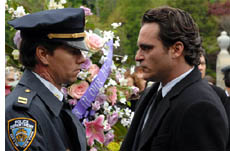
We Own the Night: I admired James Gray’s The Yards, but this seemed to me quite standard. One brother’s a cop, the other’s on the shady side: back to Warner Bros. of the 1930s. (Where’s the tough priest, though?) Although set in the 1980s, it looks a bit like a 1970s movie, with all those long-lens shots and flattened color values. The plot was by-the-numbers, and lines like “You’re a dead man” and “I love you very much” don’t help. I guess it’s a “personal” project for Phoenix and Wahlberg, both brave performers in other vehicles but mostly going through the motions here. Further evidence that today’s cinema is classic studio cinema, with more sex, violence, drugs, and rock-and-roll.
Gone Baby Gone: At least We Own the Night doesn’t promise to be more than a typical genre piece. For several years now, many ambitious or “prestige” pictures have given genres the uplift treatment, making them—well, serious. So a crime thriller that might have been trim at 90 minutes gets padded out to portentous dimensions, chiefly through scenery-gobbling performances and tricky narration. A recent model is The Departed, but Mystic River also worked this ground.
Such is Gone Baby Gone, another Lehane exercise in male pain in a gritty ethnic enclave. Director Ben Affleck shoots it in a standard way, with long-lens glimpses of homely people sitting on stoops (don’t get too close), and he resorts to the now-common device of flashbacks that fill us in on what really happened in a crucial scene. As usual in such fare, the plot is a pretext for Oscar-bait performances, and I confess that to my surprise I found Casey Affleck pretty riveting.
Michael Clayton: Another tricked-out genre effort, with echoes of Three Days of the Condor. Again a mystery plot is overlaid with a guy’s personal problems: divorce, druggy brother, loyalty to his mentor. (By the way, when is someone going to do a study of the hero’s weak friend in Hollywood cinema?) We get the fancy flashbacks as well, starting at a high point—an exploding car bomb, which ought to grab you—before a title pops up: “Four days earlier.” Eventually, as per usual nowadays, the opening scene is replayed, from a more omniscient point of vantage. And just as I have problems with any movie that resolves its plot with somebody writing a check, I don’t find it terribly original to settle things by secretly taping the bad guys admitting their chicanery. Yet I appreciated Paul Gilroy’s calm direction. I especially liked his crosscut sequences, in which the sound of one line of action plays out over images from the other line. This technique isn’t brand-new, but Gilroy handles these passages well, building story momentum while creating compact characterizing bits (e.g., the insecurity of lawyer Tilda Swinton faced with critical meetings).
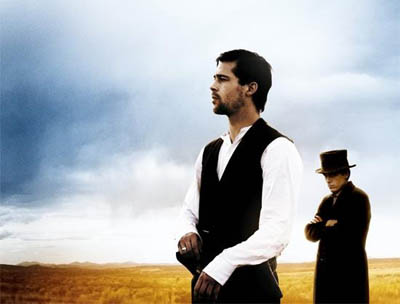
The Assassination of Jesse James by the Coward Robert Ford: The really successful fancy-pants genre film in my latest round of viewings. Andrew Dominik has made a grave, spare movie about the myth of Jesse and his murderer that doesn’t splash on period details and swamp the action in overproduced sets. The film could have been another funny-hats Western, but it turns out to be as austere as a sharecropper’s porch in a Walker Evans photograph. With an average shot length close to seven seconds, the film lets actors use their bodies a bit and interact within a fixed frame. In this context, the vignetted shots stand out, but not as mere flourishes; their wavery softness is picked up in the distorting windowpanes of the farmhouses and eventually in the fatal reflection in the picture Jesse is adjusting.
For once a post-Unforgiven western earns its meta-commentary on the Legends of the West. Jesse is the quietly charismatic star, while Ford is the overeager admirer, the outlaw as groupie. Daringly, the plot wanders away from its main characters for considerable stretches, and the protracted dialogues feature archaic turns of speech that can become ominous. Jesse is a raconteur whose paranoia can unnerve anybody: “You got a tale to swap with me now?” Assassination also reminded me of Magnolia in the dry authority of its voice-over narration and in its epilogue, which follows Ford to the end of his enigmatic life.
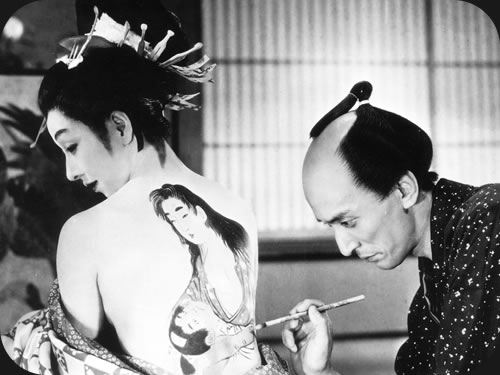
But where am I at the peak hours on Friday and Saturday, when throngs at the multiplex line up for popcorn, nachos and Dots? At our cozy Cinematheque, where we screen dazzling items like Nouvelle Vague and Utamaro and His Five Women. Right now, Godard and Mizoguchi own my nights.
The close-up blogathon launched by Matt Zoller Seitz is over, but it contains enough specimens and analyses for a hefty book. It also inspired Jim Emerson to devote a cine-lyric to the close-up. I missed the deadline, so I suppose that this constitutes my sideways contribution to Matt’s enterprise.
Sideways, because a full-blown analysis of In the City of Sylvia (En la ciudad de Sylvia; Dans la ville de Sylvie) would be a breach of decorum. Most people haven’t heard of this new film by José Luis Guerin, let alone seen it. I saw it at the Vancouver festival in September, and it will make its way through the festival circuit over the coming months and should show up on cable or DVD thereafter. But apart from calling attention to it as a remarkable film, I want to look at one of its most absorbing sequences and suggest some of its originality. Lee Marshall has already pointed out one of Sylvia‘s arresting features:
Guerin seems to have created pure drama without recourse to story. We’re always taught that story is the engine of drama. Not here: somehow Guerin has created an almost plotless film that has the dramatic tension of vintage Hitchcock. (1)
Although the story situation is slight, the tension we feel springs partly from vivid stylistic patterns. In other words: Minimal and uncertain story action is heightened by engaging visual narration. This narration in turn derives its power from one of the most traditional devices of filmic storytelling.
Consider the other person’s point of view
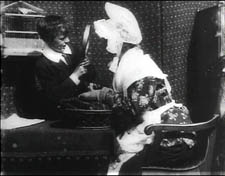
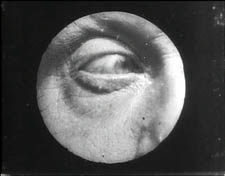
The point-of-view shot is a mainstay of cinematic storytelling, and its history is an intriguing one. Many of the earliest examples we have are motivated as views through optical gadgets. Two films by the Englishman G. A. Smith, both from 1900, handily show the options. Grandma’s Reading Glass justifies the point-of-view image as what the boy sees when he peers at granny through her big magnifier.
Smith’s As Seen through a Telescope motivates the cut-in POV shot as what our dirty old man in the foreground has an eye for.
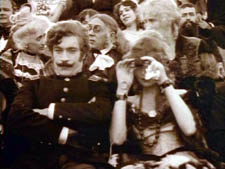
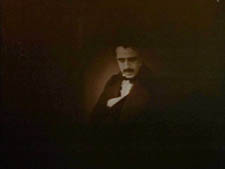
Fairly soon, this use of the magnifying POV shot was mingling with more straightforward ones. In The Birth of a Nation (1915), D. W. Griffith offers a rough-edged example. When the Stoneman brother and sister visit Ford’s Theatre on the night of Lincoln’s assassination, we see Elsie pointing out the famous actor John Wilkes Booth.
Booth is framed in an iris, which Griffith often uses to underscore an important image. But when Elsie studies Booth through her opera glasses, Griffith, usually not fastidious about such things, supplies the same irised image, now doing duty for the sort of magnifier-masking we get in the Smith films.
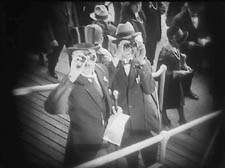
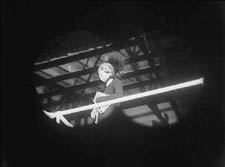
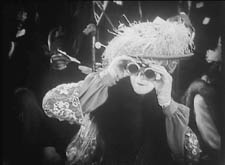
Presumably a more consistent technique would show Booth in long shot first, without the iris, and reserve the optical masking for replicating the view through the opera glasses. This is what happens in Ernst Lubitsch’s Lady Windermere’s Fan (1926), which contains a sequence built entirely around crisscrossed character looks. (1)
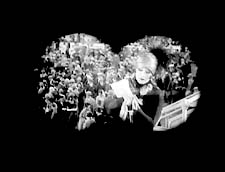
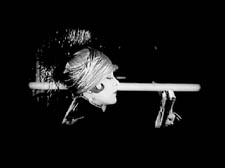
The woman of the world Mrs. Erlynne arrives at the racetrack and creates a stir, causing many men to watch her from all over the grandstand.
Note that Lubitsch has gone beyond Griffith by fitting the angle of Shot B to the viewer’s orientation, looking up. There are so many POV shots that at one point Lubitsch simply shows her from different angles and deletes the shots of each watching man.
This is a fascinating example of a process we often see in stylistic history. An “overlearned” visual convention can be treated elliptically; the filmmaker can leave out bits and we’ll fill them in. The binocular masking suffices to let us know that Mrs. Erlynne is being studied from afar. Moreover, Lubitsch gets an expressive bonus from being so concise. Now it doesn’t matter who’s watching, just that somebody is—actually, a lot of somebodies.
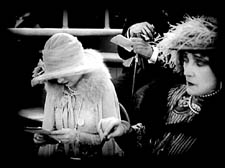
Later, after much more byplay with people looking at one another and misunderstanding what they see, Mrs. Erlynne sits down. Three gossips have been studying her, but now their view is blocked. So one gossip has to twist around to spy on her, and Lubitsch obligingly gives us a slightly tipped point-of-view framing—a full shot, without masking.
Adjusting her binoculars, the gossip is able to get a bigger view of Mrs. Erlynne, and she racks focus gleefully to catch a gray hair peeping out.
The visual narration in this sequence, already perfectly modulated, supplies the stylistic premise for Hitchcock’s Rear Window and all of its progeny, most recently Disturbia (2007). What might be overlooked is that by the 1920s the view through a device—field glasses, a microscope, a surveillance camera—had become a special, marked case. From then till now, the default POV pattern is the simple shot of a character looking, followed by an unadorned shot of what that person sees, from more or less the correct standpoint. Lubitsch’s sideways shot of the gossip’s view of Mrs. Erlynne, casually introduced, exemplifies the modern norm for presenting a character’s vision, and it’s so common that we seldom notice it.
POV shots: The basics
In his book Point of View in the Cinema, Edward Branigan itemizes the cues that the filmmaker can manipulate in creating a POV construction. (2) To simplify somewhat: Shot A shows a point in space and a character glance from that point. Shot B is taken from a camera position more or less approximating the point in A, and it shows an object. The shot-change presumes temporal continuity between A and B, and we assume as well that the character is aware of the object shown in B.
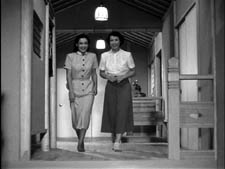
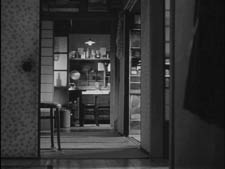
This seems like a complicated way of stating the obvious, but by teasing these elements apart, Branigan shows that each one can be manipulated in intriguing ways. For example, you can create a disorienting moment by violating the condition of temporal continuity. Ozu does this in Early Summer (1951), when Noriko and Aya decide to peek in at the man Noriko almost married. The two women tiptoe down a hall toward us as the camera tracks slowly backward. Ozu cuts to a forward-tracking shot that momentarily suggests a reverse angle POV on the corridor.
In fact, however, the camera movement is revealed to be the first shot of a new scene, among different characters, and we won’t ever see the man the two women went to spy on.
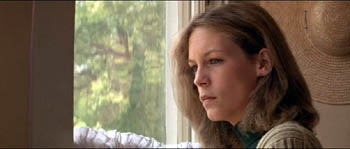
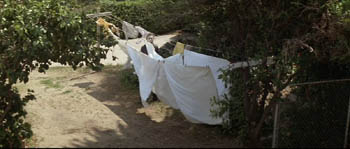
Here’s another interesting case, not cited by Branigan. In Halloween (1978), John Carpenter shows Laurie looking out a window and seeing Michael Myers in his mask, standing between fluttering washlines.
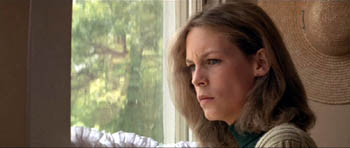
Cut back to Laurie, now frowning slightly.
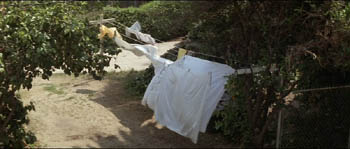
Cut to a second POV shot; but now Michael has vanished.
This simple change in shot B’s object, Michael himself, has an uncanny effect. Did Michael just walk away from the washline? If so, this is an odd way to present it. Why not show him walking away? Alternatively, did he just disappear? Surely not; Laurie would be shocked. Carpenter wins twice over. Without obviously violating realism or directly showing that Michael has supernatural powers, he gives Michael the ability to come and go in a ghostly fashion. By the end of the film, when he miraculously disappears after a fall that would kill an ordinary person, we are prepared to believe that he is indeed, as Dr. Sam Loomis says, the Boogyman.
Who is Sylvia? What is she that all the swains commend her?
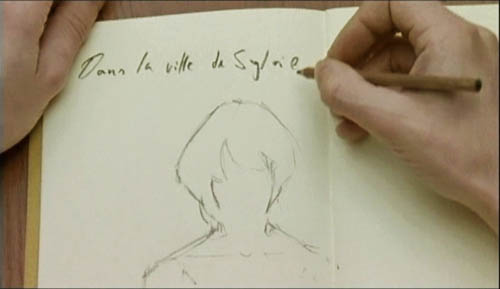
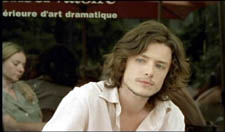
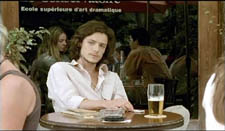
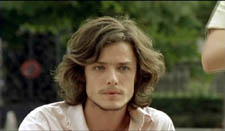
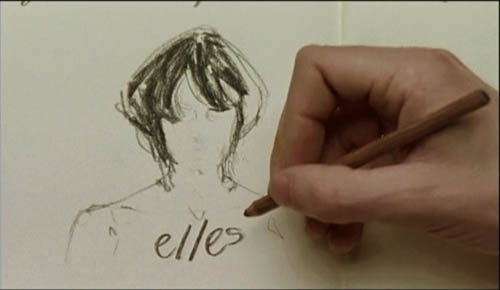
In the City of Sylvia centers on a young man staying at a hotel. We’re given no reason why he’s visiting the city, and no backstory about him. One day he’s sitting at a café. Now, across nearly twenty minutes of screen time he watches women and idly sketches them.
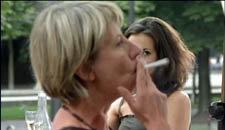
The sequence is a pleasure to watch, partly because of the constant refreshing of the image with faces, nearly all of them gorgeous, most of them female. Either Strasbourg has an extraordinary gene pool, or this café attracts only Ralph Lauren models. Yet the scene builds curiosity and suspense too, thanks to Guerin’s sustained and varied use of optical POV. He gives us an almost dialogue-free exploration of a cinematic space through one character’s optical viewpoint. (Stop reading here if you don’t want to know anything more about the film before you see it.)
The young man, known in Guerin’s companion film Unas fotos en la ciudad del Sylvia as the Dreamer, is almost expressionless as he scans the women’s faces. Slight shifts of his glance are accentuated by his habit of turning his head but keeping his eyes fixed. In over a hundred shots, Guerin uses some ingenious cinematic means to tease us into ever-greater absorption in the Dreamer’s visual grazing.
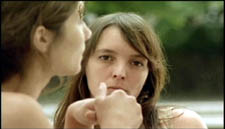
Fairly far into the sequence, Guerin gives us more or less the orthodox POV construction. The Dreamer looks at one woman at a table, and we see her return his look.
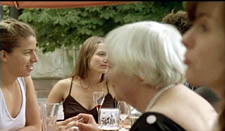
But here shot B isn’t really clean: the hands of the woman on the left sometimes block our view of the principal woman. This obtrusiveness is one of Guerin’s most basic strategies in the sequence. Inevitably, in passages before and after the cut I just showed, what the Dreamer is looking at is partially hidden in layers of faces and body parts.
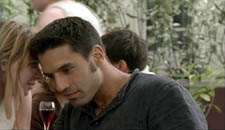
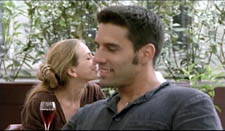
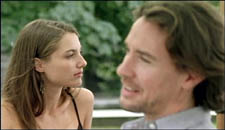
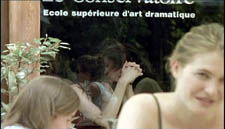
Our prototype of the POV cut presumes a more or less single ‘point’ we are watching in shot B, but throughout this scene Guerin plays with this cue. He tantalizes us with several points to be observed, and he often obscures the most important ones. He also creates some startling juxtapositions. Near the very start we get this shot, which may or may not be the Dreamer’s POV.
By making the background girl seem to kiss the foreground guy, Guerin, as Eisenstein would say, “christens” his sequence. In effect, the image says: Watch out! Layered space will become important! When I saw this shot, I nearly jumped out of my seat.
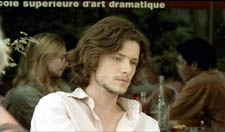
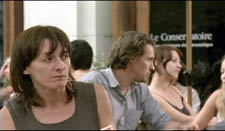
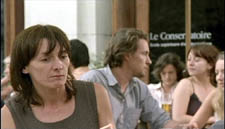
The Dreamer is treated no differently, at least at the start. In most movies, the POV construction is set up with a clear, clean framing of our looker in shot A. Here, though, at the start of the scene Guerin peels away layers to get to our man. For the first six shots of the café, we don’t know he’s on the scene. Then he’s shown out of focus, in the background of more prominent action. The woman in the foreground has been primed to be the shot’s subject. At the moment she shifts her gaze and we try to read her expression, a second woman on the distant right shifts aside to reveal the Dreamer behind her.
Surely this is the most unemphatic entry of a protagonist we’ve seen in a while! Guerin is able to add planes to block the main ‘point’ of shot B because he’s working with long lenses, a crowded space, and careful choreography. Even focus plays a role, as in this case; our Dreamer is pretty hazy.
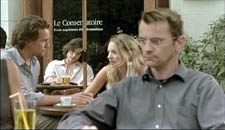
One upshot of this strategy is that we’re plunged into a “cubistic” space, in which slightly varied camera angles pick up bits of space we’ve seen in earlier combinations and oblige us to assemble it all in our head. Be thankful for the guy in the blue shirt above, for he plays an anchoring role in several setups that would otherwise float free.
It’s hard to convey in stills how much fascination and frustration that this teasing style creates. Like the Dreamer, we’re given only glimpses of the women, and even though we don’t know his purposes—is he just an artist in search of beauty? a serial killer picking out victims?—the partial views lure us at several levels. We try to complete the faces. We try to infer the women’s state of mind from their expressions and gestures, which are far more animated than our Dreamer’s.
And a search for story plays a part here. We’re primed for some action to start, and we browse through these shots looking for anything that might initiate it. Each face the Dreamer spots promises to kick-start a plot: when the Dreamer gets a full view of one of these women, perhaps things will get going.
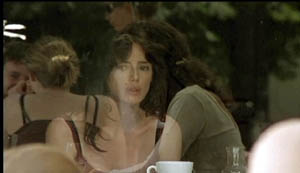
Without giving away every detail, I’ll just say that the sequence has a strong visual arc as the Dreamer starts paying more and more attention to certain women. And just as he finally gets a full view of one fabulous face, his attention wanders to . . . another layer, this time one inside the café.
As he gapes at the woman inside, layers pile up, creating a cubistic climax of all the optical obstructions we’ve encountered.
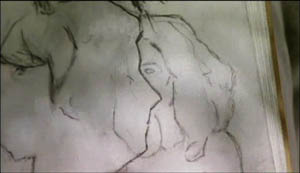
The motif of reflections will take over the rest of the film’s visual design, and eventually we’ll see that some of the Dreamer’s drawings evoke the piled-up and sliced-up faces in the café shots.
Later in the film, the Dreamer will explain why he’s in the city and why he’s scanning women. We’ll have a tram ride that Guerin compares with Sunrise, and a scene in a music club that not only parallels the café sequence but evokes Manet. We’ll also have occasion to compare this film with Bresson’s Four Nights of a Dreamer, a citation signaled from the outset.
All that is to come. Even if the later scenes weren’t as compelling as they are, this café sequence would make Sylvia one of the most adventurous films I’ve seen this year. By revising the simple, long-lived POV schema, Guerin has made it yield fresh feelings and implications. Like Lubitsch’s racetrack scene, this imaginative sequence provokes the jubilation you feel in the presence of calm, precise artistry.
(1) Lee Marshall, “Past Perfect,” Screen International (19 October 2007): 27. The web version is here, but it may require a subscription.
(2) I analyze the visual narration of Lady Windermere, which I think deserves to be ranked with Potemkin and Sunrise, in Narration in the Fiction Film (Madison: University of Wisconsin Press, 1985), 178-186.
(3) Edward R. Branigan, Point of View in the Cinema: A Theory of Narration and Subjectivity in Classical Film (The Hague: Mouton, 1985), 102-121.








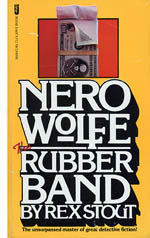 I’ve registered my admiration for Stout
 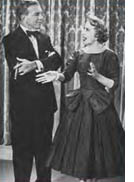 But above all stood George and Gracie. When I started to get what they were about, their program was ripening into its baroque phase. More than individual shows, I remember the brilliant central conceit. Gracie would hatch a wacko scheme, usually recruiting the hapless Harry von Zell as her minion. George would get suspicious and retire to his den to tune in the very show we were watching. He was then in a position to block her maneuvers, usually by tormenting von Zell. The idea that George could simply watch his own program still seems a stroke of genius. Artistic form, I must have realized subconsciously, can always be turned into a dizzy game. M. Godard, Ozu-san, meet Burns and Allen.
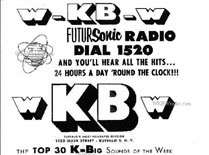 WKBW was a radio station out of Buffalo. At 50,000 watts it was so powerful it tended to seep into any blank spot on the dial. Actually, the DJs probably didn’t need an antenna, since they conducted their shows at ear-splitting volume. They indulged in all the profound things that characterized radio in the 1950s: cute sound effects (car crashes, always good), music clips (audio tape made it easy), jingles and station IDs that quickly became earworms, and nonstop patter sustained by whinnies, table-pounding, and laughter at feeble jokes. KB’s promotional efforts were no less strenuous. Once the station asked the public’s help in finding a missing DJ, only to reveal that he’d gone into hiding to drum up publicity.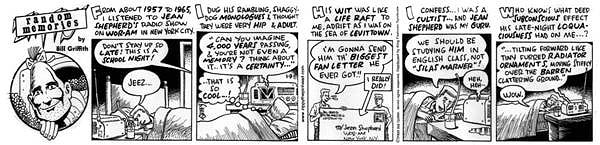
 We Own the Night: I admired James Gray’s The Yards, but this seemed to me quite standard. One brother’s a cop, the other’s on the shady side: back to Warner Bros. of the 1930s. (Where’s the tough priest, though?) Although set in the 1980s, it looks a bit like a 1970s movie, with all those long-lens shots and flattened color values. The plot was by-the-numbers, and lines like “You’re a dead man” and “I love you very much” don’t help. I guess it’s a “personal” project for Phoenix and Wahlberg, both brave performers in other vehicles but mostly going through the motions here. Further evidence that today’s cinema is classic studio cinema, with more sex, violence, drugs, and rock-and-roll.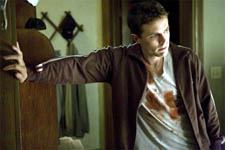
 Michael Clayton: Another tricked-out genre effort, with echoes of Three Days of the Condor. Again a mystery plot is overlaid with a guy’s personal problems: divorce, druggy brother, loyalty to his mentor. (By the way, when is someone going to do a study of the hero’s weak friend in Hollywood cinema?) We get the fancy flashbacks as well, starting at a high point—an exploding car bomb, which ought to grab you—before a title pops up: “Four days earlier.” Eventually,