
Friday | January 18, 2008
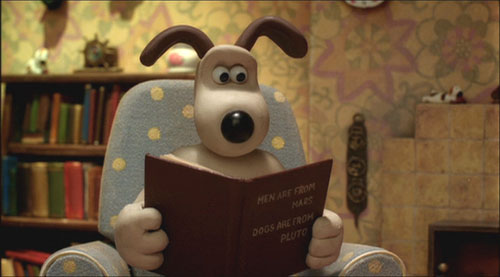
Cracking Contraptions: The Tellyscope
Kristin here—
David and I are currently plugging away on revising our Film History textbook. In setting out to update the section on Aardman animation, I ran into difficulties pinning down the dates of certain television series or the director of a given short film. Indeed, I was quite surprised at the dearth of complete chronologies or filmographies for such a famous and important company.
The obvious sources such as Wikipedia and the Internet Movie Data Base, are helpful but sketchy. Aardman’s own “History” section on its official website is even briefer–and ends in 2005. The filmography in Peter Lord and Brian Sibley’s coffee-table book, Creating 3-D Animation (p. 189), is far from complete. (I must confess that I’m still using the first edition, but even so the filmography is sketchy for the period it covered. The revised edition came out in 2004.) Each source was, however, incomplete in different ways. I decided to try and compile as comprehensive a chronology/filmography as I could as a research and reference tool. This turned out to be a considerable task. Given how little of this work will end up in the textbook, I decided that I might as well offer it to the world.
I expected to find one or more fan-originated sites that would provide additional information, as so often happens in the world of popular culture. The main “unofficial” site that came up when I Googled Aardman is actually an online shop with scarcely any actual information.
What follows is not by any means complete. It’s more like a rough draft for a filmography, though it’s more detailed than any that I have found so far. No doubt it has gaps and perhaps inaccuracies. One problem I encountered is that dates given in various filmographies seem to waver between when a film was made, when it was copyrighted, and when it was released to theaters or first shown in TV. I’ve tried to stick to release/broadcast dates when I could find them.
Aardman has produced many ephemeral animations for station-identification logos, credit sequences, and websites, as well as perhaps hundreds of commercials. I’ve made no attempt to include commercials, apart from the Heat Electric series, which are available on DVD. The following primarily includes television shorts and series, as well as films.
My main sources of information are: The Internet Movie Datebase; the history section of Aardman’s official website (which ends with 2005); the Big Cartoon Database’s Aardman page; Lord and Sibley’s Creating 3-D Animation; Insideaard (a booklet included in the British DVD Aardman Classics); and the credits of various Aardman films on DVD and on AtomFilms. Some details have been filled in from the Wikipedia entries on Nick Park and Steve Box. The main Aardman entry is so far rather sketchy, though it includes some films not listed in other filmographies and links to entries on the individual films and series, given below.
[Added January 29: Aardman itself might seem to be the ideal place to start, but the company doesn’t currently have a list of all its productions. It recently hired an archivist who, among other tasks, plans to compile such a list, including the commercials. In the meantime, this entry can serve as a stop-gap reference source.]
* indicates a music video, as identified in Lord and Sibley.
1970s
c. 1972, Friends and amateur animations Peter Lord and David Sproxton sell an untitled cel short featuring a “Superman” gag (illustrated on p. 10 of Lord and Sibley) to the BBC for about ₤15, for its “Vision On” series (producer Patrick Dowling; aimed at deaf children). The superhero’s name, Aardman, would give the pair’s company its name.
 1976 Aardman Animation founded 1976 Aardman Animation founded
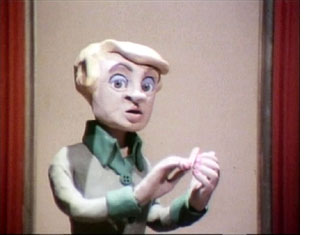
1978 Two films for “Animated Conversations” series, BBC: Down and Out (copyright 1977) and Confessions of a Foyer Girl (left; both dir. Lord and Sproxton). First use of real-life interviews for soundtracks.
1980s
1979-1982 Morph shorts for BBC. Initially part of “Vision On” series, then “Take Hart,” and finally on its own as “The Amazing Adventures of Morph” (dated 1981-83 in Lord and Sibley; 1980-81 on imdb).
c. 1982 Aardman starts making commercials. This becomes the financial staple of the studio and allows the company to move into larger facilities and hire more staff. Thereafter Aardman has produced 25-30 commercials a year. Lord and Sibley’s filmography contains a list of the products/companies for which Aardman made commercials from 1982 to 1998, but listed alphabetically without individual dates. (A few of these are on YouTube, such as this one for Chevron.)
1983 “Conversation Pieces” series: Sales Pitch, Palmy Days, Late Edition, Early Bird, and On Probation (dir. Lord and Sproxton). All shown during one week on Channel Four for its first anniversary.
1985 Nick Park joins Aardman full time
1986 Babylon (Lord and Sproxton) First film that Nick Park worked on. Channel Four
* Sledgehammer (dir. Stephen Johnson; Aardman’s portion animated by Park, Lord, Richard Goleszowski) Peter Gabriel music video.
1986-91 Aardman provides the “Penny” segments for five seasons of “Pee-wee’s Playhouse,” CBS.
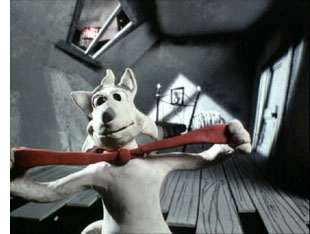
* 1987 My Baby Just Cares for Me (dir. Lord; right)
Going Equipped (dir. Lord)
* Barefootin’ (dir. Goleszowski) On YouTube
* 1988 Harvest for the World (one sequence, dir. Sproxton, Lord, and Goleszowski)
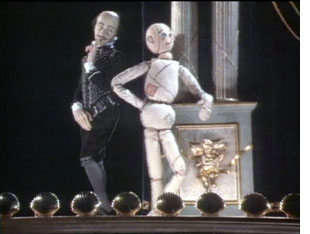 1989 “Lip Sync” series: Next (dir. Barry Purves; left), Ident (dir. Goleszowski; first appearance of Rex the Runt), Going Equipped (dir. Lord), Creature Comforts (dir. Park), War Story (dir. Lord) Channel Four 1989 “Lip Sync” series: Next (dir. Barry Purves; left), Ident (dir. Goleszowski; first appearance of Rex the Runt), Going Equipped (dir. Lord), Creature Comforts (dir. Park), War Story (dir. Lord) Channel Four
Creature Comforts spawns the “Heat Electric” series of ads
A Grand Day Out (dir. Park) Produced by the National Film & Television School and finished with help from Aardman. The introduction of Wallace & Gromit.
Lifting the Blues (dir. Sproxton)
1990s
1990 Steve Box joins Aardman
1990-91 Rex the Runt: How Dinosaurs Became Extinct (dir. Goleszowski)
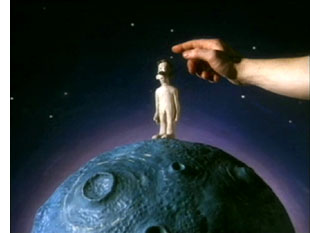 1991 Adam (Lord; right) 1991 Adam (Lord; right)
Rex the Runt: Dreams (Goloeszowski)
1992 Never Say Pink Fury Die (dir. Louise Spraggon)
Love Me … Loves me Not (dir. Jeff Newitt)
1993 The Wrong Trousers (dir. Park). Co-financed by Aardman and the BBC. Shown during the Christmas season.
Not without My Handbag (dir. Boris Kossmehl) Channel Four
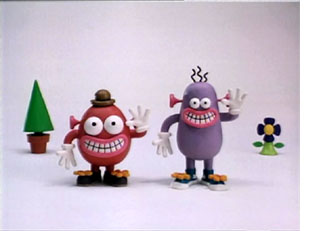 1994 Pib & Pog (dir. Peter Peake; left) 1994 Pib & Pog (dir. Peter Peake; left)
1995 A Close Shave (dir. Park), shown on the BBC at Christmas.
The Title Sequence (dir. Luis Cook and Dave Alex Riddett)
The Morph Files (dir. Lord and Sproxton) BBC
1996 Rex the Runt: North by North Pole (Goleszowski) “Pilot”
Wat’s Pig (dir. Lord) Channel Four
Pop (dir. Sam Fell)
* Never in Your Wildest Dreams (dir. Bill Mather)
 1997 Dreamworks pre-buys the U.S. rights to Chicken Run 1997 Dreamworks pre-buys the U.S. rights to Chicken Run
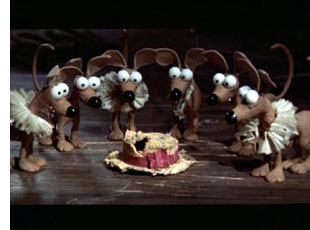
Stage Fright (dir. Box, right)
Owzat (dir. Mark Brierly)
1998 Humdrum (dir. Peake) Channel Four and Canal +
Al Dente (dir. Brierly)
“Rex the Runt” (dir. Goleszowski) 13 episodes for BBC2, aired December 1998 to January 1999
“The Angry Kid” series (dir. Darren Walsh) 3 episodes posted on the internet by AtomFilms
* Viva Forever (dir. Box)
1999 “The Angry Kid” (dir. Darren Walsh) 13 episodes distributed on the internet by AtomFilms
Minotaur and Little Nerkin (dir. Nick Mackie) Theatrical release
Rabbits! (dir. Sam Fell)
2000s
2000 “The Angry Kid” (dir. Walsh) episodes 14-25 (continuation of season one)
Chicken Run (dir. Lord and Park) Aardman’s first feature. Released in the U.S. by DreamWorks and in the U.K. by Pathé.
Non-Domestic Appliance (dir. Sergio Delfino) This and the next four films were posted on AtomFilms in 2003.
Chunga Chui (dir. Stefano Cassini)
Comfy (dir. Seth Watkins)
Ernest (dir. Darren Robbie)
Hot Shot (dir. Michael Cash)
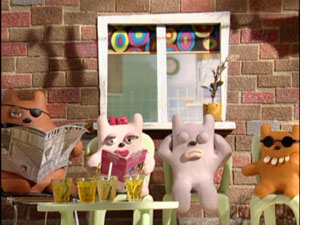 2001 “Rex the Runt” (dir. Golwszowski; left) second season, BBC2, 13 episodes, aired September to December 2001 “Rex the Runt” (dir. Golwszowski; left) second season, BBC2, 13 episodes, aired September to December
The Deadline (dir. Stefan Marjoram) A CGI short imitating Aardman’s traditional claymation style, made for an Aardman retrospective in New York. Nickelodeon subsequently commissioned twenty one-minute episodes with the same characters to create the series The Presenters (The Deadline on YouTube.)
2002 “Cracking Contraptions” (dir. Lloyd Price and Christopher Sadler) Ten episodes shown by BBC during the Christmas season.
Chump (dir. Fell) Theatrical
2003 “Creature Comforts” (dir. Goleszowski) First season, 13 episodes, ITV1
“The Angry Kid” moves from the internet to BBC3
2004 The Angry Kid: Who Do You Think You Are? (dir. Walsh) 22 minute film outside the series.
2005 Wallace & Gromit in The Curse of the Were-Rabbit (dir. Box and Park) Released in the U.S. by DreamWorks and in the U.K. by United International Pictures.
“Planet Sketch” (dir. ?) 13 episodes, 2005-2006. For a breakdown of episodes, see the Wikipedia entry.
Creature Comforts, second season, ITV starting in October.
2006 Flushed Away (dir. David Bowers and Fell) Distributed in the U.S. by DreamWorks and in the U.K. by United International Pictures. Aardman’s first CGI feature.
Purple and Brown (dir. Richard Webber) 21 episodes, Nickelodeon U.K. (Episode list on Wikipedia; a collection of the YouTube postings have been collected here, with some repetition.)
2007 January, DreamWorks terminates its five-feature contract with Aardman (claiming a write-off of $25 million for Wallace & Gromit in The Curse of the Were-Rabbit and $109 million for Flushed Away)
“Pib and Pog” (dir. Peake) Five shorts for the AtomFilms site: The Kitchen, X-Factor, Peter’s Room, Daddy’s Study, and The Dentist (copyright date 2006)
April, Sony announces that it has a deal to distribute Aardman features
“Shaun the Sheep” (dir. Sadler) 20 episodes, BBC, first series March, second series September.
“Creature Comforts America” (dir. ?) CBS, seven episodes. Three episodes aired in June, and the rest were cancelled due to low ratings.
The Pearce Sisters (dir. Cook) Theatrical
“Chop Socky Chooks” (dir. Delfino) 26 episodes, Cartoon Network (For character list, see Wikipedia entry)
2008 “Creature Discomforts” (dir. Steve Harding-Hill) Four public-service spots featuring disabled characters (with sound provided by people with disabilities), on ITV beginning January (also online).
Wallace and Gromit in Trouble at Mill (dir. Park) Half-hour Wallace & Gromit film to be shown by the BBC at Christmas.
[February 19, 2009: This films was shown under the title Wallace and Gromit: A Matter of Loaf and Death. The DVD is currently available for pre-orders on Amazon.UK and will be released March 23.]
1000 Sing’n Slugs (dir. ?) Bonus disc for re-issue of Flushed Away
2009 Announcement of “Timmy” (dir. Jackie Cockle) Spin-off from “Shaun the Sheep” aimed at pre-schoolers. 52 ten-minute episodes for BBC.
These features are currently announced as in progress: Tortoise vs. Hare (2009), Pirates (2009), Untitled Wallace & Gromit project (2010), Operation Rudolph (2010), and The Cat Burglars (2010).
Aardman has a CGI department mainly used for commercials and station-identification logos, including BBC’s three “Blob” spots, Nickelodeon’s “Presenters,” and BBC2’s “Booksworms”
Lord and Sibley list an undated, untitled public-information film on HIV/AIDS.
DVDs and the Internet
I won’t attempt a complete list of DVDs, given that some of these films have been repackaged in various compilations. I’ll mention the ones in our own collection, which cover most of what is available on DVD.
Leaving aside the Wallace & Gromit films for now, the crucial DVD for the studio’s output is Aardman Classics, which contains 25 shorts plus 12 “Heat Electric” ads that use interviews with animals in the style of Creature Comforts. Unfortunately this DVD was issued only in the U.K. [Added January 22: It was also issued in Australia with Region 4 coding.] It’s still available, and if you have a multi-standard player and are interested in Aardman, I can’t recommend it highly enough. It contains most of the films to 1998, going back to Confessions of a Foyer Girl and Down and Out. Presumably for rights reasons, it does not include the classic music video, Sledgehammer.
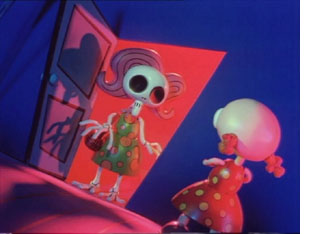 American viewers restricted to Region 1 DVDs have far less available to them. The American DVD of Creature Comforts (now out of print) contained only three other Aardman films: Wat’s Pig, Adam, and Not without My Handbag (left)—among the best, no doubt, but far from the cornucopia on Aardman Classics. American viewers restricted to Region 1 DVDs have far less available to them. The American DVD of Creature Comforts (now out of print) contained only three other Aardman films: Wat’s Pig, Adam, and Not without My Handbag (left)—among the best, no doubt, but far from the cornucopia on Aardman Classics.
Sledgehammer is included on the Peter Gabriel: Play the Videos DVD. I assume the quality there is distinctly better than the many copies available on YouTube and elsewhere on the Internet. By the way, the Quay Brothers did the rest of the animation for Sledgehammer.
Some of the TV series are available on DVD. Both seasons of “Rex the Runt” were released as a boxed set in the U.S. It’s rather pricey but has a 260-minute running time and some minor extras. The British DVD of the first season of “The Angry Kid” is now out of print. Both seasons of the British series “Creature Comforts” are available as a set in the U.S. The ill-fated “Creature Comforts America” has also been released. So far the two “Shaun the Sheep” series are only available in the U.K., separately or in a boxed set containing both.
Chicken Run, Wallace & Gromit in The Curse of the Were-Rabbit, and Flushed Away are all out on DVD. (The Were-Rabbit disc includes the classic 1997 Steve Box short, Stage Fright, as well as some good making-of supplements.) I had held off ordering Flushed Away in the hope, probably vain given the film’s weak U.S. box-office showing, that an edition with making-of bonuses will be forthcoming. Now, however, a re-issue (NTSC, but with no region coding) is coming out on February 19. (U.K. here.) It includes a second “all-new slugtacular disc,” 1000 Sing’n Slugs (not sold separately). Forget the making-ofs, my pre-order is in!
Finally, the all-important question: which DVD of the three classic Wallace & Gromit shorts to purchase? For once the American disc, “Wallace & Gromit in Three Amazing Adventures,” has the advantage, in that it includes all ten episodes of the “Cracking Contraptions” series. These are all available on the Aardman website, but for a larger image and better visual quality, fans will want the DVD. The British disc, “Wallace & Gromit: Three Cracking Adventures!” has only the three films and a bonus, “The Amazing World of Wallace & Gromit,” a brief history of Aardman that I remember as being pretty good.
Apart from its own website, the official outlet for Aardman shorts on the Internet is AtomFilms, which currently has lists 37 titles under the category “The Best of Aardman.” A group of very short films, Non-Domestic Appliance, Chunga Chui, Comfy, Ernest, and Hot Shot (all copyright 2000 but posted in 2003) look to me as if they might have been training exercises for young animators who also worked on Chicken Run. A group of classic films are available: Creature Comforts, Minotaur and Little Nerkin, War Story, Wat’s Pig, Stage Fright, Hundrum, Pop, Owzat, Adam, Al Dente, and Loves Me, Loves Me Not. The original Pib and Pog is also there, as well as a “Pib and Pog” series of five original shorts posted in 2007. Another series, “A Town Called Panic,” has six episodes; it is a Belgian production (copyright 2002; see the Wikipedia entry for episodes, characters, and links) which Aardman distributes. It was posted on Atom Film in 2007. There are also several “Angry Kid” episodes.
There are many Aardman items on YouTube. Many are bad copies of films available elsewhere, but there are some treasures to be found among them. I leave it to you to continue the search.
I would appreciate any corrections, additions, or other significant links that readers can provide.
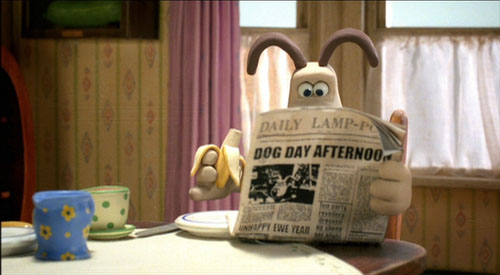
Cracking Contraptions: The Autochef
Posted in Animation, Animation: Aardman, Film history |  open printable version
| Comments Off on Tracking down Aardman creatures open printable version
| Comments Off on Tracking down Aardman creatures
Friday | January 11, 2008
DB here:
In December Kristin and I attended a wide-ranging conference at Rome University devoted to “Exploded Narration”—the effects that digital technology has had on storytelling in film and television. As our host Vito Zagarrio put it, the question is one of continuity or rupture. Have new formats like HD, the Internet, and DVD revolutionized media storytelling? Or are they serving traditional approaches?
Many papers explored the “rupture” option, while Kristin and I offered presentations that emphasized continuity. You can find one version of my argument elsewhere on this site. Still, both of us also pointed up some innovations, or what I called “spillover” effects. As so often with such questions, the answer turned out to be complicated.
 We enjoyed the conference, and one standout aspect was the presence of Amos Poe. Poe is probably best known for his first feature, Alphabet City (1985), and for his 16mm film on the Punk scene, The Blank Generation (1976). His Triple Bogey on a Par Five Hole (1991) has also attracted attention. For three decades Poe has worked as a director, producer, screenwriter, and teacher. The Sundance festival is playing Amy Redford’s The Guitar, which Poe wrote and coproduced. We enjoyed the conference, and one standout aspect was the presence of Amos Poe. Poe is probably best known for his first feature, Alphabet City (1985), and for his 16mm film on the Punk scene, The Blank Generation (1976). His Triple Bogey on a Par Five Hole (1991) has also attracted attention. For three decades Poe has worked as a director, producer, screenwriter, and teacher. The Sundance festival is playing Amy Redford’s The Guitar, which Poe wrote and coproduced.
Amos was great fun. A soft-spoken man with a quick and wicked sense of humor, he enlivened our dinners at various ristoranti. He also spoke extensively about screenwriting, which he teaches at NYU and at NYU’s Florence program. Like many screenwriters, he’s extremely intelligent and articulate about his craft. Three examples:
*How to learn screenwriting? Get a script version of a film you admire. Read the first ten pages, then closely watch the first ten minutes of the movie. Go back and read the next ten pages, and go ahead and watch the corresponding ten minutes. And so on until the end. Do this with three first-rate films, and you will have a concrete, intuitive understanding of how a screenplay works.
*A screenplay, Amos points out, isn’t a short story or novel or play. It’s a movie in words. It must make the reader see and hear an imaginary film, and not only the action, either. Without indicating specific shots, the descriptions should suggest the flow of long-shots and close-ups (”Her lipstick leaves a smear on the cigarette butt”). “The screenwriter is a filmmaker.”
*Write sounds into the background of scenes, setting them up for fuller presence later. If a train becomes important late in the story, mention the wail of a distant train early in the screenplay. This sort of auditory planting quietly strengthens the structure of the story in your reader’s mind.
Amos must be a terrific teacher. I learned a great deal from his descriptions of contemporary film conventions, several of which I hadn’t noticed before. Don’t be surprised to find some of them creeping into future blogs.
Given Amos’ expertise in mainstream storytelling, the film he presented was quite a surprise. It’s called Empire II, and though you don’t normally call a three-hour movie a delight, I can’t think of a better word. After a week of tourism and no films, it was just the sensuous boost that my hungry eyes needed.
Man with a Video Camera
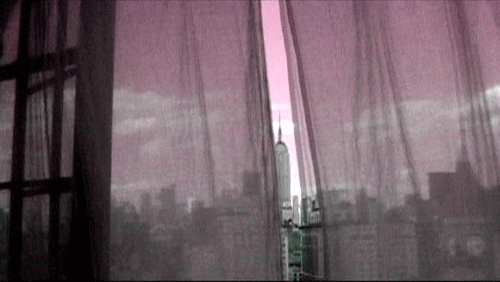
Poe’s apartment on Christopher Street yields a stunning view of the Manhattan skyline—the Chrysler Building, Jefferson clock tower, and of course the Empire State Building. He planted a Sony PD150 video camera at his window for a year, from 1 November 2005 to 31 October 2006, and took time-lapse shots. Through single-framing, he captured a total of 1 or 1 ½ seconds of every thirty seconds of real time. He shot traffic, people, skies, and the horizon. He did not look at the footage until after the year was up.
He wound up with sixty hours of imagery. He then made an absolute gesture. Using Final Cut Pro, he compressed all sixty hours into three. What was already highly elliptical, a string of tiny slices of action, became enormously accelerated.
Poe and his students then spent months blending up to forty tracks of music, spoken verse, and sound effects. It’s a crisp stereo mix, with remarkable audio-visual correspondences: whipping wind and ticking machinery sync up with snow and the tower clock. The music, which ranges from alt-rock to Keith-Jarrettish piano strumming, works sympathetically but not redundantly with the imagery. (No surprise that Poe has made music videos.) Shooting the film cost virtually nothing, but Poe spent about $100,000 for music clearances, though old friends like Patti Smith and Deborah Harry gave him their material for free.
The result is a city symphony, a lyrical tribute to the looks and sounds of New York. It joins the tradition of Walter Ruttmann and Dziga Vertov, as well as Paul Strand’s Manhatta (1921) and Jay Leyda’s Bronx Morning (1931). It also reminds you that Poe has roots in the downtown avant-garde. In 1972-1975, he often watched works by Jonas Mekas, Stan Brakhage, Michael Snow, Bruce Baillie, and Jack Smith at Millennium Film Workshop, and he made films for its Friday night open screenings. As a result, Empire II carries premises of lyrical and Structural cinema into the digital era.
The conditions of production are at once subjected to strict guidelines—a single year, only views from the window, the 20x compression—and open to chance. As with the films of Ernie Gehr, chance becomes more felicitous when set within a rigid frame. “I needed to create a base for accidents to happen.” Poe refused to cut or rearrange what he had (”I don’t edit unless I get paid for it”) and so he was ready to accept what came out. “I had to let go of the result.” That result mixes smoothness and fracture; the moon arcs like a golf ball, but traffic hammers relentlessly in a way recalling the last sequence of Man with a Movie Camera. Every so often there are calm islands of blank frames, provided by Poe’s occasional neglect to set focus or exposure.
Poe’s Book of Hours and Days
The title pays homage to Warhol’s 1964 film, so often discussed and so little seen. In many ways, though, Poe gives us an anti-Empire. Instead of a silent film, sound, both aggressive and immersive. (The stereo tracks shoot noises bouncing across channels, swallowing you up.) Instead of a single night, a year’s time span. Warhol shot Empire at 24 frames per second but insisted on projecting it at 16, slowing up time; Poe’s single-frame sampling and frantic acceleration speed time up. Warhol used for the most part a single camera position and shot in long takes, but Poe presents a flutter of shots. The framing is steady, but what we see flickers and pulsates, creating superimposition effects comparable to Ruttmann’s and Vertov’s slashing diagonals.
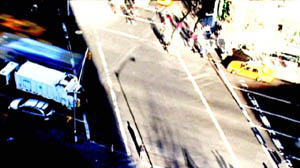
Warhol was withdrawn and impersonal, but Poe turned on the camera when he spotted something that looked interesting. He felt free to focus, reframe, zoom, and shift camera position for different angles on the life beyond his balcony. Likewise, the automaton Warhol (”I’d like to be a machine”) is counterposed to Poe’s more organic sensibility. He never lets us forget the flowers twitching on his windowsill, and their growth and rearrangements become traces of his daily life in the apartment.
The rules are simple and viewer-friendly. We instantly recognize the trappings of city life; we know the cycles of the seasons and the shifts between night and day. This cogent structure throws all our attention on what we see from moment to moment, and how we see it.
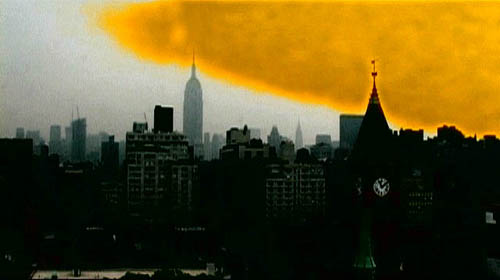
The Empire State Building and the skyline around it, along with the flowing clouds, remain stable reference points for a flurry of visual transformations. The taxis and pedestrians we glimpse move in jagged, incomplete rhythms very different from the smooth flow of fast motion in Godfrey Reggio’s films like Koyaanisqatsi.
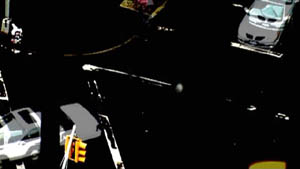
As you see, high angles, plays of focus, and tight framings provide energetic abstraction. Flaring exposure makes the Building look like it’s in flames, triggering echoes of the 9/11 attacks.
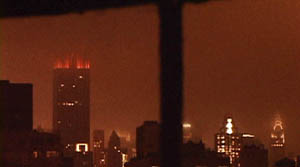
When the weather changes, the light does too. Raindrops become not only a pebbly surface on the windows but tiny filters. As with Warhol’s films, we have to change our conception of what counts as an event. Slight differences of framing and texture become visual epiphanies. Rain can be gray-green, and snow can go pale red. At times, the steeple clock face in the lower right becomes an imperturbable timekeeper, a sort of pictorial timecode, reminiscent of the clock in the corner of the shots of Robert Nelson’s Bleu Shut (1971).
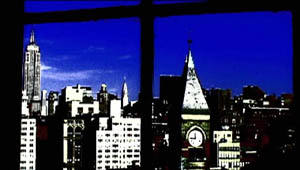
Spring comes about halfway through. It’s as lyrical as you’d expect, but again the colors startle. If snow can be red, then budding trees can be blindingly white.
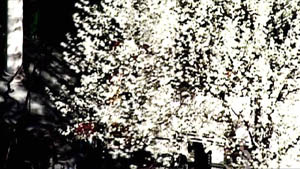
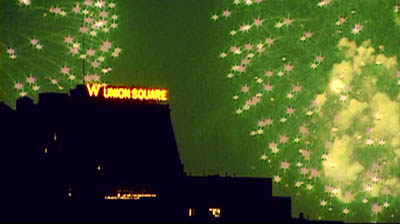
As in Ives’ Holidays Symphony, the festive iconography of Americana is made somewhat dissonant. July Fourth fireworks become splinters, and the slurred, jerky figures in the final Halloween chapter recall Mekas’ Notes on the Circus. Now shooting more continuously, with handheld shots and bumpy pans and zooms, Poe lets his 20x compression turn the parading ghosts, skeletons, nuns, and dark angels into scurrying hallucinations, complete with cellphones.
Empire II is at once exuberant and tranquil. What a pleasure to find a film devoted simply to seeking out beauty in everyday surroundings. “She celebrates the small,” sings Jimmie James while we see snow lashing the sidewalks. So does Poe. He has said that he made the film at a difficult period of his life, but what he has given us, I think, is jubilation.
PS 22 Jan: For more on Empire II, including a trailer, go to amospoe.com.
Posted in Experimental film, Film comments, Film technique, New media: Technology, People we like, Screenwriting | open printable version
| No Comments »
Saturday | January 5, 2008
DB here:
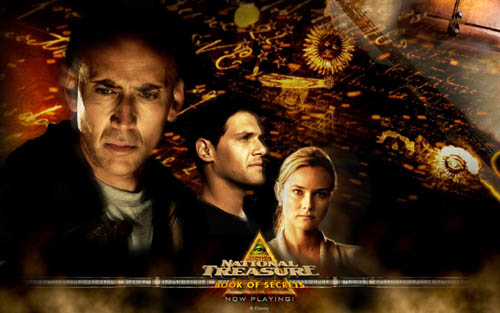
More informative about American history than Fahrenheit 9/11. More brain-teasing, and far more enjoyable, than I’m Not There. Less graphically violent than almost any other movie you’re likely to see. What else could I be talking about but National Treasure: Book of Secrets?
Jerry Bruckheimer is, in my view, the most astute producer now working in Hollywood. I could cite many proofs, but let’s stick just to the first National Treasure. Here’s a movie with no pop music, no cusswords, no naked ladies, no drugs, no screwing, and scarcely any violence. (One bad guy accidentally falls to his death down a deep black hole.) When it came out—you can verify this by asking Kristin—I said that it was the ideal movie for grandparents to take the grandkids to. The man who gave us Bad Boys and CSI has realized that there’s a market niche for the PG-rated action film. So we get an amiable romp that mixes together Freemasons, the Knights Templar, the Rosicrucians, Ben Franklin, and for all I know Judge Crater, Atlantis, and the Lindbergh baby.
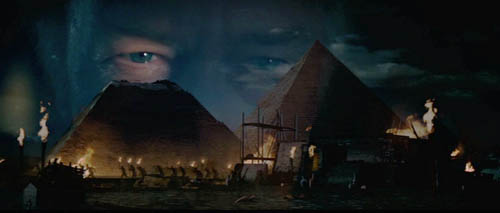
My colleagues, students, and wife think I’m nuts to like National Treasure. In defense I could point to evocative images like the one surmounting today’s entry, the superimposition of Grandpa Gates’ eye on a pyramid as a condensation of the Masonic/ monetary/ paternity motifs swarming through the movie. But I needn’t strain so far. The pleasures are more elemental.
Secret codes, knights, lost treasure, rich sinister Brits, really deep holes filled with cobwebs, and a cipher on the back of the Declaration of Independence—what’s not to like? All of this is pulled together by a hero who is actually intelligent and knowledgeable. He’s a nerdy patriot (another Bruckheimer touch, reminiscent of The Rock) who can turn a priceless hoard over to the US government without a quiver. How often do you find a story whose protagonists are people who know and care about the past? In the DVD supplement, an alternative ending shows schoolboys eyeing the recovered Declaration. One wonders if there’s really a treasure map on the back. The other mutters, “It’s a plot to make us learn history.” What if he is right?
Of course some will say Spielberg/ Lucas/ Kasdan did it already with Raiders. But that was a knowing effort to relive somebody’s phantom vision of B serials. Besides, does anybody believe that Indy knows as much about archaeology as Ben Gates does about nearly everything? If it recycles anything, National Treasure amounts to a revival of the wholesome 1950s Disney adventure movie. What Treasure Island (1950), Davy Crockett (1955), and The Great Locomotive Chase (1956) were for an earlier generation, National Treasure is for today’s twelve-year-olds. It compares favorably with those entries in verve, wit, and speed. (How it gets that speed is a topic I take up in “The Hook,” a new online essay. That piece tries to show that even if you don’t like the movie, its narration provides a nifty tutorial in some strategies of Hollywood storytelling.) My only regret is that in the epilogue NT 1 actually uses, Ben and Abigail are given a mansion and Riley gets a cherry-colored Ferrari. That’s a bit crass. Knowledge, selflessness, and pluck should be their own rewards.
Your correspondent regrets to report that Book of Secrets is not up to its predecessor. It’s still quite entertaining, and it has some transitions as clever as those I talk about in the aforementioned essay. The premise, involving the Lincoln assassination and the besmirched reputation of Ben’s ancestor, is workable and even moving, grounded as it is in parallel father-son reconciliations. The clue-sequences are more ingenious than, say, the simple linear connectives in Bourne Ultimatum. There are a few nifty compositions (e.g., a reflection of Ben in a windshield) and some nicely-timed reaction shots of Riley and Ben’s dad. (Someday, I swear, I will blog about reaction shots, a key to Hollywood storytelling.) I liked the way that the slapped-together family of the first installment—Dad Ben, Mom Abigail, Riley the kid—is expanded to include the old folks. Of course I regard the rekindled affection between Ben’s father and mother as backup for my Grandparents-Grandkids Hypothesis.
Still, the sequel lacks the throwaway byplay between Ben and Riley and the clever misdirection of certain scenes, principally the extended heist at the National Archives reception. The plot is somewhat too stuffed with incident, jerking us abruptly from continent to continent. (Will American filmmakers please give up the informative title card “Paris, France”?) It seemed to me as well that Ben’s reasoning involved not so much high-context inferences as inspired guesswork. The contrived quarrel in Buckingham Palace between Ben and Abigail is nothing like as enjoyable as Ben’s snippy requests for silence after they’ve lifted the Declaration in NT 1. Sequels don’t have to be a step down from the original, as this entry has argued at length, but alas NT 2 is.
Don’t, however, tell me that the thing is preposterous. Friend, the genre is built upon the preposterous. Preposterosity is its middle name. Jules Verne, H. G. Wells, and Edgar Rice Burroughs all spun their yarns out of hopelessly far-fetched premises. There is nothing as nutty in this franchise as the idea that Tarzan could teach himself to read. The task is always to make a crazy logic out of a farrago, and this the new installment does, skipping from pre-Columbian inscriptions to the idea that, as Riley phrases it, “Mount Rushmore was a coverup.” I buy that, and I completely buy the idea that our Chief Executives pass along a book recording all the Big Secrets in US history. The only item I couldn’t swallow was the prospect that America might elect a President who majored in architectural history.
Compensating for the feature’s drawbacks were the hors d’oeuvres at my screening. Now when we go to the multiplex we get Bonus Supplements, just like in the old days of trailers, shorts, and educational featurettes. My extras were a trailer for the upcoming Pixar release Wall*e, a trailer for the new Narnia installment (produced by our old compadre Mark Johnson), and even a Goofy cartoon, How to Hook Up Your Home Theater. Brainwashed by TV ads, the Goof races to the chain store Shiny $tuf to get his gigantoscreen and peripherals, under signs reading: “Obey—Buy!” At home, he has to sweep a faded pic of Uncle Walt off his sideboard to clear space for the new gear, which arrives in a blizzard of styrofoam peanuts. As fast as a Clampett and as silly as a classic Goofy, the cartoon includes his memorable “Wah-yoo-yah!” holler as he is launched into space.
How to Hook Up Your Home Theater even looked hand-drawn. If it’s on the Book of Secrets DVD, I’ll buy that disc. Hell, I probably will anyhow.
PS 7 January Thanks to Greg Thow for calling my attention to a nice background interview on the making of the Goofy short.
PPS 8 January Thumbing through folders–real ones, made of manila–I find that agents use National Treasure as the model of a “four-quadrants” movie.
Posted in Film comments, Film genres, Film industry, Hollywood: Artistic traditions, Hollywood: The business, Narrative strategies | open printable version
| No Comments »
Friday | December 28, 2007
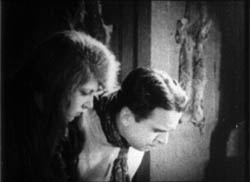 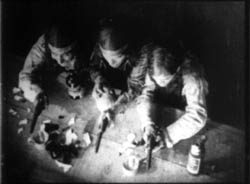
Wild and Woolly (1917).
KT:
Periodization is a tricky task for historians, and there are a lot of disputes about how to divide up the 110-plus years of the cinema’s existence. We all have to deal with it, though, if we want to organize our studies of the past into meaningful units. How to do that?
Do we divide the periods of film history according to major historical events? World War I had a huge impact on the film industry, to be sure, and we might say that one significant period for cinema is 1914-1918. Yet 1919 didn’t mark the start of a new period. The major European post-war film movements didn’t start then. French Impressionism arguably began in 1918, German Expressionism in 1920, and Soviet Montage in 1924 or 1925.
Carving up film history partly depends on what questions the historian is asking. If you’re studying wartime propaganda, 1914 and 1918 would provide significant beginning and end points. If you want to trace the development of significant film styles, it doesn’t seem very useful.
While historians have difficulties agreeing on periodization, just about everyone concurs that there were two amazing years during the 1910s when filmmaking practice somehow coalesced and produced a burst of creativity: 1913 and 1917.
One can point to stylistically significant films made before 1913. Somehow, though, that year seemed to be when filmmakers in several countries simultaneously seized upon what they had already learned of technique and pushed their knowledge to higher levels of expressivity. “Le Gionate del Cinema Muto” (“The Days of Silent Cinema”), the major annual festival, devoted its 1993 event to “The Year 1913.” The program included The Student of Prague (Stellan Rye), Suspense (Phillips Smalley and Lois Weber), Atlantis (August Blom), Raja Harischandra (D. G. Phalke), Juve contre Fantomas (Louis Feuillade), Quo Vadis? (Enrico Guazzoni), Ingeborg Holm (Victor Sjöström), The Mothering Heart (D. W. Griffith), Ma l’amor mio non muore! (Mario Caserini), L’enfant de Paris (Léonce Perret), and Twilight of a Woman’s Soul (Yevgenii Bauer). .
1917, by contrast, was primarily an American landmark. As 2007 closes, we thought it appropriate to wish happy birthday to the most powerful and pervasive approach to filmic storytelling the world has yet seen. That would be classical continuity cinema, synthesized in what was coming to be known as Hollywood.
DB:
In The Classical Hollywood Cinema and work we’ve done since, we’ve maintained that 1917 is the year in which we can see the consolidation of Hollywood’s characteristic approach to visual storytelling. This idea was first floated by Barry Salt, and our research confirms his claim. Over the ninety years since 1917 the style has changed, but its basic premises have remained in force.
Before classical continuity emerged, the dominant approach to shooting a scene might be called the tableau technique. Action was played out in a full shot, using staging to vary the composition and express dramatic relationships. Elsewhere on this site I’ve mentioned two major exponents of this approach, Feuillade and Bauer.
When there was cutting within the tableau setup, it usually consisted of inserted close-ups of important details, especially printed matter, like a letter or telegram. Occasionally the close-up of an actor could be inserted, usually filmed from the same angle as the master shot. The tableau approach was more prominent in scenes taking place in interiors; filmmakers were freer about cutting action occurring outdoors.
We shouldn’t think of the tableau as purely “theatrical.” For one thing, the master shot was typically closer and more tightly organized than a scene on the stage would be. Moreover, for reasons I discuss in Figures Traced in Light, the playing space of the cinematic frame is quite different from the playing area of the proscenium theatre. The filmmaker can manipulate composition, depth, and blocking in ways not available on the stage.
The tableau approach was the default premise of US filmmaking through the early 1910s. You can see it at work, for example, in this shot from At the Eleventh Hour (W. V. Ranous, 1912). Mr. and Mrs. Richards are in the study of Mr. Daley. After Richards has refused to sell his railroad bonds, Daley’s wife shows off her diamond necklace to the visitors.
At first the two couples are separated in depth, the men in the foreground and the women further back. In the first frame below, a new necklace has just been delivered, and a servant gives it to Mrs. Daley. Only the servant’s hand is visible, as she is blocked by Richards in the foreground. In the second frame, the two women come forward. Mrs. Daley holds the necklace up and Mrs. Richards oohs and ahhs over it, while her husband glances at Daley as if to wonder how he could afford it.
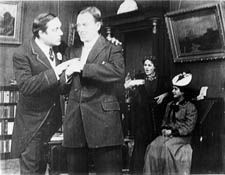 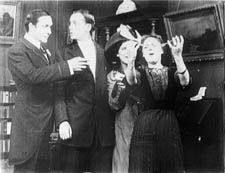
Instead of breaking the scene into closer views, spreading the characters’ reactions across separate shots, Ranous squeezes all of their actions and expressions into a tight space across the center of the shot. Nor does he provide a close-up of the necklace, which will be important in the plot. (1) We might be inclined to say that this is a “theatrical” shot, but on a stage the actions in depth (the women chatting, the servant handing over the parcel) wouldn’t be visible to everyone in the auditorium. Likewise, on a stage the packed faces in the later phase of the scene wouldn’t be visible to people sitting on the sides.
As films became longer, American filmmakers were starting to organize their plots around characters with firm goals. Conflicting goals would set the characters in opposition to one another, and at a climax, usually under the pressure of a deadline, the protagonist achieves or fails to achieve the goals. The plot also tends to build up two lines of action, at least one involving romance.
There’s no reason this conception of narrative could not have been applied to the tableau style; in many cases it was. But hand in hand with the rise of goal-driven plotting came a new approach to filming. Sporadically before 1917, filmmakers in many countries were exploring ways to build scene out of many shots. (If you want to know the process in the US in more detail, check out Early American Cinema in Transition by Charlie Keil.) By 1917, American filmmakers had synthesized these tactics into an overall strategy, a system for staging, shooting, and cutting dramatic action.
We know the result as the 180-degree system. This encourages the filmmaker to break a scene into several shots, taken from different distances and angles, all from one side of an imaginary line slicing through the space. Around 1917, this stylistic approach comes to dominate US feature films, in the sense that every film made will tend to display all the devices at least once. The system remains in place to this day, and it came to form the basis of popular cinemas across the world. (2)
Once you break a scene into several shots, some characters won’t be onscreen all the time. So you need to be clear about where offscreen characters are; you need to supply cues that allow the audience to infer their positions. So 1910s filmmakers developed various ways of “matching” shots.
Shots can be connected by character looks, thanks to the eyeline match. Here’s an instance from Victor Schertzinger’s The Clodhopper (1917). First there is a master shot of the mother and son in their farm kitchen.
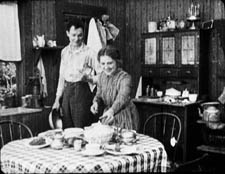
This is followed by a separate shot of each one. Their bodily positions and eyelines remind us that the other is just out of frame.
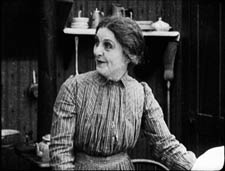 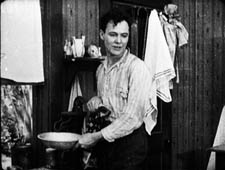
Although over-the-shoulder shooting hadn’t yet been developed, a conception of the reverse angle is at work here too. Schertzinger’s camera doesn’t shoot the actors perpendicularly, but takes up an angle on one that becomes an echo of that filming the other. Here’s another example of reverse angles from The Devil’s Bait (1917, director Harry Harvey).
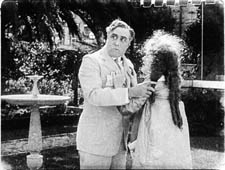 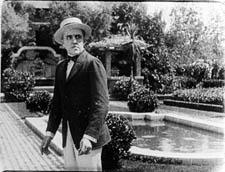
The camera doesn’t just enlarge a portion of the space, as in the inserted shot in a tableau scene. The angle of view has changed significantly.
Changes of angle within the scene have become fairly complex by 1917. This strategy is apparent when the action takes place in a theatre, a courtroom, a church, or some other large-scale gathering point. The camera position changes often in this scene from The Girl without a Soul (director John Collins).
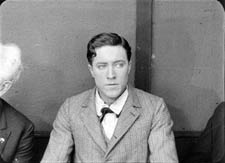 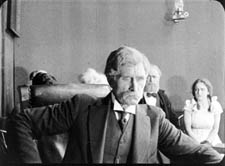 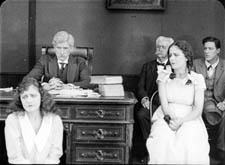
The concept of matching extends to physical movement too, through the match on action. This device allows the director to highlight a new bit of space while preserving the continuity of time. In Roscoe Arbuckle’s The Butcher Boy, the cut-in to Fatty (with a change of angle) also matches his gesture of putting his hands on his hips.
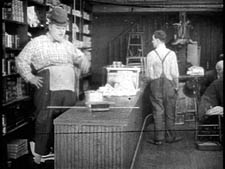 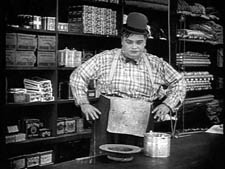
Interestingly, even this early, directors have learned to leave a little bit of overlapping action across the cut. If you move frame by frame, you’ll see that Fatty’s gesture is repeated a bit at the start of the second shot.
When a character leaves one frame, he or she can come into another space, from the side of the frame consistent with the 180-degree premise. This is matching screen direction. A cut of this sort lets us know that the next portion of the locale that we see is more or less adjacent to the previous one. In Field of Honor (director Allen Holuban), Wade crosses to Laura, who’s waiting in a carriage. A few years earlier, the director might have presented his greeting in a single deep-space long shot. Instead, Wade exits one shot and enters the next.
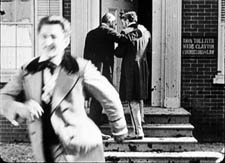 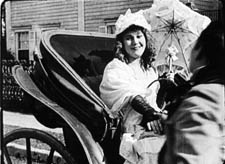
Again, the reverse-angle principle governs the camera setups. Wade moves along a diagonal toward the camera and away from it.
More generally, Field of Honor exhibits a polished handling of the new style: lots of reverse shots and eyeline matches, fades that bracket flashbacks, binocular points of view, rack-focus shots, and rapid cutting (there’s even a ten-frame shot). The point is not to claim Field of Honor as an undiscovered masterpiece but rather to indicate that by 1917 a director could handle all the devices with assurance.
Match-cutting devices had been used occasionally before 1917, but by that year filmmmakers melded them into a consistent and somewhat redundant method of guiding the audience through each scene.
The continuity system not only creates a basic clarity about characters’ positions. It can as well generate a speed and accentuation not easily achieved within a single shot. For example, Wade’s frame exit and entrance above is cut so as to skip over moments that he consumes crossing the driveway. Continuity editing enhances the rapid pace of US films, a quality immediately noted by foreign observers in the 1910s and 1920s.
Two of the best films of 1917 exploit the dynamism of continuity cutting. The Doug Fairbanks comedy western, Wild and Woolly, seems designed to prove that American films could proceed at breakneck speed. In climactic scenes, we’re caught in a whirlwind of fast cutting, with the pace set by the hyperactive protagonist, a financier’s son who longs to prove himself as a cowboy.
John Ford’s Straight Shooting proceeds at a more measured pace, but in its final shootout we see a prototype of all the main-street gundowns that will define the Western. Ford provides alternating shots of the cowboys advancing toward each other, framing each man more tightly and concluding with suffocating close-ups of each man’s face, highlighting the eyes.
Sergio Leone, eat your heart out.
Propelled by goal-driven characters and a linear arc of action, films like Wild and Woolly and Straight Shooting are completely understandable and enjoyable today. (But when will we have them on DVD?) Their stories are engrossing and their performances are engaging, but just as important their storytelling technique has become second nature to us. The narrative strategies that coalesced in 1917 remain fundamental to mainstream cinema.(2)
The Mystery of the Belgian Print
KT:
For decades now we have been visiting Brussels and working at the Cinémathèque Royale de Belgique/Koninklijk Belgisch Filmarchief. Sometimes I feel that we would know half as much about the cinema were it not for the unfailing hospitality we have been shown, initially by the great archivist Jacques Ledoux and now by his successor Gabrielle Claes. Our indebtedness to this institution and its staff are reflected in David’s named professorship; he is the Jacques Ledoux Professor of Film Studies. We dedicated our Film History: An Introduction, to Gabrielle.
We do whatever favors we can in return for such wonderful help. David lectures regularly at the biannual summer school run by the Flemish Service for Film Culture in partnership with the Royal Film Archive. (David wrote about the 2007 event in an earlier entry.) I try to identify silent films. I am not always successful, but I suppose over the years I have been able to put names to thirty-some mystery prints.
Silent films are more likely to be unidentified than sound ones because it was standard practice to splice in intertitles in the local language. Sometimes too the film’s title was changed. The film’s actors may be forgotten today, or the print may be incomplete, lacking the opening title and credits. Sometimes even the country of origin is unknown.
Back in the early 1990s I was asked to identify a five-reel nitrate print with the title Père et fils. It was an original distribution copy from the silent era. The information on the archival record card listed some possible identifications: Father and Son, a 1913 Vitagraph film or Father and Son, produced by Mica in 1915. It was tentatively thought to be American.
As I watched the film, it quickly became apparent that it was indeed American. It centered on the rivalry between a small dime store owned by the heroine’s father and a modern dime store being built in the same town. The hero is charged with the mission of driving the older store out of business.
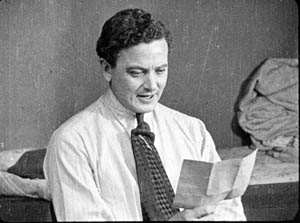
So we had our typical goal-driven plot. The style was what David has described as typical of 1917, so that was my tentative dating. I felt almost certain that the reels I was watching were not from a 1913 or 1915 movie. The film was a fairly modest item, done on a relatively low budget and not starring any actors that would be familiar to most modern viewers. I had seen the actor playing the hero before, however, and I thought he might be Herbert Rawlinson. By the time I finished the film, those were my clues: a medium-budget American film of c. 1917 concerning dime stores and perhaps starring Rawlinson.
My task turned out to be fairly simple. A little research after we returned home confirmed the Rawlinson guess. In preparing the write The Classical Hollywood Cinema, I had seen him in The Coming of Columbus (a 1912 Selig film) and in Damon and Pythias (Universal, 1914).
My next step was to consult the monumental, indispensible reference book, The American Film Institute Catalog. This multi-volume set, many years in the making, was originally published as books. It is now online, but available only to AFI members or through libraries. The catalogues were published by decade—thus obviating the problem of periodization. Each decade gets two volumes, one of entries on all the films, listed in alphabetical order. Credits, production companies, release dates, plot synopses, and other information are included. A second volume indexes the films by chronology, personal names, corporate names, subject, genre, and geography (i.e., where the films were shot).
Until now I had found little use for the subject index, but now it came to my aid. I turned to the Ds to see if there was an entry for dime stores. The AFI indexers were thorough, and sure enough, there was one entry: Like Wildfire. A check of the personal names index under Rawlinson, Herbert revealed that he had acted in a film called Like Wildfire, made in 1917 by Universal. Once I had the title, I checked its catalog entry and found that its plot description matched the film I had seen. Case closed.
Admittedly, in this instance the date wasn’t a crucial clue. Still, determining a film’s year of release can narrow down the possibilities. Thanks as well to the development of classical cutting, a close view of an actor helps in identifying him.
The Best of 1917
DB:
This is the season when everybody makes a list of best pictures. We have stopped playing that game. For one thing, we haven’t seen all the films that deserve to be included. For another, the excellence of a film often dawns gradually, after you’ve had years to reflect on it. And critical tastes are as shifting as the sirocco. Never forget that in 1965 the Cannes palme d’or was won by The Knack . . . and How to Get It.
Still, enough time has elapsed to make us feel confident of this, our list of the best (surviving) films of 1917, both US and “foreign-language.” Titles are in alphabetical order.
The Clown (Denmark, A. W. Sandberg)
Easy Street (U.S., Charles Chaplin)
The Girl from Stormycroft (Sweden, Victor Sjöström)
The Immigrant (U.S., Charles Chaplin)
Judex (France, Louis Feuillade)
The Mysterious Night of the 25th (Sweden, Georg af Klercker)
The Narrow Trail (U.S., Lambert Hillyer)
The Revolutionary (Russia, Yevgenii Bauer)
Romance of the Redwoods (U.S., Cecil B. De Mille)
Terje Vigen (Sweden, Victor Sjöström)
Straight Shooting (US, John Ford)
Thomas Graal’s Best Film (Sweden, Mauritz Stiller)
Wild and Woolly (US, John Emerson)
Next year, maybe we’ll draw up our list for 1918.
(1) For more on this scene and the film as a whole, see Kristin Thompson, “Narration Early in the Transition to Classical Filmmaking: Three Vitagraph Shorts,” Film History 9, 4 (1997), 410-434.
(2) Beyond The Classical Hollywood Cinema, see Kristin’s Herr Lubitsch Goes to Hollywood and Storytelling in the New Hollywood. I’ve talked about these issues in On the History of Film Style, Planet Hong Kong, Figures Traced in Light, The Way Hollywood Tells It, and essays included in Poetics of Cinema. The basics of classical continuity are presented in Chapter 6 of Film Art: An Introduction, and we trace some historical implications of it in Film History: An Introduction.
Posted in 1910s cinema, Actors: Fairbanks, FILM ART (the book), Film history, Film scholarship, Film technique, Film technique: Editing, Film technique: Staging, Hollywood: Artistic traditions, Narrative strategies, Readers' Favorite Entries, Silent film, The Ten Best Films of... | open printable version
| No Comments »
|


















