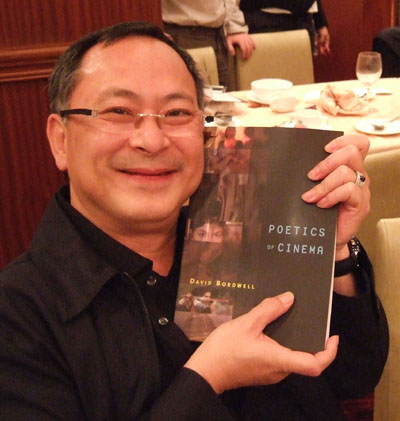
by Kristin Thompson. Berkeley: University of California
Press, 2007.
400 pages, 6 × 9 inches, 12 color illustrations;
36 b/w illustrations.
[go
to Amazon | go to The Frodo Franchise blog]
For those of you who have had problems connecting with this site: Sorry! Our server was down for a couple of days. Ironically, I was one of the last to climb on. Hence the slight delay in this posting from the Hong Kong International Film Festival.
Whither Hong Kong film?
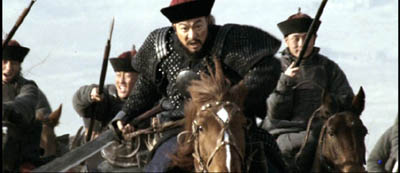
The Warlords.
Local cinema is still in the doldrums. As in most countries, Hollywood rules the box office. Production has dropped to about 50 releases last year, and the quality of what I’ve seen over the last week isn’t on the whole strong.
I’m told by a film professional who follows things closely that critics feel that 12-15 local films from 2007 are worth seeing and about 5 are actually good. Those five are Ann Hui’s The Postmodern Life of My Aunt, Derek Yee’s Protégé, Johnnie To’s Mad Detective, Yau Na-hoi’s Eye in the Sky, and Peter Chan’s The Warlords. It’s significant, my friend indicates, that almost never before has the same clutch of films been nominated for best picture, best screenplay, and best director at the Hong Kong Film Awards. (The awards will be given on 13 April.) “The falling industry has reached a plateau,” she remarks.
My sense is that Hong Kong cinema is sustained, however minimally, on three levels. As usual, there are the program pictures, chiefly urban action films and romantic comedies and dramas. These come and go, using local singers and TV stars, and allow theatres to keep their doors open. More creative are the films from local auteurs, principally Johnnie To Kei-fung. (Should I count Wong Kar-wai as a local filmmaker any more?) To’s Milkyway company turns out several worthy items per year, most directed by To. As I indicate in an earlier post, The Sparrow is their upcoming release; it’s also the best Hong Kong movie I’ve seen so far on my trip.
A third category includes the increasingly important China coproductions, nearly always military costume dramas. The emblematic shot: Mighty warriors on mighty steeds galloping toward the camera in a telephoto framing. Add spears, swords, shields, and slow-motion to taste.
The Warlords is the prime instance from last year, but it was preceded by The Myth (2005) and A Battle of Wits (2006). The genre was made popular by Mainland movies like Zhang Yimou’s overdecorated epics, and it has already furnished us two spring releases, An Empress and the Warriors (yes, you read that right) and The Three Kingdoms: Resurrection of the Dragon. Both are straightforward tales of military struggle, centering on loyalty and honor, with relatively little of the palace intrigue that usually furnishes plot motivation.
An Empress, starring Donnie Yen, Leon Lai, and Kelly Chen, is pretty thin going, with overhasty fight scenes and Bumpicam coverage. The only engaging element, apart from the porcupine armor on display in the ads, is the fact that Leon plays a warrior who has retired from the world. He has for obscure reasons turned his patch of the forest into a launching pad for a hot-air balloon. Still, when ninja-like invaders assault his rickety scaffolding, we get a fairly effective action scene that carries a little of the impact of director Ching Siu-tung’s best movies.
The Three Kingdoms, a Korean-China coproduction directed by Hong Kong’s Daniel Lee, is a somewhat more impressive item. The plot traces the rise of a general (Andy Lau), aided by his mentor (Sammo Hung), and their confrontation with a rival general, whose cause is taken over by his daughter (Maggie Q). There is little characterization; everything hinges on honor, retribution, and service to one’s superior. A tranquil interlude with Andy’s love interest, a shadow puppeteer, is quickly forgotten in the rush to combat. The musical score channels Morricone, and as in Empress, it employs thunderous drumbeats, chanting male choruses, and a keening soprano. Inevitably, we also sense the influence of Wong Kar-wai in the meditative voice-over and the fight scenes (choreographed by Sammo) that recall Ashes of Time in their slurring and spasmodic rhythms.
Are such films really desired by Asian audiences, let alone Western ones? The jury is still out. Thanks to shooting in China and the diffusion of CGI technology, such genre pieces can be made for much less than Hollywood would spend. Three Kingdoms came in at less than US$20 million, which is twice the budget purportedly spent on Empress. But international sales of the genre are spotty, and audience uptake isn’t overwhelming. Somebody will have to tweak the formula creatively. Will it be John Woo, with Red Cliff? Odds are against it, but I’d like to be surprised.
Incorrigibly optimistic, I’m still looking forward to Ann Hui’s newest film, The Way We Are, premiering tonight, and Coffee or Tea, the collaboration of veteran director Shu Kei and his student Mandrew Kwan Man-hin. That’s the closing film of the festival.
Films briefly noted
Kabei–Our Mother.
Other festival highlights for me:
Please Vote for Me! A primary school in Wuhan is introduced to democracy when the teacher decides that the monitor will be elected by the class. There ensues a struggle all too reminiscent of U.S. political campaigns. We have sound bites, applause lines, political operatives (here, overzealous parents), scurrilous charges, personal attacks, and outright bribery. The collision of human nature and democratic ideals make this a charming and thoughtful movie. I can’t imagine anyone not enjoying it, if only for its reminder of how humiliation feels when you’re nine years old.
Observando al cielo. Jeanne Liotta’s ode to astronomical phenomena, at once scientific demonstration and lyrical tribute to the swiveling of the heavens. Visit her website here.
Mauerpark. From the Austrian collective Stadtmusik, Tati-goes-Betacam. A long shot of a snow-covered park is at first puzzling, then amusing, then engrossing.
Alexandra. I nearly always like Sokurov. Yes, the films can be a little overbearing, but they have a certain weirdness that keeps them from pretentiousness. Here he gives us another story of family love. An old lady visits her grandson, who’s soldiering in the Caucasus. She rides in a tank, watches men clean their weapons, and putters doggedly about the bivouac. No big emotional climaxes, unless you count her encounters with other old ladies, who have set up a market selling shoes and cigarettes, and the moment when her soldier tenderly braids her hair.
The weirdness comes in the color values–sometimes blinding orange, sometimes bilious green reminiscent of Sovcolor—and in a murmuring soundtrack that blends machine whirs and conversation with barely discernible swoops of orchestral and vocal music. (Since Galina Vishnevskaya plays the old lady, are these fragments from her performances?) Nobody makes soundtracks quite like Sokurov; even an unadorned shot can take on urgency through the drifting whispers our ears struggle to make out.
Elegy of Life. Rostropovich. Vishnevskaya. Also a pleasure to listen to, but much more straightforward. A documentary tribute to the great cellist/ conductor and the singer. Since I’m interested in Russian music and cultural politics, this was an unadorned pleasure. To hear Rostropovich compare Prokofiev the classicist with Shostakovich the Mahlerian was especially worthwhile.
Kabei—Our Mother. Yamada Yoji received a lifetime tribute at the Asian Film Awards. Having directed over seventy movies, including the long-running Tora-san series, he’s usually discussed in terms of sheer productivity. But his calm, grave period films Twilight Samurai (2002), Hidden Blade (2004), and Love and Honor (2006) have reminded people that he’s a fine director too. A man of restraint, he never shoots handheld, he seldom moves the camera, and he uses close-ups as high points, not default values. His sobriety makes the 1.85 ratio look as cleanly fitted to the human body as the 1.33 one is. “The last classical director,” Mike Walsh called Yamada after the screening, and it’s hard to disagree.
Kabei was for me the high point of the festival so far. It’s 1940, and a Tokyo intellectual is arrested for “thought crimes.” As he endures prison, his wife and two daughters struggle to make ends meet, with the help of Yamazaki, a loyal student. An epilogue reminds us of the now-elderly mother’s devotion to her husband.
That’s about it, but the poise of the performances and the simplicity of the presentation make this like a film from the era it portrays. I wish I had a DVD to illustrate the craftsmanship that Yamada brings to the very first shot, which unhurriedly introduces the family while the mother simply hangs out wash on the line. I wish I could show you how the moment that a badminton birdie lands on a rooftop pivots from comedy to sadness. I wish I could replicate the composition that hides a weeping Yamazaki from us—a shot that actually makes the audience burst into laughter. Who else would have the film’s biggest star, Tadanobu Asano, keep his back to us for an entire scene?
But maybe it’s better I don’t give such things away. Best to say: Despite all the other movies you see, Kabei shows one way that cinema can still be.
Finally, as antidote to my somewhat depressing diagnosis of the state of HK film, two items. First, the reception for Sylvia Chang‘s Run, Papa, Run showed off her lively charm. Here Sylvia, in black, is flanked by her stars, Yuhan Liu, Rene Liu, Lewis Koo, and Nora Miao, who played in Bruce Lee pictures.
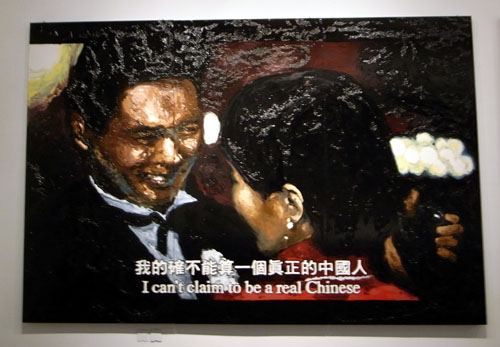
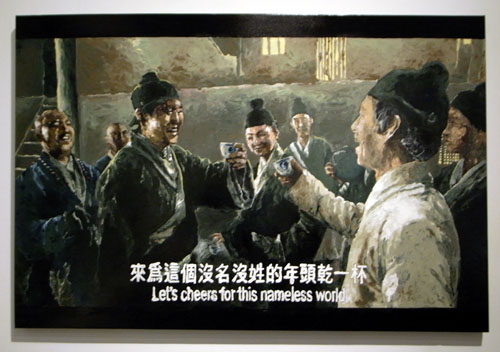
Second, in the entertaining exhibit Made in Hong Kong at the art museum, you will find the work of Chow Chun-fai, whose output includes large, glossy enamel images taken from movies, complete with letterboxing and subtitles (typically about Chinese/ Hong Kong identity). The blocky figures seem both chunkily monumental and somewhat decaying. One of Chow’s huge pictures, derived from Love in a Fallen City, surmounts this blog entry. Below is another, based on King Hu’s Dragon Inn.
More to come in a few days, including, I hope, thoughts on Maya Deren and an interview about sound design in Milkyway movies.
PS later on 27 March: I’ve just discovered a remarkable array of comments on Alexandra in this Criterion thread. John Cope‘s discussion is particularly admirable.
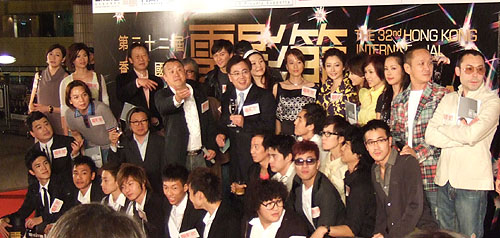
Today, pix from two get-togethers during the Hong Kong International Film Festival.
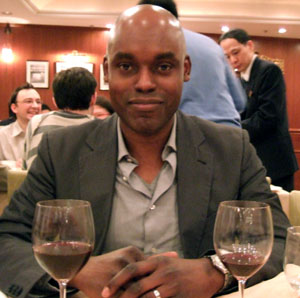
Johnnie’s dinner Johnnie To gave another of his legendary dinners, this time to a crowd of filmmakers, distributors, festival directors and programmers, and hangers-on like me. The meal was old-school HK fusion, mixing Brit colonial food (boiled tongue, boiled potatoes, boiled veggies) with unique local variations (pigeon, a puffy vanilla soufflé). I think it’s akin to what Maggie Cheung and Tony Leung scarf down so elegantly in In the Mood for Love. Very tasty.
Among those present: Director Kirk Wong.
Kirk made The Club (1981), Health Warning (1982), Gunmen (1988), and other classics, including the 1994 double-header Organized Crime and Triad Bureau and Rock ‘n’ Roll Cop. These are terrific movies, admired by every fan of action cinema.
One of the most appealing things about Hong Kong film is that character actors, as we call them in America, go on and on, becoming not only stars but directors and producers. As Leslie Cheung pointed out, the local audience is loyal to its favorites and encourages them to try many things.
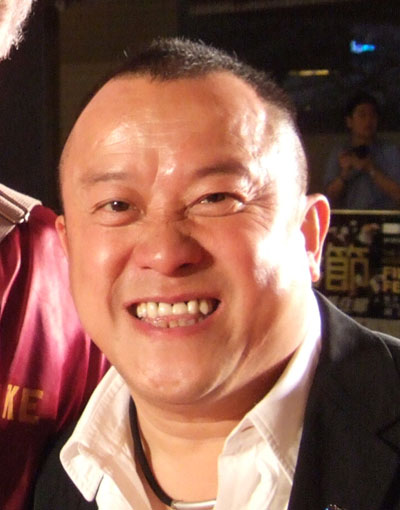
Eric Tsang, the short, cherubic guy with the perpetually hoarse voice and blinding smile, began, surprisingly, as a soccer player. In 1974 he became a bit player and stuntman in Shaws’ martial-arts releases. He directed two of the movies in the top-grossing Aces Go Places cycle (1982, 1983), and rose to become a screen personality. He’s so familiar to Hong Kong movie lovers that we couldn’t call him Tsang; he’s just Eric, and he’s irreplaceable.
He worked steadily and hard, appearing in nine films in 1985 and an astounding seventeen in 1988. Several of his performances are superb: playing a small-time loser in Final Victory (1987), a flamboyantly gay music coach in He’s a Woman, She’s a Man (1994), a philandering policeman in the exhilarating and little-known Task Force (1997), a wistful romantic in Metade Fumaca (1999), and of course an implacable triad boss in the Infernal Affairs trilogy (2002-2003). He perks up every movie he graces, rescuing routine projects with his beaming ordinariness. In a fairly ordinary policier like Cop on a Mission (2001), he starts out as a thuggish menace and becomes not only sympathetic but heroic in his devotion to his errant wife.
Cop on a Mission is one of several of Eric’s films screened in the HKIFF tribute. The event also emphasizes his role as a producer. Thanks to him, we have The Outlaw Brothers (1990), Dr. Mack (1995), Men Suddenly in Black (2003), Jiang Hu (2004), and several films he coproduced with Peter Chan Ho-sum. Most recently, Eric has launched a project to support young directors. He launched Winds of September, a feature trilogy about coming of age in the “three Chinas”—the mainland, Hong Kong, and Taiwan.
For the premiere of Tom Lin Shu-yu‘s Taiwan entry on Friday night, the festival held a little party for several hundred of Eric’s closest friends. For once, that last phrase is no joke; everybody feels close to him.
Glamor to spare: Cheng Pei-pei, of Shaws’ glory days and since, with her daughter Marsha Yuan Zi-hui.
Peter Chan, fresh from the success of The Warlords, chats with Tony Rayns.
Michelle Carey, Festival Editor of the encyclopedic online journal Senses of Cinema and scout for several film festivals. Alongside, Cheung Tat-ming, idiosyncratic young actor; check out his laid-back performance in Once Upon a Time in Triad Society 2 (1996).
Also there were Teddy Robin Kwan, a wonderful actor and pop singer who first made his mark with movies from Cinema City, and Albert Lee, this year’s Executive Director of the festival.
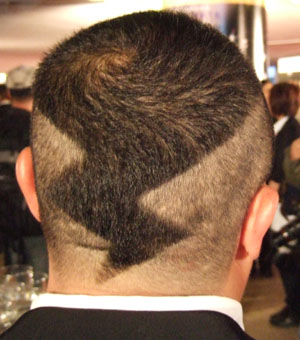
And Eric was as entertaining from the back as from the front.
Next time, I promise more on the movies. I close with two items:
Strangest line of the last twenty-four hours: From inside a hotel room I was passing: “Mom, I haven’t mentioned a threesome until now.”
Johnnie To shows himself a man of outstanding taste.
And I show myself a man of no shame. But you knew that already.
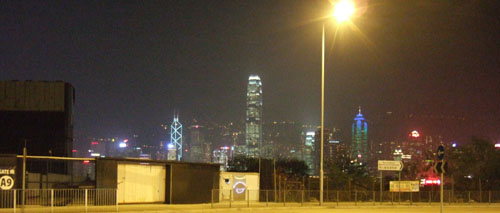
Hong Kong’s Entertainment Expo, including the Hong Kong International Film Festival, the Asian Film Finance Forum, and the Hong Kong Filmart, runs for nearly a month, and it has drawn me back to the fragrant harbor. For refreshers, you can visit last year’s posts here.
Biz
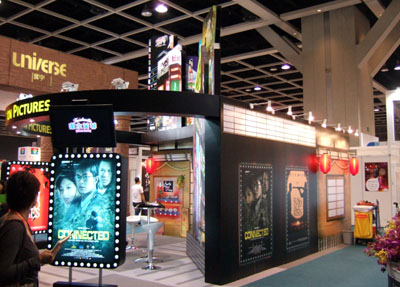
The Filmart has become Asia’s biggest spring media event, with hundreds of companies crowding into a pavilion of the Convention Centre. Here people traffic in movies and TV shows, buying and selling distribution rights, seeking funds for production and partners in movie ventures. I wandered through it last year, and you can track this year’s activities at Variety’s site here.
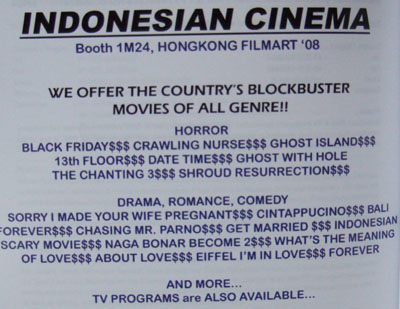
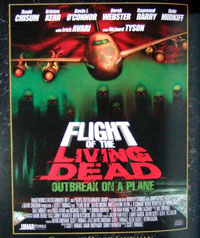
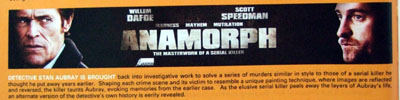
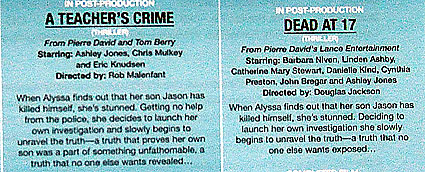
The last figures I saw indicate that the world pumps out about 4800 features each year. Coming to a market like Filmart, you get to peek below the waterline and see the iceberg that’s underneath.
There are, for instance, the bulk genre items from secondary, or tertiary, producing countries.
There are the films that seem somewhat derivative.
Then there’s the vehicle with the midrange star that just might make it to late-night cable.
Finally, there are the films that acknowledge themselves to be identical. These descriptions come from Imagination Worldwide’s catalogue ad.
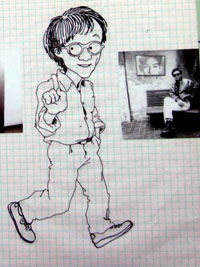
By contrast Filmart mounted a respectful display devoted to Edward Yang, who died last summer. Edward made idiosyncratic, powerful films that would, even today, be very hard to sell at a market. He was a skilled cartoonist, and the display includes some of his perky storyboards and a self-portrait.
Glitz
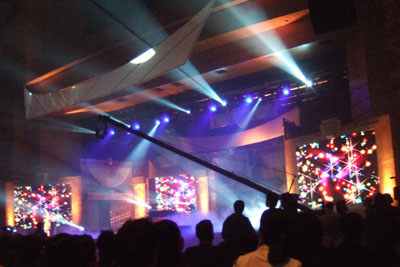
The Asian Film Awards, which I covered last year, started things off with a midsize bang Monday night.
The full results can be found here. I was pleased that Secret Sunshine, quite a good film, won three top awards (film, director, actress). Milkyway, a favorite company of mine, garnered a couple of prizes, and The Sun Also Rises, one of my favorites from last year, did pick up the Production Design prize.
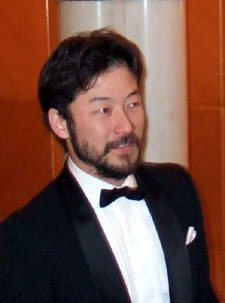
Some Big Stars were visible at both the show and the after-party. Heartthrob Tadanabu Asano arrives.
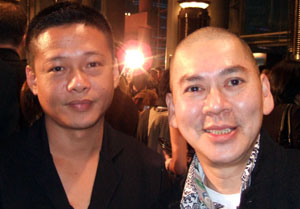
Lee Kang-sheng and Tsai Ming-liang mingle before the awards.
Marco Muller, Director of the Venice Film Festival, at the after-party.
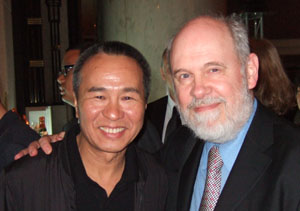
I got to talk briefly with one of my heroes, Hou Hsiao-hsien.
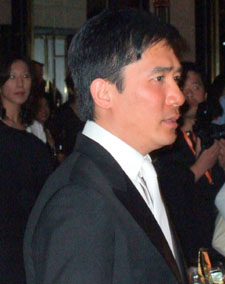
And of course Tony Leung Chiu-wai, emblem of the Entertainment Expo and winner of the Best Actor Award (Lust, Caution), was everywhere, and always looking good.
Flix
Within 36 or so hours, I saw quite a lot of movies. With friends Paisley Livingston and Mette Hjort and their kids I caught Enchanted, which pleased me with its schmaltzy cleverness. As part of the Festival, I re-watched on 35mm two movies I’d seen and commented upon last year: Jiang Wen’s The Sun Also Rises and the Tsui/ Lam/ To Triangle. These were shown at the shock-and-awe auditorium of a new cinema in a spanking new mall, Elements. The seats vibrate at the lowest frequencies, creating what is marketed as “4-D.”
At Filmart I saw the Luc Besson production Taken, another satisfying dose of formulaic filmmaking. Altogether different was Manuel de Oliveira’s Christopher Columbus, The Enigma. The title suits this apparently slight film about a historian’s earnest pursuit of Portugal’s influence on North American history. Haunting images of 1940s Manhattan swathed in fog, along with touching scenes of Mr. and Mrs. Oliveira visiting historic sites, linger.
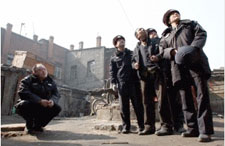
Two films struck me as excellent. Gao Qunshun’s Old Fish (2008) centers on a simple idea. Somebody is planting bombs throughout Harbin, and an aging police officer is the only person remotely qualified to dismantle them. Over a leisurely half hour, we’re introduced to Old Fish, his wife, and his colleagues. Then the first bomb is found, and the suspense kicks in. The apparently clumsy codger, who in an early scene fumbles a World War II grenade, summons up wiliness and delicacy when he has to defuse the mysterious packages.
I don’t think I’ve ever seen more tension-filled sequences of this sort. The film made me realize that in any bomb-disposal scene, when close-ups of a sweating face and a knifeblade hovering over a wire are followed by an extreme long-shot of the scene—that’s when we expect an explosion. Conventionally, the long shot announces the bang. But here, Gao gives us the long shot, and we have to wait, and wait some more. When the explosion does come, it is genuinely surprising.
Shot by shot and sound by sound, this is a very well-crafted, humane film. If anybody tells you that “foreign films” are digressive and boring, show them Old Fish.
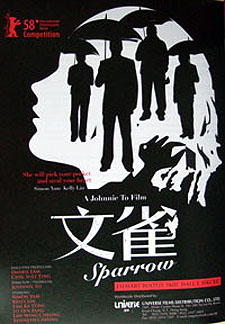
Just as fine, but more unclassifiable, was Johnnie To Kei-fung’s The Sparrow (2008), premiered at Berlin. A gang of pickpockets led by Simon Yam is beguiled by a mysterious lady on the run (Kelly Lin), and their schemes start to fall apart. As often with To, the conception of the film is slim, but the execution is rich. There are the games and competitions, the symmetries and repetitions, the offhand motifs (here, cigarettes, cigars, and pipes), the geometrical and arithmetical plot mechanics. Johnnie To has become perhaps the world’s most unpretentiously, unapologetically formalist director.
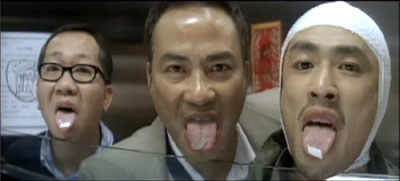
It’s a procession of twists and set-pieces. There are the funny one-off shots, like the two grifters with symmetrically broken legs and the gang flashing the razor blades they hide in their mouths. Some sequences are unpredictable miniatures, like the scenes that show how many camera angles you can find in an elevator car, even with a fishtank squeezed in. There’s also a delirious bit with a lipstick-stained cigarette.
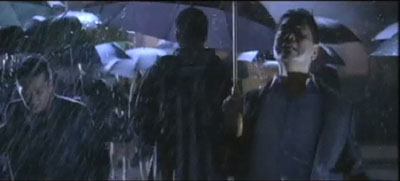
Other set-pieces unfold more majestically. There’s a sweeping crane shot of the gang vacuuming up wallets of passersby, and an elaborate theft of a pendant during massage therapy. The climax is an exuberant pocket-picking competition with all contestants stalking through a downpour, their umbrellas forcing them to work with only one hand.
The Sparrow is at once a loving tribute to old Hong Kong island (Simon’s hobby is black-and-white photography), an unpredictable genre piece, and an exercise in light-fingered filmmaking. Like Old Fish, it offers lessons to Hollywood directors, if they have the wit to learn them.
Bits
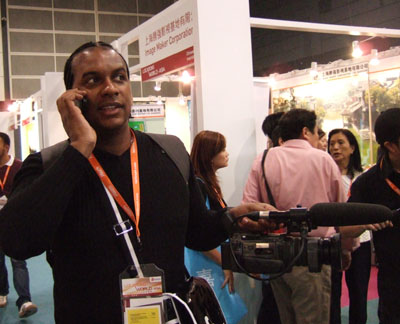
At Filmart, Fred Ambroisine multitasks, taking cellphone calls and shooting docu footage at the same time.
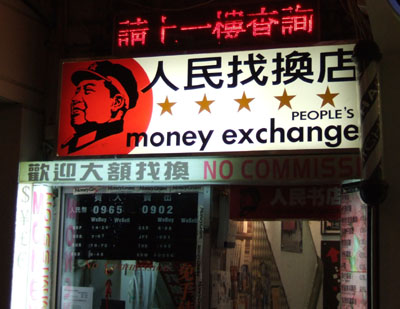
Deng said “To get rich is glorious,” and now Mao agrees.
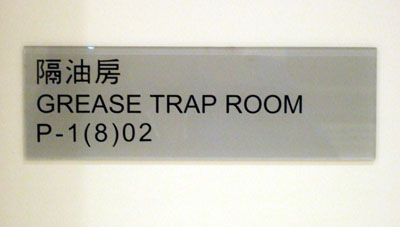
And in the spanking new, gargantuan mall known simply as Elements, an entire room is devoted to one essential Element.
A seesaw trip in my last few days in Japan, with notes on watching some rare movies, visiting some superheroes, and watching some children cut down swaggering samurai.
Kansai wanderer
On Friday I traveled to Nagoya University with Yamanouchi Etsuko. She was my translator for a talk on Japanese film for my student, now professor, Fujiki Hideaki (above). Hideaki oversaw the translation of Film Art into Japanese and is the author of a new book on the growth of movie culture in Japan during the first decades of the century.
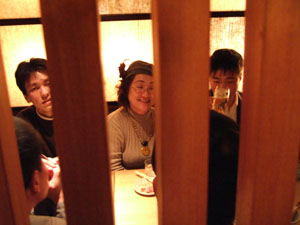
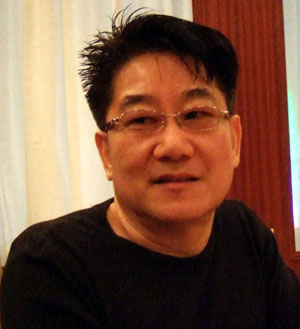
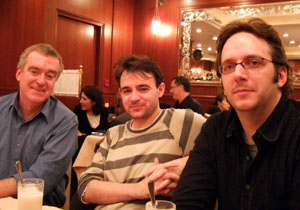
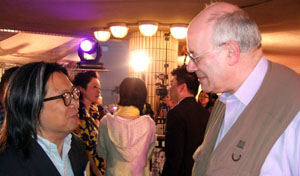
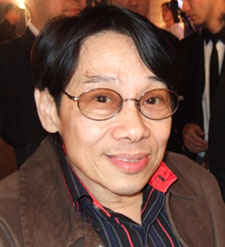
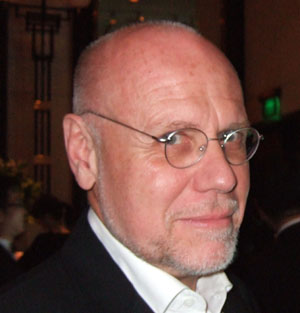
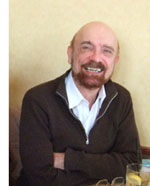
The talk seemed to go well, though my customary rapid-fire yammer sometimes left the fluent Etsuko breathless. Hideaki’s students and colleagues kept me on my toes with sharp questions. Then we all went out to a sumptuous dinner, where I had a chance to talk to many Nagoyans, including senior Japan expert Peter High, author of The Imperial Screen. Peter is now about to retire, as you can perhaps tell from his expression.
Because I lectured on what I call the “game of vision” in Japanese films, we had fun at dinner with composing shots that mimicked the peekaboo framings. Even relaxing, film wonks never turn off the movies running in our heads.
Next day I took a fairly impulsive trip to Kyoto. I tried to visit Mizoguchi’s grave, but had no luck finding it. After visiting it ten years ago, I shouldn’t have trusted my memory. Instead, I found Toei’s movie theme park, which provided me three hours of diversion.
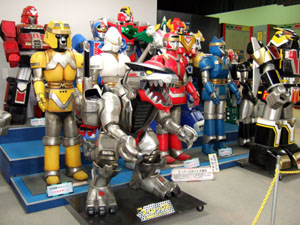
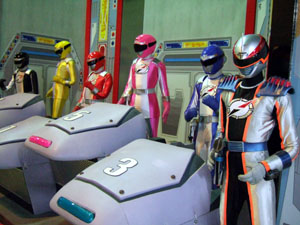
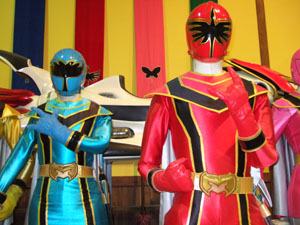
Shochiku studios failed with its own theme park (go here for my reminiscence of it), partly because it had only Ozu and Tora-san as main attractions. But Toei has a bevy of swordplay heroes and….Power Rangers. An entire wing of the facility is dedicated to superheroes, life-size and some much larger.
I had no idea who these hardfaced bipeds were, but they sure looked pretty, with their nice snowmobiles and vaguely obscene gestures.
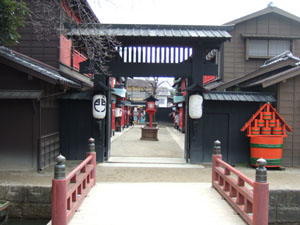
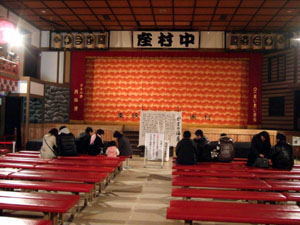
Elsewhere in the Toei park are streets evoking old Edo and Kyoto, as well as a kabuki theatre.
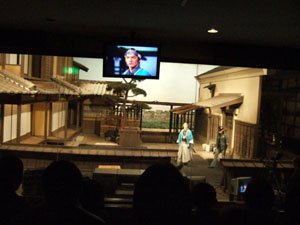
Mechanical ninja crawl around overhead, and samurai stroll the alleyways. You can watch a director pretending to shoot a TV show of swordplay in a studio set.
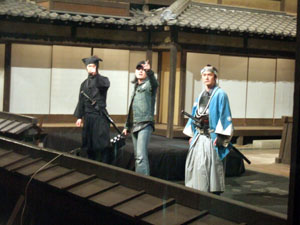
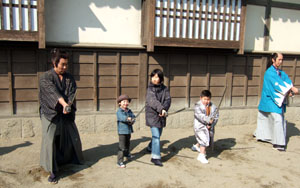
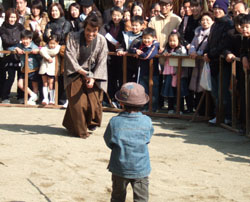
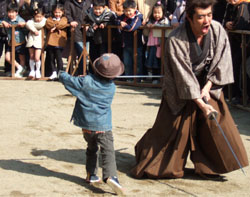
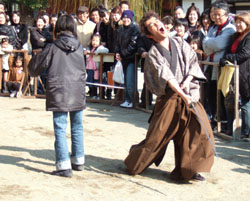
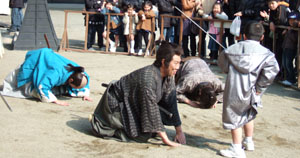
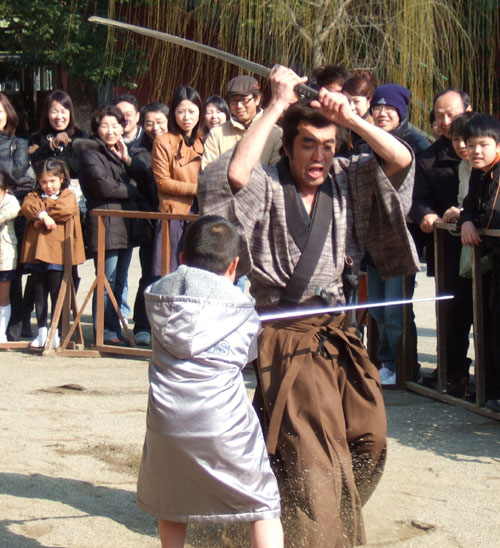
The most enjoyable moments came with a display of swordfight stunts carried out by three good-humored young samurai. They summoned from the audience a tiny boy, a somewhat older boy, and a tall little girl, and they gave them some elementary fighting skills. These skills consisted of stomping forward, crouching, and swinging the sword while letting out a blood-freezing shriek. The teachers made it look easy.
Then each kid was planted in front of the crowd and a swordsman rushed forward, with howling abandon. Miraculously, the kids’ fairly minimal defense tactics always defeated the men, who died in agony.
When one winner got obeisance from his enemies, he acted like the constantly scratching Mifune in Seven Samurai.
A new old Mizoguchi
Back to Tokyo and a round of shopping, eating, and moviegoing. I was staying with Komatsu Hiroshi, a friend of almost thirty years whom I first met at a conference on Dreyer in Verona. Hiroshi is a monumental figure in silent-cinema circles, and I’m planning a later blog entry profiling him.
With Hiroshi I saw two silent Makino Masahiro films at the national Film Center. For more on this series, see an earlier entry. Chronicle of 3 Generations (Gakkusei san daki, 1930) consisted of two installments of a short-comedy series produced by Makino. In the first, a modern girl throws over her boyfriend because he’s a bad baseball player. The second was reminiscent of Ozu’s Days of Youth in showing a college student trying to hide his slacker ways from his visiting father.
The second film, also part of a series, was directed by Makino. Street of Ronin (Roningai, 1929) was a bustling tale of a neighborhood of ne’er do wells. The benshi commentator must have been busy; there are over 260 intertitles in a film of about 72 minutes. I can’t tell you what happened in the plot, but the movie shows yet again that by the end of the 1920s Hollywood continuity style was in full vigor here. Makino uses a remarkable number of different setups in each scene.
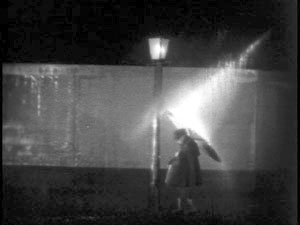
At Hiroshi’s house he screened many rare items from his collection, mostly silent European, American, and Japanese films. One of the most striking Japanese titles was Magic in the Dark (Kurayami no Tejina, 1927), an experimental short with some of the stylization one finds in Kinugasa Teisuke’s Page of Madness (1926). The rain-drenched night scenes are like something out of Murnau.
The plot is didactic and uplifting, showing how a boy tempted by money pursues a righteous path. Magic in the Dark was directed by Suzuki Shigeoshi, whose most famous film is What Made Her Do It? (1930). That famous but currently incomplete feature, along with Magic in the Dark, will be released on the Kinokinuya DVD series that Hiroshi directs. Alas, no English subtitles. (See the PS below.)
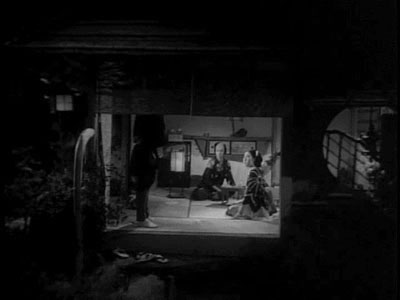
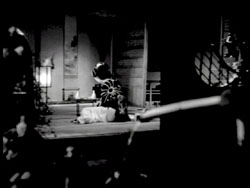
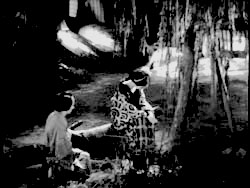
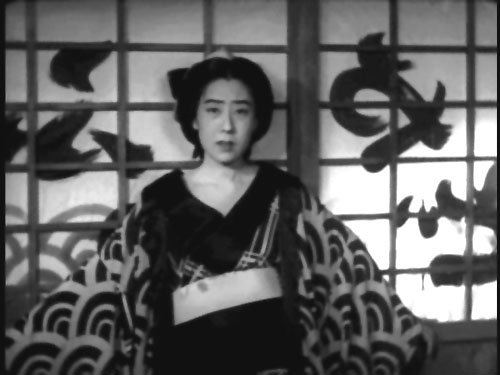
The killer item was a newly discovered Mizoguchi film, one that doesn’t appear on official filmographies! Miss Okichi (Ojo Okichi, 1935) was residing in the Shochiku vaults, and a copy, in beautiful condition, was recently screened on Japanese television. Mizo codirected it with Takashima Tatsunosuke, a director whose work I don’t know, for Dai Ichi Eiga, the production company he formed with Nagata Masaichi. Dai Ichi Eiga, which later became Daiei, financed Mizo’s masterpieces Naniwa Elegy (1936) and Sisters of Gion (1936).
A bit like The Downfall of Osen (Orizuru Osen, 1935), this film centers on a woman who’s a cat’s paw for a gang involved in shady dealings. Okichi, played by Yamada Isuzu (whose bosom I nestle against in my earlier entry), is pulling scams for the sake of her lover. But she falls out with the gang and takes pity on one of the young men whom she victimizes.
I can’t comment on the film after only one viewing, and the fact that Mizoguchi is credited after Takashima suggests that he may have had little input. Still, it’s another tale of a woman who sacrifices herself for more or less unworthy men. Miss Okichi also has some typically Mizoguchian scenes that dwell on chiaroscuro melancholy. Much of the film takes place at night, and this strategy reinforces the somber atmosphere. There are some remarkably opaque long shots and one moment that includes Okichi turning toward the camera in a sort of plaintive challenge.
Given my admiration for Mizo, this capped a terrific ten days in Japan. Now on to Hong Kong, where I’ll blog at intervals on what happens at the Hong Kong Filmart market, the Asian Film Awards on Monday night, and the HK International Film Festival. I’ll be there, like Bernstein in Citizen Kane, before the beginning and after the end.
PS 24 July 2008: The Kinokuniya DVD of What Made Her Do It? has come out, and Joanne Bernardi reports that at least one version does have English subtitles…by her! Magic in the Dark is included on that disc. And despite information to the contrary, the DVD Joanne has is not Region 2 but all-region. Oddly, online listings of the DVD make no mention of these facts. Joanne does not yet know whether the subtitled all-region disc is the same as the one offered on amazon.jp and the Kinokuniya site, but it seems likely. More information as I get it, from Joanne or others.







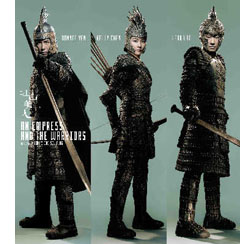 An Empress, starring Donnie Yen, Leon Lai, and Kelly Chen, is pretty thin going, with overhasty fight scenes and Bumpicam coverage. The only engaging element, apart from the porcupine armor on display in the ads, is the fact that Leon plays a warrior who has retired from the world. He has for obscure reasons turned his patch of the forest into a launching pad for a hot-air balloon. Still, when ninja-like invaders assault his rickety scaffolding, we get a fairly effective action scene that carries a little of the impact of director Ching Siu-tung’s best movies.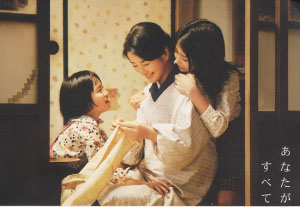
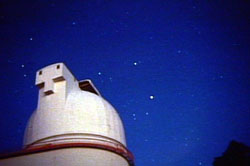 Observando al cielo. Jeanne Liotta’s ode to astronomical phenomena, at once scientific demonstration and lyrical tribute to the swiveling of the heavens. Visit her website here.
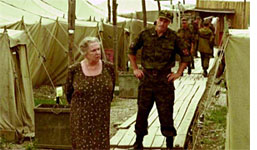 Alexandra. I nearly always like Sokurov. Yes, the films can be a little overbearing, but they have a certain weirdness that keeps them from pretentiousness. Here he gives us another story of family love. An old lady visits her grandson, who’s soldiering in the Caucasus. She rides in a tank, watches men clean their weapons, and putters doggedly about the bivouac. No big emotional climaxes, unless you count her encounters with other old ladies, who have set up a market selling shoes and cigarettes, and the moment when her soldier tenderly braids her hair.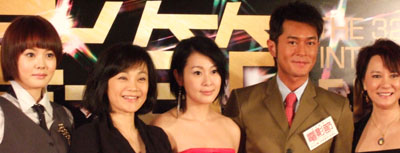


 The talk seemed to go well, though my customary rapid-fire yammer sometimes left the fluent Etsuko breathless. Hideaki’s students and colleagues kept me on my toes with sharp questions. Then we all went out to a sumptuous dinner, where I had a chance to talk to many Nagoyans, including senior Japan expert Peter High, author of