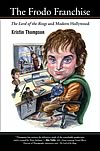
by Kristin Thompson. Berkeley: University of California
Press, 2007.
400 pages, 6 × 9 inches, 12 color illustrations;
36 b/w illustrations.
[go
to Amazon | go to The Frodo Franchise blog]
I’ve had a terrific time since I arrived late last Saturday. The only thing that could have improved it would be the discovery that there was a Japanese town named Bordwell. If it could happen to Barack, why not me?
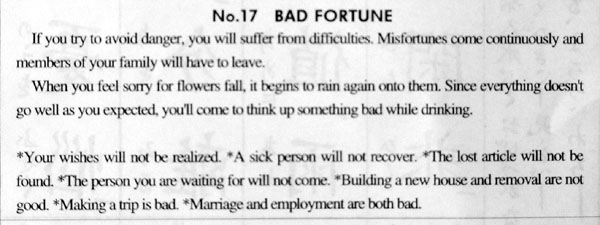
Actually, I know why not. On Sunday, a trip to a temple yielded a promise that nothing good would come on any front.
Pretty dire. Yet I press on, foolishly trusting that meals will be tasty, the city will shake me up, and three fine sorts of things will grace the first phase of my stay: the symposium, the movies, and my companions. Still, I vow to avoid thinking up something bad while drinking.
The conference
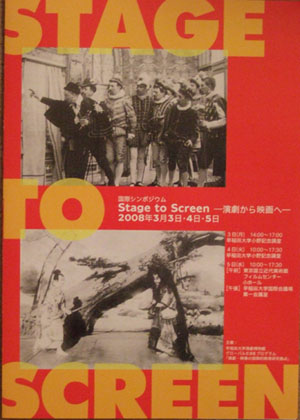
I came for a symposium at Waseda University, Stage to Screen. For three days local scholars delivered papers and comments about how cinema related to theatre.
Young researchers have done thorough work on the relation of Japanese cinema to the culture’s lively theatrical traditions. Usai Michika explored a topic that’s always fascinating–the benshi, the person who accompanied silent film with commentary and dialogue. She found a remarkable poster from the Waseda Theatre Museum collection illustrating many short films, and through diligent archive work she was able to identify most of the films. Although the poster came from 1899, the films were all pre-1896. Ogawa Sawako gave a thorough examination of how films were influenced by kodan, a sort of novelistic oral recitation. It turns out that kodan stories were at least as important as kabuki plays as sources of Japanese film, well into the 1920s. Shimura Miyoko studied later forms of rensa-geki, the mix of live performance and film that was fairly common in the silent era. She showed that there was a resurgence of it in the early 1930s, with sound cinema.
Western cinema attracted attention as well. Kataoka Noburo analyzed the relationship between Samuel Beckett’s Play and his Film, directed by Alan Schneider and starring Buster Keaton. Our host Professor Komatsu Hiroshi gave a talk called “Actors without Bodies,” suggesting the quasi-supernatural qualities of early film. He surveyed cinema’s links to the phantasmagoria shows of the French magician Robertson. He also explored how sound recordings synchronized with early films evoked theatre but didn’t exactly correspond to stage performance techniques–another form of bodiless acting.
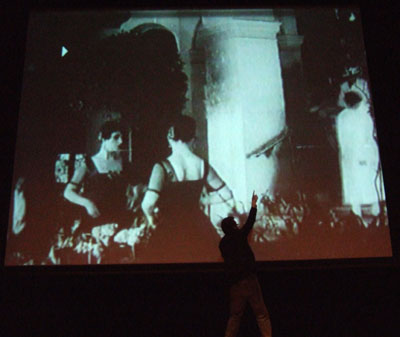
There were two keynote addresses as well, one from Yuri Tsivian and one from me. Yuri was, as usual, energetic and infectious. Our talks naturally overlapped when we touched on the 1910s, and we had some good conversation about films of that era offstage as well as on. Above you see Yuri analyzing, with his usual body English, a scene that he has made famous–a play with mirrors in Bauer’s King of Paris (1917).
The films
The last day of the symposium was devoted to two films that show how world film language changed between the mid-1910s and the early 1920s. Goro Masamune (1915) is a complicated tale about a swordsmith and the dramatic results of his mysterious parentage. It offered a stringent version of the sort of tableau staging we find in Europe and the US at the same period. As with those films, Goro Masamune used lateral staging and some striking depth effects, as well as long takes: I counted 58 shots and 24 intertitles across its 58 minutes.
With 356 shots and 25 intertitles, Roben-sugi exemplified a more cutting-based approach to cinematic storytelling. Scenes were broken down into many shots, often with a great variety of setups; the 180-degree system is in force; and many expressive effects were based on intercut close-ups. In the lengthy final scene, Roben, a temple bishop, discovers his long-lost mother and she prostrates herself before him. The action is played out in high-angle shots of the mother and low-angle shots of Roben. You couldn’t ask for better proof that filmmakers around the world were adopting the US continuity approach than this 1922 film.
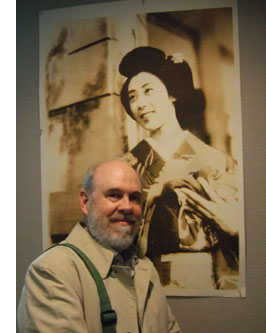
These two movies were powerful treats, and the day was embellished with a visit behind the scenes to the Film Center’s staff area, where I got Yuri to shoot me with one of my favorites, Yamada Isuzu.
Earlier in the week, with Kyoko Hirano, I’d visited the Film Center to catch an item in its massive Makino Masahiro retrospective. Makino, son of Japan’s pioneering director Makino Shozo, directed films from the late 1920s to the early 1970s. For his centenary, the Center has mounted 100 programs of his work. No, that’s not a typo. The screenings include 110 titles directed or produced by Makino—and of course several others are lost. Japanese filmmakers are nothing if not prolific.
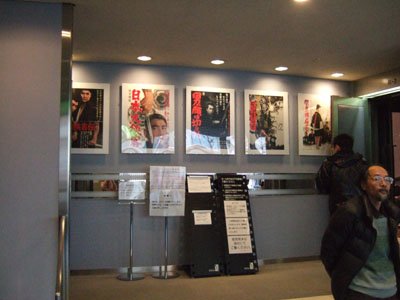
The film that Kyoko and I saw wasJapanese Gangster Story 6: Sake Cup of the White Sword(1967), starring Takakura Ken. The plot consisted of intrigues crisscrossing rival gangs during the 1920s, capped by two bloody fights at the end. Ken doesn’t say much, but the camera loves him; early in the film he seemed to me to get the biggest close-ups. In the finale, of course he sacrifices himself for his gang boss. Is any genre cinema more standardized than the 1960s-1970s yakuza yarn? After a lunch of the Asakusa version of big Hiroshima-style omelettes, Makino’s buoyant retake on the classic tropes was a filling dessert.
The people
The third factor that has made this trip so pleasant has been the people. Hanging out with Yuri was great fun, and as luck would have it, Wisconsin film guy Michael Pogorzelski was visiting Tokyo at the same time. Mike is the archivist for the Academy of Motion Picture Arts and Sciences, and he restores classic films for the AMPAS collection. (It isn’t all Hollywood, either: the archive is handling Satayajit Ray and Stan Brakhage.) Darkness and rain turned our trip through Shibuya into a scene out of Blade Runner.
Then there was Komatsu Hiroshi, who invited me to the symposium. Hiroshi is one of Japan’s top film historians, a man tirelessly committed to finding Japanese films and explaining their significance. He has made his appearance on this blog before. There was also Fujiwara Toshi, an exuberant young filmmaker I first met in Kyoto about ten years ago. Toshi has directed docs about Amos Gitai and other filmmakers, and his latest fiction film, We Can’t Go Home Again, played at the Berlin festival.
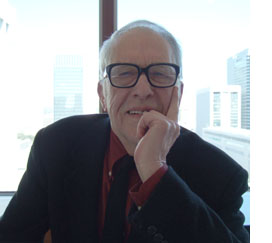
I’ve mentioned Kyoko Hirano, another former student and a best-selling author. Then there was my lunch with Donald Richie, hearty at 82 and planning more books, film screenings, and festival trips. His classic, The Inland Sea, is now being translated into Romanian. He gave me a copy of his newest, A Tractate on Japanese Aesthetics and I reciprocated with a copy of Poetics of Cinema. Donald’s book is as delicate and sharp as a Basho lyric; beside it, my book looks like an andiron.
At the symposium I learned a great deal from Prof. Takemoto Mikio, director of the Tsubouchi Memorial Theatre Museum at Waseda University, and the vice-director Prof. Akiba Hirokazu; Prof. Takeda Kiyoshi, who studied with Christian Metz; Prof. Nagata Yasushi of Theatre Studies; and many others who contributed talks and comments.
Finally, one more person, the one who spurred me to study Japanese cinema.
Ozu Yasujiro‘s gravesite is in Kita-Kamakura, about an hour southwest of Tokyo by train. In the summer of 1988, Kristin and I were led there by Donald, and so I was due for another pilgrimage. The day was cool and sunny, perfect for a brisk walk through the grounds of Engaku-Ji Temple.
At the end of my trip was the gravestone, which famously bears a single character: Mu, or nothing. Twenty years ago, two beer cans sat reverently on the stone, but today there was an opened bottle of sake. A cigarette lighter was tucked into a hole in the surrounding stone fence. Ozu, fierce smoker and professional drinker, was in his element.
On the platform and then on the train, I let my eyes drift among the schoolkids and the teenyboppers and the salarimen and the grave elders with hygiene masks. I began to imagine how Ozu, the poet of the transience of city life and the comic poignancy of human ties, would turn us all into cinema. He might put the camera over there, squatting on the floor of the traincar. That boy with the backpack might give a sassy reply to his father. Those two stylish office ladies sharing an iPod while a middle-aged man snores beside them–surely that’s a setup for a gag. Playing with the possibilities, one gaijin felt a pang of rapture at the blending of life and art.
When we watch films, our bodies and minds are engaged at a great many levels. Nobody doubts this claim. The interesting questions are: What forms does this engagement take? What gives movies the ability to seize our senses, prod our minds, and trigger emotions? How have filmmakers constructed films so as to tease us into such activities? What, to use a phrase from the philosopher Noël Carroll, creates the power of movies?
On this blogsite, I’ve touched on such questions in concrete cases—how eye movements shape our uptake of story information (here and here), how suspense can be created and sustained (here). Those are just small-scale samples of what is, to me, an exciting and promising way of studying certain aspects of cinema. That research trend is growing substantially, and an upcoming event on our home turf marks a new phase.
In June, the Society for Cognitive Studies of the Moving Image will hold a conference here in Madison. This organization was officially created in 2006. Its membership grew out of an informal group of scholars who had been meeting every couple of years since 1997. The meetings have been stimulating affairs, bringing together film historians and theorists, filmmakers, philosophers, and social scientists. Now we’re a full-fledged, incorporated association. We have annual membership dues (cheap at $25), a slate of officers, and a set of bylaws. The Society’s conferences will become annual next year, when we convene at the University of Copenhagen.
You can learn details about the organization here, and you can scan the conference schedule here. There’s also information about getting to Madison and visiting local attractions. (I recommend The House on the Rock.) The earlier incarnation of our group, The Center for Cognitive Studies of the Moving Image, has a rather full archive here.
As president of SCSMI, I’ve had my say about the organization’s remit on the webpage. I’m using today’s blog entry to gesticulate toward some ways that the organization tries to advance our understanding of films, filmmaking, and film viewing. I’ll also shamelessly promote our event.
What is this fascinating new film theory known as cognitivism?
There are, roughly, two ways to think about doing film theory. One way is to look at a body of research or reflection in some established area (history, philosophy, psychology, etc.) and ask: What can it tell me about movies? So you might look at Freudian psychoanalysis or Gestalt perceptual psychology as a whole and then home in on ideas that seem to have relevance to cinema.
The other way to do film theory is to look closely at some filmic phenomenon and ask: What’s the best way to understand this aspect of movies? Your reading and thinking might then lead you to adjacent fields of inquiry for help. In the first instance, you start broad and move to particular cases. In the second, you start with particular cases and explore what broader ideas or information can shed light on them.
On the whole, academic film studies of the 1970s and 1980s started from the big-picture end. Several scholars decided, on various grounds, that psychoanalysis (a mixture of Freudian and Lacanian versions), provided a powerful explanatory system for virtually all human activity. The ideas of that system were then mapped onto many humanities disciplines, and then applied to particular instances of literature, the visual arts, and cinema. Many times, the big system became a doctrinal whole, a Theory of Everything, that was unquestioningly accepted.
In a 1989 essay called “A Case for Cognitivism” (available online here), I suggested that Freud did not intend his theories to become this sort of all-encompassing doctrine. And whatever Freud thought, in that essay and a later one for Post-Theory I argued that it’s more fruitful to develop film theories in a middle-level fashion, shifting from concrete problems to broader explanatory frameworks. My collaborator Noël Carroll called this focus on particular problems “piecemeal” theorizing.
It was through middle-level, piecemeal thinking that I first became interested in the cognitive sciences. During the early 1980s, I was concerned to understand how films told their stories. This process was usually called narration. From the start it seemed clear to me that filmic storytelling doesn’t work unless the spectator does certain things. We make assumptions, frame expectations, notice certain things, draw inferences, and pass judgments on what’s happening on the screen.
Film narratives are designed for just this sort of active pickup. I was interested, then, in how certain traditions of filmmaking shaped that pickup—by parceling out story information, composing shots, structuring scenes, and so on. Going beyond those particular traditions, what general capacities of spectators enabled us to understand the twists and turns of a film’s action, as presented by the movie?
During the 1960s Christian Metz had posed my question in a precise and provocative way—“We must understand how films are understood”—and had used it to found his initial version of a semiotics of cinema. But by the early 1980s, it wasn’t a question that much exercised people working in the dominant paradigm of the moment, psychoanalysis. Moreover, I was and remain skeptical of the psychoanalytic framework; I don’t think it has very solid scientific support.
So I began reading in other domains of psychology. At this point, the “cognitive sciences” were coming into their own as a result of work in linguistics, psychology, and anthropology. I didn’t have the benefit of Howard Gardner’s masterful state-of-play survey The Mind’s New Science (1985), but I saw some of the convergences he was pointing out. Perceptual psychology, social psychology, the shortcuts and shortcomings of informal reasoning, studies in classification and story comprehension–all these illuminated my central questions.
Characterizing, quick and dirty
The answers I proposed to those questions showed up in Narration in the Fiction Film (1985). Nowadays we’d call it an attempt at reverse engineering. In many instances, that book argued, features of narratives in film seemed designed to solicit activities that research in the cognitive sciences has studied. Here’s one example.
The first time we encounter a character in a narrative, we tend to form an immediate, fairly fixed judgment about what sort of person she or he is. Why is this? Why don’t we suspend judgment and wait until we have more information? At least two reasons.
First is what psychologists call the primacy effect, the likelihood that the first item or few items in a series tend to form a benchmark for what will follow. Here are two multiplication exercises:
8 x 7 x 6 x 5 x 4 x 3 x 2 x 1 = ?
1 x 2 x 3 x 4 x 5 x 6 x 7 x 8 = ?
Give a person just one of the problems and ask him or her not to do the math but to quickly offer a rough estimate of the size of the result. What happens? People given the first problem tend to give bigger estimates than those given by people who see the second problem. Even though the product is exactly the same, the order of presentation—starting with large or small numbers—seems to have biased people toward different results. The initial items become a rangefinding device for later judgments.
A second reason for our snap judgments about characters stems from a well-supported finding of social psychology. We tend to size up other people using a rule of thumb, or heuristic, that attributes their actions to personality rather than to circumstances. If someone acts bossy in a meeting, we’re inclined to say that the person has an aggressive nature. But if you ask the person why he or she came on so strong, the answer is likely to be “I was having a bad day,” “The responses I was getting were just so lame,” “The pressures of those meetings are intolerable,” and so on. This is called the fundamental attribution error. We tend to assign behavior to character traits rather than take into account contextual factors. We are biased toward believing that others’ misbehavior is due to their temperament while ours was forced by circumstances beyond our control.
In real life, the primacy effect and the fundamental attribution error can be quite unfair ways of coming to conclusions, and they can lead us astray. But filmmakers and other storytellers, being intuitive psychologists like the rest of us, realize how strong these heuristics are, so they design their stories so as to make use of them. Usually, when a character walks into the story world, he or she is characterized by signaling key traits right off the bat.
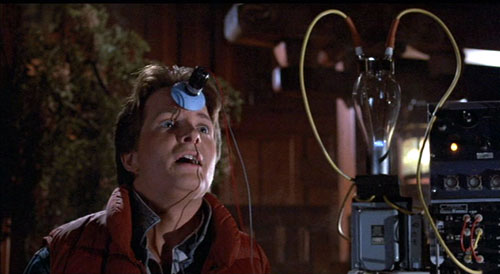
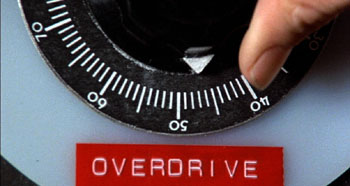
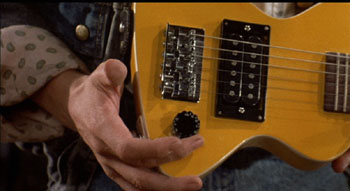
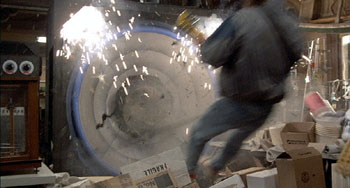
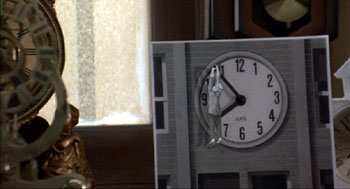
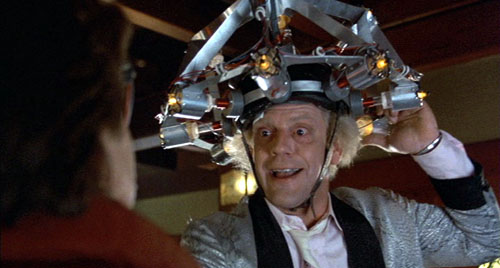
Consider Back to the Future (released the same year as NiFF was published). It might have begun with Marty McFly skating down the street for several minutes on the way to Doc’s laboratory. Instead, the narration introduces Marty by showing him cranking up the lab’s amplifier to overdrive. He strikes a star pose, hits a guitar chord, and is blasted off his feet. He’s shaken up but awestruck: “Whoa. . . Rock and roll.” We now assume that Marty likes to take risks, that he’s committed to his music, that he’s a bit preening, and that he can bounce back. Likewise, before Marty comes in, during the opening shots exploring the lab, we get information about Doc as well, though more indirectly. For both characters, the narration encourages us to leap to conclusions that will be confirmed again and again in the story that follows.
Sometimes, though, filmmakers thwart our propensities by either neutralizing the initial cues (we don’t know how to read the character) or offering strong ones that are later countermanded (we’ve been led to misread the character). Preminger offers wonderful examples of both possibilities in Anatomy of a Murder. Either way, the filmmaker is still exploiting the primacy effect and the fundamental attribution error, but in order to yield different experiences. Meir Sternberg’s superb book, Expositional Modes and Temporal Ordering in Fiction(1978), points out such strategies and explores in detail what he called, “the rhetoric of anticipatory caution”—the ways that novelists trigger the primacy effect only to force us to reevaluate our snap judgments. Sternberg was, I think, one of the first narrative theorists to bring cognitive research to bear on storytelling strategies.
I found, in short, that experimental results in the cognitive sciences could explain, in a fairly direct way, many of the tactics that stories use to engage us. Contrary to what my Wikipedia entry implies, I’m not a cognitivist 24 hours a day; many of the research questions I tackle don’t depend on such assumptions. Still, since NiFF, I’ve revisited them a few times. Making Meaning (1988), for example, tried to show that a lot of cinematic interpretation is explainable in cognitive terms.
Most recently, some essays in Poetics of Cinema (2007) draw on psychological and anthropological research to clarify why films use certain formal strategies. For instance, what aspects of Mildred Pierce mislead us about what is happening, and how are we led to misremember those aspects? Why do actors stare at each other in a way we seldom see in life? And why don’t they blink the way we do? Another essay in the collection, “Convention, Construction, and Cinematic Vision,” moves to broader terrain. It argues that a great deal of our understanding of films relies not on codes particular to cinema (contra the semiotic tradition) but rather on our everyday inference-making habits and skills.
The cognitive turn
Written in 1982-83, Narration in the Fiction Film leaned heavily on what was then called “New Look” psychology, the first wave of cognitive research in psychology. The pioneers of that program, such as Jerome Bruner, R. L. Gregory, Ulrich Neisser, and others, emphasized the mind’s role in actively building up structures of meaning on the basis of incomplete or ambiguous information. So my claims that films cue us to flesh out their action, invoke schemas (knowledge structures), ask us to reorganize story order, and to fill in missing bits—all stem from that research program. The art historian E. H. Gombrich, another big influence on me, was perhaps the first person to see how New Look psychology could inform theorizing in the humanities.
In the late 1990s, cognitively inflected film theory really took off, and in directions that shaped the growth of SCSMI. The first avatar of the SCSMI was founded by Joseph and Barbara Anderson. Joe and I were graduate students together at Iowa in the early 1970s, where he wrote a dissertation on binocularity in the cinema, and later we worked together here at Madison, where Barb was a grad student. Joe taught a course in film perception that I sat in on occasionally, and it was a revelation. When NiFF came out, Joe (by then a film producer) felt encouraged to go on with his own work, and the result was The Reality of Illusion (1998). It proposed an alternative to the New Look orientation, grounded in J. J. Gibson’s theories of ecological perception. Since then, Joe and Barb have published two anthologies, with contributions from SCSMI members.
At the same period, Torben Grodal published Moving Pictures (1997) a comprehensive theory of cinema grounded in the cognitive sciences, with particular focus on brain functions. Torben was also a founding member of the SCSMI group.
Since 2000, publications in the area have increased markedly, parallel to the growth of cognitive studies in literature and other areas. I hope to discuss some of these books and articles in a later blog.
Broadly, cognitive film theory has tracked the development of the cognitive sciences. After the New Look and ecological frameworks, we’re seeing more emphasis on evolutionary psychology and neuroscience as explanatory forces. Film scholars who talk about adaptive fitness and mirror neurons are still, for the most part, doing middle-level, piecemeal theorizing—trying to explain particular processes by appeal to what scientific research has brought to light. None, I think, expects cognitivism to provide a Big Theory of Everything.
Early on, Noël, I, and others sought to show that the cognitive perspective offered better explanations for some aspects of cinema than the dominant psychoanalytic approach. We were sometimes chastised for being pugilistic and polemical. Yet interestingly, nobody responded to our arguments, let alone replied at the same level of detail. The situation reminded me of Godard’s response to people who complained that Letter to Jane (1972) mistreated Jane Fonda. His reply was: “I merely wrote her a letter, but she never answered.”
In the years since, I have yet to see a substantive critique of the cognitive research tradition in film studies. The only extended argument I know of isn’t really focused on cognitivism and is surprisingly flimsy. (My response to it is here.)
Advocates for Poststructuralist or Cultural Studies perspectives sometimes dismiss the cognitive framework as “common sense.” But common sense is in the eye of the beholder, and there’s no reason to assume that flagrantly uncommensical claims are any more likely to be accurate than those which seem intuitively right. In doing research, we just try to ascertain the evidence for any belief, commonsensical or not. The primacy effect might seem simply to rely on the old saw, “First impressions matter,” but it’s good to know that at least one commonplace is well supported. By contrast, the fundamental attribution error doesn’t on the face of it seem either common sense or not. It’s something that our folk psychology doesn’t guide us toward or away from. It’s actually a fresh discovery about some habits of our minds.
Moreover, a great deal of cognitivism flouts what some might take as common sense. Before Chomsky, most intellectuals thought that language was social through and through. He was able to show that certain features of it, including syntax, are likely to be part of our biological endowment. A lot of cognitive social psychology has been dedicated to showing how common-sense inferences are often illogical. These findings are now being popularized in books like Cordelia Fine’s A Mind of Its Own: How Your Brain Distorts and Deceives, and Thomas Kida’s Don’t Believe Everything You Think(from which my multiplication example comes). As for humanists’ suspicion of science, I address that unfounded fear in the introduction to Poetics of Cinema. If you prefer big-picture arguments about the issue, try Edward Slingerland’s new book.
Movies on the brain
The real debate on cognitivism in film studies has yet to take place. Meanwhile, the cognitivists keep plugging away. Over the years, the Society for Cognitive Studies of the Moving Image has attracted, broadly, three sorts of persons. All are represented in our upcoming conference.
*There are the film-trained academics like me, who have branched out into cognitive film theory to illuminate particular research projects. Our June gathering includes a great many such scholars, many of them pioneers in the cognitive perspective like the Andersons, Carroll, Grodal, Murray Smith, Carl Plantinga, Patrick Colm Hogan, et al.
*There are the psychologists, who are interested in explaining the psychological mechanisms of cinema. They tend to focus on particular phenomena, like eye movements, cutting, or other triggering processes, and they study the effects at various levels, from perceptual response to brain-scanning. Their great predecessor is Julian Hochberg, who studied cinema as a sort of stage show that displayed psychological processes with particular clarity. A magisterial collection of Hochberg’s work, In the Mind’s Eye, has recently been published. At our June gathering, an entire thread is largely devoted to psychological research into cinematic uptake. Our two plenary speakers, Uri Hasson of NYU and Dan Levin of Vanderbilt, also represent this tradition.
*Then there are the philosophers. Most are concerned with art and literature, and most incline to an Anglo-American form of conceptual analysis. These scholars come to SCSMI because they are of a cognitivist bent, or because they want to argue with cognitivist work, or because this is a useful forum for the sort of film-based questions they want to pursue. The June event includes many of the most prominent philosophers of film, and a panel session is devoted to critiques of Noël Carroll’s recent book The Philosophy of Motion Pictures.
Visit our schedule page, and you’ll get a sense of how varied this work is. Speakers are talking about everything from editing patterns to the effects of digital technology on filmic perception. The participants consider propaganda, melodrama, TV series, and videogames. There are presentations on the emotional dimensions of horror and on the ways that color works in particular movies. How do viewers who have never seen films before understand cutting? In what sense is film content fictional? How does the language of film theory affect the way we theorize? Is there something inherently filmic that sets cinema apart from other media?
Cognitivism isn’t a Big Theory of Everything; nobody has a clue about how these diverse research programs would fit together. The variety is what makes it fun. I think that anybody who wants to know more about movies would find something worthwhile at the Madison event, not least the opportunity to shmooz. And there’s The House on the Rock.
The evidence is mounting. Cognitivism is cool.
PS 17 April: This line of thought strikes a chord in Lee Marshall, who offers encouragement at Screen Internationalhere.
During my first year as a Ph.D. candidate at the University of Wisconsin-Madison, the great animator Bob Clampett paid a visit to our campus. I actually got to sit next to him at lunch, and he was a charming, amusing man. Unfortunately I didn’t really know at the time what a genius he was, and, to my eternal regret, I neglected to ask for his autograph.
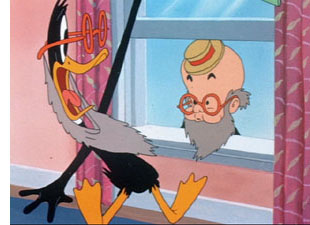
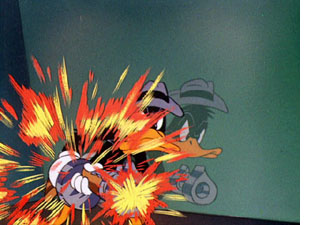
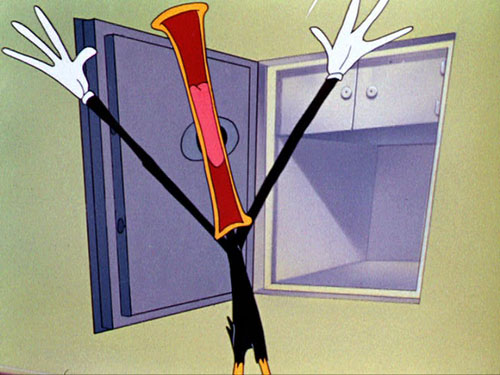
Today Clampett is less well-known to the general public than is Chuck Jones or Tex Avery. Jones and the other main creators of the classic Warner Bros.’s cartoons reportedly resented Clampett’s attempts to promote his own reputation by claiming sole credit for major achievements, such as “inventing” Bugs Bunny. When Jones put together The Bugs Bunny/Road Runner Movie (1979), there were no Clampett-supervised cartoons included. Clampett never wrote his memoirs. Jones did and left Clampett out. (Below, Draftee Daffy, 1945.)
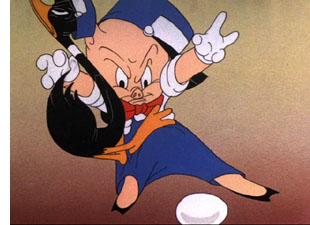
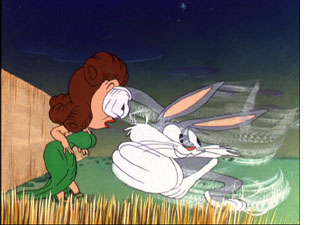
These three major directors had their own distinctive approaches. Jones was on the whole more cerebral and often opted for beautiful visuals, perhaps most obviously evident in What’s Opera, Doc. Avery had a penchant for bad puns, often assembling whole cartoons based entirely around them. Clampett went for craziness and often for break-neck speed. The Wikipedia entry on him has this to say: “his characters are easily the most rubbery and wacky of all the Warner directors’.” (Above, Baby Bottleneck [1946].)
That wackiness was built into the name of one of Warner’s two animated series, “Looney Tunes.” Daffy Duck’s name characterizes him, but modern audiences may not be aware that “Bugs” also was a slang term for “crazy.” Along with Porky Pig, those were the two characters that Clampett used most often.
I’m not going to sum up Clampett’s career here. There is already quite a bit of excellent material on him available on the internet. For an overview of his career and style, see Adrian Danks’s “It Can Happen Here! The World of Bob Clampett” on Senses of Cinema; Michael Barrier’s epic 1970 interview with Clampett, with comments and corrections, is available on his website. That website contains many other shorter pieces on Clampett. Danks and the Wikipedia entry both give enough bibliographical sources to direct enthusiasts to additional information.
My purpose here is more modest. I simply want to point out how to find even more hilarity in Clampett’s cartoons beyond simply watching them.
As I’ve mentioned, David and I are in the process of revising our second textbook, Film History: An Introduction. The other day I was working on the section that deals with Hollywood animation in the 1930 to 1945 period. We’re adding more color to the book for its third edition, so I decided that Draftee Daffy, which we describe briefly, should have its own color plate.
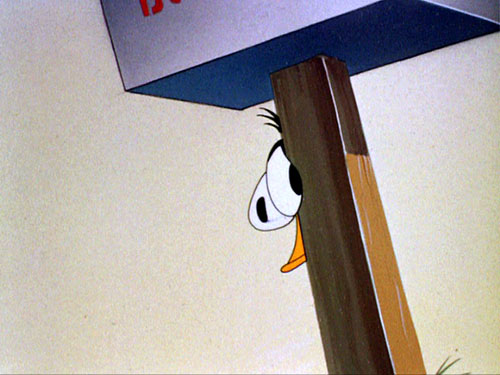
As I watched the film on DVD, I paused on a number of possible frames to use, and I found myself laughing out loud at almost every one—something that doesn’t often happen during the revision of a textbook. Some of the character movements in Clampett’s films are so fast and brief that they come across as a flurry of images too fleeting to register. Frozen, they reveal some of the extraordinary means that the director and his animators used to achieve those effects of speed. Clampett was also adept at highly exaggerated reactions and hilarious distortions of the animal body. Watching these cartoons with a finger on the pause button can yield hilarity and teach you a lot about normally hidden aspects of the art of animation.
David has written about the artistry in Walt Disney’s films. He points out that a quick movement may be accomplished by adding extra limbs, as when in Melody Time Johnny Appleseed gathers an armload of falling apples and multiple arms and hands convey the speed of his gestures—as do a pair of phantom heads in the uppermost frame of the three David reproduces.
Such multiple images work without our noticing them. It’s not an obvious sort of technique to use. As David wrote, “Through trial and error Disney’s animators learned that rather strange single images will look exactly right on the screen; these men were practical perceptual psychologists.”
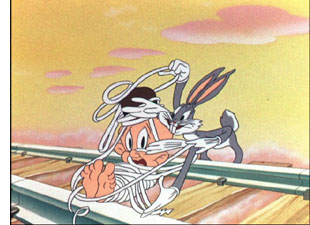
The same was true in the Warners animation department. In The Big Snooze (1946), Clampett’s last cartoon for the studio, he includes a scene of Bugs rapidly tying Elmer to some railroad tracks. In a couple of frames, he sprouts extra arms and hands. In The Great Piggy Bank Robbery (1946), phantom images of Daffy accompany his firing a machine gun.
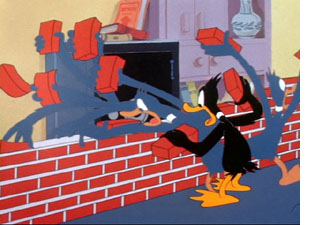
But Clampett’s single images were often far stranger than the ones in the Melody Time example. In this one from Draftee Daffy, for example, the extra figures of Daffy as he frantically builds a wall between himself and his nemesis (the little man from the draft board) are purple.
I suppose that’s because multiple black figures of Daffy would blend together, but it’s still a bit weird. As an animator, how do you decide on a color?
Maybe it’s because purple is a subdued color that won’t call attention to the extra ducks and yet will contrast well with the black. It’s also the same color as the floor, so that might create an extra reason why we won’t notice them as standing out from the overall composition as it flashes past. If you know those purple ducks are there, you can just barely see them during normal projection. If you don’t know that, then you’re likely to miss them.
(I used that example of Daffy building the wall in my sole academic publication on animation, “Implications of the Cel Animation Technique,” in Teresa de Lauretis and Stephen Heath, eds., The Cinematic Apparatus [St. Martin’s Press, 1980]. There it had to be in black and white, unfortunately.)
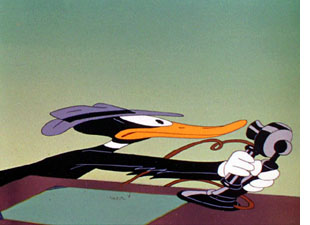
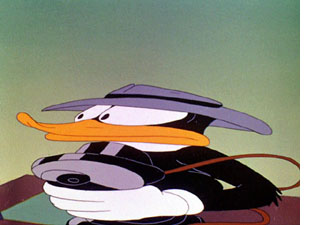
Clampett often draws upon a standard animation device, “stretch,” to convey a sense of speed–although his characters may cross a room in as little as two or three frames. The first image of the telephone scene from The Great Piggy Bank Robbery is a fairly straightforward example of stretch, yet in the same scene, Daffy rapidly turning around uses the opposite technique, “squash.”
A similar technique which Clampett uses occasionally for a character about to launch into a rapid movement is a sort of squash with a perspective effect stretching the character toward the viewer, as in The Big Snooze when Bugs instructs Elmer to “Run this way.” (Bugs isn’t the only one who gets into drag in these cartoons.)
I’ve picked some of my favorite Clampett films, but many frames worth pausing on are to be found in others. With the Looney Tunes boxed sets still coming out, in five volumes to date, one can hunt out the Clampett films–though annoyingly, the indexes list neither the date nor the supervising animator, and there seems to be little logic involved in which films go on which discs. (There are also occasional jumps where something has presumably been censored.) It’s best to get thoroughly familiar with these films by simply viewing them. Then, pick up that remote and begin your search. You’ll discover that Clampett was one of the most imaginative of those “practical perceptual psychologists.”
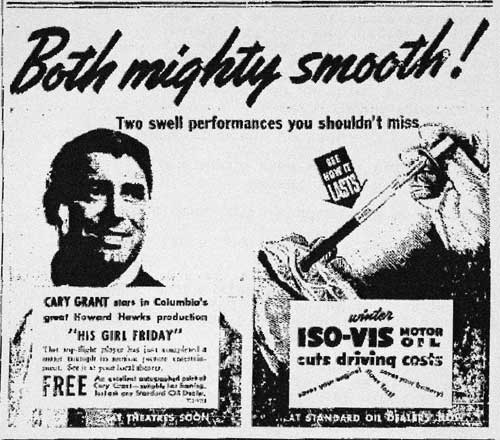
In early April of 1940, His Girl Friday came to Madison, Wisconsin. It ran opposite Juarez, The Light that Failed, Of Mice and Men, and a re-release of Mamoulian’s Dr. Jekyll and Mr. Hyde.Pinocchio was about to open. Most screenings cost fifteen cents, or $2.21 in today’s currency.
Before television and home video, film was a disposable art. Except in big cities, a movie typically played a town for a few days. Programs changed two or three times a week, and double bills assured the public a spate of movies—nearly 700 in 1940 alone. People responded, going to the theatres on average 32 times per year. Given the competition, it’s no surprise that His Girl Friday didn’t stand out in the field; it was nominated for no Academy Awards and honored by no prizes. On just a single day in Madison, the cast of His Girl Friday was up against icons like Muni, Colman, March, and Bette Davis.
Nowadays, of course, nearly everyone regards HGF as one of the great accomplishments of the studio system. Most would consider it a better movie than any of the others it played opposite in my home town. A typical example of critical exuberance is Jim Emerson’s comment here. Or read James Harvey’s 1987 encomium:
It would be hard to overstate, I think, the boldness and brilliance of what Hawks has done here: not only an astonishingly funny comedy, but a fulfillment of a whole tradition of comedy—the ur-text of the tough comedy appropriated fully and seamlessly to the spirit and style of screwball romance. His Girl Friday is not only a triumph, but a revelation.
Oddly, this extraordinary film lay largely unnoticed for three decades. How did it become a classic? The answer has partly to do with the rising status of Howard Hawks, the director, among critics. It also owes something to changes in how academics thought about film history. And a little movie piracy didn’t hurt.
An unseen power watches over the Morning Post
Hawks the Artist is a creation of the 1960s. Before that, American film historians almost completely ignored him. Andrew Sarris often reminds us that he’s absent from Lewis Jacobs’ Rise of the American Film (1939), but he’s also missing from Arthur Knight’s The Liveliest Art (1957), the most popular survey history of its day. Apart from press releases and reviews of individual films, there were few discussions of Hawks in American newspapers and magazines. The most famous piece is probably Manny Farber’s “Underground Movies” of 1957, which treats Hawks along with other hard-boiled directors like Wellman and Mann.
From the start, Hawks was more appreciated in France. There film historians acknowledged A Girl in Every Port (1928), in part because of the presence of Louise Brooks, and they usually flagged Scarface (1932) as well, which they could see and Americans couldn’t. (Howard Hughes kept it out of circulation for decades.) But Hawks is barely mentioned in Georges Sadoul’s one-volume Histoire du cinéma mondiale (orig. 1949) and he’s ignored in the 1939-1945 volume of René Jeanne and Charles Ford’s monumentally monotonous Histoire encyclopédique du cinéma (1958).
The essay that marked the first phase of reevaulation was evidently Jacques Rivette’s “The Genius of Howard Hawks” in Cahiers du cinéma in 1953. Inspired by Monkey Business, Rivette’s philosophical flights and you-see-it-or-you-don’t tone helped define the auteur tactics identified with Cahiers’s young Turks. Rivette and his colleagues became known as “Hitchcocko-Hawksians.” The essay, however, doesn’t seem to have been immediately influential. Antoine de Baecque claims that within Cahiers, an admiration for Hawks was controversial in a way that liking Hitchcock was not. (1) It took some years for Hawks to ascend to the Pantheon.
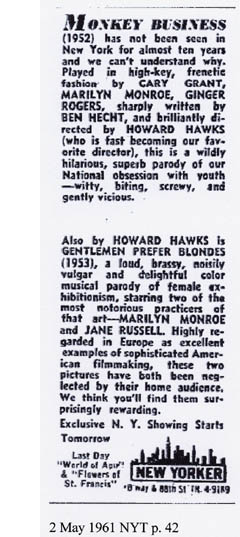
The story of that ascent has been well-told by Peter Wollen in his essay, “Who the Hell Is Howard Hawks?” In France, the Young Turks’ tastes had been nurtured by Henri Langlois, who showed many Hawks films at the Cinémathèque Française. In New York, Andrew Sarris and Eugene Archer had become intrigued by Cahiers but were ashamed that as Americans they didn’t know Hawks’ work. They persuaded Daniel Talbot to show a dozen Hawks films at his New Yorker Theatre during the first eight months of 1961. The screenings’ success allowed Peter Bogdanovich to convince people at the Museum of Modern Art to arrange a 27-film retrospective for the spring of 1962. The package went on to London and Paris, sowing publications in its wake.
For the MoMA retrospective, Hawks granted Bogdanovich a monograph-length interview, which was to be endlessly reprinted and quoted in the years to come. (2) Sarris, now knowing who the hell Hawks was, wrote a career overview for the little magazine, The New York Film Bulletin, and this piece became a two-part essay in the British journal Films and Filming. Both Bogdanovich and Sarris made brief reference to His Girl Friday, as did Peter John Dyer in another 1962 essay, this one for Sight and Sound. At the end of 1962, another British magazine, Movie, published an issue on Hawks. At the start of 1963, Cahiers devoted an issue to him, including an homage by Langlois himself. Thanks to the work of Archer, Bogdanovich, Sarris, and MoMA, Hawks was rediscovered.
Sarris provided a condensed case for Hawks in his far-reaching catalogue of American directors, published as an entire issue of Film Culture in spring of 1963. There followed an interview with Hawks’s female performers in the California journal Cinema (late 1963), an appreciation by Lee Russell (aka Peter Wollen) in New Left Review (1964), another Cahiers issue (November 1964), J. C. Missiaen’s slim French volume Howard Hawks (1966), Robin Wood’s Howard Hawks (1968), and Manny Farber’s Artforum essay (1969). There were doubtless other publications and events that I never learned about or have forgotten. In any case, by the time I started grad school in 1970, if you were a film lover, you were clued in to Hawks, and you argued with the benighted souls who preferred Huston. . . even if you hadn’t seen His Girl Friday.
Light up with Hildy Johnson
One of my obsessions in graduate school was the close analysis of films. But I was also interested in whether one could build generalizations out of those analyses. My initial thinking ran along art-historical lines. My Ph. D. thesis on French Impressionist cinema sought to put the idea of a cinematic group style on a firmer footing, through close description and the tagging of characteristic techniques. But that approach came to seem superficial. I wasn’t satisfied with my dissertation; although it probably captured the filmmakers’ shared conceptions and stylistic choices, I couldn’t offer a very dynamic or principled account of formal continuity or change.
Watch a bunch of movies. Can you disengage not only recurring themes and techniques, but principles of construction that filmmakers seem to be following, if only by intuition? As I was finishing my dissertation, reading Russian Formalist literary theory pushed me toward the idea that artists accept, revise, or reject traditional systems of expression. These become tacit norms for what works on audiences. My reading of E. H. Gombrich pushed me further along this path. We should, I thought, be able to make explicit some of those norms. Eventually I would call this perspective a poetics of cinema.
I was assembling my own version of some ideas that were circulating at the time. In the early 1970s, several theorists floated the idea that different traditions fostered different approaches to filmic storytelling. People were seeing more experimental and “underground” work, as well as films from Asia and what was then called the Third World. Being exposed to such alternative traditions helped wake us up to the norms we took for granted. The mainstream movie, typified by what Godard called “Hollywood-Mosfilm,” seemed more and more an arbitrary construction.
People began examining films not as masterworks or as expressions of an auteur, but as instances of a representational regime. Films became “tutor-texts,” specimens of formal strategies that were at play across genres, studios, periods, and directors. Again, the French pointed the way, particularly Raymond Bellour, Thierry Kuntzel, and Marie-Claire Ropars. At the same moment, Barthes’ S/z was published in English, and it seemed to provide a model for how one might unpick the various strands of a text, either literary or cinematic. Screen magazine was a conduit for many of these ideas in the English-speaking world.
Some of my contemporaries disdained the mainstream cinema and moved toward experimental or engaged cinema. Others read the dominant cinema symptomatically, for the ways it revealed the contradictions of ideology. I learned from both approaches, but I believed that the current analysis of how Hollywood worked, even considered as a malevolent machine, was incomplete. Could we come up with a more comprehensive and nuanced account of the mainstream movie? This line of thinking was already apparent in non-evaluative studies of form and style, such as essays by Thomas Elsaesser, Marshall Deutelbaum, and Alan Williams. (3)
At some point in graduate school at the University of Iowa, between fall 1970 and spring 1973, I saw a screening of His Girl Friday. I fell in love with its heedless energy. It seemed to me a perfect example of what Hollywood could do.
In my admiration I was channeling the cultists. Rivette, in a review of Land of the Pharoahs: “Hawks incarnates the classical American cinema.” (4) Bogdanovich: He is “probably the most typical American director of all.” Richard Griffith, then film curator of MoMA, had slighted Hawks in his addendum to Paul Rotha’s The Film Till Now, but in his foreword to the Bogdanovich interview he caved to the younger generation: “Hawks works cleanly and simply in the classical American cinematic tradition, without appliquéd aesthetic curlicues.” As for HGF, in the 1963 Cahiers tribute Louis Marcorelles called it “the American film par excellence.”
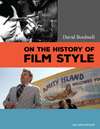
Praising Hawks, and HGF specifically, was part of a larger Cahiers strategy to validate the sound cinema as fulfilling the mission of film as an art. What traditional critics would have considered theatrical and uncinematic in HGF—confinement to a few rooms, constant talk, an unassertive camera style—exactly fit the style that Bazin and his younger colleagues championed. (For more on that argument, see Chapter 3 of my On the History of Film Style.)
These niceties didn’t inform my reaction at the time. I was already primed to like Hawks, though, having caught what films I could after reading Wood et al. (During my initial summer in Iowa City, I went to a kiddie matinee of El Dorado and got Nehi Orange spilled down my neck.) On my first viewing His Girl Friday delighted me with the sheer gusto of the pace and playing. Clearly the cast was having fun. A press release sent out before the film claimed that during one scene, with Cary Grant dictating frantically to Rosalind Russell, she cracked him up by handing over what she had typed.
Cary Grant is a ham. Cary Grant is a ham. Now is the time for all good men to quit mugging. You don’t think you can steal this scene, do you—you overgrown Mickey Rooney? The quick brown fox jumps over the studio. Cary Grant is a ham.
Even discounting this tale as PR flackery, we know from Todd McCarthy’s excellent biography that Hawks encouraged competitive scene stealing and wily improvisation. Russell hired an advertising copywriter to compose quips she could “spontaneously” conjure up in her duels with Grant.
If there was a “classical Hollywood cinema”—a phrase that was in the early ’70s coming into circulation via Screen—the buoyant forcefulness of His Girl Friday embodied it. Here was a film pleasure-machine that hummed with almost frightening precision. What else do you expect from a director who studied engineering and whose middle name is Winchester?
Production for use
When I saw His Girl Friday, little had been written about it. Despite Langlois’ screenings, before the 1962 touring program, the Cahiers critics seemed to have had limited access to Hawks’ prewar work. His Girl Friday wasn’t released theatrically in France until January of 1945 (not perhaps the most propitious moment), and it apparently made no long-lasting impression on the intelligentsia. I can’t find any critical commentary on it in French writing before the 1963 issue of Cahiers.
In the United States, HGF earned Hawks a courteous write-up in the New York Times by, of all people, Bosley Crowther, (5) but it wasn’t acknowledged as an instant classic like Mr. Smith Goes to Washington or The Philadelphia Story. After the initial flurry of mostly favorable reviews, the movie seems to have been forgotten until Manny Farber’s 1957 essay, and even there it’s only mentioned in a list. Interestingly, it wasn’t screened during the 1961 New Yorker series. Robin Wood’s sympathetic but not uncritical discussion in his Hawks book of 1968 seems to have been the most comprehensive account available since the movie’s release.
At about the time Wood’s book was published, something big happened. Columbia Pictures failed to renew its copyright, and His Girl Friday fell into the public domain.
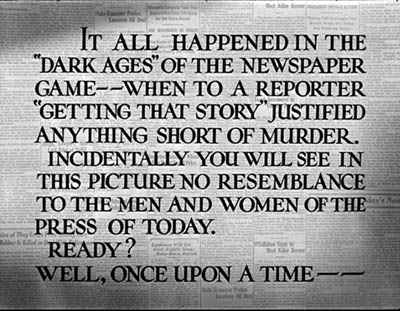
Entrepreneurs made dupe copies, in quality ranging from okay to terrible. You could rent one for peanuts and buy one for only a little more. Some of these bleary prints have been telecined and turned into the DVD versions of the film that fill bargain bins today. After I got to the University of Wisconsin, where Hawks films stoked the two dozen campus film societies, I bought a public domain print. The copy was better than average, although it lacked the fairy-tale warning title at the start. From 1974 on, I showed the poor thing constantly.
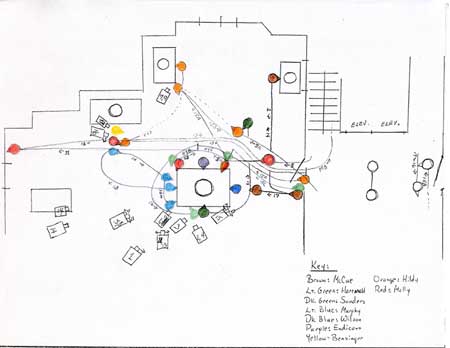
In Introduction to Film, taught to hundreds of students each semester, HGF illustrated some basic principles of classical studio construction. It had the characteristic double plotline (work/ romance), a careful layout of space, an alternation of long takes and quick cutting, manipulation of point-of-view, judicious depth framing (see frame below), and cascading deadlines. In Critical Film Analysis, I asked students to map out scenes shot by shot (see diagram above) and to show how different approaches (genre-based, feminist, Marxist) would interpret the film. In a seminar on “the classical film and modernist alternatives” HGF grounded comparisons with Bresson, Dreyer, Ozu, Godard, and Straub/Huillet. By steeping ourselves in such alternative traditions, could we resist the naturalness of Hollywood artifice?
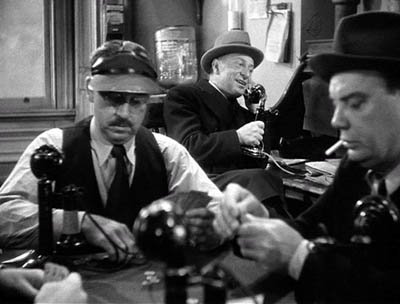
The movie became a UW staple. It went into the first edition of Film Art (1979) as an instance of classical construction; even the telephones were scrutinized. Marilyn Campbell’s paper from our seminar was published in 1976. (6) Over the years, many of our grad students, exposed to the film in our courses, have gone on to use it in their teaching.
Doesn’t have to rhyme
I can’t let HGF go. I still use moments to illustrate points in my writing and lectures. Madison colleagues and I swap banter from it; Kristin and I talk in Hawks-code, as she explains here. I’ve been told that grad students in another PhD program compared our program to the Morning Post pressroom (favorably or not, I don’t know). Thanks to Lea Jacobs, the invitation to my retirement party was surmounted by a picture of Walter Burns whinnying into his phone.
But seriously, His Girl Friday, isn’t a bad guide to a lot of social life. You can learn a lot from its Jonsonian glee in selfishness and petty incompetence, as well as its sense that virtue resides with the person who has the fastest comeback. Think as well how often you can use this line in a university setting:
If he wasn’t crazy before, he would be after ten of those babies got through psychoanalyzing him.
I’m not claiming special credit for the HGF revival, of course. Plenty of other baby-boomer film professors were teaching it. It became a reference point for feminist film criticism, particularly Molly Haskell’s From Reverence to Rape (1974), and it has never lost its auteurist cachet. Richard Corliss’s 1973 book on American screenwriters flatly declared that “His Girl Friday is Hawks’s best comedy, and quite possibly his best film.”
Most important of all, TV stations were screening their bootleg prints. HGF didn’t become a perennial like that other public domain classic It’s a Wonderful Life, but its reputation rose. Its availability pushed the official Cahiers/ Movie masterpieces Monkey Business and Man’s Favorite Sport? into a lower rank, where in my view they belong.
Once HGF became famous, the proliferation of shoddy prints became an embarrassment. In 1993 it was inducted into the National Film Registry, which gave it priority for Library of Congress preservation. Columbia managed to copyright a new version of the film. A handsomely restored version was released on DVD, and a few years back I saw a 35mm copy whose sparkling beauty takes your breath away.
The lesson that sticks with me is this. If Columbia had renewed its copyright on schedule, would this film be so widely admired today? Scholars and the public discovered a masterpiece because they had virtually untrammeled access to it, and perhaps its gray-market status supplied an extra thrill. Thanks mainly to piracy, His Girl Friday was propelled into the canon.
Epilogue
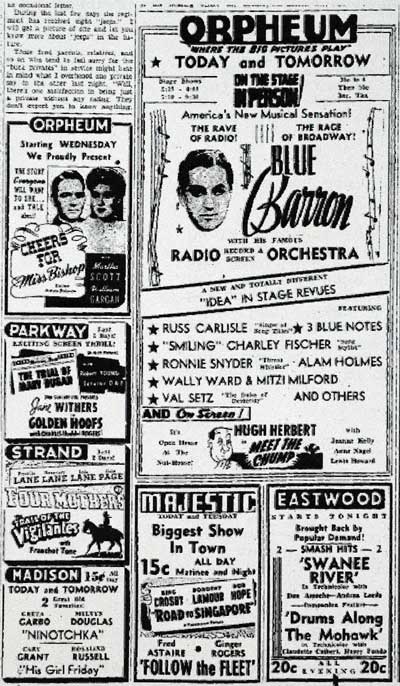
In May of 1940, His Girl Friday hung around Madison, shifting from its first venue, the Strand downtown, to an east side screen, the Madison. The film came back in late September to yet a third screen, the Eastwood (now a music venue).
HGF was revived in March of 1941, as the second half of a double bill at the Madison (bottom left below). Check out the competition: some killer re-releases from Ford, Lubitsch, Astaire-Rogers, and Hope-Crosby. A Midwestern city of 60,000 could become its own cinémathèque without knowing it.
(1) Antoine de Baecque, Cahiers du cinéma: Histoire d’une revue, vol. 1: À l’assaut du cinéma, 1951-1959 (Paris: Cahiers du cinéma, 1991), 202-204.
(2) Bogdanovich has published a much fuller version in Who the Devil Made It? (New York: Knopf, 1997) , 244-378.
(3) Thomas Elsaesser, “Why Hollywood?” Monogram no. 1 (April 1971), 2-10; “Tales of Sound and Fury,” Monogram no. 4 (1972), 2-15; Marshall Deutelbaum, “The Structure of the Studio Picture,” Monogram no. 4 (1972), 33-37; Alan Williams, “Narrative Patterns in Only Angels Have Wings,” Quarterly Review of Film Studies 1, 4 (November 1976), 357-372.
(4) Jacques Rivette, “Après Agesilas,” Cahiers du cinéma no. 53 (December 1955), 41.
(5) Bosley Crowther, “Treatise on Hawks,” New York Times (17 December 1939), 126. “He brings to his work as a director the ingenious and calculating brain of a mechanical expert. . . . He pitches into the job just as though he were building a racing airplane.”
(6) Marilyn Campbell, “His Girl Friday: Production for Use,” Wide Angle 1, 2 (Summer 1976), 22-27.
For a helpful collection of conversations with the master, see Howard Hawks Interviews, ed. Scott Breivold (Jackson: University of Mississippi Press, 2006). Go here for a 1970s piece by James Monaco on then-current controversies.
PS 24 Feb: Jason Mittell responds to my post with some nice nuancing and draws out the implication for copyright issues: contrary to current media policy, the wider availability of a work can actually enhance its value.
Coming attraction: Kristin is preparing a blog entry commenting on fair use in the digital age.









 These two movies were powerful treats, and the day was embellished with a visit behind the scenes to the Film Center’s staff area, where I got Yuri to shoot me with one of my favorites, Yamada Isuzu.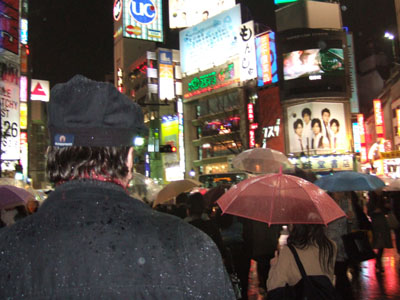
 I’ve mentioned Kyoko Hirano, another former student and a best-selling author. Then there was my lunch with Donald Richie, hearty at 82 and planning more books, film screenings, and festival trips. His classic, The Inland Sea, is now being translated into Romanian. He gave me a copy of his newest, A Tractate on Japanese Aesthetics and I reciprocated with a copy of Poetics of Cinema. Donald’s book is as delicate and sharp as a Basho lyric; beside it, my book looks like an andiron.
 The story of that ascent has been well-told by Peter Wollen in