Friday | October 24, 2008
Subjective
[NOTE: There are some spoilers here, though I’ve tried to avoid giving away the ends of the films I mention. Teachers who show clips in class would probably want to do the same. Some of the films mentioned here would be good choices to show in their entirety to classes when they study Chapter 3 of Film Art.]
Kristin here—
We have had occasion to mention the Filmies list-serve of the Department of Communication Arts’ Film Studies area here at the University of Wisconsin-Madison. Current and past students and faculty, sometimes known as the “Badger squad,” share news, links, and requests for information. Once in a while a topic is raised for discussion. These exchanges are usually fascinating, and when we have felt that they might be of interest to a general audience, we have used them as the basis for blog entries. (See here and here.)
Another occasion arose recently, one which relates to the teaching of Film Art: An Introduction. Matthew Bernstein, of Emory University, queried the group about suggestions for teaching a section of the third chapters, “Narrative as a Formal System.” He found that the section, “Depth of Story Information,” gives some students trouble. They can’t grasp the distinction we make between perceptual and mental subjectivity.
Our definitions of the terms go like this. Perceptual subjectivity is when we get “access to what characters see and hear.” Examples are point-of-view shots and soft noises suggesting that the source is distant from the character’s ear. In contrast, “We might hear an internal voice reporting the character’s thoughts, or we might see the character’s inner images, representing memory, fantasy, dreams, or hallucinations. This can be termed mental subjectivity.”
We then go on to give a few examples. The Big Sleep has little perceptual subjectivity, while The Birth of a Nation contains numerous POV shots. We see the heroine’s memories in Hiroshima mon amour and the hero’s fantasies in 8 ½. Filmmakers can use such devices in complex ways, as when in Sansho the Bailiff, the mother’s memory ends not by returning to her in the present, but to her son, apparently thinking of the same things at the same time.
Yeah, but what about …?
Filmmakers don’t always use these categories in straightforward ways. They may oscillate between perceptual and mental representations and events. Films may present narrative events that make the distinction between characters’ perceptions and their mental events ambiguous. That’s why in introducing the concepts, we stress that “Just as there is a spectrum between restricted and unrestricted narration, there is a continuum between objectivity and subjectivity.
Easy to say, but not necessarily so easy to grasp for a student who’s trying to understand these categories. They need to start with simple examples to familiarize themselves with the basic distinction before going on to what the likes of Resnais, Fellini, and Mizoguchi can throw at them. But some students immediately proffering exceptions. As Charlie Keil, of the University of Toronto, put it in his post on the subject, “I hardly need add that students, even the least analytically astute, border on the brilliant when it comes to suggesting examples that provide challenges to categorical coherence.”
Looking over the one and a half pages of the textbook that we devoted to depth of narration, you might find it fairly straightforward. Once you start looking for ways to teach the concepts without bogging down in too many nuances and subcategories, though, the passage does seem challenging. What follows is a suggestion about how someone might go about explaining and utilizing examples. It also points up some ways we might revise this passage of the book for its next edition.
What it’s not
One obstacle that Matthew has found is that students are used to thinking of “subjective” as meaning something like “biased,” as in “here’s my subjective opinion on that.” It might be useful to point out that this is only one meaning of the word. The dictionary definition that comes closest to the way we use it in Film Art is this: “relating to properties or specific conditions of the mind as distinguished from general or universal experience.” For film, we specify that “subjective” means either sharing the characters’ eyes and ears (properties) or getting right inside his or her mind (conditions).
Another misconception comes when students assume that the facial expressions, vocal tones, and gestures used by actors are subjective because they convey the characters’ feelings. Again, best to scotch that notion up front. Those techniques are projected outward from the character, and we observe them. Cinematic subjectivity goes inward.
One step at a time
Another distinction to stress early on is the basic one we make between film technique and function. There are a myriad of film techniques that could be used in either objective or subjective ways. To take a simple example, a low camera angle might indicate the POV of a character lying down and looking up at something; that’s perceptual subjectivity. A low angle of a skyscraper in an establishing shot might simply be the objective narration’s way of showing where a new scene will occur.
In contrast, indicating perceptual and mental subjectivity are two specific kinds of functions. Filmmakers can call upon whatever cinematic techniques they choose, and historically the more imaginative ones have shown immense creativity in trying to convey what characters see and think.
Some films depend heavily upon subjectivity, but objective narration is more common. There are many films that give us little access to characters’ perceptual and mental activities. Apart from The Big Sleep, there are films like Anatomy of a Murder, or virtually anything by Preminger. Most films use subjectivity sparingly. So let’s assume the students can tell that objective narration is the default.
With that out of the way, we can go back to basics. Both perceptual and mental subjectivity depend on being “with” the character in a strong way, as opposed to observing him or her as we would see another person in real life.
Perceptual subjectivity is fairly simple. The camera is in the character’s place, showing what he or she sees. The microphone acts as the character’s ears. Other characters present in the scene could step into the same vantage point and observe the same things.
So the test could run like this: As a viewer, when we see something in a film, is it really present within the scene? Could someone else in the same position see and hear the same things? Or is it a purely mental event, something no one else could see and hear, even if they stood beside the character or stepped into the place where that character had been standing?
If I were teaching the concept of narrational subjectivity as Film Art defines it, I would stress the notion of a continuum. After starting with very clear examples of both perceptual and mental subjectivity, I would progress to more ambiguous, mixed, or tricky instances.
Contributing to this discussion on the Filmies list, Chris Sieving, of the University of Georgia, says he shows a 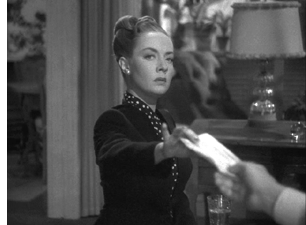 clip from Lady in the Lake, the film noir where the camera always shows the POV of the detective protagonist. As Chris says, “It seems to effectively get across what perceptual subjectivity means (and how awkward it is in large doses), as well as what is meant by a (highly) restricted range of narration (as is the case with most whodunits).” As Chris also says, Lady in the Lake is a sort of limit case, a film that depends as much on perceptual subjectivity as it’s possible to do. (That’s “our” hand taking the paper in the shot at the right.) One could show several minutes from any section of the film and make the point thoroughly. clip from Lady in the Lake, the film noir where the camera always shows the POV of the detective protagonist. As Chris says, “It seems to effectively get across what perceptual subjectivity means (and how awkward it is in large doses), as well as what is meant by a (highly) restricted range of narration (as is the case with most whodunits).” As Chris also says, Lady in the Lake is a sort of limit case, a film that depends as much on perceptual subjectivity as it’s possible to do. (That’s “our” hand taking the paper in the shot at the right.) One could show several minutes from any section of the film and make the point thoroughly.
There are other films that contain a lot of POV shots but intersperse them with objective ones. Rear Window is an obvious case. When Jefferies is alone, we see the courtyard events from his POV, a fact which is stressed by his use of binoculars and his long camera lenses to spy on his neighbors. This is clearly perceptual rather than mental. We never doubt that what we see through the hero’s eyes is real; we don’t believe that he’s making things up to entertain himself or because his mind is unbalanced. For one thing, there are two other characters who visit at intervals and see the same things that he does. We and they might question whether Jefferies’ interpretation of what he sees is correct, but we assume that the story’s real events have been conveyed to us through his eyes and ears. Only if we saw something like his fantasy of how he imagines his neighbor might have killed his wife would we move into the mental realm.
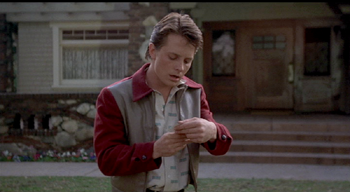
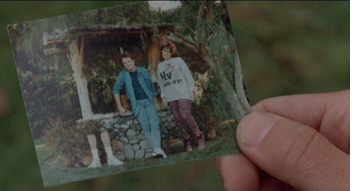
These two films foreground their use of POV. Usually, though POV shots are slipped into the flow of the action smoothly. Scenes of characters looking at small objects or reading letters often cut to a POV shot to help us get a look at an important plot element. At intervals during Back to the Future, Marty looks at a picture of himself and his siblings, gradually fading away to indicate that the three of them might never be born if he doesn’t succeed in bringing their parents together. It’s a simple way of reminding us what’s at stake and that Marty’s time to solve the problem is running out.
The Silence of the Lambs uses many POV shots and provides an excellent case of narration switching frequently and seamlessly between objective and subjective. Most of the POV views are seen through Clarice’s eyes, but sometimes through those of other characters. The first view of Lecter is a handheld tracking shot clearly established as what she sees as she walks along the corridor in front of the row of cells.
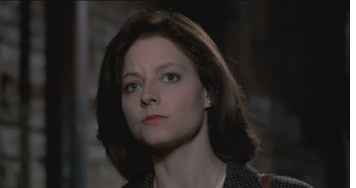

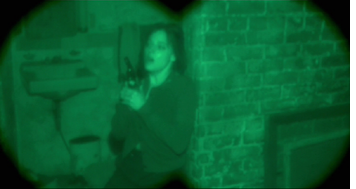
The scenes of Clarice conversing with Lecter develop from conventional over-the-shoulder shot/ reverse shot to POV shot/ reverse shot as both characters stare directly into the lens. (In Film Art, we use this device as an example of how style can shape the narrative progression of a scene [p. 307, 8th edition]). Other characters have POV shots as well, most noticeably, when Buffalo Bill twice dons night-vision goggles and we briefly see the world as he does.
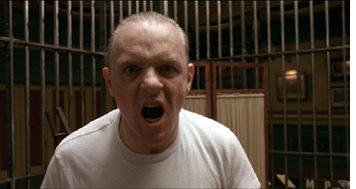
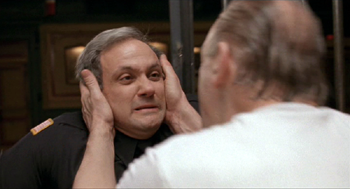
Occasionally we see the POV of even minor characters, as when Lecter’s attack on his guard is rendered with a quick POV shot of Lecter lunging open-mouthed at the camera and then an objective shot of him grabbing the guard.
In their minds
Let’s jump to the other end of the continuum. Here we find a clear-cut use of mental subjectivity for fantasies, hallucinations, and the like. Obviously no one else present, unless he or she is posited as having special telepathic abilities, can see and hear what takes place only in a character’s mind.
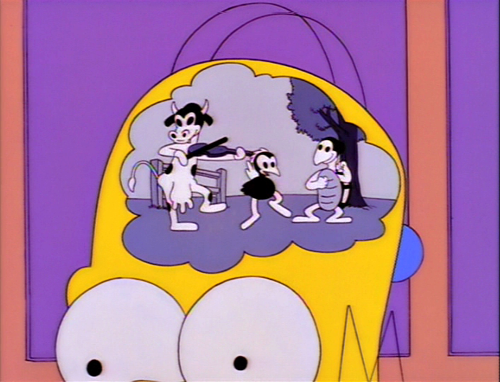
Such fantasies are a running gag on The Simpsons, where Homer’s misinterpretations, distractions, and visions of grandeur are shown either in a thought balloon or superimposed on his skull. In the example above, he abruptly starts “watching” a little cartoon after assuring Lisa that she has his complete attention. No one could mistakenly assume that these exist anywhere but in Homer’s imagination.
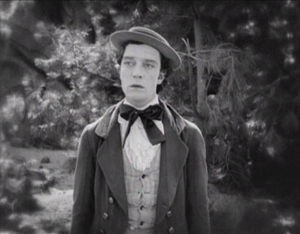
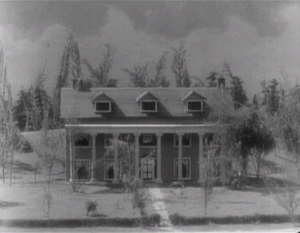
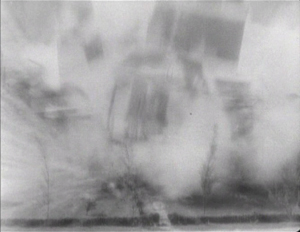
In Buster Keaton’s Our Hospitality, the hero receives a letter telling him he has inherited a Southern home. After an image of him thinking there is a dissolve to a view of a large, pillared house. Later, when he arrives at his small, ramshackle house, he stands staring in a similar situation, and here there is a fade-out to his dream house, which abruptly blows up. The humor in the second scene would be impossible to grasp if we didn’t easily understand that the shot of the house exists only in his mind.
Whole films can be built around fantasies. A large central section of Preston Sturges’ black comedy Unfaithfully Yours consists of a husband envisioning three different ways he might kill his supposedly cheating wife, all set to the musical pieces he is conducting at a concert. Fellini’s 8 ½ is only the most obvious example of how the art cinema often brings in fantasies. Other examples include Jaco van Dormael’s Toto le héros or Bergman’s Persona.
Once students have grasped the basic distinction between perceptual and mental subjectivity, it might be useful to emphasize the continuum by moving directly to its center, where the two types coexist.
The middle of the continuum: Ambiguity and simultaneity
Right in the middle of the continuum between the pure cases we find ambiguous cases. Filmmakers can create deliberate, complex, and important effects by keeping it unclear whether what we see is a character’s perception of reality or his/her imaginings.
1961 was a big year for ambiguous subjectivity, with two of the purest cases appearing. One was a genre picture, the other a controversial art film.
The first is the British horror film, The Innocents, directed by Jack Clayton and based on Henry James’s novella, The Turn of the Screw. In several scenes, a new governess at a country estate sees frightening figures whom she takes to be ghosts haunting the two children entrusted to her. We see these figures as she does, but we never see them except when she does. The children behave very oddly in ways that might be consistent with her belief, yet they deny seeing any ghosts. Finally the governess tries to force the little girl to admit that she also sees the silent female figure standing in the reeds across the water. Does the child’s horrified expression reflect her realization that the governess knows about her secret relationship with the ghosts? Or is she simply baffled and frightened by the governess’s increasingly frantic demands that she confess to seeing something that in fact she can’t see?
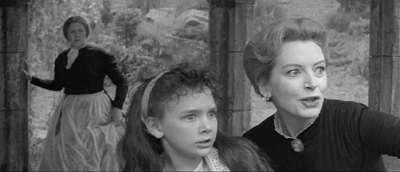
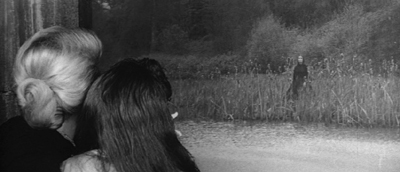
From the first appearance of the eery figures, the question arises as to whether the governess is imagining the ghosts or they are real, controlling the children, who try to keep them secret. There are apparent clues for either answer. By the end, we arguably are no closer to knowing whether the ghosts are real or figments of the heroine’s imagination.
Since Last Year at Marienbad appeared, critics have spilled gallons of ink trying to fathom its symbolism and sort out the “real” story that it tells. Clearly there are contradictions in events, settings, and voiceover narration. The second of the three accompanying images depicts the heroine as the hero’s voiceover describes their first meeting. They talked about the statue that stands beside her, seen against the formal garden of walks lined with pyramid-shaped shrubs. Yet another version of the first meeting starts, this time with the characters and the same statue against a background of a large pool. Later scenes in these locales display the same inconsistencies.
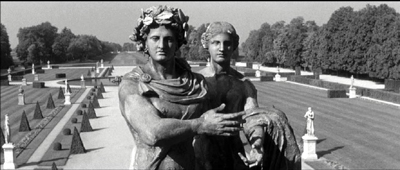
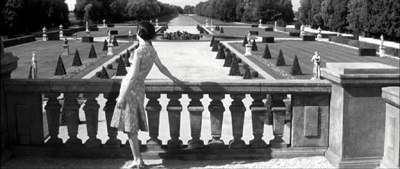
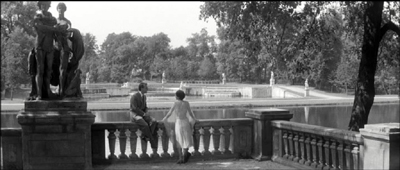
Are such contradictions the result of one character’s fantasies or of the conflicting memories that two characters have of the same event? Or are the contradictions not the products of subjectivity at all but just the playfulness of an objective, impersonal narration, manipulating characters like game pieces to challenge the viewer? (Our analysis of Last Year at Marienbad is available here on David’s website. It and all the Sample Analyses that have been eliminated from Film Art to make room for new essays are available here as pdf’s; the index to them is here, about halfway down the page.)
It’s not a good example of subjectivity to show students, but just as an aside, the screwball comedy Harvey is an interesting case, a sort of reversal of the Innocents situation. The narration withholds a character’s perceptual and mental events. Elwood P. Dowd describes what he sees and hears: a six-foot talking rabbit invisible to us and to all the other characters. The story concerns whether Dowd’s relatives will institutionalize him for insanity, and we assume along with them Harvey is a mere delusion. Thus the narration seems to be objective—or, the ending asks, has it been very uncommunicative, withholding something that the hero really does see and hear? True, throughout the film the framing leaves room for Harvey, as if he were there. One could argue, though, that these framings simply emphasize that the giant rabbit isn’t visible to us or the other characters and hence isn’t likely to really exist.
A film can easily present both perceptual and mental subjectivity at the same time. A POV shot may be accompanied a character’s voice describing his or her thoughts and feelings. Matthew shows his class part of the opening section of The Diving Bell and the Butterfly, where a stroke victim’s extremely limited sight and hearing are rendered in juxtaposition with his voice telling of his reactions to his new situation. It is one of the most extensive and successful uses of such a combination in recent cinema, and it might be very effective in differentiating the two for introductory students.
A scene can also move rapidly back and forth between a character’s perceptions and his or her thoughts. Charlie writes that he shows his students the scenes of Marion Crane driving in Psycho. While the car is moving, almost every alternating shot is a POV framing of the rearview mirror or through the windshield. At that same time, we hear the voices of her lover, her boss, her fellow secretary, and the rich man whose money she has stolen while she imagines how they would react to her crime.
Showing scenes like these, where both types of subjectivity are used and clearly distinguishable might be more useful for students than showing several scenes that contain only one or the other.
Flashbacks, Voiceovers, and Altered States
In his original query to the Filmies, Matthew also said that students have problems with flashbacks: “Particularly, they resist the idea that a flashback is an example of subjective depth in general, even if the flashback unfolds objectively.” I can think of two ways to explain this.
First, classical films tend not to have flashbacks that just start on their own. To be sure, some do: a track-in to an important object and a dissolve can signal the start of a passage from the past, without a character being there. But more often a character is used to motivate the move into the past. A thoughtful look may do it, or a character may describe the past to someone else. In either case, the flashback is coming “from” the character and is assumed to show approximately what he or she is remembering. Occasionally the flashback may be a lie rather than objective truth, as we know from Hitchcock’s Stage Fright, The Usual Suspects, and a few other films.
In Poetics of Cinema’s third essay, David argues that most flashbacks in films are motivated as a character’s memory, but what is shown often strays from what he or she knew or could have known. He suggests that the prime purposes of most flashbacks is to rearrange the order of story events, and the character recalling or recounting simply provides an alibi for the time shift.
So we might think of character-motivated flashbacks as subjective frameworks that also contain objectively conveyed narrative information.
Second, the fact that flashbacks slip in objective information into characters’ memories is a convention. It’s a widely used method for presenting us with two things at once: first, a character’s memories and second, some story information that the viewer needs to have—even if the character couldn’t know about it. As we watch movies, we frequently accept conventions for the sake of being entertained. Beings that travel to Earth from distant galaxies speak English, high school kids can put together shows that wind up triumphing on Broadway, and people who drive up to buildings in crowded cities always find perfect parking spots. In a similar way, implausible mixtures of subjectivity and objectivity in flashbacks is just something we have to accept.
There are two other techniques that didn’t get mentioned during the discussion but that might confuse students.
What about shots showing the vision of a character who is drunk, dizzy, drugged, or otherwise unable to see straight? The most common convention is to include a POV shot that’s out of focus, perhaps accompanied by a bobbing handheld camera. Other characters in the scene, assuming they are not similarly impaired, would not see the surroundings in the same way.
Still, I think the same perceptual/mental distinction holds for such moments. The fuzziness and the lack of coordination are physical effects that are not being imagined by the character. They remain in the perceptual realm. Mental effects of impairment would be dreams or hallucinations. Some examples: the “Pink Elephants on Parade” sequence in Dumbo and the DTs vision of the protagonist of Wilder’s The Lost Weekend. As the title suggests, Altered States takes such mental activities as its subject matter and has many scenes that represent them.
A harder case is voiceover. Are all cases of voiceover subjective? Clearly not. If we have a situation where a character tells a story to a group and his or her voice continues over a flashback, the narration remains objective. We assume that the group can still hear the storyteller. Cases where the voice exists only in the mind, as when a character speaks to himself or herself, but not aloud, are mental subjectivity.
That said, there are many unclear cases. Just what is the status of the narration in Jerry Maguire? Jerry seems to speak directly to us, pointing out things that happen during the action, yet clearly there is no suggestion that he made the film we are watching. The problem is compounded in Sunset Boulevard, where the protagonist not only implicitly addresses us but is also dead. In many cases when a character’s voice is heard over a scene, it might occur to audience members to wonder where the character is or was when speaking these words. And does a character’s voice describing his or her feelings constitute objective or subjective narration? Probably we would want to say that only when the voice is posited as strictly an internal voice, audible only to the character, would we want to dub it subjective.
The problem with voiceovers arises, I think, because it’s such a slippery technique to begin with, and therefore often hard to categorize. Is a character speaking narration over events that happened in the past diegetic sound or nondiegetic? If there’s never an establishment of where and when that character does the narrating, he or she exists in a sort of limbo in between the two states: diegetic because he or she is a character, nondiegetic because he or she is in some ineffable way removed from the story world.
For voiceovers, then, I think it’s best simply to categorize the ones that obviously are straightforwardly objective or subjective. In tricky cases, we just have to admit that not all uses of film technique are easy to pin labels on. But the point of having categories like these isn’t to pin labels. In part knowing them allows us simply to notice things in films that might otherwise remain a part of an undifferentiated flow of images. They enable us to see underlying principles that make films into dynamic systems rather than collections of techniques. They give us ways to organize our thoughts about films and convey them to others. And, though students may doubt this, watching for such things becomes automatic and effortless once we have understood such categories and watched a lot of films. As a child, I don’t think I knew about the concept of editing or ever really noticed cuts. Now I’m aware of every cut in every film I see, and I notice continuity errors and graphic matches and other related techniques, all automatically, without that awareness impinging in the least on my following the story and being entertained. Learning the categories is only the beginning.
Playing with subjectivity
Once students have seen some clear cases of each type of cinematic subjectivity and understand the difference, the teacher could move on to emphasize that filmmakers can play with both in original ways. It’s not really possible in an introductory textbook to discuss all the possibilities—and probably not possible to come up with a typology that would cover every example of subjectivity that could exist across that continuum we mentioned. Imaginative filmmakers will always find new variants on how to use techniques for this purpose. But here are a few intriguing cases.
In his class, Chris shows the scene in Hannah and Her Sisters where the Woody Allen character, a hypochondriac, visits a doctor for some hearing tests. Initially the doctor comes into the room and gives a dire diagnosis of inoperable cancer. After Mickey has reacted to that, a cut takes us back to an identical shot of the doctor entering, but this time he gives Mickey a clean bill of health. The first part of the scene is retroactively revealed to have been a mental event, Mickey’s pessimistic fantasy.
The same sort of thing happens in a more extended way with the familiar “it was only a dream” revelations that make the audience realize that a major part of the plot has been subjective. In a more sophisticated way, as Chris points out, other sorts of mental subjectivity, usually lies or extended fantasies, can be revealed retrospectively, as in The Usual Suspects, Mulholland Drive, and Fight Club.
A flashback from one character’s viewpoint may reveal something new about an earlier scene. In Ford’s The Man who Shot Liberty Valance, the shootout is initially shown through objective narration. Only later in the plot does another character reveals that, unbeknownst to us or the other people present, he had also been present at the shootout. The flashback to his account reveals that the shootout happened very differently from the way we had assumed when first seeing it.
I’ll close with an example from The Silence of the Lambs. This shows how subtle and effective a play with perceptual and mental narration can be. In the scene at the funeral home where a recently discovered body of a murder victim is to be examined, Clarice is left waiting in the midst of a group of state troopers who stare at her. To get out of the situation, she turns and looks into the chapel, where a funeral is taking place. We see her face and then her POV as she surveys the room. A cut shows Clarice suddenly within the chapel, moving forward toward the camera and staring straight into the lens. We will only realize retrospectively that this image begins a fantasy that leads quickly into a memory. Clarice has not actually left her previous position just outside the door.
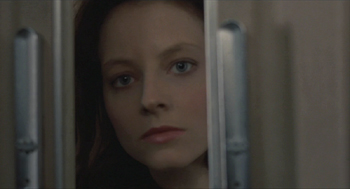
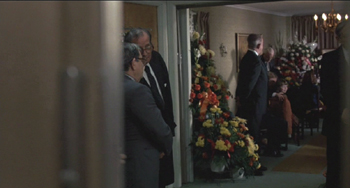
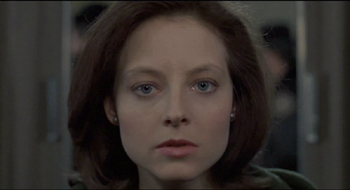
The next shot is a track forward through the center aisle toward the casket. Since Clarice had been walking in that direction before the cut, we recognize this as a POV and assume that Clarice is continuing to walk. Yet the man in the casket, as we soon will learn, is Clarice’s father. The shot represents a different funeral, one in the past which she has been triggered to remember by her glance into the chapel. The fantasy has become a flashback. A second, similar view of Clarice’s face returns us to her fantasizing adult self, the one remembering this scene but not the one still standing outside the door. A closer view of the father’s casket shows it from a lower vantage-point, as if that of a child.
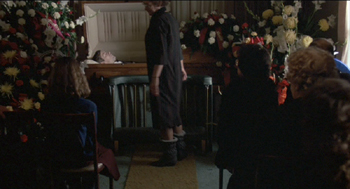
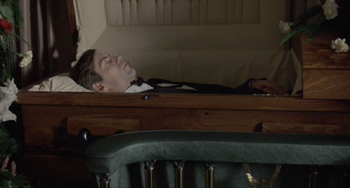
The reason for the change becomes apparent from a radical change at the next cut, so that the camera is on the far side of the casket, filming from a low angle. The sudden shift moves us away from the adult Clarice in order to show her as a child approaching her father and leaning down to kiss him. A noise pulls Clarice out of her memory, and a cut back to the hallway shows her turning away from the chapel. (As often happens, sound, and particularly music, helps guide us through the scene, marking the beginning and ending of the fantasy/flashback.)
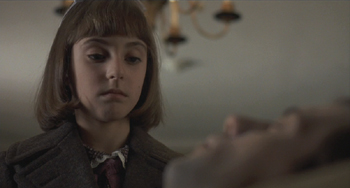
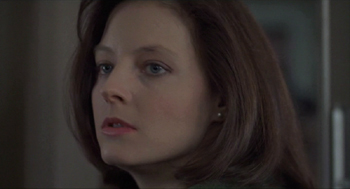
The most experienced film specialist could not track all the rapidly shifting levels of subjectivity in this scene on first viewing. Still, later analysis using some categories of subjective narration can help us appreciate how Demme has woven them into a scene that helps explain Clarice’s motives in becoming an FBI agent and her determination in pursuing her first case.
Categories matter
To some students, the categories I’ve just discussed may seem like trivial distinctions. They’re not. The use of subjective narration is one of the key ways the filmmaker has to engage our thoughts and emotions with the characters. In Psycho, we become involved in Marion Crane’s life in a remarkably short time, partly because of her situation but also partly because Hitchcock keeps us so close to her once she prepares to steal the money. The camera not only frames her closely, but to a considerable degree we see and imagine what she does: her fearful forebodings of how her rash act will turn out. Much the same thing happens with Clarice Starling in The Silence of the Lambs, though there our emotional involvement lasts throughout the film, and we are given glimpses of Clarice’s memories.
Perhaps choosing a scene or two from such films and going through them with the students, trying to imagine what it would be like without the POV shots and the imaginings and the memories, would convince them of the value of learning these categories. After all, the exceptions they find are only exceptional because they play in a zone defined by solid concepts.
[Note added October 24: I should have referred back as well to David’s entry “Three Nights of a Dreamer,” largely on POV.]

Objective
Posted in Film comments, Film criticism, Film technique: Cinematography, Film technique: Editing, Film technique: Sound, Film theory, Narrative strategies, Readers' Favorite Entries |  open printable version
| No Comments » open printable version
| No Comments »
Wednesday | October 22, 2008
Ten AM on a Tuesday, and I’m at my local megaplex, Star Cinema. I’m here to not to see a movie, exactly, but to catch a phenomenon I’ve been curious about for some years.
To back up: Kristin and I have fallen a bit behind in our blogging. For one thing, the presidential election has been so exciting that we spend more time staring at cable news than ever before. (But the time hasn’t been wasted: the campaigns have given me an idea for a blog entry, which I hope to post next week.) Secondly, we’ve been going over the copy-edited version of the third edition of our textbook, Film History: An Introduction. It’s due out this spring, and we’ll have more to say about it later. If you want a preview now, check the new essay I posted elsewhere on this site. It’s called “Doing Film History,” and it’s an updated version of the introduction that appeared in earlier editions of FH.
Kristin has been laboring over an epic blog on character subjectivity. As for me, to take a break from both politics and the textbook, I headed to Star.
The youngest demographic

The phenomenon I was interested in goes by different names, but here in Madison it’s called Baby Box Office.
Every Tuesday morning Star runs screenings for parents and their pre-schoolers. It’s billed as a chance to bring your child to see a film in a welcoming setting. The theatre is a little more illuminated than normal, the sound a little softer. Nobody will ask the kid to shush; you can even nurse your baby. Incidentally I hope that this gets babies to associate movies with oral gratification. The future needs passionate filmgoers, not to mention film students.
You can get more details from the Kerasotes chain’s website, and they’re pretty interesting. (Some theatres offer a Stroller Valet Service.) So I got curious and headed to the ‘plex.
I was surprised that five films were lined up to be screened—not Saw V and Max Payne, naturally, but a fairly wide range, including W. and a couple of animated titles. If none of the customers chooses a film, it’s not run. I asked which movie was today’s top pick, and Susan the cashier suggested The Secret Life of Bees. Buying my ticket, I met Meg and her son Connor. I asked whether she came often. With a smile, she said: “It’s been a life-saver.” She regularly meets a friend, who also has an infant, at the show.
Outside the auditorium there was a changing cot, with baby powder at the ready. Somehow, knowing it was there comforted me.
I counted twelve non-kids at the show, including a guy more or less like me (graying, maybe retired) and three young women who might have been playing hooky from high school. The show was an ordinary screening. There were local ads and video commercials. There were trailers for upcoming releases The Boy in the Striped Pajamas (Nazis with, natch, British accents), Marley and Me (a dog running in surf), The Soloist (Oscar bait), and Australia (part African Queen, part Out of Africa; I gather that She Will Fall in Love with a Man. . . and a Country).
I wish I could report that a dramatic incident, or at least an epiphany, took place during my visit. But the kids were mostly quiet. Occasionally I heard a wail or gurgle, and at one point a mother took a fretful baby out. The screening went fine. Glancing at the kids, I saw many of them staring at the screen transfixed and uncomprehending. On the basis of this experience, I’ve decided it’s better to have a squad of babies in a theatre than a few teenage boys.
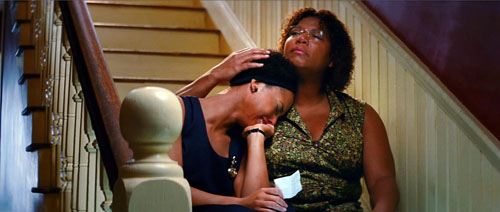
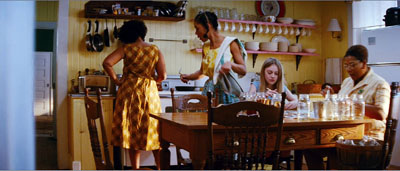
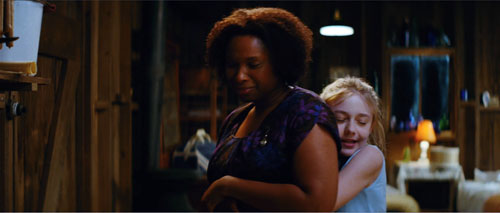
As for The Secret Life of Bees: Cynics will say it’s ready for the Hallmark Channel, but I liked it. It’s what the Japanese call a “wet” film, affording many occasions for tears, in which I freely indulged. Not of much pictorial interest, it is saved, at least for me, by a robust script (tailored to Kristin’s four-part template), solid performances, and sentimental situations centering on racism, child abuse, female bonding, and raging male inadequacy. Needless to say, thanks to intensified continuity a lot of reaction shots drive home each moment. Appropriately, the mommy audience was seeing a movie about mommies; the idealistic but forlorn little heroine winds up with three, at least.
Afterwards, I talked to a pair of ladies who had brought a toddler. While he wrestled with the steering wheel on an arcade driving game, they explained that they frequently come to the shows and are glad that Star Cinema offers them the option. I then talked at length with Star’s savvy general manager, Craig Hussin, who has been part of the Madison movie scene for many years. Craig sees Baby Box Office as part of what every theatre should do—offer the patrons many options, and do it with the sort of flair that used to be called showmanship.
Mom, dad, and dollars

Susan Hansen, Meg Teter, and Connor.
There’s a broader point of interest to us as students of cinema. I think that the phenomenon is a good example of market segmentation, which David Waterman has talked informatively about in Hollywood’s Road to Riches. (1)
Obviously, people’s preferences about movies, as about anything else, differ. Some people want to see a movie the day it’s released; others are willing to wait a while. So it’s better business to charge the eager consumer more than the more cautious one. This is a form of price discrimination.
What makes the film business unusual, Waterman points out, is that it has a very wide range of price demands. Some people will pay a lot to see a film on opening night, others will pay a smidgeon to see it years later on basic cable TV, and there is a wide range of pricing options in between. Just on DVD, you can rent it new, or rent it later for less. You can buy it new, buy it discounted a few months later, or buy a used copy for still less.
In the classic studio days, the principles of market segmentation and price discrimination gave birth to a systematic strategy of distribution, discussed by historians Tino Balio and Doug Gomery (2): The run/ zone/ clearance system. A run was the period during which a film was screened in theatres. The first-run showing, usually at a well-appointed downtown cinema, gave city viewers the first chance to see the movie. The second-run shows, in neighborhood theatres and small towns, took place later, at lower ticket prices. Zones established the territory in which any title could play exclusively. Clearances were the intervals of time separating the runs, typically a matter of weeks or months.
What’s interesting is that the system is still with us. Your average Hollywood movie has its first run at a multiplex. It may get a second theatrical run at a budget theatre or campus venue. Then begins its most profitable string of runs, in the nontheatrical sector. The movie is released on various video platforms sequentially–pay per view, premium cable, airline and hotel systems, DVD, Internets, and eventually free cable. As in the old days, there are clearances between these runs; today they’re called “release windows.” You’ve probably noticed that films come to the ancillary platforms faster than they did only a few years ago. This trend toward shrinking windows is, as you’d expect, a bone of contention with distributors.
The point of the system is to extract the most money from the film. If films were only shown first-run, some people wouldn’t go at all. The price would be set too high for their level of interest. So the prices shrink over time, with broadcast or basic cable airings becoming the last link in the chain. Spreading out the opportunities to see the film allows people with different preferences and budgets to buy in at different points.
So I’m thinking that the Baby Box Office is a nice example of market segmentation. Parents with young children tend not to go to movie theatres. A night out is expensive, especially reckoning in babysitter costs, and many couples I know are just too tired to enjoy a movie at the theatre. If the parents take an infant to a show, it might squall and disturb others. So many parents just stay home. Baby Box Office goes after a niche market.
It’s shrewd policy to screen a recent release for Baby Box Office. If the film were in second-run, the screenings might seem a step down from what else the ‘plex is showing. But if parents see a first-run title, they can then gain the sense of participating in a current pop-culture event—an important motivator for first-run patrons—and they, like other first-run patrons, can spread word of mouth.
Do the costs make sense? At first glance, no. Babies get in free. Mom or Mr. Mom pays $5. If the child is three years old or more, that ticket costs $3. Not a huge amount of money in all: the 12 adults at my screening yielded only $60. But it’s a mistake to compare the takings with Friday-night box office, fattened by hordes of teens.
First, some of the theatre staff are working in the morning anyhow, preparing for the day’s shows, checking prints and projection equipment, talking with bookers on the phone, supervising cleaning, priming the concession stand. So running a few prints at that time of day isn’t a big extra expense. Tuesdays are theatres’ slowest days, so since you’re open you might as well get some people through the turnstiles. Then there’s the intangible factor of good will. Parents are likely to think well of a business that takes pains to cater to them, and they may be likely to return to that theatre when they get other chances.
As for price, five bucks is a little more than a DVD rental these days, so the off-hours screening is a bargain compared to standard ticket prices, but it preserves the integrity of the runs/ windows system. And the concession stand is open. There, where the real money is made, a parent can indulge a guilty impulse for Raisinets.
You can argue that the phenomenon is really a reaction to thinning theatre attendance, and that may indeed be part of the story. But more positively, Baby Box Office sessions seem to lie on a continuum with making a movie available on video, on iPods or phones, and on the Internets. Media moguls have long said that today’s consumers want their objects of desire, no matter how obscure, with maximum convenience. Media distribution has had to adapt itself to audiences’ schedules. Granted, theatres can’t do that as flexibly as video can. Still, Baby Box Office seems a logical effort by exhibitors to adjust to a world in which people expect entertainment to adjust itself to their lifestyles, kids and all. Kids especially.
(1) David Waterman, Hollywood’s Road to Riches (Cambridge: Harvard University Press, 2005), 9-10.
(2) Gomery explains the origins of the strategy in The Hollywood Studio System: A History (London: British Film Institute, 2005), 19-20.
Posted in Film comments, Film industry | open printable version
| No Comments »
Monday | October 13, 2008

Our final post from this year’s Vancouver International Film Festival. Plenty to talk about, so today you get your money’s worth. Oh, wait….it’s free. So you definitely get your money’s worth.
Kristin here—
East
If Abbas Kiarostami and Mohsen Makhmalbaf have been the most prestigious Iranian directors, with their features prominent at film festivals, Majid Majidi has been among the most popular. His Children of Heaven (1997) and The Color of Paradise (1999) both had international success, perhaps largely due to their focus on children and their sentimental, heartwarming stories. The Song of Sparrows (above, 2008) represents a pleasant development and is the best Majidi film I’ve seen. It’s still sentimental and heartwarming, but there’s also a great deal of humor and some highly imaginative situations that give the film more originality than the director’s earlier work.
For a start, the film puts children into supporting roles and sticks continuously with Karim, a hard-working father who strives to make extra money to replace his daughter’s hearing aid. Initially Karim works at an ostrich farm, a completely unexpected locale that generates considerable humor—until one ostrich escapes and Karim loses his job. His one asset is his motorcycle, which he turns into a cab in nearby Tehran, thereby earning good money. Meanwhile his mischievous son and his friends dream of dredging a covered pond near their village and making money by filling it with goldfish to sell.
The triumphs and obstacles that Karim and his son meet make up the bulk of the story, though the life of the tiny cluster of houses in which the main family and their neighbors dwell is charmingly depicted.
The plot of Under the Bombs involves a Lebanese divorcée returning from abroad to search for her sister 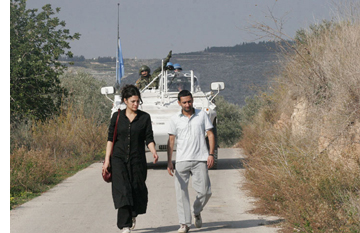 and son just after the 2006 war between Hezbollah and Israel. Only one taxi driver is willing to drive her into the southern region, where bombing could re-erupt at any time; he’s from that area himself, and he’s also attracted to Zeina. This simple story, however, is not half as compelling as the environment in which it takes place. and son just after the 2006 war between Hezbollah and Israel. Only one taxi driver is willing to drive her into the southern region, where bombing could re-erupt at any time; he’s from that area himself, and he’s also attracted to Zeina. This simple story, however, is not half as compelling as the environment in which it takes place.
The film opens abruptly with extreme long shots of bombs going off among residential blocks, and as the two main characters travel through scenes of devastation, there is a vivid sense of the action being staged as the events depicted were actually unfolding. One scene depicts French NATO troops landing with the first relief supplies; another shows coffins being dug out of a mass grave and handed over to grieving family members.
Director Philippe Aractingi manages to convey something of the sense of outrage that news coverage of the Hurricane Katrina disaster did in the U.S. As Zeina questions shelter inhabitants about her lost relatives, they tell their tales of losing their entire families and of being separated from loved ones. We can’t tell whether these people may be actors or actual people who have suffered the losses they describe, but a cumulative sense of outrage emerges at the Israelis’ willingness to attack residential areas in their fight against terrorists.
West
Last time I wrote about films from Haiti and Jordan. The festival continued to offer films from countries that have had little or no regular production. El Camino (2007) hails from Costa Rica, though its director, Ishtar Yasin, is Chilean-Iraqi. The narrative is spare, though not in the enigmatic art-cinema fashion of Eat, for This Is My Body. We are introduced to 12-year-old Saslaya and her younger, mute brother Dario. They live with their grandfather in a shack and scavenge in the local dump. The grandfather sexually abuses Saslaya, and the children set out to find their mother. We watch their journey progress in typical picaresque fashion as they meet people, witness a puppet show put on by a vaguely sinister old man, and wander the streets of the local town. Yet we don’t learn where their mother is, why and when she left. The exposition is minimal, as is the dialogue. Watching El Camino, one becomes aware of how much talk most films contain, since the siblings don’t talk to each other or anyone else.
Finally, nearly 70 minutes into a 91-minute film, the children take a ferry. There the other passengers exchange stories about why they are traveling. Gradually we learn that the early part of the film was set in poverty-stricken Nicaragua, and these people are trying to enter Costa Rica illegally to find work. Saslaya reveals that her mother had left with that goal eight years earlier, after their father died. At last we get some sense of the situation, but the pair’s progress is interrupted once the group goes ashore and are shot at by local authorities. Losing Dario, Saslaya wanders into a town and perhaps an unhappy future—one that may echo what had happened to her mother.
This simple story is enhanced by poetic, even at times vaguely surrealist images, such as the two men struggling to move a wooden table who keep crossing the children’s path. With so little narrative to follow, we are encouraged to focus on the hardships and occasional pleasures of a culture which seldom figures in world cinema.
I referred to the two Mexican films that I described in our first Vancouver report as melodramas. Add another 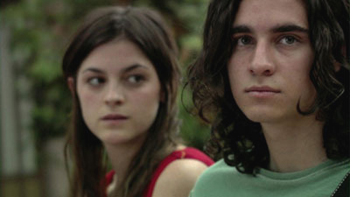 to the list with Francisco Franco’s Burn the Bridges. Two teenagers care for their dying mother in a setting that seems to attract many Latin American filmmakers: a large, decaying mansion. The sister refuses to leave the house, determined to build an isolated world for herself and her brother, to whom she feels an incestuous attraction. He, however, wants nothing more to escape, especially when a tough new kid at school awakens his dawning homosexuality. The action seems a bit overblown at times; I wasn’t always sure whether apparent humor was deliberate or not. But the film and its settings are visually compelling, especially a scene in which the brother and his new friend sneak into a forbidden part of their Catholic school, passing a series of large religious paintings and finally emerging on the roof. to the list with Francisco Franco’s Burn the Bridges. Two teenagers care for their dying mother in a setting that seems to attract many Latin American filmmakers: a large, decaying mansion. The sister refuses to leave the house, determined to build an isolated world for herself and her brother, to whom she feels an incestuous attraction. He, however, wants nothing more to escape, especially when a tough new kid at school awakens his dawning homosexuality. The action seems a bit overblown at times; I wasn’t always sure whether apparent humor was deliberate or not. But the film and its settings are visually compelling, especially a scene in which the brother and his new friend sneak into a forbidden part of their Catholic school, passing a series of large religious paintings and finally emerging on the roof.
O’Horten is a Norwegian film from Bent Hamer, who has emerged as a film festival favorite with his 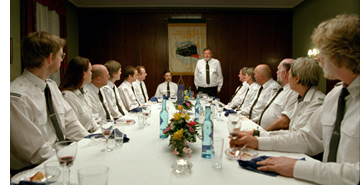 previous Kitchen Stories (2003) and Factotum (2005). It’s a character study of a fastidious train engineer striving to cope with retirement; the film plays out in an episodic series of encounters that eventually lead to Horten’s acceptance of his new life. The comedy of eccentricity proceeds in leisurely, continually entertaining scenes. Apart from its mainly quiet tone and somewhat slow pace, it presents no art-cinema challenges to the audience. Norway has chosen it as its candidate for this year’s foreign-language Oscar, and Sony Classic Pictures has announced that it will release the film in the U.S. in early 2009. previous Kitchen Stories (2003) and Factotum (2005). It’s a character study of a fastidious train engineer striving to cope with retirement; the film plays out in an episodic series of encounters that eventually lead to Horten’s acceptance of his new life. The comedy of eccentricity proceeds in leisurely, continually entertaining scenes. Apart from its mainly quiet tone and somewhat slow pace, it presents no art-cinema challenges to the audience. Norway has chosen it as its candidate for this year’s foreign-language Oscar, and Sony Classic Pictures has announced that it will release the film in the U.S. in early 2009.
Many critics have treated Terence Davies’ Of Time and the City as if it were a sort of elegiac cinematic salute to his native city of Liverpool. Despite the fact that, following the undeserved commercial failure of his excellent adaptation of The House of Mirth (2000), Davies has not made any films, he clearly retains his popularity among aficionados. In fact, however, there is plenty of criticism interspersed with the new film’s lyrical passages. Davies deplores what has become of Liverpool since his childhood there and doesn’t hesitate to assess blame, and he includes harsh comments on religion and on British royalty. He has said that he modeled his documentary on those of Humphrey Jennings, and in particular Listen to Britain (1942), though Jennings’ films had none of the bitterness on display here. Given, however, that Davies was bullied in his school, grew up gay in a more intolerant era, and has had a stunted filmmaking career, such bitterness is hardly surprising.
During Davies’s youth, brick row-houses encouraged communities among the working-class families 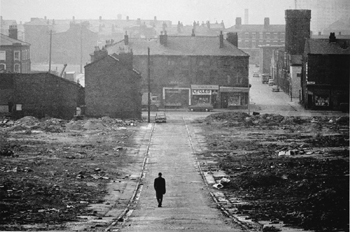 necessary to Liverpool’s industries. Using moving and still footage from the era set to classical music, the director manages to create a poignant sense of the grim conditions these people endured. Modern footage shows these old row-houses in ruins—yet shows the council apartment blocks that replaced them to be in almost equally ramshackle shape. Davies contrasts these with some of the few remaining glorious buildings of Liverpool, mainly columned government spaces through which he cranes his camera. He also filmed candid footage of children, perhaps hinting at the one hope for the future, perhaps displaying those whose youthful memories of Liverpool are now being formed in a far less attractive city. necessary to Liverpool’s industries. Using moving and still footage from the era set to classical music, the director manages to create a poignant sense of the grim conditions these people endured. Modern footage shows these old row-houses in ruins—yet shows the council apartment blocks that replaced them to be in almost equally ramshackle shape. Davies contrasts these with some of the few remaining glorious buildings of Liverpool, mainly columned government spaces through which he cranes his camera. He also filmed candid footage of children, perhaps hinting at the one hope for the future, perhaps displaying those whose youthful memories of Liverpool are now being formed in a far less attractive city.
Of Time and the City marks a welcome comeback, one which I hope will lead to more films by Davies.
DB here:
A miscellany
The Dragons and Tigers programs continued to bring forth very impressive items. Jia Zhang-ke’s 24 City offered a meditation on newly industrializing China, in the vein of last year’s Useless. Aditya Assarat’s Wonderful Town was a prototypical “art movie” that handled a doomed love affair with sensitivity and suspense.
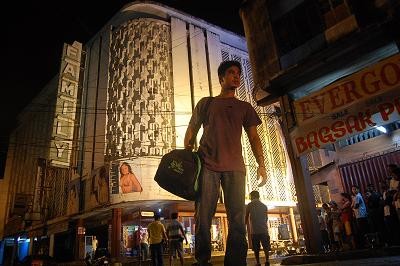
Especially engaging was the new offering from Brillante Mendoza, whose Slingshot I admired at Vancouver last year. In Serbis (“Service”), the Family film theatre lives up to its name only with respect to its management. For here, in the sweltering Philippines town of Angeles, the Pineda family screens porn. The movies attract mostly gay men, who service one another in the auditorium, the toilets, and the stairways. While the matriarch Nanay Flor fights a legal battle, she runs the lives of her employees and kinfolk in a milieu teetering on the edge of confusion. The Pinedas live in the theatre, so that the youngest boy must thread his way to school through a maze of transvestite hookers.
Mendoza confines the action almost entirely to the movie house. That premise recalls Tsai Ming-liang’s Goodbye Dragon Inn, but Serbis has none of that film’s nostalgia for classic cinema. Here movie exhibition is an extension of the sex trade, exuberant in its tawdriness, steeped in heat and sweat, prey to randy projectionists and stray goats. Almodovar might make something more elegant out of the situation, but Mendoza’s careening camera yanks us from vignette to vignette, from the complaints of the operatic Nanay Flor to her loafing husband to the lusty projectionist with a boil on his buttock. Crowded with vitality, the film can spare its last moments for a burst of reaction shots that imply a whole new layer of comic-melodramatic turpitude.
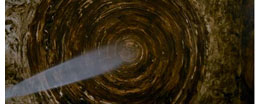
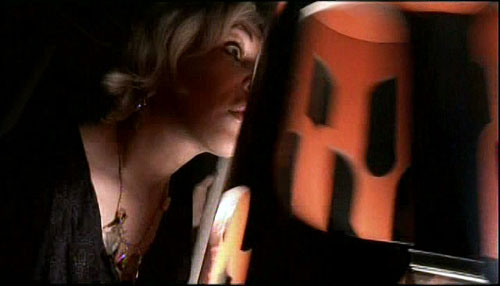
In other strands of the festival, I enjoyed Nik Sheehan’s lively documentary FlicKeR, which tells the tale of Brion Gyson, friend to the Beats and especially Burroughs. But the real star is Gyson’s Dream Machine. A turntable that spins a slotted cylinder around a lightbulb, the gadget—reminiscent of the Zootrope and other precinematic toys—proved mesmerizing to artists and countercultural fellow travelers. Marianne Faithful, Iggy Pop, and other worthies attest to the hypnotic power of the Machine, which triggered a drug-free high. Sheehan fills in a patch of important cultural history and may inspire others to tickle their alpha waves with a homemade Dreamer.
Almost exactly halfway through Steve McQueen’s Hunger lies a long dialogue scene in which IRA prisoner Bobby Sands explains to a priest why he has to launch a hunger strike. Over cigarettes the two men debate the cost of pushing tactics to this extreme. Running nearly twenty minutes and relying almost entirely on a protracted profile shot, it’s the first extended conversation in what is largely a film of bits of behavior and glimpses of a harrowing place.
 Hunger starts by showing the morning routine of a guard at Maze Prison. He washes up. Stiff along a wall, he smokes a cigarette. He painstakingly folds up the tinfoil that wraps his lunch. McQueen’s oblique approach to the subject is maintained when we see a new prisoner brought in. Through him we learn of the cell walls whorled with excrement, the unannounced beatings, and the charade of providing tidy clothes for the prisoners to wear on visitors’ day. Hunger starts by showing the morning routine of a guard at Maze Prison. He washes up. Stiff along a wall, he smokes a cigarette. He painstakingly folds up the tinfoil that wraps his lunch. McQueen’s oblique approach to the subject is maintained when we see a new prisoner brought in. Through him we learn of the cell walls whorled with excrement, the unannounced beatings, and the charade of providing tidy clothes for the prisoners to wear on visitors’ day.
Comparisons with Bresson’s A Man Escaped are inevitable. McQueen is less rigorous and original pictorially, assembling shots based on current image schemas (planimetric framings, selective focus, extreme close-ups, artily off-center compositions, handheld shots for scenes of violence). And he can underscore points a bit too much, as with the repeated shots of the guard’s scabbed knuckles. Still, compared with Schnabel’s conventionally daring Diving Bell and the Butterfly, the film is willing to be unusually hard on us. Through his nameless prisoners, McQueen treats both brutality and fortitude matter-of-factly. His experience with gallery-installation video seems to have encouraged him to let sheer duration do its job. A patient shot stationed at the end of the corridor waits while a guard, proceeding steadily toward us, clears puddles of urine with a push-broom.
Once Sands passes through his revolutionary catechism, the stakes are clear. The rest of the film returns to the dry, nearly dialogue-free atmosphere of the opening as Sands’ strike ravages his body. The objectivity of the opening yields to Sands’ hallucinatory recollections of his childhood as a long-distance runner. Some may see these images, including birds in flight, as clichéd sympathy-getters, but McQueen’s handling is pretty unsensational. Hunger’s quasi-geometrical structure, the sidelong introduction of horrific material, and the almost clinical treatment of Sands’ deterioration invite us to feel, but they also urge us to think about the price of sacrifice to a cause.
Genre crossovers
Some people consider the “festival movie” a genre in itself–the somber psychological drama with little external action, shot at a slow pace. The stereotype is all too often accurate, but festivals play genre pictures too. Usually these are impure genre pictures, more self-consciously artful or ambitious than multiplex crowd-pleasers. Vancouver had its share of such crossover items.
Hansel and Gretel, a South Korean horror film, played with a classic premise: the happenstance that brings someone from the normal world into a peculiar, isolated household. In this case, a superficial young man lost in a forest stumbles into the House of Happy Children. Here three kids seem to rule their passive, saccharine parents. The situation recalls Joe Dante’s episode of the Twilight Zone film, and during the Q & A director Yim Phil-sung acknowledged the influence of that movie, as well as Night of the Hunter. Brisk, fast-paced, and boasting remarkable sets—dazzlingly lit, jammed with toys and sweets, and ineradicably sinister—Hansel and Gretel could earn cult following in America. Rob Nelson has more here.
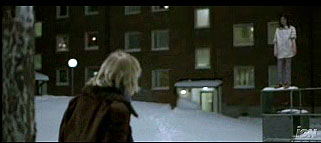
Artier, and scarier, was Let the Right One In, a Swedish film by Tomas Alfredson. Adapting Chekhov’s precept that the gun on the mantle in Act 1 has to go off in Act 3, the film begins with the boy Oskar playing with a knife at his window. Later we’ll learn that his stabbing is a fantasy rehearsal for dealing with the bullies who torment him at school. He meets Eli, a girl who comes out only at night, and their adolescent friendship/ love affair on the jungle gym of a housing block is intertwined with a series of vampire attacks on a small town. The tautly constructed script develops in gory directions that I found both unexpected and inevitable. The wintry widescreen cinematography is handsome and precise, and may well look better on 35mm than on the somewhat contrasty digital version available for the festival. It will have a limited opening in the U. S. later this month.
After School, by Uchida Kenji, is an agreeable thriller—somewhat overbusy and implausible in its plotting, but offered with a modesty and assurance that make it worth a watch. The basic situation, of a missing salaryman who may be having an affair, gains suspense by initially restricting our viewpoint to a shabby private detective. Uchida has fun with one of those misleading openings so common nowadays: you think you understand it from the get-go, but when it’s replayed it takes on a new meaning (and explains the title). The final shot, from a surveillance camera trained on an elevator, is a nicely oblique reminder of what seemed at the time a throwaway moment.
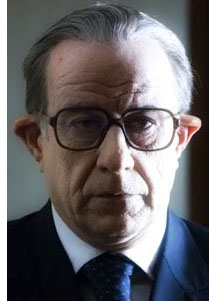 Variety characterizes Il Divo’s genre as “Biopic, Foreign, Political, Drama,” which covers all the bases. Giulio Andreotti, long-time Italian politico, is the subject of the movie, described by an ironic friend as “one-half of the current Italian film renaissance.” The movie surveys Andreotti’s career after the Red Brigades’ murder of Aldo Moro, which triggered a wave of investigations, tribunals, and assassinations, and it concentrates on years after 1995, when Andreotti was accused of links to the Mafia. The first half-hour feels like a single montage sequence, with murders and huddled meetings whisked past us thanks to rapid cutting, swooping camera movements, and pulsating music. (The eclectic score ranges from Sibelius to Gammelpop.) Imagine the sinuous opening of Magnolia, with machine guns. Variety characterizes Il Divo’s genre as “Biopic, Foreign, Political, Drama,” which covers all the bases. Giulio Andreotti, long-time Italian politico, is the subject of the movie, described by an ironic friend as “one-half of the current Italian film renaissance.” The movie surveys Andreotti’s career after the Red Brigades’ murder of Aldo Moro, which triggered a wave of investigations, tribunals, and assassinations, and it concentrates on years after 1995, when Andreotti was accused of links to the Mafia. The first half-hour feels like a single montage sequence, with murders and huddled meetings whisked past us thanks to rapid cutting, swooping camera movements, and pulsating music. (The eclectic score ranges from Sibelius to Gammelpop.) Imagine the sinuous opening of Magnolia, with machine guns.
When director Paolo Sorrentino settles down to to presenting straightforward scenes, his florid technique persists (he never met a crane shot he didn’t like), but the action is dominated by Toni Servillo’s lead performance, which is weirdly showoffish in its own way. Servillo’s Andreotti is a rigid, buttoned-up fussbudget, an impassive mole of a man; only his epigrams (“Trees need manure to grow”) suggest a mind inside. The maniacally contained performance is as stylized as a turn by Lon Chaney, and as hard to keep your eyes off. Then again, given the glimpses of Andreotti in this report on the Italian response to Il Divo, the portrayal seems only a little exaggerated.
Of course there can be a straightforward genre picture here and there at the festival. The most disappointing instance I saw was The Girl at the Lake, an Italian whodunit that is only a notch or so above a TV movie. More entertaining was Welcome to the Sticks, the fish-out-of-water comedy that has become the top-grossing French film of recent years. A postal supervisor is assigned to a remote village where, he’s convinced, the hicks and the freezing cold will make him miserable. Instead he finds warm-hearted people and plenty of fun. The problem is to keep his wife from finding out how much he’s enjoying himself.
The item is hammered and planed to the Hollywood template. Plot lines: love affairs, both primary and secondary, complicated by work. Structure: four parts, with a neat epilogue that wraps everything up. Motifs: traffic cops, carillon bells, and food, often treated as running gags. Style: overall, less cutting than we might find in Hollywood (8.7 seconds average shot length), but still huge close-ups for extended passages of dialogue. In all, Wecome to the Sticks is sitcom fare that provided, I have to admit, a nice break from a lot of misery on display in the more orthodox festival offerings.
Turning Japanese
In our first communiqué, I talked about films by Kitano and Wakamatsu. I want to add comments on two more Japanese movies I saw, both of exceptional quality.
In All Around Us, Hashigushi Ryosuke (Like Grains of Sand, 1995) tells the story of a fraught marriage. The happy-go-lucky Kanao settles into a job as a courtroom artist for TV news, while Shozo, who works in publishing, is a believer in strict rules for their relationship. Their efforts to have a child end unhappily, and Shozo finds her life unraveling. Domestic troubles, amplified by tumult in Shozo’s extended family, play out while every day Kanao covers soul-destroying criminal cases, many involving assaults on children.
The mix of tender sentiments and extreme violence (offscreen, but evoked through chilling testimony) give the film a typically Japanese flavor. Hashigushi filters much of the courtroom horrors through Kanao’s point of view, so that while a defendant berates himself for not killing more people, Kanao watches a mother, and the close-up of her bandaged wrist concentrates all her grief.
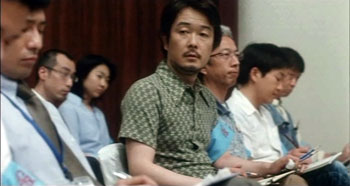
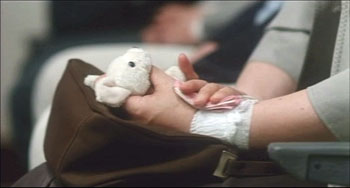
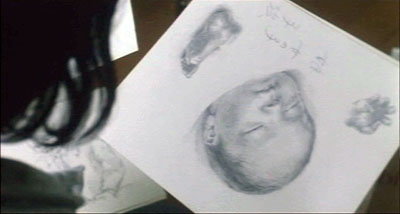
The tact of Hashigushi’s handling is on display in a late sequence. As Shozo struggles out of her depression, her family gathers for what apparently will be her grandfather’s final moments. The adults assemble to discuss the situation while children play in a room behind them. Kanao shows them sketches that they take to be of the father in his final moments.
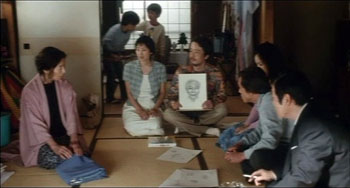
During their discussion, the adults are distracted by the children shattering an urn in the background.
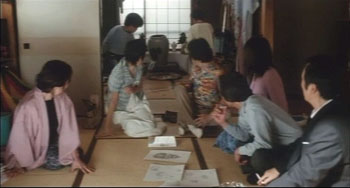
Here Hashigushi uses staging techniques I’ve discussed in On the History of Film Style and Figures Traced in Light. Kanao’s display of his sketch favors us; it is centered and frontal. Then, after blocking the children’s play for some time, Hashigushi reveals it—centered and exposed as the adults in the foreground turn to look.
Then most of the family leaves. Hashigushi tracks in slowly to the mother’s confession of her misdeeds, and he ends the shot with a close-up of Shoko.
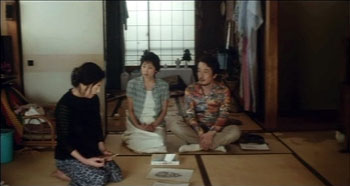
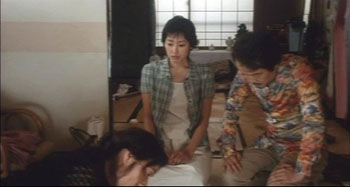
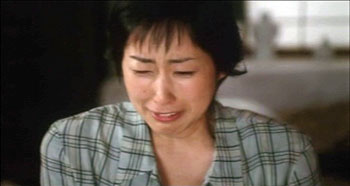
In a film in which the camera moves seldom and without much fanfare, this creates a simple, powerful impact and refocuses the drama on the psychologically fragile Shoko.
The film I’ve admired most across the festival is, predictably, Still Walking by Kore-eda Hirokazu. It relies on a simple situation. Grandpa and grandma celebrate a son’s death anniversary by a visit from the families of their son and daughter. Across a little more than a day, memories resurface and old tensions are replayed.
Everything unfolds quietly, and the pace is steady: none of the histrionics, both dramaturgical and stylistic, of the Danish Celebration and other psychodramas of dysfunctional families. Still Walking is a classic Japanese “home drama” in the Ozu mold. The conflicts will be muffled and nothing is likely to break the placid surface.
In a stream of vignettes Kore-eda brings each family member to life, displaying an easy mastery in shifting attention from one to another. Gradually he assembles a group portrait of a domineering father, a good-humored mother, a slightly daffy daughter, a son always compared unfavorably to his elder brother, and in-laws striving to be well-received by the grandparents without alienating their spouses. The spirit of Ozu, particularly Tokyo Story and Early Summer, hovers over specifics: a dead brother is invoked, the family poses for a picture, and the patriarch, a retired doctor, has a clinic in his home.
Kore-eda doesn’t get as much credit as he deserves; he’s often overshadowed by extroverts like Miike Takeshi. That’s partly because his is an art of quietness, shown perhaps in its most extreme form in his first feature, Maborosi (1995). At the time I thought it was only one, albeit exquisitely wrought, version of the “Asian minimalism” that sprang up in Taiwan, Japan, China, and even a bit in Hong Kong. I suspect that this trend was largely due to Hou Hsiao-hsien’s masterpieces like Summer with Grandfather, Dust in the Wind, and City of Sadness. A Japanese critic told me that indeed Maborosi was criticized as being too Hou-like.
Now, after After Life, Distance, Nobody Knows, and Hana, Kore-eda has moved to the forefront of Japanese cinema. It seems to me that he maintains the classic shomin-geki tradition of showing the quiet joys and sadness of middle-class life while also plumbing the resources of “minimalist” mise-en-scene.
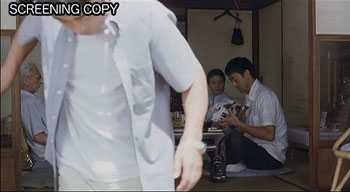
In Still Walking he works in an engaging, unfussy way. He lets us get to know and like his characters, feeling neither superior nor inferior to them. He builds up his plot more through motifs than dramatic action; a good example is the pop song that the mother loved and that gives the movie its title. The technique, spare but not austere, enforces the relaxed pacing. The film has only around 375 shots in its 111 minutes. While there are plenty of reaction shots and close-ups (the first shot shows women’s hands scraping radishes), some scenes play out in long takes rich in detail.
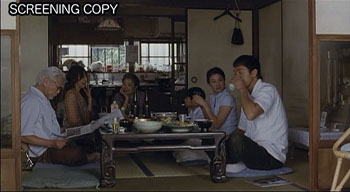
For example, in a three-minute shot early in the film, most of the family is gathered around a table.
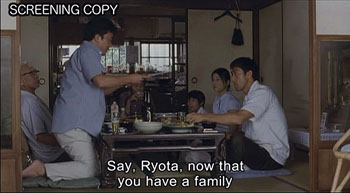
The brother-in-law, a used-car salesman, goes out to the garden to play with the children.
Now the family members discuss the dead brother’s widow, who doesn’t come to family gatherings.
When the father declares that a widow with a child is harder to marry off, he is obtusely insulting his son Ryota’s new wife. Kore-eda marks the disruption with a cut to a reverse angle.
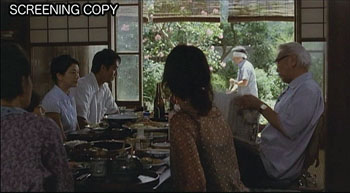
This generates another long take, in which Ryo’s wife Yukari deflates the tension by saying she was lucky to get him. The women then rise and clear the foreground, somewhat as the brother-in-law had by going into the garden. As the family talks, we can see him in the distance helping the kids break open a melon.
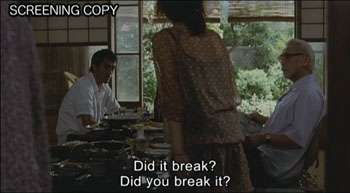
Ryo talks about his job restoring paintings. It’s clear that the father disapproves of it, wishing that Ryo, like the deceased brother, had taken up medicine. Kore-eda keeps the garden action as a secondary point of interest by having Ryo glance off occasionally.
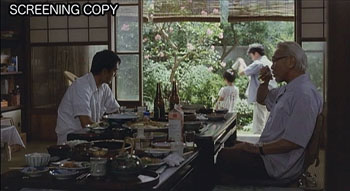
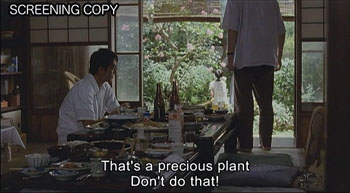
But Ryo’s explanation of his job is cut off by the father’s abrupt rise and walk to the doorway, ordering the kids to stay away from one plant.
When the father returns to the table, the nearly two-minute long shot is replaced by a series of singles as Ryo tries to explain his work.
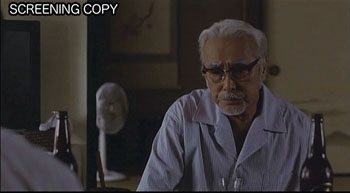
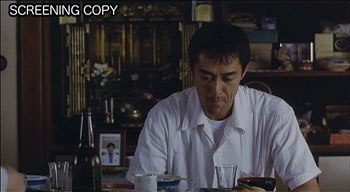
These shots employ one of Ozu’s staging tactics, settling two characters not directly opposite one another but one space apart. The camera seats us across from each one. As a result, the men can be posed frontally, while now we can watch where their glances go—most often, downward. The new setups let us see that the father and son don’t look at each other much.
Instead of moving to these singles right away, as most directors today would, Kore-eda has saved them as a way to articulate the next, more intense phase of the drama. It is arguably a less ostentatious way to raise the tension than the prolonged track inward that Hashigushi uses in All Around Us. (Then again, Hashigushi employs that technique at a climactic moment, while this scene we are still rather early in Kore-eda’s film.) The point is the simplicity and delicacy with which Kore-eda deploys traditional elements of craft.
It wouldn’t be fair to offer a more intensive analysis of this trim work, since it has yet to be widely seen. In the best of all worlds, it will get an American theatrical release.
In all, another wonderful Vancouver festival. See you there next year?
FlicKeR.
Posted in Asian cinema, Directors: Kore-eda Hirokazu, Directors: Mendoza, Experimental film, Festivals, Festivals: Vancouver, Film genres, Film technique, Film technique: Staging, Narrative strategies, National cinemas: Iran, National cinemas: Italy, National cinemas: Japan, National cinemas: Mexico, National cinemas: Middle East, National cinemas: Philippines, National cinemas: South America, National cinemas: South Korea, National cinemas: Sweden, National cinemas: UK | open printable version
| No Comments »
Wednesday | October 8, 2008
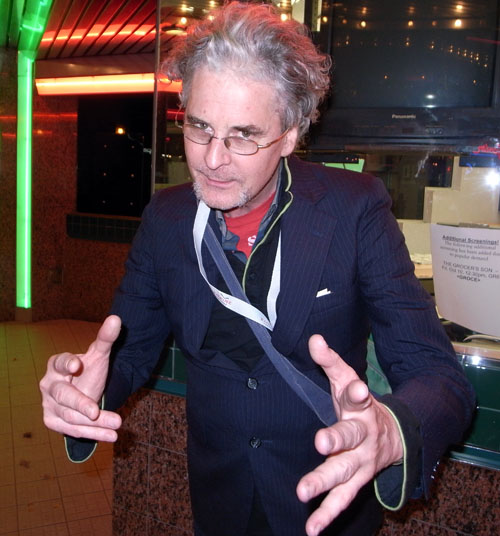
Craig Baldwin, upper half.
DB here:
Tonight we’re packing to leave the Vancouver International Film Festival, and we still have to write up comments on several more films. We’ll scribble as we drive back and try to post our final blog entry after we’ve returned to Madison. In the meantime, here are some snapshots from a superb two weeks and an aggregate of over forty movies between us.

First, the context. Vancouver must be one of the most gorgeous cities in North America, at least when it’s not raining. For the first time in my four visits to the festival, I actually had time to do a little exploring, thanks mostly to a longer stay but also to Kristin’s being along. It’s more fun to do touristic things with somebody else–especially if that somebody can read a map.
At the festival, guests gathered for breakfast in the reception room of the Listel Hotel. Over tasty waffles we could catch up with old friends and make new ones. Here is Lisa From Toronto, a long-time aficionado of Chinese film, with programmer Shelly Kraicer and Michael Walsh, former Wisconsin student and now a professor at Flinders University in Adelaide.
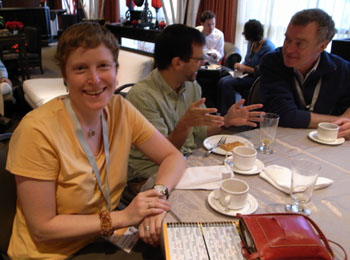
Pan-ek Ratanaruang, director of Last Life in the Universe and other major films, was always fun to have at the table. Here he regales Sean Axmaker, of the remarkable new website Parallax View, and in the background, Tony Rayns, VIFF programmer and coordinator of the Dragons and Tigers award.
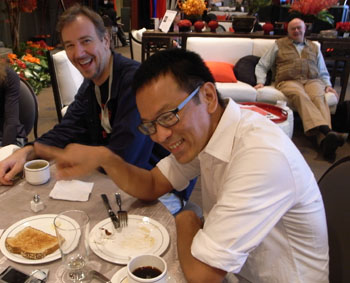
Alissa Simon, Variety reviewer and programmer for the Palm Springs Film Festival, is another former Wisconsite. I saw her about a year ago, but Kristin hadn’t seen her in many years, so we had a chance to catch up with each other’s news.
Gerwin Tamsma, programmer from the Rotterdam International Film Festival, makes a point as Nik Sheehan looks on. Nik is the director of FlicKeR, a remarkable movie about Brion Gyson and his Dream Machine.
When breakfast was over, we went to the movies, sometimes five per day. As often as not, we were sitting near Frank, one of Vancouver’s most passionate and knowledgeable cinephiles.

Frank is an ardent fan of Albert Serra‘s Birdsong (aka Song of the Birds, which I wrote about here), and he was there to hear Serra explain that the film’s final shot has the graphic shape of a goblet or chalice.
Another director I enjoyed talking to was Lance Hammer, whose admirable Ballast is now circulating throughout the U. S. (Go here for my comments in our prior entry.)
Old friends Tony Rayns (a long-running presence on this site) and Geoff Gardner, another Aussie with long-lived love of movies, were often found larking about, as they would say.
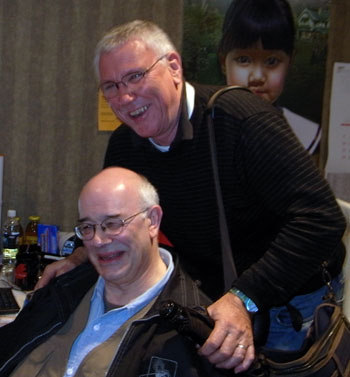
When we weren’t watching movies or talking with other viewers, we ate. A lot. Vancouver harbors many fine fooderies, at all levels of cost and taste. One thing you can get in profusion is crepes, of all sorts.

In Chinatown, at the Jade Dynasty, the mango pudding comes in cute shapes.

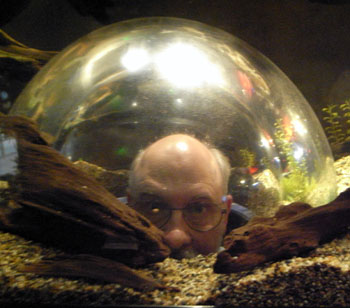
Speaking of fish, an inevitable tourist spot is the Vancouver Aquarium Marine Science Center in Stanley Park, where the jellyfish never take bad pictures but film profs are likely to.

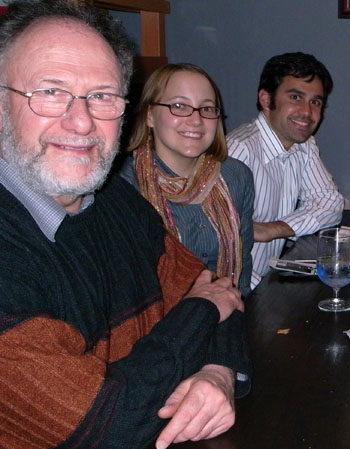
Our early days in the city were spent with nephew Sanjeev and niece-in-law Maggie, who came along from Seattle and proved excellent company. Which is to say, they were willing to laugh at my lamest jokes. Here they are with Michael Campi, cinephile nonpareil and scout for the Melbourne Film Festival.
That’s it for now; back to packing. More pictures, and lots more text, to come some time this weekend, we hope.
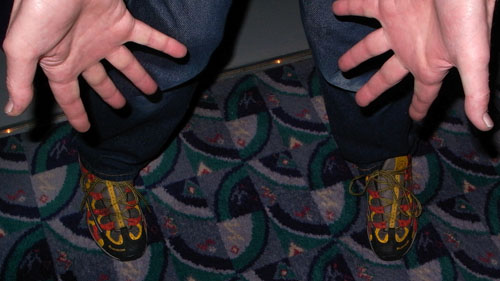
Craig Baldwin, lower half.
Posted in Experimental film, Festivals, Festivals: Vancouver, People we like | open printable version
| No Comments »
|