

David Bordwell's website on cinema   click for CV

Home

Blog

Books

Perplexing Plots: Popular Storytelling and the Poetics of Murder

On the History of Film Style pdf online

Reinventing Hollywood: How 1940s Filmmakers Changed Movie Storytelling

Film Art: An Introduction

Christopher Nolan: A Labyrinth of Linkages pdf online

Pandora’s Digital Box: Films, Files, and the Future of Movies pdf online

Planet Hong Kong, second edition pdf online

The Way Hollywood Tells It pdf online

Poetics of Cinema pdf online

Figures Traced In Light

Ozu and the Poetics of Cinema pdf online

Exporting Entertainment: America in the World Film Market 1907–1934 pdf online

Video

Hou Hsiao-hsien: A new video lecture!

CinemaScope: The Modern Miracle You See Without Glasses

How Motion Pictures Became the Movies

Constructive editing in Pickpocket: A video essay

Essays

Rex Stout: Logomachizing

Lessons with Bazin: Six Paths to a Poetics

A Celestial Cinémathèque? or, Film Archives and Me: A Semi-Personal History

Shklovsky and His “Monument to a Scientific Error”

Murder Culture: Adventures in 1940s Suspense

The Viewer’s Share: Models of Mind in Explaining Film

Common Sense + Film Theory = Common-Sense Film Theory?

Mad Detective: Doubling Down

The Classical Hollywood Cinema Twenty-Five Years Along

Nordisk and the Tableau Aesthetic

William Cameron Menzies: One Forceful, Impressive Idea

Another Shaw Production: Anamorphic Adventures in Hong Kong

Paolo Gioli’s Vertical Cinema

(Re)Discovering Charles Dekeukeleire

Doing Film History

The Hook: Scene Transitions in Classical Cinema

Anatomy of the Action Picture

Hearing Voices

Preface, Croatian edition, On the History of Film Style

Slavoj Žižek: Say Anything

Film and the Historical Return

Studying Cinema

Articles

Book Reports

Observations on film art

Gradation of emphasis, starring Glenn Ford

Thursday | November 13, 2008
DB here:

Charles Barr’s 1963 essay “CinemaScope: Before and After” has become a classic of English-language film criticism. (1) It proffers a lot of intriguing ideas about widescreen film, but one idea that Barr floated has more general relevance. I’ve found it a useful critical tool, and maybe you will too.

Grading on a curve

Barr called the idea gradation of emphasis. Here’s what he says:

The advantage of Scope [the 2.35:1 ratio] over even the wide screen of Hatari! [shot in 1.85:1] is that it enables complex scenes to be covered even more naturally: detail can be integrated, and therefore perceived, in a still more realistic way. If I had to sum up its implications I would say that it gives a greater range for gradation of emphasis. . . The 1:1.33 screen is too much of an abstraction, compared with the way we normally see things, to admit easily the detail which can only be really effective if it is perceived qua casual detail.

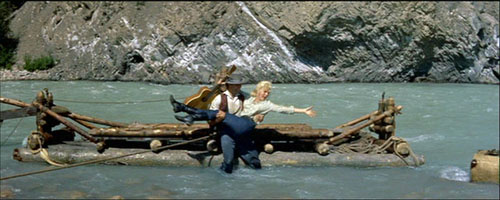
The locus classicus exemplifying this idea comes in River of No Return (1954). When Kay is lifted off the raft, she loses her grip on her wickerwork bag and it’s carried off by the current. (See the frame surmounting this entry.) Kay and her boyfriend Harry are rescued by the farmer Matt. As all three talk in the foreground, the camera catches the bundle drifting off to the right.
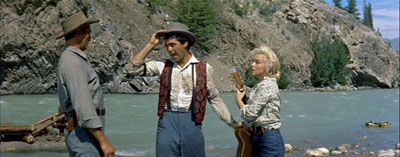
Even when the men turn to walk to the cabin, Preminger gives us a chance to see the bundle still drifting downstream, centered in the frame.
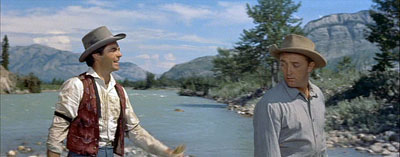
The point of this shot, Barr and V. F. Perkins argued, is thematic. As Kay moves from the mining camp to the wilderness, she will lose more and more of her dance-hall trappings and be ready to accept a new life with Matt and Mark. The last shot of the film shows her final traces of her old life cast away.

Cutting in to Kay’s floating bag would have been heavy-handed; if you stress a secondary element too much, it becomes primary. Barr reminds us that any film shot can include the most important information, as well as information of lesser significance. A film can achieve subtle effects by incorporating details in ways that make them subordinate as details and yet noticeable to the viewer. Or at least the alert viewer.

In Poetics of Cinema, I wrote an essay on staging options in early CinemaScope, and Barr’s idea helped me illuminate some of the strategies I discuss. (For earlier comments on Barr on Scope and River of No Return, see my article elsewhere on this site.) Today I want to consider how the notion of gradation of emphasis has a more general usefulness.

Barr contrasts the open, fluid possibilities of CinemaScope with two other stylistic approaches, both found in the squarer 1.33 format. The first approach is the editing-driven one he finds in silent film. This tends to make each shot into a single “word,” and meaning arises only when shots are assembled. Barr associates this approach with Griffith and Eisenstein. The second approach, only alluded to, is that of depth staging and deep-focus shooting, typically associated with sound cinema of the late 1930s and into the 1950s.

Both of these approaches, montage and single-take depth, lack the subtle simplicity of Scope’s gradation of emphasis.

There are innumerable applications of this [technique] (the whole question of significant imagery is affected by it): one quite common one is the scene where two people talk, and a third watches, or just appears in the background unobtrusively—he might be a person who is relevant to the others in some way, or who is affected by what they say, and it is useful for us to be “reminded” of his presence. The simple cutaway shot coarsens the effect by being too obvious a directorial aside (Look who’s watching) and on the smaller [1.33] screen it’s difficult to play off foreground and background within the frame: the detail tends to look too obviously planted. The frame is so closed-in that any detail which is placed there must be deliberate—at some level we both feel this and know it intellectually.

To see Barr’s point, consider a shot like this one from Framed (1947).
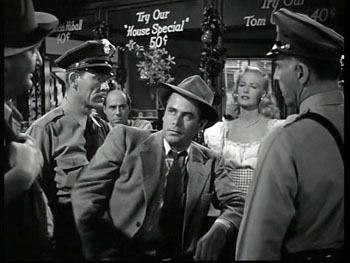
The shot, rather typical of 1940s depth staging, displays an almost fussy precision about fitting foreground and background together. That bartender, for instance, stands squeezed into just the right spot. (2) Barr claims that we sense a certain contrivance when primary and secondary centers of interest are jammed into the 1.33 frame like this.

We don’t sense the same contrivance in the widescreen format, he suggests. Barr assumes, I think, that the sheer breadth of any Scope frame will include areas of little consequence, whereas that’s comparatively rare in a 1.33 composition. This is an intriguing hunch, but uninformative patches of the frame may not be intrinsic to the Scope technology. Perhaps the fairly neutral and inexpressive uses of Scope that dominate the early 1950s, the sense of empty and insignificant acreage stretching out on all sides, make us expect that little of importance will be found there. Accordingly, directors can create a sense of discovery when we spot a significant detail in this stretch of real estate.

Anyhow, Barr indicates that if static deep-space staging made the frame too constrained, 1930s and 1940s directors who combined depth with camera movement created more spacious and fluid framings. He suggests that Mizoguchi, Renoir, and others anticipated the possibilities of Scope.

Greater flexibility was achieved long before Scope by certain directors using depth of focus and the moving camera (one of whose main advantages, as Dai Vaughan pointed out in Definition 1, is that it allows points to be made literally “in passing”). Scope as always does not create a new method, it encourages, and refines, an old one (pp. 18-19).

Barr believes that Scope positively encouraged gradation of emphasis, and that widescreen directors of the 1950s and 1960s have made the most fruitful use of the strategy. But he allows directors of all periods utilized gradation of emphasis, even in the standard 1.33 format. This is, I believe, a powerful idea.

Before Scope: Making the grade

Barr’s discussion of silent cinema, relying on notions of editing associated with Griffith and Soviet directors like Eisenstein, is done with a broad brush, but it’s typical of the period in which he was writing. We didn’t know much about silent filmmaking until archivists started to exhume important work in the 1970s. It’s no exaggeration to say that we haven’t really begun to understand the first twenty-five years of cinema until fairly recently.

In a way, the staging-driven tradition of the 1910s, which I’ve often mentioned on this site (here and here and here), exemplifies some things that Barr would approve of. Directors of that period made extraordinary use of the frame and compositional patterning. They staged action laterally, in depth, or both. They let shots ripen slowly or burst with new information. This approach to using the full frame (with only occasionally cut-in elements) has come to be called the tableau style, emphasizing its similarity to composition of a painting—although we shouldn’t forget that these films are moving paintings, and the compositions are constantly changing. The result is that emphasis tends to be modulated and distributed among several points of interest.

Central to this strategy, I think, was camera distance. American directors tended to set the camera moderately close, cutting figures off at the knees or hips, and by taking up more frame space, the foreground actors tended to limit the area available for depth arrangement or for significant detail.
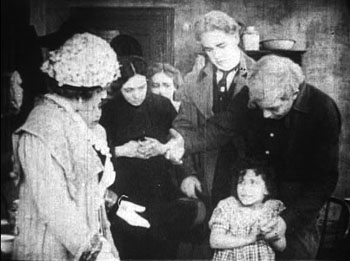
This shot from Thanhouser’s The Cry of the Children (1912) is a rough 1910s equivalent of the crammed shot from Framed above. (See also the tightly composed shots from DeMille’s Kindling (1915) here.)

The European directors, by contrast, tended to let the scene play out in more distant shots, creating spacious framings of a sort that would be reinstituted in early CinemaScope. Consider this shot from Holger-Madsen’s Towards the Light (Mod Lyset, 1919) and another from Island in the Sun (1957).
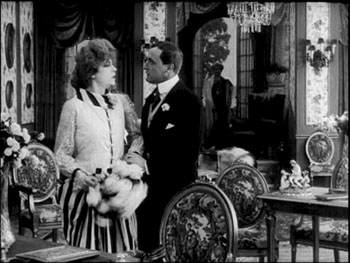
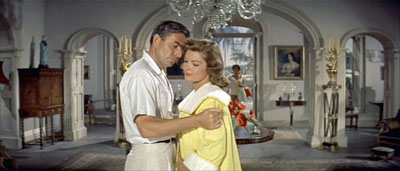
Both, it seems to me, have the type of open composition and the foreground/ background interplay that Barr praises in his article.

We can go back further. The Lumière brothers’ cameramen made fiction films as well as documentaries, and we occasionally find moments that suggest early efforts at gradation of emphasis. In Le Faux cul-de-jatte (1897), an apparent amputee is begging in the foreground while in the distance a man is walking down the street.
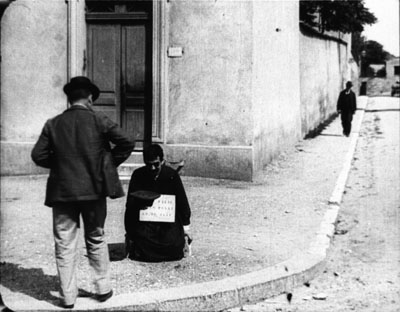
A cop crosses the street from off right and follows the pedestrian.
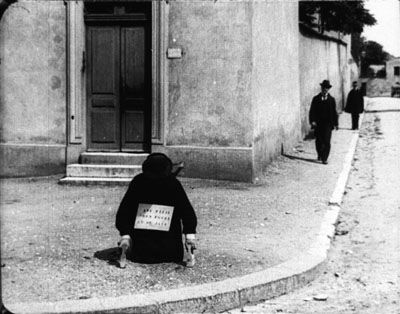
As the foreground fills up, the man we’ve seen in the distance gives the beggar some money.
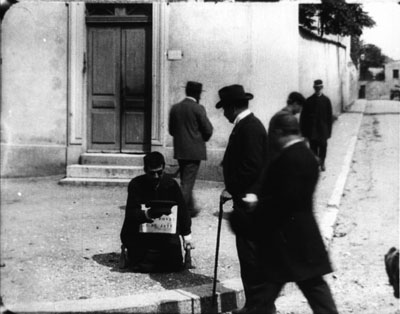
As he goes out left, the cop is still approaching, and a vagrant dog appears.
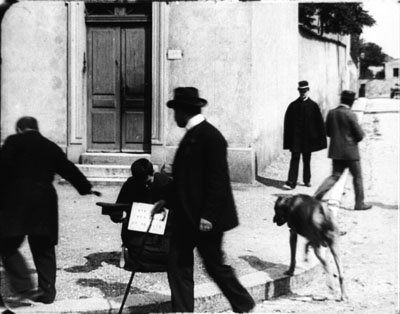
The cop comes to the beggar, partially blocking the dog, who takes care of other business. (Not everything in this movie is staged.)
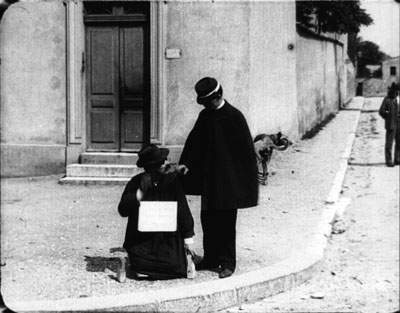
The cop checks the beggar’s papers and finds them to be suspect. The fake amputee jumps up and races off in the distance, with the cop pursuing.
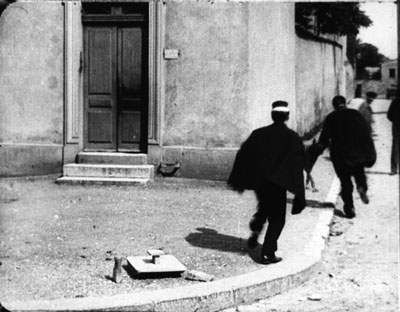
As with many staged Lumière shorts, several figures converge in the foreground in order to create a culminating piece of action. Here the distant man and the cop, both secondary centers of interest, serve as a kind of timer, assuring us that something will happen when they meet at the beggar.

These are just some quick examples. We should continue to study the ways in which, with minimal use of editing, early filmmakers found ingenious ways to create gradation of emphasis. (2)

Some uses of grading

Barr, like most critics writing for the British journal Movie, was sensitive to the ways in which technique has implications for character psychology and broader thematic meanings. Kay’s bundle is one point along a series of changes in her character and her situation. But gradation of emphasis can serve more straightforward narrative purposes as well.

Consider our old friends, surprise and suspense. In the original 3:10 to Yuma (1957) Dan Evans is confronting the ruthless outlaw Ben Wade.
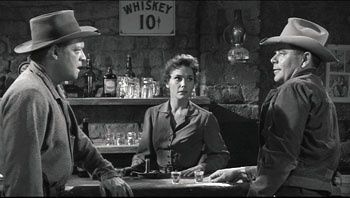
We get a string of reverse shots.
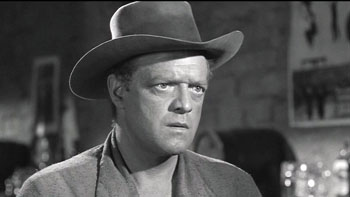
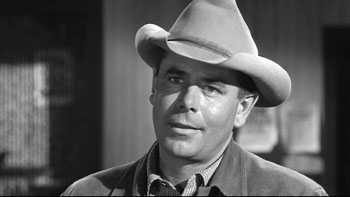
Then in one shot of Wade, without warning, a shadowy figure emerges out of focus in the left background.
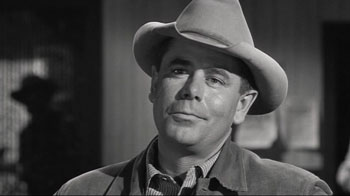
Now we realize that Evans has been diverting Wade from the fact that the sheriff’s posse is surrounding him. Now we wait for Wade to discover it; how will he react?

While we’re on Glenn Ford, another nice example occurs in Framed. Mike Lambert has been romancing a woman named Paula, but we know that she and her lover Steve are plotting to fake Steve’s death and substitute Mike’s body.
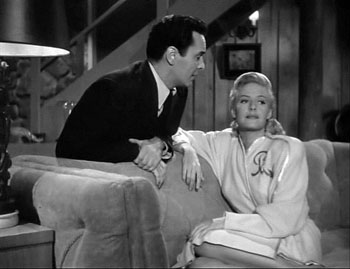
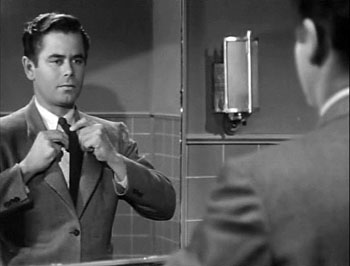
She brings Mike to Steve’s elegant country house, having presented Steve as someone she knows only slightly. When Mike goes into the bathroom to wash up, we notice something important behind him.
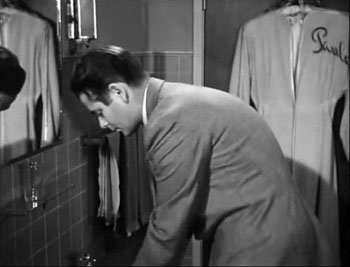
With Mike at the sink, we have plenty of time to recognize Paula’s robe. Director Richard Wallace prolongs the suspense by giving us a new shot of Mike in the mirror, with the robe no longer visible.
But when Mike turns to leave, a pan following him brings him face to face with what we saw, accentuated by a track forward.
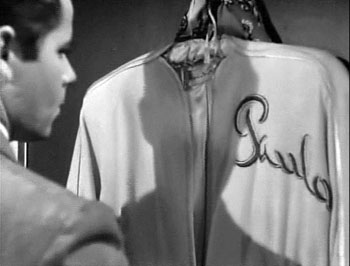
We get Mike’s reaction shot, followed by a cut to Steve and Paula downstairs, suspecting nothing. “So far, so good,” says Steve, looking upward at the bathroom.
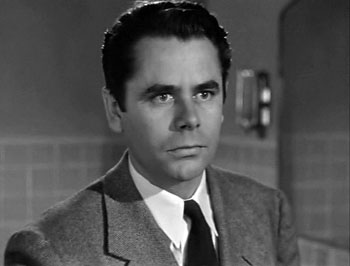
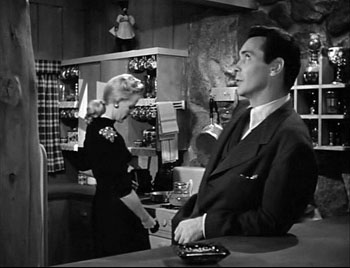
The rest of the scene will play out with Mike aware that they’re deceiving him. As often happens with suspense, we know more than any one character: We know the couple’s scheme and Mike doesn’t, but they don’t (yet) know that Mike is now on his guard.

This isn’t as subtle a case as River of No Return, but I suspect that it’s more typical of the way Hollywood filmmakers use gradation of emphasis. Paula’s bathrobe is a good example of what I called in The Classical Hollywood Cinema the strategy of priming: planting a subsidiary element in the frame that will take on a major role, even if initially its presence isn’t registered strongly. My example in CHC was a coat rack in the Dean Martin/ Jerry Lewis comedy The Caddy (1953). In effect, the distant pedestrian in the Lumière film is an early example of priming.

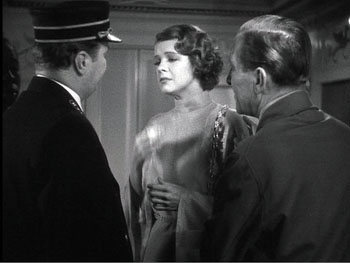
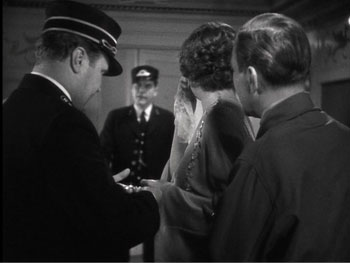
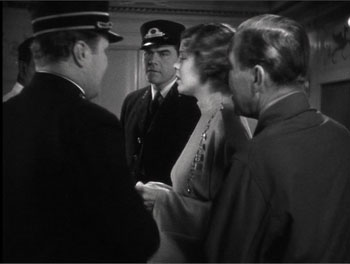
Howard Hawks adopts the Lumière technique in order to sustain a flow of dialogue in Twentieth Century (1934). Here the foreground conversation is accompanied by a procession of people emerging in the distance and stepping up to take part.
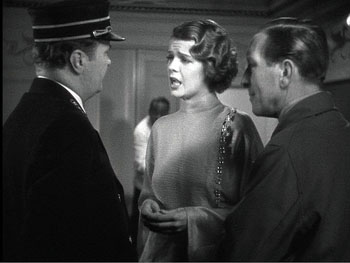
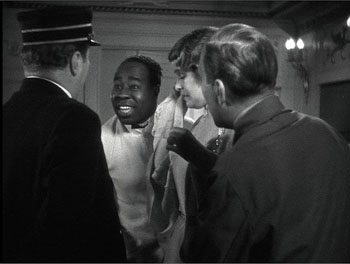
The shot concludes, as does the shot of Faux cul-de-jattes, with a retreat from the camera.
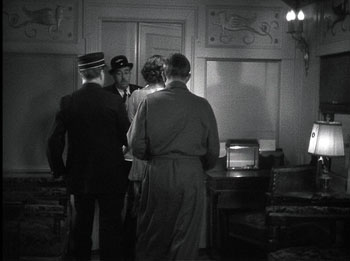
The priming of secondary elements here, the summoning of the train attendant and the conductor, obeys Alexander Mackendrick’s dictum that the director ought to construct each shot so as to prepare for what will come next.

As Barr indicates, the idea of gradation shades insensibly off into general matters of cinematic expression. In The Devil Thumbs a Ride (1947), the bank robber has hitched a ride with an unassuming civilian, and they stop for gas. When the attendant shows a picture of his little girl, the robber gratuitously insults her. (“With those ears she’ll probably fly before she can walk.”)
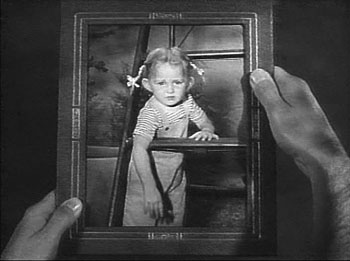
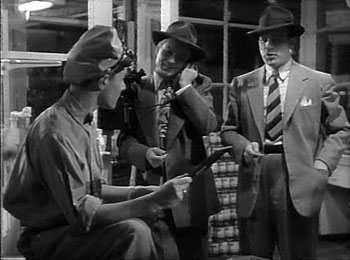
Later, the station attendant hears a radio broadcast describing the fugitive. First he has his head cocked as he listens attentively, but then his gaze drifts to the picture of his little girl.
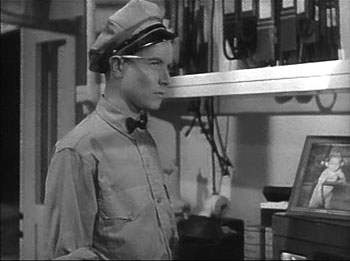
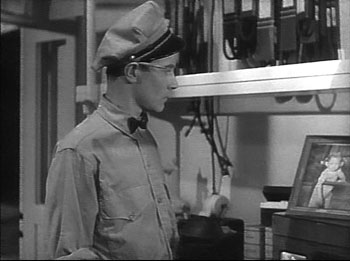
The attendant is the center of dramatic interest, but when he looks at the picture, so do we (primed by the view of it earlier). Instantly we understand that the attendant’s resolve to call the police springs partly from an urge to get even with the man who insulted his daughter. A minor instance, surely, but it illustrates Barr’s point that the notion of gradation of emphasis leads us to consider “the whole question of significant imagery.”

The more the merrier
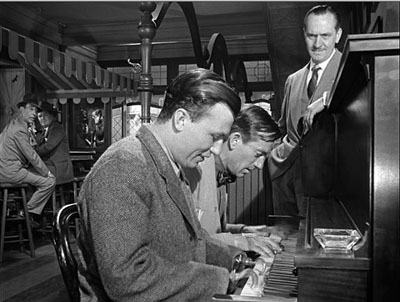
Barr seems to favor a plain style; he prefers Preminger’s quiet framings to the rococo imagery of Aldrich’s Vera Cruz (1954). Presumably the famous shot above from Wyler’s Best Years of Our Lives (1946) would be too obviously composed for Barr’s taste.

But there is merit in considering how a secondary center of interest can vie for supremacy. André Bazin declared Wyler’s shot a bold stroke exactly because its self-conscious precision created a tension between what was primary and what was subordinate. (3) The action in the foreground is of dramatic interest because Homer has learned to play the piano, and this represents a phase of his coming to terms with his wartime disability. Yet the most consequential action is taking place in the distant phone booth, where Fred breaks up with Al’s daughter Peggy. The gradation of emphasis is inverted, and we wait in suspense to find out what happens. Bazin taught us to recognize that what appears to be primary may actually be creatively distracting us from the scene’s principal action. (4)

A director can also turn a primary center of interest into something secondary, but powerful. In one sequence of Eisenstein’s Ivan the Terrible I (1944), the apparently dying tsar is being prayed over by churchmen. Ever suspicious, he peers out from under the book, using only one eye.
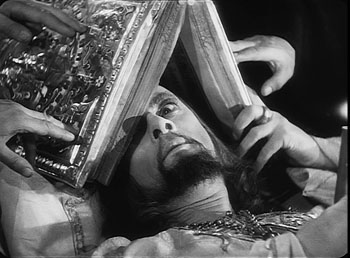
As the scene develops, Prince Kurbsky meets Ivan’s wife and tries to seduce her. In the background an icon’s eye glares out, as if Ivan is watching them.
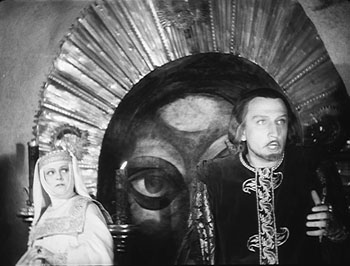
The single eye, which is a motif we find in other Eisenstein films, becomes a significant one throughout both parts of Ivan. More generally, this device manifests Eisenstein’s conception of polyphonic montage, which explored how the filmmaker can control all the various aspects of his images and make them weave throughout the film—promoting one at one moment, demoting it at another. (5)

Barr’s essay assumes that Eisenstein’s montage stripped each image down to a single meaning. In fact, though, Eisenstein wanted to multiply the sensuous and intellectual implications of each shot by weaving objects, gestures, body parts, musical motifs, and the like into an ongoing stylistic fabric. Each shot’s gradation of emphasis can suggest thematic parallels, deepen the drama, or heighten emotional expression, just as a complex score enhances an operatic scene.

Tati as well likes to create an interplay between primary and subsidiary centers of interest. Or rather, he sometimes abolishes our sense of what is primary and what isn’t. The crowded compositions of Play Time (1967) often bury their gags in a welter of inessential details. During the lengthy scene in the Royal Garden restaurant, a minor running gag involves the dyspeptic manager. He has just mixed some headache medicine with mineral water, but the action is easily lost within the tumultuous image. Even the soundtrack cues us only slightly, with a bit of fizz among the music and crowd noise.
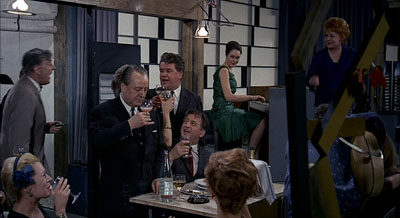
As the manager lowers the glass, Hulot thinks it’s pink champagne being offered to him.
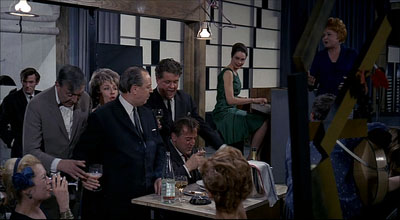
Rolling the stuff in his mouth, Hulot realizes his mistake as he earns a stare from the manager.
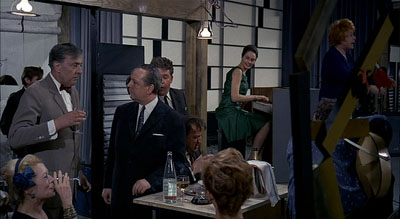
There is so much competing sound and activity in the shot that some viewers simply don’t notice this bit at all. In Play Time, gradation of emphasis is often flattened out, leaving us to rummage around the composition for the gag.

Some final notes

Barr was not particularly interested in the mechanics of how we come to notice something in the shot, be it primary or secondary in value. In On the History of Film Style, I suggested that many aspects of technique work to call attention to any element in the field. The filmmaker can put a something in motion, turn it to face us, light it more brightly, make it a vivid color, center it in the frame, have it advance to the foreground, have other characters look at it, and so on. These tactics can work together in a complex choreography. In Figures Traced in Light, I argued that they depend on the fact that we scan the frame actively; the techniques guide our visual exploration. (6)

You can see this guidance at work in most of the examples I’ve mentioned. In River of No Return, we are coaxed into noticing Kay’s bundle because we’re cued by movement (the bundle falls and drifts off), performance (she shouts, “My Things!” and stretches out her arm), music (we hear a chord as the bundle splashes), and framing (Preminger’s camera pans slightly as the trunk drifts away). The critic can refine our sense of the effects that a film arouses, but it’s one task of a poetics of cinema, as I conceive it, to examine the principles and processes that filmmakers activate in achieving those effects.

Finally, we might ask: To what extent do we find gradation of emphasis in current filmmaking? Today’s American cinema relies heavily on editing, using a style I’ve called intensified continuity. Each shot tends to mean just one thing, and once we get it we’re rushed on to the next. The unforced openness of the wide frame that Barr celebrated has been largely banned, in favor of tight singles—even in the 2.40 anamorphic format. It seems that most filmmakers are no longer concerned with gradation of emphasis within their shots.

To find this strategy surviving at its richest, I think we have to look overseas. If you want names: Angelopoulos, Tarr, Kore-eda, Jia, Hou. (7)

(1) It was published in Film Quarterly, vol. 16, no. 4 (Summer, 1963), 4-24. Unfortunately, it’s not available free online, nor is a complete version available in anthologies, so far as I know. If you have access to online journal databases, you can find it. Otherwise, off to the library w’ye!

(2) In the Poetics of Cinema piece (pp. 303-307), I argue that some early uses of Scope tried to approximate such tightly organized composition, despite technological barriers to focusing several planes of action.

(3) See André Bazin, “William Wyler, or the Jansenist of Directing,” in Bazin at Work: Major Essays and Reviews from the Forties and Fifties, ed. Bert Cardullo, trans. Cardullo and Alain Piette (New York: Routledge, 1997), 14-16.

(4) Actually the phone booth is primed for our notice by earlier shots in Butch’s tavern. See On the History of Film Style, 225-228.

(5) For more on Eisenstein’s idea of polyphonic montage, see my Cinema of Eisenstein (New York: Routledge, 2005) and Kristin’s Eisenstein’s Ivan the Terrible: A Neoformalist Analysis (Princeton: Princeton University Press, 1981).

(6) For some empirical evidence of this guided scanning, see the work of Tim Smith at his website and in this entry on this site.

(7) I discuss some of these alternatives in On the History of Film Style and the last chapter of Figures Traced in Light.
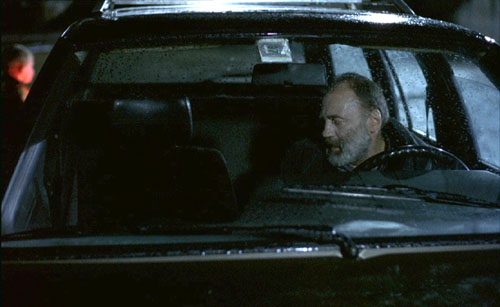
Eternity and a Day.

PS 15 Nov. Two more items. First, if the ideas floated here intrigue you, you might want to take a look at an earlier entry on this site, called “Sleeves.”

Second, I had planned to include one more example, but forgot it. In Lumet’s Before the Devil Knows You’re Dead, Andy Hanson’s life is unraveling. We follow him back to his apartment, and as he enters on the extreme left, his wife Gina is visible sitting on the extreme right, her back to us.
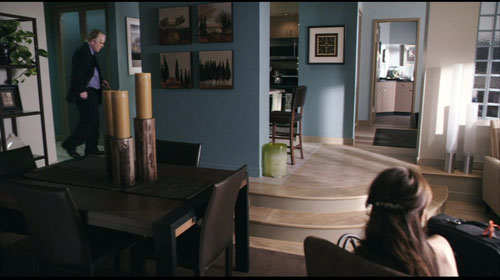
Gina forms a secondary center of attention, but the key to the upcoming action is revealed in a third point of interest: the black suitcase pressed against the right frame edge. The shot tells us, more obliquely than one showing her leaving the bedroom with the case, that she is planning to leave him. Lumet’s image, reminiscent of the framing of the trunk in River of No Return, shows that gradation of emphasis isn’t completely dead in American cinema. The orange scrap of yarn, knotted to the handle for baggage identification, is a nice touch of realism as well as a welcome color accent that further draws the suitcase to our notice.

Filling the New Line gap

Thursday | November 6, 2008

The Loews Santa Monica Beach Hotel, one of the AFM venues

Kristin here-

The 2008 American Film Market started yesterday. Like the film festivals at Cannes, Toronto, and, increasingly, Berlin, the AFM is one of the major places where independent and foreign-language films get sold. Distributors from all over the world come to sell their products and to buy the films that they will release at home. It seems a good occasion to look at what effect the folding-in of New Line Cinema into a unit within Warner Bros. early this year has had on the international independent film market.

The good old days

In my book The Frodo Franchise, Chapter 9 dealt with the impact of The Lord of the Rings on the film industry. There I discuss what effects the trilogy had on New Line and its parent company Time Warner. I also analyze the rise of the fantasy genre, the technological advances, and the boost given to the depressed indie market internationally. The 26 international independent distributors that financed a substantial portion of the film’s production through presales—with commitments to all three parts, sight unseen, at very steep prices—grew dramatically as a result of its success.

In 2001, an international slump in independent and foreign-language cinema started. The causes were complex, and I detail them in the book; they included a sag in advertising, the dot-com bust, the September 11 attacks, and the American dollar’s high exchange rate. With perfect timing, The Lord of the Rings: The Fellowship of the Ring came out in December of 2001. Its theatrical and DVD earnings in 2002 poured money into the market through the 26 companies’ ability to buy new product when other distributors were still strapped for cash. By early 2004, the market had substantially recovered. Rings wasn’t the only factor aiding that recovery, but it was a major one.

That section of Chapter 9 is one of the parts of the book I’m proudest of. Most people interested in film knew something about most of the topics I covered. They were probably at least vaguely aware of the video games and other tie-in products, the highest successful internet campaign, the growth in filmmaking and tourism in New Zealand, and so on. But the fact that this massive blockbuster was an independently financed film, sold on the independent market, and highly beneficial to that market was something completely unknown except to specialists within the industry. I cottoned onto it only because there were a few references to these distributors’ unusual buying power during the coverage of the 2003 Cannes Film Festival and AFM in Variety and The Hollywood Reporter.

Beyond those brief discussions, there was really no way I could research the topic without talking to people involved. That meant interviewing some of the executives of those 26 companies and someone very expert in the international indie market. A very helpful source was Mads Nedergaard, then of SF-Film, Copenhagen, who provided marvelous information for my major case study in that chapter. For the expert, I decided upon Jonathan Wolf, then and now the Managing Director of the AFM. Luckily he agreed to be interviewed. During our conversation Jonathan remarked that he had been very struck that I understood that Rings was an independent film and that it had had a positive impact on international markets. I gather that’s why he agreed to the interview, during which he furnished me with valuable insights. Those two interviews really made that part of the chapter possible.

Despite the huge success of the trilogy, New Line continued to function as an independent, financing its films through presales of distribution rights and of licensing fees for ancillary products. It continued to sell them at events like the AFM, as well as having regular output deals with some of the same overseas companies that it had been dealing with for nearly a decade. New Line was one of the main U.S. firms supplying such distributors. Its growing success ultimately became part of what got the studio into trouble.

What had worked so well for Rings continued to work until the blockbuster fantasy trilogy that had been touted as the successor to Rings. The Golden Compass was financed in the same way, with special rights pre-sold to foreign distributors, many of them the same ones that had handled Rings. The problem was that Compass did tepid business in the U.S. but was a distinct success abroad. That money stayed with the foreign distributors.

Absorbed into Warner Bros.

The Compass problem coincided with the promotion of Jeff Bewkes as CEO of Time Warner at a time when the conglomerate’s stock price was low. The real problem was the encumbrance of AOL, but that was a problem that would take time to solve. New Line’s lack of success with its big Christmas release made it a target. Bewkes could slash the company as a signal to stockholders that he would streamline Time Warner. On February 25, he announced that New Line would be folded into Time Warner, to become a production unit specializing in the sort of genre fare that had sustained New Line for so long, such as the Nightmare on Elm Street series. It would also continue to produce the occasional major film, such as The Hobbit.

The point of absorbing New Line into Warner Bros. was largely to downsize the former by eliminating its distribution and other departments that could be handled by Warners. With Warners distributing New Line films abroad, the income would return to the studio rather than remaining with foreign distributors. Receiving financing from Warners, New Line would no longer need to finance films through presales.

For Time Warner, this made sense, but it was a blow to the overseas distributors with regular output deals with New Line. New Line and Miramax had provided steady product to these companies, which otherwise would have to compete in the open market on a film-by-film basis. With the departure of the Weinstein brothers from Miramax, that firm had dried up as a source, leaving the burden on New Line. Now New Line was disappearing as well.

What now?

In the 7 March 2008 issue of Screen International (the online version is subscription only), Mike Goodridge discussed where these distributors might be able to turn after the expiration of their New Line contracts. He pointed out, “The distribution partners had good years and bad with New Line. None were thrilled with The Long Kiss Goodnight or The Island Of Dr. Moreau but for every flop, there was a Seven or Austin Powers, a Mask or Rush Hour.” He also confirms my claims about the Rings trilogy’s impact on its international distributors: “The success of the three films for the international partners cannot be overestimated. Nor can the fact that they, more than anybody involved, took a huge risk on the trilogy. The risk paid off. The Greens at Entertainment [the U.K. distributor], the Hadidas at Metropolitan [the French distributor] and others genuinely shared in the profits of one of the box-office phenomenons of the last 20 years. It was the international buyers’ dream. Instead of losing money on studio cast-offs, they had a hefty piece of a trilogy which grossed nearly $2bn outside North America.” New Line’s disappearance as a source of hit films “brings a dramatic sea change to the complexion of the global business,” according to Goodridge. These independent firms “will be competing for an increasingly small number of tentpole pictures available to them.”

Where have these distributors turned for films? In some cases their contracts with New Line, which predate the studio’s absorption into Warner Bros., are good through 2009. That means, however, that those distributors are already looking ahead for releases after the contracts end. At Cannes this year, New Line had a much-reduced presence. Camela Galano, one of the executives who had been in the studio’s international sales wing for years, was promoted to being its president in May. She brought only Journey to the Center of the Earth. Galano told Variety, “We just won’t be selling movies … but we’ll be doing what we normally do with our outputs, which is go through the lineup, releases and materials.”

A number of firms at Cannes stepped up to fill in the void left by New Line’s withdrawal from distribution. One up-and-coming firm, QED, was selling Oliver Stone’s W, the sci-fi film District 9 (produced by Peter Jackson and due out in the U.S. next August 14), and the Milla Jovovich thriller A Perfect Getaway. Gary Michael Walters, co-president of Bold Films, commented that he saw an opportunity presented by Warners’ takeover of New Line’s foreign distribution. “We see a sweet spot in that niche of $10 million-$30 million smart but commercial pictures.” Similar rising firms include IM Global, formed by the former head of Miramax International, Stuart Ford. (See Variety‘s summary here.)

John Hazleton analyzed the impact of New Line’s withdrawal from the international market for Screen International just before Cannes (May 9, 2008 issue). Hazleton harks back to the impact of Rings and other New Line franchises:

Many sales executives, in fact, go further and suggest that by boosting the fortunes of the distributor partners with which it had ongoing output or package deals—companies including the UK’s Entertainment, France’s Metropolitan, Australia’s Villege Roadshow and Spain’s Tri Pictures—New Line effectively elevated the independent international industry as a whole. Other sellers benefited, for example, when the New Line distributors reinvested profits from The Lord of the Rings and Rush Hour movies—or from last Christmas’ The Golden Compass—in the acquisition of non-New Line films.

No wonder, then, [that] the decision by parent Warner Bros to turn New Line into a stripped-down genre label whose films will (once current deals expire) be distributed worldwide by the studio is having such an impact in the independent arena. Filling the New Line void has suddenly become a pressing need, or an enticing opportunity, for all sorts of independent players.

One such player is Hyde Park International, whose president Lisa Wilson told Hazleton, “We’re certainly seeing an uptick in interest from distributors who previously didn’t need as much product because they were secure in having the New Line output. They’ve been making more of an effort than usual to meet us before Cannes.” Another is The Film Department, selling two films under production, Law Abiding Citizen, a thriller starring Gerard Butler, and The Rebound, a Catherine Zeta-Jones vehicle.

Hazleton identifies two major independent films suppliers that are stepping into the supply gap left by New Line’s departure:

Leading the field of remaining big picture suppliers are Summit Entertainment and the combination of Lionsgate and Mandate formed when the former acquired the latter last September. Crucially, like New Line, each group now has its own North American theatrical distribution operation, giving international buyers assurance that films will get a domestic theatrical launch and allowing the co-ordination of domestic and international release dates.

Summit is new to the domestic distribution business. But it is a company with vast international experience that plans to handle 10-12 films in the $15m-$45m budget range a year. Its Cannes slate includes Terrence Malick’s drama Tree of Life, starring Brad Pitt, and it already has output deals for its own productions in France, Germany, UK and Scandinavia.

In Lionsgate, Mandate has a well-proven domestic distribution outlet that last year scored three $50m-plus box-office hits and this year has a bigger market share than any independent or studio specialty division.

As the combination’s international arm, Mandate—which will be in Cannes with titles including Whip It! featuring rising star Ellen Page, and family animation Alpha And Omega—handles around half of Lionsgate’s domestic slate plus titles from third-party producers.

New Line’s withdrawal, says Helen Lee Kim, president of Mandate International, “just puts us in a better situation, because you can count on one hand the independent companies able to bring studio-level product to the marketplace.”

Hazleton also points out that “Studio-owned sales operations Paramount Vantage and Focus Films International [a Universal subsidiary] will be another alternative source for buyers.” In general, though, the Hollywood studios’ recent retreat from art-house divisions means that they will have less to contribute to foreign distributors.

Summit and Mandate are both participating in the AFM as well. Another major firm is Relativity Media, a rapidly expanding production-distribution independent responsible for such recent films as 3:10 to Yuma, Atonement, Baby Mama, and Pineapple Express. Relativity had expanded into international sales this year at Cannes. In October it offered $150 million for Universal’s Rogue Pictures and will gain the 40-50 projects that genre division has in the works. As the AFM began, it had just signed long-term output contracts with nine foreign distributors. Finally, Relativity has, according to Variety, “partnered with sales company Mandate Intl. to oversee sales in non-output territories as well as provide worldwide servicing of the slate.”

Other sales firms at Cannes included Odd Lot and Essential, and new companies debuting at the AFM this year were FilmNation, Exclusive Film Distribution, Icon Entertainment, and WestEnd Films. Some of these companies will grow, others won’t. But gradually they will absorb the market position formerly held by New Line.

So does all this mean that the impact of New Line’s glory days is over? Not entirely. I believe that although the distribution of The Lord of the Rings has receded five years into the past and New Line has now disappeared as an independent entity, the trilogy’s impact still lingers in the international industry. Steve Bickel, president of The Film Department, commented to Screen International shortly before Cannes, “The loss of any independent or independent-spirited company is a loss to the industry. New Line provided a great service to all of us because they helped make strong companies that we’re now able to sell to.”

A new hope

Tuesday | November 4, 2008

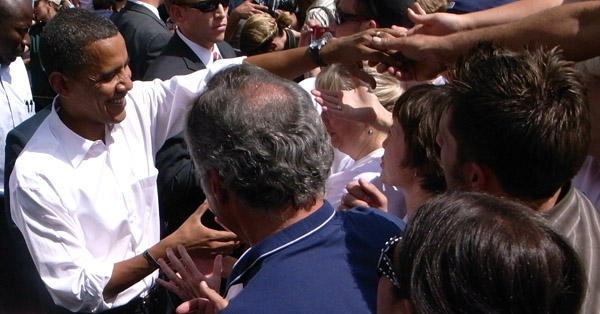
Photo by David Bordwell.


It was a dark and stormy campaign

Thursday | October 30, 2008

How do you get people to believe that if you can’t get the press to make an honest assessment of it? You tell a story. “When it came down to a choice between my very life and my country, I chose my country.” That’s why the story’s important. Just as Obama’s story is important to him. I don’t gainsay it. You know, tell your story! —John McCain staff member and co-author Mark Salter

There was a mismatch between the way he was behaving and the narrative the press had bought into. It made reporters wonder, “Have we been had?”–Professor Marion Just, Wellesley, on John McCain

This political bullshit about narratives.–Peggy Noonan, Republican columnist


I’m David Bordwell and I approved this message.

A long time ago a student complained to me that we film academics were foisting upon them words that no professional filmmakers used. The student’s example was “genre.” Today of course filmmakers use the term all the time. Sometimes you hear “classical filmmaking,” and Variety tells us that Henry Jenkins’ label “transmedia” is starting to break through:

Famed s/f writer Larry Niven is working with “transmedia” (today’s new buzzword) production company Alchemic Productions to create a new game property called “Free Fall.”

More broadly, the terminology of Big Theory in the humanities has trickled into journalism and politics. For some time now “deconstruction” has been peppering mass-market discourse. Granted, it’s not employed in the way Derrida and his acolytes would like. It seems to mean a blend of “construction” and “destruction,” which can entail “analysis” or even just “pulling something apart.”

Deconstruct Black Ink: Your children can use chromatography to deconstruct black ink and find out what color the ink really is.

Scientists Deconstruct Clownfish Chatter

U. of Kansas Looks to Deconstruct Its School of Fine Arts

This election season has shown me that even the idea of the Other, considerably divorced from its use by Jacques “The Lack” Lacan, can show up. Nicholas Kristof claims that John McCain’s efforts to suggest that Barack Obama isn’t “sufficiently Christian” are an effort to “otherize” him.

But I think the term that has gotten the most play is “narrative.”


Discovering narrative

During my days as an undergraduate in literary studies and as a grad student in film studies, between 1965 and 1973, you scarcely ever heard the word. It doesn’t appear in the index of Wellek and Warren’s Theory of Literature (3rd ed., 1956) or Wimsatt and Brooks’ Literary Criticism: A Short History (1957) or Northrop Frye’s Anatomy of Criticism (1957). Story, tale, plot, dramatic structure: these words were common, but not “narrative”.

In American academia, the term began to gain currency with Robert Scholes and Robert Kellogg’s The Nature of Narrative (1966). The authors identify narrative with a broad literary tradition, embodied not only in the novel and short story but also in oral storytelling. And the definition is clearly language-based, in pointed contrast with drama.

By narrative we mean all those literary works which are distinguished by two characteristics: the presence of a story and a story-teller. A drama is a story without a story-teller; in it characters act our directly what Aristotle called an “imitation” of such action as we find in life. (4)

The Nature of Narrative was published the same year that Roland Barthes, in a special issue of the French journal Communications, published his essay “Introduction to the Structural Analysis of Narratives.” (1) His conception of narratives (récits) is far more generous than that of Scholes and Kellogg.

Narrative is first and foremost a prodigious variety of genres, themselves distributed amongst different substances—as though any material were fit to receive man’s stories. Able to be carried by articulated language, spoken or written, fixed or moving images, gestures, and the ordered mixture of all these substances, narrative is present in myth, legend, fable, tale, novella, epic, history, tragedy, drama, comedy, mime, painting (think of Carpaccio’s Saint Ursula), stained glass windows, cinema, comics, news item, conversation. (79)

Barthes’ essay, along with other Structuralist studies, initiated the academic field of “narratology,” the systematic study of storytelling as it is manifested in many media. From the 1970s to the present, this became a vast, varied, and exciting area of inquiry.

The questions are fascinating.

*What is a story? How does it differ from other things, such as a description or an abstract image? Are jokes narratives? Are dreams? Are riddles? Is the concept so broad that anything can be treated as a story?

*Why do stories engage us? What do we need to know, or do, to understand a story? What powers enable us to create stories? Are story-making and story comprehension distinctively human activities?

*Do stories rendered in language differ from those rendered in other media? Is the ability to make or follow stories dependent on our knowing language, even if the story is presented without words (as, say, a silent film)?

*How do narratives imply or suggest or symbolize broader meanings than the bare events they recount? What enables a narrative to stand for more than it seems to say?

*What patterns of narrative construction do we find in different traditions, periods, times, and places? How might they bear the traces of social and political views? How might they express varying conceptions of the world?

In retrospect, we can see that Aristotle, nineteenth-century theorists of the drama, and theorists like Walter Benjamin, Georges Polti, R. S. Crane, and Northrop Frye did reflect on the phenomenon as narratologists were beginning to conceive it. But very few thinkers had asked these particular questions, in quite the way that Barthes and other Structuralists had.

The questions may seem impossibly abstract or broad, but they get more manageable if we look at particular cases. Take film. We all assume that Hollywood movies belong to a storytelling tradition, one that some people consider formulaic. But if Hollywood movies are formulaic, they must adhere to conventions—conventions we might not find, say, in Homer’s epics or Ibsen’s dramas or Neorealist films. What are those narrative conventions? Where did they come from? How do they fit together? What might be their effects on viewers’ beliefs and experiences?

Studying the narrative conventions of various filmmaking traditions has kept Kristin and me busy for many years. We explained some rudiments of narrative theory in the first edition of Film Art (1979); I think that this was the first time an introductory textbook put the area on the film studies agenda. In the 1980s we wrote The Classical Hollywood Cinema and Narration in the Fiction Film; in the 1990s Kristin wrote Storytelling in the New Hollywood; in the 2000s I wrote The Way Hollywood Tells It and Poetics of Cinema. Most recently we composed some items on this website (here and here and here).

Now, after a thirty-year pageant of academic theories and analyses, we find that the term has trickled down, so to speak, to bare-knuckle politics. It turns out that the current Presidential election in the U. S. is all about “narratives.” The candidates have them, as do the campaigns. And those narratives are served up in newspaper accounts that are also narratives. How the word gained its new status is a question for another time. For now, we have plenty of tales to occupy the narratologist.


Two quick caveats

Narrative doesn’t equal fiction. Most narratologists have followed Barthes in treating factual accounts, like newspaper stories and conversations, as narratives. Sometimes a filmmaker will say, “I make documentaries, not narratives,” but documentaries can be, and often are, narrative in form. So too are some avant-garde films, such as Meshes of the Afternoon and Tribulation 99. One of the reasons that we study narrative is that it’s a very widespread phenomenon.

This is not to say that the fact/ fiction distinction doesn’t matter. We react differently to narratives purporting to be fictional and ones claiming to be factual. And studying narrative doesn’t commit us to saying that all narratives are fictional (because they’re constructed, or because they’re selective, or whatever). History books and newspaper reports can be more or less faithful to what really happened. And sometimes fact seems more narratively coherent than fiction. If you wrote a novel about an idealistic presidential candidate born in a town called Hope, you’d be accused of heavy-handed symbolism; but tell that to Bill Clinton.

Narrative is a type of representation. What happens to you today isn’t a narrative until you tell somebody about it, or write it up in your diary, or at least sort it out as a story in your mind. A narrative, as the name implies, is a string of events that is narrated—represented in some form. In this sense, the Presidential campaign isn’t a narrative in and of itself. It becomes a narrative when people represent it: select events, omit others, perhaps invent or imagine still others, and present them in words, pictures, music, or some other medium.

This idea of presenting a chain of causally connected events, enacted by agents and unfolding in time, is what we characteristically mean by storytelling. You can find a more abstract definition of narrative in Film Art and other things Kristin and I have written, but this will suffice for now.


The plots thicken

Clearly the presidential candidates have come to believe that what seizes the public aren’t just policy views and promises. Now the campaigns want to tell stories in which the candidates are the protagonists. The life of Barack Obama, or Joe Biden, or Sarah Palin is said to be a story (usually “an American story”). According to Robert Draper’s influential recent article, John McCain’s campaign has deliberately set out a series of “narratives”: McCain endures suffering in Hanoi as a POW; he enters politics and fights for reform in government. Mark Salter, McCain’s staff member and coauthor, has the responsibility of stitching incidents of the Senator’s career into what he calls the “metanarrative” of McCain’s life—rather as George Lucas presides over the Bible of the Star Wars universe.

The campaigns’ efforts at representing narratives don’t just amount to giving us backstory about the protagonists. Things get tricky when they try to present the ongoing campaign as itself a narrative. This involves planning a smooth cascade of events, such as during the party convention, when the suspense builds toward the climax of nomination. The problem of course is that events outside the candidates’ control can force changes in the story line. During the recent financial meltdown, McCain’s campaign would have preferred to create a dialogue about national security, and Obama’s campaign was prepared to talk about the war and the squeeze on the middle class. Instead, each had to respond to swiftly changing events and rewrite the script every day.

Why is the McCain campaign flagging? Contrary to Salter’s intentions, many believe that it never found “a compelling story”—that is, a way to integrate all the events hurled at their ideal scenario. Obama’s story was simpler: he could simply point to each new catastrophe as caused by Republican rule.

Sometimes the mass media replay the narratives concocted by the campaign, but sometimes they offer counter-narratives. A Rolling Stone article sought to replace the official McCain “metanarrative” by adding incidents, characters, and causes that add up to a far more damaging story. More broadly, a common account portrays the campaigns as a study in contrasts: Obama’s enterprise ran steadily according to the well-planned strategy of pursuing votes in nearly every state, while McCain’s campaign was more tactical and reactive, taking red states for granted. And as in any good narrative, the actions are treated as reflecting the traits of the two characters. Obama is seen to be calm and measured, so his campaign runs smoothly; McCain appears splenetic and tightly wound, so his campaign is spasmodic. Character and action are believed to mesh. (More on character traits shortly.)

Once these narrative arcs are in place, they become hard to dislodge. As I write this, unnamed handlers in the McCain campaign are blaming one another and Sarah Palin, and this new string of incidents only seems to confirm the scenario of a rudderless, probably doomed, enterprise. Other observers, and historians in future years may embellish, revise, or reject the mainstream account. My point is that we’ve watched a standard story emerge as a full-bodied narrative, or rather a cluster of them—the way that a folktale or myth presents different variants of emphasis and point of view. Still, each one of the variants is a narrative—a representation of a string of events, enacted by agents and bound together through chronology and causal connections.


What’s your story?

I long ago learned to distrust my childhood and the stories that shaped it. It was only many years later, after I had sat at my father’s grave and spoken to him through Africa’s red soil, that I could circle back and evaluate these early stories for myself. Or, more accurately, it was only then that I understood that I had spent much of my life trying to rewrite these stories, plugging up holes in the narrative, accommodating unwelcome details, projecting individual choices against the blind sweep of history, all in the hope of extracting some granite slab of truth upon which my unborn children can firmly stand.

Barack Obama, Dreams from My Father, xv-xvi

Each of the two top presidential candidates has signed an autobiography that functions, in today’s story-hungry ecosystem, as a bid to control his narrative. In 1995, Obama published Dreams from My Father: A Story of Race and Inheritance; four years later McCain produced Faith of My Fathers: A Family Memoir. In what follows, I’ll refer to the latter as McCain’s book, though apparently coauthor Mark Salter is responsible for both a lot of the research and the actual prose of the result.

Like Steven Spielberg and Martin Scorsese, Obama and McCain are deeply concerned with fathers and how they shape sons. Both books portray three generations of men: the author, his father, and his grandfather. The concern for the father’s role is enacted in the overall design of each narrative.

McCain’s book is more straightforwardly chronological, and it proceeds in three layers. After an emblematic moment when his father and grandfather met at the end of World War II (more on this below), the narrative starts with a brief biography of the elder, McCain senior, who served as an admiral under William Halsey during World War II. There follows a somewhat longer account of McCain junior, who also won the rank of Admiral and who commanded naval operations during the Vietnam war. Woven into these accounts are vignettes of the youngest McCain’s reactions to these two awe-inspiring warriors.

The bulk of the book presents his own life, rendered chronologically. He swiftly runs through a “misspent youth” of impulsive rebellion and reluctance to kowtow to authority. McCain expresses gratitude for the family heritage—a sense of duty and, above all, honor—that informed his life. But he did not fully understand the weight of these traditions, he tells us, until he was taken prisoner by the North Vietnamese and was held as a POW for over five years. There, under severe torture and despite the greatest resistance he could muster, he signed a false confession. It was a betrayal not only of his country, but of a family tradition.

They were the worst two weeks of my life. I couldn’t rationalize away my confession. I was ashamed. I felt faithless, and couldn’t control my despair. I shook, as if my disgrace were a fever. I kept imagining that they would release my confession to embarrass my father. All my pride was lost, and I doubted I would ever stand up to any man again. Nothing could save me. No one would ever look upon me again with anything but pity or contempt. . . . The Vietnamese had broken the prisoner they called the “Crown Prince,” and I knew they had done it to hurt the man they believed to be a king. (244-245)

The rest of the narrative tells of redemption. Months of poor medical care, mind-numbing routine, solitary confinement, and spasms of torture had made McCain vulnerable. But in living with other prisoners, McCain discovers that loyalty to country merged with loyalty to comrades and to God. Honor and duty are bound up with faith.

I was no longer the boy to whom liberty meant simply that I could do as I pleased, and who, in my vanity, used my freedom to polish my image as an I-don’t-give-a-damn nonconformist. . . . In prison, where my cherished independence was mocked and assaulted, I found my self-respect in a shared fidelity to my country. All honor comes with obligations. I and the men with whom I served had accepted ours, and we were grateful for the privilege. (255)

By the time he is released, McCain—now living with other prisoners—can help create the bonds that make them resist, and occasionally subvert, their captors’ plans. (Among other things, he enlivens their nightly meetings with long recitations of the plots of movies he has seen.) And he refuses to be released out of the sequence of his capture. At the end, on the verge of freedom, the boyish McCain reemerges, offering some insolent quips to Vietnamese officers. He returns home, not to his father—that conventional scene is oddly absent—but to a greater sense of his responsibility.

McCain has spoken of Viva Zapata! as his favorite film, but in reading the book I couldn’t escape the feeling that it traces, in a less light-hearted tenor than Ford’s film does, the way in which Ensign Pulver becomes Mr. Roberts.

The narrative arc of Dreams from My Father is far less linear in its plot. At bottom, it is a conventional autobiography, telling how a boy born in Hawaii to an American mother and a Kenyan father, wound up going to law school. Unlike McCain, who grew up knowing about the triumphant careers of his father and grandfather, Obama never really knew his father. His parents divorced when he was two, and he saw his father only once, when he was ten. His mother, and then his grandparents, were his family. The narrative is, like McCain’s, presented in three parts, but these correspond to three stages of the protagonist’s life: an early phase of childhood, high school, and college; a period of young manhood spent in Chicago, organizing community groups for social improvement; and a trip to Kenya before entering Harvard.

If McCain’s book is an adventure tale, Obama’s is a detective story. The through-line, as screenwriters might say, is Obama’s search for his identity as a African American. If McCain’s plot is driven by honor and duty, Obama’s depends on race and social responsibility. McCain steers by a fixed star, and is shamed when he goes off course. Obama is scanning the heavens for some stable pole that will give him a sense of who he is.

In Chicago, he is confronted with the poverty and fragmentation of the black community. Some failures and moderate successes in community organizing give his young life a degree of purpose. He learns from Harold Washington and various preachers, surrogate father figures, that there are larger forces working to tear apart the fragile unity citizens might achieve. The chief danger is losing hope. Attending a service by Jeremiah Wright and hearing talk of “the audacity of hope,” Obama has a conversion:

If a part of me continued to feel that this Sunday communion sometimes simplified our condition, that it could sometimes disguise or suppress the very real conflicts among us and would fulfill its promise only through action, I also felt for the first time how that spirit carried within it, nascent, incomplete, the possibility of moving beyond our narrow dreams. (294)

But still his own history feels incomplete, and he sets out to complete it by visiting his father’s tangled family in Kenya. He finds he has many brothers, sisters, aunts, and uncles. He witnesses deep divisions in a squabble over his father’s estate, and he comes to realize how family bonds can be both liberating and stifling. As he explores, he learns more about his father and, eventually, his grandfather.

McCain gives encapsulated judgments of his father and grandfather, while Obama keeps offering partial portraits, images slipping in and out of focus. His father was a noble man, much respected till his death; no, he fell into drunken lassitude; no, even in his decline he was generous and loyal to his friends. Eventually, talking with his grandmother, Obama learns of the history of his father’s family. As in a detective story, the book’s climax is a recitation of what the protagonist had never known, the hidden causes of why his mother and father divorced—and the revelation of a secret his mother and her parents had always kept from him. Like McCain, Obama finds himself, but not through living up to an external code of conduct. By an act of sympathetic imagination, Obama grasps how he continues to live, in his own register, the problems and promise embodied in a man who had abandoned him two decades earlier.

Obama’s tale is more complex than McCain’s, but each one reflects the image of the protagonist. McCain lives in a world of clear-cut demands, called the Code, and so any problem comes from failing to meet the obligations of duty. Obama’s world is hazy and uncertain; there is no Code. How should a man like him, with his heritage, find a way to live with dignity?


Telling details

The differences in the overall narrative progression get embodied in differences at the level of texture, or narration—the concrete way each story is told, moment by moment. Consider the opening of Faith of My Fathers:

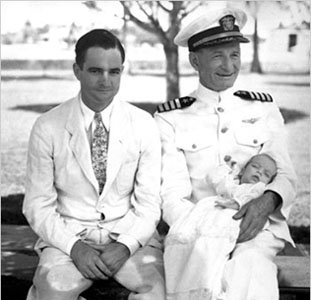
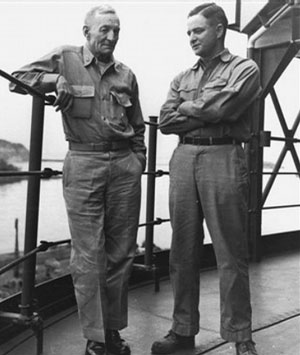
I have a picture I prize of my grandfather and father, John Sidney McCain Senor and Junior, taken on the bridge of a submarine tender, the USS Proteus, in Tokyo Bay a few hours after the war had ended. They had just finished meeting privately in one of the ship’s small staterooms and were about to depart for separate destinations. They would never see each other again.

Despite the weariness that lined their faces, you can see they were relieved to be in each other’s company again. My grandfather loved his children. And my father admired my grandfather above all others. My mother, to whom my father was devoted, had once asked him if he loved his father more than he loved her. He replied simply, “Yes, I do.”

And here are the opening lines of Obama’s memoir:

A few months after my twenty-first birthday, a stranger called to give me the news. I was living in New York at the time, on Ninety-fourth between Second and First, part of that unnamed, shifting border between East Harlem and the rest of Manhattan. It was an uninviting block, treeless and barren, lined with soot-colored walk-ups that cast heavy shadows for most of the day. The apartment was small, with slanting floors and irregular heat and a buzzer downstairs that didn’t work, so that visitors had to call ahead from a pay phone at the corner gas station, where a black Doberman the size of a wolf paced through the night in vigilant patrol, its jaws clamped around an empty beer bottle.

A card-carrying narratologist could squeeze a whole article out of these two openings, but just notice how well designed each is. Both grab the reader: Why would McCain’s father and grandfather never meet again? What was “the news” headed for Obama? The short, crisp sentences of the McCain extract—few adjectives and adverbs, no description except for the lines on the men’s faces—set the pace for what we’ll get later. McCain (via Salter) tells his tale in brief paragraphs and unvarnished prose, as laconic as the talk of the seamen he admires. The two opening scenes, that of father and son meeting on the bridge of the Proteus and the moment when McCain’s father tells his wife that he loves his father more than her, might have come from a John Ford film. The climactic “Yes, I do” even enacts that legendary Ford dictum that you shouldn’t let actors talk much.

Obama’s scene is more like a sequence from a 1970s urban movie, yielding washed-out imagery packed with scruffy detail. Everything suggests “dangerous neighborhood” and “black poverty,” but at no point does Obama use any of those words. Instead we get suggestions of grime and bleakness. As in many novels, the milieu comes to life through action: the broken buzzer initiates the routine of people calling ahead. By metonymy, the adjacent gas station reminds the narrator of the almost hallucinatory Doberman trotting through the night. And instead of telling us that drunkards left their beer bottles littering the streets, this paragraph suggests this sorry milieu obliquely by having the patrol dog clenching one in its jaws.

It might be tempting to say that McCain is deliberately avoiding literary grace notes, as befits a man identified with Straight Talk, while Obama is writing in a self-consciously novelistic way, like the elitist he is. Actually, no. Both are writing in literary ways, but using different techniques of narration.

Obama is adhering to Henry James’ admonition to “Dramatize, dramatize!” He tries to make every scene come alive for the reader through small details. He’s the sort of memoirist who not only gives you twenty-year-old conversations word for word, but adds all the gestures, vocal tones, and props.

“See there,” Marcus said. “Makes you embarrassed, don’t it—just being seen with a book like this. I’m telling you, man, this stuff will poison your mind.” He looked at his watch. “Damn, I’m late for class.” He leaned over and pecked Regina on the cheek. “Talk to this brother, will you? I think he can still be saved.”

Regina smiled and shook her head as we watched Marcus stride out the door. “Marcus is in one of his teaching moods, I see.” (103)

This sort of prose is movie-adaptation ready: You can see the scene. McCain doesn’t work at this level of concrete rendition, but his narration is no less carpentered. Consider this passage:

I didn’t think, “Gee, I’m hit—what now?” I reacted automatically the moment I took the hit and saw that my wing was gone. I radioed, “I’m hit,” reached up, and pulled the ejection seat handle.

I struck part of the airplane, breaking my left arm, my right arm in three places, and my right knee, and I was briefly knocked unconscious by the force of the ejection. Witnesses said my chute had barely opened before I plunged into the shallow water of Truc Bach Lake. I landed in the middle of the lake, in the middle of the city, in the middle of the day. An escape attempt would have been challenging. (189)

Things happen quickly here. The scene is over in seven sentences—no description of what the blackout felt like, no sense of imminent death. Point of view switches with equal speed. McCain is fully aware until he’s flung out of the plane and loses consciousness. Then his narration has to resort to an objective report of what happened while he was out. (“Witnesses said…”) The statement is backed up by a quick, vernacular summary of where and when he landed. The tone then switches to understated reflection, using the flat language of the stoic man of war: Escape wouldn’t have been impossible, or fatal, merely “challenging.” The paragraph plays down the crisis of survival by tapering into ironic self-effacement.

The rule of three is one of the writer’s best friends. The last sentence of the first paragraph renders three McCain actions—radioing, reaching, and pulling—in swift succession. Injuries pile up in triple-formation too: arm, arm, knee. The third trio is casual but memorably repetitive: middle of the lake, middle of the city, middle of the day. Should McCain claim that he, like Hamlet, “uses no art at all,” a narratologist will remind him of the technique pervading this passage—and his book’s opening. In a novel, mentioning a ship called Proteus would foreshadow the changes that young John will undergo. And James Wood complains in his recent How Fiction Works that a great many “apprentice novels” begin with the narrator pondering a family photo (95-96).

Percy Lubbock’s The Craft of Fiction (1921), a classic of literary narratology, distinguishes two methods of narration. The scenic method strives to make each moment palpable through energetic description, while the panoramic one inclines toward summary and generalization. Along this (fairly rough) continuum, Dreams from My Father lies closer to the scenic pole and Faith of My Fathers is closer to the panoramic one. Both autobiographies deploy the rhetoric of fiction, and both are unavoidably artificial. And each one’s technique (subtly eloquent versus direct and plain-spoken) creates a voice that fits the man’s narrative and his public persona.


Peopling the story

Characters in a narrative are usually identified by their roles and their traits of personality. Indiana Jones is a professor and adventurer, an intellectual cowboy. He is courageous, knowledgeable in his field, risk-loving, a bit insolent, somewhat impetuous, and so on. (For more on character construction, see my third essay in Poetics of Cinema.) Given very few cues we can fill in a character, so it becomes important that people who would become characters in their own stories send out the right signals. Rewriting real life is hard.

In the presidential campaign, it isn’t hard to identify the traits that the candidates are trying to define. All want to show integrity, resolve, prudence, a willingness to sacrifice for the greater good, and so on. But each candidate has also become identified with more individual traits. Without my enumerating them, let’s try a game.

Imagine our candidates as people in a high school. (2) Which one is the assistant principal on the verge of retirement? Which one is the social studies teacher who can always be led off the lesson plan with a strategically innocent question? Which one is the earnest first-year teacher, convinced that he can reform secondary education by reaching miscreants? And which one is Miss Popularity, cruel queen of the cliques, bluffing her way through assignments?

Maybe you don’t agree with my assessment of the candidates’ traits, but you knew exactly whom I referred to in each case. That’s because at least one narrative frame has sorted the characters along these lines. It’s a little scary to see that a flesh-and-blood person can be “characterized” so stereotypically, but whatever our political protagonists are like privately or deep down inside, as characters in the narratives that they spin or others spin around them, they fit well-worn templates.

Indeed, they can strive quite consciously to do that. To claim to possess “audacity” or to call yourself a “maverick” is to conjure up a set of traits, and these have implications for how you will act. As your actions mount up, a portrait snaps into focus that is hard to eradicate. Sarah Palin, introduced as a hard-edged fighter in the mold of Hillary Clinton, has been the most obvious instance of gradual revelation. She was an outline waiting to be filled in with events, and despite the campaign’s efforts to control what those events were, damaging pieces of behavior have mounted up and campaign leaks have confirmed their dire side. Palin now stands as a provincial politician adept at small-scale patronage whose ignorance of policy, world affairs, and science is abysmal and invincible. This has not kept some people from admiring her, of course.

Palin betrays no change in personality over the course of the campaign, and neither does Biden. According to reporters who cover him, he’s the same Joe he always was, take it or leave it. For real change—not of America’s direction but of public personas—we need to look at the top of the ticket. In the course of the campaign, for example, Obama has managed to seem consistent with his core program while having “seasoned” and “matured,” thanks to the tough primary fights. (Another cluster of narratives I can’t tackle here.)

McCain has been rendered as changing too, but not in a good way. One prominent large-scale narrative has portrayed him as losing some of his independence of thought—tacking to the right on cultural matters, losing the argument about his running mate. Few speak of the old Barack Obama versus the new one, but the narrative of John McCain 2.0 has stuck. Mr. Roberts has become the captain himself—a man crumpled with vexation, the cranky officer he would have rebelled against at Annapolis. I suspect that some day a McCain biographer will construct a narrative that shows him to have become a tragic figure.


The big three ingredients

Narratives arouse emotions in us; some would say that’s their chief purpose. The emotions can be of all kinds—pity, sympathy, indignation, joy, and down the line. But are there emotions characteristic of narrative in general? The theorist Meir Sternberg (3) has suggested that a narrative as such, regardless of other emotions it can conjure up, depends on three emotional states. Simplifying a bit, we can say that stories create curiosity about past events, suspense about future events, and surprise by means of unexpected events. Whatever other emotions a narrative evokes, we need to feel at least one of these three states.

Most narratives invoke all of these, but some genres rely on more than others. Detective stories rely a lot on curiosity, as characters try to solve the crime by exposing the events that led up to what’s happening now. Likewise, psychological tales—like Obama’s search for his roots—will evoke curiosity about the origins of events or personality traits. Action-driven narratives rely heavily on suspense: Will the protagonist reach her goals, or even just survive? The Dark Knight, with all its ticking clocks and hairbreadth escapes, is driven chiefly by suspense. (For more on suspense, you can visit this entry.) Plots with “a sting in the tail,” such as in stories by O. Henry and Roald Dahl and the early films of M. Night Shyamalan, have endings that depend to an unusual degree on surprise.

We can distinguish the two Presidential campaigns’ “master narratives,” along these dimensions. In the ongoing electioneering, Obama’s campaign is now driven almost completely by suspense. He’s not asking us to find out more about what led to the war in Iraq or the economic collapse or the crumbling infrastructure; it’s assumed that we know enough backstory. Everything is about what comes next. Ask any Obama supporter the predominant emotion she or he feels, and I’ll bet it will be suspense. What will happen next? What could throw the juggernaut off course? Fingers crossed: The very image of suspense.

McCain, by contrast, is running a campaign driven by curiosity and surprise. Many of his talking points dwell on the past. Who is Barack Obama, really? What did he have to do with Ayers, Rezko, the Fannie Mae and Freddie Mac executives? Why did he sit in Jeremiah Wright’s church? And so on. These questions ask us to feel curiosity in the form of suspicion about McCain’s rival. The fact that most in his audience haven’t taken up the hint has driven the campaign to try to invoke another emotion: surprise. The pick of Sarah Palin is the most obvious instance, but several others have followed: suspending the campaign, promising to buy people’s mortgages, yanking Joe the Plumber out of obscurity as an emblem of small business, even the “not ready yet” tagline of a recent ad. There may be more surprises to come, as gloomy Democrats fear (which only increases their feeling of suspense). At this point, the act of winning would be the ultimate McCain surprise.

So the campaigns may teach us something of interest about narratives: You can’t have a gripping narrative without some suspense. You can do without curiosity or surprise, but a story lacking suspense won’t keep us turning enough pages to be curious or surprised. (4) Maybe that’s why the McCain campaign never had a “compelling narrative.” It didn’t build up enough of a sense of how it would win or how, after the election, the future would be different.


Narrative plus

On 29 October, the Obama campaign ran a 30-minute television film, American Stories, about why he should be president.This infomercial is a gift to the film analyst, and there’s much more to say about it than I can articulate here. I’ll concentrate on one intriguing aspect of it.

Narrative isn’t the only way to organize a film or literary text. In Film Art, we suggest that there are other principles of organization. Using categorical form, you can survey different types of things, like baseball cards or political systems, without telling a story. You can use a rhetorical format, making an argument for a position you believe in by adducing reasons. What we call associational form can link various images, sounds, and actions through analogy, contrast, or metaphorical connection; one example would be the film Koyaanisqatsi. And very often these principles can combine in a single book, film, or tv program.

American Stories isn’t centrally about Obama’s life or his family or running mate. Instead, the campaign created a series of anecdotal narratives. In turn, these narratives were linked by associations, not by the causal connections typical of narrative. Most broadly, Obama framed these narratives and linkages within a set of policy statements, so that the narratives provided illustrative examples of a rhetorical argument.

A football mom can’t pay for her husband’s medical treatment and must ration the kids’ snacks. An elderly retiree who paid off the family house must return to work to pay for his wife’s medications. A teacher in a school for at-risk kids must take a second job and still find time for her training, while deciding whether to buy a gallon or half-gallon of milk. A loyal Ford assembly-line worker is dropped to half-time; unlike his father and grandfather, he cannot expect a full pension. “Everybody here’s got a story,” Obama remarks.

The stories serve to illustrate a checklist of Obama’s positions: rescuing the middle class by means of tax cuts, making corporations accountable for pension fulfillment, working for energy independence, reforming health care, and shifting the war on terror to Afghanistan. So far, so categorical. But these talking points aren’t linked by logical inference but by association.

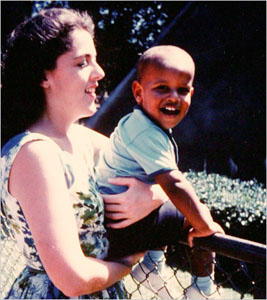
Take the story of teacher Juliana Sanchez. She instantiates the ‘education’ idea. Cut to Obama saying that teachers can do only so much: Parents must take responsibility for their children’s learning. Just as Juliana is taking care of her children, Obama recalls his mother taking care of him, as a single parent. Over family photographs he tells of his mother rousing him from bed to go through his lessons before she went to work. Link to Obama giving a speech in which he declares that every child needs a world-class education. Cut to him addressing the camera, declaring that he’s seen school reform work. The political has become doubly personal, exemplified by Juliana and by Obama’s own experience.

Then: “Just as I believe that every American has a right to an affordable education, I also believe that every American has a right to affordable health care.” This segues to a statement of Obama’s medical policy, which is followed by an account of his mother’s premature death, in which he shows that he knows what it is to lose a loved one. “It felt arbitrary.”

While the local connections are driven by associations like these, the overall shape of the half-hour is—no surprise—rhetorical. Obama is adducing reasons to vote for him. His case is that Americans are facing problems to which he has solutions. He could have presented the solutions as a list, in the form of bullet points or charts. Instead, he makes the problems concrete by illustrating how they affect ordinary people, including his own family, and then presents his solution by talking to an audience.

This use of rhetorical form contrasts with the one we discuss in Film Art (Chapter 10), when we analyze The River (1937). In that film, director Pare Lorentz doesn’t highlight individuals’ experience but creates a vast, sweeping story of erosion on the Mississippi river. Correspondingly, Lorentz doesn’t give the solution to the problem as a speech; it is presented in images of people taming the river, building the dam, and settling in new communities.

Obama could have adopted Lorentz’s strategy by tracing a broad history of the last eight years of Republican government, leading up to the financial crisis as a climax of mismanagement, and then turning to his policy prescriptions. He chose, as his campaign has largely chosen, not to rehearse the mistakes and misdeeds of the past (with which many Democrats were involved as well) but to put the emphasis on current conditions and hope for the future. Instead of Lorentz’s epic sweep, which arouses a feeling of grandeur and civic pride in getting a big job done, the Obama film asks us to empathize with “Americans looking for real and lasting change that makes a difference in their lives.”

Thanks to this blend of different types of formal organization, even the abstractions of policy draw upon the powers of storytelling. Maybe this campaign really is all about narratives. If so, maybe narratology can illuminate public discourse in useful ways.

Just don’t call this blog entry a deconstruction.


(1) Roland Barthes, “Introduction to the Structural Analysis of Narratives,” in Image Music Text, ed. and trans. Stephen Heath (New York: Hill and Wang, 1977). Barthes’ essay originally appeared in Communications 8 (1966), devoted to semiological research into narrative. Assembling a veritable who’s who of Structuralism, the issue included essays by Greimas, Bremond, Eco, Todorov, and Genette, as well as Christian Metz’s essay on the “Grand Syntagmatic” of narrative film.

(2) People say that Hollywood is high school with money, and that Washington is Hollywood for ugly people. So Washington must be high school, money, and ugly people? Obama and Palin seem to disprove the last condition.

(3) Sternberg laid out these principles in Expositional Modes and Temporal Ordering in Fiction (Baltimore: Johns Hopkins University Press, 1978), one of the finest studies of narrative theory I know. He elaborated the ideas in two articles under the title “Telling in Time.” See Poetics Today 11, 4 (Winter 1990), 901-948, and 13, 3 (Fall 1992), 463-541.

(4) Of course there is suspense on the McCain side too, but more and more it consists of the question: How bad will the damage be? Although the Obama campaign hasn’t exploited curiosity about McCain’s campaign narrative, the press has done so by slowly creating a backstory about Palin’s record and the way she was selected.

David Bordwell
top of page

have comments about the state of this website? go here