






Ashes to Ashes (Redux)
Thursday | December 18, 2008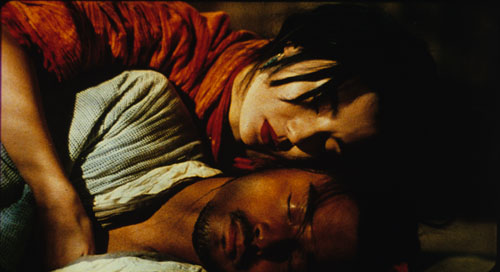
DB here:
Hong Kong films constantly shift their shapes. Both film prints and video versions circulate in a bewildering variety of forms. A movie shot in Cantonese (the vernacular of the locals) may be dubbed into Mandarin, the language of the Mainland and of Taiwan. But it may also be dubbed into English, French, or other Western languages; such was the fate of many kung-fu films of the 1970s, as well as later productions like The Killer (1989). I have seen Happy Together in Italian and In the Mood for Love in Spanish. When a movie is exported, it may also be recut to suit the local market. Typically Hong Kong producers have sold films under terms that allowed foreign distributors to do pretty much what they liked with both theatrical and video releases.
Alternatively, the filmmaker may cooperate and remake the film to fit foreign tastes. During the boom years of the 1980s and early 1990s, when many films were funded through presales to Taiwan, it was common to have both a Taiwanese version (usually longer) and a Hong Kong one. Jackie Chan’s Police Story (1985) included extra scenes of Jackie’s antics to satisfy Japanese audiences, and the directors of Infernal Affairs (2002) provided a less desolate ending to satisfy Chinese censors. In addition, filmmakers began circulating “international versions” that would play film festivals, and these might not accord with what was released locally. I’ve discussed one instance earlier on this blog: a version of Days of Being Wild that includes opening material not visible in the international print. My current supposition is that this is a local release print that may have circulated in Western Chinatowns too.
To complicate things further there was the institution of the midnight show. Instead of holding test screenings, Hong Kong producers would preview their films at a few theatres late on weekend nights. Audiences knew that they were acting as guinea pigs and weren’t shy about expressing their displeasure. While filmmakers cringed in the back, viewers might shout insults at the screen. The producers and the director would meet to settle on what changes should be made. Then they would hustle to prepare new versions for the official release in the next week or two.
On top of this, add the next layer of revision: the post-festival rethink. Western directors have redone their movies after discouraging festival response. Probably the most famous instance is the death and resurrection of Vincent Gallo’s The Brown Bunny (2003).Now that Hong Kong and Taiwanese directors circulate on the fest scene, they too have tinkered with their work after premieres, notably Hou Hsiao-hsien, who has reworked films following less than enthusiastic Cannes screenings.
A director’s job is never done?
Like many Hong Kong movies, nearly every one of Wong Kar-wai’s films went through multiple versions. But unlike many directors he seems to enjoy tweaking and rethinking his work. In production he shoots scenes, watches them, reshoots them, recuts them, and reshoots again. Editing and mixing involve the same play with variants. He adds different shots, juggles the order, adds or subtracts music at will.
The process may seem to betray an uncertainty about what he wants his movie to be. For In the Mood for Love, he shot scenes of the central couple making love but didn’t use them, playing with the possibility that the affair is chaste. 2046 began as a high-concept project, based on the fifty-year expiration of the 1997 handover accords, and it went through many different incarnations. At one point it was to be a tale of the intertwining lives of different Hong Kong citizens whose addresses were 2046 on their streets. Even the actors may not know what’s up. At the Cannes premiere of 2046, Maggie Cheung was startled to learn that she was barely in the movie.
Of course most filmmakers rediscover their films at each stage of production, but for Wong the idea of a “locked” version is fairly indeterminate. Virtually everyone now acknowledges that a Wong festival premiere is a first approximation. Delivered in the nick of time (sometimes embarrassingly late), the film is likely to be reworked after initial screenings. Venice and Cannes, Tony Rayns points out, have served as counterparts to the local midnight shows.
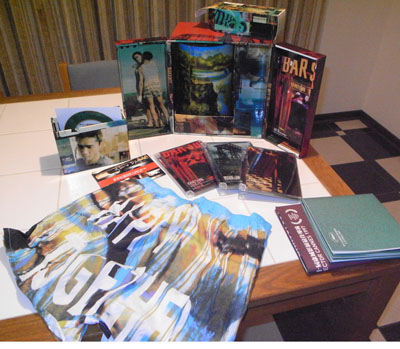
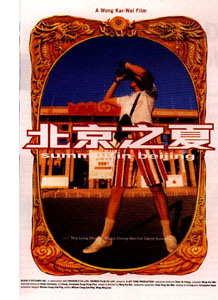 In Planet Hong Kong I suggested that Wong became a shrewd guardian of his brand. He has created high-end ancillary products, not only CD soundtracks but posters, T-shirts, glossy photo books, and limited-edition DVD sets. The Happy Together anniversary box (limited to 2046 units) includes a model of the spinning Iguazu Falls lamp and a pair of men’s briefs. The spinoffs are issued with fancy packaging, and they have usually sold briskly in upscale Asian shops, particularly in Japan. It’s characteristic that Wong’s aborted project Summer in Beijing could serve as a corporate travel logo. At once cult filmmaker and luxury franchise, Wong has every reason to refresh, and re-market, his content at intervals.
Yet I don’t maintain that he’s insincere. His drive to redo his films seems to go beyond indecision or commercial calculation. Wong seems to have taken to heart his central theme of the transient moment, the fact that love can be extinguished at any instant. So why not change your films to match your mood today? Further, like Warhol, he seems to enjoy prodigality for its own sake. He enjoys conjuring up one variation after another, multiplying just barely different avatars, and draping in mist the notion of any original text. His films’ basic constructive principle—the constant repetitions that create parallels and slight differences, loops of vaguely familiar images and sounds and situations—gets enacted in his very mode of production.
So he rebuilds even after release. The DVD release lets him tack on unused materials, extra scenes and different endings. That’s enough for most directors, but Wong has long harbored the dream of compiling vast swatches of unused footage in a sort of variorum DVD set of all his films. But why should he have all the fun? He once announced plans to put his footage for Happy Together on the Internet and let anyone make a personal version of it. That didn’t happen, but he did allow his assistants to make Buenos Aires Zero Degree (1999): not only an essayistic making-of but also a handsome reliquary of discarded material, including a gorgeous sequence of two taxis arcing away from each other.
Evil East, Malicious West, and their posse
Now we have Ashes of Time Redux, premiered at Cannes and showing in the US. The most apparent analogies, the oft-revised Blade Runner and the other redux, Apocalypse Now, don’t do justice to Wong’s fussbudget impulses.
For the original Ashes Wong assembled a high-wattage cast that included two of the Heavenly Kings of Cantopop and three glamorous female stars. He spreads out their duties by means of an ensemble plot. At the center stands Ouyang Feng (Leslie Cheung Kwok-wing), a swordsman who has set up a way station on the edge of the desert. He acts as a broker for people who want to hire killers. Another swordsman, Huang Yaoshi (Tony Leung Kar-fai) visits him every year. Ouyang nurses unrequited love for his brother’s wife (usually known as the Woman, played by Maggie Cheung Man-yuk), who lives far away. Huang is also subject to the Woman’s charms, but he is more deeply in love with Peach Blossom (Carina Lau Kar-ling), a woman he saw bathing her horse in a river. Peach Blossom is the wife of yet another wandering swordsman, who is gradually growing blind (Tony Leung Chiu-wai). He too fetches up at Ouyang’s outpost. Huang also runs afoul of the Murongs, a brother and sister who may be the same person (Brigitte Lin Ching-hsia). Meanwhile, a young girl (Charlie Yeung Choi-nei), fortified only with a mule and a basket of eggs, waits at Ouyang’s cabin to hire someone to avenge her brother’s death. Finally, there is Hong Qi (Jacky Cheung Hok-lau), a down-at-heel young killer for hire, who is followed across the desert by his wife.
The interlocking love triangles around a narcissistic man recall Wong’s breakthrough film, Days of Being Wild (1990), although here the parallels and connections are fleshed out through kinship too. The basic relations are at first hard to parse, though a Western viewer who didn’t recognize these stars will have more trouble than a Chinese one. Wong complicates the exposition by fragmenting his scenes and inserting flashbacks, though most of the latter are easy to follow.
He also helps the audience by following a common Hong Kong storytelling principle: reel-by-reel plotting. This breaks the movie into fairly discrete chunks of ten minutes (about a reel) or twenty minutes (about two reels). The first reel sets up the central relation of Ouyang Feng and Huang Yaoshi. Then two reels are devoted to the Murongs and their efforts to trap Huang. The next two reels are spent on the Blind Swordsman, followed by two reels devoted to Hong Qi and the Egg Girl. The last two reels unearth the long-simmering relationship among Ouyang, the Woman, and the despairing Huang. So the plot is actually a bit tidier than it seems at first, although each of these chunks is marbeled with references to other story lines. In Redux, Wong has also divided the plot into seasons, a strategy that accentuates the multipart structure.
Now about all those versions. Preliminary confession: These comments are based on one 35mm screening, and my analytical points are based on a DVD screener.
Keeping it unreal
Before Redux, there were at least two versions of Ashes of Time. One premiered at the Venice festival of 1994, the other became the international standard version. The differences are striking.
The international version has several hyperactive swordfights quite early. In a prologue before the title credit, Ouyang Feng and Huang Yaoshi fight a duel. After that, each is given a combat sequence in which he takes on hordes of assailants. These sequences are rapidly cut, with exaggerated angles, accelerated or slowed motion, and pulsing freeze frames. At the end of the international version comes a brief, parallel epilogue showing the surviving warriors (Ouyang, Huang, Hong Qi, and Murong) in the midst of combat. This epilogue includes a tableau of Yin, the female Murong, writhing ecstatically on a bed of red blossoms.
It’s widely believed among Hong Kong film people that this international version was initially created for the regional market and overseas Chinatowns. Wong added swordplay sequences at the beginning and end in order to satisfy his Taiwanese producers, who wanted more action in this otherwise talky and moody movie. How this version, running about ninety-five minutes without credits, became the standard one I don’t know, but evidently Wong did not control the international rights on the film. In any case, we have the evidence of Derek Elley’s Variety review that these passages were not in the Venice copy.
I’ve seen Ashes in 35mm in several countries, and it’s always been the international version. That is the version available on Hong Kong laserdisc and video, as well as on Japanese DVD (as near as I can tell from my imperfect disc). But the French DVD, released by TF1, is quite different. It runs 87:30 without credits (and assuming 24 fps). This version lacks several scenes, including the opening brawls, and ends with a close-up of the pale face of the Woman looking out to sea. It may be that this French version, billed on the packaging as the “original” one, is close to the Venice print.
Wong reports that he rescued original material, both positive and negative, from various sources. Since some of it was in poor condition, digital versions were made. In the final result, a few shots have been replaced with alternate takes. Yet the film is not simply restored but “reimagined,” as the title Redux indicates.
By and large, the sequence of story events, the shot-by-shot progression, and the monologues and dialogues are the same in both the international version and this new one. What, then, has Wong changed? He has kept nearly all of the brief prologue showing a rapid-fire combat between Ouyang and Huang. He has eliminated the approximately three minutes of the two fights that establish the solo prowess of the fighters. He has also cut the epilogue’s burst of action, retaining only a shot of Ouyang slashing in slow-motion and swiveling in a freeze frame that gradually fades out. In other fight scenes, he has trimmed some elaborate action and at least one gory bit, showing Murong impaling a cat.
Which is to say that he has deleted several conventional displays of the wuxia pian, or “heroic chivalry” film, of the 1990s. In Planet Hong Kong, I argued that Wong’s films often play off the mainstream conventions of his moment. He embraces pop music, pop stars, and pop genres: the triad movie (As Tears Go By, 1988), the melodrama (Days of Being Wild, Happy Together), and the romantic comedy/ cop movie (Chungking Express). But the films rework those conventions too. Wong subtracts a bit of glossiness by emphasizing the grubbiness of location shooting and by mussing up his stars, but then he re-beautifies things through his lustrous images and his unashamed interest in romantic longing. His men alternate between impulsive action and moody withdrawal, and his women mostly lounge about waiting for their men to make a move. (You could do a whole essay on the figure of the Waiting Woman in his work.) The sheer conviction of his style and sentiment can redeem quite hoary clichés, such as the woman’s inevitable complaint that her man never told her he loved her (a crucial turning point in Ashes of Time).
By the early 1990s, the wuxia pian had become a fantasy extravaganza, packed with flying swordsmen, magic potions, special effects, dynamic visuals, pounding music, and play with gender identity. The second and third installments of Tsui Hark’s Swordsman trilogy, a phantasmagoric treatment of the genre, present Brigitte Lin as the bi-gendered Invincible Asia, a vessel of both martial and erotic fantasies.
In part Ashes cites these current formulas in order to rework them. Conventional props like magic wine become tied to themes of memory and regret for missed chances. Discussions of combat strategy are replaced by monologues musing on lost loves. The male/ female masquerade of The East Is Red becomes, in Ashes, a hallucinatory shift of identity (are the Murongs two people or one person?) and forms one point of a thematic continuum centering on men’s desire to possess other men’s women.
Visually as well, Wong borrows and reworks fantasy wuxia conventions. One of the women warriors in The East Is Red (1993) unleashes her volcanic sword skills while standing on the surface of the sea.
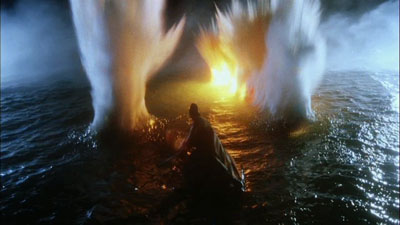
Something quite similar happens in Ashes. But once Wong has turned Murong’s ambidextrous gender into a question of identity, you could argue that the geysers of water she unleashes make a broad thematic point: the primal force of a character named both Yin and Yang.
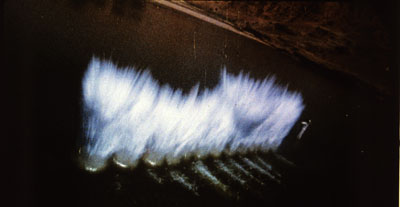
So the original Ashes reworks motifs to be found in Tsui’s extravaganzas, and for all I know in others as well. But apart from the Murong waterworks, these moments of dialogue with the fantasy wuxia pian entries are muffled in Redux.
From the original action scenes Wong has trimmed the turbocharged leaps and swoops, the blasts of “palm power,” and the possibility that a slashing blade can make a hillside explode. Perhaps Wong wanted to leave behind the overwrought world of wuxia fantasy—popular in 1994 but likely to seem cartoonish to Western audiences now. I wonder, though, why he has retained the opening clash between Ouyang and Huang, since the rest of the film presents them as friends. The answer may lie in the original Louis Cha novel, The Eagle-Shooting Heroes, a multi-volume saga that inspired both Ashes and the 1993 Jeff Lau film (co-produced by Wong) called by the novel’s title.
Other changes serve to create greater nuance or lyricism. The synthesizer score has been replaced by a spacious orchestral one, enhanced by stereo. Other stretches of music have been dropped altogether. There is a little less of the Morricone flavor now; the music coaxes rather than hammers. We get more shots of the moon, some fresh landscape vistas, a few more pools of water. Sometimes blood splashes out at us, but at one point an out-of-focus spray of blood is replaced by an optical effect showing wafting dark red billows.
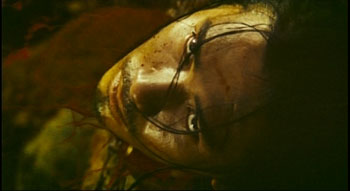
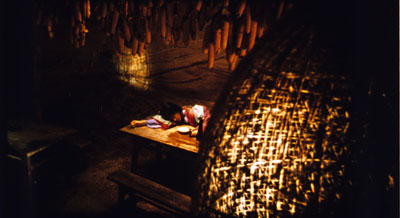
The most pervasive change has involved the color tonalities. The 35mm prints of Ashes I’ve seen have favored a vivid orange-brown palette, with strong blues (sky and water), red accents, and very little green. The video copies vary, but the most commonly available DVD version is notably more russet and lower contrast than the 35mm. Redux, though, is a total rethink. Interiors have lost most of their hard-edged chiaroscuro and become softer and paler. Exteriors, and some interiors, have been keyed toward a hard yellow. The vivid browns and oranges have gone a bit gray, and the blacks verge on green. In addition, some highlights have burned out.
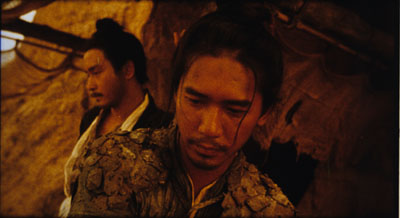
Consider these three frames. The first is a scanned Fujichrome slide that was photographed from a 35mm print. The second frame is from the Hong Kong DVD release. The third is from the Redux screener DVD. None has been photographically adjusted for reproduction here.

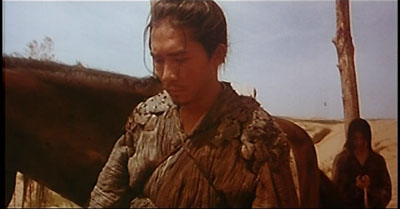
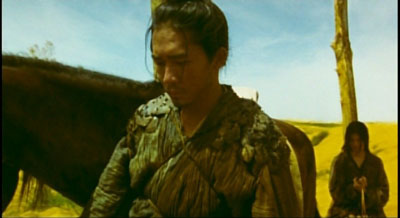
All of these are some distance from their sources; for instance, the 35mm slide can’t really capture the range of tonalities of the original, especially in the dark areas. Still, I think the relationship is a fair reflection of the differences. In 35mm, Redux looks a lot more crisp, rich, and detailed than in this DVD frame-grab, but the lemon yellows and pale greens are fairly faithful to my memory of the print.
Wong has taken advantage of ways to improve the film. Seeing the international version in 35mm, I was struck by problems in color matching. Shots apparently taken on different days didn’t always cut smoothly together, and sometimes shot/ reverse-shot passages displayed varying color grades and levels of graininess. By adding fairly consistent tints and by softening certain sequences, Wong has given the film greater tonal consistency. Further, he has upped the artificiality of the film’s look, creating a neutral ground against which certain colors, such as the wan face and ruby lips of the Woman, stand out even more vividly. With its softening and tinting, the film now looks more like a recent release–portions of Soderbergh’s Traffic, say, or some of the tamer stretches of a Tony Scott movie.
Once Redux appears on DVD, admirers will be kept busy plotting some minute differences in shot order and alternate takes. They will marvel at the way that Wong has inserted a few more images (e.g., during the fantasy caressing of Ouyang) but has kept the overall sequence the same length. There will also be intriguing questions. Why the choice of yellow as a key tone? Why the occasional and blatantly video-derived image, such as the pan shots that enframe the central story, and perversely run the opposite direction of their counterparts in the other versions? And why the digitized banks and foliage—maybe just because they look wonderful?
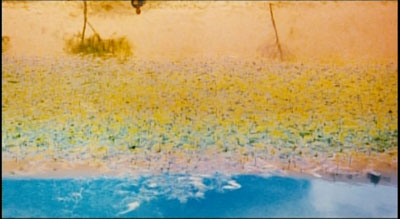
In case you wonder, this frame is not inverted.
I’m still getting accustomed to the film’s new look, and I need to see a print again to verify these general impressions. Still, I like to think that by recasting his film so markedly, Wong has brought his masterpiece back under his control. In this sense, his changes remind me of Stravinsky’s reorchestration of Petrushka and other early ballets. Stravinsky rewrote the scores in order to win performance rights, but he also brought his latest thinking to the task. In the same way, Wong has made Ashes of Time new all over again—available to many more viewers now and hereafter. This daring, fourteen-year-old exercise in avant-pop moviemaking is miles ahead of nearly everything on view right now.
For more on Wong Kar-wai product lines, go here. Wong talks about the restoration of Ashes here and here and in a video interview at the New York Film Festival. For more on reel-by-reel plotting in Hong Kong film, and a broader discussion of Wong’s films, see my Planet Hong Kong: Popular Cinema and the Art of Entertainment, 180-182, 271-281. For other critical discussions of Ashes of Time, see Stephen Teo, Wong Kar-wai (London: British Film Institute, 2005) and Peter Brunette, Wong Kar-wai (Urbana: University of Illinois Press, 2005). Unless otherwise noted, the frame enlargements in this entry are taken from a 35mm print of the 1994 international version of Ashes.
Thanks to Michael Barker of Sony Pictures Classics and Sarah Simonds and Jacob Rust of Sundance 608, Madison, Wisconsin, where Ashes of Time Redux is scheduled to open on 30 January.

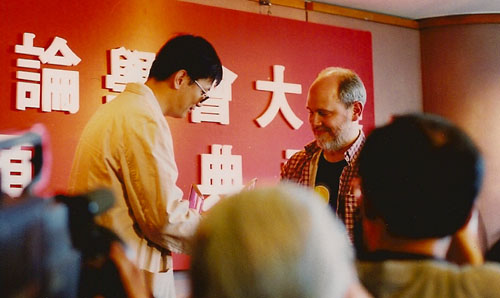
Top: WKW and the Hong Kong Film Critics Society, which awarded its Best Film honor to Ashes of Time, spring 1995. Below: DB presents WKW with the award.