Wednesday | April 22, 2009
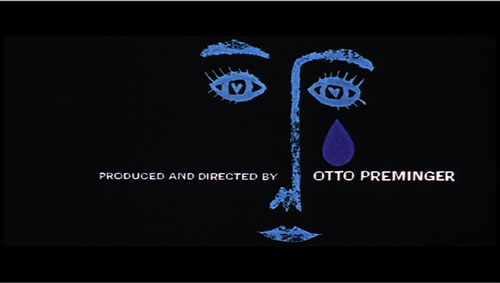
Bonjour Tristesse.
DB here:
Our weekly Film Colloquium is sort of like your old high-school assembly, except that it’s fun. The Film Studies area meets nearly every Thursday afternoon at 4 to hear a paper by a grad student, a faculty member, or a guest. It’s a great forum for ideas and information, and it gives the speaker a chance to try out a talk before taking it to a conference or lecture gig. The local audience is, in my experience, the toughest I’m likely to encounter. And this spring, despite a heavy travel and work schedule, Kristin and I caught two outstanding presentations.
Not in color, but colored
By now we all understand that silent films were most often shown with musical accompaniment, and sometimes sound effects. But we tend to forget that most silent films were in color too.
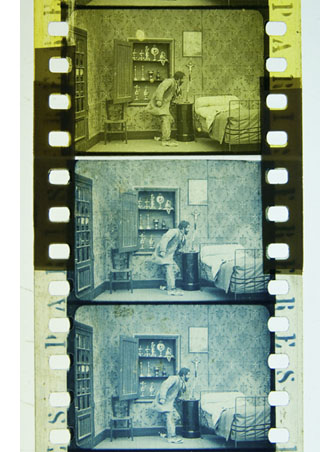
By the early 1920s, 80% of films were colored in one way or another. There were a few efforts to record the actual colors in a scene, but most often color was added after filming. Areas of the frame might be painted over by stenciling or by freehand. More commonly, the shots were dipped into dyes, yielding images that were tinted (washing over the image and coloring the areas of white, as in the frames below) or toned (coloring the darkest areas and leaving the white areas white). Over the years, film prints were preserved in black and white, partly because color stock was more expensive than today. As a result, even archival prints lost the sense of what audiences actually saw. Today archivists labor to reconstruct what silent films looked like in all their rainbow glory.
 Professor Joshua Yumibe of Oakland University wrote his Ph. D. thesis on early color processes, and his Colloquium talk asked some powerful questions. We know that there was a transition in film artistry from the late 1900s to the early 1910s, a shift toward what Tom Gunning has called the “cinema of narrative integration.” As films became longer and were shown in more or less permanent venues, moviemakers began to tell more complicated stories. How, Josh asks, did this shift away from a cinema of isolated “attractions” affect practices of coloring? Do color processes affect the way stories were told? Do the color processes change how people saw the space on screen? How did the trade press respond to different strategies of coloring? Professor Joshua Yumibe of Oakland University wrote his Ph. D. thesis on early color processes, and his Colloquium talk asked some powerful questions. We know that there was a transition in film artistry from the late 1900s to the early 1910s, a shift toward what Tom Gunning has called the “cinema of narrative integration.” As films became longer and were shown in more or less permanent venues, moviemakers began to tell more complicated stories. How, Josh asks, did this shift away from a cinema of isolated “attractions” affect practices of coloring? Do color processes affect the way stories were told? Do the color processes change how people saw the space on screen? How did the trade press respond to different strategies of coloring?
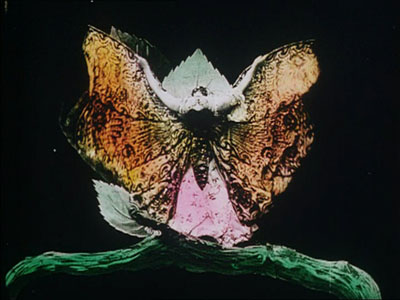
These are fascinating questions, and Josh’s exploration of them was careful and detailed. He has done enormous research on the various color processes, and he was able to trace several lines of development. For instance, he found that writers of the earliest years thought that color enhanced the sensual and emotional effects of the image, even creating an illusion of 3-D. In a shot like that of the butterfly dancer, people seem to have sensed that her multicolored shape was thrusting out of the screen toward them.
Josh argues that with the growing emphasis on narrative, color became more muted. Filmmakers were no longer aiming at momentary stimulation but at ongoing mood. Now tinting and toning came into their own. Color codes developed: blue for night scenes, yellow for sunlight, red for fire, amber for artificial light. Josh also explored the different ways in which European and US companies conceived of color; there seem to have been different color policies at Pathé and at American companies. But this wasn’t the end of change. In the 1920s, with the feature film now at the center of the theatre program, a wide variety of color practices emerged, including those isolated Technicolor sequences we find in films like The Wedding March.
The Q & A was as lively as the talk itself, and afterward, we repaired to a bar and thence to dinner. Josh’s talk was a model of deep, imaginative research and it kept us thinking and talking for a long time afterward. Not to mention his slide show, which regaled us with gorgeous shots that make you realize how much you’re missing when you see an old movie in black and white.
Bass, o profondo!
Another stimulating Colloq session was presided over by our old friend Jan-Christopher Horak, director of the UCLA Film and Television Archive. Chris was in town because our Cinematheque has been showcasing UCLA archival restorations across the semester, and he introduced our screening of The Dark Mirror. But we also got him to give a talk, and that was quite something.
Chris reminded me that we first met thirty years ago, here in Madison, when he came to do research on his dissertation. Since then Chris has been a top-flight scholar and author of many books. His Lovers of Cinema, published by our series at the UW Press, laid the groundwork for the popular film series Unseen Cinema. He’s also been one of the world’s leading film archivists, having supervised collections at Eastman House, the Munich Film Archive, Universal studios, and most recently UCLA.
Chris has long worked at the intersection of film, photography, and the graphic arts. He is one of the world’s experts on the 1920s German avant-garde; one of his early curatorial coups was a 1979 restaging of the pioneering Film und Foto exhibition of 1929. Chris has also long been fascinated by film publicity, having written a book on the subject. So it’s natural that he would gravitate toward studying the film-related work of Saul Bass, one of America’s greatest graphic designers.
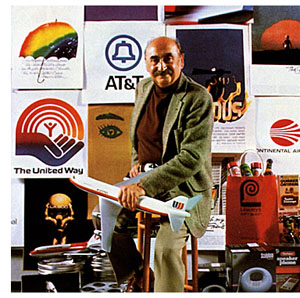 Chris’s talk focused not so much on Bass’s brilliant credit sequences for films by Preminger and Hitchcock as on Bass’s contributions to poster design. Bass turns out to have had a fascinating career, having worked in Manhattan advertising before moving to Los Angeles in 1948. Chris has found at least one early 1950s poster design that Bass probably executed, but he definitely worked for Preminger on publicity for The Moon Is Blue (1953) and Carmen Jones (1954)—the latter yielding to my mind one of the greatest credit sequences in film history. In 1955 Bass founded his own firm. Chris’s talk focused not so much on Bass’s brilliant credit sequences for films by Preminger and Hitchcock as on Bass’s contributions to poster design. Bass turns out to have had a fascinating career, having worked in Manhattan advertising before moving to Los Angeles in 1948. Chris has found at least one early 1950s poster design that Bass probably executed, but he definitely worked for Preminger on publicity for The Moon Is Blue (1953) and Carmen Jones (1954)—the latter yielding to my mind one of the greatest credit sequences in film history. In 1955 Bass founded his own firm.
Throughout, he carried on the ideals of György Kepes, his teacher and a major conduit for Bauhaus ideas into America. Like his European models, Kepes promoted the idea of art as having cognitive value, teaching us to see the world in a new way. Kepes also emphasized that artworks could be of practical utility—an idea that chimed with Bass’s turn toward commercial design.
Chris was able to show that the Bauhaus tradition powerfully influenced Bass’s design principles. Who would have thought that the credits for The Seven Year Itch replayed Paul Klee? Obvious, though, when Chris showed us the images.
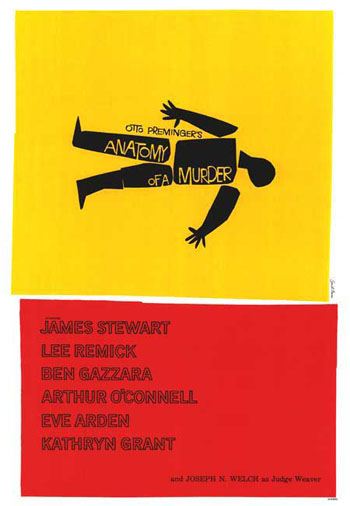
Chris emphasized two further points. First, Bass understood what we now call branding. We have to remember that it up to that time, most film publicity featured images of the stars, either in portraits or caught in typical scenes from the film. Bass’s poster design concealed the stars. Instead, he relied on dynamic geometrical design to capture a film’s mood in a powerful, stylized image. The result was an eye-catching logo, instantly recognizable: the flaming rose of Carmen Jones, the Vertigo whirlpool, the dismembered body of Anatomy of a Murder.
The key image could be repeated in newspaper ads, posters, credits, even the production company’s letterhead. When you saw the teaser trailer for Star Trek (“Under Construction”) dominated by that looming boomerang shape, you saw the heritage of Saul Bass. Who cares who’s in the movie? The very image is intriguing. No accident that Bass also designed many corporate logos, like the ATT bell and the United Way hand.
Chris’s second main point was that Bass was able to flourish because of the rise of independent production in the 1950s. Preminger, Hitchcock, and Wilder, acting as their own producers, could control the publicity for their films to a degree not possible for directors working in the classic studio system. Now films were sold as one-offs, and each film needed to pull itself above the clutter. In addition, Bass’s signature designs could set a director apart. In the 1950s, the Bass look was closely identified with his major clients like Hitchcock and Preminger, to the point that other designers for those directors tried to copy his style. I had always thought that Bass did the title design for Hurry Sundown, but Chris showed that it’s another artist’s pastiche of the master.
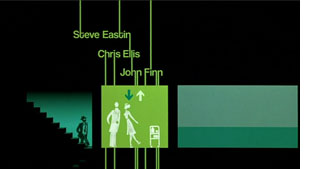 Chris’s talk reminded me that Bass contributed to making the opening credits a major attraction—not merely an overture, but an abstract treatment of the key story idea, a sort of graphic map that teases us into the main story. The opening sequences of Se7en and Catch Me If You Can (left) owe a lot to Bass’s idea that the credits should constitute a little movie, witty or ominous, tantalizing us with sketchy glimpses of what is to come. And Almodóvar’s diverting openings, probably the most sheerly enjoyable credit sequences we have today, are unthinkable without Bass. Synchronized with infectious music, Bass’s credit sequences can be seen as continuing the tradition of Walter Ruttmann and Oskar Fischinger, who back in the 1920s and 1930s made abstract films that advertised consumer goods. Chris’s talk reminded me that Bass contributed to making the opening credits a major attraction—not merely an overture, but an abstract treatment of the key story idea, a sort of graphic map that teases us into the main story. The opening sequences of Se7en and Catch Me If You Can (left) owe a lot to Bass’s idea that the credits should constitute a little movie, witty or ominous, tantalizing us with sketchy glimpses of what is to come. And Almodóvar’s diverting openings, probably the most sheerly enjoyable credit sequences we have today, are unthinkable without Bass. Synchronized with infectious music, Bass’s credit sequences can be seen as continuing the tradition of Walter Ruttmann and Oskar Fischinger, who back in the 1920s and 1930s made abstract films that advertised consumer goods.
For such reasons, I’m glad I hung around Madison after my retirement. With visiting researchers like Josh and Chris, who wants to go fishing?
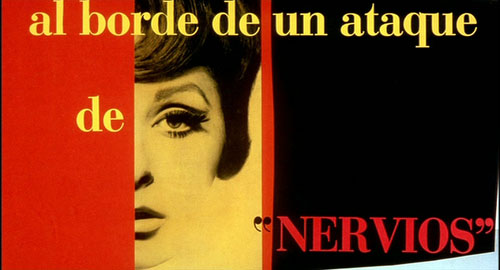
Woman on the Verge of a Nervous Breakdown.
Thanks to Joshua Umibe for the silent-film illustrations. The first comes from Gaston Velle, Métamorphoses du Papillon / A Butterfly’s Metamorphosis (Pathé, 1904). Frame enlargement from Discovering Cinema (di. Eric Lange and Serge Bromberg, Lobster Film/Flicker Alley). The second comes from Albert Capellani’s Le Chemineau / The Vagabond (Pathé, 1905; tinted and toned). Frame enlargement Joshua Yumibe, courtesy of the Netherlands Filmmuseum.
Posted in Animation, Film archives, Film history, Film industry, Film scholarship, Film technique, Film theory, Hollywood: The business, Silent film, UW Film Studies |  open printable version
| No Comments » open printable version
| No Comments »
Sunday | April 19, 2009
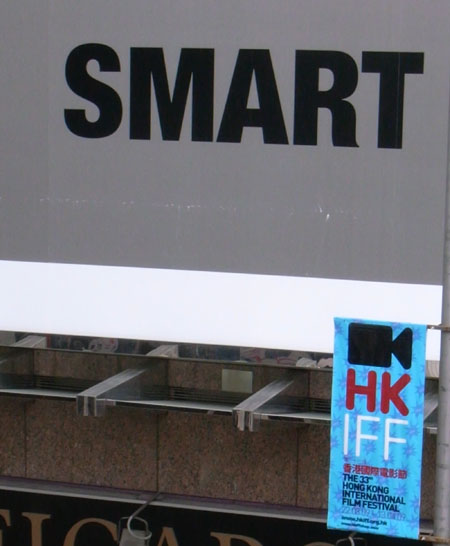
DB here, just back:
The numbers are pretty staggering. The Hong Kong International Film Festival ran 22 days (the first four incorporating Filmart, the Asian market). In 510 screenings, 279 films from 50 countries were shown. There were 19 world premieres, 17 international premieres, and 33 Asian premieres. Attendance figures are yet to be determined, but so far things look to match the nearly 600,000 tickets sold last year. (*Correction 1 May 2009: The figure of 600,000 refers to an estimate of total attendance at all events, including free screenings, panels, seminars, etc. Total tickets are currently estimated at 100,000. Thanks to Li Cheuk-to for the correction.)
Having stayed for the whole event, I felt some festival fatigue. But the final days of the fest were full of fine movies. I left feeling that all my time was well-spent—not least in seeing old friends and visiting some of the outstanding spots in this adrenaline-fueled city.

Ken Smith and Joanna Lee are forces of nature in the cultural life of Asia. Working mostly in musical performance, they arrange for performers’ tours, consult with cultural agencies, translate, write, and do damn near everything else as well. Call them global impresarios. They helped coordinate the YouTube Symphony Orchestra, and they played central roles in the creation of the opera The Bonesetter’s Daughter, a collaboration between Amy Tan and Stewart Wallace. This resulted in a 2008 production by the San Francisco Opera. The September premiere was broadcast in Hong Kong last Easter Sunday, and will be available at the RTHK website for playback for the following 365 days. Give it a listen here.
Ken’s engrossing book, Fate! Luck! Chance!, documents the making of the opera and includes a libretto. You can read background on Ken’s book here.
Above, Ken and Joanna take in pudding at a historic hole-in-the-wall eatery. The pudding comes in two varieties, milk and eggyolk-based. Mighty sweet, and as if by chance (or fate, or luck), the stools mimic the main attractions.
 
Old friends Linda Lai Chiu-han and Hector Rodriguez teach in the digital media and arts program at the City University of Hong Kong.

Linda has just had a film accepted for Oberhausen. She’s on a roll: It’s her second screening in this, the major festival for short films.
The W Hotel, where the Festival was headquartered, was posh to the max. Every time I went in, I expected someone to figure out that I wasn’t well-dressed enough to be there. If you ever wondered what George Segal’s ghostly sculptures would read, you could check out these pale volumes fastened to the shelves along the elevators.

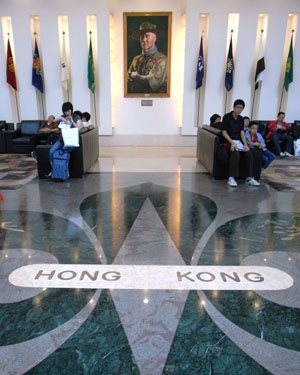
My own hotel was somewhat different. The B. P. in B. P. International House stands for Baden-Powell, and the place was teeming with Boy and Girl Scouts nearly every day. In the modern atrium hangs a reverent portrait of the man himself.
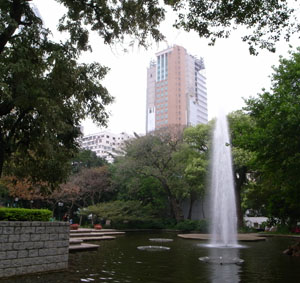
It was pleasant to stay beside Kowloon Park. Headed for the Cultural Centre or the ferry, I could avoid the crowds on Nathan Road by ambling through the park.
While I was in town, developers put the finishing touches on a neo-retro-colonialist complex at the south end of Canton Road.
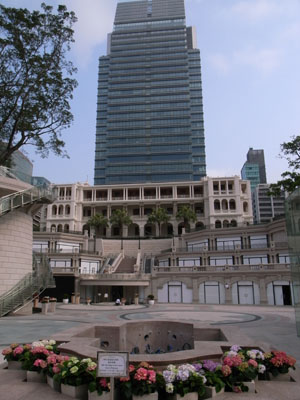
You must admit that Hong Kong sorely needs another shopping mall.
Back to the faces: Gary Bettinson (University of Lancaster), Emilie Yeh (Hong Kong Baptist University), and Darrell William Davis (Lingnan University).
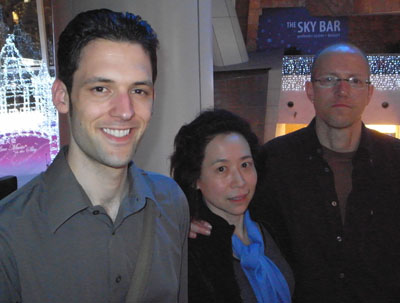
Gary writes on contemporary Hong Kong cinema, particularly Wong Kar-wai; most recently, he has an essay on 2046 in Warren Buckland’s anthology on puzzle films. Emilie researches Chinese film, as does her husband Darrell, who started his career working on Japan. I’ve already mentioned their book on Asian media industries in an earlier blog, but also have a look at their fine Taiwanese Film Directors: A Treasure Island. I gave a talk for Emilie and Darrell at HK Baptist, and we had a good discussion among their students and colleagues.
More intellect: This year the festival paid tribute to Ingmar Bergman. A friend of his, Marie Nyreröd, brought her enlightening documentary, Bergman’s Island. Here she’s seen with another Bergman expert, my amigo Paisley Livingston, philosopher and film critic-theorist teaching at Lingnan University.
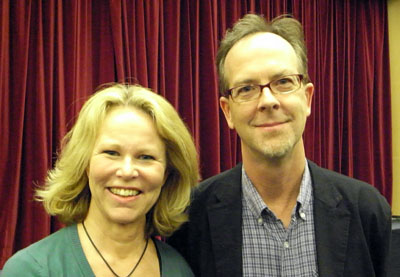
For over forty years, Erika and Ulrich Gregor have been colossal figures in world film culture–as critics, archivists, and festival programmers. They served on two juries during their stay here.

Scan earlier years of my Hong Kong visits and you’ll find these three regulars: King Wei-Chu (FantAsia programmer), Peter Rist (Film prof at Concordia of Montreal), and Yvonne Teh, Hong Kong journalist. After a screening at the Science Museum, it’s wonderful to sit out in a cafe.

Here are Johnnie To and his right-hand man Shan Ding at To’s magnificent office in Milkyway Headquarters.
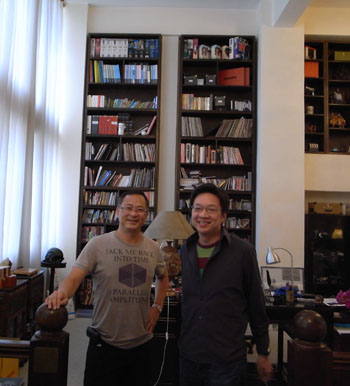
The Milkyway team is busy. To’s Vengeance, starring Johnny Hallyday, will open in Paris on 20 May. Mr. To and Shan continue to work with their collaborators on a remake of Melville’s The Red Circle, and they’re preparing a New Year’s comedy as well. Here’s Cheang Soi, one of the most ambitious of the younger HK directors (Love Battlefield, Dog Bite Dog). Soi is finishing Accident, which looks to premiere at the end of the summer.
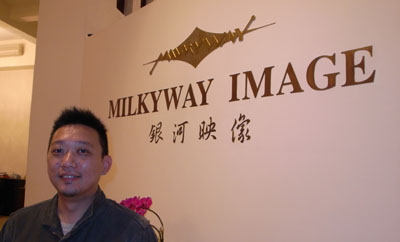
John Shum (aka Sham) is a legendary figure–a comedian since the 1980s, a producer, and an energetic advocate for local democracy.

Wong Ain-ling has been a critic and festival administrator. Currently she works as Senior Researcher at the Hong Kong Film Archive. She played a crucial role in the restoration of Fei Mu’s Confucius.

Derek Kwok (director of The Pye-Dog) is again collaborating with legendary actor-singer Teddy Robin Kwan.
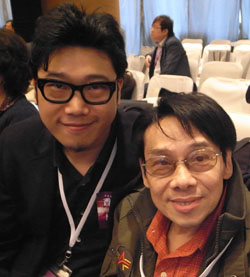
In all, another wonderful year of food (and food for thought), talk, and above all movies. You won’t find a festival anywhere more dedicated to the power of film in all its variety. So once more my tagline: See you here next year?
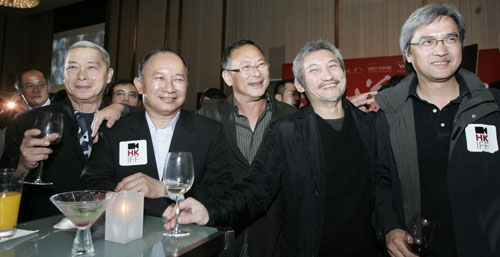
At the Film Workshop party: Lau Siuming, John Woo, Johnnie To, Tsui Hark, and Benny Chan. Thanks to Alvin Tse for the photo.
Posted in Asian cinema, Festivals, Festivals: Hong Kong, Film comments | open printable version
| No Comments »
Thursday | April 16, 2009
35 Shots of Rum.
DB, flying back from Hong Kong:
Some of the most important films playing at the Hong Kong International Film Festival were already familiar to me—Still Walking, Il Divo, Gomorrah, Ashes of Time Redux—and some of my discoveries in Hong Kong have been covered in more recent entries.
What remains? Accentuating the positive, I’ll not talk about the disappointing items, some with strong reputations. I hope to blog about others in the months to come, when I’ve had a chance to study DVDs.
In the meantime, Kristin has already touched on Beaches of Agnès, a real charmer. Varda can be whimsical without turning fey; even dressed as a potato she doesn’t seem to be trying to grab attention. The film is a digressive, passionate memoir. The background on her early life is captivating, and her career as a photographer, shooting snaps of Pierre Vilar and Gerard Philippe, furnishes a stab of pathos. A montage of beautiful boys and girls: gone. Soon we get Varda’s straightforward acknowledgment of Demy’s death from AIDS. “All the dead lead me back to Jacques.”
Götz Spielmann’s Revanche, which I’d passed up at other fests, was a very solid psychological thriller. It’s built around two contrasting worlds, the sex trade of Vienna and the placid, churchgoing lifestyle of a village. From the first comes Alex, a man-of-all-work in a brothel. He falls in love with a Ukrainian hooker, and between bouts of cocaine he vows to help her escape the business. In the village live the policeman Robert and his wife Susanne, trying to have a child. Their life is secure and cozy, though Robert is wound a bit tight. The two worlds intersect during a bank robbery, and the rest of the drama plays out in the countryside, with Alex taking refuge on his grandfather’s farm. Alex and Robert become two variants of masculine anxiety, each defined by his way with a pistol, and their decisive confrontation is deftly postponed until the very last moments of the film.
I admire the way that Spielmann uses a spare long-take technique to increase suspense. Each scene usually consists of a single shot, taken from a judiciously chosen angle that unfolds the drama smoothly. There are barely 200 shots in nearly two hours, but the scenes don’t seem stiff because the framing and staging are quietly varied. Shot/ reverse-shot cutting is reserved for two turning points, one in the middle and one at the end. It’s nice to see a movie with no filler material, no passages of people driving in cars or going into the buildings, none of those time-wasting aerial shots of cities.
Some nice sound work too! No Country for Old Men has been rightly praised for its use of offscreen noise, but the Coens look rather showoffish compared to what Spielmann has accomplished here. A shot of Robert and Susanne on their patio is accompanied by the faintest rustle on the right channel: Alex, spying on domestic happiness like a character out of Highsmith or Ruth Rendell, has slipped away.
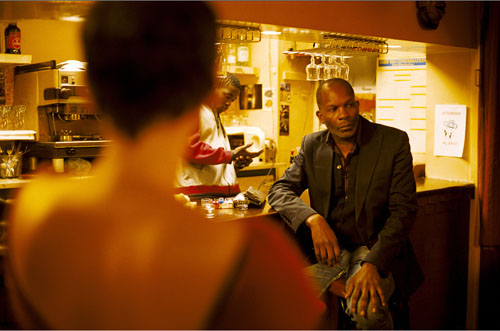
Similarly elegant in its staging and sound work is Claire Denis’ 35 Shots of Rum. The teasing exposition—a man watches commuter trains, a young woman rides one—dares us to imagine scenarios that could involve both. Our speculations turn out to be too wild, since their relationship is the most uncomplicated to be imagined. Based frankly on Ozu’s Late Spring, 35 Shots builds up its drama through daily routines, following its principals and their neighbors in everyday situations until, quite unexpectedly, a quiet crisis blossoms. Soon one scene ends: “We could be like this forever.” Next scene: everything has been overturned, and characters must change their lives. Visually the film is a marvel, with glowing scenes of semidarkness and discreetly out-of-focus details. As in her masterful Beau Travail, Denis supplies a powerful last shot, this time of an object we’ve nearly forgotten.
Two more thoughts: In my discussion of Revanche and 35 Shots, I’ve had to be coy in explaining basic plot situations and character relationships. That’s because these films work elliptically, holding back the sort of expository information that would be given in a concentrated dose early in most classical narratives. This narrational strategy poses no problem for an academic analysis, which tends to assume that the reader has seen the film. But it’s more difficult to handle when you’re writing a review. You don’t want to spoil the viewer’s surprise by explaining a core situation that the filmmaker has chosen to unfold gradually. If reviewers of Hollywood movies can’t give away the ending, the reviewer of an art film probably shouldn’t give away the beginning, or at least the information that it keeps in suspension for some time.
In other respects, though, there isn’t a clear dividing line between the “psychological” drama of international festival cinema and the more “externally driven” action of mainstream entertainment. Popular cinema relies on physical props like clues, souvenirs, messages, and gifts to help drive the plot. So, less obviously, do art films. The two photographs in Revanche deepen the character drama while triggering a major realization. The accidentally discovered letter (a convention of melodrama akin to the overheard conversation) in 35 Shots not only explains past actions but primes us to expect some conflict to come. As Aristotle knew, stories seem to need tokens to drive character revelation and plot reversals. A narrative universal?
Japanorama
Naked of Defenses.
Many of the movies I most enjoyed were Japanese. No surprise there. I know I’m prejudiced in favor, but objectively speaking the Japanese industry has long combined high output with great diversity and depth. I’m inclined to think that across film history, the three most consistently excellent filmmaking nations have been America, France, and Japan.
During Filmart, Yoshizaki Masahiro gave a swift but informative report on the current state of Japan’s “content industry.” It is the currently the world’s second-largest national film market , but it will sooner or later be replaced by China. Currently Japanese films are reclaiming the local audience, sometimes grabbing over half the annual box office. Unfortunately, that audience isn’t growing, and with a plunging birthrate, it’s unlikely to do so. Moreover, Japanese cinema has always been difficult to export, even in Asia. The great exception, of course, is anime, but even that is starting to slump. Anime is largely a television/ video format, yielding about twice in those platforms what it yields in theatrical income. But as advertising dollars have withered in the recession, anime has been cut back.
Despite all this, Japanese companies manage to release a staggering 400 or so films per year. (What counts as a release—theatrical? direct to video?—we leave for another day.) And the variety remains remarkable, judging by what I saw during my stay in Hong Kong. Put another way: Japan makes movies that are sweet, touching, funny, silly, and peculiar to the point of perversity. Not necessarily perversion, but that’s there too. And yes, schoolgirls’ panties are involved.
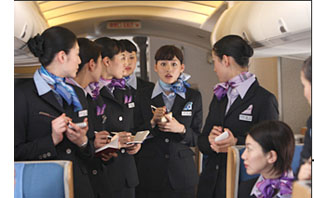 Not part of the festival, but playing in town was the diverting comedy Happy Flight. Like Airport and Airplane!, it weaves together various characters involved with a single flight. It concentrates almost completely on the professionals, from gate agents and mechanics to pilots and air hostesses. The one passenger depicted in detail rings true: After being allowed to bring an oversized bag into the cabin, he becomes a browbeating jerk. Not part of the festival, but playing in town was the diverting comedy Happy Flight. Like Airport and Airplane!, it weaves together various characters involved with a single flight. It concentrates almost completely on the professionals, from gate agents and mechanics to pilots and air hostesses. The one passenger depicted in detail rings true: After being allowed to bring an oversized bag into the cabin, he becomes a browbeating jerk.
The film maintains its infectious pacing, adorning the action with minor-key gags like the airport’s “Somkin Room” for smokers. I also liked the moments of teamwork. When the stewardesses need a cake, they concoct one out of various packaged snacks. A young mechanic, constantly berated by his boss, thinks he’s dropped a wrench into the plane’s engine, and the whole ground crew searches the hangar for it. As with Airplane!, the final credits resolve several plotlines and add a few gags. If you like Waterboys and Swing Girls, also directed by Yaguchi Shinobu, you’d probably enjoy this.
Just as light, but a lot more intricate is Nakamura Yoshihiro’s Fish Story. Another network narrative, this one traces how Japan’s purported first punk song changed the course of history. The plot skips among periods from 1953 to 2012, when a comet is about to incinerate the earth. With many pop-culture in-jokes, from Beatles albums to The Karate Kid, this breezy, off-kilter item gets by on sheer adrenaline and on a cascade of puzzles. Why does the Fish Story song make no sense? Why does it contain a one-minute passage of silence? How are all these stories connected? And how can a song save the world? The narration cleverly withholds the basic relationships among the characters until a dizzying montage at the end wraps everything up.
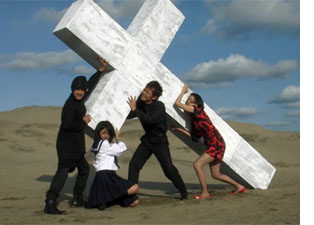 Still further out there on the Nutsometer is Love Exposure, your basic four-hour inquiry into Christianity, cross-dressing, superheroics, and schoolgirl underwear. The story starts with a boy who promises his mother he’ll marry a woman like the Virgin Mary, but thanks to digital photography and an acrobatic approach to filming schoolgirls’ nether regions, he becomes known to his peers as King of the Perverts. Director Sion Sono satirizes cult religions, which seems to include Catholicism (“Your sin is that you can’t remember your own sin”), while devoting some attention to pornographic movies and “Candle in the Wind.” Rambling and digressive, but rapidly paced, Love Exposure proves that nobody beats the Japanese for cheerful dirty fun. Still further out there on the Nutsometer is Love Exposure, your basic four-hour inquiry into Christianity, cross-dressing, superheroics, and schoolgirl underwear. The story starts with a boy who promises his mother he’ll marry a woman like the Virgin Mary, but thanks to digital photography and an acrobatic approach to filming schoolgirls’ nether regions, he becomes known to his peers as King of the Perverts. Director Sion Sono satirizes cult religions, which seems to include Catholicism (“Your sin is that you can’t remember your own sin”), while devoting some attention to pornographic movies and “Candle in the Wind.” Rambling and digressive, but rapidly paced, Love Exposure proves that nobody beats the Japanese for cheerful dirty fun.
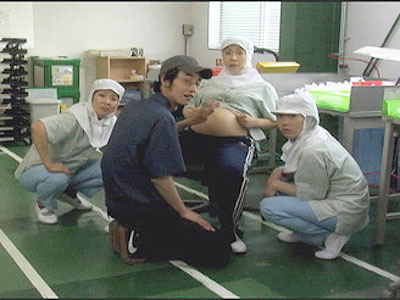
A more straightforward Japanese entry in the Asian Digital competition was Ichii Masahide’s Naked of Defenses (the most awkwardly titled film I saw). Two women work at a factory making plastic parts. Ritsuko, a plain but dogged supervisor, is becoming alienated from her husband after her miscarriage. She envies the pregnant and insouciant new hire Chinatsu, whose marriage is overcoming its problems. Plain and sincere in its technique, Naked of Defenses ends with an astonishing sequence. By all the evidence onscreen, Ichii got a pregnant woman to play Chikatsu and filmed her giving birth. Balancing this powerful ending is the striking performance of Moriya Ayako as a woman sinking into depression but who may be saved by friendship and maternal love.
I took the occasion to catch Departures at a local theatre, since I had missed it at earlier festivals. And I’m happy to report that it’s distributed in the US by Regent Entertainment, run by Wisconsin graduate and old friend Steven Jarchow.
By now you’ve probably seen Departures too. At one level, it’s a good old-fashioned Shochiku movie, mixing tears and good-natured humor. Some decry it as middlebrow sentiment, but I found it a touching, fluent tale. For me, the central attraction is the repertory of gestures. Our two professionals handle the recently deceased tenderly, but that doesn’t preclude a crisp efficiency in flaring out a sleeve. I don’t think I’ll forget the way the undertaker grasps the dead person’s clasped hands and then executes a circular snap. Precise manipulation becomes a sign of respect.
And it isn’t all sunniness. Handling dead bodies is hazardous cultural territory in Japan. It is traditionally a task for the burakumin, a minority group long looked down upon. Although discrimination against the group has apparently diminished, the fact that a big star like Motoki Masahiro could play the role of a corpse-preparer could help dispel a lingering social stigma.
You could almost mount a Japanese film festival about mortality. Some musts would be Ozu’s Brothers and Sisters of the Toda Family and Tokyo Story, Kurosawa’s To Live, and Kore-eda’s After Life. Another required item would be Dying at a Hospital (1993), a rarely seen Ichikawa Jun film screened as part of a tribute to the recently deceased director. It consists of staged episodes showing a few cancer patients in their last months. An elderly husband and wife both have cancer, but must separate and be treated in different hospitals. A widow laments her rotten luck. A lively young man can’t accept the fact that he won’t see his children grow up. A homeless man is brought in, filthy and disoriented, and as he becomes aware of his plight, he still apologizes for accidentally turning up his pocket radio.
These and other cases are accompanied by voice-over narration from the doctor and nurse who treat them. Interspersed with these scenes are rapid documentary montages of people enjoying life—eating, drinking, viewing cherry blossoms, celebrating festivals, just walking down the street. The intimate facial reactions we’re denied in the hospital scenes are supplied in these vérité passages.
Dying at a Hospital is gentle and sympathetic, but its manner of shooting gives it special resonance. The hospital scenes are shot in planimetric fashion, with the camera rigidly facing a row of three beds, or a pair of beds, or only a single one. Everything is played in long shot, with no close-ups or camera movements to enlarge the faces.
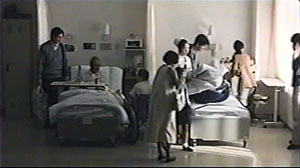
Patients, visitors, and hospital staff move through these blocks of space. The lighting effects are particularly subtle, accentuated by very gradual fade-ins and fade-outs, as if dawn were breaking or night were coming on. As the film goes on, Ichikawa introduces variations in scale and new cutting patterns, creating what I called in Narration in the Fiction Film a sparse version of parametric narration. For instance, the spaces become more compact as terminal patients are shifted from a shared room to a private one, which permits nuanced effects of distant depth.
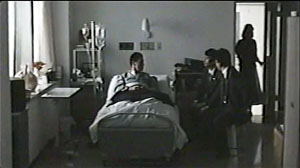
Ichikawa’s dry, physically detached treatment lets the poignancy of each situation emerge without any directorial boosting. The glimpses of daily life outside the hospital, zestful and shot on the fly, generate a powerful contrast: the preciousness of ordinary pleasures, and the dignity that must be accorded everyone about to leave them behind.
For a brief but sensitive appreciation of 35 Shots, see Ryland Walker Knight’s comments here–perhaps best read, for reasons mentioned above, after you’ve seen the film.

Departures.
Posted in Asian cinema, Festivals, Festivals: Hong Kong, Film technique, Film technique: Cinematography, Film technique: Staging, National cinemas: France, National cinemas: Germany, National cinemas: Japan | open printable version
| No Comments »
Wednesday | April 15, 2009
DB, in Hong Kong:
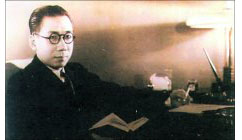 Fei Mu is a little-known name in the West, but on the evidence of even a few films, it’s clear that this mainland Chinese filmmaker was one of the finest working anywhere during the 1930s and 1940s. His best-known film, Spring in a Small Town (1948), was considered in the Maoist era an overliterary piece of sympathy for the bourgeoisie. Now things have changed. Many specialists today consider Spring in a Small Town the best Chinese film of all time. It’s an extraordinary work, anticipating Antonioni in its slow unfolding of an erotic situation, treated with a mixture of sympathy and austerity. It’s a great pity that the film isn’t available on good and subtitled DVD copies, though a digitally restored print was made in 2005. Fei Mu is a little-known name in the West, but on the evidence of even a few films, it’s clear that this mainland Chinese filmmaker was one of the finest working anywhere during the 1930s and 1940s. His best-known film, Spring in a Small Town (1948), was considered in the Maoist era an overliterary piece of sympathy for the bourgeoisie. Now things have changed. Many specialists today consider Spring in a Small Town the best Chinese film of all time. It’s an extraordinary work, anticipating Antonioni in its slow unfolding of an erotic situation, treated with a mixture of sympathy and austerity. It’s a great pity that the film isn’t available on good and subtitled DVD copies, though a digitally restored print was made in 2005.
Two other Fei Mu films I’ve seen show the variety and flexibility of his craft. Onstage, Backstage (1936) is a drama of theatre life, and its fluid figure movement in depth recalls Renoir. Very different is the expressionistic allegory Nightmares in Spring Chamber (1937), an episode in the portmanteau film called Lianhua Symphony. Fei presents the Japanese invasion of China as the pursuit of an innocent girl through dark sets by a leering, frock-coated Japanese. Other surviving Fei works, such as Blood on Wolf Mountain (1936), are also held in high regard. After Mao’s revolution, Fei Mu moved to Hong Kong, where he died at the age of 45. He directed no films in the Crown Colony.
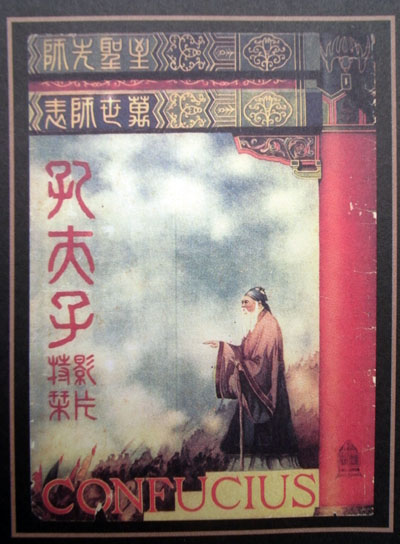
All this makes the discovery of a print of Confucius (1940) an event of capital importance. An anonymous individual donated a print to the Hong Kong Film Archive, which spent years restoring it in collaboration with L’Immagine Ritrovata of Bologna. In the donated print of Confucius, some portions of the soundtrack had liquefied, so some stretches are silent, and there are about nine minutes of fragments that have yet to be integrated.
At the premiere, a very useful booklet on the film’s restoration was given out, and moving introductory speeches were presented by Barbara Fei Ming-yee, the director’s daughter, and Serena Jin, daughter of the producer Jin Xinmin. The screening added electronic subtitles that not only translated the dialogue but identified each speaker—a helpful gesture for a film with many characters and a tangled intrigue.
I can’t comment on it as a representation of Confucius’ thought and life, although experts tell us that it is quite different from the elevated, almost sanctified portrayals that were known before. The plot dramatizes the ineffectuality of the sage’s ideals of civic virtue by showing how power players of his era ignored or undercut his teachings. Scenes from Confucius’ life alternate with scenes of political and military strategy, as warlords and statesmen debate tactics and, not incidentally, calculate how to eliminate Confucius. As Confucius migrates across China, he is unable to halt the continuous warfare among various factions. His disciples leave or die. Just before his death he has only his grandson to care for him. “A great educator, thinker, and philosopher,” Fei Mu writes in an essay, “Confucius was doomed a victim of the politics of his time.”
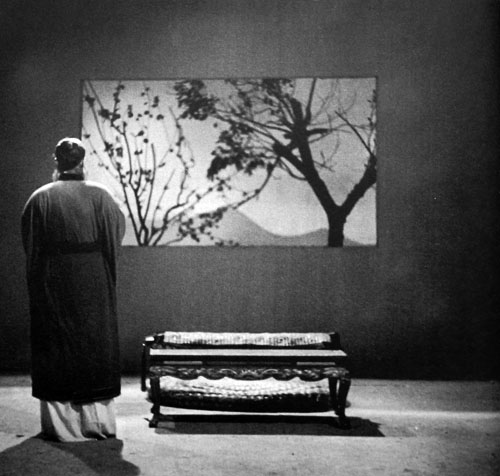
The film is slow-moving and hieratic. Some of the fragments show bits of violence, but the film as a whole relies on dialogue. Although some scenes unfold in natural exteriors, Fei Mu often employs theatrical tableaus, complete with painted landscapes; occasionally the actors cast shadows on the backdrops. The cutting is often axial, simply enlarging a chunk of space as actors declaim their dialogue. The nearly square Movietone frame enhances the symmetry of the compositions, which often feature a window or some other aperture.
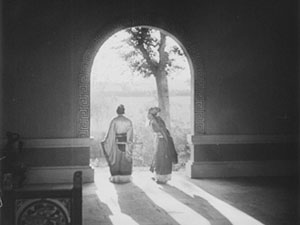
Knowing the fluid style of Fei’s 1930s films, we can only regard this rigid, rather ceremonial look as a deliberate artistic choice. In this respect, the film recalls Eisenstein’s Alexander Nevsky and Mizoguchi’s Genroku Chushingura, films of that era aiming to treat a weighty historical subject with solemnity. In Confucius, Fei seems to have been rethinking the relation of cinema to theatre, a quest that preoccupied other directors of the period and that remains important today. Wong Ain-ling’s essay in the booklet aptly notes Rohmer’s Perceval le Gallois as a more recent parallel, and the film likewise has some of the feel of the Straub/ Huillet version of Von heute auf morgen (1997). As often happens, Fei Mu feels like a modern filmmaker.
Confucius was shown across China in 1940 and 1941, and a reedited version was released in 1948. Fei Mu was so upset by the new cut that he took out a newspaper ad denouncing it. Wong Ain-ling, who prepared the documentation for the festival presentation, and Sam Ho, the Archive Programmer, have concluded that this print is likely to have been the re-release version. Sam told me that the archive staff would be spending the next year researching how to integrate the fragments and supply a sense of the original’s design. The Archive is planning to screen that restoration at next year’s festival. Whatever the experts come up with, surely this is a discovery that will be discussed and enjoyed for many years.
Posted in Asian cinema, Directors: Fei Mu, Festivals, Festivals: Hong Kong, Film comments, National cinemas: China | open printable version
| No Comments »
|