Friday | December 10, 2010
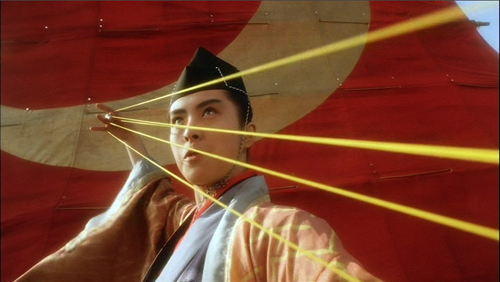
The East Is Red (1993).
DB here:
In about two weeks, we try something new here. It’s an experiment in self-publishing, like everything on this site, but this time we offer a new version of an oldish book.
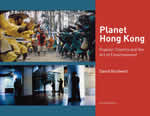
Planet Hong Kong was published in 2000. It sold pretty well for an academic book, shifting about 7000 copies through 2007. It was translated into Chinese twice, once in Hong Kong and once on the mainland. It also got encouraging reviews; I’ve put up links at the end of this entry.
At some point in 2008, Harvard University Press took the book out of print, a decision I learned about accidentally in spring of 2009. The story is here.
Since then, the book has become rather scarce; only about twenty copies are currently offered on Amazon. Rather than letting the poor thing fade away, I considered revising it for the web. The more I thought about it, the better the prospect looked. I could add as much to the text as I wanted. The text could be corrected, updated, and supplemented in the future. I could add photos, lots of them, and they could be in color. The text would be searchable. And instead of waiting nine to thirteen months to see the result, I could see it in weeks.
Moreover, readers could use the book as they liked. If it was presented as a pdf download, they could read it on a computer or on several models of e-book readers. They could also print out all or part of it. Interestingly, when I asked students and faculty if they’d use the book, nearly all said they’d print it, or let a facility like Kinko’s do it. All in all, it looked like an experiment worth trying.
[Insert montage of fluttering calendar pages here]
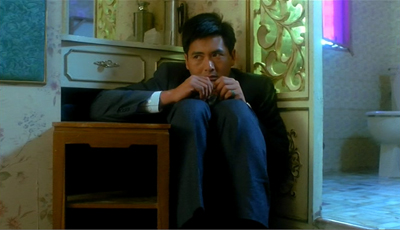
God of Gamblers (1989).
Since July I’ve spent virtually all my time on the book, with a break to go to the unmissable Vancouver film fest. Reworking the manuscript, watching and rewatching films, and preparing new material kept me from writing other things I had planned. No blog for Godard’s eightieth birthday, aiming to defend Film Socialisme as an intelligible part of his career. No web entry on the remarkable films of Kon Satoshi, creator of Perfect Blue, Millennium Actress, and The Girl Who Leaped through Time. No discussion of the 1950s-1960s art-cinema canon in the light of Tino Balio’s fine new book on that period in U. S. film culture. No speculations on the psychological processes aroused by a movie’s opening scenes. Maybe next year.
Instead, apart from two quick entries provoked by Inception, I was absorbed in Hong Kong movies on film and DVD, notes from ten years of film festivals and conferences, and plenty of books and websites. Two blog entries, one on coincidence and the other on Jackie Chan’s Police Story, were chips from the workbench. As for my seeing recent releases, The Social Network and Megamind have been about it.
Now, after a month of fourteen-hour days, Planet Hong Kong redux is close to ready. I hope to make it available on this site during the week of 20 December.
The beast has grown in captivity. The first edition ran about 130,000 words; the new version adds 40,000 words. (In defense, I remind you of Adorno explaining why The Authoritarian Personality turned out so long: “We didn’t have enough time to make it short.”) There are over 150 new stills, all in color and many from 35mm prints. But no clips! These films are too beautiful to be reduced to those wretched mutants you get on YouTube. Besides, I don’t have the rights.
Planet Hong Kong 2.0 will not be free. My Ozu and the Poetics of Cinema and Kristin’s Exporting Entertainment are free online, but neither of those was revised, and we absorbed comparatively little of the costs of production. By contrast, the digital PHK is the fruit of a lot of paid labor. Heather Heckman and Mark Minett did excellent scanning and Photoshop tweaking, and Meg Hamel, our web tsarina, designed the book and is making it web-ready. I’m still reckoning the cost of the e-book, but it will be $20 or less. Payment will be rendered unto Caesar, aka Caesar Bordwell, via PayPal.
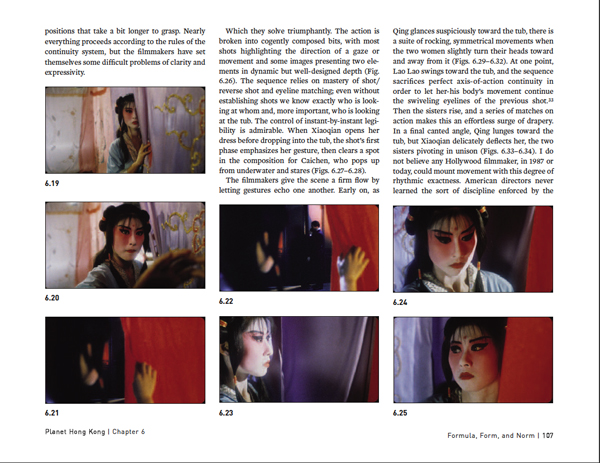
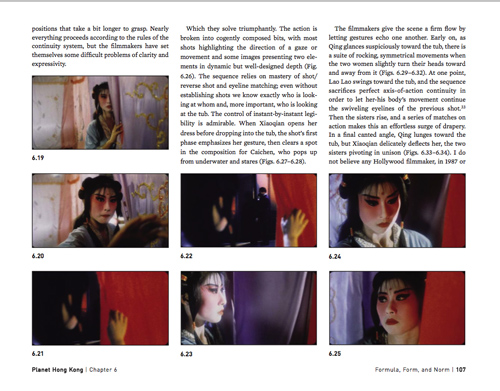
Here’s a sample page from our beta version. I’m still fiddling with the text, but the design looks to me like a nice compromise between the stability of a book page and the flow of a website. The file I’m using here is low-resolution, and this frame from it is a paltry 72 dpi jpeg, but the final pdf page should look very sharp. For curious boffins, the 35mm frame stills were scanned at 2000 dpi and reduced to 300 dpi for insertion. We don’t know yet how big the whole book’s file will be, but of course Meg will optimize it for downloading.
By the way: No, Wong Kar-wai did not invent the luscious image of the yearning woman.
Once the book is up, I plan to add a Hong Kong picture gallery to this site. It will include snapshots of celebs and fans from across the years 1995-2010.
ISNAQs (Infrequently, Sometimes Never, Asked Questions)
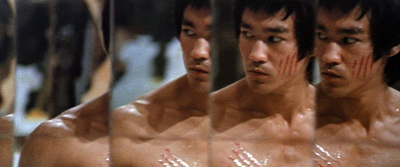
Enter the Dragon (1973).
PHK isn’t a comprehensive history of Hong Kong filmmaking; for that you must turn to Stephen Teo’s Hong Kong Cinema: The Extra Dimensions. Nor is it a fan’s guide to the wild and crazy side of this local cinema. Stefan Hammond’s two books handle that task nicely, and there are many similar handbooks since. Most strikingly, the fanboys have been usurped by the professors. A geyser of academic books and articles about Hong Kong cinema burst in the new millennium, along with invaluable documentation from the Hong Kong Film Archive and the Hong Kong International Film Festival. My book doesn’t rival these.
What does this book do, then?
I try to design my books in layers, with different implications and possibly different readerships, at each level. The first and founding layer of Planet Hong Kong is my effort to convey the sheer pleasure offered by this filmmaking tradition. I write as an enthusiast for other enthusiasts, and for potential converts. In this respect, PHK is an academic dressup of a noble gonzo tradition. Hong Kong cinema has benefited from the gusto of admirers like Ross Chen, Lisa Morton, Stephen Cremin, Grady Hendrix, Stefan Hammond, Chuck Stephens, Richard Corliss, David Chute, Howard Hampton, and other lively writers. This cinema inspires dazzling, sometimes headbanging appreciations from critics.
Next there’s a historical layer. Hong Kong cinema is, I’m convinced, an important “national school” in world film history. It shaped global popular culture to a degree matched only by the westerns and gangster films turned out by the Hollywood studios. Every video game that includes martial arts, every American action movie, and every comic book showing a sword-wielding superhero owe a lot to Bruce Lee and the cinema he springs from. Less obviously, Hong Kong innovated approaches to film form and style that remain striking today. When I wrote the book, this artistic heritage was almost completely unappreciated, by both general audiences and specialized film scholars. The situation is a little better now, but the case always needs restating. Through close analyses of many films and sequences, the book tries to show the originality and force of the Hong Kong touch.
Another layer up, the book asks how popular cinema works. The clichéd split between “art” and “business” isn’t much help in understanding mass-entertainment film. The business relies on artistic traditions, and those traditions in turn are born from and shaped by industrial factors–not just constraints but also enabling opportunities. Hong Kong film provides a case study in how a mass-entertainment movie builds its effects on genre, star appeal, storytelling strategies, and stylistic tactics. It shows vividly how a media industry relies on conventions, and how artists tap those, stretch them, and sometimes twist them out of recognition. My interviews with several writers, directors, choreographers, and actors helped me understand the ways that creativity could be fostered by craft traditions.
At the most general level, PHK is a small-scale demo of an approach to asking questions about cinema. It shows how we might systematically study the principles of construction informing popular filmmmaking. Stealth poetics, in other words.
The old and the new
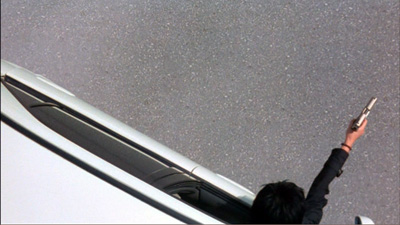
Leave Me Alone (2004).
The big changes in Asian cinema of the last decade make the original book something of a historical artifact itself. I did the research across the 1990s and wrote nearly all of it in 1998. Its emphases reflect issues circulating in fan and academic culture at that time. DVDs, introduced in 1997, had not become widespread, and VCDs were unwatchable. (Still are.) Most of the films that mattered had to be studied on film copies, although laserdiscs offered a passable backup in some cases. VHS tapes were seldom letterboxed, but laserdiscs often were.
The biggest constraint on the book was the scant availability of Shaw Brothers films on any format. Thanks to the Hong Kong International Film Festival, trips to archives, and the film collector’s market, I was able to see quite a few, but nothing like what’s available now in the massive and restored Shaw DVD library. Consequently, apart from the work of King Hu, Chang Cheh, and Lau Kar-leong, PHK doesn’t deal with the very interesting output of the territory’s most famous company. Fortunately, Shaws has been carefully studied in the years since my book, in a massive volume from the Hong Kong Film Archive and in Poshek Fu’s China Forever: The Shaw Brothers and Diasporic Cinema. For my part, this web essay and these blog entries try to make amends.
I could have recast PHK top to bottom, but I wasn’t convinced that I could come up something as pointed as the original. The text has been corrected, of course, and patches have been recast for greater clarity. It has also been enhanced by a few more examples, film sequences I referred to in passing but could not illustrate because I couldn’t find a print or couldn’t include color images. The chief updating is a series of sections added to the back end.
So here is what the book now looks like.
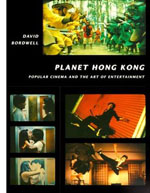 The first chapter broaches the general idea of an aesthetic of popular cinema. There follows an interlude comparing Hong Kong and Hollywood, focusing on The Untouchables and Gun Men. Instead of launching into a general history of local cinema, Chapter 2 sketches some general features of the territory’s film culture, concentrating on its audiences and its critics. The following interlude,”Two Dragons,” talks about Bruce Lee and Jackie Chan, the two most famous Hong Kong heroes. Chapter 3 provides a condensed history of Hong Kong filmmaking up to 1997. The next chapter, “Once Upon a Time in the West,” traces how Hong Kong film attracted fans and festival prestige. There’s an interlude devoted to John Woo, then the fanboys’ demigod. The first chapter broaches the general idea of an aesthetic of popular cinema. There follows an interlude comparing Hong Kong and Hollywood, focusing on The Untouchables and Gun Men. Instead of launching into a general history of local cinema, Chapter 2 sketches some general features of the territory’s film culture, concentrating on its audiences and its critics. The following interlude,”Two Dragons,” talks about Bruce Lee and Jackie Chan, the two most famous Hong Kong heroes. Chapter 3 provides a condensed history of Hong Kong filmmaking up to 1997. The next chapter, “Once Upon a Time in the West,” traces how Hong Kong film attracted fans and festival prestige. There’s an interlude devoted to John Woo, then the fanboys’ demigod.
Chapter 5 surveys the industry, with emphasis on filmmakers’ craft traditions (how stories are planned, scenes are cut, and so on). The interlude that follows takes Tsui Hark as an instance of a director who creatively reworked such traditions. Chapters 6 and 7 go into the most detail about the aesthetics of Hong Kong film, surveying the dynamics of genre, the star system, visual style, and plot construction. Between these two chapters is sandwiched an interlude devoted to Wong Jing, the most disreputable major filmmaker in the territory. The longest chapter, the eighth, explores the distinctive aesthetic of action pictures, from martial arts to contemporary crime movies. The interlude that follows discusses three outstanding directors in the martial-arts tradition: Chang Cheh, Lau Kar-leung, and King Hu. The final chapter of the original book considers how the premises of popular cinema can be adapted to create “art films.” The principal, but not sole, example is the work of Wong Kar-wai. The original book concluded with an analysis of Chungking Express.
The new material in this edition starts with a chapter on changes in the film industry since 1997. That’s followed by an interlude focusing on the Infernal Affairs trilogy, which was as you know the source for The Departed. The next chapter considers how the artistic trends surveyed in the first edition have changed over the last ten years or so. While discussing developments in genre, storytelling, technology, and style, the chapter includes sections on Stephen Chow (particularly Shaolin Soccer and Kung-Fu Hustle), Wong Kar-wai (In the Mood for Love and 2046), and Johnnie To Kei-fung. The final interlude is a more in-depth discussion of To’s crime films and their relation to the indigenous action-movie tradition. At the very end is a new bibliography and endnote citations.
Readers not drawn to Hong Kong cinema might find my more general arguments of interest. For example, I suggest that Hong Kong shows us how important regional and diasporan networks are in creating and maintaining a film culture. To the claim that films reflect their societies, I reply that Hong Kong films suggest a different way to think about such a dynamic, using the model of cultural conversation. Readers interested in fandom should find something intriguing in the story of how cultists around the world helped establish Hong Kong film as a cool thing in the early 1990s. I also argue against the tendency in film studies to assume that when a film tradition doesn’t follow the rules of classical plot construction it must be based on something called “spectacle.” I suggest instead that we need to study principles of episodic plotting, which are probably quite common in popular art generally. In these and other areas, I wanted to use this cinema as a way into thinking about popular moviemaking as a whole.
After World War II, a tailor shop in Hong Kong put up a sign: “Reopening soon. Sooner if possible.” The same goes for me: Planet Hong Kong Redux is coming soon. Sooner if possible.
Here are some reviews of Planet Hong Kong by Richard Corliss in Time Asia (said I typed in my shorts with a beer at my elbow), Paul F. Duke in Variety (liked the book, worried that I talked like a Marxist), an anonymous writer in The Economist (said I’m a scholar who writes as a fan), Steve Erickson in Senses of Cinema (noticed my appreciation of stars), Mina Shin for Framework (developed my suggestions about festival culture), Leon Hunt in Scope (liked book, called me an empiricist, which tickles me down to my sense data), and Shelly Kraicer at chinesecinemas.org (as usual, more generous than he should be).
The most unexpected mention of the book seems to have vanished from the web. A New York critic who is surprisingly easy to outrage made an interesting attempt to charge me with synergistic marketing. He proposed, in the midst of a pan of Tsui Hark’s Time and Tide, that PHK was a covert attempt to promote Crouching Tiger, Hidden Dragon, which had just won acclaim at Cannes. I wrote James Schamus, writer-producer of CTHD: “Now that we’ve been found out, we have to abandon our scheme to reprint my Dreyer book so as to coincide with Ang’s remake of Ordet.”
My quotation from Adorno may be apocryphal.
P.S. 13 December: Thanks to Daniel Erdman, I’ve now got the synergistic review mentioned above. It’s here. Thanks as well to Antti Alanen, who writes from Finland:
About ‘no time to be short’: quite possibly Adorno said so, and you are in good company:
Blaise Pascal: “Je n’ai fait celle-ci plus longue que parce que n’ai pas eu le loisir de la faire plus courte” (The Provincial Letters). J.W. von Goethe: »Da ich keine Zeit habe, dir einen kurzen Brief zu schreiben, schreibe ich dir einen langen« (letter to his sister Cornelia, but Goethe had apparently learned this from Cato and Cicero).
And soon after that came from Antti, Philippe Theophanidis wrote to point out the Pascal source as well. Once more I pay for the lack of a classical education!
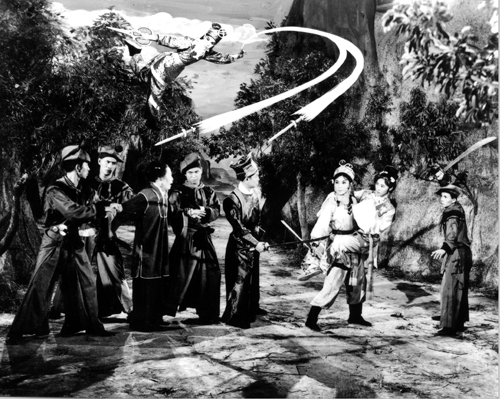
Golden Scissors Part I (1963). Famous martial-arts choreographer and director Lau Kar-leung is on the far right. Source: Hong Kong Film Archive.
Posted in Directors: Johnnie To Kei-fung, Directors: Tsui Hark, Festivals: Hong Kong, Film comments, Film history, Film technique, National cinemas: Hong Kong, PLANET HONG KONG: backstories and sidestories, Poetics of cinema |  open printable version
| No Comments » open printable version
| No Comments »
Sunday | December 5, 2010
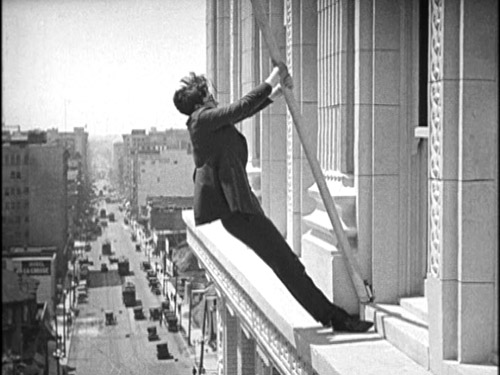
High and Dizzy
Kristin here:
Three years ago, we saluted the ninetieth anniversary of what was arguably the year when the classical Hollywood cinema emerged in its full form. The stylistic guidelines that had been slowly formulated over the past decade or so gelled in 1917. We included a list of what we thought were the ten best surviving films of that year.
In 2008 we again posted another ten-best list, again for ninety years ago. This annual feature has become our alternative to the ubiquitous 10-best-films-of-2010 lists that print and online journalist love to publish at year’s end. It’s fun, and readers and teachers seem to find our lists a helpful guide for choosing unfamiliar films for personal viewing or for teaching cinema history. (The 1919 entry is here.)
There were many wonderful films released in 1920, but, as with 1918, I’ve had a little trouble coming up with the ten most outstanding ones. Some choices are obvious. I’ve known all along that Maurice Tourneur’s The Last of the Mohicans (finished by Clarence Brown when Tourneur was injured) would figure prominently here. There are old warhorses like Das Cabinet des Dr. Caligari and Way Down East that couldn’t be left off—not that I would want to.
But after coming up with seven titles (eight, really, since I’ve snuck in two William C. de Mille films), I was left with a bunch of others that didn’t quite seem up to the same level. Sure, John Ford’s Just Pals is a charming film, but a world-class masterpiece? A few directors made some of their lesser films in 1920, as with Dreyer’s The Parson’s Widow or Lubitsch’s Sumurun. Seeing Frank Borzage’s legendary Humoresque for the first time, I was disappointed—especially when comparing it with the marvelous Lazy Bones of 1924. (Assuming we continue these annual lists, expect Borzage to show up a lot.) Chaplin didn’t release a film in 1920, and Keaton and Lloyd were still making shorts, albeit inspired shorts. Mary Pickford’s only film of the year, the clever and touching Suds, is a worthy also-ran. Choosing Barrabas over The Parson’s Widow or Why Change Your Wife? over Sumurun has a certain flip-of-the-coin arbitrariness, but we wanted to keep the list manageable. But they all repay watching.
The year 1920 can be thought of as a sort of calm before the storm. In Hollywood a new generation was about to come to prominence. Griffith would decline (Way Down East may be his last film to figure on our lists). Borzage will soon reach his prime, as will Ford. Howard Hawks will launch his career, and King Vidor will become a major director. The great three comics, Chaplin, Keaton, and Lloyd will move into features. In other countries, an enormous flowering of new talent will appear or gain a higher profile: Murnau, Lang, Pabst, Eisenstein, Pudovkin, Dozhenko, Kuleshov, Vertov, Ozu, Mizoguchi, Jean Epstein, Pabst, Hitchcock, and others. The experimental cinema will be invented, and Lotte Reiniger will devise her own distinctive form of animation. Watch for them all in future lists, which will be increasingly difficult to concoct
In the meantime, here’s this year’s ten (with two smuggled in). Unfortunately, some of these films are not available on DVD. They should be.
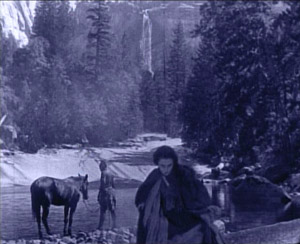
The great French emigré director Maurice Tourneur figured here last year for his 1919 film Victory. The Last of the Mohicans is just as good, if not better. I haven’t read the Cooper novel, set during the French and Indian War, but it’s obvious that Tourneur has pared down and changed the plot considerably. The sister, Alice, is made a less important character, with the plot focusing on two threads: the Indian attack on the British population as they leave their surrendered fort and on the virtually unspoken attraction between the heroine Cora and the Mohican Indian Uncas. The seemingly impassive gazes between these characters, forced to conceal their attraction, convey more passion than many more effusive performances of the silent period. The actress playing Cora also wore less makeup than was conventional, de-glamorizing her and making her a more convincing frontier heroine.
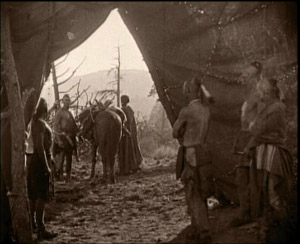
The film is remarkable for its gorgeous photography, with spectacular location landscapes, some apparently shot in Yosemite (below left). Tourneur’s signature compositional technique of shooting through a foreground doorway or cave opening or other aperture appears frequently (below right). (Brown’s account of the filming in Kevin Brownlow’s The Parade’s Gone By makes it sound as though he shot most of the picture, but in watching the film I find this hard to believe.)
Finally, the film stands out from most Hollywood films of its day for its uncompromising depiction of the ruthless violence of the conflict between the British and those Indians allied with the French. The scene in which the inhabitants of the fort leave under an assumed truce and are massacred can still create considerable suspense today, and the outcome puts paid to the notion that all Hollywood films end happily.
The word melodrama gets tossed around a lot, and many would think of much of D. W. Griffith’s output as consisting of little besides melodramas. But Way Down East is the quintessential film melodrama. An innocent young woman (Lillian Gish) is lured into a mock marriage and ends up deserted and with a baby. The baby dies and she finds a place as a servant to a large country family, where the son (Richard Barthelmess) falls in love with her. Her sinful status as an unwed mother leads the family patriarch to order her out, literally into the stormy night. She ends up on an ice flow, headed toward a waterfall. Along the way there’s comic relief from some country bumpkins and a naive professor who falls for the hero’s sister. It all works, partly because Griffith treats the main plot with dead seriousness and partly because Gish elicits considerable sympathy for her character.
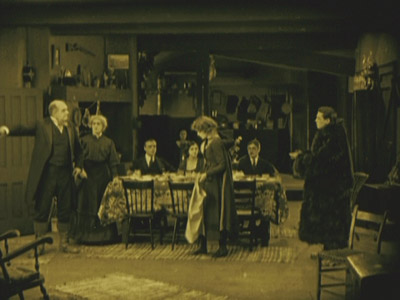
Not only is it a great film, but it provides a window into the past, preserving a popular nineteenth-century play and giving insight into the drama of that era. It’s hard to think of another feature film that conveys such a genuine record of the Victorian theater, directed by a man who had made his start on the stage of the same period. (Unfortunately the film does not survive complete. The Kino version linked above is from the Museum of Modern Art’s restoration, which provides intertitles to explain what happens during missing scenes.)
Way Down East displayed a conservative attitude toward sex that was rapidly receding into the past–at least as far as the movies were concerned. The same year saw two films that set the tone for the Roaring ’20s in their more risqué depiction of romantic relationships: Cecil B. De Mille’s Why Change Your Wife? and Mauritz Stiller’s frankly titled Swedish comedy Erotikon.
De Mille has featured on our previous lists, for Old Wives for New in 1918 and Male and Female in 1919. Why Change Your Wife? ramped up the sexual aspect of the plot, however, as a Photoplay reviewer made clear: “”Having achieved a reputation as the great modern concocter of the sex stew by adding a piquant dash here and there to Don’t Change Your Husband, and a little more to Male and Female, he spills the spice box into Why Change Your Wife?” The plot is not nearly as daring as this suggests. Gloria Swanson plays a wife who is straight-laced and intellectual, driving her husband to spend time with a stylish woman who tries to seduce him. Yet he flees after one kiss, and after his wife divorces him on the assumption that he has cheated on her, he marries the seductress. The heroine discovers the error of her ways and becomes sexy in her dress and behavior. As a result the husband regains his old love for her, and they remarry. No actual adultery occurs, and the first marriage is affirmed with a happy ending.
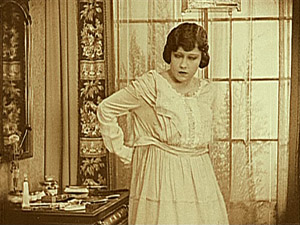 
Why Change Your Wife? may have seemed more daring because De Mille here externalizes the shifting relationships through the costumes to the point where no viewer could miss the implications. Initially the wife’s demure dresses mark her as prudish, while the woman who lures her husband away is dressed like a vamp. Once the wife lets go, she dons similar revealing, expensive designer clothes. As a result, the male members of the audience might revel in a fantasy of their ideal wife, and the women would delight in displays of fashions most of them could never own in reality. It proved a successful combination. We tend to forget it now, but the 1920s was full of variants and imitations of Why Change Your Wife?, often featuring a fashion-show scene that was nothing but a parade of models in outlandish clothes. (Early Technicolor was sometimes shone off in such sequences.) Top designers like Erté were recruited to bring their talents to such films.
Fashion as a selling point in films remains with us. The glossy new version of The Hollywood Reporter, recently decried by David, now has a regular “Hollywood Style” section. The November 24 issue ran “Costumes of The King’s Speech,” and the December 1 issue describes “Fashions of The Tourist,” with photos of Angelina Jolie in her various costumes. In addition to shots of the stars, both articles feature enticing close-ups of lipstick, shoes, jewelry,and purses.
A double feature of Why Change Your Wife? and Erotikon would provide a vivid sense of the differing moral outlooks of mainstream America and Europe in the post-war years. In Erotikon, the situation is reversed. An absent-minded entomologist neglects 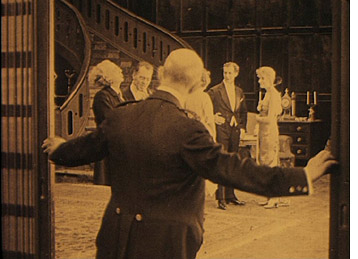 his sexy wife, who is having an affair with a nobleman. She is in love, however, with a sculptor, who is having an affair with his model. The sculptor returns her love, but eventually becomes jealous, not of her husband, who is his best friend, but of her lover. When the husband finds out that his wife has been unfaithful, he is mildly upset, but he settles down happily with his cheerful young niece, who pampers his taste for plain cooking and an undemanding home life. About the only thing these two films have in common is that they view divorce, which was still quite a controversial issue in the 1920s, as sometimes benefiting the people involved. Adultery actually occurs rather than being hinted at but avoided, though faithful monogamy is ultimately put forth as the ideal. his sexy wife, who is having an affair with a nobleman. She is in love, however, with a sculptor, who is having an affair with his model. The sculptor returns her love, but eventually becomes jealous, not of her husband, who is his best friend, but of her lover. When the husband finds out that his wife has been unfaithful, he is mildly upset, but he settles down happily with his cheerful young niece, who pampers his taste for plain cooking and an undemanding home life. About the only thing these two films have in common is that they view divorce, which was still quite a controversial issue in the 1920s, as sometimes benefiting the people involved. Adultery actually occurs rather than being hinted at but avoided, though faithful monogamy is ultimately put forth as the ideal.
Erotikon reflects some of the influences from Hollywood that were seeping into European films after the war. Sets are larger, cuts more frequent (though not always respecting the axis of action), and three-point lighting crops up occasionally. Yet Stiller maintains the strengths of the Scandinavian cinema of the 1910s, with skillful depth staging (left) and a dramatic use of a mirror. In the opening of a crucial scene where the sculptor confronts the wife with her adultery, tension builds because she does not know he is watching her until she sees him in the mirror (see bottom). Still, apart from its European sophistication, Erotikon could pass for an American film of the same era. Stiller and lead actor Lars Hansen would both be working in Hollywood by the mid-1920s.
I can’t allow the nearly unknown director William C. de Mille to take up two slots this year, though it’s tempting. William’s career was shorter than that of his much better-known brother Cecil. It peaked in 1920 and 1921, though, and I still look back fondly on the films by him that were shown in “La Giornate del Cinema Muto” festival of 1991. That year saw a large retrospective of Cecil’s films, and the organizers wisely decided to include a 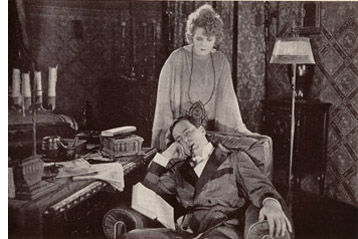 sampling of William’s surviving work. sampling of William’s surviving work.
The two men’s approaches were markedly different. Where Cecil by this point was setting his films among the rich and using visual means like costumes to make the action crystal-clear to the audience, William was more likely to favor middle-class settings with small dramas laced with humor and presented with restrained acting and small props. Despite William’s skill as a director and his ability to create sympathy for his characters, he never gained much prominence, especially compared to his brother. He retired from filmmaking in 1932, at the relatively young age of 54. Yet obviously he was attuned to his brother’s style, having written the script for Why Change Your Wife? It may be characteristic of the two that Cecil capitalized the De in De Mille, while William didn’t.
Relatively few of William’s films survive, but these include two excellent films from 1920, Jack Straw and Conrad in Quest of His Youth. I don’t remember Jack Straw well enough to describe it. It involved the hero’s falling in love with a woman when they both live in the same Harlem apartment building. When her family becomes rich, Straw disguises himself as the Archduke of Pomerania in order to woo her. Sort of a Ruritanian romance but played out in the U.S.
I remember Conrad in Quest of His Youth better. The hero returns from serving as a soldier in India. He feels old and decides to try and recover his youth. The first attempt comes when he and three cousins agree to return to their childhood home and indulge themselves in the simple pleasures of their youth. Eating porridge for breakfast is a treasured memory, but the group discovers that this and other delights are no longer enjoyable to them as adults. Conrad goes on to seek romance elsewhere and eventually finds a woman who makes him feel young again. The film’s poignant early section manages in a way that I’ve never see in any other film to convey both nostalgia for the joys of childhood and the sad impossibility of recapturing them.
Neither film is available on DVD. Indeed, I couldn’t find an image from either to use as an illustration. The only picture I located is a rather uninformative one from Conrad in Quest of His Youth, above right, which I scanned from William C.’s autobiography (Hollywood Saga, 1939). It’s no doubt an indicator of William’s modesty that the frontispiece of this book is a picture of his brother directing a film.
Maybe this entry will serve as a hint to one of the DVD companies specializing in silent movies that these two titles deserve to be made available. They’re high on my list of films I would love to see again.
Most people who study film history see Das Cabinet des Dr. Caligari very early on, though they probably push it to the backs of their minds later on. I have a special fondness for Caligari precisely because I did see it early on. I took my first film course, a survey history of cinema, during my junior year. Maybe I would have gotten hooked and gone on to graduate school in cinema studies anyway, but it was Caligari that initially fascinated me. It was simply so different from any other films I had seen in what I suddenly realized was my limited movie-going experience. It inspired me to go to the library to look up more about it, a tiny exercise in film research.
Some may condemn it as stage-bound or static. Despite its painted canvas sets and heavy makeup, however, it’s not really like a stage play. Many of the sets are conceived of as representing deep space, though often only with a false perspective achieved by those painted sets:
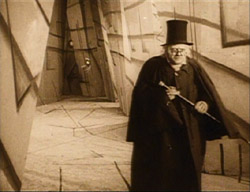 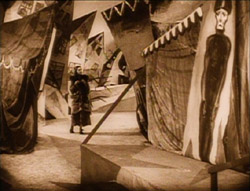
Still, in an era when experimental cinema was largely unknown, Caligari was a bold attempt to bring a modernist movement from the other arts, Expressionism, into the cinema. It succeeded, too, and inaugurated a stylistic movement that we still study today.
I haven’t watched Caligari in years (I think I know it by heart), but I’m still fond of it. The plot is clever grand guignol. It has three of the great actors of the Expressionist cinema, Werner Krauss, Conrad Veidt, and Lil Dagover, demonstrating just what this new performance style should look like. The frame story retains the ability to start arguments. The set designs area dramatically original, and muted versions of them have shown up in the occasional film ever since 1920. Even if you don’t like it, Caligari can lay claim to being the most stylistically innovative film of its year.
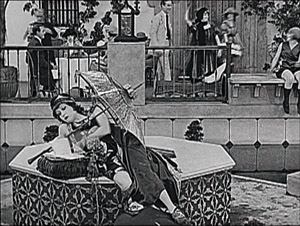
As I did for our 1918 ten-best, I’m cheating a bit by filling one slot of the ten with a pair of shorts by two of the great comics of the silent period. Both have matured considerably in the intervening two years. In 1918, Harold Lloyd was still working out his “glasses” character. By this point he is much closer to working with his more familiar persona. Similarly, in 1918, Buster Keaton was still playing a somewhat subordinate role in partnership with Fatty Arbuckle. In 1920, he made his first five solo shorts, co-directing them with Eddy Cline.
The Lloyd film I’ve chosen is High and Dizzy, the second short in which he went for “thrill comedy” by staging part of the action high up on the side of a building. (See the image at the top.) Four years later he would build a feature-length plot around a climb up such a building in Safety Last, one of his most popular films. In High and Dizzy, Harold is not quite the brash (or shy) young man he would soon settle on as the two variants his basic persona. The opening shows him as a young doctor in need of patients. He soon falls in love with the heroine, and through a drunken adventure, ends up in the same building where she lies asleep. She sleepwalks along a ledge outside her window, and when Harold goes out to rescue her, she returns to her bedroom and unwittingly locks him out on the ledge. The film is included in the essential “Harold Lloyd Comedy Collection” box-set, or on one of the two discs in Kino’s “The Harold Lloyd Collection,” Vol. 2.”
Neighbors was the fifth of the five Keaton/Cline shorts made in 1920. (It was actually released in early 1921, but I’ll cheat a little more here; there are other Keaton films to come in next year’s list.) It’s a Romeo and Juliet story of Keaton as a boy in one working-class apartment house who loves a girl in a mirror-image house opposite it. Two bare, flat yards with a board fence running exactly halfway between them separate the lovers. Naturally the two sets of parents are enemies.
Lots of good comedy goes on inside the apartment blocks, but the symmetrical backyards and the fence inspire Keaton. We soon realize that his instinctive ability to spread his action up the screen as well as across it was already at play. The action is often observed straight-on from a camera position directly above the fence, so that we–but usually not the characters–can see what’s happening on both sides. For one extended scene involving policemen, Keaton perches unseen high above them, hidden. Even though we can’t see him, the directors keep the framing far enough back that the place where we know he’s lurking is at the top of the frame as we watch the action unfold. The playful treatment of the yard culminates in an astonishingly acrobatic gag that brings in Keaton’s early music-hall talents.
The boy and girl have just tried to get married, but her irate father has dragged her home and imprisoned her in a third-floor room. She signals to Keaton, across from her in an identical third-floor window. A scene follows in which two men appear from first- and second-story windows below Keaton, and he climbs onto the shoulders of the two men below. This human tower crosses the yard several times, attempting to rescue the girl; each time they reach the other side, they hide by diving through their respective windows:
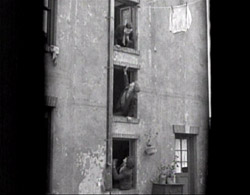 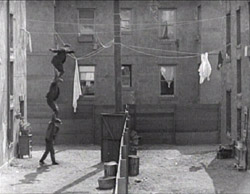 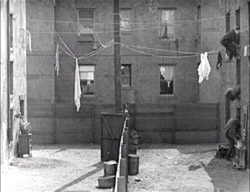
They perform similar acrobatics on the return trips to the left side, carrying the bride’s suitcase or fleeing after her father suddenly appears.
Neighbors is included as one of two shorts accompanying Seven Chances in the Kino series of Keaton DVDs, available as a group in a box-set.
Our final two films lie more in David’s areas of expertise than mine, so at this point I turn this entry over to him.
DB here:
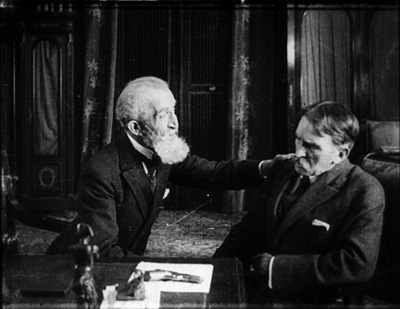
With Barrabas Feuillade says farewell to the crime serial. Now the mysterious gang is more respectable, hiding its chicanery behind a commercial bank. Sounds familiar today. As Brecht asked: What is robbing a bank compared with founding a bank?
Over it all towers another mastermind, the purported banker Rudolph Strelitz. In his preparatory notes Feuillade called him “a sort of sadistic madman, a virtuoso of crime . . . a dilettante of evil.” Against Strelitz and his Barrabas network are aligned the lawyer Jacques Varèse, the journalist Raoul de Nérac (played by reliable Édouard Mathé), and the inevitable comic sidekick, once again Biscot (so perky in Tih Minh).
The film’s seven-plus hours (or more, depending on the projection rate) run through the usual abductions, murders, impersonations, coded messages, and chases. But there’s little sense of the adventurous larking one finds in Tih Minh (1919), in which the hapless villains keep losing to our heroes. The tone of Barrabas is set early on, when Strelitz forces an ex-convict into murder, using the letters of the man’s dead son as bait. The man is guillotined. The epilogue rounds things off with a series of happily-ever-afters in the manner of Tih Minh, but these don’t dispel, at least for me, the grim schemes that Strelitz looses on a society devastated by the war. Add a whiff of anti-Semitism (the Prologue is called “The Wandering Jew’s Mistress”), and the film can hardly seem vivacious.
According to Jacques Champreux, Barrabas was the first installment film for which Feuillade prepared something like a complete scenario, although it evidently seldom described shots in detail. The film has a quick editing pace (the Prologue averages about three seconds per shot), but that is largely due to the numerous dialogue titles that interrupt continuous takes. With nearly twenty characters playing significant roles and some flashbacks to provide backstory, there’s a lot of information to communicate.
Of stylistic interest is Feuillade’s movement away from the commanding use of depth we find in Fantômas and other of his previous masterworks. Here the staging is mostly lateral, stretching actors across the frame. Very often characters are simply captured in two-shot and the titles do the work, as if Feuillade were making talking pictures without sound. Once in a while we do get concise shifting and rebalancing of figures, usually around doorways. Here Jacques vows to go to Cannes and tell the police of the kidnapping of his sister. As Raoul and Biscot start to leave, Jacques pivots and says goodbye to Noëlle, creating a simple but touching moment of stasis to cap the scene.
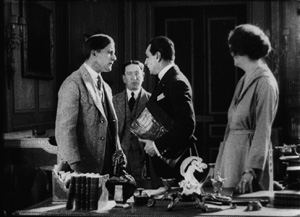 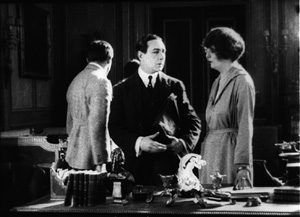 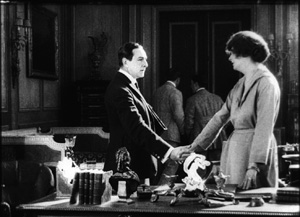
Full of incident but rather joyless, Barrabas will never achieve the popularity among cinephiles of the more delirious installment-films, but it remains a remarkable achievement. The ciné-romans that would follow until Feuillade’s death in 1925 would lack its whiff of brimstone. They would mostly be melodramatic Dickensian tales of lost children, secret parents, strayed messages, and faithful lovers. Barrabas is not available on DVD.
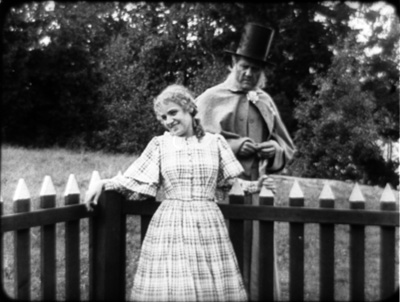
You might think that a movie that opens with a frowning old man studying a skeleton would also be somewhat unhappy fare. Such isn’t actually the case with Victor Sjöström’s generous-hearted Mästerman, a story of a village pawnbroker obliged to take a young woman as a housekeeper. With his stovepipe hat and air of sour disdain, Samuel Eneman, known to the village as Mästerman, is a ripe candidate for rehabilitation. Once Tora is installed and has put a birdcage (that silent-cinema icon of trapped womanhood) on the window sill, the scene is set for Mästerman’s return to fellow feeling. But she is there merely to cover the debts and crime of her sailor boyfriend, and eventually Eneman realizes he must make way for young love. The drama is played out in front of the townspeople, and as often happens in Nordic cinema (e.g., Day of Wrath, Breaking the Waves) the community plays a central role in judging, or misjudging, the vicissitudes of passion.
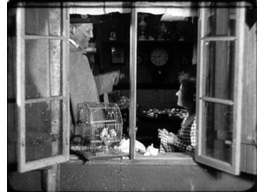 As a director Sjöström is a marvel. His finesse in handling the 1910s “tableau style” shines forth in Ingeborg Holm (1913), but unlike Feuillade and most of his contemporaries, he immediately grasped the emerging trend of analytical editing. His The Girl from the Marsh Croft (1917) and Sons of Ingmar (1918-1919) show a mastery of graded shot-scale, eyeline matching, and the timing of cuts. In Mästerman he continued to use brisk editing and close-ups to suggest the undercurrents of the drama. He moves people effortlessly through adjacent rooms, and his long-held passages of intercut glances recall von Stroheim. On all levels, Mästerman deserves to be more widely known–an ideal opportunity for an enterprising DVD company. As a director Sjöström is a marvel. His finesse in handling the 1910s “tableau style” shines forth in Ingeborg Holm (1913), but unlike Feuillade and most of his contemporaries, he immediately grasped the emerging trend of analytical editing. His The Girl from the Marsh Croft (1917) and Sons of Ingmar (1918-1919) show a mastery of graded shot-scale, eyeline matching, and the timing of cuts. In Mästerman he continued to use brisk editing and close-ups to suggest the undercurrents of the drama. He moves people effortlessly through adjacent rooms, and his long-held passages of intercut glances recall von Stroheim. On all levels, Mästerman deserves to be more widely known–an ideal opportunity for an enterprising DVD company.
For a valuable source on Feuillade’s preparation for Barrabas and other of his works see Jacques Champreux, “Les Films à episodes de Louis Feuillade,” in 1895 (October 2000), special issue on Feuillade, pp. 160-165. I discuss Feuillade’s adoption of editing elsewhere on this site.
Tom Gunning provides an in-depth discussion of Sjöström’s style at this period in “‘A Dangerous Pledge’: Victor Sjöström’s Unknown Masterpiece, Mästerman,” in Nordic Explorations: Film Before 1930, ed. John Fullerton and Jan Olsson (Sydney: John Libbey, 1999), pp.204-231. For more on some of the directors discussed in this entry, check the category list on the right.
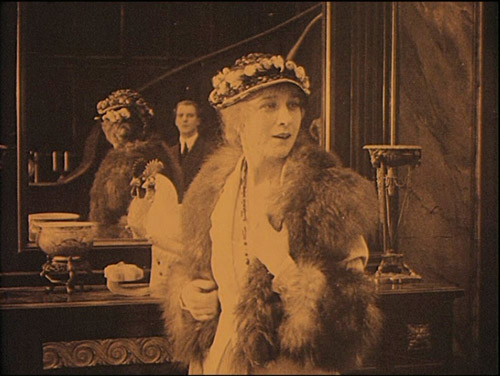
Erotikon.
Posted in 1910s cinema, Directors: Feuillade, Directors: Griffith, Directors: Keaton, Directors: Lloyd, Harold, Directors: Sjöström, Film comments, Film history, Film scholarship, Film technique: Cinematography, Film technique: Staging, Hollywood: Artistic traditions, National cinemas: France, National cinemas: Germany, National cinemas: Sweden, Silent film, The Ten Best Films of... | open printable version
| No Comments »
Sunday | November 28, 2010
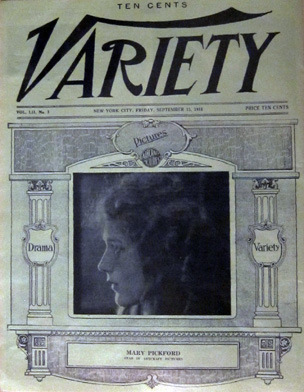 
DB here:
Over the last couple of months, some strange things have been happening to America’s most venerable show-business trade papers. In the case of Variety, the strange thing is very important and yields almost unalloyed good news. In the case of The Hollywood Reporter, the strange thing is, at least for the moment, a step backward.
Kristin and I have subscribed to weekly editions of both newspapers since the mid-1990s. With the advent of Web 2.0, each paper created an online archive, more or less searchable, stretching back into the 1990s. Not everything you would wish for, since Variety started publishing in 1905 and The Hollywood Reporter began in 1930. But film historians are grateful for anything. I found both papers’ archives very helpful in reworking Planet Hong Kong over the last year. Now, however, some of the recent happenings affect our ability to do research.
Issues about issues
First the bad strange new thing. In a collapsing advertising market, The Hollywood Reporter has done a makeover. From being a daily and weekly trade paper it turned into an upscale lifestyle weekly, sort of an industry-slanted version of Vanity Fair‘s movie issue, with a soupçon of airline magazine. Among the recycled press releases, superficial interviews, soft-focus profiles, and awards-season handicapping, you find fashion tips like “Into the Blue: Punch up your executive look—top to toe—with the season’s blockbuster hue.” There’s also the sort of feature that movers and shakers can use to promote themselves: “Hollywood’s Young Guns ….Where they work, why they matter, how they’re changing the game.”
True, Variety sometimes resorted to such frippery in these desperate years. V-Life was in some ways a forerunner of the new HR, but V-Life was a supplement. In the main paper you could still find reportage, analysis, overviews, and opinion. There’s relatively few of these ingredients in the new Hollywood Reporter.
If this is the strategy for fighting Movie City News and Deadline Hollywood and IFC, I’m betting on the webroots.
Anyhow, forget the daily THR ephemera. I want to go into the past, as I did until October, scrambling through elusive coverage of Hong Kong stuff. Problem is: I can’t do that any more.
THR not only remade its magazine; it remade its website, radically. So radically that when I go there via Safari or Chrome I get this welcome.

Well, you say, skip your bookmarks and go through Google. But then:

Only Firefox does the trick.

Anyhow, at last I’m on. Breaking News today starts with “Jennifer Grey Wins ‘Dancing with the Stars’; Bristol Palin Comes in Third.” Skip that. As a subscriber, I ought to be able to log in to the proprietary content, right?
Here is the routine. Using my old password, I have no luck. When I call the 800 number, an ominous recording tells me that they are aware of the “issues” (what we used to call “problems”) with the website and subscriber logins. After half an hour, a hard-working person answers and with a few magic passes of her mouse she gets me into the subscriber areas.
Yet the next time I try, I’m refused again. So I write to the email service they announce, and immediately get a form reply saying that my problem will be addressed in 1-2 business days. The next communiqué, from some days later, begins: “We apologize for the delayed response.” They give me a password which is suspiciously generic.
This has been going on for nearly three weeks. But I can live with it because I’m not so concerned with Jennifer Grey or Bristol Palin. I’m there for the archive.
Problem is, the Archive isn’t there for me. Once I’m inside as a subscriber, I find no way to get into the two decades of stories and stats I could reach under the earlier incarnation of the website.
Another call, another recording apologizing for the “issues,” another half-hour of wait, and now a very puzzled answerperson. Where’s the Archive? Nobody ever asked him that before. He’s no better than I am at finding a button for it. He consults his supervisor. The supervisor doesn’t know where the Archive went either.
You can search the site, he points out. True, but the search takes me only to items posted since the makeover began.
Hmmm. The best they can do is suggest I call the Editorial Offices. When I do, the recording instructs me to leave my story tip and someone will get back to me. I might say, “Psst, I have it on good authority that the next big color will be vermillion,” but instead I hang up.
Trying tonight, I find that the search function now turns up articles published throughout calendar 2010, but no earlier. So maybe THR will gradually expand its backfile. It would be too bad if the dolled-up version of the print mag drained resources from maintaining a stable and deep website. I worry that THR intends to dump the old (already very partial) online archive altogether, resetting the clock at the year of the makeover. If so, they send a signal that the past—theirs, that of the industry they cover—doesn’t matter. They wouldn’t even agree with Jack Valenti, who supposedly did say, “It’s only history,” and then opened the MPPDA papers for research.
Infinite Variety
13 September 2010 was the date of the good thing that happened to the trade papers. At that point, Variety went the opposite direction of The Hollywood Reporter. It opened up its vault completely.
For many years film historians have relied on Variety for detailed information about how Hollywood and other national industries have worked. Most of these historians have scanned the paper on microfilm, cranking through reel after reel, getting dizzy from the whizzing lines your eyes try to fasten on. But these scholars managed to do real research. You couldn’t believe everything you read in the paper, of course; you had to be skeptical. Still, getting something was always better than getting nothing.
More recently, Variety has kept an online archive of its materials since the early 1990s. These stories were in html-friendly format, not in the form of published pages, and some stories that appeared in the paper never made it online or were revised for the net. Older stories, mostly film reviews, were summarized and undated. So as records, they were only partly reliable. Still, even this iceberg-tip was well worth surveying.
In September, though, Variety put online its back file from 1906 to the present. Every page of the weekly and daily paper has been digitized. You can access it for a year for a $600 subscription fee, probably what many people pay for designer coffee over the same period. If you want shorter-term access, $60 gets you into up to 50 issues per month.
Reader, I signed up.
There were teething pains for a few weeks. Some pages failed to load, and often you had to scroll through an entire issue to find the page you wanted. But those “issues” are mostly in the past. Now you can plunge into an ocean of well-mapped movie coverage.
As usual with people of my generation, I’m shaken by the abrupt transition from a research economy of scarcity to one of overabundance. Had this bounty existed when Kristin and Janet Staiger and I wrote The Classical Hollywood Cinema, we might still be writing it. Type in “John Ford” or “Meet Me in St. Louis” and you’re led into the labyrinth, with one item teasing you to search others, forever.
Some things, for instance, seem never to change. “CINEMAS TO SURVIVE HI-TECH ERA,” wrote A. D. Murphy in the 4 August 1982 issue’s top story. People were claiming that the theatre experience would soon vanish (presumably because of home video, although that’s barely mentioned). No way, says Murphy, citing several reasons, including the plausible assumption that “Nothing yet has managed to keep young people confined to their homes.” He adds that going out to the movies is the most robust form of “pay per view….free of all that bother of billing, dunning, disconnects and such.”
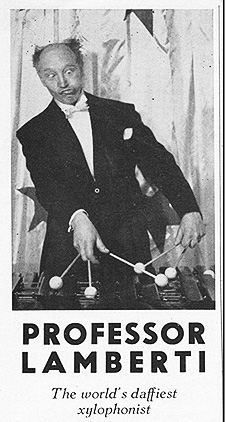 Yet a stroll through the vault can also remind you of how strange things were back then. How’d you like to sit through a live opening act before Citizen Kane? Variety tells us that in San Francisco’s Golden Gate theatre in early September 1941, Kane did brisk business at popular prices. It was accompanied by the vaudeville act of one Prof. Lamberti. The local Hearst newspapers, while refusing to advertise Kane for the unsurprising reason that Hearst thought the movie was about him, did advertise Prof. Lamberti’s act at the house. He was worth paying attention to. He never made snide fun of Marion Davies. Yet a stroll through the vault can also remind you of how strange things were back then. How’d you like to sit through a live opening act before Citizen Kane? Variety tells us that in San Francisco’s Golden Gate theatre in early September 1941, Kane did brisk business at popular prices. It was accompanied by the vaudeville act of one Prof. Lamberti. The local Hearst newspapers, while refusing to advertise Kane for the unsurprising reason that Hearst thought the movie was about him, did advertise Prof. Lamberti’s act at the house. He was worth paying attention to. He never made snide fun of Marion Davies.
But who was Prof. Lamberti? A magician, a musician, a real prof? We check Variety for 22 March 1950 and learn from his obituary that “Professor” Lamberti was a comedian who played on stage and in nightclubs. According to the obit:
Lamberti’s best known act was playing the xylophone, while shapely gal did a striptease back of him and he was apparently unaware of the goings on. This provided the delusion that successive encores on the semi-classic tunes such as “Listen to the Mocking Bird” were prompted by the audience’s music appreciation, rather than the bumps and grinds of the peeler. Howl finish had the comic get hep and seltzer squirt the gal off stage.
I ask you: How could a red-blooded American male viewer concentrate on the ambiguities of Thompson’s quest after an opening act like that? And as a mood-setter for the opening sequence at Xanadu, the World’s Daffiest Xylophonist might not be ideal. Even more striking, we learn from the same obit that Prof. Lamberti did his signature bit in the film Tonight and Every Night (1945) with Rita Hayworth “as the strip-gal”—the same Rita Hayworth who was then married to Citizen Kane’s director.
Aha, you say, but Wikipedia has an article on Prof. Lamberti too, and with more details than the Variety obit. (Please visit this orphan entry; it needs hits.) I would never badmouth Wikipedia, that wonder of our young century, but it’s not yet the poor man’s Variety vault. For one thing, it doesn’t use the phrase “bumps and grinds of the peeler.” Further, I can find no help on Wikipedia on a looming question that has vexed some of our best minds: At what aspect ratio should Lang’s While the City Sleeps (1956) be shown?
A lack of ‘Scope
There is a full-frame version occasionally broadcast on Turner Classic Movies and now available on Region 2 DVD. There’s also a 1.66 crop that was released on laserdisc many years ago. Some older cinephiles recall seeing a widescreen anamorphic version circulating on 16mm. Yet Lang apparently claimed he did not shoot the film in anamorphic widescreen.
When While the City Sleeps was made, the releasing studio RKO was supporting a widescreen system called SuperScope. That’s what Variety called it, anyhow, though sometimes you’ll see the name with a small middle s, or with “Super” italicized.
Invented by the brothers Joseph and Irving Tushinsky, SuperScope was a progenitor of the Super-35mm system of today. A film shot in standard full-frame 35mm would be turned into an anamorphic one. A portion of the frame was extracted, optically squeezed, and printed as an anamorphic image, which would then be unsqueezed in projection. The aspect ratio was 2.0:1. The reasoning was that it was easier to shoot a movie in the standard way and then “SuperScope” it than it was to shoot a CinemaScope film. Some projectionists called this process BogusScope, not just because it was fake but because Benedict Bogeaus was then a producer feeding projects to RKO, and some of his titles used the format.
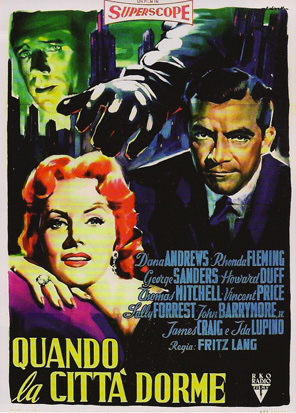
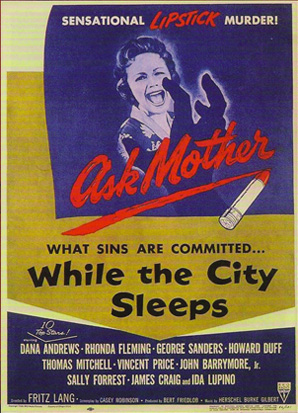
Slightly Scarlet and Invasion of the Body Snatchers, both released in 1956, were designed to be given the SuperScope treatment. The films carry the logo in their credits, and contemporary Variety reviews mention the process by name (15 February 1956 and 29 February 1956). The accompanying Italian poster for While the City Sleeps also makes reference to the SuperScope process. But there is no mention of SuperScope on the release print, or in the Variety review (2 May 1956), or in the US release poster, or in the pressbook kindly posted online by TCM.
Lang is on record, in Peter Bogdanovich’s Who the Devil Made It, as saying that he disliked CinemaScope. He told Bogdanovich that he agreed with his famous claim in Godard’s Contempt that “CinemaScope is only good for snakes and funerals” (p. 224). But SuperScope is not CinemaScope (which is 2.35:1 or sometimes even wider), and moreover Lang made one of the better CinemaScope films in Moonfleet (1955). So the question can’t immediately be resolved on auteur grounds.
Moreover, SuperScope prints of While the City Sleeps do exist. I found one in a European archive some years ago. It was pretty fuzzy (a chronic problem with SuperScope prints, because of the rephotography involved), but I took some frames from it. Here are some comparisons with the 1.37 DVD.
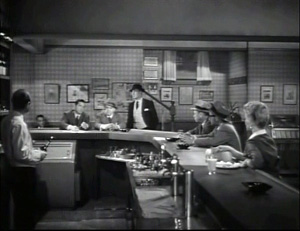 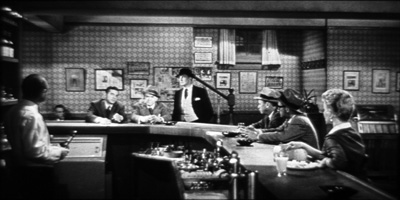
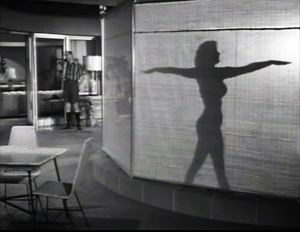 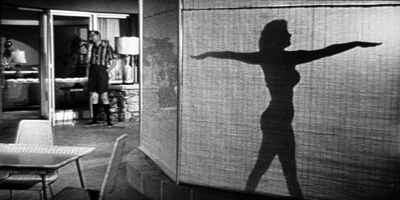
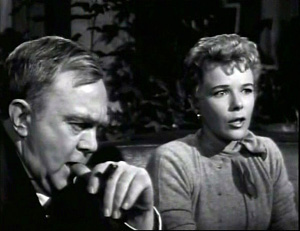 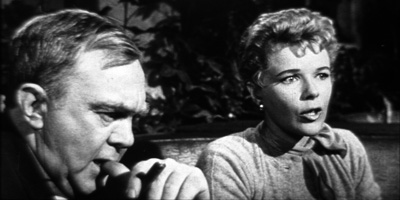
For my purposes here, I could have simply cropped and blown up the full-aperture frame grabs, but I’d rather preserve the slightly bulgier quality that seems to have come with the anamorphic optics. Also, because the wider versions are from 35mm frames, they include a little more area on the sides, which is lost in video versions like my DVD grabs on the left.
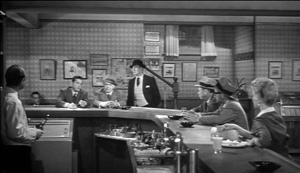
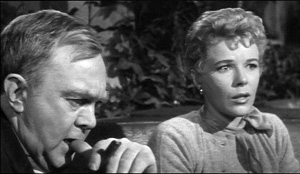
Actually, the widescreen version isn’t terribly offensive to me. For one thing, it slices off that slab running across the top of the bar set in the first image above. But in some cases the change in shot scale and internal relations make for mild differences in emphasis. The SuperScope version brings characters quite a bit nearer to us. Do they also seem seem closer together? There’s also the matter of taste. Some will dislike the headroom in the left shot below, while noting that the right one looks like a classic early ‘Scope composition.
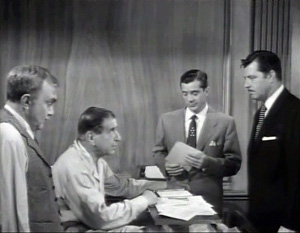 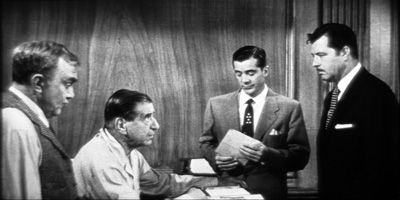
So which one is the original? You can sample the online cinephile discussions from 2003 onward here and here and here. The ever-diligent folks at DVD Beaver have much to add as well.
Fortunately, about five minutes of snooping in the Variety vault reveals the answer.
Joseph and Irving Tushinsky yesterday concluded a contract with RKO for conversion of “While the City Sleeps” into the SuperScope process for foreign release (“SuperScoping ‘City,’” Variety, 12 April 1956, p. 3).
According to other stories in Variety, several films were given the SuperScope treatment ex post facto, including a re-release of Olivier’s Henry V (1945).
So we can confirm the hunch expressed by some of the cinephiles above that the SuperScoped copies were destined for overseas screenings. The Variety vault proves useful for things both great and small. Okay, mostly small, but you get my point.
Scoping things out: An epilogue for ratio fetishists
SuperScope logo for Invasion of the Body Snatchers.
There’s still all that headroom in the full-frame images. That roominess is fairly uncharacteristic of Lang. In his pre-widescreen films, he used the whole frame, even the corners. Try SuperScoping this tightly-packed shot from Kriemhilde’s Revenge.

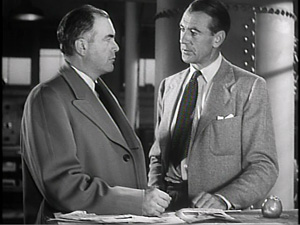
In Cloak and Dagger, Cooper’s character uses the apple on the workbench to explain the power locked up in the atom, and apples will become thematically significant in a later Adam-and-Eve scene.
Moonfleet also takes advantage of the lower right corner (see the image at the very end of today’s entry). But Lang’s last two American films, While the City Sleeps and Beyond a Reasonable Doubt (1956), seem to me to have more open and less compact compositions. There’s quite a bit of unused furniture in City‘s mise-en-scene, even though it adds a Vidor-Fountainhead air of vastness.
At this point we should recall that by 1956, most U. S. theatrical releases were shown in something wider than 1.33. There was a lot of variability, but films were commonly cropped in printing or projection to 1.66 or 1.75 or 1.85. Even if Lang did not shoot City with an anamorphic ratio in mind, he might well have assumed there would be cropping to some wide ratio. The approximately 1.75 ratio seen on the laserdisc version looks like a reasonable compromise between the extremes.
 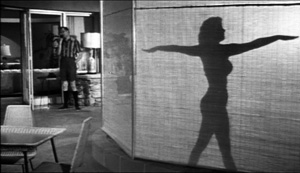
 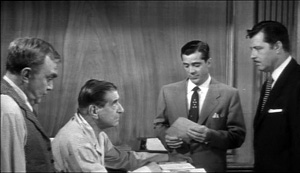
I’m inclined to say that Lang expected the film to be cropped somewhat in projection, but probably not to the full 2.0 proportions. He could no longer count on projectionists’ framing a single ratio, so he doesn’t tuck details along the edges or into the corners.
Unfortunately, I can’t find confirmation of Lang’s wide-frame choices in the fabled Variety vault. But I’m still looking, there and elsewhere. And maybe some researcher reading this entry can clarify things further. In any case, Variety has given a magnificent gift to those of us interested in film history–who ought to be everybody.
The standard source on widescreen systems of the postwar era is Robert E. Carr and R. M. Hayes, Wide Screen Movies: A History and Filmography of Wide Gauge Filmmaking (Jefferson, NC: McFarland, 1988). Carr and Hayes discuss SuperScope, or as they call it SuperScope (the credit logo is actually in caps, as in SUPERSCOPE) on pp. 67-72 and list the films in that format on p. 104. They don’t include While the City Sleeps. See also Daniel Sherlock’s comments on the book at Film-Tech.
Writing this has led me to wonder whether the admiration of European, especially French, critics for While the City Sleeps is based on their seeing the anamorphic version. In their writings I haven’t found specific reference to SuperScope. Raymond Bellour’s probing 1966 essay “On Fritz Lang” is one of the few I know from that period to scrutinize the patterns of composition and framing in While the City Sleeps, but I can’t tell whether he’s referring to the widescreen version. An English translation is in Fritz Lang: The Image and the Look, ed. Stephen Jenkins; see pp. 31-35.
Although Turner Classic Movies has run While the City Sleeps in 1.37, the TCM website recommends that it play at 1.66. Interestingly, the illustrations in Tom Gunning’s Films of Fritz Lang are in about 1.75:1 ratio. Another SuperScope production, Jacques Tourneur’s Great Day in the Morning (1956), runs on TCM in this ratio. Since projectionists of the period, and still today, are fairly flexible about ratios, it’s possible that even anamorphic 2.0 SuperScope was projected with a little trimmed from the sides.
A DVD release of Invasion of the Body Snatchers includes both a SuperScope 2.0 version and a 1.37 one. But the 1.37 one is a pan-and-scan version of the SuperScope one, not the integral frame that SuperScope worked from. The DVD version of Slightly Scarlet from VCI International is framed at 1.78, and the transfer (of poor optical quality) has been bungled so that everything is slightly stretched left to right. Both Arlene Dahl and Rhonda Fleming are more zaftig than they should be.
For more on aspect ratios, you can go here and here on this site. I experiment with extracting ‘Scope proportions from a 1930s movie in a general essay on widescreen aesthetics, “CinemaScope: The Modern Miracle You See without Glasses,” in Poetics of Cinema, p. 323.
Correction (28 November 2010): The original version of the piece claimed that the Search function of the Hollywood Reporter website found only pieces published since the recent makeover. That was the case when I used it two weeks ago. A more recent search I conducted this evening turned up articles from throughout 2010. I have recast the entry to reflect this change.
PS (17 December 2010): More developments on the Hollywood Reporter backfile, and more on the uses of the Variety Vault are discussed in this later entry.
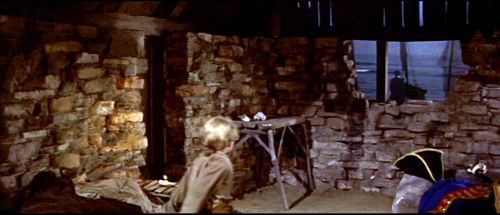
Moonfleet.
Posted in Directors: Lang, Film technique: Cinematography, Film technique: Staging, Film technique: Widescreen, Hollywood: Artistic traditions, Hollywood: The business | open printable version
| No Comments »
Wednesday | November 24, 2010
KT (working away on Amarna artifacts in London) + DB (working away finishing Planet Hong Kong 2.0):
Here in the US it’s the Thanksgiving holiday, so we’re taking off this week. In the meantime, we want to thank all the readers who visit our site. Next week we’ll return with more bloggy thoughts.
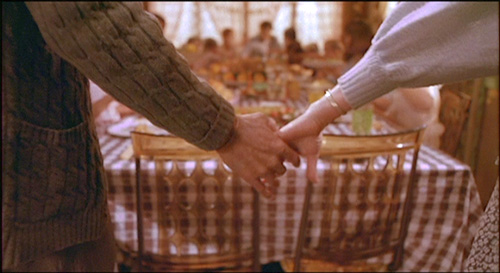
Raising Arizona.
Posted in Film comments | open printable version
| No Comments »
|