Thursday | January 20, 2011
Kristin here–
On August 28, 2009, I posted an entry called “Has 3-D Already Failed?” As I wrote then, my title was deliberately provocative. It depended on which of two yardsticks you measured success by:
1. If you’re Jeffrey Katzenberg and want every theater in the world now showing 35mm films to convert to digital 3-D, then the answer is probably yes. That goal is unlikely to be met within the next few decades, by which time the equipment now being installed will almost certainly have been replaced by something else.
2. It also seems possible that the powers that be will decide that 3-D has reached a saturation point, or nearly so. 3-D films are now a regular but very minority product in Hollywood. They justify their existence by bringing in more at the box-office than do 2-D versions of the same films. Maybe the films that wouldn’t really benefit from 3-D, like Julie & Julia, will continue to be made in 2-D. 3-D is an add-on to a digital projector, so theaters can remove it to show 2-D films. Or a multiplex might reserve two or three of its theaters for 3-D and use the rest for traditional screenings.
If the second, more modest goal is the one many Hollywood studios are aiming at, then no, 3-D hasn’t failed. But as for 3-D being the one technology that will “save” the movies from competition from games, iTunes, and TV, I remain skeptical.
So, nearly 17 months later, where do we stand? There has been a considerable increase in the number of screens with 3D projection systems, from 4,400 in May 2010 to 8,770 in early December. That’s out of roughly 38,000. This growth presumably came in response to the huge success of Avatar and Alice in Wonderland. Anne Thompson’s “Year-End Box Office Wrap 2010” quotes Don Harris, Paramount’s executive vice-president of distribution: “There are more screens, so a theater can now handle anywhere from two to three 3-D films at one time.” By year’s end, there were roughly 13,000 3D-equipped screens outside the North American market. The number of 3D films per year has grown from 2 in 2008 to 11 in 2009 to 22 in 2010 to an announced 30+ for this year.
Thompson also points out two other important strengths of 3D films: they sell a lot of tickets abroad, often earning three times as much as in the North American market, and they have led to theatrical income is “again the leading film revenue stream.” Of course, that’s partly due to the drop in DVD sales.
Yet for some the bloom seems to be off the rose. Low-budget exploitation films in 3D, films shot in 2D and converted for 3D release, filmgoer impatience with ticket surcharges and clunky glasses, and a general decline in the novelty value of 3D have all combined to leave its future still in doubt.
Before going more deeply into those problems, though, let’s look at the box-office successes, or apparent successes, of 3D films in 2010.
3D props up the box office
This week’s print version of The Hollywood Reporter heralds 2010 as “The year that was saved by 3D.” (For subscribers, the article is online, though it lacks the charts.) As Pamela McClintock, author of this excellent article, points out, “Of the top 20 films at the domestic box office, 11 were 3D titles (out of a total of 22 major 3D releases). Why the fat grosses? On average, a 3D title can expect to make 30 percent more because of the 30 percent upcharge for a 3D ticket.” (The accompanying chart, below, covers only the top 11 titles.)
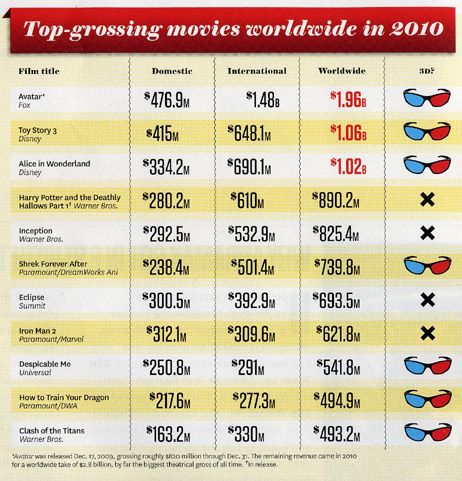
(I will step in here and point out something that never seems to get mentioned in coverage of 3D, which is that part of that fee goes to pay for the glasses.)
Moreover, overseas markets, which have been making up an increasing portion of most big films’ worldwide grosses, are adding 3D screens like crazy. “The U.K., China, Russia, Japan, France, Germany, China and Russia in particular have seen a surge in digital-theater installations.” Given that the U.S. is still making more 3D films than most of these countries, Hollywood is getting a generous slice of that box-office income. Some films thought to be disappointments in the States did well worldwide, such as Clash of the Titans, with $493.2 million, and The Last Airbender, with $318.9 million.
Of course, there have been underperformers: Cats and Dogs: the Revenge of Kitty Galore, The Voyage of the Dawn Treader, and Gulliver’s Travels, most notably. McClintock points out, “It’s almost certain that Deathly Hallows would have jumped the $1 billion mark worldwide had it been released in 3D, but Warners didn’t want to tarnish the franchise.” As it is, Harry Potter and the Deathly Hallows Part 1 has grossed $937,257,461 worldwide and is still in distribution.
Another thing that McClintock points out that most commentators ignore is that making a film in 3D adds to its budget, on average about $20 million for a two-hour feature. The alternative practice of shooting a film in 2D and then converting it to 3D is common. That costs about $100,000 or more a minute, or about $12 million for a two-hour film. (James Cameron, who ought to know, says a quality job would be $15 million or more.) For a movie that grosses in the hundreds of millions, that’s pretty small, but it’s not insignificant for a more modest film.
Let’s think about that for a moment. Jeffrey Katzenberg and James Cameron may still expect that all films will someday be made in 3D. But, to take one example I’ve seen people use in recent months, do we really think The Kids Are All Right would be enhanced by 3D? Even if some people do, the film cost only around $4 million to make and grossed a little under $30 million worldwide. Would $20 million spent on 3D cause it to gross over $50 million to make up the difference?*
Or does it?
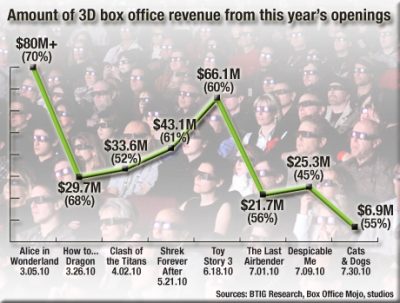
Despite the fact that 3D brought in higher grosses for the more successful films in that format last year, some experts are pointing to a decline in revenues over the year. In July of last year, Daniel Frankel published a widely cited chart called “The Rise & Fall of 3D” on The Wrap showing that since the release of Avatar the previous December, the proportion of the opening weekend box-office for major films coming from 3D screenings had declined:
Then in August Slate posted a more detailed study by Daniel Engber bluntly entitled “Is 3-D Dead in the Water?” Engber took issue with Frankel’s chart saying that it did not reflect problems with a shortage of 3D screens available during the release of these films. But Engber didn’t disagree that 3D’s share of a film’s income has been falling. Quite the contrary, he thought it the decline was even greater. Taking a different approach that basically compares per-screen averages for 3D and 2D screening of the same film, he came up with a new chart:
The chart below—created with enormous help from Slate designer Holly Allen—shows the ratio of 3-D revenue to 2-D revenue, on a per-screen basis, for almost every major three-dimensional release going back to the beginning of the current revival.
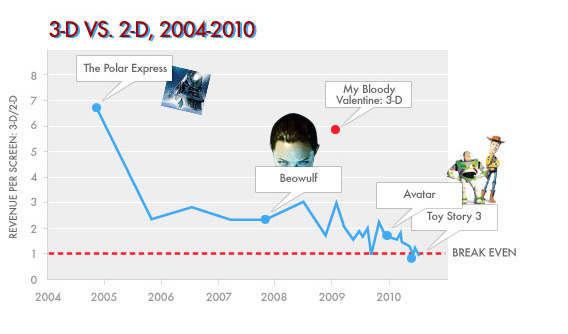
Here’s the simplest way to interpret this graph: 3-D has been getting less and less profitable, relative to 2-D, over the past five years. It’s an ominous, downward trend that started long before Avatar and Alice in Wonderland and continued after. (The red dotted line represents a break-even point, where screenings in 3-D and 2-D theaters make exactly the same amount of money.)
(I can’t go into the details here, but Engber presents additional charts and information; it’s a must-read for anyone interested in 3D, pro or con.)
Last year the big complaint from Katzenberg and other 3D purveyors was that there weren’t enough theaters to screen all the films that were coming out in that format. Katzenberg is still not satisfied with the rate at which theaters are converting screens to 3D, but maybe exhibitors have realized that there is not as much future in it as they had been led to believe. Given that most multiplexes have two, three, or even four screens capable of showing 3D films, the rate of conversion is likely to slow, if it hasn’t already.
Toy Story 3‘s release seems to have marked the point where some industry analysts began to notice the downward trend in 3D revenues in comparison to 2D. Its opening offers an insight into whether the drop is real or just an apparent effect of too many 3D films vying for too few screens, as is so often claimed. Media financial analyst Richard Greenfield pointed out that the film’s percentage of revenue from 3D screens was 1% less than with Shrek Forever After (released May 21). Toy Story 3 had made 60% of its opening weekend box office on 3D screens, while Shrek Forever After (released May 21) had made 61% and Alice in Wonderland (March 5) had made 70%.
1% may not sound like a lot, but Toy Story 3 was released on the largest number of 3D screens of any film to that date. In that case, it could not be claimed that the drop resulted from too many 3D films jostling for screens. On the contrary, one would expect a rise.
Not only that, but Engber points out that the 2D versions of Toy Story 3 actually outperformed the 3D ones:
Then we come to the weekend of June 18, 2010, when Toy Story 3 opened in more than 4,000 theaters around the country. It was a huge weekend for the Pixar film—one of the biggest of all time, in fact, with more than $110 million in total revenue, and $66 million from 3-D. Yet a close look at the numbers shows something else: On average, Toy Story 3 pulled in $27,000 for every theater showing the movie in 3-D, and $28,000 for every one that showed it flat. In other words, the net effect of showing Woody, Buzz, and friends in full stereo depth was negative 5 percent. The format was losing money.
One could posit, of course, that the 2D screenings simply benefited from the overflow from sold-out 3D screenings. People who wanted to see the film in 3D had to settle. But that still doesn’t explain the drop in comparison to earlier films given the fact that Toy Story 3 opened on the largest number of 3D screens. At least two tickets to the film in 2D were sold to people who had the option of going to a 3D screening: David and me.
Engber goes on to consider some explanations for the decline, some of the same basic ones I’ll discuss here. He concludes that the situation is dire for 3D: “For mainstream movies that can be viewed in either format, the added benefit of screening in three dimensions is trending toward zero.”
Is 3D TV competing with theatrical or hurting it?
There seems to be an assumption that pop culture is headed toward a time when new media in general are delivered in 3D. The assumption is that 3D television will help boost sales of movies on DVD and Blu-ray. Maybe, but the sales of 3D TVs have been reported as lower than expected. According to a revealing article in Variety, Samsung projected that it would sell 3 million units in 2010 and sold less than 2 million: “According to several electronics makers, the biz will be concerned if the negativity continues six months from now.” Screen Digest’s year-end summary of 3D TV’s prospects (“After one year of 3D in the home,” December 2010 issue) points out that not only do 3D sets cost half again as much as 2D ones, but they are also mostly 44” or over, larger than most people can afford even in 2D sets.
That’s not the only cost holding back sales of sets. According to Variety: “The main reasons for holding out have been the pricey pairs of active-shutter glasses (sold for around $150 or more) that can be cumbersome to wear, easy to break and require batteries that run out. At the same time, there hasn’t been much 3D content to watch on the new sets.”
Sets with these active-shutter glasses come with one pair included. The things are bulky and require batteries. New 3D TV models are in the pipeline, some that work with lighter polarized glasses costing more like $20, with  four pairs included. As Bob Mayson president of consumer electronics for RealD (a major 3D theatrical supplier) told Variety, “You won’t have a Super Bowl party with active eyewear. With passive eyewear [i.e, those polarized glasses] you can buy a bag of glasses from Costco and be in business.” four pairs included. As Bob Mayson president of consumer electronics for RealD (a major 3D theatrical supplier) told Variety, “You won’t have a Super Bowl party with active eyewear. With passive eyewear [i.e, those polarized glasses] you can buy a bag of glasses from Costco and be in business.”
Maybe guys who sit around drinking beer and watching the Super Bowl will get used to seeing each other wearing plastic glasses. Still, I have long been of the opinion that until 3D technology reaches a point where the glasses are unnecessary, the format can’t be universally viable. Toshiba and Sony have prototypes of such sets at technology fairs, but they reportedly won’t reach consumers for three to five years. I’m curious to know what the 3D effect will look like if you’re not sitting at exactly the right spot in front of the screen. From what I’ve read, you have to be positioned not only in front but also close. An excellent article in Wired summing up the obstacles to watching 3D on TV says the depth effect is limited to about four feet. In fact, there already are monitors for 3D without glasses (mainly available in Japan); they’re used mainly to display ads in stores. But in October Toshiba showed off two models intended for the home (left). The monitors are 12″ and 20″ and the optimum viewing distance is 90 cm for the larger monitor; that’s about three feet. They can project 3D to nine points in the room, but it sounds downright impossible for that many people to perch at precise points, all about a yard from the screen. Bigger versions will no doubt follow.
More content is coming for 3D TV, but again according to Variety, many content-providers are
focused on high-profile fare like sports and concerts, because as long as 3D TV requires glasses, it will only be used for event programming, not casual viewing. It may be tough to broadcast the Super Bowl in full 3D, outside of relying on a conversion, however, given that too many seats in the stadium would have to be removed for the 3D cameras. Networks could use robotic and remote-controlled 3D cameras but those are still too new of technologies to rely on yet.
Screen Digest ‘s year-end summary of 3D TV focuses on other obstacles, primarily the lack of content:
As recently as early September 2010 two thirds of the 21 3D BD [Blu-ray Disc] titles confirmed for US release in 2010 were tired to exclusive bundling deals with 3D hardware, leaving only seven available for purchase in store. By November, the total 3D BD slate had increased to 37 titles, 25 of which had been confirmed for retail sale by the year end. Furthermore, many of the biggest titles (including Avatar, the Shrek franchise, Monsters v Aliens, Ice Age 3) were still tied into exclusive bundles. By comparison, at the end of Blu-ray’s first year of availability (2006) 135 titles had been released on the format in the U.S.
I’m sure the brand partnerships between the TV makers and the studios have saved a lot in advertising, but it’s hard to imagine investing in a new technology when every time you want a popular film title, you have to buy a TV set to go with it. No doubt the availability of films to buy will increase, but the introductory approach seems a strange way to go about fostering interest in 3D movies on TV.
The Screen Digest article makes another interesting point. Initially, “3D in the home was conceived first and foremost as an attempt to mirror the revenues proven in the cinema—a 20 per cent premium over 2D features.” But much 3D TV content is also surprisingly like 2D TV content: “Ten percent of the cinema features have been dance or music, with a further four per cent including live sports and opera. This suggests an appetite for content that has traditionally been better suited to live television transmission than physical or cinematic tradition.” That further suggests that in the long run, people may be keener on 3D TV than on theatrical films in 3D—just the opposite of the studios’ hopes as they went in for 3D.
Beyond film and TV content, there is also the likelihood that 3D video-game playing through the large monitor will take up some of the time spent in front of the appliance. There’s also the fact that streaming or downloading 3D films requires far more bandwidth than 2D movies, though methods of compression are being developed.
The Screen Digest author predicts that by the end of 2014, 25% of American homes will have 3D TV. The question remains: What will people be watching?
Next week: Part two: RealDsgusted
*No doubt some cost-cutting is possible. Still, Tsui Hark’s Flying Swords of Dragon Inn (announced for a 2011 release), shot with the relatively inexpensive Red 3D digital camera, is budgeted at approximately $35 million. The difference between that and his usual cost per film could easily include $15-20 million for 3D. See Filmsmash for information and numerous photos derived from Chinese sites; the latter include images of the camera and of shooting in front of a green screen.

By Sam Spratt at Gizmodo
Posted in 3D, Hollywood: The business, Movie theatres, New media: Technology, Readers' Favorite Entries |  open printable version
| No Comments » open printable version
| No Comments »
Wednesday | January 19, 2011
Kristin here–
In one of our reports from the 2009 Vancouver International Film Festival, I expressed my enthusiasm for Elia Suleiman’s third feature, The Time that Remains. Yesterday Aaron Cutler posted an excellent interview with Suleiman on the Bomblog site (recorded November 2). It’s an unusual interview in that it spends quite a lot of time on the form and style of the film. The posting follows the limited release of the film on January 9 by the Independent Film Channel. Very limited, since it’s so far only on one screen. If it plays anywhere near you, I’d suggest seeing it on the big screen. I saw it twice at Vancouver, on the assumption that I’m unlikely to see it again in a 35mm print. This is one of those cases where seeing the film for the first time on video would be inadequate.
I often think back to that year’s festival when I see reviewers kvetching that there aren’t any great films any more. The blog linked above also covers Lucrecia Martel’s The Headless Woman and Samuel Maoz’s Lebanon. There are definitely worthwhile films made every year, but you have to attend film festivals to see many of them. Most year-end 10-best lists don’t include many foreign films like these (or else they include almost nothing but foreign films). I like the way Roger Ebert makes separate top-10 lists for mainstream films, foreign films, animated films, and documentaries. Not only does he avoid comparing apples and oranges, but he promotes four times as many films, some of which most readers would never hear about otherwise.
Posted in Directors: Suleiman | open printable version
| No Comments »
Tuesday | January 18, 2011

Hong Kong, Central, April 2008.
DB here:
Planet Hong Kong, in a second edition, is now available as a pdf file. It can be ordered on this page, which gives more information about the new version and reprints the 2000 Preface. I take this opportunity to thank Meg Hamel, who edited and designed the book and put it online.
As a sort of celebration, for a short while I’ll run daily entries about Hong Kong cinema. These go beyond the book in dealing with things I didn’t have time or inclination to raise in the text. The first one, listing around 25 HK classics, is here. The second, a quick overview of the decline of the industry, is here. The third discusses principles of HK action cinema here. A fourth, a portfolio of photos of Hong Kong stars, is here. That was followed by a tribute to western Hong Kong fans and then by a photo gallery of directors. Today’s installment is the last. Thanks to Kristin for stepping aside and postponing her entry on 3D, which will appear later this week.
Since the 1980s, the film festival circuit has become the only distribution system to rival Hollywood’s global reach. A big-name festival publicizes a film, some high-end critics at the festival write reviews, then once the film opens in a region or country, critics at large review it. As smaller festivals pick up films from the bigger ones, until eventually films make their way to small cities around the world. This process is parallel to the one that the studios orchestrate, though they have more centralized control. Video distribution, the circulation of DVD screeners, and Internet reviewing complicate this picture, but I don’t think they change the essential role of the festival network.
Just as film scholars have started to pay attention to fandom (see this post), they’ve started to ask research questions about festivals. As very few films from overseas find their way to U. S. screens, scholars keen on current cinema have realized that they need to visit festivals. It’s like scholars of painting traveling to exhibitions and gallery shows, or opera aficionados attending premieres at Bayreuth and La Scala. And film scholars of certain genres or periods have realized that they can do on-the-fly research by visiting historically oriented festivals like Pordenone and Bologna.
These days I see more of my colleagues at various festivals. In particular there’s the peripatetic Bérénice Reynaud, an early example of the multitasker (critic, programmer, professor, fan). On the same circuit I meet Virginia Wright Wexman, Peter Rist, Mike Walsh, Jim Udden, Gary Bettinson, and many other profs. So I’m starting to think that festivals are giving academic film studies a fresh charge of energy. Reciprocally, the events at Pordenone and Bologna, which began as cinephile events, have invited academic researchers to help program them and write for their publications. In sum, festivals are now a vigorous workspace for not just screenings and critical write-ups but discussions about ideas that would normally haunt the groves (or is it grooves?) of academe.
Saturation booking

Athena Tsui and Li Cheuk-to. Hong Kong, 2000.
I had dropped in at screenings at the New York and London film festivals in the 1970s and 1980s, and I had steadily attended the summer Cinédécouvertes series in Brussels. But I had never “done” a festival intensively until I went to Hong Kong in the spring of 1995. There I saw films that still stay with me: Through the Olive Trees, Postman, In the Heat of the Sun, A Borrowed Life, Smoking/ No Smoking, Quiet Days of the Firemen, Taebek Mountains, 71 Fragments of a Chronology of Chance, Whispering Pages, and Clean, Shaven. (My one big miss was Sátántangó; I had to wait years to catch up with that.) Who says the 1990s were a meager decade? Can any festival today come up with a menu like this?
I had gone, as I explain in the Preface to Planet Hong Kong, mainly to check on local cinema. The “Hong Kong Panorama” surveying 1994 releases yielded a bumper crop, including some titles I’d seen only on laserdisc (Chungking Express, Ashes of Time) and others that were revelations. Above all, there was a retrospective—an entire festival in itself, really—dedicated to early Chinese and Hong Kong cinema. They swept over me in a heaving wave: Love and Duty (1932), The Eight Hundred Heroes (1938), Boundless Future (1941), and many others, along with postwar Hong Kong classics like Where Is My Darling? (1947), Song of a Songstress (1948), The Kid (1950), with Bruce Lee, and on and on. The series was capped by stunning restored Technicolor prints of The Orphan (1960), also with Bruce, and General Kwan Seduced by Due Sim under Moonlight (1956). Some of these had circulated on poor VHS copies, but most were, and still are, unknown in the West.
I had picked the perfect year to come to the festival. Looking back at the notes I scribbled in the dark, I realize that over three weeks I got a crash course in Chinese film history. In any given day I was given more to think about, and certainly more to feel about, than I got from almost any academic conference.
For those of us interested in non-Hollywood cinema, festival programmers and critics are central gatekeepers. They scout the ridge and scan the horizon, and around the campfire they teach us film lore. They’ve built up fingertip knowledge about movies, moviemakers, distribution patterns, sales agents, theatre circuits—in sum, the workings of world film culture. The best of these gatekeepers are intellectuals, ready to search out something stimulating in even the most marginal film. They have honed their senses to detect qualities that could provoke an audience or yield a lively Q & A or a piquant catalogue entry or a solid review. Out of pure selfishness, I wish I could download the neural storage files of Alissa Simon, Richard Peña, Tony Rayns, Cameron Bailey, and their peers. Alas, there is no app for that.
In Hong Kong I met Li Cheuk-to, Jacob Wong, Freddie Wong, and many other programmers, along with Athena Tsui and Shu Kei. What made my experience that spring of 1995 so thrilling were their months of patient planning and sleepless nights behind the scenes—finding the prints, arranging for them, writing catalogue copy and, not least, assembling a massive reference work like Early Images of Hong Kong & China, one of the precious books the festival managed to turn out every year to document the local cinema.
Many programmers are also critics, and such was the case in Hong Kong. When I arrived, Cheuk-to and his colleagues had just formed the Hong Kong Film Critics Society, and I was invited to their first awards ceremony. They were mostly young, and after the awards were handed out I was invited out to dinner with several of them. It was then I realized that here was a local film culture in which criticism mattered. Hong Kong was small enough for critics to band together to debate their cinema. Soon another critics’ group was founded, and the debates spread. I started to understand that if one were to study a film culture, one would have to grasp the dynamics of taste among schools of critics and between critics and their audiences. I made an effort to describe this dynamic in the second chapter of Planet Hong Kong.
It’s not just that that book had its origins in that first visit. And it’s not just that the newest edition is the result of my attending the festival for the last fifteen years. More important, my ideas about film and about the world changed when I met critics, programmers, and other academics in Hong Kong. Immersion in one of the world’s most fascinating cities had something to do with it too.
Favorites, for now
As Tears Go By (1988).
In my first entry in this hurriedly posted series, I listed around 25 Hong Kong films that most aficionados consider of major importance—historical, artistic, cultural, or all three. In the days since, I’ve mentioned several other films that you can check into. Here, as an envoi to this yakathon, are a few more movies that I’ve repeatedly enjoyed, and that I’ve sometimes talked about in PHK 2. They’re grouped in very loose categories.
Lesser-known items from major directors. Once a Thief is a good example. Sandwiched between Woo’s official classics is this good-natured, somewhat silly action comedy about art thieves, romance, and parenthood. Lifeline is one of my favorite Johnnie To Kei-fung films—not as formally audacious as his later masterpieces, but containing one of cinema’s great action sequences involving a fire that seems as unstoppable as a waterfall, with the bonus of a throat-catching epilogue. Ann Hui On-wah’s Summer Snow, about a busy career woman who must treat her Alzheimer’s-affected father, glows with the intimate realism and understated sentiment that inform her more recent The Way We Are.
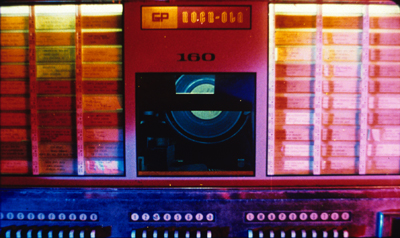
Everybody knows some works by Wong Kar-wai, but I think his later accomplishments have overshadowed his debut, As Tears Go By, a prototype of the arty gangster movie. Drenched in romanticism, it has one of the great music montages in Hong Kong film and a finale that you feel lifting from genre formula to pictorial poetry. With Johnnie To as well, even offbeat items like Throw Down are getting well-known, but I’d like to make a pitch for the New Year’s mahjong comedy Fat Choi Spirit. It has some of the 1980s nuttiness; the laughs start at the DVD menu.
Tsui Hark has produced so many films that have been fan favorites–Peking Opera Blues, Once Upon a Time in China, and Swordsman III: The East Is Red–that you can’t expect anything worthy to be overlooked. And yet not enough people have seen the bouncy Shanghai Blues, with moments of musical rapture, and The Chinese Feast, with all his faults and virtues bundled into a celebration of cooking and eating. There’s also The Blade, a convulsive revenge saga that seems to me one of the best movies made anywhere in the 1990s. After it’s over, you’re not sure what hit you.
Drama, comedy, dramedy. Any reader of PHK knows my fondness for the gender-bending romance Peter Chan Ho-sun’s He’s a Woman, She’s a Man, a lovely integration of musical, coming-of-age story, and satire of sex roles. But my favorite Michael Hui film, Chicken and Duck Talk didn’t feature in the first edition because I couldn’t get my hands on a print to illustrate it. Tracing the rivalry between a scruffy duck restaurant and a Japanese knockoff of Colonel Sanders, it yields many hilarious sequences, perhaps most notably Hui’s efforts to conceal a plague of rats from health inspectors.
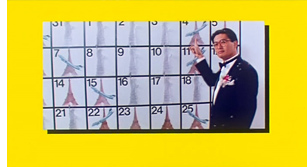 Chow Yun-fat made his western reputation in crime movies, but his local fans also love his comedies and dramas. Try the screwball Diary of a Big Man (right) in which Chow juggles two wives and enacts a music video; the wistful romantic drama An Autumn Tale; and of course the male melodrama All About Ah Long. Churning out six to nine movies a year, the man was a real movie star. In April 1995, I was waiting in line to see Peace Hotel and felt the crowd’s nervous anticipation. Three whole months had passed since they’d seen their friend in a new movie. Chow Yun-fat made his western reputation in crime movies, but his local fans also love his comedies and dramas. Try the screwball Diary of a Big Man (right) in which Chow juggles two wives and enacts a music video; the wistful romantic drama An Autumn Tale; and of course the male melodrama All About Ah Long. Churning out six to nine movies a year, the man was a real movie star. In April 1995, I was waiting in line to see Peace Hotel and felt the crowd’s nervous anticipation. Three whole months had passed since they’d seen their friend in a new movie.
My associates sigh when I mention Wong Jing. What can I say? I find some of his films funny. Try Boys Are Easy, Tricky Master, and, probably my favorite, Whatever You Want. If you don’t like them, write my suggestion off as David in his Dotage. Speaking of silliness, I’m not over-fond of Stephen Chow, but All for the Winner, Flirting Scholar, From Beijing with Love, and A Chinese Odyssey are ingratiating enough. Square that I am, I like Shaolin Soccer too.
I’d add the medical melodrama C’est la Vie, Mon Cherie, the unpredictable cop stakeout movie Bullets over Summer, and the poignant Juliet in Love, about a triad’s attraction to a woman recovering from a mastectomy. Sylvia Chang Ai-chia’s quiet romantic dramas Tempting Heart and 20 30 40 are also rewarding. Patrick Tam Kar-ming’s films are still unjustly neglected, so anything might be considered obscure, but I was delighted when a passable DVD of My Heart Is that Eternal Rose was released. Here Tam lyricized the gangster movie; Wong Kar-wai took the next step.
For grotesque comedy, try You Shoot I Shoot, about a contract killer who adds value by having an aspiring director film the hits (complete with slo-mo) for the delectation of the client. Unclassifiable is The Inspector Wears Skirts II, a cop-training story that pits women recruits against dimwitted men. It includes a dance sequence displaying minimal skill and maximal cheerfulness.
Fight club: Of Chang Cheh’s vast output of martial-arts movies, I have a special affection for New One-Armed Swordsman, a spectacularly mounted action picture, and Crippled Avengers, in which “disabled” really does mean “differently abled.” For Lau Kar-leung, I especially admire Legendary Weapons of China, one of the strangest of his forays into the arcana of martial arts lore and Chinese history; Shaolin Challenges Ninja (aka Heroes of the East), a sort of Taming of the Shrew, but with throwing stars; and the harrowing Eight-Diagram Pole Fighter, something of a valedictory for the Shaolin tradition at Shaw Brothers. Both these directors made so many worthwhile films that you can spend a lot of agreeable time exploring their output.
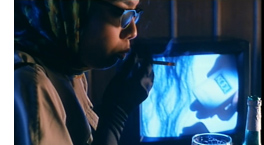 Though not everyone agrees, I think that Corey Yuen Kwai is a fine director of action pictures, from the tonally discordant Ninja in the Dragon’s Den through the warrior-women saga Yes, Madam!, the vigilante-justice Righting Wrongs (incredible, literally, final airborne sequence), and Saviour of the Soul, a futuristic fantasy with one shot looking forward to Chungking Express (right). Yuen’s Fong Sai-yuk films and Bodyguard from Beijing contain classic sequences—fighting on the heads of a crowd, on top of a precarious pile of furniture, in a hypermodern kitchen. Co-signing the first Transporter film, he turned in something resembling the classic Hong Kong style. Though not everyone agrees, I think that Corey Yuen Kwai is a fine director of action pictures, from the tonally discordant Ninja in the Dragon’s Den through the warrior-women saga Yes, Madam!, the vigilante-justice Righting Wrongs (incredible, literally, final airborne sequence), and Saviour of the Soul, a futuristic fantasy with one shot looking forward to Chungking Express (right). Yuen’s Fong Sai-yuk films and Bodyguard from Beijing contain classic sequences—fighting on the heads of a crowd, on top of a precarious pile of furniture, in a hypermodern kitchen. Co-signing the first Transporter film, he turned in something resembling the classic Hong Kong style.
In the crime vein consider Kirk Wong’s hard-driving and pitiless Rock ‘n’ Roll Cop and Danny Lee’s Law with Two Phases (not a typo). Ringo Lam’s films are notably tougher and more tactile than those of his contemporaries; see his deromanticized classic City on Fire, the effort to out-Woo Woo that is Full Contact, and the lesser-known Full Alert. Eddie Fong Ling-Ching isn’t known for policiers, but Private Eye Blues was one of the films I enjoyed in the 1995 Panorama. His historical drama Kawashima Yoshiko is even more remarkable.
Connoisseurs know The Outlaw Brothers; one glimpse of the climax, in which a gunfight is interrupted by a hailstorm of poultry, usually convinces any viewer to take a closer look. I must add the below-the-radar ensembler Task Force, by John Woo protégé Patrick Leung Pak-kin. Gratifyingly untidy in skipping among the personal lives of a cop squad, it eventually focuses on the need to settle conflicts without violence—after, of course, supplying some snappy fight scenes of its own.
Post-handover take-outs. Most of the films I’ve mentioned are from the 1970s through the 1990s. But many worthy films have emerged in the 2000s. If they don’t always carry the effervescence of the earlier ones, many are solidly crafted. Some are discussed in Planet Hong Kong 2.0 and many more have received commentary on other websites (e.g., LoveHKFilm), so I’ll just mention a few that seem to me of more than transitory appeal.
Patrick Tam’s After This Our Exile is an unsentimental look at how an aggressive, heedless father must come to terms with his little boy. Needing You is a better-than-average office comedy, while Hooked on You is poignant in the gruff Hong Kong way, with a touching finale about the changes since 1997. Benny Chan Muk-sing’s action pictures usually deliver sturdy value in the old style. Try Connected, a remake of Cellular; New Police Story, with Jackie Chan as a cop coming to terms with age and failure in the face of nihilistic youth; and Invisible Target, which boasts an old-fashioned Hard Boiled demolition derby, with a police station ground zero this time. Horror fans already know how uneven HK films in that genre can be, but surely Fruit Chan Goh’s Dumplings is an admirably creepy achievement, and Soi Cheang Pou-soi did good work in the genre as well (Diamond Hill, Horror Hotline) before moving to the suspenseful Love Battlefield and the harsh action picture Dog Bite Dog.
Whew! After seven sword-like days, I’m running out of time, and I haven’t achieved a final victory. Want more dangerous encounters? Go to PHK or the Hong Kong Critics Society Award winnerss and start looking for your better tomorrow.
Sorry, I couldn’t resist.
Kristin and I discuss film festivals as an aspect of global film culture in Chapter 29 of Film History: An Introduction. For detailed research into the festival scene, see Richard Porton, ed., Dekalog 3: On Film Festivals and several publications from St. Andrews University. The most recent volume, edited by Dina Iordanova and Ruby Cheung, focuses on East Asian events.
P.S. Thanks to Yvonne Teh for a title correction, and Tim Youngs for a geographical one!

Photo: Joanna C. Lee, courtesy Ken Smith.
Posted in Directors: Ann Hui, Directors: Johnnie To Kei-fung, Directors: Tsui Hark, Directors: Wong Kar-wai, Festivals, Festivals: Hong Kong, Film comments, Film scholarship, National cinemas: Hong Kong, PLANET HONG KONG: backstories and sidestories | open printable version
| No Comments »
Monday | January 17, 2011
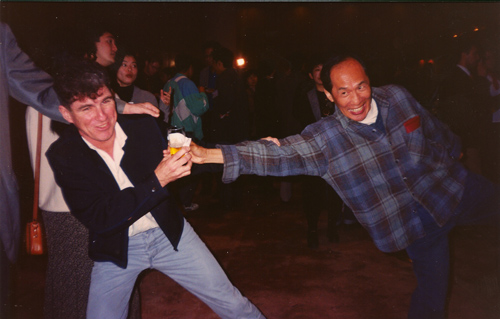
Your beer kung-fu is pretty good: Christopher Doyle and Po Chi Leung (Jumping Ash, He Lives by Night, etc.). Hong Kong Film Festival, 1996. Photo by DB.
DB here:
Planet Hong Kong, in a second edition, is now available as a pdf file. It can be ordered on this page, which gives more information about the new version and reprints the 2000 Preface. I take this opportunity to thank Meg Hamel, who edited and designed the book and put it online.
As a sort of celebration, for a short while I’ll run daily entries about Hong Kong cinema. These go beyond the book in dealing with things I didn’t have time or inclination to raise in the text. The first one, listing around 25 HK classics, is here. The second, a quick overview of the decline of the industry, is here. The third discusses principles of HK action cinema here. A fourth, a portfolio of photos of Hong Kong stars, is here. That was followed by a tribute to western Hong Kong fans. The final entry is concerned with the role of film festivals and a short list of other favorite films. Thanks to Kristin for stepping aside and postponing her entry on 3D.
When Andrew Sarris formulated an American version of the politique des auteurs, he used directorial “personality” as an index of true directorial creativity. Later, theorists and academics tried to define this elusive quality, and many concluded that auteur directors had recurring themes, a stylistic signature, and what we might call storytelling manner. To sketch an example: Welles can be thought of as concerned with the relation of power to love, and the loss of both. He favored aggressive depth compositions, long takes, and unusual uses of sound. In narrative terms, he was fond of stories featuring a larger-than-life man, turning on a puzzle or a crime, and presented in some time-shifting ways (e.g., flashbacks). This is a unsubtle characterization, but my point is simply that crtiics thought that recurring qualities like these offered a strong case for directorial authorship.
Yet a mass-market cinema makes “pure” authorship difficult, since directors may not freely choose their projects and their artistic preferences may be overridden by budgets, weather, producer rulings, censorship and the like. Creativity in a film industry, we’re usually told, requires collaboration. That’s true, but of course many other art forms do as well, notably theatre, dance, and song composition. A director may not explore favorite thematic concerns every time out (Look: stick to the script!), or may be thwarted in certain technical choices (We can’t afford long tracking shots!) or storytelling strategies (We’re adding a voice-over to clarify the backstory).
As with most high-output cinemas, the appeal of many Hong Kong films can be traced not to directorial flair but to the genre and other components (stars, scripts, studio resources). I wouldn’t say that many of the Jackie Chan-Sammo Hung-Yuen Biao outings like Winners and Sinners (1983), Wheels on Meals (this is not a typo; 1984), and My Lucky Stars (1985) exhibit much directorial personality, but they are skillfully made and pretty entertaining. Every industry needs its artisans, its steady hands on the tiller; it’s no mean feat to turn out a solid movie. Even the most distinctive directors in an industry need craft competence; as Sarris once remarked, “A great director has to be a good director.” Much of Planet Hong Kong is about the collective norms of local filmmaking, the tricks of the trade and the professional practices that shape the artistry of non-auteur movies.
But are there true Hong Kong auteurs? I think so, to various degrees. Ones discussed in PHK 2.0 are King Hu, Chang Cheh, Lau Kar-leung, Tsui Hark, Wong Kar-wai, and Johnnie To Kei-fung. John Woo, I argue, is one in a special, almost meta-sense: He understood the idea of authorship and crafted his public image, as well as his films, around certain themes (Christianity, heroic self-sacrifice) and stylistic choices (most visibly, flying pistoleros).
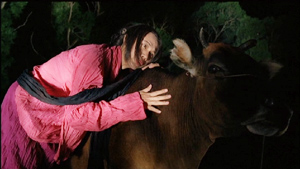
Wong Jing is a bit meta- too, in the way that Mel Brooks is a parodic auteur. Wong Jing’s farcical cinema carries to an extreme the vulgar potential always lurking in his territory’s cinema. He can provide quite precise mockery of other (better) directors, as when the arthouse filmmaker in Whatever You Want (1994) turns out a pretentious effort suspiciously similar to Ashes of Time. The evocative, fragmentary shots of Carina Lau Ka-ling clutching at her horse are replaced by one of Law Kar-ying caressing a cow.
So it was in hope of learning both about craft norms and directorial temperament that between 1995 and the present I’ve visited and talked with various filmmakers. The results are in the book, but here are some photos commemorating the encounters.
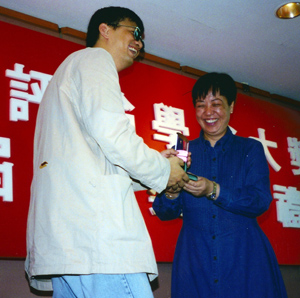
Here Ann Hui On-wah presents Wong Kar-wai with the best screenplay award (for Ashes of Time) at the first annual Hong Kong Film Critics Society Awards, 1995. She looks as happy as he is. The film also won Best Film, Best Director, and Best Actor (for Leslie Cheung Kwok-wing, who wasn’t present). For a further note on Wong, check the bottom of this entry.
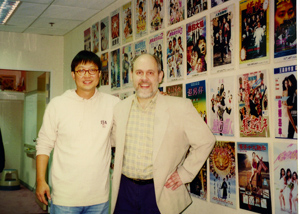
My longest stay in Hong Kong was during the spring of 1997. Doing research for PHK, I interviewed several people. One of my top stops was BoB & Partners, then the latest incarnation of Wong Jing’s entrepreneurship. (On the wall in the left still you see posters for Naked Killer, 1992, and other genre classics.) BoB stood for “Best of the Best,” and one of the partners was Andrew Lau Wai-keung, top-flight cinematographer who had become famous as a director with the Young and Dangerous series. Soon he was to go on to Storm Riders (1998) and eventually to the Infernal Affairs trilogy (2002-2003). Next door, Wong Jing also talked with me. He had several TV screens facing him, one with video games, and you can see his console front and center on his desk.
Another busy man, Peter Chan Ho-sun, had become an important director of contemporary comedies and dramas (e.g., He’s a Woman, She’s a Man, 1994; Comrades, Almost a Love Story, 1996). I met him in 1997 and brought him to Madison in 1999; below, a photo from 2008. Even more prolific, and less easy to categorize, is Herman Yau Lai-to–DP, rock-and-roller, and director of everything from grossout horror (The Ebola Syndrome, 1996) to harsh social critique (From the Queen to the Chief Executive, 2001; Whispers and Moans, 2007). How could you not learn a lot about filmmaking craft from a guy who had directed over fifty movies and been DP on thirty-five more? I wrote about Herman’s On the Edge here.
 
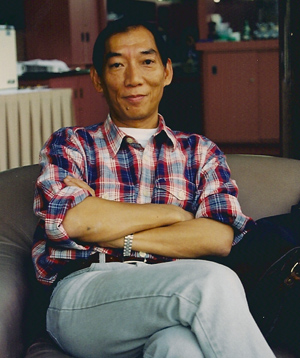
I met some directors from the older generation too. There was Yuen Woo-ping (aka Yuen Wo-ping), one of the great fight choreographers (The Matrix, Kill Bill) but also a lively director in exhilarating films like Legend of a Fighter (1982), Dance of the Drunk Mantis (1979), Iron Monkey (1993), and Tai-chi Master (1993). And there was Ng See-yuen, another local legend. He directed some sturdy kung-fu films like The Secret Rivals (1976) and The Invincible Armour (1977). He’s also an iconoclastic producer, backing Jackie Chan’s breakthrough film Snake in the Eagle’s Shadow (directed by Yuen Woo-ping), Tsui Hark’s Butterfly Murders (1979) and We’re Going to Eat You (1980), and several of the Once Upon a Time in China entries. Here Ng is at the 1997 Hong Kong Film Awards.
Two of the high points were my interviews with major figures of the Hong Kong New Wave of the 1980s, both still going strong in 1997. Ann Hui was warm and generous with her time; she visited Madison that year with Summer Snow (1995) and other films. The picture below is from 2005.

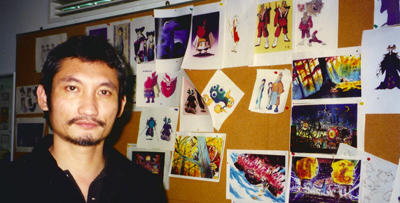
Then there was my several-hour talk with Tsui Hark at the Film Workshop headquarters. Good thing I taped it; I couldn’t keep up with him in my note-taking. He was planning Knock-Off and the animated version of Chinese Ghost Story.
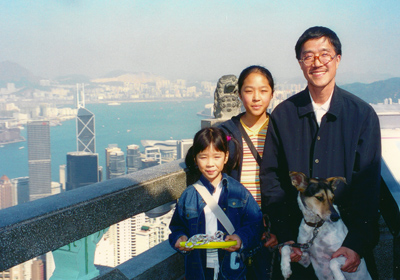
After 1997, I looked in on some other filmmakers. I was invited to visit the Academy for the Performing Arts in 2001 under the guidance of Professor Lau Shing-hon, another early New Waver (House of the Lute, 1980; The Final Night of the Royal Hong Kong Police, 2002). Here he is with his family on the Peak.
Since I started blogging, I have put my best (or rather the least amateurish) shots online. So for more snaps, you can rummage through the category, Festivals: Hong Kong. But I can’t resist two final ones. Here are Johnnie To and the younger director Soi Cheang Pou-soi (Love Battlefield, 2004; Dog Bite Dog, 2006; Accident, 2009), in shots from 2005 and 2009 respectively.
 
And now for something not quite completely different. In both print and e-book editions of Planet Hong Kong, I wrote about our last view of the Brigitte Lin Ching-hsia’s character in Chungking Express. Wong Kar-wai presents a jerky slow-motion shot of her leaving the crime scene and dodging out of the frame. It freezes on her, at a moment that yields a perversely unreadable image.
A shot of this frame would have been mud in the black-and-white pages of the book and probably not much better in the color pdf. I couldn’t imagine catching the faint reddish glint of the woman’s sunglasses. (Actually, the e-book’s quality turned out well enough that we might have tried for it.) So I picked the most legible image I could find from the shot, and that’s what’s in the print book and the digital copy (Fig. 9.13).
In any case, for obsessives like me, I reproduce the frozen frame here. This still comes from a 35mm print of the movie, and it is, of course, a lot more poetic than my snapshots, partly because it teases you about what’s in the frame.

Posted in Directors: Ann Hui, Directors: Johnnie To Kei-fung, Directors: Tsui Hark, Directors: Wong Kar-wai, Film comments, National cinemas: Hong Kong, PLANET HONG KONG: backstories and sidestories | open printable version
| No Comments »
|