David Bordwell's website on cinema   click for CV

Home

Blog

Books

Perplexing Plots: Popular Storytelling and the Poetics of Murder

On the History of Film Style pdf online

Reinventing Hollywood: How 1940s Filmmakers Changed Movie Storytelling

Film Art: An Introduction

Christopher Nolan: A Labyrinth of Linkages pdf online

Pandora’s Digital Box: Films, Files, and the Future of Movies pdf online

Planet Hong Kong, second edition pdf online

The Way Hollywood Tells It pdf online

Poetics of Cinema pdf online

Figures Traced In Light

Ozu and the Poetics of Cinema pdf online

Exporting Entertainment: America in the World Film Market 1907–1934 pdf online

Video

Hou Hsiao-hsien: A new video lecture!

CinemaScope: The Modern Miracle You See Without Glasses

How Motion Pictures Became the Movies

Constructive editing in Pickpocket: A video essay

Essays

Rex Stout: Logomachizing

Lessons with Bazin: Six Paths to a Poetics

A Celestial Cinémathèque? or, Film Archives and Me: A Semi-Personal History

Shklovsky and His “Monument to a Scientific Error”

Murder Culture: Adventures in 1940s Suspense

The Viewer’s Share: Models of Mind in Explaining Film

Common Sense + Film Theory = Common-Sense Film Theory?

Mad Detective: Doubling Down

The Classical Hollywood Cinema Twenty-Five Years Along

Nordisk and the Tableau Aesthetic

William Cameron Menzies: One Forceful, Impressive Idea

Another Shaw Production: Anamorphic Adventures in Hong Kong

Paolo Gioli’s Vertical Cinema

(Re)Discovering Charles Dekeukeleire

Doing Film History

The Hook: Scene Transitions in Classical Cinema

Anatomy of the Action Picture

Hearing Voices

Preface, Croatian edition, On the History of Film Style

Slavoj Žižek: Say Anything

Film and the Historical Return

Studying Cinema

Articles

Book Reports

Observations on film art

Bringing up Hawks

Saturday | July 2, 2011

Hawks looms large in any history of American film, but even so…

DB here:

Still scrambling to keep up with all the movies at Bologna’s Cinema Ritrovato, I offer a quick entry on three films in the complete retrospective of Howard Hawks’ early work. Go back here for comments on Cradle Snatchers (1927).

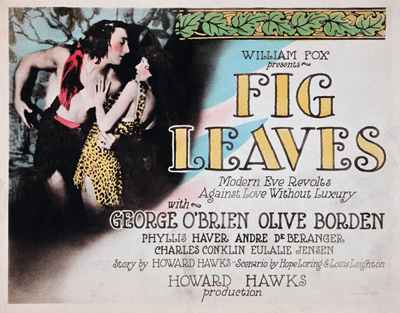
Those who claim that Hawks’ talents are at full stretch in comic situations would find solid evidence in several Ritrovato picks. Fig Leaves (1926) starts in the Garden of Eden, where Adam uses a teetering cocoanut as his alarm clock and the Serpent coaxes Eve into complaining that she simply hasn’t a thing to wear. With its Flintstones anachronisms and genial dinosaurs, the prologue of Fig Leaves makes fun of the hoary device of showing primitive life as a parallel to today, a wheeze Keaton had already exploited in Three Ages (1923).

Our modern Eve’s longing for nice clothes impells her into a job modeling for the house of André, while a shrewd jazz-baby neighbor plays the role of the Serpent in the modern garden. Filled out by Technicolor fashion parades (much praised at the time, but surviving only in contrasty black-and-white), this satirical modern comedy remains a pleasant diversion.

As ever with Hawks, there’s a play on sexual identity. When Adam and Eve wake up in the morning, he’s shot with hard-edged lighting and sharp focus. By contrast, Eve is wrapped in soft light and plenty of diffusion in the manner of the Fox heroines in Borzage and Murnau movies. No surprise there, but later the vaguely Continental dress designer André is introduced in a moderately soft, diffused image, as if he were halfway between man and woman. Although he’s not gay (that role falls to his preening assistant), he’s presented as a sissy as much through the cinematography as through his performance. Then again, most guys look effeminate compared to the brawny Charles Farrell, who is given plenty of chances to strip to the waist. Olive Borden is a matching mate. Variety predicted that “her big, dark, soulful eyes ought to carry her far in the picture world,” but it’s not her eyes that attract André. He’s riveted by the sight of her in a gown, lit from behind so that her figure pops into a curvy silhouette.

E. C. Bentley’s Trent’s Last Case of 1913 was a turning point in the modern detective novel, but you wouldn’t know it by the time that Hawks got around to filming it in 1929. He turns it into a comedy. The murder victim, the millionaire Manderson, uses a book, Unsolved Murders, as a guide to committing suicide in a fashion that will incriminate his secretary, who is in love with Manderson’s wife. The tone is uncertain, and a few cornball low angles with horror lighting are thrown in to goose up some rather overplayed moments.

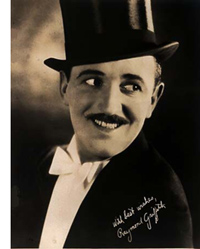
The Trent of the novel set the fashion for the dilettante savant (later incarnated in Lord Peter Wimsey and Ellery Queen), but he remains a somewhat withdrawn figure. In the film, comedian Raymond Griffith plays him as a parody of the chipper playboy, breezy in Griffith’s signature topper and tails. The climax provides a pure travesty of the original. The major innovation of the book, the mistaken solution that takes the sleuth down a peg, becomes a gag in Hawks’ hands. At the climax, Trent denounces one suspect, is proven wrong, moves to another, gets it wrong again, until he has arrived at the truth through elimination. Convinced that he would have sent at least four persons to the gallows, he shrugs off detective work and declares this is his last case.

The film was released in two versions, one completely silent and the other incorporating some sound sequences. The surviving print contains no talking scenes and runs nearly twenty minutes shorter than either 65-minute original. The US release of Trent’s Last Case was evidently quite brief. It remains the strangest and probably the weakest entry in the Hawks filmography.

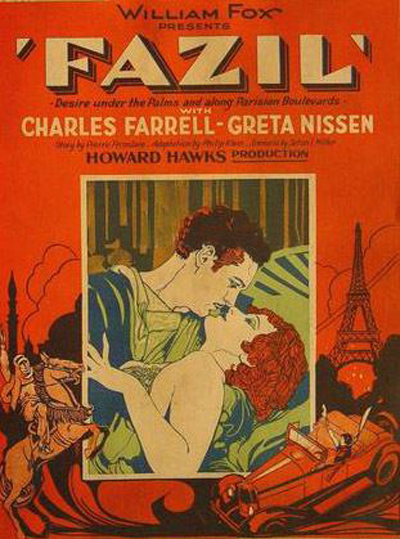
Fazil (1928) could use a lot more comedy, but it brings out Hawks’ interest in vigorous sexual situations. Fazil, a prince from “Araby,” meets Fabienne, a passionate French girl. They marry immediately. Fabienne’s desire for Fazil overcomes her worry that he believes in total domination over her. She defies his commands, and they separate, only to be reunited after she seeks him out in his homeland. When she sees his harem, and then realizes his intent to take a second wife, she again tries to opt out, this time with the help of her European friends. Her escape from his compound climaxes in a gun battle that fatally wounds Fazil. Fabienne accepts a lethal injection from his poison ring so that they may die together, with him finally confessing that he loves her.

This Orientalist farrago, handled humorously at the start (the call to prayer interrupts a beheading), quickly turns serious, even a little decadent. The sexual ambience of the Sheik cycle becomes fairly steamy. After the couple meet at a Venetian party, fade out to the next scene. Fabienne is now sharing Fazil’s bed. Has an affair started? For a little while we’re entitled to think so, until Fazil goes to the window and we see the Eiffel Tower. Soon Fabienne is on the phone talking about her marriage to the prince.

The New York Times review charged that Hawks erred “in his eagerness to display the voluptuous side of a desert chieftain’s life, a series of scenes which would never be missed. “ Actually, I’d miss the moment when Fabienne is introduced to Fazil’s harem. Tracking shots run along the line of scantily-dressed women sizing her up, and reverse shots follow her as she surveys them in fear and fascination, her fingers nervously stroking her upper chest. “August heat,” boasted a Fox ad at the time, “is intensified by the torrid Fazil.” Something like it happened in the June heat of Bologna.


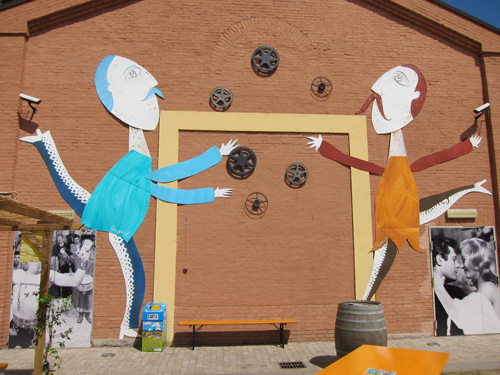
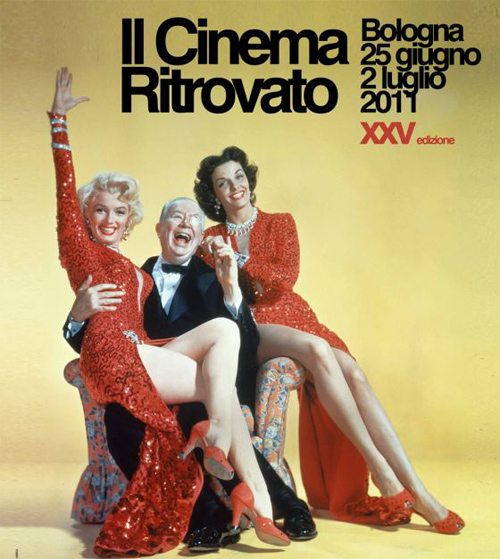
The image surmounting this entry is taken from this year’s extraordinary Ritrovato catalog. Variety‘s review of Fig Leaves was published in the 7 July 1926 issue, p. 16. Bentley’s novel Trent’s Last Case is available free online. The New York Times review of Fazil appeared in the 5 June 1928 issue, p. 21. Fox’s ad for its 1928 slate was published in Variety on 11 January 1928, p. 11.

…But brunettes prefer programmers. Guy Borlée and colleagues.

Unquiet silents

Wednesday | June 29, 2011

DB here:

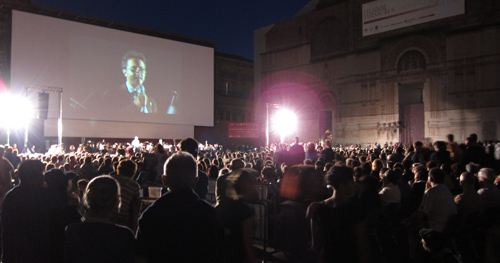
It happens every year: the Cinema Ritrovato festival in Bologna is offering something for everyone. It’s officially dedicated to film history, but its organizers understand that history includes today. This year you can watch films from 1898 (Gaumont shorts) to 2011 (The Actor, hot from Cannes). Silent cinema is given its due, but so are films from the 1930s-1950s, with glimpses of the 1960s (Petri’s The Assassin, the new La Dolce Vita) and 1970s (Kevin Brownlow’s little-seen Winstanley).

The director retrospectives alone are overwhelming. We have a chance to watch great swatches of films by the celebrated Alice Guy, the underappreciated Luigi Zampa, the effortlessly lyrical Boris Barnet, and the still-being-discovered master of the 1910s, Albert Capellani. Oh yeah, then there’s a guy called Hawks, with a complete set of all his surviving silents filled out with little items like Twentieth Century, Tiger Shark, and thanks to Grover Crisp a lab-fresh restoration of Only Angels Have Wings that had even hard-core Ritrovato veterans gaping.

Not to mention sidebars dedicated to images of socialism and utopia, the development of color cinema, and the annual “100 Years Ago” series curated by Mariann Lewinsky, who brought a stunning array of 1911 films into our ken. With Ayn Rand’s gospel of egoism and selfishness finding ever more adherents these days, a screening of the original Italian version of We the Living (Noi Vivi) reminds us that, contrary to the evidence of this year’s Atlas Shrugged, you can make a pretty good movie from one of her books. (Of course the great Rand adaptation is the out-sized Fountainhead.) In the evenings, on the Piazza Maggiore, items like The Thief of Bagdad and Taxi Driver regale a thousand people or more.

In short, a feeding frenzy for the cinephile. We’ve been here before; you can read reports from the last four years in the category Festivals: Cinema Ritrovato. But this time things are even more intense. A fourth venue has been added, the ample and modern Cinema Jolly, so the decisions about what to see are even more pressing.

Kristin has concentrated her viewing on the 1910s, although so far she’s found time for Wind Across the Everglades and an episode of Barnet’s charming Miss Mend. (She wrote about the Flicker Alley DVD of this here). Her upcoming blog entry will concentrate on Capellani. For now, I find that a mere two films give me something to chew on.

From talky silents to talking movies
Upstream.

Ford and Hawks are very different directors, but two 1927 films, both made at Fox, allow us to see their work blending into a broad trend.

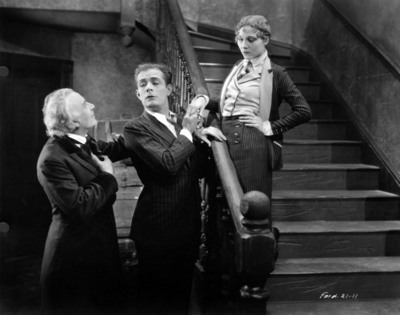
Upstream, recently rediscovered and shown to admiring audiences around the world, takes place largely in a boarding house for struggling vaudevillians. A knife-thrower is in love with his assistant, who is in love with a self-centered ham hired to play Shakespeare. Among the roomers are a declining classical actor and the song-and-dance brothers Callahan and Callahan, one of whom is Jewish. The ham accidentally becomes a star, in the process forgetting the girl he once wooed. But her marriage to the knife-thrower is threatened when the ham returns to the boarding house.

The film has the drawling, anecdotal quality of many Ford comedies. The plot is simple, but it’s decorated with character bits and an overall tone of self-aware corn. The latter was enhanced in the Ritrovato screening by the brash musical accompaniment designed by Donald Sosin, with him on piano and Guenter A. Buchwald on violin. Sosin, like Ford, knows hokum when he sees it, and both know that you must revel in it.

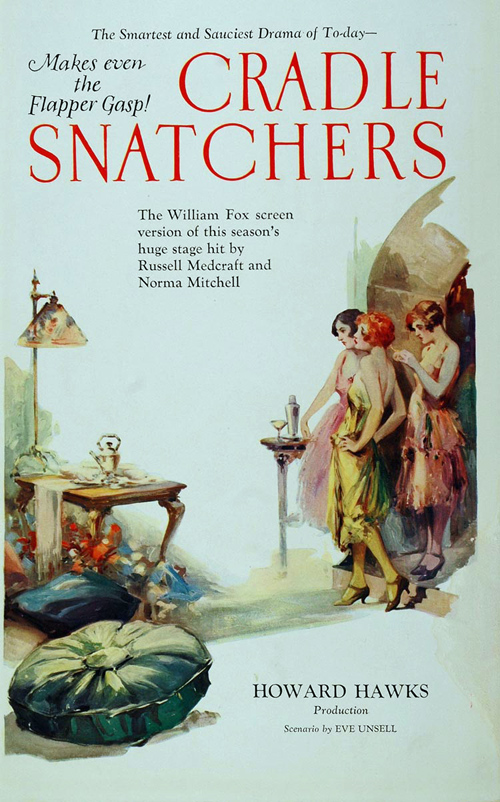
Cradle Snatchers, Hawks’ third film, shows a trio of cheated wives exacting revenge on their philandering husbands. The women arrange for three penniless college boys to pretend to court them so that their husbands can become jealous. Even though some portions are missing, the first reel is intact, and it’s instructive. Instead of opening with the women’s plight, as the source play does, the film starts with the fraternity brothers and mostly anchors our viewpoint to theirs. Variety noticed.

Probably the most remarkable angle of transplanting this “smash” comedy to celluloid lies in the manner in which the three college youths have been duplicated. As a screen threesome they overshadow the women who play the neglected wives. . . Each of the male youngsters does exceptionally well and Hawks has directed them splendidly.

Once Hawks turned it into a male-centered plot, he could indulge in the gay-play that would crop up in his later work. A title points out that “When a roommate takes a girlfriend, he becomes only half a roommate.” One of the boys hangs up on his girlfriend in order to chat up a sexy dame strolling by, but she turns out to be a frat brother in drag (the same Sammy Cohen playing Callahan frère in Upstream). Still, the gags provide equal-opportunity innuendo, as when Louise Fazenda flounces in from a massage and is asked “What have you been doing?” She replies: “I’m not doing, I’ve been done.”

Visually the films are remarkably similar. Removed from Monument Valley, Ford doesn’t give us vistas, deep focus, or even scenes organized around doorways. At home in sparky comedy, Hawks doesn’t provide the graceful, pell-mell staging we get in Twentieth Century and His Girl Friday. Instead, we have classical American silent technique, already by the early 1920s quite polished (as can be seen in the 1922 Ritrovato entry from another master, The Real Adventure by King Vidor).

This silent technique turns out rather talky. Dialogue titles constitute seventeen percent of the shots in Upstream and sixteen percent of the shots in Cradle Snatchers. This isn’t a late 1920s development, since The Real Adventure contains nearly twenty percent dialogue titles. Why are these figures interesting?

The 1920s, the era of the “mature silent cinema,” led many filmmakers and critics to expect that filmmakers would shift toward purely visual methods of storytelling. Keaton’s Our Hospitality (1923), Lloyd’s Girl Shy (1924), and Lubitsch’s Lady Windermere’s Fan (1925) remain dazzling exercises in getting maximum impact from the flow of images, with dialogue titles adding another layer of dramatic interest.

Ideally, the aesthetes thought, one could make a film entirely without titles. German films like Der letzte Mann (1924) are the most famous examples, but there were American experiments along these lines too, such as The Old Swimmin’ Hole (1921). The arrival of sound threatened this trend toward “purely cinematic” narration. Now, critics fretted, filmmakers would be forced to rely on language to make dramatic points. The visual side of cinema would be secondary to “theatrical” methods.

Actually, however, alongside the consummate pictorial storytelling of Keaton, Lloyd, Lubitsch, and others, something else was happening. During the 1920s, quite a lot of American cinema became dependent on language. This happened, paradoxically, because of what critics then and since called the increasingly “cinematic” qualities of movie storytelling.

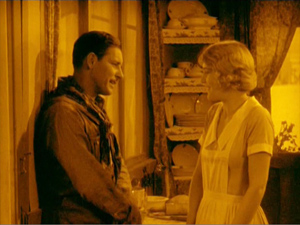
Not having either Cradle Snatchers or Upstream available for illustration, here’s an example from a film not playing here. In Henry King’s Winning of Barbara Worth (1926), Holmes the engineer is calling on Barbara before he sets out on a mission. He tells her that he plans to go back east, and he’d like her to join him. He’ll be back in a week for her decision.

At the purely imagistic level, the scene is presented in standard continuity, with a long shot establishing the kitchen, then a series of reverse-angle medium-close shots of Holmes and Barbara as they talk flirtatiously.
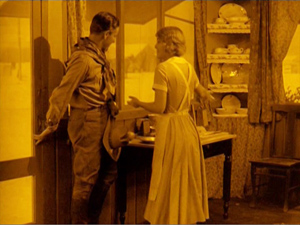
The conversation is interrupted by a cutaway to Abe outside, coming in the gate, which serves as a transition to a two-shot of Holmes and Barbara.
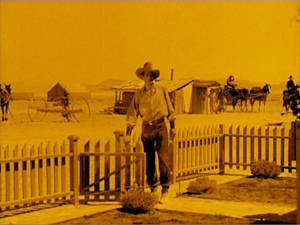
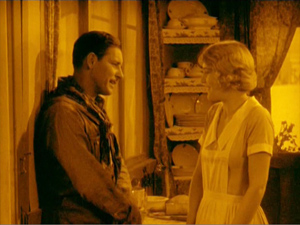
It’s from that framing that Holmes leaves, and she lingers at the doorway.
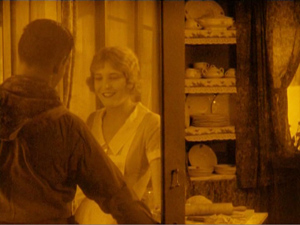
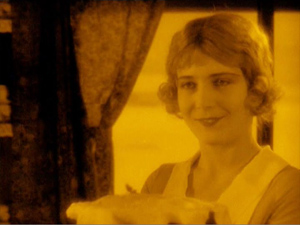
But the scene is even more broken down than this. Of its twenty-eight shots only eighteen are images; the other ten are dialogue titles. They are sandwiched in between the tight singles of Holmes and Barbara, as here:
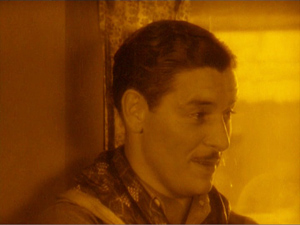
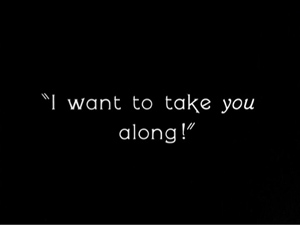
In effect, breaking the scene down “cinematically” into close views of each character may seem to pull cinema away from theatre. Yet it works to frame and underscore each line of dialogue. The pattern is speaker/ title/ speaker. Even the more distant shots, like the opening establishing shot and the final two-shot framing, are broken up by inserted titles.
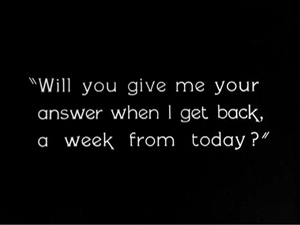
Across the 116 seconds of the passage, nearly 36% of the shots consist of dialogue. Of course this proportion wouldn’t be sustained across the whole film, since many sequences are filled with physical action and have no conversation. But in this and many other films American directors were creating a silent-film dramaturgy that incorporated dialogue into the texture of the cutting. Dialogue titles became editing units that could maintain a rapid pace and, combined with legible singles and two-shots, made for cogent storytelling.

This is what happens in Upstream and Cradle Snatchers. They are dialogue-driven vehicles (one a short-story adaptation, the other taken from a play), and both Ford and Hawks, idiosyncratic stylists in other genres and at other times, accept the dominant norms of their moment for these projects. These films employ speaker/ title/ speaker cutting, the singles and firm two-shots, and the careful eyeline matching. In fact, Ford uses a clever “impossible” eyeline match when the ham star looks up from the dinner table and the answering shot shows the distraught Gertie in her room upstairs, looking down, as if at him.

So were films like Upstream, Cradle Snatchers, The Real Adventure, and The Winning of Barbara Worth “preparing” for sound? In the sense of underscoring dialogue, yes. But the detailed breakdown into singles was not the most common option in most talkie scenes, at least in US cinema. (Japan is another story; cf. Ozu’s 1930s films.) The default for most scenes was the two-shot framing, with characters conversing within a sustained shot. This strategy is present at the end of our Barbara Worth scene, and it can be found throughout 1920s cinema. In other words, given the choices already established during the 1920s, sound-era filmmakers usually preferred the two-shot over singles. Accordingly, the cutting rate slowed down in most sound cinema. (The over-the-shoulder shot, a sort of single-plus, was another fairly rare option in the 1920s, but that too came into its own in the talking film.)

As often happens, Hollywood style offers a menu, with some options becoming more common at different periods. For sound filming, directors relied upon what had been an alternative option in the silent era, the two-shot. They saved singles for key moments. Today, with the dominance of what I’ve called intensified continuity, we seem to be back in the late 1920s. Filmmakers are inclined to present a line of dialogue with a tight single of the speaker, as happens in the Ford, Hawks, Vidor, and King films–but this time, of course, sync sound does duty for the intertitles.

This is one of the things that Ritrovato does best—provoke you into seeing new connections and trying out fresh ideas. Of course, it shows you a wonderful time in the process.


Kristin’s 2010 blog entry on Capellani is here. She will update it and write a new one after she’s assimilated the Ritrovato experience. The Variety review of Cradle Snatchers is from 1 June 1927, p. 16. We discuss dialogue intertitles in American cinema throughout The Classical Hollywood Cinema (1985), particularly in the chapters written by Kristin.

Triple play

Wednesday | June 22, 2011

The Disciple of Hong Kong.

First, if you haven’t yet visited Jim Emerson’s Scanners blog entry on “Geriatric Noir,” you must do it pronto. It confirms once more the spontaneous genius of the American people. We are the world’s very best at smart-alec, disrespectful, shameless humor.

Second, I’ve just received an advance copy of Jac and Johan’s film The Disciple of Hong Kong. It’s an essay on Tarantino’s debt to Hong Kong film. Twitch announced it here, and you can watch the trailer here.

This is a fan’s fever dream. It features interviews with many HK film experts like Roger Garcia and Bey Logan, along with local legends Raymond Chow, Ringo Lam, Simon Yam, and Gordon Liu, below. The movie is a load of fun, with many clever retro touches, and I learned a lot from it.

I wander in from time to time, with probably my most significant line being “Excuse me, do you have any syrup?”

It’s coming up on 26 June on a French channel dedicated to action films. I don’t know exactly when it will be available otherwise. For some clues to the identity of directors Jac and Johan, go here. Frederic Ambroisine, another HK film expert, was involved with the project as well. His site is a remarkable video resource, and he currently writes at actionqueens.com and alivenotdead.com.

Third and finally, Kristin and I are soon off to Bologna’s Cinema Ritrovato. We will be blogging.


Speaking of shameless: To get more of my take on HK cinema, visit the Hong Kong national cinema category below. If you’re really devoted, or just at a loss for how to spend $15, pick up a copy of my e-book Planet Hong Kong.

Rukik Sallé (Mad Movies), Fred Ambroisine, Jac, and Johan. Hong Kong, 2011.

Pike’s peek

Sunday | June 19, 2011

The Lady Eve.

DB here:

Hollywood is supposedly making movies for mass audiences, and up to a point that’s true. But there’s an in-group aspect of Hollywood as well. There are moments in the movies when the writers and directors and actors seem to be talking more among themselves than to outsiders. We’re probably more familiar with this nowadays, as when Tarantino and Soderbergh cast Michael Keaton as the same character in both Jackie Brown and Out of Sight. Not only does the gesture suggest solidarity between two directors of roughly the same generation. I think it’s also a sign that the directors respect Elmore Leonard’s concern to let a character from one novel pop up in another.

You see the same attitude in those in-jokes we occasionally find in Hollywood movies. The most famous, I suppose, is Cary Grant’s warning, in His Girl Friday, that the last man who thought he’d beaten him was Archie Leach, “just a week before he cut his throat.” Archie Leach was of course Grant’s real name. In the same film, Grant as Walter Burns tells the platinum blonde Angie to seduce Bruce Baldwin. How will she know him? He looks like that fella in the movies, he says, “You know, Ralph Bellamy.” Angie replies with simple lack of interest, “Oh, him?” Since Bruce is played by Bellamy, this is a little cruel; both character and actor are treated as losers.
Preston Sturges liked such playfulness, as when in The Lady Eve (1941) he used his birthday as the date on a check. In the same movie, the protagonist reads a book called Are Snakes Necessary?

No such book exists, more’s the pity. The title pays comic reference to James Thurber’s 1929 best-selling satire on marriage manuals, Is Sex Necessary? and confirms the snake-as-phallus imagery that isn’t exactly underplayed in the rest of the film. Sturges revisited the gag phrase when he proposed Is Marriage Necessary? as the title for a later picture. Unsurprisingly, it didn’t pass the censor, and instead we got a more anodyne title, The Palm Beach Story (1942).

These are comedies, though. On Saturday night, I saw an instance of in-group crosstalk where I hadn’t expected it. The Long Night (1947) is Anatol Litvak’s somber remake of Le Jour se lève. Unlike Hawks and Sturges, Litvak wasn’t exactly known for cockeyed humor, nor was screenwriter John Wexley (The Roaring Twenties, City for Conquest, Hangmen Also Die!). Yet in one shot, there it was, a citation as plain as a pikestaff.

Over several years I’ve been gathering material for a blog or web essay on product placement. (I’m mostly in favor of it.) So I tend to scrounge around among hand props and other bits of flotsam in the frame, hoping to catch a brand name. Usually this task-driven visual search comes to naught, but The Long Night paid me back.

In Sturges’ The Lady Eve, you’ll remember, Henry Fonda plays Charles Poncefort Pike, heir to the vast fortune of the Pike brewery. The firm’s success rests upon Pike’s Pale Ale. A flyer for the product convinces Jean and her father that Charles should be the target of their next con job.

Pike’s Pale and its tagline run through the movie as a comic motif. But no such product then existed. It features on a list of fake movie products in a 2006 New York Times story.

All the more surprising, then, is a scene in The Long Night six years later. The rapacious magician Maximilian (Vincent Price) takes Joanne (Barbara Bel Geddes) to a symphony concert. She reads the program avidly, and on the back we can glimpse a familiar brand.

The advertisement even features the same text and layout as the flyer in Sturges’ film.

If it’s an in-joke à la His Girl Friday, what’s the punchline? And how did it even get there? We have two different studios (Paramount, RKO) and different genres (satiric romantic comedy, gloomy romantic drama). Was the ad just lying around a props warehouse? Did Fonda, who plays the hero of The Long Night, keep the flyer as a souvenir of The Lady Eve and ask the producers to include it as a shout-out to Sturges? Was there a company specializing in making printed props for the studios and here it just recycled something it had done for Paramount? Or is it just a case of Hollywood gratuitously referencing itself?

I’d be eager to hear from anybody who knows or has an educated guess. In the meantime, I’ll keep scanning frames, and being diverted by the ways that the Hollywood In-Crowd creates a world of off-center echoes and cross-references. It’s as if movies fertilized each other, but promiscuously, creating an eccentric world behind the screen, where stray images and lines of dialogue jostle against one another. Of one thing we can be sure: It will be unpredictable.


Today there is a real Pike’s Pale Ale. The proprietors of Seattle’s Pike Brewing company didn’t know about The Lady Eve when they conjured up their brew. I’ve never tasted it, but you might count this a case of blog product placement. Mmmmm, pale ale….

Ian Patrick displays an imaginative gouache called “Are Snakes Necessary?” here.

Incidentally, The Long Night is another of those 1940s movies with a flashback within a flashback, of the sort I considered in an earlier post.

I top and tail the entry with pictures of Slim because he looks swell when he’s thinking.

The Long Night.

PS 19 June: Rapid Response Dept: Alert reader Sean Weitner points out the reappearance of the same newspaper page in a bevy of TV shows. The evidence is here. Thanks to Sean!

PPS 21 June: More bulletins from alert readers. Leo Rubinkowski points out the source of the recurring newspage on Slate here. This wouldn’t, I think, explain the reappearance of Pike’s Pale, but maybe…. Andrea Comiskey has found that Douglas Sirk was apparently fond of certain foil-etched items. The films are All That Heaven Allows and Written on the Wind, and the pix are here and here and here and here. Leo and Andrea are UW grad students, so I’m especially happy to thank them.


David Bordwell
top of page

have comments about the state of this website? go here