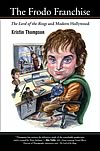
by Kristin Thompson. Berkeley: University of California
Press, 2007.
400 pages, 6 × 9 inches, 12 color illustrations;
36 b/w illustrations.
[go
to Amazon | go to The Frodo Franchise blog]
Once Fassbinder said something to this effect: “One is always misunderstood. If you spend time clearing up misunderstandings, you’re dead.” Usually I think this is good advice. Now, though, a filmmaker whom I admire has, in publicity for a film that I admire, misunderstood me. So I’m squawking, mildly.
I met Raúl Ruiz only once, many years ago during his visit to our university here in Madison. We’d programmed At the Top of the Whale and Life Is a Dream. One afternoon we were sitting in the Student Union looking out over majestic Lake Mendota, and he started to muse. “I see a boat on the lake. Three men are in the boat. One is planning to kill the other two, but we don’t know which one it is.”
This was only one of many forking paths our conversation took. Over dinner that night Ruiz was at pains to explain that there was nothing new in Postmodernism that we couldn’t already find in the Spanish Baroque. That was pretty persuasive. He talked as well about his two production courses at Harvard. “In one, we shoot a drama as if it were a TV quiz show. In the other, we shoot a quiz show as if it were a drama.” In sum, typical Ruiz ebullience and passion for rethinking forms.
Earlier this year my name got linked to his in an unexpected way. In an interview, Ruiz mentioned that a Swiss magazine had claimed that Mysteries of Lisbon didn’t conform to “Bordwell’s Paradigm,” and he agreed. Alerted to this interview by Adrian Martin, I shook my head and thought, I don’t know what Bordwell’s Paradigm is, so how can anybody else? I suspect the label has to do with my characterization of classical Hollywood cinema, but who knows?
Since then Ruiz has signed a discussion of Mysteries of Lisbon that expands on the same theme. You can read it here. It starts off with a bang:
The American professor David Bordwell considered that all narrative strategies that can be applied to modern films are based on a certain notion of verisimilitude (or narrative evidence).
Thanks to them, the most unbridled fictions are acceptable and accepted. And this very verisimilitude, it is said, is averse to any straying from a guiding line (what is commonly called the action’s guiding arrow), with its variations in intensity and its turbulent twists and turns.
This theory, which depends on a certain number of rules often abusively attributed to Aristotle, finally became what purists hastened to naively call “Bordwell’s paradigm”–the whole of narrative strategies that stem from impulse, from the presumption of verisimilitude.
What is called “modern drama” or “bourgeois drama,” or even “the Ibsen Shaw postulate” has given rise to this superstition. In modern drama, structure and construction dominate, even beyond the poetic incoherence or the irrelevant facts it supposes. The author is an architect who builds shelters for fictions, various events which, and only because they are protected from the rain of the improbable, become credible and relevant.
Each of these fictions, of these mobile structures, is guided by a narrative arrow. But beware, only one per fiction: William Tell is a well-told story because only one arrow cuts in two only one apple, but the battle of Azincourt is not because Robin Hood and his people’s swarm of arrows does not enable one to read the time on the narrative clock, veiled as it is by clouds of arrows, each guided by its independent little intrigue. “Clouds and not clocks” would say Karl Popper.
In modern drama, the proliferation of truncated facts is not acceptable because it makes us stray from the notion of causality which is inherent to that of verisimilitude, and without which there would be no story.
Promoting a film by citing an American professor may not be the height of shrewd marketing, but put that aside. Peering through the haze of this rather awkward translation, I’m inclined to say that Ruiz mistakes my claims. I’ve said in several places that narrative, prototypically, requires causality. But that isn’t the same thing as claiming that such causality is realistic in nature, or that causality is the main attraction of narrative. Mainstream cinema, including Hollywood, often uses certain kinds of verisimilitude as an alibi for formal experimentation. And I’ve celebrated filmmakers like Eisenstein and Ozu who break away from narrative causality.
It’s ironic that on the same day I post a blog entry arguing that realism gets short shrift in studio cinema of the 1940s, I find Ruiz claiming that realism is my guiding light. If I disapproved of the “disparate, truncated, labyrinthine and baroque” aspects of narrative, I wouldn’t have said this about Mysteries of Lisbon:
This being a Ruiz film, there is as well a tangible pleasure in the artifice of storytelling. The film acknowledges that all the handy coincidences, buried pasts, multiple identities, and revelations of kinship are there for our delectation. . . .
This recounted history is only the first of a cascade of flashbacks, issuing from several characters, and these gradually show deep connections among persons tied to Pedro’s past. Secondary characters in one story become protagonists of another. The young hero is gradually displaced as the center of the action by war, secret romances, rivalries, duels, and infidelities. Like Pasolini in his Trilogy of Life, Ruiz is happiest when opening up a plot detour that will eventually become a new main road.
You can read my whole account, from last year’s Vancouver International Film Festival, here.
I think that Ruiz and I might disagree about how much Mysteries owes to psychological causation, and about whether labyrinthine trails can converge, let alone become highways. Both of us use metaphors of linearity, so maybe our disagreements are basically about whether the detours and paths are truly dead ends. Maybe I think his plotting is tighter than he does. Still, I expect that we’d agree that much of the pleasure of the film is its delight in apparently capricious digression.
Anyhow, my squawk is mild because it’s a pleasure to be misunderstood by a grand filmmaker. What Fassbinder didn’t say was that artists’ misunderstandings can be productive, leading to the creation of new artworks, and perhaps ideas about them.
If my remarks on Mysteries of Lisbon don’t make you thirst to see it, Manohla Dargis’ review surely will.
“I thought they burned that.” Hellzapoppin (1941).
DB here:
Coming back from my five-week stay in Europe (known in the Midwest as Yurrrp), I watched two releases I’d missed in the spring. Neither one was of outstanding quality, to put it mildly, and both were limited by “having been formatted to fit” the 4 x 3 airplane screen. Still, I was struck by how much both were like the 1940s movies I’d just been talking about with eighty participants in the Antwerp Zomerfilmcollege.
Of course the films’ look and feel were quite different, with Bouncycam and fast cutting instead of the rock-steady compositions and more sedate pace of the 40s films. But since I’d been concentrating on narrative matters, both of the recent releases chimed with my concerns in the course.
For one thing, both relied on flashbacks. Battle: Los Angeles used the technique casually. After a brief prologue showing our squad in a helicopter heading into a firefight, we get a title, “Enemy contact minus 24 hours.” This takes us back to the previous day, when the aliens’ attack seemed merely a meteor shower. We get to meet the Marines’ team in the usual vignettes of guys buddying around, planning their futures (one grunt is getting married soon), and nursing their woes (ageing, or mourning a slain brother). Why couldn’t these twenty minutes of exposition be given at the outset? Do the makers think we’re too impatient to wait for the first alien onslaught? Do they think we don’t know that the whole premise of the movie is an interplanetary assault on LA? In any case, the flashback is over by the sacred 25-minute mark, and we’re plunged into the ongoing action, starting with the team’s effort to save some civilians trapped in the combat zone.
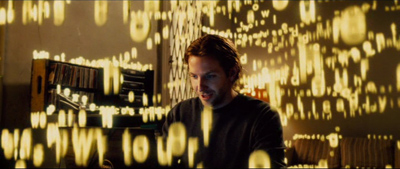
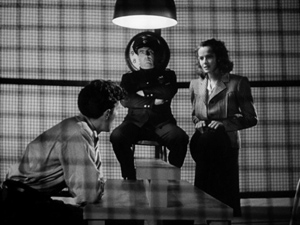
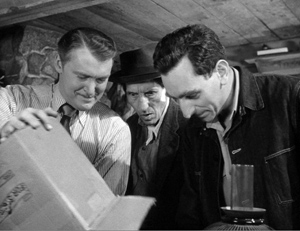
Limitless used a more extended flashback. It follows what I called in Antwerp the “crisis” architecture, whereby the plot begins at or near the action’s climax and then moves back to the point at which the main story action begins. A prototype of the structure is The Big Clock (1948). Accordingly, Limitless opens with the protagonist about to leap off a high-rise terrace while his enemies pound at the door of his apartment. Then we return to his origins as a grungy wannabe writer, and the bulk of the film moves toward the critical point shown in the opening.
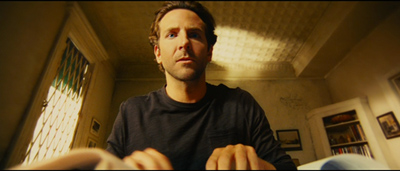
Limitless also reminded me of the 1940s’ penchant for rendering character psychology through subjective film techniques. After Eddie Morra takes the mind-enhancing drug, his world becomes distorted and we get unusual angles on him.
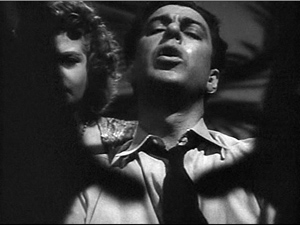
But Eddie’s head trips have precedents in the frenzied dream sequence of an early film noir like The Stranger on the Third Floor (1940). A frantic rehearsal montage in Blues in the Night(1941), with its shots from the “viewpoint” of a piano keyboard, pushes the pictorial envelope further than the comparable shot in Limitless.
Today’s digital technologies make it easier to go for extreme effects, but wild imagery is nothing new, especially when it’s motivated as representing extreme subjective states.
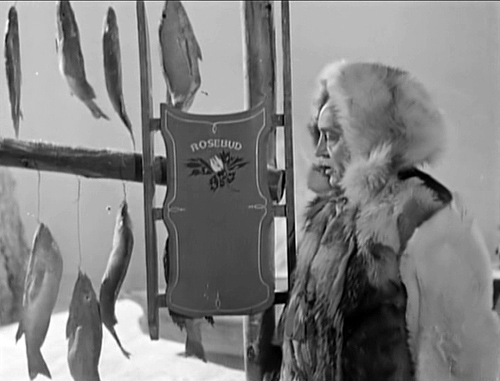
Of course flashy storytelling, including time-juggling and subjective images and sounds, can be found in cinema before the 1940s. But in that era they became more prevalent, in effect a “new normal.” And very quickly filmmakers sought to push them further, with results that linger today. In The Way Hollywood Tells It, I try to argue that the flagrant artifice of 1940s films was revived in the 1990s and 2000s. Citizen Kane is in a way the ultimate “puzzle film,” with one clue to the meaning of Rosebud tucked away in a minor set. The narrative gymnastics of The Hudsucker Proxy, Pulp Fiction, Memento, The Matrix, Inception, Shutter Island, and many other movies hark back to the revisions of storytelling traditions that crystallized fifty years earlier.
Unelected affinities
It’s not just that the two airborne movies chimed with what I’d been screening. Anyone who teaches art or literature is familiar with what we might call the cluster-surprise effect. When you assemble a batch of books or plays or films to make up a semester course, you start to notice affinities you wouldn’t have spotted if the artworks hadn’t been set side by side.
To a greater degree than usual, cluster surprises arose within the movies I screened for the Belgian Zomerfilmcollege. I’ve participated in these summer movie camps before, but seldom have I had such a sense of interconnections among the films we watched. It’s as if the makers were talking to each other, or at least looking over their shoulders at what their compadres were up to.
To some extent, convergence was to be expected. The films were picked to illustrate storytelling innovations in 1940s Hollywood films, so that guaranteed some overlap. Moreover, I’ve elsewhere suggested that filmmakers are making movies as much for each other as they are for the general public. My most recent instance was in a peculiarly recurring ad for ale.
So I probably shouldn’t have been as surprised as I was. Still, I was initially ready to notice changes within individual directors’ outputs, such as Welles’ development from the quietly controlled pressure of The Magnificent Ambersons to the narrative fireworks of The Lady from Shanghai. What I didn’t expect was the crosstalk among Ford, Mankiewicz, and Siodmak in their handling of flashbacks, or the way that the elegant methods of characterization found in A Letter to Three Wives set off the opacity and contradictory behaviors of the love triangle in Daisy Kenyon.
I need to think more about how the films we screened, plus the hundred or so others I’ve been watching in the spring and summer, can illuminate our understanding of creative choices facing filmmakers then (and today). Some of this thinking will eventually surface in more extended writing, I hope. For now, here are three ideas about 1940s storytelling, sparked by the sheer juxtaposition of interesting movies.
Of course there are spoilers. The films most vulnerable to spoilage are Laura, The Killers, All About Eve, and Sunset Blvd. Maybe you can use your parafoveal abilities to skip the passages that deal with ones you haven’t seen.
Art as artifice
The Magnificent Ambersons (1942).
The 1940s highlight a basic feature of Hollywood cinema, and indeed most popular traditions I know. Artifice, often self-conscious artifice, usually rules. It’s most evident in crazy comedy (see way up top), but even dramas seldom yield what people usually think of as realism.
Imagine a continuum between surveillance-camera video at one extreme and ballet or commedia dell’arte at the other. Hollywood lies much closer to the stylized side than to the documentary-recording side. This tradition is heir to a host of conventions derived from painting, drama, vaudeville, opera and operetta, prose fiction, and, by the 1940s, radio. All of the resources of these arts are brought together for the sake of telling a compelling, moving story, and anything that works is fair game.
Take one technique that became robust in the 1940s, the voice-over narrator. Some theorists claim that every narrative must have not only a narrator but a “narratee,” somebody who is listening to the story being told. Yet in most situations we haven’t the foggiest idea who the narratee would be.
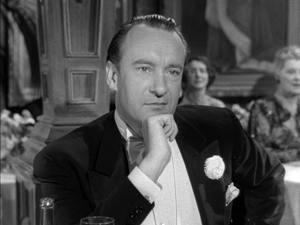
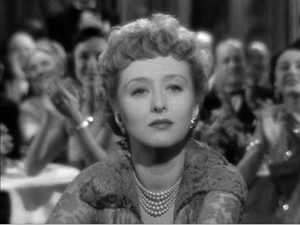
At the start of The Magnificent Ambersons, Welles’ ripe baritone tells us things about the town, the family, and long-gone fashions. At the start of All About Eve (1950), the urbane Addison DeWitt promises to give us the dirt on the young woman’s rise to stardom. The cases are significantly different. Welles creates what we might call an external narrator, one who isn’t participating in the events we witness. Addison is a character narrator, one who exists within the story and plays a role in the action. In either case, though, we can ask: To whom is the narrator speaking?
Addison isn’t addressing other characters, even in retrospect; we never see anyone listening to his tale. Welles’ voice-over narrator can’t be addressing the characters because he isn’t in the story world at all. So who’s listening? Before you say, “Well, they’re addressing us, the audience,” remember that both these narrators are fictional beings. They don’t exist in our world and we don’t exist in theirs. In daily life, if you said your nonexistent friend told you of his adventures, we’d tend to wonder about you, and we’d certainly place little credence in the events reported.
In art, though, no problem. It’s simply a convention—a piece of artifice—that lets us accept the voice-over as a mimicry of a conversational situation (a person speaking to another) and delete the part that assumes a tangible listener. So the commonsense answer is right. These narrators are speaking to us. In fact, everything in a fiction film is addressed to us. If you want an ontologically tidy answer: The actual filmmakers are the storytellers, the actual viewers are the audience, and everything else is smoke and mirrors, or puppetry and ventriloquism.
You can put it more generally. As often happens, the movie summons up a familiar schema from ordinary life, the conversation, but revises it for artistic purposes. The film draws on certain features of reality but deletes others, retaining just enough salient bits to prompt our understanding. Filmmakers can assemble, in the manner of collage, pieces of standard social interactions for particular effects. Our response depends on the patterns that are formed, not on the reality status of the bits or of what is left out. We concentrate on the effect, not the means used to trigger it.
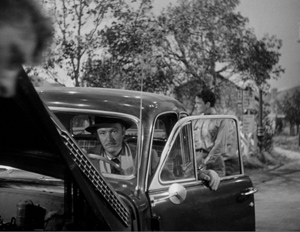
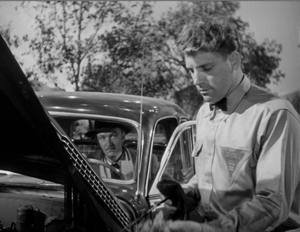
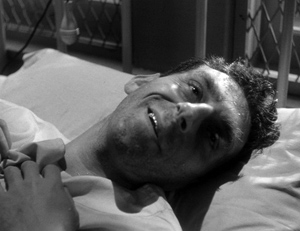
The same thing goes for the narrator’s range of knowledge. In literature, the “I” narrator typically cannot report things she doesn’t know about. If something happens that she couldn’t witness at the time, she’s obliged to explain how she learned about it subsequently. But internal filmic narrators often lead us into moments, or entire sequences, that they weren’t present to witness. In The Killers (1946), Nick Adams tells the insurance investigator Riordan that Ole the Swede encountered a mysterious man from his past, but given Nick’s position at the rear of the car, paying no attention to the encounter, he couldn’t have observed the way Ole intently avoids meeting the driver’s eyes.
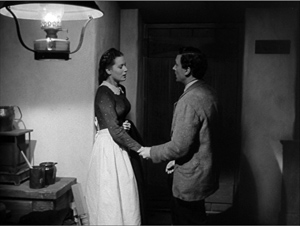
Huw, the narrator of How Green Was My Valley (1941), didn’t see, and may not have known about, his sister Angharad’s visit to Reverend Gruffyd.
Yet the scene, played out between the two near-lovers, is given to us within the narration established as Huw’s.
By convention, then, filmic narration allows a lot of leeway to a character narrator. Again, a realistic situation, someone reporting on what they know, is treated in a partial, stylized fashion for the sake of sharpening the effect. We’re more curious after noticing the driver’s frowning look at Ole, whether or not Nick could have strictly seen it. We’re more intensely involved with the emotion of the Angharad/ Gruffyd romance than if we simply saw Huw learning about her visit later.
Proteus in Hollywood
Once a convention is put in place, somebody is bound to play with it. A one-off example occurs in Ambersons, when we get this exchange on the soundtrack:
Gossip: They’ll have the worst spoiled lot of children this town will ever see.
. . . .
Narrator: The prophetess proved to be mistaken in a single detail merely. Wilbur and Isabel did not have children. They had only one.
Gossip: Only one! But I’d like to know if he isn’t spoiled enough for a whole carload.
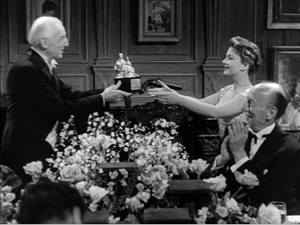
(Interestingly, Welles doesn’t present this exchange in his 1938 radio version of the novel.) Likewise, the opening of Eve is trickier than I indicated, partly because Addison’s narration is accompanied by a freeze-frame at the moment the award is presented.
Since a few years before this, It’s a Wonderful Life (1947) showed angels freezing time and commenting on George Bailey’s dreams, you have to wonder if Mankiewicz isn’t endowing Addison with a supernatural power.
Addison will, by the end of the film, be utterly in control of Eve.
The 1940s and early 1950s see an immense amount of experimentation with narrators. Narrators can lie about what they report. They can be dead (Scared to Death, 1947; Sunset Blvd, 1950), otherworldly (the angels in It’s a Wonderful Life), non-human (the house in Enchantment, 1948), or of uncertain status (Woman in Hiding, 1950).
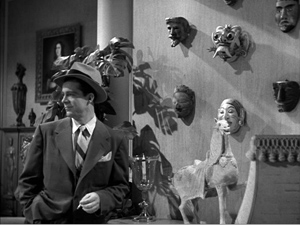
A good example of the high artifice of the period comes in Laura (1944). The film is introduced by Waldo Lydecker’s voice-over, remembering “the weekend Laura died,” and remarking on the detective Mark McPherson, wandering through Waldo’s art collection. Waldo’s voice-over, describing events in the past, might seem to assure us that he survives the ensuing story.
Fairly soon Waldo’s voice-over reappears, but it doesn’t frame the overall fiction. As he explains his relationship with Laura to McPherson, we get episodic flashbacks showing Laura’s rise (and, true to form, including events Waldo couldn’t have known about). At the end of their evening together, the film’s narrational weight shifts visibly to Mark, showing him in an uncharacteristically tight close-up watching Waldo depart.
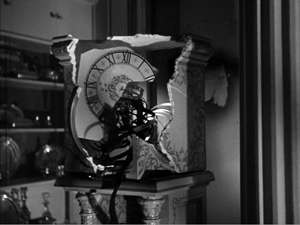
The absorption of Waldo’s voice into the overall texture of Mark’s investigation invites us to forget that Waldo initiated the film, and that he in fact fed us false information. (Laura didn’t die that weekend.) So the ending, in which Waldo falls before policemen’s pistol blasts, comes as a new surprise. The camera tracks away from him murmuring, “Goodbye, Laura”, past Laura and Mark, to the shattered clock face that recalls what Waldo’s shotgun did to Laura’s surrogate.
Over this image we hear Waldo’s voice: “Good night, my love.” From one angle, the line could be considered Waldo’s offscreen dying words, continuing his murmured farewell to Laura. Yet the last line is closely miked in the manner of the opening voice-over, suggesting a voice from beyond the grave. Was Waldo narrating the first scene from the same place? Is this a tale told by a corpse? The ending is equivocal, hovering between the two possibilities.
Again and again, the films we saw fractured tidy patterning. Addison’s voice-over narration in All About Eve gives way to that of another character, Karen Richards. After he glances at her, a cut presents her voice-over taking up the burden of introducing us to the young Eve in a flashback.
How to explain this tag-teaming, except as pure artifice, a new wrinkle in a convention that by 1950 had become second nature to filmmakers and viewers?
In The Killers, the dying crook Blinky is questioned by two investigators. No problem about narratees here; he speaks to them. But the film makes a new problem for itself. Blinky is too far gone to respond to questions. All he can do is mutter phrases from the past. Yet the film’s narration dramatizes his ravings, presenting the scene he invokes as fully as any other.
Is this what his listeners are imagining? No; it’s just a stretching of the conventions surrounding the character narrator. After several orthodox voice-overs earlier in the movie, we can assume that Blinky’s babble will be translated into solid scenes, as more articulate talk has been earlier. Again, plausibility is flagrantly violated; who could construct a coherent set of actions, let alone a legal case, out of fragmentary phrases? But who cares? Blinky is a device to get us into the past, and the filmmakers assume that we’ll follow the most slender lead they offer.
Meir Sternberg has articulated a powerful case that there are no “package deals” in verbal art. Any narrative or stylistic device can fulfill a wide range of functions, and any functions can (with sufficient motivation) find expression in many different techniques. To take a filmic example, a dissolve can indicate a passage of time, but sometimes a dissolve (say from a long-shot to a closer view of a character) suggests continuous duration. And a cut may indicate continuous time, but it can also indicate that a stretch of time has been skipped over, as throughout Resnais’ Muriel. Sternberg calls this the Proteus Principle, “the endless interplay between form and function.”
Along these lines, conventions within a tradition can be seen as the most probable fit between form and function, the ones we expect because we’ve seen them in other films. In studio-era Hollywood film, dissolves usually signal a passage of time, and cuts within scenes usually indicate continuity. But those functions are local and subject to revision. Likewise, a voice-over narrator is unlikely to talk with the characters, except in the case of comedy. For Welles to try it in a drama was a bit daring, but it simply shows that there is room, if the filmmaker proceeds carefully, to stretch the convention. (It had already been stretched in both the play and film versions of Our Town.)
Collaborative competition
How to explain these fractures of form? Invoking a Zeitgeist explanation—wartime trauma, postwar dislocation—seems to me a desperate measure, for reasons I’ve outlined elsewhere. In the Antwerp sessions, I suggested some other explanations, which I hope to justify at greater length another time. For now, let me propose just one factor that seems to me to have contributed to the wilder side of 1940s storytelling.
The famous opening of E. H. Gombrich’s Story of Art—“There really is no such thing as Art. There are only artists”—is open to many interpretations. One is that art history is driven by the human dispositions of the image-makers. Those dispositions include rivalry. In his 1974 essay “The Logic of Vanity Fair,” Gombrich further explores the role of competition among artists. In many traditions, they may try to raise the stakes, seeking to outdo others in virtuosity. I’d add that such artists either try to beat their predecessors and contemporaries at their own game, or to invent a game in which a newcomer can excel. Later in his career Gombrich suggested an analogy to ecology: some artists fight for the same niches, others adapt themselves to unexploited ones.
From this standpoint, I’d suggest that a close-knit world like Hollywood encouraged competition among its creators. In the period I’m concerned with, some ambitious Hollywood filmmakers (not only screenwriters but also directors, cinematographers, and their colleagues) saw voice-over narration as an opportunity to innovate. The technique may have arisen partly because people were used to it from radio, and it offered advantages in efficiency and low cost. Detour (1945) shows that a fairly static, cheaply shot scene can be energized by extensive voice-over. Ambitious filmmakers could make this still-emerging technique more forceful, more mysterious, more evocative. The cost of this effort was some violation of realism and an occasional violation of tidy form.
In just a few years, we go from Welles’ external narrator being sassed by a gossip to Mankiewicz’s character narrator passing the expository ball to another character. We see a community of creators pushing each other to revise a schema they inherited, to test its limits and find new effects it could create. I think that this “collaborative competition” operates in other innovations of the period, such as the long take, the flashback, deep-focus cinematography, and sound manipulations.
Something like this creative community still exists. Urges to compete through innovation (or to revive older conventions) seem to drive some of our filmmakers. The impulses assume a feeble form in Limitless and Battle: Los Angeles, but at least these program pictures remind us that competition isn’t only financial; it’s also artistic. The pressure to come up with a fresh revision of a familiar schema is, if anything, keener today than in the 1940s. Insidious has to top Paranormal Activity, which itself revised a traditional formula in fresh ways.
The snag is to do something that we haven’t seen before. That’s tough when you come at the end of the line that includes filmmakers like Ford, Hitchcock, and so many others. This is the problem of belatedness, and some day it will get a whole entry of its own.
Two especially strong books on Hollywood cinema of the 1940s are Thomas Schatz’s Boom and Bust: American Cinema in the 1940s (University of California Press, 1997) and Dana Polan’s Power and Paranoia: History, Narrative, and the American Cinema, 1940-1950 (Columbia University Press, 1986). By presenting a detailed overview of industrial developments, Schatz supplies a vivid context for studying artistic trends. Polan, focusing on an immense range of films, aims to explain their formal and thematic qualities from a broadly Foucauldian perspective. Here “discourse” assumes an immense power over the way the films look and sound, and the motive force behind the discourse is largely, though sometimes obliquely, World War II.
In addition, I should pay tribute to Sarah Kozloff’s fine Invisible Storytellers: Voice-Over Narration in American Fiction Film (University of California Press, 1988). Kozloff includes concise, sensitive analyses of How Green Was My Valley and the opening of All About Eve. For the latter film, she traces Addison’s narrational power in some detail. Needless to say, my thinking has also been influenced by Kristin’s essays on Laura and Stage Fright, to be found in her collection Breaking the Glass Armor: Neoformalist Film Analysis (Princeton University Press, 1988).
For more information about Mankiewicz’s plans for All About Eve, including a scene replaying earlier action with different significance, see Gary Carey, More about All About Eve (Random House, 1972), 56-58. According to Carey, Mankiewicz shot this and other material that was excised in the editing stage. The version of the screenplay printed in Carey’s book clearly isn’t the shooting script (it seems to be close to a transcript of the finished film), and it does contain the passages I’ve considered: the freeze-frame (p. 127) and the moment in which the narrational voice slips from Addison to Karen (p. 128). This published version is widely available online in various formats; the typescript copy available here carries the tag “Shooting Draft” and doesn’t contain the scenes that Carey claims were dropped in postproduction.
My quotation from Meir Sternberg comes from “Narrativity: From Objectivist to Functional Paradigm,” Poetics Today 31, 2 (Fall 2010), 594. Gombrich’s essay, “The Logic of Vanity Fair: Alternatives to Historicism in the Study of Fashions, Style and Taste,” appears in his collection Ideals and Idols: Essays on Values in History and in Art (Phaidon, 1979), 60-92.
In my Antwerp talks I approached questions of form and style in the 1940s by trying to reconstruct the creative problems and solutions arising within the filmmaking community. For me, filmmakers working within institutions are the most proximate agents of stability and change. For examples of this approach, see my chapters of The Classical Hollywood Cinema, The Way Hollywood Tells It (which considers the problem of belatedness), and my analysis of Mildred Pierce in Poetics of Cinema. My critique of Zeitgeist or mood-of-the-moment explanations can be found in Poetics of Cinema, 30-32.
You can sample how I’ve tried this approach out in pieces on this site. For instance, this entry examines artistic competition through the example of high-school lipdubs, this one talks about our appetite for artifice, and this one discusses how Cloverfield solves the problem of point of view in a monster movie. This essay on actors’ eye behavior develops the idea that filmic conventions often remake, in streamlined form, familiar aspects of social interaction. I hope to develop my case for the 1940s more thoroughly at some future point.
Zomerfilmcollege, Antwerp (July 2011). For more on this event, see earlier entries here and here.
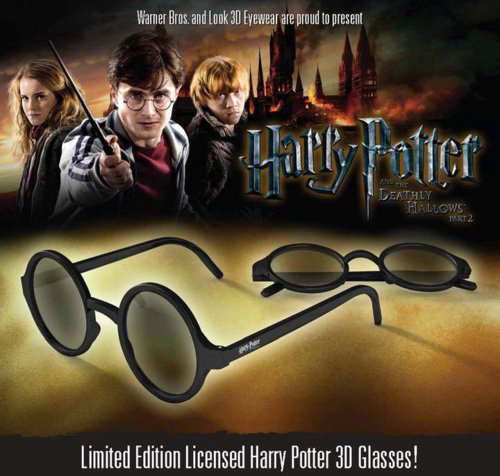
(Yours for $11 in theaters equipped with RealD systems, but you don’t get the pouch they came in at the opening midnight screenings)
Kristin here:
As 3D really took hold in the wake of the release of Avatar in December 2009, we got used to hearing that roughly 60% of a blockbuster’s income came from 3D. This summer the figure has hovered around 40%. Both figures are highly misleading. How much does 3D really bring in?
Yes, 40% of the total amount for almost all big 3D films this summer was for tickets sold for 3D screenings. But looked at another, more realistic way, 3D films as such made far less than that for their makers and the theaters that showed them.
That’s because a lot of the people buying tickets to see a film in 3D probably would have gone to see it if it had been strictly 2D. That, is, 3D itself is probably not luring in many new viewers. If every person buying a 3D ticket would refuse to see the film in 2D, then, yes, the figure would be 40%. I’m sure a small percentage of people are lured to see a given title only because it is in 3D. There’s no way to know how many, however, so let’s stick to the facts we do know.
The basic fact is that the money brought in by a film made in 3D only amounts to the supplement paid by the spectator beyond what he or she would have paid if the film were in 2D. Let’s assume that the supplement is $3 and that a 3D admission costs $12 and a 2D one $9. Let’s also assume for the sake of argument that everyone who saw the film in 3D for $12 would pay $9 to see the same film if it were only available in 2D. (In reality, there’s also evidence that 3D keeps some people away from a film altogether if they don’t have access to 2D screenings. I’ll assume these two groups, the 3D enthusiasts and the 2D hold-outs, cancel each other out.) Removing the $3 supplement takes away 25% of the ticket price. So what the 3D process as such really adds to the box-office total is 10% (that’s 25% of 40%). To put it another way, $9 of the $12 for the ticket is just for the film qua film, the rest is for its being in 3D.
In addition, the costs for the glasses and any extra labor they entail have to come out of that $3. I don’t know what such costs are, so I’ll leave those expenses out of the calculations.
Consider the opening weekend of Captain America, which grossed $65.7 million, 40% of which came from theaters equipped with 3D. But it’s really 10% by my reasoning, so it’s not $26.3 million that 3D generated, but $6.57 million. Assuming further that it costs about $30 million to make a film in 3D or convert it to 3D in post-production, Captain America would have to run in the U.S. market for around four weeks with no decline in attendance to break even on 3D. But most films decline on their second weekend, unless they open in more theaters or have terrific word of mouth. Even The Lord of the Rings: The Fellowship of the Ring, which had lots of repeat business, declined 19% on its second weekend.
Of course, the popularity of 3D films is holding up better abroad than in the domestic market–so far. Still, we have to remember that only about half of the worldwide box-office receipts make their way back to the studios. That seems to imply that a film would have to gross $600 million internationally to break even on the addition of costs for 3D. ($300 million going to the studios, roughly 10% of which is paid for by 3D supplements=$30 million.) Some films do gross that much. Pirates of the Caribbean: On Stranger Tides, Transformers: Dark of the Moon, the final Harry Potter installment have passed that mark this year. It’s not common, though.
Naturally if a film takes in as much as 60% of its box-office from 3D screens, as Transformers: Dark of the Moon did, 15% of the costs of 3D will be paid for by the process.
How consistent is the trend?
Let’s look at the major 3D films out so far this year in terms of percentages of gross vs. percentages of theaters:
Film: Release Date (% of BO from 3D / % of locations showing 3D)
Green Hornet: January 14 (69% / 75%)
Gnomeo and Juliet: February 11 (58% / 60%)
Rio: April 15 ( 58% / 68%)
Thor: May 6 (60% / 69%)
Pirates of the Caribbean: 4: May 20 (46% / 66%)
Kung Fu Panda: 2 May 26 (45% / 69%)
Green Lantern: June 17 (45% / 71%)
Cars 2: June 24 (37% / 61%)
Transformers: Dark of the Moon: 3 July (60% / 70%)
Captain America: July 22 (40% / 68%)
Opening weekend only : Harry Potter and the Deathly Hallows: Part 2: July 15 (68% / 71%)
[Added July 31: The opening weekend for The Smurfs followed a similar pattern. The July 29 release made 45% of its gross from 3D engagements; 60% of its venues showed 3D. As Box Office Mojo points out, on the same weekend in 2009, G-Force made 56% of its opening-weekend gross in 3D, which showed in only 43% of theaters.]
(Granted, there is a problem with such figures. The percentage of locations showing 3D is based on theaters, not screens. Any multiplex showing 3D counts as 1, even though it may have 3 screens showing 3D and 2 showing 2D. Whether those two 2D screens would be credited to the venues showing 3D or 2D is not stated. Unfortunately, the way box-office figures are reported, there is no way to calculate by numbers of screens. We’ll do what we can with what we’ve got. In addition, venues without 3D tend to be one- or two-screen theaters in small towns. That 2D now brings in more than half the gross income for most 3D films is all the more impressive.)
Now for the list of films. There are interesting patterns here. First, the drop in 3D percentages came at about the time when the summer-movie season began, and with one exception is has proven surprisingly consistent, hovering in the 40-45% range. Second, the greater the gap between the percentage of income and the percentage of theaters, the less well 3D would presumably be performing for each release. Thus although Transformers: Dark of the Moon brought in a higher percentage of 3D income, it performed proportionately no better than, say, Rio. Third, as long as the percentage of income is less than the percentage of theaters, it should be the case that the average per theater for 2D showings should be higher than those for 3D—which is true for every film.
More theaters, fewer tickets
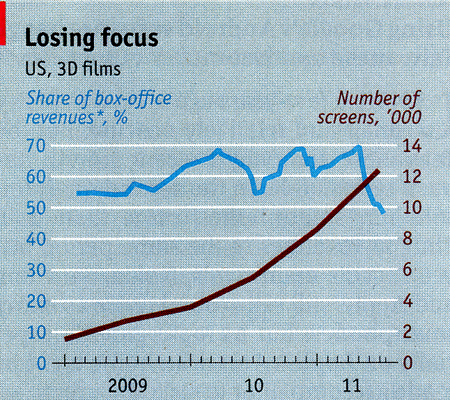
The decline in 3D’s contribution to film grosses has come despite the fact that the number of screens in the U.S. equipped to show 3D has gone up roughly six-fold since the beginning of 2009: from under 2,000 to over 12,000. Take a look at this graph from The Economist (derived from information supplied by BTIG Research and Screen Digest). The point where the lines cross is May, 2011:
Kvetching about 3D as a process and as a method of purse-gouging has declined somewhat, or at least that’s my impression. It’s not gone, though. Take a look at Mark Harris’ smart piece, “Honk If You’re Sick of 3-D!” in the June 24 Entertainment Weekly. Justin Chang’s Variety review of Harry Potter and the Deathly Hallows: Part 2, while generally very favorable, concludes: “D[irector of].p.[hotography] Eduardo Serra’s brooding, beautiful work gains little, however, from the underwhelming stereoscopic conversion; this is the first Potter film to be released entirely in 3D as well as 2D, and on this count, at least, one can be grateful that it will be the last.” “The “entirely in 3D” phrase refers to earlier episodes which have had a few scenes in 3D.)
There was also the controversy back in late May over whether 3D lenses, which notoriously cast dim images of 3D films, were being left on movie projectors for 2D screenings, thereby dimming the light getting to the screen for them as well. I don’t have the space to trace that discussion, but you can read about it in the original Boston Globe article, Roger Ebert’s indignant follow-up, and an expert projectionist’s assessment of the situation. Here the problems were being discussed largely in relation to 2D screenings.
But for quite some time now the larger 3D-equals-dim-images notion got wide coverage, and the topic had featured in many articles and postings critical of 3D. All that must have had some impact. In June Variety announced that for Transformers: Dark of the Moon Paramount would take “the unprecedented step of releasing a special digital print aimed at delivering almost twice the brightness of standard 3D projection.” These special prints, however, only went to about 2,000 theaters, those with RealD systems. But would prospective ticket purchasers know which cinemas had these prints? As Variety pointed out, “Exhibs may want to avoid planting the notion that some 3D screens are better than others when there’s no price distinction between the screens.” Given that it’s almost impossible these days to call a movie theater and ask a question, I doubt whether many moviegoers who attended Transformers knew which version they saw. Paramount’s move was obviously a desirable one, but it can’t account for the relatively high percentage of the film’s 3D income. (The New York Timesalso covered Michael Bay’s and Paramount’s efforts to promote screen brightness for the film.)
All in all, evidence seems to show that many theater owners are losing business by showing 3D films. Of Captain America’s total gross income, 40% came from the theaters showing 3D, which amounted to 68% of all venues (2511 locations out of 3715). Flip the figures, and the 32% of the theaters showing the film in 2D brought in 60% of the gross. On average, if you were an exhibitor playing the film, you made more money if you showed it in 2D. A lot more. Even not being able to charge $3 extra.
Box Office Mojo’s report on Captain America‘s first weekend confirmed that attendance was not dropping for the film as a whole, but that a greater proportion of people were opting for 2D: “While the gross difference was a sliver, Captain had eight percent greater estimated attendance than Thor, which received more bolstering from 3D (and had IMAX): Captain‘s 3D share was 40 percent at 2,511 3D locations, compared to Thor‘s 60 percent at 2,737.
Industry spokespeople are putting a good face on all this. Rob Moore, vice-chairman of Paramount, seized upon Transformers: Dark of the Moon’s 60% 3D opening-weekend share to boost the format to Variety: “‘There are so many 3D releases, audiences now are going to pick and choose which films to see in 3D,’ Moore said, before adding that the format has become a tool more for event filmmaking. ‘If the 3D is good, audiences are going to pay for it.'” But of course, most theater-goers don’t know whether the 3D is good until they have already paid for it. They go for other reasons, whether star, director, or genre. Or maybe it’s what their date or friends or family want to see. If it has those factors and it’s in 3D, it might seem worth the extra $3.
The opening weekend for Deathly Hallows might tend to confirm Moore’s claim, but the 3D share of the gross was still slightly below the percentage of 3D theaters, if not by much, and included an unusually large number of Imax locations (274)–which charge an even larger fee for 3D. Given the fans’ frenzy to see Deathly Hallows on its first weekend, they probably bought tickets for whichever screening they could, not much swayed by whether they would be seeing it in 3D or 2D.
Another point before I move on. Consider The Hangover Part II: $80 million dollars announced budget, $562.9 million worldwide gross and still in distribution. No 3D.
Anti-3D sentiment
Some people just don’t like 3D, supplement or no supplement. I went to some of the early releases to keep up with developments in the industry. It’s part of my job, after all. But after I got a sense of what it was like, I gave it up. I think the last 3D film I saw, apart from Werner Herzog’s wonderful Cave of Forgotten Dreams in February, was Avatar in December, 2009, and the one before that Up, in the summer of that year. I just saw Cars 2 the other day, 2D and on 35mm film, a treat that we must savor before release prints on film disappear over the next few years. By the way, Cave of Forgotten Dreams is the only exception to my new avoid-3D rule, and it also happens, proportionate to its budget, to be the most successful 3D film so far this year.
I’ve seen the two Pixar films made since Up only in 2D, and I don’t miss the 3D at all—despite the fact that Pixar’s films are probably the best that have been made during the latest vogue for 3D. Cars 2 naturally had quite a few shots with depth in the set design and staging. It occurred to me when I saw them that I actually might be getting a stronger sense of depth watching them in 2D than in 3D. The human mind has all sorts of ways of reading depth cues in a flat image. 3D tends to exploit only one of them, binocularity, which I suspect minimizes the others. I have no scientific evidence for that, just my own impression formed while watching the film.
I’m far from alone in avoiding 3D. The other day I participated in an online exchange on the subject. Sean Axmaker, contributor to the Parallax View website, wrote on his Facebook page that he had just seen Deathly Hallows 2 on film, in 2D and added, “I’d see “Captain America” here too, but it’s only in 3D and I just don’t see the need to see it with an extra pair of glasses on.”
The issue of studios and theaters switching entirely from 35mm release prints to digital projection would require a whole additional entry. But in late May Variety ran a long story, “Studios must revisit d-cinema,” with people from within the industry recounting dismal experience viewing both 3D and 2D films with digital projection. One 3D system cuts fully half the light from the projector. Cinematographer Roger Bailey is quoted: “It’s unbelievable that in an age when we think we have unbelievable technology, and the studios are talking about eliminating 35mm film prints in the next 18 months, that they haven’t begun to sort out the problems that have been caused by digital projection.”
The Economist ended its recent article, the one that contained the above graph, on a sour note:
Richard Gelfond, the boss of IMAX, reckons customers have become picky. “People used to see something just because it was in 3D,” he says. Now they ask how much pleasure the glasses will add. The explosive “Transformers 3” did well in 3D; perhaps the 2D version was not sufficiently headache-inducing. The key to three-dimensional projects, then, is to put out hugely popular films with extraordinary special effects. Easy.
Speaking of headaches, a small study conducted at the University of California-Berkeley seems to indicate that 3D glasses can cause eyestrain and discomfort. For those who want the full scientific text, it’s here. For a brief summary, go here. The main point is that the eyes naturally try to focus on the screen (the focal distance). The vergence point is where the imaginary lines going out from the 2 slightly separated 3D lenses come together. If it’s in front of or “behind” the screen, eyestrain can occur, since one is trying to focus on two different planes in depth simultaneously. The problem turns out to be worse the further you sit from the screen.
I myself have not noticed eyestrain or headaches caused by watching 3D movies with the current generation of glasses. I could imagine that since eyestrain is cumulative, those who watch large doses of television or spend hours at a 3D gaming console would have greater problems with the glasses.
Whether we want it or not
Business types seem to think people want 3D inserted into their lives. Note the 3D Webcam, pictured at the bottom. The accompanying text says, “The Minoru 3D Dual lens web camera is still at proof of concept stage atm but it can create stereoscopic 3D video which needs those cool blue and red 3D glasses to view.” (Note: “atm” means “at the moment,” not “go withdraw some money to buy one.”) I also ran across the 3D drawing pad pictured below left. It is available from the Perpetual Kid website, which explains: “Each page is a stereographic background for your writing or drawing. Put on these ultra cool (come on…you know you look good in them!) 3D specs and see your lines float above the page!” Why do people promoting such things seem to think that we can be convinced these glasses are cool?
Right now there’s a big push to sell 3D mobile phones and other handheld gadgets. On July 25, Roger Cheng posted a skeptical article on the subject of the Thrill 4G model, by LG:
But it’s unclear if consumers are ready to grab hold of it yet.
3D is the latest feature to be crammed in the increasingly Swiss Army-knife-like smartphone. Like with televisions, the feature is getting aggressive marketing support. But despite the marketing campaigns, the feature has been little more than a gimmick. And like 3D televisions, there’s been tepid interest.
“3D is just one of an onslaught of features that end up on a phone even if people don’t ask for it,” said Maribel Lopez, an analyst at Lopez Research.
Sam Biddell over on Gizmodo, did not hold back in commenting on the HTC Evo 3D phone:
The EVO 3D is the first phone to ever literally hurt my face. The 4.3-inch 3D screen’s glasses-free, of course, which means it uses the same auto-stereoscopic method as the Nintendo 3DS. Well, not the same—the 3DS is a joy to use and view, while looking at 3D stuff on the Evo felt like I was having my eyes gouged out, Oedipus-style. It gave me a headache. I wanted to look away. And for what? A 3D effect that just isn’t very good. To pull off a 3D picture of video that has any ‘pop’ whatsoever, you need to use framing so contrived as to render the whole thing pointless.
This, mind you, despite the fact that you don’t need glasses to see a 3D image on phones.
depends on how one defines success. If you’re Jeffrey Katzenberg and want every theater in the world now showing 35mm films to convert to digital 3-D, then the answer is probably yes. That goal is unlikely to be met within the next few decades, by which time the equipment now being installed will almost certainly have been replaced by something else […] But it also seems possible that the powers that be will decide that 3-D has reached a saturation point, or nearly so. 3-D films are now a regular but very minority product in Hollywood. They justify their existence by bringing in more at the box-office than do 2-D versions of the same films. Maybe the films that wouldn’t really benefit from 3-D, like Julie & Julia, will continue to be made in 2-D. 3-D is an add-on to a digital projector, so theaters can remove it to show 2-D films. Or a multiplex might reserve two or three of its theaters for 3-D and use the rest for traditional screenings.
If for the rest of this year blockbuster films continue to bring in 40% of their gross revenues in 3D-equipped venues and those venues continue to be around 70% of the total locales, then I would think that the saturation point I mentioned has been exceeded. Some theater owners might decide that they could make more money with less hassle by showing 2D. That would drive 3D devotees to the reduced number of 3D houses, making their revenue go up. Which in turn would presumably make some of the exhibitors who had given up 3D go back to it, and the balancing act would continue until the precise saturation point is finally attained. But at this point, adding more 3D screens to a multiplex or converting a mom-and-pop theater in a small town would probably just worsen the problem. I think what I predicted is coming true, that multiplexes will reserve a small number of their screens for 3D and keep the rest flat. Maybe the studios will decide that $30 million is not a great investment.
The more important news is that digital projection will continue to spread. Some theaters have installed it already to save costs. Wanting to play 3D films (which mostly can only be shown digitally) has undoubtedly been a factor in exhibitors’ purchases of digital projectors, but it will probably become less so now. The studios, however, want to give up 35mm release prints, which cost a lot for both lab work and shipping. They’ll pressure the theaters until it finally happens.
Now excuse me, I’m off to see Deathly Hallows in 2D on film, while I still can.
Postscript
As I was finishing this entry, I found a story in the Los Angeles Times (July 25) reporting that IMAX’s stock dropped 11% earlier this week:
Stifel Nicolaus analyst Ben Mogil downgraded box-office projections for the second half of the year and lowered his target for the company’s stock price to $27, from $32. His report came a week after similar predictions were made by Merriman Capital. The stock was trading at $25.33 late Monday.
“We believe that estimates for IMAX for [second half 2011] are too optimistic given that the [fourth quarter 2011] slate has three kids’ films, a genre which this year has seen considerably lower 3D share this year compared to last,” Mogil wrote.
Most, but not all, Imax movies play in 3-D, a technology that has been dropping in popularity among domestic movie audiences.
These downgrades came partly as a result of the fact that IMAX has had three straight quarters where income fell short of its own predictions.
This story was updated later the same day: “Imax Chief Executive Richard Gelfond said, ‘We have a diversified slate based on blockbuster films in 2D and 3D, for families and fanboys. We think it’s way too premature to predict how the slate will perform for the year.'”
As I read this, Gelfond is assuring investors that there are quite a few 2D films mixed in among the 3D films, so that the latter’s decline will not hurt the firm’s overall income.
On July 26, Variety ran a long story with Jeffrey Katzenberg giving an elaborate explanation of how Kung Fu Panda 2 underperformed in the U.S. because it opened the same weekend as The Hangover: Part 2. There’s no indication as to how a raunchy, R-rated film could run roughshod over a kid-oriented animated movie. All those older brothers refusing to take their younger siblings to the movies? Usually it’s called “counter-programming” and often it works.
According to Variety:
Katzenberg is also still high on 3D, at least overseas, where “the marketplace couldn’t be stronger,” he said. “Outside of North America, the performance of 3D continues to be very strong across many different films. We see continued interest in it and appeal for it and growth over these next 12 to 24 months. There’s still a pretty decent way for it to expand meaningfully internationally.”
Domestically, the exec admitted to being partly to blame for some of the extremely optimistic views of 3D’s revenue potential. At the same time, the pessimism of its longevity is also on an extreme level, he said.
For DWA [Dreamworks Animation], at least, 3D remains one of the best returns on investment for the company, after it was able to shave off the costs to produce its pics in the format.
Two years ago, DWA spent $15 million per pic to deliver a 3D version. Today, the cost is half that, Katzenberg said. The studio now has nine 3D films in production.
If executives keep offering rationalizations and suggestions that we look to the future instead of the past, maybe we can conclude that 3D is officially in a slump.
Earlier this month Manohla Dargis wrote a New York Times article on how we watch, or should watch, films that some audiences consider slow and boring. She suggested that appreciating such films requires us to cultivate fresh ways of seeing. Her article and my interests coincide on this matter, so I wrote an entry developing some ideas about viewing strategies and skills. This piece also, happily, brought new readers to Tim Smith’s experiment in tracking viewers’ scanning of a scene in There Will Be Blood.
Today I explore another angle on the problem of how to watch movies that aren’t the normal fare. But this time what’s abnormal for us was once normal for everybody. I look at the pictorial possibilities that emerged in the 1910s. Those possibilities are of interest if we want to fully understand film history, but they offer some mysteries as well. If viewing movies involves skills, did people a century ago have the ones we have? Or did they employ different viewing habits, ones that we have to learn?
Editing, your imaginary friend
I write from my annual research trip to the Royal Film Archive of Belgium, now known as the Cinematek. For some years, I’ve been looking into feature filmmaking of the 1910s. On every visit I’ve found rich material, movies off the beaten path that give me a sense of the immense creativity of that early period. (See the bottom of this post for links.) The official classics of these years, by Chaplin and Griffith and Fairbanks and Bauer and Gance and Sjõström and Feuillade, remain remarkable, and Kristin’s latest entry makes a case that Alberto Capellani belongs among this heroic company. But you can also find extraordinary moments in ordinary movies. Even the most banal film has something to teach me about what choices faced the era’s filmmakers.
One of those teachable elements involves the ways in which directors guide our attention. We know that editing serves to shift our attention from one part of a scene to another, but so does judicious staging. This is one of the great lessons of the cinema of the 1910s. Watching films from that period convinced me that the craftsmanship of Anderson in There Will Be Blood, and of other directors reliant on long-take ensemble staging, has deep roots in filmmaking tradition. But the golden age of cinematic staging was relatively brief, and it was eclipsed by an approach based largely on editing. That approach is, essentially, still with us.
Let’s start by appreciating the technique that became most prominent. By the late 1910s, Hollywood filmmakers had more or less perfected what we’ve come to call the classic continuity editing system. The camera could penetrate the most intimate exchange, breaking it up into intelligible bits. Here, in a minor Metro film called False Evidence (1919), Madelon tries to persuade her father that she, not her boyfriend, is responsible for a crime.
After giving us father and daughter close together in profile, the camera has somehow squirmed in between them, showing each one in a tight 3/4 view. Or rather, the cutting has forced the staging to pull the characters a bit apart so that each one can have a frame to him- or herself. Spatial plausibility gives way to dramatic urgency; what we care about are clear views of their emotional responses. As long as the spatial relations remain clear, they can be just approximately consistent.
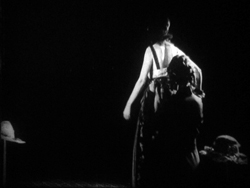
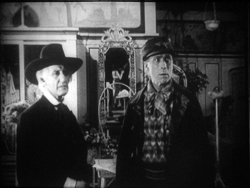
For a little more finesse, we can look–as usual–to Rio Jim. William S. Hart’s films are among the most visually elegant and ambitious of this period, and even his less-known items seldom disappoint. John Petticoats (1919) gives us “Hardwood” John Haynes, a rough-edged logger who finds he has inherited a New Orleans dressmaking shop. His comic introduction to the place, in the company of a new friend he’s made, uses editing to tease us. The two gents come in, with John bewildered by a feminine world he’s never known. They pause before a model sashaying on the stage, and when she pauses, she’s blocked by the Judge’s body.
We’re left without the revelation of her appearance, but when her dresser comes forward to peel off her wrap, we cut, in effect, “through” the Judge to get a clear view of the disrobing. The blocked shot teased us, but the cut pays us off.
Now that the model bares a lot more than before, the biggest tease begins. How will John react? The answer is given in the next shot, a nearly 180-degree shift from the earlier framing of the men that incorporates a mirror in the background to keep the model onscreen.
Thanks to a cut, action and reaction are given in the same shot–in fact in the same zone of the frame, the center.
A pass, a pat, a squeeze
Fabiola (1918).
Many European directors were moving in the same direction as Lambert Hillyer in John Petticoats. Although they might not use as many shots or as many different angles as their American counterparts, they were confidently breaking their scenes up into closer views, often through axial cuts that take us straight into or out of the action, along the lens axis.
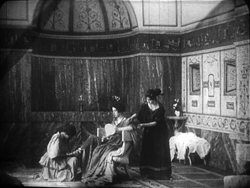
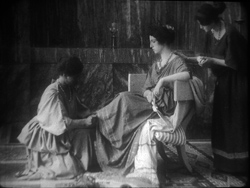
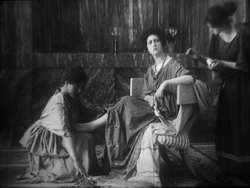
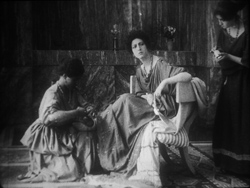
Take Enrico Guazzoni’s Fabiola (1918), henceforth known to me as Fabulosa. Normally I consider the Roman oppression of Christianity one of the least fertile topics for a good movie, but Fabiola proves me wrong. For one thing, the title names a rather unpleasant woman who barely figures in the action until the climax. For another, Guazzoni proves an adept filmmaker. I was struck by those immense sets that distinguish the Italian costume drama, the dazzling lighting (see above), and the skilful editing.
Our introduction to Fabiola comes as she sits disdainfully in her household, attended by servants. After a long shot showing off the set, an axial cut takes us closer to her.
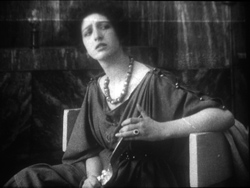
She turns as her tardy servant Sira comes in. Having stretched her elegant neck, Fabiola tips her head forward slightly, in a bob of disdain.
Another axial cut takes us still closer to her. And in a few frames her gesture, at once haughty and angry, is repeated. (The streak across the first image below is the splice, so this is the very first frame of the next shot.)
This, I think, is no mistake. The matches on action elsewhere in the film are quite precise, and indeed earlier Italian films have shown that directors used this device skilfully. Guazzoni wanted to stress Fabiola’s head movement, and he used the same tactic, the overlapped action match, that some Americans would use and that many Soviet directors drew on later. This slight accentuation of Fabiola’s gesture is a vivid way to introduce the character, caught in a characteristically scowling moment. Very soon, in a fit of pique she’ll jab Sira with a hatpin.
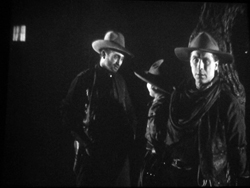
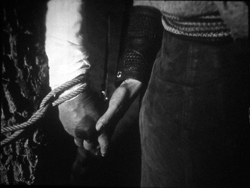
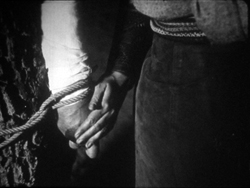
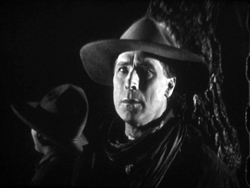
On the whole, keeping the setups close to the camera axis is the default value in Fabiola. For the Americans, though, cutting made the camera almost ubiquitous. A year after John Petticoats, O’Malley of the Mounted (1920), lets Lambert Hillyer again resort to intelligible shifts of setups. O’Malley, played by Hart, has gone undercover to track a killer. Posing as a robber, he has joined an outlaw gang, but they’ve discovered he’s betrayed them and plan to hang him at sunup. He’s lashed to a tree and guarded by his enemy, the brutal Big Judson. But Rose Lanier, who has drifted along with the gang, is going to help O’Malley escape. The cutting will show us exactly how she does it, and why.
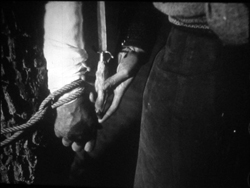
Rose interposes herself between Big and O’Malley, chatting up the thug. A cut of about 180 degrees takes us to the opposite side of the tree and shows her slipping a knife toward O’Malley’s hand. We’re so familiar with this sort of insert that we’re likely to forget that once it was fresh.
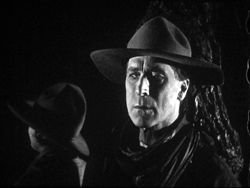
O’Malley starts, then shifts his gaze toward Big.
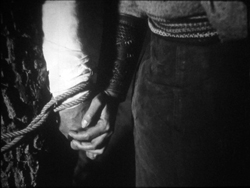
Then comes a simple, remarkable shot. Rose slips the knife to O’Malley. Then she pats his hand. Then she gives it a squeeze.
Mystery and charm of the American cinema, as Godard would say: a single cut-in of hands can give us a lot. First there’s the narrative information (I’m passing you the knife), then Rose’s expression of support (Good luck!), capped by a burst of affection (I love you). The whole thing takes less time than I’ve used to tell it. Surely this ability to invest plot-driven detail shots with heartfelt emotion helped American cinema conquer the world. I’m tempted to say that we could sum up of the power of Hollywood, in its laconic prime, with that formula: the pass, the pat, the squeeze.
This shot is as compact in its expression as the previous one. It’s impossible to capture here all the emotions that flit across O’Malley’s face: hope of eluding death, realization that Rose loves him, anxiety that surviving will make him choose between love and duty. Rose’s brother is the killer he’s been tracking, and in a perversely honorable way O’Malley had looked forward to being hanged. That would have spared him arresting the boy. Now he must live, enforce the law, and lose the woman who has saved him.
I saw some European films that absorbed such continuity tactics quite deeply. Above all, Mauritz Stiller’s Song of the Scarlet Flower (Sangen om den Eldroda Blomman, 1919) and Johan (1921) relied heavily on analytical editing in the American fashion, including angled shot/ reverse shot. As in Fabiola, some of the discontinuous cuts have their own logic. I wish I had time to explore those Stiller films in more detail–particularly their use of turbulent rivers as dynamic plot elements, not mere landscapes. Maybe in some future entry….
Four-quadrant style
Before they adopted the analytical editing characteristic of American cinema, directors were still able to guide our attention. The so-called “tableau” style, about which I’ve waxed enthusiastic on this site before, became a rich tradition in the 1910s. Editing within the scene is minimized. (Apparently most European directors didn’t consider it a creative option in its own right until later in the decade.) The drama is carried by performance and ensemble staging. Relying on movement, acting, and composition, the director controls where we look and when we look at it
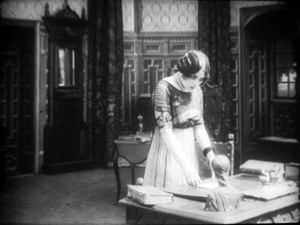
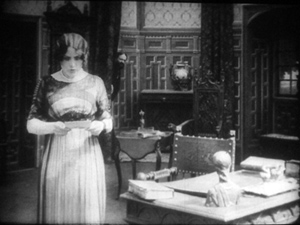
To take a straightforward example, consider the rather ordinary melodrama Le Calvaire de Mignon (Mignon’s Calvary, 1917). The scheming and dissolute Dénis de Kerouan wants to wreak misery on his brother Robert. While Robert is out of the country, Dénis hires a forger to fabricate a letter indicating that Robert has a mistress. Dénis leaves the letter on the desk for Robert’s wife to find.
Dénis has exited through the central entryway, and into the empty study comes Robert’s wife. She discovers the letter.
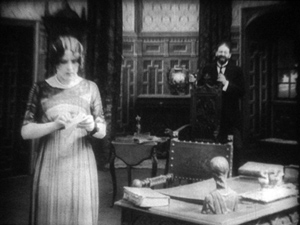
She moves to the left foreground and starts examining it. At this point Dénis’ face peeps out from behind the central curtain. The director makes it easy for us to notice him because nothing else is happening in the set, and Denis’ face is rather close to the wife’s. It’s almost as if he’s looking over her shoulder.
Once we register Dénis’ presence, the director can proceed to balance the shot. All that empty real estate on the right of the frame asks to be filled, and that’s what happens.
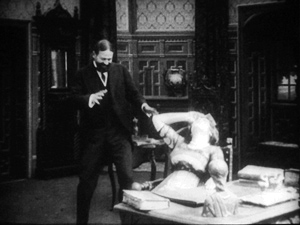
When the wife reads the damning letter, she collapses rightward into the chair, just as Dénis rushes forward to take charge of the situation.
This move exemplifies the staging technique known as the Cross, which motivates the switching of characters’ positions in the frame.
Simple as it is, this portion of the prologue of Le Calvaire de Mignon shows how, without cutting, a director can steer us to one or another zone of the shot through such cues as faces, centering, proximity to points of emphasis, and movement. Something similar happens in one, more striking moment of another fairly unexceptional movie from the period.
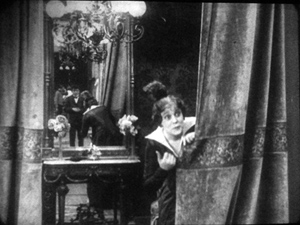
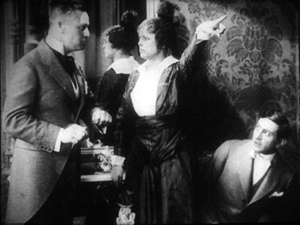
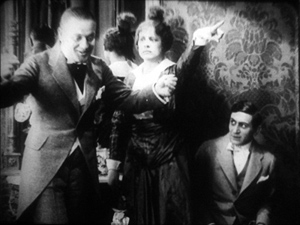
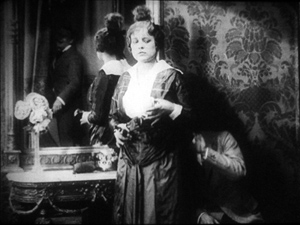
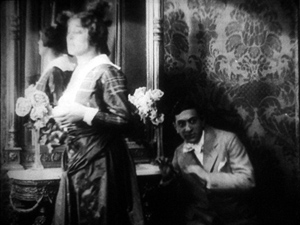
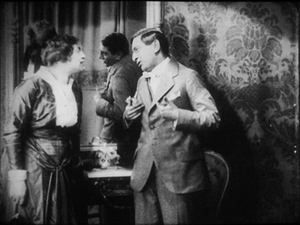
Nobody will claim Der Stoltz der Firma (The Boss of the Firm, 1914) is a masterpiece, or its director Carl Wilhelm is a master. It’s one of the many comedies in which Ernst Lubitsch starred before becoming a director. Here he’s Siegismund, a bumbling young provincial with more aspirations than abilities, who simply lucks into marrying the boss’s daughter. On the way to the happy ending, he wins the patronage of a fashion designer, Lilly, whose husband finds her flirtation with the young parvenu none too innocent.
Wilhelm’s use of the tableau approach isn’t especially dynamic in most of the film, but there’s one flashy scene. Wilhelm gets us to watch a very small, tight area of the frame and then gently swings our attention to a wider swath of action. As usual, everything depends on a sort of task-commitment on our part: Watch what’s likely to forward or enrich the ongoing narrative.
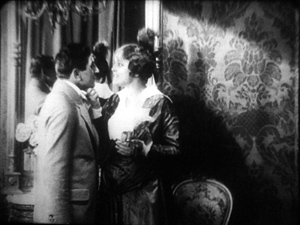
Lilly lures Siegismund into a changing room, with the composition showing him reflected in a mirror behind her. This sets up an item of setting that will be central to the scene.
Once inside, he coyly presents her with a flower and they draw close together. Since we tend to concentrate on faces, the small area encompassing their two profiles is likely to draw our attention. Nonetheless, the shot is notably unbalanced, as if anticipating something coming in from the right side.
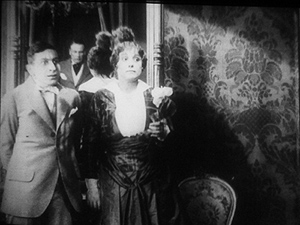
Abruptly Siegismund and Lilly draw apart, and the space between them, in the mirror, is filled by the face of Lilly’s husband, coming through the curtain.
I’d bet that a Tim Smith experiment would find that nearly every spectator is already watching this small zone in the upper left quadrant of the shot. Faces, especially frontally positioned ones, command our notice, and thanks to the mirror we here have three of them. Moreover, movement is an attention-getter too, and all three faces are in motion. Mr. Maas’s face, in fact, gets notably bigger and clearer. His wrathful expression is another reason to watch him.
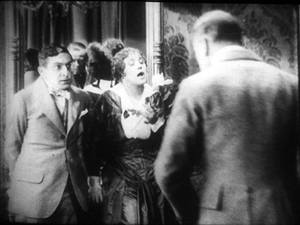
The husband’s body enters to fill the frame, then presses into the center of the shot, blotting out Lilly as he faces down Siegismund.
Now the director controls the speed of our gaze quite precisely. Maas slowly rotates, forcing Siegismund to swing from left to right, as if he were attached to the bigger man by a rod. This yields, again, that nice sense of refreshing the frame that we always get from a Cross.
Siegismund collapses into the lower right of the frame, flinching from the fight that’s about to start. Lilly soon shoves aside her husband’s chastisement and melodramatically tells him to leave. “We’re divorcing!” the following intertitle says.
Mr. Maas takes it in stride, shrugging and spreading his arms. He leaves, and thanks to the helpful mirror we can see him chortling as he glances back and passes through the curtain.
If we hadn’t already noticed Siegismund cowering behind Lilly in the lower right quadrant, we will now. Lilly angrily flounces to our left (the Cross again). Siegismund rises to explain he hadn’t meant to cause a rift in the marriage.
We’re back to something like the initial setup, but now with Siegismund centered, the couple further apart, and a less unbalanced frame. The drama, which now consists of Lilly inviting him to tea tomorrow, can proceed from here.
A different way of seeing?
Tom Tom the Piper’s Son (1905).
We’ve become used to editing-driven storytelling, and I’m convinced that we can learn to notice the staging niceties of the tableau alternative. But what if early filmmakers explored some other ways of looking that are far more unfamiliar to us today?
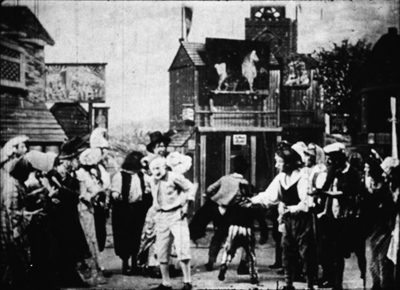
Noël Burch, in his 1990 book Life to Those Shadows, argued that in the first dozen years or so of cinema, movies solicited viewing skills that we lack today. He suggested that early filmmakers often refused to center figures and crammed their frames with so much activity that to our eyes the shots look confused and disorganized. In Tom, Tom, the Piper’s Son (1905), Burch notes, the bustle of the fair, the reliance on an extreme long shot, and the absence of any cutting make the central event, Tom’s swiping of the pig, difficult to catch. In the frame surmounting this section, Tom is making off with the pig in an area just right of center, but the antics of the clown and the response of the crowd may well distract us from the main action.
The result, says Burch, is a mode of filmmaking that demanded
a topographical reading by the spectator, a reading that could gather signs from all corners of the screen in their quasi-simultaneity, often without very clear or distinctive indices immediately appearing to hierarchise them, to bring to the fore “what counts,” to relegate to the background “what doesn’t count” (p. 154).
Later developments linearized this field of competing attractions, creating a smooth narrative flow “harnessing the spectator’s eye.” Among these developments were the presence of a lecturer at many screenings (telling people what to watch) and, of course, the growth of the continuity editing system. But Burch suggests that the “primitive mode” hung on until about 1914.
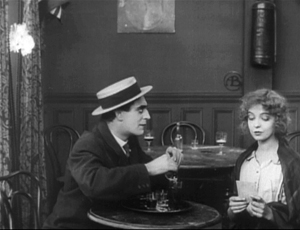
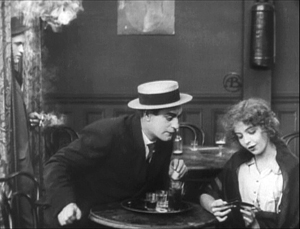
A famous example is a shot from Griffith’s Musketeers of Pig Alley (1912). The gangster has lured the Little Lady (Lillian Gish) into a back room and distracts her with a photograph while he tries to dope her drink, in a precursor of date-rape drugging. But the Snapper Kid, another gangster, has been keeping an eye on her and follows. As the gangster starts to pour the drug out, the Kid’s entry is presaged by a whiff of cigarette smoke.
At the crucial moment, we have three things to notice: the Little Lady’s obliviousness, the gangster’s pouring the drug, and the full entrance of the Snapper Kid.
Today’s director would likely resort to editing that shows the doping, then the Kid arriving, then the doping again, and leaving us to infer a vague sense that they’re happening at the same time. Griffith’s choice gives us genuine simultaneity, but at a cost. Two cues compete for our attention: central composition for the drink, major motion on the edge for the Kid’s entry. In my experience, viewers tend to notice the appearance of the Kid, but to miss the business with the drink. (Another passage for Tim Smith to test!) By today’s standards, Griffith has failed as a director, but Burch’s view suggests that 1912 viewers, more sensitive to “all-over” composition, could have registered both actions, perhaps by rapidly scanning back and forth.
During my trip I found a fascinating example of this issue, as well as an apt counterexample. Both involve daggers.
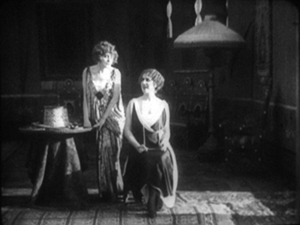
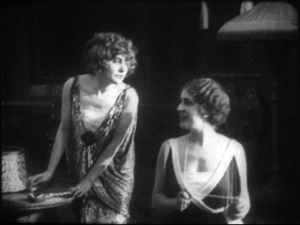
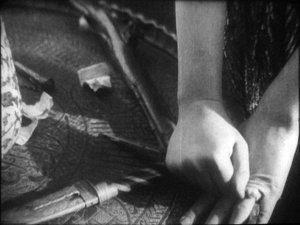
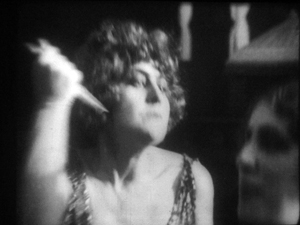
In Maman Poupée (1919), a remarkable Italian film directed by Carmine Gallone, a devoted, somewhat infantile wife learns of her husband’s affair with a society woman. Susetta confronts the mistress and begs her to break off the affair. The woman laughs in her face. What happens next is given in several shots, mostly through axial cuts.
The linear editing, as Burch indicates, lays everything out for us step by step. The close-ups accentuate what is important at each moment: Susetta seizing the dagger, stabbing her rival, and–in a remarkably modern-looking extreme close-up–registering her horror at what she has done.
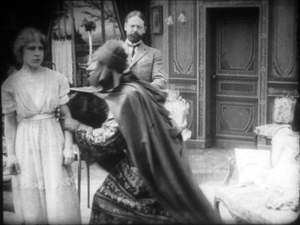
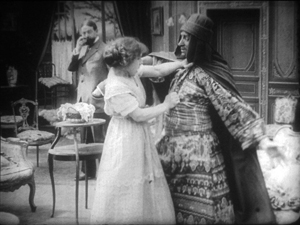
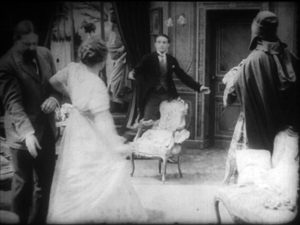
Two years before, Marcel Simon, the (Belgian!) director of Calvaire de Mignon, handled a similar situation rather differently. The diabolical Dénis, whom we met earlier, has succeeded in destroying his brother’s life. It remains only for him to force Robert’s niece Mignon to marry the Algerian Emir Kalid. Kalid is at first humble, beseeching Mignon to become his bride, but then he gets rough. We might note already that Mignon, while fairly near the camera, hovers close to the left frame edge.
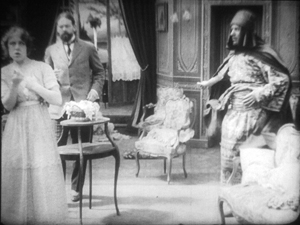
In their tussle, Mignon snatches something from Kalid’s waistband and flings him far away to the right.
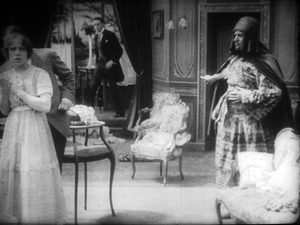
What’s up? Mignon has grabbed the Emir’s dagger and stands poised with it pressed to her heart. But we haven’t been able to see that dagger very clearly (no cut-in close-up here, as in Maman Poupée) and she’s returned to her position far off-center. It’s likely that a viewer today wouldn’t understand that she’s holding the men at bay by threatening suicide. Would a 1917 viewer be as uncertain? Would the situation, plus her posture and the men’s hesitation, be enough to get the point across?
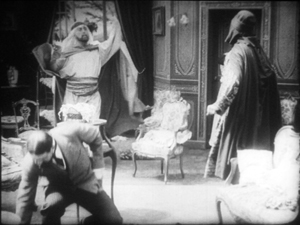
Moreover, this moment goes by very quickly. Scarcely has Mignon struck her pose when her true love, René, bursts in behind her–frontal, fairly centered, and moving fast. Meanwhile, Dénis is sneaking up on her, hugging the left frame. Mignon makes a break for René, dropping the still almost indiscernible dagger.
While Mignon and Rene embrace in the right rear doorway, blocked from our view by Kalid, Dénis stoops over. It’s a timely adjustment, giving us full view of the benevolent Le Maire sweeping into the room.
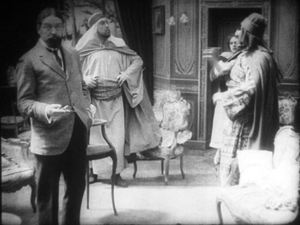
As the two men confront one another–the climax of the scene–director Simon has the effrontery to let Dénis steal the show. He picks up the dagger, which now can be seen more or less plainly, weighs it in his hand, and looks out for a brief, pondering moment.
We seem to have a late example of the Snapper Kid Effect, in which important actions compete for our attention. Is it clumsy direction to perch Mignon on the frame edge as René rushes in, and to let Dénis recover the dagger while we’re supposed to concentrate on the face-off between the two powerful men? Or would audiences have tracked all the strands of action and enjoyed their simultaneity?
On this site and elsewhere, I’ve assumed that directors in the 1910s structured their compositions for what Charles Barr calls “gradation of emphasis,” a fluid pattern of primary and secondary points of attention. I’ve argued as well that Burch exaggerates the decentered, nonlinear compositions of even the earliest years. Many of the films staged by Lumière cameramen are designed cogently, and so are many films from the 1900s. (Tom, Tom might be the exception rather than the norm.) Yet every so often, you get a later case, like Musketeers of Pig Alley or Le Calvaire de Mignon, that suggests that some viewers might have been more adept at tracking simultaneous events than we are.
A still broader question remains. Let’s assume that people were able to follow and enjoy films in the tableau style, even when that style pushed toward illegibility. What enabled people to adapt, and so quickly, to continuity-based movies? Some scholars and filmmakers argue that continuity editing achieved its power and worldwide acceptance because it mimics our natural mode of perception. At any moment, we’re concentrating on just a small portion of our surroundings, and this is like what editing does for us in a scene. On the other side, Burch and others would argue that continuity filmmaking is only one style among others, with no special purchase on our normal proclivities. On this view, classical continuity’s apparent naturalness hides all the artifice that goes into it, and this concealment makes its work somewhat insidious. I’ve offered some thoughts on this problem elsewhere, but I bet I tackle it again on this site some time.
In any case, we need to study films that seem odd or difficult, whether they’re recent or from the distant past. We’re guaranteed to find some striking and unpredictable things that provoke us into thinking. That’s one of the pleasures of exploring the history of film as an art.
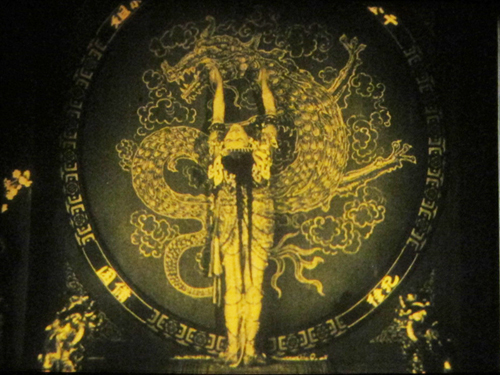
For earlier studies of the tableau style on this site, see this entry on Bauer, this one on 1913 films, this one on Feuillade, and this one on Danish classics. This entry discusses the emergence of Hollywood-style continuity, and this one explores the exemplary editing in William S. Hart films. I go into more detail in two books, On the History of Film Style (chapters four and six) and Figures Traced in Light (chapter two) and in the essay, “Convention, Construction, and Cinematic Vision” in Poetics of Cinema. The last-named piece tries to stake out a middle position on the “naturalness” of continuity editing. Kristin has analyzed Alberto Capellani’s films as instances of the tableau trend, last year here and just last week here. She also weighs in on the debate about whether viewers of his time were better prepared to grasp the action than we are. More generally, Capellani’s career exemplifies the major and swift stylistic changes of the 1910s. When he went to America, he became pretty adept at the emerging continuity style, as the Nazimova vehicle The Red Lantern (1919) indicates. Of course that’s got some striking single images too.