Tuesday | October 11, 2011

The Green Wave.
Kristin here:
The Vancouver International Film Festival has offered a rich selection of Iranian and Israeli films this year. I tried to see as many as I could, and most of the screenings were packed.
Iran
The range of Iranian films, made within the country and by émigrés, reflects the paradoxes of that unhappy nation. The glory days of the Iranian cinema of the 1980s and 1990s seem irrecoverable, with leading directors Abbas Kiarostami and Mohsen Makhmalbof and his family working abroad and their younger colleagues, mostly famously Jafar Panahi, being arrested and forbidden to work. Although this national cinema has triumphed at international film festivals, forces in the regime seem determined to squelch the creative people who made that prominence possible. Yet somehow impressive films continue to be made.
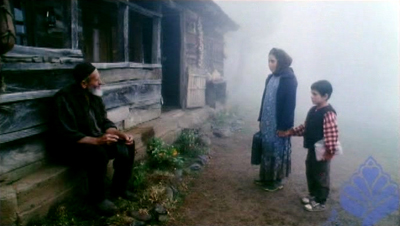
Mohammad-Ali Talebi’s Wind & Fog recalls the classic Iranian films of the 1980s and early 1990s, simple stories centered around children’s quests. Talebi himself is a veteran director whose career stretches back to the mid-1980, an era when major filmmakers were skirting the censors by focusing on children and seemingly uncontroversial situations.
Wind & Fog is set in the north of Iran, during the early days of the Iran-Iraq war—a safe enough era, since the loyalty to the government during such a conflict would be unquestionable. The story concerns an eight-year-old boy who becomes mute when his mother is killed during shelling. His father takes him and his older sister to live with their grandfather in the mountains while he works elsewhere. The forested, misty hills are beautifully photographed and contrast sharply with the desert landscapes familiar from other Iranian films. The children form the core of the action as the boy struggles both with his trauma and with bullying at his new school. Both child leads gives wonderfully affecting performances, and the gradual acceptance of the strange young boy by the villagers makes for the sort of happy ending that is rare in the contemporary adult-oriented dramas reaching festivals.
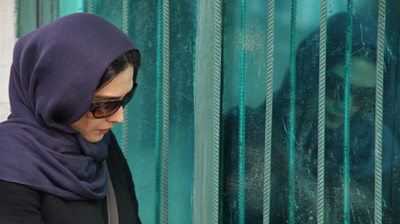
One such film is Goodbye, by Mohammad Rasoulof. Although made within the Iranian industry and presumably passed by the censors, it deals remarkably directly with the efforts of its heroine, a young lawyer named Noora, to leave the country. Initially she plans to depart with her journalist husband. A black-market agency has concocted a scheme to have her become pregnant, be invited abroad to give a paper (arranged by the agency), and give birth abroad; in that way she can avoid returning to Iran.
The film stays entirely with Noora, often filming her in medium-close-up against simple, blank backgrounds. The result is an austere visual scheme of black, gray, and blue-tinged white, with an intense concentration on Noora and her increasing doubts and anxieties. The only moments of everyday life come from a motif of Noora feeding her pet turtle and coping with its tank when it begins to leak. Eventually the turtle escapes, and we never learn its fate, an obvious parallel with Noora’s situation. Possibly the authorities thought this story would be an exposé of illegal agencies fostering emigration, but our sympathies are entirely with Noora and her desire to flee.
I also caught up with A Separation, by Asghar Farhadi. David wrote about this exceptionally fine film from the Hong Kong Film Festival earlier this year. His earlier film, About Elly, is unfortunately not available on English-subtitled DVD but deserves to be released.
Maryam Keshavarz’s Circumstance is often spoken of as an Iranian film, and it gained a higher profile when it won the Audience Award at this year’s Sundance Film Festival. It actually was shot in Beirut and is a US/Iranian/French co-production. Based in part on Keshavarz’s own youth in Iran, it deals with two lesbian teenagers in love and the increasing opposition they face from the brother of one of them—a reformed drug addict who swings to the opposite extreme by becoming an informant for the police. Circumstance has impressive production values and is skillfully shot. I found it a bit sensationalistic, as if the director were flaunting the fact that her film was made far away from the repressive society it depicts. Moreover, its heroines looked more like glamorous models than suffering teenagers. I also wished a more plausible explanation had been given to explain how the brother gained so much power within the police establishment, to the point where he pops up everywhere and seems able to determine the outcome of every situation the reckless girls get themselves into. Indeed, the general stigma attached to homosexuality in Iranian culture is not explored; the girls’ troubles are largely reduced to a family melodrama of conflict between siblings.
The Green Wave is a documentary about the events of May and June, 2009 surrounding the suppression of the brief democratic movement that coalesced around the candidature of Mir-Hossein Mousavi. Made in Germany and directed by Ali Samadi Ahadi, the film stitches together talking-head interviews with activists who have fled Iran, simple animated sequences visualizing accounts culled from blog entries written during the events, and clandestine footage of the demonstrations and brutal crackdown that followed. Much of the clandestine footage was captured on cell phones and other amateur video formats, and the quality is often poor. Still, it provides a valuable record of the police and military firing on and beating peaceful protestors and bystanders in the streets
The film is skillfully laid out, initially conveying the atmosphere of hope that surrounded the campaigning for Mousavi, moving on to show the election itself and how it was rigged to return Ahmadinejad to the presidency, and then focusing on the horrendous crimes committed by the government against its own people. The series of events recalls the hope of the democratic demonstrations in Tiananmen Square in 1988 and the equally brutal attacks on the crowds gathered there. The hopeful attitudes of the crowds in the early days of these events provide a sad contrast with the more recent successful revolutions in Tunisia, Egypt, and Libya, though the Iranian government’s thorough control of its military made a similar outcome impossible. One can only trust that similar documentation of the current events in Syria are being created and will someday be assembled into an effective film like The Green Wave.
A note on This Is Not a Film
DB here:
Jafar Panahi, as you probably know and as this site noted last year, spent several weeks of 2010 in jail for “preparing an anti-government film.” While he was under house arrest in 2011, he made what has been called, for want of a better term, an “effort.” This Is Not a Film is at once funny and disturbing, playful and provocative. It takes its place in the remarkable tradition of Iranian films that oblige us to reflect on cinema–Close-Up, Salaam Cinema, Moment of Innocence, Through the Olive Trees, and Panahi’s own The Mirror. At the same time, this non-film reminds us that artistic matters are tightly intertwined with both political ideologies and the everyday lives that surround their creators.
Panahi and another distinguished director, Muhammad Rasoulof, were arrested while they were making a film in Panahi’s apartment. This Is Not a Film takes place in that space, as if to defy the government’s control over what artists may create in the privacy of their homes. While never letting us forget the political price that Panahi may have to pay—banned from filmmaking for twenty years, sentenced to prison for six—the non-film reflects more broadly on what a film is. At first Panahi seems more or less resigned to his solitude, with his family away and his big-screen TV connecting him to the world outside. He gets a call from his attorney, who suggests that his appeals may shave off some penalties, but “prison is certain.” He ponders this news, but then turns his attention to the real reason he’s recording today.
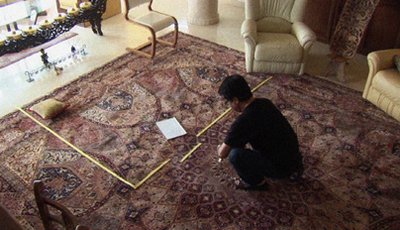
Panahi explains that he will try to read, with supplementary explanations, the script that he had intended to film. Trying to “create an image of it,” he runs yellow tape across his living-room carpet to mark out a room, a corridor, and a staircase, a skeletal spatial model recalling von Trier’s Dogville. He starts to enact the story of a girl who’s prevented from registering at a university by being locked in her room by her parents. In that reflecting-mirror fashion beloved by Iranian cinema about cinema, we’re invited to see that film, and its reenactment here, as echoing the director’s real-life situation.
The enterprise forces us to ask: Is even this partial, virtual version of an unfilmed film not itself a film? Can you shoot a script by reciting it? Up to a point, Panahi suggests yes. After a couple of tries, though, he falters and seems near tears. “If you could tell a film, then why make the film?” Rerunning a scene from Crimson Gold reminds him that during filming, a project swerves into unexpected territory: a performer’s physical being creates a texture than can’t be captured in language, let alone planned. “A film must be made before you can explain it.” This isn’t just a titillating theoretical aside. It acknowledges the Iranian cinema’s gift for discovering a spontaneous specificity in the most everyday events.
The script-reading-as-film project goes on hold, and mundane household matters intrude. It would be unfair to catalogue all of the anecdotal incidents that invade Panahi’s stronghold. (Yes, as you may have heard, an iguana and a dog named Micky are involved.) The non-film ends with Panahi’s co-director, Mojtaba Mir Tahmaseb, departing and leaving his camera behind. There follows one of those casual, piercing encounters with ordinary people that give Iranian cinema a unique glow. Without warning, the abandoned camera takes on a life of its own, suggesting that house arrest—particularly on the night of a fireworks festival—is as hard to define as a film can be.
An unhappy coda: Documentarist Mojtaba Mir Tahmaseb, the only other individual credited in This Is Not a Film, was one of six Iranian filmmakers arrested on 17 September and imprisoned. A petition on behalf of these people is online here.
Israel
Footnote.
Kristin again:
Judging by the three Israeli fiction films on offer at Vancouver, the country’s cinema is striving toward more straightforward entertainment appeal in some of its productions, though one of the three contains a strongly political subject.
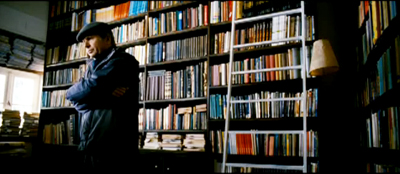
Footnote is that rare comedy set in academia that actually focuses its plot around the main characters’ research. The core conflict is between a father and son, both Talmudic scholars. Eliezer Shkolnik is a stubborn, bitter old man. His lengthy, meticulous study of variant versions of the Talmud was upstaged just before its publication by a colleague, Prof. Grossmann, who made a chance discovery that proved the same conclusions. Eliezer had continued to teach, but his main scholarly claim to fame has been a single footnote in a large introductory study, acknowledging his help.
Eliezer’s son Uriel has become much more famous, based on his many popularizing books that have made him a public intellectual. Early on he is inducted into the Academy. Later, through a mistake, Eliezer receives word that he is to receive the prestigious Israel Prize, but the intended recipient is actually Uriel. Academic politics intervene when Uriel tries to decline the prize in favor of his father: it turns out that the scholar who had beaten Eliezer into print is dead set against him receiving the award. The title takes on a double meaning. In his publication on the Talmudic variants, Grossmann had not acknowledged Eliezer’s work at all, and the missing footnote in that text becomes as significant as the actual one upon which Eliezer has pinned his sense of his own accomplishment.
The film is funny and fast-paced, cleverly using voiceover and PowerPoint-style graphics to lay out the exposition about father and son. It’s apparent why Footnote won the prize for the best screenplay at Cannes. There are many droll touches, including an absurdly small conference room in which Uriel argues with university officials about denying the prize to Eliezer. There’s also a scene where a guard tries to keep Eliezer from re-entering the Israel Museum during the Academy investiture party and he adamantly refuses to provide the information that would gain him access. The whole thing has something of the air of a Coen Brothers film.
Restoration, directed by Joseph Madmony, is a somewhat more conventional family drama, though again with a father-son conflict. The main character, Yaakov Fidelman, is an expert furniture restorer in an age of disposable products. The death of his partner reveals that the business is bankrupt, and Fidelman’s son hopes to sell off the shop’s valuable premises. Fidelman’s young helper discovers that an old, seemingly worthless piano sitting in the shop is a Steinway worth a great deal—if it can be restored. The film is a slick, well-made item. It won the best-screenplay prize at Sundance this year. That surprises me a little, because it depends on an enormous coincidence. The young wastrel hired off the street as Fidelman’s assistant happens to be a promising pianist who abandoned his career path, but who could recognize the value of the old piano.
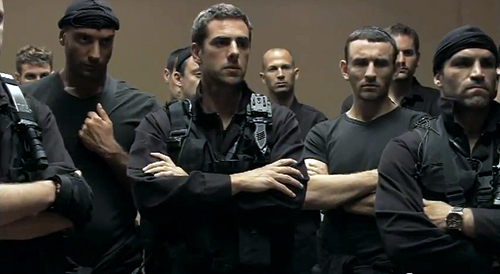
Policeman (Nadav Lapid) is the one distinctly political film, but in a novel way. It deals not with the usual threats from Palestine and from nearby countries but with masculine identity class tensions inside Israeli society. The first half concentrates on Yaron, a member of an elite anti-terrorist unit, and his bluff, muscular comradeship with his partners. A sudden switch introduces Shira, a member of a cadre of well-off Israeli terrorists determined to invade a lavish wedding and take hostage some of the country’s most wealthy industrialists. Yaron’s squad is brought in to save the situation, and he is stunned when face to face with home-grown terrorists, including a beautiful woman with a gun. It’s a fast-paced film that might do well in the U.S., though so far it apparently doesn’t have distribution there.
P.S. 17 October: Panahi’s appeal has failed and the original sentence of six years in jail and twenty years of forbidden filmmaking has been upheld. Panahi’s attorney plans to appeal to Iran’s Supreme Court. See the Variety story here.
Policeman.
Posted in Festivals: Vancouver, National cinemas: Iran, National cinemas: Middle East |  open printable version
| No Comments » open printable version
| No Comments »
Sunday | October 9, 2011
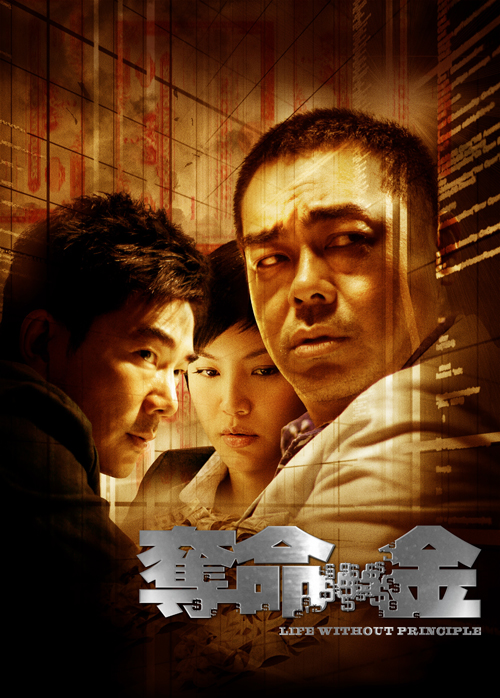
DB here, still at the Vancouver International Film Festival:
The Milkyway films of Johnnie To Kei-fung have resisted some of the fancier tactics of contemporary cinema, such as self-correcting flashbacks and forays into what-if universes. It’s true that he has played a little with disorienting subjectivity (The Mad Detective), and his intricate plotting in films like The Mission have something of the feel of converging-fates stories. But his chief devices, I tried to argue in Planet Hong Kong and occasionally on this site, have been laconicism and ellipsis.
Hollywood dramaturgy tells you something important three times, but To’s films often just mention a key story point in passing. If you miss it, you’ll have to try to recall it later, even after the film is over. Likewise, in Hollywood films, any time periods that are skipped over are assumed to be irrelevant to the plot. But To’s films (like Lang’s) omit showing us intervals that later prove to be quite important. Taken together, the laconic and elliptical approaches to storytelling make The Mission, Running Out of Time, The Longest Nite, The Mad Detective, and the last episode of Triangle into narrative games–games of wits among the characters, but also between the filmic narration and the audience.
With Life without Principle, fresh from screenings at Venice and Toronto, To embarks on a full-blown network narrative. The film follows three clusters of characters across three days, with the last day showing the collapse in world stock markets caused by the Greek debt crisis. All the characters are tied to this macro-event. Police officer Cheung and his wife Connie are about to buy an apartment, the bank investment advisor Teresa sees her customers lose thousands, and the triad Panther partners with his old friend Lung just before Lung’s market maneuvers crash.
Each character has more personal concerns as well. Cheung has learned that his dying father has taken a Mainland mistress, and he and Connie must decide whether to adopt the woman’s child. Teresa’s sales record is poor, and she’ll lose her job if she doesn’t generate more business. Panther needs money to bail out an errant triad colleague. Tying together all three strands is the gloating moneylender Yuen, who scoffs at the stock market and points out that he offers better terms than credit-card companies.
Designing a network plot offers you essentially two options. You can intercut all the strands as the protagonists move through time together (as in Nashville) or you can segregate the plotlines into blocks, as in the “chapters” of Pulp Fiction or the character-tagged chunks of Go. In the block pattern, some chronological fiddling will be necessary. We follow one character or group through story events and then hop back to an earlier period in order to follow another strand.
Mild spoilers start here.
Life without Principle takes the block option. A prologue shows Cheung investigating a murder and Connie trying to buy an apartment for them. The bulk of the film starts by following Teresa through the days leading up to the financial crisis. The narration then glides back to the evening of the first day and we meet Panther, an obsequious but loyal triad working for a self-centered boss. Panther eventually joins his pal Lung in an internet stock swindle. The two plotlines converge at a murder in the bank’s parking ramp, involving HK $10 million in cash. In its final stretch the film starts crosscutting among Teresa, Panther, Lung, Cheung, and Connie. Each line of action comes to a distinct climax, only tangentially related to the others but still tied together by the fluctuations of the stock market.
Still, Johnnie To offers a network narrative on his own terms. Where a Hollywood film is careful to tell us when it skips back in time, usually by use of titles, To’s playfully laconic narration eliminates titles. Instead, the transitional marker is a rightward tracking shot of Hong Kong Island accompanied by jaunty a capella music in Swingle Singer style. More generally, To doesn’t mark the three days overtly within Teresa’s and Panther’s tales. To is more interested in creating a flow across each story rather than that sense of modular architecture we get with modern day-by-day plotting.
Moreover, the tonal shifts that we find in many Milkyway films help keep the stories distinct. Teresa’s and officer Cheung’s plots are straightforwardly dramatic and suspenseful, while Panther’s is grotesquely comic—a quality underscored by Lau Ching-wan’s blinking portrayal of a dense but compulsively earnest company man. The spaces are at variance too. Teresa is never seen outside the bank building (until the last shot), and so the action in her story is built around enclosure and small details, especially a crucial key. Panther’s story is expansive, roaming from a triad banquet to the streets and cafes of Kowloon.
The film relieson classic suspense techniques to an unusual degree , especially the passages in Teresa’s office. Moreover, we always like a drama that forces sympathetic characters to make bad decisions. Cheung, who impassively does his duty as a good cop, ponders disowning the half-sister he never knew he had. Panther, abused by his boss and his pals, remains naively loyal to them.
Our keenest investment, I think, is in Teresa’s situation. Rapacious bank policies make her sell chancy investments to people who can’t understand them. Her scenes with the aged Hi Kun, blindly buying into a high-risk fund, consume an agonizing ten minutes, and throughout you sense Teresa’s qualms about the scam she’s pulling. When she goes to fetch Hi Kun coffee, she pauses meditatively over the cup: laconic To again. Later, when Teresa is confronted by massive temptation, all our instincts urge her to succumb, even though it would be a crime.
Will these basically decent people come through the financial crisis unscathed? The Milkyway universe can be harsh and capricious. Expect the unexpected.

So Hang-shuen, Denise Ho, and Johnnie To on the set of Life without Principle.
Posted in Directors: Johnnie To Kei-fung, Narrative strategies, National cinemas: Hong Kong | open printable version
| No Comments »
Friday | October 7, 2011
Pina 3D.
Kristin here, reporting from Vancouver:
Entertainment and arts journalists seem to have some telepathic way of agreeing upon what will be the big hooks upon which to hang their stories. This year one such hook is the notion that auteurs are finally working in 3D, and this will somehow help determine whether the technique continues to spread. In Hollywood, those auteurs primarily include Spielberg, with The Adventures of Tintin due out in December, and Scorsese with Hugo, the adaptation of a bestseller based on the last years of Georges Méliès.
Two major directors have already brought 3D into film festivals and arthouses. Herzog contributed the one film that even people who dislike 3D (including me) admit uses the technique justifiably: The Cave of Forgotten Dreams. His countryman Wim Wenders’ Pina 3D (Pina–Ein Tanzfilm in 3D) is also a documentary. It creates a portrait of the late Pina Bausch primarily through a collection of scenes where dancers from the current Tanztheater Wuppertal troupe perform excerpts from several of her choreographed pieces.
As usual, the 3D seems superfluous. The opening shot of the theater, with its surrounding stretches of paved surfaces and its rows of trees, looks almost like a model. This is partly due to the almost complete lack of movement. Only some tiny figures on a bench shifted slightly and proved that this was a real space. Within the dance scenes, the 3D effect is more pronounced, but I suspect I would have found the dancing equally dramatic and original had the print been in 2D. One thing I will say for it was that the scenes are bright enough to look good in 3D. The 3D print of Miike Takashi’s Harakiri: Death of a Samurai, which we saw immediately after Pina, displays the notorious loss of light filtered through the glasses. Lowering the glasses a few times during the screening, I got the impression that the print was actually about twice as bright as it was seen through the glasses.
I heard some complaints that Pina offers little information about the choreographer herself. Another objection was that none of the dances are shown complete. Even the lengthiest excerpts, from Bausch’s well-known staging of The Rite of Spring, present only a small portion of the whole ballet. My own reaction was that the variety of shorter scenes gives someone unacquainted with Bausch’s style a good overview of her work.
Rather than go through archival material to present a biographical portrait of Bausch, Wenders chose to highlight each of the members of her troupe with a portrait in medium close-up and a short statement by each about their relationship to the choreographer. I found this helped in keeping track of the performers, who reappear in various combinations throughout the dance scenes, sometimes in solos or pairs, sometimes as a group. Their words about Bausch, though brief, collectively suggest their devotion to her, a devotion that pushed them to collaborate with her in inventing avant-garde moves suited to themselves and yet contributing to a recognizable overall style.
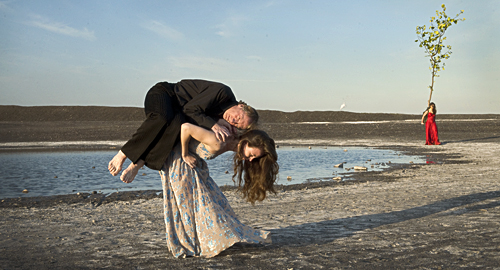
Wenders begins with the dancers on the theater stage, but what differentiates Pina from standard records of dance performances is the filmmaker’s decision to stage some of the short scenes out of doors, in landscapes, city streets, and large empty buildings. One shot looks out over a vast quarry, with a young man bursting up over the edge of it and dancing wildly on the sandy space beside it. Another has a woman performing simple steps on point against the backdrop of a large, rusty factory. A pond in the midst of barren fields forms the stage for a composition juxtaposing a woman carrying a man in the foreground with one carrying a tree at the rear (see above). A few brief scenes have the dancers performing on the corners of busy city streets.
The result gives more an impression of Bausch’s approach to choreography than an overview of her life, but it surely will lure many viewers to seek to learn more about her.
Two Years at Sea
Ben Rivers’ Two Years at Sea neatly straddles the boundary between documentary and experimental film. It appears to be a portrait of an eccentric middle-aged man, Jake, living by himself in a sprawling house in a Scottish forest. The title is never explained, nor is the subject’s name ever given. This film’s natural venues are festivals and perhaps galleries, where notes can supply the information that as a young man Jake spent two years as a sailor, saving up money to live his dream of getting away from urban environments and living close to the land.
Jake makes an excellent subject, almost never glancing at the camera but simply performing his chores, relaxing, or hiking in an unself-conscious way. In the final lengthy shot, he falls asleep on camera. Yet in fact, as we can know only through the program notes or during the filmmaker’s Q&A, Jake plays a somewhat fictionalized version of himself. (The real Jake is more gregarious and welcomes guests.) Rivers suggested some things that his subject might do, and Jake agreed: taking a shower, building a raft from which to fish on a local pond, and mostly notably, raising a small trailer into a pine tree to form a sort of tree house. The framing of the shots showing the trailer rising through the branches hides just how this was accomplished, resulting in a touch of magic realism.
Jake’s home is not a small shack but a rambling building in need of some repair. It is crammed with stuff, empty cans, tools, ancient mattresses, and worn-out objects that the owner can salvage for other uses. Similarly, the yard is overrun by old vehicles, heaps of firewood, and spare parts of unknown machines. Amongst all this apparent junk, Jake has rigged a shower, a stove, an aged washing machine, and a place to sleep. His only company is a cat, although photos glimpsed at intervals—a woman’s face, some children, Jake as a young man building a wall—hint at a past that is never made explicit. Surprisingly, he has a fairly modern car, presumably his means of supplying his needs from an unseen nearby town. He also apparently has a generator, running the lights, washing machine, and a few lamps.
The irony seems to be that Jake has escaped to nature and yet seems almost overwhelmed by the sheer volume of manufactured objects around him. The placement of the trailer atop a tree suggests that now Jake is fleeing the crowded environment he has himself created. Once the trailer is secured, he drags up a small mattress to sit on, cleans the window with his sleeve and, sits contemplating the trees outside.
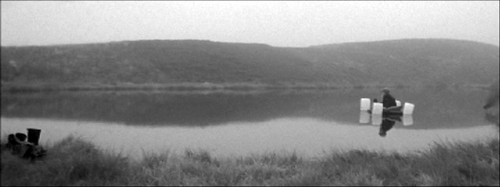
The techniques with which Jake’s routines are recorded are as Spartan as Jake’s chosen life. Rivers has avoided digital filmmaking, choosing to shoot on black-and-white anamorphic 16mm. He hand-processed the footage at home, creating a grainy, occasionally blotchy image. There are many lengthy takes of actions with slow rhythms. Most is one in which Jake, having built a raft out of a frame covered with an inflated mattress and held afloat by four empty plastic bottles that look like giant marshmallows, launches it, he clumsily paddles a short distance out on the pond, and we watch him fish and drift slowly across the wide screen (see below), ending up near the shore and again paddling further out. He never tells us what he is doing or why, and the filmmaker provides no voiceover. We are left with the impression of a man who does exactly what he wants to do when he wants to do it, whether the practical act of chopping wood or the simple contemplation of something in the landscape because he finds it interesting.
Ultimately, as with any film about someone who has fled to a simpler life, we are lured to contemplate our own occasional fantasies of giving up society’s complex challenges and joys and living somewhere isolated and peaceful. It’s a rare person who would ultimately decide to do so, but here the filmmaker builds a portrait of someone who has.
Two Years at Sea.
PS, October 18: Ben Rivers takes part in a conversation about artists and funding in the UK on Frieze Magazine.
Posted in 3D, Documentary film, Experimental film, Festivals: Vancouver | open printable version
| No Comments »
Wednesday | October 5, 2011
The Skin I Live In.
DB here:
Contemporary Hollywood films can play prettily with time, parallels, and point-of-view, at least within certain boundaries. (We’ve talked about this with Source Code, Inception here and here, and other titles further back.) But if you want to see filmmakers coloring outside the lines, a film festival provides a wider sampling of ingenious storytelling strategies.
Last year, in “Seduced by structure,” I wrote about films that worked ingratiatingly with flashbacks, stories within stories, and the like. I’m still a sucker for these things, and several of the offerings at the Vancouver International Film Festival have enticed me. Since these are rather new films, I’ll try to avoid spoilers.
Flashbackhand
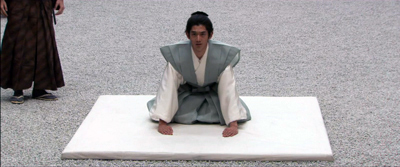
Harakiri.
Perhaps the simplest case I’ve encountered so far is Miike Takeshi’s 3-D Harakiri: Death of a Samurai. It’s seventeenth-century Japan, and penniless samurai are eking out survival through the “suicide bluff.” They arrive at a noble house and ask to commit seppuku on the premises. Because the family won’t risky sullying the family name, the ronin are paid to go away. But the head retainer of the house of Ii is done with the game. The suicide bluff, he maintains, dishonors the samurai code.
A severe-looking ronin appears and asks to die in the Ii compound. The retainer explains to him that recently they had a similar request.
Thus begins the first of two flashbacks. It’s confined to the visit of a very young samurai making the suicide petition, with harsh and grisly results. We return to the narrating frame, and we find that the original petitioner isn’t dissuaded. Why not? And why are the three swordsmen most implicated in the young man’s visit missing today?
A second flashback, more or less from the standpoint of the older petitioner, goes far back in time to fill in the youth’s identity and background. This structural choice shows several worthy things that a flashback can do. It can flesh out things that were merely hinted at earlier, in both the present-time sequences and the first flashback. The flashback can create mysteries by virtue of its placement, as indicated earlier. It can build its own narrative momentum: Even though we know vaguely how things are likely to go, we get to see the gaps filled in with unexpected details.
The flashback pattern also creates two layers of response. We know the young man’s fate, so everything in the leadup gains an extra pathos. Meanwhile, as we recall the present-time situation, the older petitioner’s action remains suspended and we want to return to it to see how it develops. A bonus is that arranging the film in flashbacks allows an intense, arresting scene to appear at the film’s beginning, with the young ronin’s petition, and then assign a cluster of swordplay fights at the end. Arranged in linear story order, the scenes would have created a slow-burning opening and a crowded conclusion, with several violent scenes close together.
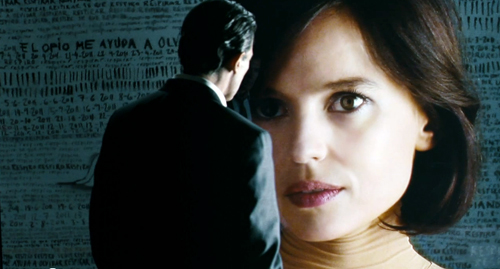
A more audacious play with flashbacks is found in Pedro Amodóvar’s elegant, decadent The Skin I Live In. As with Harakiri, we begin far along the story’s development. A beautiful young woman is imprisoned in a postmodern equivalent of the mad scientist’s lair, a designer house filled with sumptuous furniture and high-tech gadgetry, including a close-circuit video system that lets the doctor keep an eye on his prey. Already there are plenty of questions, particularly when the young woman, Vera, asks to stay with Robert forever.
We quickly asume that she is the object of the doctor’s experiment in creating unblemished, fire-resistant, and snugly fitted human skin. (Almodóvar used a digital intermediate chiefly for the purpose of making the actress’s skin perfect) But more questions arise when a horrendous jewel robber named Zeca, dressed in a tiger skin (it’s the carnival season), breaks into Vera’s sanctuary.
Melodramatic twists come thick and fast, and the first flashback, sponsored by the maid Marilia, tells us of how Robert’s first wife was burned in a car crash. His daughter Norma saw her mother commit suicide and became deeply disturbed thereafter.
The family history gets even more tangled with two later flashbacks. One, initiated by Robert as he sleeps (though it seems more “objective” than a dream) takes us back six years and fills in more of Norma’s sad history. The second, more peculiar, return to the past is obliquely introduced by Vera. The narration seems pretty reliable, and it replays some of the events presented in Robert’s flashback. The curious thing is Vera doesn’t appear in any of the scenes. Shouldn’t she be present for at least some of the action she is “recalling”?
The question is answered with the sort of shocking finesse that Almodovar summons up effortlessly. The flashbacks in Harakiri fill in and flesh out what we’ve seen, while the flashbacks in The Skin I Live In reveal layers of shocking discoveries about what’s really going on in the present-time situation. The flashback structure doesn’t fulfill the film’s opening so much as yank the bottom out from it. Perverted story action summons up perverse narration.
I wish I could say more about these formal arabesques, but secrets must be respected. Suffice it say that Miike provides us a sober, dignified jidai-geki making modest use of 3D and lacking the outlandish gore that he’s come to be identified with. It’s not even as action-oriented as last year’s 13 Assassins. Harakiri ‘s most striking moments are quiet ones. A woman picks splinters out of her dead husband’s bloody hand. Earlier the same poverty-stricken man, having dropped a pair of eggs on the pavement, stoops and licks up their contents.
As for The Skin I Live in: Almodovar’s eye for fashion is still teasing; the credits list is a pageant of brand names like Gucci and Prada. He can also plant nifty little motifs, as when the tidy graffiti with which Vera has filled her cell are echoed by the window display in a dress shop.
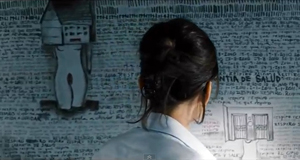 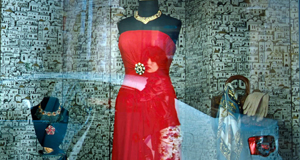
As usual, the story of revenge and unspeakable desire, or rather revenge as unspeakable desire, is wrapped in smooth technique, wondrous music, and eye-gratifying palettes. The flashbacks help too.
She said, he said
Split plot structures have become more common in recent years. Hong Sang-soo provided one of the most striking versions in The Power of Kangwon Province (1998); a recent instance is Apichatpang Weerasethakul’s Syndromes and a Century (2006). In the most common case, the film is split into two long sections, with each line of action following a different character or presenting alternative possibilities. Sometimes the lines present successive lines of action, as in Chungking Express. Sometimes the lines are more or less simultaneous, suggesting different viewpoints on the same events. Often the two lines intersect, so we get scenes replayed from different viewpoints or suggesting alternative versions of events–even parallel universes.
This sort of cleft plot patterning is exploited engagingly in The Natural Phenomenon of Madness, a Filipino film by Charliebebs Gohetia. A brief prologue sets up the situation. A man and a woman, friends since childhood, are having sex, and suddenly it turns rough. Both will later think of his action as a rape. He leaves in the morning, she chops off most of her hair, and they proceed to live their lives separately, sometimes converging, usually not.
The first long chapter, called She, follows her days wandering the city, signing up for a medical study, visiting a grave, inducing a miscarriage, and pursuing Him, whom she loves more than anyone. The second section, “He,” traces his efforts to induce another woman to marry him, to assuage his guilt about the rape, and to get Her to help him with his bone-marrow transplant. Both lines are taking place at roughly the same time and pace. The woman’s autobiographical monologues addressed to offscreen medical personnel are paralleled by the man’s increasingly sorrowful confessions to a priest. She’s a Bohemian artist, He’s a store owner wracked by Catholic guilt. At times, we see them doing things alone that suggest a sort of spiritual synchronization: She stands at a bridge and shouts, and later we see Him doing the same thing.
He and She meet occasionally, and then we get the same scene twice. Or do we? Every repetition is played out in symmetrically varied ways. For instance, early in the She chapter, He is already seated by a wall playing with an origami (of the sort my grade school used to call a Cootie Catcher). She joins him.
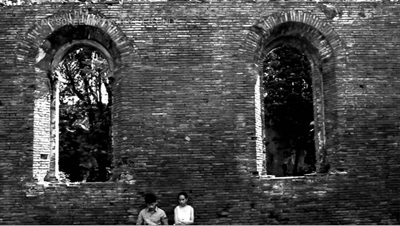
In His story’s version, she’s already there, playing with the origami, and He comes to join her.
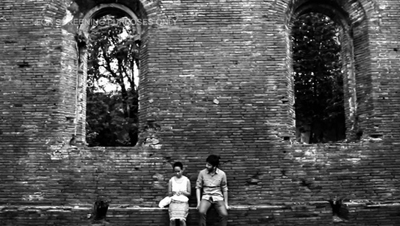
Moreover, the conversation isn’t the same each time. So are the apparently iterated scenes completely different meetings, taking place in the same locale and filmed in similar fashion? Some cues suggest that the tandem sequences represent only one occasion. For instance, both of these wall scenes purportedly show their first meeting since She cut her hair. As we’re watching, we might be forgiven if we’re not sure of the variations: The repetition comes about 67 minutes later than the original scene. We’re left with meetings that are partly repetitions, partly variations: alternative universes embedded in one, perhaps.
One effect of the parallel plotting is to heighten the differences between the two protagonists. As Gohetia suggested in the Q & A after the VIFF screening, She actively chooses ways of living her life, while He clings passively to his situation, hoping that the other woman will marry him, that somebody will donate bone marrow, and that the Church may offer help. Both have unrequited love: She wants him, He wants another girl. There are plenty of abstract parallels, such as that between the medical establishment and the clerisy, but the precise, locked-down shots help us notice physical differences too, such as the walk through Manila streets with distinct gaits. And the final convergence of the couple nicely echoes the prologue. The Natural Phenomenon of Madness shows that once a new narrative strategy enters the public domain, filmmakers can play with its components, twisting them like facets of a Rubik’s cube to engage us in fresh ways.
The Skin I Live In will be released in the US by Sony Pictures Classics on 14 October. The American Cinematographer story on the making of the film may be read here.
P.S. 6 October 2011: Thanks to Philippe Mathieu for correcting an erroneous film title!
P. S. 14 August 2012: Thanks to Marvin Ortiz for correcting two characters’ names in my account of The Skin I Live In.

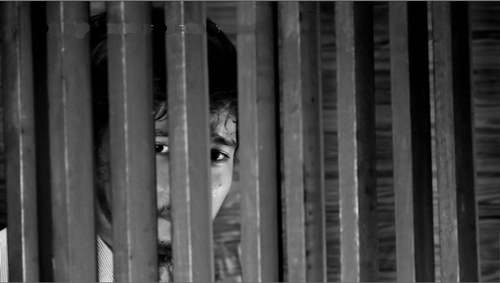
The Natural Phenomenon of Madness.
Posted in Directors: Almodovar, Directors: Miike Takashi, Film comments, Narrative strategies, National cinemas: Japan, National cinemas: Spain and Portugal | open printable version
| No Comments »
|