






David Bordwell's website on cinema   click for CV

Home

Blog

Books

Perplexing Plots: Popular Storytelling and the Poetics of Murder

On the History of Film Style pdf online

Reinventing Hollywood: How 1940s Filmmakers Changed Movie Storytelling

Film Art: An Introduction

Christopher Nolan: A Labyrinth of Linkages pdf online

Pandora’s Digital Box: Films, Files, and the Future of Movies pdf online

Planet Hong Kong, second edition pdf online

The Way Hollywood Tells It pdf online

Poetics of Cinema pdf online

Figures Traced In Light

Ozu and the Poetics of Cinema pdf online

Exporting Entertainment: America in the World Film Market 1907–1934 pdf online

Video

Hou Hsiao-hsien: A new video lecture!

CinemaScope: The Modern Miracle You See Without Glasses

How Motion Pictures Became the Movies

Constructive editing in Pickpocket: A video essay

Essays

Rex Stout: Logomachizing

Lessons with Bazin: Six Paths to a Poetics

A Celestial Cinémathèque? or, Film Archives and Me: A Semi-Personal History

Shklovsky and His “Monument to a Scientific Error”

Murder Culture: Adventures in 1940s Suspense

The Viewer’s Share: Models of Mind in Explaining Film

Common Sense + Film Theory = Common-Sense Film Theory?

Mad Detective: Doubling Down

The Classical Hollywood Cinema Twenty-Five Years Along

Nordisk and the Tableau Aesthetic

William Cameron Menzies: One Forceful, Impressive Idea

Another Shaw Production: Anamorphic Adventures in Hong Kong

Paolo Gioli’s Vertical Cinema

(Re)Discovering Charles Dekeukeleire

Doing Film History

The Hook: Scene Transitions in Classical Cinema

Anatomy of the Action Picture

Hearing Voices

Preface, Croatian edition, On the History of Film Style

Slavoj Žižek: Say Anything

Film and the Historical Return

Studying Cinema

Articles

Book Reports

Observations on film art

It’s good to be the King of the World

Sunday | April 22, 2012

DB here:

Every spring the National Organization of Theatre Owners holds a convention and trade show in Las Vegas. It’s now called CinemaCon, but in earlier times it was known as ShoWest. The gathering assembles thousands of exhibitors from around the world. Directors and stars show up to publicize summer and fall releases. There are screenings, award ceremonies, display booths, and panels about everything from sound systems to popcorn pricing.

The convention is always an extravaganza, but in 2005 things were particularly stirring. Then fewer than a hundred US screens were digital. To ShoWest 2005 came three of the most financially successful directors in history: George Lucas, James Cameron, and Robert Zemeckis. Robert Rodriguez joined them, and Peter Jackson participated in a prerecorded video clip. Their mission:  to sell digital cinema.


Battle angels

James Cameron and George Lucas at CinemaCon 2011.

Cameron and company knew that the exhibitors needed a rationale for switching that would actually enhance their business. The killer app for digital screening, these directors and others had decided, was 3D.

Lucas claimed that he was hoping to re-release the first Star Wars in 3D in 2007. “We’re giving you two years,” he said pleasantly. Zemeckis announced two 3D films in preparation. In a 3D film clip, Jackson said, “I’m looking forward to one day seeing Hobbits in 3D.” Cameron, who had started working with 3D back in the 1990s, was fresh off the January release of Aliens of the Deep in IMAX 3D. He promised the exhibitors Battle Angel, telling Lucas, “You can have all my theatres when Battle Angel moves out.”

One argument was that 3D offered a way to build the business. 3D screenings would bring in new audiences who seldom went to ordinary movies. More important, the enhanced format would justify higher ticket prices. But of course 3D would necessitate moving to digital projection.

No Battle Angel and no Star Wars IV showed up in 3D, but the celebrity directors  kept their word to some extent. Zemeckis led the pack with Beowulf (2007), and Avatar (2009) cemented the deal.  With its record $2.7 billion worldwide box office, the latter convinced exhibitors that digital and 3D could be huge moneymakers. In 2009, about 16,000 theatres worldwide were digital; in 2010, after Avatar, the number jumped to 36,000. 3D was the killer app, or Trojan Horse, that pressured exhibitors into going digital.

But here’s the funny thing. At the 2005 confab, the directors summoned up an explanation that goes back to the days when TV threatened the movie trade: You need something special to yank viewers off their couches. In 1953, the bonus was widescreen color images and stereo sound. In 2005, the bonus was stereoscopic projection. All tentpole pictures, Cameron claimed, would be in 3D. “With digital 3D,” he said, “we now have a reason to get people out of their houses from in front of their flatscreen, high-definition TVs and back to the movies.” The premise was that 3D wouldn’t be feasible at home.

Now let’s jump ahead. It’s the 2011 conference of the National Association of Broadcasters. 3D TV is starting to arrive. Celebrity director James Cameron visits with his business partner Vince Case, who have formed the Cameron Pace Group. According to Variety his message to the TV people is:

Your business is about to go 3D. . . . [He said that] the transition to 3D televison as going to happen much faster than usually predicted, even as soon as five years [when] “everything is in 3D and people demand 3D the way people used to demand color, and if you’re not broadcasting in 3D you’re not playing the game and you’re not getting any revenue.”

In 2005 Cameron told filmmakers and exhibitors to shoot in 3D to outrun television. Six years later, when nearly half of movie screens are digital, he advised broadcasters to adopt 3D as fast as possible.

It’s probably not irrelevant that the Cameron Pace Group supplies 3D cameras and assistance to both filmmakers and TV production companies. During the following year, the group announced, it was a 3D equipment provider for CBS Sports and ESPN.

Lest Cameron’s message be missed, he and Pace reiterated it earlier this month. At NAB’s convention he said that sports was only the beginning. Episodic television can also be shot quickly in 3D and easily converted to 2D. Television can’t confine itself to one-off shows or a 3D channel: “We have to hit a critical mass of enough entertainment in 3D.” “The future of 3D,” he told an interviewer, “will be defined by TV.”


Leapfrog
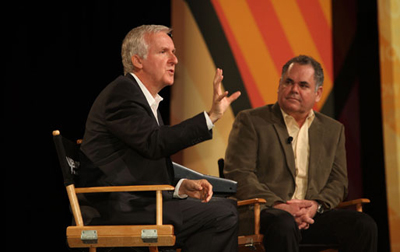
James Cameron and Vincent Pace.

Where does this leave film? Having convinced exhibitors to go digital and to install 3D rigs in their booths, what does Cameron propose to offset the rise of 3D TV? He came to last year’s CinemaCon with a new “incentive”—now all stick and no carrot.

It’s well known that one problem with 3D cinema is a dimmer image. If a vibrant 2D film image is about 16 foot-lamberts, many 3D films are shown at less than four. This turned out to be a problem with screenings of Avatar, which in some venues ran at two foot-lamberts. So Cameron is proposing that exhibitors fit their projectors with gear that permits higher frame rates. Shooting and showing at 48 frames per second (or even 60 fps) instead of the traditional 24 will yield a brighter, sharper picture. Interestingly, 3D TV doesn’t have the same problem with light output, so it’s possible, notes Steven Poster of the ASC, that a 3D HD image would have whiter whites and blacker blacks than a 3D film screening.

Moreover, Cameron prepared a demonstration that showed that in 3D, figure movement and camera movement strobe noticeably at the 24fps rate. They look much smoother at 48fps. This is probably true, but I haven’t noticed problems of strobing in 35mm films by Mizoguchi, Jancsó, Welles, Renoir, and other camera-movement masters. Since they didn’t use our modern 3D, they didn’t encounter the artifacts that Cameron and his peers now brood over.

Having pressured exhibitors to go digital and 3D, Cameron is now asking them to change their equipment to permit him to shoot in a new way he likes better—and to compensate for a deficiency in the 3D system he thrust on them. But he assures them that revamping their projectors is merely a matter of “little tweaks . . . tiny things that make it better.” He has claimed it’s a matter of a software upgrade.

This holds good, evidently, only for the projectors made since January 2010, the so-called “second” series. Projectors made earlier may need replacing. Moreover, one report suggests that the projectors using the Texas Instruments system, the dominant technology in the field, will require not only new software but a new media block. Christie, a major projector manufacturer, says that it will have these available in June for $10,000 apiece.

You have to give Cameron credit for chutzpah. Once more he trots out the argument that theatres have to leapfrog home viewing:

With theatre owners already worried that audiences are abandoning the cinema for the comforts of their home entertainment centers, Cameron argued that exhibitors cannot afford to make the case that “What you’re going to see is special and better than what you have in your home, except the motion sucks.”

The message seems clear. Digital and 3D gave you a competitive advantage for a couple of years, but now it’s time to retool. Those of you who didn’t get 3D along with digital, better start moving, especially if you want Avatar 2 and 3. (Just what Lucas said in 2005 about Star Wars IV 3D, which still awaits us.) And upgrade to 48fps, or even 60. Cameron’s message got support in this year’s NATO convention, when Peter Jackson announced that he’d be trying to induce some theatres to play The Hobbit  at 48 fps, the rate at which he’s shooting that 3D production.


Who died and made you King of the World?
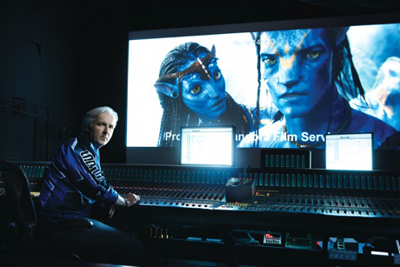
I’m left with two observations.

First, there was a time when exhibitors called these directors’ bluff. When Lucas griped that there weren’t enough digital screens for Star Wars: Episode III—Revenge of the Sith (2005), John Fithian, president of the National Organization of Theater Owners, replied memorably: “I don’t put projectors in just for Star Wars.”

Now, it seems, the exhibitors are so scared of missing the next blockbuster that the filmmakers can dictate terms. It’s remarkable that these men can do something neither Griffith nor DeMille nor Disney nor any other powerful Hollywood filmmaker of the classic years dared do. They keep asking that the fundamental technology of cinema be changed so we can all watch a couple of their movies for a month or two every few years.

Second, if these guys are so passionately committed to quality, why don’t they make better movies?


For accounts of Cameron’s 3D explorations before Avatar see Christopher Probst, “Future Shock,” American Cinematographer 77, 8 (August 1996), 38-44; Ron Magid, “Digitizing the Third Dimension,” AC 77, 8 (August 1996), 45-50; Jay Holben. “Taking the Plunge,” AC 84, 7 (July 2003), 58-71; and John Calhoun, “Voyage to the Bottom of the Sea,” AC 86, 3 (March 2005), 58-69.

According to Cameron, he and Vincent Pace, an expert in underwater cinematography, have been working together since 1988. They began building an HD and 3D system in 1999 and finished their first one in 2000. See the GigaOM interview here. In the same interview Cameron mulls over the prospect of 4K television transmission.

A video showing Cameron’s ideas about digital cinema is available at Filmofilia.

As many have pointed out, higher frame rates were argued long ago for film screenings, notably by Doug Trumbull and Dean Goodhill. (See also Roger Ebert on Goodhill’s Maxivision.) Needless to say, Eastman Kodak enthusiastically supported this initiative, since it would step up film consumption.

This entry is a pendant to the series, Pandora’s Digital Box, which ran on this site earlier this year. That series, reorganized and expanded with new material and arguments, will be available in e-book form later this spring.

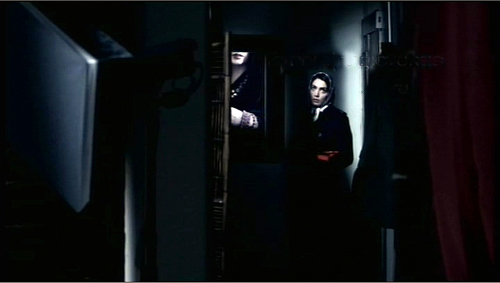
Avatar.

Spring comes, bringing movies for Badgers

Monday | April 16, 2012

Good Bye (Mohammad Rasoulof).

DB here:

The thirteen years of our Wisconsin Film Festival have furnished plenty of high-definition moments. I’ll never forget Roger Ebert facing a crowd of a couple of thousand in the Orpheum Theatre to introduce A Hard Day’s Night, or Michael Snow explaining Corpus Callosum to a couple of hundred of the devout in our Cinematheque. We sponsored the first retrospective of Hong Sang-soo’s work—after he had made only three films—and he came along. Hundreds of young filmmakers have visited Madison with their independent works, while we’ve also sponsored some wonderful restorations of classics. Somehow spring always arrives right on time as people line up, chatting, to pass from sunshine into the darkness of our local movie houses, or to the many coffeehouses and pubs near the venues.

Some years the festival has clashed with the Hong Kong International Film Festival, and it’s always been awkward for me to leave Madison for the Fragrant Harbor. But this year, number 14, I can happily stay at home and let the festival come to me.

Roger Ebert and Meg Hamel, Wisconsin Film Festival 2006.

You can see what’s on offer here. Our programming team has gone the full distance for us.

This year’s guests include the distinguished experimentalist Phil Solomon (three programs, one curated by him) and Dan Levin, cognitive scientist and part-time filmmaker , who’s paying tribute to Joel Gersmann in a movie called Filthy Theater. We also have James Schamus of Focus Features. You know him as the award-winning screenwriter of many Ang Lee films and a founder of the Good Machine company, a bastion of bold independent cinema in the 1990s. His New York Times profile is here. James is giving a talk, “My Wife Is a Terrorist” on Thursday at 7:30, and it should be quite something: a narrative analysis of his wife’s Homeland Security file, including, he promises, meditations on redactions.

I thought I’d use today’s entry to signal to Madisonians, and anybody else who’s interested, some of the films that we’re showing that I’ve found worthwhile. In some cases, I supply links to write-ups on this site.

Monsieur Lazhar is a warm drama given astringency by its sudden bits of realism. The mysterious title character takes a teaching post in a primary school and must negotiate between corridor politics and students’ personal problems. Just enough sweetness, just enough toughness, and just enough of an uncertain ending to put it squarely in the Tradition of Quality. That isn’t meant as a complaint.

For me The Devil, Probably is second-tier Bresson, which means first-rate anybody else. People tend to forget that this spiritual director, his eyes supposedly lifted to the clouds and mists of holiness, was also resolutely secular. He was fascinated by young people and their way of being in the world, from the boyish Country Priest to the hapless Mouchette. Moving with the times, he gave us this reflection on post-’68 disenchantment with where things were going. I should see it again. Everybody should.

Good Bye (aka Goodbye) has a bit of Bresson about it. It’s an austere film concentrating on a woman lawyer forced out of her profession and up against a plethora of problems. Her past and present unfold gradually: Every scene has two levels, usually a mundane action that gradually yields hints about her husband, her unborn child, and her plans to leave Iran. A scathing portrait of a culture of bureaucracy, bribery, and surveillancer (the film was smuggled out of the country), Good Bye will stay with you. Kristin talks about it here.

Current, in my view wholly justified, admiration for Tinker Tailor Soldier Spy should bring people to The Deadly Affair, Sidney Lumet’s intelligent version of A Call for the Dead. All have had their say about Guinness vs. Oldman as spymaster George Smiley, but what about a 57-year-old James Mason in the role? This time around the sexual jealousies underlying the recent Tinker Tailor are brought to the fore (the title is a pun), with Harriet Andersson as a ravishing Ann Smiley.

Another Brit retrospective item is Alberto Cavalcanti’s Went the Day Well? Kristin spent a whole blog on this surprisingly grim study in complacency overcome by offhand heroism.

One of the very best films we saw at Vancouver last fall was Once Upon a Time in Anatolia (above), which we discuss a little bit here. Somber and mesmerizing, it coaxes you to pay attention. My kind of movie.

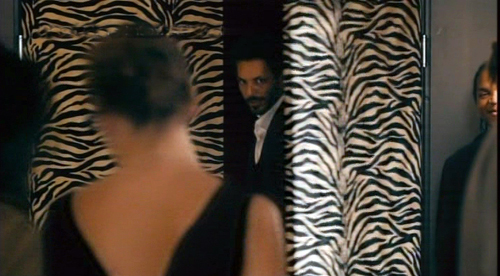
Action pictures are a universal genre; every culture makes some good ones. The French have been at it longer than most, and a happy result is Sleepless Night. A cop (is he dirty or just working undercover?) has to rescue his kidnapped son from a drug dealer. It was a neat idea to stage action scenes in a jam-packed disco-cum-casino, complete with glitterballs and zebra-skin doors, so our scruffy protagonist must hurtle through masses of the hip rich. There’s a kitchen-utensil fight according to Hong Kong rules: Use everything to hand as a weapon, and don’t stop until everybody collapses in pain and exhaustion. Lots of handheld work, but mostly coherent, with an admirable fondness for precise matches on movement. Kinetic fun, and wall-eyed for Hollywood.

Speaking of Hong Kong, there’s one of Johnnie To’s latest, Life without Principle. This story of intersecting destinies during the European financial crisis spurred me to comment at some length here. To is, in my immodest opinion, one of the best directors working anywhere today, and a chance to see his recent work is really splendid. We have a 35mm print, and I’m tempted to go back and see it a third time.

Klown’s outrageous bad manners are perhaps a little too calculated, but this Danish dramedy from Lars von Trier’s company does catch you up. Laced with jokes about pedophilia and manly touching rituals, it seems at first glance a rough-edged bromance. Two pals and a nephew go on a canoeing trip aiming to end at an upscale brothel. After a string of slapstick disasters, the thing looks ominously like it might end in hugs and cheerful tears, but the biggest sting comes in the last few seconds. With a funny, offhand performance by musician Bent Fabric and a walk-on by Jørgen Leth (himself no stranger to outlaw sexytime).

Testosterone to the bursting point is no less on display in Policeman, a bristling, brutal examination of male bonding among Israeli cops. Although it builds to an incendiary action sequence, it’s mostly a study of how people of all classes and political cultures acquire an appetite for violence. Kristin wrote about it here.

Ben Rivers’ Two Years at Sea is a low-key, haunting piece. A portrait documentary? Semi-autobiographical fiction? Experimental film? All three, I guess. And in glorious black-and-white 16mm, which Rivers processes himself. Kristin gives it thumbs up here.

Finally: No film can portray the state of a country at a moment in history, but you’ll be thinking a lot about how today’s Russia might work after you see Elena. A character study of a woman whose ruthlessness is made reasonable and even sympathetic, a thriller centered on how to keep your enemies close, and a sociological study of the haves and have-nots in rapacious capitalism.

Because these are outstanding movies, several are listed as sold out. But some seats have been kept aside, and inevitably some who bought tickets won’t show up. The festival staff tell me that there will be a wait line for each show, and they’ll try to get everybody in. Me, I hope to watch at least a dozen programs, and I’ll try to blog about some in the afterglow. See you there?

Sleepless Night (Nuit blanche; Frédéric Jardin).

Once more, Mad City movies

Sunday | April 15, 2012

 Night and the City.

DB here:

It’s been a busy time in Madison, at least for me. KT is in Egypt, peering at shards of statues and documenting earlier Armana excavations. I’m at home, having missed the Hong Kong International Film Festival (doctor’s orders) and wistfully wishing I’d been there for the tribute to Peter Chan Ho-sun (check out Fred Ambroisine’s interview at Twitchfilm) and a chance to see—Don’t say whoa!Keanu Reeves, who was there with Side by Side, his new film on digital cinema (snif).

Instead of traveling, I’ve been doing other stuff. There were, and still are, last-minute checks and fixups on the new edition of Film Art. I went to some movies–Star Wars Episode I: The Phantom Menace, The Hunger Games, The Raid: Redemption, Carnage, 21 Jump Street—as well as screenings at our Cinematheque. Late at night I’ve been watching 1940s films for a long-range project. Most frantically, I’ve been working on a little e-book to be finished, I hope, in three weeks. It will be available on this site, ludicrously cheap, you will want one for sure, I bet, well, why not? More about it later.

In the meantime, Madison has hosted some remarkable visits. I’ve already mentioned Lynda Barry’s delightful presentation of Chris Ware and Ivan Brunetti. I must also mention two other dignitaries that illuminated our lives this spring.

In early March, Tony Rayns (right), cinema’s man-about-Asia, came to pillage our city’s supply of DVDs and, not incidentally, give a lecture. It was his usual fine performance. “The Secret History of Chinese Cinema” took us through a series of unofficial classics stretching back to the 1930s, including Song at Midnight (1937), with its fairly off-putting defacement, and Scenes of City Life (1935), Tony’s candidate for the best unknown Chinese film. It was gratifying to hear him pay homage to Sun Yu, who attended UW’s theatre program long ago. Who knew that the great director of Daybreak (1933) and The Highway (1934) was a Badger?

More recently, we were visited by Schawn Belston, an old friend who’s Senior Vice-President of Library and Technical Services at Twentieth Century Fox. Our Cinematheque is running a string of Fox restorations, and Schawn brought along a stunning print of the lustrous noir classic Night and the City (Jules Dassin, 1950).

There’s a nifty story behind that print. Schawn and archivist (and Badger) Mike Pogorzelski discovered an original camera negative in the Movietone News vault in Ogdensburg, Utah. When they struck our print (directly from the neg) and showed it to Dassin a few years ago, he wept with pleasure.

Schawn found another version of unknown provenance. On the basis of the first reel, which he screened for us, this seems to be a British version, with a different voice-over narrator, varying footage and cutting patterns, and a lighter, more romantic score. As Schawn pointed out, this plays more slowly and is more of a melodrama than a thriller; it also makes the Richard Widmark character a little more sympathetic, I thought. Nobody has yet discovered why this version was made.

So a mood-drenched noir print, a new slant on postwar film, and a nice little puzzle. On top of those, a talk on the previous day by Schawn, discussing current restoration issues. Naturally the topic turned to the digital conversion, a hot topic on this site and elsewhere. Some basic facts from the inside:

*Lots of filmmakers are still finishing on film, but the plan is to make no prints available to US theatres after 2012. About 300 prints of current titles will still be made for the world market.

*Both Fuji and Kodak are still making film stock, even new emulsions, but the decline in usage will raise prices. A 35mm print now costs $4000, a 70mm print runs $35,000 and up.

*Storage problems are immense. The studio wants to save all the raw footage; in the case of Titanic, that comes to 2.5 million feet. Which version of the film has priority for the shelf? Typically, the longest cut, often the first preview print.

*All studios are still making 35mm negatives for preservation, typically from 4K scans. Ironically, their soundtracks, usually magnetic, can’t match the uncompressed sound of the files on a Digital Cinema Package (DCP).

*”Film is the most stable medium, but the preservation practices for it are the most vulnerable.”

*Nearly all film restoration is digital now, so the best way to show the results is probably digitally. That also makes for standardized presentation and less wear and tear on physical copies.

*Most classic films in a studio library are not available on DCP. If an archive or cinematheque or theatre wants one, there are ways to make on-demand DCPs. But it’s not cheap. A 2K scan runs $40,000; a 4K scan, somewhat more. Schawn opts for 4K because a digital version should be the best possible. It might be the last chance to make one!

*Films stored on digital files must be migrated frequently. Sometimes that’s done through “robotic tape recycling.” But there are problems with the constantly changing formats and standards. The Movietone News library was originally digitized to ID-1, a high-end broadcast tape format from the mid-1990s, so that material will need to be copied to something more current.

*Schawn believes that objective criteria about color, contrast, and other properties need to be balanced with concern for the audience’s experience. By today’s standards, original copies of Gone with the Wind and The Gang’s All Here look surprisingly muted. But to audiences of the time, they probably looked splashy, because viewers saw so few color movies. Restorers and modern viewers have to recognize that perception of a film’s look is comparative, and the terms of the comparison can change.

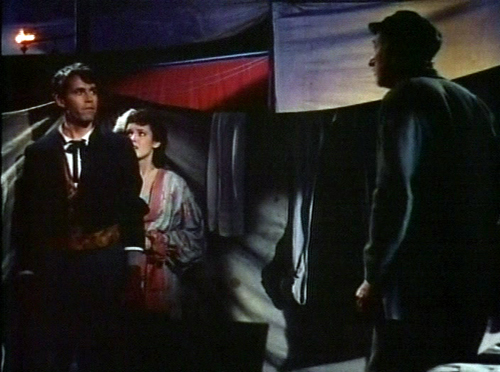
Schawn’s point was made after his visit with our Cinematheque show of the restored copy of Chad Hanna (Henry King, 1940). For a Technicolor film, it had a surprising amount of solid black, and not just in night scenes. We’re used to “seeing into the dark” via today’s film stocks and digital video formats, and we probably identify Technicolor with the candy-box palette of MGM musicals on DVD. We sometimes forget that chiaroscuro was no less a resource of color film of the 1940s than of black-and-white shooting of the period. A leisurely, charmingly unfocused story with a radiant Linda Darnell (she lights up the dark) and Fonda at his most homespun, Chad Hanna was good in itself and an education in color style circa 1940.

Schawn’s visit, like Tony’s, was informative and plenty of fun. We want to see both again soon.

Up next, as Robert Osborne would say: Some picks for the Wisconsin Film Festival, which launches Wednesday.


Thanks to Jim Healy, Cinematheque programmer, for arranging Schawn’s visit and the Fox retrospective.

Chad Hanna. Not, emphatically not, from 35mm; from Fox Movie Channel.

The Tao of RIO BRAVO; or, A Yakky Way of Knowledge

Wednesday | April 11, 2012

Too long has this scrolling site ignored the Sacred Text. In a gesture of penance, I return to the true path. Like all Sacred Texts, this one attracts worshippers in different degrees: the Seekers, the Initiates, the Adepts, and the Exegetes. There are Heretics too. Today, I wish merely to introduce you, who may not yet be even a Seeker, to the serenity of The Way.


The Word, in plenty

Seekers who have become Initiates agree: Their blinding moment of conversion came when they realized that the words of the Sacred Text speak to all times, all places.

Other Sacred Texts dispense a few trinkets of wisdom (“I have a bad feeling about this.” “We’re gonna need a bigger boat.” “Show me the money.”) These are tag lines, sound bites, not poetic glimpses of glory. Uniquely and universally, passages in our Text raise the spirit and cast out doubt and despair. But far from being otherworldly, they carry practical wisdom and illuminate every situation. What crisis in your life, brother or sister, would not be piercingly clarified if you were able to utter one of these lines?

It’s nice to see a smart kid for a change.

I’d say he’s so good he doesn’t feel he has to prove it.

That’s what I’d do if I were the kind of girl you think I am.

Sorry don’t get it done, Dude.

You look a little used.

Aw, I’m not gonna hurt him.

If I’m gonna get shot at, I might as well get paid for it.

Let’s take a turn around the town.

I’m glad we tried it a second time. It’s better when two people do it.

Borachone talking big.

You’d better go easy on that stuff.

Don’t set yourself up as being so special. You’d think you invented the hangover.

Aw, hell, what’s the difference? We’d all be dead by then.

Nobody’s run in here./ We’ll remember you said that.

Found yourself another knot-head who don’t know when he’s well off?

A game-legged old man and a drunk. That’s all you got?/ It’s what I’ve got.

Think you’re good enough?

Is he as good as I used to be?/ It’d be pretty close. I’d hate to have to live on the difference.

To become an Initiate, the Seeker must commit these to memory and meditate upon them intently. An Adept will be able to summon them up, half-consciously, in a range of situations–the more far-fetched, the more enlightening. One will always be appropriate.


The Name

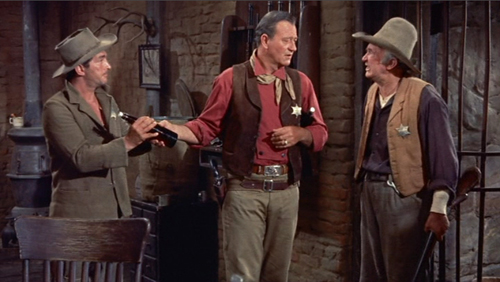
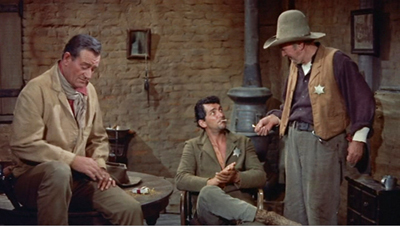
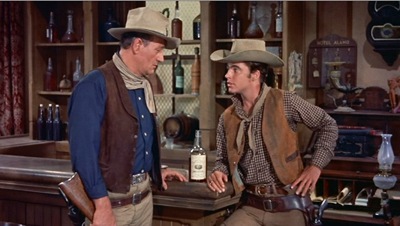
Exegetes have pointed out that the figures of light in the Sacred Text do not have the usual names. They are, emblematically, called Stumpy, Dude (aka Borachone), Colorado, Feathers. He Who Is Called Chance is named John T., but even the middle initial is turned into an epithet (“T for Trouble”).

Far from being an accident, the names in the Sacred Text are there to impel the Initate into deeper mysteries. Is, for instance, Stumpy The Elder called Stumpy because of his lameness—always a sign of grace in sacred texts? Because of his inertness (as stiff as a stump)? Or because a tree, even though harvested, retains its attachment to the earth by remaining rooted? Perhaps He Who Is Called Stumpy is “grounded,” as the current saying has it.

The Text is figural, both metonymic and metaphoric. Young Colorado is son of Rocky Ryan from Denver. He Who Is Called Wheeler is a man of wagons. She Who Is Called Feathers wears feathered clothes, but also has a teasing lightness of manner. He Who Is Called Dude constitutes a crux. Is he a “dude,” an Easterner who has come west, or is he a dude because he favors fancy outfits? (See “Raiment,” below.)

The central fact is that in this text, the mystery of naming opens on to the Mystery of Being. Everyone is named something, but many are not named by their name.


Raiment

Once the devout Seeker has sensed the limitless depths of the The Words, the more inquisitive will turn to the images. In the opening scene of the Sacred Text, a largely wordless series of encounters in barrooms, a world is created before our eyes. It is a world of debasement, treachery, and sudden death. A contemporary text called Variety, secular but still enlightening, notes: “…gets off to one of the fastest slam-bang openings on record.”

Exegetes have long praised this eloquent passage. They note that a text so replete with Words benefits from an extended passage of muteness. Not silence, for the almost continuous music attributed to Dmitri Tiomkin provides its own wordless “commentary” on the action. This sordid, barbarous world will be redeemed; those who are left low on the saloon floor will rise three days afterward (note!) to triumph.

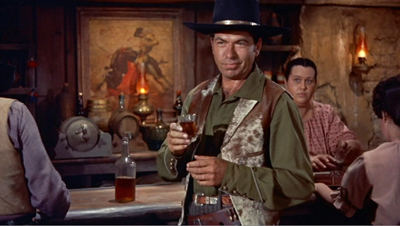
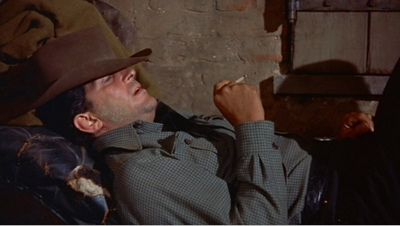
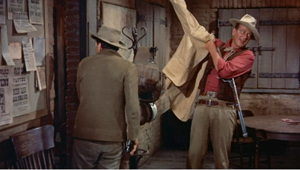
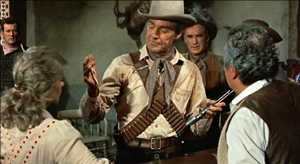
Serious study of the Text’s images drives the Adept to note the raiment in which the figures are clothed. The Nemesis Joe Burdette wears a bright cowhide vest, suggesting his animalistic anima. He Who Is Called Dude begins in dirty garments, earns the right to garb himself in splendor, but through weakness of soul he is once more soiled.

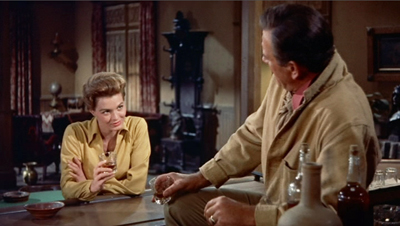
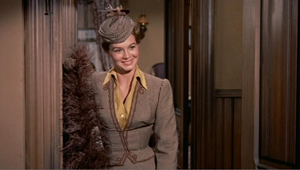
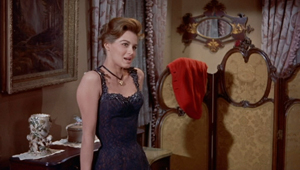
She Who Is Called Feathers manifests the most dazzling changes in raiment.


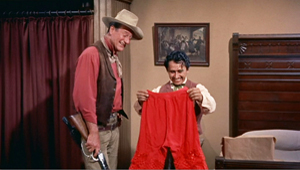
Hers receive commentary within the Text, while the garments of He Who Is Called Chance are noticed only by her.

Those things have big possibilities, but not for you.

Hey, Sheriff, you forgot your pants.

But these may be interpolations by later hands.


Disputed passages

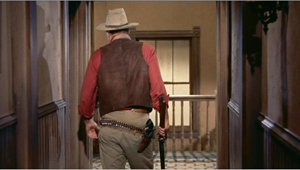
Like all Sacred Texts, this contains stretches that excite puzzled commentary. What, in the opening scene, is Wheeler supposed to “tell his men”? Why so many flying insects at night? Why is He Who Is Called Chance once, and only once, seen awkwardly grappling with his rifle, trying to hold it while he shrugs into his jacket?

There is the curious verbal slippage in the song sung by He Who Is Called Dude. He sings of “My three good companions—my rifle, pony, and me.” To the heathen mind, this is a flagrant error. You can have a rifle and a pony as a companion, but you can’t have you as your companion. Can you?

To doubt the Sacred Text at this point is to underestimate the subtlety of the Authors. Recall that the tale told by the song is a dream (“It’s time for a cowboy to dream“). As in other venerable texts (e.g., Bible, Ramayana), dreams are to be taken as warnings, prophecies, or hints as to the true meaning of the story. And so it proves here. We know that He Who Is Called Dude is a divided man: Borachone and pistolero, drunk and deputy. The singer, as we’ve seen, has an untamed side that bursts out into violence against nearly everyone, including his Savior, He Who Is Called Chance.

Hence the split identity of the rider in the song. He is a me, but he also has a me. And around the bend, waiting for both of them, is another divided figure, a woman called “my sweetheart darling.”

There are Exegetes who would see in this passage the source of another worthy text, Western Redundancy Playhouse Theatre, but exploring that would take us too far afield.

More obvious is the Text’s great cosmic sign: The sun rises and sets on the same horizon.


No further proof is needed of the miraculous nature of this narrative.


Heresies

I do not refer to callow efforts to dishonor the Text (e.g., “I think we need a few more scenes in the jail”). Instead, I mention simply the most important efforts by believers, often Adepts, to sow petty doubts. There is, for instance, the efforts to replace the canonical status of this Text by later, more derivative ones (El Dorado; Rio Lobo). Uneven and fragmentary, they have never achieved widespread recognition of Sacredness. Other heresies claim our text itself is derivative, and one offers the biggest challenge to the devout.

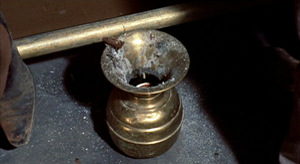
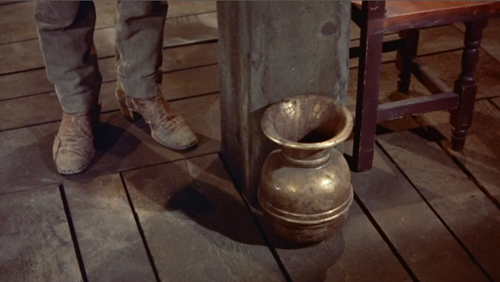
I refer of course to the Heresy of the Spittoon.

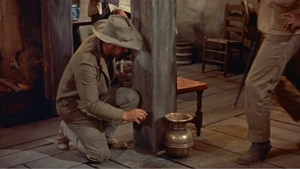
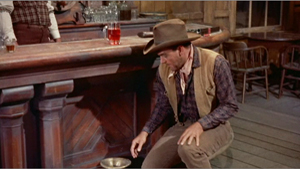
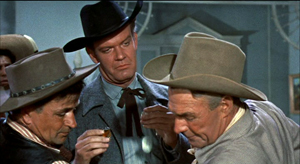
In the Genesis section already mentioned, Nemesis Burdette flips a coin into a spittoon, and He Who Is Called Dude, needing to buy drink, stoops to retrieve it from the rancid vessel.

Only the intervention of He Who Is Called Chance saves He Who Is Called Dude from this act of degradation. This passage has a parallel later in the Text, when another nemesis must fish a coin out of a spittoon.

The reversal in power is also a step in the redemption of He Who Is Called Dude.

But Adepts have noticed that in Decision at Sundown, a text attributed to one Budd Boetticher and dated 1957 (the Sacred Text we have is dated 1959), a sheriff refuses to accept the money of the protagonist and drops the coins into a spittoon.


Consider another passage in another Boetticher-signed text of the era, Buchanan Rides Alone (confirmed to be from 1958). Here the protagonist, prosaically named Buchanan, disarms a young gunslinger and drops the boy’s bullets into a spittoon.

The vessel, offscreen below frame, announces its presence by the tinkling sound made by the falling rounds.

Heretics have hinted at plagiarism, especially in the light of a reference in another text of the period, Ride Lonesome (dated February 1959, two months before the appearance of our Sacred Text). Here a nemesis tells of a poster “gun-tacked to every tree and stump (!) between here and Rio Bravo.”

While undeniably puzzling, these correspondences do not point to plagiarism. There may have been an earlier, Ur-version of our Sacred text, that has simply not survived. In moments like these we must put our faith in the Authors.


Recurring formulae

Finally, we must return to the Word. Seeker, Initiate, Adept, Exegete: All acknowledge the Text’s verbal echoes. As with Homer’s wine-dark sea and Vergil’s pious Aeneas, formulaic tags recur in our tale, but with more variation than in classic texts.

Our first business is business.

We have important business …. Me and my friend we make our business alone.

I’ll tell you what I’m a lot better at, Mr. Wheeler. That’s minding my own business.

I figure why is not my business./ You’ve got peculiar ways of choosing what is your business.

You think I’ll ever get to be sheriff?/ Not unless you mind your own business.

As if to signal to the devout the importance of every word, the Text provides its own meta-commentary. As a French exegete has said: “Discourse cleansing discourse, backchat ruling over chatter and chitchat.”

I’ll go outside so you can talk more freely.

I guess I talk too much.

He’ll keep talking till we get out of here.

Can’t you talk plainer than that?

Young Colorado says that Nemesis Nathan Burdett is “talking now” through the Deguelo tune./ I guess we made him talk after all.

Me, I just talk all the time./ You most certainly do./ You’ll get used to that. You’ll have to. Either that, or start talking to me.

Now I’m running out of breath. You talk if you want to.

Like all Sacred Texts, for all this talk of talk, this one knows that the ultimate truth lies beyond words.

Just stop talking. Just let it be.

Good advice.

Before I followed the Way, the spittoon was a spittoon. As I began to learn the Way, the spittoon was more than a spittoon. When I had learned the way, the spittoon was once again a spittoon.

Addendum 15 April 2012: This humble guide to the Text has aroused further passion among Exegetes. Three have pressed even more fiercely the Heresy of the Spittoon, claiming that it derives from a much more ancient text than the Boetticher-attributed ones mentioned above.


Antonio of the Red Palace writes:

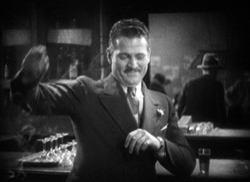
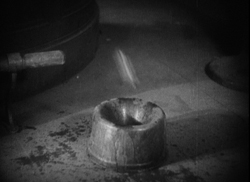
Regarding the scene involving the spittoon, I think it’s a shout-out to another one from Sternberg’s Underworld. You know, that one involving an equally “Borachone” character (Rolls Royce Wensel) being humiliated by “Buck” Mulligan. Interestingly, the “hero” (in this case Bull Weed) stands for the weak one. 

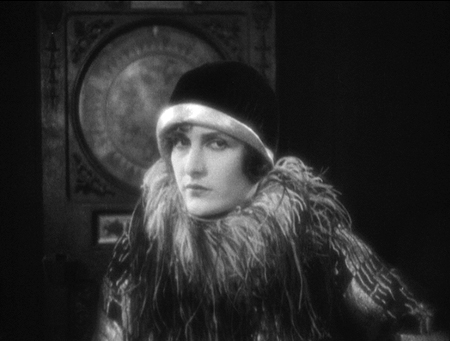
Even in both films, the female character is called Feathers. ¿ Coincidence? 

The Exegete declares a heartening willingness to believe, as all Seekers must, that There are no coincidences. From David Cairns, Sifu of Shadowplay, Exegete Extraordinaire of many other texts, comes further observations:

The spittoon . . . derives first from Sternberg’s Underworld, which also has a leading lady called Feathers. We do know that Sternberg and Hawks were (unlikely) friends and unofficial collaborators. Hawks claims to have suggested Dietrich’s tuxedo in Morocco, which, given his interest in androgyny, may be true.
Interesting that the scene made it out West and stayed there — I guess because the spittoon just seems to naturally belong there. But Sternberg’s version, in which a man tries to humiliated a drunk by throwing money in a spittoon, is closest of all spittoon scenes to the one in Rio Bravo. It’s also so close to Sterberg’s typical concerns that it must surely have either been devised by him, or else by Hawks in a spirit of “I bet he’ll love this…”

Like Antonio of the Red Palace, Shadowplay Sifu displays admirable historical awareness and interpretive ingenuity. But there is still room for disputation about sources and the path of influence. Here is Lea Jacobs of the School of the Badger to open another avenue:

The earliest version of the coin in the spittoon that I know is Underworld. Charles Furthman, brother of Jules [scribe who co-penned Rio Bravo], worked on the adaptation [of Underworld]. So I have always assumed the bit was “in the family.”

It is a measure of the spiritual power of the Sacred Text that it so stirs the imagination of the devout. And in truth, this scrolling blog’s little guide should have pointed out the strongest evidence for the Spittoon heresy (as well as the philological question of “Feathers”). These Exegetes are hereby thanked for extending the already vast commentary on the Text. But let us remember that the earlier text in question is regarded by many Adepts as itself derivative.

In Underworld, the nemesis who flings a ten-dollar bill into the spittoon is called “Buck” Mulligan–a transparent trace of literary lineage. For what readers text do not recognize the reference?

Stately, plump Buck Mulligan came from the stairhead, bearing a bowl of lather on which a mirror and a razor lay crossed.

Let us not forget that this literary “Buck Mulligan” has the proper first name Malachi, usually translated as “God’s messenger.” This surely changes our understanding of the blowhard who mockingly offers the ten-dollar bill to Rolls Royce; for he starts Rolls Royce on his path toward sobriety and self-respect.

For such reasons, Ulysses is most fruitfully read as a gloss on Underworld.

Nonetheless, consultation with wiser heads than this chronicler’s yields a change in the Canon. Henceforth the Heresy of the Spittoon will be known as the Cuspidor Crux.

Addendum 21 April 2012: Another Adept, Simone Starace, has disclosed more evidence for the Cuspidor Crux. She points to a passage in the secondary writ,  Joseph McBride, Hawks on Hawks (1982), p. 131:

JMB: There are several things in Rio Bravo that are similar to Underworld, which you and Furthman also helped write.

HH: I stole two things, the dollar in the spittoon and the girl’s name, Feathers.

Simone adds that on page 159, according to McBride’s filmography: “Hawks claimed to have contributed to the script of Underworld.” The palimpsest thickens.

David Bordwell
top of page

have comments about the state of this website? go here