Sunday | February 8, 2015
Kristin here:
We are happy to have a guest entry from our long-time friend and colleague, Leslie Midkiff DeBauche, who recently retired from teaching film at the University of Wisconsin–Stevens Point. Back in the 1990s, when David and I were helping edit a series called “Wisconsin Studies in Film” (University of Wisconsin Press), Leslie contributed Reel Patriotism: The Movies and World War I. Now she is involved in a fascinating project on the same period, the 1910s. There is much focus these days on reception studies, which focuses on trying to gauge the reactions of audiences to movies. Reconstructing mental events is a difficult, near impossible task. Yet Leslie has found a way to glimpse the ways in which American girls and young ladies of decades ago consumed and thought about movies: by studying the scrapbooks they left behind. Here’s a sample of what she has discovered.
Fangirls of yesteryear
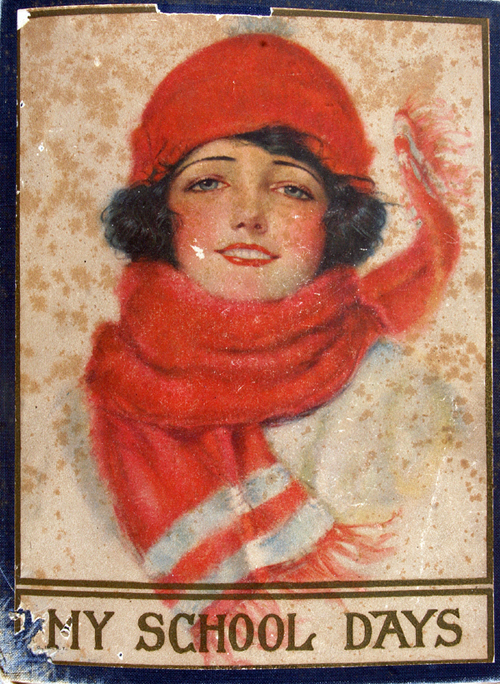
Kate Key received a scrapbook bound in red leather and entitled My Commencement as a gift from her oldest sister Ruth when she graduated from Lampasas High School, class of 1917.
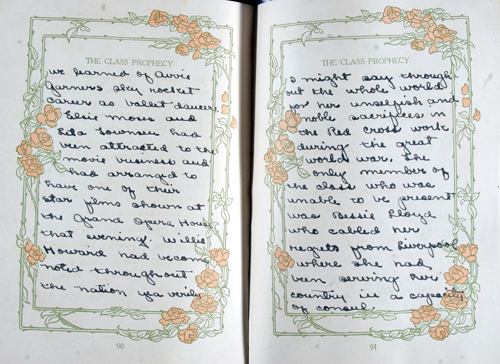
She was eighteen, born and raised in this central Texas farming and ranching community of about 2,100. As far as I can tell, there were no dedicated film theatres in town. Instead, movies alternated with concerts, vaudeville and plays on the bill at the Witcher Opera House. So, I was surprised to read in her class prophecy (a humorous forecast of what the students would be doing in a fictive future) that Elsie Moses and Leta Townsen would return for their class’s reunion in 1928 as movie stars and graciously show their films at the Grand Opera House.
This caused me to wonder whether girls who lived in other parts of the United States also made jokes out of the movies? Might scrapbooks offer film historians like me, interested in the ways that films fit into the lives of everyday people, a new sort of evidence of exhibition and reception in the 1910s and 1920s? When girls mentioned movies in their scrapbooks, or pasted in ticket stubs and theater programs, did they whisper “open sesame” to a quotidian film culture? Was that culture different from and more pervasive than that practiced by fangirls (and boys) who avidly consumed Photoplay and wrote mash notes to their favorite actors? I began to search out scrapbooks, specifically high school and college memory books.
To date, I have collected upwards of 45 scrapbooks. The scrapbooks I have found and studied are mainly the products of white, middle class and upper middle class girls. I have an example or two at either end of the economic spectrum. Despite my best efforts, I have had no luck so far finding the memory books made by African-American teenagers, though I suspect these exist. (I would welcome any suggestions.) New immigrants to the country may not have been aware of this “tradition.”
Before I survey what I have learned from American girls about themselves and about movie-going, let me tell you a bit about scrapbooks.
Multi-purpose compendiums
They have a long history in the United States. Samuel L. Clemons, Mark Twain himself, was an avid scrapbook-maker, and he patented a model featuring self-adhesive pages in 1873. By 1880, how-to books like E.W. Gurley’s Scrapbooks and How to Make Them, Containing Full Instructions for Making a Complete and Systematic Set of Useful Books, guided novices with instructions for what to include and even recipes for the glue to stick objects in place.
Arranged by topic and indexed for efficient access, early scrapbooks consolidated recipes for food or household concoctions. They served as encyclopedias and also provided entertainment. Poetry and fiction were appropriate inclusions harking back to the days of commonplace books. The scrapbook became a means for autobiography and a method of keeping family history. Gurley promoted making scrapbooks both an individual and a collective endeavor. Neighborhoods might organize a scrap-book club, and families could draw on the help of relatives to fill the gaps in their chronicles by bringing their books to reunions. For example, in 1906, Marion Renfrew, a school girl in Boston, invited her friend Eva Alberta Mooar to a party celebrating the “debut” of the “offspring of her labor and patience Memory Book.” Eva saved that letter in her own scrapbook, and the Arthur and Elizabeth Schlesinger Library on the History of Women in America at Radcliffe preserved Mooar’s book in its archive.
Marketing scrapbooks to girls
Girls were a devoted audience for advice about creating scrapbooks, and the activity became, increasingly, a gendered one. By 1905, scrapbooks were a commodity, mass produced, sold at stationery shops, and complemented by auxiliary 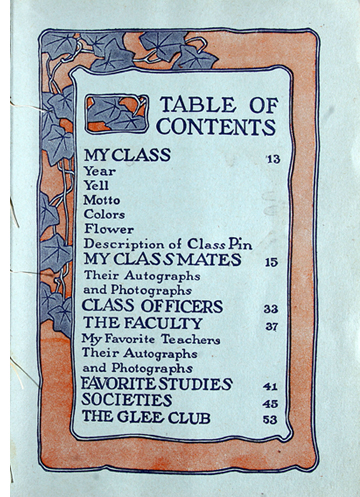 businesses which supported them. Companies manufactured specialty paper corners, some with elaborate designs for sticking photographs to the scrapbook page. One genre of scrapbook was the memory book designed mostly for girls and young women and given to them as presents on special occasions like graduation from high school or college. businesses which supported them. Companies manufactured specialty paper corners, some with elaborate designs for sticking photographs to the scrapbook page. One genre of scrapbook was the memory book designed mostly for girls and young women and given to them as presents on special occasions like graduation from high school or college.
The Reilly & Britton Company offered eight different titles of school memory books for sale by 1917. The price of these gift books depended on their binding; “Fancy cloth, decorated with gold and two colors,” cost two dollars (about $40 today), but a leather cover with a velvety finish called ooze, added an extra dollar and twenty-five cents.
A blank page might have invited girls to fill in stuff of their choosing, but flowery Art Nouveau borders pushed the design toward a notion of conventional, appropriate girlhood. The filled spaces also conjured the metaphor that school was a garden, carefully tended, its flowers growing in tidy uniform beds. Memory books featured standard tables of contents that suggested what girls should preserve and how their mementos ought to be arranged. However helpfully intended, these headings also functioned to delimit what high school included and to prompt girls to tell a cheery, triumphal story in which “favorite” teachers, “best friends,” all sorts of parties, athletic endeavors, and the rituals of graduation would lead ineluctably to the happy reunion foretold by the class prophecy.
Still, what I have come to relish about girls who made scrapbooks is that they did not necessarily abide by the dictates of their books’ blueprints. They surely recognized the ideological requisites of girlhood structured onto memory book pages, but they may not have entirely subscribed to them. Often and idiosyncratically, girls changed and adapted their books.
Girls make scrapbooks to suit themselves
Elizabeth Walker travelled more than one hundred miles from Mineola, Texas to attend the College of Industrial Arts at Denton in 1918. She seemed to embrace the process of compiling My Memory Book. Hers was larger than most: 15” wide, 11” tall, and 2 ¼” thick. It appears that she received it when she matriculated and she filled in the pages as she progressed through her four years of teacher-training. After Elizabeth graduated in 1922, she became a teacher in El Paso. She continued to slide letters, documents including the Code of Ethics for Texas teachers and newspaper clippings, inside the back cover of her book during the 1930s. The most recent insertion was dated 15 July 1969. It was snipped from the school’s (now Texas 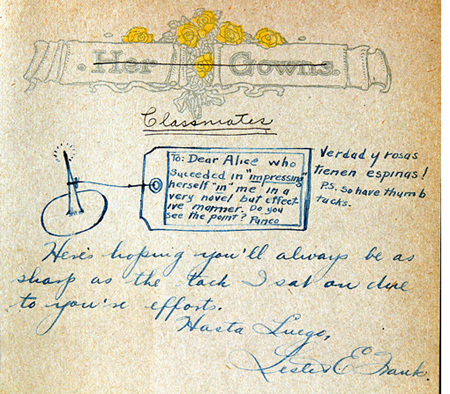 Women’s University) alumnae bulletin and brought her up-to-date on members of the class of ’22. Women’s University) alumnae bulletin and brought her up-to-date on members of the class of ’22.
Still, at the beginning, the freshman Elizabeth had composed a bantering dialogue with her memory book’s table of contents. She treated it as a slightly irritating senior who was trying to tell her how to act. For instance, halfway down the list of things she was supposed to save were pressed flowers and leaves. “Don’t believe in ‘em,” retorted Betty.
Alice Ebeling graduated in 1919 from South Bend High School in Indiana. She drew a line through the heading “Her Gowns,” replaced it with “Classmates,” and used the pages for autographs from her friends including Lester Frank (left). Apparently, he was on the receiving end of a prank she played in Spanish class.
Corinne Campau, Sophie B. Wright High School, New Orleans, class of 1919, crossed out “Favorite Studies” and pasted in a drawing of a rotund store clerk resembling the Campbell Soup kids drawn by Grace Drayton. Even better, the illustration covered up rude comments Corinne had written about a first-aid class and its annoying, irrelevant, teacher: “IT’S a joke. (‘Girls, I heard a case of a beautiful young woman—Oh, a sweet lovely young woman who fell on a brick + broke her hip.’)”
To me, there is irony, if not a nervous, dark humor in the decision of Fannie Klapman (Murray F. Tuley High School, Chicago, 1920) to glue a little cloth envelope embroidered with flowers on the page designated for “Card Parties.” The description she wrote underneath said, “New Year’s card from my brother at that time in France.” (He mustered out safely and went on to graduate from Crane Junior College in 1920.)
As well as manifesting a playful irreverence, the ways that girls altered memory books testified to a belief in their own agency. Scrapbooks were not private or secret like diaries. Girls took them to school where they solicited classmates’ autographs and good wishes; they showed them to friends who visited their homes. Although I expect many girls started to compile their memory books by following the order set out in tables of contents, when that rubric didn’t accommodate their stuff or their lives, they deliberately, messily, and with the knowledge that their actions would be seen, took matters into their own hands. They also began to make changes in the history of their lives at school almost as soon as they pasted their stuff in place. Memory books, like memory itself, were changeable, dynamic.
Movies and American girls
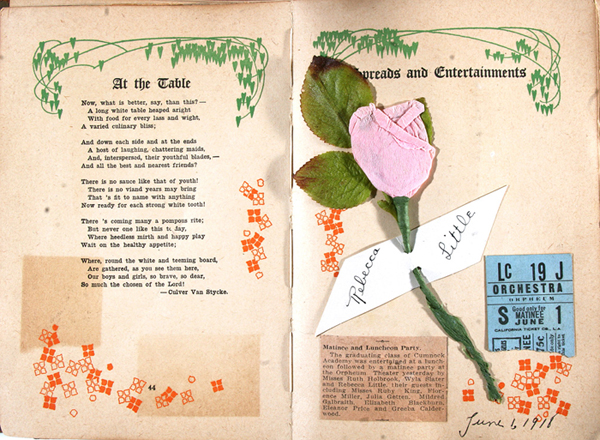
Since none of the books I have examined contain designated pages for films, how did American girls fit movie scraps into their memory books? When I consider my collection of artifacts, two broad patterns hold.
First, girls saved ephemera including ticket stubs, programs, occasionally newspaper advertisements that proved they actually saw films. (Above, Rebecca Little’s scrapbook from 1918.) I’ll call this category “Girls Go to the Movies.”
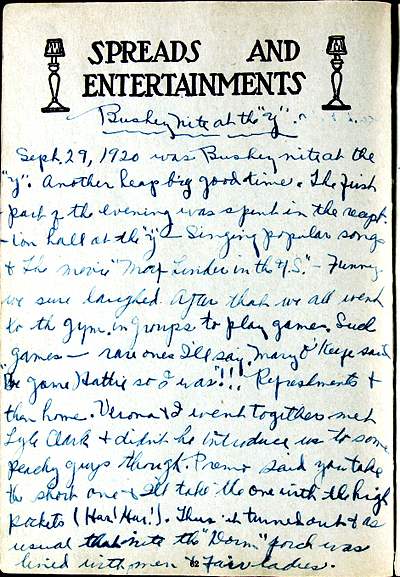
Second, and more intriguing, scrapbooks are crammed full of evidence that girls incorporated the movies–their actors, narrative conventions, and film titles—into a vernacular culture, national in its scope, spanning different religious affiliations. (Above, Hattie Stein’s School Friendship Book describes how she and her friends saw a Max Linder movie at the YMCA in Appleton, Wisconsin.) Let’s name this second motif, “Girls Make Fun with Movies.”
Girls go to the movies
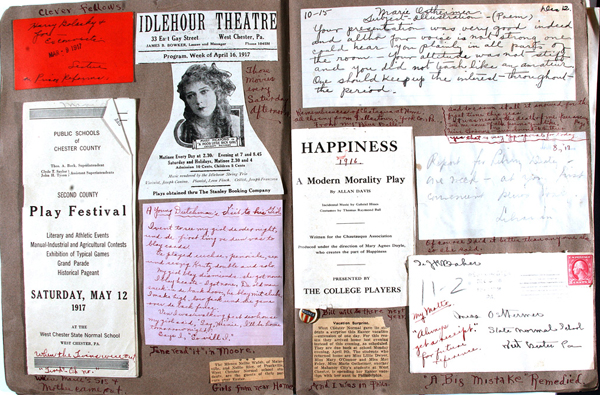
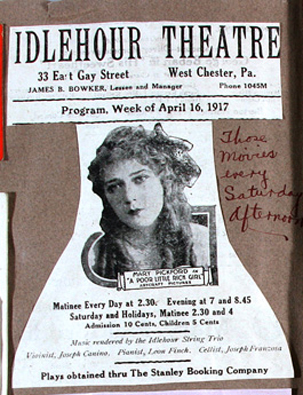
Scrapbooks show that movie-going was one activity among many that mattered to girls in the 1910s and 1920s. No one expressed this better than did Marie Ostheimer, who graduated from West Chester Normal School in southeastern Pennsylvania in 1917. The only mention of film in the thirty-six pages of her Normal Life is the Liberty Bell-shaped newspaper ad for The Poor Little Rich Girl at the Idlehour Theatre which she clipped out (see bottom image). Nevertheless, she captioned it “Those movies every Saturday afternoon.” Her annotated two-page spread surrounds Little Mary with play programs, an excellent evaluation she received for a class presentation, news cuttings about her own and her friends’ trips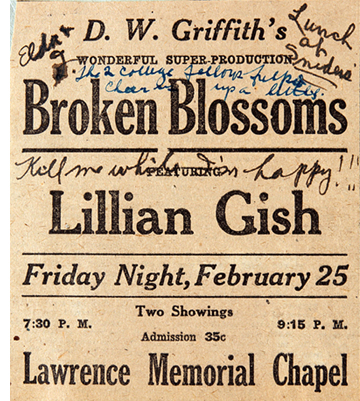 home, and a receipt that was evidence of some sort of kerfuffle over a doctor’s bill. It is a snapshot of learning, leisure, and life experiences among which going to the picture show was part of the routine of weekend fun. home, and a receipt that was evidence of some sort of kerfuffle over a doctor’s bill. It is a snapshot of learning, leisure, and life experiences among which going to the picture show was part of the routine of weekend fun.
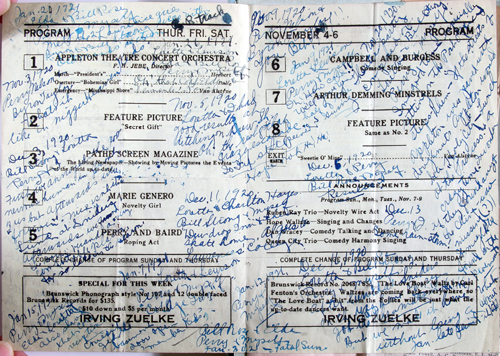
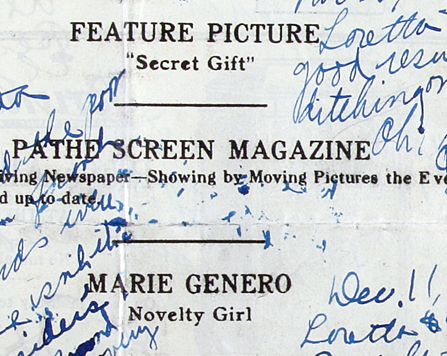
When girls did go to the movies with friends—which always seems to be the case—the screening was only one feature of the afternoon or evening’s or weekend’s entertainment. Case in point: Hattie Selma Stein, Busheys Business Academy, Appleton, WI, 1921-1922. She used a vaudeville program (above, the film Secret Gift is the 2nd turn and the chaser) to record the movies she attended during her year at school. Hattie jotted down the names of her companions, what the weather was like, how they “annoyed” the “nervous humans” seated in front of them, where they had snacks afterwards, and whether she and her boyfriend Perry won the race to the dorm’s porch swing at the end of the evening.
She didn’t always name the movie that served as the pretext for the date. Neglecting to note the film’s title wasn’t unusual in the scrapbooks I’ve examined. Instead, what girls saved was their experience of going to the movies.
For both Hester Swan from Independence, Missouri, class of 1919, and Janet Seidenman, who graduated from Western High School in Baltimore in 1926, food made an evening with friends and films tasty–an adjective which, at the time, meant not only yummy but also “in conformity with good taste.” Swan and twenty others attended a “line party,” featuring Marguerite Clark starring in Mrs. Wiggs of the Cabbage Patch. “After the show Grape Sherbert and Cake were served. We all had a lovely time and enjoyed the show and refreshments immensely.” In a page of her scrapbook, Seidenman drew an arrow from a caption “Richard Barthlemess [sic] in ‘The Fighting Blade.’ Peanut chews were served and everybody was happy,” to her admission ticket, which she also festooned with an inch-long strip of Kodak film negative.
Every so often, though, going to the movies was a special occasion. Girls responded to promotional hype surrounding roadshows. When they saved movie programs, it was invariably from “big” films shown at a theaters which usually presented plays, for instance, the Majestic Theatre in Boston or the Savoy in San Francisco, or motion pictures made on the grand scale by D.W. Griffith. Hattie Stein captioned the ad for Broken Blossoms (right) showing at the Lawrence University Chapel, “Kill Me While I’m Happy.” She also noted that two “college fellows” were on hand to cheer her up and, of course, there was “lunch,” a colloquialism for snacks, at Sniders afterwards.
Girls make fun with movies
Girls did much so more than purchase tickets, sit in theaters, and watch movies before munching on peanut chews. Memory books show that girls around the United States incorporated the movies into their own playful culture. Certainly this is evidence that by the mid-teens, Americans were widely and deeply aware of information about movie stars, narrative conventions, movie-making itself, and the nuts and bolts of film exhibition. I think it’s also akin to the ways girls exercised control over their scrapbooks. When they used movies to make jokes, girls inflected the tone of the film industry’s advertising and narrative messages. They impressed their own proclivities onto increasingly standardized fare. The graduation convention of the class prophecy is a good place to start to see how girls adapted and used the movies for their own purposes.
So you want to be in pictures?
Class prophecies were an American school graduation tradition at least through the 1960s when I completed junior high. They were intended to be light-hearted, funny predictions about the future lives of the members of the class. Prophecies were guided by certain conventions of the form. They were often read publicly during graduation festivities, and it was not unusual to find pages designated for the class prophecy in memory books. Sometimes a prediction hinged on the student’s traits, interests, or romantic inclinations; it could hinge on word play about their name. It was important that the audience got the joke, or most of the jokes.
In nearly every class prophecy I encountered written from 1917 onward, at least one student was proclaimed to be destined for a job in the film industry. The most elaborate example lodged in Bertha Glennon’s memory book. Glennon graduated in 1918 from high school in Stevens Point, WI, the small city where I live. In fact, she was the author of her class’s prophecy and it was also her honor to read it aloud at Class Day a few days before the more formal graduation exercises. (She wore a dress of old-rose colored voile for the occasion.) The rhetorical device she created to frame her story was personal, timely, and more than a little macabre. The United States had entered World War I in April of Bertha’s junior year, and she had done her bit by helping to supervise in the Red Cross Room at school where students rolled bandages.
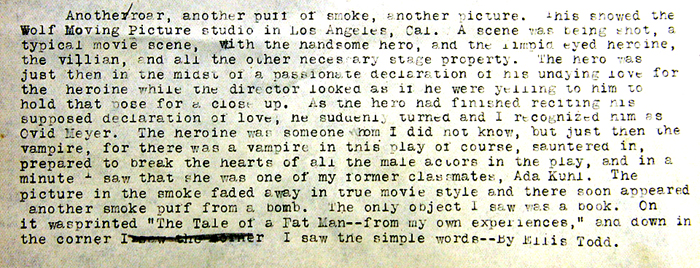
In the class prophecy, Glennon imagined herself as a nurse taking a break from her duties in a hospital on the western front. She sat on a hill and watched bombs explode in the distance. In each burst of smoke, Bertha saw a vision of the future. Boom! As the dusty haze resolved into an image, she identified classmates Ovid Meyer and Ada Kuhl in the midst of shooting a scene for a movie melodrama. Bertha Glennon described mise-en-scene, cinematography, and editing in sharp detail.
Glennon also wrote a diary that documented what she did every day during 1918, so, I know that in the five months leading up to her graduation she went to the movies fifteen times. Once she went on her birthday, another time because she didn’t have a date to the prom. She also recorded once when she went with her mother to visit a sick uncle. At his house she found a movie magazine which she read to pass the time while the grown-ups chatted. Bertha Glennon may have been a little better informed than most of my scrapbook girls, but she was not movie-mad.
Most often in class prophecies, girls were cast as movie stars. Dewene Flynt, Elizabeth Walker’s classmate at Mineola High School (1918) was sure to work for the American Motion Picture Co. and Adelheit M.W. Dettmann of Atlantic, Iowa (1918) was destined to be “Charles Chaplin’s leading lady.” After graduating in 1919 from Sophie B. Wright high school in New Orleans, Elizabeth Wakeman “will play piano at a moving picture show.”
“My Ambitions”
As you might guess, in real-life 1910s and 1920s America, relatively few girls made the transit from the high school auditorium to the movie studio, not even Rebecca Little who graduated from the Cumnock Academy in Los Angeles in 1918. (Martha Graham danced at the May Day celebration at her school that year.) Yet among the young women I have met in these books, one did actually become an actress: on the stage in the 1920s, on the radio in the 1930s, in the movies in the 1940s and 1950s, and on television in the 1950s and 1960s. She also wrote a novel, under the pseudonym Xanthippe, which was adapted into a film. Edith Meiser who graduated from the Liggett School in Detroit in 1917 is the exception that proves the rule. She was extraordinary.
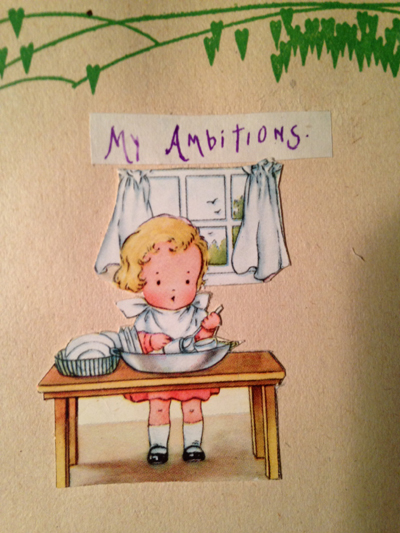
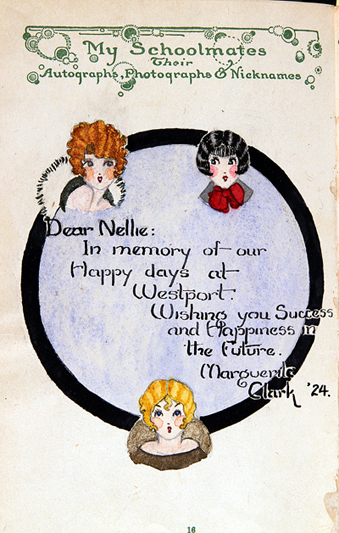
In fact, the hopes girls had for themselves and the wishes they made for others, were, in the main, conventional: success, happiness, good luck, and marriage. In a cartoon of a schoolgirl dreaming of her future, Sylvia Seidenman (Western High School, Baltimore, 1917) might have chosen the nurse with a hypodermic needle, a mother, a scholar, a ballet dancer, or a teacher with a ruler in her hand. Sylvia drew an arrow pointing at the typist, noting “This for me.” Edna Kallberg (Central High, Minneapolis, 1921) cut out and glued down a fat-cheeked toddler washing dishes (below left). “My Ambitions” was the heading which she affixed like a valance above the illustration. Nellie McKeever, from Westport High School, in Kansas City, Missouri (1924) had more talented friends and teachers than most girls did, but the same sentiments abide in their art and calligraphy (below right).
Girls didn’t make jokes with the movies when they autographed each other’s books; they wrote cautionary rhymes. “Long may you live; happy may you tarry, Court whom you please, but mind whom you marry.” (Mollie Winer warned Mary Louise Howell, Commercial High School, Atlanta, 1918.)
Some alluded to infamous moments in classes. Nearly always, they expressed the desire to be remembered. As Beatrice B. requested of Dolly Bennett (Houghton High School, Houghton, Michigan, 1921) “In the wood-box of your memory, save a little stick for me.”
The differences between the humorous fortunes cast for girls in class prophecies and the sincere but commonplace wishes one girl offered to another show that they fully understood a paradox at the heart of the popularity the film industry enjoyed with the American public. The stuff of the movies–its stars and its stories–must be both fanciful and familiar, provocative enough to pique the imagination, but also secure, a safe playground for parody. The industry provided fodder for jokes, whether it meant to or not.
Starring Lydia Kahn, Baby Vampire
I will close this post with one last example of how girls employed the movies for their own amusement, to their own ends. The society these scrapbook girls lived in valued “correctness” in dress, speech, and behavior. Girls realized there were consequences—in life as well as in fiction–for not minding their Ps and Qs. As my grandmother Kate Key might have said, they knew “straight-up.” But, propriety did not stop girls from making fun of the rules governing them as young women, and movies gave them the ingredients for jokes.
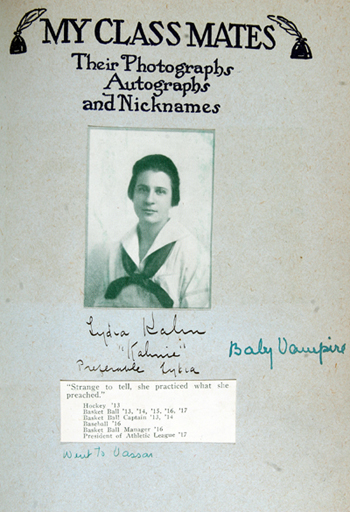
Let me introduce Lydia Kahn, “Baby Vampire.” Vampire? The reference is to the character—a woman who destroyed men—made most famous by Theda Bara when she starred in the 1915 film, A Fool There Was. It was based on an 1897 Burne-Jones painting which inspired Kipling’s poem as well as both a play and a novel by Porter Emerson Browne. The movie coined the noun vamp and the verb to vamp. It also sparked jokes among young people all over the United States.
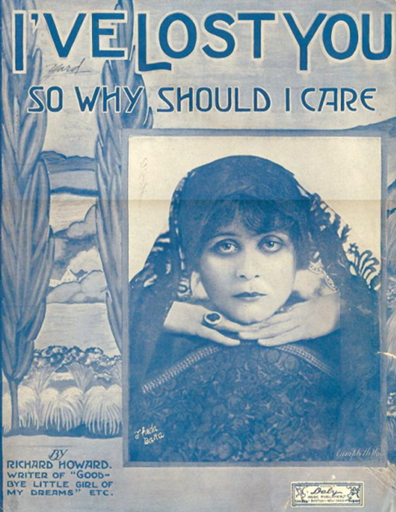
Kahn, the daughter of architect Albert Kahn, was memorialized as a vampire in Helen Schloss’s memory book. The girls were part of a remarkable class of upper and upper-middle class young women, including actress Edith Meiser, who graduated from the Liggett School in Detroit in 1917. The in-joke linking Lydia Kahn to Theda Bara was doubly made. First, there was the epithet Schloss scrawled next to her name. “Baby” in this context means vamp-in-training. Second, I found an allusion to Kahn as Bara in an issue of a little newspaper–more tongue-in-cheek than hard news–that the Liggett girls published their senior year. In a column headed “Heard at Grinnell’s” (a music store in downtown Detroit), one joke referenced a song, “’I’ve Lost Him so Why Should I Cry?’ which paraphrased the actual, “I’ve Lost You So Why Should I Care.” The titular question was attributed to “Kahnie,” which was Lydia’s nickname.
The sheet music portrayed Theda Bara—dressed, I think, for her role in Carmen (1915). Was Kahn a flirt? Had she broken up with some boy? Or, he with her? Was the question in the title ironic? Maybe Lydia Kahn was the opposite of a vamp but she bore a physical resemblance to Bara; perhaps Lydia Kahn did a great imitation of Theda Bara.
We’ll never know exactly why this joke worked so well that Helen Schloss transposed it from the Cap and Gown to her School Friendship Book, but my scrapbook collection can provide a context for interpretation. It turns out that Theda Bara’s vamp is the most common reference to the movies in memory books.
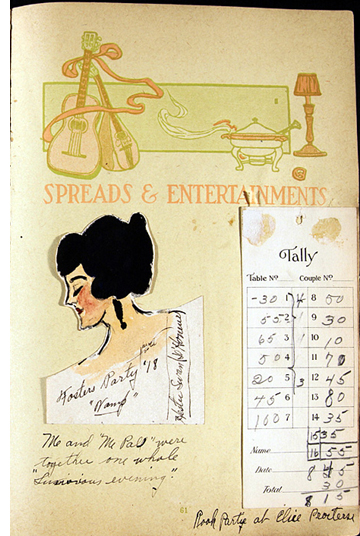
Lydia Kahn wasn’t alone, even in Schloss’s memory book, where Lucile Boynton was available to give lessons in vamping, “Efficiency guaranteed in three easy lessons. Prices reasonable.” Hester Swan’s place card at the Foster’s party (below left) read “Vamp” and pictured dangling earrings and a sophisticated demeanor. Although I expect this evening in Independence, Missouri was innocent, Swan wanted to remember that “Me and ‘My Pal’ were together one whole ‘Luxurious evening.’”
 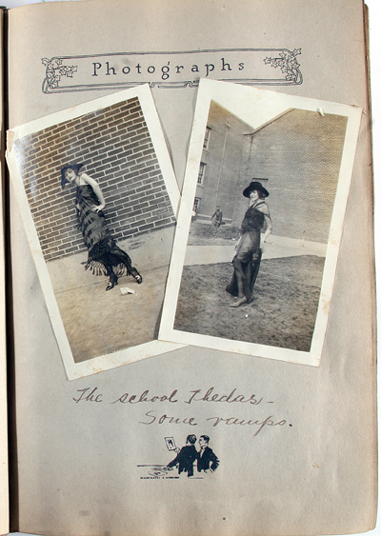
The prophecy for the Sophie B. Wright high school of 1919 foretold how Corinne Campau’s good friend Louisiana Clayton would depose Theda Bara as queen of the vamps after she graduated. This joke may have begun at the fashion show the seniors had hosted for the school’s junior class. Under snapshots of Lou dressed as the “Futurist,” and Aline Richter as “Hobble-Skirt Girl,” Corinne renamed them: “The school Thedas—Some Vamps” (above right). Everything about Lou screamed vamp: her outré costume, the slouchy, hand-on-hip pose, her dark-colored lips. There was another photo on the following page of Corinne’s memory book: here the school Theda is surrounded by classmates costumed as men–some kneeling, others leaning in–as Lou, blasé, looks off the right.
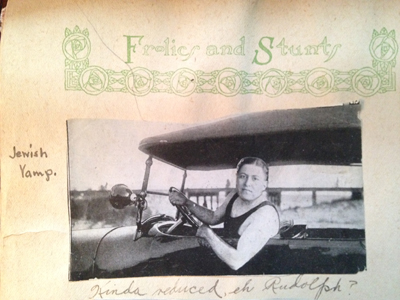
Even boys were liable to be called “Theda” or to be teased as vamps. Adele Franz seems to be recounting an embarrassing moment glimpsed in a boat house when she noted that Alfred J. Peterson, “alias Theda” would star in a production of “As the Lord Made Him.” And, Fannie Klapman printed “Jewish Vamp” beside a collage she had made by gluing the cut-out head of one of her male classmates onto the buff torso of a guy wearing a swim suit sitting at the wheel of an auto (below left ). To amplify the incongruity, underneath the picture she wrote, “Kinda reduced, eh Rudolph?” This might also be early evidence of Valentino’s star persona. No one in Fannie’s class was named Rudolph.
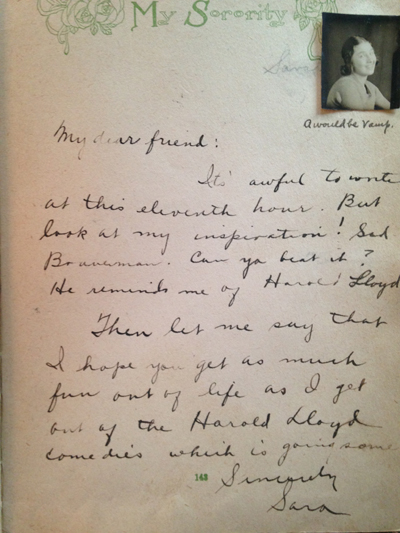
Klapman also commented upon other autographs friends wrote in her memory book. Next to a picture of Sara, who made an analogy between her own good wishes for the graduate and her love of Harold Lloyd, Fannie, somewhat cattily, I think, adds the annotation, “A would be vamp” (below right).
Hattie Stein and her girlfriends in Appleton, Wisconsin wore out the verb, vamping their way throughout their school year in 1920-1921.
What ought we to make of so many Thedas and so much vamping? I’m not entirely sure. If this is an example of an early 20th century meme, then Theda Bara and the vampire she portrayed function to throw conventional femininity and social mores into high relief. Bara was unambiguously evil in A Fool There Was. Girls (and boys) recognized this and camped her up even more. Girls could play dress-up and pretend to be bad—the better they were at the game, the clearer it was that they knew the rules of correctness. When I look at the references to Bara and vamping chronologically (and I surely wish I had more examples from 1915 and 1916), I detect a change. In the earliest mentions, there are connotations of physically sexuality (as with poor, perhaps naked, Alfred Peterson) and an imperious woman (hear the disdainful tone of “I Lost Him So Why Should I Cry” and imagine the smug look on Lou Clayton’s face as she ignores her admirers). By the early 1920s though, it seems to me that all menace has drained from verb and it simply means to flirt.
While there is more to tell about American girls, their memory books, and the movies, I must stop here. For readers who have watched and thought about American silent film or have studied its history, I hope that my research has added to your store. If you are interested in women’s history, I trust the scraps which illustrate this piece have reinforced what you know and have piqued your curiosity. I have grown inordinately fond of many of these girls and fascinated by their doings. My search for memory books continues; they are a rich resource for historians. They are exuberant, charming, funny, sometimes poignant and sad. They bear witness to how girls lived their everyday lives, what possibilities they were able to imagine for themselves, and the ways that movies fit into both these spheres.
I would like to thank David and Kristin for inviting me to share my work with you. It is a huge honor. I would also like to thank Doug Moore for shooting most of my photographs, and Sally Key DeBauche for casting her professional archivist’s eye on my scrapbooks and helping me to think about them as a collection.
Posted in Fans and fandom, Film history, Silent film |  open printable version
| No Comments » open printable version
| No Comments »
Sunday | February 1, 2015
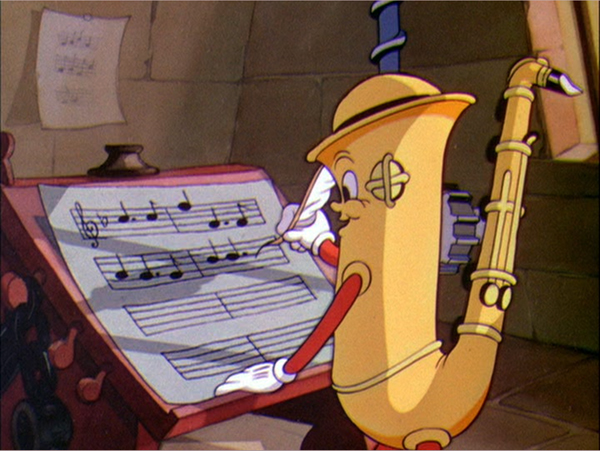
Music Land (Disney, 1935).
DB here:
“The great directors, I’ve learned, have a great sense of rhythm.” So says Alexandre Desplat, who’s again earned two Oscar nominations in the same year (for The Imitation Game and The Grand Budapest Hotel). The statement sounds true but vague. Musicians and musicologists have a firm sense of what the term rhythm means, but how can we understand it in relation to movies?
Well, surely it refers, at least, to the rhythm of the music we hear in the film. But we usually think there’s more involved. There’s rhythm in the movement on the screen. The people and things we see can be infused with a beat and tempo and pace. (Critics of the 1920s considered Chaplin a dancer, like Nijinsky.) There’s a rhythm to the combination of images too, as everybody who’s tried film editing knows. And we think that the story can be told in a way that has a distinctive pace–narrative rhythm, we sometimes call it. But how do these components work together to create an overall rhythm for the film?
When synchronized sound recording entered movies, critics and filmmakers worried a lot about this problem. Filmmakers who had mastered visual storytelling in the silent era had to figure out how to merge spoken language, music, and sound effects with the flow of images. The lazy solution was simply to shoot plays, filling the scenes with dialogue. But both audiences and critics missed the dynamism of silent films. Talkies were too talky.
The opposite solution, to eliminate words as much as possible and simply use music and sound effects, was of limited value. After all, silent film needed the written language of intertitles to make the story clear; why give up the advantages of spoken language? But how then to integrate image and sound into something that engaged the audience–not only through the film’s story but also, perhaps more deeply, through that elusive quality called rhythm?
Today this debate may seem sterile. We think filmmakers have solved the problem. Maybe they have, collectively, but each one faces it at every moment. How do you blend movement, music, pictorial composition, sound effects, and dialogue to create an overall pace that will benefit your movie? No single recipe will work. The rhythm of the Coen brothers’ Raising Arizona is very different from that of No Country for Old Men. Both Gone Girl and Non-Stop are thrillers, but Fincher’s pacing is far more deliberate and understated than Collet-Serra’s; yet both take hold of us.
Filmmakers solve the problem of rhythm in practice, often brilliantly. Those of us who want to understand how films work, and work upon us, want to get specific and explicit. What is this thing called cinematic rhythm? What contributes to it? Can we analyze it and explain its grip? Very few scholars have tackled these questions; they’re hard. In her new book, Film Rhythm after Sound: Technology, Music, and Performance, our friend and colleague Lea Jacobs takes us quite a ways toward some answers.
Mickey-mousing redux
Lea starts from the assumption that the debates of the early 1930s are still relevant. So she looks at some much-praised examples of sound/image integration: the musicals of Mamoulian and Lubitsch and the cartoons from the Disney studio. She studies these paradigm cases more closely than anyone has before. She also goes beyond them to consider the theory and practice of Eisenstein (a big admirer of Disney) and the handling of dialogue in Howard Hawks’ work from The Dawn Patrol (1930) to Twentieth Century (1934).
Central to Lea’s inquiry is the notion of synchronization. How can distinct moments in the image flow, the sound flow, and the narrative action be pinched together, like the toothpick pinning the ingredients in a sandwich? One answer is to rehabilitate the old idea of mickey-mousing. Mickey-mousing makes the patterning of the sound match, in some way, the pattern of onscreen action. Mickey-mousing has had a bad press, but Lea shows that if we look at it afresh, it offer a solid point of departure for thinking about rhythm.
Eisenstein develops the idea of sync, in a fresh but still general way, in his notion of “brickwork” structure–the non-coincidence of image and sound, like the staggered array of bricks in a wall. That is, your cut shouldn’t come on the beat (are you listening, music-video directors?). Save your sync until it can have maximum impact, ideally through accenting some action in the image and maybe a high point in your drama. This is a step beyond the duality synchronous/asynchronous sound that was floated in the early 1930s. Eisenstein shows how all the different lines of pictorial and auditory movement can be woven in a flow that will create various degrees of emphasis. In this “wickerwork” pattern (another of his metaphors), actor movement might coincide with a melodic run rather than a beat, and the cut might accentuate a line of dialogue while the music subsides. Or instead of Hollywood’s underscoring, the music might be abnormally loud, doubling and clashing with dialogue in a “Godardian” manner. At certain moments, several accents in these lines could hit simultaneously. Just as important are the moments when the imagery and the mix get thinned out so that a single element–a word, a chord, a gesture–is isolated.
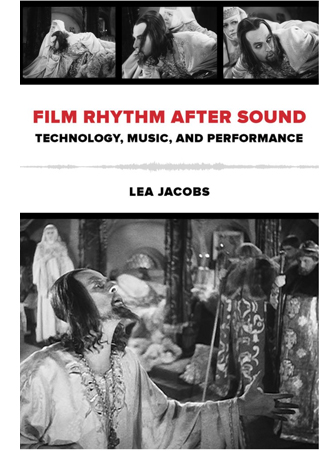 The key example comes from Ivan the Terrible, Part I, in which the ailing tsar asks the Boyars to kiss the cross in allegiance to his baby son Dmitri. In unprecedented detail, Lea tracks how the melody, meter, motifs, orchestration, and dynamics of the music fluctuate in relation to staging, line readings, and narrative developments. In a passage lasting only six minutes, she shows how–as so often happens–Eisenstein’s practice outruns his theory and creates a rich audiovisual texture at an almost microscopic level. The key example comes from Ivan the Terrible, Part I, in which the ailing tsar asks the Boyars to kiss the cross in allegiance to his baby son Dmitri. In unprecedented detail, Lea tracks how the melody, meter, motifs, orchestration, and dynamics of the music fluctuate in relation to staging, line readings, and narrative developments. In a passage lasting only six minutes, she shows how–as so often happens–Eisenstein’s practice outruns his theory and creates a rich audiovisual texture at an almost microscopic level.
Rhythm is constructed frame to frame, sync point to sync point, and involves very small durations of a half second or a quarter second. This proposition may seem obvious to anyone who has been involved in editing or scoring film music. Classical Hollywood click tracks measured tempi to fractions of a frame, as defined by the sprocket holes, and there are clear indications that composers and editors haggled over durations of five or six frames.
This urge to “think small” and study the finest grain of image and sound carries through Lea’s analysis of rhythm in Disney cartoons. Some have accused Eisenstein’s Ivan of being a live-action cartoon, and there’s no hiding either the old man’s admiration for Disney or his belief that cinema was capable of highly “engineered” effects. Still, music and its mickey-mousing possibilities determine animated films even more strongly than live-action ones. Lea takes Disney’s early sound films as experiments in synchronization.
Early sound cartoons are sometimes characterized as “prisoners of the beat” because they create cycles of motion that are lined up with the musical meter. Lea traces how Disney animation became more fluid and flexible, syncing more around sound events than around rigid beats. She illustrates her case with analyses of Hell’s Bells (1929), The Three Little Pigs (1933), and Playful Pluto (1934). The last two are widely regarded as classic Silly Symphonies, and she sheds fresh light on them through the sort of micro-analysis brought to bear on Ivan.
She shows how sections gain a fast or slow tempo through the interaction of many factors, of which shot length is only one. In particular, Disney directors could change pace through a tool that Eisenstein didn’t have: altering the frame rate of animation. Normal animation is “on twos”; each drawn frame is photographed twice, to last for two film frames. Many stretches of the Disney cartoons are on twos, but sometimes, to create vivid sync points, the filmmakers go “on ones,” allotting one frame for each drawing. This is more expensive and time-consuming, but it allows for the sort of fine control of pace that we find in The Three Little Pigs. There the Wolf launches into “a jazzy, up-tempo gallop” that accelerates the danger bearing down on the pigs. In a similar way, Playful Pluto creates variety by “matching movement to different fractions of the beat and establishing differential rates of movement within the shot.” Imagineering, for sure.
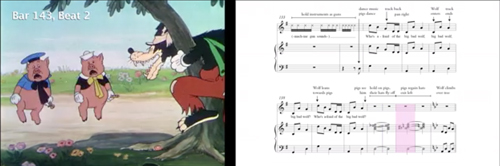
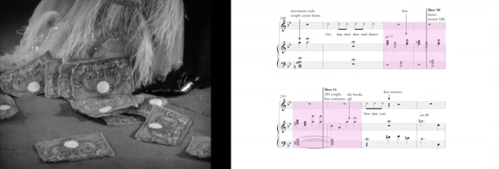
How to convey this fine-grained analysis on the page? Lea uses the familiar tactics of presentation: verbal description, musical scores, and frame enlargements. But she goes farther. At great effort and expense, she has constructed analyses of key passages as video clips, with the film scene running in interlock with a highlighting bar that shifts across the score. Annotations on the score mark actions and sync points. These analyses are designed to be watched as you read along in the book. You’ll see some frame grabs in this entry, but to watch them simply go here, select the Audio/Video tab, and choose what you want to see from the menu. This is a real step forward for film scholarship, and the University of California Press should be congratulated for helping her take it. Why shouldn’t every film book hereafter come garlanded with clips?
No age for rhythm
Monte Carlo (1930).
Okay, you might say. Rhythm is of concern to top-down audiovisual masters like Eisenstein and Disney. But there are other notions of film as art–for instance, that performance is central to its storytelling. Lea shows that, again, early sound film explored a more open and porous integration of music and image. Ernst Lubitsch, as Kristin has shown, was one of the masters of image-based cinema in the silent era. Yet as soon as sound came in, he was exploring how to blend music with the mercurial repartee and attitudes of his sophisticated characters. Rouben Mamoulian, who had indulged in sync experiments in the theatre, contributed as well to a broader trend that gave music a central role in structuring scenes.
The result wasn’t exactly “musicals” as we usually understand them, although there might be song numbers; instead, the music worked its way into the crannies of the scenes–pauses in the dialogue, moments when characters cross a courtyard or boudoir. Thanks to post-synchronization (music performed after the film was shot and cut) and sync-to-playback (prerecorded music played on the set during performance), early sound films could boast a tight rhythmic bond of performance style and musical accompaniment. That created a sort of cinematic operetta, one no longer bound to a theatrical space. In “Isn’t It Romantic?” in Mamoulian’s Love Me Tonight (1932), a song begun in a tailor’s shop is passed along through Paris, onto a train, to the open road (soldiers march to it), and eventually to a gypsy campfire, where the heroine hears it from her balcony.
Most historians find strong similarities between such passages in Love Me Tonight and scenes in Lubitsch’s Monte Carlo (1930), but Lea contrasts them. She argues that Mamoulian’s film is more like early Disney in syncing music one-to-one with figure movement and camera movement. Lubitsch (although working earlier than Mamoulian) is interested in synchronization at another level, linking musical segments to dramatically coherent parts and wholes. She shows how one sequence in Monte Carlo accelerates its techniques to culminate in a patter song, creating a curve of rhythmic interest that sculpts the scene’s overall shape. Significantly, as in the famous choo-choo “Beyond the Blue Horizon” number, the song uses noises rather than music to launch its rhythmic arc.
The case-study method leads Lea to some generalizations too, as in her survey of manners of dialogue underscoring. This section of the books seems to me especially rich, because it shows how tactics of underscoring associated with the 1930s “symphonic” scores were already available, at least sketchily, in the early years of sound. At the same time, she’s able to distinguish some creative options, such as the conversion of patter songs to a more conversational tempo, that seem very distinctive of these early sound films and not their successors. She and other scholars can now build upon her survey to track a variety of styles of dialogue underscoring.
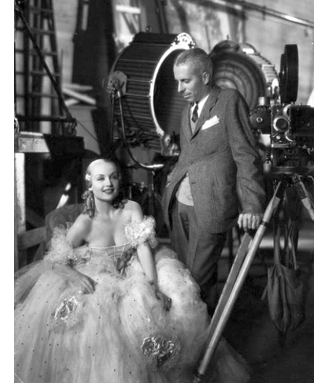 Okay, again, but these early musicals are still very pre-structured, you might say. What about movies that don’t rely on music so much and that give the actors more freedom during shooting? Okay, again, but these early musicals are still very pre-structured, you might say. What about movies that don’t rely on music so much and that give the actors more freedom during shooting?
Enter Howard Hawks.
The book’s last in-depth analysis is devoted to probably the trickiest aspect of the whole problem: rhythm in speech, performance, and narrative. Lea points out that sound film acting required quite exact timing of pauses, glances, gestures, movement around the set, and deployment of hand props–probably tighter timing than in the silent era, with its shorter takes and greater scene dissection. (Consider how often a silent film gives us a close-up of a hand picking up something; in talkies, picking up something seldom gets that emphasis, so that the actor has to integrate the action into the flow of the full shot.) In sound filming, the shooting of the scene and the actor’s performance choices limited what an editor could do to slow it down or speed it up.
Hawks is a notoriously difficult director to analyze because he doesn’t have an obvious signature style at the visual level. His conception of cinematic art relied upon his players. He famously developed his scenes slowly, letting actors improvise, asking screenwriters to recast the scene, and working out the blocking gradually. In this actor-centered cinema, we’re often told, a lot of the Hawksian tang comes from overlapping dialogue. Lea points out, though, that overlapping dialogue was already in wide use on the theatre stage and Hawks was comparatively late in importing it to film. His earliest 1930s experiments don’t owe much to it, largely because early sound technology couldn’t discriminate voices very well. Lea breaks new ground in showing other ways in which speech patterns, regulated through rhythm as well as pitch and timbre, not only contribute to characterization but supply that zesty bounce we associate with the Hawksian world.
His tactics include shifting actors around the set, letting background and foreground sound alternate in clarity, and shortening scenes. Lea goes on to show how these and other options led Hawks to create the “tough talk delivered in a tough way” that became one of his hallmarks. By measuring the length of actors’ lines in seconds and fractions of a second, she’s able to track a subtle orchestration of voices–long speeches delivered fast (or slow), short speeches delivered slow (or fast), and many varieties in between, all interwoven. Overlapping comes in occasionally, as icing on the cake. When it does, especially in Twentieth Century, Lea is ready to specify it, showing how syllables and phonemes are stepped on or cut off.
Now the control freaks aren’t the directors, the Eisensteins and Lubitsches, but the actors. Working together, they plan their lines, expressions, and gestures down to the word. They make their own music. Hawks, says Lea, gives us rhythm “without benefit of a beat.”
Film Rhythm after Sound is a breakthrough in showing how narrative cinema masters time in its finest grain. We’re used to talking about scenes, shots, and lines of dialogue. Lea has taken us into the nano-worlds of a film: frames and parts of frames, fractions of seconds, phonemes. As Richard Feynman once said of atomic particles, “There’s plenty of room at the bottom.” Of course Lea doesn’t overlook characterization, plot dynamics, themes, and other familiar furniture of criticism. But she shows how our moment-by-moment experience depends on the sensuous particulars that escape our notice as the movie whisks past us. We can’t detect these micro-stylistics on the fly. Yet they are there, working on us, powerfully engaging our senses. Film criticism, informed by historical research, seldom attains this book’s level of delicacy. Analyzing a movie’s soundtrack will not be the same again.
Again, to investigate the clips supporting the book’s argument, start at the University of California Press page devoted to the book. These take their place as part of the larger trend toward visual essays examining film aesthetics. Other examples are the work of Kevin Lee, Tony Zhou, and Matt Zoller Seitz. Now that we can quote a film, Lea shows us that we can do a kind of philology of it. Twentieth Century (1934).
Posted in Animation, Directors: Disney, Directors: Eisenstein, Directors: Hawks, Directors: Lubitsch | open printable version
| No Comments »
Sunday | January 25, 2015
The Limey (1999).
DB here:
Here’s a story, so far not finished.
Chapter 1: You can’t put ten pounds of mud in a five-pound sack (Dolly Parton)
Once upon a time, before home video and cable, movies were broadcast on television. They might be drawn from local TV stations’ 16mm collections or transmitted from the networks on “movie of the week” shows. When the film was a widescreen film, especially in anamorphic processes, it was adjusted, as we now say, “to fit your screen.”
That TV screen was in an aspect ratio of about 1.33:1 (4 x 3), like pre-1950s commercial films. But the film to be shown might be 1.75, 1.85, or 2.35. How to show it?
You could retain the whole original frame with letterboxing at top and bottom. This was done more often in Europe than in the US, I believe. Our TV system had 100 fewer lines, so the tiny picture area became quite degraded. And then (as now) there were people who persisted in believing that those black bars at top and bottom were somehow taking away part of the movie.
Far more common was the tactic of somehow making the wider image fill the box. This tactic came to be called “pan and scan.” It gained the name because in preparing the TV version, an engineer would sometimes swivel the TV frame across the original image, carving into it and sliding to and fro. The term pan and scan covered another tactic, simply making two shots out of one. We might call it “cut and scan.” Here’s an instance from an old VHS tape of Advise and Consent, one of the most daring American widescreen films. The slightly fatter faces are due to the distortion of the CRT monitor I shot from.

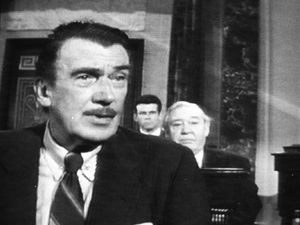 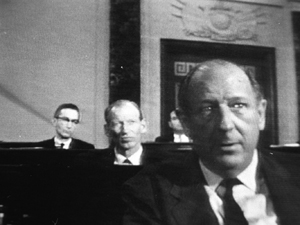
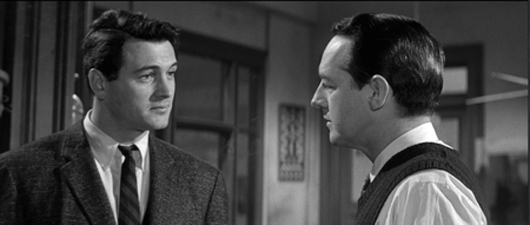
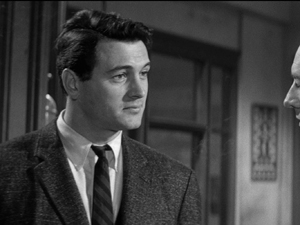
Sometimes there was neither scanning nor cutting, just simple cropping. The engineer would find a 4×3 chunk and extract it from the bigger image. To keep things simple, that chunk was usually around the center. This “center-cutting,” as it was called, could yield some funny results, as in the protruding nose in a 16mm TV print of Tarnished Angels.
Chapter 2: Shoot, protect, screw up
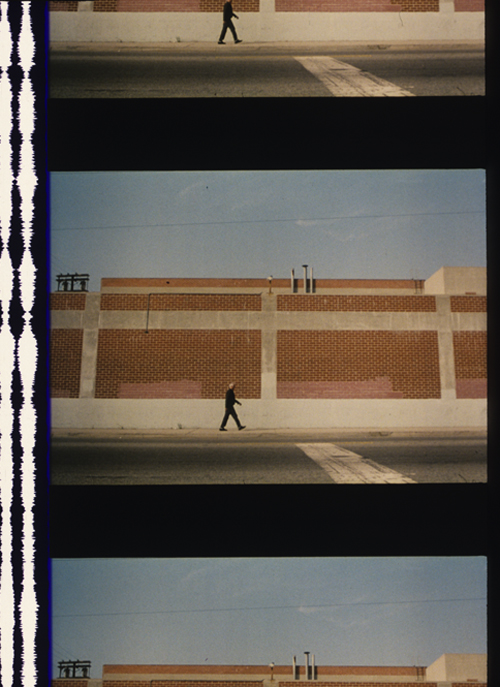
Some widescreen processes from the 1950s onward didn’t frame the image wide during filming. The image would be captured “full frame.” The result might later be “hard matted,” or letterboxed, during printing, as in the shot from The Limey surmounting today’s entry.
Sometimes, the 35mm theatrical prints would retain a 4:3 image, or something even squarer. The frames in a 35mm print of Do the Right Thing are about 1.19:1. Note the extensive headroom in the left image, from a 35mm print. For screenings the projectionist would mask the image to the proper proportions—typically 1.85. Here’s the version on the Criterion DVD, at 1.75 for widescreen monitors.
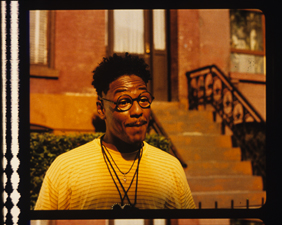 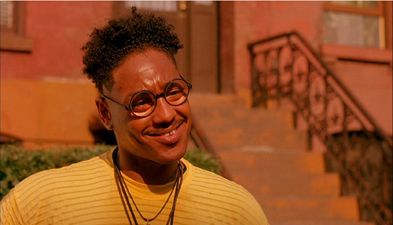
The full-frame image was available for cropping to 4:3 TV viewing. Many cinematographers used the “shoot and protect method” by composing for both 1.85 and 1.33.
There were problems with this “open matte” process in theatres. I recall a mis-framed version of Jerry Maguire in which the locker-room scene showed more of Cuba Gooding’s goodies than was intended. And a full-frame print of Godfather II reveals the duct-taped marks on the set floor (as if Pacino would ever hit them).
The same problem would appear in full-frame TV versions that were carelessly transferred from film. Microphones, unfinished stretches of the set, and other production elements might jut in. Some cinematographers didn’t consider TV versions important enough to worry about. “Fuck TV,” was heard occasionally.
More basically, the full-frame result wasn’t faithful to the “original” theatrical version, which was designed to be shown wide. Purists objected that TV versions, even if shot full-frame, didn’t fulfill the intention of the director.
Chapter 3: 16 into 9 won’t go
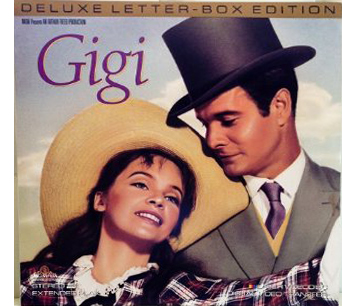 In the 1990s there came laserdiscs and DVDs. These offered properly letterboxed framings. Cinephiles cheered. It seemed that the days of pan and scan were over. In the 1990s there came laserdiscs and DVDs. These offered properly letterboxed framings. Cinephiles cheered. It seemed that the days of pan and scan were over.
Actually, pan-and-scan hung on quite a bit. Many laserdisc editions weren’t letterboxed. Airline versions offered cropped images, and still do. (Those tiny screens, after all.) Some DVDs were released in pan-and-scan versions, while others offered a letterboxed version of the film on one side of the disc and a full-frame version on the other. But serious cinephiles could assume that the general public was starting to understand that films intended to be seen at a certain ratio should be shown that way.
As the new disc formats emerged, so did a plan to standardize High Definition video for a 16 x 9 display. The European Union promoted it during the mid-1990s, and over the next twenty years it became accepted for both computer monitors and video displays. The new format developed in sync with the gradual replacement of analog broadcasting by HD transmission.
The problem is that 16:9 is a ratio of 1.77:1, close enough to 1.85 for most purposes but far off the ratio of 2.20:1 (many 70mm films) and 2.40 (anamorphic widescreen after about 1970). Yet maybe this isn’t a problem. Why not just letterbox those wider images within the 16:9 format?
If only things were so simple.
Chapter 4: Slightly off, and more
Today, at least 77% of US households have HD monitors. (Surprisingly, 41% of TVs still in use are Standard Definition, many presumably comforting children and old people.) Broadcasters make concessions to the 4:3 ratio by keeping the key action centered and cropping the 16:9 image.
Nature abhors a vacuum, and TV monitors apparently can’t bear blank space. So some purveyors of movies on video have updated pan-and-scan for the HD age. Cable, for instance.
It’s been years since I clicked my cable remote to the Sundance Channel and the Independent Film Channel, now known as IFC. Seeing them a couple of weeks ago was a mild shock. Now each boasted a bug in the lower right corner, and swarming over the image were lots of texts plugging other programs. Worse, there were commercials for weight-loss scams, Burger King, and Portlandia. More to the point here, these services give us a new version of pan-and-scan.
Thanks to the center-cutting method, I found plenty of examples of anamorphic 2.40 films sliced up to fit our monitor. Here are a couple of examples from IFC’s version of Jaws. In the first pair, the wider image gives Bruce room to move, and Brody is more salient. In the second pair, Hooper is speaking, but in the IFC image he’s even more peripheral than Mr. Nose in Tarnished Angels.
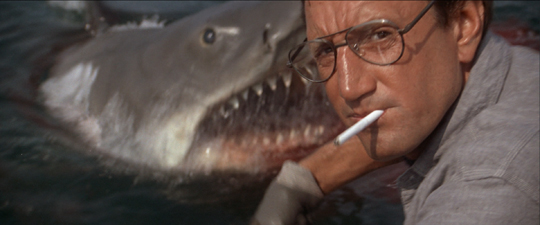 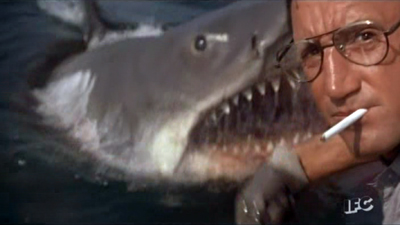
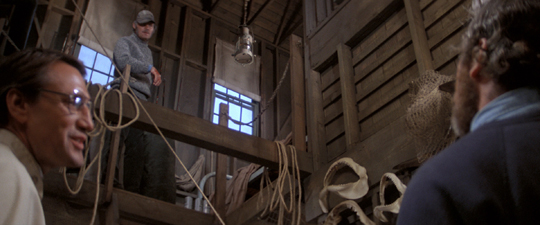 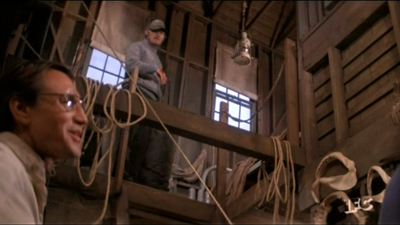
In rare cases, IFC seems to run full-scope prints; I spotted one of Chinatown. But it doesn’t seem to be the norm. Maybe IFC’s New Age pan-and-scan is trying to live up to the channel’s slogan: “Always on. Slightly off.”
Many films of the early widescreen era are compromised even at 16:9. The nose shot from Tarnished Angels would be a bit cramped in a 1.77 format, and many other shots would suffer as well.
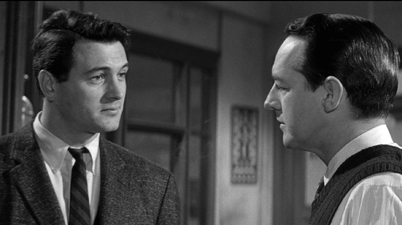
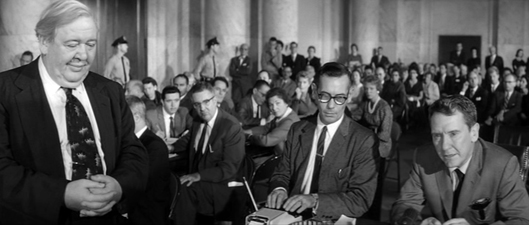
When the wide format was still new, filmmakers were exploring what they could do it, and that included scattering important information throughout the frame. Preminger was all over the place in the Senate and Committee-Room scenes of Advise and Consent. What would you do to fit these shots into 16:9? I make a silly stab at center-cutting.
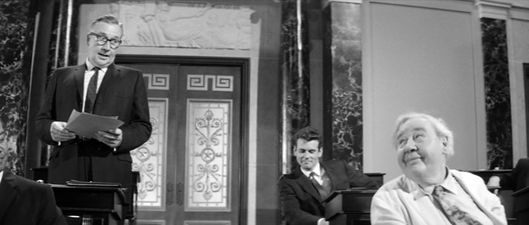 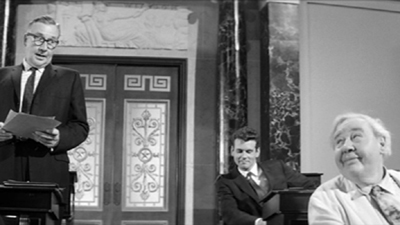
Films like this remind you of how the technology of home video has made our filmmakers less daring in their compositions. Would anyone today risk the bold composition that Richard Fleischer uses in the mortuary scene of Compulsion? As you can see from the image at the end of the entry, the crucial pair of eyeglasses rests on the lower frameline, as if on a shelf. ‘Scope nudged some directors toward quite intricate shot designs.
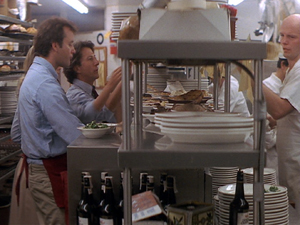
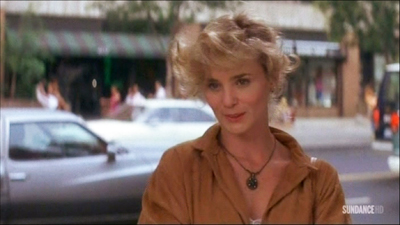
By the time Tootsie was made, with home video on the rise, filmmakers were pressed to shoot and protect better. So here there’s plenty of unused space on the sides, and most action will fit into any old frame proportions. In the shot below, the 1.33 version (available on the flip side of the DVD) is extracted from the Scope version (and slightly squeezed as well). The 1.77 version I grabbed from the Sundance Channel is also extracted from the wider framing. Both reframe the image to emphasize Michael and Jeff, the comic duo. The original 2.35 image centers the food counter and for some reason gives equal space to the inconsequential aisle and stove on the right.
Obviously, composition isn’t particularly important here. Solid as Tootsie is at the level of writing and performance (“Oh, God, I begged you to get some therapy”), we wouldn’t point to it as a model of pictorial finesse.
Moreover, pan-and-scan isn’t just a matter of retaining the action in different framings. Recasting the image changes the scale of the things in it. Old TV pan-and-scan, as in my first Advise and Consent example, makes the figures chopped out of the composition seem closer to us. Sometimes today’s pan-and-scan makes the figures seem smaller. That’s because the full-frame original image offers a bit more space at the top or bottom than we see in the anamorphic version, and that gets incorporated into the 1.77 or 1.33 version. (You can see it in the Jaws example above, with the space above Quint’s head.)
The push-pull of different versions is particularly noticeable in close views. The center-cut (and perhaps slightly squeezed) IFC version of The Matrix keeps Cypher prominent in the foreground, with the car crash in the rear. Yet do you see him and the crash as closer to us in the wide original? I do. Maybe it’s because both Cypher and the background plane are larger in the second frame.
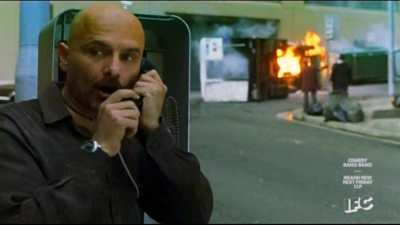 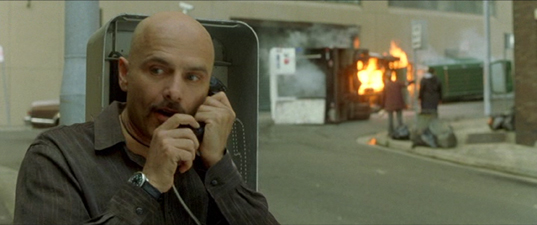
By contrast, several shots in the IFC version of The Matrix have areas at the top and bottom not visible in a wider-frame DVD. In any case, extracting from an anamorphic frame or here, pulling the 1.77 version out of a full frame, can subtly alter the scale and perspective relations within the shot.
In the old TV days, networks would show credit sequences in full widescreen, as they were obliged to make all the contributors’ names visible. So you often had the odd situation of a widescreen credits sequence that would end a movie shown in 4:3. Sundance has updated the technique. Tootsie’s penultimate shot of Julie is at 1.77, but as she and Michael walk off, we cut immediately to a final shot at 2.35 letterboxed, over which the credits roll.
 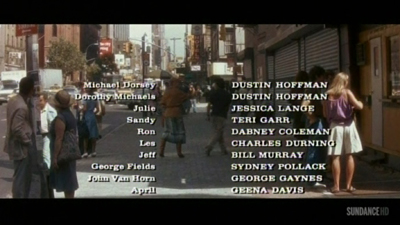
Another old trick has been revived. Back in 1960s TV, you’d have an obligatory widescreen image with credits information, but the shot might go on to show story action. Then the TV framing would close in on the wide image and gradually fill the screen with a 4:3 composition. Damned if I didn’t find the same thing happening last weekend on Sundance. The opening credits for The Graduate were in full ‘scope. That shot dissolved to the famous shot of Benjamin sitting in front of his aquarium, blankly facing the camera.
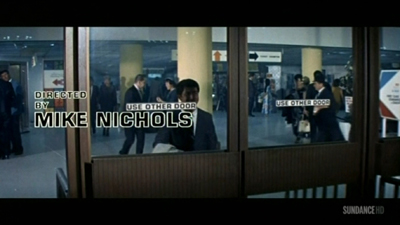 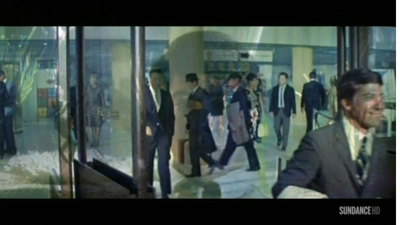 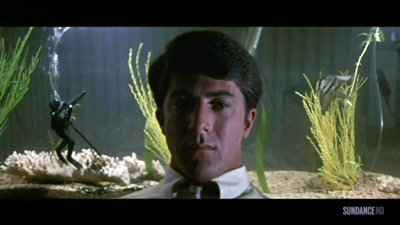
To retain the credits and keep the dissolve smooth, the engineer slowly enlarged the original shot to 16:9 proportions as Ben’s father comes in. (You can see the Sundance bug lift slowly into the lower right of the image.)
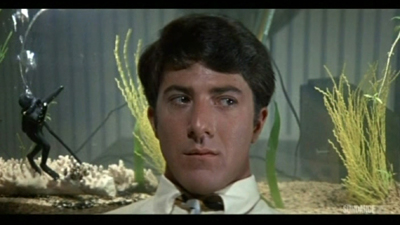 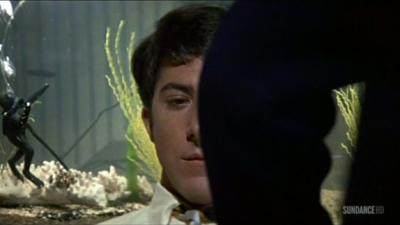
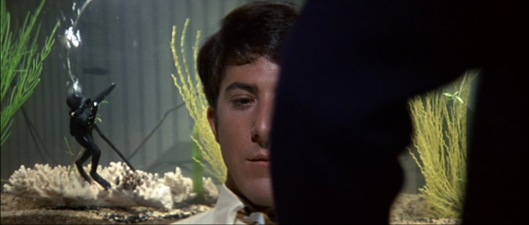
The result is a camera movement, a zoom in, that isn’t in the original film. In the original framing below, the shot scale on Ben isn’t much different, but the little scuba diver remains prominent in a way he isn’t in the 16×9 image.
Chapter 5: VOD = Variants On Demand
On cable TV we Americans can go to TCM for a purer experience of widescreen from the old days. But the more recent films shown on IFC, Sundance, Pivot, and other cable channels are likely to be hacked up in the new way. In this respect as well as others, cable has become the network TV of the new age. We get shows of all types, not just sports and movies but original series, except that now we get to pay to watch commercials.
Surely things are better with streaming?
In the spot-checking I did on Amazon and Hulu Plus, I didn’t find instances of cropping. In particular, the Criterion films I checked retain their proper aspect ratios. Netflix is another story. At this point we must thank the anonymous genius behind What Netflix Does. This site exposes a great many ways that the most popular streaming service has relied on pan-and-scan, with different crops for different markets.
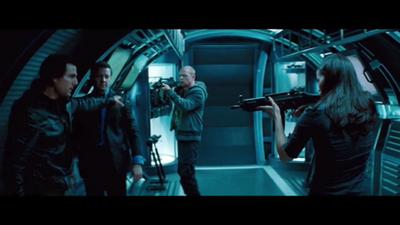 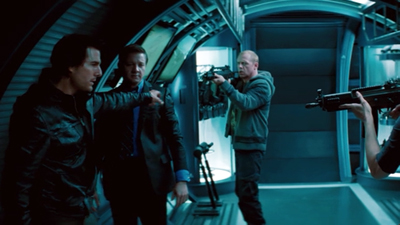
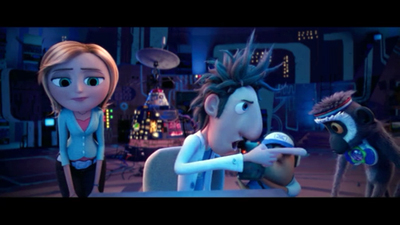 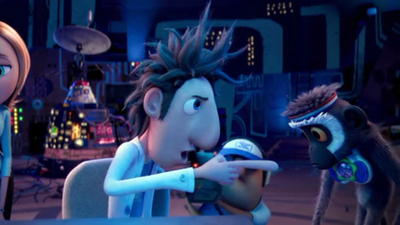
In fairness, once the anonymous genius contacted Netflix, some deficient versions were replaced by proper ones. But several of the more recent examples have not been changed. Who knows how many others remain panned and scanned because the alterations haven’t yet been detected?
In the light of all this, I’m wondering if filmmakers have been protesting this mangling of their work. During the early days of TV broadcasts, directors complained about cuts and commercials, and in more recent years we’ve learned that directors were won over to digital projection in theatres because then “the film would be shown exactly as the director intended.” With many more people seeing the film on video platforms than see it in theatres, you’d think we’d have heard more from the creative community. Once more their movies are being jammed and lopped to fit whatever box they’re put in.
I’m tempted to say that when we want to get the movie in a form close to the ways its makers wanted it to be seen, we need to see it in a theatre or get it on DVD/Blu-ray. There are exceptions, of course. Theatres can botch aspect ratios today just as they have in earlier decades, chiefly by using the wrong masking. And we have filmmakers who alter the aspect ratio on DVD, usually to expand the field from 2.35:1 to 1..77 in hopes (vain) of evoking the Imax effect (Tron: Legacy, The Hunger Games: Catching Fire).
Without getting into technicalities, some of the 1.77 versions you’ll see have a bit more area at the top and the bottom of the frame than we find in the full anamorphic image. In many cases, like the shot of Cypher in The Matrix, it’s because the film was shot in Super-35. This very full-frame capture format allowed filmmakers to extract a 2.40-proportioned image, or a 4:3 image, or images in other aspect ratios. The Wikipedia entry on Super-35 is very helpful on this and other aspect ratios, both for cinema screens and TV. Some shots in the IFC Jaws had a little more vertical area as well. I assume that’s because the ‘scope image on the DVD cropped a tad off the top and bottom of the full-frame image on the film.
Thanks to Jonah Horwitz for pointing me toward the site What Netflix Does. More general thanks to James Quandt for our long-running conversation about aspect ratios. Other entries on aspect ratio on this site involve Fritz Lang, Jean-Luc Godard, and Wes Anderson. I set out some ideas on CinemaScope aesthetics in this video lecture.
P.S. 28 January: Thomas Zorthian was ahead of the curve on this. Back in 2011 he noticed the Netflix pan-and-scan.
Your article hit home for me as I have been trying to bring attention to this problem for a while. I even wrote Roger Ebert hoping he could use his influence. He was kind enough to publish my letter: http://www.rogerebert.com/letters/netflix-stream-sometimes-overflows-the-banks. I have also written to HBO and am considering a petition to ask them to show movies in the proper ratio before HBO GO becomes a standalone service. This would enhance the value of this new service.
Thanks to Thomas for corresponding!
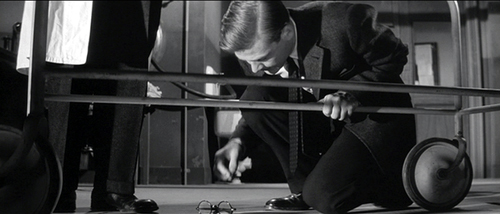
Compulsion (1959).
Posted in Film and other media, Film comments, Film technique: Cinematography, Film technique: Widescreen, Television | open printable version
| No Comments »
Sunday | January 18, 2015
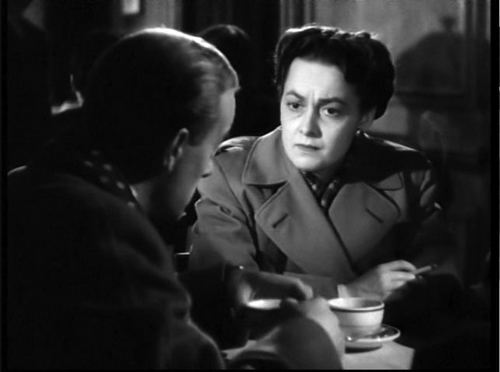
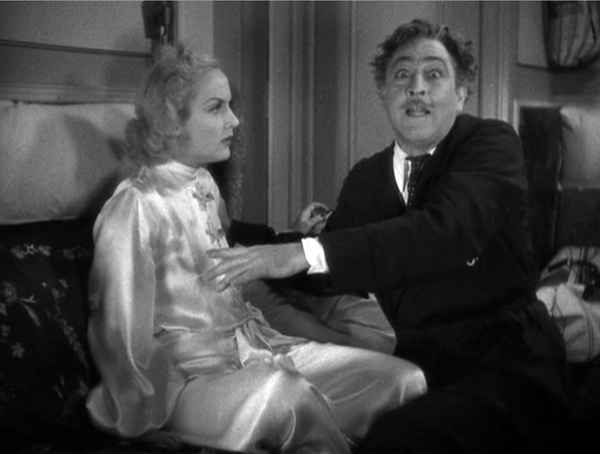
To Each His Own (1946).
DB bere:
Old friend and student, and proficient blogger, Paul Ramaeker writes:
I’m in the middle of Slayground now. In his Stark guise, Westlake as a writer really is as fearsomely directed and effective as Parker himself. I was thinking about the particular narrative pleasures here, like the way that delayed exposition works with the perspective switches between different sections. There is such precision to the way he builds certain effects in a systematic way, the way that we see Parker making plans, going around Fun Island doing things, but Stark not telling us what, exactly. I really did not get the logic of painting white circles in the house of mirrors–I thought of them as targets. Then, [spoiler excised] it makes so much sense, and becomes such a pure hit of storytelling, producing such a rush of pleasure in the reading.
That’s the way Donald E. Westlake worked. With Elmore Leonard and Ed McBain, he was one of the top crime-action writers to emerge in the postwar boom in paperback originals. He wrote a huge number of novels and some screenplays (The Grifters, The Stepfather). Several films, notably Point Blank, The Outfit, The Ax, and Made in USA, were taken from his books.
I’ve paid tribute to Westlake’s prose in this entry, but why not another Richard Stark passage to show how it’s done? Many of the novels start with a “When” clause, and upon relaunching the series in 1997, Westlake picked a dilly:
When the angel opened the door, Parker stepped first past the threshold into the darkness of the cinder block corridor beneath the stage.
The “When” clause hooks you in firmly, with the last word of the sentence locking in a framework that explains the opening. Here’s a simpler prototype Westlake himself picked, from Flashfire:
Parker looked at the money, and it wasn’t enough.
Anybody else would have cut the and and put in a period. This is better, I think because it quietly leads us to expect something more: a piece of action, a demand for more money. Anyhow, once we’re arguing about whether to put in an and, we’re talking about a real writer.
Slayground is one of those nifty experiments Westlake tried, this time putting two books in a divided POV arrangement. Both Slayground and The Black Bird begin with the same action, a getaway described almost identically in each one. Parker and his sidekick Grofield separate. One book follows Parker’s fate and other follows Grofield’s. I want to read both right now.
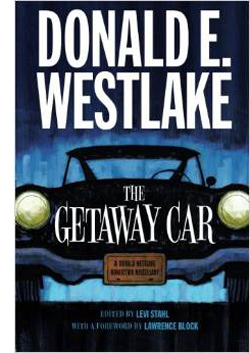 Before I do, though, I must signal (a) the University of Chicago Press’s brilliant idea of reprinting all the Stark novels; and (b) Levi Stahl’s wonderful compilation The Getaway Car: A Donald Westlake Nonfiction Miscellany. This consists of essays, memoirs, and interviews, running from 1960 into the 2000s. There’s even a recipe for tuna casserole contributed by Dortmunder’s girlfriend May. Before I do, though, I must signal (a) the University of Chicago Press’s brilliant idea of reprinting all the Stark novels; and (b) Levi Stahl’s wonderful compilation The Getaway Car: A Donald Westlake Nonfiction Miscellany. This consists of essays, memoirs, and interviews, running from 1960 into the 2000s. There’s even a recipe for tuna casserole contributed by Dortmunder’s girlfriend May.
You learn a lot about Westlake’s life, of course; for one thing, you learn how Made in USA became unseen in USA for several years. A career-survey interview with a convicted bank robber is alone worth the price of admission. Stahl adds in fragments from an autobiography (“I was born in Brooklyn, New York, on July 12, 1933, and I couldn’t digest milk”).
Westlake was a thoughtful observer of his tradition, and he offers historical surveys and close readings of his hardboiled predecessors. He compares the prose of Black Mask writers Hammett and Carroll John Daly, and calls Raymond Chandler “a bookish, English-educated mama’s boy whose raw material was not the truth but the first decade of the fiction. This is not to denigrate Chandler, or at least not to denigrate him very much.” He praises Richard S. Prather for his “bonkers” style (“She was as nude as a noodle”) and registers his admiration for lesser-known contemporaries like Peter Rabe. He offers the best analysis of George V. Higgins I know, and his appreciation of Rex Stout warms the heart. Acknowledging the cunning ways that Stout hides plot gaffes under Archie’s patter, Westlake notes that perhaps Stout had “an affinity with those Indian tribes who deliberately include a flaw in their designs so as not to compete with the perfection of the gods.”
You also learn about the market. Westlake was a “fee reader” for Scott Meredith literary agency, one of the most prestigious around. He became a self-supporting writer in 1959, when he churned out over half a million words, all published. Writing an Avon paperback in 1960 would earn you $350, or $2800 in today’s money, but writing a serial for a magazine like Analog could net $450 for only 18,000 words. There’s a marvelous letter from that year in which a twenty-seven-year-old Westlake complains to a top publisher that he can’t get his best science fiction accepted, and that specific editors traduce the work of writers he knows. Stahl calls it “one of the most spectacular acts of bridge burning in the history of publishing.” Again, the author’s gesture recalls Parker’s chilly recklessness, but with jokes.
Popcorn and Red Vines
In his recent interview with the New York Times, Patton Oswalt included the Stark/Westlake Man with the Getaway Face as one of his favorite books of all time. It comes as no surprise that this gremlin polymath gets Stark/ Westlake. Those who know his fine Zombie Spaceship Wasteland will find more of the same in Silver Screen Fiend: Learning about Life from an Addiction to Film. As ZSW traced his early standup career and its intertwined relation to nerd culture, this quasi-memoir traces his early years in LA, writing for MadTV by day, honing his comedy act by night, and watching movies obsessively at all other times.
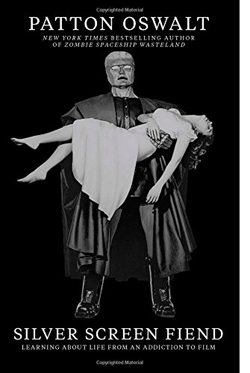 Despite his fondness for sitting far back (I’m down front) and mixing popcorn and Red Vines (I’ve been a Dots man for sixty years), Oswalt has left us the best memoir I know of being a sheer headbanging movie geek. A sort of nonfiction Moviegoer (Walker Percy), or a prose version of Cinemania, that disconcerting documentary in which everything reminds you of you, Silver Screen Fiend takes us into hard-core hell-for-leather filmgoing. Despite his fondness for sitting far back (I’m down front) and mixing popcorn and Red Vines (I’ve been a Dots man for sixty years), Oswalt has left us the best memoir I know of being a sheer headbanging movie geek. A sort of nonfiction Moviegoer (Walker Percy), or a prose version of Cinemania, that disconcerting documentary in which everything reminds you of you, Silver Screen Fiend takes us into hard-core hell-for-leather filmgoing.
Filmgoing is the operative idea, not just film viewing. The book is set on the cusp of the DVD revolution, when the big-screen experience was so much better in contrast with VHS. There are descriptions of favorite theatres and fetishized experiences like Cocteau’s Beauty and the Beast and a Hammer movie marathon. At the same time, this “sprocket fiend” was also a “stage ghoul,” trying to out-kill the other standup comics at the Largo. The two obsessions fed each other, as when Oswalt arranged public readings of the script for Jerry Lewis’ legendary Day the Clown Cried.
Throughout, the movie madness emerges as another channel for the explosive energy of a young man burning with ambition. At the theatre the splendid lunacy might be onscreen, or in the row behind you, where Lawrence Tierney was talking loudly back to Citizen Kane. The moment pulsates because Oswalt wanted to be in movies too, maybe as a character actor.
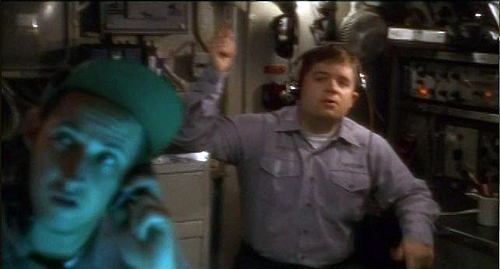
The book hits one of its high points in telling of his big break, in Down Periscope (1996), where he utters one line as the camera sweeps past him. He describes the process of filmmaking as hammering slowly away at the movie that isn’t there yet. It’s like “blasting a tunnel through a mountain. Or brushing every grain of sand off of a fossil. You attacked it relentlessly.” Oswalt squeezes pages of entertainment out of brooding over how to deliver “There’s a call for you, sir. Admiral Graham.”
Rest assured that every movie you see where an actor delivers just one line? They’ve put this kind of thought into it. Sometimes you can see it. Sometimes they can hide it. But everyone who gets in front of that lens has this inner conversation. I was having mine now. I was about to speak on film.
The moviegoing spiral ends on 20 May 1999, when Oswalt sees Star Wars: The Phantom Menace. The postmortem at a dinner marks the moment when the addiction subsides. “It hits me, sitting there with my friends, that for all of our bluster and detailed, exotic knowledge about film, we aren’t contributing anything to film.” He realizes that film should be one ingredient in the fuel for your life. “But the engine of your life should be your life.”
The epiphany is movingly described. (I wish I could say I’ve learned the same lesson.) Oswalt implies that film frenzy was a phase he went through, and now he’s grown up. (I wish I could say the same for me.) Yet I’m encouraged that Oswalt has not gone cold turkey. He’s passed from gourmand to gourmet. “My love of movies has turned into a love of savoring them.” And he can’t resist movie comparisons when describing that day-and-date release sometimes called Life. “Faces are scenes. People are films.”
In the back of Silver Screen Fiend are thirty-three pages listing all the films Oswalt saw across four years, along with the theatres where he saw them (New Beverly, Nuart, Tales Café et al.). Plenty of pure storytelling hits there. Far from makeweight, these pages create a new list of the kind he obsessed over in Danny Peary’s books. How many twenty somethings will start checking off the titles here?
The team
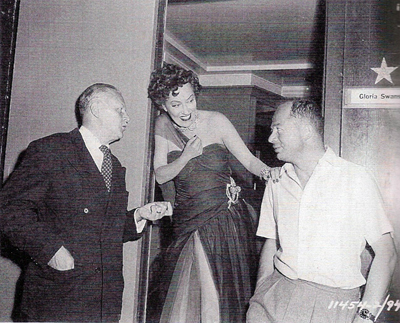
Charles Brackett, Gloria Swanson, and Billy Wilder.
On his very first night at the New Beverly, Patton Oswalt caught, and was caught by, Sunset Blvd. and Ace in the Hole. He mentions they were “co-written and directed” by Billy Wilder. He doesn’t identify the other half of the co-.
Nor do most people. In the case of Sunset Blvd., that fellow was Charles Brackett, who now stands revealed as not only a gifted writer but the Samuel Pepys of classic Hollywood. “It’s the Pictures That Got Small,” edited by Anthony Slide, is an absorbing chronicle of a tempestuous collaboration and the lifestyles of an era. A Harvard-educated WASP from Saratoga Springs, Brackett became a novelist, was made drama critic for The New Yorker, and sat at the Round Table with the likes of Woollcott and Parker. After some of his fiction was adapted to film, he moved to Los Angeles.
Brackett’s early work seems to have been undistinguished, though I’d defend at least Picadilly Jim (1936). Eventually he wound up at Paramount partnering with Wilder, and under the aegis of Lubitsch they clicked for Bluebeard’s Eighth Wife (1938) and Ninotchka (1939). There followed Midnight (1939) and Hold Back the Dawn (1941) for Leisen, and Ball of Fire (1941) for Hawks–an early title of which, we learn here, was Dust on the Heart. Then came Wilder’s directed pictures, from The Major and the Minor (1942) to Sunset Blvd. (1950). Brackett was active in the Screenwriters Guild, became a producer, and continued to write scripts for his producing projects, including the delirious Niagara (1953) and the insufficiently delirious Journey to the Center of the Earth (1959). The Uninvited (1944), Brackett’s first solo production, remains charming, and To Each His Own (1946) is an interesting wartime weepie, with Olivia de Havilland massively frumped up. Miss Tatlock’s Millions (1948) also has its defenders.
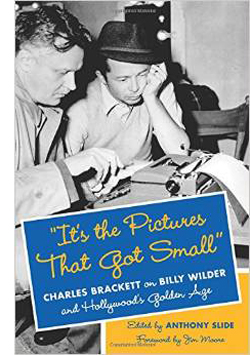 “It’s the Pictures That Got Small” is a plump album packed with tiny but revealing snapshots. Although Brackett wrote entries nearly every day, he often made do with very brief mentions. Slide has edited them judiciously and arranged them chronologically, with some stitching to fill in events. A 1936 entry strikes a warm chord: “It’s the Pictures That Got Small” is a plump album packed with tiny but revealing snapshots. Although Brackett wrote entries nearly every day, he often made do with very brief mentions. Slide has edited them judiciously and arranged them chronologically, with some stitching to fill in events. A 1936 entry strikes a warm chord:
I am to be teamed with Billy Wilder, a young Austrian I’ve seen about for a year or two and like very much. I accepted the job joyfully.
By 1943, Brackett is recording something much more rankling:
My consciousness that, after years of partnership, his first free act was to stab me in the back…my conviction that he’s turned into a second-rate director…my knowledge of the awful thinness of his mind, his stupidly limited interests. Alas, alas. And my knowledge that I am as little stimulating for him as he is for me.
During this supposed phase of creative drought, they were working on The Lost Weekend.
Apart from charting this bumpy collaboration, Brackett gives us a lot of information about how films got made. We learn about studio differences (Paramount less disciplined than MGM) and the importance of telling stories to others, face to face. I found plenty to feed my act-structure appetite. I was happy to find how often moviemakers went to the movies. Brackett attends dozens, both premieres and regular shows, and he records how easily screenwriters could summon up an older picture to be screened, even at a rival studio. This from 1947:
In the afternoon Billy and I saw Mr. Deeds at Columbia to check on certain similar situations in The Hon. Phoebe. It proved helpful and an excellent picture despite curious non-sequiturs and at least one horrible scene, Cooper absolutely charming. I could see some loathsome Capra characters beginning to unfold, but still in the lovely promising bud stage.
As a writer, Brackett is no less captivating than Westlake or Oswalt. We can rejoice in his Algonquin acidity.
Chaplin seems to me as repellant a human being as I’ve ever been in the room with—a thin, reedy voice, a show-off-hog face, and hysterical protestations of liberalism.
Jean Arthur called us, worried about the fact that there’s another woman in the picture [A Foreign Affair]. “I have sex appeal,” she said calmly, but inaccurately.
Greeted at the office by a nasty little note from Charles Jackson [author of the novel The Lost Weekend]. I had addressed him as “Birdbrain” in a telegram, something I could do to any friend—but an unsafe term to use to a man five feet tall.
And there are flat-out funny stories. Here’s just one, reported by Wilder.
[Von Stroheim] has always thought Swanson too young and desirable for the role of Norma. “Look at her,” he said. “I would like to fuck her now.” “I,” said Billy, “would rather fuck you.” “You have,” von Stroheim retorted.
If it didn’t happen, I want it to have.
In short, three more items for your shelf—repositories of good stories in themselves, prods and teases for your own thinking about story-making.
The University of Chicago Press has mounted a fine infographic on Westlake/Stark’s Parker novels here.
P.S. 19 January 2014: Thanks to David Cairns for correcting a slip. My original entry said that Brackett co-wrote Ace in the Hole with Wilder. Actually, the collaborators on Ace were Lesser Samuels and Walter Newman. Be sure to check David’s excellent Shadowplay site.
Down Periscope (1996).
Posted in Fans and fandom, Film and other media, Hollywood: Artistic traditions, People we like | open printable version
| No Comments »
|