Sunday | April 12, 2015
DB here:
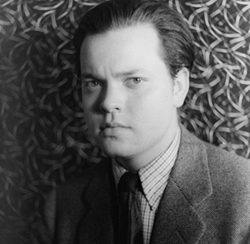
Nearly a hundred years ago George Orson Welles was born in Kenosha, Wisconsin. The story goes that when the UW—Madison asked him to come get an honorary degree long afterward, he refused. The reason? He claimed he was conceived in Rio de Janeiro, so he considered himself Brazilian.
 About ninety years ago, little Orson went to Indianola summer camp outside Madison. (A memoir of his stay, criticizing Welles’ more lurid version, is here.) He attended fourth grade in Madison 1925-1926. At that time he was studied as a child prodigy by psychologist Dr. F. G. Mueller. A story about the little rascal, who was already staging plays, appeared in a local paper. Then he transferred to the Todd School for Boys in Woodstock, Illinois. About ninety years ago, little Orson went to Indianola summer camp outside Madison. (A memoir of his stay, criticizing Welles’ more lurid version, is here.) He attended fourth grade in Madison 1925-1926. At that time he was studied as a child prodigy by psychologist Dr. F. G. Mueller. A story about the little rascal, who was already staging plays, appeared in a local paper. Then he transferred to the Todd School for Boys in Woodstock, Illinois.
Madison has done pretty neatly by him. Our Wisconsin State Historical Society collections include some Wellesiana: production material on Citizen Kane, The Magnificent Ambersons, and unmade projects, along with a rich trove from Agnes Moorehead, who taught school in Soldiers Grove and got a Masters at our university. For decades, Welles’ films were staples of our bustling campus film-society scene, and out of that emerged Wisconsin-born Joseph McBride. Joe produced a fine critical monograph on Welles in 1972 and has been writing about him ever since. Another supremo Wellesian, James Naremore, did his doctorate here. Douglas Gomery, one of our Film Studies alumni, wrote a foundational study of Welles’ relation to the studio system, and Michael Wilmington, who collaborated with Joe on a book on John Ford, has also written eloquently on Welles over the years.
So I had good luck coming here in 1973. As a teenager getting interested in film, I focused most avidly on Welles. I watched Kane and Ambersons on late-night TV, and as a good omen, there was a 16mm screening of Kane during my first week as a college freshman. With pals I traveled to New York to see the newly released Chimes at Midnight (twice) and wrote a review for our student newspaper. A few years after that Film Comment published my first serious piece of film criticism, an essay on Kane. That movie has been a leitmotif of my life—a centerpiece of our textbook Film Art since its publication in 1979, important in The Classical Hollywood Cinema, and still stubbornly facing me down in my current struggles with 1940s Hollywood narrative.
So it’s in the nature of things that our Cinematheque is honoring Welles in a year-long retrospective that started in January. And it’s even niftier that our current Wisconsin Film Festival has included three items celebrating this prodigious and prodigal Cheesehead.
Never too much johnson
I like quick cutting very much. I didn’t do much of it at the start. But the more I work, the more I like it.
Orson Welles
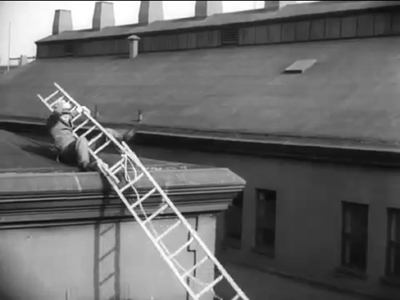
Welles shot film material to fill in exposition for the three acts of a stage production he was mounting in 1938. Too Much Johnson was a revival of a turn-of-the-century farce, and how the smart-alecky boys must have snickered at the title. The film remained uncompleted and was never shown with the play (which failed out of town). Welles edited the first part of the footage to some extent, but what remains of the rest are rushes. The footage was discovered in Pordenone, Italy in 2008 and has recently become available for screenings. You can watch it on Fandor, though we discovered that it plays best on the big screen with an audience and live music. For us, piano accompaniment was supplied by the versatile David Drazin.
Movies have long been mixed with live performance. Early films were inserted between vaudeville acts. In Japan, films enhanced and extended the action of plays. Eisenstein famously insinuated comic footage into his 1923 Moscow production of The Wise Man, and the idea caught on in Europe as well. By 1938, the New York stage had its own tradition of mixed-media, notably in the “Living Newspapers” sponsored by the Works Progress Administration. Welles had played in another politically pointed production, Sidney Kingsley’s Ten Million Ghosts (1936), which incorporated both slides and film.
The Too Much Johnson footage is a tribute to silent movies, or at least silent movies as a young theatre director in 1938 thought of them. At that time, many intellectuals admired slapstick comedy; serious silent drama was largely considered old-fashioned and “theatrical.” Movie aficianados also appreciated the silent avant-garde, especially Clair’s Entr’acte (1924), which enjoyed a place in the crystallizing Museum of Modern Art canon. Entr’acte, another movie inserted in bits during a stage show (Rélâche), was itself a reworking of American chase-and-stunt extravaganzas. I think the Too Much Johnson material bears traces of both Hollywood and Paris, especially with certain cuts that are even bolder than what we’d find in Sennett or Lloyd.
Welles scrambles several trends of silent cinema. To evoke the period of Gillette’s 1894 play, an early scene suggests filmed theatre before 1908 or so, but Welles immediately interrupts it with very brief, looming close-ups.
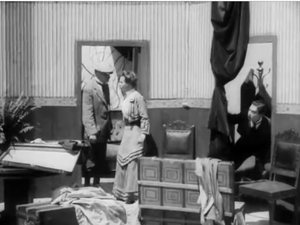 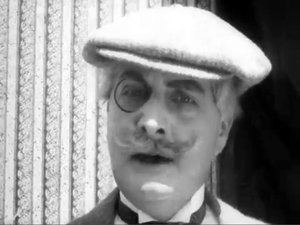
Elsewhere, Welles provides a flurry of Soviet-style axial cuts when the couple are interrupted in bed.
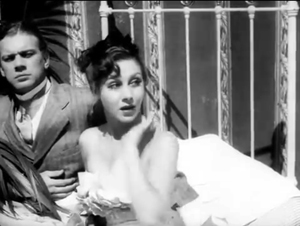 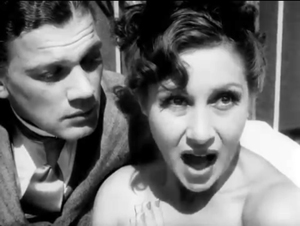 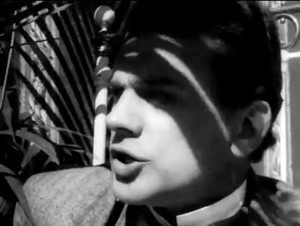 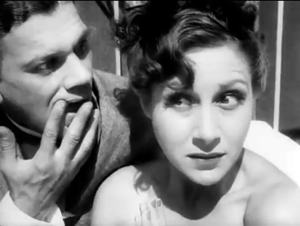 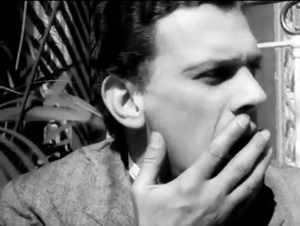 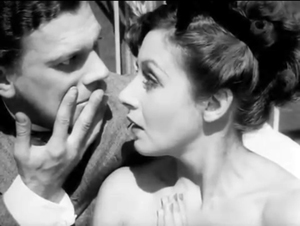
These “concertina” cuts, along with the mismatches of a twisting Joseph Cotten, create a jumpy effect reminiscent of Kuleshov’s By the Law (1925) and other films. (Though I doubt that Welles had seen that.)
There’s also a lot of Soviet-style Eccentrism in the opening footage, with Cotten scrambling over buildings and through a market in the Harold Lloyd manner. At both a pastiche and a potpourri, Too Much Johnson stands as something more than a curiosity. It’s a sketchbook, a finger-exercise in silent cinema technique, and a testament to buoyant youth from a twenty-three-year-old. It’s also evidently the first of Welles’ many unfinished films.
Noble artificiality
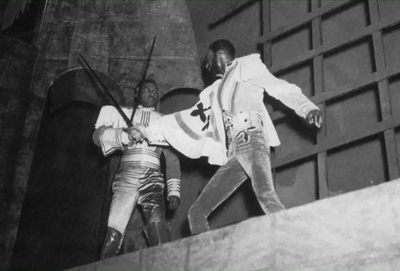
Chuck Workman’s Magician: The Astonishing Life and Work of Orson Welles has the good sense not to get in the way of Welles’ overwhelming presence. The documentary smoothly incorporates many interview clips with Himself and collaborators, kin, and admirers. There are also some splendid family photographs. The structure is chronological, and clips from the film are surrounded by contextualizing commentary from Welles and others. There’s a wonderful moment when Workman illustrates, with production photos, the dead silence following the Martians’ attack in Welles radio drama. The documentary even manages to throw doubt on Welles’ reminiscences by juxtaposing contradictory interview statements. I have a hunch that Jim Naremore, who was the major consultant on the project, encouraged this sort of historical frankness. Every Welles researcher knows that against his selective memory and penchant for fabulism, the documents must be checked.
 Among the familiar but always compelling landmarks, Norman Lloyd makes a comment that set me thinking. “He brought, in one word, theatricality.” Welles was a sponge, blending many of the innovations in staging and conception that streamed into America from overseas, but I think he was particularly marked by what was then called “theatrical theatre.” Among the familiar but always compelling landmarks, Norman Lloyd makes a comment that set me thinking. “He brought, in one word, theatricality.” Welles was a sponge, blending many of the innovations in staging and conception that streamed into America from overseas, but I think he was particularly marked by what was then called “theatrical theatre.”
The Europeans, notably Piscator, and the Russians, notably Meyerhold, had embraced frank artifice. They challenged all forms of realism, from the bland ignore-the-fourth-wall parlors of the well-made play, to the Naturalist notion that the play was a “slice of life” and that you could hang bleeding cuts of meat in your stage-set butcher shop. They also challenged the atmospheric Symbolism of Appia and others. Instead, theatrical theatre offered a stripped-down presentation that broke with the proscenium and hurled itself at the audience. The stage space was no longer a room or imaginary world cut off from the audience; it was of a piece with the auditorium. Performances were no longer representational, but “presentational,” in the manner of jugglers, acrobats, or…magicians.
For Americans, the idea of Theatrical Theatre was crystallized in Mordecai Gorelik’s book New Theatres for Old (1940). Gorelik traced the trend from Toller’s Masse Mensch (1921) directly to Welles’ 1937 “no-scenery” production of Julius Caesar. Other productions of that season, including The Cradle Will Rock (Welles and Houseman, using a bare stage perforce) and Our Town, with its scripted catcalls from the audience, were turning the blank stage into a space continuous the auditorium—not an imaginary locale but an area for acting and interacting.
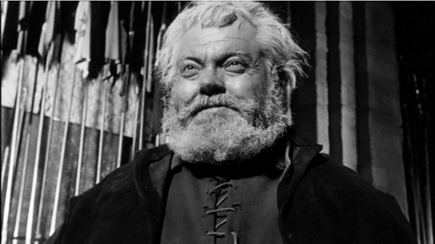
Gorelik quotes Gordon Craig: “Do not forget that there is such a thing as noble artificiality.” Not a bad summation of Welles’ productions, including the Harlem Macbeth (above) and the War of the Worlds broadcast, as well as the films. Theatrical theatre is confrontational, sometimes angrily and sometimes, as in Welles’ penchant for reviving vaudeville, good-naturedly. Even Gorelik couldn’t go along with Mercury’s 1937 Faustus, which he deprecated as a “sleight-of-hand performance.” But I think it’s plausible to take Welles as in the tradition Lloyd alludes to. Expecting realism blocks some people from appreciating the brazen stylization, the pranksterish poke in the eye we get from many of the movies.
Hearts of age
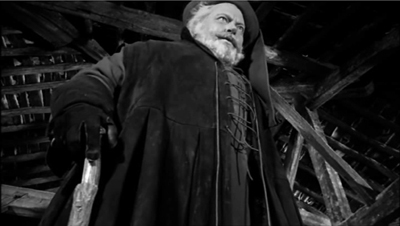
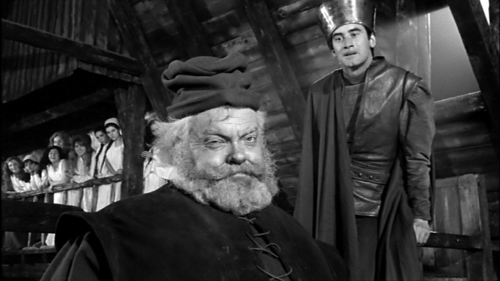
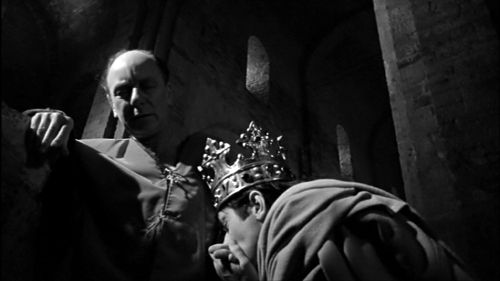
Over the last thirty years or so, I remembered Chimes at Midnight as a more cohesive movie than the admirably choppy Othello. Seeing Chimes again yesterday, I realized that they were mates. There was the same ransom-note assemblage of scenes, the abrupt cutaways covering changes in character position, the use of long shots showing characters not speaking the lines we hear them say. You hear a line and may find that nobody has opened his mouth. An empty tavern becomes suddenly full after we’ve hung around one area of it. The great battle scene starts out making sense spatially but then dissolves into chaos, as men grind and hammer one another, and the dust at their feet turns to bloody mud.
So what? One of the lessons Welles seems to have learned from Eisenstein is that continuity is overrated. Almost every shot-change forces you to readjust your attention, and a cut is less a link than a jolt. André Bazin was right to praise Welles’ long takes, but the Wonder Boy of the 1940s also loved disjunctive cuts, apparently from Too Much Johnson onward. Not all the harsh editing in The Lady from Shanghai and Macbeth can be attributed to studio interference. By the time we get to Othello, the same paste-up aesthetic governs almost every scene, with sound sometimes covering the gap and sometimes accentuating it.
Welles told Peter Bogdanovich that only the Greeks and the French classicists wrote true tragedies. Tragedy ought to be austere and pure, he seems to have thought. Shakespeare, he insisted, gives us high-level blood-and-thunder melodrama. So his Shakespeare films are rough and tumble, full of violent, strident effects, from the brimstone paganism of Macbeth to Othello’s Turkish-bath assassination. Here, it’s Falstaff and his followers providing earthy comedy, with Prince Hal enjoying the riotous living and the escalating slanging matches, where punning insults are swapped between gulps of sack. The glowing Boar’s Head versus the spare, chilly palace; fiery Fat Jack versus severe, monastic Henry IV; romps in the forest versus carnage on the battlefield—these are the options facing the young prince. Playing, as we now say, the long game, he warns Falstaff twice that when he assumes power, the old rogue will be cast off. When the new king follows his father’s advice “to busy giddy minds with foreign quarrels” (sound familiar?), you have to wonder if an occasional robbery of pious pilgrims is worse than Henry V’s cynical venture into patriotic gore: “No King of England if not King of France!” Falstaff, cold as any stone, is hauled off to his grave. Melodrama, again, and none the worse for it.
Thanks to Jared Case of George Eastman House who brought Too Much Johnson to us and provided lively commentary. Eastman House is the archive that restored the film, and is the site of The Nitrate Picture Show starting 30 April. (See you there?) Thanks as well to Jim Healy, Ben Reiser, and Mike King of our festival for many varieties of help. They do a swell job.
Frank Brady interviewed Welles extensively about the Too Much Johnson project, and the informative results are in Brady’s Citizen Welles: A Biography of Orson Welles, 145-151.
The Wisconsin Film Festival runs until 16 April, and there are many high points yet to come—not least, a 35mm screening of Where the Sidewalk Ends (15 April), which Kristin and I must miss (snif). The Cinematheque series continues this summer with a focus on Welles the actor, and in the fall with several rarities.
Of the many, many Welles celebrations this year, the Indiana University one later this month will surely be the lollapalooza.
Douglas Gomery’s trailblazing article, arguing that Welles was a prototype of the Hollywood independent, is “Orson Welles and the Hollywood Industry,” Persistence of Vision 7 (1989), 39-43. On Too Much Johnson, see Joe McBride’s in-depth piece at Bright Lights. There are too many excellent books on Welles to itemize here, but at the very least your shelf needs Peter Bogdanovich and Jonathan Rosenbaum’s This Is Orson Welles, Jim Naremore’s Magic World of Orson Welles, Joe McBride’s What Ever Happened to Orson Welles?, Jonathan Rosenbaum’s Discovering Orson Welles, and Simon Callow’s luxuriant two-volume biography. The most complete account of Welles’ stay in Madison that I know is in Peter Noble’s The Fabulous Orson Welles, pp. 26-33. The article about the Boy Wonder, age ten, appeared in The Capital Times (19 February 1926). Welles talks about Shakespearean plays as melodrama in the third audiocassette accompanying This Is Orson Welles, at 52:02.
Our analysis of Citizen Kane occupies chapters 3 and 8 of Film Art, and chapter 27 of The Classical Hollywood Cinema. There are many references to Kane and Ambersons on this site; check the Welles category. My 1967 review of Chimes at Midnight is here, on p. 9. It’s all too obviously the work of a twenty-year-old, and it demonstrates how it’s not really that hard to write a passable movie review. But at least it’s enthusiastic about the right things.
P. S. 13 April 2015: Joe McBride writes:
And Madison Mafia made man Pat McGilligan’s upcoming biog Young Orson: The Years of Luck and Genius on the Path to Citizen Kane will have many illuminating things to say about OW’s Madison days, as well as correcting other myths.
Thanks to Joe and best wishes to Pat, whose book will appear in August. For background on the Madison Movie Mafia, go here.
P.P.S. 13 April 2015: Manfred Polak advises me that the copy of Too Much Johnson that I linked is blocked for some regions of the world. It’s available for all on National Film Preservation Foundation pages. The complete 66-min. work print we saw in Madison is here and can be downloaded here. There’s also a 34-min. edited version, downloadable here.
Thanks very much to Manfred!
Posted in 1940s Hollywood, Directors: Welles, Film and other media |  open printable version
| No Comments » open printable version
| No Comments »
Wednesday | April 8, 2015
Kristin here-
Nearly two years ago, when Flicker Alley released its wonderful collection of French films made by the Russian-emigré production company Albatros in the 1920s, I wrote, “Now, if Flicker Alley will manage to release its long-rumored project, Albatros’s 1923 serial, La Maison du mystère, starring Mosjoukine, we will all be doubly grateful.” That release arrived yesterday.
For decades, La Maison du mystère remained one of the fabled lost films of the silent era. It was an enormous popular success upon its release in 1923, and critics praised it as well. Even Louis Delluc, who highmindedly promoted cinema as a realistic, restrained art, grudgingly said of it, “La Maison du mystère is a serial. They are a necessity. So be it. This one is intelligent, sober, frank, genuinely human.”
Watching the film today, “sober” seems an odd term. Despite its many arty moments, the film presents a conventionally melodramatic story, with Mosjoukine playing a struggling factory owner betrayed by a villainous “friend” who is secretly in love with his wife. He is falsely accused of murder, presumed dead after an escape from hard labor, and operates under various disguises. Blackmail, flashy escapes, a suicide pact, and flagrant coincidences all play roles. Yet in contrast to the fantastical ones of Louis Feuillade from the 1910s, the ones we are most familiar with today, Le Maison du mystère paid more attention to characterization and moved at a less breakneck pace. (Feuillade had moved into this sort of dialogue-centered melodrama himself in the 1920s, as in Les Deux Gamines, 1921, but these films are rarely watched today.)
With Alexandre Volkoff directing the script he and Mosjoukine adapted from a popular novel, filming began in the summer of 1921. At the beginning of 1922, Mosjoukine contracted typhoid fever and was out of commission for six months. Shooting was completed in the summer of 1922, and the film was released in ten weekly episodes starting in March of 1923. Ultimately, like so many silent films, it disappeared.
Severely abridged feature-length versions existed in some places. An 18-reel print discovered in the Iranian archive was destroyed in a fire before it could be sent to France for restoration. Luckily, the original negative turned up at the Cinémathèque française, having been donated in the collection of Alexandre Kamenka, the producer who took over Joseph Ermolieff’s company in 1922 and turned it into Films Albatros. After restoration, the film was shown at Il Cinema Ritrovato in 2002–well before we began our annual visits to that festival in Bologna. It was presented again at the Museum of Modern Art in 2003.
The Flicker Alley release runs 383 minutes and seems to be essentially complete, although the intertitles apparently are replacements. Unlike so many restorations derived from worn release prints, this one is visually gorgeous. It’s mostly in black and white, though it has appropriate tinting for fire and night scenes. Neil Brand provides an excellent piano score.
The old and the new
Like so many of the major French films of the 1920s, especially the Impressionist ones, La Maison du mystére combines a sentimental, old-fashioned story with unconventional stylistic devices: unusual pictorial motifs, beautiful cinematography and design, and imaginative staging. It is probably this visual interest that led to the film’s original acceptance by reviewers and to its enthusiastic reception by modern historians and silent-film buffs.
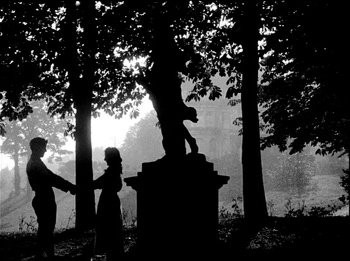
One visual motif that begins early on is silhouettes. The opening involves Mosjoukine’s character, Julien, still a bumptious, naive young man, courting Régine, the daughter of a wealthy couple who live near his chateau (the “maison” of the title). Despite his shyness, they manage to become engaged and walk joyfully through the woods together.
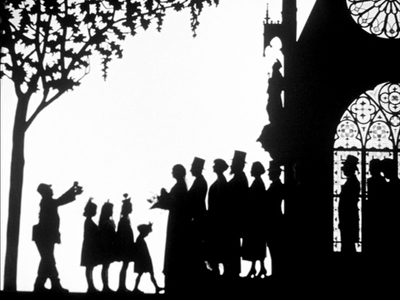
The entire wedding scene is then compressed into a series of shots done against bright white backgrounds render the actors and settings in near-black silhouettes (above). The result looks like a live-action version of a Lotte Reiniger cut-out animated film.
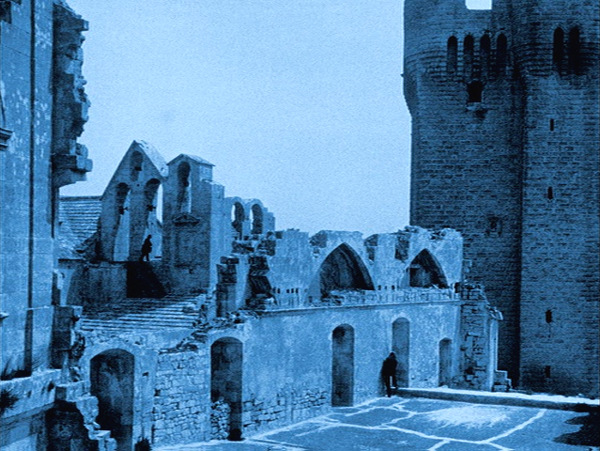
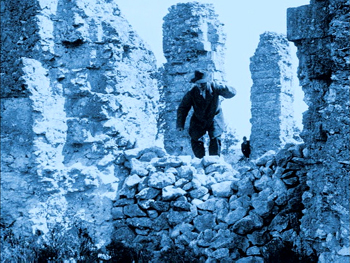
As I discussed in my entry on the Albatros DVDs, the settings in the studio’s films tended to be impressive as well. Here much of the interest is created by actual locales. David speculated that the whole film was conceived around the ruined fortress or castle where several scenes take place. That’s not likely, but the filmmakers used the ruins well. Rudeberg, a woodcutter whose penchant for amateur photography leads him to photograph the murder of which Julien is falsely accused and convicted, hides the prints in this castle. Rather than turning them over to the authorities, he is using them to blackmail the real murderer, the factory manager Corradin. Corradin twice follows him to the castle, leading to dramatic compositions of the two men in different parts of the frame. In the image at the top, Corradin slinks along the row of arched doorways at the bottom, while Rudeberg is visible moving through a higher archway at left center.
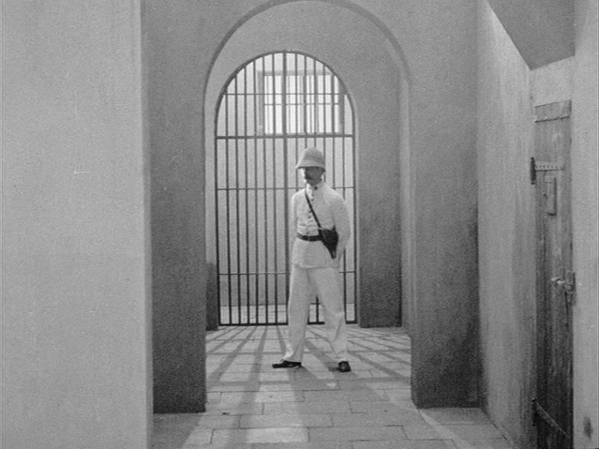
Alexander Lochakoff, the main designer for Ermolieff and then Albatros, was somewhat restricted by the story. He needed to provide realistic interiors for an antique-filled chateau rather than the modern apartments in which some of the other Albatros films take place. Still, he managed some characteristic designs, such as the prison corridor at the bottom of this entry, a location seen only in one brief shot.
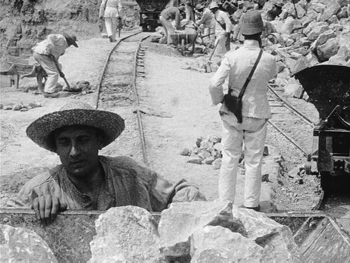
There are some brilliant moments of staging in depth. After Julien is sentenced to twenty years of hard labor, his new situation is introduced via a tracking shot with the camera atop a cartload of stone which he is pushing. Gradually the laborers breaking stone and the guards overseeing them are revealed (below left). In another shot in the ruins where Corradin is tailing Rudeberg, he is glimpsed in the background (below right).
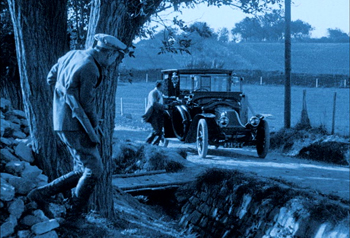
In a scene late in the film, Julien plans to flee with Régine and their daughter Christiane. He is dressed as their chauffeur, but Corradin shows up and spots the car. Julien hides and watches him from behind a tree in the foreground.
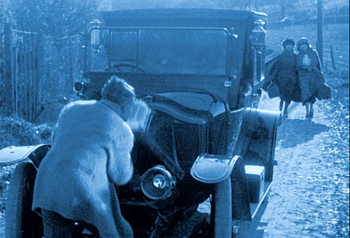
We then see the two women approaching, framed through the back window of the car and watched by Corradin, in the foreground. He ducks down and pretends to fiddle with the car’s engine to prevent their realizing who he is as they draw near.
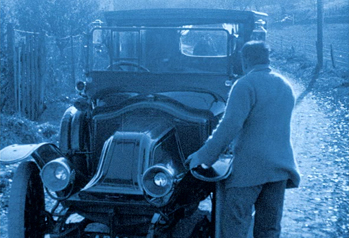 
I could go on illustrating such stylistic flourishes, but I leave it to you to find them for yourself. There’s a very early example of a montage sequence to compress the passing of World War I into a series of titles, from 1914 to 1919, superimposed over stock footage of combat, and a marvelously choreographed high-angle scene in a forest as a troop of policemen pop out of nowhere to surround and arrest Julien.
All serials need stunts
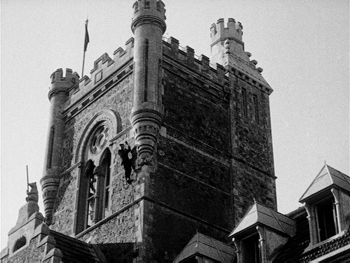
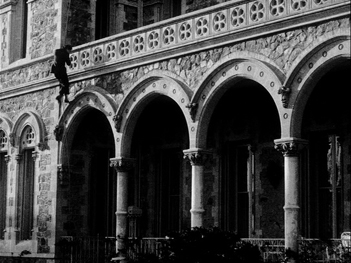
Much of the film consists of conversations and confrontations among the characters, a trait which no doubt led critics to contrast the more action-oriented serials of recent years. Still, there are two sequences where derring-do takes over. After the police arrest Julien, he makes an escape via a rope down the tower and wall of his chateau, a feat accomplished in a single take tilting down to follow his progress.
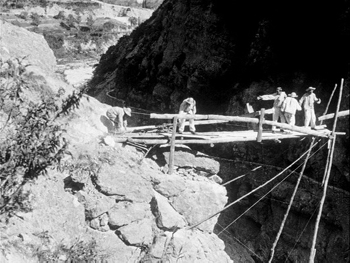
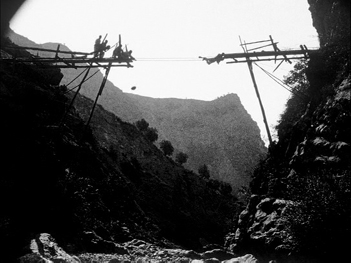
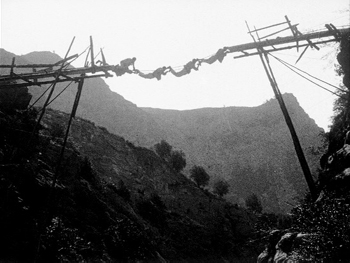
Later, in an episode entitled “The Human Bridge,” Julien and four of his fellow prisoners escape from their guards while working on a railroad track. This lengthy sequence involves first the commandeering of a passing train and then a chase over an area of rocky crags. At once point the escapees find the rickety remains of a tall bridge above a river gorge and fling ropes across. The four other prisoners then lie end to end, clinging to the ropes, forming a bridge to allow Julien, who has been wounded during their flight, to cross over. One extreme long shot of the scene shows two of the men’s hats falling off, demonstrating as they drift down to the bottom that there is no trick photography involved. It is certainly as impressive as any of the stunts in Feuillade’s films.
Touches of Impressionism
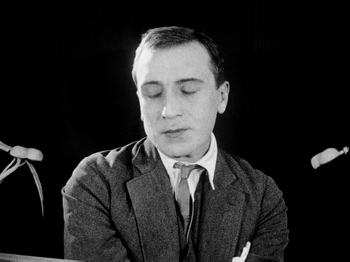
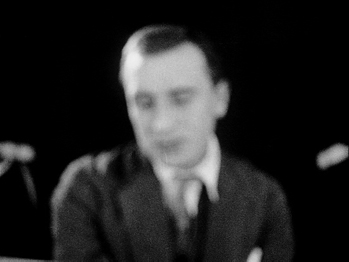
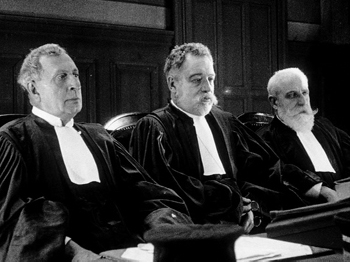
La Maison du mystère certainly cannot be characterized as an Impressionist film. Yet the movement was beginning to expand in 1921, and there are some moments of subjectivity that draw upon its newly minted conventions. As his trial is drawing to an end, Julien closes his eyes, and the shot goes out of focus. We see a series of quickshots of his surroundings and his family as he seemingly recalls the events of the trial as a montage scene. Finally the same framing of Julien shows him coming into focus.
This is a fairly straightforward Impressionist device, but a more daring suggestion of a subjective state occurs much later. Julien’s daughter Christiane and Rudeberg’s son Pascal have fallen in love, and they vow that if they cannot marry each other, they will both commit suicide. When the villainous Corradin forces Christiane to agree to marry him, Pascal sets out to drown himself. His distraught state of mind is conveyed in a single shot as he walks toward the mill pond and hesitates. As he moves into the shot, he is framed in a standard medium close-up. As he hesitates, however, he moves unusually close to the camera and then backs partway out of the frame, as if afraid to continue. Finally he turns and stares into the camera, moving forward out of focus until his dark-shadowed eyes fill the frame. The implication is that he determines to go on with his plan.
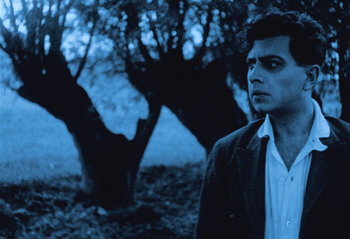 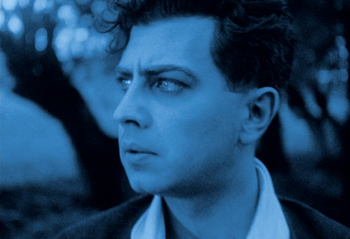
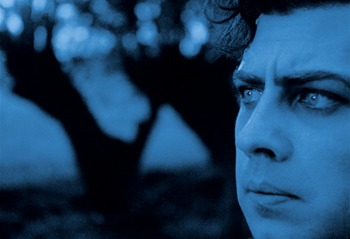 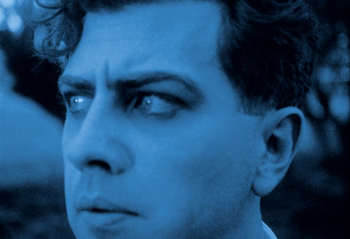
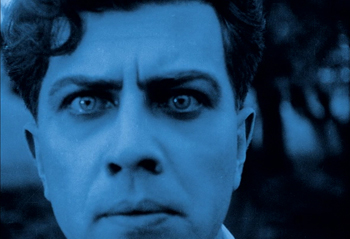 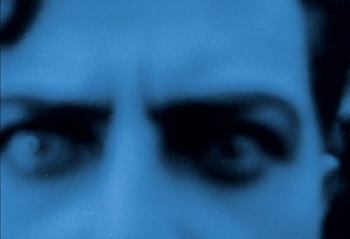
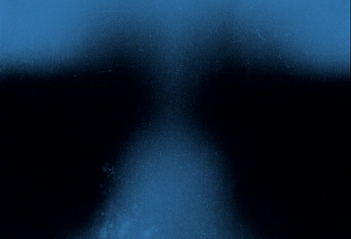
(Fans of Evgeni Bauer will recognize Vladimir Strizhevski, the son in the director’s final film, The Revolutionary.)
Star turn
Apart from the imaginative staging, cinematography, and design, La Maison du mystère is full of fine performances. It provides a vehicle for a virtuoso performance by Mosjoukine. He is part Douglas Fairbanks, part Lon Chaney as he leaps energetically about in the early parts of the film and then dons various disguises during his long period as a fugitive. He briefly poses as a clown in a small circus and later returns to work incognito in his own factory as a wounded war veteran with a limp and eye-patch.
Mosjoukine’s fellow actors refuse to be overshadowed by the star, with Hélène Darly as Régine managing somehow to age from a young lady to a mature mother without any apparent change of makeup. Nicolas Koline, best known as Tritan Fleuri in Napoléon vu par Abel Gance, brings something of his usual comic persona to Rudeberg, while also conveying the character’s guilt over choosing to use his photographs for blackmail purposes rather than to reveal Julien’s innocence. Charles Vanel, who had been acting in films since 1910 and would become a major star in the sound era, conveys Corradin’s villainy perhaps too well, making one wonder why any of the other characters ever trusted him.
Flicker Alley, along with the Cinémathèque française, David Shepard, and Lobster Films, have filled in a major gap in film history, and we are indeed doubly grateful.
The quotation from Louis Delluc and information on the production of the film come from the essay, “The Art Film as Serial” by Lenny Borger with David Robinson, included as a booklet in the DVD set.
Impressionist films have been included in some of our “best films” of ninety years ago series. See 1921, 1922, 1923, and 1924.
Posted in DVDs, Film comments, Film genres, Film history, National cinemas: France, Silent film | open printable version
| No Comments »
Sunday | March 29, 2015

Penance (2013).
DB here:
Remember Web 1.0, when blogs were really logs? You know, diary-like accounts of events befalling the writer? The sense that every instant of one’s life needs preserving and broadcasting got absorbed into Facebook and Twitter and Instagram, I suppose. Today blogs are more likely to feature essayistic thinking. People slow-cook their blogs more, it seems to me, and they write in a reflective mode. Since our blog has always been, um, expansive in such ways, I welcome the Ruminative Turn.
Like most academics, we write long for a reason. You need more words to dig into a question. That’s why books exist. But mid-range is good too. The blog format suits specualtive, exploratory work and informal prose that wouldn’t show up in a journal. In this para-academic register, the aim is to spread ideas and information around. A reviewer of the book I mention below puts it well: “democratic, attainable erudition.”
Because we write long, and maybe because we’re a bit chatty, a few of our entries have become published, suitably spruced up, as “real” articles for diverse audiences. Some overseas journals, both print and online, have published translations of pieces available here. Thanks to the good offices of the University of Chicago Press, a gaggle of our entries became a book, Minding Movies. Lately, three of our blogs have wriggled their way into paper—two as DVD liner notes, and a third in an imposing rectangular solid that is sort of a mega-book. All are aimed beyond the academy.
Doing Penance
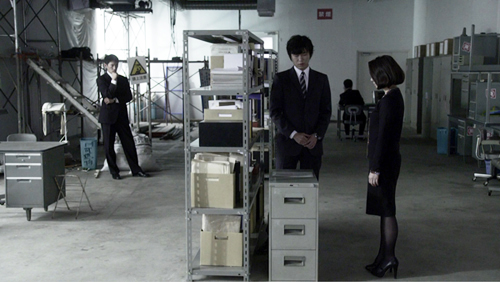
Two summers ago our friend Gabrielle Claes tipped me to a visit by Kurosawa Kiyoshi, accompanying a screening of his Penance (Shokuzai) at the Brussels arthouse Cinéma Vendôme. Of course we went, and we had a good time with the film and the Q & A that followed. I duly wrote it up, did a bit of quick analysis, and offered it to the world online.

When the Doppelgänger branch of Music Box Films decided they wanted to distribute Penance on DVD, they asked for the essay. The it’s come out in a good edition (alongside Eddie the Sleepwalking Cannibal, worth a look, and other genre fare). My essay is preceded by one by Tom Mes of Midnight Eye, who discusses the film’s relation to its source novel and pinpoints its exploration of “the gray area between the mundane and the ghastly.” there’s also an informative interview with Kurosawa.
As a five-part TV series, Penance fits its plot to the installments pretty rigorously. A little girl is assaulted and murdered, and only her four playmates have seen the killer. Taking advantage of the serial structure, Kurosawa begins each episode by revisiting the original crime, picking details relevant to what we’ll see but expanding the sequence a bit by tracing each girl’s efforts to notify the community. It’s a sophisticated version of the “Previously on [name of series]” recaps we commonly get in TV serials.
After revisiting the killing and showing the aftermath as it affects each girl, every installment shows the children gathering for a grim birthday party. On that occasion Emiri’s mother Asako demands that the girls either find the killer or do penance for their lack of vigilance.
After this juncture, each of the first four installments attaches the narration to one girl’s viewpoint fifteen years later. The episodes trace the awful effects of the crime on the girls’ personalities and their adult lives. Each one gets involved with an unstable man, with catastrophic consequences. In each episode, Asako reappears at a critical moment to demand penance or to absolve the woman. The fifth episode centers on Asako herself: her immediate reaction to her daughter’s death, her search for the killer, and her realization that the crime has roots in her own past.
I was happy to get a chance to see Penance again, because it’s continually engrossing and quite moving. It also exemplifies the sort of clean, classical genre filmmaking that doesn’t get done in America very much. After watching all the GPS views and whooshes down to street level and nonstop bludgeoning supplied by Run All Night (still, an okay movie), it’s a pleasure to turn to a film that builds its tension through a fixed camera, calm clarity, and performances suggesting suppressed menace rather than explosive confrontations–though there are a few of those too.
Penance would be something for young filmmakers to study. It shows how locations can be used elegantly and economically, and how the inability to get extreme long shots in cramped quarters can actually be an advantage. Classrooms, offices, and gymnasiums are used with a sober restraint, each one given defining geometry and color scheme. A crucial confession takes place in a police station being renovated, and Kurosawa lets the scene unfold in a way that continually reveals surprising bits of space, such as a cop standing somewhat ominously at a distance. He’s unafraid of holding long shots because the shot is propelled by the drama, not the cutting pace. Here’s another example that illustrates the Monroe Stahr rules of storytelling: not a car chase or gun battle, but a quietly puzzling situation that evokes curiosity and suspense.
Asako has gone to a drawer and withdrawn a ring. We’ve not seen it before and have no idea what it signifies.
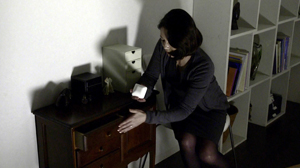 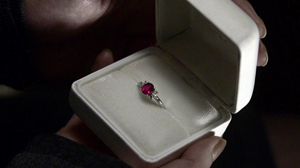
She crosses the room, as if to do something with it. Before we find out, cut to her husband in the hallway. This cut initiates a take lasting over three minutes.
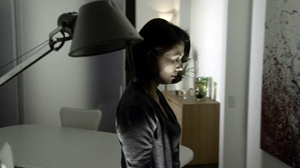 
When he reaches the doorway he catches her hurling it angrily into the wastebasket. So now we know he knows…but what?
 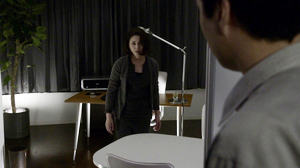
Reminding her that she’s treasured this since college, he fetches it out for her and quietly leaves.
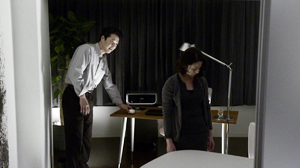 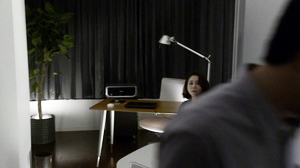
As she starts to explain, she follows him into the corridor. The camera pans right to reframe their new confrontation.
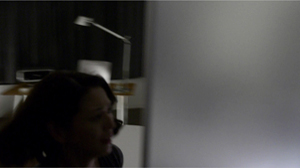 
There she reveals her secret, slowly. As she crumples to the floor, Kurosawa permits himself a camera bobble–a rarity in a film that almost entirely avoids handheld camerawork. The husband at first consoles her…
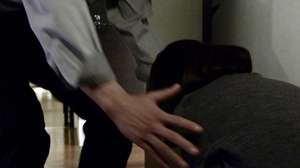 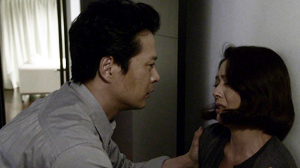
…but then she confesses her secret. He pulls away from her.
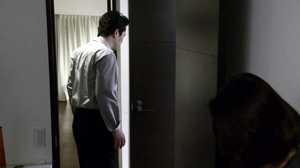 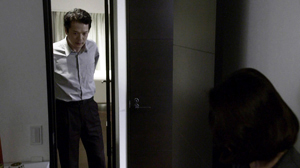
She tries to embrace him, looking for solace, but he shuts her out and withdraws.
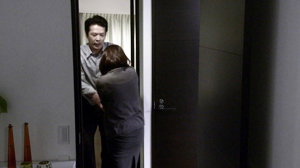 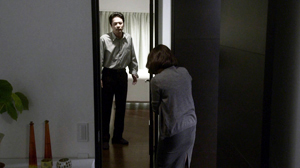
She’s left to fall to the floor crying in shame, in that classic attitude of distraught Japenese women.
 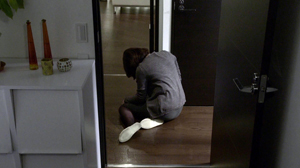
The highest pitch of the drama–Asako’s revelations–has been given a close view, but the action has led up to it and away from it through character blocking, not cutting. The situation unrolls and builds tension completely through dialogue, body language, and facial reaction. But it could hardly be considered theatrical, because the camera has judiciously strengthened certain parts, concealed others, and obliged us to shift character perspective (Asako-husband-Asako) through slight changes of position. And playing so much of the scene in distant and dorsal shots harks back, inevitably, to Mizoguchi.
As I mentioned in the early entry and the liner notes, Kurosawa always knows where to put the camera–no small accomplishment these days–and there’s as much power in this apparently simple scene as in any of the grandiose Steadicam movements in more inflated films. Trust the audience to sense the undercurrents, and they will follow you if you have mastered calm, precise cinematic storytelling.
Grand hotellerie
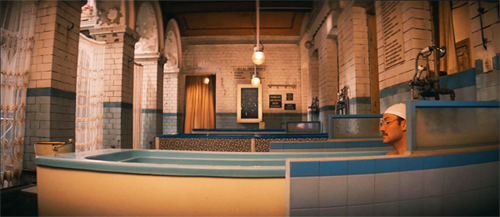
The Doppelgänger gang released Penance on DVD last November. I’m only a little less late in mentioning the arrival of Matt Zoller Seitz’s newest addition to The Wes Anderson Collection: The Grand Budapest Hotel. The decision to base a big, luscious book on a single Anderson film gives this ambitious picture even deeper treatment than we saw in the Collection’s individual chapters. From Seitz’s rich opening appreciation to the amiable list of contributors (The Society of Crossed Pens), the book is a serious divertissement, a wonder-cabinet of images, ideas, and semi-childish fun.
It’s partly a making-of book. We get production stills, script pages, set designs, storyboards, animatics, special-effects secrets, costume designs, and the now-celebrated photochrom images. Seitz has larded his captions with shrewd critical points about lenses, compositions, lighting, and staging—not the normal gee-whiz commentary of an “authorized” making-of. Anderson’s enjoyment of practical effects, his judicious use of digital tools, and his most complex voice-over narration yet come through vividly.
Seitz is especially interested in the history and artistic models behind the movie. His interviews are crowded with information about Anderson’s inspirations, which seem endless. Of course there is Stefan Zweig, who is given several pages of intense discussion. We also learn of Anderson’s interest in the exiled directors like Lubitsch and Wilder, who gave us both a Europeanized Hollywood and a Hollywoodized Europe. There are homages to The Red Shoes and Colonel Blimp and Letter from an Unknown Woman. Anderson was equally committed to a broader historical context, passing his story through different eras—the bell-jar atmosphere before the Great War, the premonitions of World War II (itself never shown), and the postwar emergence of Communism, seen in the revamped and decaying Hotel in the 1960s. Seitz has even spotted borrowings from James Bond movies. As skillful an interviewer as he is graceful an essayist, Seitz induces Anderson to reveal the density of this sweet, sinister movie—the cinematic equivalent of Chandler’s line about a tarantula on a slice of angelfood cake.
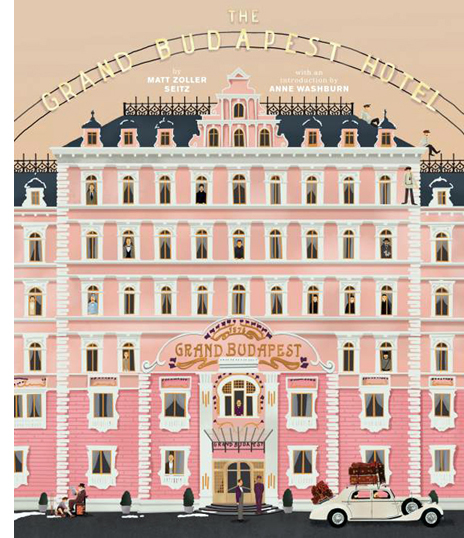 There are as well interviews with Ralph Fiennes talking of the “farce spectrum,” costume designer Milen Canonero ordering up a Prada leather coat for Willem Dafoe, the very great composer Alexandre Desplat explaining his compositional procedures, production designer (and Milwaukee native) Adam Stockhausen discussing the magnificent settings, and DP Robert Yeoman talking about shooting on 35mm. There are as well interviews with Ralph Fiennes talking of the “farce spectrum,” costume designer Milen Canonero ordering up a Prada leather coat for Willem Dafoe, the very great composer Alexandre Desplat explaining his compositional procedures, production designer (and Milwaukee native) Adam Stockhausen discussing the magnificent settings, and DP Robert Yeoman talking about shooting on 35mm.
Anderson’s fussbudget aesthetic meets its match in a book crammed with fastidious minutiae. Whimsy, as Lewis Carroll and G. K. Chesterton understood, escapes coyness only when it’s pursued rigorously. Seitz reviews the careers of the major players in postage-stamp pasteups. When Anderson is revealed as a connoisseur of frame stories, flashbacks, and other fancy techniques we favor on this site, Seitz provides a four-page spread of pick hits of voice-over. Max Dalton, the illustrator, gets the message. With their modestly lowered eyes and sidelong grins, his neo-New Yorker figures swarm these pages but assemble, obediently rank and file, in the end papers.
Most surprising of all for a production dossier, in-depth criticism is not only allowed in the tent but given its turn in the spotlight. Christopher Laverty analyzes the costumes with a precision seldom seen in academic writing, while Olivia Collette contributes an enlightening study of Desplat’s score. Steven Boone examines the art direction, with a special sensitivity to how set designs are fitted to anamorphic optics. Ali Arikan brings his characteristic lucidity to a study of Zweig’s Vienna and the traces it leaves on his fiction and Anderson’s film. The essays show that analytical film books, like volumes of academic art history, can be merit high production values.
My contribution, a revamping and nuancing of an earlier blog entry, looks at how Anderson adjusts his planimetric staging and shooting to different aspect ratios. For me, this assignment was the big time. No academic book, my usual publishing platform, could have illustrate my ideas so splendidly. I’m proud to be among fine company, and I like the fact that people are reading and buying the thing.
Of course very few film books have the built-in audience of a Wes Anderson project. As I wrote last summer, he brings his brand with him. But that isn’t, I think, a bad thing when the results are as lively and lovely as The Grand Budapest Hotel.
Last year I had to go to Hong Kong the weekend the film opened. I dashed to it during my first day in town, then squeezed in two more screenings during the festival. Now, after a year and many more viewings, it hasn’t cracked yet. At the moment I think of it in relation to the “hotel” books and movies of the 1920s and 1930s. I think of its predecessors, such as Arnold Bennett’s 1902 novel The Grand Babylon Hotel. (Did Anderson read it? I don’t find a mention here.) I remember those star-filled ensemble comedies of the 1960s like The Pink Panther and The Great Race, twitching with celebrity walk-ons and the cartoonish effects Anderson relishes. In short, I think about film history, and it pleases me when a film and its book trace out, in dazzling detail, an exceptional movie’s debts to tradition. Keep your Birdman and Gone Girl and Jersey Sniper (or is it American Boys?): This is the 2014 American film that will be remembered for decades.
Hello again, my language
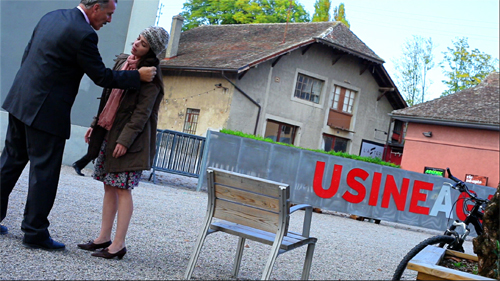
Last year’s other big film for the future is, no doubt now, Adieu au Langage, just coming out on Blu-ray as Goodbye to Language from Kino Lorber. I’ve said my say about this item twice (here and here) so about all I have to add is that after several more viewings, I’m still convinced of its excellence. Kino Lorber gives us two versions, the 3D one and the “merged” 2D one. The 2D one is still one hell of a film, but of course in 3D it’s spectacular.
The disc includes an essay developed beyond my blog entries. It says some new things, but it’s inevitably incomplete. Godard’s films so teem with ideas (both intellectual and cinematic) that there’s almost always more to notice. “One can put everything in a film,” he remarked back in the 1960s. “One must put everything in a film.” He sort of does, especially here.
Both versions belong on every cinephile’s shelf. If I didn’t already have a 3D TV (purchased so I could watch Dial M for Murder and Gravity properly, and even freeze the frame), I’d get one so I could see Farewell to Language whenever I wanted. Consider your options. 3D TV is now dead enough to be cool.
Thanks to Austin Vitt of Music Box films for picking up Penance, and Richard Lorber and Robert Sweeney for recruiting me for the Godard disc. I’m indebted to Matt Zoller Seitz for bringing me on board the Anderson project, and to Caitlin Robinson of Twentieth Century Fox for loaning me a print of The Grand Budapest Hotel so that I could study its aspect ratios in their natural habitat.
Midnight Eye features Kohei Usuda’s very detailed review of Kurosawa’s latest project, an entry in the “idol movie” genre. You can find MZS’s video introducing the Grand Budapest book here.
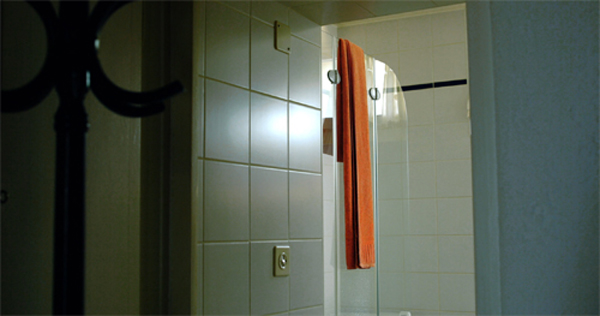
Goodbye to Language.
Posted in Directors: Anderson, Wes, Directors: Godard, Film comments, National cinemas: Japan | open printable version
| No Comments »
Sunday | March 22, 2015
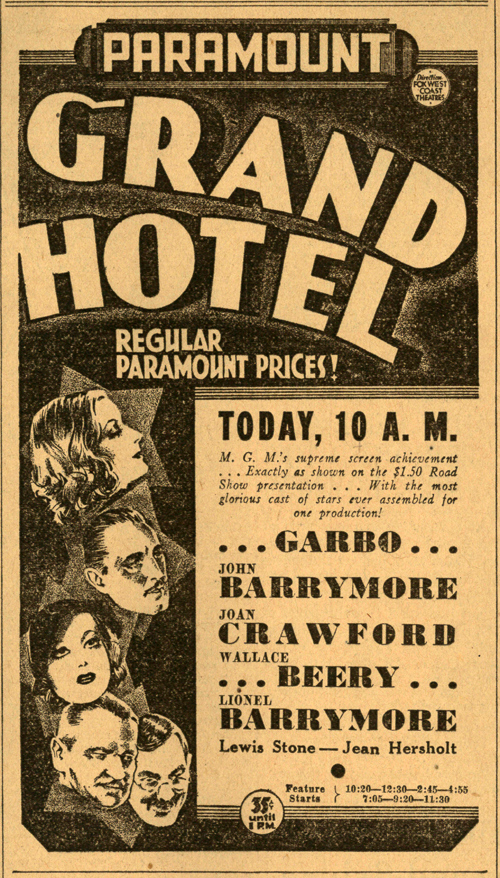
Courtesy John McElwee and his gorgeous, informative site Greenbriar Picture Shows.
DB here:
The inner monologue, as a report of a character’s immediate thoughts, seems to have been rare in 1930s films; it became more prominent in the 1940s. But the second big MGM narrative innovation of 1932 was almost instantly influential, redone and nearly done to death in the decades that followed. Even before the film was released, the idea of a “Grand Hotel plot” had gripped both the public and professional storytellers. And it never went away.
In the Strange Interlude entry, I mentioned that what’s usually of interest to us when we try to track the history of film forms is not the first time something is done but the moment when it becomes recognized as an active option. It stands forth as a strategy that can be copied, standardized, and revised. The Grand Hotel idea itself wasn’t utterly new, but the novel, play, and film of that title crystallized it as a distinct choice on the filmmaking menu.
The book: Only approximations
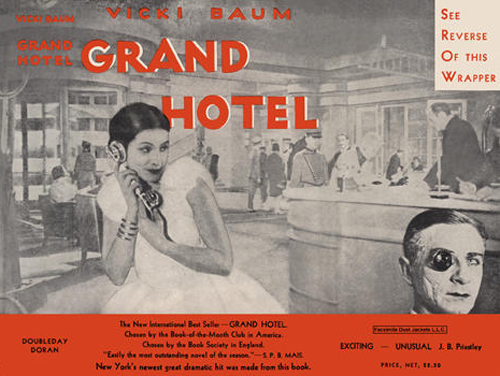
Vicki Baum, an emerging German novelist, launched Grand Hotel as a magazine serial. It was published in book form in 1929 as Menschen im Hotel and became a huge seller. The following year saw Baum’s international breakthrough. In January a stage version opened in Berlin. It migrated to Broadway in November and enjoyed huge success. Meanwhile, a British publisher brought out an English translation. In February of 1931, Doubleday published an American edition. That month Baum arrived in Hollywood to work on the screenplay for what she called her “star-studded wedding cake.”
The central story remains constant in all the media versions. Three men converge in Berlin’s Grand Hotel, each with his own aims. Baron von Gaigern is a penniless aristocrat who has taken to theft. The provincial bookeeper Kringelein has been diagnosed with a fatal disease, so he has vowed to enjoy the good life before he dies. He demands a costly room and plans to wine, dine, and gamble his savings away. The business mogul Preysing is there to meet with potential partners in a big business deal. Preysing, it turns out, is the owner of the company employing Kringelein.
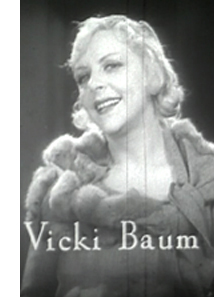 The men’s plans pull two women into their orbit. There is the glamorous but fading dancer Grusinskaya. She meets the Baron when he slips into her room to steal her pearls; during that night of sexytime they fall in love. Then there is the stenographer Flaemmchen, who takes a liking to the Baron but who is dominated by Preysing. He has hired her to record his deal-making, and he soon invites her to be his mistress. Add in secondary characters like the porter Senf, who at the start is waiting for news of his wife’s delivery of their baby, and Dr. Otternschlag, a disfigured war veteran who drifts around the lobby mournfully observing life. The men’s plans pull two women into their orbit. There is the glamorous but fading dancer Grusinskaya. She meets the Baron when he slips into her room to steal her pearls; during that night of sexytime they fall in love. Then there is the stenographer Flaemmchen, who takes a liking to the Baron but who is dominated by Preysing. He has hired her to record his deal-making, and he soon invites her to be his mistress. Add in secondary characters like the porter Senf, who at the start is waiting for news of his wife’s delivery of their baby, and Dr. Otternschlag, a disfigured war veteran who drifts around the lobby mournfully observing life.
The novel’s action consumes three days and nights, with an epilogue on the morning of the fourth day. Each major character undergoes a crisis triggered by meeting others in the hotel. Preysing catches the Baron in his apartment, bent on robbery. In beating the Baron to death, Preysing ruins his life; he is arrested and his family leaves him. Flaemmchen, about to go off with Preysing, attaches herself to Kringelein and vows to help him recover his health. Grusinskaya, who has left Berlin for her tour date in Prague, calls the Baron’s room in vain, unaware that she will never see him again.
The book offers several attitudes toward the interwoven destinies. There is that of the grim Dr. Otternschlag, who sees in the lobby’s revolving door a ceaseless cycle of mundane suffering. “Always the same. Nothing happens. . . . And so it goes on. In—out, in—out.”
The bellboy looks at the same door and sees endless variety: “Marvelous the life you see in a big hotel like this. . . . Always something going on. One man goes to prison, another gets killed. . . .Such is Life!”
The omniscient narration provides another attitude, seeing in the door an image of life’s ephemeral, fragmentary quality.
The revolving door twirls around and what passes between arrival and departure is nothing complete in itself. Perhaps there is no such thing as a completed destiny in the world, but only approximations, beginnings that come to no conclusion or conclusions that have no beginnings.
All three musings represent, we might say, alternative ways of reading the novel: as an eternal return, a varied pageant of human drama, or scattered glimpses of incomplete lives.
Play and film: Call waiting
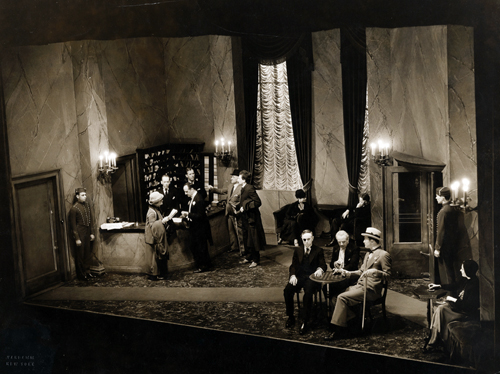
National Theatre production, New York 1930.
The novel spreads the action to the theatre, a casino, and an airplane flight, but the stage version confines itself wholly to the hotel. The play begins with a coup de théâtre for which Baum claimed the credit. Preysing, Kringelein, the Baron, Flaemmchen, and Grusinskaya’s maid Suzanne are introduced in a line of telephone booths, each making a quick phone call. The light in each booth flashes on and off as each one speaks. The pace builds until each speaker is “intercut” rapidly with another. Baum claimed that this pulsating sequence drove the opening-night audience to a frenzy of applause. Snazzy as it is, the prologue serves as crisp exposition, literally spotlighting nearly every major character, with Suzanne acting as a proxy for the dancer Grusinskaya. Then the revolving stage whisks us to a broad view of the lobby teeming with guests and staff.
The novel can proceed in a fragmentary way, shifting from one character to another, but the play contrives a more fluid rhythm of encounters. At the start, several characters assemble at the front desk, and after a “cutaway” to Grusinskaya’s room, we’re back in the lobby with Flaemmchen, the Baron, and Kringelein chatting while Preysing and his colleagues head off to their conference. Later all the major characters except Grusinskaya, who’s often marked as separate from the others, meet in the hotel bar and grill. At the conclusion, as characters depart, overlapping encounters carry Flaemmchen out the door with Kringelein, and Grusinskaya leaves for Prague wondering why the Baron has failed to meet her. The spatial concentration of the play squeezes the characters’ trajectories together more tightly than the novel does.
The film does much the same thing. When head of production Irving Thalberg bought the rights to Baum’s novel, he had to buy the stage rights as well, and so MGM funded the Broadway production. It garnered over a million dollars in its first year.
Claus Tieber points out that having seen the play, Thalberg insisted that the bits that pleased the Broadway audience had to stay in the film. No wonder that the film sticks close to the stage version. Although sequences are added, they seem in the spirit of the play’s swift pace. An American critic had described the book’s rapid changes of scene as like a film: “interlocking adventures, a little too easily linked perhaps, flit from screen to screen [shot to shot?].” Baum agreed:
I realized what had made my Grand Hotel, the novel and the play, a world success: it was probably the first of its kind to be written in a sort of moving picture technique. By now [1964] that’s the oldest of old hats, but in those days the kaleidoscopic effects, brief ever-changing scenes, flashes, staccato dialogue, were new, surprising, and exciting…on the stage. On the screen, I felt, this technique was the usual old stale shopworn thing.
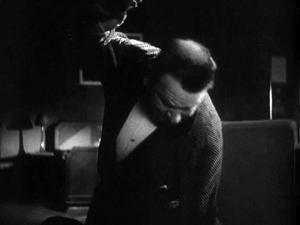
In a crucial expansion of both book and stage show, the film emphasizes the telephone switchboard, marking the hotel as the crossing point of many destinies. After Preysing has beaten the Baron to death with a phone receiver, the switchboard is ominously stilled at the climax.
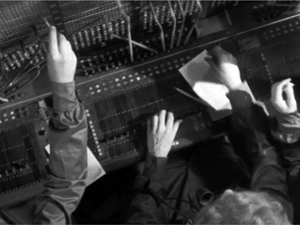  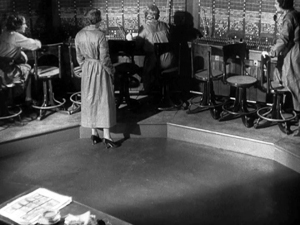
The prologue shows other protagonists making calls, but Grusinskaya, because of her isolation from the others, works the phone in the bulk of the film. Her final call for the Baron goes unanswered, heard only by his dog.
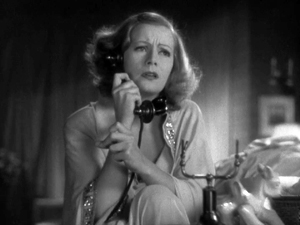 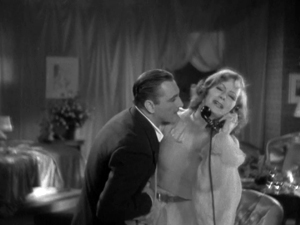 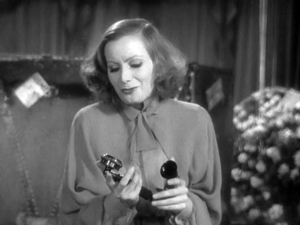
The play had enhanced the women’s roles, and the film goes farther by casting two top stars, Greta Garbo as Grusinskaya and Joan Crawford as Flaemmchen. With three strong male leads—Wallace Beery as Preysing, Lionel Barrymore as Kringelein, and John Barrymore as the Baron—the film became an ensemble drama that gave more or less equal weight to five characters. Accordingly it became known as the first “all-star picture.” On its tenth anniversary Variety proclaimed that it “disproved the contention that no picture could support a huge all-star cast.”
Even putting the cast aside, Grand Hotel crystallized a narrative option that had been emerging, more or less explicitly in the years before.
Networks and cross-sections
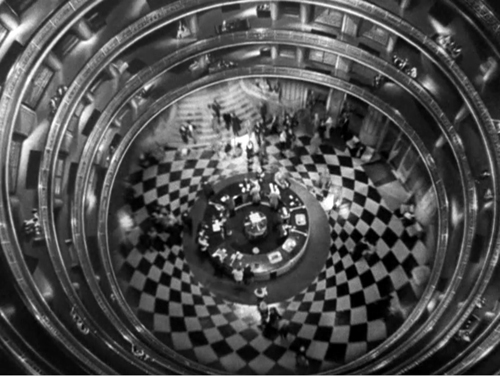
We can think of the Grand Hotel format as one variant of what I’ve called network narratives. Putting it generally, these are films that shift our attention across several somewhat linked characters and their projects.
Most films we encounter have a single protagonist, accompanied by helpers and facing some number of antagonists. Other plots have dual protagonists, perhaps cops who are buddies, or a man and a woman in a romantic relationship. A few films may have three protagonists, like Letter to Three Wives.
Another variation is the film with several protagonists, each given roughly equal weight. Usually the multiple protagonists share a goal, as in combat films, where they are united in a common mission. But when we have multiple protagonists pursuing different, largely unrelated goals, we have what I’m calling a network narrative.
What makes all these characters part of the same network? Any social relation. They might be relatives, friends, co-workers, classmates, neighbors, ex-lovers, or whatever. Also, mere proximity can connect characters; maybe they’re in the same hospital room or conference meeting or just in the same town.
As the film unfolds, we come to understand the array of characters and their connections. We follow one, then another, and we watch new relationships form. Sometimes hidden relationships are revealed to create a surprise. Some connections are distant, of the n-degrees-of-separation variety. The characters’ various purposes may run parallel, or they may intersect and clash—all more or less accidentally. Most plots of any sort are connected by causality, but network narratives are once tight (because of the pressure of the characters’ goals) and loose (because social ties can flow in many directions).
The advantage of the network approach is to yield a cross-section of life denied to more traditional linear narrative. Such plots can present, as Joseph Warren Beach puts it, a “comprehensiveness of view” that becomes “a composite picture of many distinct lives.” But the strategy raises problems too. The idea of a network narrative invites a dizzying expansion. X meets Y, who’s married to Z, the friend of A, who works with B, and pretty soon your story world is growing out of control. You need to constrain it somehow.
One way, as in Slacker, is just to sample one string of the network, moving from node to node. This generates a sort of “slice of life” plot, in the manner of Naturalist theatre. That snatches a few episodes from central characters’ lives without the customary setups and resolution. Bernard Shaw noted that “The moment the dramatist gives up accidents and catastrophes, and takes ‘slices of life’ as his material, he finds himself committed to plays that have no endings.” In film, we might think of one prototype of Neorealist cinema, The Bicycle Thieves. Baum’s framing narration of Grand Hotel, with its musing on stories without clear-cut beginnings or resolutions, tries for the same sense of what Zola called “a fragment of existence.”
Some of the literary models, such as The Lower Depths, accept a slice-of-life approach, without traditional climaxes and resolutions. Modernist writers pushed this possibility further, very open-textured networks. Dos Passos’ USA trilogy (1930-1936) is one example. Evelyn Scott’s The Wave (1929) presents seventy episodes from the Civil War, each concentrating on a different individual, although some characters reappear in sections devoted to others. A comparable strategy rules William March’s Company K (1933), with its 131 vignettes of World War I, with each soldier’s scene narrated in first person. Again, some characters reappear, but the network is largely a dispersed one.
Novels with well-defined protagonists occasionally strayed into a more lateral, open-textured approach. One example is the Wandering Rocks section of Ulysses, which fleetingly probes the minds and actions of about a hundred Dubliners moving through mid-afternoon. In Woolf’s Mrs. Dalloway (1925), a sudden noise from a car stuck in traffic, followed by an airplane swooping above, causes various members of a crowd to think stray thoughts. Like Joyce, Woolf momentarily broadens the frame to register the reactions of characters unconnected with the protagonists, except by being present outside Buckingham Palace at the same moment. Only space and time create this network, and it’s ephemeral.
Bring us together
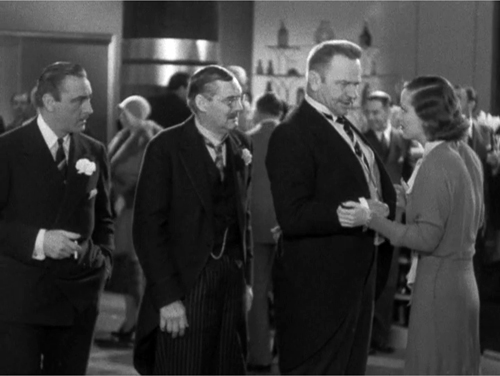
Given our appetite for linear narrative, some storytellers are bound to seek ways to tighten things up. Can we graft normal plot development—goals, conflicts, rising tension, climaxes, and resolutions—onto the network idea?
Yes. One way is to create the network through a circulating object, as in Tales of Manhattan, Au hasard Balthasar, American Gun, Twenty Bucks, or The Earrings of Madam de…. Sometimes the result will be episodic, but other times there will be a rising tension and a conclusion to at least some lines of action.
The most common way to constrain the network is to multiply the connections within the group. That is, don’t make the network loosely woven. So X meets Y, who’s married to Z, the friend of A; but A works with X, who is the cousin of B, who has been having an affair with Y, and so on. In other words, you create a “small world” defined by several connections among all the participants.
This small-word model is common in novels that create network narratives. Dickens, Balzac, and other writers have created complex degrees-of-separation plots. It’s likewise the pattern for most network narratives on film: several connections link many of the nodes. Here’s a diagram for Love Actually.
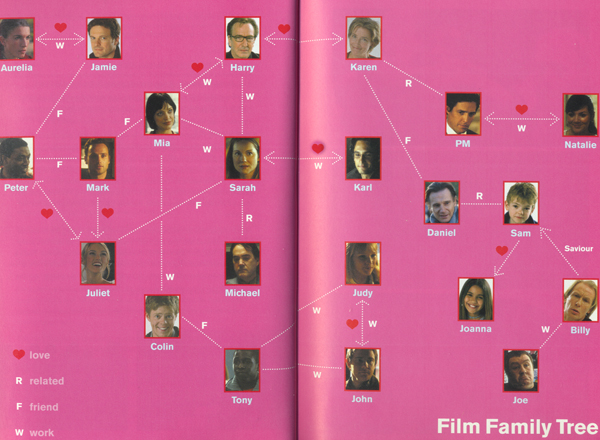
This chart is oversimplified because it doesn’t account for other relationships. Colin, for example, as the sandwich delivery boy, interacts with several of Harry’s employees. Still, at a glance you can see a fairly tight network.
Another way to constrain the network is to set limits of space and time. Slacker, like Mrs. Dalloway, explores a network established by spatial proximity; when we leave one character we pick up another nearby. The circulating-object option often presumes that the characters share a locale. Love Actually limits its intertwined stories to London, and still further to the Christmas season there. Louis Bromfield’s 1932 novel Twenty-Four Hours follows its Manhattan ensemble through one full day. (Compare that unlamented recent release, Valentine’s Day.) A 1938 British film, Bank Holiday traces several people across a weekend at a seaside resort.
The space can be more radically limited, as in Waldo Frank’s book of interconnected short stories City Block (1922). Perhaps influenced by Frank’s book, Elmer Rice wrote and staged Street Scene, a 1929 play that weaves together the lives of people living in a tenement. Their relationships are played out on the building stoop and the street in front. The play was filmed in 1931, and perhaps if it had been more successful, or had featured many big stars, we’d be talking about “Street Scene plots” rather than Grand Hotel ones.
Buildings are ideal for tying story lines together. Zola’s novel Pot-Bouille (1882) confines its action largely to an apartment house and the people who live there. Gorky’s play The Lower Depths brings together several characters in a flophouse. Inns, taverns, and hotels are natural points of convergence, and travelers naturally bring story action along with them. This is the narrative convention of l’auberge espagnole, based on the idea that in a Spanish inn you bring your own food.
When we have mostly strangers interacting in a constrained time and space, and when those interactions lead to traditional conflicts and resolutions (avoiding the slice-of-life pattern), we can speak of “converging-fates” narratives. Grand Hotel became the great prototype of converging-fates plotting.
Baum modernized the auberge espagnole idea by concentrating the action in a luxury hotel. She understood that these surroundings could motivate the chance meetings that propel the plot. She wasn’t alone. At the time her book was published, there were other “hotel” novels, notably Arnold Bennett’s Imperial Palace (1930). Whereas Bennett emphasizes the hotel staff and its routines, Baum concentrates on the guests. She motivates her comparisons across classes by making Kringelein a poor man having a final fling and making the Baron a penniless aristocrat keeping up appearances.
Baum showed how filmmakers who wanted an ensemble plot could bypass the sort of fragmentary, open-textured network seen in Dos Passos, The Wave, or Company K. She showed how to build more tightly integrated situations, with intersecting characters, each pursuing his or her goals and unexpectedly affecting other characters. The whole dynamic would take place in a rigorously confined setting and a sharply bounded period of time. The disparate story lines, knotting in certain scenes, would build to a climax. In Grand Hotel, all the characters’ fates come together when Preysing kills the Baron. Flaemmchen, terrified, rouses Kringelein and brings him into the crisis.
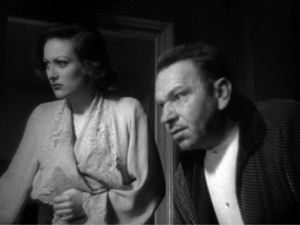 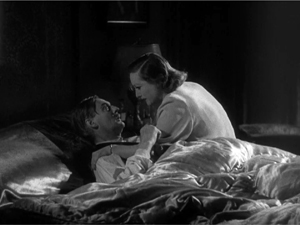
In such ways, a network narrative could become a variant of classical plotting, complete with exposition, conflict, crisis, and climax. Now Baum’s claim that the book traces mere fragments of life seems to be camouflage. Each protagonist’s fate has a linear logic; it’s just that the lines intersect.
If you’re a modernist, you find this a dilution of strong brew. You deplore the way fiction writers and moviemakers adapt avant-garde techniques to middlebrow taste. Yet if you’re a mainstream filmmaker, you can see that absorbing these techniques freshens up the norms. The crisscrossing destinies create an urgent pace, a new openness to chance and accident, and an invitation to imagine a patterning beyond that of straightforward single- or dual-protagonist plotting. Hollywood may feed on more “advanced” storytelling, but it doesn’t simply iron out the difficulties; in absorbing the techniques, it enriches its own traditions.
Thalberg predicted this change when the film was in production.
I don’t mean that the exact theme of “Grand Hotel” will be copied, though this may happen, but the form and mood will be followed. For instance, we may have such settings as a train, where all the action happens in a journey from one city to another; or action that takes place during the time a boat sails from one harbor and culminates with the end of the trip. The general idea will be that of a drama induced by the chance meeting of a group of conflicting and interesting personalities.
The last sentence isn’t a bad encapsulation of the converging-fates schema.
Hotel franchising
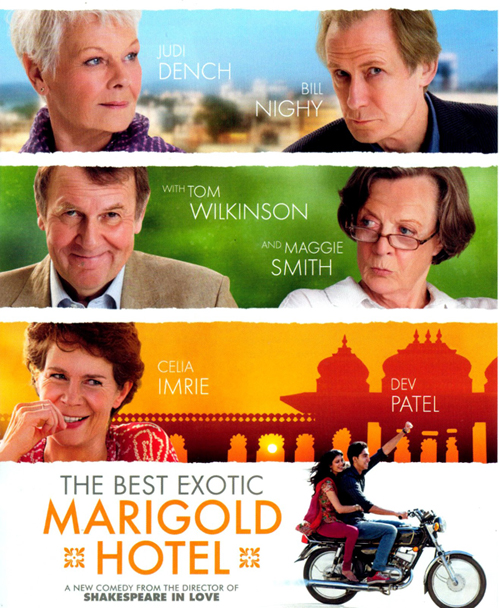
Thalberg was right, of course. Grand Hotel, in all its incarnations, encapsulated a narrative option that was irresistible. By 1955 Kenneth Tynan paid tribute to the fertility of the idea.
No literary device in this century has earned so much for so many people. Unite a group of people in artificial surroundings—a hotel, a life-boat, an airliner—and, almost automatically, you have a success on your hands.
Baum compared herself to the sorceror’s apprentice, who couldn’t stop her creature from splitting and rushing off in all directions. Critics detected traces of the novel and play in Translatlantic (1931), Union Depot (1932), and Hotel Continental (1932), all released before the MGM vehicle. These films do confine most of their action to a single setting, but they don’t multiply protagonists to the same extent as the original. A 1932 play, Life Begins, is closer to Baum’s model, finding converging destinies in a maternity ward. Some suspected that the 1932 film, released in May, was Warners’ effort to compete with Grand Hotel, premiering in April but not going wide until summer and fall.
MGM imitated itself in another 1932 release, Skyscraper Souls, which applied the formula to an office building. Faith Baldwin’s original novel Skyscraper focused on a working-girl romance, but the screenplay expanded the plot. A great many characters working in the skyscraper get involved in love affairs, a stock swindle, and an aborted jewelry theft. As with Grand Hotel, all the action transpires in one building.
Like Strange Interlude, Grand Hotel inspired parody. In Paramount’s International House (1933) various personalities converge on a hotel in Wu-Hu, China, to buy the rights to Dr. Wong’s “radioscope” (aka TV). W. C. Fields, Stuart Erwin, Bela Lugosi, Franklin Pangborn, Cab Calloway, Rudy Vallee, George and Gracie, and the notoriously torrid Peggy Hopkins Joyce enliven the proceedings. There’s an allusion to the hotel switchboard in the original film when Fields gets tangled up in phone cables. He’s also flummoxed by Gracie Allen.
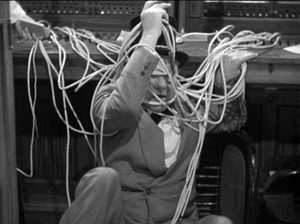 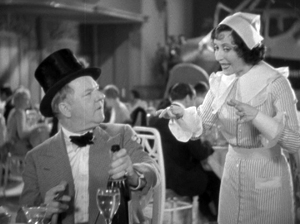
After one of Gracie’s non sequiturs Fields asks: “What’s the penalty for murder in China?”
A curious parallel surfaced in Die Wunder-bar, a German play premiered in February 1930, just a month after the opening of Grand Hotel’s stage version. Transposed to film, it became an Al Jolson vehicle, Wonder Bar (Warners, 1934). It has a fairly coherent threads-of-destiny plot. Flirtations, suicides, and musical numbers (including one with Al in blackface, of course) fill out action occurring in a single day. There was also Die Uberfahrt, a 1932 novel by Gina Kaus, translated as Luxury Liner and filmed under that title by Paramount in 1933. Variety called Wonder Bar “a ‘Grand Hotel’ of a Paris boite-de-nuit,” and Motion Picture Herald called Luxury Liner “Grand Hotel on a steamboat.”
The Grand-Hotel-on-an-X formula became a catchphrase, like Die-Hard-on-an-X of years later. We associate the phrase “Grand Hotel on wheels” with Stagecoach (1939) because that was used in its publicity. But reviewers had applied that phrase earlier, to Streamline Express (1935) and Time Out for Romance (1937)—the former involving a train, the latter an automobile convoy. The British import Rome Express (1933) was “Grand Hotel on a train” and Mitchell Leisen’s fine Four Hours to Kill (1935), set in a theatre lobby and lounge, became “Grand Hotel in miniature.” Fifty-four Ames Street, a screenplay apparently never filmed, was said to be “a sort of Grand Hotel in a New York apartment house.” Producers interested in Saroyan’s play The Time of Your Life saw in its tavern locale and migrating flocks of characters “an all-star vehicle somewhat along the lines of ‘Grand Hotel.’”
One critic worried that Winter Carnival (1940) was tantamount to “Grand Hotel on skis,” but F. Scott Fitzgerald, sweating over the script, had worried that it couldn’t be “a group picture in the sense that Stagecoach was, or Grand Hotel.” It had, he noted, “no sense of destiny.” That sense was much stronger in One Crowded Night (1940), an RKO B that I’m fond of. It might be called “Grand Motel,” as it brings together a preposterous number of plotlines at a desert auto court.
The Grand Hotel paradigm did not rest. The original film was remade, in more complicated form, as Week-End at the Waldorf (1945). There were other variants of the template—famously Lifeboat (1943) and Hotel Berlin (1945), less notably Ulmer’s Club Havana (1945) and the PRC cheapie The Black Raven (1943). Life Begins was redone as A Child Is Born (1940), and at the end of the decade Harry Cohn expressed interest in remaking it again. The play Flight to the West (1940), set on an airplane, showed Elmer Rice contributing to the trend.
By 1943, a Variety columnist was admitting that there was a tradition behind it all. “Ever since Boccaccio rounded up a herd of characters in his Decameron, dramatists have been utilizing the restricted space idea to make their stories more compact.” What he did not say was that most of Grand Hotel knockoff movies had been B-pictures.
Baum bitterly resented what had happened to her most famous work. “Countless cheap imitations and adaptations gave it a bad name. . . It all quickly became a mechanical toy. A formula, to be bought and sold on the supermarket.” That didn’t stop her from ringing changes on her model. Her play Pariser Platz 13 (1930), set in a beauty parlor, and her novel Martin’s Summer (1931), tracing a drama among strangers at a vacation resort, inevitably recalled her breakthrough work. She mined the vein again with Hotel Shanghai ‘37 (1939) and Hotel Berlin ’43 (1944). Things became risible when Variety announced that she was preparing a (never-filmed) screenplay called Grand Central Market, based on an idea by a busboy in the MGM commissary. But perhaps she wouldn’t have minded the jeers that she was milking her most marketable idea. “I know what I’m worth: I am a first-rate second-rate author.”
Catch them coming or going
The Grand Hotel converging-fates format got recycled for decades, in movies from The V.I.P.s and Hotel to Four Rooms and Auberge Espagnole. Network narrative as a general trend came back in a big way in the 1990s. In an essay for Poetics of Cinema, I counted some 148 examples just from the period between 1994 (Pulp Fiction, 71 Fragments of a Chronology of Chance, Ready-to-Wear, Chungking Express, Exotica) and 2006 (Bobby, Colossal Youth, Selon Charlie), by way of Do The Right Thing, Magnolia, Sunshine State, Wonderland, and Happiness. Filmmakers, mostly non-Hollywood ones, revived and reformatted the old template. They could cunningly resolve some story lines, and so satisfying our fondness for closure, while also leaving some unresolved, and so satisfying our belief in realistic “slices of life.”
Although I should be fed up with such plots, I still find them intriguing. They can yield mystery, as we’re teased about the possible connections among the characters; their network pattern can be revealed or obscured by flashbacks, subjective sequences, frame stories, forking-path patterns, and other devices, as in Go and Once Upon a Time in Triad Society 2. The format can really test the ingenuity of a screenwriter.
Still, network plots pose unique problems. One is figuring out all the interactions in situ. How do you weave everything together? Apart from kinship and friendship, the easy links are chance encounters, merely passing in the street, watching somebody on TV, or, most desperate of all, the traffic accident. (Crash is only the most egregious instance.) Finding fresh ways to hook up your nodes is quite a challenge, as is devising a satisfying payoff for at least some of them.
Another problem is more specific to the converging-fates option: the choice of “point of attack.” Taken just as geometry, the plot can be seen as having three phases. Here’s an infographic courtesy of our web tsarina Meg Hamel. On the left, the characters are independent. In the center–a closed environment like a hotel, or a more porous one like a holiday season–they are drawn together. They circulate and interact. On the right, we see them dispersing, all changed in one way or another.
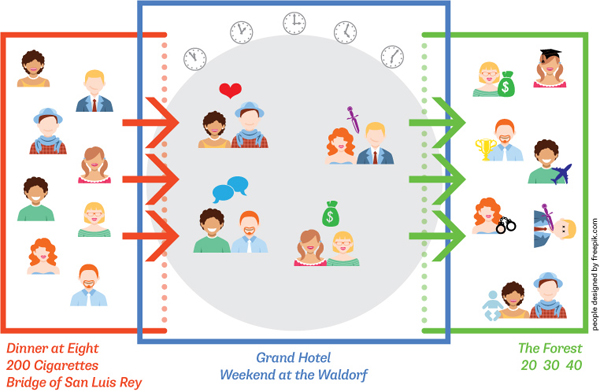
The question is: Where do you cut into this process to start and end your plot? Some films, like In Which We Serve, try to trace the whole process more fully. We see it in a more spacious form in The Great Race and Cannonball Run. Perhaps The Rules of the Game would be another instance.
But most films of this ilk concentrate on the convergence, the central circle of interaction we see in Grand Hotel. That’s what we find in Mizoguchi’s Street of Shame, The Uchoten Hotel, Drive-In, Health, The Yacoubian Building, Monsoon Wedding, et al. Often there’s a time pressure too, as the clocks in the graphic indicate.
Or you the screenwriter could shift a step back and base your plot on the action before the characters commingle. My red block indicates a plot concentrating on this early phase. The dotted line indicates our seeing a little bit of the convergence.
The prototype is probably Dinner at Eight, a 1932 play made into a 1933 film (yes, also by MGM). The comic plot traces several couples invited to a dinner party. Some of them have one-off encounters before the big night, but the plot depends on the eventual convergence of everyone. The film stops just as the assembled guests step into the dining room. A modern parallel is 200 Cigarettes, which intercuts several guests on their way to a party. Again, we don’t see the party directly, but in an epilogue a montage of snapshots gives us some glimpses.
Probably the most famous example of pre-convergence plotting is the novel The Bridge of San Luis Rey. Thornton Wilder uses a flashback construction to trace the lives of the characters. At the start we learn that the bridge collapsed, killing them all, and then via an inquisitive priest we are taken back to the events that brought them to the same fate. By contrast, Claude Lelouche’s Il y a des jours…et des nuits saves the moment of convergence for a traffic tieup at the very end of the film.
Alternatively, you could build your plot at the other end, as indicated by my green box. Your story action begins with the dispersal of the characters who have already converged, though perhaps you show something of their encounters before they split up.
This is the rarest option, I think. One example is Benedict Fliegauf’s The Forest, which shows several people leaving a train station and proceeding on to their parallel, and fairly mysterious, lives. A more heavily motivated example is Sylvia Chang’s film 20 30 40, which initially brings three women together as passengers on an airplane flight before sending each off to her own pursuits. Although they live in the same neighborhood and their activities are intercut, the women never meet. Two films I haven’t seen seem to follow this parallel-dispersal pattern. In Urlaub auf Ehrenwart (Leave on Word of Honor, 1938), a commander gives his men leave for a day on their way to the front, and the plot follows each one’s experiences. It was adapted into a Japanese film, The Last Visit Home (Saigo no kikyo, 1945).
As with any plot scheme, the closer you look, the more variations and extensions you see. Sometimes it’s useful to see any one plot as a reconfiguration of other plots. The network principle–itself a threading of goal orientation, conflict, and other narrative devices–can be a beautiful meeting point of story possibilities. One reason I think filmmakers like these plots is that, somewhat like mystery stories, they are narrative to the nth degree. How many situations, characters, and unexpected connections and analogues can you squeeze into a single movie? It’s a challenge.
What crystallized in an MGM prestige production of 1932 seemed a fresh approach to film narrative. Even in the opportunistic ripoffs of the following decades, we can sense an excitement in tinkering with a new storytelling pattern. And of course some variants still seize us today. Just ask the audience making its way to The Second Best Exotic Marigold Hotel, or the young hipsters immersed in the mini-library that is Chris Ware’s Building Stories. Lately we haven’t seen many network movies, but I expect another wave. Like it or not, some story ideas never die.
My information about Vicki Baum’s career comes from Lynda J. King’s Best-Sellers by Design: Vicki Baum and the House of Ullstein (Wayne State University Press, 1988). I drew my Baum quotations from two curiously different editions of her memoirs, I Know What I’m Worth (Joseph, 1964) and It Was All Quite Different: The Memoirs of Vicki Baum (Funk and Wagnalls, 1964). The reviewer who called Baum’s novel cinematic was Herman Ould in “Experiments in Technique: Vicki Baum and Arnold Zweig,” The Bookman 79 (November 1930), 132.
Claus Tieber analyzes the Grand Hotel story conferences in “‘A story is not a story but a conference’: Story conferences and the classical studio system,” Journal of Screenwriting 5, 2 (2014), 225-237. In correspondence Patrick Keating has shared with me a story conference concerning Skyscraper Souls (MGM, 1932), in which the participants discuss transitions between scenes. Should the film cut from one plotline to another, or use camera movements, or have the characters link to one another? The filmmakers discuss Grand Hotel as a model for handling the problem. Thanks to Patrick for the information.
Joseph Warren Beach provides a helpful survey of experiments in mainstream fiction of this period in The Twentieth Century Novel (Appleton Century Crofts, 1932). I’ve drawn upon his chapter “The Breadthwise Cutting.” Shaw’s remarks on the slice-of-life plot are in his Preface to Three Plays by Brieux (Brentano’s, 1913), xv-xvi. In The Writing of Fiction (Scribners, 1924) Edith Wharton comments that English novelists of the early nineteenth century favored the “double plot,” a form that presented “two parallel series of adventures, in which two separate groups of people were concerned, sometimes with hardly a link between the two” (81). She considers this a “senseless convention,” but it seems to me another means of creating a network narrative. Sometimes the nodes connecting the groups become clear only gradually. There may be even a dose of mystery, as in Our Mutual Friend; the reader is encouraged to wonder how the two ensembles might be hooked up.
The diagram of the network in Love Actually comes from Peter Curtis, Love Actually (St. Martin’s, 2003), 6-7. Although at least one story line in the film doesn’t get fully resolved, Curtis is committed to a classical model: “I thought I’d like to have a go at writing that kind of film–to see if it was possible to write a film with nine beginnings, nine snappy middles and nine ends.” He declared himself inspired by Nashville, which I’d argue has a much looser texture and treats its story lines largely as slices of life.
Kenneth Tynan’s remark comes from his 1955 essay “Thornton Wilder,” reprinted in Profiles, selected and edited by Kathleen Tynan and Ernie Eban (Random House, 1995), 106. My citations of critical commentary on various films comes from the Hollywood trade press, as indexed in Lantern. Thalberg’s remark on Grand Hotel‘s likely influence is quoted from “Producer Discusses Pictures,” New York Times (3 May 1931), X6. Peter B. High discusses The Last Visit Home in his The Imperial Screen: Japanese Film Culture in the Fifteen Years’ War, 1931-1945 (University of Wisconsin Press, 2003), 485-487.
My fullest treatment of network narratives is in Poetics of Cinema, in the essay “Mutual Friends and Chronologies of Chance.” To the same subject Peter Parshall devoted an insightful book, Altman and After: Multiple Narratives in Film, which I plug here. A search of our site with “network narrative” as the key phrase will turn up several remarks on the format.
P.S. 23 March 2015: Thanks to Antti Alanen for a correction: I had accidentally written that Pot-Bouille was by Balzac, not Zola.
P.P.S. 31 March 2015: Rewatching Skyscraper Souls, I added a paragraph about it, which better sets up Patrick Keating’s information in the codicil. It’s a pretty good movie, in some ways more complex than Grand Hotel.
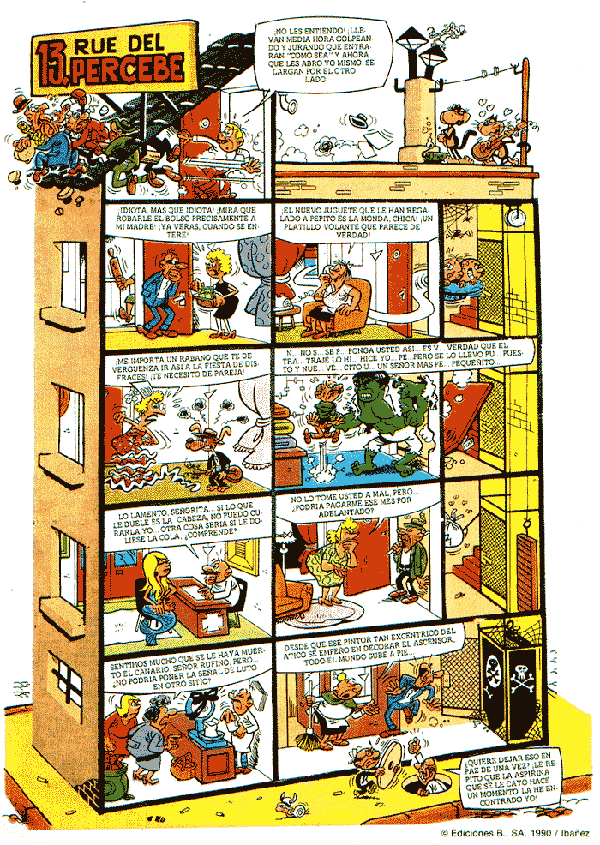
Francisco Ibáñez, 13, rue Percebe. With thanks to Vicente J. Benet.
Posted in Film and other media, Film technique: Screenwriting, Hollywood: Artistic traditions, Narrative strategies | open printable version
| No Comments »
|