















Archive for the 'UW Film Studies' Category
Sweet 16
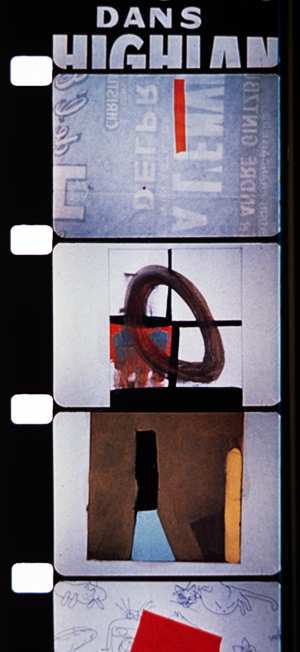
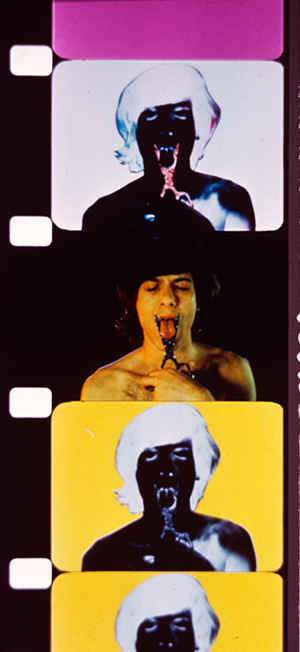
REcreation (Robert Breer, 1956); T.O.U.C.H.I.N.G (Paul Sharits, 1969).
DB here:
Snows and thaws and refreezing, amplified by a torrential rain, gave water a new path into our basement. We’ve spent about two weeks emptying bookshelves, drying them out, and shifting books to other places. No volumes were damaged, but we had to make space in the dry areas for the migrant titles.
That meant facing up to the problem of 16mm.
The solution was drastic.
Narrow-gauge movies
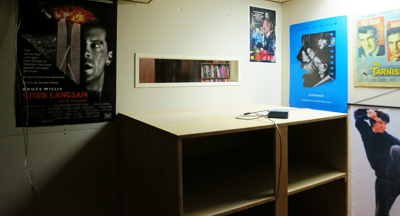
My film collecting started with 8mm. Not super-8; that was invented later. (Imagine how old I am.) I made my own movies in 8, but I also bought, from the venerable Blackhawk Films of Davenport, Iowa, copies of films in that format. Most memorable was the Odessa Steps reel from Battleship Potemkin, which I projected often on my bedroom wall.
Not until I went to college and joined a film club did I lay my hands on 16mm. I suppose if you start out handling 35mm, 16 looks skinny and 8 looks like a toy. But moving from 8 to 16, I could see only improvement. You could, with the sharp eyes of the teenage geek, actually see the image on the strip. I projected many films on our JAN surplus projectors, and one weekend I hauled a print of Citizen Kane to my apartment to watch several times. Do I need to add that all this was in the 1960s, long before films became available on videotape?
Arriving in Madison in 1973, Kristin and I bought a Kodak Pageant, the 16mm workhorse. Not as good as a Bell & Howell, most aficionados would tell you, but fairly cheap and easy to handle. When we moved from apartment to apartment, the Pageant went with us.
In 1977 we bought a house, and I set up a jerry-rigged projection room in the unfinished basement. In our second house, where we still live, I was able to set up something more permanent. Now there were two projectors encased in a booth and mounted on a platform.
We spent many hours watching movies in that currently soggy basement, with its burgundy carpet and dark wood paneling. Although the room lacked the comforts of what we think of as a home theatre, we sometimes screened things for big groups, either a party or once in a while students in a seminar.
In both venues, we previewed movies we were showing in courses and revisited some of our growing collection: The Shop Around the Corner, High and Low, True Stories (must blog about that some time), You Only Live Once, and so on. I’ve already expounded on the key role of His Girl Friday in our mini-cinémathèque.
By then Kristin and I had also started working with 35mm prints in archives and with 35mm trailers we scavenged to make slides for lectures. For a brief while we even had 35mm in our screening space, but with only one projector, shows stretched too long. Although home video had taken off, Betavision, VHS, and even laserdiscs couldn’t compare to a good 16 copy. We continued to collect and show on film, as did our department.
In the last decade, improvements in digital projection, along with the arrival of Blu-ray, led to the decline of 16 in our local media ecosystem. Our department still shows a lot of 35, but 16 seems mostly the province of our experimental and documentary courses. As for us, we hadn’t screened 16 at home for some years. Then came the February leak, and we had to face the problem.
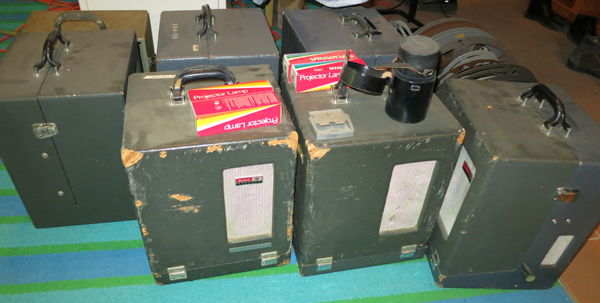
We’d already given many of our 16mm titles to the department, keeping our most fond treasures at home, thinking we’d watch them some day. Now we needed the space that those cans and cases occupied. Anyhow, it was probably time to let go. So we decided to surrender the features, the shorts, the cartoons, the splicers and the rewinds and the six Pageants—everything.
Our house is a museum of defunct technology. Just recently I surrendered my lovely Teac reel-to-reel tape recorder. Packed away are hundreds of Beta and VHS tapes. On groaning shelves sit hundreds of laserdiscs, mostly Asian. Yet under a roof that houses no fewer than six laserdisc players, there is no trace of the predominant nontheatrical film format of the twentieth century.
FOOFs
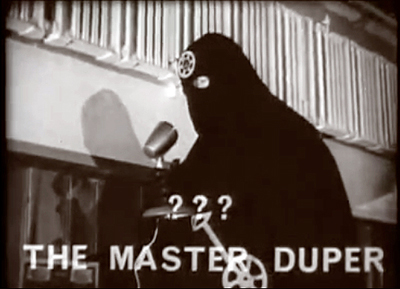
Captain Celluloid vs. the Film Pirates (1966).
Nowadays it’s easy to own a “film”—or rather a disc or file or stream of pixels fed to your display. (Though I wonder what it means to “own” something sitting on the Cloud in your virtual locker.) Back in the day, joining the ranks of 16mm collectors meant a real commitment. You needed to buy gear, you needed to clean and inspect the films, and you needed to learn a little projector maintenance. You probably subscribed to The Big Reel and Classic Film Collector, tabloids that ran ads selling or swapping prints and equipment. And you usually went to film collectors’ conventions, jamborees of selling, trading, and movie watching. The three biggest events, Cinecon (Los Angeles), Cinefest (Syracuse), and Cinevent (Columbus, Ohio), brought together the overwhelmingly male tribe of FOOFs: Fans of Old Films.
FOOF collectors had good hunting in those days. There were plenty of 16mm prints floating around, but quality varied. The best were those cast off from legit distributors. Made from internegatives drawn from 35mm positives, they usually had good tonal values. At the other end of the scale were the dupes, copies pulled from 16mm distribution prints. These ranged from acceptable to awful; but if you wanted a rarity, you might have to spring for a dupe.
In the middle zone were TV prints, probably the majority of copies in circulation. When studios licensed their pre-1948 libraries to television, go-between companies like C & C put together packages of prints to be sold to local stations around America. Small stations in the hinterlands harbored scores of 16mm copies, to be trimmed, filled out with commercials, and broadcast outside prime time, and sometimes within it as “Million Dollar Movie” or whatever. It’s still not fully appreciated, I think, how many baby-boomer auteurists around the country caught classics in the pre-dawn hours on local television.
But as network and syndicated programming expanded, there was less room for old movies. Why run a 1936 Paramount picture when you could show color re-runs of Bewitched or The Six Million Dollar Man? The stations’ 16mm prints were headed for landfill when enterprising collectors and entrepreneurs salvaged them. You could tell when you got a TV print. It might carry a packager’s logo; it would have low contrast; and splices between scenes would signal where the commercials had been jammed in.
FOOFs had their demons and demigods. Principal among the demons was one colorful character, who had the habit of bothering collectors circulating versions of old classics to which he claimed current rights. In The Sneeze, FOOFs made fun of the man who, releasing recovered prints of Birth of a Nation and Keaton films, made sure his own name featured prominently in the credits.
Among the demigods were Kevin Brownlow, he who had rescued Napoleon, and David Shepard, who started out at Blackhawk and eventually founded Film Preservation Associates. Most legendary of collectors was William K. Everson, who died in 1996. Thousands of prints were squeezed into his two Manhattan apartments and spilled over into the storage areas of NYU’s film department. He acquired many of his films in exchange for services he rendered to Hollywood studios. His gems were screened in his courses, in sessions of the Theodore Huff Memorial Film Society, and in lectures he presented around the world. I remember his excellent presentation on Joseph H. Lewis at Chicago’s Art Institute Film Center, where he showed clips from Lewis’ Poverty Row productions and even some credit sequences Lewis had crafted.
Bill brought a magnificent selection of titles to Madison in the early 80s, and many of them, such as Bulldog Drummond (1929) and Justin de Marseille (1935), remain rarities. Generous beyond measure, he also let NYU faculty and students borrow his movies. When Annette Michelson needed to see East of Borneo (1931) for her essay on Joseph Cornell’s Rose Hobart (1936), she turned to Bill. All of this largesse was made possible by the portable, user-friendly format of 16mm.
Freezing the frame
Teachers, filmmakers, and collectors had a special relation to 16mm. In addition, as researchers, we developed an unusually intimate rapport with the format. When I started teaching, I felt the need to illustrate my lectures with images from the films. My first efforts involved setting up a 35mm still camera on a tripod and photographing from the screen. If the projector could stop on a frame, so much the better; but even if not, you might snag an acceptable shot. The projected image would be surrounded by darkness. Today I wince at the results, as with this shot from Crime of M. Lange, one of the few old slides we haven’t cast out.
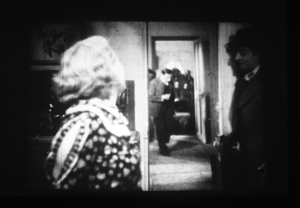
You could get sharper slides with a gadget called a Duplicon, but it cropped the 4 x 3 image to something like 3 x 2.
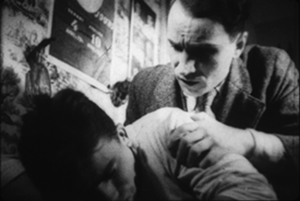
When Kristin and I decided to write Film Art: An Introduction, the few introductory textbooks relied almost entirely on production stills, those images shot on the set and circulated to promote the film. The Museum of Modern Art had an archive of production stills, and then as now, publishers turned to such collections for illustrations. As part of the first generation of university-trained film researchers, we doggedly insisted that all our examples would be actual film frames.
Today, digital video has made grabbing frames easy. But before the late 1990s, it was hard. Videotape frames looked terrible, as some books from the 1980s attest. To get decent quality, you needed access to prints. You needed a way to put a reel onto rewinds or, ideally, a flatbed editor like a Steenbeck. And you needed a camera with an enlarging attachment. When you’d copied your frames, you took the exposed film to a lab, where you hoped for a passable result. Black-and-white shots were easier than color, which required blinding lamps of a color temperature matched to Ektachrome or Fujichrome or Agfachrome.
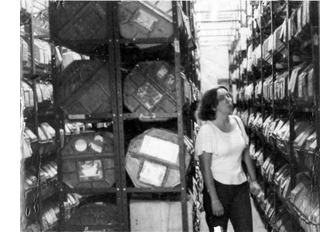 When we could get access to 35mm prints, they were our prime sources for stills. I went to Copenhagen to copy frames from Dreyer films for my first book, and for her dissertation and first book Kristin made frames from 35mm copies of Ivan the Terrible loaned her by Janus Films. Before that, for the first edition of Film Art (1979), we took our color shots from 35mm prints, most of them in the New Yorker Films library. Dan Talbot and José Lopez kindly granted us permission to go to Bonded Storage in Fort Lee. There in the tall aisles of shipping cases we set up a rewind and patiently hunted for the frames we needed.
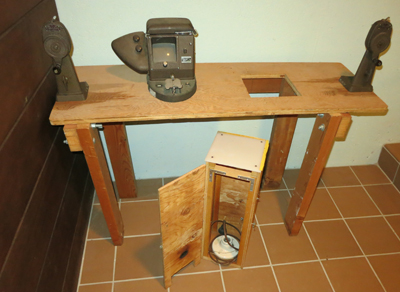
But most of the films we wanted to illustrate we could find only on 16. We rented prints and then took stills on a rickety gadget built for us by our friend David Allen. David bolted a pair of rewinds to a plank of plywood. That plank rested on a little table. Into the plank was cut a square slot for an upright light box. The box contained a bulb and was surmounted by a square of translucent plexiglass. The bulb could be put at the bottom of the box, for a photoflood lamp, or near the top with a cooler and dimmer appliance bulb for black-and-white. You positioned the film on the plexiglass and aimed the camera down at the film. A crude zoom lens allowed us to photograph a couple of frames of 16mm and one of 35.
We took the light box on our travels. Archivists certainly looked at us oddly when we brought the thing in, but they usually gave us permission to use it. We’d watch the film on a flatbed and bring the light box over alongside it. Laying the film gently on the surface, we’d poise the camera above it.
Here’s an example of what we got with our plywood setup, from Bill Everson’s print of Bulldog Drummond.
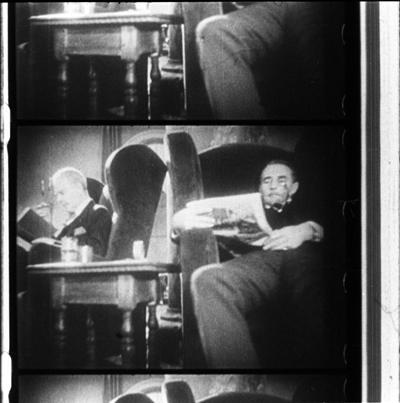
Over the years we improved our system. We bought better cameras, with sharper lenses. We found purpose-built attachments that hold the film strip firmly in place. (Alas, Canon and Nikon seem to have discontinued these rigs.) We used smaller lighting units rather than our curious box. For the last few decades we’ve shot horizontally rather than vertically.
Even in this age of video grabs, we make many frame enlargements on analog stock with 35mm cameras. Even if a film is available on DVD, some of the things we study aren’t preserved in that format. Of course many films aren’t available on video at all, and a great many of those were made to be seen on 16mm.
Format churn catches up with us
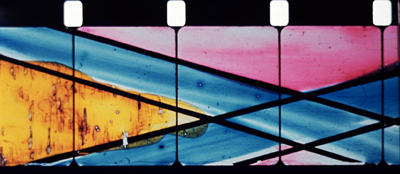
Notebook (Marie Menken, 1962).
Super-16 lives as a production format, but its older brother is nearly dead. True, a few die-hards like Ben Rivers continue to shoot on 16mm, but its future is mostly all used up. James Benning could make 16mm look like 35; when I asked him how he did it, he answered: “I use a light meter.” But even Jim has switched to digital. As for projection, many colleges and art centers have pitched out their 16 equipment.
Since our earliest editions, Film Art included discussions of two remarkable films: Bruce Conner’s A Movie (1958) and Robert Breer’s Fuji (1974). These have not been, and might never be, released on digital disc. Yet by the end of the 2000s, we found that virtually none of the users of our book screened these films for their classes, and curious readers without access to 16mm projection couldn’t easily see them. Reluctantly we cut them from the tenth edition of last year. We replaced A Movie with Koyanisqaatsi to illustrate associational form, and Fuji was replaced by Švankmajer’s Dimensions of Dialogue as an instance of experimental animation. Both titles are available on DVD.
Thanks to the Internet we’ve been able to revive our original discussions of the Conner and Breer films on our site here. We hope that will help the few loyal chevaliers who told me that they did indeed use the films in their courses. But our choice points up a larger problem.
So many documentary and avant-garde films were made and circulated on 16mm that we are at risk of losing a very large slice of film history. We’re lucky to have some Stan Brakhage and Hollis Frampton films on DVD, but what about all the other titles that were distributed by Canyon Cinema, the Film-Makers’ Coop, and other groups? We can get DVDs of Frederick Wiseman documentaries, and some classic ones have been made available on archival collections; but there are many more that depended on 16mm platforms. Even bigger is the set of everyday 16mm movies: amateur films, home movies, and hundreds of miles of newsfilm, from both big TV networks and local affiliates. A great many of the “orphan films” championed by Dan Streible and his colleagues are in this narrow-gauge format.
Recall too that the films of those animators and experimentalists who work frame by frame, such as Breer and Paul Sharits and Paolo Gioli, cannot be studied closely on DVD. How could DVD reveal to us the nifty paintwork of Marie Menken’s Notebook? For that you need a light table, or someone able to photograph it and show you.
Archives will retain 16mm projectors and viewing tables as long as they can. They will preserve prints, perhaps migrating the most sought-after ones to digital formats. Passionate collectors like Tim Romano, who zealously pursues lost films and then donates them to the AFI, will find a way to use our cast-off gear. Our Film Studies department will hang onto the format until the last aperture plate cracks.
16mm was so much a part of our work, our play, our education—in short, our lives—that the separation was inevitably poignant. Pinned to the bulletin board in my basement booth was Ellen Levy’s poem, “Rec Room.” It is, I think, about the fragility and faultiness of the 16mm image, as made palpable in home screenings, and about how that fragility nonetheless carries a pulse of vitality. It begins:
The film assumes the texture of its screen
on the first projection. Audrey Hepburn’s face
creases where the rec room paneling once
took exception to it for the sake of
rephrasing it slightly—a lesson
these late viewings have brought home. Home
screen or revival house . . . .
Thanks to Erik Gunneson and Tim Romano for helping us recycle our 16mm stuff.
Media historian Eric Hoyt, in our Communication Arts Department, studies among other things how the American studios disposed of their film libraries. He talks about his research and his book project, Hollywood Vault, here.
The FOOF contingent was unequivocally a force for good. To sample some of its wonkish hijinks, watch Captain Celluloid vs. the Film Pirates.
New York University’s Cinema Studies Department has created an extensive online collection of William K. Everson materials. For more on Bulldog Drummond, see this entry and this essay on the great William Cameron Menzies. Annette Michelson’s essay on Joseph Cornell, “Rose Hobart and Monsier Phot: Early Films from Utopia Parkway,” was published in Artforum 11 (June 1973), 47-57.
Bonded Storage in Fort Lee is part of the history of American cinema, as this article shows.
Paradoxically, you can study films frame by original frame on some laserdiscs, and on VHS tapes too if you are aware of the 3:2 pulldown. See my entry here. As so often happens, progress along one dimension means regression on another. So I cling to my rotting laserdiscs and demagnetizing old tapes.
James Benning discusses how digital cinema changed his artistic practice at Bombsite. An earlier entry of ours showcases the efforts of the Academy of Motion Picture Arts and Sciences to preserve experimental cinema.
Ellen Levy’s fine “Rec Room” is available in its entirety in The New York Review of Books (9 October 1986).
To watch a video about our Film Studies program, go here.
Talks, pictures, and more
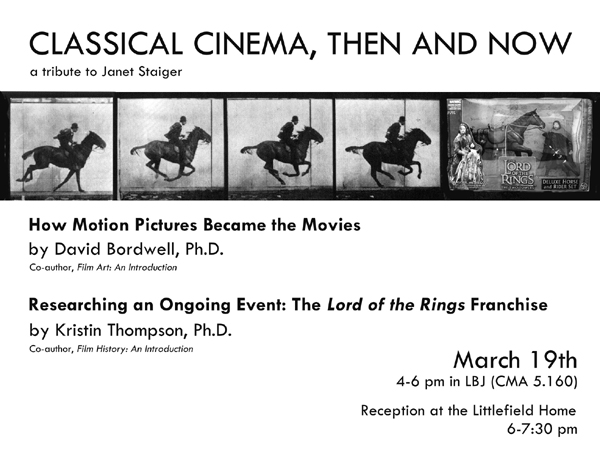
Hard though it is to believe, our dear friend and colleague Janet Staiger is retiring this year from her post as the William P. Hobby Centennial Professor of Communication at the University of Texas. About a year and a half ago, Janet joined us in writing an essay celebrating the twenty-fifth anniversary of the publication of our collaborative volume, The Classical Hollywood Cinema. Several of our other books have gone out of print, but that one remains available. We’re convinced that its success rests on the fact that the three of us were able to contribute different areas of expertise that meshed seamlessly to cover what turned out to be a far more ambitious topic than we initially envisioned.
We’re delighted to help celebrate Janet’s retirement, since the Department of Radio-Television-Film has invited both of us to lecture at an event to pay tribute to Janet. We’d love to see any of you in the Austin area on March 19. We chose our topics without planning it that way, but they end up book-ending the classical era. David will be speaking on the 1910s, when the early cinema was coalescing into the art of “the movies,” and Kristin deals with the question of how one can deal with a contemporary event that has not yet run its course. (KT)
Short film
The American release of Jafar Panahi’s This Is Not a Film, as well as the first Best Foreign Film Oscar for an Iranian film, A Separation (Asgar Farhadi), have kindled a new interest in Iranian cinema just as some of its most prominent practitioners are dealing with exile, house arrest, and censorship. The International Campaign for Human Rights in Iran has recently posted a short film, Iranian Cinema Under Siege, which lays out the issues succinctly.
Earlier many cinephile sites, including ours, called attention to Panahi’s plight. Anthony Kaufman updates us on his still-undetermined fate. (KT)
Lotsa pictures, lotsa fun (cont’d)
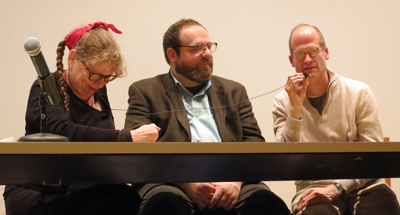
Lynda Barry, Ivan Brunetti, and Chris Ware share a mic.
Our Arts Institute has brought Lynda Barry to campus as an artist in residence this spring, and it’s been a breath of fresh air—actually, make that “blast.” Kristin and I have loved Barry’s work since the 1970s, but only recently did we learn that she was born in Wisconsin and still lives here.
Barry’s UW webpage is a captivating foray into Barryland, and her course, “What It Is: Manually Shifting the Image,” has been open to anyone interested in exploring drawing and/or writing. Convinced that art is a biological phenomenon (“Anybody can make comics,” she says), she encourages people to expand their creative powers without fear of being considered unskillful.
 As part of her visit, Professor Lynda has also scheduled events to introduce people to writers and artists. She hosted Ryan Knighton (“badass blind guy”), gave a talk
 on with guest Matt Groening, and will interview Dan Chaon (3 May). Her first pair of invitees, on 15 February, was Chris Ware and Ivan Brunetti.
You know I was there.
In fact, I came ninety minutes early to get my front row seat, alongside comics guru Jim Danky. Good thing too; by the time the session started, the big lecture hall was packed.
The first part of the session was a brief panel discussion among Barry, Brunetti, and Ware. As if by design, the table mike didn’t work, so Barry’s lavaliere, threaded up through her pants and blouse, had to be yanked out and stretched across the table when her guests wanted to talk. Result shown above.
Barry called Brunetti a master of balancing the verbal and the visual aspects of comics, and she introduced Ware as “the Wright Brothers” of the graphic novel, with Lint as his Kitty Hawk. Then the two guests, who live in Chicago and get together for Mexican lunch once a week, talked about their influence on one another. Brunetti says that seeing Ware’s work in Raw made him rethink comics altogether. Ware finds in Brunetti “an honest critic.”
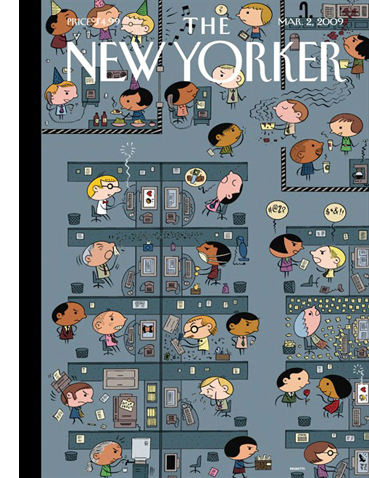
Then Ware left the stage to Brunetti, who took us through his career in PowerPoint. He traced the influence of comics like Nancy and Peanuts on his pretty but edgy big-head style, and he talked about the autobiographical impulse behind much of his work. (“I draw these things to make fun of myself.”) Like many comics artists, he’s fascinated by cinema—be sure to check his “Produced by Val Lewton” page—and some of his New Yorker ensemble panels have the fluid connections we find in network narratives.
In all, it was a lively session that reminded me, among other things, how comic-crazy our town is. Not to mention our state: don’t forget Paul Buhle’s Comics in Wisconsin. That book is filled with work by Crumb, the Sheltons, Spiegelman, etc. It’s as well a tribute to enterprising publisher Denis Kitchen and the now-departed Capital City comics distribution firm. (DB)
Le mot Joost
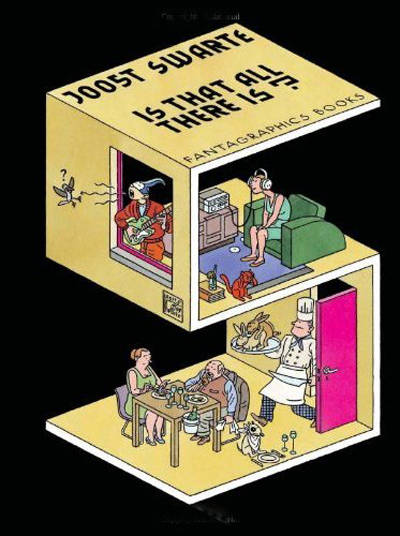
I got a little chance to talk to Ware, and we shared our admiration of Joost Swarte, one of the greats of cartooning. Readers of this blog may recall my shameless promotion of Swarte’s work (here and here and here); one of the big events of my fall was getting to meet him in a Brussels gallery. As chance would have it, a couple of days after Barry’s event, I got my copy of the new Swarte collection Is That All There Is?
The book is a fine introduction to work that has for too long been restricted to French and Dutch publications. You get to meet the infinitely knowledgable Dr. Anton Makassar, the lumpish Pierre van Genderen, and the hip but mysteriously ethnic Jopo de Pojo. You also get the first statement of Swarte’s idea of the “Atom Style” of postwar design, connected to the “clear line” school of cartoon art. The book, done up in gorgeous graphics, is graced by an introduction by none other than Chris Ware.
It’s sort of hard to write an introduction for a cartoonist you can’t completely read. . . . I’ve read plenty of his drawings, however. Studied, copied, and plagiarized them, actually; the precise visual democracy of his approach compelled me as a young cartoonist to consider the meaning of clear and readable or messy and expressive, and it was the former which won out.
Now that he mentions it, there is a line running from Ware’s obsessive schematics of narrative space (and time, as Barry says) straight back to the fluent precision of Swarte’s design. Both artists invite your eye to discover things at all level of scale and visibility, while leading you, in Hogarth’s phrase, “on a wanton kind of chase.” (DB)
Derange your day with Feuillade
Two patient, ambitious researchers have contributed to our knowledge of Louis Feuillade’s work, a central concern of DB’s writing and this blog (here and here, in particular). They also teach us intriguing things about cinematic space.
First, Roland-François Lack of University College, London hosts The Cine-Tourist, a site that traces the use of Paris locations in films. His devotion to Paris equals that of the city’s filmmakers, so he provides a thorough canvassing of areas seen in Les Vampires, Fantômas, and Judex. Beyond Feuillade, you can find the places featured in other movies, including L’Enfant de Paris and Le Samourai. Roland-François has even solved the riddle of what movie house Nana visits in Vivre sa vie.
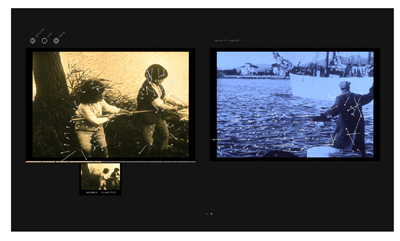
Hector Rodriguez of the City University of Hong Kong has set up a site devoted to Gestus. It’s a program that tracks vectors of movement in a shot and generates abstract versions of them that can be compared with action in other sequences. Gestus can whiz through an entire film–in this case, Judex–and come up with an anatomy of its movement patterns. Hector sees the enterprise as sensitizing us to movement patterns that we don’t normally notice. It also provides a dazzling installation.
Gestus’ ability to generate a matrix of comparable frames recalls Aitor Gametxo’s Sunbeam exploration. But Aitor was interested in how Griffith maps adjacent three-dimensional spaces. Hector’s project focuses on two-dimensional patterning, specifically the deep kinship between different shots when rendered as abstract masses of movement. And while the Sunbeam experiment lays out how spectators mentally construct a locale, Hector is just as interested in friction. “The system invites, confuses, and sometimes frustrates the viewer’s cognitive-perceptual skills.”
That, of course, is part of what cinema is all about. Visit Roland-François’ and Hector’s sites and have a little derangement today. (DB)
If you’re unfamiliar with Chris Ware’s work, a good overview/interview can be found here. Swarte’s stupendously beautiful site is here.
PS 12 March: Because I’ve been immersed in other stuff, I didn’t realize that Matt Groening actually showed up for Barry’s session! And I missed it! Hence the strikeout correction above, initiated by Jim Danky. More on Groening’s visit here.
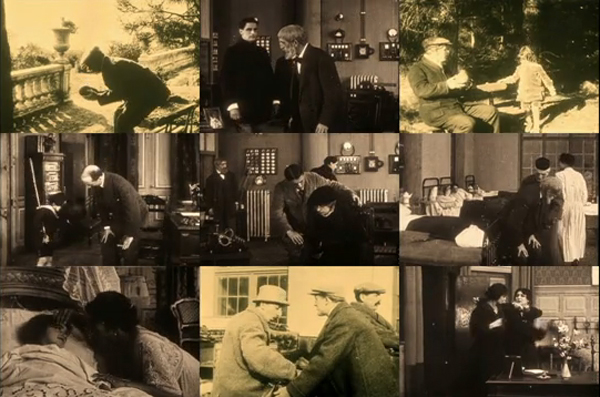
Echoic patterns of stooping in Judex, as revealed by Gestus.
Dante’s cheerful purgatorio
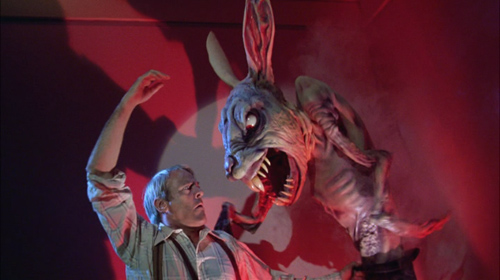
Twilight Zone: The Movie.
DB here:
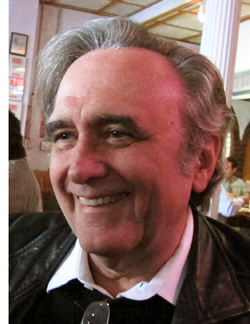
When will we baby boomers relax our chokehold on popular culture? Never, if the enthusiastic response to Joe Dante’s visit to Madison last weekend is any indication. A showing of Gremlins (1984) packed the house. A screening of his Twilight Zone: The Movie episode brought fans forward with DVD slipcases to sign. College kids reminisced about watching The ‘burbs with their dads and Explorers with their buddies (all on video, of course).
Although steeped in classical Hollywood, intimately acquainted with the most obscure output of the studios, Dante hasn’t abandoned the present. He shoots TV shows, webisodes, and the 3D feature The Hole (still awaiting a US release). He hosts a website, Trailers from Hell, in which directors comment on other directors’ works using a trailer as a point of departure.
His films, from Piranha (1978) and The Howling (1981) to the present, by way of Amazon Women on the Moon (1987) and Matinee (1993), combine the gonzo spirit of the 1960s with a good-natured reverence for the past. Particularly movies. Particularly crazed, tasteless movies. Like Spielberg and Peter Jackson, he’s a fanboy. “Most filmmakers are kids at heart,” he says. “And all actors are.”
Unlike Spielberg and Jackson, though, Dante keeps politics close to the surface. His films sustain the baby-boomer hope that you can squeeze cultural critique into a genre project. Everybody knows that the Gremlins movies are subversive trips into the shadows of bourgeois normalcy. Has a shiny kitchen blender ever been used more efficiently?
The Gremlins pictures and The ‘burbs are valentines compared to Homecoming, Dante’s installment in the series Masters of Horror. This asks a simple question: Suppose that all the soldiers killed in combat were able to come back and vote? Is that a powerful lobbying group or what? When resurrected vets of Iraq start stalking to the polls, an Ann Coulter lookalike tries to stop them. Run on cable in 2005, this left-wing zombie movie slashes to ribbons pious platitudes about war’s costs. It’s required viewing for all 2012 presidential candidates.
Don’t crowd me, Joe
Dante began his career as a collagist. That’s not too fancy a name for a man who, with his friend Jon Davison, collected the ephemera of the great age of 16mm. TV shows, ads, and movie trailers swept out of local stations went into their archives. In time these and other glories of late-night TV found a new life, like a monster stitched together out of morgue remains. The strategy was simple. Dante and Davison rented five or six 16mm sub-B features and projected stretches of them, in rough order but jumbled together. The movies were interspersed with reels of clips.
The Movie Orgy played college campuses in the late 1960s and early 1970s. The Orgy lasted about seven hours, and its auteurs urged viewers to drift in and out. “Go get a pizza whenever you want. You won’t miss a thing.” Eventually Schlitz hired them to take it around the country and sold beer at the screenings.
When Dante began working for Roger Corman’s company—cutting trailers, thereby tapping his skills as a collage-maker—The Orgy was suspended. But some years ago the footage that he could find was transferred to digital and played at the New Beverly. It found a new success. Dennis Cozzallo has a lively tribute from 2008 here. Needless to say, we had to have The Orgy for Dante’s visit to Madison.
Affection for the detritus of the media takes many forms. After watching too many campus simpletons (both students and profs) laugh mockingly at Fritz Lang and John Woo movies, I’m opposed to condescension. I suspect Camp in its disdainful form. I don’t like people demonstrating their sense of superiority to the trash their parents and grandparents enjoyed. Knowingness leaves you with nothing.
 But The Movie Orgy is different. It offers another take on subpar product: The pleasure of sheer unpredictability. How will common sense be violated? How will demands of craftsmanship be dodged or bungled? How will canons of taste be overturned? How will things that were once stupid, and remain stupid, and will be stupid forever, still communicate a certain cynical earnestness? A foolish idea carried off with obstinate conviction will always deserve respect, so Earth vs. The Flying Saucers and Beginning of the End wind up having a touching desperation, like the badly-tied noose in a suicide hanging.
Moreover, in sequence after sequence, there’s a quality of astonishment that doesn’t make us feel superior. Take one exemplary moment of dépaysment. If you and I tried to be naive or trashy, we couldn’t come up with this.
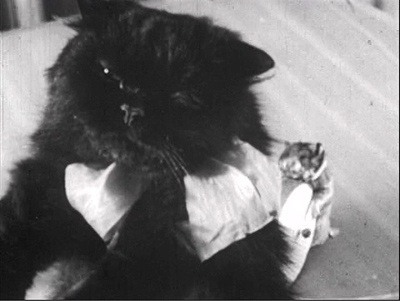
Andy Devine hosted a kiddie TV show, Andy’s Gang, which featured Froggy the Gremlin (Plunk your magic twanger, Froggie!), the cat Midnight, and Squeeky the mouse (played by a hamster). About an hour into The Orgy, Andy induces Midnight to play a miniature pipe organ while Squeeky accompanies him. Cut to a deep-focus shot of what seems to be a slightly drugged cat locked in place and rhythmically pawing the offscreen keyboard. In the background Squeeky, apparently clamped within a mechanical mouse body, bangs a tiny bass drum. Andy sings along tunelessly. The song is “Jesus Loves Me.”
You don’t laugh, you gape. It’s like one of our local attractions, The House on the Rock: What’s disturbing is not that it’s done poorly, but that somebody thought of doing it at all.
The form of The Orgy—and it does have a form, of sorts—is to open with openings and end with endings. Several of the movies get started in the first half hour (Dante and Davison love opening credits) and we’re given enough of the plots to become curious. Most prominent are Attack of the 50-Foot Woman and Speed Crazy, the latter receiving a loving dissection highlighting, and repeating to the point of obsession the heel protagonist’s tagline, “Don’t crowd me, Joe.” Eventually the guy and his flashy sports car wind up crowded, all right–crowded into a ravine.
More TV episodes and movies get added as the hours roll by, and by the end we’re facing Armageddon. Los Angeles, Las Vegas, Chicago, New York, DC—every major city is under attack by some alien or giant monster. Sky King has to dump dynamite for some reason, Superman has to save Lois from a pistolero. A sort of amphetamine Intolerance, The Movie Orgy cuts together all these climaxes, which include The End titles that are far, far from signaling the end.
The clip from Andy’s Gang reminds us that the piece is somewhat misnamed. It’s a Movies And TV Orgy. More specifically, it’s a Movies On TV orgy. The structure of the whole shebang imitates a long stretch of television ca. 1955-1960. Over lunch Dante recalled watching Million Dollar Movie as a kid in New Jersey, seeing a feature shoehorned into a ninety-minute slot and chopped up by commercials. The Orgy replicates the jagged tempo of switching among three or four channels, glimpsing variant commercials for Colgate toothpaste or Raleigh cigarettes, catching a bit of this movie and then a bit of that one. With all its kid shows from my youth (The Lone Ranger, Lassie, Mighty Mouse, etc.) in endless eruption and interruption, it’s a baby-boomer time capsule. Puncturing this evocation of childhood are the clips scavenged from teenpix and Dick Clark’s dance show, Vietnam, Nixon’s Checkers speech, and film-society icons like the Marx Brothers, Fields, and Abbott and Costello. The late sixties counterculture breathes more fully in some clever fake ad spots. In one, a crucifix starts to wobble as the carved Jesus struggles to free his hands.
Dante claims that he and Davison were inspired to find out about the popular culture that shaped their parents’ generation. But nearly everything we see filled the airwaves during our younger days as well. The Movie Orgy in its current form seems to me a zestful celebration of the world our generation saw when we flopped on our bellies, propped our chins in our hands, and stared at the tumultuous world inside a black-and-white (not color) TV (not video) set (not monitor).
We cartoon characters can have a wonderful life
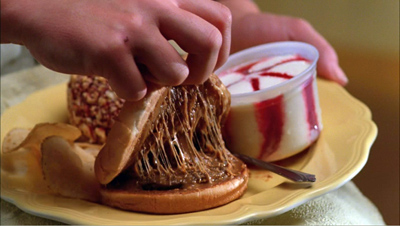
Dante the collagist leaves his fingerprints all over another film he screened here. When Spielberg launched his Amblin company, he hunted for directors who could make family entertainment in a genre format. Dante, who had already started Gremlins, was invited onto the omnibus Twilight Zone project. After the fatal accident on the Landis set, the studio backed off and it become “a movie they wanted to make but didn’t want anything to do with.” This gave Dante wide latitude and made him think, mistakenly, that studio suits always leave directors alone.
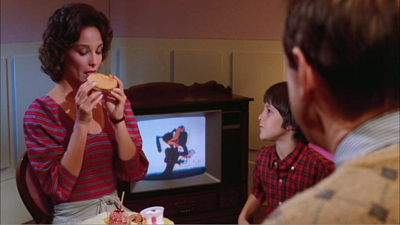
For this episode, Dante wanted to do an original story but Warners insisted that it had to be based on an episode of the TV series. He went back to the original Jerome Bixby story, which Dante and Richard Matheson reworked to add cartoons as a running gloss to the comic horror. The pseudo-family of demonic little Anthony inhabits a house that is half cartoonland, half-PoMo-Caligari. Saturated colors, occasionally striped with noir shadows, provide another Dante caricature of family domesticity, but now cartoons comment on the action. When Helen steels herself to eat, the dog on the screen behind her is doing the same.
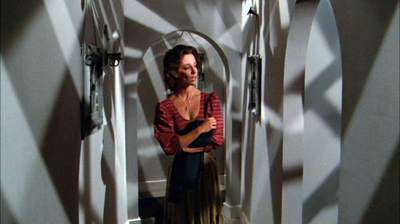
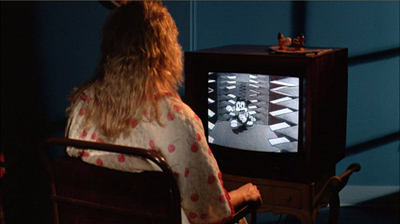
The crisscrossed shadows of the corridors are replayed in the sawtooth walls pursuing Bimbo.
The collage principle gets developed further in Dante’s use of the soundtrack. The Movie Orgy uses no new sound work; the clips are just spliced together. But for the Twilight Zone episode, let loose in Warners’ classic archive, Dante could weave in Carl Stalling music (reorchestrated for stereo by Jerry Goldsmith) and a rich mélange of daffy sound effects.
The TV is incessantly on. The cartoons running in the background supply whizzes, boinks, and thuds that jarringly punctuate the conversation between puzzled teacher Helen Foley and the family that Anthony holds in his magical grip. “This is Helen,” says Anthony, introducing her to Uncle Walt and his sister, as we hear a smash from the TV set. The cartoon tracks comment on the action too. As the family settle down in front of the tube, the elders dote on Helen and we hear a Stalling rendition of “Ain’t She Sweet?” Dinner is served to the tune of “The Teddy Bears’ Picnic.” And when Helen discovers her burger has been slathered with peanut butter, the visceral image is underscored by warbling winds that rise when she lifts the bun. Eisenstein, for reasons given here, would have loved the moment. The whole sequence plays out as live-action animation, with naturalistic dialogue and effects given a creepy overlay by the cartoon track. Is Helen Foley’s last name part of the gag?
Dante, impresario of the comic grotesque, finds his inspiration in popular culture, the more wacko and inept the better. The comedy may come from childhood silliness, the grotesque from childhood fears. They say we baby boomers will always be just big kids, and Dante accepts this with a grin and a darkly cheerful eye.
Many thanks to the resourceful Jim Healy for arranging his friend Joe Dante’s trip to Madison. Thanks as well to the Cinematheque, the Marquee, and the Chazen Museum of Art for hosting the screenings.
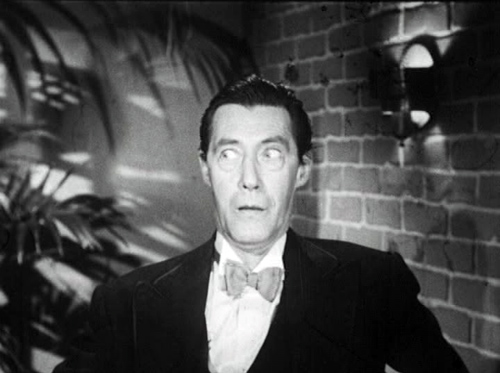
John Carradine in The Movie Orgy.
Time for a quick one: A miscellany from friends
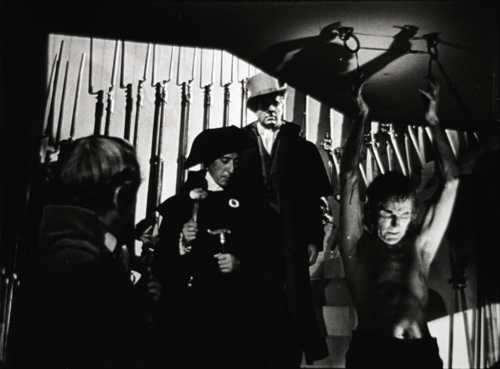
The Black Book (aka Reign of Terror).
DB here, catching up with books, videos, and events:
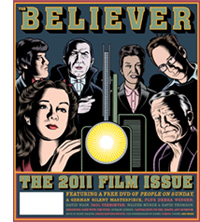 David Cairns has written a lively appreciation of William Cameron Menzies for the March/ April issue of The Believer. The essay bristles with rapid-fire aperçus, such as the suggestion that the great, demented Kings Row is something like the Twin Peaks of its day. David is particularly good at plotting the extent to which Menzies dominated the work of his directors. Directors without a visual style of their own, he points out, were easy for Menzies to overwhelm, but those with an already-developed signature could assimilate his contributions, as Hitchcock did in Foreign Correspondent.
In The Black Book (aka Reign of Terror) Menzies found soul mates in two other aggressive pictorialists, Anthony Mann and John Alton, the team becoming “a crazy triangle,” eager to indulge in “thrusting gargoyle faces in fish-eye distortion, clutching shadows, and funky, teetering compositons.” Bob Cummings never looked so bizarre, before or since. I didn’t talk about this wild movie in my online Menzies material here and here because I had such poor illustrations from it. Now things have changed, and a decent, or perhaps rather indecent, sample of the film’s delirium (above) can serve to back David’s point.
David’s “Dreams of a Creative Begetter” is one of several film-related pieces in this issue of The Believer. The issue includes a DVD of the seminal People on Sunday (Menschen am Sonntag, 1930), which gathered the talents of Billy Wilder, Curt Siodmak, Robert Siodmak, Edgar G. Ulmer, Fred Zinnemann, and Rochus Gliese. A helpful introductory essay is at the Believer site.
Speaking of David’s writing, don’t miss his superb shot-by-shot analysis of a key scene in Gilda at his Shadowplay site, an obligatory stop for all cinephiles.
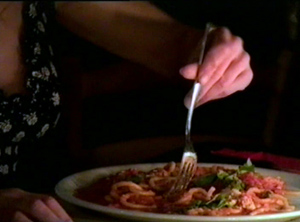
Seldom does a monograph on a single film probe so deeply as Mette Hjort’s new book on Lone Scherfig’s Italian for Beginners. It’s easy to take this movie as Dogme Lite, since compared to the earliest, rather harrowing Dogme efforts, it’s an ingratiating romantic comedy-drama. Mette does justice to this side of Scherfig’s film, but she also shows that it’s an exercise in moral seriousness. Reconstructing the production process, she conducts in-depth analysis of performance and technique. She is sensitive to actors’ moments, such as simply laying down a knife and fork; aware that these gestures are developed through improvisation, she is able to trace how each character is built up through details.
In her books and articles on the Dogme school Mette has shown that its innovations go beyond the vaunted technical “rules.” She always addresses them, of course; here she provides an illuminating typology of ways the rules have been followed or dodged. But she also stresses, as most writers don’t, that Dogme films engage with matters of political importance. For example, she has shown that The Idiots’ controversial display of “spazzing” triggered an important debate about Danish attitudes toward the disabled. In her new book Mette indicates that Scherfig’s efforts to endow her characters with the dignity to be found in everyday life offers viewers a chance “to re-connect with one of their culture’s most powerful moral commitments.” Mette talks about the project in this video.
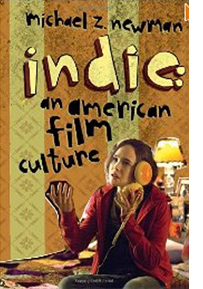 David Gordon Green directs Your Highness; Justin Lin signs his third Fast & Furious movie. With indie filmmakers eagerly joining the tentpole and franchise business, the whole phenomenon seems due for a rethink. This makes Michael Z. Newman’s Indie: An American Film Culture all the more necessary. Although I can’t be unbiased, because I served as Michael’s advisor on the dissertation that became the book, I think that any reader would find the result a fresh and vigorous exploration of the achievements of the Sundance/ Miramax generation.
Michael starts by looking closely at the audiences and marketing. He suggests that viewers engage with the films through particular viewing habits (e.g., “Characters are emblems”). He then shows how these habits were nourished and refined by distributors, promotion, and film festivals. The next two sections of the book consider what we might take to be the two poles of indie difference from Hollywood: greater realism, and more self-conscious artifice. The central chapters analyze realism in relation to “character-centered” filmmaking in the Indie trend. Michael turns a critical eye on characterization in films as different as Walking and Talking, Lost in Translation, and Welcome to the Dollhouse. The third batch of chapters considers the trend’s other major appeal, the sort of play with style and form we get in the Coens, Tarantino, Nolan, and others.
Michael shows how character-driven realism and gamelike artifice mesh well with the mandates of distribution and reception—how, in effect, “originality” becomes something that can be calculated and branded. The book concludes with thoughts on the evolution of the trend, comparing Happiness with Juno and raising the inevitable question: How artistically independent is independent film? Newman leaves us pondering: “Indie cinema has become Hollywood’s most prominent alternative to itself.”
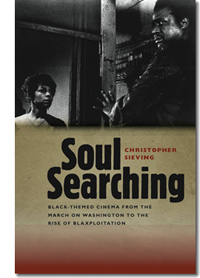 One of the hallmarks of the Wisconsin program in film studies is its nuanced refusal of the art/ commerce duality that supposedly rules filmmaking. From many angles, researchers here have shown that creative impulses and business mandates mix in complicated ways, and the results are often fascinating. Indie is one example of this sort of research project, and so is another dissertation-become-book, Christopher Sieving’s Soul Searching: Black-Themed Cinema from the March on Washington to the Rise of Blaxploitation. (Again, I was involved, serving on the committee chaired by Tino Balio.)
Chris concentrates on 1960s black-themed films from A Raisin in the Sun onward, because he wants to trace how filmmakers tried out a variety of ways to represent and comment on black life. It was a transitional era, but as he puts it “because of the insights they reveal about the periods that bracket them, transitional periods are among the most fascinating and significant in all of film history.”
For Chris, Gone Are the Days (1963), The Cool World (1964), Uptight (1968), The Landlord (1970), and the unproduced Confessions of Nat Turner provide case studies of alternatives to what became the crime-and-comedy product of blaxploitation. Why did decision-makers believe that black-themed films would sell broadly enough to repay investment? What choices and compromises were necessary to “universalize” material (for white viewers) while also retaining “authentic” blackness? Or was it better simply aim the films at white liberals?
Chris tackles such questions through a painstaking study of the film industry’s efforts to find, or create, an audience for films that took great risks. Written with verve (on the screen handling of the Black Panthers, Chris talks about Hollywood’s “Black Power outage”), Soul Searching revives films that are all but forgotten and shows how their efforts to create one variety of independent cinema failed for particular social and industrial reasons.
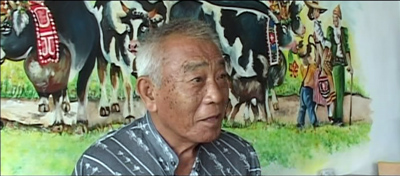
Someone I’ve been meaning to spotlight for a while: Frédéric Ambroisine is a multitalented critic, filmmaker, stuntman, and collector based in Paris. One of his careers is making supplements for French DVD releases of Hong Kong films, both classic and current. If you have even a smattering of French, you can follow his supplements with ease. He gets precious interviews with screen legends like Kara Hui Ying-hung and Ku Feng (below), master villain of the great New One-Armed Swordsman.
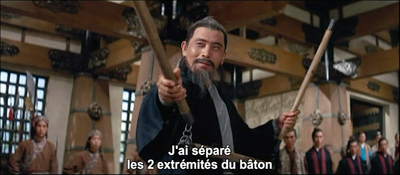
The videos from Wild Side often include Fred’s featurettes. You can follow Fred’s activities at actionqueens.com and alivenotdead. Much of the material in both places is in English.
Finally, if you’re in Los Angeles this week, why not visit the celebration of Orphan Films playing at UCLA 13 and 14 May? While I was in New York in February, I met NYU’s Dan Streible, moving spirit of the Orphan Films movement. Dan and his colleagues work with archives, collectors, and filmmakers to save films that fall through the cracks, digging up everything from home movies to news clips and experimental cinema. Dan curated a program of orphans at our local festival earlier this spring. At UCLA he will be a guest for screenings and discussions of many orphan titles, including the mysterious Madison Newsreel (Madison, Maine alas, not Wisconsin). Go here for Sean Savage’s discussion of the orphan oddity that has become a cult movie, and here for background on Northeast Historic Film, which found the footage.
PS: Speaking of friends, I should thank the solicitous people who wrote me during my recent illness. I appreciate your get-well notes, and I’m happy to report that I’m on the mend.
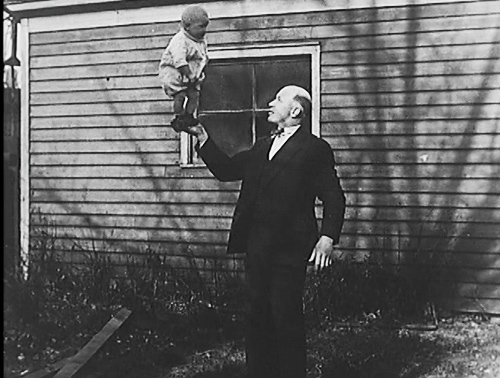
“World’s Youngest Acrobat” (Hearst Metrotone/ Fox Movietone 1929). From Orphans 7: A Film Symposium.



