





Archive for the 'UW Film Studies' Category
Trims and outtakes
Some jottings from DB:
Continuity Boy meets Badgers
 Tim Smith, who studies how we perceive film, recently visited our department at the University of Wisconsin–Madison. His talk was splendid.
Tim studies the ways we scan shots and shift our attention across cuts. His talk was illustrated with film sequences showing little yellow dots swarming around the frame; these indicate the points in the image where his subjects’ glances landed. Tim shows pretty conclusively that there’s a consensus about where viewers look during a shot (faces, movement, the center of the frame) and that classical continuity cuts can push our attention to and fro with remarkable facility. One of the most surprising findings was that viewers are often starting to shift their attention to a new frame area just before the cut comes. Why? Tim has some intriguing suggestions.
Tim also showed some remarkable effects of what I’ve called “intensified continuity,” the fast-cut close-ups that characterize so much current cinema. Because these passages leave no time for visual exploration, viewers seem to revert to a cursory test for the shot’s basic point, usually at the center of the frame. Tim’s examples from Requiem for a Dream were fascinating, showing how real viewers are playing catchup in very fast-cut sequences.
This is rich and promising research, showing once more that Leonardo da Vinci, Eisenstein, and a few others were right to think that many creative choices in the arts can be studied with the tools of science. It also shows that filmmakers, like other artists, are seat-of-the-pants psychologists, achieving complex effects through decisions that “feel right” and that they have no need to explain theoretically. That’s our job.
For Tim’s narrative of his visit, and a lot more about his research program, go here. For something not quite completely different, about eye-tracking, print ads, and crotches, go here.
Six more from RKO
The enterprising folks at Turner Classic Movies have discovered six RKO films that have been missing for many years. It’s a harvest of 1930s titles, promising some intriguing situations (e. g., Ginger Rogers as a telemarketer) and carrying the names of directors like William Wellman, John Cromwell, and Garson Kanin.
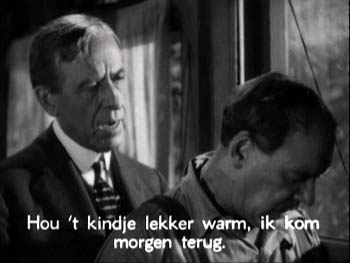
A Man to Remember (1938; at the top of this page), Kanin’s first film, is the only one of the batch I’ve seen so far. One of the New York Times‘ ten best films of 1938, it went virtually unseen until a print surfaced at the Netherlands Filmmuseum in 2000. A Man to Remember is a portrait of a small-town doctor who tends to the poor and lets others, chiefly a cadre of corrupt businessmen, take credit for his good works.
It could all be mawkish, but Edward Ellis plays the doctor as a testy guy who levels with his patients and wins the town’s respect through quiet cussedness. The performance echoes Ellis’ crabby but likable inventor in The Thin Man (1934). Dalton Trumbo’s script has an intriguing flashback structure, less bold than in The Power and the Glory (1933) but still ambitious for a B project.
The six RKO discoveries are screening on April 4th as an ensemble, then they’re scattered through the rest of the month. All should be worth checking out. Once more TCM proves itself the film-lover’s channel of first choice.
Bambi or kitty?
Two recent books support the claim that New Hollywood, or New New Hollywood, is at bottom in debt to old Hollywood. (The full case is presented in The Way Hollywood Tells It and Kristin’s Storytelling in the New Hollywood.)
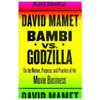 David Mamet’s Bambi vs. Godzilla: On the Nature, Purpose, and Practice of the Movie Business (Pantheon) is as pungent and eccentric as you’d expect, but also deeply traditional in its storytelling advice. A movie’s characters must have goals, and over the course of three acts they achieve them, or definitively don’t. The Lady Eve is Mamet’s model of this construction. Furthermore, three questions structure every scene: Who wants what from whom? What happens if they don’t get it? Why now? In wide-ranging essays, Mamet pays tribute to the craftsmanship of below-the-line talent and celebrates movies as various as The Diary of Anne Frank and I’ll Sleep When I’m Dead (whose protagonist is remarkable for “his personification of enigma”).
Mamet adds a fair amount on editing, supplementing the remarks in his Pudovkin-flavored On Directing Film. For instance: “At the end of the take, in a close-up or one-shot, have the speaker look left, right, up, and down. Why? Because you might just find you can get out of the scene if you can have the speaker throw the focus. To what? To an actor or insert to be shot later, or to be found in (stolen from) another scene. It’s free. Shoot it, ’cause you just might need it.”
Mamet bemoans the script reader, whose motto must be Conform or Die. By contrast, Blake Snyder makes conformity seem fun and–well, if not easy, at least attainable. His Save the Cat! The Last Book on Screenwriting You’ll Ever Need (Michael Wiese Productions) bulges with formulas, recipes, and gimmicks.
 Like Kristin and me, Snyder treats the Second Act as really two sections, broken by a midpoint. But for him three acts are just the beginning. He demands that there be an Opening Image (on script p. 1), Theme Stated (p. 5), Catalyst (p. 12) and on and on until we get the Finale (pp. 85-110) and the Final Image (p. 110). This is the most strictly laid-out cadence I’ve seen; it would be fun to see if actual scripts adhere to it. In addition, you get catchy tips like Save the Cat! (show the protagonist doing something likable early on) and the Pope in the Pool (burying exposition). Snyder includes a list of the most common screenplay errors. An enjoyable read with some hints about construction I hadn’t encountered before.
Speaking of screenplays….
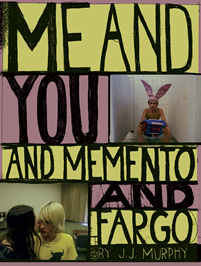

J. J. Murphy is an old friend (we went to grad school with him in 1971) and colleague (he teaches in our department). Renowned as an experimental filmmaker, he has turned his attention to American indie cinema. His new book Me and You and Memento and Fargo: How Independent Screenplays Work offers an in-depth analysis of several recent films. J. J. shows how they obey mainstream conventions of construction while still innovating in other ways. I especially like his discussions of Hartley’s Trust, Korine’s Gummo, and Lynch’s Mulholland Dr. I think it’s a book that everyone interested in current American cinema would find stimulating.
You can find out more about it, and read an excerpt, here. Congratulations, J. J.!
Bs in their bonnets: A three-day conversation well worth the reading
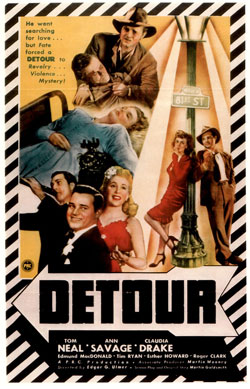
From DB:
The Film faculty and graduate students at the University of Wisconsin—Madison are a close-knit bunch. Keeping in touch via email, we exchange ideas about teaching and research, as well as passing along gossip and peculiar things that appear on the Internets. Our community includes grad students and alumni from several generations. The youngest are taking courses now; the most senior were here in the early 1970s, and they still have all their marbles.
Over three days earlier this month, there was a lightning round of exchanges on B films. With the permission of the participants, I’m posting highlights of the correspondence here because it exemplifies one way in which the Web can advance film studies.
Most film writing on the web comments on current films or video releases. Nothing wrong with that. But if you’re a researcher into film, you also want to talk about history. It’s rare to find an online debate about historical evidence and alternative interpretations of that evidence.
So to scratch my academic itch, I give you mildly edited extracts from our UW cyber-dialogue. You’ll see some hard-working professors practicing imaginative pedagogy, and you’ll find ideas for research and teaching. You’ll also see, I hope, that film studies can make progress by asking precise questions and refining them through inquiry and critical discussion.
Note to film scholars: Blogs are seldom cited in academic writing, but if you intend to use this material in your own research, it would be courteous to mention these esteemed sources, as they mention others.
To be a B, or not to be a B
First, a little background. Today sometimes we call low-budget films or just poor quality movies “B movies.” But across the history of Hollywood the term had a more specific meaning. You can find a primer at GreenCine, but here’s a little more industrial context.
During the heyday of the studio system, most theatres ran double bills—two movies for a single ticket (along with trailers, news shorts, cartoons, and the like). Very often the main feature, or A picture, was a high-budget item with major stars from a significant studio. The B film was low-budget, ran to only 60-80 minutes, and showcased lesser-known players. A B tended to be distributed for a flat fee rather than a percentage of the box office.
(I’ve just distinguished Bs in terms of its level of production; as you’ll see from the dialogue, we can think of them in other ways too.)
MGM, Warner Bros., Twentieth Century-Fox, and other major companies made B pictures as well as As. Often the B film was part of a series. Fox had Mr. Moto and Charlie Chan, MGM had Andy Hardy and Dr. Kildare. Since the most powerful studios owned theatres as well, the B film filled out the double bill with company product. Moreover, the Bs allowed studios to make maximum use of the physical plant. Sets built for an A picture could be used for a B, and actors idling between big projects could take small parts in Bs. Bs could also serve as training ground for stars, crews, and directors who might move up.
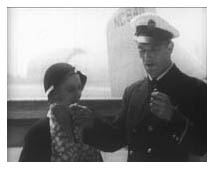 Other companies concentrated wholly on making B pictures. The most famous of these so-called Poverty Row studios are Monogram, Republic, Mascot, and Producers Releasing Corp. Besides turning out stand-alone Bs, the Poverty Row studios specialized in serials, like Don Winslow of the Navy and Hurricane Express (1932, Mascot, with John Wayne, right).
Still other studios, the so-called Little Three, hovered between A and B status. Universal, Columbia, and RKO were smaller companies, and some of their A pictures might have been considered really B’s, in terms of budget and resources. This is one theme of the conversation that follows.
As the major studios cut back production after the war, many B pictures were made as independent productions. Double bills in the US persisted into the 1960s, and Roger Corman and other producers turned out B-films for drive-ins, declining picture palaces, and rural theatres. Still, the prime years of B films were the 1930s-early 1950s. They have always been an object of admiration for cultists; recall that Godard dedicated Breathless to Monogram. Important directors like Anthony Mann and Budd Boetticher started in B production. Several Bs, notably noirs and horror films, are staples of cable and home video.
Want to know more? Here’s some essential reading: Tino Balio’s The American Film Industry, rev. ed. (Madison: University of Wisconsin Press, 1985); Douglas Gomery, The Hollywood Studio System: A History (London: British Film Institute, 2005); Todd McCarthy and Charles Flynn, eds., Kings of the Bs: Working within the Hollywood System (New York: Dutton, 1975).
Now to the question of the day.
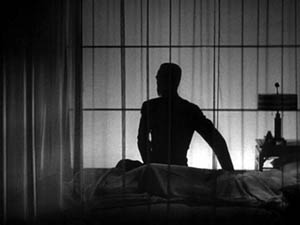
Day 1: What do I teach?
It all began on 6 February. (Cue harp music and dissolve here.) Paul Ramaeker of the University of Otago asked an innocent question….
OK, so I am running a grad seminar (or, more precisely, our closest equivalent- a 4th year Honours course) on Classical Hollywood Cinema. I want to spend time on the industry, obviously, which raises questions about what to screen for those weeks. I thought an A pic and a B pic. For the A, I was thinking about Robin Hood. For the B, I’m not sure, but I had for other purposes been considering a double bill of The Black Cat and I Walked with a Zombie. Now, the latter, I know, is a B pic; but is The Black Cat a B? It’s about an hour, which suggests a B and it’s not got a lot of sets. But it’s got Lugosi and Karloff, who surely were two of Universal’s bigger stars at the time, right? So which is it?
Any other good B pic recommendations are welcome.
The replies came fast. First, from Jane Greene of Denison University:
I do the same thing in my history class and I’ve found that Casablanca and Detour work well. It helps that most students have heard of Casablanca and a surprising number have seen it. You can point out how this “timeless classic” was very much a product of collaboration, how the star system, budget and schedule determined the look of many scenes, and it also allows you to discuss censorship… I mean self-regulation. (See Richard Maltby’s “Dick and Jane Go to 3.5 Seconds of the Classical Hollywood Cinema” in a little-known book called Post-Theory.)
Aljean Harmetz’s The Making of Casablanca is coffee-table-y, but she did consult tons of production and publicity material and there are reproductions of production documents (script pages, even a Daily Production Report!).
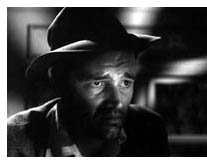 And, if yer willing to go Poverty Row for yer B Film, Detour just rocks. It’s so obviously re-using 2-3 sets and locations, has the foggiest scene ever shot, and long voiceovers that sound deep and poetic and take up half the film. The kids love it. And it could ease you gently into the waters of film noir, should you wish to go that way (and I bet you do).
Leslie Midkiff DeBauche of UW—Stevens Point also shared a teaching technique.
I teach the 1930s with a colleague in the History Department and we like to create a whole program: News Parade of 1934 from Hearst Metronome News; Three Little Pigs (1933), followed by the first half of a documentary called “Encore on Woodward” about the Fox Theater opening in Detroit. It opens in 1929 and is wonderful–it has clips of late silents like Seventh Heaven, sound comes, and we end it after a woman remembers how her boyfriend proposed to her, in the balcony, during Robin Hood. We usually show the 1936 (I think, it could be 1934) year-in-review newsreel that is on the Treasures of the Archive
I set of DVDs and the feature we use is It Happened One Night. What the students like best though is the popcorn and the give-a-ways between the parts of the program: Nancy Drew and Superman, a bag of groceries with food items from 1930s–turns out to be current student food–Bisquick, Snickers, Jiffy peanut butter,Ritz crackers. The grand prize bank night equivalent is an A on the final exam. They freak! It is like they won big money.
From Notre Dame comes Chris Sieving on RKO:
In researching Lewton last year I found a few sources that argue vehemently that the Lewton-Tourneur-Wise-Robson horror films were not B films, but more like nervous As: budgets were decent, prestige factor was high, occasional name stars (like Karloff).
Another veddy interesting and perhaps more “authentic” B film, besides Detour, is Stranger on the Third Floor (1940). It contains some very bizarre and magical Peter Lorre acting, plus some people call it the “first” film noir. (Speaking of film history myths that need debunking…)
Lea Jacobs, doyenne of Film Studies here in Madison interjects:
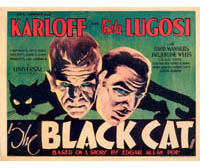 I would think The Black Cat is a B, not only because of running time but because of genre. When I was researching the distribution of B’s at RKO I was surprised by the way the horror films made by Val Lewton’s unit at RKO (many justly celebrated today) were treated as the lowest of the low–opening alongside films with titles like Boy Slaves at the small Rivoli or Rialto theaters in New York for very short runs, and later booked in and out of theaters nationally on an ad hoc basis. See my article, “The B Film and the Problem of Cultural Distinction,” Screen 33, no. 1 (Spring 1992): 1-13. I also think that Universal simply wasn’t making many A films in 1934, even with their recognizable stars.
When I teach the B film I like to show Detour and Moon Over Harlem (now out on DVD). The latter has two really amazing scenes in a movie made for less than $10,000. But maybe that is too Ulmer heavy. Anyway you can’t go wrong with I Walked with a Zombie.
Kevin Heffernan of Southern Methodist University weighs in.
 Great movies, Paul! “Cries of pleasure will be torn from” your students (as they were from our hero in S/Z).
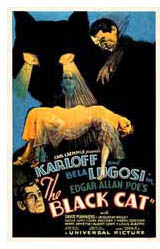
The Black Cat is an A picture, I think. All of the Universal horror movies ran between 65-71 mins, so this is just under their average. Also, names above the title usually point to an A, and I’m virtually certain the movie would have played a percentage (rather than a flat fee) in its initial engagement. I would imagine that a Universal horror picture sold well in subsequent run as a component in double bills, so they would be sort of de facto B pics in some situations.
And it is worth mentioning to your students, as Elder Goodman [Douglas] Gomery pointed out years ago, that the Deanna Durbin musicals were much more financially successful for Laemmle et cie than the horror movies. They’re all out on video now. Ghastly, unwatchable, wretched.
Lea Jacobs replies:
Universal is one of the little three in 1934, and, unlike today, when horror films command high budgets and garner big returns, in the 1930s horror films and sci fi were the stuff of serials and the bottom half of the double bill. I would have to see a contract before I believe it played for a percentage. One way, apart from that, to decide, is to look at where it opened in New York, how long it played and where it played subsequently in the key cities.
Doug Gomery, Resident Scholar at the University of Maryland, is succinct on I Walked with a Zombie:
RKO in the 1940s was a low budget studio and Floyd Odlum owned it. Odlum went cheap after his experiment with the likes of Citizen Kane. So it was B pure and simple.
Then Hughes bought it after the war and dabbled with his strange way of doing things.
It’s now 5:30 on the same day, but are our eager scholars tired? You have to ask?
Lea Jacobs follows up:
It is pretty safe to assume that most Universals in the 1930s were in the B range–their films were shown on the bottom of the double bills in theaters owned by the Majors. Even in the 1920s one reads Variety complaining about the cheapness of Universal’s product. A far cry from when it was taken over by Doug’s favorite Lew Wasserman.
Jim Udden of Gettysburg College jumps in, invoking the founder of film-industry studies at UW, Tino Balio:
 Tino does discuss this issue in Grand Design. According to him, Frankenstein and Dracula are clearly A pics, part of Universal’s strategy to break into the first-run market, since, as we all know, they had very few theaters of their own. But Black Cat is only one third the budget of Frankenstein, according to the figures in IMDB.com. Does that make it a B pic? Perhaps. Yet it seems to me that this film could still have been marketed and released like the initial Universal Horror films, riding on their coat tails, so to speak, but with less actual money invested in the production.
So was Black Cat more often one of these “featured” features, or was it usually the bottom half of the double bill, as Lea says? Maybe this is an AB pic?
This to me, sound like a researchable topic! (I myself have not time for this, unfortunately…)
Lea Jacobs replies:
Yes, Jim, I agree, a researchable question that I don’t have time for either. But a distinction that can be made, without research (or prior to it) is one between A/B at the level of production planning and budget and A/B at the level of distribution. Sometimes relatively “cheap” films were marketed as As (Variety usually complains about this its reviews!). Thus, to be really certain of how a film lines up, you have to look at both the budget ranges at the studio at the time of the films’ production, and the distribution pattern, including, of course, whether it was distributed for a percentage or flat fee.
Kevin Hagopian, Penn State University, comes rolling in at 10:30 pm.
* The trouble with some of the great B’s, like The Black Cat, Detour, and I Walked with a Zombie is that they’re so good that they don’t give a sense of the real purpose of the “B,” which was to hold down half of a double bill, and amortize overhead at the studios over a larger number of opportunities for revenue – that is, individual films. A comparison of scenes from an A film and a B film using the same standing sets does this nicely; I use the RKO New York street set, visible in Citizen Kane and Stranger on the Third Floor, as an example. (A great visual example I’d like to make would be Lewton’s Ghost Ship, which is said to be a script written for an existing ocean liner set, but I haven’t seen that set in another RKO film as yet.)
*I’ve often done a clip show that involves:
A. Clips from films like the Lewtons, or the Schary-Rapf films at MGM (like Pilot #5 and Joe Smith, American), or one of the series films, like a Maisie film. These films show that the resources of a big studio, such as talent, standing sets, skilled cinematography and editing departments, etc, could generate a film that, while it might have been double feature fodder, still maintains a sense of `quality’ that, perhaps, studios wanted to maintain for purposes of brand equity.
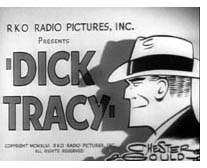
B. Clips from fairly awful B’s, like the Dick Tracys or Tim Holt Westerns at RKO, which show what could happen when questions of production value were not attended to quite so scrupulously, simply because, given the films’ titles, they were likely to draw from a market which did not make attendance decisions in the same way as patrons of, say, Pilot #5.
C. Clips from minor studio “B” westerns, ala Buck Jones. REALLY gets the point across about the relationship between production expenses and expected grosses; clearly, these films were made on a precise calculus. As films, of course, they’re nowhere near as interesting as the Lewtons or RKO “B’ noirs like The Devil Thumbs a Ride, but they work, particularly when students can’t really tell the difference between a Buck Jones, a Tom Mix, or a Three Mesquiteers – that’s sort of the point. Peter Stanfield’s work on “B” Westerns, however, shows how the signifying practices of the B Westerns, production values aside, could be truly divergent from anything in the A film canon, and worth studying. But in defense of my students, being trapped in a screening room with a true B Western at full length can be a grueling experience.
*A handout listing the films produced in a single given year by one studio, grouped by genre, and with A or B indicated in each case. 1939 is a good year to do this with, as it contains some of the few studio films students have even ever heard of. They can see how certain studios specialized in certain genres, and how B’s supported A’s in the production calendar.
*Finally, by way of an outro, of course, talking about modern equivalents of B films, and even arguing whether such equivalents exist in the film or cable marketplaces. (Jim Naremore’s chapter on direct to video “erotic thrillers” in his wonderful book on noir, More than Night, can be very helpful here.)
Our researchers retire from the field. But not for too long.
Day 2: Diving for Dollars
Brad Schauer, Ph.D. candidate at UW-Madison fires this off at 9:33 CST on 7 February:
Wow, what a digest I received this morning! With all this B movie talk, I couldn’t resist adding my $.02.
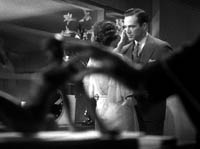
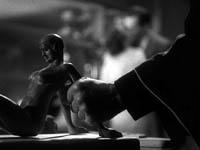
The Black Cat is a tricky case – it was worth flipping through some of the secondary sources to investigate (Senn 1996; Weaver, Brunas, and Brunas 1990, Soister 1999). In a sense, it’s a clear B. The budget was about $90K and was scheduled for a two-week shoot. Compare this to next year’s Bride of Frankenstein, which cost $400K and took Whale about six weeks to film. Plus, Black Cat has all the wonderful hallmarks of a quintessential B: lurid storyline, short running time, sometimes incomprehensible narrative (due in this instance to censorship), etc.
And it was devalued by the critics because of its genre and the concomitant transgressive material (the flaying scene is still shocking).
However, the film was also a big hit for Universal, its top moneymaker for 1934. Looks like it brought in rentals around $250K – which isn’t a lot, but it suggests a percentage release, at least in its initial run. Variety also said it had “box office attraction” because of the current popularity of Lugosi & Karloff, teamed for the first time. Someone would have to investigate its distribution patterns to be sure, but it kinda looks like a B picture that was sold as an A, as Lea suggested. Maybe Universal knew it could throw a cheap movie out there and it would succeed based on the popularity of the genre and the stars. It’s a kind of precursor to all those low-budget, highly-profitable horror films like Halloween and Saw. So for me it’s about 4/5th B, 1/5th A.
Would I show it as an example of a B? As Kevin Hagopian mentioned, it’s really much too good to be a truly representative example, but students will probably like it more than a Dr. Kildare movie or something. If you really want to sock it to them, dig into the Sam Katzman filmography. Try one of the Jungle Jims or the Lugosi Poverty Rows.
David already mentioned the real gems of the studio Bs, the Motos. The Chans are great too. (I can even watch the Monogram Chans, although the Karloff Mr. Wongs can be a real slog.) As far as other mystery series go, the Universal Holmes films are extremely well done, the Dick Tracys, Perry Masons, and Torchy Blaines are a lot of fun, and I have a soft spot for the Falcon films due to AMC early morning reruns in my childhood. The Kitty O’Day mysteries are on my “to watch” pile, but I’m not optimistic. Follow Me Quietly (1949) also comes to mind as a great B-noir.
And also, the Thin Man movies weren’t really Bs. Not responding to anyone – just needed to get that out there. Closer to Bs would be MGM’s Sloan mystery knockoffs, which are fun too (especially Fast and Furious, which is fortunate enough to have Rosalind Russell).
Whew, thanks for reading if you made it this far.
As a new day dawns on Texas, Kevin Heffernan has more thoughts.
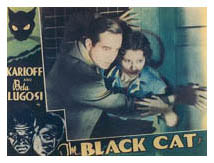 Thanks for the info, Brad. Yes, Black Cat is a curious hybrid case. For a “truer” example of a Karloff/Lugosi B from Universal, see The Raven from the following year–most notably in its use of fairly minimal, obviously left-over sets (nothing like the very bold production design of Black Cat). And, although I recall that Kristin is a Lew Landers fan (didn’t she call him “lightly likeable at least” in Breaking the Glass Armor?), his name was somewhat synonymous with quotidian program pictures in the 30s and 40s.
My assertion that Black Cat was an A referred to my understanding of the terms of its first-run distribution . But I actually had little evidence, I have discovered, as I looked over my notes on the movie from Tino’s seminar a few years back.
Lea and Doug’s observations about Universal’s “Little Three” status and the general role its horror pictures played in the larger patterns of distribution seem spot on to me and of course became more prevalent (inflexible, even) in the post-Laemmle years. The only exception to this that I can think of was Son of Frankenstein, which was U’s entry in the superproduction cycle of 1938-39 (stars on loan from other studios, spectacular production design, initial plans to shoot in Technicolor, etc), but that movie was really the last gasp of the A horror pic at the studio, I think.
And at 10:10 AM CST Lea Jacobs is back at the keyboard.
I guess Brad has the last word on The Black Cat. Nothing like doing the research.
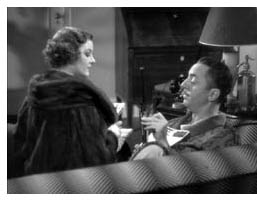 Now about the Thin Man series. In the essay on film budgets at MGM that appeared a few years back, I recall that these films were in the “B” range for MGM (about $250,000). (See H. Mark Glancy, “MGM Film Grosses—1934-1948: The Eddie Mannix Ledger,” Historical Journal of Film, Radio and Television 12, 2, 1992: 127-144.) This is a lot of money relative to what other studios were spending on B films, of course, but all of MGM budget ranges were high relative to the other majors (the average MGM A was between $700,000 and $1 mil as I recall). So I agree that the Thin Man films are elegant and well dressed and don’t fit anyone’s conception of a B, but at least when considered from the perspective of film budget categories at MGM, wouldn’t these count as Bs? Or, put another way, what would you count as an MGM B?
Doug Gomery adds in re MGM B-pictures:
Nicholas Schenck was no great man, but he ran Loew’s/MGM from 1927 to 1954. To him the Thin Man series were Bs from his studio. Remember block booking? These simply made MGM a more attractive package. The question of A v. B is at its heart a budget decision and then a release one. The New York-based men, like Schenck, made those decisions.
Day 3: B Mania Subsides; some answers, more questions
8 February: Brad Schauer revisits Nick and Nora:
 Real quick about the Thin Mans before I run to lecture: I know I was being a bit contentious when I said they weren’t Bs. Lea and Prof. Gomery are absolutely right that if you go by budget, they’re Bs…at least initially. But by the time we get to Another Thin Man (1939), the budget is up to $1.1 mil, only a couple of Gs less than Ninotchka. 1944’s Thin Man Goes Home is budgeted at $1.4 mil, only about $500K less than Meet Me in St. Louis (!).
Another reason they don’t seem like Bs to me is that they were consistently among the top grossers for MGM in the ’30s. But so were the Andy Hardys, you might argue, and they’re clearly Bs.
Except…from what I could tell from analyzing the distribution patterns of the ’35-’36 season (not done this morning, don’t worry), After the Thin Man played in major first run theaters, and hardly ever with a second feature until it hit the nabes (neighborhood theatres). It was distributed like a big deal A, and you can sense the exhibs’ excitement in the trade press that another Thin Man installment was coming out.
Finally, we can look at the running times. MGM’s Bs were sometimes longer than other studios, but the first sequel After the Thin Man is nearly two hours long. Compare that to MGM’s Sloan mysteries (Thin Man knock-offs), which clock in at 75 minutes each.
So, like The Black Cat, the Thin Man films seem an unusual case. The first installments may have been budgeted as Bs, but as the series caught on, it was treated like an A property, both in terms of production and distribution – compared to the Andy Hardy films, for instance, whose budgets remained quite low for the entire series.
Although I think the Hardy films were often exhibited as the top of a double feature, but that’s another story.
I kinda feel like lecturing on this stuff this morning instead of the continuity system, although I’m not sure the students will want to hear about distribution patterns at 8:30 a.m.
 Lea Jacobs’ fingers fly over the keyboard a few moments later:
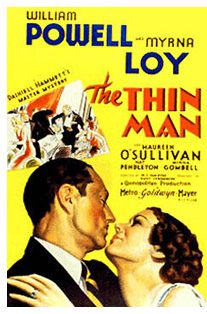
This is very interesting, Brad. I wonder if any of this could be correlated with William Powell and Myrna Loy’s salaries? That is, maybe the series made them stars (I am pretty certain that they were not prior to the first of the series). Higher budgets for later Thin Man films might have been a function, not only of more expensive settings and shooting practices, but also of MGM raising the stars’ pay.
Anyway, it might be worth looking at the publicity attached to the two stars over the course of the series and see if it increased and if it changed. I don’t know of any source that would tell you what they were paid (at least any source that can be trusted) although contracts might exist at AMPAS.
And then, of course, there is the question of whether or not the cutting rate went down over the course of the series…
This last remark refers to an email entry of my own, sent about the same time:
I have another idea about how to spot a B. It isn’t infallible, but it might serve as an index. I’m thinking Average Shot Length.
Oho, you think, here we go again. But hear me out.
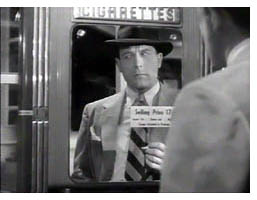 Last night I watched THE DEVIL THUMBS A RIDE, a 62-minute RKO item from 1952, directed by Felix Feist. Laurence Tierney is the most recognizable name in it, and if you know him only from RESERVOIR DOGS, you might not recognize him. Good suspense, very few sets (lots of car driving with background process plates), familiar character actors wandering in to do a bit part (including Harry Shannon, aka Charles Foster Kane’s father). A surprisingly violent twist at one point. Even the title tells you you’re watching a B.
And 6.0 second ASL.
We found in our Hollywood book [The Classical Hollywood Cinema], and pretty reliably since, that during the 1930s-1950s the Hwood norms ranged from 8-11 seconds per shot. But those samples were drawn, I increasingly realize, from mostly A pix, because in the vast initial filmography we compiled, what we found in archives tended to be A pix. Only William K. Everson had a substantial collection of B titles on our first list, more even than the Library of Congress.
So maybe Bs tend to be cut faster? Here are some other ASLs from the 1930s, from B or B+ items: Murder by an Aristocrat, 6.3 seconds; Nancy Drew and the Hidden Staircase, 6.8; Indianapolis Speedway, 5 seconds; Tarzan the Ape Man, 6.6 seconds; Tarzan Finds a Son, 3.6 seconds!
From the 1940s: Parole Fixer, 6.6 seconds; Chain Lightning, 6.3; Framed, 6.3.
Now this mini-sample has skewing problems of its own–lots of mystery and action pictures. We’d need to test it with other genres. Can there be fast-cut musicals? (Actually, yes; Footlight Parade.) Comedies? (Yeah, Duck Soup.) Melodramas? (Yep, Mr. Skeffington.) Still, I don’t have enough from any genres to say much of substance. As for our two big horror examples, The Black Cat falls in the A-picture range (8.5 seconds), while The Raven is much faster cut (5.7 seconds).
And what about the real Bs–the Westerns from Monogram et al? Plenty of them play on TCM and we have tons sitting in the Wisconsin Center for Theater Research, but I confess to having watched only a handful and never counted shots. Also, films with lots of stock footage (travel, racetracks, jungle animals, etc.) tend to be cut faster…and we know that Bs use lots of stock footage.
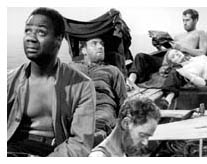 Interestingly, of major directors I’ve sampled, Hitchcock’s ASLs come closest to the ‘B’ touch. Selznick famously told Hitchcock to slow down the pace because his British films were too “cutty”; was there an unspoken belief that fast cutting was a little downmarket if you were making A pictures? Hitchcock sometimes cut fairly fast (until Rope and Under Capricorn, of course): 6.4 seconds for Lifeboat (on right), 7.3 for The Paradine Case, 6.8 for Notorious.
ASL can’t be an infallible detector because there are some Bs with ordinary ASLs, and a few with longish ones. Detour clocks in with an unusually lengthy 14.3 second ASL. Joseph H. Lewis’ The Big Combo (1954), made for Allied Artists (the revamped Monogram), boasts an ASL of 14.6 seconds and has many single-shot sequences (though given its cast and technical credits, it’s arguably a B+). Still, most marathon ASLs seem to come in A pix by Minnelli, Preminger, Wilder, and their peers.
What makes this stuff interesting is a long-standing assumption that because of short shooting schedules, B films couldn’t afford many camera setups. I think there’s an unspoken belief that directors used longer takes to get more footage per day. The shot length averages suggest the opposite: B films can use lots of shots, and a surprising variety of setups.
This may also suggest a difference between A studios making B pictures and Poverty Row studios making only B pictures. Again, my sample is slanted toward the former. Nevertheless, although faster than normal cutting isn’t a necessary condition of a studio-era B picture, it may be a symptom of one. If other indicators point toward a B, and you’ve got an ASL of less than 7 seconds, that could strengthen the case.
Scott Higgins of Wesleyan University raises a new question about my ASLs:
Fascinating. Are shot scales different as well? Might editing compensate for cheaper mise-en-scene? In any case, this is good evidence that staging takes time!
Coming full circle
On 8 February, at 8:00 CST, Paul Ramaeker, who started it all two days earlier, writes:
 Wow! Thanks to everyone for their input on this; now I just have to sort through everyone’s arguments and make a judgment call (given the degree of controversy over the question). I have to say, though I have now been convinced to use Detour as one of my screenings for that week, so as to have an example of Poverty Row, it would seem that either Black Cat or Zombie would work (as well as a Moto, which I hadn’t thought of at first), not least because there is some element of ambiguity in both cases that would be fodder for discussion.
I have to say, though, I think the reminders about the status of the Little 3, as well as the budgetary info, are kinda persuasive in the case of The Black Cat. And while I’d hate to lose Zombie, I can see some value in screening two films at different production levels by the same director, Ulmer in this case. There may well be such a thing as too much Ulmer, but if anyone could possibly object to a Black Cat/Detour double bill, they’d have to be kicked out of the class.
Cheers to all!
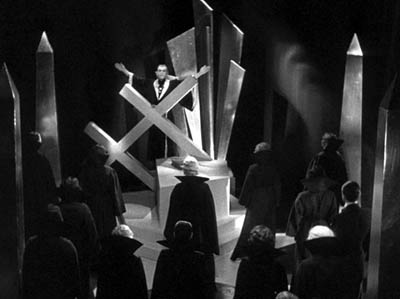
Weekly colloquium meeting of the Film area, UW–Madison
Mad City’s movie mania
The Hilldale Theatre of Madison, Wisconsin opened its doors in spring of 1966 roadshowing The Sound of Music, and last weekend the theatre closed. To celebrate its passing, the management held a Sound of Music Sing Along, complete with subtitles to help with the lyrics. (No, not “How do you hold a moonbeam in your hand?” but the really tough ones.)
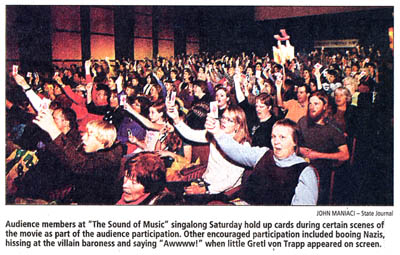
People came dressed as Maria, nuns, and the frog that was slipped into Maria’s pocket. There were cues for audience interaction, including saying “Awwww!” when Gretl appears on screen. This brought back memories of The Rocky Horror Picture Show, which ran at midnight shows at the now departed Majestic Theatre from 1976 through the mid-1990s. For a report on that, and the connubial bliss it brought, have a look here.
Kristin and I came to Madison in fall of 1973, prime time. The campus boasted 22 film societies: Wisconsin Film Society, Fertile Valley, Green Lantern, Hal-9000, and all the rest. Members of the Union Film Committee, overseeing the only campus 35mm venue, were passionately debating whether to show Godard, or Jancso, or a John Ford retrospective. I convinced them to show The Young Girls of Rochefort, which hurt my reputation,and Play Time, which I think helped it.
The Wisconsin Center for Film and Theater Research had just acquired several thousand Warners and RKO films. The Majestic Theatre ran double and triple bills (kung-fu, Leone’s Dollars trilogy). The Velvet Light Trap magazine was going strong, run wholly by students and semi-students.
In those days, before home video, it was glorious to be in Mad City. We had 6-10 movies to see every night, apart from course screenings. We didn’t even own a TV. Who needed one?
 Not to mention the cast of characters, all colorful. In the late 1960s-early 1970s the film community included:
The late Mark Bergman, premiere projectionist, fan of Phil Karlson, and gentle soul.
Joe McBride, critic (Variety), screenwriter (Rock and Roll High School), actor (The Other Side of the Wind), and excellent biographer (Spielberg, Capra, Ford, now Welles; What Ever Happened to OW? is very engaging).
Mike Wilmington, one of America’s top film critics, a mainstay of the Chicago Tribune.
Tim Onosko, author of Wasn’t the Future Wonderful?, industry consultant, and documentary filmmaker.
Gerry Peary, enterprising critic, screenwriter, and film professor.
Danny Peary, most famous for his series of Cult Movies books.
John Davis, co-founder of the Light Trap and creator of Capital City Comics.
Susan Dalton, another co-founder of the Light Trap and archivist at the American Film Institute.
Pat McGilligan, prolific critic, interviewer, and biographer.
Tom Flinn, the other co-founder of the Light Trap, pop-culture encyclopedist, and expert on Germans in Hollywood.
Bill Banning, founder of Roxie Releasing and operator of San Francisco’s Roxie Cinema.
Reid Rosefelt, publicist, producer’s rep, and filmmaker.
Many of these worthies ran film societies, so their ideas and passions showed through the films they screened. For more on the Madison Movie Mafia, go here.
Also present and active in late 1960s-early 1970s:
Filmmakers Erroll Morris, Stewart Gordon, Jim Benning, Bette Gordon, Michelle Citron, Karyn Kay.
Scholars-in-training James Naremore, Doug Gomery, Maureen Turim, Fina Bathrick, Marilyn Campbell, Diane Waldman, Ed Branigan, Vance Kepley, Peter Lehman, Brian Rose, Peter Brunette, Frank Scheide, and many more.
Great days, and nights…Mike Wilmington has written a fond appreciation of the whole scene here.
But this isn’t just an exercise in baby-boomer nostalgia. The Madison Cinema Juggernaut rolls on. The Light Trap just published its 58th issue. The Onion, founded by Madison students, continues to be America’s finest news source. Dan Fuller makes silent films with his students, using cameras from the 1920s, and the results have played at Pordenone. And not least, the Cinematheque, founded by faculty and students in the Communication Arts Department, carries on the spirit of the old film societies.
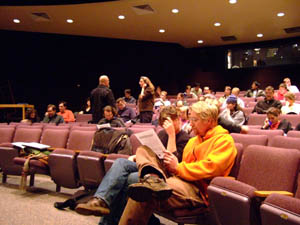
In sync with the closing of Hilldale, our Cinematheque ended the semester last weekend. (Crowd starting to gather above.) An outstanding schedule (S. Ray, Tarr, Godard, Sjostrom.) wound up with Lau Kar-leung’s Dirty Ho, the last of our string of Shaw Brothers classics. It was, of course, a delight, full of flamboyant, good-humored, and downright weird kung-fu.
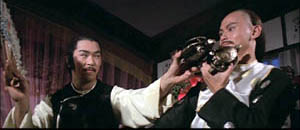
A lot of it was close-quarter work, as warriors examining pottery or sampling wine disguise their deadly thrusts as elaborate courtesy. Lau is arguably Hong Kong’s top martial arts choreographer, but he’s a fine moviemaker as well, and Dirty Ho is one of his best. Even the shabby state of the print, an original from 1979 complete with curious purple splotches, seemed to pay tribute to three decades of campus film fanaticism. It could have played the Majestic.
Even with the loss of the two Hilldale screens, Madison has five commercial screens dedicated to foreign and independent films, not counting the Cinematheque and the Play Circle in the Student Union. Come spring with Sundance, we’ll get six more. And our Wisconsin Film Festival (April 12-15) comes hard on the heels of the Sundance complex. Wisconsin Movie Madness lives on.
DB
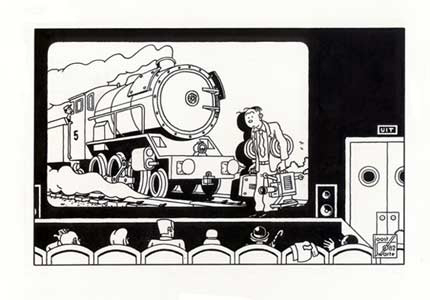
PS: Thanks to Ivo Blom for the Swarte illustration up top.
PPS 21 December: Today’s Isthmus has a nice story on Dan Fuller and the Wisconsin Bioscope company. I played a small role in their last film of the semester, and despite the need to wear eye shadow, this gave me an even greater appreciation of their efforts. They’ll have a screening of recent work some time next term.
Lewis Klahr X 3, X 4
DB here:
Last Saturday Lewis Klahr came to Madison, brought by the Starlight Cinema group of the University’s Student Union. He showed two sets of films: The Two Minutes to Zero Trilogy (2003-2004) and Daylight Moon (A Quartet) (2002-2004). He’s one of the most gifted collage animators in the American avant-garde, surely the most accomplished since Larry Jordan. Both filmmakers work in the Surrealist tradition, but Jordan seems more drawn to images from nineteenth-century illustration, while Klahr loves US pop culture. As a baby boomer who came of age in the 1970s, he recycles magazine ads, comic books, and book illustrations in lyrical and sometimes aggressive ways.
Tipped off by Tom Gunning, I first encountered Klahr’s work in The Pharoah’s Belt (1993), his most famous film. I also enjoyed seeing his film-within-a-film in Miguel Almereyda’s imaginative Hamlet (2000). At a recent Hong Kong International Film Festival I saw The Two Minutes to Zero Trilogy and decided to study it a bit. I contacted Klahr and he kindly sent me the film, along with Daylight Moon, and some lovely work by Janie Geiser, an accomplished filmmaker in her own right. You can get examples of their work on this DVD from Craig Baldwin (himself an extraordinary filmmaker).
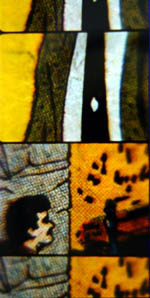
Seeing the Trilogy again, I was even more impressed by it. Each of its three parts consists of images snipped out of old 77 Sunset Strip comic books, with each part implying a bank holdup and a chase, but each time the events are compressed more and more. The last episode runs only one minute. “A feature length narrative compressed 3 different times into 3 separate films of diminishing duration until the synoptic is synopsized,” as Klahr puts it.
Don’t try to find a plot. Each episode uses just enough cops-and-crooks iconography to tease us into trying to create a coherent narrative, but it frustrates that in several ways. The images refuse to settle down, slipping and snicking past your eye in an imitation of saccadic glances. The microscopically short snippets recall multitrack sampling. In the Madison Q and A, Klahr called it a “pan and scan aesthetic.”
Sometimes the cartoon panels jerking past the camera create a weird effect of motion. A man dodging into a car with a valise seems to be whizzing off, a woman seems–for only one frame–to wave a sheaf of bills.
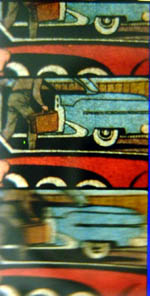
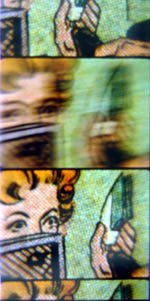
The cutting is rapid-fire as well. I’d thought that Klahr had edited in the camera, but he spliced everything. A certain maniacal precision becomes evident when you can actually look at the images on the strip and see the bold shot-changes, like the one crowning this post. The trilogy evokes the rush of a heist film without ever giving us more than glimpses of what the narrative might be. The sense of action hurtling toward chaos is cranked up by soundtracks using roaring guitar music from Rhys Chatham and Glenn Branca.
Daylight Moon (A Quartet) was far more relaxed. I saw it as a meditation on childhood and its sensitivities, fears, and moments of awe and mystery. (A touch of Joseph Cornell, maybe.) Valise is dominated by the vastness of our planet and the cosmos; Hard Green gives us comic-book imagery of military combat. Soft Ticket was a lyrical remembrance of baseball cards, and the finale, Daylight Moon blended imagery of kid culture and suburban utopias with the soundtrack of Night of the Hunter.
Klahr talked about the quartet as “the best film I’m ever likely to make,” largely because it achieved his aim of a “democracy of subjectivity.” He meant by this the poetic power of the juxtapositions he creates, which invite viewers to connect the material in unpredictable ways. Hollywood films, he remarked, try to get us all to experience the material in a single way, and that’s suitable for a mass audience. But collage films like his have a “signal to noise ratio” that allows viewers to tune in to something, drop out for a few moments, and then tune in again.
For each viewer, the high-information moments will be different, and if a viewer returns to the film, he or she will probably find new images to focus on. This time through the Quartet, I noticed that each of the first three films had a recurring male figure–a sea diver/ astronaut, a soldier, baseball players–until Daylight Moon ends with a man stretched out on a used car. This would seem to be a reverie about a boy’s childhood.
Klahr is a warm, unpretentious speaker and he engaged the audience in a lively dialogue. His work deserves to be more widely known. I can’t imagine watching the Trilogy on DVD; could digital sampling capture the REM effects of the blurring pans? Still, a release on that format would surely expand his circle of admirers.