



Archive for the 'Film technique: Staging' Category
Bando on the run
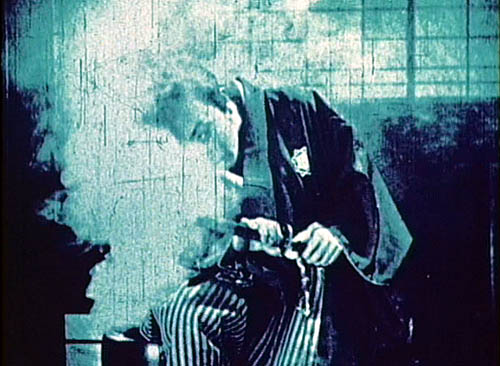
Sakamoto Ryoma (1928).
The Matsuda Eigasha company of Tokyo deserves enormous credit for restoring and making available classic Japanese films. My first visit to the firm twenty years ago was a revelation. Matsuda Shinsui was a former benshi, or spoken-word film accompanist, and he and his sons were collecting old films so that he could accompany them in screenings. A great many of the films were chambara, or swordfight movies. Most survived only in fragments, but what tantalizing fragments they were! (1)
The company made several of the films available on VHS tape, accompanied by benshi commentary prepared by Mr. Matsuda. I came away with several of these treasures. On later visits I was able to watch some films that hadn’t been transferred to video, and several of those deserve to be more widely seen.
When Mr. Matsuda’s son kindly drove me to my train station, I noticed that his car had a VHS player and video monitor installed in the dashboard. So much for my Tokyo-ga experience.
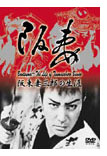 In 1979 Matsuda Eigasha compiled a documentary on the swordplay star Bando Tomasaburo. Now Digital Meme has made it available on DVD, complete with English subtitles. Bantsuma: The Life of Tomasaburo Bando is obligatory viewing for everyone interested in Japanese cinema. Not only does it handily trace Bando’s remarkable career through stills, interviews, and surviving footage. It also supports something I’ve tried to show for some time: that the Japanese action cinema of the 1920s and 1930s was one of the most powerful and creative trends in world filmmaking.
Action and innovation
Some writers have thought that Japanese filmmakers were developing a culturally anchored approach to filmic storytelling independent of Western influences. But in Ozu and the Poetics of Cinema and two essays in my forthcoming Poetics of Cinema, I argue something different. By the early 1920s Japanese filmmakers had mastered Hollywood’s norms of visual storytelling. In the Matsuda documentary, this is evident from the clips from early Bando films like Gyakuryu (1924) and Kageboshi (1924). Long shots are broken up into closer views, and conversations are treated in reverse-angle shots of speaker and listener. Camera movements follow the characters as they walk or run.
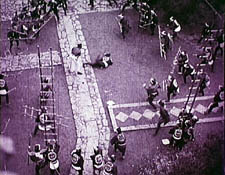
So far, so conventional. But many Japanese filmmakers revised the American approach, turning it into something more expressive and experimental. So, for example, a very steep high angle in Kirarazaka (1925) serves at first to show us that Bando is surrounded by fighters who use ladders to try to trap him. As the scene returns to this framing again and again, it becomes more abstract, with the fallen ladders becoming vectors of a geometrical shot design targeting the hero.
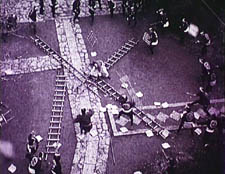
An even more remarkable example is Orochi (1925), a Bando film that survives intact and in fine shape. (Matsuda released it on VHS; I don’t think it’s on DVD yet.) The clip in the 1979 documentary shows one of Orochi‘s most dazzling passages. The hero, played by Bando, fights his way through a town, and, backed up against a wall, he’s trapped on all sides by his opponents. An extreme long-shot (below) shows us the situation, with Bando in the distant center. Many shots break this space down into opposing forces, Bando versus his adversaries, and quite fast cutting shows the men on either side of him.
The stretch that interests me most begins with a shot of Bando looking left.
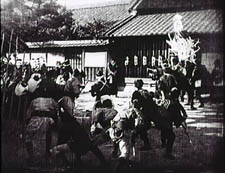
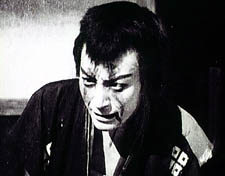
The director Futagawa Buntaro then breaks the confrontation into separate shots of the other swordsmen. Nothing unusual about that. But most directors would have handled the next few shots of the standoff this way:
Shot of Bando looking left.
Shot of a combatant looking right (implicitly, back at him).
Shot of Bando looking right.
Shot of a combatant looking left (implicitly, back at him).
This way we’d get a clear, simple sense of the fact that he’s surrounded on all sides. Instead, Futagawa follows the shot of Bando looking left with no fewer than twelve very close shots of fighters, all looking rightward. For example:
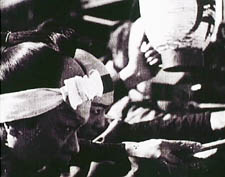
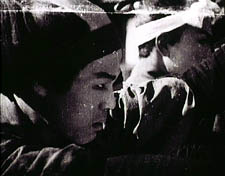
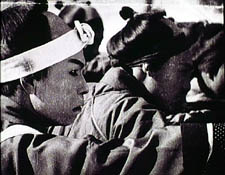
Then we get six shots of their arms outthrust, as here:
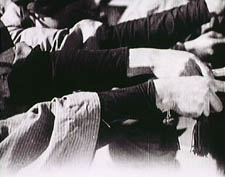
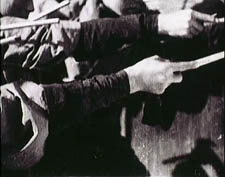
We then get a shot of several men looking straight to the camera, as if they represent the group directly in front of Bando, no longer at the left. Next there appear another ten shots of fighters looking leftward at Bando, all of them quite close to the camera. For example:
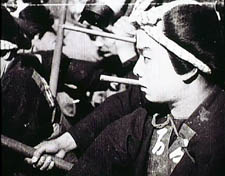
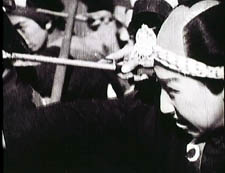
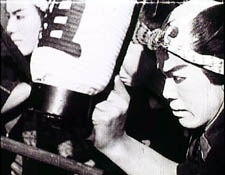
In both sets of shots, many images are composed to match each other graphically: the first group of faces tends to place each man on the left frame edge, while the second set puts most men at the far right. The first set of shots develops a pattern, moving from tight facial close-ups to shots of arms and swords thrusting toward Bando. The second set develops toward showing faces that are ever more cut off by the right frame edge.
Add in the fact that all these shots are cut very quickly, ranging from four frames down to one! This is extraordinarily rare in 1925 cinema. (I talk more about how to study such passages in an earlier blog.) Words can’t really convey the way these images clatter against one another. Their percussive speed makes them graspable only as a tense thrust in one direction countered by an equally tense one opposite. Faces pile frantically up against Bando first one one side, then the other. The sense of linear force is strengthened by the shift from the cluster of face shots to that of the arms, with the transition handled in a pair of weird jump cuts along different men’s arms.
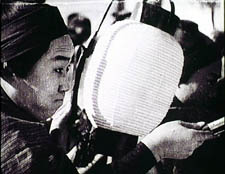
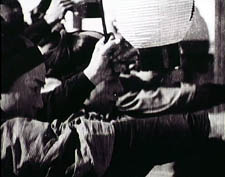
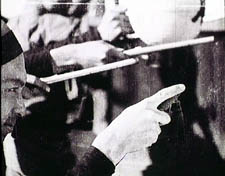
The transition from the first shot above to the second creates the impression that the man has jabbed with his spear, while the cut from the second to the third shot eases us to the forearm shots shown earlier.
This bravura passage is triggered by the initial shot of Bando, haggard and shaky. Perhaps the cascade of shots is motivated as subjective, reflecting his exhaustion in the face of entrapment. Just as likely, I’d say, is the fact that Futagawa took a stereotyped situation, the hero surrounded by his adversaries, and looked for a way to make it fresh, to use energetic stylistic innovation to amplify the story point emotionally and perceptually.
Nothing in the sequence violates continuity editing’s basic principles. The shots keep screen direction constant and character position clear. Indeed, the director has understood spatial continuity very deeply: the men to the left of Bando are pushed far to the left side of the frame, the men to the right are squeezed rightward, so that Bando is always implicitly filling the area they’re recoiling from. But what American director would have risked such a bold piece of cutting?
Orochi, let’s remember, was released the same year as Strike and Potemkin. If this passage had been known to the earliest generation of film historians, Japan might well have been greeted as another birthplace of daringly dynamic montage. (2)
There are several other intriguing flourishes in the footage on display in Bantsuma, particularly a scene of Bando dying in a swirl of steam (this entry’s top image). But two points should be clear: this is innovative filmmaking of a high order, and it took place in a shamelessly commercial film industry. Mainstream filmmaking in Japan has been open to stylistic experiment to a degree rare in other popular cinemas. You can trace a line from the 1920s to the present, from the chambara directors through Ozu and Mizoguchi and Kinoshita and Suzuki Seijin right up to Kitano and Miike. Along a parallel path, Hong Kong action cinema pressed filmmakers toward creative renovation of film technique. (3) In this tradition, the action films of Bantsuma and his peers hold an honored place.
The lessons are familiar ones from this blog. Mass-market cinema harbors experimental impulses; creative directors working in well-known genres are often striving to push the limits. By attending to technique, we can discover a dazzling variety in areas of film history not usually considered “artistic.”
PS: Through Digital Meme, Matsuda has also made available a treasury of 55 animated films from the earliest years. The are at work on a DVD of early Mizoguchi films, including a fragment I’m keen to see from Tojin Okichi (Okichi, Mistress of a Foreigner, 1930).
(1) A large set of them has been available for some years on a DVD-ROM, also available from Digital Meme. For useful reviews, go to Midnight Eye and hors champ.
(2) ) I offer several other examples in the essays “Japanese Film Style, 1925-1945” and “A Cinema of Flourishes” in the forthcoming Poetics of Cinema.
(3) I make this argument in Planet Hong Kong and the essays “Aesthetics in Action” and “Richness through Imperfection” in Poetics of Cinema.
Intensified continuity revisited
DB here:
We’re just beginning to understand the history of film forms, but some trends in Hollywood already seem clear. During the late 1910s American filmmakers synthesized an approach to cinematic storytelling that relied on continuity editing, the practice of breaking a scene into matched shots in order to highlight character action and reaction. In the years that followed, this editing strategy became the dominant approach to mass-market filmmaking across the world. Many historians and theorists believed that editing was the essence of cinema itself.
When sound arrived in the late 1920s, the technology was difficult to master and consumed a lot of production time. It would have been easy for American filmmakers to shoot every scene from a single position, but instead they used multiple cameras to cover the action, much as three-camera TV handles sitcoms now. This made filming cumbersome and limited the lighting choices, but filmmakers wanted to preserve the option of cutting to closer views and fresh angles as the scene developed. Continuity editing continued through the 1930s and well beyond, with filmmakers refining it in various ways.
The strategy has proven remarkably robust. Today’s mass-audience films, from all over the world, adhere to the principles and particulars of continuity editing. Not many artistic styles, in any medium, have had such a long run.
These ideas are developed in more detail in things that Kristin and I have written. (1) Most recently my book The Way Hollywood Tells It tries to track shorter-term changes in the continuity style. I found that one handy way to do this was to look at remakes. Remakes allow us to keep story factors somewhat constant and focus on differences in visual technique. Today’s blog looks at parallel scenes from two films, an original and a remake, in order to illustrate what I’ve called “intensified continuity”—the editing style that comes to dominate American films after 1960 or thereabouts.
Dear friend….
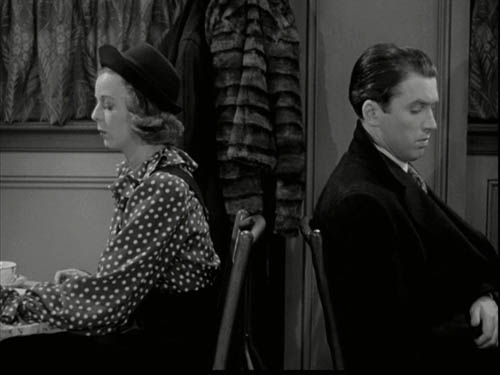
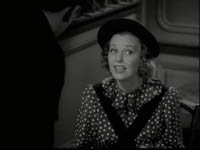
In Ernst Lubitsch’s wonderful Shop around the Corner (1940) Kralik (James Stewart) works in a Budapest gift shop with Klara (Margaret Sullivan). They quarrel constantly. But each has an anonymous pen pal, and the relationship is growing into love. Unfortunately, we learn early on, they’re writing to each other.
On the day they’ve agreed to meet face to face, Kralik is fired. He and another salesman Pirovitch (Felix Bressart) trudge to the café where Kralik is to meet his secret friend. Kralik can’t bear to face her now that he has no job, so he wants Pirovitch to deliver a note saying he can’t come. Still, his curiosity makes him ask Pirovitch to look in the window and describe her. Pirovitch tries to soften the blow, but he has to admit that the young woman waiting with a copy of Anna Karenina and a red carnation is Klara.
Angry, Kralik takes back the note and decides to let her wait. But after Pirovitch is gone, he returns to the café and meets her—not divulging his identity, but trying some conciliatory moves.
In the silent era, Lubitsch was one of the greatest exponents of continuity editing. You need only look at The Marriage Circle or Lady Windermere’s Fan to see his quiet virtuosity. (Kristin’s Herr Lubitsch Goes to Hollywood devotes a chapter to his cutting.) But in Shop around the Corner Lubitsch uses only two shots to present Kralik’s and Pirovitch’s conversation outside the café. A fairly distant tracking shot follows the two men to the window, then we get a very lengthy shot of the two men outside. It starts with Kralik instructing Pirovitch to check on what his correspondent looks like.
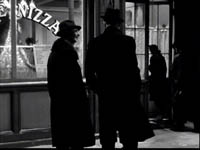
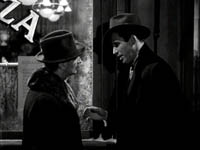
Another director would have given us point-of-view shots showing what Pirovitch sees, along with his reactions. Instead, Lubitsch keeps the emphasis on Kralik, who’s responding to Pirovitch’s reports. Consequently, Kralik’s reactions aren’t given in cut-in close-ups but rather in the prolonged two shot.
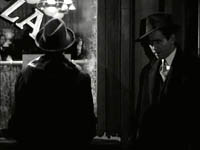
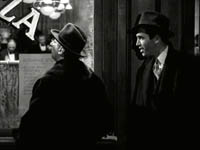
This allows both performers to act with their bodies. Bessart’s shoulders relax, for instance, when he spots Klara, as if he’s slightly recoiling. Stewart’s reactions are more varied; he leans forward eagerly and nods as Pirovitch finds the woman. He slumps, then tugs his hat when Pirovitch mentions Klara.
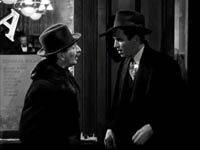
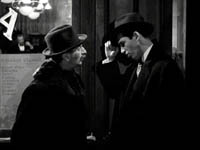
Kralik looks in to see for himself, and collapses a bit. He eventually relaxes when he wryly accepts the fact that his pen pal is his quarrelsome coworker.
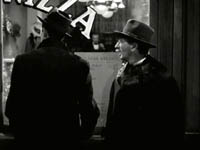
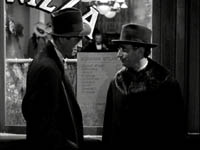
Visually, it’s a simple scene, but it shows the power of the unvarnished two-shot.
After the two men separate, Lubitsch shifts the scene inside and gives us another sustained shot as the anxious Klara talks with a waiter. Instead of crosscutting to Kralik returning outside, Lubitsch creates a humorous shot by letting his head drift into the window behind Klara.
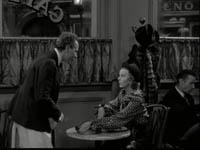
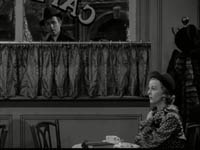
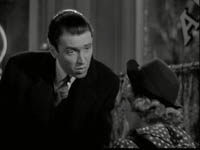
When Kralik goes in to meet Klara, he doesn’t tell her that he’s her pen pal, so narrationally speaking, the knowledge is unbalanced. He and we know more than Klara does, which makes her unhappiness more pathetic. It’s a wonderfully textured scene, partly because we know that each one’s annoyance with the other masks disappointment and anxiety. As the action develops, there’s somewhat more cutting, but even Lubitsch’s closer views often keep both in the frame. He saves his closest shots for the most intense exchange, when Klara mockingly refuses Kralik’s efforts at friendship. The scene will end on a painful note, with each wounding the other with hurtful remarks.
AOL buddies
As you probably know, The Shop around the Corner was remade as You’ve Got Mail. There are some important story differences. The two protagonists have other partners, and Joe Fox owns a bookstore chain that is crushing the children’s bookstore owned by Kathleen Kelly (Meg Ryan). But the parallel scene in You’ve Got Mail is remarkably similar to the one we’ve just been examining.
The sequence starts with Joe and his assistant Kevin (Dave Chappelle) approaching the coffee shop, and Joe is apprehensive—not because like Kralik he’s out of a job but because of the upheaval that meeting his email correspondent could cause in his personal life. Like Kralik, he asks his friend to peer in the window to check her out.
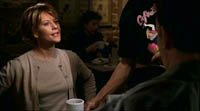
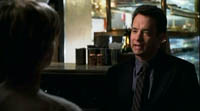
But Nora Ephron handles the scene quite differently than Lubitsch did. She breaks all the dialogue into several shots, mostly favoring one actor (either over-the-shoulder shots or what are called singles). The process starts during the men’s approach to the café.
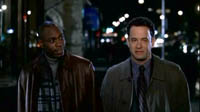
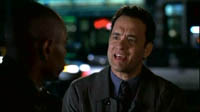
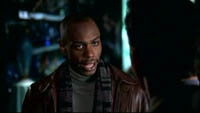
Once they arrive, the staging stations Joe at the foot of a flight of stairs and Kevin at the top, so a sustained two-shot isn’t really in the cards. The pattern is that Kevin reports what he sees, and in reaction shots we see Joe’s response.
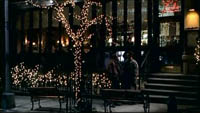
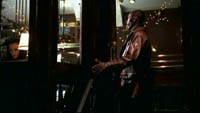
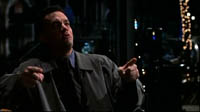
When each man looks inside, unlike Lubitsch Ephron supplies point-of-view shots of Kathleen.
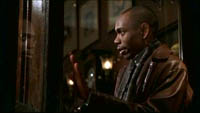
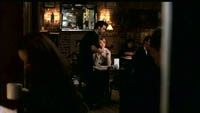
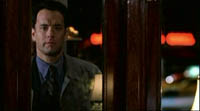
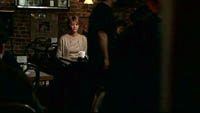
Joe reacts vindictively when he learns his email correspondent is his adversary, and he returns to punish her, but not before we’re taken inside the café and watch Kathleen wait for her correspondent. Even her encounter with another customer, somewhat similar to Klara’s chat with the waiter, is broken into three shots.
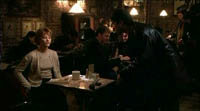
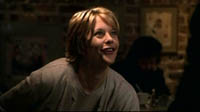
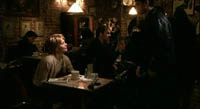
When Joe arrives, his conversation with Kathleen is handled in variations of shot-reverse shot, often in fairly tight framings. Again, the closer framings accentuate the bitter insults the characters exchange.
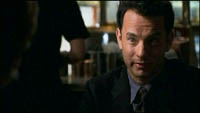
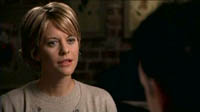
You’ve got cutting
Both scenes run almost exactly the same length: 8:48 in Shop, 8:42 in You’ve Got. But the initial portion, showing the two men on the sidewalk, consumes only two shots in the Lubitsch and 41 shots in the Ephron. That means that Lubitsch’s average shot in the scene runs about 82 seconds, while Ephron’s runs about 4.1 seconds!
The same disparity arises in the section of the scene taking place in the café. In Shop, 14 shots treat the action inside, but in You’ve Got there are 84! Lubitsch’s shots in this portion average about 21 seconds, still very lengthy, while Ephron’s are almost exactly the same as in the earlier portion, coming in at 4.3 seconds. We tend to think that only high-octane action sequences are cut quickly, but today’s dialogue scenes are cut fast too.
In both films, actors’ line readings are very important, but in Shop, the performances include sustained passages of body language. In You’ve Got, actors act mostly with their faces. Whereas Ephron gives us singles from the start (Kevin and Joe’s approach), Lubitsch saves his close shots for the encounter between his squabbling romantic couple. There’s an effect of gradation, with the cutting building the scene visually toward a high point, that isn’t provided by Ephron.
Oddly, the modern film is less subtle than the older one. Lubitsch uses no nondiegetic music in the scene, but Ephron inserts conventionally comic music as Kevin and Joe approach and we get sorrowful music when Kathleen leaves the café in tears. Although many people think that old movies are hammy and overplayed, here it’s just the opposite. Stewart performs subtly, but Hanks, whom many take as today’s Jimmy Stewart, plays broadly, gesturing in extremis and at one point shaking the brownstone’s railing. The Lubitsch scene also makes use of dramatic pauses to a greater extent than Ephron does.
The redundancy is seen as well in Ephron’s reliance on cutting and singles. Nearly every line or reaction in the You’ve Got sequence gets a shot to itself. This isn’t unique to this film; every remake I’ve examined is cut faster than its original. Fast cutting, down to 2 or 3 seconds per shot on average, and a reliance on OTS’s and singles typify today’s intensified brand of continuity.
Silent films were cut quite fast—in America, around five seconds per shot was common—but the arrival of sound slowed down the editing pace. The good people at Cinemetrics are building a database tracking this trend, among others. But since the 1960s, things picked up in American cinema, and today it isn’t uncommon to find films with average shot lengths of 2-4 seconds….and not just action movies. Likewise, such cutting operates in conversation scenes, making it more likely that the shots are singles rather than two-shots or ensemble framings.
This “intensification” of traditional continuity tactics, I’d argue, dominates mainstream moviemaking today, and not just in the US. Such cutting can sometimes be found in the 1930s and 1940s too, but then it was one possibility within a broader range. The Lubitsch example adheres to the principles of continuity editing, but it allows for more variety of camera distance and pacing.
I don’t denounce intensified continuity as such; some films, most recently David Fincher’s fine Zodiac, make intelligent use of it. Still, with this as the dominant approach, the director’s range of choice has narrowed. When contemporary directors lengthen a take, it’s usually to create a virtuoso traveling shot. A simple framing like the one outside the cafe in Shop is very unusual nowadays. The sustained two shot is practically an endangered species.
Why? What led to these changes between the studio era and contemporary cinema? A cynic would say that, contrary to Steven Johnson, audiences have gotten dumber and need more emphasis on character action and reaction to follow what’s going on. But in The Way Hollywood Tells It I suggest that there are many factors at work in this stylistic change. The book also provides more details of other techniques characteristic of today’s intensified continuity.
(1) In particular Kristin’s Breaking the Glass Armor: Neoformalist Film Analysis, our sections of The Classical Hollywood Cinema: Film Style and Mode of Production to 1960 (written with Janet Staiger), and our Film Art: An Introduction.
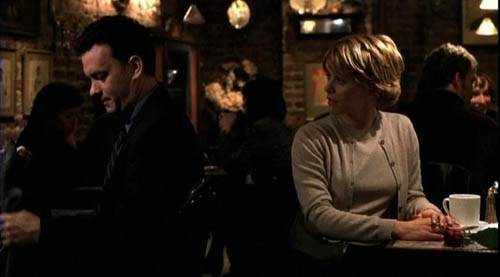
Funny framings
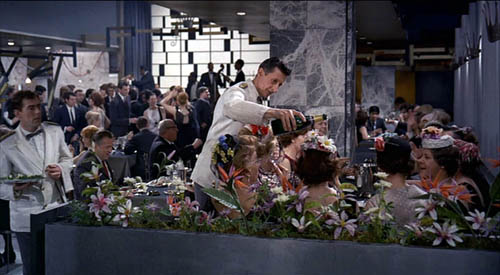
DB asks: Can a film shot be amusing in itself?
Of course a shot can show us a gag that’s funny. If Jerry Lewis or Adam Sandler is going to fall off a ladder into a Dumpster, we want to see everything clearly. Here the framing can be modestly functional. But can the very choice of lens, angle, scale, or composition play a stronger role? Can camerawork itself provide the gag?
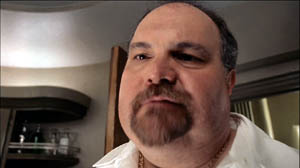
Barry Sonnenfeld, cinematographer for the Coens and now a prominent director, thinks so. He’s remarked that an extreme wide-angle lens is inherently funny. In the commentary for the DVD of RV, he explains, “You just put a big 21mm lens really close to [Will Arnett’s] face and you get comedy without him having to do anything.” I don’t have an RV frame handy, but here’s an example from Big Trouble, with both the wide lens and the low-angle creating the sort of grotesque disproportions that Sonnenfeld finds funny.
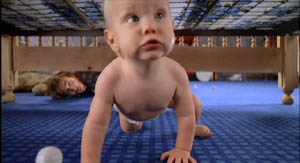
Sonnenfeld got this idea, he claims, by working on the Coens’ early films, which used wide-angle shots for cartoonish exaggeration. In Raising Arizona, the angle and lens length make the wandering baby loom; we’re not used to seeing an infant rampant.
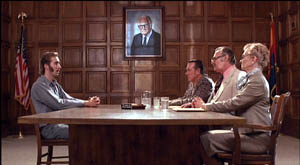
But the Coens had a broader approach to funny framings than Sonnenfeld acknowledges. For instance, they created humor by means of geometrical tableaus. In H. I.’s parole hearing in Raising Arizona, an absurd solemnity is set up by the symmetrical layout of actors. At the apex of the triangle, a portrait of Senator Barry Goldwater blesses the occasion.
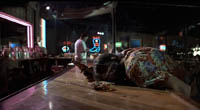
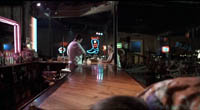
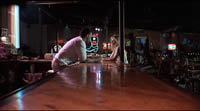
Even more memorable is the forward tracking shot down the bar top in Blood Simple. The camera, encountering a drunk sprawled in its path, simply crawls over him.
The silent comedians knew how to use camera position to build up their gags. Long ago Rudolf Arnheim praised the opening scene of Chaplin’s The Immigrant. As a ship rocks treacherously, we see Charlie from the rear heaving and kicking on the railing. As Arnheim puts it, “Everyone thinks the poor devil is paying his toll to the sea.” (1)
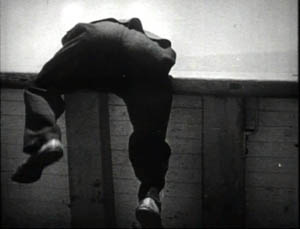
But then Charlie turns toward the camera to reveal he’s been struggling to reel in a fish.
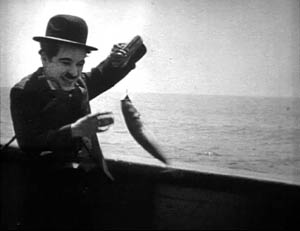
Here the framing creates the gag by what it doesn’t show. “The element of surprise,” Arnheim notes, “exists only when the scene is watched from one particular position.” The camera setup also makes an expressive analogy; we probably never noticed the similarity between vomiting and wrestling a fish.
One of my favorite comic framings occurs in The General. Buster’s train is hurtling along, and a cannon on one car is suddenly trained on him. The first shot gives us the situation with maximum clarity, in a profiled shot. But then Keaton cuts to another angle, showing the cannon in the foreground and Buster trying to escape it.
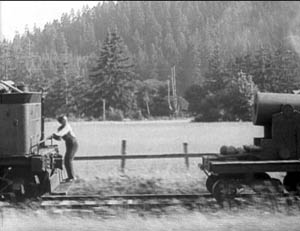
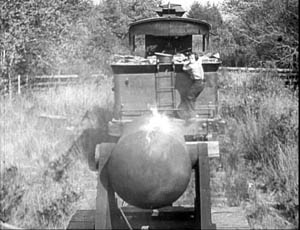
Nothing much has changed in the scene’s action, just the camera setup. But now we get to watch the cannon draw a bead on Buster. Audiences invariably laugh at this shooting-gallery image.
Jacques Tati is in many ways the modern heir of Keaton, and humor in his sequences often stems simply from a juxtaposition of elements in a single frame. An older man ogling a pretty woman on the beach is funny in a standard way, but in M. Hulot’s Holiday, we get more.
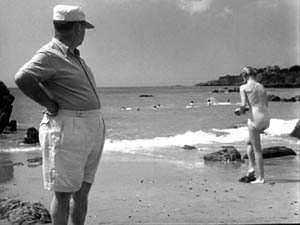
No words are spoken, but Tati’s staging and framing juxtapose the very different bodies in telling ways. We’re invited to note the difference between age and youth, paunchiness and health, passing yearning and its likelihood of fulfillment.
Play Time, Tati’s masterpiece and one of the greatest films ever made, offers an abundance of subtly comic framings. The shot below promotes the film’s theme that modern architecture has homogenized the world. The posters present the same building in different locales, with only stereotyped add-ons to distinguish the US, Hawaii, Mexico, and Stockholm. As one of the ladies on Barbara’s tour says, “I feel at home everywhere I go.”
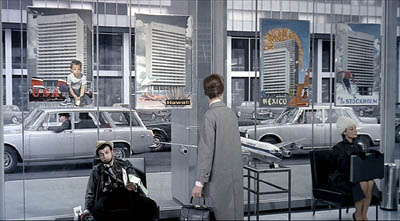
Again, though, a juxtaposition adds to the humor. Throughout Play Time, Tati suggests the disparity between the joy of travel as promoted by our culture and the stress of hustling from place to place. The promise of the posters is undercut by the dazed traveler who’s flopped underneath them, clutching maps and flightplans. And he in turn contrasts with the no-nonsense businesswoman on the far right.
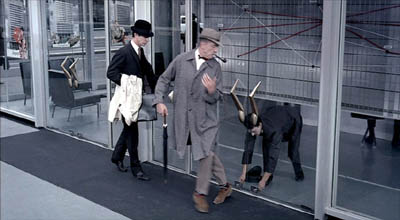
Tati can create comedy by the exact placement of the camera; a foot to the left or right and the gag would vanish. In the image at the start of this entry, the waiter is pouring champagne, but he seems to be watering the ladies’ flowery hats, which mask their champagne glasses. The same sort of exactitude of placement occurs in a shot we use as an illustration in Film Art (p. 195). M. Hulot is leaving an office building when it’s closing. As a guard locks down a doorway, his cap falls off and Hulot is startled: the guard seems to have grown horns.
Can we find funny framings in current films? Yes! I was prompted to write this blog while rewatching Shaun of the Dead. Zombies have overrun London, and two groups of human survivors meet. Shaun is leading one, Yvonne is leading the other. Instead of being presented as a mingling of the two groups, the scene plays out along two lines of people. Have a look.
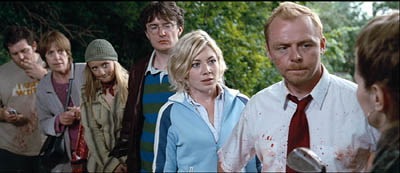
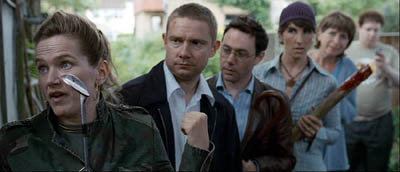
The gag’s premise is that each survivor has a counterpart in the other line. There are two posers in brown leather jackets, two can-do girls, two matrons, and two distracted videogame geeks. I wonder how many first-time viewers catch this? (Kristin did, I didn’t.)
These mirror-image depth shots set up the real gag, which pays off in another clever composition. When the two groups set off on separate paths, each member passes and smiles awkwardly at her/his lookalike, while the framing underscores their likenesses.
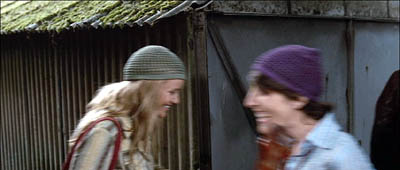
As they walk through the frames, the similarities increase.
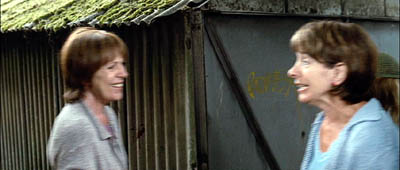
The framing makes a clever point about conformity and social stereotypes. Ending the procession with the two gamers, oblivious to the danger and to one another, tops the topper, as gag writers would say.
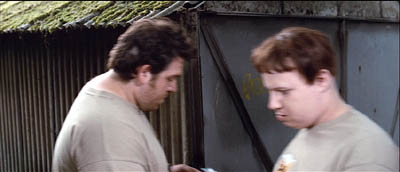
Tati would have loved these shots.
Of course I’ve simplified things for the sake of making my point. It’s not that the camera is somehow capturing a free-standing event by selecting the most amusing view. In all these examples, the staging is calculated to match the camera position. Staging, like camerawork and other film techniques, creates filmic narration. I’m only suggesting that in these scenes, the staging wouldn’t work on its own to create humor, nor would a simply functional framing. Choices of lens, camera position, and the like seem to be critical in making the gags work.
Finally, a borderline case that intrigues me. In last year’s Crank, our hero is in overdrive thanks to a constant intake of drugs. Stepping into an elevator, he faces a man who starts speaking Japanese. Naturally, his line is subtitled.
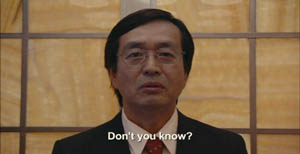
But then we get this:
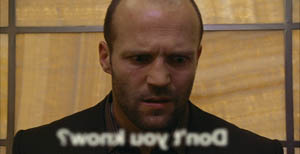
The idea of the head-on reverse angle is carried to comic extremes by reversing the subtitle as well (and blurring it to reaffirm the hero’s muzzy mental state).
I think that aspiring filmmakers can learn a lot from this tradition. Our films need more pictorial creativity, which often doesn’t require fancy CGI. Stylistic handling can add fresh layers to a basic story situation, and astute filmmakers can be alert to the possibilities of comic compositions and funny framings.
(1) Rudolf Arnheim, Film as Art (Berkeley: University of California Press, 1957), p. 36.
PS 4 May: Owen Williams writes to point out that the gag in Crank depends not just on a reverse framing but a play on the idea of lens focus. “The subtitle is fuzzy because it’s supposed to exist in real space (at least in this character’s head), with the letters hanging in mid-air in front of the Japanese man. Therefore in the reverse angle they appear out of focus (fuzzy) because they are closer to the camera. It’s a great gag.” Thanks, Owen.
PPS 8 May: I’ve gotten a lot of correspondence about this blog entry. Here are some nifty supplements:
Kent Jones was reminded of the shot in High Anxiety in which the camera moves to a picture window, with people dining behind it, and then crashes through the glass.
Sam Adams recalled a shot in Killer of Sheep that had something of the same effect, showing men trying to load a car engine onto the bed of a pickup truck. But the context isn’t itself comic. Sam reflects: “Based on the examples you choose, it seems that ‘comic framing’ invariably involves a level of self-consciousness, a feeling that the audience is being deliberately toyed with by the figure behind the camera. We get a sense that the scene has been staged for our amusement, rather than feeling that we must identify emotionally with whatever the characters are going through (which even in comedies is often quite sad).”
Stew Fyfe found a host of in-jokes in the Shaun of the Dead shots:
“Viewers of British television might notice an extra parallel between the shots. The actors playing each of the group leaders, Simon Pegg (Shaun) and Jessica Stevenson (Yvonne), were the leads in the sitcom Spaced (also directed by Edgar Wright, the TV predecessor to Shaun). Also split between the two groups are Lucy Davis (Shaun’s Group, hat) and Tim Freeman (Yvonne’s group, second in line), from original The Office and Dylan Moran (Shaun’s group, glasses) and Tamsin Greig (Yvonne’s group, hat), the leads of the sitcom Black Book. Yvonne’s mum (second matron) is played by Julie Deakin, who played the drunk and desperately lonely/horny landlady in Spaced.”
Thanks also to Bryan Wolf for a note on the same subject.
Finally, this from Jeremy Butler:
“I like your example from The General, but my favorite example of comic framing from Keaton’s work (and one I use in class to illustrate how he was more “cinematic” than Chaplin) is in Sherlock, Jr. Buster runs along the top of a freight train, and is then flushed to the tracks by a spout from a water tank. What makes it funny, I’d suggest, is the choice to frame it from the side, at a right angle to the tracks (much like the first General frame in your example). It minimizes the size of Buster’s body and contrasts him with the size of the train cars. Plus, it emphasizes the movements in opposite directions of his body and the train.
All these elements make it visually funny in a way that would not be apparent if it were filmed from an oblique angle or from behind the train.
But then, maybe I just like to show it because it’s the scene in which Buster literally broke his neck–which he didn’t realize until decades later when being x-rayed for something completely different!”
Thanks to everyone who wrote in with comments and who linked to this entry.
Angles and perceptions; with a note on Thai censorship
Hide your face
“Angles alter perceptions,” notes a recent Newsweek story. You bet, as we say in Wisconsin. But intriguing evidence emerges from new research into videotaped confessions.
Over 500 jurisdictions now record confessions on video, we’re told. In virtually all instances, there’s only one camera, and it shows only the accused. That means, in movie terms, there are no reverse shots of the questioner.
What difference does it make? Quite a lot, it seems.
In Newsweek‘s words, “When a camera shows only a suspect’s face, studies show, potential jurors are more likely to believe the confession was voluntary and the suspect guilty than when it shows the faces of both suspect and interrogator.” The problem may also infect judges. Experiments conducted by G. Daniel Lassiter at Ohio University found that a sample of 21 judges appraised the confessions as more voluntary when the camera framed only the confessor and didn’t show the police officer.
The obvious worry is that we can’t be sure that the confession is voluntary if we don’t get any sight of the questioner. To take an extreme, but not fanciful, possibility, maybe the person offscreen is holding a weapon. But even if the questioner isn’t threatening the confessor, his or her facial expression will help us appraise the whole situation more fully. Is s/he reacting with sympathy, anger, or neutrality? Do the questioner’s facial expressions set a context for the questions asked? We can’t know, and this absence of knowledge may encourage us, by default, to side with authority and presume that the confession is genuine.
In fiction films, sometimes the camera doesn’t give us the reverse angle. It may simply dwell on one character, often when she or he is delivering a monologue. A close analog to the videotaped confession occurs in Truffaut’s 400 Blows when an offscreen therapist questions the boy Antoine about his life.
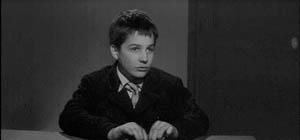
Several effects flow from Truffaut’s choice of this technique. The handling suggests a quasi-documentary objectivity in recording Antoine’s replies. Making the questioner unseen suggests that she won’t become a significant character, rather a voice that typifies the impersonal authority of the detention facility. The fact that the questioner is a woman reminds us of Antoine’s relation to his mother, an important topic in the interview. In all, this strategy concentrates on Antoine, letting us see new sides of his past and his mind.
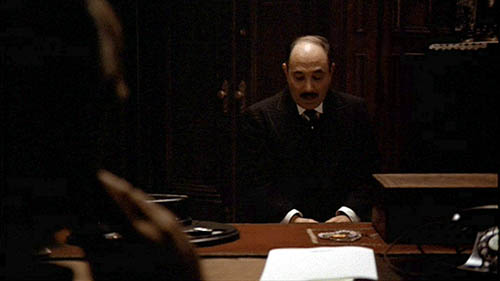
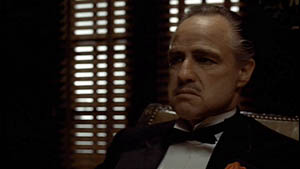
In other scenes, I’ve noticed that suppressing the reverse angle not only showcased the character we see but also rendered the scene’s action more suspenseful or ambiguous. Recall the famous first shot of The Godfather, which concentrates on the mortician and refuses to supply the reactions of Don Vito.
The shot gives full sway to Bonasera’s monologue. At the same time, by slowly zooming back, the shot creates a growing suspense. To whom is he speaking? What is the listener’s reaction? Only at the end of Bonasera’s plea, when he rises to whisper in Vito’s ear, does Coppola supply the view of Don Vito—a big theatrical entrance for this character and the actor playing him.
Less operatic is an early scene in Sauvage Innocence (2001), by Philippe Garrel. The filmmaker François is going over his dead wife’s belongings, which his friend has preserved. Garrel gives us an establishing shot of the action, then, as the friend continues to talk, the camera concentrates on Francois’s reaction to the letters, poems, and photographs. Although his expressions are somewhat ambivalent, at least we can see them.
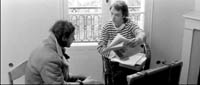
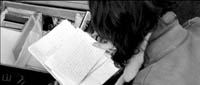
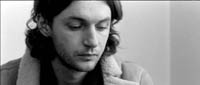
But in the next scene, a single shot lasting about seventy-five seconds, Garrel withholds the reverse angles that we’d normally get when his protagonist speaks. The camera favors the friend, a minor character, who asks questions about François’s new film while feeding a baby. François replies that he’s having trouble finding a producer, and if this last opportunity fails, the project will be over.
Garrel doesn’t choose to reveal François’s expression as he reports this critical state of affairs: no reverse shots. We must infer his emotional state from his voice, his pauses and sighs, and his postures as he replies, rises, and sits down.
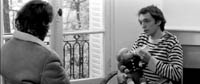
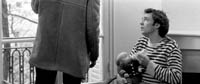
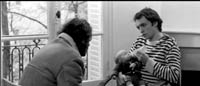
At most we can assume that he’s dispirited, perhaps because of his film’s slim prospects and the reminder of his dead wife.
In the scene, there’s one glimpse of his face, as he turns slightly, and—Tim Smith might be able to confirm this—I’d bet that most viewers zero in on him at that moment. (The movement is centered in the frame as well.) But that view is pretty brief and uninformative.
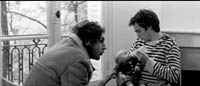
Overall, we have to infer François’s attitude from other cues than his expressions, and the results aren’t clear-cut. It seems to me that Garrel’s choices here are typical of one strain of “art cinema.” This storytelling tradition aims to make scenes somewhat indefinite in their meaning and to leave considerable room for spectators to play with various implications of the action.
Cutting and Social Intelligence
Some years ago I developed some ideas about the importance of shot/ reverse shot cutting in an essay called “Convention, Construction, and Cinematic Vision.” (1)
One school of thought in film studies holds that cinematic conventions are wholly arbitrary social constructions. This implies that we have to learn to watch movies, just as we have to learn any arbitrary sign system, like Morse code or written languages. My essay argued that cinema, like painting, offers a continuum of conventions: some require a lot of exposure to learn, while others require much less. The easiest ones rely on regularities of everyday experience. I tried to show that shot/ reverse shot is a fairly easy convention to learn because it mimics the alternation between speaker and listener that we find in the turn-taking of ordinary conversation.
As my examples suggest, even if person A is doing all the talking, we don’t fully understand the scene if we can’t also monitor the reactions of B. By contrast, the shot/ reverse-shot patern keeps a running tab of the dynamics of the conversation. When a director wants to suppress information about B’s response, deleting the reaction shot can create uncertainty or suspense.
Confessions aren’t fictional films; we don’t assume that they use much staging. I’d argue that in videotaped interrogations any uncertainty about the listener’s reactions is quelled by our assumption that the officer is neutral or that any emotion she expresses has no effect on the confession. In other words, during a videotaped confession, any reaction on the part of B is presumed, perhaps wrongly, to be irrelevant. But in watching a fiction film, we tacitly assume that the director has suppressed B’s reaction in order to shape our experience in a particular way. The use of shot/ reverse shot, then, has a narrational function, governing the flow of story information.
We might posit this maxim of social intelligence: We understand an interchange more fully when we can see both participants’ responses to it, moment by moment. This notion underpins our old friend shot/ reverse shot, a convention that requires no specialized learning beyond watching and participating in conversations in real life. The absence of the reverse shot in videotaped confessions forces us to fill in one side of the conversation, and what we fill in may not be warranted.
Lassiter suggests a subtler effect of single-shot confessions. He has specialized in what psychologists call “illusory causation,” as explained in a 2002 press piece.
Criminal interrogations are customarily videotaped with the camera lens zeroed in on the suspect. Psychological research has shown that objects that are the focus of attention, are “more likely than less conspicuous objects to be judged the originators of a physical event, even when there is no objective basis for such a conclusion,” said G. Daniel Lassiter, author of the study. This phenomenon is referred to as “illusory causation.”
So by concentrating wholly on the suspect, the framing attributes a greater causal power to him or her than would a shot/ reverse-shot sequence.
I can’t at the moment see how this might come into play in a fiction film. In both of my major examples here, Bonasera and the baby-feeding friend have less causal power than the character whose response is suppressed. I suspect that the story context of film scenes provides our main sense of who has the causal power, which film style can reiterate or undercut.
Censoring Syndromes
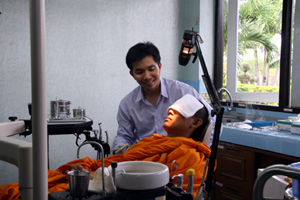
Apichatpong Weerasethakul’s Syndromes and a Century was one of the best new films I saw last year. It has played at Venice, Vancouver (my quick remarks are here), Hong Kong, and other major festivals. It also won the best editing award at the Asian Film Awards. You can read the Variety review here. Jeff Reichert’s exhilarating appreciation appears, in keeping with the theme of the above entry, at Reverse Shot.
But now Apichatpong has withdrawn the film from theatres because local censors have demanded cuts. The objectionable portions include shots of monks playing with toys and a doctor kissing his girlfriend in a hospital. Details are available at Variety and Limitless Cinema. According to Screen Daily (not available free online):
Apichatpong questions why many other Thai and foreign films which contain excessive violence, nudity, coarse language, crude jokes on other ethnic groups, and monks doing stupid things did not suffer the same fate.
Below I reprint Apichatpong’s most recent statement and information about a petition that’s available online.
Free Thai Cinema Movement Petition
Statement by Apichatpong Weerasethakul with Bioscope, the Thai Film Foundation, Thai Film Director’s
Association, and Alliances.
I am saddened by what has happened to my film. However, this is not the venue to try to make SYNDROMES AND A CENTURY shown in Thai theaters. It is not my intention to use this opportunity to promote my work.
But, it is time to seriously think about what is going on with our censorship laws, so that the next generation of filmmakers will not face the same problems as us, and so that the Thai audiences can truly achieve a freedom of choice.
It is time we discuss whether all films, before being released, should be seen by the Buddhist council, doctors council, teachers council, labor council, the army, pet lovers group, taxi union, representatives from other foreign countries etc? Or, is it easier to turn our nation into a Fascist state so that we can live in harmony and don¹t have to waste time talking about democracy?
The system of the Thai Board of Censors needs to be evaluated. Their members’ relevancy and efficiency needs to be questioned, and we should decide whether the laws should be changed.
I would like to ask you to reflect on the censorship practices in our country and to provide us with advice at
http://www.petitiononline.com/nocut/petition.html
Later on, this Petition will be submitted to the Thai government. Your support will be a great contribution to our fight for one of our most basic rights – that of freedom.
I am grateful for your time and your participation. Thank you very much.
Warmest Regards,
Apichatpong Weerasethakul
KICK THE MACHINE FILMS Co., Ltd.
(1) It’s not available online; it was published in Post-Theory and will be reprinted in my forthcoming Poetics of Cinema collection.