






Archive for the 'Film technique: Staging' Category
Scorsese, ‘pressionist
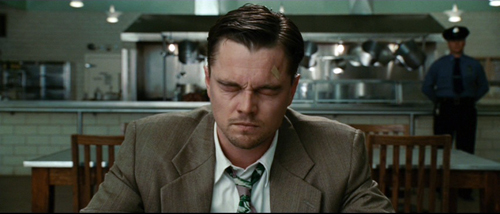
Shutter Island.
I was interested in the way she presented herself at that moment. Later on I figured out that as she gets up from the chair we should do it in three cuts, three separate close-ups, because I think he’ll never forget that moment the rest of his life. He’ll play it back many times. . . . It’s just his perception, his memory of what it’s going to be like. . . . We shot it very quickly, two takes each, one at 24 frames, one at 36, and one 48.
Martin Scorsese, on filming The Age of Innocence.
DB here:
Few directors think so carefully about how a film looks and sounds. Sensitive to technique in the work of classic filmmakers, Martin Scorsese has always tried to give each picture a vivid visual and auditory profile. Although he’s often praised for his realism (usually prefaced by the adjective “gritty”), Scorsese is often a subjectively oriented director. This quality goes beyond the justly celebrated performances of his actors. He is unafraid to use unusual cinematic techniques to thrust us boldly into the characters’ minds and emotions. In this effort he joins some great cinematic traditions. No surprise there: He has an immediate sense that film history hovers over every choice a director makes.
Spoilers loom out of the mist ahead.
Inside out, outside in
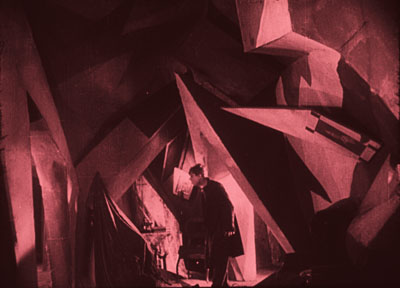
Raskolnikov.
Once American filmmakers developed a model of visual storytelling in the late 1910s, filmmakers elsewhere were surprisingly quick to push it in more subjective directions. There emerged something like an international division of techniques.
To convey inner experience, German directors of the 1910s and 1920s worked principally on aspects of mise-en-scene—performance, staging, setting, lighting, costume, make-up, and the like. The classic example is The Cabinet of Dr. Caligari (1920), in which the cutting and camerawork are fairly conservative, but the setting and acting seek to convey a madman’s vision of the world.
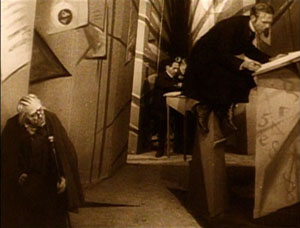
Caligari “subjectivizes” the characters’ surroundings, a process signaled through warped perspectives and fantastically distorted settings.
This brand of visual contortion became the hallmark of what was called German Expressionist cinema. Scholars argue about exactly what films belong under that rubric, but Caligari, along with From Morn to Midnight (1920) and Raskolnikov (1923, above), are pretty uncontroversial examples of making the external world reflect the characters’ psychic turmoil.
At the same period, French directors were also experimenting with subjective cinema. But they tended to concentrate less on mise-en-scene and more on what the camera could do to suggest both optical and mental point of view. In the so-called “French Impressionist” school, we find framings, angles, distorting lenses, changes of focus, slow-motion, and other cinematographic techniques used to suggest characters’ mental states. Thus in Germaine Dulac’s Smiling Madam Beudet (1923), the downtrodden wife sees her husband as monstrous.
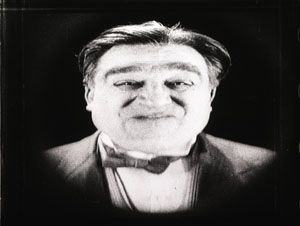
In El Dorado (1921) Marcel L’Herbier uses a gauzy filter to suggest that his heroine is distracted, before pulling it aside and letting her face come into focus.
A little later, leading Soviet filmmakers made editing, not mise-en-scene or camerawork, their most salient technique. They experimented with graphic and rhythmic montage, as well as cuts that sacrificed spatial and temporal continuity to eye-smiting impact.
Of course this three-way division of technical labor is too neat. You find some camera experimentation in German Expressionism, as with the fast motion in Nosferatu (1922). The French were using rapid cutting even before the Soviets, as Gance’s La Roue (1923) shows. And some Soviets, such as Eisenstein and the FEKS directors, explored unusual lighting and camera angles. It should be said, though, that these shared techniques often serve different purposes. Fast cutting in Impressionist films tends to suggest the heightened experience of the characters, rather than serving, as in the Soviet case, to dynamize a historical situation for the viewer. The quick cutting in the carnival ride in Jean Epstein’s Coeur fidèle (1923) simulates the chaotic burst of “impressions” felt by the characters, but the quick cutting in the street riot of Strike (1925) doesn’t mimic the characters’ states but aims to arouse shock and suspense in us.
In any case, my technical division remains only a first approximation toward understanding pretty complicated historical trends. The main point is that both the German Expressionist and the French Impressionist filmmakers of the 1920s were seeking to use particular film techniques to give the audience a deeper sense of the characters’ sensory experience and emotional states.
American cinema selectively adopted some of these tactics of lighting and set design. In a blog entry and a web essay, I’ve written about William Cameron Menzies as one importer of the German approach. You can see Expressionist touches in Fox’s Mr. Moto movies. Likewise, 1940s films particularly enjoyed mimicking Impressionist camera tricks to signal drunkenness, delirium, hallucination, and other altered states. Hitchcock’s Spellbound (1945) and Wilder’s Lost Weekend (1945) are famous examples. Typically such Expressionist and Impressionist touches were associated with crime, craziness, or genre stylization. Much of this flagrant irrealism went out of A-pictures in the 1950s, but it survived in horror and, interestingly, in the US avant-garde cinema of Deren, Markopoulos, and others.
One of Scorsese’s contributions to the 1970s, I think, was to revive and consolidate this legacy. While we were celebrating his films as victories for urban realism and neo-Method acting, many of the movies were also charged exercises in subjective cinema.
Making streets mean, and meaningful
Taxi Driver.
From Mean Streets (1973) everyone remembers the aura of street-punk camaraderie, the harsh turns of mood (usually triggered by Johnny Boy’s recklessness), and the vibrancy of the neighborhood, with its social hierarchy and rituals of bullying and bluff and negotiation. Alongside these tokens of realism we find breathless grace notes, as when Charlie glides through the club, a visual equivalent of his joy in being among pals and sexy women. (The shot was made by having Keitel ride the dolly instead of walking in front of it.)
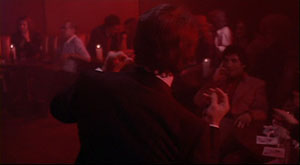
This euphoria of this neo-Impressionist shot is counterbalanced later by the Rubber Biscuit song, with Charlie now thoroughly drunk and floating in grotesque frontal close-up before the floor rises up to kiss his head.
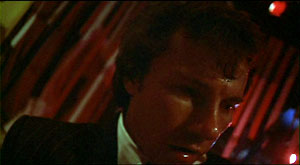
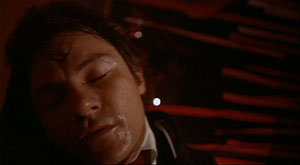
Charlie has come in to the club announcing himself as Jesus, a pious man to create order. Now this shot charts his fall from drunken exuberance into queasiness and mounting anxiety about Johnny Boy’s debt.
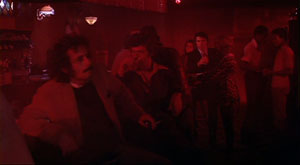
More generally, Tony’s club is given heavily unrealistic treatment through slow-motion and faked slow-motion, along with character movement synchronized with the music. If the camerawork mimics Charlie’s mental states in Impressionist fashion, the ruby-red club lighting suggests his erotic inflammation in a mildly Expressionist one.
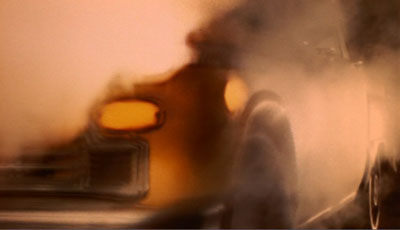
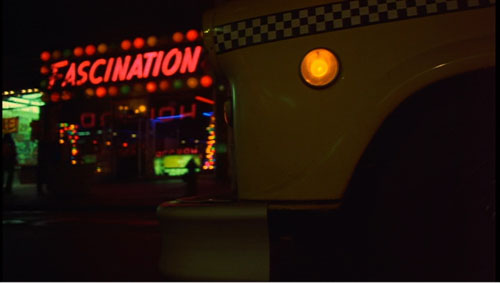
Taxi Driver (1976) is Scorsese’s most famous venture into subjectivity. From the first shot of the cab heaving through wafting vapor—steam? smoke? sulfur fumes?—we cut to a man’s eyes, and then to dissolving views of the city through a rainy windshield.
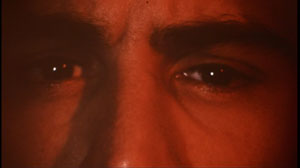
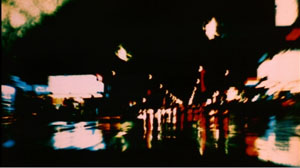
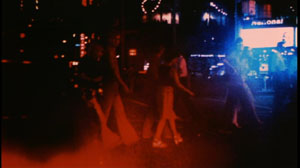
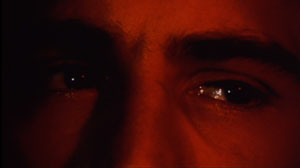
From the start Scorsese announces one of his most basic strategies: a realistic motivation for expressionist effects. It’s only rain, but shooting it through the windshield and adding slow motion gives the streets an otherworldly shimmer. As the neon dribbles down the glass, and we see pedestrians moving through tinted clouds like hesitant ghosts, the man’s face becomes bathed in a red glow—vaguely motivated as reflected from the traffic light, but unrealistically saturated, as in the Mean Streets club.
We see the real New York, but filtered through the eyes of a man who considers it an open sewer. The plot will soon lock us into his consciousness more explicitly, through restricted point of view and voice-over diary extracts and crisp montages of the cruising cab. In addition, the motifs introduced here, particularly purifying water and blips of light, will become elaborated in the course of the movie. The general point, however, is that Scorsese has updated Impressionist and Expressionist tactics in order to reveal a man’s mind through images.
Qui tollis peccata mundi
Bringing Out the Dead.
In some films Scorsese plays things straighter, invoking subjectivity only briefly. There are the prizefights and the visions of Vicki in Raging Bull (1980), and the slipperier passages of fantasy in The King of Comedy (1982). But other films plunge us deeply into subjectivity, forcing the world through the filter of a driven character’s sensibility.
For thoroughgoing efforts in this direction we can look to Bringing Out the Dead (1999). In this movie about a paramedic haunted by spirits of those unfortunates he might have saved, Scorsese along with cinematographer Robert Richardson and production designer Dante Ferretti reinvoke the nightmarish qualities of Taxi Driver. The exhilaration Frank Pierce gets from saving lives is offset by his despair at gambling with death every night. The result is another exercise in neo-Impressionism and –Expressionism.
Once again rain and light, objectively out there in the urban world, become projections of the character’s tormented psyche, thanks to camera angle and framing. The windshield gives Frank’s face phantom tears.

Once again concrete shapes and colors, filtered through a moving vehicle, are distorted to suggest the protagonist’s anxieties.
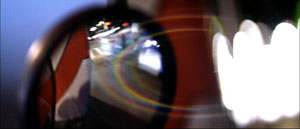
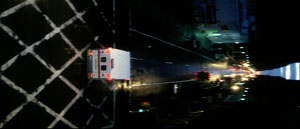
To measure Frank’s descent into desperation, the camera even follows the ambulance upside down, or sideways.
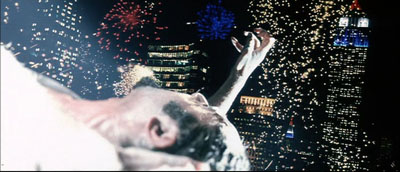
Scorsese ventures into full-blown Expressionism as well. There are naturally dream sequences, but we also get the unforgettable image of the drug dealer Sy, impaled on a fence rail and reaching toward skyscrapers as fireworks (real fireworks?) consecrate his gesture. Later, hurtling through the city and moving closer to mental breakdown, Frank starts to see every woman on the street as Rosa, the woman he could not rescue. How the Germans would have loved having CGI available for such a hallucination.
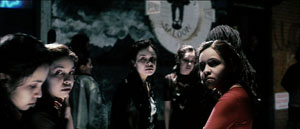
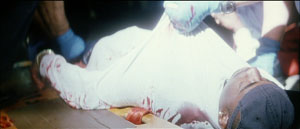
Perhaps the subtlest touches are the patches of blown-out white. At first they seem a signal of death, gleaming off the bodies of Mary’s father and the young man found on the street.
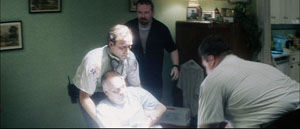
In the final scene, Frank tells Mary of her father’s death (and sees her as Rosa). She invites him in and eventually he falls asleep in her arms. The final shot quietly shifts from a normal, rather dark texture, to one endowing his shirt with a blinding glow.
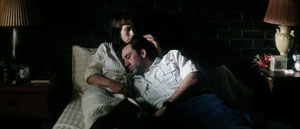
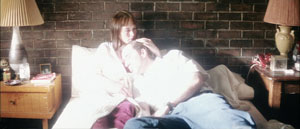
This change in lighting and exposure, unmotivated by any realistic source, suggests that Frank feels he has found a bit of peace, while also hinting that a spiritual radiance has entered this unhappy world through a tortured secular saint.
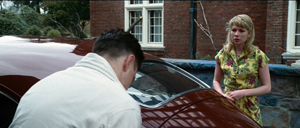
Shutter Island caters to the ‘pressionist side of Scorsese’s vision. It hovers between realism and subjectivity: parts of what we see are really happening in the fiction, while other parts are wholly in Teddy/ Edward’s mind. The difference is that here the balance tips strongly toward expressionism. Apart from the dream sequences, certain hallucinations are rendered in undistorted terms. So, for instance, scenes like the cave conversation with the second Rachel Solando are wholly Teddy’s mental projections. Other scenes oscillate between subjectivity and objectivity, as when Teddy is preparing to set fire to Cawley’s car and talks with his wife Dolores–although the next shot confirms she’s not really there.
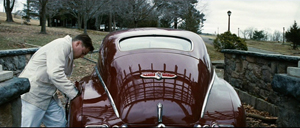
I find all this less resourceful than the virtuosic ways in which Scorsese subjectivizes the neighborhoods of New York. The Gothic trappings of the hospital, the cagelike wards, and the rainswept island offer less opportunity for novel stylization than an urban landscape. Moreover, I think that the creaky gimmick ruling the plot of Shutter Island relies on farfetched explanations and leaves too many loose ends. If the storm didn’t really occur, as Dr. Cawley tells us, then did the storm-tossed dialogues with Chuck not occur either? Why are the doctors talking about the prospects of a (nonexistent) flood before Teddy even comes into the room? And could the inmates be relied upon to execute the physicians’ complex role-playing game? A second viewing left me in the dark about matters that a Shyamalan would have tidied up.
But I did have to admire the way in which Scorsese uses Teddy’s breakdown as an alibi for the mismatched cuts I’ve objected to before. (Some legerdemain with a water glass is particularly clever.) And the ending supplies one further twist that somewhat ennobles the whole loopy contraption.
Cranking it up

Crank 2: High Voltage.
You can argue that Scorsese’s talent was well suited to this project: We don’t notice the plot problems because his stylistic assurance carries us along smoothly. That assurance allows me to raise my final point.
I’ve argued elsewhere, in books and on this site, that Hollywood storytelling techniques have been overhauled in recent decades. Over the last forty years or so, filmmakers have amped up the “continuity style” forged in the 1910s. They have cut faster, sometimes averaging 2-3 seconds per shot across a film. They have relied more heavily on singles (shots of one character), and these singles are often fairly large close-ups. Directors have also embraced extremes in lens lengths—very long lenses (for that perspective-flattening effect) and very wide-angle ones (often yielding flagrant distortions). Filmmakers have also relied a great deal on camera movement, frequently tracking in or out or even circling around the characters as they speak. The basic premises of continuity cinema aren’t violated, but the result is more aggressive visuals. Hence my label “intensified continuity.”
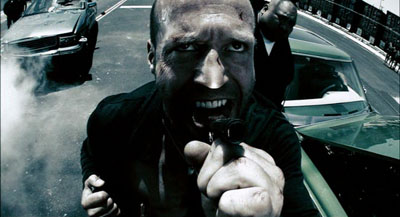
I think that intensified continuity became the new baseline for popular filmmaking both in the US and overseas. Over this style, however, some filmmakers have laid lots of fancy filigree. Many flashy techniques fill our movies. We get slow-motion, fast-motion, reverse-motion, ramping, and freeze-frames. There are brutal jump cuts, ragged shifts between color and monochrome, deliberately awkward framings, abrupt overhead compositions, slippery focus, and jerky handheld shooting. On the soundtrack we get ominous rumblings, metallic crashes, and noisy transitions. The Bourne films and The Hurt Locker (2009) offer moderate examples, but edging toward the extreme you have Crank 2: High Voltage (2009). Here intensified continuity has itself been intensified to a height of frenzied artifice. “Over the top” doesn’t capture it. There is, it seems, no longer a top to go over.
This swaggering style takes classical space and time as its basis—we still have analytical cutting, over-the-shoulder shots, and the like—but it pushes beyond the modest demands of simply laying out dramatic elements for easy comprehension. The intensified approach, itself trying for punch, has been raised to a new level of shock and awe. This trend, I’d speculate, is an escalation of tendencies seen in 1970s-1980s filmmakers like Brian De Palma, Ken Russell, Nicholas Roeg, Ridley Scott, and Scorsese.
Scorsese’s stylistic élan proved enormously influential, I think; Mean Streets is virtually a compendium of the new techniques. But unlike some others, he explored the emerging style in order to probe characters’ feelings and moods. Many of today’s amped-up techniques come off as merely eye candy, or prods for visual arousal, or pieces of narrational subterfuge (as often in De Palma). Scorsese has sought to make these decorative techniques more operatic—perhaps in the tradition of Visconti, Michael Powell, and other filmmakers he admires. The images (and of course the music) swirl around the action, providing cadenzas that bring out feelings which his men often can’t articulate. Sometimes the stylistic accompaniment becomes bombastic, as I think Shutter Island largely is. Yet the finest of Scorsese’s pictures contribute to a rich tradition in which the cinema, normally committed to objective realism, makes palpable what goes on inside us.
Scorsese’s remarks on The Age of Innocence come from a Film Comment interview with Gavin Smith reprinted in Martin Scorsese Interviews, ed. Peter Brunette (Jackson: University Press of Mississippi, 1999), 200. For more on Expressionist and Impressionist silent cinema, see our Film History: An Introduction, Chapters 4 and 5. By the end of the 1920s, these tendencies and Soviet Montage were blending into a sort of international style, a development considered in Chapter 8.
Taxi Driver.
PS 24 April: Filmmaker Max Jacoby writes:
I just read your blog entry on Scorsese’s style. You point out the glowing light which appears in some scenes of Bringing out the Dead. That is actually a signature lighting effect of cinematographer Bob Richardson. He has used this before he came into contact with Scorsese. You can already see it in some of the Oliver Stone films that he shot, such as JFK. This glowing effect is achieved by combining an overexposed toplight (several stops over key) with a diffusion filter (such as a White Pro Mist) in front of the lens or a net behind the lens. You can actually see the pattern of the net in question on the close-up of Nic Cage that you picked; it clearly stands out from the out-of-focus highlights in the background.
The net is more than likely a Christian Dior Denier 10 stocking, made of silk. They are very sought after and hard to find nowadays, because Dior stopped making these some years ago and switched to nylon instead. Once that became known, you had plenty of cinematographers invading women’s underwear stores to buy up the last remaining stock!
Max’s point helpfully indicates how a director can give a DP’s preferred choice a particular function. It seems to me that Scorsese’s patterned usage of the glowing white patches creates a significant motif in the movie–especially when it dominates the last shot, always a crucial moment. Thanks to Max for this, and for a followup reference to Eric Rudolph’s article, “Urban Gothic” in American Cinematographer 80, 11 (November 1999), 30-41; available here. In it Richardson discusses the flaring whites I mention in the blog entry.
METROPOLIS unbound
Fritz Lang has created a lot of pretty pictures and has discovered the astonishing talent of Brigitte Helm. I cannot blame him for not being able to cut the quantity of ideas in individual scenes mercilessly enough (the water catastrophe, the duel), but instead repeatedly trying out new lighting and angles. This time the film’s qualities lie precisely in these efforts: and if the viewer knows how to make the best of something, he will derive pleasure from these images.
Rudolf Arnheim, review of Metropolis, 1927.
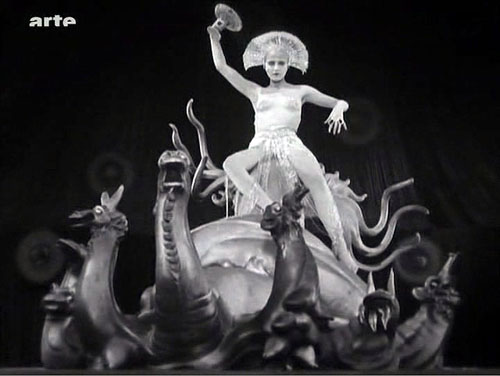
Along with La Roue and The Battleship Potemkin, Metropolis (1927) is one of the great sacred monsters of the cinema. Many versions circulate, and restorations never seem to stop. A beautifully restored, though incomplete, version was premiered in Berlin in 2001. This is the basis of the most authoritative DVD releases. By now, however, everybody has heard about the 2008 discovery of a significantly longer version in Argentina, a 16mm preservation copy drawn from a scratch-infested 35 nitrate original.
Since 2008 a team at the Friedrich-Wilhelm-Murnau-Stiftung has been at work adding material from the Argentine version to the earlier one. Kristin and I have written earlier entries (here and here) tracing the progress of the restoration, and the team have produced a detailed website explaining their work. The result made its world premiere at the Berlin Film Festival earlier this year, and an exhaustive exhibition about the film has been running at the Deutsche Kinematek in Berlin.
Now I’ve seen it, at a screening during the Hong Kong International Film Festival. Frank Strobel, a member of the restoration team, conducted the Hong Kong Sinfonietta, and another collaborator, Martin Koerber, curator at the Deutsche Kinematek, was present to discuss the restoration process. A handsome booklet, cosponsored by the Goethe-Institut of Hong Kong, provided a lot of background. The film was projected digitally, but at very high resolution and looking quite crisp. I had a front-row center seat. I had a swell time.
Metropolis has never been my favorite Lang of the period, but this version makes the strongest possible case for the film. It’s hard to dislike its shameless, preposterous ambitions, its stew of biblical and modern ingredients, its bold architectural vistas, and its trancelike characterizations. Also, people running crazily about in gargantuan spaces can usually hold your interest.
I just met a girl named Maria
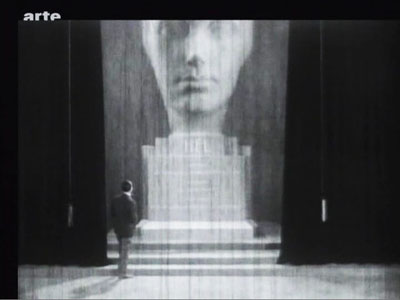
All [the American editors] were trying to do was to bring out the real thought that was manifestly back of the production and which the Germans had simply “muffed.” I am willing to wager that “Metropolis” as it is seen at the Rialto now is nearer Fritz Lang’s idea than the version he himself released in Germany. . . . There was originally a very beautiful statue of a woman’s head, and on the base was her name–and that name was “Hel.” Now the German word for “hell” is “hoelle” so they were quite innocent of the fact that this name would create a guffaw in an English speaking audience. So it was necessary to cut this beautiful bit out of the picture . . . .
Randolph Bartlett, The New York Times, 13 March 1927
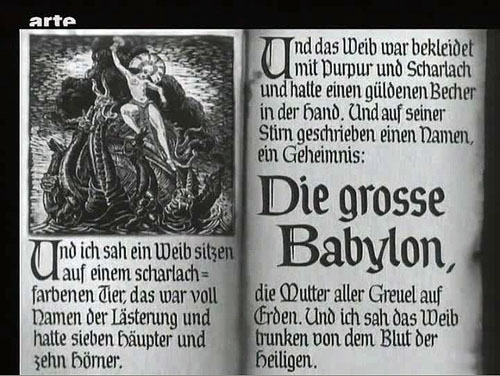
The new version gives the film a better narrative balance. Somewhat surprisingly, the plot hinges on one of the oldest and simplest narrative devices: mistaken identities. The overlord Fredersen engages the crazed scientist Rotwang to create a mechanical Maria who will lead the workers astray. Rotwang takes the occasion to avenge himself on Fredersen by having his robot urge the workers to destroy the machines. Two Marias, then–actually more, if you count the robot Maria’s incarnation as the Whore of Babylon in the Yoshiwara Club.
Thanks to the Argentine footage, we now know that another major character doubling involves Freder. At the start of the version we all know, Freder is visited by Maria and a flock of children. Upon seeing her radiant charity, he becomes suddenly convinced that he must join the oppressed workers, his “brothers and sisters.” Helping them has become his destiny. He gains an ally in Josaphat, an employee whom his father has brusquely fired. Descending to the cavernous machine halls, Freder switches identities with Georgy, a worker who returns aboveground to live Freder’s life. Freder wants him to go to Josaphat’s apartment, where they will meet. But the Thin Man, a long, leering hireling of Freder’s father, is charged with trailing Freder.
Stretches of the Thin Man subplot are missing from the previous version, but now we can see that Georgy/ Freder is a sort of early counterweight to the Maria/ Maria parallels. As in the latter case, the switch leads to misunderstanding, with the Thin Man following Georgy to the club and eventually to Josaphat. The Georgy substitution also allows Harbou and Lang to introduce the Yoshiwara Club early, but teasingly, in a rapidly dissolving montage. Only later will we get a good look at the delicious degeneracy inside.
As Martin Koerber indicated in several remarks, the older, most common version of Metropolis turns it into a science-fiction film, since it puts the robot Maria at the center of the plot. Just as important, though, is Freder’s plan for overturning class oppression, something fleshed out in the Georgy/ Josaphat material. Other new footage puts the relationship between Fredersen and Rotwang in a new light. We now see that Rotwang was in love with Fredersen’s wife Hel, and he has constructed not only a huge bust of her but also a “mechanical man,” outfitted with a distinctly female anatomy, as a sort of Hel substitute.
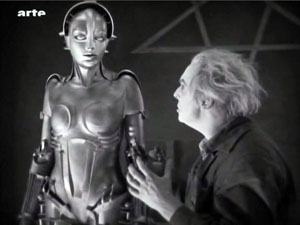
Fredersen diverts Rotwang’s plan to the purpose of mimicking Maria. So we get another doubling: Freder’s mother Hel becomes the firmware for the robot Maria through the machinations of two father figures. (Freder will kill one and redeem the other.) In all, the new footage yields a play of eerie Freudian substitutions.
The 2010 restoration also establishes the film as consisting of three large-scale movements. The first section, “Prelude” (Auftakt), runs a bit more than an hour. It shows Freder joining the workers and his father planning to have the Thin Man follow him. This part also introduces Rotwang, establishes Fredersen’s order to make a robot Maria, and ends with Rotwang’s capture of Maria. A second part, called “Intermezzo” and lasting about thirty minutes, is devoted to intertwining the Freder/ Josaphat plot with the creation of the robot Maria. The section more or less climaxes with a demo of the new Maria, dancing sexily at the Yoshiwara.
In “Furioso,” everything builds to a climax across a remarkable fifty minutes. The cloned Maria leads the workers to destroy the machines, fulfilling Rotwang’s plan to avenge himself on Fredersen, while the real Maria escapes from Rotwang’s compound during a fight between Rotwang and Fredersen. (We’re still lacking some of this footage.) At the same time, Freder and Josaphat converge on the underground city. The workers’ smashing of the machines triggers a flood from which the children must be saved. At the finale, during a hand-to-hand struggle with Freder, Rotwang falls to his death. There follows the famous epilogue in which Freder, “the Mediator,” must bring together hands (the foreman Grot) and head (the capitalist Fredersen).
Fluidity and freedom
This delirious fable is rendered with unrelenting zest. Lang has now perfected his breathless version of silent-film narration. He relies on simple, immediately graspable compositions, rapid crosscutting among different plotlines, and a dynamic approach to analytical editing.
In the late 1920s, many American films became more heavily dependent on intertitles; it’s as if directors were anticipating talkies. But of Metropolis’s over 1800 shots, I counted only 26 expository titles and 156 dialogue titles—in a film running nearly 2 ½ hours. Lang plunges us into each scene with no fuss, and once we’re there, a smooth continuity carries us from shot to shot. Confronting the seven deadly sins in the cathedral, Freder turns away, twisting Georgy’s cap in his hands as he exits the frame.
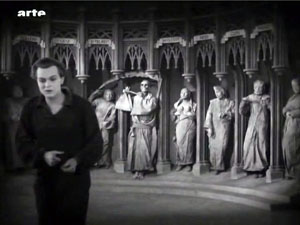
Cut to the main area of the cathedral, and Freder is still twisting the cap as he enters the frame. (Like other shots from the Argentine version, this is slightly reduced because of the 16mm source.)
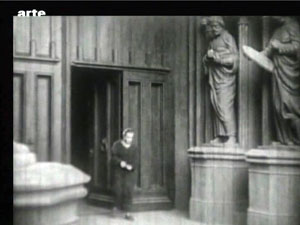
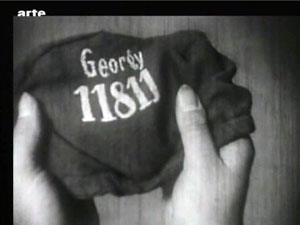
He lifts the cap, and we get his point of view on Georgy’s name and number.
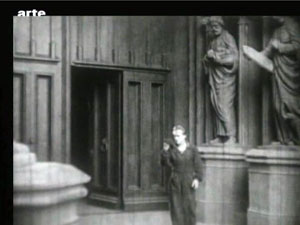
Cut to the Yoshiwara nightclub closing, as Georgy steps groggily into the street.
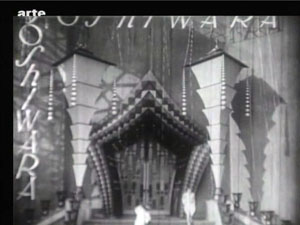
Here the new footage lets us see that Lang is exploiting the sort of verbal and imagistic hooks he had developed in earlier films: from Georgy’s cap to Georgy himself, with no need of an intertitle to take us to the new scene.
Lang’s freedom of camera position is typical of late silent cinema, but he deploys his angles with characteristic precision. As usual in Europe, Hollywood-style continuity isn’t completely adhered to—there are some crossings of the 180-degree line—but Lang is careful to keep us oriented to the action through eyelines. This allows great flexibility in camera placement.
Fredersen is dictating to his secretaries while Josaphat is monitoring prices. A vast establishing shot shows all of them.
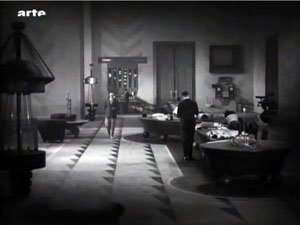
Fredersen’s pacing around his office allows Lang to introduce a new area around the window and the desk.
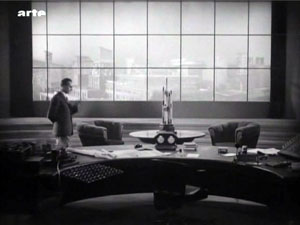
Now pacing in the center of the office, Fredersen pauses in his dictation and Freder bursts in behind him.
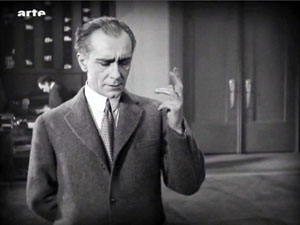
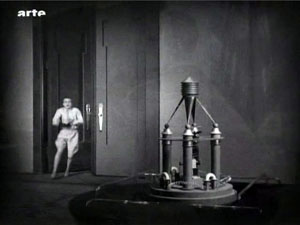
But Fredersen, who’s already holding up one hand as he speaks, simply twists his wrist, and this silences his son.
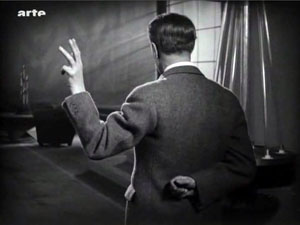
The shot approximates Freder’s point of view, but Lang gets a bonus from it. The sharp change of angle makes the imperious hand (and not, say, Fredersen’s expression) the compositional focus of the shot. In fact, this sort of hovering hand will become part of the characterization of Fredersen, and Lang will stress it through, once more, energetic changes of angle.
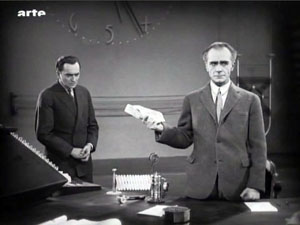
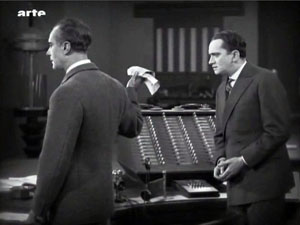
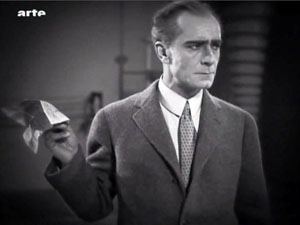
And still later, the framing will spotlight Freder’s pointing finger by pushing it to one zone on the far right of the shot.
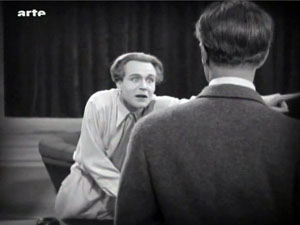
Lang’s concise handling of such small actions forms a delicate counterbalance to the mass movements elsewhere in the film. Perhaps for him, both gestures and crowd scenes are merely two ways of creating a geometry that can activate every area of the screen.
The carefully controlled freedom of spatial construction is facilitated by one of Lang’s favorite tactics: shooting from directly on the axis of character interaction. (No, Wes Anderson didn’t invent this.) Lang in effect sets the camera between the two characters so that they stare out at us, as if mesmerized. The technique is most memorable in the scene in which Freder is confronted by Maria and the children.
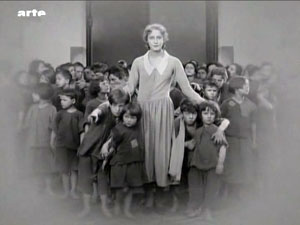
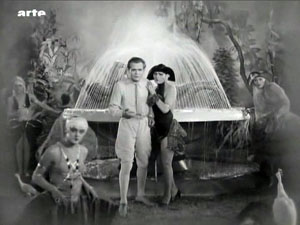
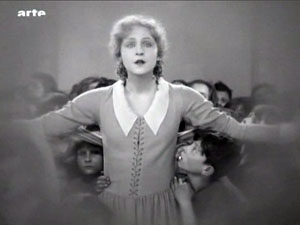
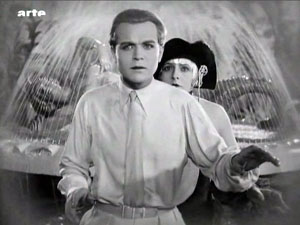
Again, though, the Argentine material brings more instances to our attention.
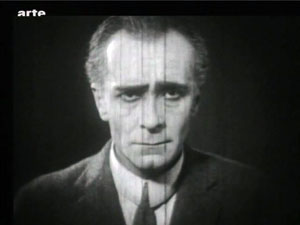
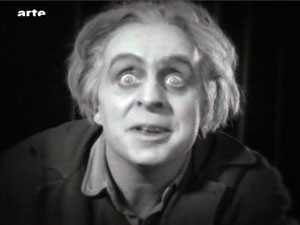
Putting the camera on the axis allows Lang leeway in changing his angles. From a shot on the center line, you can cut to pretty much any other area of space.
Lang’s crisp visual narration comes to a climax in the well-named Furioso section. As the action ramps up, the characters rush from spot to spot, hurling themselves into the frame and then abruptly halting to hold the composition.
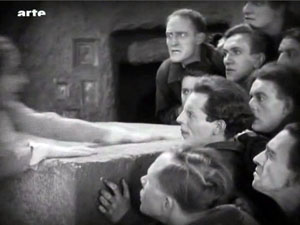
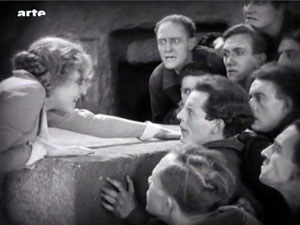
The extreme case is the robot Maria, whose head and limbs jerk puppetlike from one position to another.
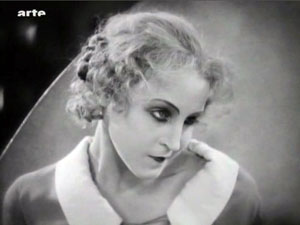
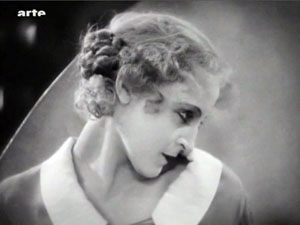
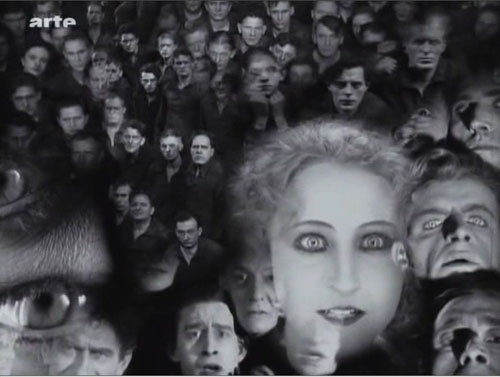
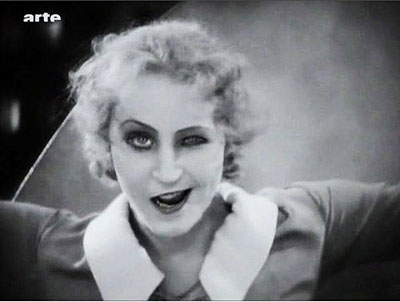
In all, Lang’s precise, almost diagrammatic visual style rushes us through the film’s wild plot and dazzling architecture. An emblem of precision in the service of slightly demented material might be that memorable close-up of the robot Maria: One eye staring out normally, the other half-closed, and the mouth half-twisted in a leer, as if the circuitry in the skull was failing.
A little encyclopedia

Martin Kroeber, Togichi Akira, Winnie Fu, Sam Ho, and Wong Ain-ling discuss preservation and restoration at the Hong Kong Film Archive.
In a Q & A after the screening, Martin Koerber and Frank Strobel shared information about the version. They and their colleague Anke Wilkening could publish a whole book about the restoration, but here are some highlights, drawn as well from Martin’s comments at a lengthy seminar at the Hong Kong Film Archive.
*Sources for information about the premiere version include a copy of the script (helpfully marked with reel ends and calculations about running time), censorship cards recording the credits and intertitles reel by reel, Gottfried Huppertz’s musical score, and thousands of production stills.
*Using these materials, earlier researchers were able to create a sort of mosaic of the version that premiered in Berlin in January 1927. The resulting study film embedded long swathes of blank footage as place-holders. The fact that the Argentine shots fitted in neatly proved the validity of that edition. This study film may be ordered on DVD at nominal cost by educational and research institutions.
*What’s still missing? Some shots in the Argentine version may have been censored; we’re missing a bit in which Georgy, at liberty in a cab, sees a woman baring her body. Also lacking is nearly all the fight between Rotwang and Fredersen, which enables Maria’s escape. In addition, the Argentine print lacks a scene showing a monk preaching in the cathedral, which yields some apocalyptic images.
*If the film plays fast for contemporary tastes, don’t blame the restorers. This version runs at 24 frames per second. Actually, for the 1927 premiere the film was run even faster. The score includes passages accompanying missing footage as well as over a thousand synch-points for specific onscreen action. On the basis of this evidence, it seems that the film was designed to run at about 28 frames per second. This reminds us that silent-film running speeds were far from standardized, and they sometimes exceeded the 24 fps that would be established for sound film. (For more on this matter, go here and scroll down a bit.) In addition, Frank mentioned that in theatres with orchestras, the conductor could regulate the speed of the film with a dial set into the podium.
*Why insert the cropped 16mm footage in such obvious fashion? Couldn’t the framelines be adjusted to match the surrounding 35mm material? Yes, but this slight blowup of the footage would falsify the shot scale of the original footage and not match comparable shots in the 35mm footage. Moreover, Martin pointed out that because not all the scratches and fuzziness of the 16mm material could be purged, it’s better to let these stand stand out somewhat as evidence of the vagaries of film history–like leaving some damage visible in historic buildings.
*Why is the restoration in black and white, since most silent film restorations are in color? Lang was opposed to tinting and toning, so Metropolis premiered in black and white. This caused a debate among critics, some of whom considered it a promising departure from contemporary practices of coloring scenes. The tinted versions that one can occasionally see are likely export versions colored at the request of distributors in particular markets.
*Although future screenings of the 2010 version are to be accompanied by other ensembles devising their own music, there’s a powerful case for retaining Huppertz’s original score. It reflects the filmmakers’ intentions, and its Wagnerian romanticism and modern rhythms are enjoyable simply as music. Just as important, Huppertz designed his score around leitmotifs that, as in opera, can call to mind characters who aren’t onscreen at the moment.
*Metropolis, Martin argued, is too often considered simply a late Expressionist film or an early science-fiction effort. Now we can see that it’s much more: “a compendium of everything in the air in 1927 Germany.” It brings together political ideas, debates about class society and urban life, current trends in the fine arts, acting styles, and cinematic experiments. It owes a great deal to the “monumental” films of the late 1910s, such as Joe May’s Herrin der Welt (1919), but it’s also a synthesis of what filmmaking had become since then. “It’s a little encyclopedia of 1927 cinema. . . . There’s something in it for everybody.”
To see the restoration with the stirring score, vigorously conducted by Frank, was a high point of my Hong Kong trip and indeed of my filmgoing year.
This version of Metropolis was simulcast, if that’s the right word, on 12 February by Arte during the premiere at the Berlin International Film Festival. My frames are taken from that broadcast version; hence the bug. The restoration will be screened on Turner Classic Movies in the fall, and then released on DVD in the US by Kino International.
The epigraph quotation from Arnheim comes from Film Essays and Criticism, trans. Brenda Benthien (Madison: University of Wisconsin Press, 1997), 119. The article about the US cut of the film, which became widely seen around the world, is Randolph Bartlett, “German Film Revision Upheld as Needed Here,” New York Times (13 March 1927), X3.
Thanks to Martin Koerber for an abundance of information. For further reading, he recommends Erich Kettelhut’s memoirs on designing and filming the project, Der Schatten des Architekten (Munich: Belleville, 2009), ed. Werner Sudendorf, with many documents from sketches and photos; and the Deutschen Kinemathek exhibition catalogue, Fritz Langs Metropolis, ed. Franziska Latell and Werner Sudendorf (Munich: Belleville, 2010). You can get a sense of the tangled history of the versions of the film from Martin’s article in the latter volume, which includes a detailed account of the digital restoration. An earlier version of his piece, keyed to the 2001 version, is available as “Notes on the Proliferation of Metropolis,” in Preserve Then Show (Copenhagen: Danish Film Institute, 2002), 128-137. The Metropolis exhibition runs through 25 April.
A special thanks to Lee Tsiantis, Langian extraordinaire.
Foreground, background, playground
The Devil and Miss Jones (1941); The Hudsucker Proxy (1994)
DB here:
I’ve been waiting for thirty years for Alice in Wonderland. No, not the theatrical release of Tim Burton’s version. That interests me only mildly. I’m referring to the DVD release of the 1933 Paramount picture. I saw it on TV as a kid, and remembered it only dimly. But it bobbed up on my horizon in the summer of 1981 when I was doing research on our book The Classical Hollywood Cinema.
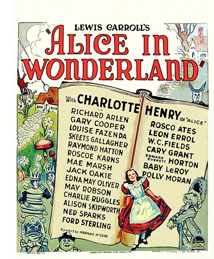 I was in the old Academy library in Los Angeles studying the emergence of certain compositional schemas. I can’t recall what put me on the track, but I requested the shooting script of Alice. What came was Farciot Edouart’s copy, over six hundred pages teeming with sketches for each shot. And a lot of those shots had a startling similarity to good old Citizen Kane.
I was reluctant to attribute pioneering spirit to director Norman Z. McLeod. Instead, I realized that these images’ somewhat freaky look owed more to one of the strangest talents in Hollywood history.
I tried to see Alice in Wonderland, but I couldn’t track down a print. So for years I’ve been waiting to find if it confirmed what I saw on those typescript pages. In the meantime, for the CHC book and thereafter, I’ve bided my time, sporadically looking in on the career of one of Hollywood’s most eccentric creators. He’s the subject of a new web essay I’ve just posted here (or click on the top item under “Essays” on the left sidebar). Today’s blog entry is a teaser trailer for that.
Deep thinkers
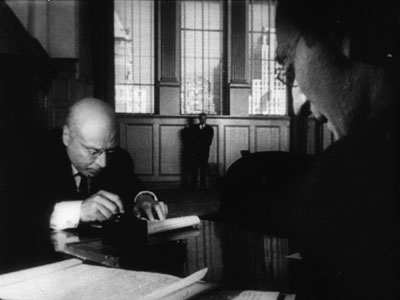
It’s commonplace now to say that Citizen Kane (1941) pioneered vigorous depth imagery, both through staging and cinematography. Many of the film’s shots set a big head or object in the foreground against a dramatically important element in the distance, both kept in fairly good focus. But where did this image schema come from?
The standard answer used to be: The genius of Gregg Toland and Orson Welles. In the 1980s, however, I wanted to explore the possibility that something like the deep-focus look had been a minor option on the Hollywood menu for some time. Once you look, it’s not hard to find Kane-ish images in 1920s studio films, from Greed (1924) to A Woman of Affairs (1929).
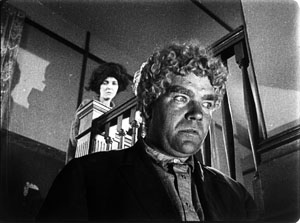
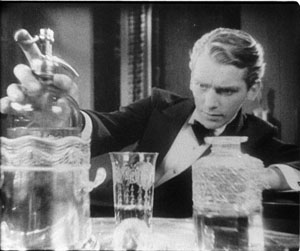
During the 1930s, William Wyler cultivated such imagery in some films shot with Toland, such as Dead End (1937), and some films shot by other DPs, such as Jezebel (1938). In turn, Toland had undertaken comparable depth experiments in films with other directors. Moreover, yet other directors, notably John Ford, had used this sort of imagery in films shot by Toland and others, such as George Barnes, Toland’s mentor. There are plenty of non-auteur instances too. (See my post on 1933 Columbia films.) We also find similar imagery in films from outside America. Here’s a stunner from Eisenstein’s Bezhin Meadow (banned 1937).
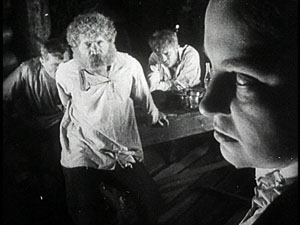
You see how complicated it gets.
What I concluded in Chapter 27 of CHC was that Toland and Welles didn’t invent the depth technique. They fine-tuned it and popularized it. Their predecessors, in the US and elsewhere, had staged the action in aggressive depth and used many of the same compositional layouts. But the wide-angle lenses then in use couldn’t always maintain crisp focus in both planes (below, American Madness, 1932).
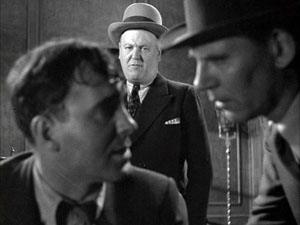
Welles and Toland found ways to keep both close and far-off planes in sharp focus. They deployed arc lamps, coated lenses, and faster film stock. Although it wasn’t publicized at the time, we now know that some of the most famous “deep-focus” shots were also accomplished through back-projection, matte work, double exposure, and other special effects, not through straight photography. Again, though, this tactic was anticipated in earlier films. One of my favorite examples comes from a matte shot in Mr. Moto’s Gamble (1935).
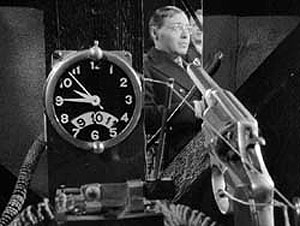
Menzies seems to have planned for similar fakery. In the script for Alice in Wonderland we find: “CLOSE UP, leg of mutton. The room and characters in the background are on a transparency.”
The flashy depth compositions of the 1920s and 1930s were typically one-off effects, used to heighten a particular moment. Welles and Toland pushed further by making the depth look central to Kane’s overall design and by featuring such imagery in fixed long takes. The prominence of Kane may have encouraged several 1940s filmmakers, such as Anthony Mann, to make the depth schema part of their repertoire. But as the style was diffused across the industry, the hard-edged foregrounds became absorbed into dominant patterns of cutting and spatial breakdown. The static long takes of Kane remained a rare option, perhaps because they dwelt on their own virtuosity.
Digging up films made around the time of Kane, I found many filmmakers experimenting with the look that Toland and Welles highlighted. You can see touches of it in The Maltese Falcon (1941) and All That Money Can Buy (1941). Above all, there are two remarkable movies directed by, of all people, Sam Wood. Our Town (1940) turns Wilder’s play (itself surprisingly melancholy) into a Caligariesque exercise.
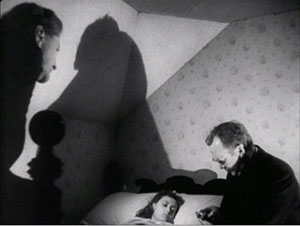
Several shots anticipate the low-slung depth, bulging foregrounds and all, that became the hallmark of Citizen Kane a year later.
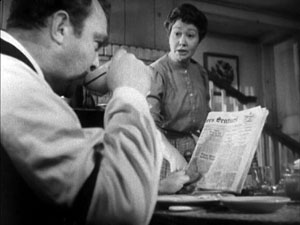
Our Town also uses postproduction techniques that yield depth-of-field effects you couldn’t get in camera.
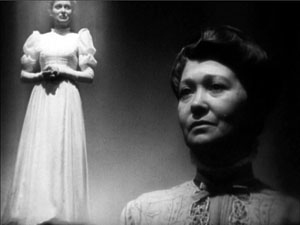
Perhaps even more startling is Wood’s Kings Row (1942), with deep-focus imagery that occasionally rivals Kane‘s.
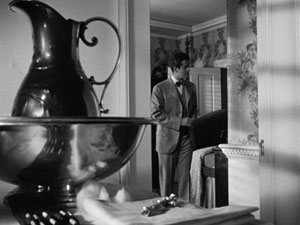
From the evidence I was encountering, it seemed that Welles and Toland’s accomplishment was to synthesize and push further some deep-space schemas that were already circulating in ambitious Hollywood circles. Connecting some dots, I realized that one of the earliest champions of aggressive imagery in general, not just big foregrounds and deep backgrounds, was William Cameron Menzies.
Menzies frenzies
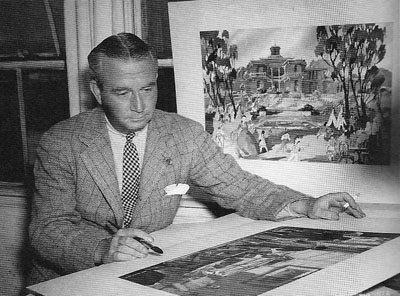
Menzies started out as an art director, most famously for United Artists. He designed sets for Mary Pickford’s Rosita (1923, directed by Lubitsch) and several Fairbanks films, notably The Thief of Bagdad (1924). He won the first Academy Award for set design and went on to a noteworthy career—most famously as production designer for Gone with the Wind (1939). He also directed films, such as Things to Come (1936) and Invaders from Mars (1953). Most significant for my purposes, he was production designer for Our Town, Kings Row, and three other films of the early 1940s directed by Sam Wood. And he designed the 1933 Alice in Wonderland. The drawings I saw in Edouart’s script were by Menzies or his assistants.
Menzies was one of the chief importers of German Expressionist visuals to the US. Although his early efforts leaned toward Art Nouveau effects, by the end of the 1920s he was cultivating a dark, contorted look keyed to the harsh geometry of city landscapes.
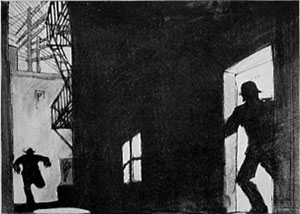
Since the late 1920s, Menzies had explored the possibility of steep depth compositions. He didn’t usually employ a big foreground, but he did favor overwhelming perspective–either abnormally centered or abnormally decentered. Here is his sketch for Roland West’s Alibi (1929) and the shot from the finished film.
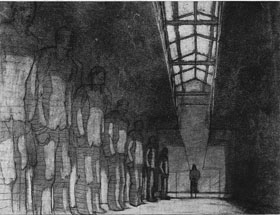
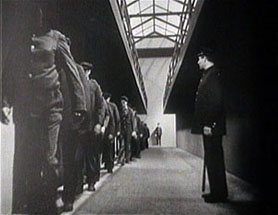
Menzies loved slashing diagonals created by architectural edges and worm’s-eye viewpoints. The harrowing opening of Things to Come is full of such flashy imagery.
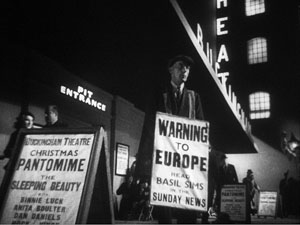
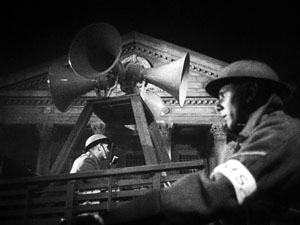
Menzies calmed his style down for GWTW, although the sequences he directed bear traces of his inclinations. And in his work for other directors he managed to slip in a few odd shots. Here, for instance, is a typically maniacal central perspective view from H. C. Potter’s Mr. Lucky (1943). Squint at this image and you’ll see that it’s weirdly symmetrical across both horizontal and vertical axes.
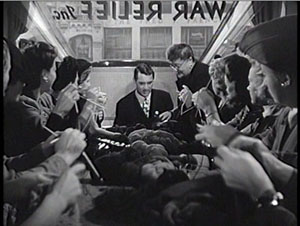
When he met Sam Wood, it seems, Menzies found a director ready to let his imagination roam further. In these collaborations, we get depth shots à la Welles and Toland, but also skewed perspectives. Pride of the Yankees (1943/44) searches for ways to make a baseball stadium look like a Lissitzky abstraction.
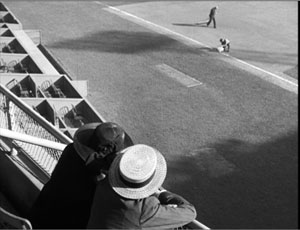
Menzies subjects the partisans of For Whom the Bell Tolls (1944) to his sharp diagonals as well.
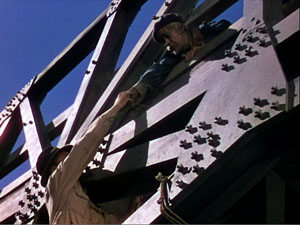
Alice, we hardly knew ye
What then of Alice in Wonderland? Back in the early 1980s, I wasn’t permitted to photocopy or photograph script pages. Here is one of the few sketches I later found for the film. Alice crawls into the mirror with looming armchairs in the foreground.
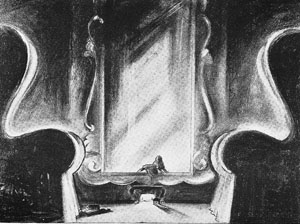
Surely, I thought, the film would be an early example of the depth aesthetic that would be developed by Welles, Wyler, and Wood/ Menzies. Alas, the film has nothing like those imperious armchairs.
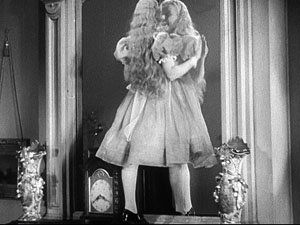
In fact, Alice proves a huge disappointment on the pictorial front. Menzies expended all his ingenuity on the special effects, coordinated by Paramount master Farciot Edouart. Although the spfx are not in the league of that other big 1933 effects-film King Kong, they are pretty solid for the time. It’s just that this remains a painfully arch, flatly filmed exercise.
But I look on the bright side. Menzies created some memorable movies, both on his own and with other directors. (Of his directed films, not only Things to Come but Address Unknown, 1944, remain of interest today.) Perhaps most important, his stylistic boldness may have encouraged other filmmakers to try something fresh. Most immediately there is Since You Went Away (1944), a big Selznick production that bears traces of the Menzies touch.
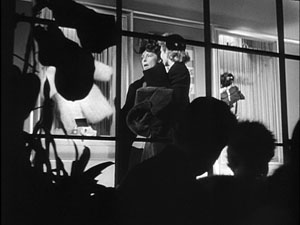
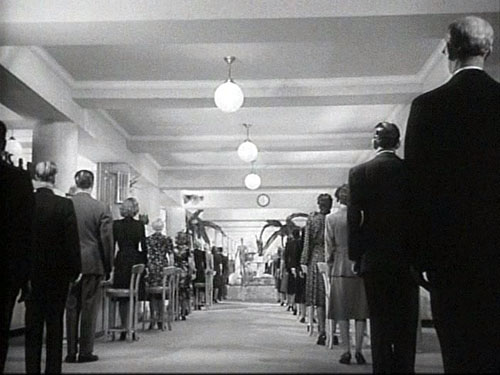
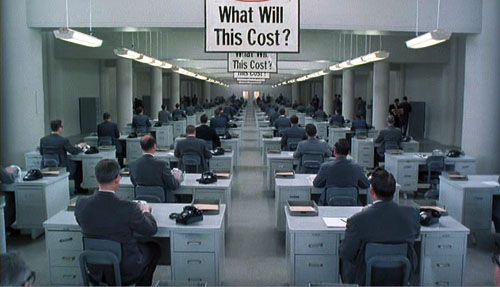
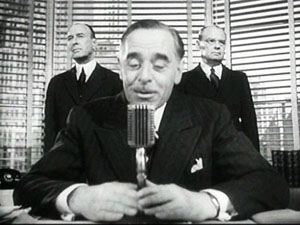
More broadly, Menzies represents a strand in American cinema that never really disappeared. His frantic Piranesian perspectives, canting the camera and filling the frame with grids, whorls, and cylinders, are still in use. And his head-on, wide-angle grotesquerie looks ahead to the Coen brothers. This shot of a department-store manager in The Devil and Miss Jones (1941) could come from any of their films.
Menzies’ films, though mostly not celebrated as classics, gave American cinema the permission to be peculiar. Meet me in the sidebar for a closer look at one of Hollywood’s most eccentric creators. Special thanks to Meg Hamel for going beyond the call of duty in posting that essay.
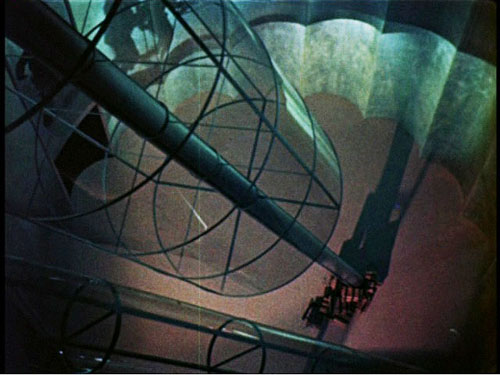
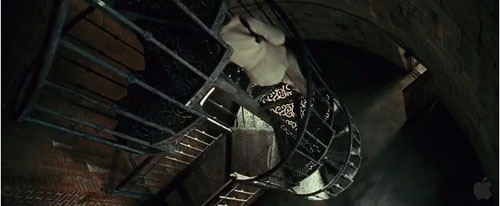
Invaders from Mars (1953); Shutter Island (2010).
Paris-Berlin-Brussels express
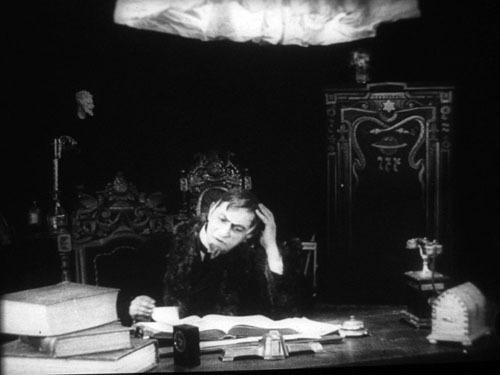
Doktor Satansohn.
Our trip to Europe has come to an end, and so we finish with a post scanning some highlights.
The magic lantern learns new tricks
DB here:
What am I seeing? Many avant-garde films pose this question. Mainstream fiction film and documentary cinema have mostly relied on the idea that the image should be recognizable as “what it is.” But one strain of experimental film has worked to delay or even prevent us from making out what’s in front of the camera.
Sometimes we lose our bearings only briefly, as when we eventually identify pot lids in Ballet Mécanique or bits of sunlit linoleum in Brakhage films. Sometimes language points out what’s really there. The titles of Joris Ivens’ Rain and the Eames’ Blacktop: The Washing of a School Play Yard allow us to enjoy the ways that ordinary sights can yield unexpected abstraction. Sometimes we toggle back and forth, as when in Ken Jacobs’ Tom, Tom, the Piper’s Son recognizable human figures, however grainy, jump into sheer blotchiness and then back into something like legibility. But other times we can’t ever tell what we’re seeing. Brakhage’s Fire of Waters offers one of the best examples I know, with its jagged bursts of light in a smoky void.
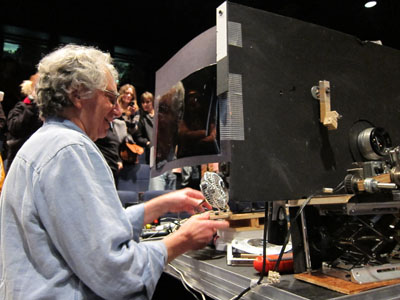
What am I seeing? The uncertainty was doubled during my visit to Ken Jacobs’ Nervous Magic Lantern performance at the Cinémathèque Française. I say “doubled” because at least with Fire of Waters and Tom, Tom I knew I was watching a film. With this display, What am I seeing? started as a question about the format itself. Was it a film, a video, or something else?
Then the question became the customary one. Off-white textures—pebbly, dribbly, stalagmite-like—swim in and out of focus. Some are viscous and globular, some are like tangled foliage. They seem to spiral, but actually (I put up a finger to measure) they barely move. The effect of movement is given by pulsations of pure black, breaking the lyrical effect of the surfaces with a harshness that becomes aggressive. Aggressive as well is the soundtrack, blocks of sound from subway platforms and traffic and kitsch Latin percussion, all played at high volume. The surfaces just keep shifting and not shifting, sort of rotating while jabbing out at us, lovely and anxiety-inducing at the same time.
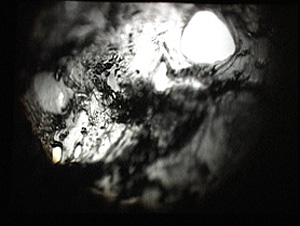
At the end of the performance, people crowded around the cardboard booth in the middle of the theatre. As Ken and Flo Jacobs packed up, they showed how they had generated the effects. What had I been seeing? Neither a film nor a video but a true magic-lantern display, assembled on the spot. But what had I been seeing? Something created with home-made equipment of a startling simplicity. (Strapping tape was involved.) Our magicians explained their tricks, like magic-lantern operators of earlier centuries explaining the science behind their shows. But I think it’s best that you not know until after you have a chance to see what they create.
In earlier entries (here and here) Kristin and I have praised Jacobs’ films for showing how very slight adjustments in technique or technology can create disturbing cinematic illusions. In this vein, the first item on the Cinémathèque program, a video called Gift of Fire, turned Louis Le Prince’s brief 1888 street scene into a 3D movie. (The homage was appropriate because Le Prince experimented with multiple-lens cameras.) The Nervous Magic Lantern performance generated a different sort of illusion, one conjuring up micro-landscapes and otherworldly vortices. In all, Jacobs makes us realize how many evocative effects are still to be discovered by tinkering with images thrown on a screen.
Detour to Berlin
KT here:
As David mentioned in last week’s entry, I took a week in the middle of our visit to Europe for research at the Ägyptisches Museum in Berlin. The staff there welcomed me into their storerooms, and I spent the days looking at fragments and the records of their discovery and the nights downloading and backing up my photos. No time for filmgoing. The most I managed was a trip to the well-stocked arts bookshop Bücherbogen, which has one of the best selections of film books to be found in Germany. Our old friend, experimental filmmaker Carlos Bustamente, met me there, and we had a quick cup of tea–most welcome on a cold morning when the results of the biggest snowfall in decades were still blanketing many sidewalks and roads.
I did note one film-related phenomenon, however. Every day I took the S-Bahn from Savignyplatz to Friedrichstrasse. The tracks pass directly across the street from the Theater des Westens (that is, the western part of Berlin). It was playing Der Schuh des Manitu, a musical version of the 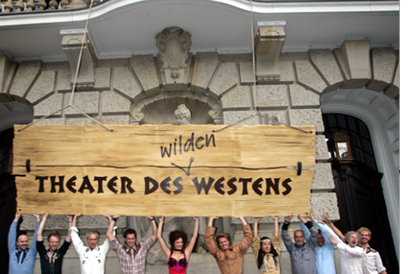 highly successful 2001 German film of the same name. (I hope the publicity photo at the left was taken in warmer weather than I experienced.) I mentioned the film here, in reference to the fact that every major producing country, and some minor ones as well, turn out their own local comedies, films that don’t travel well but are very popular locally.
By now it’s a familiar phenomenon in the U.S. for successful Hollywood films to be turned into stage musicals. It wasn’t always so. Back in the 1950s and 1960s, films were made of popular musicals, sometimes successfully, as with My Fair Lady, and sometimes not, as with Mame. But now the trend is the other way, with everything from Shrek to Hairspray getting the Broadway treatment.
It’s interesting to know that the same thing goes on abroad, though I’m not sure how prevalent such adaptations are. Der Schuh des Manitu, directed by Michael “Bully” Herbig, remains the highest grossing German film. Herbig doesn’t act in the stage play, as he did in the film, but he served as a creative advisor. The musical is a hit, having premiered on December 7, 2008 and it is expected to continue until at least the autumn of this year. There are several clips from both the film and the musical on YouTube. This one, at 8 minutes, gives a generous dose of the show. There are no subtitles.
I had only a couple of days back in Paris before we headed for Brussels for the final week of our trip. The German theme continued, since a few of the 1910s films David needed to see at the Cinematek here were German. The one I most wanted to see was Edmund Edel’s 1916 feature, Doktor Satansohn. Its main claim to fame is probably the fact that Ernst Lubitsch plays the title role. My book with Lubitsch started with his 1918 move to features, when he began to concentrate more on directing and less on acting. By 1920, with Sumurun, he appeared onscreen for the last time; being discontented with his performance as the tragic clown, he decided it was time to move behind the camera for good.
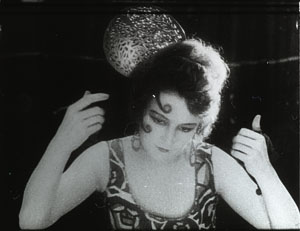
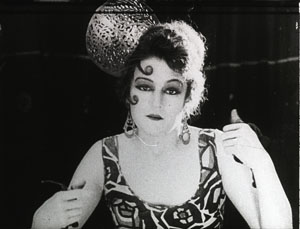
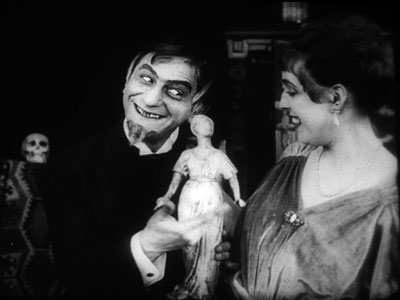
In the short films he starred in before 1918, Lubitsch often played a brash, ambitious Jewish youth, as in Der Stoltz der Firma (“The Pride of the Firm,” 1914). In Doktor Satansohn he’s a physician with a magical machine that transforms older women into beautiful young ones. We’re first introduced to a couple and the wife’s mother. When the latter makes a pass at her son-in-law and is rejected, she seeks the doctor’s help. His machine works by capturing the wife’s essence in a statuette and making the mother look like her daughter. Problem is, every time she’s about to kiss the husband, the doctor pops up with his devilish leer, visible only to the “wife.” David and I decided that the film is a comedy, though perhaps one only Germans of the day would find truly amusing. For one thing, the title character is clearly a Jewish caricature, one played to the hilt by Lubitsch. He decorates his machine with the Star of David and a Hebrew inscription (not to mention vipers and an image of Saturn).
Stylistically it’s a fairly conventional film for its day, though the black background of the doctor’s office, with its stylized youth machine and satyr-like bust, gives a hint of Expressionism to come. (See our topmost image.) Inevitably near the end there comes the moment beloved of historians of pre-World War II German cinema. The real daughter, released from her imprisonment in the statuette, confronts her double in the doctor’s waiting room. The Doppelgänger motif strikes again.
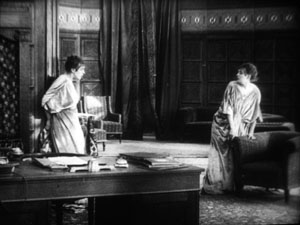
I wonder if German films actually have more Doppelgängers in them than appear in other national cinemas. Do they really reflect the disturbed soul of the nation? Or did the possibilities of filmic special effects draw moviemakers to try and multiply single figures? Georges Méliès and Buster Keaton used in-camera techniques to multiple their own figures in virtuoso displays. I recall being impressed by The Parent Trap‘s duplication of Hayley Mills when I saw it as a kid, and the whole notion of a single actor playing twins and other lookalike relations is a common enough convention. In Doktor Satanssohn, the doubled figure appears only in this one shot, and it’s the leering Lubitsch, delighted with his own nastiness, who walks off with the picture.
The 1910s, again, and still
DB again:
We saw Doktor Satansohn while I was studying staging and cutting strategies of the 1910s, thanks to the remarkable holdings of the Royal Film Archive of Belgium, also known as the Cinematek. My comments on last summer’s visit are here.
Another German film, in a choppy Russian print, vouchsafed a new glimpse of Asta Nielsen. In Totentanz (Urban Gad, 1912), she plays a guitarist-dancer who must take to the stage to support her infirm husband. She attracts the devotion of a composer, and soon she feels attracted to him. Torn between desire and duty, she snaps during a rehearsal of his latest piece, “Totentanz.” In a chilling gesture, she uses his dagger to slice her lute strings.
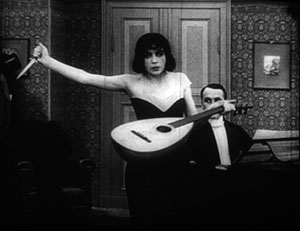
Soon the two are locked in a violent erotic struggle, and a stabbing ensues. In all, melodrama as ripe as one could want.
As ever, I was happy to have my hypotheses about tableau staging confirmed by several of the titles I saw. A minor French bedroom farce, Le Paradis (M. G. Leprieur, 1914 or 1915), had a brief passage of the sort of blocking and revealing we find in many films of the period. The painter Raphael Delacroix (no kidding) is pretending to be the lover of Claire Taupin to deflect the advances of randy M. Pontbichot. But Claire is actually the mistress of M. Grésillon. . . .
First, very frontal staging strings out Pontbichot, Raphael, and Claire. The older man relents in his pursuit of her.
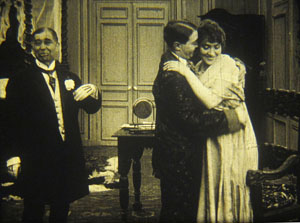
In the vivid depth characteristic of the tableau tradition, Pontbichot withdraws. But his position accentuates that central door, which starts to open.
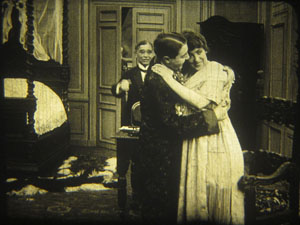
Most remarkably, Pontbichot ducks almost entirely behind the couple, giving pride of place to M. Grésillon’s arrival in the center of the shot.
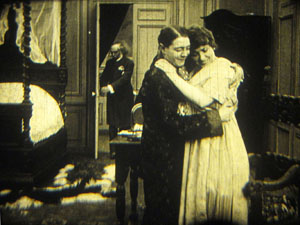
Pontbichot slides out in time to register Grésillon’s outraged reaction to finding his mistress in another man’s arms.
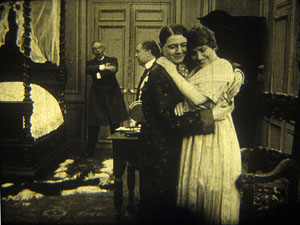
Grésillon rushes to the frontal plane, furious. As ever, a thrust to the foreground creates a major spatial/ dramatic event.
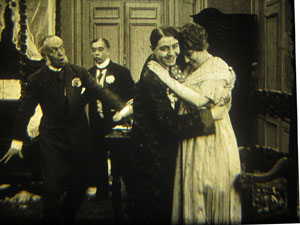
Although the Le Paradis passage is ABC compared to the emotionally powerful patterns of staging we find in Ingeborg Holm (1913), it illustrates how even average films could resort to the blocking/ revealing tactic within the deep-space geometry of the tableau.
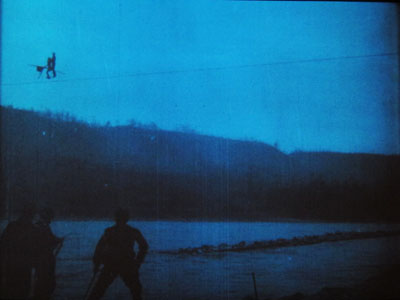
More flamboyant was Il Jockey della Morte (1915), an Italian circus film made by the Dane Alfred Lind. Its bold lighting and varied angles on the Big Top recalled the Danish films of a few years before. Halfway through, Lind launches a dazzling chase that features leaps from a tall bridge and bicycling stunts on a cable stretched across a river.
Another Italian film, this time a diva vehicle, suggests that by 1917 1923 (see below) the tableau style was already giving way had given way to scenes organized around close shots. (See below.) L’Ombra (Mario Almirante) starred Italia Almirante Manzini as a lively, trusting wife who becomes paralyzed. While her husband betrays her with her younger protégée, she gradually recovers bodily movement. Yes, a paralyzed diva seems a contradiction in terms, but one small-scale scene shows a remarkable range of emotions. Berta’s hands start twitching, one lifts up, and she stares wildly, as if it were an alien being.
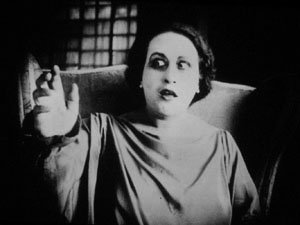
In an earlier scene, Berta had asked that a mirror facing her be tipped upward so that she would never see herself sitting immobile. This shot pays off now, when the hand ascends almost magically into the bit of reflection she can see.
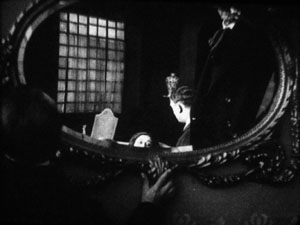
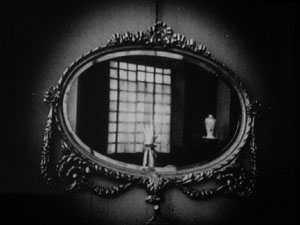
When the hand descends, her astonishment turns into joy. She experimentally shoves the hands together, as if asserting her control.
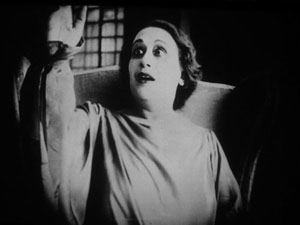
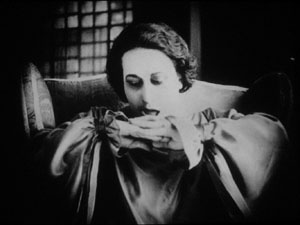
In the end, she kisses her hands as if they were pampered children.
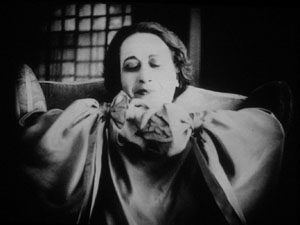
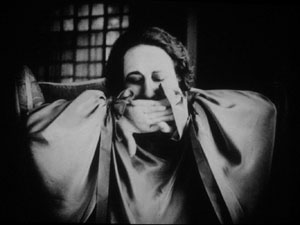
Manzini runs through many more micro-emotions than I’ve indicated here, but this sample is typical of the ways in which L’Ombra avoides the long-shot choreography of only a few years before and builds a performance out of face, body, and arms in a close framing. The mirror-shot motif shows that fairly careful filmic construction was emerging at this point too.
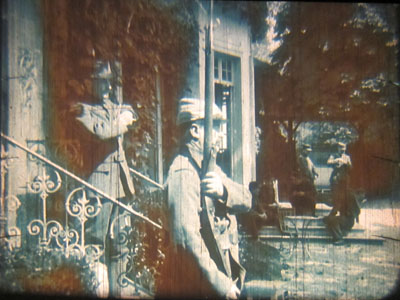
During my stay, I learned more about tinting and toning from the ever-helpful Noël Desmet. On the seldom-seen World War I drama L’Empreinte de la patrie (M. Dumeny, 1915), some images had curious oscillating patches of rusty brown. Noël explained that when Prussian Blue toning was combined with rose tinting, the chemicals eventually reacted to alter the pink cast. An example is shown at the top of this section, though the blue is more saturated in the original.
Once we get back to Madison, I’ll have to sort out all that I’ve learned from these movies. Onward and upward with the 1910s!
For more on Jacobs’ Nervous Magic Lantern, see Scott Foundas’ interview here. The Youtube clip doesn’t do the spectacle justice. If you must know something of Jacobs’ tools, the Dailymotion video from the performance I saw offers some clues. My notions about 1910s staging are laid out in On the History of Film Style and Figures Traced in Light. You can also find several discussions in earlier entries on this site. Just execute a search on tableau.
Now is a good time to thank Noël Desmet and Marianne Winderickx, both of whom are retiring from the archive in March. The research that Kristin and I have done over the years owes an enormous lot to them, and of course to the Director of the Cinematek Gabrielle Claes.
P.S. 15 November 2013: Ivo Blom has pointed out that the version of L’Ombra I saw wasn’t from 1917 but rather from 1923. Hence the corrections above. Thanks very much to Ivo! Go here for his blog and information about his newest publication on silent Italian cinema.
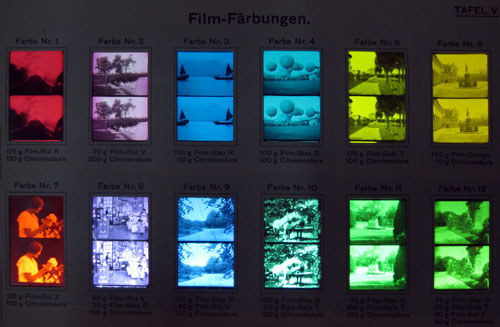
A tinting and toning sample card from the early 1920s. Courtesy Noël Desmet.