






Archive for the 'People we like' Category
A modest extravagance: Four looks at Ozu
DB here:
Ozu Yasujiro was born on 12 December 1903. He died on 12 December 1963.
For Donald Richie
The film comes to us calmly, not trying to overpower us or sneak into our good graces: just a simple story that seems to tell itself. First there is the daily routine. People arise, go to work or school, greet their acquaintances, labor at their desks, meet friends at a bar or teahouse or coffeehouse. Gradually, as one character mentions or meets another, the film carries us to that one. Then we discover another network of people, also linked through everyday action and little courtesies. This movie, it seems, could sidestep from group to group forever, eventually introducing us to the population of Japan.
A plot coalesces. Someone has fallen in love; someone is unhappy; someone must pass an exam; someone must get married to oblige a parent. Now everything that we have seen starts to crystallize into a drama. But the narrative flow is so unpredictable, even diffuse, that we can scarcely imagine what the climax could be. Sometimes the action is just put on hold, and an idyll shows a character recalling days of prior happiness, or imagining recalling today as a moment of consummate peace.
Suddenly a crisis descends. Someone we have come to care about falls ill, or decides not to marry, or decides to marry someone else, or betrays a friend. And soon we are truly overpowered, with a climax that seems completely contingent. Why this? Why now? The characters may ask along with us, but they resign themselves to things. The epilogue is like a farewell. These people who have come to matter to us drift away to an uncertain future that has a touch of stoic serenity.
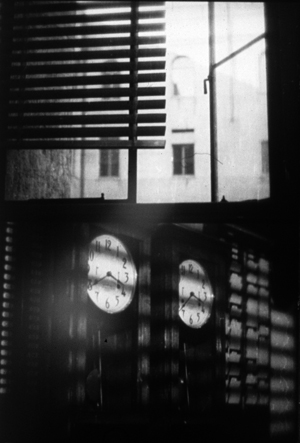
All very straightforward, even artless. But that’s at first glance. Take a second look, and you see a subtle architecture. The distantly connected characters actually form a table of contrasts. For every wilful father, a tolerant one; for every cheerful daughter, a morose one; for each flirtatious boss a kindly widower. Long ago Donald Richie pointed out the importance of parallelism in Ozu: every person or circumstance is echoed or inverted elsewhere. Into these parallels Ozu inserts prefigurations of future action, motifs which connect characters (gestures, lines of dialogue, props like watches or cups), and daring ellipses which skip over important events. (Once he has us hooked, he can tease us by withholding what we want to see.) The ending and epilogue have the inevitability of the final lines of a grand poem. Look closely, and each Ozu film has a magnificently filigreed structure, and everything that will happen seems quietly destined from the start.
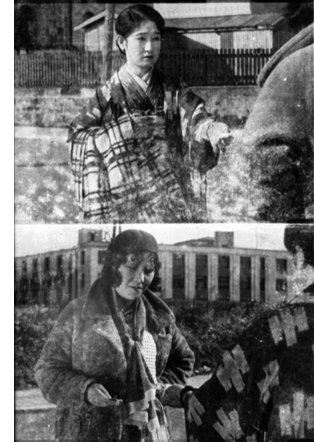
Third look: The simplicity of style. What could be easier than to shoot each scene with a master shot, followed by medium-shots? Each character, no matter how minor, gets his or her “single,” and a cut very seldom interrupts a line of dialogue. Every person gets a chance to speak, and people listen to each other. Nobody interrupts. A few establishing shots will link one scene with another. The camera is set low in nearly every shot, as if to eliminate any decision about where else it might be put, and it almost never moves. This, surely, is Moviemaking 101.
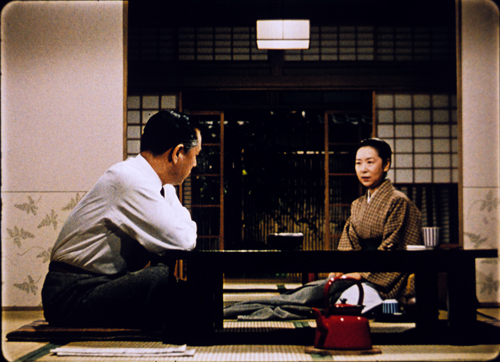
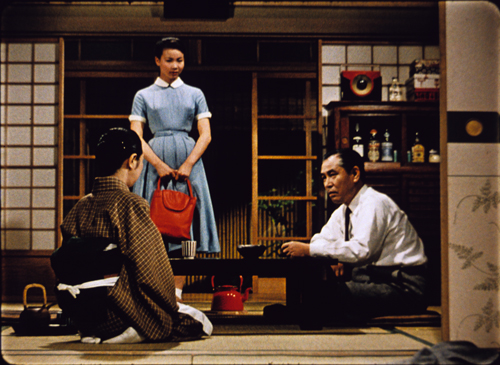
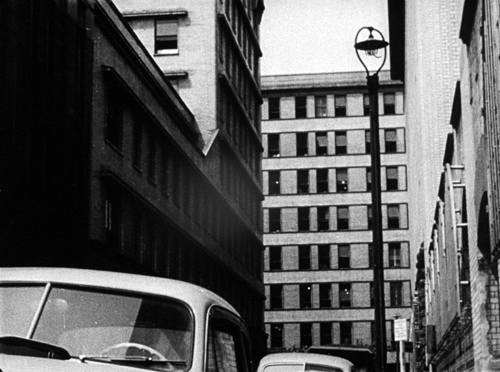
Look again, and it all becomes staggeringly complicated. Each shot is composed meticulously, down to the arrangement of food on the table. The compositions mirror each other uncannily: every medium-shot single puts the person’s face in the same part of the frame, so that the eyes of one character weirdly coincide with those of another. Indeed, Ozu’s bold play with graphic qualities—lines, masses, and color—from shot to shot is without peer in mainstream filmmaking. Contrary to what critics still say, the camera position doesn’t mimic a seated person’s view. It’s obstinately low even in train corridors and on sidewalks. What it does is subject the entire visible world to a precise patterning.
Thanks to this maniacally repeated framing, layers of space bristle with tantalizing possibilities. A humdrum space becomes charged with muted dynamism. Mundane bits of setting, like a red teakettle or a hanging sock-tree, come alive. And the intermediate spaces which link scenes often don’t establish the new scene’s locale very clearly. Instead, they hook one area to another by visual or auditory rhymes. The transitions also play games with our expectations. We may think we are going one place, but something, perhaps only the shadow of rippling water cast on a screen, swerves us to somewhere else. Just as Shakespeare’s dialogue can be read as pure poetry, the surface texture of these films would entrance us even if there were no story to follow.
Thanks to his apparently simple stories and easily grasped technique, Ozu has captivated and moved audiences for eighty years. But this humble artisan who compared himself to a tofu seller created a cinema of which no other director dreamed. Modest in effect yet extravagantly precise in execution, Ozu’s films are at once amusing, rapturous, and experimental. He tests his characters, his medium, his audience, and himself. His films show us how profound a genre- and star-driven studio picture can be. At the same time they open up a vast realm of purely cinematic possibilities. No filmmaker has come closer to perfection.
This essay originally appeared in slightly different form in Ozu Yasujiro: 100th Anniversary (Hong Kong International Film Festival, 2003). It is reprinted here by permission. Illustrations are from 35mm prints of Equinox Flower, Dragnet Girl, The Lady and the Beard, and Early Summer. DVD copies of Ozu films are available from the Criterion Collection in the US, the British Film Institute in the UK, and other sources elsewhere. A site showcasing all things Ozu is Ozu-san.com. My book, Ozu and the Poetics of Cinema, is out of print in hard copy, but a free pdf file is available for download here.
Dante’s cheerful purgatorio
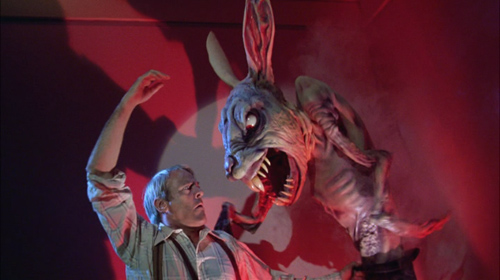
Twilight Zone: The Movie.
DB here:
When will we baby boomers relax our chokehold on popular culture? Never, if the enthusiastic response to Joe Dante’s visit to Madison last weekend is any indication. A showing of Gremlins (1984) packed the house. A screening of his Twilight Zone: The Movie episode brought fans forward with DVD slipcases to sign. College kids reminisced about watching The ‘burbs with their dads and Explorers with their buddies (all on video, of course).
Although steeped in classical Hollywood, intimately acquainted with the most obscure output of the studios, Dante hasn’t abandoned the present. He shoots TV shows, webisodes, and the 3D feature The Hole (still awaiting a US release). He hosts a website, Trailers from Hell, in which directors comment on other directors’ works using a trailer as a point of departure.
His films, from Piranha (1978) and The Howling (1981) to the present, by way of Amazon Women on the Moon (1987) and Matinee (1993), combine the gonzo spirit of the 1960s with a good-natured reverence for the past. Particularly movies. Particularly crazed, tasteless movies. Like Spielberg and Peter Jackson, he’s a fanboy. “Most filmmakers are kids at heart,” he says. “And all actors are.”
Unlike Spielberg and Jackson, though, Dante keeps politics close to the surface. His films sustain the baby-boomer hope that you can squeeze cultural critique into a genre project. Everybody knows that the Gremlins movies are subversive trips into the shadows of bourgeois normalcy. Has a shiny kitchen blender ever been used more efficiently?
The Gremlins pictures and The ‘burbs are valentines compared to Homecoming, Dante’s installment in the series Masters of Horror. This asks a simple question: Suppose that all the soldiers killed in combat were able to come back and vote? Is that a powerful lobbying group or what? When resurrected vets of Iraq start stalking to the polls, an Ann Coulter lookalike tries to stop them. Run on cable in 2005, this left-wing zombie movie slashes to ribbons pious platitudes about war’s costs. It’s required viewing for all 2012 presidential candidates.
Don’t crowd me, Joe
Dante began his career as a collagist. That’s not too fancy a name for a man who, with his friend Jon Davison, collected the ephemera of the great age of 16mm. TV shows, ads, and movie trailers swept out of local stations went into their archives. In time these and other glories of late-night TV found a new life, like a monster stitched together out of morgue remains. The strategy was simple. Dante and Davison rented five or six 16mm sub-B features and projected stretches of them, in rough order but jumbled together. The movies were interspersed with reels of clips.
The Movie Orgy played college campuses in the late 1960s and early 1970s. The Orgy lasted about seven hours, and its auteurs urged viewers to drift in and out. “Go get a pizza whenever you want. You won’t miss a thing.” Eventually Schlitz hired them to take it around the country and sold beer at the screenings.
When Dante began working for Roger Corman’s company—cutting trailers, thereby tapping his skills as a collage-maker—The Orgy was suspended. But some years ago the footage that he could find was transferred to digital and played at the New Beverly. It found a new success. Dennis Cozzallo has a lively tribute from 2008 here. Needless to say, we had to have The Orgy for Dante’s visit to Madison.
Affection for the detritus of the media takes many forms. After watching too many campus simpletons (both students and profs) laugh mockingly at Fritz Lang and John Woo movies, I’m opposed to condescension. I suspect Camp in its disdainful form. I don’t like people demonstrating their sense of superiority to the trash their parents and grandparents enjoyed. Knowingness leaves you with nothing.
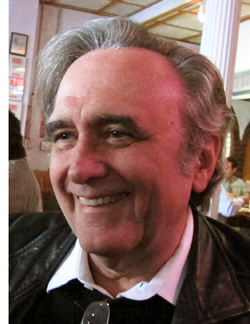 But The Movie Orgy is different. It offers another take on subpar product: The pleasure of sheer unpredictability. How will common sense be violated? How will demands of craftsmanship be dodged or bungled? How will canons of taste be overturned? How will things that were once stupid, and remain stupid, and will be stupid forever, still communicate a certain cynical earnestness? A foolish idea carried off with obstinate conviction will always deserve respect, so Earth vs. The Flying Saucers and Beginning of the End wind up having a touching desperation, like the badly-tied noose in a suicide hanging.
Moreover, in sequence after sequence, there’s a quality of astonishment that doesn’t make us feel superior. Take one exemplary moment of dépaysment. If you and I tried to be naive or trashy, we couldn’t come up with this.
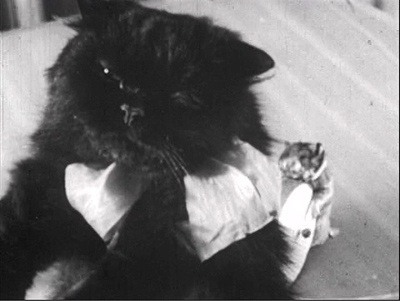
Andy Devine hosted a kiddie TV show, Andy’s Gang, which featured Froggy the Gremlin (Plunk your magic twanger, Froggie!), the cat Midnight, and Squeeky the mouse (played by a hamster). About an hour into The Orgy, Andy induces Midnight to play a miniature pipe organ while Squeeky accompanies him. Cut to a deep-focus shot of what seems to be a slightly drugged cat locked in place and rhythmically pawing the offscreen keyboard. In the background Squeeky, apparently clamped within a mechanical mouse body, bangs a tiny bass drum. Andy sings along tunelessly. The song is “Jesus Loves Me.”
You don’t laugh, you gape. It’s like one of our local attractions, The House on the Rock: What’s disturbing is not that it’s done poorly, but that somebody thought of doing it at all.
The form of The Orgy—and it does have a form, of sorts—is to open with openings and end with endings. Several of the movies get started in the first half hour (Dante and Davison love opening credits) and we’re given enough of the plots to become curious. Most prominent are Attack of the 50-Foot Woman and Speed Crazy, the latter receiving a loving dissection highlighting, and repeating to the point of obsession the heel protagonist’s tagline, “Don’t crowd me, Joe.” Eventually the guy and his flashy sports car wind up crowded, all right–crowded into a ravine.
More TV episodes and movies get added as the hours roll by, and by the end we’re facing Armageddon. Los Angeles, Las Vegas, Chicago, New York, DC—every major city is under attack by some alien or giant monster. Sky King has to dump dynamite for some reason, Superman has to save Lois from a pistolero. A sort of amphetamine Intolerance, The Movie Orgy cuts together all these climaxes, which include The End titles that are far, far from signaling the end.
The clip from Andy’s Gang reminds us that the piece is somewhat misnamed. It’s a Movies And TV Orgy. More specifically, it’s a Movies On TV orgy. The structure of the whole shebang imitates a long stretch of television ca. 1955-1960. Over lunch Dante recalled watching Million Dollar Movie as a kid in New Jersey, seeing a feature shoehorned into a ninety-minute slot and chopped up by commercials. The Orgy replicates the jagged tempo of switching among three or four channels, glimpsing variant commercials for Colgate toothpaste or Raleigh cigarettes, catching a bit of this movie and then a bit of that one. With all its kid shows from my youth (The Lone Ranger, Lassie, Mighty Mouse, etc.) in endless eruption and interruption, it’s a baby-boomer time capsule. Puncturing this evocation of childhood are the clips scavenged from teenpix and Dick Clark’s dance show, Vietnam, Nixon’s Checkers speech, and film-society icons like the Marx Brothers, Fields, and Abbott and Costello. The late sixties counterculture breathes more fully in some clever fake ad spots. In one, a crucifix starts to wobble as the carved Jesus struggles to free his hands.
Dante claims that he and Davison were inspired to find out about the popular culture that shaped their parents’ generation. But nearly everything we see filled the airwaves during our younger days as well. The Movie Orgy in its current form seems to me a zestful celebration of the world our generation saw when we flopped on our bellies, propped our chins in our hands, and stared at the tumultuous world inside a black-and-white (not color) TV (not video) set (not monitor).
We cartoon characters can have a wonderful life
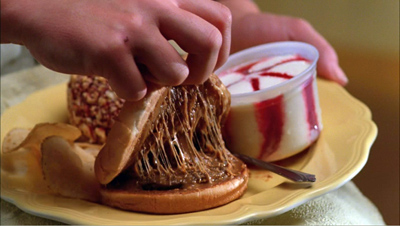
Dante the collagist leaves his fingerprints all over another film he screened here. When Spielberg launched his Amblin company, he hunted for directors who could make family entertainment in a genre format. Dante, who had already started Gremlins, was invited onto the omnibus Twilight Zone project. After the fatal accident on the Landis set, the studio backed off and it become “a movie they wanted to make but didn’t want anything to do with.” This gave Dante wide latitude and made him think, mistakenly, that studio suits always leave directors alone.
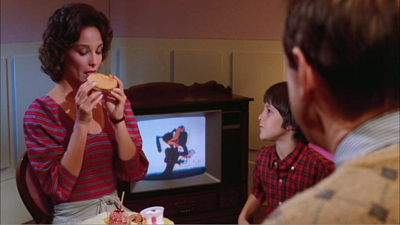
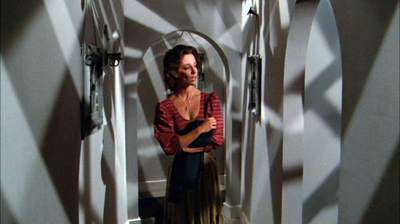
For this episode, Dante wanted to do an original story but Warners insisted that it had to be based on an episode of the TV series. He went back to the original Jerome Bixby story, which Dante and Richard Matheson reworked to add cartoons as a running gloss to the comic horror. The pseudo-family of demonic little Anthony inhabits a house that is half cartoonland, half-PoMo-Caligari. Saturated colors, occasionally striped with noir shadows, provide another Dante caricature of family domesticity, but now cartoons comment on the action. When Helen steels herself to eat, the dog on the screen behind her is doing the same.
The crisscrossed shadows of the corridors are replayed in the sawtooth walls pursuing Bimbo.
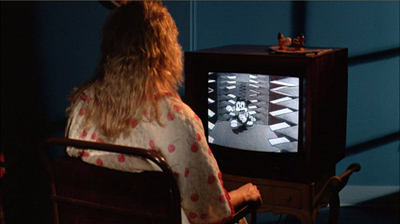
The collage principle gets developed further in Dante’s use of the soundtrack. The Movie Orgy uses no new sound work; the clips are just spliced together. But for the Twilight Zone episode, let loose in Warners’ classic archive, Dante could weave in Carl Stalling music (reorchestrated for stereo by Jerry Goldsmith) and a rich mélange of daffy sound effects.
The TV is incessantly on. The cartoons running in the background supply whizzes, boinks, and thuds that jarringly punctuate the conversation between puzzled teacher Helen Foley and the family that Anthony holds in his magical grip. “This is Helen,” says Anthony, introducing her to Uncle Walt and his sister, as we hear a smash from the TV set. The cartoon tracks comment on the action too. As the family settle down in front of the tube, the elders dote on Helen and we hear a Stalling rendition of “Ain’t She Sweet?” Dinner is served to the tune of “The Teddy Bears’ Picnic.” And when Helen discovers her burger has been slathered with peanut butter, the visceral image is underscored by warbling winds that rise when she lifts the bun. Eisenstein, for reasons given here, would have loved the moment. The whole sequence plays out as live-action animation, with naturalistic dialogue and effects given a creepy overlay by the cartoon track. Is Helen Foley’s last name part of the gag?
Dante, impresario of the comic grotesque, finds his inspiration in popular culture, the more wacko and inept the better. The comedy may come from childhood silliness, the grotesque from childhood fears. They say we baby boomers will always be just big kids, and Dante accepts this with a grin and a darkly cheerful eye.
Many thanks to the resourceful Jim Healy for arranging his friend Joe Dante’s trip to Madison. Thanks as well to the Cinematheque, the Marquee, and the Chazen Museum of Art for hosting the screenings.
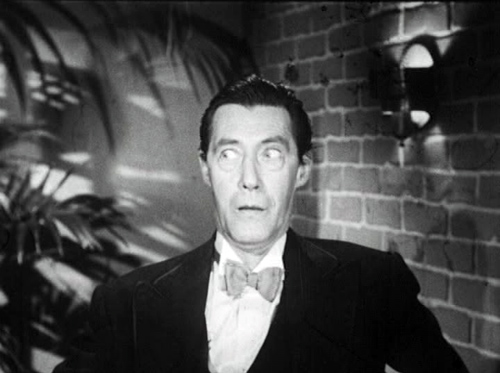
John Carradine in The Movie Orgy.
VIFFpix
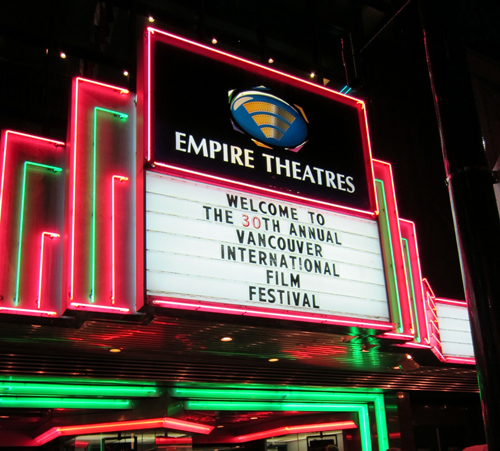
The big three-oh for VIFF.
DB here:
After several entries (they start here), time for a wrapup.
It was a record-breaking year for the Vancouver International Film Festival: over 150,000 admissions, 386 films, and many awards. Go here for the stats. But linger here for glimpses of friends old and new.
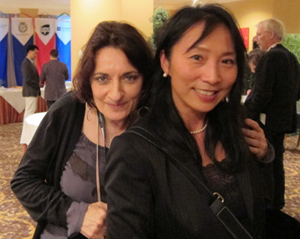
Every night there’s a little, sometimes not so little, reception for filmmakers, guests, the press, et al. in the Hospitality Suite. Sort of like a college mixer, except with better food and everybody talking about movies. On the left we find critic/professor/festival scout Bérénice Reynaud and PoChu AuYeung, VIFF Program Manager and Senior Programmer. On the right, Jack Vermee, Eurocinema expert and Programming Consultant.

More VIFFers at work: Below left, Alan Franey, dynamic Festival Director, with Programming Associate Mark Peranson in the background. With his colleague Jessica Bradford, Justin Mah curates the all-important VIFF videothèque. Below right, Justin (also on the Programming Committee) gets in the holiday mood.
One of the wondrous things about the festival is the access you have to filmmakers. Here’s Kristin with Ann Hui, director of A Simple Life, and Ben Rivers, director of Two Years at Sea.
More fun with filmmakers: Raymond Phatanavirangoon, producer of Headshot, and Charliebebs Gohetia (The Natural Phenomenon of Madness); and Saul Landau (Will the Real Terrorist Please Stand Up?).
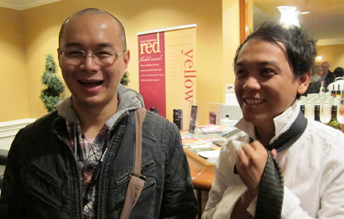
Programmers powwow over waffles: Shelly Kraicer, Dragons & Tigers Programmer, and Alissa Simon, Program Consultant for VIFF and Programmer for the Palm Springs Film Festival.

It’s not just for my camera; everybody here grins all the time. On left, Oz festival consultant Geoff Gardner poses with Bruce, while Bruce’s owner Eunhee Cha Brown, Hospitality Suite Manager and all-round organizer, looks on. On right, Tony Rayns, Dragons & Tigers Programmer, reflects on a figure in world film culture who, he reports, “insinuated himself ferretlike into the anus of every major world dictator.”

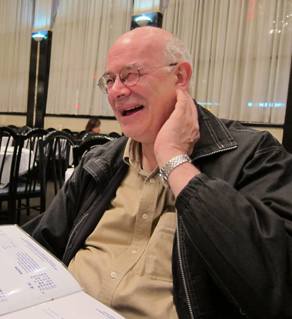
Other critics get jolly too, not to mention hungry. On the left, Sean Axmaker, proprietor of the excellent Parallax View website (which houses VIFF reports from him and his colleagues Kathleen Murphy and Richard Jameson). On the right, Peter Rist, professor at Montreal’s Concordia University and critic for another fine site, Offscreen. Although my pictures of long-time critical comrade Jim Emerson turned out lousy, you should imagine one embedded here and proceed to his magisterial Scanners site for more VIFF coverage.
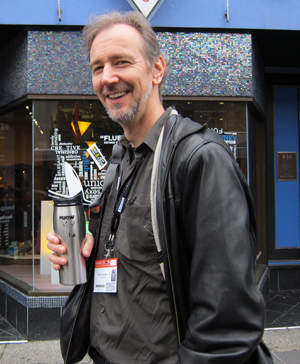
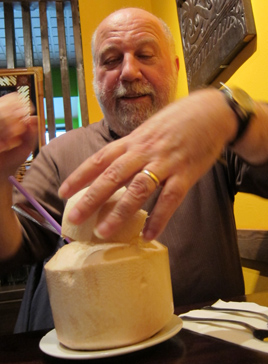
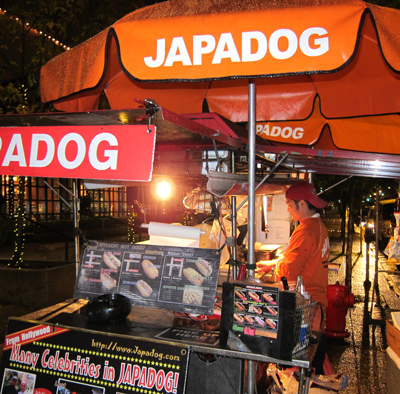
Loyal readers of our VIFF missives over the years know that JPG does not stand for Jpeg but rather Japadog. (2009 and 2010 pix here and here). This enterprise is as important as any festival sidebar. Below, a nighttime glimpse of the Japadog wagon conveniently planted outside our hotel. On the right, Professor Jim Udden of Gettysburg College and author of a superlative book on Hou Hsiao-hsien, seated at Japadog Command and Control Center on Robson Street, contemplates the luscious deliciousness that awaits him.
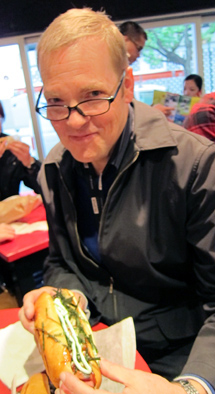
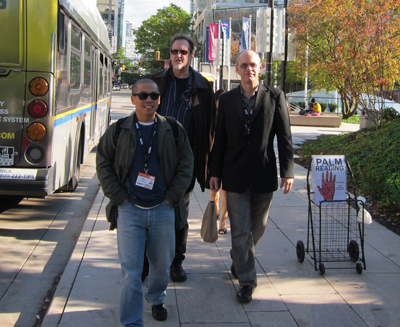
Director Ho Yuhang, critics Chuck Stephens and Robert Koehler, after a JPG feast: From the cut of their strut you know they’re auditioning for Reservoir Japadogs. (Thanks, Chuck.)
Too many more pictures (over 450), lots more to say, many new ideas; but not enough time. (See? Not even time for subjects and verbs.) Suffice it that once more we had a splendid time at this friendly, low-pressure but high-quality festival. You should come next year.
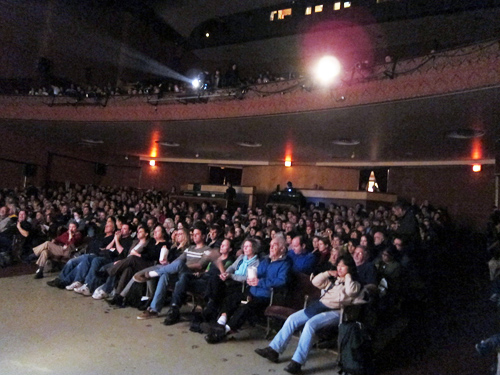
A packed house at The Vogue, a 1941 theatre that had become a music venue in recent years. It was brought into festival service after some years off-duty. Prettier interior shots are here. To see another Granville Street mainstay in its heyday, go here.
A memory palace
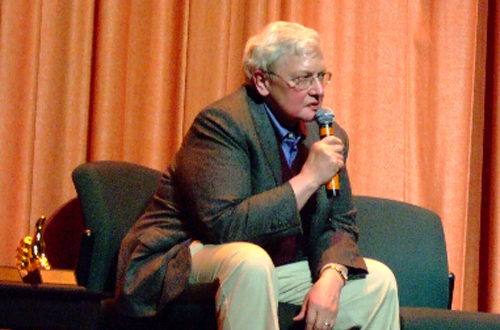
Roger Ebert in a moment of seriousness at Ebertfest 2006.
DB here:
Life Itself is not an ordinary memoir. True, it’s roughly chronological, taking you from Roger’s childhood through college to journalist days and then to the career we all more or less know. But from the start, we may find several moments, decades apart, squeezed into a single paragraph, even a single line. An incident in the past triggers a flashforward, an account of what became of this person, why this place became one to revisit. Later in the book, layers of flashbacks stack up. And usually the passage slips still further outward to the enveloping narrative, recounted by a man who now finds pleasure in the very act of recollection.
A trip to London in the mid-1960s, during which Roger and his old friend Dan Curley discover The Perfect London Walk, summons up an episode, years later, in which their guidebook of the same name is clutched in the hands of tourists whose paths cross with Roger and Chaz’s. Then we’re with Roger in a hospital bed years later as he revisits London in his mind, with details rising unbidden. He sees a nursery school and the shadow of a wooden palm tree in a window. And then we glide outward to another frame, the very moment of writing that conjures up all the others. “I believe that I could pause right now and remember something I saw on a walk that I have never thought of again since that time.” That moment yields another cascade of memories, ending in the 1970s with Roger crawling through a hotel window in order to look down on Pembridge Square.
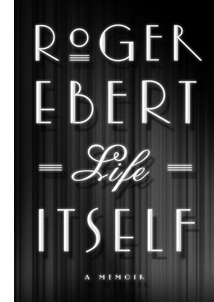 Gifted with a preternatural memory, Roger shames most memoirists. Not for him the procession of big names and picturesque places that makes the usual autobiography little more than a prosed-up agenda book. The book crackles with sensory impressions: the taste of a ploughman’s lunch in a pub, the whiff of a Steak and Shake cheeseburger. The world is there to be known, in all its teeming variety. I remember talking with him after George W. Bush got elected, and he was appalled that our new President had not held a passport before being elected governor. “Can you imagine a young man being that incurious?”
Above all, Roger’s curiosity turns toward people. Vast though his appetites and energies are, and frank as he is about his faults and failures, the writer is most fascinated by a picaresque procession of extraordinary individuals, most not famous. Yes, there are portraits of Mitchum and Scorsese and Royko and other larger-than-life celebs, but they’re brought down to earth. He favors the unknowns. He has, like his beloved Dickens, a genuine interest in everybody. After telling a bit about Letterman and Leno, he really gets going on the civilians whom he and Siskel met doing man-on-the-street gags. Studs Terkel becomes a fatherly exemplar of this worldly curiosity about the absolute uniqueness of everybody. “Two people meeting with Studs standing between them would hear from him how extraordinary they both were.”
Roger’s cast consists of everyone who has provided him laughter, sober self-analysis, affection, passion, and a long-running, tuition-free course in being a good person. For Sartre’s character, Hell is other people. Ebert, I’d say, thinks that other people are a decent, secular definition of Heaven. Life Itself radiates respect for the stubborn, sometimes maddening uniqueness of human beings.
“I was born inside the movie of my life,” the book begins. Okay, but what kind of movie? As a bona fide film brat, Roger has given us the autobiographical equivalent of a 1960s off-Hollywood art picture. It recalls those exercises in broken chronology like Petulia, but it’s gentler: not grating cuts, but quick dissolves. The time frames keep shifting and flipping over. Far along, at something like the climax of the book, love affairs and alcoholism set off a spiral of associations around his mother. And each era is quickened by the observer’s awareness of the preciousness of the sensuous moment. Roger is writing and watching teenage Roger dancing with Marty McCloy to the Everly Brothers in the Tigers’ Den:
Under our armpits, sweat formed dark circles, and our cheeks were moist as they touched.
Cinematic though it is, Life Itself is a literary exercise too. Roger, perhaps our most bookish living film critic, provides a montage of styles and genres. The childhood scenes, echoing Portrait of the Artist and A Death in the Family and perhaps The Sound and the Fury, are bursts of bright, disconnected impressions. Things coalesce into anecdotes as the boy’s mind matures. (Is it just me who hears echoes of another Midwestern yarn-spinner, Jean Shepherd?) In the young man who yearns to travel, to explore every city, to read every book he can lay his hands on, to shyly move toward girls, we see Thomas Wolfe, teenage Roger’s guiding star. Soon enough, though, we’re in a Ben Hecht Chicago newsroom:
Once Paul was talking on a telephone headset, tilted back in his chair, and fell to the floor and kept on talking. Eppie [Ann Landers] reached in a file drawer and handed down her pamphlet Drinking Problem? Take This Test of Twenty Questions.
(Aspiring writers: Compose a 50-word paragraph explaining why “handed down” is a better choice than “handed him.”)
Every memoir needs a credo, and this we get in concluding chapters entitled, “How I Believe in God” and “Go Gently.” They give you much to chew over, including laconic bon mots like “I was perfectly content before I was born, and I think of death as the same state.” The lesson of this life? Expect no spoilers from a fellow critic, but I can provide a teaser. It has to do with joy.

Graven image and original: Ebertfest 2006.



