






Archive for the 'Narrative strategies' Category
Cronenberg’s violent reversals
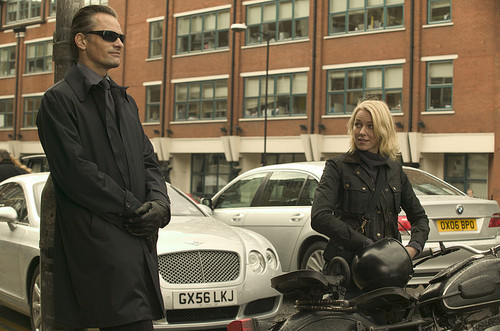
Eastern Promises
Kristin here–
A Pair of Films
I haven’t read nearly all the review of Eastern Promises, of course. Sampling eight or so, I have noticed that quite a few critics briefly note a similarity between David Cronenberg’s new film and his previous one, A History of Violence. There are the obvious links. Viggo Mortensen plays the lead in both, a man with a secret—or a bunch of them. Both involve crime syndicates run by families. Both contain scenes of graphic, brutal violence.
Reviewer John Beifuss calls Eastern Promises “A sort of companion piece to Cronenberg’s previous feature, ‘A History of Violence’ (2005), adding that, “‘Eastern Promises’ opens in a modest barber shop that recalls the small-town diner that was the site of unexpected brutality in ‘Violence.’” Beth Accomando comments, “In some ways, Nikolai has much in common with Mortensen’s character in A History of Violence, who hides one persona beneath another.”
J. Hoberman goes a little further in defining the parallels. “Eastern Promises is very much a companion to A History of Violence. Both are crime thrillers that allow Viggo Mortensen to play a morally ambiguous and severely divided, if not schizoid, action-hero savior; both are commissioned works that permit hired-gun Cronenberg to make a genre film that is actually something else.” (For more reviews, see Rotten Tomatoes’ page on the film.)
It would be hard to discuss the similarities between the films without giving away too much of the plot, and clearly that’s why reviewers have said so little on the subject. So I should make it very clear that I’m writing a brief analysis here, not a review. There will be major spoilers for both films. I don’t always mind spoilers for films I’m going to see, but A History of Violence and especially Eastern Promises really depend on the withholding of information. I’d urge you to see both films before reading the rest of this entry.
What I’m primarily interested in here is the extent to which the second film manages to be a mirror-image reversal of the first. It’s a remarkable formal accomplishment, I think, to have a director make two consecutive films with different plots, characters, settings, and narrational strategies that are such exact reversals of each other. Eastern Promises isn’t a sequel, yet it forms a pair with A History of Violence. It’s like those trilogies that are united by theme rather than by being parts of the same story (e.g., Ingmar Bergman’s Through a Glass Darkly, Winter Light, and The Silence, or Phillip Glass’s three biographical operas, Einstein on the Beach, Satyagraha, and Akhnaton). Whether or not this pairing was intended by Cronenberg, one could easily imagine him working again in the same vein.
Basically you’ve got a central character with two sides to him, the criminal and the good. In A History of Violence, the protagonist is leading an ordinary domestic life that is threatened by a revelation of his criminal past. He barely manages to suppress the threat to his family that results when his former associates re-establish contact with him, and he can suppress it only by using more violence and revealing to his family what he had been
In Eastern Promises, the hero does the opposite. He is voluntarily leading a criminal life undercover in order to fight the Russian mafia gang he works for. By meeting and falling in love with Anna, he is given a chance to lead a normal life with her but manages to suppress his longing for that in order to continue his struggle. (Even his boss in whatever crime-fighting organization he secretly works for offers him an out, saying that the Russian embassy has requested he be taken off the case. Nikolai insists on continuing his activities, since he now has had a promotion that will allow him to penetrate to the very heart of the criminal gang he has been fighting.)
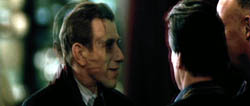
There are contrasts and parallels that encourage a comparison of the two films. The modest diner that Tom Stall runs in A History of Violence could not be more unlike the 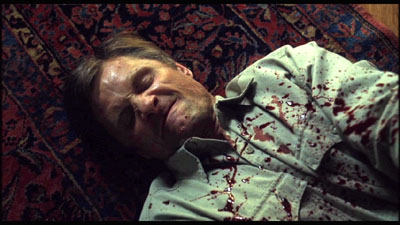 sumptuous Russian restaurant that is the front for Semyon’s vory v zakone activities. The much-lauded fight scene in the public baths in Eastern Promises is a more visceral version of a battle late in A History of Violence when Tom, about to be killed at his brother’s order, manages to kill all five of the men holding him captive. (At left, four down, one to go.)
The black, forbidding car that Nikolai drives echoes that of the vengeful thug Fogarty in A History of Violence; both glide to ominous stops on the street outside the dwelling of their presumed victims. Each of the films ends on a close view of the protagonist seated at a table: Tom fearfully yet hopefully searching the faces of his family for signs of acceptance and Nikolai sitting in the Russian restaurant he now runs, thinking in sorrow of Tatiana and presumably of his missed life with Anna. Even the meal that Tom returns home to and the one Anna’s family are having at the end are similar: roast beef and vegetables.
Ultimately the contrasts in the two films are what makes the ending of Eastern Promises even more affecting than that of A History of Violence. Tom Stall has used deceit to walk away from his violent life and make a new and normal one. By the end the revelation of the deceit has damaged that normal life considerably, but there are indications that the damage will gradually, though not wholly, fade through re-established love and trust. Nikolai, on the other hand, has gone down the far more difficult road: walking away from a potentially normal life to continue to use deceit and violence to fight the vicious organization that preys upon normal people. (When Anna’s mother warns her away from her contact with the criminals, saying “This isn’t our world. We are ordinary people,” Stepan responds that Tatiana was an ordinary person, too.)
One thing that distinguishes the films is that we never learn whether Nikolai was already a real criminal earlier in his life, one whom the British authorities successfully recruited to help them run an underground operation against the vory v zakone in London. Were his tattoos really given him in Russian prisons, or are they an elaborate disguise created in England? We don’t know if Nikolai had a normal life before and gave it up to play out this ruse or if this undercover job is his redemption for past evils.
Tatiana’s Voice
One specific device intrigued me the first time I saw the film: the voice of Tatiana, the girl who dies early in the film giving birth. That voice is heard over at intervals, speaking passages from the diary that Anna finds in her purse and tries to get translated. What is the “source” of this voice? Against seeming logic, the voiceover becomes associated with people reading or translating the diary only fairly late in the film. The early instances occur over scenes where no one present could know the contents of the diary.
On my second viewing of the film, I took notes on the contexts in which the voice is heard, and I think this is a complete list:
First, as Anna initially opens the diary and finds the card for the restaurant; cut to her on bike heading for the restaurant.
Second, early the next evening as Anna rides her bike to the restaurant; the voice bridges the cut to Semyon drinking alone inside restaurant.
Third, during the scene of Nikolai having sex with the blonde prostitute.
Fourth, over Anna at hospital with baby Christina. Semyon comes in and says he has translated the diary—but doesn’t give the translation to her.
Fifth, shortly thereafter, Semyon leaves, and the voice resumes over a shot of Anna, upset by his implied threats. It bridges the cut to the dining room where the mother and Stepan are translating the diary. The voice of Tatiana dissolves into that of Stepan. This signals the point at which the family members finally become aware of the specific contents of the diary: that Semyon is the one who raped Tatiana and left her pregnant with Christina.
Sixth, a scene beginning with Nikolai in the restaurant alone, reading the diary. (Anna had given Nikolai the diary at the end of the previous scene, telling him to read it.) Semyon enters, gets the diary from him, and burns it.
Seventh, over a brief scene of Anna at home reading the translation of the diary. (This is immediately followed by a scene of Nikolai in his car watching Stepan go into a block of flats.) The implication is subtle, but in the most recent conversation between her and Nikolai, he has told her that she should raise Christina herself. Now perhaps she is searching the diary for evidence to justify such a decision.
Eighth, the final voiceover passage begins as Anna sits with Christina, whom she has adopted, in the garden; the voice bridges to the restaurant with Nikolai sitting alone, a bottle of vodka at his elbow. This is, I believe, the only repeated passage, being the same part as we hear in the first instance of voiceover. The passage ends, “That is why I left. To find a better life.”
This is two-edged. On the one hand, Nikolai does not have the option of leaving and finding the better life that he wishes he could have with Anna—the one we’ve just seen her leading with her family. On the other, he has the chance to save others from the fate that Tatiana suffered.
Only after the scene in which we see Nikolai reading the diary (the sixth occurrence of Tatiana’s voiceover) do we find out that he has been working against the gang—arranging for the blonde prostitute to be rescued by the police, spiriting Stepan away into hiding rather than murdering him. Yet it is not the diary’s contents that affects him and causes him to do such things. Reading the diary provides a plot point, giving him the vital clue that Semyon is Christina’s father, allowing him to tell the police how to test for DNA and convict Semyon of statutory rape.
The first four instances of the voiceover are not associated with anyone reading the diary. The last four are: Stepan translating it, Anna reading it, Nikolai reading it, and finally Nikolai apparently remembering it as he sits in place of Semyon in the restaurant. Seeing the film the first time, at the end I wondered if perhaps Tatiana’s voice becomes retrospectively linked to Nikolai, who sacrifices his own chance to happiness to continue battling the system of human trafficking that had victimized her.
Watching Eastern Promises again, I realized that the device is not that straightforward. Yet just as learning late in the film about Nikolai’s long undercover work against the vory v zakone shifts the implications of almost everything we have seen, so the resonance of the voiceover passages changes upon re-viewing. All the occurrences of it seem to lead up to the epilogue and to link our privileged access to Tatiana’s writings to our special knowledge of Nikolai’s role in so much of what has happened.
The voiceover motif has other functions. It keeps reminding us of the diary, which is crucial to the plot in several ways. It provides exposition about Tatiana’s life and about the methods used by the Russian mafia to lure girls and women into leaving their homes. Indeed, the device is typical of the narration, which remains quite objective and informative on the whole, moving between the two central characters in an even-handed fashion and even showing the other major characters when those two are not present. The voiceover becomes another means that the narration uses to inform us about the one character who disappears from the scene almost immediately.
Only at the end does the narration settle with one of the characters. We have seen Anna, finally happy in motherhood after having suffered a miscarriage shortly before the action of the plot began. The film ends with Nikolai, briefly lingering over his grim situation and allowing us to picture what his life will be like. That moment, I think, was where I came to associate Tatiana’s voiceover primarily with him.
Figuring backward
Some reviewers have compared Eastern Promises with A History of Violence primarily in qualitative terms. Is the second film inferior to the first? As good? Better?
They’re both very good. If more films these days were as good as either, we’d complain a lot less. Still, upon viewing each a second time in preparing to write this entry, I became convinced that Eastern Promises is even better than its predecessor. A History of Violence is a relatively simple film, and it remained much as I had remembered it. Revisiting Eastern Promises only a week after my first viewing, I saw far more in it.
The character of Kirill, Semyon’s son and apparent heir, is more complex. More importantly, Nikolai’s involvement in the affairs of the family’s gang activities is hinted to be far more direct than his modest standing as a “driver” would indicate. Indeed, there is a strong suggestion dropped that Nikolai caused the murder of Soyka (the shocking throat-slitting in the barber shop that opens the film). In the scene after Kirill gives Nikolai a truckload of champagne, Nikolai talks with Semyon and explains that the murder had been committed because Soyka was “talking about” Kirill. It’s evident that Nikolai himself could have been the source of any such notions about Soyka. There are other moments when we are led to contemplate the dense weave of possible causes and effects underlying the narrative.
It’s a rich film indeed. At the beginning I cautioned that you should see it before reading this entry. If you’ve done that, now I suggest seeing it again.
[Added October 18: I’m grateful to Eric Dienstfrey, who has responded to this entry with an intriguing suggestion about the “reversal” trait I noticed in these two films: “I think complementary films exist through most of Cronenberg’s career. Dead Ringers and M. Butterfly are two that come to mind, both films being about Jeremy Irons — to reference the old Woody Allen joke — at two with himself, either as twins, or internally as both a gay and straight individual. I also like the complement between Videodrome and The Dead Zone. In Videodrome, Woods loses control as he becomes more and more sadistic, whereas in The Dead Zone, Walken loses control as he becomes more and more heroic.”]
The sarcastic laments of Béla Tarr
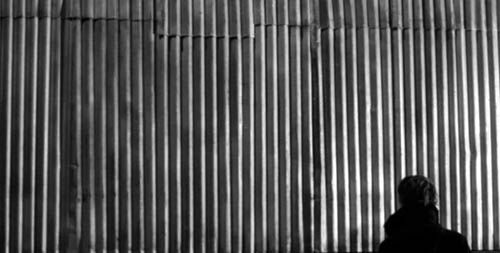
Werckmeister Harmonies.
DB here:
Last weekend, Facets MultiMedia in Chicago held a tribute to Béla Tarr. Milos Stehlik and his colleagues have been long-time champions of Tarr’s work, holding retrospectives and releasing nearly all his features on DVD (with Sátántangó soon to come). Tarr arrived on Saturday, but an emergency sent him back to Hungary sooner than he expected. So instead of discussing his work with a panel, he could only introduce the screening of Werckmeister Harmonies before running off to the airport.
The panel went ahead, with Jonathan Rosenbaum, Scott Foundas, and me chatting with Susan Doll of Facets. It wasn’t as pungent a session as it would have been with Tarr there, but I thought it was still pretty interesting. Jonathan, Scott, and Susan had thoughtful comments, and the questions from the audience were exceptionally good. The whole session was recorded for an online broadcast at some point, so you might want to watch out for that. And I have earlier blog entries on Sátántangó here and here.
In preparation for the panel I spent last week reconsidering Tarr’s work, so I offer a few notions about his films and how we might place them in the history of cinematic form and style. Some of these remarks build on things I said at the session.
Up close and personal
 Some directors accommodate critics, accepting or at least tolerating writers’ efforts to probe the work. Not Tarr. Ask about his plots and characters, and he claims that he doesn’t tell stories. Point out what seem allegorical or symbolic touches, and he protests that he doesn’t make allegories and he hates symbols. Mention contemporary cinema, and the reply is abrupt: “For me, when I see something at the cinema it is always full of shit.” And if you tell him that his early films seem quite different from his more recent ones, he vehemently disagrees.
As Scott pointed out in our panel, though, it can be plausible to apply the concept of “period” to filmmakers’ work as we do to painters’ careers. Lars von Trier has been fairly explicit that after mastering a polished style for his work up through Zentropa/ Europa he wanted to try something new, and with The Kingdom he shifted toward a looser, on-the-fly style that pointed toward Dogme 95. Any viewer can be forgiven for thinking that Tarr has moved in the opposite direction of von Trier, from a pseudo-documentary approach toward something much more grave and majestic.
The first three theatrical features focus on the urban working class and their struggles to improve their lot. In Family Nest (1979), a family who can’t afford a flat of their own squeezes in with the husband’s parents. The tight quarters, the ceaseless complaints of the father-in-law, and the husband’s inertia force his wife and child to flee to the streets. The Outsider (1981) follows a young violinist as he drifts among jobs and into a passive marriage before being called up for military service. The family in The Prefab People (1982) has a flat and a decent job, but the wife finds the husband indifferent to her boring routines, and he looks for an escape in a job in another town. The concentration on ordinary people’s lives and the search for drama in the everyday dissatisfactions of city life put the films in the neorealist line of succession.
Stylistically, the films are stripped down in ways that also owe debts to modern traditions. Shot mostly handheld, adjusting the framing to the actors’ performances, they belong to a strain of films from the 1960s on that sought to suggest the immediacy of cinéma-vérité documentary. Unlike many such films, however, Tarr’s buy into a long-take aesthetic. Perhaps surprisingly, these movies’ shots run abnormally long: an average shot length of 32 seconds for Family Nest, 33.5 for The Outsider, 47 seconds for Prefab People. By comparison, Hollywood films of these years were consistently running between 4 and 8 seconds per shot, and comparatively few European and Asian films rely on shots as lengthy as Tarr’s.
Most scenes in these three films are dialogues, and the camera holds intently, if shakily, on faces. This concentration is enhanced by the general absence of establishing shots. A scene opens more or less in the middle of a conversation, and we get a character already challenging another. The visual pattern is that of shot/ reverse-shot, and in most scenes the first face is counterposed to a second one by either a cut or a pan. Shooting on location in cramped rooms, Tarr makes his framings tight; in Family Nest, the jammed frames give us and the characters almost no breathing space.
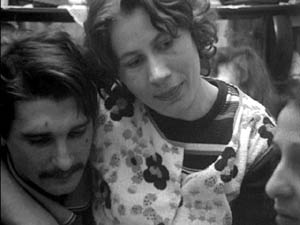
By relying on more or less isolated faces in close-ups, Tarr can absorb us in the intimate drama while sometimes catching us off guard. For instance, when we get a single character without an establishing shot, there is often a momentary uncertainty about where we are, or when the action is taking place. We also can’t be sure of who’s present besides the speaker, so the close view of him or her leaves us hanging: To whom is s/he talking? We’re pushed to pay close attention to what the character is saying, looking for any clues to the dramatic context. Tarr’s tactic also delays the reaction of the listener; he may withhold sight of the conversational partner until s/he speaks. The effect, heightened by the lengthy takes, is to turn many of these scenes into monologues, in which a character pours out his or her reaction to a situation, and we’re forced to take that in more or less pure form.
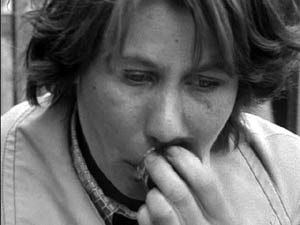
By the end of Family Nest, Tarr is shooting entire scenes concentrated on a single face, and because we don’t know if there is anyone else present, we have to take the talk as virtually a soliloquy.
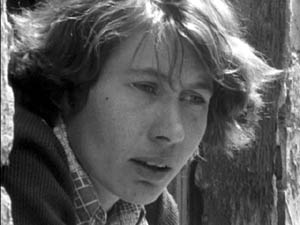
It’s as if Tarr invoked the stylistic schema of shot/ reverse shot and simply postponed or suppressed the reverse shot, leaving only an inexpressive shoulder in the foreground, if that. I’ve discussed the delayed reverse-shot as a convention of European cinema in an earlier blog, and Tarr makes ingenious use of it.
Tarr builds these films out of conversational blocks, punctuated by undramatic routines. The result is that often major plot actions take place offscreen, or rather in between the dialogues. Exposition that other filmmakers would give us up front is long delayed, with bits of information sprinkled through the entire film. In Family Nest, the father claims that he’s seen Iren having an affair with another man. We can’t be sure he’s lying because we haven’t strayed enough out of the household to judge her activities. In The Outsider, one scene ends with the drifter Andras telling Kata, a woman he has recently met, that he has a child by another woman. The scene ends with him smiling in indifference, leaving his sentence unfinished. In the next scene, a band strikes up a tune: Andras and Kata are celebrating their marriage.
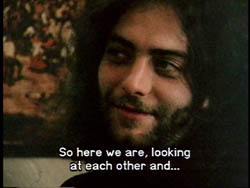
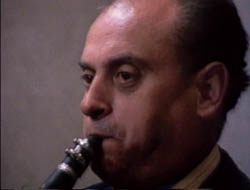
Most filmmakers would show us more of the courtship and a scene of proposal, but Tarr moves directly to the next block, suggesting Andras’ laid-back heedlessness. Agreeing to get married is no big deal. Further, by skipping over the most obviously dramatic incidents, Tarr’s storytelling joins that tradition of ellipsis celebrated by André Bazin in his essays on neorealism. No longer does the filmmaker have to show us every link in the causal chain, and no longer are some scenes peaks and others valleys. By deleting the obviously dramatic moments, the filmmaker forces us to concentrate on more mundane preambles and consequences.
This block construction yields an unusually objective narration. These films lack voice-overs, subjective flashbacks, dreams, and other tactics of psychological penetration. We have to watch the people from the outside, appraising them by what they say and do. It is a behavioral cinema. True, Prefab People opens with a flashback: The husband is packing to leave his wife, and the plot moves back to an anniversary dinner that ends badly. But the flashback to the earlier phase of the marriage isn’t framed as the wife’s memory. When the plot’s chronology brings us back to the moment of the husband’s departure, the replay of the opening allows us to watch the characters with more knowledge of what is driving them apart. Unsurprisingly if you know Tarr’s earlier films, that replay is followed by a long monologue showing the wife expressing her sorrow at his departure, without any visual cues about who, if anyone, is listening.
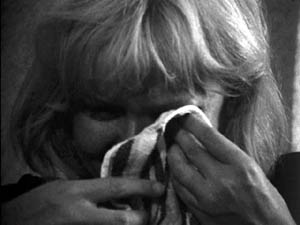
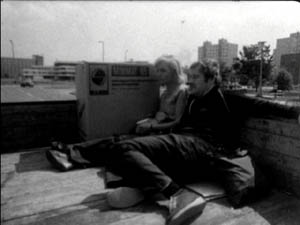
Then, without preparation, we see the couple back together, shopping in an appliance store. How did they reconcile? Have their attitudes changed, or are they simply reconciled to their old life? Like Antonioni and many other modern filmmakers, Tarr doesn’t tell us such things. He simply ends his film on a long take of husband and wife riding expressionless in the back of a truck, as much pieces of cargo as the washing machine beside them.
After the Fall
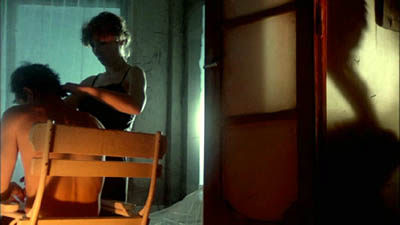
The second-phase films do look and feel rather different. Almanac of Fall (1984), a story of duplicity and spite among people sponging off a well-to-do older woman, offers a wholly elegant mise-en-scene. Characters are often framed from far back, surroundings take on much more importance, the framing is stable—often with windows, doors, and furnishings impeding our view of the action—and the camera moves smoothly, often in arcs around stationary figures. The takes are even longer, averaging just under a minute. The rococo lighting (patches of color seem to follow actors around) and atmosphere of strained upper-class narcissism seem like quite a break from the working-class films. If I had to find an analogy to Almanac of Fall, it would be Fassbinder’s Chinese Roulette (1976), with its camera arabesques and slightly decadent ostentation.
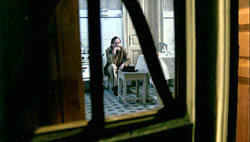
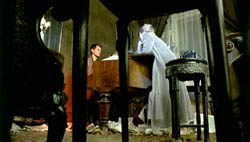
The overripe shots of Almanac of Fall signaled a shift toward a self-consciously formal cinema, but then Tarr stripped his settings and cinematography down. From Damnation (1988) onward, his films feature ruined exteriors, shabby interiors, elaborate chiaroscuro, rhythmic camera movement, and very long takes. (Damnation has an ASL of 2 minutes; Sátántangó, 2 minutes 33 seconds; Werckmeister Harmonies, 3 minutes 48 seconds).
Tarr insisted in conversation with me that there isn’t a sharp break between early and late styles. For one thing, his video piece Macbeth (1982) consists of only two shots across 63 minutes. It was made before The Prefab People, so his shift toward the ambulatory long take was already in the works. Moreover, The Outsider ends with a strained restaurant encounter captured in a virtuoso handheld shot running nearly seven minutes. A nightclub scene in The Prefab People likewise features some sidewinding long takes around a dance floor that wouldn’t be out of place, at least in their repetitive geometry, in Damnation.
If we’re inclined to look for other continuities, we can find them. In the films from Damnation onward, the deferred reverse shot has been put at the service of attached point of view, so that often when Tarr’s protagonists peer around a corner or out of a window, instead of optical pov cutting we have an over-the-shoulder view that conceals their facial reaction. One scene in Damnation starts as a typically Tarrian scrutiny of texture, with the wrinkling wall echoing Karrer’s topcoat. But then the camera arcs and refocuses, showing what Karrer is watching but not how he responds.
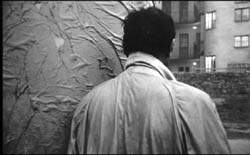
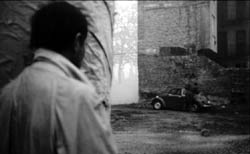
The blocklike construction of scenes in the early films carries on in the later work, but now Tarr minimizes the cuts within a scene, so that it becomes an even more massive hunk of space and time. Tarr refuses as well to use crosscutting, which would show us various characters pursuing their activities at roughly the same time—another strategy that keeps us fastened to one relentlessly unfolding chain of actions and, usually, one character’s range of knowledge. The avoidance of crosscutting will have major structural implications in Sátántangó, which overlaps characters’ individual points of view by replaying certain events and stretches of time.
The long-held facial shots of the early films don’t create a natural arc; the shot will go on as long as the character wants to talk. Similarly, many long takes in the later films don’t present a beginning-middle-end structure. We simply follow a character walking toward or away from us, pushing into a stretch of time whose end isn’t signaled in any way. This becomes especially clear in those extended long shots in which a character walks away toward the horizon and the camera stays put. Traditionally, that signals an end to the scene, but Tarr holds the image, forcing us to watch the character shrink in the distance, until you think that you’ll be waiting forever. Likewise, the diabolical dance shots of Sátántangó, built on a wheezing accordion melody that seems to loop endlessly, are exhausting because no visual rhetoric, such as a track in or out, signals how and when they might conclude. Early and late, Tarr won’t hold out the promise of a visual climax to the shot, as Angelopoulos does; time need not have a stop.
Nonetheless, I do agree with my fellow panelists that the later films have a significantly different look and feel, and it’s on them that Tarr’s place in world film history will chiefly rest. As I indicated at the end of Figures Traced in Light, he stands out as a distinctive creator in a contemporary tradition of ensemble staging. Like Tarkovsky, he shifts our attention from human action toward the touch and smells of the physical world. Like Antonioni and Angelopoulos, he employs “dead time” and landscapes to create a palpable sense of duration and distance. Like Sokurov in Whispering Pages (1993), he takes us into an eerie, Dostoevskian realm where characters are cruel, possessed, mesmerized, humiliated, and prey to false prophets.
Ties to tradition
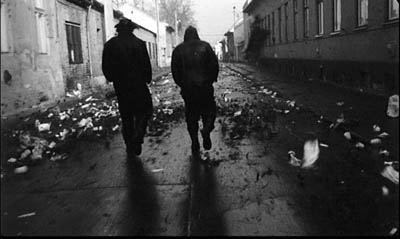
Tarr, however, maintains that his work, early or late, owes little to cinema. He claims not to have been influenced by other directors, and he asserts that he gets his ideas from life, not from films. When pressed, he admits that he knew the films of Miklós Jancsó “and I liked them very much. But I think what he does is absolutely different from what we do.”
It’s not uncommon for strong creators to reject the idea of influence, and many feel that they may sap their originality if they’re exposed to other work. Still, nothing comes from nothing. Any artwork is linked to others through an expanding network of affinity and obligation. Often influence is like influenza; you catch it unawares, despite your efforts to ward it off. And sometimes artists on their own find strategies that other artists have already or simultaneously hit upon.
Whether or not Tarr consciously joined a tradition, his practices do link him to several trends. Tarr has rejected the idea, floated by Jonathan, that his early films are indebted to Cassavetes, but there seems little doubt that by 1979, when Family Nest was released, it contributed to the fictional-vérité tradition, regardless of his intent. Likewise, his late films’ reliance on long takes is part of a broader tendency in European cinema after World War II. The neorealists taught us that you could make a film about a character walking through a city (The Bicycle Thieves, Germany Year Zero), and other directors, such as Resnais in the second half of Hiroshima mon Amour, developed this device. With Antonioni, Dwight Macdonald noted, “the talkies became the walkies.” Jancsó took Antonioni further (acknowledging the influence) in the endless striding and circling figures of The Round-Up, Silence and Cry, and The Red and the White. So even if there wasn’t any direct influence, Antonioni and Jancsó paved the way for Tarr; they made such walkathons as Sátántangó and Werckmeister thinkable as legitimate cinema.
Still more broadly, as Hollywood cinema has become faster-paced, accelerating its action and cutting, art cinema in Asia and Europe has tended toward ever slower rhythms. Visit any festival today, as Scott mentioned in our panel, and you’ll see plenty of films with long takes and fairly static staging. I criticize this fashion a bit in Figures, but it’s undeniably a major option on today’s menu. It’s even been picked up in contemporary American indies, with Gus Van Sant’s work from Elephant on offering prominent examples. He, of course, has been crucially influenced by Tarr, but Hou, Tsai Ming-liang, Sokurov, and other directors haven’t. We seem to have a case of stylistic convergence, with Tarr choosing to explore the long take at the same time others were doing so.
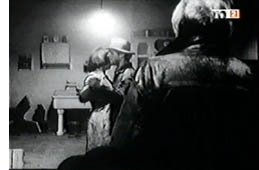 Within recent Hungarian cinema, it would be fruitful to examine Tarr’s relation to his contemporaries. Janós Szasz’s Woyzeck (1994) takes place in a wasteland not unlike those of Damnation and Sátántangó. Even closer to Tarr is the work of György Fehér. I’ve seen only Passion (1998; right) and one scene from Twilight (1990). Here again we get very long takes with a supple camera, grungy settings, and down-at-heel characters wandering in rain and mist or dancing as if possessed by demons. Fehér has worked with Tarr as producer, dialogue writer, and “consultant.” We could also explore Tarr and Fehér’s affinities with Benedek Flieghauf, the younger director of The Forest (2003) and Dealer (2004). Fleghauf builds these films around extensive long takes, and the remarkable Forest carries the idea of the suppressed reverse-shot to an eerie extreme, as characters study mysterious offscreen objects that may never be shown us.
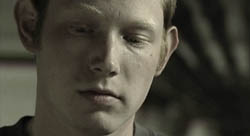
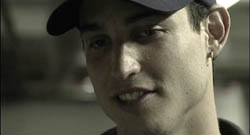
More generally, and more speculatively, we could look to a wider movement in late and post-Soviet art toward mournfulness and lamentation in response to cultural collapse. Tarkovsky’s Nostalghia is one instance, but Larissa Shepitko’s The Ascent (1976) and Elem Klimov’s Come and See (1985) point in this direction too. Vitaly Kanevsky’s Freeze, Die, Come to Life! (1989) offers a rusting, dilapidated world not far from Tarr’s. In the 1970s and 1980s, composers like Arvo Pärt, Henryk Górecki, Giya Kancheli, Vyacheslav Artyomov, and Valentin Silvestrov created austere, threnodic music that sometimes evokes spirituality but just as often suggests a bleak end to everything. The very titles—Symphony of Sorrowful Songs (Górecki), Symphony of Elegies (Artyomov), Postludium (Silvestrov)—evoke something more than the death rattle of Communism. The pieces can be heard as meditations on the ruins of modern history, asking what humankind has accomplished and what can come next. Tarr’s severe parables, grotesque and sarcastic in the manner of Kafka, don’t exude the religiosity we can find in some of this music or filmmaking, but, at least for me, they share the impulse to lament humans’ inability to transcend their brutish ways. “I just think about the quality of human life,” he remarks, “and when I say ‘shit’ I think I’m very close to it.”
I have more ideas about Tarr, especially on Sátántangó and Werckmeister, but I have to stop somewhere. I hope to see his new film The Man from London when I go to the Vancouver International Film Festival next week, and of course I’ll report on it here.
The best piece of writing I know on Tarr’s cinema is András Bálint Kovács’ “The World According to Tarr,” in the catalogue Béla Tarr (Budapest: Filmunio, 2001).
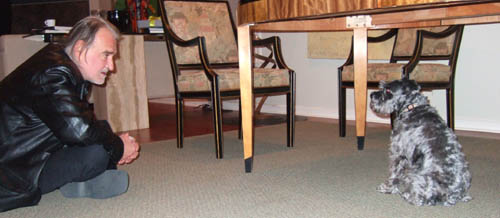
Béla mesmerizes Lola, Chicago 15 September 2007.
Thanks to Milos Stehlik, Susan Doll, Charles Coleman, and Megan Rafferty of Facets, to Béla Tarr for generous conversation, and to András Kovács for enlightening discussions over the years.
PS 20 September: The reports of Tarr’s earlier visit to Minneapolis are emerging; here’s a good link.
I broke everything new again
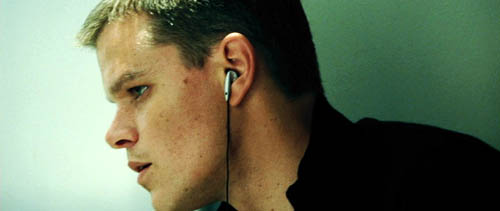
DB here:
Today some notes about cinematic storytelling in two trilogies, one long and one lasting only ninety seconds.
Extreme ways are back again

Yes, one more entry on The Bourne Ultimatum, which I thought I was done with. But alert reader Damian Arlyn sent me an email proposing an ingenious explanation for Ultimatum‘s repetition of a scene from The Bourne Supremacy. (Something like his idea is also suggested here and here.)
After yet another viewing, I agree: That scene is the same piece of plot action, replayed in a new context. This makes the film’s structure more interesting than I’d thought in my entries here and here.
Continue at the risk of spoilers.
At the climax of Supremacy, Jason kills Marie’s assassin in a traffic-clogged tunnel. He then visits the daughter of the Russian couple he murdered during his first CIA mission. The epilogue of Supremacy takes place in New York City. Jason calls Pamela Landy while he watches her in her office from an opposite building. Apparently as a token of thanks, Pam tells him his real name and adds his birthdate: “4/15/71.” Supremacy ends with him striding off with a shoulder bag and vanishing into the Manhattan crowd.
The phone conversation is replayed in Ultimatum. Bourne and Pam are in the same clothes, her office furniture is the same, what we hear of the dialogue is identical. But now the sinister Deputy Director Noah Vosen is monitoring the call, so at moments we see the scene refracted through his and his technicians’ eavesdropping. Just as important, Pam’s report of Jason’s birthdate turns out to be inaccurate. She has given him a coded reference: the building where he received his initiation into the assassin’s life is 415 71st Street. He heads there to confront Dr. Albert Hirsch, his Svengali. The script has played fair with us on this: We’ve had opportunities to glimpse Bourne’s real birthdate (9/13/70) on the paperwork Pam flicks through in an earlier scene.
You could argue that this replay dilutes the emotional force of the Supremacy scene. Instead of giving Jason back his identity, a gesture of emotional bonding, Pam presents yet another clue of the sort that has linked Bourne’s quest throughout the film. Feeling, one might say, has been replaced by espionage-movie plot mechanics. But I think that the device is more interesting than that. For one thing, if you’ve seen the first film, there will still be the lingering memory of your sense of Pam’s sincerity and Jason’s gratitude. Just as intriguing are the structural consequences.
If we imagine the second and third installments in the franchise as presenting one long story, the original phone conversation in Supremacy comes after most of the events we see in Ultimatum. Ultimatum begins with Bourne in Moscow, limping as he was upon leaving the daughter’s apartment and still spattered with blood from the tunnel chase. That is, the prologue of this film carries on continuously from the end of the second film’s climax, but long before its epilogue in New York.
After a title announcing, “Six Weeks Later,” Bourne’s European globetrotting in Ultimatum begins. Meanwhile, back at the CIA Pam explains that Jason had gone to Moscow to find the daughter. The bulk of the film carries him to Paris, London, Madrid, and Tangier, all the while trailed by the agency. The final clue brings Bourne to Manhattan. Only then does he visit the building opposite the CIA station and make the call we’ve already, and incompletely, seen at the close of the second film. This new version of the scene initiates the final section of Supremacy, as Bourne sends the agents on a false trail, breaks into Noah’s office to grab incriminating documents (which he tucks into that shoulder bag), and makes his way to 71st Street and his fateful confrontation with Hirsch.
So the two films mesh intriguingly. Most of film 3 takes place just before the end of film 2, making the epilogue of 2 launch the climax of 3. This is a step beyond the more common sort of flashback to founding events in the story chronology, the tactic used at the start of Indiana Jones and the Last Crusade and The Lord of the Rings: The Return of the King. In these films, the jump back in time is more obviously signposted than in the Bourne movies.
The screenwriters Tony Gilroy, Scott Z. Burns, George Nolfi, and Tom Stoppard (uncredited) have made a clever and welcome innovation that I didn’t appreciate at first. I’m happy to finally understand it, though, because it fits into a trend I discussed in The Way Hollywood Tells It and an earlier entry. Some filmmakers today create looping, back-and-fill story lines that tease us into watching the movie over and over on DVD, à la Memento and Donnie Darko. There are still some Bourne questions lingering in my mind, so I guess Universal can sign me up as a DVD customer. . . sigh.
I’ve seen so much in so many places
Speaking of The Way, there I also noted the growth in contemporary cinema of what I call network narratives, or what Variety calls criss-crossers. These are films with several protagonists connected by friendship, kinship, or accident. The characters pursue different goals but as the film develops their actions affect one another. The classic examples are Nashville, Short Cuts, and Magnolia, but in writing about this strategy for my collection Poetics of Cinema, I found over a hundred such movies.
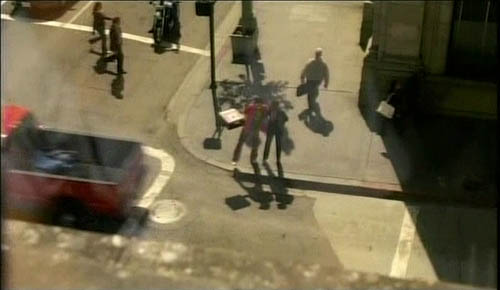
This week I noticed that a trio of TV commercials from Liberty Mutual Insurance seems to be influenced by this format. Each of these “Responsibility” ads compresses network principles into thirty seconds, while also adding a Twilight-Zoneish time warp. You can watch the ads here.
Each commercial begins by showing a woman and a pizza-delivery kid at a street corner. She thrusts out her arm to keep him from striding into the path of a car.
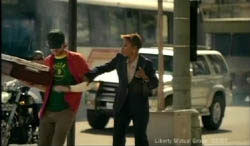
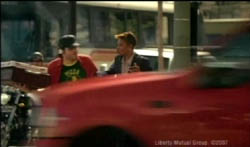
Somebody sees the woman’s act of kindness, and then that person is shown doing something kind. Someone else sees the second person and then is shown being kind, and so on. For example, in one variant a man across the street notices the woman and the delivery boy, and then he helps a lady with a baby get off a bus. He is watched by a man at the bus stop, who then is shown helping someone else. Like a benign contagion, solicitude spreads from person to person.
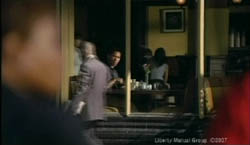
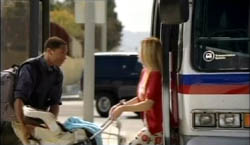
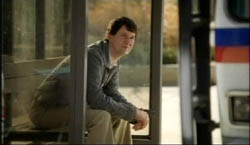
So we have a very slight set of connections: A is seen by B who is seen by C and so on. This patterning seems comparable to the shifting plotlines and viewpoints we find in some network films, with each character connected by accident and spatial proximity. The framings orient us by overlapping bits of space; the pizza boy’s red jacket gives us a landmark in the foreground, as does the bus in the later shot.
More interestingly, all three ads start with the same situation, the woman and the pizza boy, but they move on to different B’s, C’s, etc. In the variant I just mentioned, the man watching is sitting across the street. In another one, the woman’s act of responsibility is observed by the biker behind her, and he becomes B in a new chain of connections, setting out a traffic cone to warn drivers.
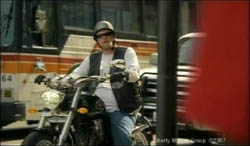
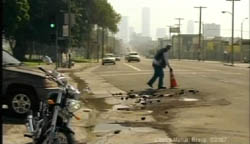
The biker is visible in the first shot of the other ads (see above), but there he plays no role. In the third ad, a man watching from above sees the pizza-boy mishap. (His point-of-view shot is at the top of this post.)
So, as with Jason’s and Pam’s conversation in Bourne, we have a narrative node or pivot that is contextualized differently in another film. What allows this to work, I suggest, is a piece of our social intelligence–our understanding that chance can connect people—plus our cultural experience with storytelling, particularly network narratives. The oddest twist, though, comes at the end of each ad, which like the Bourne trilogy offers an interesting repetition.
Each string of actions ends with the woman we saw at the beginning observing someone else’s act of kindness. For example, in one ad she sees a man at an airport baggage conveyor help an old man snag his bag.
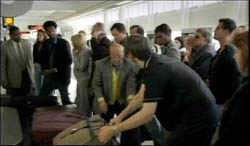
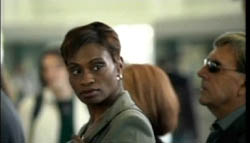
And then once more we see her halt the pizza-delivery kid. So each ad gives us a network something like this: A-B-C-D-…-A. The action moves in a circle, back to the woman as a witness, and then back to her at the pedestrian crossing, once more protecting the delivery boy.
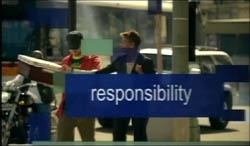
Huh? The ending of the ad suggests that by seeing another person acting responsibly, the woman is more inclined to warn the boy. But that act, with the same boy, was what set off the chain of charity in the first place. In strictly realistic terms, we’ve got a sort of möbius strip (no, not a Moby strip), where the head is glued to the tail and the whole cycle is in a twist.
Well, consider the filmmakers’ problem. How could you end it otherwise? The cascade of charity could go on indefinitely, which is not a plausible scenario for a thirty-second spot. Instead, the swallowing-the-tail tactic brings the pattern to a satisfying conclusion, while providing an event that can be the jumping-off point for another cycle in another ad. The last shot of any of the ads is the first shot of any of the others. You can enjoy the whole cycle as a mini-movie that jumps back in time to the original act of kindness at the corner.
Of course the pattern isn’t meant to be realistic. The message is that small acts can make a difference, and that Liberty Mutual tries to live up to an ideal of responsibility in its business. The themes are presented in an oblique, rather poetic story that suggests that kindness is catching and that even as strangers we are bound to help one another. Significantly, the act that’s presented through multiple replays is the most consequential: the woman is in effect saving the pizza boy’s life.
Both the Bourne movies and “Responsibility” show that studying film narrative is endlessly interesting, and storytellers can be quite creative. There’s always room in life for this.
[insert your favorite Bourne pun here]

DB here:
You may be tired of hearing about The Bourne Ultimatum, but the world isn’t.
It’s leading in the international market ($52 million as of 29 August) and has yet to open in thirty territories. It’s expected, as per this Variety story, to surpass the overseas total of $112 for the previous installment, The Bourne Supremacy. According to boxofficemojo.com, worldwide theatrical grosses for the trilogy are at $721 million and counting. Add in DVD and other ancillaries, and we have what’s likely to be a $2-$3 billion franchise.
There’s every reason to believe that the success of the series, plus the critical buzz surrounding the third installment, will encourage others to imitate Paul Greengrass’s run-and-gun style. In an earlier blog, I tried to show that despite Greengrass’s claims and those of critics:
(1) The style isn’t original or unique. It’s a familiar approach to filmmaking on display in many theatrical releases and in plenty of television. The run-and-gun look is one option within today’s dominant Hollywood style, intensified continuity.
(2) The style achieves its effect through particular techniques, chiefly camerawork, editing, and sound.
(3) The style isn’t best justified as being a reflection of Jason Bourne’s momentary mental states (desperation, panic) or his longer-term mental state (amnesia).
(4) In this case the style achieves a visceral impact, but at the cost of coherence and spatial orientation. It may also serve to hide plot holes and make preposterous stunts seem less so.
I got so many emails and Web responses, both pro and con, that I began to worry. Did I do Ultimatum an injustice? So I decided to look into things a little more. I rewatched The Bourne Identity, directed by Doug Liman, and Greengrass’s The Bourne Supremacy on DVD and rewatched Ultimatum in my local multiplex. My opinions have remained unchanged, but that’s not a good reason to write this followup. I found that looking at all three films together taught me new things and let me nuance some earlier ideas. What follows is the result.
For the record: I never said that I got dizzy or nauseated. The blog entry did, however, try to speculate on why Greengrass’s choices made some viewers feel queasy. Some of those unfortunates registered their experiences at Roger Ebert’s site. For further info, check Jim Emerson’s update on one guy who became an unwilling receptacle.
Another disclaimer: For any movie, I prefer to sit close to the screen. In many theatres, that means the front row, but in today’s multiplexes sitting in the front row forces me to tip back my head for 134 minutes. So then I prefer the third or fourth row, center. From such vantages I’ve watched recent shakycam classics like Breaking the Waves and Dogville, as well as lesser-known handheld items like Julie Delpy’s Looking for Jimmy. My first viewing of Ultimatum was from the fifth row, my second from the third. (1)
Finally: There are spoilers ahead, pertaining to all three films.
How original?
Someone who didn’t like the films would claim that they’re almost comically clichéd. We get titles announcing “Moscow, Russia” and “Paris, France.” You can poke fun at lines of dialogue like “What connects the dots?” and “You better get yourself a good lawyer” and the old standby “What are you doing here?” But these are easy to forgive. Good films can have clunky dialogue, and you don’t expect Oscar Wilde backchat in an action movie.
More significantly, all three films are quite conventionally plotted. We have our old friend the amnesiac hero who must search for his identity. Neatly, the word bourne means a goal or destination. It also means a boundary, such as the line between two fields of crops–just as our hero is caught between everyday civil law and the extralegal machinery of espionage.
The film’s plot consists of a series of steps in the hero’s quest. Each major chunk yields a clue, usually a physical token, that leads to the next step. Add in blocking figures to create delays, a hierarchy of villains (from swarthy and unshaven snipers to jowly, white-haired bureaucrats), a few helpers (principally Nicky and Pam), and a string of deadlines, and you have the ingredients of each film. (Elsewhere on this site I talk about action plotting.) The last two entries in the series are pretty dour pictures as well; the loss of Franka Potente eliminates the occasional light touch that enlivened Bourne Identity right up to her nifty final line
All three films rely on crosscutting Bourne’s quest with the CIA’s efforts to find him, usually just one step behind. Within that structure most scenes feature stalking, pursuits, and fights. In the context of film history, this reliance on crosscutting and chases is a very old strategy, going back to the 1910s; it yields one of the most venerable pleasures of cinematic storytelling.
Mixed into the films is another long-standing device, the protagonist plagued by a nagging suppressed memory. Developing in tandem with the external action, the fragmentary flashbacks tease us and him until at a climactic moment we learn the source: in Supremacy, Bourne’s murder of a Russian couple; in Ultimatum, his first kill and his recognition of how he came to be an assassin. The device of gradually filling in the central trauma goes back to film noir, I think, and provides the central mysteries in Hitchcock’s Spellbound and Marnie.
By suggesting that the films are conventional, I don’t mean to insult them. I agree with David Koepp, screenwriter of Jurassic Park and Carlito’s Way, who remarks:
There are rules and expectations of each genre, which is nice because you can go in and consciously meet them, or upend them, and we like it either way. Upend our expectations and we love it—though it’s harder—or meet them and we’re cool with it because that’s all we really wanted that night at the movies anyway. (2)
There can be genuine fun in seeing the conventions replayed once more.
The series makes some original use of recurring motifs, the most obvious being water. The first shot of the first film shows Jason floating underwater; in the second film he bids farewell to the drowned Marie underwater; and in the last shot of no. 3, we see him submerged in the East River, closing the loop, as if the entire series were ready to start again. There’s also a weird parallel-universe moment when Pam tells Jason his real name and birthdate. She does it in 2, and then, as if she hasn’t done it before, tells him again in 3, in what seem to be exactly the same words. In 3, though, it has a fresh significance as a coded message, and a new corps of CIA staff is listening in, so probably the second occurrence is a deliberate harking-back. Or maybe Bourne’s amnesia has set in again. [Note of 9 Sept: Oops! Something that’s going on here is more interesting than I thought. See this later entry.]
The look of the movies
The big arguments about Ultimatum center on visual style. The filmmakers and some critics, notably Anne Thompson, have presented the style as a breakthrough. But again, the movie is more traditional than it might first appear.
In a film of physical action, the audience needs to be firmly oriented to the space and the people present. The usual tactic is to present transitional shots showing people entering or leaving the arena of action. What might be filler material in a comedy or drama—characters driving up, getting out of their vehicles, striding along the pavement, entering the building—is necessary groundwork in an action sequence. So we see Bourne arriving on the scene, then his adversaries arriving and deploying themselves, in the alternation pattern typical of crosscutting. Surprisingly, for all the claims made about the originality of Greengrass’s style in 2 and 3, he is careful to follow tradition and give us lots of shots of people coming and going, setting up the arena of confrontation.
Then the director’s job is just beginning. Traditionally, once the scene gets going, the positions and movement of the figures in the action arena should be clearly maintained. Likewise, it’s considered sturdy craftsmanship to delineate the overall space of the scene and quietly prepare the audience for key areas—possible exits, hiding places, relations among landmarks. (See this entry for how one modern director primes spaces in an action scene.) I claimed in the earlier entry that such basic orienting tasks aren’t handled cogently in Ultimatum, and a second viewing of the scene in Waterloo Station and the chase across the Tangier rooftops hasn’t made me change that opinion. Later I’ll discuss how Greengrass and some commentators have defended the loss of orientation in such scenes.
All the films in the trilogy employ traditional strategies of setting up the action sequences, but the series displays an interesting stylistic progression. In Identity, Liman gives us mostly stable framings and reserves handheld bits for moments of tension and point-of-view shots. He saves his fastest cutting for fights and chases.
Supremacy displays a more mixed style. It contains passages of wobbly, decentered framing, but those exist alongside more traditionally shot scenes—stable framing, with smooth lateral dollying and standard establishing shots. There are some aggressive cuts, as in the crisp emphasis on the sniper at the start of the first pursuit, but on the whole the editing isn’t more jarring than usual these days. We also get, as I mentioned in the earlier entry, some almost willfully obscure over-the-shoulder shots, and occasionally we get the eye-in-the-corner technique that would become more prominent in Ultimatum.
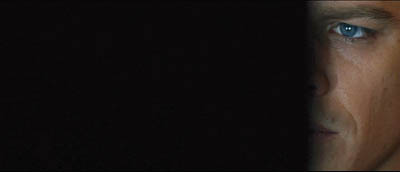
As we’d expect, in Supremacy the bounciest camerawork and choppiest editing are found in the sequences of the most energetic physical action. Most of the surveillance scenes get a little bumpy, while the chases are wilder. The most extreme instance, I think, is the very last chase in the tunnel, when Bourne avenges the death of Marie and slams the sniper’s vehicle into an abutment. As in Identity, Supremacy arrays its technique along a continuum, saving the most visceral techniques for the most brusing action sequences.
So Ultimatum raises the stakes by applying the run-and-gun style more in a more thoroughgoing way. Everything is dialed up a notch. The flashbacks are more expressionistic than those of Supremacy: instead of dark hallucinations we get blinding, bleached-out glimpses of torture and execution, in staggered and smeared stop-frames. The conversation scenes are bumpier and more disjointed; the cat-and-mouse trailings are more disorienting, with jerky zooms and distracted framings; the full-bore action scenes are even more elliptical and defocused. It’s as if the visual texture of Supremacy’s tunnel chase has become the touchstone for the whole movie.
That texture I tried to describe in the earlier entry. Greengrass relies on camerawork, cutting, and sound to convey the visceral impact of action, rather than showing the action itself. The most idiosyncratic choices include framing that drifts away from the subject of the shot, oddly offcenter compositions, and a rate of cutting that masks rather than reveals the overall arc of the action. Some critics have liked the film’s technique, some have hated it, but I think my account stands as a fair account of the destabilizing tactics on the screen, and a likely source of some spectators’ vertigo.
Run-and-gun, with a gun
The style of Ultimatum is a version of what filmmakers call run-and-gun: shot-snatching in a pseudo-documentary manner. This approach has a long history in American film. The bumpy handheld camera, I tried to show in The Way Hollywood Tells It, has been repeatedly rediscovered, and every time it’s declared brand new. I have to admit I’m startled that critics, who probably have seen Body and Soul, A Hard Day’s Night, The War Game, Seven Days in May, or Medium Cool, continue to hail it as an innovation. Today it’s a standard resource for fictional filmmaking, to be used well or badly.
What’s at issue here are the role it plays and the effects it achieves. In Lars von Trier’s The Idiots, I’d argue that handheld work becomes genuinely disorienting because the camera is scanning the scene spontaneously to grab what emerges. But von Trier’s roaming camera yields rather long takes compared to what we find in the Bourne series. Greengrass is practicing what I called, in Film Art and The Way Hollywood Tells It, intensified continuity.
This approach breaks down a scene so that each shot yields one, fairly straightforward piece of information. The hero arrives at the station. Car pulls up; cut to him getting out; cut to him walking in. Traditional rules of continuity—matching screen direction, eyelines, overall positions in the set—are still obeyed, but the dialogue or physical action tends to be pulverized into dozens of shots, each one telling us one simple thing, or simply reiterating what a previous shot has shown. (Oddly, sometimes intensified continuity seems more, rather than less, redundant than traditional continuity cutting.)
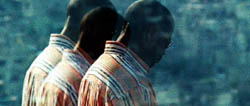
Within the intensified continuity approach, we can find considerable variation. I argued that one highly mannered version can be found in Tony Scott’s later work, where the shots are fragmented to near-illegibility and treated as decorative bits. You can find Scott’s signature look tawdry and overwrought, but Liman and Greengrass belong in the same tradition. All three directors rely on telephoto lenses, for example, and they have recourse to well-proven techniques for rendering hallucinatory states of mind, as in these multiple-exposure shots, one from Man on Fire and the second from Bourne Supremacy.
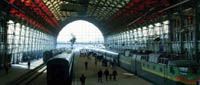
Despite the stylistic differences among the three Bourne films, the basic one-point-per-shot premises remain in place. Here’s a passage from Supremacy. Jason gets off the train in Moscow. We get an establishing shot of the station as the train pulls in, followed by a shot of him getting off, moving left to right. The establishing shot is a smooth craning movement down, but the following shot is a little shaky.
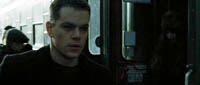
Then we get a blurry shot of him walking, taken with a very long lens. A head-on shot like this traditionally creates a transition allowing the filmmaker to cross the axis of action, letting Jason walk right to left in the next shot.

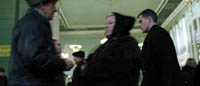
Cut to closer view: Jason turns his head slightly. Cut to what he sees, in a shaky pov: Cops.

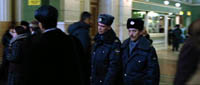
The answering handheld shot shows Jason reacting. As he strides on purposefully, a still closer shot accentuates his eye movement and adds a beat of tension.


Jason turns and goes to the pay phones, followed by the unsteadicam, then turns his head watchfully. A smooth match-on-action cut brings us closer.

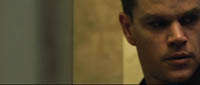
But then Jason turns back to his task, and suddenly a passerby blots out the frame.


When the frame clears, a jouncy shot shows Jason’s hands thumbing a phone book. This might be a continuation of the same shot, or the result of a hidden cut. I suggest in The Way Hollywood Tells It that such stratagems are common in intensified continuity: blotting out the frame, flashing strobe lights, and other devices can create a pulsating rhythm akin to that of cutting. Jason turns the pages, and a jump cut shows him on another page.


Cut back to him scanning the pages. He writes down an address, in a very shaky framing.
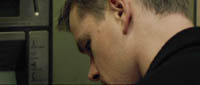

Cut back again to Jason, and another smooth match-on action brings us back to the slightly fuller framing we’ve seen already. Greengrass shoots with at least two cameras simultaneously, which can facilitate match-cutting like this.


Jason strides toward us, going out of focus. Then a stable long shot pans with him, moving left as before. He leaves the station.
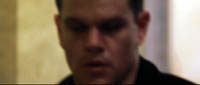
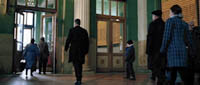
A very simple piece of action has been broken into many shots, some of them restating what we’ve already seen. In the days of classic studio filming, most directors wouldn’t have given us so many shots of Bourne leaving the train platform; a single tracking shot would have done the trick. A single shot could have shown us Jason at the phone, scribbling down the address. As a result, the whole passage is cut faster than in the classic era. The sequence lasts only forty-one seconds but shows sixteen shots. Two to three seconds per shot is a common overall average for an action picture today. The rapid cutting helps create that bustle that Hollywood values in all its genres.
It’s clear, I think, that here the run-and-gun technique is laid over the premises of intensified continuity, letting each shot isolate a bit of narrative information to make sure we understand, even at the risk of reiterating some bits. Jason has arrived in Moscow, he has to be careful because cops are everywhere, now he needs an address, he finds it, he’s writing it down . . . . All of this action is bookended by long shots that pointedly show us the character arriving at the station and leaving it.
I suggested in the earlier entry that in Ultimatum, Greengrass takes more risks than in the previous film. He still assigns one piece of information per shot, but now that piece is sometimes not in focus, or slips out of the center of the frame, or is glimpsed in a brief close-up. The September issue of American Cinematographer, which arrived as I was completing this entry, explains that he encouraged his camera operators to follow their own instincts about focus and composition. (3) Seeing Ultimatum again, I realized that the film can get away with this sideswiping technique by virtue of certain conventions of genre and style.
A telltale clue, like the charred label left over from a car bomb, can be given a fleeting close-up because physical tokens are carrying us from scene to scene throughout the film and we’re on the lookout for them. A sniper racing away out of focus in the distance is a character we’ve seen before, and he’s spotted in frame center before he dodges away. The larger patterning of shots relies on crosscutting or point-of-view alternation (Jason looks/ what he sees/ Jason reacts), and so the framing of any shot can be a little less emphatic. Given intensified continuity’s emphasis on tight close-ups for dialogue, faces can be framed a little loosely, trusting us to pick up on what matters most—changes in facial expression.
In short, because there’s only one thing to see, and it’s rather simple, and it’s the sort of thing we’ve seen before in other films and in this film, it can be whisked past us. This tactic crops up from time to time in Liman’s first installment, when a shot seems to fumble for a moment before surrendering the key piece of data. For example, Jason is striding through the hotel and a wobbly point-of-view shot brings the hotel’s evacuation map only partly into view.
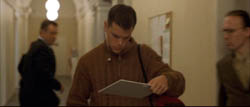

Again, Greengrass takes a visual device that was used occasionally in Identity and extends it through an entire film.
Realism, another word for artifice
Finally, what’s the purpose behind Ultimatum’s thoroughgoing exploitation of run-and-gun? I quoted Greengrass’s claim that it conveys Bourne’s mental states, and some critics have rung variations on this. Of course the cutting is choppy and the framing is uncertain. The guy’s constantly scanning his environment, hypersensitive to tiny stimuli. Besides, he’s lost his memory! Yet the same treatment is applied to scenes in which Bourne isn’t present—notably the scenes in CIA offices. Is Nicky constantly alert? Is Pam suffering from amnesia?
Alternatively, this style is said to be more immersive, putting us in Bourne’s immediate situation. This is a puzzling claim because cinema has done this very successfully for many years, through editing and shot scale and camera movement. Don’t Rear Window and the Odessa Steps sequence in Potemkin and the great racetrack scene in Lubitsch’s Lady Windermere’s Fan thrust us squarely into the space and demand that we follow developing action as a side-participant? I think that defenders need to show more concretely how Greengrass’s technique is “immersive” in some sense that other approaches are not. My guess is that that defense will go back to the handheld camera, distractive framing, and choppy cutting . . . all of which do yield visceral impact. But why should we think that they yield greater immersion?
I think we get a clue by recalling that Supremacy and Ultimatum display the run-and-gun strategy that Greengrass employed in Bloody Sunday and United 93. This approach implies something like this: If several camera operators had been present for these historic events, this is something like the way it would have been recorded. We get a reality reconstructed as if it were recorded by movie cameras. I say cameras because we’re telling a story and need to change our angles constantly; a scene couldn’t approximate a record of the event as experienced by a single participant or eyewitness. In movies, the camera is almost always ubiquitous.
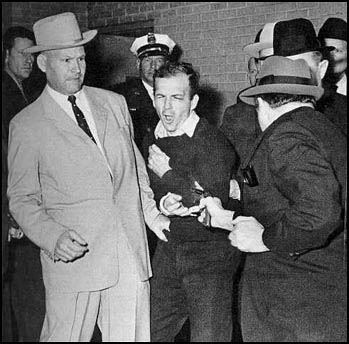
Recall the famous TV footage of Jack Ruby shooting Lee Harvey Oswald. There the lone camera lost some of the most important information by being caught in the crowd’s confusion and swinging wildly away from the action. But in a fiction film, we can’t be permitted to miss key information. So with run-and-gun, the filmmakers in effect cover the action through a troupe of invisible, highly mobile camera operators. That’s to say, another brand of artifice.
In general, the run-and-gun look says, I’m realer than what you normally see. In the DVD supplement to Supremacy, “Keeping It Real,” the producers claimed that they hired Greengrass because they wanted a “documentary feel” for Bourne’s second outing. Greengrass in turn affirms that he wanted to shoot it “like a live event.” And he justifies it, as directors have been justifying camera flourishes and fast cutting for fifty years, as yielding “energy. When you get it, you get magic.” (4)
I’d say that the style achieves visceral disorientation pretty effectively, but some claims for it are exaggerated. So far Greengrass has matched the style to hospitable genres, either historical drama or fast-paced espionage. But isn’t immersion something we should try for in all genres? Wouldn’t High School Musical 2 gain energy and magic if it were shot run-and-gun? If a director tried that, some critics might say that it added intensity and realism, and suggest that it puts us in the minds and hearts of those peppy kids in a way that nothing else could.
I finish this overlong post by invoking Andrew Davis, director of The Fugitive (which back in 1993 gave us fragmentary flashbacks à la Bourne Ultimatum) and the admirable Holes.
When you think about the beginnings: everything was very formal and staged and composed, and then years later people said, “We want it shaky and out of focus and have some kind of honest energy to it.” And then it became a phony energy, because it was like commercials, where they would make everything have a documentary feel when they were selling perfume, you know? (5)
Whether you agree with me or not, I’m glad that The Bourne Ultimatum raised issues of film style that audiences really care about. I’m eager to look more closely at the movie when the DVD is released, but don’t worry–I don’t expect to mount another epic blog entry.However, I do have an item coming up that talks about how we assess what filmmakers say about their movies….
(1) I’m aware that this can be an uncomfortable option, but not as bad as with music. Many years ago I sat in the front row of a John Zorn concert, and I don’t think my ears ever recovered.
(2) Quoted in Rob Feld, “Q & A with David Koepp,” in Josh Friedman and David Koepp, War of the Worlds: The Shooting Script (New York: Newmarket Press, 2005), 136-137.)
(3) See Jon Silberg, “Bourne Again,” American Cinematographer (September 2007), 34-35, available here.
(4) Oddly, though, in the DVD supplement to The Bourne Identity, Frank Oz says that Liman brought “a rough-edged, very energetic” feel to the project, thanks to his indie roots. Interestingly, the energy is attributed to Liman’s abilities as a camera operator, a skill that enables him to shoot things quickly. The same supplement offers a familiar motivation for the film’s purportedly jittery style: the hero is trying to figure out who he is, and so is the viewer. Just as the films revamp a basic plot structure each time, perhaps the producers’ rationales get recycled too.
(5) Quoted in The Director’s Cut: Picturing Hollywood in the 21st Century, ed. Stephan Littger (NY: Continuum, 2006), 96.
PS: On a wholly unrelated subject Kristin answers a question on Roger Ebert’s Movie Answer Man column: What was the first movie?
PPS 5 January 2008: Steven Spielberg weighs in on the Bourne style here, confirming that he’s a more traditional filmmaker. Thanks to Fred Holliday and Brad Schauer for calling my attention to his remarks.