















Archive for the 'Narrative strategies' Category
Happy birthday, classical cinema!, or The ten best films of … 1917
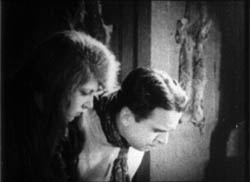
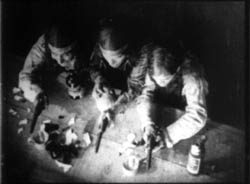
Wild and Woolly (1917).
KT:
Periodization is a tricky task for historians, and there are a lot of disputes about how to divide up the 110-plus years of the cinema’s existence. We all have to deal with it, though, if we want to organize our studies of the past into meaningful units. How to do that?
Do we divide the periods of film history according to major historical events? World War I had a huge impact on the film industry, to be sure, and we might say that one significant period for cinema is 1914-1918. Yet 1919 didn’t mark the start of a new period. The major European post-war film movements didn’t start then. French Impressionism arguably began in 1918, German Expressionism in 1920, and Soviet Montage in 1924 or 1925.
Carving up film history partly depends on what questions the historian is asking. If you’re studying wartime propaganda, 1914 and 1918 would provide significant beginning and end points. If you want to trace the development of significant film styles, it doesn’t seem very useful.
While historians have difficulties agreeing on periodization, just about everyone concurs that there were two amazing years during the 1910s when filmmaking practice somehow coalesced and produced a burst of creativity: 1913 and 1917.
One can point to stylistically significant films made before 1913. Somehow, though, that year seemed to be when filmmakers in several countries simultaneously seized upon what they had already learned of technique and pushed their knowledge to higher levels of expressivity. “Le Gionate del Cinema Muto” (“The Days of Silent Cinema”), the major annual festival, devoted its 1993 event to “The Year 1913.” The program included The Student of Prague (Stellan Rye), Suspense (Phillips Smalley and Lois Weber), Atlantis (August Blom), Raja Harischandra (D. G. Phalke), Juve contre Fantomas (Louis Feuillade), Quo Vadis? (Enrico Guazzoni), Ingeborg Holm (Victor Sjöström), The Mothering Heart (D. W. Griffith), Ma l’amor mio non muore! (Mario Caserini), L’enfant de Paris (Léonce Perret), and Twilight of a Woman’s Soul (Yevgenii Bauer). .
1917, by contrast, was primarily an American landmark. As 2007 closes, we thought it appropriate to wish happy birthday to the most powerful and pervasive approach to filmic storytelling the world has yet seen. That would be classical continuity cinema, synthesized in what was coming to be known as Hollywood.
DB:
In The Classical Hollywood Cinema and work we’ve done since, we’ve maintained that 1917 is the year in which we can see the consolidation of Hollywood’s characteristic approach to visual storytelling. This idea was first floated by Barry Salt, and our research confirms his claim. Over the ninety years since 1917 the style has changed, but its basic premises have remained in force.
Before classical continuity emerged, the dominant approach to shooting a scene might be called the tableau technique. Action was played out in a full shot, using staging to vary the composition and express dramatic relationships. Elsewhere on this site I’ve mentioned two major exponents of this approach, Feuillade and Bauer.
When there was cutting within the tableau setup, it usually consisted of inserted close-ups of important details, especially printed matter, like a letter or telegram. Occasionally the close-up of an actor could be inserted, usually filmed from the same angle as the master shot. The tableau approach was more prominent in scenes taking place in interiors; filmmakers were freer about cutting action occurring outdoors.
We shouldn’t think of the tableau as purely “theatrical.” For one thing, the master shot was typically closer and more tightly organized than a scene on the stage would be. Moreover, for reasons I discuss in Figures Traced in Light, the playing space of the cinematic frame is quite different from the playing area of the proscenium theatre. The filmmaker can manipulate composition, depth, and blocking in ways not available on the stage.
The tableau approach was the default premise of US filmmaking through the early 1910s. You can see it at work, for example, in this shot from At the Eleventh Hour (W. V. Ranous, 1912). Mr. and Mrs. Richards are in the study of Mr. Daley. After Richards has refused to sell his railroad bonds, Daley’s wife shows off her diamond necklace to the visitors.
At first the two couples are separated in depth, the men in the foreground and the women further back. In the first frame below, a new necklace has just been delivered, and a servant gives it to Mrs. Daley. Only the servant’s hand is visible, as she is blocked by Richards in the foreground. In the second frame, the two women come forward. Mrs. Daley holds the necklace up and Mrs. Richards oohs and ahhs over it, while her husband glances at Daley as if to wonder how he could afford it.
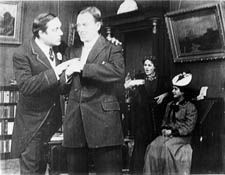
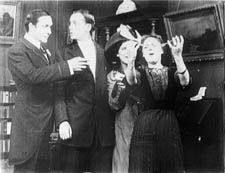
Instead of breaking the scene into closer views, spreading the characters’ reactions across separate shots, Ranous squeezes all of their actions and expressions into a tight space across the center of the shot. Nor does he provide a close-up of the necklace, which will be important in the plot. (1) We might be inclined to say that this is a “theatrical” shot, but on a stage the actions in depth (the women chatting, the servant handing over the parcel) wouldn’t be visible to everyone in the auditorium. Likewise, on a stage the packed faces in the later phase of the scene wouldn’t be visible to people sitting on the sides.
As films became longer, American filmmakers were starting to organize their plots around characters with firm goals. Conflicting goals would set the characters in opposition to one another, and at a climax, usually under the pressure of a deadline, the protagonist achieves or fails to achieve the goals. The plot also tends to build up two lines of action, at least one involving romance.
There’s no reason this conception of narrative could not have been applied to the tableau style; in many cases it was. But hand in hand with the rise of goal-driven plotting came a new approach to filming. Sporadically before 1917, filmmakers in many countries were exploring ways to build scene out of many shots. (If you want to know the process in the US in more detail, check out Early American Cinema in Transition by Charlie Keil.) By 1917, American filmmakers had synthesized these tactics into an overall strategy, a system for staging, shooting, and cutting dramatic action.
We know the result as the 180-degree system. This encourages the filmmaker to break a scene into several shots, taken from different distances and angles, all from one side of an imaginary line slicing through the space. Around 1917, this stylistic approach comes to dominate US feature films, in the sense that every film made will tend to display all the devices at least once. The system remains in place to this day, and it came to form the basis of popular cinemas across the world. (2)
Once you break a scene into several shots, some characters won’t be onscreen all the time. So you need to be clear about where offscreen characters are; you need to supply cues that allow the audience to infer their positions. So 1910s filmmakers developed various ways of “matching” shots.
Shots can be connected by character looks, thanks to the eyeline match. Here’s an instance from Victor Schertzinger’s The Clodhopper (1917). First there is a master shot of the mother and son in their farm kitchen.
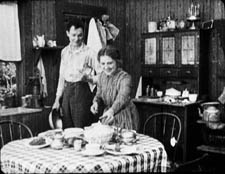
This is followed by a separate shot of each one. Their bodily positions and eyelines remind us that the other is just out of frame.
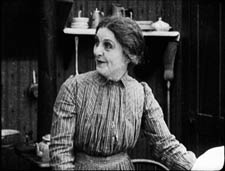
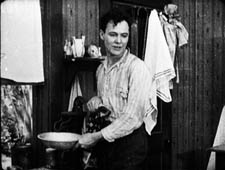
Although over-the-shoulder shooting hadn’t yet been developed, a conception of the reverse angle is at work here too. Schertzinger’s camera doesn’t shoot the actors perpendicularly, but takes up an angle on one that becomes an echo of that filming the other. Here’s another example of reverse angles from The Devil’s Bait (1917, director Harry Harvey).
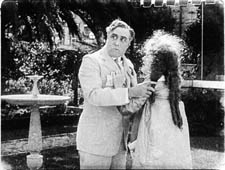
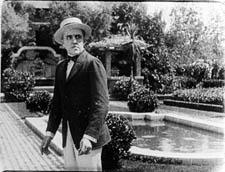
The camera doesn’t just enlarge a portion of the space, as in the inserted shot in a tableau scene. The angle of view has changed significantly.
Changes of angle within the scene have become fairly complex by 1917. This strategy is apparent when the action takes place in a theatre, a courtroom, a church, or some other large-scale gathering point. The camera position changes often in this scene from The Girl without a Soul (director John Collins).
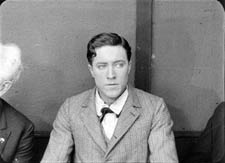
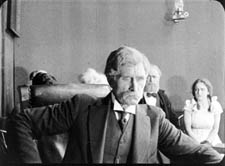
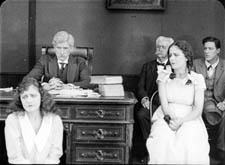
The concept of matching extends to physical movement too, through the match on action. This device allows the director to highlight a new bit of space while preserving the continuity of time. In Roscoe Arbuckle’s The Butcher Boy, the cut-in to Fatty (with a change of angle) also matches his gesture of putting his hands on his hips.
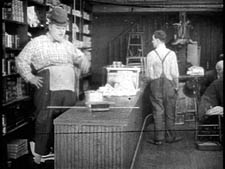
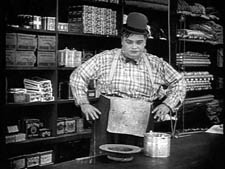
Interestingly, even this early, directors have learned to leave a little bit of overlapping action across the cut. If you move frame by frame, you’ll see that Fatty’s gesture is repeated a bit at the start of the second shot.
When a character leaves one frame, he or she can come into another space, from the side of the frame consistent with the 180-degree premise. This is matching screen direction. A cut of this sort lets us know that the next portion of the locale that we see is more or less adjacent to the previous one. In Field of Honor (director Allen Holuban), Wade crosses to Laura, who’s waiting in a carriage. A few years earlier, the director might have presented his greeting in a single deep-space long shot. Instead, Wade exits one shot and enters the next.
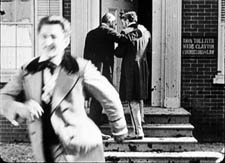
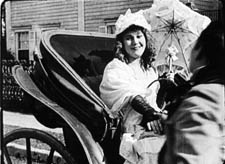
Again, the reverse-angle principle governs the camera setups. Wade moves along a diagonal toward the camera and away from it.
More generally, Field of Honor exhibits a polished handling of the new style: lots of reverse shots and eyeline matches, fades that bracket flashbacks, binocular points of view, rack-focus shots, and rapid cutting (there’s even a ten-frame shot). The point is not to claim Field of Honor as an undiscovered masterpiece but rather to indicate that by 1917 a director could handle all the devices with assurance.
Match-cutting devices had been used occasionally before 1917, but by that year filmmmakers melded them into a consistent and somewhat redundant method of guiding the audience through each scene.
The continuity system not only creates a basic clarity about characters’ positions. It can as well generate a speed and accentuation not easily achieved within a single shot. For example, Wade’s frame exit and entrance above is cut so as to skip over moments that he consumes crossing the driveway. Continuity editing enhances the rapid pace of US films, a quality immediately noted by foreign observers in the 1910s and 1920s.
Two of the best films of 1917 exploit the dynamism of continuity cutting. The Doug Fairbanks comedy western, Wild and Woolly, seems designed to prove that American films could proceed at breakneck speed. In climactic scenes, we’re caught in a whirlwind of fast cutting, with the pace set by the hyperactive protagonist, a financier’s son who longs to prove himself as a cowboy.
John Ford’s Straight Shooting proceeds at a more measured pace, but in its final shootout we see a prototype of all the main-street gundowns that will define the Western. Ford provides alternating shots of the cowboys advancing toward each other, framing each man more tightly and concluding with suffocating close-ups of each man’s face, highlighting the eyes.
Sergio Leone, eat your heart out.
Propelled by goal-driven characters and a linear arc of action, films like Wild and Woolly and Straight Shooting are completely understandable and enjoyable today. (But when will we have them on DVD?) Their stories are engrossing and their performances are engaging, but just as important their storytelling technique has become second nature to us. The narrative strategies that coalesced in 1917 remain fundamental to mainstream cinema.(2)
The Mystery of the Belgian Print
KT:
For decades now we have been visiting Brussels and working at the Cinémathèque Royale de Belgique/Koninklijk Belgisch Filmarchief. Sometimes I feel that we would know half as much about the cinema were it not for the unfailing hospitality we have been shown, initially by the great archivist Jacques Ledoux and now by his successor Gabrielle Claes. Our indebtedness to this institution and its staff are reflected in David’s named professorship; he is the Jacques Ledoux Professor of Film Studies. We dedicated our Film History: An Introduction, to Gabrielle.
We do whatever favors we can in return for such wonderful help. David lectures regularly at the biannual summer school run by the Flemish Service for Film Culture in partnership with the Royal Film Archive. (David wrote about the 2007 event in an earlier entry.) I try to identify silent films. I am not always successful, but I suppose over the years I have been able to put names to thirty-some mystery prints.
Silent films are more likely to be unidentified than sound ones because it was standard practice to splice in intertitles in the local language. Sometimes too the film’s title was changed. The film’s actors may be forgotten today, or the print may be incomplete, lacking the opening title and credits. Sometimes even the country of origin is unknown.
Back in the early 1990s I was asked to identify a five-reel nitrate print with the title Père et fils. It was an original distribution copy from the silent era. The information on the archival record card listed some possible identifications: Father and Son, a 1913 Vitagraph film or Father and Son, produced by Mica in 1915. It was tentatively thought to be American.
As I watched the film, it quickly became apparent that it was indeed American. It centered on the rivalry between a small dime store owned by the heroine’s father and a modern dime store being built in the same town. The hero is charged with the mission of driving the older store out of business.
So we had our typical goal-driven plot. The style was what David has described as typical of 1917, so that was my tentative dating. I felt almost certain that the reels I was watching were not from a 1913 or 1915 movie. The film was a fairly modest item, done on a relatively low budget and not starring any actors that would be familiar to most modern viewers. I had seen the actor playing the hero before, however, and I thought he might be Herbert Rawlinson. By the time I finished the film, those were my clues: a medium-budget American film of c. 1917 concerning dime stores and perhaps starring Rawlinson.
My task turned out to be fairly simple. A little research after we returned home confirmed the Rawlinson guess. In preparing the write The Classical Hollywood Cinema, I had seen him in The Coming of Columbus (a 1912 Selig film) and in Damon and Pythias (Universal, 1914).
My next step was to consult the monumental, indispensible reference book, The American Film Institute Catalog. This multi-volume set, many years in the making, was originally published as books. It is now online, but available only to AFI members or through libraries. The catalogues were published by decade—thus obviating the problem of periodization. Each decade gets two volumes, one of entries on all the films, listed in alphabetical order. Credits, production companies, release dates, plot synopses, and other information are included. A second volume indexes the films by chronology, personal names, corporate names, subject, genre, and geography (i.e., where the films were shot).
Until now I had found little use for the subject index, but now it came to my aid. I turned to the Ds to see if there was an entry for dime stores. The AFI indexers were thorough, and sure enough, there was one entry: Like Wildfire. A check of the personal names index under Rawlinson, Herbert revealed that he had acted in a film called Like Wildfire, made in 1917 by Universal. Once I had the title, I checked its catalog entry and found that its plot description matched the film I had seen. Case closed.
Admittedly, in this instance the date wasn’t a crucial clue. Still, determining a film’s year of release can narrow down the possibilities. Thanks as well to the development of classical cutting, a close view of an actor helps in identifying him.
The Best of 1917
DB:
This is the season when everybody makes a list of best pictures. We have stopped playing that game. For one thing, we haven’t seen all the films that deserve to be included. For another, the excellence of a film often dawns gradually, after you’ve had years to reflect on it. And critical tastes are as shifting as the sirocco. Never forget that in 1965 the Cannes palme d’or was won by The Knack . . . and How to Get It.
Still, enough time has elapsed to make us feel confident of this, our list of the best (surviving) films of 1917, both US and “foreign-language.” Titles are in alphabetical order.
The Clown (Denmark, A. W. Sandberg)
Easy Street (U.S., Charles Chaplin)
The Girl from Stormycroft (Sweden, Victor Sjöström)
The Immigrant (U.S., Charles Chaplin)
Judex (France, Louis Feuillade)
The Mysterious Night of the 25th (Sweden, Georg af Klercker)
The Narrow Trail (U.S., Lambert Hillyer)
The Revolutionary (Russia, Yevgenii Bauer)
Romance of the Redwoods (U.S., Cecil B. De Mille)
Terje Vigen (Sweden, Victor Sjöström)
Straight Shooting (US, John Ford)
Thomas Graal’s Best Film (Sweden, Mauritz Stiller)
Wild and Woolly (US, John Emerson)
Next year, maybe we’ll draw up our list for 1918.
(1) For more on this scene and the film as a whole, see Kristin Thompson, “Narration Early in the Transition to Classical Filmmaking: Three Vitagraph Shorts,” Film History 9, 4 (1997), 410-434.
(2) Beyond The Classical Hollywood Cinema, see Kristin’s Herr Lubitsch Goes to Hollywood and Storytelling in the New Hollywood. I’ve talked about these issues in On the History of Film Style, Planet Hong Kong, Figures Traced in Light, The Way Hollywood Tells It, and essays included in Poetics of Cinema. The basics of classical continuity are presented in Chapter 6 of Film Art: An Introduction, and we trace some historical implications of it in Film History: An Introduction.
You may own the night, but I’ve got a lien on midday
DB here:
Since I retired, I usually go to matinee shows. It’s cheaper, and the auditorium is depopulated. Sometimes I’m the only person there. I know, movies are supposed to be seen with a big audience; but I’ve seldom liked the experience of a packed house. Does the humble worshipper in the temple need a congregation to confirm his faith? Isn’t it best to commune with the deity alone? More to the point: Even before the advent of cellphones, somebody always coughs or talks at the wrong time.
If there are any other people around during my matinees, they are likely to be elderly folks, misfits, losers, idlers, and troublemakers. This makes me feel superior. But then I realize that to an objective observer, I could fit into any of those categories. Last time I went to my local, the cashier at the ticket stand gave me the Senior Citizens discount automatically. The pleasure of saving a dollar was small compensation for the blow to baby-boomer pride—sort of the reverse of being carded at a bar when you’re 30.
Curiously, as film attendance is dropping, multiplexes are offering more screenings. I enjoyed the idea of starting the screening cycle at noon or so, but now some ‘plexes start running as early as 10:30. At my neighborhood ‘plex, you can attend the Baby Box Office (“The lights are a little brighter, the sound a little softer”) on Tuesdays at 10:00 AM. It’s currently featuring the ideal picture for babes in arms, American Gangster.
Here are some jotted opinions on movies seen at midday over the last couple of weeks.
 We Own the Night: I admired James Gray’s The Yards, but this seemed to me quite standard. One brother’s a cop, the other’s on the shady side: back to Warner Bros. of the 1930s. (Where’s the tough priest, though?) Although set in the 1980s, it looks a bit like a 1970s movie, with all those long-lens shots and flattened color values. The plot was by-the-numbers, and lines like “You’re a dead man” and “I love you very much” don’t help. I guess it’s a “personal” project for Phoenix and Wahlberg, both brave performers in other vehicles but mostly going through the motions here. Further evidence that today’s cinema is classic studio cinema, with more sex, violence, drugs, and rock-and-roll.
Gone Baby Gone: At least We Own the Night doesn’t promise to be more than a typical genre piece. For several years now, many ambitious or “prestige” pictures have given genres the uplift treatment, making them—well, serious. So a crime thriller that might have been trim at 90 minutes gets padded out to portentous dimensions, chiefly through scenery-gobbling performances and tricky narration. A recent model is The Departed, but Mystic River also worked this ground.
Such is Gone Baby Gone, another Lehane exercise in male pain in a gritty ethnic enclave. Director Ben Affleck shoots it in a standard way, with long-lens glimpses of homely people sitting on stoops (don’t get too close), and he resorts to the now-common device of flashbacks that fill us in on what really happened in a crucial scene. As usual in such fare, the plot is a pretext for Oscar-bait performances, and I confess that to my surprise I found Casey Affleck pretty riveting.
 Michael Clayton: Another tricked-out genre effort, with echoes of Three Days of the Condor. Again a mystery plot is overlaid with a guy’s personal problems: divorce, druggy brother, loyalty to his mentor. (By the way, when is someone going to do a study of the hero’s weak friend in Hollywood cinema?) We get the fancy flashbacks as well, starting at a high point—an exploding car bomb, which ought to grab you—before a title pops up: “Four days earlier.” Eventually, as per usual nowadays, the opening scene is replayed, from a more omniscient point of vantage. And just as I have problems with any movie that resolves its plot with somebody writing a check, I don’t find it terribly original to settle things by secretly taping the bad guys admitting their chicanery. Yet I appreciated Paul Gilroy’s calm direction. I especially liked his crosscut sequences, in which the sound of one line of action plays out over images from the other line. This technique isn’t brand-new, but Gilroy handles these passages well, building story momentum while creating compact characterizing bits (e.g., the insecurity of lawyer Tilda Swinton faced with critical meetings).
The Assassination of Jesse James by the Coward Robert Ford: The really successful fancy-pants genre film in my latest round of viewings. Andrew Dominik has made a grave, spare movie about the myth of Jesse and his murderer that doesn’t splash on period details and swamp the action in overproduced sets. The film could have been another funny-hats Western, but it turns out to be as austere as a sharecropper’s porch in a Walker Evans photograph. With an average shot length close to seven seconds, the film lets actors use their bodies a bit and interact within a fixed frame. In this context, the vignetted shots stand out, but not as mere flourishes; their wavery softness is picked up in the distorting windowpanes of the farmhouses and eventually in the fatal reflection in the picture Jesse is adjusting.
For once a post-Unforgiven western earns its meta-commentary on the Legends of the West. Jesse is the quietly charismatic star, while Ford is the overeager admirer, the outlaw as groupie. Daringly, the plot wanders away from its main characters for considerable stretches, and the protracted dialogues feature archaic turns of speech that can become ominous. Jesse is a raconteur whose paranoia can unnerve anybody: “You got a tale to swap with me now?” Assassination also reminded me of Magnolia in the dry authority of its voice-over narration and in its epilogue, which follows Ford to the end of his enigmatic life.
But where am I at the peak hours on Friday and Saturday, when throngs at the multiplex line up for popcorn, nachos and Dots? At our cozy Cinematheque, where we screen dazzling items like Nouvelle Vague and Utamaro and His Five Women. Right now, Godard and Mizoguchi own my nights.
Three nights of a dreamer
DB here:
The close-up blogathon launched by Matt Zoller Seitz is over, but it contains enough specimens and analyses for a hefty book. It also inspired Jim Emerson to devote a cine-lyric to the close-up. I missed the deadline, so I suppose that this constitutes my sideways contribution to Matt’s enterprise.
Sideways, because a full-blown analysis of In the City of Sylvia (En la ciudad de Sylvia; Dans la ville de Sylvie) would be a breach of decorum. Most people haven’t heard of this new film by José Luis Guerin, let alone seen it. I saw it at the Vancouver festival in September, and it will make its way through the festival circuit over the coming months and should show up on cable or DVD thereafter. But apart from calling attention to it as a remarkable film, I want to look at one of its most absorbing sequences and suggest some of its originality. Lee Marshall has already pointed out one of Sylvia‘s arresting features:
Guerin seems to have created pure drama without recourse to story. We’re always taught that story is the engine of drama. Not here: somehow Guerin has created an almost plotless film that has the dramatic tension of vintage Hitchcock. (1)
Although the story situation is slight, the tension we feel springs partly from vivid stylistic patterns. In other words: Minimal and uncertain story action is heightened by engaging visual narration. This narration in turn derives its power from one of the most traditional devices of filmic storytelling.
Consider the other person’s point of view
The point-of-view shot is a mainstay of cinematic storytelling, and its history is an intriguing one. Many of the earliest examples we have are motivated as views through optical gadgets. Two films by the Englishman G. A. Smith, both from 1900, handily show the options. Grandma’s Reading Glass justifies the point-of-view image as what the boy sees when he peers at granny through her big magnifier.
Smith’s As Seen through a Telescope motivates the cut-in POV shot as what our dirty old man in the foreground has an eye for.
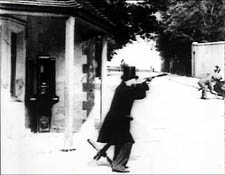
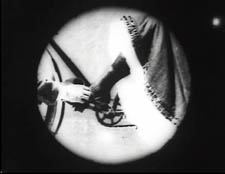
Fairly soon, this use of the magnifying POV shot was mingling with more straightforward ones. In The Birth of a Nation (1915), D. W. Griffith offers a rough-edged example. When the Stoneman brother and sister visit Ford’s Theatre on the night of Lincoln’s assassination, we see Elsie pointing out the famous actor John Wilkes Booth.
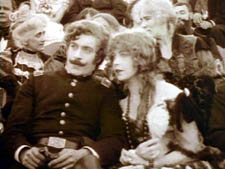
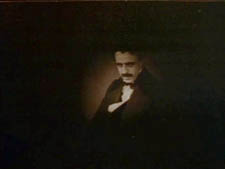
Booth is framed in an iris, which Griffith often uses to underscore an important image. But when Elsie studies Booth through her opera glasses, Griffith, usually not fastidious about such things, supplies the same irised image, now doing duty for the sort of magnifier-masking we get in the Smith films.
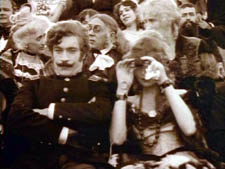
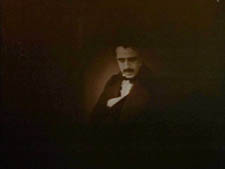
Presumably a more consistent technique would show Booth in long shot first, without the iris, and reserve the optical masking for replicating the view through the opera glasses. This is what happens in Ernst Lubitsch’s Lady Windermere’s Fan (1926), which contains a sequence built entirely around crisscrossed character looks. (1)
The woman of the world Mrs. Erlynne arrives at the racetrack and creates a stir, causing many men to watch her from all over the grandstand.
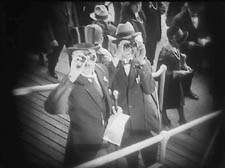
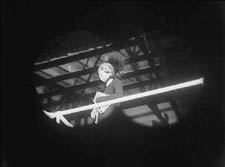
Note that Lubitsch has gone beyond Griffith by fitting the angle of Shot B to the viewer’s orientation, looking up. There are so many POV shots that at one point Lubitsch simply shows her from different angles and deletes the shots of each watching man.
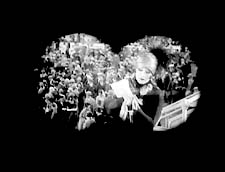
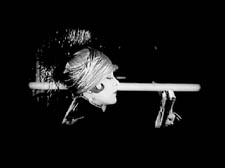
This is a fascinating example of a process we often see in stylistic history. An “overlearned” visual convention can be treated elliptically; the filmmaker can leave out bits and we’ll fill them in. The binocular masking suffices to let us know that Mrs. Erlynne is being studied from afar. Moreover, Lubitsch gets an expressive bonus from being so concise. Now it doesn’t matter who’s watching, just that somebody is—actually, a lot of somebodies.
Later, after much more byplay with people looking at one another and misunderstanding what they see, Mrs. Erlynne sits down. Three gossips have been studying her, but now their view is blocked. So one gossip has to twist around to spy on her, and Lubitsch obligingly gives us a slightly tipped point-of-view framing—a full shot, without masking.
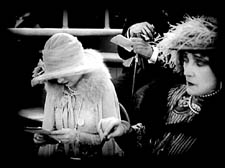
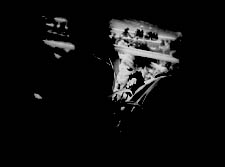
Adjusting her binoculars, the gossip is able to get a bigger view of Mrs. Erlynne, and she racks focus gleefully to catch a gray hair peeping out.
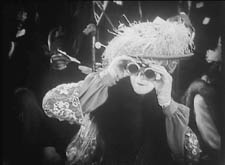
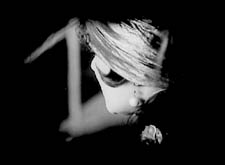
The visual narration in this sequence, already perfectly modulated, supplies the stylistic premise for Hitchcock’s Rear Window and all of its progeny, most recently Disturbia (2007). What might be overlooked is that by the 1920s the view through a device—field glasses, a microscope, a surveillance camera—had become a special, marked case. From then till now, the default POV pattern is the simple shot of a character looking, followed by an unadorned shot of what that person sees, from more or less the correct standpoint. Lubitsch’s sideways shot of the gossip’s view of Mrs. Erlynne, casually introduced, exemplifies the modern norm for presenting a character’s vision, and it’s so common that we seldom notice it.
POV shots: The basics
In his book Point of View in the Cinema, Edward Branigan itemizes the cues that the filmmaker can manipulate in creating a POV construction. (2) To simplify somewhat: Shot A shows a point in space and a character glance from that point. Shot B is taken from a camera position more or less approximating the point in A, and it shows an object. The shot-change presumes temporal continuity between A and B, and we assume as well that the character is aware of the object shown in B.
This seems like a complicated way of stating the obvious, but by teasing these elements apart, Branigan shows that each one can be manipulated in intriguing ways. For example, you can create a disorienting moment by violating the condition of temporal continuity. Ozu does this in Early Summer (1951), when Noriko and Aya decide to peek in at the man Noriko almost married. The two women tiptoe down a hall toward us as the camera tracks slowly backward. Ozu cuts to a forward-tracking shot that momentarily suggests a reverse angle POV on the corridor.
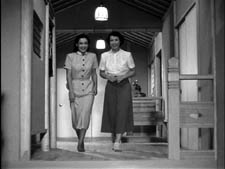
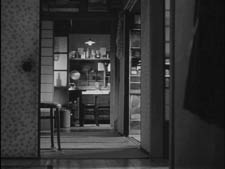
In fact, however, the camera movement is revealed to be the first shot of a new scene, among different characters, and we won’t ever see the man the two women went to spy on.
Here’s another interesting case, not cited by Branigan. In Halloween (1978), John Carpenter shows Laurie looking out a window and seeing Michael Myers in his mask, standing between fluttering washlines.
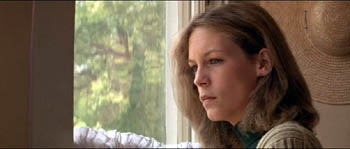
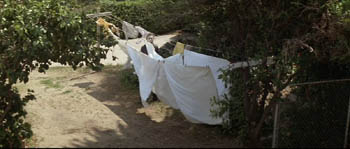
Cut back to Laurie, now frowning slightly.
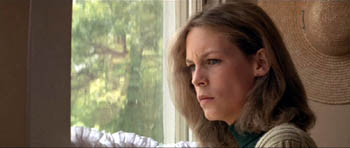
Cut to a second POV shot; but now Michael has vanished.
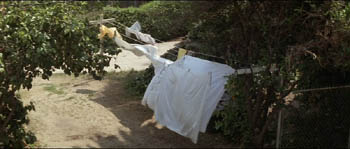
This simple change in shot B’s object, Michael himself, has an uncanny effect. Did Michael just walk away from the washline? If so, this is an odd way to present it. Why not show him walking away? Alternatively, did he just disappear? Surely not; Laurie would be shocked. Carpenter wins twice over. Without obviously violating realism or directly showing that Michael has supernatural powers, he gives Michael the ability to come and go in a ghostly fashion. By the end of the film, when he miraculously disappears after a fall that would kill an ordinary person, we are prepared to believe that he is indeed, as Dr. Sam Loomis says, the Boogyman.
Who is Sylvia? What is she that all the swains commend her?
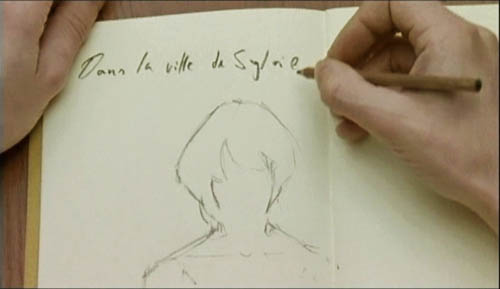
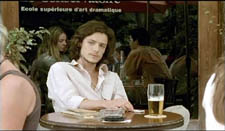
In the City of Sylvia centers on a young man staying at a hotel. We’re given no reason why he’s visiting the city, and no backstory about him. One day he’s sitting at a café. Now, across nearly twenty minutes of screen time he watches women and idly sketches them.
The sequence is a pleasure to watch, partly because of the constant refreshing of the image with faces, nearly all of them gorgeous, most of them female. Either Strasbourg has an extraordinary gene pool, or this café attracts only Ralph Lauren models. Yet the scene builds curiosity and suspense too, thanks to Guerin’s sustained and varied use of optical POV. He gives us an almost dialogue-free exploration of a cinematic space through one character’s optical viewpoint. (Stop reading here if you don’t want to know anything more about the film before you see it.)
The young man, known in Guerin’s companion film Unas fotos en la ciudad del Sylvia as the Dreamer, is almost expressionless as he scans the women’s faces. Slight shifts of his glance are accentuated by his habit of turning his head but keeping his eyes fixed. In over a hundred shots, Guerin uses some ingenious cinematic means to tease us into ever-greater absorption in the Dreamer’s visual grazing.
Fairly far into the sequence, Guerin gives us more or less the orthodox POV construction. The Dreamer looks at one woman at a table, and we see her return his look.
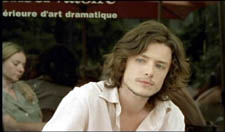
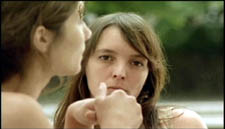
But here shot B isn’t really clean: the hands of the woman on the left sometimes block our view of the principal woman. This obtrusiveness is one of Guerin’s most basic strategies in the sequence. Inevitably, in passages before and after the cut I just showed, what the Dreamer is looking at is partially hidden in layers of faces and body parts.
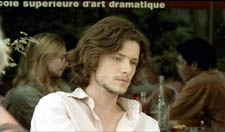
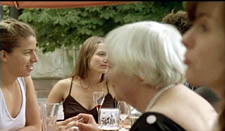
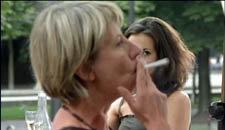
Our prototype of the POV cut presumes a more or less single ‘point’ we are watching in shot B, but throughout this scene Guerin plays with this cue. He tantalizes us with several points to be observed, and he often obscures the most important ones. He also creates some startling juxtapositions. Near the very start we get this shot, which may or may not be the Dreamer’s POV.
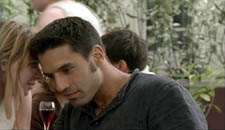
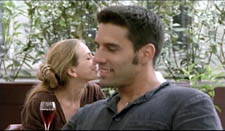
By making the background girl seem to kiss the foreground guy, Guerin, as Eisenstein would say, “christens” his sequence. In effect, the image says: Watch out! Layered space will become important! When I saw this shot, I nearly jumped out of my seat.
The Dreamer is treated no differently, at least at the start. In most movies, the POV construction is set up with a clear, clean framing of our looker in shot A. Here, though, at the start of the scene Guerin peels away layers to get to our man. For the first six shots of the café, we don’t know he’s on the scene. Then he’s shown out of focus, in the background of more prominent action. The woman in the foreground has been primed to be the shot’s subject. At the moment she shifts her gaze and we try to read her expression, a second woman on the distant right shifts aside to reveal the Dreamer behind her.
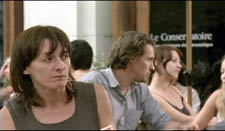
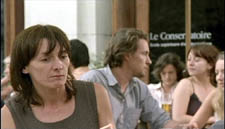
Surely this is the most unemphatic entry of a protagonist we’ve seen in a while! Guerin is able to add planes to block the main ‘point’ of shot B because he’s working with long lenses, a crowded space, and careful choreography. Even focus plays a role, as in this case; our Dreamer is pretty hazy.
One upshot of this strategy is that we’re plunged into a “cubistic” space, in which slightly varied camera angles pick up bits of space we’ve seen in earlier combinations and oblige us to assemble it all in our head. Be thankful for the guy in the blue shirt above, for he plays an anchoring role in several setups that would otherwise float free.
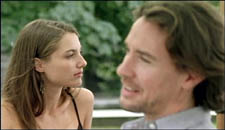
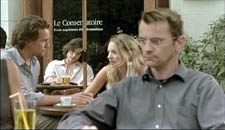
It’s hard to convey in stills how much fascination and frustration that this teasing style creates. Like the Dreamer, we’re given only glimpses of the women, and even though we don’t know his purposes—is he just an artist in search of beauty? a serial killer picking out victims?—the partial views lure us at several levels. We try to complete the faces. We try to infer the women’s state of mind from their expressions and gestures, which are far more animated than our Dreamer’s.
And a search for story plays a part here. We’re primed for some action to start, and we browse through these shots looking for anything that might initiate it. Each face the Dreamer spots promises to kick-start a plot: when the Dreamer gets a full view of one of these women, perhaps things will get going.
Without giving away every detail, I’ll just say that the sequence has a strong visual arc as the Dreamer starts paying more and more attention to certain women. And just as he finally gets a full view of one fabulous face, his attention wanders to . . . another layer, this time one inside the café.
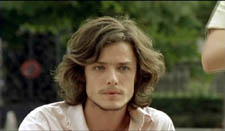
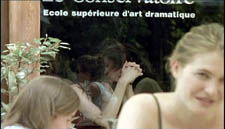
As he gapes at the woman inside, layers pile up, creating a cubistic climax of all the optical obstructions we’ve encountered.
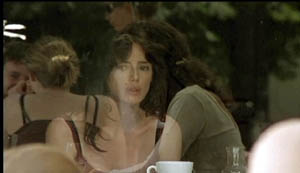
The motif of reflections will take over the rest of the film’s visual design, and eventually we’ll see that some of the Dreamer’s drawings evoke the piled-up and sliced-up faces in the café shots.
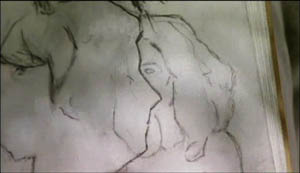
Later in the film, the Dreamer will explain why he’s in the city and why he’s scanning women. We’ll have a tram ride that Guerin compares with Sunrise, and a scene in a music club that not only parallels the café sequence but evokes Manet. We’ll also have occasion to compare this film with Bresson’s Four Nights of a Dreamer, a citation signaled from the outset.
All that is to come. Even if the later scenes weren’t as compelling as they are, this café sequence would make Sylvia one of the most adventurous films I’ve seen this year. By revising the simple, long-lived POV schema, Guerin has made it yield fresh feelings and implications. Like Lubitsch’s racetrack scene, this imaginative sequence provokes the jubilation you feel in the presence of calm, precise artistry.
(1) Lee Marshall, “Past Perfect,” Screen International (19 October 2007): 27. The web version is here, but it may require a subscription.
(2) I analyze the visual narration of Lady Windermere, which I think deserves to be ranked with Potemkin and Sunrise, in Narration in the Fiction Film (Madison: University of Wisconsin Press, 1985), 178-186.
(3) Edward R. Branigan, Point of View in the Cinema: A Theory of Narration and Subjectivity in Classical Film (The Hague: Mouton, 1985), 102-121.
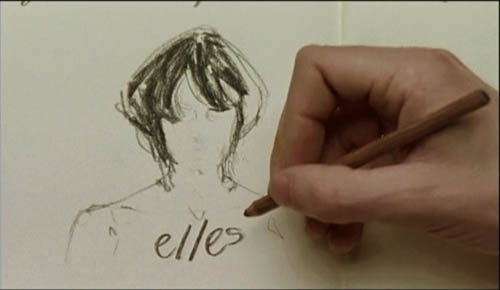
Scribble, scribble, scribble
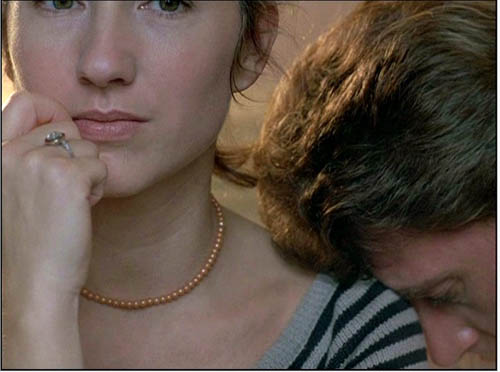
Detective (Godard, 1985).
Another damned, thick, square book! Always scribble, scribble, scribble, eh, Mr. Gibbon?
William Henry, Duke of Gloucester, 1781.
David here:
Kristin kept the blogfires burning while I traveled last week and did UW duties this one. I had a great time at the University of Georgia in Athens (but didn’t see Stipe) and at Emory in Atlanta (but didn’t see Scarlett). At both places I met sharp, energetic students and faculty. I have a couple of blog entries backlogged for posting, but now recent items relating to publications get the pole position.
 First, a Japanese translation of our Film Art: An Introduction has just appeared. It’s a very handsome version of the seventh edition, rendered by Fujiki Hideaki and Kitamura Hiroshi. We’re grateful to them and to Nagoya University Press for publishing it.
Second, the University of California Press is having a big sale on many outstanding media titles, from Richard Abel’s books on French silent cinema and André Bazin’s classics of film theory to Michele Hilmes’ study of NBC television and Mike Barrier’s new Disney biography, The Animated Man. To get the discount you must sign up for an e-newsletter, but it’s not intrusive.
Among the books of mine on sale, the biggest bargain is the hardcover edition of Figures Traced in Light (2005), originally priced at $65, now going for $7.95 plus postage. (No, apparently I don’t get the full-price royalties.) You can find this item here. There are also paperback copies of Figures (going for $12.95) and of The Way Hollywood Tells It ($15.95). If you’re inclined, hurry: the sale ends on 31 October.
 The biggest news, though, is that I just got my author’s copies of Poetics of Cinema, published last week. For a while Amazon was telling some people who pre-ordered it that copies won’t be available until 27 December, but now, despite what it says here, the book seems ready to ship.
Bad news first. Poetics of Cinema is priced at $45 in paperback, with no sellers I know offering it at discount. Go ahead, say it: Very expensive. If you haven’t published a book, you may not know that authors have no say in the pricing of their work. Publishers would never set a price or price ceiling in a contract, and calculations about pricing are based on many factors, including what comparable books sell for. A high cost isn’t my preference, of course; every writer wants to reach as many readers as possible. But unless you blog or self-publish your work, the publisher sets the price.
There are some good reasons for the cost. Running to 500 fairly dense pages and containing over 500 photographs, Poetics of Cinema was a complicated book to produce. I peddled it to other publishers, but they ruled it out as too whopping an investment for them. So Routledge has priced it along lines of comparable books, reckoning in the size of the likely audience (I hope, more than 118.3 readers). I have to thank Bill Germano, then Publishing Director at Routledge, for taking a chance on this project.
From age fifteen or so I’ve been a compulsive writer. Scribble, scribble, scribble. I’ve been at work on one book or another for over thirty years. I’ve got several projects in mind for my next effort, but I’ve held back committing. Is there any point in publishing more books, at least as books?
I mean this as a serious question. Would it have made any difference to me or my readers if Poetics of Cinema appeared as pdfs, available at a price considerably less than $45? Wouldn’t I find more readers? What about variable pricing? If Radiohead can do it, why can’t I? Somebody in film studies should try putting a digital book for sale online; maybe I will. But for a few years at least, this last baggy monster will be available only in dead-tree format.
Poetics: Some puzzles
Gentlemen Marry Brunettes (Richard Sale, 1955).
If you’ve read this far, you may be interested in what the book is about. Most basically, it’s predicated on the belief that we make progress in research by asking questions. Some questions are too deep to be answered—call them mysteries—but others can be answered with a fair degree of precision and reliability. We can turn mysteries into puzzles and puzzles into plausible answers.
Here’s a fairly common sort of composition in Hollywood cinema of the 1940s. This shot from The Killers (1946) displays the sort of steep depth I’ve talked about at various points on this blog and in my other books.
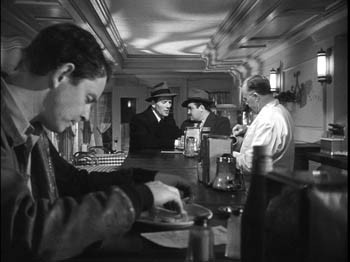
But now here’s an equally tense confrontation at a counter, from Bad Day at Black Rock (1955), made in early CinemaScope.
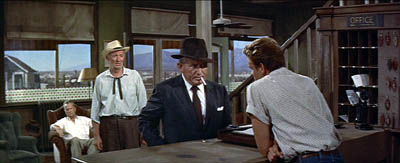
It doesn’t look much like the 1940s shot. The characters stand far from us, and the figure in the foreground doesn’t loom over the background. The shot is more open, the composition more porous. And unlike The Killers, Bad Day doesn’t contain close-ups of the actors in any scenes.
So questions come to mind. Did John Sturges have to stage the scene in Bad Day this way? Did other filmmakers resort to the same choice? What factors created pressures toward this more spacious format? Could more resourceful filmmakers have done something different? And given that such shots are rare today, what changes made it possible for filmmakers in later years to create the tight anamorphic widescreen close-ups we have now (as here in Cellular)?
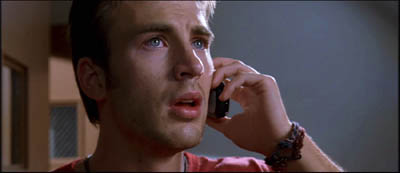
Despite all that has been written about CinemaScope and other early widescreen processes, no one has explored, shot by shot, what staging options were used by filmmakers. A chapter in Poetics of Cinema called “CinemaScope: The Modern Miracle You See Without Glasses” tries to show how filmmakers used the new format to tell their stories. This led them, I propose, to experiment with some staging strategies that, surprisingly, had precedents as far back as the 1910s.
Take another instance. We’re all familiar with recent films that present alternative futures, like Run Lola Run. A story line runs along and then is interrupted, and we switch to the same characters living a different storyline in a parallel universe. The emergence of such “forking path” movies arouses my curiosity. How do they work? How do they make their alternative-reality stories intelligible to the audience? How is it that we’re able to understand them? (After all, the notion of an infinite number of alternative universes to ours is pretty hard to get your head around.) Are such stories a brand-new innovation, or do they have precedents? (Clue: Remember A Christmas Carol?) Why do we see a cluster of these emerging in recent filmmaking?
I tackle these questions in another essay, called “Film Futures.” There I look at several such movies and try to spell out the tacit rules that filmmakers follow and that audiences pick up on. While this story format probably doesn’t constitute a genre, it does obey certain conventions, and I try to chart those. Some films also make some clever innovations in the format, which I also try to trace. The essay as well suggests how the conventions are handled differently in mass-market films like Sliding Doors and in art films like Kieślowski’s Blind Chance.
These two essays, along with the others in the book, try to explain and illustrate an approach to film studies I call film poetics. At bottom, this is an effort to explain why films are designed the way they are: how filmmakers have made certain choices in order to shape our response to their films. How do movies work? How do movies work on us?
Poetics: The project
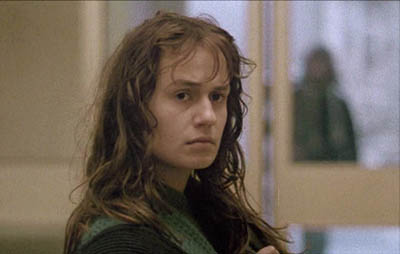
Vagabond (Varda, 1985).
As a kind of reverse engineering, film poetics looks at both structure and texture. I argue that we ought to study how films are constructed architecturally, as revealed for instance in plot structure or narration. Poetics also concentrates on stylistic patterning, the way filmmakers organize the techniques available to the medium. Poetics traditionally deals as well with thematics, the subjects and ideas that are mobilized by filmmakers and reworked by large-scale form and cinematic style.
Put it this way: I want to know how filmmakers have confronted problems set by others, or created problems for themselves to solve. I want to know how they draw on the past to borrow or modify or reject creative strategies. I want to know filmmakers’ secrets, including the ones they don’t know they know. And I want to know how all this creative activity is shaped to the uptake of spectators in different times and places.
Some of what I’ve written on this blog could illustrate how the poetics-driven perspective works in particular cases. The book offers more such instances, probed in more detail than is possible here. Using a comparative method, I also trace out some general principles of film form and style as they have developed over history.
The book consists of fifteen essays. Some have been published before; those have been revised for this collection. Other essays are newly written. After a somewhat polemical introduction, the first part concentrates on some theoretical problems. The anchoring essay offers a general introduction to the idea of a film poetics, with several examples. (An earlier version is on pdfs here.) In the same essay, I float a model of how film viewers respond to various aspects of films. I distinguish activities of perception, comprehension, and appropriation, and I suggest that a cognitive perspective sheds light on them.
Part I also contains an essay considering how cinematic conventions work. A poetics-based approach will spend a lot of time on norms, traditions, and received routines, for these are often the basis of filmmakers’ creative choices. This essay argues that some conventions are local and require a lot of cultural knowledge, while others are cross-cultural, compelling us to study why certain cinematic strategies seem to crop up across the world.
The second part of Poetics of Cinema considers narrative, one of the most common ways in which films are organized to affect viewers. I wrote a new essay to launch this section, a wide-ranging study called “Three Dimensions of Film Narrative.” The three dimensions I consider are narration, plot structure, and the narrative world. The essay considers how each of these shapes our understanding of a film’s story. This essay ends with a discussion called “Narrators, Implied Authors, and Other Superfluities.”
Some more tightly-focused pieces follow. One is devoted to forking-path plots. Another concentrates on an odd question: What role does forgetting play in our watching a film? Cognitive theory can offer some answers, and I take Mildred Pierce as an example. There’s an update of an essay that has been something of a golden oldie in film courses, “The Art Cinema as a Mode of Film Practice.” In a supplement to that piece I suggest some new avenues of inquiry and draw on more examples, notably Varda’s Vagabond (Sans toit ni loi).
The longest piece in Part II is devoted to what I call network narratives. Prototypes of this would be Grand Hotel, Short Cuts, Crash, and Babel. This essay tries to show how a poetics of cinema shed light on this format, currently a very popular one. When I started looking at these movies, I was surprised to discover how many filmmaking traditions work in this vein; I append a filmography with nearly 250 items, and today I could update it with several more. (1) I consider how this option has developed distinctive strategies of narration, plotting, and worldmaking. I also survey some common themes running across network tales, such as the role of chance and fate. The essay finishes with more in-depth analyses of four films: Altman’s Nashville, Iosseliani’s Favoris de la lune, Anderson’s Magnolia, and Jean-Claude Guiget’s Les Passagers.
Poetics: More problems
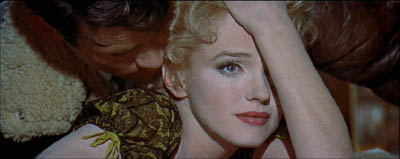
Bus Stop (Logan, 1955).
Part III moves from questions of narrative to questions of film style, no stranger to this blog. The opening essay is a tribute to Andrew Sarris that appraises his role in making readers of my generation style-conscious. It’s the most personal piece in the book. There follows a study of Robert Reinert, a director in the German silent cinema who might have become much better known if his quite demented Nerven and Opium had been as widely seen as Caligari. The essay “Who Blinked First?” considers how our reaction to films is affected by the ways in which actors use their eyes, including how and when they blink. Big deal, huh? Actually, yes.
The monster essay in this section is the CinemaScope piece, of which I’ve given versions in lecture form over the last couple of years. I argue that some directors responded to the new widescreen technology by adapting certain norms of staging and shooting to the new format, while other filmmakers moved in more adventurous directions. The piece uses the model of problem/solution as a way to understand stylistic continuity and change, a framework I’ve floated in On the History of Film Style as well.
The last four studies in Part III are devoted to style in Asian cinema. There are two essays on Japanese film of the 1920s and 1930s, both expanded somewhat from their original versions. There I argue that we can see Japanese directors as building upon, as well as adventurously departing from, stylistic norms shared by most filmmaking countries of the period. This brace of essays fills out some ideas that I fielded in Ozu and the Poetics of Cinema, and they should appeal to that growing body of viewers who have developed a passion for Naruse Mikio and Uchida Tomio. It’s gratifying that several of the films I discuss, which I had to study in archives, are now circulating in touring programs.
Poetics of Cinema concludes with two studies of Hong Kong film, one surveying the stylistic tactics by which that very lively tradition excites its audience, the other analyzing the unique innovations of King Hu. The articles are companion pieces to Planet Hong Kong.
Poetics: The mysteries
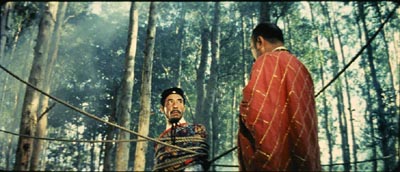
A Touch of Zen (King Hu, 1970).
As an approach to answering questions about cinema, poetics blends history, criticism, and theory. It requires that we do research into the artistic history of film, looking at styles, genres, narrative modes, and other traditions. It asks for close analysis and interpretation of films. At the same time, it asks broader questions about what principles govern narrative, stylistic patterning, and the like. I’d say it obliges a historian to concentrate on aesthetics; it makes criticism more historical and theoretical; it ties theory to concrete historical conditions and the fine-grain workings of individual films.
Kenneth Burke used to say that you could get a sense of a book by looking at its first and last sentences. My book’s first essay opens this way:
Sometimes our routines seem transparent, and we forget that they have a history.
I think that this captures my concern to look closely at familiar things in film and try to make their principles a little more evident. Yet in trying to make filmmakers’ choices explicit and tracing out the principles undergirding how we make sense of movies, I’m sometimes criticized for simply stating common sense. Poetics can look bland alongside the skywriting swoops of most academic film theory. But skywriting is blurry and dissolves while you look at it. By contrast, clearly setting out some basics of filmic construction and comprehension offers a firmer place to start answering questions about how movies work and work on us.
Poetics tries to produce concrete, approximately true claims about cinema. Most film theory operates as an application, borrowing big theories of culture, identity, nationhood, and the like and then mapping them onto films. The results are usually thin. It seems to me that most film theory today is not carefully thought through or persuasively argued. For examples, see my essay in Post-Theory, the last chapter of Figures, and my comments here and here on this site.
In trying to establish reliable knowledge about cinema, we won’t answer every question and we will make false steps, but we can make progress. Film poetics is one way we film enthusiasts can join that tradition of rational and empirical inquiry which remains our most dependable path to knowledge. My introduction, though peppered with some pokes at Big Theory, has the serious purpose of making a plea for film scholars to join that tradition.
The final line of the book concludes the essay on King Hu:
The mainstream [Hong Kong] style has given us many beautiful and stirring films, but Hu’s eccentric explorations evoke something that other directors’ works seldom arouse: a sense that extraordinary physical achievement, if caught through precisely adjusted imperfections, becomes marvelous.
To get the full point you need to read the essay, but what should come through here is my concern to highlight filmmakers’ originality when I find it, and to locate it by means of a comparative method. In addition, I hope that what comes through is an appreciation of the sheer exhilaration we feel when a filmmaker has made the right, bold choice. A poetics-based approach probably can’t fully explain this feeling—it may fall under the heading of mysteries rather than puzzles—but at least it can reveal how some forces contribute to it.
My summary, and the size of the book, may leave the impression that I think that I’ve answered these questions fully. Of course I don’t. I try only to make some progress, realizing that offering answers is also an invitation to disagree, to refine the questions and tackle new ones. Nor do I think that these are the only questions that matter. We’re just starting to understand how films work and work on us, and there are a great many areas we haven’t charted. (Performance, to take a big one.) We have to start somewhere, though. I’d hope that by posing some questions and proposing some answers, Poetics of Cinema offers fruitful points of departure.
(1) Some candidates are 25 Fireman Street (1973, Hungary, István Szabó), Feast of Love (2007, US, Robert Benton), Continental—A Film without Guns (2007, Canada/ Stephane Lafleur), The Edge of Heaven (2007, Germany/ Turkey, Fatih Akin), Unfinished Stories (2007, Iran, Pourya Azarbayjani), God Man Dog (2007, Taiwan, Singing Chen [Chen Hsin-hsuan]), A Century’s End (2000, Korea, Song Neung-han), and Why Did I Get Married? (2007, US Tyler Perry).
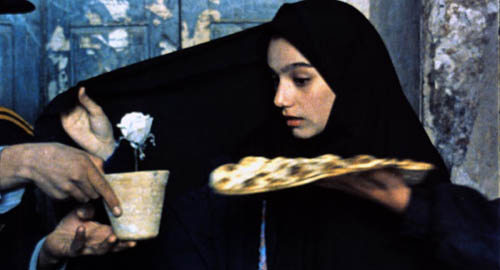
A Moment of Innocence (Mohsen Makhmalbaf, 1996).



