




Archive for the 'Narrative strategies' Category
Slumdogged by the past
DB here:
In graduate school a professor of mine claimed that one benefit of studying film history was that “you’re never surprised by anything that comes along.”
This isn’t something to tell young people. They want to be surprised, preferably every few hours. So I rejected the professor’s comment, and I still think it’s not a solid rationale for studying film history. But I can’t deny that doing historical research does give you a twinge of déjà vu.
For instance, the film industry’s current efforts to sell Imax and 3-D irresistibly remind me of what happened in the early 1950s, when Hollywood went over to widescreen (Cinerama, CinemaScope, and the like), stereophonic sound, and for a little while 3-D. Then the need was to yank people away from their TV sets and barbecue pits. Now people need to be wooed from videogames and the Net. But the logic is the same: Offer people something they can’t get at home. It’s 1953 once more.
So historians can’t resist the “Here we go again” reflex. But they shouldn’t turn that into a languid “I’ve seen it all before.” Because we can genuinely be surprised. Occasionally, there are really innovative movies that, no matter how much they owe to tradition, constitute milestones. In my view, Kiarostami’s Through the Olive Trees, Hou’s City of Sadness, Wong’s Chungking Express, Tarr’s Satantango, and Tarantino’s Pulp Fiction are among the 1990s examples of strong and original works.
More often, the films we see draw on film history in milder ways than these milestones. But this doesn’t mean that these movies lack significance or impact. We can be agreeably surprised by the ways in which a filmmaker energizes long-standing cinematic traditions by blending them unexpectedly, tweaking them in fresh ways, setting them loose on new material. And the more you know of those traditions and conventions, the more you can appreciate how they’re modified. Admiring genius shouldn’t keep us from savoring ingenuity.
Which brings me to Slumdog Millionaire. I happen to like the film reasonably well. Part of my enjoyment is based on seeing how forms and formulas drawn from across film history have an enduring appeal. Many people whose judgments I respect hate the movie, and they would probably call what follows an ode to clichés. But I mean this set of notes in the same spirit as my comments on The Dark Knight (which I don’t admire). Even if you disagree with my predilections, you may find something intriguing in Slumdog’s ties to tradition. These ties also suggest why the movie is so ingratiating to so many.
Warning: What follows contains plot spoilers, revelatory images, and atrocious puns.
Slumdog and pony show
Adaptation is still king. Almost as soon as movies started telling stories, they were borrowing from other media. Many of this year’s Oscar candidates are based on plays, novels, and graphic novels. Slumdog is a redo of Vikas Swarup’s 2005 novel Q & A. The book provides the basic situation of a poor youth implausibly triumphing on a version of Who Wants to be a Millionaire? The novel also lays down the film’s overall architecture: in the present, the hero narrates his past, tying each flashback to a round of the game and a relevant question. In the novel, the video replays are described, but of course they’re shown in the film.
There are many disparities between novel and movie, but for now I simply note two. First, Swarup’s book has several minor threads of action, but the film concentrates on Jamal’s love of Latika. (The screenwriter Simon Beaufoy has melded two female characters into one.) Correspondingly, the book introduces a romance plot comparatively late, whereas the film initiates Jamal’s love of Latika in their childhoods. Such choices give the film a simpler through-line. Second, whereas Q & A skips back and forth through Jamal’s life, keying story events to the quiz questions, the film’s flashbacks follow the chronology strictly. This is a good example of how screenwriters are inclined to adjust the plasticity of literary time to the fact that, at least in theatrical screenings, audiences can’t stop and go back to check story order. Clarity of chronology is the default in classical film storytelling.
Then there’s the double plotline. The streamlining of Swarup’s novel points up one convention of Hollywood narrative cinema. The assortment of characters and the twists in the original novel are squeezed down to the two sorts of plotlines we find in most studio films: a line of action involving heterosexual romance and a second line of action, sometimes another romance but just as often involving work. The common work/ family tension of contemporary film plotting is to some extent built into the Hollywood system.
Beaufoy has sharpened the plot by giving Jamal a basic goal: to unite with Latika. The quiz episodes form a means to that end: the boy goes on the show because he knows she watches it. If told in chronological order, the quiz-show stretches would have come late in the film and become a fairly monotonous pendant to the romance plot. One of the many effects of the flashback arrangement is to give the subsidiary goal more prominence, creating a parallel track for the entire film to move along and arousing anomalous suspense. (We know the outcome, but how do we get there?)
Q & A. Swarup’s novel begins: “I have been arrested. For winning a quiz show.”
We have to ask: What could make such a thing happen? Soon the police and the show’s producers are wondering something more specific. How could Ram, an ignorant waiter, have gotten the answers right without cheating?
Noël Carroll proposes that narratives engage us by positing questions, either explicitly or implicitly. Stories in popular media, he suggests, induce the reader to ask rather clear-cut ones, and these will get reframed, deferred, toyed with, and in the short or long run answered.
Slumdog accepts this convention, presenting a cascade of questions to link its scenes and enhance our engagement. Will Jamel and Salim get Bachchan’s autograph? Will they survive the anti-Muslim riot? Will they escape the fate of the other captive beggar children? And so on.
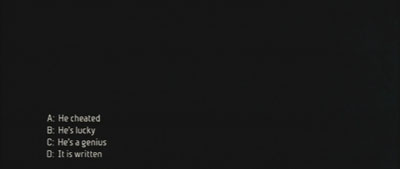
More originally, the film cleverly melds the question-based appeal of narrative with the protocols of the game show, so that we are confronted with a multiple-choicer at the very start. (As in narrative itself, the truth comes at the end.) The principal question will be answered in the denouement, in a comparably impersonal register.
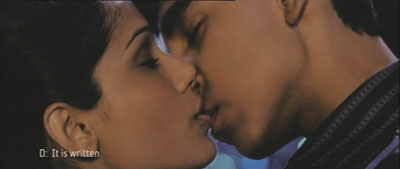
Flashbacks are also a long-standing storytelling device, as I was saying here last week. A canonical situation is the police interrogation that frames the past events, as in Mildred Pierce, The Usual Suspects, and Bertolucci’s The Grim Reaper. This narrating frame is comfortable and easy to assimilate, and it guides us in following the time shifts.
But 1960s cinema gave flashbacks a new force. From Hiroshima mon amour (1958) onward, brief and enigmatic flashbacks, interrupting the ongoing present-tense action, became common ways to engage the audience. Such is the case with the glimpse of Latika at the station that pops up during the questioning of Jamal, rendered as almost an eyeline match.
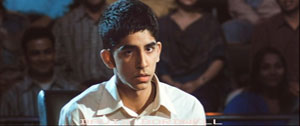

At this point we don’t know who she is, but the image creates curiosity that the story will eventually satisfy. Flashbacks can also remind us of things we’ve seen before, as when Jamal recalls, obsessively, the night he and Salim left Latika behind to Maman’s band. Boyle and company call on these time-honored devices in the assurance that wewill pick up on them immediately, as audiences have for decades.
Flashforwards are trickier, and rarer. The 1960s also saw some experimentation with images from future events interrupting the story’s present action. Unless you posit a character who can see the future, as in Don’t Look Now, flashforwards are usually felt as externally imposed, the traces of a filmmaker teasing us with images that we can’t really assimilate at this point. (See They Shoot Horses, Don’t They?) Such flashforwards pop up during the initial police torture of Jamal.
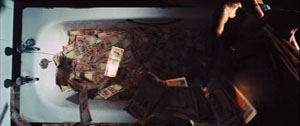
Encountering the bathtub shot so early in the film, we might take it as a flashback, but actually it anticipates a striking image at the climax, after Jamal has been released and returned to the show. I’d argue that the shot functions thematically, as a vivid announcement of the motif of dirty money that runs through the movie and is associated with not only the gangster world but also the corrupt game show.
Slumdog days
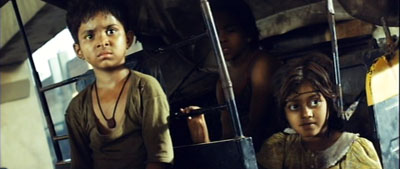
Empathy. One of the most powerful ways to get the audience emotionally involved is to show your protagonist treated unfairly. This happens in spades at the start of Slumdog. A serious-faced boy is subjected to awful torture, then he’s intimidated by unfeeling men in authority. He’s mocked as a chaiwallah by the unctuous host of the show, and laughed at by the audience. Once Jamal’s backstory starts, we see him as a kid (again running up against the law) and suffering a variety of miseries.
To keep Jamal from seeming a passive victim, he is given pluck and purpose. As a boy he resists the teacher, boldly jumps into human manure, shoves through a crowd to get an autograph, and eventually becomes a brazen freelance guide to the Taj Mahal. This is the sort of tenacious, resourceful kid who could get on TV and find Salim in teeming Mumbai. The slumdog is dogged.
Our sympathies spread and divide. Latika is also introduced being treated unfairly. An orphan after the riot, she squats in the rain until Jamal makes her the “Third Musketeer.” By contrast, Salim is introduced as a hard case—making money off access to a toilet, selling Jamal’s Bachchan autograph, resisting bringing Latika into their shelter, and eventually becoming Maman’s “dog” and Latika’s rapist. The double plotline gives us a hero bent on finding and rescuing his beloved; the under-plot gives us a shadier figure who finds redemption by risking his life a final time to help his friends. Jamal emerges ebullient from a sea of shit, but Salim dies drowned in the money he identified with power.
Our three main characters share a childhood, and what happens to them then prefigures what they will do as grownups. This is a long-standing device of classical cinema, stretching back to the silent era. Public Enemy and Angels with Dirty Faces give us the good brother and the bad brother. Wuthering Heights, Kings Row, and It’s a Wonderful Life present romances budding in childhood. These are plenty of less famous examples. Here, for instance, is a synopsis of Sentimental Tommy (1921), a film that may no longer exist.
The people of Thrums ostracize Grizel, a child of 12, and her mother, known as The Painted Lady, until newcomer Tommy Sandys, a highly imaginative boy, comes to the girl’s rescue and they become inseparable friends. Six years later Tommy returns from London, where he has achieved success as an author, and finds that Grizel still loves him. In a sentimental gesture he proposes, but she, realizing that he does not love her, rejects him. In London, Tommy is lionized by Lady Pippinworth, and he follows her to Switzerland. Having lost her mother and believing that Tommy needs her, Grizel comes to him but is overcome by grief to see his love for Lady Pippinworth. Remorseful, Tommy returns home, and after his careful nursing Grizel regains her sanity.
The device isn’t unknown in Indian cinema either; Parinda (1989) motivates the character relationships through actions set in childhood. Somehow, we are drawn to seeing one’s lifetime commitments etched early and fulfilled in adulthood.
This story pattern carries within it one of the great thematic oppositions of the cinema, the tension between destiny and accident. In Slumdog, The Three Musketeers may be introduced casually, but it will somehow provide a template for later events. Lovers are destined to meet, even if by chance, and when chance separates them, they are destined to reunite . . . if only by chance. A plot showing children together assures us that somehow they will re-meet, and their childhood traits and desires will inform what they do as adults. It is written.
This theme reaffirms the psychological consistency prized by classic film dramaturgy as well. Characters are introduced doing something, as we say, “characteristic,” and this first impression becomes all the more ingrained by the sense that things had to be this way. What you choose—say, to pursue the love of your childhood—manifests your character. But then, your character was already defined with special purity in that childhood.
Just another movie conceit? The existence of Classmates.com seems to suggest otherwise.

Chance needs an alibi, however. Hollywood films are filled with coincidences, and the rules of the game suggest that they need some minimal motivation. Not so much at the beginning, perhaps, because in a sense every plot is launched by a coincidence. But surely, our plausibilists ask, how could it happen that an uneducated slumdog would have just the right experiences to win the quiz? A lucky guy!
As Swarup realized, the flashback structure helps the audience by putting past experience and present quiz question in proximity for easy pickup. Yet as Beaufoy indicates in one of the most informative screenwriting interviews I know, the device also softens the impression of an outlandishly lucky contestant. At the start we already know that Jamal has won, so the question for us is not “How did he cheat?” but rather “What life experience does the question tap?” Each of the links is buried in a welter of other details, any one of which could tie into the correct answer. Moreover, sometimes the question asked precedes the relevant flashback, and sometimes it follows the flashback, further camouflaging the neat meshing of past and present.
It’s a diabolical contrivance. If you question Jamal’s luck, you ally with the overbearing authorities who suspect cheating. (You just think the film cheated.) Who wants to side with them? By the end the inevitability granted by the flashback obliges us to accept the inspector’s conclusion: “It is bizarrely plausible.”
The film has an even more devious out. Jamal can reason on his own, arriving at the Cambridge Circus answer. More important, his street smarts have made him such a good judge of character that he realizes that the MC is misleading him about the right answer to the penultimate question. So his winning isn’t entirely coincidence. Life experience has let him suss out the interpersonal dynamics behind the apparently objective game. As for the final answer—a lucky guess? Fate?—it’s a good example of how things can be written (in this case by Alexandre Dumas).
Slumdoggy style
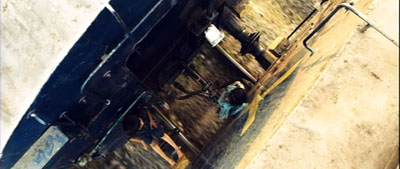
The whole edifice is built on a cinematic technique about a hundred years old: parallel editing. Up to the climax, we alternate between three time frames. The police interrogation takes place in the present, the game show in the recent past (shifting from the video replay to the scenes themselves), and Jamal’s life in the more distant past. Any one of these time streams may be punctuated, as we’ve seen, by brief flashbacks. So the problem is how to manage the transitions between scenes in any one time frame and the transitions among time frames.
Needless to say, our old friend the hook—in dialogue, in imagery—is pressed into service often. A sound bridge may link two periods, with the quiz question echoing over a scene in the past. “How did you manage to get on the show?” Cut to Jamal serving tea in the call center. In a particularly smooth segue, the boys are thrown off the train as kids and roll to the ground as teenagers. There are negative hooks too. At the end of a quarrel with Salim, Jamal walks off saying, “I will never forgive you.” The next scene opens with the two of them sitting on the edge of an uncompleted high-rise building, having come to an uneasy truce.
In the climax, the three time frames all come into sync, creating a single ongoing present. Jamal will return to the show. The double-barreled questions are reformulated. Now we have genuine suspense: Will he win the top prize? Will Latika find him? To pose these engagingly, directors Danny Boyle and Loveleen Tandan create an old-fashioned chase to the rescue.
Each major character gets a line of action, all unwinding simultaneously: Salim prepares to sacrifice himself to the gangster Khan, she flees through traffic, and Jamal enters the contest’s final round. A fourth line of action is added, that of the public intensely following Jamal’s quest for a million. He has become the emblem of the slumdog who makes good.
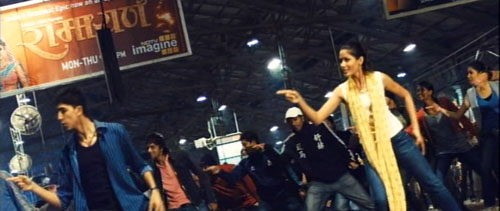
The rescue doesn’t come off; Latika misses Jamal’s phone plea for a lifeline, and he is on his own. Fortunately, he trusts in luck because “Maybe it’s written, no?” The lovers reunite instead at the train station, where Jamal had pledged to wait for Latika every day at 5:00. Fitting, then, that in the epilogue a crowd shows up, standing in for all of Mumbai, singing and dancing to “Jai Ho” (“Victory”). All the remaining lines of action—Jamal, Latika, and the multitudes—assemble and then disperse in a classic ending: lovers turning from the camera and walking into their future, leaving us behind.
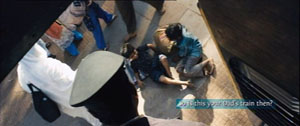
Then there’s the film’s slick technique. The whole thing is presented in a rapid-fire array, with nearly sixty scenes and about 2700 shots bombarding us in less than two hours. Critics both friendly and hostile have commented on the film’s headlong pacing and flamboyant pictorial design. If some of Slumdog’s storytelling strategies reach back to the earliest cinema, its look and feel seems tied to the 1990s and 2000s. We get harsh cuts, distended wide-angle compositions, hurtling camerawork, canted angles, dazzling montage sequences, faces split by the screen edge, zones of colored light, slow motion, fast motion, stepped motion, reverse motion (though seldom no motion). The pounding style, tinged with a certain cheekiness, is already there in most of Danny Boyle’s previous work. Like Baz Luhrmann, he seems to think that we need to see even the simplest action from every conceivable angle.
Yet the stylistic flamboyance isn’t unique to him. He is recombining items on the menu of contemporary cinema, as seen in films as various as Déjà Vu and City of God. (That menu in turn isn’t absolutely new either, but I’ve launched that case in The Way Hollywood Tells It.) More surprisingly, we find strong congruences between this movie’s style and trends in Indian cinema as well.
Over the last twenty years Indian cinema has cultivated its own fairly flashy action cinema, usually in crime films. Boyle has spoken of being influenced by two Ram Gopal Varma films, Satya (1998) and Company (2002). Company‘s thrusting wide angles, overhead shots, and pugilistic jump cuts would be right at home in Slumdog.
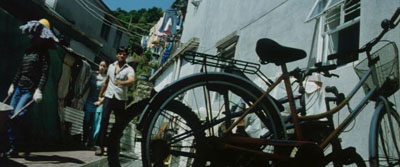
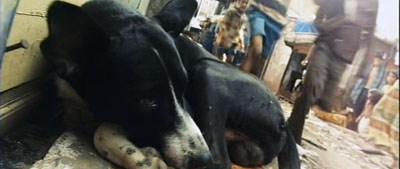
It seems, then, that Slumdog’s glazed, frenetic surface testifies to the globalization of one option for modern popular cinema. The film’s style seems to me a personalized variant of what has for better or worse become an international style.
Slumdogma
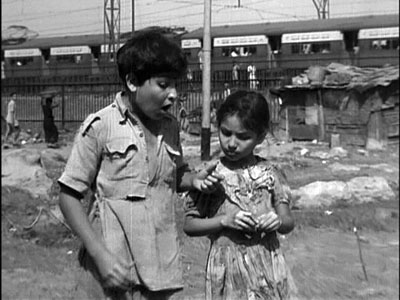
Boot Polish.
I’d like to mention many other ways in which the movie engages viewers, such as running (an index of popular cinema; does anybody run in Antonioni?). But I’ve said enough to suggest that the film is anchored in film history in ways that are likely to promote its appeal to a broad audience. The idea of looking for appeals that cross cultures rather than divide them isn’t popular with film academics right now, but a new generation of scholars is daring to say that there are universals of representation and response. It is these that allow movies to arouse similar emotions across times and places.
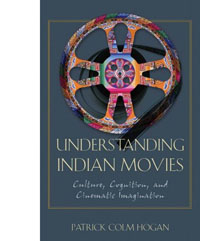
Patrick Hogan has made such a case in his fine new book Understanding Indian Movies: Culture, Cognition, and Cinematic Imagination. There he shows that much of what seems exotic in Indian cinema constitutes a local specification of factors that have a broad reach—certain plot schemes, themes, and visual and auditory techniques. Hogan, an expert in Indian history and culture, is ideally placed to balance universal appeals with matters of local knowledge that require explication for outsiders.
For my part, I’d just mention that a great deal of what seems striking in Slumdog has already been broached in Indian cinema. Take the matter of police brutality. The torture scene at the start might seem a piece of exhibitionism, with an outsider (Boyle? Beaufoy?) twisting local culture to western ideas of uncivilized behavior. But look again at the gangster films I’ve mentioned: they contain brutal scenes of police torture, like this from Company.
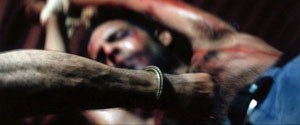
Like Hong Kong cinema and American cinema, Indian filmmaking seems to take a jaundiced view of how faithful peace officers are to due process.
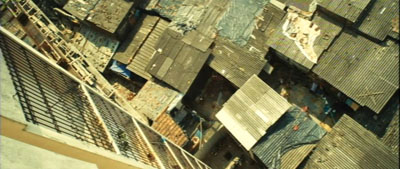
More basically, consider the representation of the Mumbai slums. Doubtless the title slants the case from the first; Beaufoy claims to have invented the word “slumdog,” though Ram is called a dog at one point in the novel. The insult, and the portrayal of Mumbai, has made some critics find the film sensationalistic and patronizing. Most frequently quoted is megastar Amitabh Bachchan’s blog entry.
If SM projects India as [a] Third World dirty underbelly developing nation and causes pain and disgust among nationalists and patriots, let it be known that a murky underbelly exists and thrives even in the most developed nations.
Soon Bachchan explained that he was neutrally summarizing the comments of correspondents, not expressing his own view. In the original, he seems to have been suggesting that the poverty shown in Slumdog is not unique to India, and that a film portraying poverty in another country might not be given so much recognition.
It’s an interesting point, although many films from other nations portray urban poverty. More generally, Indian criticisms of the image of poverty in Slumdog remind me of reactions to Italian Neorealism from authorities concerned about Italy’s image abroad. The government undersecretary Giulio Andreotti claimed that films by Rossellini, De Sica, and others were “washing Italy’s dirty linen in public.” Andreotti wrote that De Sica’s Umberto D had rendered “wretched service to his fatherland, which is also the fatherland of . . . progressive social legislation.” Liberal American films of the Cold War period were sometimes castigated by members of Congress for playing into the hands of Soviet propagandists. It seems that there will always be people who consider films portraying social injustice to be too negative and failing to see the bright side of things, a side that can always be found if you look hard enough.
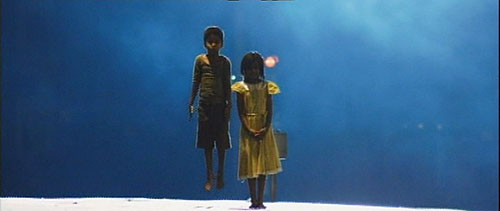
Moreover, Neorealists made a discovery that has resonated throughout festival cinema: feature kids. Along with sex, a child-centered plot is a central convention of non-Hollywood filmmaking, from Shoeshine and Germany Year Zero through Los Olvidados and The 400 Blows up to Salaam Bombay, numerous Iranian films, and Ramchandi Pakistani. Yes, Slumdog simplifies social problems by portraying the underclass through children’s misadventures, but this narrative device is a well-tried way to secure audience understanding. We have all been children.
There is another way to consider the poverty problem. The representation of slum life, either sentimentally or scathingly, can be found in classic Indian films of the 1950s. One of my favorites of Raj Kapoor’s work, Boot Polish (1954), tells a Dickensian tale of a brother and sister living in the slums before being rescued by a rich couple. (Interestingly, the key issue is whether to beg or do humble work.) Another example is Bimal Roy’s Do Bigha Zamin (Two Acres of Land, 1953). Later, shantytown life was more harshly presented in Chakra (1981), shot on location.
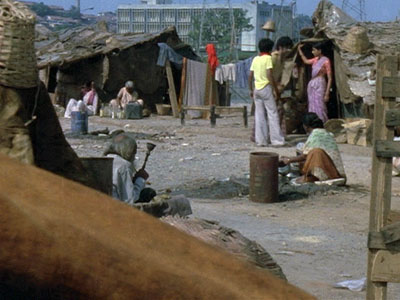
And of course poverty in the countryside has not been overlooked by Indian filmmakers.
Slumdog may have become a flashpoint because more recent Indian cinema has avoided this subject. In an email to me Patrick Hogan (who hasn’t yet seem Slumdog) writes:
There was a strong progressive political orientation in Hindi cinema in the 1940s and 1950s. This declined in the 1960s until it appeared again with some works of parallel cinema. Thus there was a greater concern with the poor in the 1950s–hence the movies by Kapoor and Roy that you mention. There are some powerful works of parallel cinema that treat slum life, but they had relatively limited circulation. On the other hand, that does not mean that urban poverty disappeared entirely from mainstream cinema. At least some sense of social concern seemed to be retained in mainstream Indian culture, thus mainstream cinema, until the late 1980s.
 However, at that time Nehruvian socialism was more or less entirely abandoned and replaced with neo-liberalism. In keeping with this, ideologies changed. Perhaps because the consumers of movies became the new middle classes in India and the Diaspora, there was a striking shift in what classes appeared in Hindi cinema and how classes were depicted. As many people have noted, films of the neoliberal period present images of fabulously wealthy Indians and generally focus on Indians whose standard of living is probably in the top few percentage points. . . . I don’t believe this is simply a celebration of wealth and pandering to the self-image of the nouveau riche–though it is that. I believe it is also a celebration of neoliberal policies. Neoliberal policies have been very good for some people. But they have been very bad for others. . . .
In this neoliberal cinema (sometimes misleadingly referred to as “globalized”), even relatively poor Indians are commonly represented as pretty comfortable. The difference in attitude is neatly represented by two films by Mani Ratnam—Nayakan (1987) and Guru (2007). The former is a representation of the difficulties of the poor in Indian society. The film already suffers from a loss of the socialist perspective of the 1950s films. Basically, it celebrates an “up from nothing” gangster for Robin Hood-like behavior. (This is an oversimplification, but gives you the idea.)
Guru, by contrast, celebrates a corrupt industrialist who liberates all of India by, in effect, following neoliberal policies against the laws of the government. Neither film offers a particularly admirable social vision. But the former shows the urban poor struggling against debilitating conditions. The latter simply shows a sea of happy capitalists and indicates that lingering socialistic views are preventing India from becoming the wealthiest nation in the world. Part of the propaganda for neoliberalism is pretending that poor people don’t exist any longer–or, if they do, they are just a few who haven’t yet received the benefits.
Paradoxically, then, perhaps local complaints against Slumdog arise because the film took up a subject that hasn’t recently appeared on screens very prominently. The same point seems to be made by Indian commentators and by Indian filmmakers who deplore the fact that none of their number had the courage to make such a movie. The subject demands more probing, but perhaps the outsider Boyle has helped revive interest in an important strain of the native tradition!
Finally, the issue of glamorizing the exotic. Some critics call the film “poverty porn,” but I don’t understand the label. It implies that pornography of any sort is vulgar and distressing, but which of these critics would say that it is? Most such critics consider themselves worldly enough not to bat an eye at naughty pictures. Some even like Russ Meyer.
So is the issue that the film, like pornography, prettifies and thereby falsifies its subject? Several Indian films, like Boot Polish, have portrayed poverty in a sunnier light than Slumdog, yet I’ve not heard the term applied to them. Perhaps, then, the argument is that pornography exploits eroticism for money, and Slumdog exploits Indian culture. Of course every commercial film could be said to exploit some subject for profit, which would make Hollywood a vast porn shop. (Some people think it is, but not typically the critics who apply the porn term to Slumdog.) In any case, once any commercial cinema falls under the rubric of porn, then the concept loses all specificity, if it had any to begin with.
The Slumdog project is an effort at crossover, and like all crossovers it can be criticized from either side. And it invites accusations of imperialism. A British director and writer use British and American money to make a film about Mumbai life. The film evokes popular Indian cinema in circumscribed ways. It gets a degree of worldwide theatrical circulation that few mainstream Indian films find. This last circumstance is unfair, I agree; I’ve long lamented that significant work from other nations is often ignored in mainstream US culture (and it’s one reason I do the sort of research I do). But I also believe that creators from one culture can do good work in portraying another one. No one protests that that Milos Forman and Roman Polanski, from Communist societies, made One Flew Over the Cuckoo’s Nest and Chinatown. No one sees anything intrinsically objectionable in the Pang brothers or Kitano Takeshi coming to America to make films. Most of us would have been happy had Kurosawa had a chance to make Runaway Train here. Conversely, Clint Eastwood receives praise for Letters from Iwo Jima.
Just as there is no single and correct “Indian” or “American” or “French” point of view on anything, we shouldn’t deny the possibility that outsiders can present a useful perspective on a culture. This doesn’t make Slumdog automatically a good film. It simply suggests that we shouldn’t dismiss it based on easy labels or the passports of its creators.
Moreover, it isn’t as if Boyle and Tandan have somehow contaminated a pristine tradition. Indian popular films have long been hybrids, borrowing from European and American cinema on many levels. Their mixture of local and international elements has helped the films travel overseas and become objects of adoration to many westerners.
I believe we should examine films for their political presuppositions. But those presuppositions require reflection, not quick labels. If I were to sketch an ideological interpretation of Slumdog, I’d return to the issue of how money is represented in an economy that traffics in maimed children, virgins, and robotic employees. Money is filthy, associated with blood, death, and commercial corruption. The beggar barracks, the brothel, the call center, and the quiz show lie along a continuum. So to stay pure and childlike one must act without concern for cash. The slumdog millionaire doesn’t want the treasure, only the princess, and we never see him collect his ten million rupees. (An American movie loves to see the loser write a check.) To invoke Neorealism again, we seem to have something like Miracle in Milan–realism of local color alongside a plot that is frankly magical.
Perhaps this quality supports the creators’ claims that the film is a fairy tale. As with all fairy tales, and nearly all movies I know, dig deep enough and you’ll find an ideological evasion. Still, that evasion can be more or less artful and engrossing.
So it seems to me enlightening and pleasurable to see every film as suspended in a web, with fibers connecting it to different traditions, many levels and patches of film history. Acknowledging this shows that most traditions aren’t easily exhausted, and that fresh filmmaking tactics can make them live again. Thinking historically need not numb us to surprises.
The amount of Web writing on Slumdog is exploding. Go to GreenCine for a good sampling of commentary from late 2008. The film’s technique is discussed in Stephanie Argy, “Rags to Riches,” American Cinematographer 89, 12 (December 2008), 44-61. Boyle shows his camera to Darren Aronofsky at Slantfilm. Kim Voynar of Movie City News reviews, critically, the Slumdog backlash.
For a more detailed rationale for this entry’s suspension of value judgments for the sake of analysis, try my earlier blog entry here. Noël Carroll discusses question-and-answer structures in narrative in several books, notably The Philosophy of Horror; or, Paradoxes of the Heart (New York: Routledge, 1990), 130-136. On recent Indian action movies, see Lalitha Gopalan, Cinema of Interruptions: Action Genres in Contemporary Indian Cinema (London: British Film Institute, 2002). The quotations from Giulio Andreotti come from P. Adams Sitney, Vital Crises in Italian Cinema: Iconography, Stylistics, Politics (Austin: University of Texas Press, 1995), 107; and Millicent Marcus, Italian Film in the Light of Neorealism (Princeton: Princeton University Press, 1986), 26.
Thanks to Cathy Root, who is at work on a book on Bollywood, for advice and links. Thanks as well to Patrick Colm Hogan and Lalita Pandit for corrections, information, and ideas.
PS 2 Feb: David Chute, expert on Indian cinema, has written a helpful and balanced entry on Slumdog at his Hungry Ghost site.
PPS 14 Feb: From another expert on Indian film, Corey Creekmur, at the University of Iowa, some further ideas and references on the childhood motif:
I would emphasize that establishing a film’s narrative direction through childhood events is a dominant narrative trope in popular Indian cinema, animating many famous “golden age” examples, including Raj Kapoor’s Awara (1951), Mehboob Khan’s Anmol Ghadi (1946), and Bimal Roy’s Devdas (1955), along with a number of the major 1970s films starring Amitabh Bachchan, which often carry childhood traumas into the adult character’s life. The story of brothers growing up on two sides of the law is also a Hindi film staple, central to Bachchan’s emergence as a superstar in Deewar in 1975. It seems to me curious that Slumdog Millionaire’s Western filmmakers draw on these conventions more fully than the source novel [Q & A] by a non-resident Indian does.
I attempt to explain the decades-long cultural function (and eventual waning) of this narrative trope — often achieved through a specific formal device (a dissolve from boy to man) moving from the lives of children to adults (skipping over adolescence) that I call the “maturation dissolve” — in an article “Bombay Boys: Dissolving the Male Child in Popular Hindi Cinema,” in Where the Boys Are: Cinemas of Boyhood, ed. Murray Pomerance and Frances Gateward. (Detroit: Wayne State UP, 2004). In that essay I suggest that some of the Hollywood examples — as well as Citizen Kane — you mention could have inspired the Indian examples, but also suggest certain Indian sources (the childhood love of the god Krishna and his consort Radha, which informs all versions of Devdas) as well. Since I’m citing myself, I’ll also note a recent essay on the “Devdas” phenomenon in Indian cinema: “Remembering, Repeating, and Working Through Devdas,” which appears in Indian Literature and Popular Cinema: Recasting Classics, ed. Heidi R. M. Pauwels (Routledge, 2008). By the way, you might also enjoy a website devoted to popular Hindi cinema by my colleague Philip Lutgendorf (with whom I regularly teach Indian cinema classes). Most of the entries on his site are his, but as you will note, sometimes he lets me put my two cents in there as well: http://www.uiowa.edu/~incinema/
PPPS 21 February: Several scholars comment on the film’s representation of the Dahravi neighborhood and the multilayered significance of Indian protests against Slumdog. See today’s New York Times here and here.
Grandmaster flashback
DB here:
Elsewhere I’ve sung the glories of Turner Classic Movies. Would that the other basic-cable staple, the Fox Movie Channel, were as committed to classic cinema. It’s curious that a studio with a magnificent DVD publishing program (the Ford boxed set, the Murnau/ Borzage one) is so lackluster in its broadcast offerings. Fox was one of the greatest and most distinctive studios, and its vaults harbor many treasures, including glossy program pictures that would still be of interest to historians and fans. Where, for instance, is Caravan (1934), by the émigré director Erik Charell who made The Congress Dances (1931)? Caravan‘s elaborate long takes would be eye candy for Ophuls-besotted cinephiles.
Occasionally, though, the Fox schedulers bring out an unexpected treat, such as the sci-fi musical comedy Just Imagine (1930). Last month, the main attraction for me was The Power and the Glory (1933), directed by William K. Howard from a script by Preston Sturges.
This was an elusive rarity in my salad days. As a teenager I read that it prefigured Citizen Kane, presenting the life of a tycoon in a series of daring flashbacks. I think I first saw it in the late 1960s at a William K. Everson screening at the New School for Social Research. I caught up with it again in 1979, at the Thalia in New York City, on a double bill with The Great McGinty (1940). In my files, along with my scrawls on ring-binder paper, is James Harvey’s brisk program note, which includes lines like this: “One of Sturges’ achievements was to make movies about ordinary people that never ever make us think of the word ‘ordinary.’” I was finally able to look closely at The Power and the Glory while doing research for The Classical Hollywood Cinema (1985). The UCLA archive kindly let me see a 16mm print on a flatbed viewer.
So after a lapse of twenty-eight years I revisited P & G on the Fox channel last month. It does indeed prefigure Kane, but I now realize that for all its innovations it belongs to a rich tradition of flashback movies, and it can be correlated with a shorter-term cycle of them. Rewatching it also teased me to think about flashbacks in general, and to research them a little. You see, I am very fond of what contemporary practitioners like to call broken timelines.
A trick, an old story
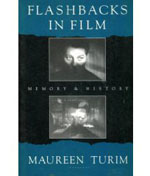 On our subject for today, the indispensible book, which ought to be brought back into print or archived online, is Maureen Turim’s Flashbacks in Film: Memory and History (Routledge, 1989). We may think of the flashback as a modern technique, but Turim shows that flashbacks have been a mainstay of filmic storytelling since the 1910s.
Although the term flashback can be found as early as 1916, for some years it had multiple meanings. Some 1920s writers used it to refer to any interruption of one strand of action by another. At a horse race, after a shot of the horses, the film might “flash back” to the crowd watching. (See “Jargon of the Studio,” New York Times for 21 October 1923, X5.) In this sense, the term took on the same meaning as then-current terms like “cut-back” and “switch-back.” There was also the connotation of speed, as “flash” was commonly used to denote any short shot.
But around 1920 we also find the term being used in our modern sense. You can find it in popular fiction; one short story has its female protagonist remembering something “in a confused flashback.” F. Scott Fitzgerald writes in The Beautiful and Damned of 1922:
Anthony had a start of memory, so vivid that before his closed eyes there formed a picture, distinct as a flashback on a screen.
At about the same time writers on theatre start to adopt the term and credit it to film. A historian of drama writes in 1921 of a play that rearranges story order:
The movies had not yet invented the flashback, whereby a thing past may be repeated as a story or a dream in the present.
Within film circles, there were signs of an exasperation with the device. One 1921 writer calls the flashback a “murderous assault on the imagination.” Turim quotes a New York Times review of His Children’s Children (1923):
For once a flash-back, as it is made in this photoplay, is interesting. It was put on to show how the older Kayne came to say his prayers.
In the same year, a critic discusses Elmer Rice’s On Trial, an influential 1911 stage play. Rice employs
a dramatic technique which up to its time was probably unique, though since then the ever recurrent “flash back” of the movies has made the trick an old story.
During the 1930s, although some critics and filmmakers employed older terms like “switch back” and “retrospect,” flashback seems to have become the standard label. It denoted any shot or scene that breaks into present-time action to show us something that happened in the past. It probably speaks to the intuitive and informal nature of filmmaking that writers and directors didn’t feel a need to name a technique that they were using confidently for two decades.
The early flashback films pretty much set the pattern for what would come later. Turim shows that all the sorts we find today have their precedents in the 1910s and 1920s. Adapting her typology a little bit, we can distinguish between character-based flashbacks and “external” ones.
A character-based flashback may be presented as purely subjective, a person’s private memory, as in Letter to Three Wives or The Pawnbroker or Across the Universe. There’s also the flashback that represents one character’s recounting of past events to another character, a sort of visual illustration of what is told. This flashback is often based on testimony in a trial or investigation (Mortal Thoughts, The Usual Suspects), but it may simply involve a conversation, as in Leave Her to Heaven, Titanic, or Slumdog Millionaire. It can also be triggered by a letter or diary, as happens with the doubly-embedded journals in The Prestige.
An alternative is to break with character altogether and present a purely objective or “external” flashback. Here an impersonal narrating authority simply takes us back in time, without justifying the new scene as character memory or as illustration of dialogue. The external flashback is uncommon in classic studio cinema (although see A Man to Remember, 1938) but was common in the 1900s and 1910s and has returned in contemporary cinema. Typically the film begins at a point of crisis before a title appears signaling the shift to an earlier period. Recent examples are Michael Clayton (“Three days earlier”), Iron Man (“36 Hours Before”), and Vantage Point (“23 Minutes Earlier”).
In current movies, flashbacks can fall between these two possibilities. Are the flashbacks in The Good Shepherd the hero’s recollections (cued by him staring blankly into space) or more objective and external, simply juxtaposing his numb, colorless life with the past disintegration of his family? The point would be relevant if we are trying to assess how much self-knowledge he gains across the present-time action of the film.
Rationales for the flashback
What purposes does a flashback fulfill? Why would any storyteller want to arrange events out of chronological order? Structurally, the answers come down to our old friends causality and parallelism.
Most obviously, a flashback can explain why one character acts as she or he does. Classic instances would be Hitchcock’s trauma films like Spellbound and Marnie. A flashback can also provide information about events that were suppressed or obscured; this is the usual function of the climactic flashback in a detective story, filling in the gaps in our knowledge of a crime.
By juxtaposing two incidents or characters, flashbacks can enhance parallels as well. The flashbacks in The Godfather Part II are positioned to highlight the contrasts between Michael Corleone’s plotting and his father’s rise to power in the community. Citizen Kane’s flashbacks are famous for juxtaposing events in the hero’s life to bring out ironies or dramatic contrasts.
Of course, flashbacks need not explain or clarify things; they can make things more complicated too. We tend to think of the “lying flashback” as a modern invention (a certain Hitchcock film has become the prototype), but Turim shows that The Goose Woman (1925) and Footloose Widows (1926) did the same thing, although not with the same surprise effect. Kristin points out to me that an even earlier example is The Confession (1920), in which a witness at a trial supplies two different versions of a killing we have already (sort of) seen.
At the limit, flashbacks can block our ability to understand characters and plot actions. This is perhaps best illustrated by Last Year at Marienbad, but the dynamic is already there in Jean Epstein’s La Glace à trois faces (“The Three-Sided Mirror,” 1927).
I argue in Poetics of Cinema that, at bottom, flashbacks are tactics fulfilling a broader strategy: breaking up the story’s chronological order. You can begin the film at a climactic moment; once the viewers are hooked, they will wait for you to move back to set things up. You can create mystery about an event that the plot has skipped over, then answer the question through a flashback. You can establish parallels between past and present that might not emerge so clearly if the events were presented in 1-2-3 order. Consequently, you can justify the switch in time by setting up characters as recalling the past, or as recounting it to others.
Having a character remember or recount the past might seem to make the flashback more “realistic,” but flashbacks usually violate plausibility. Even “subjective” flashbacks usually present objective (and reliable) information. More oddly, both memory-flashbacks and telling-flashbacks usually show things that the character didn’t, and couldn’t, witness.
I don’t suggest that recollections and recountings are merely alibis for time-juggling. They bring other appeals into the storytelling mix, such as allegiance with characters, pretexts for point-of-view experimentation, and so on. Still, the basic purpose of nonchronological plotting, I think, is to pattern information across the film’s unfolding so as to shape our state of knowledge and our emotional response in particular ways. Scene by scene and moment by moment, flashbacks play a role in pricking our curiosity about what came before, promoting suspense about what will happen next, and enhancing surprise at any moment.
A trend becomes a tradition
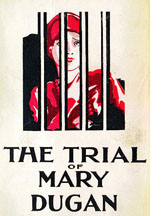 When The Power and the Glory was released in August 1933, it was part of a cycle of flashback films. The Trial of Mary Dugan (1929), The Trial of Vivienne Ware (1932), and other courtroom films rendered testimony in flashbacks. A film might also wedge a brief or extended flashback into an ongoing plot. The most influential instance was probably Smilin’ Through (1931), which is notable for using a crane shot through a garden to link present and past.
Also well-established was the extended insert model. Here we start with a critical situation that triggers a flashback (either subjective or external), and this occupies most of the movie. Digging around, I found these instances, but I haven’t seen all of them; some don’t apparently survive.
- Behind the Door (1919): An old sea salt recalls life in World War I and, back in the present, punishes the man responsible for his wife’s death. A ripoff of Victor Sjöström’s Terje Vigen (1917)?
- An Old Sweetheart of Mine (1923): A husband goes through a trunk in an attic and finds a memento that reminds him of childhood sweetheart. The pair grow up and marry, facing tribulations. At the end, back in the present, she comes to the attic with their kids.
- His Master’s Voice (1925): Rex the dog is welcomed home from the war. An extended flashback shows his heroic service for the cause, and back in the present he is rewarded with a parade.
- Silence (1926): A condemned man explains the events that led up to the crime. Back in the present, on his way to be executed, he is saved.
- Forever After (1926): On a World War I battlefield, a soldier recalls what brought him there.
- The Woman on Trial (1927): A defendant recalls her past.
- The Last Command (1928): One of the most famous flashback films of the period. An old movie extra recalls his life in service of the tsar.
- Mammy (1930): A bum reflects on the circumstances leading him to a life on the road.
- Such is Life (1931): A ghoulish item. A fiendish scientist confronts a young man with the corpse of the woman he loves. A flashback to their romance ensues.
- The Sin of Madelon Claudet (1931; often cablecast on TCM): A young wife bored with her husband is told the story of a neighbor woman who couldn’t settle down.
- Two Seconds (1932): A man about to be executed remembers, in the two seconds before death, what led him here. A more mainstream reworking of a premise of Paul Fejos’s experimental Last Moment (1928), which is evidently lost.
An interesting variant of this format is Beyond Victory, a 1931 RKO release. The plot presents four soldiers on the battlefield, each one recalling his courtship of the woman he loves back home. The principle of assembling flashbacks from several characters was at this point prised free of the courtroom setting, and multiple-viewpoint flashbacks became important for investigation plots like Affairs of a Gentleman (1934), Through Different Eyes (1942), The Grand Central Murder (1942), and of course Citizen Kane, itself a sort of mystery tale.
Why this burst of flashback movies? It’s a good question for research. One place to look would be literary culture. The technique of flashback goes back to Homer, and it recurs throughout the history of both oral and written narrative. Literary modernism, however, made writers highly conscious of the possibility of scrambling the order of events. From middlebrow items like The Bridge of San Luis Rey (1927) to high-cultural works by Dos Passos and Faulkner, elaborate flashbacks became organizing principles for entire novels. It’s likely that Sturges, a Manhattanite of wide literary culture, was keenly aware of this trend.
It’s just as likely that he noticed similar developments in another medium. By 1931, when Katharine Seymour and J. T. W. Martin published How to Write for Radio (New York: Longmans, Green), they could devote considerable discussion to frame stories and flashbacks in radio drama (pp. 115-137). Especially interesting for Sturges’ film, radio programs were letting the voice of the announcer or the storyteller drift in and out of the action that was taking place in the past.
For whatever reasons, the technique became more common. The year 1933 saw several flashback films besides The Power and the Glory. In the didactic exploitation item Suspicious Mothers, a woman recounts her wayward path to redemption. Mr. Broadway offers an extensive embedded story using footage from another film (a common practice in the earliest days). Terror Aboard begins with the discovery of corpses on a foundering yacht, followed by an extensive flashback tracing what led up the calamity. A borderline case is the what-if movie Turn Back the Clock (1933). Ever-annoying Lee Tracy plays a small businessman run down by a car. Under anesthesia, he reimagines his life as it might have been had he married the girl he once courted. Call it a rough draft for the “hypothetical flashbacks” that Resnais was to exploit in his great La Guerre est finie.
The point of this cascade of titles is that in writing The Power and the Glory, Sturges was working with a set of conventions already in wide circulation. His inventiveness stands out in two respects: the handling of voice-over and the ordering of the flashbacks.
Now I’m about to divulge details of The Power and the Glory.
Narratage, anyone?
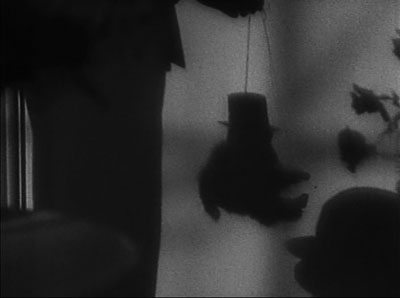
The film begins with what became a commonplace opening gesture of film, fiction, and nonfiction biography: the death of the protagonist. We are at the funeral of Thomas Garner, railroad tycoon. His best friend and assistant Henry slips out of the service. After visiting the company office, Henry returns home. Sitting in the parlor with him, his wife castigates Garner as a wicked man. “It’s a good thing he killed himself.” So we have the classic setup of retrospective suspense: We know the outcome but become curious about what led up to it.
Henry’s defense of Garner launches a series of flashbacks. As a boyhood friend, Henry can take us to three stages of the great man’s life: adolescence, young manhood, and late middle age. Scenes from these time periods are linked by returns to the narrating situation, when Henry’s wife will break in with further criticisms of Garner.
Sturges boasted in a letter to his father: “I have invented an entirely new method of telling stories,” explaining that it combines silent film, sound film, and “the storytelling economy and the richness of characterization of a novel.” At the time, the Paramount publicists trumpeted that the film employed a new storytelling technique labeled narratage, a wedding of “narrating” and “montage.” One publicity item called it “the greatest advance in film entertainment since talking pictures were introduced.” Hyperbole aside, what did Sturges have in mind?
There is evidence that some screenwriters were rethinking their craft after the arrival of sound filming. Exhibit A is Tamar Lane’s book, The New Technique of Screen Writing (McGraw-Hill, 1936). Lane suggests that the talking picture’s promise will be fulfilled best by a “composite” construction blending various media. From the stage comes dialogue technique and sharp compression of action building to a strong climax. From the novel comes a sense of spaciousness, the proliferation of characters, a wider time frame, and multiple lines of action. Cinema contributes its own unique qualities as well, such as the control of tempo and a “pictorial charm” (p. 28) unattainable on the stage or page.
Vague as Lane’s proposal is, it suggests a way to think about the development of Hollywood screenwriting at the time. Many critics and theorists believed that the solution to the problem of talkies was to minimize speech; this is still a common conception of how creative directors dealt with sound. But Lane acknowledged that most films would probably rely on dialogue. The task was to find engaging ways to present it. Several films had already explored some possibilities, the most notorious probably being Strange Interlude (1932). In this MGM prestige product, the soliloquys spoken by characters in O’Neill’s play are rendered as subjective voice-over. The result, unfortunately, creates a broken tempo and overstressed acting. A conversation will halt, and through changes of facial expression the performer signals that what we’re now hearing is purely mental.
The Power and the Glory responds to the challenge of making talk interesting in a more innovative way. For one thing, there is the sheer pervasiveness of the voice-over narration. We’re so used to seeing films in which the voice-over commentary weaves in and out of a scene’s dialogue that we forget that this was once a rarity. Most flashback films in the early sound era had used the voice-over to lead into a past scene, but in The Power and the Glory, Henry describes what we see as we see it.
Most daringly, in one scene Henry’s voice-over substitutes for the dialogue entirely. Young Tom and Sally are striding up a mountainside, and he’s summoning up the nerve to propose marriage. What we hear, however, is Henry at once commenting on the action and speaking the lines spoken by the couple, whose voices are never heard.
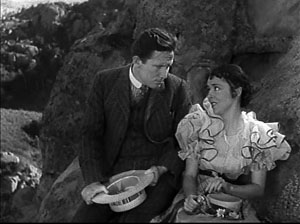
This scene, often commented upon by critics then and now, seems have exemplified what Sturges late in life recalled “narratage” to be. Describing that technique in his autobiography, he wrote: “The narrator’s, or author’s, voice spoke the dialogue while the actors only moved their lips” (p. 272).
So one of Sturges’ innovations was to use the voice-over not only to link scenes but to comment on the action as it played out. In her pioneering book Invisible Storytellers: Voice-Over Narration in American Fiction Film (Univesity of California Press, 1988), Sarah Kozloff has argued that the pervasiveness of Henry’s narration has no real precedent in Hollywood, and few successors until 1939 (pp. 31-33). (There’s one successor in Sacha Guitry’s Roman d’un tricheur.) The novelty of the device may have led Sturges and Howard toward redundancies that we find a little labored today. The transitions into the past from the frame story are given rather emphatically, with Henry’s voice-over aided by camera movements that drift away from the couple. (Compare the crisp shifts in Midnight Mary, below.) Henry’s comments during the action are sometimes accentuated by diagonal veils that drift briefly over the shot, as if assuring us that this speech isn’t coming from the scene we see.
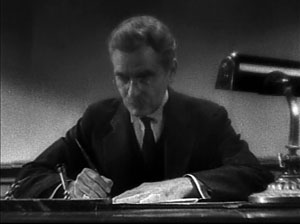
The “montage” bit of “narratage” also invokes the idea of a series of sequences guided by the voice-over narrator. The concept might also have encompassed the most famous innovation of The Power and the Glory: Sturges’ decision to make Henry’s flashbacks non-chronological.
Even today, most flashback films adhere to 1-2-3 order in presenting their embedded, past-tense action. But Sturges noticed that in real life people often recount events out of order, backing and filling or free-associating. So he organized The Power and the Glory as a series of blocks. Each block contains several scenes from either boyhood, youth, or middle age. Within each block, the scenes proceed chronologically, but the narration skips around among the blocks.
For example, a block of boyhood scenes gives way to a set showing Garner, now in middle age, ordering around his board of directors. The next cluster of flashbacks returns to Garner’s youth and his courtship of his first wife, Sally. Then we are carried back to his middle age, with scenes showing Garner alienated from Sally and his son Tommy but also attracted to the young woman Eve. And from there we return to Garner’s early married life with Eve.
To keep things straight, Sturges respects chronology along another dimension. Not only do the scenes within each block follow normal order, but the plotlines developing across the three phases of Garner’s life are given 1-2-3 treatment. In one block of flashbacks, we see Tom and Sally courting. When we return to that stage of their lives in another block, they are happily married. The next time we see Garner as a young man, he is improving himself by attending college. The later romance with Eve develops in a similar step-by-step fashion across the blocks devoted to middle age.
A major effect of the shuffling of periods is ironic contrast. Maureen Turim points out that seeing different phases of Garner’s life side by side points up changes and disparities. In his youth, Tom watches the birth of his son with awe; in the next scene, we are reminded what a wastrel young Tommy turned out to be.
The juxtaposition of time frames also nuances character development. As Sally ages, she turns into something of a nag, quarreling with her husband and pampering Tommy. But in the next sequence we see her young, ambitiously pushing Tom to succeed and willing to undergo sacrifice by taking up his job as a railroad track-walker. The next scenes show Tom in class and in a bar while Sally walks the desolate tracks in a blizzard. She has given up a lot for her husband. In the next scene, set in middle age, Garner confesses his love to Eve but says he could never leave Sally, and the juxtaposition with Sally’s solitary track-walking suggests that he recognizes her sacrifice. And in the following scene, when Sally comes to Garner’s office, she admits that she has become disagreeable and asks if they couldn’t take a trip to reignite their love. The juxtaposition of scenes has turned a caricatural shrew into a woman who is a more complex mixture of devotion, disenchantment, and self-awareness.
Other characters aren’t given this degree of shading—Tommy is pretty much a wastrel, Eve a vamp—but another married couple deepens the central parallel. Meek Henry is dominated by his wife, but by the end she is chastened by what she learns of Garner’s real motives. Critic Andy Horton, in his helpful introduction to Sturges’ published screenplay, indicates that this couple adds a note of contentment to what is otherwise a pretty sordid melodrama of adultery and quasi-incest.
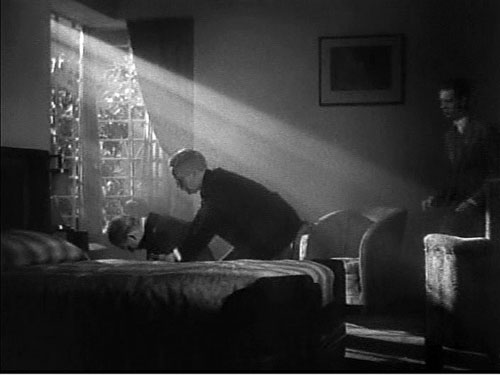
The innovative flashbacks and voice-overs are an important part of the film’s appeal, but director William K. Howard supplied some craftsmanship of his own. Particularly striking are some silhouette effects, low angles, and deep-focus compositions that underscore the parallels between Sally’s suicide and Garner’s impending death.
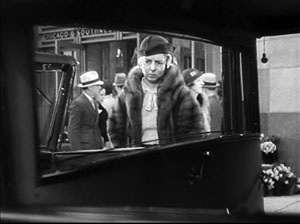
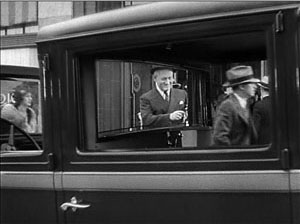
The original screenplay suggests that Sturges intended to push his innovations further. About halfway through, he starts to break down the time-blocks. In the script, Sally visits Garner while he’s working on a bridge. The next scene shows their son Tommy already grown and spoiled, being taken back into his father’s good graces. Then the script returns to the bridge, where Sally tells Tom she’s pregnant. The interruption of the bridge scene reminds us of how badly their child turned out.
The script jumps back to the birth of the baby. In the film the birth scene plays out in its entirety, but in the screenplay Sturges cuts it off by the scene (retained in the film) showing Garner’s marriage to Eve. The final moments of the birth scene, when Garner prays (“Thou art the power and the glory”), become in the script the very end of the film. Coming after Tom’s death at the hand of his son, this epilogue is a bitter pill, rendered all the harder to take by providing no return to Henry and his wife.
The greater fragmentation of the second part of the script, along with Garner’s death as a sort of murder-suicide and the failure to return to the narrating frame, is striking. It’s as if Sturges felt he could take more chances, counting on his viewers’ familiarity with current flashback conventions and on his film’s firmly established time-shuttling method. But if, as sources report, Sturges’ script was initially filmed exactly as written, then it seems likely that the film’s June 1933 preview provoked the changes we find in the finished product. “The first half of the picture,” he remarked in a letter, “went magnificently, but the storytelling method was a little too wild for the average audience to grasp and the latter half of the picture went wrong in several spots. We have been busy correcting this and the arguments and conferences have been endless.”
Even the compromised film proved difficult for audiences. Tamar Lane, proponent of the “composite” form suitable for the sound cinema, felt that the “retrospects” in The Power and the Glory were too numerous and protracted. Nonetheless, he praised it for its “radical and original cinema handling” (p.34). That handling rested upon tradition—a tradition that in turn encouraged innovations. Once flashbacks had become solid conventions, Sturges could risk pushing them in fresh directions.
Mary remembers
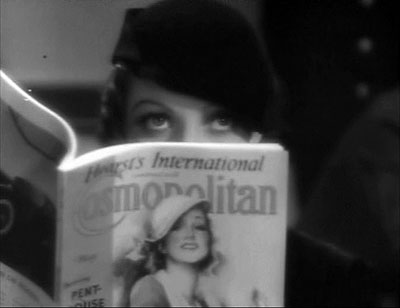
Finally, two more flashy flashback movies from 1933. Some spoilers.
Midnight Mary (MGM, William Wellman) works a twist on the courtroom template. The defendant Mary Martin is introduced jauntily reading a magazine while the prosecutor demands that the jury find her guilty of murder. This also sets up a nice little motif of shots highlighting Loretta Young’s lustrous eyes. The motif pays off with a soft-focus shot of her in jail just before the climax.
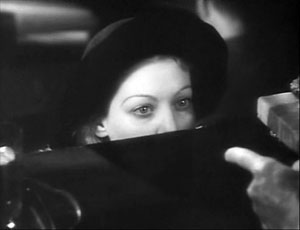
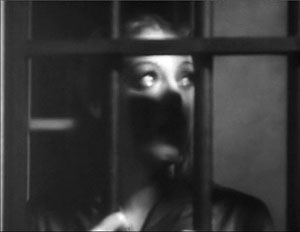
As the opening scene ends, Mary is led to a clerk’s office to wait for the verdict. There’s an automatic dose of suspense (Will she be found guilty?) but there’s also considerable curiosity: Whom has she killed? How was she caught?
These questions won’t be answered for some time. Lounging in the clerk’s office, Mary runs her eye runs across the annual reports filling his shelves. The flashbacks, which comprise most of the film, are introduced as close-ups of the volumes’ spines—1919, 1923, 1926, 1927, and so on up to the present. They serve as neatly motivated equivalents of those clichéd calendar pages that ripple through montage sequences of the 1930s.
The flashbacks are motivated as subjective; Mary doesn’t recount her life to the clerk but simply reviews it in her mind. Unlike the flashbacks in The Power and the Glory, they are chronological and without gaps. Nothing is skipped over to be revealed later. As usual, though, once Mary’s recollections have triggered the rearrangement of story order, the flashbacks are filmed as any ordinary scenes would be, including bits of action that she isn’t present to witness. The film is a good example of using the extended-flashback convention chiefly to delay the resolution of the climactic action. Told in chronological order, Mary’s tale of woe would have had much less suspense.
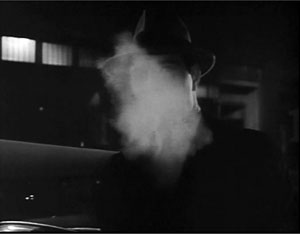
Transitions between present and past are areas open to innovation, and early sound filmmakers took advantage of them. In Midnight Mary, the long flashback closes with gangsters pounding on the door of Mary’s boudoir; this sound continues across the dissolve to the present, with Mary roused from her reverie by a knock on the clerk’s office door. Earlier, one transition into the past begins with Mary blowing cigarette smoke toward the bound volumes on the shelf.
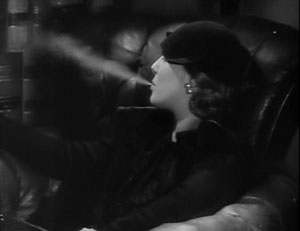
Dissolve to a close-up of one book as smoke wafts over it, and then to a shot of Mary’s gangster boyfriend blowing cigarette smoke out before he sets up a robbery..
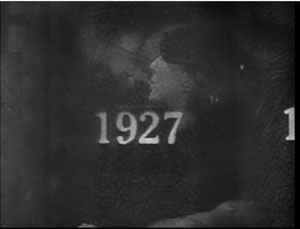
At one point the narration supplies a surprise by abruptly shifting into the present. Once Mary has become a prostitute, she is slumped over a barroom table in sorrow, while her pal Bunny consoles her. In a tight shot, Bunny (Una Merkel, always welcome), leans over and says: “Oh, what’s the diff, Mary? A girl’s gotta live, ain’t she?”
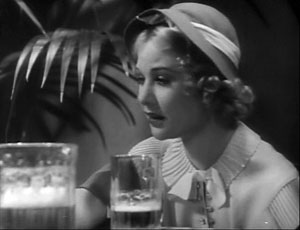
Cut directly to the present, with Mary murmuring: “Not necessarily, Bunny. The jury’s still out on that.”
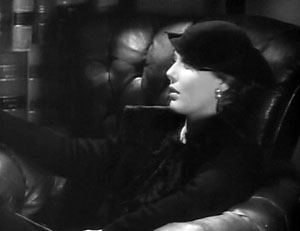
Mary’s reply casts Bunny’s question about needing to live in a new light, since Mary is facing execution, and the use of the stereotyped phrase, “The jury’s still out,” now with a double meaning, reminds us of the present-tense crisis. It is a more crisp and concise link than the transitions we get in The Power and the Glory. But then, Wellman has no need for continuous voice-over, which gives the Sturges/ Howard film its more measured pace.
Filmmakers were concerned with finding storytelling techniques appropriate to the sound film, and these unpredictable links between sequences became characteristic of the new medium. Similar links had appeared in silent films, but they gained smoothness and extra dimensions of meaning when the images were blended with dialogue or music. For more on transitional hooks, go here.
Nora and narratage
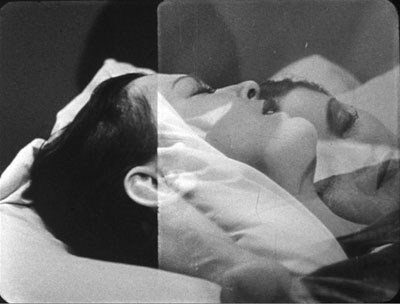
The hooks between scenes are perhaps the least outrageous stretches of The Sin of Nora Moran, a Majestic release that, thanks to a gorgeous restoration and a DVD release, has rightly earned a reputation as the nuttiest B-film of the 1930s.
It is a flashback frenzy, boxes within boxes. A District Attorney tells the governor’s wife to burn the apparently incriminating love letters she’s found. In explaining why, the D. A. introduces a flashback (or is it a cutaway?) to Nora in prison. We then move into Nora’s mind and see her hard life, the low point occurring when she’s raped by a lion tamer.
Now we start shuttling between the D. A. telling us about Nora and Nora remembering, or dreaming up, traumatic events. At some points, characters in her flashbacks tell her that what she’s experiencing is not real. In one hazy sequence, her circus pal Sadie materializes in her cell to remind Nora that she killed a man. (Actually, she didn’t.) At other moments Nora’s flashbacks include moments in which she says that if she does something differently, it will change—it being the outcome of the story. At this point another character will point out that they can’t change the outcome because it has already happened . . . of course, since this is a flashback.
By the end, after the governor has had his own flashback to the end of his affair with Nora and after she appears as a floating head, things have gotten out of hand. The rules, if there are any, keep changing. And the whole farrago is propelled by furious montage sequences built out of footage scavenged from other films.
Publicity and critical response around The Sin of Nora Moran implied that the movie followed the “narratage” method. There was surely some influence. Scenes contain fairly continuous voice-over commentary, and director Phil Goldstone occasionally drops in the diagonal veil used in The Power and the Glory. But on the whole this delirious Poverty Row item falls outside the strict contours of Sturges’ experiment. Nora Moran blurs the line separating flashbacks and fantasy scenes, and it illustrates how easily we can lose track of what time zone we’re in. Watching it, I had a flashback of my own—to Joseph Cornell’s Rose Hobart, another compilation revealing that Hollywood conventions are only a few steps from phantasmagorias.
Unwittingly, Nora Moran’s peculiarities point forward to the flashback’s golden age, the 1940s and early 1950s. Then we got contradictory flashbacks, flashbacks within flashbacks within flashbacks, flashbacks from the point of view of a corpse (Sunset Boulevard) or an Oscar statuette (Susan Slept Here). Filmmakers knew they had found a good thing, and they weren’t going to let it go.
The original screenplay of The Power and the Glory is included in Andrew Horton, ed., Three More Screenplays by Preston Sturges (Berkeley: University of California Press, 1998). Sturges’ reflections from the late 1950s are to be found in Preston Sturges by Preston Sturges: His Life in His Words, ed. Sandy Sturges (New York: Simon and Schuster, 1990). The quotations from Sturges’ letters and from publicity about “narratage” can be found in Diane Jacobs, Christmas in July: The Life and Art of Preston Sturges (Berkeley: University of California Press, 1992), 123-129 and James Curtis, Between Flops: A Biography of Preston Sturges (New York: Harcourt Brace Jovanovich, 1982), 87.
My citatations of literary uses of the term come from Elliott Field, “A Philistine in Arcady,” The Black Cat 24, 10 (July 1919), 33; Fitzgerald’s The Beautiful and Damned (1922), available here, 433; Samuel A. Eliot, Jr., ed., Little Theater Classics vol. 3 (Boston: Little, Brown, 1921), 120; The Outlook (11 May 1921), 49, available here; review of His Children’s Children, quoted in Turim p. 29; commentary on On Trial, in The New York Times (25 March, 1923), X2.
For more on the history of flashback construction, apart from Maureen Turim’s Flashbacks in Film, see Barry Salt’s Film Style and Technology: History and Analysis, 2nd ed. (London: Starword, 1992), especially 101-102, 139-141. There are discussions of the technique throughout David Bordwell, Janet Staiger, and Kristin Thompson, The Classical Hollywood Cinema: Film Style and Mode of Production to 1960 (New York: Columbia University Press, 1985), especially 42-44.
P.S. 15 November 2015: 1940s flashback technique is surveyed in my Reinventing Hollywood: How 1940s Filmmakers Changed Movie Storytelling.
Ashes to Ashes (Redux)
DB here:
Hong Kong films constantly shift their shapes. Both film prints and video versions circulate in a bewildering variety of forms. A movie shot in Cantonese (the vernacular of the locals) may be dubbed into Mandarin, the language of the Mainland and of Taiwan. But it may also be dubbed into English, French, or other Western languages; such was the fate of many kung-fu films of the 1970s, as well as later productions like The Killer (1989). I have seen Happy Together in Italian and In the Mood for Love in Spanish. When a movie is exported, it may also be recut to suit the local market. Typically Hong Kong producers have sold films under terms that allowed foreign distributors to do pretty much what they liked with both theatrical and video releases.
Alternatively, the filmmaker may cooperate and remake the film to fit foreign tastes. During the boom years of the 1980s and early 1990s, when many films were funded through presales to Taiwan, it was common to have both a Taiwanese version (usually longer) and a Hong Kong one. Jackie Chan’s Police Story (1985) included extra scenes of Jackie’s antics to satisfy Japanese audiences, and the directors of Infernal Affairs (2002) provided a less desolate ending to satisfy Chinese censors. In addition, filmmakers began circulating “international versions” that would play film festivals, and these might not accord with what was released locally. I’ve discussed one instance earlier on this blog: a version of Days of Being Wild that includes opening material not visible in the international print. My current supposition is that this is a local release print that may have circulated in Western Chinatowns too.
To complicate things further there was the institution of the midnight show. Instead of holding test screenings, Hong Kong producers would preview their films at a few theatres late on weekend nights. Audiences knew that they were acting as guinea pigs and weren’t shy about expressing their displeasure. While filmmakers cringed in the back, viewers might shout insults at the screen. The producers and the director would meet to settle on what changes should be made. Then they would hustle to prepare new versions for the official release in the next week or two.
On top of this, add the next layer of revision: the post-festival rethink. Western directors have redone their movies after discouraging festival response. Probably the most famous instance is the death and resurrection of Vincent Gallo’s The Brown Bunny (2003).Now that Hong Kong and Taiwanese directors circulate on the fest scene, they too have tinkered with their work after premieres, notably Hou Hsiao-hsien, who has reworked films following less than enthusiastic Cannes screenings.
A director’s job is never done?
Like many Hong Kong movies, nearly every one of Wong Kar-wai’s films went through multiple versions. But unlike many directors he seems to enjoy tweaking and rethinking his work. In production he shoots scenes, watches them, reshoots them, recuts them, and reshoots again. Editing and mixing involve the same play with variants. He adds different shots, juggles the order, adds or subtracts music at will.
The process may seem to betray an uncertainty about what he wants his movie to be. For In the Mood for Love, he shot scenes of the central couple making love but didn’t use them, playing with the possibility that the affair is chaste. 2046 began as a high-concept project, based on the fifty-year expiration of the 1997 handover accords, and it went through many different incarnations. At one point it was to be a tale of the intertwining lives of different Hong Kong citizens whose addresses were 2046 on their streets. Even the actors may not know what’s up. At the Cannes premiere of 2046, Maggie Cheung was startled to learn that she was barely in the movie.
Of course most filmmakers rediscover their films at each stage of production, but for Wong the idea of a “locked” version is fairly indeterminate. Virtually everyone now acknowledges that a Wong festival premiere is a first approximation. Delivered in the nick of time (sometimes embarrassingly late), the film is likely to be reworked after initial screenings. Venice and Cannes, Tony Rayns points out, have served as counterparts to the local midnight shows.
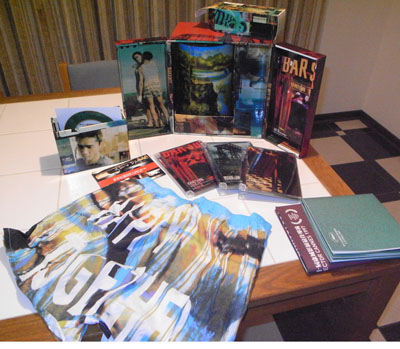
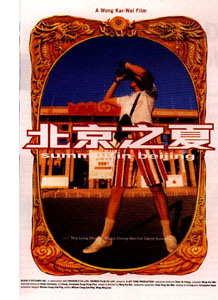 In Planet Hong Kong I suggested that Wong became a shrewd guardian of his brand. He has created high-end ancillary products, not only CD soundtracks but posters, T-shirts, glossy photo books, and limited-edition DVD sets. The Happy Together anniversary box (limited to 2046 units) includes a model of the spinning Iguazu Falls lamp and a pair of men’s briefs. The spinoffs are issued with fancy packaging, and they have usually sold briskly in upscale Asian shops, particularly in Japan. It’s characteristic that Wong’s aborted project Summer in Beijing could serve as a corporate travel logo. At once cult filmmaker and luxury franchise, Wong has every reason to refresh, and re-market, his content at intervals.
Yet I don’t maintain that he’s insincere. His drive to redo his films seems to go beyond indecision or commercial calculation. Wong seems to have taken to heart his central theme of the transient moment, the fact that love can be extinguished at any instant. So why not change your films to match your mood today? Further, like Warhol, he seems to enjoy prodigality for its own sake. He enjoys conjuring up one variation after another, multiplying just barely different avatars, and draping in mist the notion of any original text. His films’ basic constructive principle—the constant repetitions that create parallels and slight differences, loops of vaguely familiar images and sounds and situations—gets enacted in his very mode of production.
So he rebuilds even after release. The DVD release lets him tack on unused materials, extra scenes and different endings. That’s enough for most directors, but Wong has long harbored the dream of compiling vast swatches of unused footage in a sort of variorum DVD set of all his films. But why should he have all the fun? He once announced plans to put his footage for Happy Together on the Internet and let anyone make a personal version of it. That didn’t happen, but he did allow his assistants to make Buenos Aires Zero Degree (1999): not only an essayistic making-of but also a handsome reliquary of discarded material, including a gorgeous sequence of two taxis arcing away from each other.
Evil East, Malicious West, and their posse
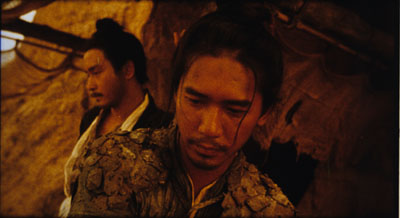
Now we have Ashes of Time Redux, premiered at Cannes and showing in the US. The most apparent analogies, the oft-revised Blade Runner and the other redux, Apocalypse Now, don’t do justice to Wong’s fussbudget impulses.
For the original Ashes Wong assembled a high-wattage cast that included two of the Heavenly Kings of Cantopop and three glamorous female stars. He spreads out their duties by means of an ensemble plot. At the center stands Ouyang Feng (Leslie Cheung Kwok-wing), a swordsman who has set up a way station on the edge of the desert. He acts as a broker for people who want to hire killers. Another swordsman, Huang Yaoshi (Tony Leung Kar-fai) visits him every year. Ouyang nurses unrequited love for his brother’s wife (usually known as the Woman, played by Maggie Cheung Man-yuk), who lives far away. Huang is also subject to the Woman’s charms, but he is more deeply in love with Peach Blossom (Carina Lau Kar-ling), a woman he saw bathing her horse in a river. Peach Blossom is the wife of yet another wandering swordsman, who is gradually growing blind (Tony Leung Chiu-wai). He too fetches up at Ouyang’s outpost. Huang also runs afoul of the Murongs, a brother and sister who may be the same person (Brigitte Lin Ching-hsia). Meanwhile, a young girl (Charlie Yeung Choi-nei), fortified only with a mule and a basket of eggs, waits at Ouyang’s cabin to hire someone to avenge her brother’s death. Finally, there is Hong Qi (Jacky Cheung Hok-lau), a down-at-heel young killer for hire, who is followed across the desert by his wife.
The interlocking love triangles around a narcissistic man recall Wong’s breakthrough film, Days of Being Wild (1990), although here the parallels and connections are fleshed out through kinship too. The basic relations are at first hard to parse, though a Western viewer who didn’t recognize these stars will have more trouble than a Chinese one. Wong complicates the exposition by fragmenting his scenes and inserting flashbacks, though most of the latter are easy to follow.
He also helps the audience by following a common Hong Kong storytelling principle: reel-by-reel plotting. This breaks the movie into fairly discrete chunks of ten minutes (about a reel) or twenty minutes (about two reels). The first reel sets up the central relation of Ouyang Feng and Huang Yaoshi. Then two reels are devoted to the Murongs and their efforts to trap Huang. The next two reels are spent on the Blind Swordsman, followed by two reels devoted to Hong Qi and the Egg Girl. The last two reels unearth the long-simmering relationship among Ouyang, the Woman, and the despairing Huang. So the plot is actually a bit tidier than it seems at first, although each of these chunks is marbeled with references to other story lines. In Redux, Wong has also divided the plot into seasons, a strategy that accentuates the multipart structure.
Now about all those versions. Preliminary confession: These comments are based on one 35mm screening, and my analytical points are based on a DVD screener.
Keeping it unreal
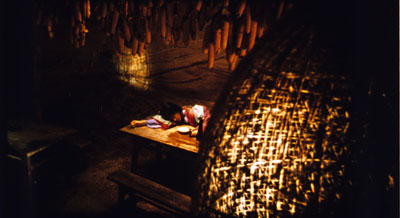
Before Redux, there were at least two versions of Ashes of Time. One premiered at the Venice festival of 1994, the other became the international standard version. The differences are striking.
The international version has several hyperactive swordfights quite early. In a prologue before the title credit, Ouyang Feng and Huang Yaoshi fight a duel. After that, each is given a combat sequence in which he takes on hordes of assailants. These sequences are rapidly cut, with exaggerated angles, accelerated or slowed motion, and pulsing freeze frames. At the end of the international version comes a brief, parallel epilogue showing the surviving warriors (Ouyang, Huang, Hong Qi, and Murong) in the midst of combat. This epilogue includes a tableau of Yin, the female Murong, writhing ecstatically on a bed of red blossoms.
It’s widely believed among Hong Kong film people that this international version was initially created for the regional market and overseas Chinatowns. Wong added swordplay sequences at the beginning and end in order to satisfy his Taiwanese producers, who wanted more action in this otherwise talky and moody movie. How this version, running about ninety-five minutes without credits, became the standard one I don’t know, but evidently Wong did not control the international rights on the film. In any case, we have the evidence of Derek Elley’s Variety review that these passages were not in the Venice copy.
I’ve seen Ashes in 35mm in several countries, and it’s always been the international version. That is the version available on Hong Kong laserdisc and video, as well as on Japanese DVD (as near as I can tell from my imperfect disc). But the French DVD, released by TF1, is quite different. It runs 87:30 without credits (and assuming 24 fps). This version lacks several scenes, including the opening brawls, and ends with a close-up of the pale face of the Woman looking out to sea. It may be that this French version, billed on the packaging as the “original” one, is close to the Venice print.
Wong reports that he rescued original material, both positive and negative, from various sources. Since some of it was in poor condition, digital versions were made. In the final result, a few shots have been replaced with alternate takes. Yet the film is not simply restored but “reimagined,” as the title Redux indicates.
By and large, the sequence of story events, the shot-by-shot progression, and the monologues and dialogues are the same in both the international version and this new one. What, then, has Wong changed? He has kept nearly all of the brief prologue showing a rapid-fire combat between Ouyang and Huang. He has eliminated the approximately three minutes of the two fights that establish the solo prowess of the fighters. He has also cut the epilogue’s burst of action, retaining only a shot of Ouyang slashing in slow-motion and swiveling in a freeze frame that gradually fades out. In other fight scenes, he has trimmed some elaborate action and at least one gory bit, showing Murong impaling a cat.
Which is to say that he has deleted several conventional displays of the wuxia pian, or “heroic chivalry” film, of the 1990s. In Planet Hong Kong, I argued that Wong’s films often play off the mainstream conventions of his moment. He embraces pop music, pop stars, and pop genres: the triad movie (As Tears Go By, 1988), the melodrama (Days of Being Wild, Happy Together), and the romantic comedy/ cop movie (Chungking Express). But the films rework those conventions too. Wong subtracts a bit of glossiness by emphasizing the grubbiness of location shooting and by mussing up his stars, but then he re-beautifies things through his lustrous images and his unashamed interest in romantic longing. His men alternate between impulsive action and moody withdrawal, and his women mostly lounge about waiting for their men to make a move. (You could do a whole essay on the figure of the Waiting Woman in his work.) The sheer conviction of his style and sentiment can redeem quite hoary clichés, such as the woman’s inevitable complaint that her man never told her he loved her (a crucial turning point in Ashes of Time).
By the early 1990s, the wuxia pian had become a fantasy extravaganza, packed with flying swordsmen, magic potions, special effects, dynamic visuals, pounding music, and play with gender identity. The second and third installments of Tsui Hark’s Swordsman trilogy, a phantasmagoric treatment of the genre, present Brigitte Lin as the bi-gendered Invincible Asia, a vessel of both martial and erotic fantasies.
In part Ashes cites these current formulas in order to rework them. Conventional props like magic wine become tied to themes of memory and regret for missed chances. Discussions of combat strategy are replaced by monologues musing on lost loves. The male/ female masquerade of The East Is Red becomes, in Ashes, a hallucinatory shift of identity (are the Murongs two people or one person?) and forms one point of a thematic continuum centering on men’s desire to possess other men’s women.
Visually as well, Wong borrows and reworks fantasy wuxia conventions. One of the women warriors in The East Is Red (1993) unleashes her volcanic sword skills while standing on the surface of the sea.
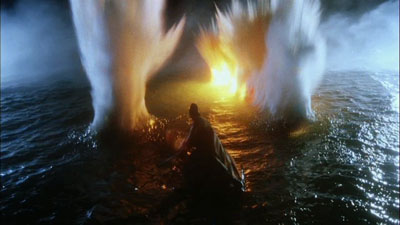
Something quite similar happens in Ashes. But once Wong has turned Murong’s ambidextrous gender into a question of identity, you could argue that the geysers of water she unleashes make a broad thematic point: the primal force of a character named both Yin and Yang.
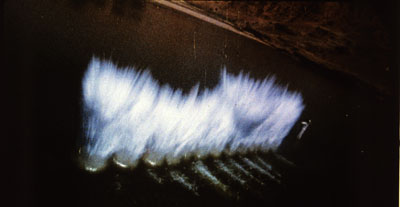
So the original Ashes reworks motifs to be found in Tsui’s extravaganzas, and for all I know in others as well. But apart from the Murong waterworks, these moments of dialogue with the fantasy wuxia pian entries are muffled in Redux.
From the original action scenes Wong has trimmed the turbocharged leaps and swoops, the blasts of “palm power,” and the possibility that a slashing blade can make a hillside explode. Perhaps Wong wanted to leave behind the overwrought world of wuxia fantasy—popular in 1994 but likely to seem cartoonish to Western audiences now. I wonder, though, why he has retained the opening clash between Ouyang and Huang, since the rest of the film presents them as friends. The answer may lie in the original Louis Cha novel, The Eagle-Shooting Heroes, a multi-volume saga that inspired both Ashes and the 1993 Jeff Lau film (co-produced by Wong) called by the novel’s title.
Other changes serve to create greater nuance or lyricism. The synthesizer score has been replaced by a spacious orchestral one, enhanced by stereo. Other stretches of music have been dropped altogether. There is a little less of the Morricone flavor now; the music coaxes rather than hammers. We get more shots of the moon, some fresh landscape vistas, a few more pools of water. Sometimes blood splashes out at us, but at one point an out-of-focus spray of blood is replaced by an optical effect showing wafting dark red billows.
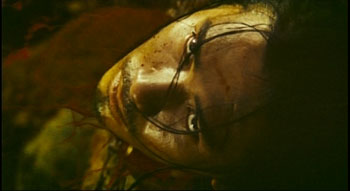
The most pervasive change has involved the color tonalities. The 35mm prints of Ashes I’ve seen have favored a vivid orange-brown palette, with strong blues (sky and water), red accents, and very little green. The video copies vary, but the most commonly available DVD version is notably more russet and lower contrast than the 35mm. Redux, though, is a total rethink. Interiors have lost most of their hard-edged chiaroscuro and become softer and paler. Exteriors, and some interiors, have been keyed toward a hard yellow. The vivid browns and oranges have gone a bit gray, and the blacks verge on green. In addition, some highlights have burned out.
Consider these three frames. The first is a scanned Fujichrome slide that was photographed from a 35mm print. The second frame is from the Hong Kong DVD release. The third is from the Redux screener DVD. None has been photographically adjusted for reproduction here.

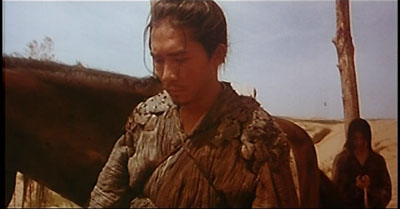
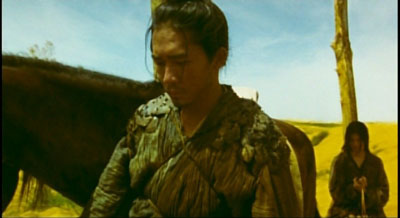
All of these are some distance from their sources; for instance, the 35mm slide can’t really capture the range of tonalities of the original, especially in the dark areas. Still, I think the relationship is a fair reflection of the differences. In 35mm, Redux looks a lot more crisp, rich, and detailed than in this DVD frame-grab, but the lemon yellows and pale greens are fairly faithful to my memory of the print.
Wong has taken advantage of ways to improve the film. Seeing the international version in 35mm, I was struck by problems in color matching. Shots apparently taken on different days didn’t always cut smoothly together, and sometimes shot/ reverse-shot passages displayed varying color grades and levels of graininess. By adding fairly consistent tints and by softening certain sequences, Wong has given the film greater tonal consistency. Further, he has upped the artificiality of the film’s look, creating a neutral ground against which certain colors, such as the wan face and ruby lips of the Woman, stand out even more vividly. With its softening and tinting, the film now looks more like a recent release–portions of Soderbergh’s Traffic, say, or some of the tamer stretches of a Tony Scott movie.
Once Redux appears on DVD, admirers will be kept busy plotting some minute differences in shot order and alternate takes. They will marvel at the way that Wong has inserted a few more images (e.g., during the fantasy caressing of Ouyang) but has kept the overall sequence the same length. There will also be intriguing questions. Why the choice of yellow as a key tone? Why the occasional and blatantly video-derived image, such as the pan shots that enframe the central story, and perversely run the opposite direction of their counterparts in the other versions? And why the digitized banks and foliage—maybe just because they look wonderful?
In case you wonder, this frame is not inverted.
I’m still getting accustomed to the film’s new look, and I need to see a print again to verify these general impressions. Still, I like to think that by recasting his film so markedly, Wong has brought his masterpiece back under his control. In this sense, his changes remind me of Stravinsky’s reorchestration of Petrushka and other early ballets. Stravinsky rewrote the scores in order to win performance rights, but he also brought his latest thinking to the task. In the same way, Wong has made Ashes of Time new all over again—available to many more viewers now and hereafter. This daring, fourteen-year-old exercise in avant-pop moviemaking is miles ahead of nearly everything on view right now.
For more on Wong Kar-wai product lines, go here. Wong talks about the restoration of Ashes here and here and in a video interview at the New York Film Festival. For more on reel-by-reel plotting in Hong Kong film, and a broader discussion of Wong’s films, see my Planet Hong Kong: Popular Cinema and the Art of Entertainment, 180-182, 271-281. For other critical discussions of Ashes of Time, see Stephen Teo, Wong Kar-wai (London: British Film Institute, 2005) and Peter Brunette, Wong Kar-wai (Urbana: University of Illinois Press, 2005). Unless otherwise noted, the frame enlargements in this entry are taken from a 35mm print of the 1994 international version of Ashes.
Thanks to Michael Barker of Sony Pictures Classics and Sarah Simonds and Jacob Rust of Sundance 608, Madison, Wisconsin, where Ashes of Time Redux is scheduled to open on 30 January.

Top: WKW and the Hong Kong Film Critics Society, which awarded its Best Film honor to Ashes of Time, spring 1995. Below: DB presents WKW with the award.
Fast forward, now pause
DB here:
Since Kristin got back from Petra (glimpses of her trip are here), we’ve been busy checking the page proofs of the third edition of Film History: An Introduction. It’s due out in February and we have to go over the whole enormous thing, since we’ve made adjustments to almost every chapter. There will be updates of several chapters, as well as two new chapters taking into account developments since our last edition (written in the fall of 2001). We’re also expanding our Notes and Queries supplements, which will appear online. Already our new introduction, discussing some approaches to historical research, is available elsewhere on this site.
This task hasn’t given us much time for blogging. Now, though, we are in a small hiatus before the final push, so each of us hopes to finish a blog entry this week. Kristin will write about a recent visit to Madison of Stefan Droessler, head of the Munich Film Archive. He gave lectures and screened a reconstructed Lubitsch film, The Wife of the Pharaoh (1922). My entry will focus on Wong Kar-wai’s Ashes of Time Redux. I hope to point out some interesting differences among the versions of this remarkable movie.
But to keep your eyes warm, three quick items of note.
I probably don’t have to urge you to see the new Criterion edition of Chungking Express, out in both standard and Blu-ray editions. It’s the Miramax/ Rolling Thunder version, in a crisp transfer with a nice range of color and detail. (I don’t have Blu-ray and so can’t report on that disc.) There’s also a precious 1996 British TV episode in which WKW and a beer-guzzling Chris Doyle tour some Hong Kong locales we see in the movie, tossing out technical information along the way. The show also supplies a more or less documentary record of the Midnight Express fast-food counter a couple of years after the film. Still later, the success of Wong’s film led the owner to upgrade it, with results you can see at the end of this entry.
In the supplementary short, Chris Doyle catches himself talking like a critic and says it’s because “I’ve been reading Tony Rayns.” Not by chance, the Criterion set includes a superb commentary track by Tony, who has worked closely with Wong and Doyle for years. Tony’s fluent discussion anticipates practically every question you might ask about the movie, including why Faye Wong wears a United Airlines uniform.
Chungking Express is my favorite of Wong’s work, but that’s not the main reason I devoted a chapter to it in Planet Hong Kong. I think it’s an important film historically. In the context of Hong Kong cinema, it was as much a breakthrough as was Days of Being Wild, but its offhandedness made it seem more innocuous. Wong makes daring use of plot structure: two stories, barely linked, that connect thematically rather than causally. (We also examine this aspect in one section of Film Art.) Further, Chungking Express is an exhilarating instance of a type of storytelling that fascinates me, what I call “network narrative” and that I analyze in one essay in Poetics of Cinema. Finally, because this film was more widely seen than Wong’s earlier work, it identified him with a particular style: dazzlingly composed shots alternating with smeared and rushed ones, pulsations of saturated color, precise matching of image to music, and a tone of wistful romanticism. Who else could make such an engaging movie about two guys whose girlfriends have left them?
Across his career, Wong’s technique has been more varied than the flash-and-grab breeziness of Chungking Express, Fallen Angels, and Happy Together suggests. The blurred imagery and stuttering slow motion proved easy to mimic and even parody (in Wong Jing’s Whatever You Want, 1994). In the Mood for Love and 2046 returned to the more precise and controlled staging, the nearly abstract use of setting, and the tight close-ups of Wong’s earliest films. For all their virtues, though, these late movies lack the sheer ingratiating zest of Chungking Express. If My Blueberry Nights disappointed you (as it did me), revisit the original and watch it jump off the screen. Keep an eye peeled for those reflections.
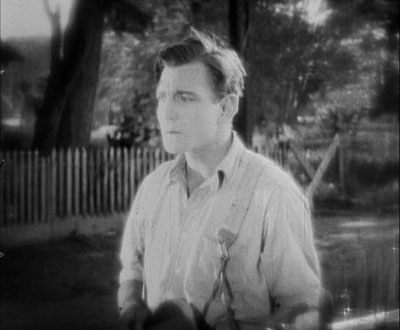
Speaking of new DVDs, today the UPS man lugged a Fox Murnau/ Borzage box to our door. This cost more than my first car (and weighs about the same), but it’s a better bargain. My oil-leaking ‘62 Impala did not come fully loaded with Sunrise and City Girl and Seventh Heaven. Dedicated Fox archivist Schawn Belston has labored hard to create this remarkable collection, as robust a contribution to our understanding of film history as his Ford at Fox box a year ago. Tucked inside the chocolate-colored case are twelve films and two handsome books with texts by Janet Bergstrom. An entire book is devoted to the lost Four Devils, and one disc houses a lengthy documentary on the two directors.
Many of the early thirties Borzages are new to me, and I can’t wait to see them. But Kristin and I are very happy to have two lesser-known titles that we love, Lucky Star (1929) and Lazybones (1925). The latter is a striking example of the trend toward the “soft style” of cinematography that swept Hollywood in the 1920s (and that Kristin analyzes in The Classical Hollywood Cinema). Even men were shot with filters, gauzes, and selective focus, creating lyrical images like the one of our hero above. The soft style was about as popular then as the dark, earth-and-steel tonalities we find in so many films today. When our travails with Film History are ended, we look forward to digging into this new Fox treasure chest.
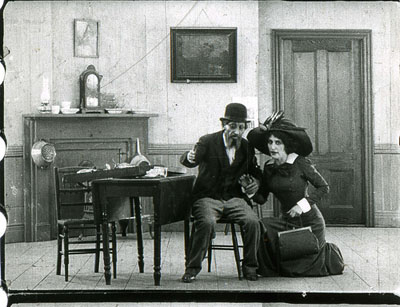
Finally, why not try to identify a mystery movie like the one above? In an email Joe Lindner, archivist at the Academy of Motion Picture Arts and Sciences, writes:
The Nitrate Film Interest Group of the Association of Moving Image Archivists has put together a page on flickr where archivists can post images of unidentified films. The submissions have tended towards silent films and nitrate prints, but sound films and safety elements are welcome as well. The page is also set up for short video clips, and the first video post has just been uploaded from a new scan of a 28mm print in the Academy Film Archive’s collection. This is also a good resource for anyone out there seeking help in identifying film elements, and you do not have to be a member of AMIA to submit images.
This is a remarkable site, and the images are tantalizing. As of this writing, several films have already been identified.
So, three snacks to tide us all over. Check in later this week for some new stuff, when our eyes will focus again.