





Archive for the 'Narrative strategies' Category
His majesty the American, leaping for the moon
DB here:
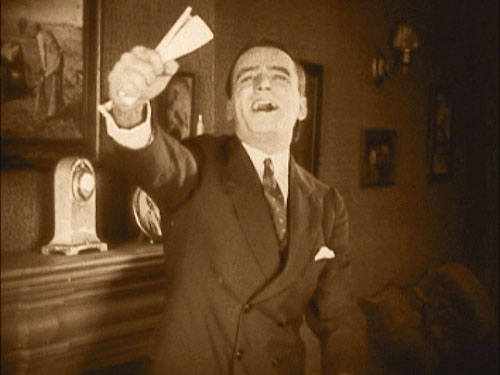
 Douglas Fairbanks is remembered today as the nimble, insouciant hero of a string of swashbuckling films: The Mark of Zorro (1920), The Three Musketeers (1921), Robin Hood (1922), The Thief of Baghdad (1924), Don Q Son of Zorro (1925), and The Black Pirate (1926). He is the primary subject of a gorgeously illustrated, solidly researched new biography by Jeffrey Vance with Tony Maietta. Proceeding film by film, the authors interweave his life story with production data and summaries of critical reception. While tracing his career, they make an intriguing case that Fairbanks’ 1920s features more or less founded the modern film of action and adventure.
In the five years before The Mark of Zorro, Fairbanks made twenty-nine features and shorts. Vance and Maietta are enlightening on this period, but they treat it as prologue to the more spectacular work. Now, as if to counterbalance their book, comes a new Flicker Alley DVD collection, Douglas Fairbanks: A Modern Musketeer, gathering ten of the early films along with a very pretty copy of The Mark of Zorro and Fairbanks’ last modern-day movie, The Nut (1921), made because he wasn’t sure that Zorro would be a hit. (It was.) To the DVD package Vance and Maietta have contributed an informative booklet and they offer enlightening conversation in a commentary track for A Modern Musketeer (1917).
 Kristin and I have long been fans of the pre-Zorro titles. Kristin wrote an appreciation of the early films for a Pordenone catalogue, and I studied Wild and Woolly (1917) as an early prototype of Hollywood narration. (1) There’s no denying that the 1920s costume pictures offer dashing spectacle and derring-do. But the 1915-1920 films are something special—lively, lilting, and unexpectedly peculiar. (2)
Before he became Fairbanks, he was Doug, the relentlessly cheerful American optimist. This star image was created very quickly, in films and in public events that made him seem the nicest guy in the country. His manic energy came to incarnate the new pace of American cinema, and his films helped shape the emerging precepts of Hollywood storytelling.
Doug
Consider his contemporaries. William S. Hart keeps his distance; perhaps his severe remoteness comes from secret pain. The result is a man you respect and admire but can hardly love. Mary Pickford, though, is lovable, and so is Chapin, although his cruel streak complicates things. But Doug is quintessentially likable. His early films present us with a brash youth who is all pep and pluck, bouncing with barely contained energy, unselfconscious in his engulfing enthusiasm for life. Today he could be elected President, the ultimate guy to have a beer with. (In real life Fairbanks was a teetotaler.)
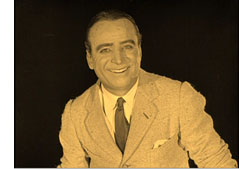 There is no guile in him, no hidden agenda. When he’s brimming with delight, as he often is, he flings his arms out wide. In another actor this would be hamminess, but for Doug it’s simply an effort to embrace the world. Any social embarrassments he commits—and they are plenty—he acknowledges with a puzzled frown before flicking on an incandescent grin. Who else makes movies with titles like The Habit of Happiness (1916) and He Comes Up Smiling (1918)?
But how can such a genial fellow yield any drama? Give him an idée fixe, a cockeyed hobby or life philosophy into which he can pour his adrenaline. Now add a goal, something that his obsession blocks or unexpectedly helps him attain. Toss in the staples of romantic comedy: a good-humored maiden uncertain how to tame this creature of nature, a few old fogeys, some unscrupulous rivals. Hardened crooks may make an appearance as well. Be sure to include some tables, chairs, sofas, or horses for him to vault over, as well as some perches near the ceiling or on the roof; Doug feels most comfortable lounging high up. Add windows, for his inevitable defenestration. (In a poem about him, Jean Epstein wrote, “Windows are the only doors.”) There should also be chases. Other comedy stars run because they must. Doug’s joy in flat-out sprinting suggests that he welcomes the chance to flush a little hyperactivity out of his system. At the story’s climax he must save the day, taming his obsession and achieving his purpose while acceding to the claims of the practical world.
An early example is His Picture in the Papers (1916). In this satire on vegetarianism and the American lust for publicity, Doug works for his father’s health-food firm, even though he prefers thick steaks. But he’s full of ideas for promoting the product. Doug needs money to marry his equally carnivorous girlfriend, but his father will give him the dough only if Doug can pitch their line of dietary supplements. Doug vows to get his picture in every newspaper in town. While he launches a series of high-profile stunts—wrecking his car, entering a prizefight, brawling on an Atlantic City beach—his sweetheart’s father is pursued by a gang called the Weazels, who try to extort money from him.
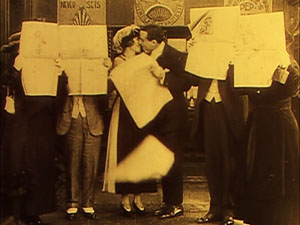
The two plotlines converge, with Doug stopping a train wreck and winning a place on the front pages. (In a sly dig at the press, each news story contradicts the others.) The movie is a little disjointed, but several scenes are remarkable, not least a boxing match in an actual athletic club before an audience of cheering Fairbanks pals. And there is more than one funny framing, notably a nice planimetric one showing all our principals lined up and reading different newspapers celebrating Doug’s triumph.
As the title indicates, in The Matrimaniac (1916) Doug’s goal is elopement, which he pursues obsessively. He evades a rival suitor, his girlfriend’s father, a sheriff, and a posse of city officials in order to tie the knot in a gag that must have looked radically up-to-date. Reaching for the Moon gives us a more philosophical Doug, a naive disciple of self-help books that urge him to strive, to concentrate, and above all to keep his eye on the most supreme goal he can imagine. He ends up in New Jersey.
Wild and Woolly (1917) casts Doug as the son of a railroad tycoon. Although he lives in Manhattan, he dreams of being a cowboy. His bedroom boasts a teepee, and he practices his roping skills on the butler. Sent out to Bitter Creek to investigate a deal, he encounters the rugged frontier of his dreams, complete with shootouts, town dances, and hard-drinking cowpokes. But all of this is a show, staged by the locals to make him look favorably on a railroad spur. In another twist, a crooked Indian agent uses the charade to rob the bank and stir up an Indian settlement. Now Doug’s obsessions prove really useful, as his cowboy skills rescue the town.
Wild and Woolly is among the very best of the surviving early Fairbanks titles, and its adroit storytelling is still admirable today. The best-known version was a very poor print, salvaged from the Czech archives and still circulating on barely visible VHS and public-domain DVD copies. Forget those. On the Flicker Alley collection the image quality, while not perfect, allows this trim little masterpiece to be appreciated. (3)
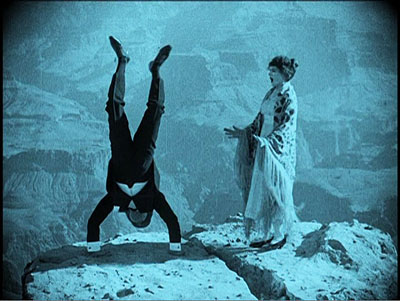
“Always chivalrous, always misunderstood,” reads one intertitle in another gem, A Modern Musketeer. Here Doug is possessed by the spirit of D’Artagnan, simply because while he was in the womb his mother was reading The Three Musketeers. He manages to live up to his heritage as he overcomes a philandering rival and a bloodthirsty Indian. The climactic chase takes place at the Grand Canyon, affording Doug a chance to shinny up and down cliffs and do handstands along a precipice.
Doug never does things by halves. In Flirting with Fate, he is a starving artist, out of money and apparently unloved by his girl. The logical solution is to hire a killer to end his misery. Of course Doug’s fortunes instantly change, and life becomes worth living, but then he must somehow find his assassin and call off the hit.
Many of the early films show the protagonist fully formed as a cross between a cheerleader and a track star. But Fairbanks made a big success on stage playing a sissy. The task in such a plot is to turn him into a red-blooded man. His first film, The Lamb replayed this lamb-into-lion plot, which also served as the basis for Buster Keaton’s first feature, The Saphead (1920).
In the Flicker Alley collection, this strain of Doug’s work is represented by The Mollycoddle (1920). Doug is the descendant of hard-bitten westerners, but growing up in England has made him a fop. Coming to America with a batch of wealthy Yanks, he is a continual figure of fun, waving his monocle and cigarette holder. Once in Arizona, however, he’s confronted with a diamond-smuggling racket. He starts to channel his ancestors and turns into a hell-for-leather hero. He allies with a tribe of exploited Indians to capture the gang, in the process indulging in leaps, falls, canyon-scaling, and fistfights in raging rapids.
The titles often invoke craziness, vide the Matrimaniac, The Nut, and Manhattan Madness (1916). But this motif is carried to an extreme in one of the strangest pictures of the still-emerging Hollywood cinema. When the Clouds Roll By (1919) crams in enough gimmicks for three Doug stories. First, our hero is neurotically superstitious. He will climb over a building to avoid letting a black cat cross his path. He meets a girl who is as superstitious as he is, so after a session at the Ouija board, they seem a good match.
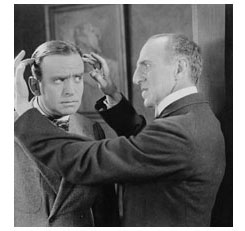 At the same time, however, a psychiatrist is making Doug the subject of a demonic experiment: Can one drive a person to madness and suicide? Through bribes and surveillance, Dr. Metz turns Doug’s life into hell—botching his romance, getting him disowned by his father, and even inducing nightmares. As if all this weren’t enough, the last reel jams in a train crash, a bursting dam, and a flood. Before this overwhelming climax, When the Clouds Roll By isn’t so much funny as eerily paranoiac. The way Dr. Metz’s Mabuse-like scheme enfolds everyone is as anxiety-provoking as anything in a film noir. This dreamlike movie ends on a surrealist note: Doug and his sweetheart get married when flood waters carry a church past them.
Across these films, in fact, the Fairbanks persona starts to disintegrate. Somewhat like those naïve Capra heroes of the 1930s (Mr. Deeds, Mr. Smith) who turn into melancholy victims in Meet John Doe and It’s a Wonderful Life, Doug becomes more brooding and helpless. In Reaching for the Moon, his absurd dream of glory is revealed as just that, a dream. When the Clouds Roll By saves itself from despair through splashy last-minute rescues.
Fairbanks was evidently becoming uncomfortable in cosmopolitan comedy. His taste for large-scale stunts and tests of prowess led him to the costume sagas of the 1920s. In the process, as Vance and Maietta point out, he cleared the way for Keaton and Harold Lloyd. Both comics would sometimes play obtuse idlers in the Lamb mode, and both would take thrill comedy to new heights. But avoiding Fairbanks’ ebullient optimism, Keaton brought a perplexity to every situation, along with an angular athleticism and a geometrical conception of plotting and shot composition. Lloyd frankly presented a hero lacking social intelligence, afflicted with a stammer or shyness or even cowardice, always desperate to fit in. Both men deepened the possibilities of modern-day comedy, thriving in the niche vacated by Fairbanks.
Bug and Mr. E
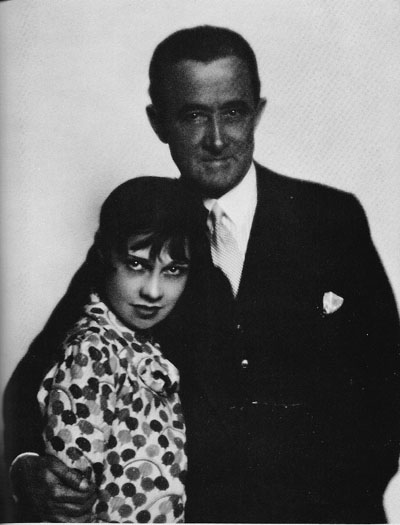
For nine of the early films, Fairbanks had the help of John Emerson and Anita Loos. All three worked on the stories, with Emerson usually directing and Loos writing the scripts and intertitles. The collaboration lasted only about two years, but it yielded some definitive moments in the creation of the Doug mystique.
Emerson found his first success acting and directing on the New York stage. Under Griffith’s supervision he started filmmaking in 1914, with an adaptation of his own successful play, The Conspiracy. I haven’t seen this or most of his other early work, but his 1915 Ibsen adaptation Ghosts, codirected with George Nichols, betrays little of the dynamism that would run through his Fairbanks projects (although The Social Secretary of 1916, without Doug, is lively enough). Emerson continued to direct films and New York stage productions until his death in 1936, at the age of fifty-eight.
Loos was a tiny prodigy. She sold her first scripts at age nineteen, with the third, The New York Hat (1913), directed by Griffith, earning her twenty-five dollars. (Her punctilious account book is reprinted in her 1974 autobiography Kiss Hollywood Goodbye.) After writing scores of shorts, she moved into features in 1916, when, she claims, Emerson discovered her script for His Picture in the Papers. Clearing the project with Griffith and casting Doug Fairbanks, the team proceeded. This, Fairbanks’ third feature, proved a great success and solidified important aspects of his star persona.
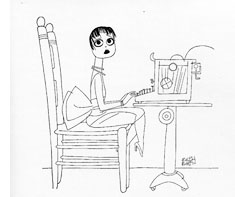 Loos married Emerson, whom she recalled as having “perfected that charisma, which even a bad actor has, of being able to charm his off-stage public.” (4) He called her Bug, she called him Mr. E., and they became a Hollywood couple. They kept themselves before the public eye with interviews and books like How to Write Photo Plays (1920) and Breaking into the Movies (1921). These are full of information about the filmmaking practices of the day.
Why did Emerson and Loos split from Fairbanks? Loos says that that Doug had become somewhat jealous of her notoriety. (5) Further, the couple yearned to return to New York. There Loos would hobnob with the Algonquin club crowd and write Gentlemen Prefer Blondes, a successful serial, book, play, and silent film. Eventually she would write plays and return to Hollywood as an MGM screenwriter.
Although they remained married and collaborated on plays and films, the pair eventually lived apart, the better to ease Emerson’s philandering. “Mr. E.’s devotion was largely affected by the amount of money I earned,” Loos recalled. (6) By her own testimony, she earned plenty. She writes in 1921:
The highest paid workers in the movies today are the continuity writers, who put the stories into scenario form and write the “titles” or written inserts. The income of some of these writers runs into hundreds of thousands of dollars a year . . . . Scenario writing does not require great genius. (7)
Loos is largely credited with bringing the witty intertitle into its own. Expository “inserts” were often neutral descriptions of the action or pseudo-literary ruminations. Loos created intertitles that were amusing in themselves. When Jeff, the hero of Wild and Woolly, comes to Bitter Creek he’s delighted to find a rugged life matching the one he mimicked in his East Coast mansion. So naturally Loos’ title reads, “All the discomforts of home.”
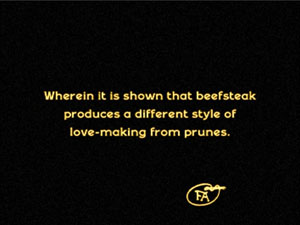
She wedged in puns, satiric jabs, and asides to the audience. The vegetarianism portrayed in His Picture in the Papers makes for anemic romance. Loos’ title prepares us:
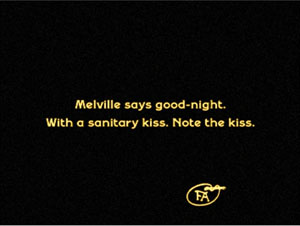
The young suitor and Christine kiss by tapping each other’s cheek with their fingertips.
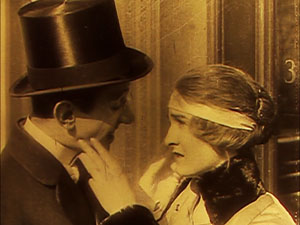
Later the intertitle stresses the more robust wooing program launched by Doug.
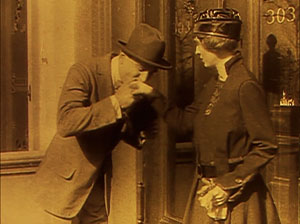
By the time Loos and Emerson left Fairbanks, the look and feel of their contributions had been mastered by others, notably director Allan Dwan, and smart-alec intertitles continued to grace Fairbanks’ modern comedies. Throughout the 1920s, most comedies would strive, not always successfully, for the cleverness Loos brought to the task. My own favorite in her vein comes in the Lloyd vehicle For Heaven’s Sake (1926). Harold is a millionaire courting a girl working in her father’s mission house in the slums, and one of the titles refers to “The man with a mansion and the miss with a mission.” Such niceties largely vanished when movies started to talk.
Cutting edge
We can learn a lot about the history of Hollywood from these films too. In the 1910s, narrative techniques were being put in place: the goal-oriented hero, the multiple lines of action, the need to prepare what will happen later, the use of motifs as running gags. At the start of The Matrimaniac, we see Doug sneaking into a garage and letting the air out of a car’s tires. Only later, after he has eloped with the daughter of the household, do we realize that this was a way to keep her father from pursuing them. In the course of the same film, the elopement is aided by passersby, and Doug keeps scribbling IOUs to pay them. At the end, the parson who has helped the couple the most is rewarded by the biggest payoff, with Doug shoveling bills at him.
The same years saw the consolidation of the “American style” of staging, shooting, and cutting scenes. (For more on this trend, see our earlier entries here and here.) Fairbanks’ films from 1916 to 1920 display a growing mastery of continuity techniques; the style coalesces under our eyes.
The system depended on breaking up master shots into many closer views. This practice was less common among European directors of the time, who might supply inserts of printed matter like letters but did not usually dissect the scene into shots of different scales. In His Picture in the Papers, for instance, we get a master shot (nearer than it would be in a European picture) of Melville paying court to Christine, followed immediately by closer views that show their expressions.

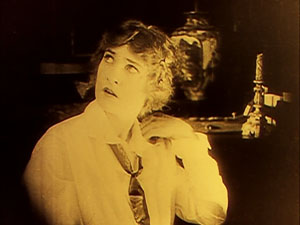
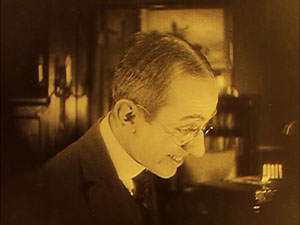
This is a minimal case. Not only are the shots all taken from the same side of the line of action (the famous 180-system) but they are taken from approximately the same angle. Filmmakers sometimes varied the angle more, usually to indicate a character’s point of view but sometimes to bring out different aspects of the action. (See here for examples from William S. Hart.)
Very quickly directors realized that you didn’t need a master shot if you planned your shots carefully. In Flirting with Fate, the artist Augy is chatting with Gladys, while her mother and her rich suitor watch from another part of the room. No long shot presents both pairs.
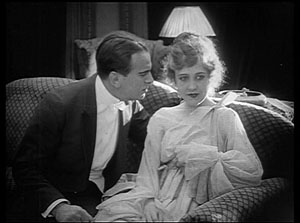
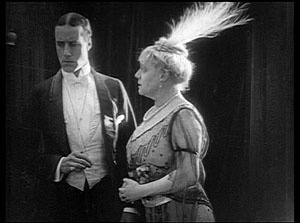
The mother summons Gladys, and when she and Augy rise, director Christy Cabanne cuts to another shot of them, moving into the frame.
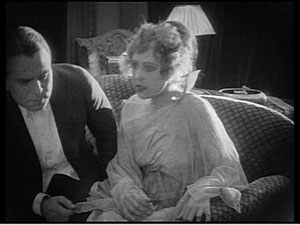
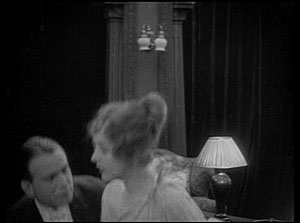
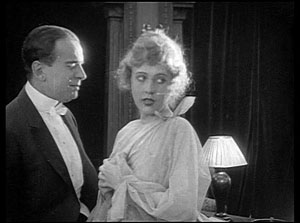
This is a very rare option in most national cinemas of the period, which would simply frame the couple in a way that allowed them to rise into the top of the same shot. Now Gladys hurries out, crossing the frame line. This exit matches her entrance on frame left, meeting her mother.
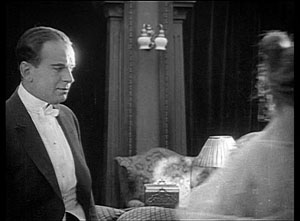
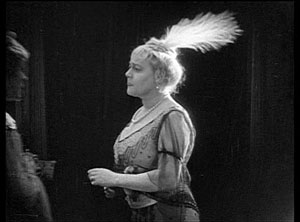
Such a scene is obvious by today’s standards, but a revelation at the time—a way of lending even static dialogue scenes a throbbing rhythm that absorbed viewers. Around the world, notably in the Soviet Union, young directors saw this as the cutting-edge approach to visual storytelling. The new style was as probably as exciting to them as the powers of the Internet are in our time.
Because of analytical editing, the cutting pace of American films of the late 1910s is remarkable, and the Fairbanks films, with their strenuous tempo, are fair examples; the average shot length in these films ranges between 4 seconds and 6.6 seconds. With so many shots, production procedures emerged to keep track of them. To a certain extent shots were written into the scenarios Loos refers to, but directors also broke the action up spontaneously during filming. The cameraman, and later a “script girl,” would log the shots during shooting so that they could be assembled correctly in the editing phase.
Directors were still refining the system, though, as we can see from an awkward passage of shot/ reverse shot in A Modern Musketeer.
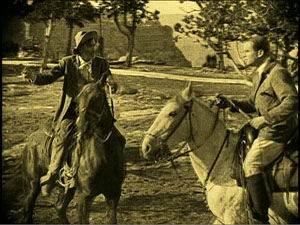
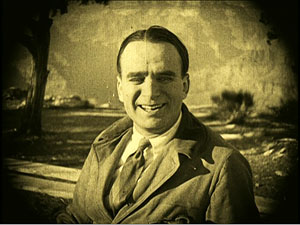
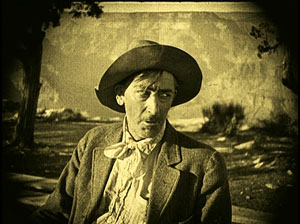
The eyelines are a bit out of whack, but odder still are the identical backgrounds of the two shots. Evidently director Allan Dwan made these shots quickly and closer to the canyon rim, in the expectation that nobody would notice the disparity.
Point-of-view shots were easier to manage, and they could intensify the drama. Later in A Modern Musketeer, the rapacious Chin-de-dah tells the white tourists he’s getting married. To whom? asks Elsie. Instead of answering, “You,” he holds up his knife.
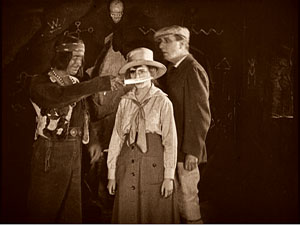
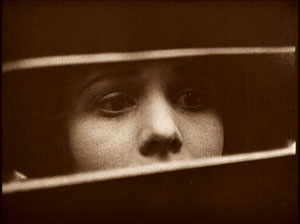
Sometimes you suspect that filmmakers were multiplying shots just for the fun of it. The early Fairbanks films are vigorous to the point of choppiness; action scenes spray out a hail of images, some offering merely glimpses of what’s happening. Wild and Woolly is especially frantic, with the final sequences of kidnapping, gunplay, and a ride to the rescue breathless in their pace. In the course of it, Emerson realizes that fast action needs some overlapping cuts to assure clarity. Doug bursts through a locked door in one shot, and from another angle, we see the door start to open again.
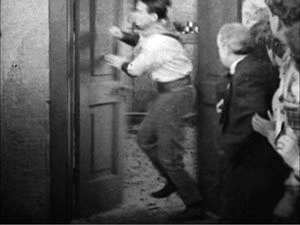
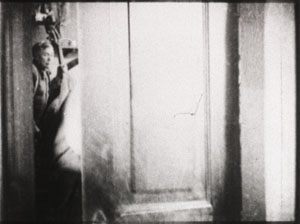
Only a few frames are repeated, but the movement gains a percussive force. Doubtless the Russians studied cuts like this; Eisenstein made the overlapping cut part of his signature style.
By contrast, The Mark of Zorro and its successors have calmer pacing. Doug’s acting got more restrained too, with his bounciness largely confined to the action scenes. Already in 1920, high-end pictures were finding a more academic look, a polished and measured style. Dialogue titles became more numerous, and big sets and other production values were highlighted.
I’ve been able to sample only a few points of interest in the early Fairbanks output. I haven’t talked about Fairbanks’ foray into Sennett-style farce, the cocaine-fueled Mystery of the Leaping Fish (1916), or the bold experimentation of the cinematography in the dream sequence of When the Clouds Roll By. My point is just to note that these films radiate exuberance—not only in their hero but in their very texture. Scene by scene, shot by shot, Doug’s energy is caught by an efficient, pulsating style that was an engaging variant of what would soon become the lingua franca of cinematic storytelling.
For other reading on Fairbanks, you can consult Alastair Cooke’s Douglas Fairbanks: The Making of a Screen Character (New York: Museum of Modern Art, 1940), one of the earliest and still most thought-provoking studies; John C. Tibbetts and James M. Welsh’s His Majesty the American: The Films of Douglas Fairbanks, Sr. (South Brunswick, NJ: A. S. Barnes, 1977), which is wide-ranging and strong on the early films; Booton Herndon’s Mary Pickford and Douglas Fairbanks (New York: Norton, 1977); and Douglas Fairbanks: In His Own Words (Lincoln, NE: iUniverse, 2006), a collection of interviews and essays signed (but probably mostly not written) by the star. I’ve also been enlightened by Lea Jacobs’ essay “The Talmadge Sisters,” forthcoming in Star Decades: The 1920s, ed. Patrice Petro (Brunswick: Rutgers University Press, forthcoming). Online, there is much information at the Douglas Fairbanks Museum site.
(1) Kristin Thompson, “Fairbanks without the Mustache: A Case for the Early Films,” in Sulla via di Hollywood, ed. Paolo Cherchi Usai and Lorenzo Codelli (Pordenone: Biblioteca dell’Immagine, 1988), 156-193; David Bordwell, Narration in the Fiction Film (Madison: University of Wisconsin Press, 1985), 166-168, 201-204.
(2) This set is very well chosen, but there are enough other films surviving from this period to warrant another box. It could include The Lamb (1915), Double Trouble (1915), The Good Bad Man (1916), Manhattan Madness (1916), The Americano (1916), Down to Earth (1917), The Man from Painted Post (1917), His Majesty the American (1919), and The Half Breed (1916), in which Fairbanks plays a biracial hero. On the matter of race, the films in the collection aren’t free of condescension and stereotyping, but there are also moments of affection between Fairbanks and Native Americans. He had extraordinarily dark skin, a fact he apparently took in his stride.
(3) I believe that this print is from a different version than the one I’ve known before; a few shots seem to show slightly different angles. (Perhaps the earlier one was from a foreign negative?) An informative page of the Flicker Alley booklet signals the provenance of the prints. While I’m on the subject, I should mention that occasionally the framing seems a bit cropped, but that could be due to the source material.
(4) Loos, Kiss Hollywood Goodbye (New York: Ballantine, 1974), 2.
(5) Loos’ account of the break with Fairbanks can be found in her memoir, A Girl Like I (New York, 1966), 178. You have to admire a book that ends with the line, “Miss Loos, you sure are flypaper for pimps!”
(6) Loos, Kiss Hollywood Goodbye, 14.
(7) Emerson and Loos, Breaking into the Movies (Philadelphia: Jacobs, 1921), 43.
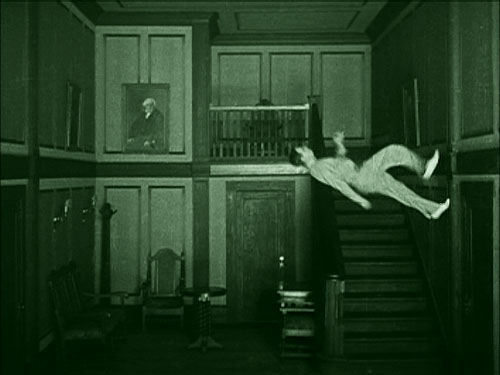
When the Clouds Roll By.
PS 30 Nov: Internets problems and a memory lapse kept me from mentioning two other important books on Anita Loos: Gary Carey’s lively biography Anita Loos (Knopf, 1988) and Anita Loos Rediscovered: Film Treatments and Fiction, ed. and annotated by Cari Beauchamp and Mary Anita Loos (University of California Press, 2003). Both Carey and Beauchamp echo Loos’ claims that the couple split from Fairbanks because he was somewhat envious of the attention they received, while Carey adds that Fairbanks wanted to break out of the “boobish” parts Loos wrote for him (p. 50).
PPS 8 Dec: Mea culpa again. I overlooked Richard Schickel’s book-length essay, His Picture in the Papers: A Speculation on Celebrity in America, Based on the Life of Douglas Fairbanks, Sr. (New York: Charterhouse, 1973). It’s a lively and thoughtful argument that Doug was one of the very first modern celebrities, and one who enjoyed his role as such.
It was a dark and stormy campaign
How do you get people to believe that if you can’t get the press to make an honest assessment of it? You tell a story. “When it came down to a choice between my very life and my country, I chose my country.” That’s why the story’s important. Just as Obama’s story is important to him. I don’t gainsay it. You know, tell your story! —John McCain staff member and co-author Mark Salter
There was a mismatch between the way he was behaving and the narrative the press had bought into. It made reporters wonder, “Have we been had?”–Professor Marion Just, Wellesley, on John McCain
This political bullshit about narratives.–Peggy Noonan, Republican columnist
I’m David Bordwell and I approved this message.
A long time ago a student complained to me that we film academics were foisting upon them words that no professional filmmakers used. The student’s example was “genre.” Today of course filmmakers use the term all the time. Sometimes you hear “classical filmmaking,” and Variety tells us that Henry Jenkins’ label “transmedia” is starting to break through:
Famed s/f writer Larry Niven is working with “transmedia” (today’s new buzzword) production company Alchemic Productions to create a new game property called “Free Fall.”
More broadly, the terminology of Big Theory in the humanities has trickled into journalism and politics. For some time now “deconstruction” has been peppering mass-market discourse. Granted, it’s not employed in the way Derrida and his acolytes would like. It seems to mean a blend of “construction” and “destruction,” which can entail “analysis” or even just “pulling something apart.”
Deconstruct Black Ink: Your children can use chromatography to deconstruct black ink and find out what color the ink really is.
Scientists Deconstruct Clownfish Chatter
U. of Kansas Looks to Deconstruct Its School of Fine Arts
This election season has shown me that even the idea of the Other, considerably divorced from its use by Jacques “The Lack” Lacan, can show up. Nicholas Kristof claims that John McCain’s efforts to suggest that Barack Obama isn’t “sufficiently Christian” are an effort to “otherize” him.
But I think the term that has gotten the most play is “narrative.”
Discovering narrative
During my days as an undergraduate in literary studies and as a grad student in film studies, between 1965 and 1973, you scarcely ever heard the word. It doesn’t appear in the index of Wellek and Warren’s Theory of Literature (3rd ed., 1956) or Wimsatt and Brooks’ Literary Criticism: A Short History (1957) or Northrop Frye’s Anatomy of Criticism (1957). Story, tale, plot, dramatic structure: these words were common, but not “narrative”.
In American academia, the term began to gain currency with Robert Scholes and Robert Kellogg’s The Nature of Narrative (1966). The authors identify narrative with a broad literary tradition, embodied not only in the novel and short story but also in oral storytelling. And the definition is clearly language-based, in pointed contrast with drama.
By narrative we mean all those literary works which are distinguished by two characteristics: the presence of a story and a story-teller. A drama is a story without a story-teller; in it characters act our directly what Aristotle called an “imitation” of such action as we find in life. (4)
The Nature of Narrative was published the same year that Roland Barthes, in a special issue of the French journal Communications, published his essay “Introduction to the Structural Analysis of Narratives.” (1) His conception of narratives (récits) is far more generous than that of Scholes and Kellogg.
Narrative is first and foremost a prodigious variety of genres, themselves distributed amongst different substances—as though any material were fit to receive man’s stories. Able to be carried by articulated language, spoken or written, fixed or moving images, gestures, and the ordered mixture of all these substances, narrative is present in myth, legend, fable, tale, novella, epic, history, tragedy, drama, comedy, mime, painting (think of Carpaccio’s Saint Ursula), stained glass windows, cinema, comics, news item, conversation. (79)
Barthes’ essay, along with other Structuralist studies, initiated the academic field of “narratology,” the systematic study of storytelling as it is manifested in many media. From the 1970s to the present, this became a vast, varied, and exciting area of inquiry.
The questions are fascinating.
*What is a story? How does it differ from other things, such as a description or an abstract image? Are jokes narratives? Are dreams? Are riddles? Is the concept so broad that anything can be treated as a story?
*Why do stories engage us? What do we need to know, or do, to understand a story? What powers enable us to create stories? Are story-making and story comprehension distinctively human activities?
*Do stories rendered in language differ from those rendered in other media? Is the ability to make or follow stories dependent on our knowing language, even if the story is presented without words (as, say, a silent film)?
*How do narratives imply or suggest or symbolize broader meanings than the bare events they recount? What enables a narrative to stand for more than it seems to say?
*What patterns of narrative construction do we find in different traditions, periods, times, and places? How might they bear the traces of social and political views? How might they express varying conceptions of the world?
In retrospect, we can see that Aristotle, nineteenth-century theorists of the drama, and theorists like Walter Benjamin, Georges Polti, R. S. Crane, and Northrop Frye did reflect on the phenomenon as narratologists were beginning to conceive it. But very few thinkers had asked these particular questions, in quite the way that Barthes and other Structuralists had.
The questions may seem impossibly abstract or broad, but they get more manageable if we look at particular cases. Take film. We all assume that Hollywood movies belong to a storytelling tradition, one that some people consider formulaic. But if Hollywood movies are formulaic, they must adhere to conventions—conventions we might not find, say, in Homer’s epics or Ibsen’s dramas or Neorealist films. What are those narrative conventions? Where did they come from? How do they fit together? What might be their effects on viewers’ beliefs and experiences?
Studying the narrative conventions of various filmmaking traditions has kept Kristin and me busy for many years. We explained some rudiments of narrative theory in the first edition of Film Art (1979); I think that this was the first time an introductory textbook put the area on the film studies agenda. In the 1980s we wrote The Classical Hollywood Cinema and Narration in the Fiction Film; in the 1990s Kristin wrote Storytelling in the New Hollywood; in the 2000s I wrote The Way Hollywood Tells It and Poetics of Cinema. Most recently we composed some items on this website (here and here and here).
Now, after a thirty-year pageant of academic theories and analyses, we find that the term has trickled down, so to speak, to bare-knuckle politics. It turns out that the current Presidential election in the U. S. is all about “narratives.” The candidates have them, as do the campaigns. And those narratives are served up in newspaper accounts that are also narratives. How the word gained its new status is a question for another time. For now, we have plenty of tales to occupy the narratologist.
Two quick caveats
Narrative doesn’t equal fiction. Most narratologists have followed Barthes in treating factual accounts, like newspaper stories and conversations, as narratives. Sometimes a filmmaker will say, “I make documentaries, not narratives,” but documentaries can be, and often are, narrative in form. So too are some avant-garde films, such as Meshes of the Afternoon and Tribulation 99. One of the reasons that we study narrative is that it’s a very widespread phenomenon.
This is not to say that the fact/ fiction distinction doesn’t matter. We react differently to narratives purporting to be fictional and ones claiming to be factual. And studying narrative doesn’t commit us to saying that all narratives are fictional (because they’re constructed, or because they’re selective, or whatever). History books and newspaper reports can be more or less faithful to what really happened. And sometimes fact seems more narratively coherent than fiction. If you wrote a novel about an idealistic presidential candidate born in a town called Hope, you’d be accused of heavy-handed symbolism; but tell that to Bill Clinton.
Narrative is a type of representation. What happens to you today isn’t a narrative until you tell somebody about it, or write it up in your diary, or at least sort it out as a story in your mind. A narrative, as the name implies, is a string of events that is narrated—represented in some form. In this sense, the Presidential campaign isn’t a narrative in and of itself. It becomes a narrative when people represent it: select events, omit others, perhaps invent or imagine still others, and present them in words, pictures, music, or some other medium.
This idea of presenting a chain of causally connected events, enacted by agents and unfolding in time, is what we characteristically mean by storytelling. You can find a more abstract definition of narrative in Film Art and other things Kristin and I have written, but this will suffice for now.
The plots thicken
Clearly the presidential candidates have come to believe that what seizes the public aren’t just policy views and promises. Now the campaigns want to tell stories in which the candidates are the protagonists. The life of Barack Obama, or Joe Biden, or Sarah Palin is said to be a story (usually “an American story”). According to Robert Draper’s influential recent article, John McCain’s campaign has deliberately set out a series of “narratives”: McCain endures suffering in Hanoi as a POW; he enters politics and fights for reform in government. Mark Salter, McCain’s staff member and coauthor, has the responsibility of stitching incidents of the Senator’s career into what he calls the “metanarrative” of McCain’s life—rather as George Lucas presides over the Bible of the Star Wars universe.
The campaigns’ efforts at representing narratives don’t just amount to giving us backstory about the protagonists. Things get tricky when they try to present the ongoing campaign as itself a narrative. This involves planning a smooth cascade of events, such as during the party convention, when the suspense builds toward the climax of nomination. The problem of course is that events outside the candidates’ control can force changes in the story line. During the recent financial meltdown, McCain’s campaign would have preferred to create a dialogue about national security, and Obama’s campaign was prepared to talk about the war and the squeeze on the middle class. Instead, each had to respond to swiftly changing events and rewrite the script every day.
Why is the McCain campaign flagging? Contrary to Salter’s intentions, many believe that it never found “a compelling story”—that is, a way to integrate all the events hurled at their ideal scenario. Obama’s story was simpler: he could simply point to each new catastrophe as caused by Republican rule.
Sometimes the mass media replay the narratives concocted by the campaign, but sometimes they offer counter-narratives. A Rolling Stone article sought to replace the official McCain “metanarrative” by adding incidents, characters, and causes that add up to a far more damaging story. More broadly, a common account portrays the campaigns as a study in contrasts: Obama’s enterprise ran steadily according to the well-planned strategy of pursuing votes in nearly every state, while McCain’s campaign was more tactical and reactive, taking red states for granted. And as in any good narrative, the actions are treated as reflecting the traits of the two characters. Obama is seen to be calm and measured, so his campaign runs smoothly; McCain appears splenetic and tightly wound, so his campaign is spasmodic. Character and action are believed to mesh. (More on character traits shortly.)
Once these narrative arcs are in place, they become hard to dislodge. As I write this, unnamed handlers in the McCain campaign are blaming one another and Sarah Palin, and this new string of incidents only seems to confirm the scenario of a rudderless, probably doomed, enterprise. Other observers, and historians in future years may embellish, revise, or reject the mainstream account. My point is that we’ve watched a standard story emerge as a full-bodied narrative, or rather a cluster of them—the way that a folktale or myth presents different variants of emphasis and point of view. Still, each one of the variants is a narrative—a representation of a string of events, enacted by agents and bound together through chronology and causal connections.
What’s your story?
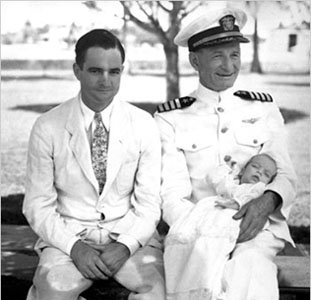
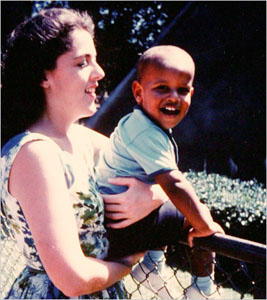
I long ago learned to distrust my childhood and the stories that shaped it. It was only many years later, after I had sat at my father’s grave and spoken to him through Africa’s red soil, that I could circle back and evaluate these early stories for myself. Or, more accurately, it was only then that I understood that I had spent much of my life trying to rewrite these stories, plugging up holes in the narrative, accommodating unwelcome details, projecting individual choices against the blind sweep of history, all in the hope of extracting some granite slab of truth upon which my unborn children can firmly stand.
Barack Obama, Dreams from My Father, xv-xvi
Each of the two top presidential candidates has signed an autobiography that functions, in today’s story-hungry ecosystem, as a bid to control his narrative. In 1995, Obama published Dreams from My Father: A Story of Race and Inheritance; four years later McCain produced Faith of My Fathers: A Family Memoir. In what follows, I’ll refer to the latter as McCain’s book, though apparently coauthor Mark Salter is responsible for both a lot of the research and the actual prose of the result.
Like Steven Spielberg and Martin Scorsese, Obama and McCain are deeply concerned with fathers and how they shape sons. Both books portray three generations of men: the author, his father, and his grandfather. The concern for the father’s role is enacted in the overall design of each narrative.
McCain’s book is more straightforwardly chronological, and it proceeds in three layers. After an emblematic moment when his father and grandfather met at the end of World War II (more on this below), the narrative starts with a brief biography of the elder, McCain senior, who served as an admiral under William Halsey during World War II. There follows a somewhat longer account of McCain junior, who also won the rank of Admiral and who commanded naval operations during the Vietnam war. Woven into these accounts are vignettes of the youngest McCain’s reactions to these two awe-inspiring warriors.
The bulk of the book presents his own life, rendered chronologically. He swiftly runs through a “misspent youth” of impulsive rebellion and reluctance to kowtow to authority. McCain expresses gratitude for the family heritage—a sense of duty and, above all, honor—that informed his life. But he did not fully understand the weight of these traditions, he tells us, until he was taken prisoner by the North Vietnamese and was held as a POW for over five years. There, under severe torture and despite the greatest resistance he could muster, he signed a false confession. It was a betrayal not only of his country, but of a family tradition.
They were the worst two weeks of my life. I couldn’t rationalize away my confession. I was ashamed. I felt faithless, and couldn’t control my despair. I shook, as if my disgrace were a fever. I kept imagining that they would release my confession to embarrass my father. All my pride was lost, and I doubted I would ever stand up to any man again. Nothing could save me. No one would ever look upon me again with anything but pity or contempt. . . . The Vietnamese had broken the prisoner they called the “Crown Prince,” and I knew they had done it to hurt the man they believed to be a king. (244-245)
The rest of the narrative tells of redemption. Months of poor medical care, mind-numbing routine, solitary confinement, and spasms of torture had made McCain vulnerable. But in living with other prisoners, McCain discovers that loyalty to country merged with loyalty to comrades and to God. Honor and duty are bound up with faith.
I was no longer the boy to whom liberty meant simply that I could do as I pleased, and who, in my vanity, used my freedom to polish my image as an I-don’t-give-a-damn nonconformist. . . . In prison, where my cherished independence was mocked and assaulted, I found my self-respect in a shared fidelity to my country. All honor comes with obligations. I and the men with whom I served had accepted ours, and we were grateful for the privilege. (255)
By the time he is released, McCain—now living with other prisoners—can help create the bonds that make them resist, and occasionally subvert, their captors’ plans. (Among other things, he enlivens their nightly meetings with long recitations of the plots of movies he has seen.) And he refuses to be released out of the sequence of his capture. At the end, on the verge of freedom, the boyish McCain reemerges, offering some insolent quips to Vietnamese officers. He returns home, not to his father—that conventional scene is oddly absent—but to a greater sense of his responsibility.
McCain has spoken of Viva Zapata! as his favorite film, but in reading the book I couldn’t escape the feeling that it traces, in a less light-hearted tenor than Ford’s film does, the way in which Ensign Pulver becomes Mr. Roberts.
The narrative arc of Dreams from My Father is far less linear in its plot. At bottom, it is a conventional autobiography, telling how a boy born in Hawaii to an American mother and a Kenyan father, wound up going to law school. Unlike McCain, who grew up knowing about the triumphant careers of his father and grandfather, Obama never really knew his father. His parents divorced when he was two, and he saw his father only once, when he was ten. His mother, and then his grandparents, were his family. The narrative is, like McCain’s, presented in three parts, but these correspond to three stages of the protagonist’s life: an early phase of childhood, high school, and college; a period of young manhood spent in Chicago, organizing community groups for social improvement; and a trip to Kenya before entering Harvard.
If McCain’s book is an adventure tale, Obama’s is a detective story. The through-line, as screenwriters might say, is Obama’s search for his identity as a African American. If McCain’s plot is driven by honor and duty, Obama’s depends on race and social responsibility. McCain steers by a fixed star, and is shamed when he goes off course. Obama is scanning the heavens for some stable pole that will give him a sense of who he is.
In Chicago, he is confronted with the poverty and fragmentation of the black community. Some failures and moderate successes in community organizing give his young life a degree of purpose. He learns from Harold Washington and various preachers, surrogate father figures, that there are larger forces working to tear apart the fragile unity citizens might achieve. The chief danger is losing hope. Attending a service by Jeremiah Wright and hearing talk of “the audacity of hope,” Obama has a conversion:
If a part of me continued to feel that this Sunday communion sometimes simplified our condition, that it could sometimes disguise or suppress the very real conflicts among us and would fulfill its promise only through action, I also felt for the first time how that spirit carried within it, nascent, incomplete, the possibility of moving beyond our narrow dreams. (294)
But still his own history feels incomplete, and he sets out to complete it by visiting his father’s tangled family in Kenya. He finds he has many brothers, sisters, aunts, and uncles. He witnesses deep divisions in a squabble over his father’s estate, and he comes to realize how family bonds can be both liberating and stifling. As he explores, he learns more about his father and, eventually, his grandfather.
McCain gives encapsulated judgments of his father and grandfather, while Obama keeps offering partial portraits, images slipping in and out of focus. His father was a noble man, much respected till his death; no, he fell into drunken lassitude; no, even in his decline he was generous and loyal to his friends. Eventually, talking with his grandmother, Obama learns of the history of his father’s family. As in a detective story, the book’s climax is a recitation of what the protagonist had never known, the hidden causes of why his mother and father divorced—and the revelation of a secret his mother and her parents had always kept from him. Like McCain, Obama finds himself, but not through living up to an external code of conduct. By an act of sympathetic imagination, Obama grasps how he continues to live, in his own register, the problems and promise embodied in a man who had abandoned him two decades earlier.
Obama’s tale is more complex than McCain’s, but each one reflects the image of the protagonist. McCain lives in a world of clear-cut demands, called the Code, and so any problem comes from failing to meet the obligations of duty. Obama’s world is hazy and uncertain; there is no Code. How should a man like him, with his heritage, find a way to live with dignity?
Telling details
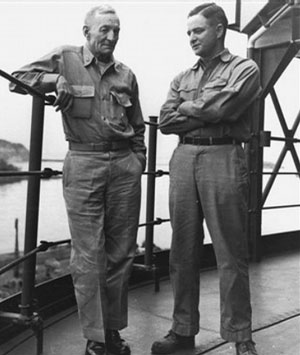
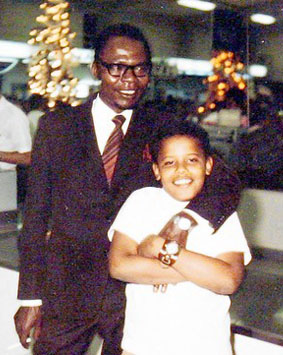
The differences in the overall narrative progression get embodied in differences at the level of texture, or narration—the concrete way each story is told, moment by moment. Consider the opening of Faith of My Fathers:
I have a picture I prize of my grandfather and father, John Sidney McCain Senor and Junior, taken on the bridge of a submarine tender, the USS Proteus, in Tokyo Bay a few hours after the war had ended. They had just finished meeting privately in one of the ship’s small staterooms and were about to depart for separate destinations. They would never see each other again.
Despite the weariness that lined their faces, you can see they were relieved to be in each other’s company again. My grandfather loved his children. And my father admired my grandfather above all others. My mother, to whom my father was devoted, had once asked him if he loved his father more than he loved her. He replied simply, “Yes, I do.”
And here are the opening lines of Obama’s memoir:
A few months after my twenty-first birthday, a stranger called to give me the news. I was living in New York at the time, on Ninety-fourth between Second and First, part of that unnamed, shifting border between East Harlem and the rest of Manhattan. It was an uninviting block, treeless and barren, lined with soot-colored walk-ups that cast heavy shadows for most of the day. The apartment was small, with slanting floors and irregular heat and a buzzer downstairs that didn’t work, so that visitors had to call ahead from a pay phone at the corner gas station, where a black Doberman the size of a wolf paced through the night in vigilant patrol, its jaws clamped around an empty beer bottle.
A card-carrying narratologist could squeeze a whole article out of these two openings, but just notice how well designed each is. Both grab the reader: Why would McCain’s father and grandfather never meet again? What was “the news” headed for Obama? The short, crisp sentences of the McCain extract—few adjectives and adverbs, no description except for the lines on the men’s faces—set the pace for what we’ll get later. McCain (via Salter) tells his tale in brief paragraphs and unvarnished prose, as laconic as the talk of the seamen he admires. The two opening scenes, that of father and son meeting on the bridge of the Proteus and the moment when McCain’s father tells his wife that he loves his father more than her, might have come from a John Ford film. The climactic “Yes, I do” even enacts that legendary Ford dictum that you shouldn’t let actors talk much.
Obama’s scene is more like a sequence from a 1970s urban movie, yielding washed-out imagery packed with scruffy detail. Everything suggests “dangerous neighborhood” and “black poverty,” but at no point does Obama use any of those words. Instead we get suggestions of grime and bleakness. As in many novels, the milieu comes to life through action: the broken buzzer initiates the routine of people calling ahead. By metonymy, the adjacent gas station reminds the narrator of the almost hallucinatory Doberman trotting through the night. And instead of telling us that drunkards left their beer bottles littering the streets, this paragraph suggests this sorry milieu obliquely by having the patrol dog clenching one in its jaws.
It might be tempting to say that McCain is deliberately avoiding literary grace notes, as befits a man identified with Straight Talk, while Obama is writing in a self-consciously novelistic way, like the elitist he is. Actually, no. Both are writing in literary ways, but using different techniques of narration.
Obama is adhering to Henry James’ admonition to “Dramatize, dramatize!” He tries to make every scene come alive for the reader through small details. He’s the sort of memoirist who not only gives you twenty-year-old conversations word for word, but adds all the gestures, vocal tones, and props.
“See there,” Marcus said. “Makes you embarrassed, don’t it—just being seen with a book like this. I’m telling you, man, this stuff will poison your mind.” He looked at his watch. “Damn, I’m late for class.” He leaned over and pecked Regina on the cheek. “Talk to this brother, will you? I think he can still be saved.”
Regina smiled and shook her head as we watched Marcus stride out the door. “Marcus is in one of his teaching moods, I see.” (103)
This sort of prose is movie-adaptation ready: You can see the scene. McCain doesn’t work at this level of concrete rendition, but his narration is no less carpentered. Consider this passage:
I didn’t think, “Gee, I’m hit—what now?” I reacted automatically the moment I took the hit and saw that my wing was gone. I radioed, “I’m hit,” reached up, and pulled the ejection seat handle.
I struck part of the airplane, breaking my left arm, my right arm in three places, and my right knee, and I was briefly knocked unconscious by the force of the ejection. Witnesses said my chute had barely opened before I plunged into the shallow water of Truc Bach Lake. I landed in the middle of the lake, in the middle of the city, in the middle of the day. An escape attempt would have been challenging. (189)
Things happen quickly here. The scene is over in seven sentences—no description of what the blackout felt like, no sense of imminent death. Point of view switches with equal speed. McCain is fully aware until he’s flung out of the plane and loses consciousness. Then his narration has to resort to an objective report of what happened while he was out. (“Witnesses said…”) The statement is backed up by a quick, vernacular summary of where and when he landed. The tone then switches to understated reflection, using the flat language of the stoic man of war: Escape wouldn’t have been impossible, or fatal, merely “challenging.” The paragraph plays down the crisis of survival by tapering into ironic self-effacement.
The rule of three is one of the writer’s best friends. The last sentence of the first paragraph renders three McCain actions—radioing, reaching, and pulling—in swift succession. Injuries pile up in triple-formation too: arm, arm, knee. The third trio is casual but memorably repetitive: middle of the lake, middle of the city, middle of the day. Should McCain claim that he, like Hamlet, “uses no art at all,” a narratologist will remind him of the technique pervading this passage—and his book’s opening. In a novel, mentioning a ship called Proteus would foreshadow the changes that young John will undergo. And James Wood complains in his recent How Fiction Works that a great many “apprentice novels” begin with the narrator pondering a family photo (95-96).
Percy Lubbock’s The Craft of Fiction (1921), a classic of literary narratology, distinguishes two methods of narration. The scenic method strives to make each moment palpable through energetic description, while the panoramic one inclines toward summary and generalization. Along this (fairly rough) continuum, Dreams from My Father lies closer to the scenic pole and Faith of My Fathers is closer to the panoramic one. Both autobiographies deploy the rhetoric of fiction, and both are unavoidably artificial. And each one’s technique (subtly eloquent versus direct and plain-spoken) creates a voice that fits the man’s narrative and his public persona.
Peopling the story

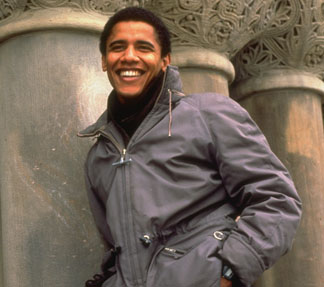
Characters in a narrative are usually identified by their roles and their traits of personality. Indiana Jones is a professor and adventurer, an intellectual cowboy. He is courageous, knowledgeable in his field, risk-loving, a bit insolent, somewhat impetuous, and so on. (For more on character construction, see my third essay in Poetics of Cinema.) Given very few cues we can fill in a character, so it becomes important that people who would become characters in their own stories send out the right signals. Rewriting real life is hard.
In the presidential campaign, it isn’t hard to identify the traits that the candidates are trying to define. All want to show integrity, resolve, prudence, a willingness to sacrifice for the greater good, and so on. But each candidate has also become identified with more individual traits. Without my enumerating them, let’s try a game.
Imagine our candidates as people in a high school. (2) Which one is the assistant principal on the verge of retirement? Which one is the social studies teacher who can always be led off the lesson plan with a strategically innocent question? Which one is the earnest first-year teacher, convinced that he can reform secondary education by reaching miscreants? And which one is Miss Popularity, cruel queen of the cliques, bluffing her way through assignments?
Maybe you don’t agree with my assessment of the candidates’ traits, but you knew exactly whom I referred to in each case. That’s because at least one narrative frame has sorted the characters along these lines. It’s a little scary to see that a flesh-and-blood person can be “characterized” so stereotypically, but whatever our political protagonists are like privately or deep down inside, as characters in the narratives that they spin or others spin around them, they fit well-worn templates.
Indeed, they can strive quite consciously to do that. To claim to possess “audacity” or to call yourself a “maverick” is to conjure up a set of traits, and these have implications for how you will act. As your actions mount up, a portrait snaps into focus that is hard to eradicate. Sarah Palin, introduced as a hard-edged fighter in the mold of Hillary Clinton, has been the most obvious instance of gradual revelation. She was an outline waiting to be filled in with events, and despite the campaign’s efforts to control what those events were, damaging pieces of behavior have mounted up and campaign leaks have confirmed their dire side. Palin now stands as a provincial politician adept at small-scale patronage whose ignorance of policy, world affairs, and science is abysmal and invincible. This has not kept some people from admiring her, of course.
Palin betrays no change in personality over the course of the campaign, and neither does Biden. According to reporters who cover him, he’s the same Joe he always was, take it or leave it. For real change—not of America’s direction but of public personas—we need to look at the top of the ticket. In the course of the campaign, for example, Obama has managed to seem consistent with his core program while having “seasoned” and “matured,” thanks to the tough primary fights. (Another cluster of narratives I can’t tackle here.)
McCain has been rendered as changing too, but not in a good way. One prominent large-scale narrative has portrayed him as losing some of his independence of thought—tacking to the right on cultural matters, losing the argument about his running mate. Few speak of the old Barack Obama versus the new one, but the narrative of John McCain 2.0 has stuck. Mr. Roberts has become the captain himself—a man crumpled with vexation, the cranky officer he would have rebelled against at Annapolis. I suspect that some day a McCain biographer will construct a narrative that shows him to have become a tragic figure.
The big three ingredients
Narratives arouse emotions in us; some would say that’s their chief purpose. The emotions can be of all kinds—pity, sympathy, indignation, joy, and down the line. But are there emotions characteristic of narrative in general? The theorist Meir Sternberg (3) has suggested that a narrative as such, regardless of other emotions it can conjure up, depends on three emotional states. Simplifying a bit, we can say that stories create curiosity about past events, suspense about future events, and surprise by means of unexpected events. Whatever other emotions a narrative evokes, we need to feel at least one of these three states.
Most narratives invoke all of these, but some genres rely on more than others. Detective stories rely a lot on curiosity, as characters try to solve the crime by exposing the events that led up to what’s happening now. Likewise, psychological tales—like Obama’s search for his roots—will evoke curiosity about the origins of events or personality traits. Action-driven narratives rely heavily on suspense: Will the protagonist reach her goals, or even just survive? The Dark Knight, with all its ticking clocks and hairbreadth escapes, is driven chiefly by suspense. (For more on suspense, you can visit this entry.) Plots with “a sting in the tail,” such as in stories by O. Henry and Roald Dahl and the early films of M. Night Shyamalan, have endings that depend to an unusual degree on surprise.
We can distinguish the two Presidential campaigns’ “master narratives,” along these dimensions. In the ongoing electioneering, Obama’s campaign is now driven almost completely by suspense. He’s not asking us to find out more about what led to the war in Iraq or the economic collapse or the crumbling infrastructure; it’s assumed that we know enough backstory. Everything is about what comes next. Ask any Obama supporter the predominant emotion she or he feels, and I’ll bet it will be suspense. What will happen next? What could throw the juggernaut off course? Fingers crossed: The very image of suspense.
McCain, by contrast, is running a campaign driven by curiosity and surprise. Many of his talking points dwell on the past. Who is Barack Obama, really? What did he have to do with Ayers, Rezko, the Fannie Mae and Freddie Mac executives? Why did he sit in Jeremiah Wright’s church? And so on. These questions ask us to feel curiosity in the form of suspicion about McCain’s rival. The fact that most in his audience haven’t taken up the hint has driven the campaign to try to invoke another emotion: surprise. The pick of Sarah Palin is the most obvious instance, but several others have followed: suspending the campaign, promising to buy people’s mortgages, yanking Joe the Plumber out of obscurity as an emblem of small business, even the “not ready yet” tagline of a recent ad. There may be more surprises to come, as gloomy Democrats fear (which only increases their feeling of suspense). At this point, the act of winning would be the ultimate McCain surprise.
So the campaigns may teach us something of interest about narratives: You can’t have a gripping narrative without some suspense. You can do without curiosity or surprise, but a story lacking suspense won’t keep us turning enough pages to be curious or surprised. (4) Maybe that’s why the McCain campaign never had a “compelling narrative.” It didn’t build up enough of a sense of how it would win or how, after the election, the future would be different.
Narrative plus

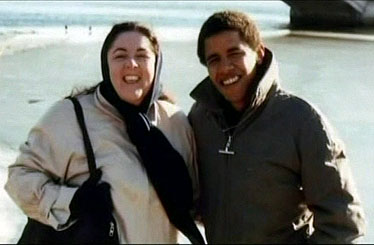
On 29 October, the Obama campaign ran a 30-minute television film, American Stories, about why he should be president.This infomercial is a gift to the film analyst, and there’s much more to say about it than I can articulate here. I’ll concentrate on one intriguing aspect of it.
Narrative isn’t the only way to organize a film or literary text. In Film Art, we suggest that there are other principles of organization. Using categorical form, you can survey different types of things, like baseball cards or political systems, without telling a story. You can use a rhetorical format, making an argument for a position you believe in by adducing reasons. What we call associational form can link various images, sounds, and actions through analogy, contrast, or metaphorical connection; one example would be the film Koyaanisqatsi. And very often these principles can combine in a single book, film, or tv program.
American Stories isn’t centrally about Obama’s life or his family or running mate. Instead, the campaign created a series of anecdotal narratives. In turn, these narratives were linked by associations, not by the causal connections typical of narrative. Most broadly, Obama framed these narratives and linkages within a set of policy statements, so that the narratives provided illustrative examples of a rhetorical argument.
A football mom can’t pay for her husband’s medical treatment and must ration the kids’ snacks. An elderly retiree who paid off the family house must return to work to pay for his wife’s medications. A teacher in a school for at-risk kids must take a second job and still find time for her training, while deciding whether to buy a gallon or half-gallon of milk. A loyal Ford assembly-line worker is dropped to half-time; unlike his father and grandfather, he cannot expect a full pension. “Everybody here’s got a story,” Obama remarks.
The stories serve to illustrate a checklist of Obama’s positions: rescuing the middle class by means of tax cuts, making corporations accountable for pension fulfillment, working for energy independence, reforming health care, and shifting the war on terror to Afghanistan. So far, so categorical. But these talking points aren’t linked by logical inference but by association.
Take the story of teacher Juliana Sanchez. She instantiates the ‘education’ idea. Cut to Obama saying that teachers can do only so much: Parents must take responsibility for their children’s learning. Just as Juliana is taking care of her children, Obama recalls his mother taking care of him, as a single parent. Over family photographs he tells of his mother rousing him from bed to go through his lessons before she went to work. Link to Obama giving a speech in which he declares that every child needs a world-class education. Cut to him addressing the camera, declaring that he’s seen school reform work. The political has become doubly personal, exemplified by Juliana and by Obama’s own experience.
Then: “Just as I believe that every American has a right to an affordable education, I also believe that every American has a right to affordable health care.” This segues to a statement of Obama’s medical policy, which is followed by an account of his mother’s premature death, in which he shows that he knows what it is to lose a loved one. “It felt arbitrary.”
While the local connections are driven by associations like these, the overall shape of the half-hour is—no surprise—rhetorical. Obama is adducing reasons to vote for him. His case is that Americans are facing problems to which he has solutions. He could have presented the solutions as a list, in the form of bullet points or charts. Instead, he makes the problems concrete by illustrating how they affect ordinary people, including his own family, and then presents his solution by talking to an audience.
This use of rhetorical form contrasts with the one we discuss in Film Art (Chapter 10), when we analyze The River (1937). In that film, director Pare Lorentz doesn’t highlight individuals’ experience but creates a vast, sweeping story of erosion on the Mississippi river. Correspondingly, Lorentz doesn’t give the solution to the problem as a speech; it is presented in images of people taming the river, building the dam, and settling in new communities.
Obama could have adopted Lorentz’s strategy by tracing a broad history of the last eight years of Republican government, leading up to the financial crisis as a climax of mismanagement, and then turning to his policy prescriptions. He chose, as his campaign has largely chosen, not to rehearse the mistakes and misdeeds of the past (with which many Democrats were involved as well) but to put the emphasis on current conditions and hope for the future. Instead of Lorentz’s epic sweep, which arouses a feeling of grandeur and civic pride in getting a big job done, the Obama film asks us to empathize with “Americans looking for real and lasting change that makes a difference in their lives.”
Thanks to this blend of different types of formal organization, even the abstractions of policy draw upon the powers of storytelling. Maybe this campaign really is all about narratives. If so, maybe narratology can illuminate public discourse in useful ways.
Just don’t call this blog entry a deconstruction.
(1) Roland Barthes, “Introduction to the Structural Analysis of Narratives,” in Image Music Text, ed. and trans. Stephen Heath (New York: Hill and Wang, 1977). Barthes’ essay originally appeared in Communications 8 (1966), devoted to semiological research into narrative. Assembling a veritable who’s who of Structuralism, the issue included essays by Greimas, Bremond, Eco, Todorov, and Genette, as well as Christian Metz’s essay on the “Grand Syntagmatic” of narrative film.
(2) People say that Hollywood is high school with money, and that Washington is Hollywood for ugly people. So Washington must be high school, money, and ugly people? Obama and Palin seem to disprove the last condition.
(3) Sternberg laid out these principles in Expositional Modes and Temporal Ordering in Fiction (Baltimore: Johns Hopkins University Press, 1978), one of the finest studies of narrative theory I know. He elaborated the ideas in two articles under the title “Telling in Time.” See Poetics Today 11, 4 (Winter 1990), 901-948, and 13, 3 (Fall 1992), 463-541.
(4) Of course there is suspense on the McCain side too, but more and more it consists of the question: How bad will the damage be? Although the Obama campaign hasn’t exploited curiosity about McCain’s campaign narrative, the press has done so by slowly creating a backstory about Palin’s record and the way she was selected.


Categorical coherence: A closer look at character subjectivity
Subjective
[NOTE: There are some spoilers here, though I’ve tried to avoid giving away the ends of the films I mention. Teachers who show clips in class would probably want to do the same. Some of the films mentioned here would be good choices to show in their entirety to classes when they study Chapter 3 of Film Art.]
Kristin here—
We have had occasion to mention the Filmies list-serve of the Department of Communication Arts’ Film Studies area here at the University of Wisconsin-Madison. Current and past students and faculty, sometimes known as the “Badger squad,” share news, links, and requests for information. Once in a while a topic is raised for discussion. These exchanges are usually fascinating, and when we have felt that they might be of interest to a general audience, we have used them as the basis for blog entries. (See here and here.)
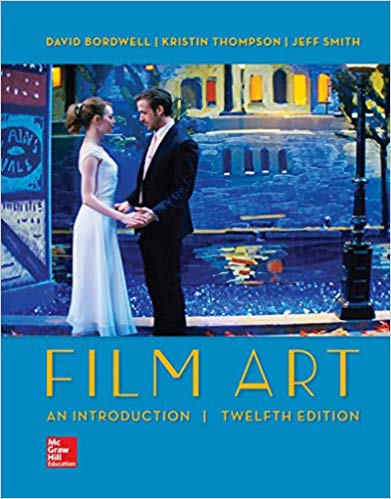
Another occasion arose recently, one which relates to the teaching of Film Art: An Introduction. Matthew Bernstein, of Emory University, queried the group about suggestions for teaching a section of the third chapters, “Narrative as a Formal System.” He found that the section, “Depth of Story Information,” gives some students trouble. They can’t grasp the distinction we make between perceptual and mental subjectivity.
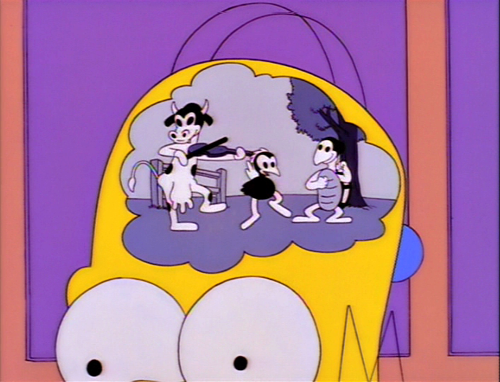
Our definitions of the terms go like this. Perceptual subjectivity is when we get “access to what characters see and hear.” Examples are point-of-view shots and soft noises suggesting that the source is distant from the character’s ear. In contrast, “We might hear an internal voice reporting the character’s thoughts, or we might see the character’s inner images, representing memory, fantasy, dreams, or hallucinations. This can be termed mental subjectivity.”
We then go on to give a few examples. The Big Sleep has little perceptual subjectivity, while The Birth of a Nation contains numerous POV shots. We see the heroine’s memories in Hiroshima mon amour and the hero’s fantasies in 8 ½. Filmmakers can use such devices in complex ways, as when in Sansho the Bailiff, the mother’s memory ends not by returning to her in the present, but to her son, apparently thinking of the same things at the same time.
Yeah, but what about …?
Filmmakers don’t always use these categories in straightforward ways. They may oscillate between perceptual and mental representations and events. Films may present narrative events that make the distinction between characters’ perceptions and their mental events ambiguous. That’s why in introducing the concepts, we stress that “Just as there is a spectrum between restricted and unrestricted narration, there is a continuum between objectivity and subjectivity.
Easy to say, but not necessarily so easy to grasp for a student who’s trying to understand these categories. They need to start with simple examples to familiarize themselves with the basic distinction before going on to what the likes of Resnais, Fellini, and Mizoguchi can throw at them. But some students immediately proffering exceptions. As Charlie Keil, of the University of Toronto, put it in his post on the subject, “I hardly need add that students, even the least analytically astute, border on the brilliant when it comes to suggesting examples that provide challenges to categorical coherence.”
Looking over the one and a half pages of the textbook that we devoted to depth of narration, you might find it fairly straightforward. Once you start looking for ways to teach the concepts without bogging down in too many nuances and subcategories, though, the passage does seem challenging. What follows is a suggestion about how someone might go about explaining and utilizing examples. It also points up some ways we might revise this passage of the book for its next edition.
What it’s not
One obstacle that Matthew has found is that students are used to thinking of “subjective” as meaning something like “biased,” as in “here’s my subjective opinion on that.” It might be useful to point out that this is only one meaning of the word. The dictionary definition that comes closest to the way we use it in Film Art is this: “relating to properties or specific conditions of the mind as distinguished from general or universal experience.” For film, we specify that “subjective” means either sharing the characters’ eyes and ears (properties) or getting right inside his or her mind (conditions).
Another misconception comes when students assume that the facial expressions, vocal tones, and gestures used by actors are subjective because they convey the characters’ feelings. Again, best to scotch that notion up front. Those techniques are projected outward from the character, and we observe them. Cinematic subjectivity goes inward.
One step at a time
Another distinction to stress early on is the basic one we make between film technique and function. There are a myriad of film techniques that could be used in either objective or subjective ways. To take a simple example, a low camera angle might indicate the POV of a character lying down and looking up at something; that’s perceptual subjectivity. A low angle of a skyscraper in an establishing shot might simply be the objective narration’s way of showing where a new scene will occur.
In contrast, indicating perceptual and mental subjectivity are two specific kinds of functions. Filmmakers can call upon whatever cinematic techniques they choose, and historically the more imaginative ones have shown immense creativity in trying to convey what characters see and think.
Some films depend heavily upon subjectivity, but objective narration is more common. There are many films that give us little access to characters’ perceptual and mental activities. Apart from The Big Sleep, there are films like Anatomy of a Murder, or virtually anything by Preminger. Most films use subjectivity sparingly. So let’s assume the students can tell that objective narration is the default.
With that out of the way, we can go back to basics. Both perceptual and mental subjectivity depend on being “with” the character in a strong way, as opposed to observing him or her as we would see another person in real life.
Perceptual subjectivity is fairly simple. The camera is in the character’s place, showing what he or she sees. The microphone acts as the character’s ears. Other characters present in the scene could step into the same vantage point and observe the same things.
So the test could run like this: As a viewer, when we see something in a film, is it really present within the scene? Could someone else in the same position see and hear the same things? Or is it a purely mental event, something no one else could see and hear, even if they stood beside the character or stepped into the place where that character had been standing?
If I were teaching the concept of narrational subjectivity as Film Art defines it, I would stress the notion of a continuum. After starting with very clear examples of both perceptual and mental subjectivity, I would progress to more ambiguous, mixed, or tricky instances.
Contributing to this discussion on the Filmies list, Chris Sieving, of the University of Georgia, says he shows a 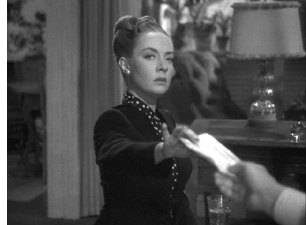 clip from Lady in the Lake, the film noir where the camera always shows the POV of the detective protagonist. As Chris says, “It seems to effectively get across what perceptual subjectivity means (and how awkward it is in large doses), as well as what is meant by a (highly) restricted range of narration (as is the case with most whodunits).” As Chris also says, Lady in the Lake is a sort of limit case, a film that depends as much on perceptual subjectivity as it’s possible to do. (That’s “our” hand taking the paper in the shot at the right.) One could show several minutes from any section of the film and make the point thoroughly.
There are other films that contain a lot of POV shots but intersperse them with objective ones. Rear Window is an obvious case. When Jefferies is alone, we see the courtyard events from his POV, a fact which is stressed by his use of binoculars and his long camera lenses to spy on his neighbors. This is clearly perceptual rather than mental. We never doubt that what we see through the hero’s eyes is real; we don’t believe that he’s making things up to entertain himself or because his mind is unbalanced. For one thing, there are two other characters who visit at intervals and see the same things that he does. We and they might question whether Jefferies’ interpretation of what he sees is correct, but we assume that the story’s real events have been conveyed to us through his eyes and ears. Only if we saw something like his fantasy of how he imagines his neighbor might have killed his wife would we move into the mental realm.
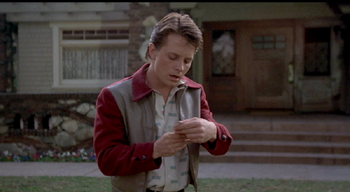
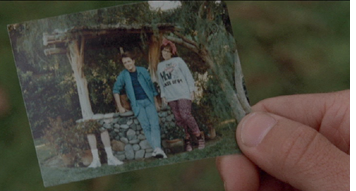
These two films foreground their use of POV. Usually, though POV shots are slipped into the flow of the action smoothly. Scenes of characters looking at small objects or reading letters often cut to a POV shot to help us get a look at an important plot element. At intervals during Back to the Future, Marty looks at a picture of himself and his siblings, gradually fading away to indicate that the three of them might never be born if he doesn’t succeed in bringing their parents together. It’s a simple way of reminding us what’s at stake and that Marty’s time to solve the problem is running out.
The Silence of the Lambs uses many POV shots and provides an excellent case of narration switching frequently and seamlessly between objective and subjective. Most of the POV views are seen through Clarice’s eyes, but sometimes through those of other characters. The first view of Lecter is a handheld tracking shot clearly established as what she sees as she walks along the corridor in front of the row of cells.
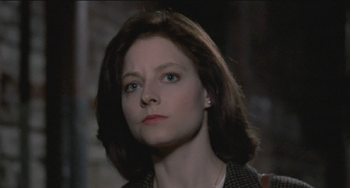

The scenes of Clarice conversing with Lecter develop from conventional over-the-shoulder shot/ reverse shot to POV shot/ reverse shot as both characters stare directly into the lens. (In Film Art, we use this device as an example of how style can shape the narrative progression of a scene [p. 307, 8th edition]). Other characters have POV shots as well, most noticeably, when Buffalo Bill twice dons night-vision goggles and we briefly see the world as he does.
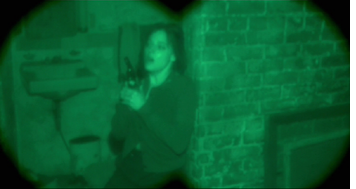
Occasionally we see the POV of even minor characters, as when Lecter’s attack on his guard is rendered with a quick POV shot of Lecter lunging open-mouthed at the camera and then an objective shot of him grabbing the guard.
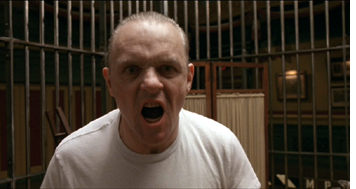
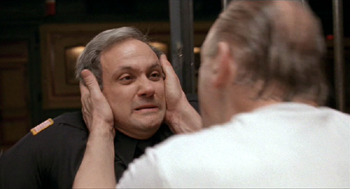
In their minds
Let’s jump to the other end of the continuum. Here we find a clear-cut use of mental subjectivity for fantasies, hallucinations, and the like. Obviously no one else present, unless he or she is posited as having special telepathic abilities, can see and hear what takes place only in a character’s mind.
Such fantasies are a running gag on The Simpsons, where Homer’s misinterpretations, distractions, and visions of grandeur are shown either in a thought balloon or superimposed on his skull. In the example above, he abruptly starts “watching” a little cartoon after assuring Lisa that she has his complete attention. No one could mistakenly assume that these exist anywhere but in Homer’s imagination.
In Buster Keaton’s Our Hospitality, the hero receives a letter telling him he has inherited a Southern home. After an image of him thinking there is a dissolve to a view of a large, pillared house. Later, when he arrives at his small, ramshackle house, he stands staring in a similar situation, and here there is a fade-out to his dream house, which abruptly blows up. The humor in the second scene would be impossible to grasp if we didn’t easily understand that the shot of the house exists only in his mind.
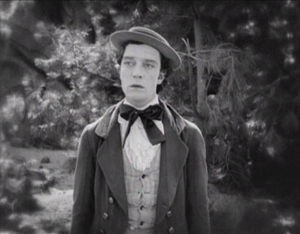
Whole films can be built around fantasies. A large central section of Preston Sturges’ black comedy Unfaithfully Yours consists of a husband envisioning three different ways he might kill his supposedly cheating wife, all set to the musical pieces he is conducting at a concert. Fellini’s 8 ½ is only the most obvious example of how the art cinema often brings in fantasies. Other examples include Jaco van Dormael’s Toto le héros or Bergman’s Persona.
Once students have grasped the basic distinction between perceptual and mental subjectivity, it might be useful to emphasize the continuum by moving directly to its center, where the two types coexist.
The middle of the continuum: Ambiguity and simultaneity
Right in the middle of the continuum between the pure cases we find ambiguous cases. Filmmakers can create deliberate, complex, and important effects by keeping it unclear whether what we see is a character’s perception of reality or his/her imaginings.
1961 was a big year for ambiguous subjectivity, with two of the purest cases appearing. One was a genre picture, the other a controversial art film.
The first is the British horror film, The Innocents, directed by Jack Clayton and based on Henry James’s novella, The Turn of the Screw. In several scenes, a new governess at a country estate sees frightening figures whom she takes to be ghosts haunting the two children entrusted to her. We see these figures as she does, but we never see them except when she does. The children behave very oddly in ways that might be consistent with her belief, yet they deny seeing any ghosts. Finally the governess tries to force the little girl to admit that she also sees the silent female figure standing in the reeds across the water. Does the child’s horrified expression reflect her realization that the governess knows about her secret relationship with the ghosts? Or is she simply baffled and frightened by the governess’s increasingly frantic demands that she confess to seeing something that in fact she can’t see?
From the first appearance of the eery figures, the question arises as to whether the governess is imagining the ghosts or they are real, controlling the children, who try to keep them secret. There are apparent clues for either answer. By the end, we arguably are no closer to knowing whether the ghosts are real or figments of the heroine’s imagination.
Since Last Year at Marienbad appeared, critics have spilled gallons of ink trying to fathom its symbolism and sort out the “real” story that it tells. Clearly there are contradictions in events, settings, and voiceover narration. The second of the three accompanying images depicts the heroine as the hero’s voiceover describes their first meeting. They talked about the statue that stands beside her, seen against the formal garden of walks lined with pyramid-shaped shrubs. Yet another version of the first meeting starts, this time with the characters and the same statue against a background of a large pool. Later scenes in these locales display the same inconsistencies.
Are such contradictions the result of one character’s fantasies or of the conflicting memories that two characters have of the same event? Or are the contradictions not the products of subjectivity at all but just the playfulness of an objective, impersonal narration, manipulating characters like game pieces to challenge the viewer? (Our analysis of Last Year at Marienbad is available here on David’s website. It and all the Sample Analyses that have been eliminated from Film Art to make room for new essays are available here as pdf’s; the index to them is here, about halfway down the page.)
It’s not a good example of subjectivity to show students, but just as an aside, the screwball comedy Harvey is an interesting case, a sort of reversal of the Innocents situation. The narration withholds a character’s perceptual and mental events. Elwood P. Dowd describes what he sees and hears: a six-foot talking rabbit invisible to us and to all the other characters. The story concerns whether Dowd’s relatives will institutionalize him for insanity, and we assume along with them Harvey is a mere delusion. Thus the narration seems to be objective—or, the ending asks, has it been very uncommunicative, withholding something that the hero really does see and hear? True, throughout the film the framing leaves room for Harvey, as if he were there. One could argue, though, that these framings simply emphasize that the giant rabbit isn’t visible to us or the other characters and hence isn’t likely to really exist.
A film can easily present both perceptual and mental subjectivity at the same time. A POV shot may be accompanied a character’s voice describing his or her thoughts and feelings. Matthew shows his class part of the opening section of The Diving Bell and the Butterfly, where a stroke victim’s extremely limited sight and hearing are rendered in juxtaposition with his voice telling of his reactions to his new situation. It is one of the most extensive and successful uses of such a combination in recent cinema, and it might be very effective in differentiating the two for introductory students.
A scene can also move rapidly back and forth between a character’s perceptions and his or her thoughts. Charlie writes that he shows his students the scenes of Marion Crane driving in Psycho. While the car is moving, almost every alternating shot is a POV framing of the rearview mirror or through the windshield. At that same time, we hear the voices of her lover, her boss, her fellow secretary, and the rich man whose money she has stolen while she imagines how they would react to her crime.
Showing scenes like these, where both types of subjectivity are used and clearly distinguishable might be more useful for students than showing several scenes that contain only one or the other.
Flashbacks, Voiceovers, and Altered States
In his original query to the Filmies, Matthew also said that students have problems with flashbacks: “Particularly, they resist the idea that a flashback is an example of subjective depth in general, even if the flashback unfolds objectively.” I can think of two ways to explain this.
First, classical films tend not to have flashbacks that just start on their own. To be sure, some do: a track-in to an important object and a dissolve can signal the start of a passage from the past, without a character being there. But more often a character is used to motivate the move into the past. A thoughtful look may do it, or a character may describe the past to someone else. In either case, the flashback is coming “from” the character and is assumed to show approximately what he or she is remembering. Occasionally the flashback may be a lie rather than objective truth, as we know from Hitchcock’s Stage Fright, The Usual Suspects, and a few other films.
In Poetics of Cinema’s third essay, David argues that most flashbacks in films are motivated as a character’s memory, but what is shown often strays from what he or she knew or could have known. He suggests that the prime purposes of most flashbacks is to rearrange the order of story events, and the character recalling or recounting simply provides an alibi for the time shift.
So we might think of character-motivated flashbacks as subjective frameworks that also contain objectively conveyed narrative information.
Second, the fact that flashbacks slip in objective information into characters’ memories is a convention. It’s a widely used method for presenting us with two things at once: first, a character’s memories and second, some story information that the viewer needs to have—even if the character couldn’t know about it. As we watch movies, we frequently accept conventions for the sake of being entertained. Beings that travel to Earth from distant galaxies speak English, high school kids can put together shows that wind up triumphing on Broadway, and people who drive up to buildings in crowded cities always find perfect parking spots. In a similar way, implausible mixtures of subjectivity and objectivity in flashbacks is just something we have to accept.
There are two other techniques that didn’t get mentioned during the discussion but that might confuse students.
What about shots showing the vision of a character who is drunk, dizzy, drugged, or otherwise unable to see straight? The most common convention is to include a POV shot that’s out of focus, perhaps accompanied by a bobbing handheld camera. Other characters in the scene, assuming they are not similarly impaired, would not see the surroundings in the same way.
Still, I think the same perceptual/mental distinction holds for such moments. The fuzziness and the lack of coordination are physical effects that are not being imagined by the character. They remain in the perceptual realm. Mental effects of impairment would be dreams or hallucinations. Some examples: the “Pink Elephants on Parade” sequence in Dumbo and the DTs vision of the protagonist of Wilder’s The Lost Weekend. As the title suggests, Altered States takes such mental activities as its subject matter and has many scenes that represent them.
A harder case is voiceover. Are all cases of voiceover subjective? Clearly not. If we have a situation where a character tells a story to a group and his or her voice continues over a flashback, the narration remains objective. We assume that the group can still hear the storyteller. Cases where the voice exists only in the mind, as when a character speaks to himself or herself, but not aloud, are mental subjectivity.
That said, there are many unclear cases. Just what is the status of the narration in Jerry Maguire? Jerry seems to speak directly to us, pointing out things that happen during the action, yet clearly there is no suggestion that he made the film we are watching. The problem is compounded in Sunset Boulevard, where the protagonist not only implicitly addresses us but is also dead. In many cases when a character’s voice is heard over a scene, it might occur to audience members to wonder where the character is or was when speaking these words. And does a character’s voice describing his or her feelings constitute objective or subjective narration? Probably we would want to say that only when the voice is posited as strictly an internal voice, audible only to the character, would we want to dub it subjective.
The problem with voiceovers arises, I think, because it’s such a slippery technique to begin with, and therefore often hard to categorize. Is a character speaking narration over events that happened in the past diegetic sound or nondiegetic? If there’s never an establishment of where and when that character does the narrating, he or she exists in a sort of limbo in between the two states: diegetic because he or she is a character, nondiegetic because he or she is in some ineffable way removed from the story world.
For voiceovers, then, I think it’s best simply to categorize the ones that obviously are straightforwardly objective or subjective. In tricky cases, we just have to admit that not all uses of film technique are easy to pin labels on. But the point of having categories like these isn’t to pin labels. In part knowing them allows us simply to notice things in films that might otherwise remain a part of an undifferentiated flow of images. They enable us to see underlying principles that make films into dynamic systems rather than collections of techniques. They give us ways to organize our thoughts about films and convey them to others. And, though students may doubt this, watching for such things becomes automatic and effortless once we have understood such categories and watched a lot of films. As a child, I don’t think I knew about the concept of editing or ever really noticed cuts. Now I’m aware of every cut in every film I see, and I notice continuity errors and graphic matches and other related techniques, all automatically, without that awareness impinging in the least on my following the story and being entertained. Learning the categories is only the beginning.
Playing with subjectivity
Once students have seen some clear cases of each type of cinematic subjectivity and understand the difference, the teacher could move on to emphasize that filmmakers can play with both in original ways. It’s not really possible in an introductory textbook to discuss all the possibilities—and probably not possible to come up with a typology that would cover every example of subjectivity that could exist across that continuum we mentioned. Imaginative filmmakers will always find new variants on how to use techniques for this purpose. But here are a few intriguing cases.
In his class, Chris shows the scene in Hannah and Her Sisters where the Woody Allen character, a hypochondriac, visits a doctor for some hearing tests. Initially the doctor comes into the room and gives a dire diagnosis of inoperable cancer. After Mickey has reacted to that, a cut takes us back to an identical shot of the doctor entering, but this time he gives Mickey a clean bill of health. The first part of the scene is retroactively revealed to have been a mental event, Mickey’s pessimistic fantasy.
The same sort of thing happens in a more extended way with the familiar “it was only a dream” revelations that make the audience realize that a major part of the plot has been subjective. In a more sophisticated way, as Chris points out, other sorts of mental subjectivity, usually lies or extended fantasies, can be revealed retrospectively, as in The Usual Suspects, Mulholland Drive, and Fight Club.
A flashback from one character’s viewpoint may reveal something new about an earlier scene. In Ford’s The Man who Shot Liberty Valance, the shootout is initially shown through objective narration. Only later in the plot does another character reveals that, unbeknownst to us or the other people present, he had also been present at the shootout. The flashback to his account reveals that the shootout happened very differently from the way we had assumed when first seeing it.
I’ll close with an example from The Silence of the Lambs. This shows how subtle and effective a play with perceptual and mental narration can be. In the scene at the funeral home where a recently discovered body of a murder victim is to be examined, Clarice is left waiting in the midst of a group of state troopers who stare at her. To get out of the situation, she turns and looks into the chapel, where a funeral is taking place. We see her face and then her POV as she surveys the room. A cut shows Clarice suddenly within the chapel, moving forward toward the camera and staring straight into the lens. We will only realize retrospectively that this image begins a fantasy that leads quickly into a memory. Clarice has not actually left her previous position just outside the door.
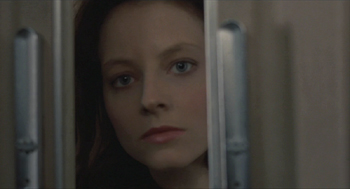
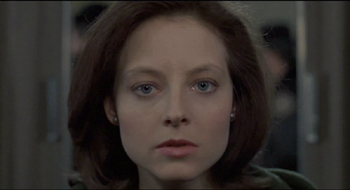
The next shot is a track forward through the center aisle toward the casket. Since Clarice had been walking in that direction before the cut, we recognize this as a POV and assume that Clarice is continuing to walk. Yet the man in the casket, as we soon will learn, is Clarice’s father. The shot represents a different funeral, one in the past which she has been triggered to remember by her glance into the chapel. The fantasy has become a flashback. A second, similar view of Clarice’s face returns us to her fantasizing adult self, the one remembering this scene but not the one still standing outside the door. A closer view of the father’s casket shows it from a lower vantage-point, as if that of a child.
The reason for the change becomes apparent from a radical change at the next cut, so that the camera is on the far side of the casket, filming from a low angle. The sudden shift moves us away from the adult Clarice in order to show her as a child approaching her father and leaning down to kiss him. A noise pulls Clarice out of her memory, and a cut back to the hallway shows her turning away from the chapel. (As often happens, sound, and particularly music, helps guide us through the scene, marking the beginning and ending of the fantasy/flashback.)
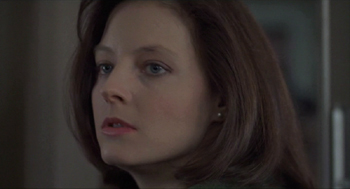
The most experienced film specialist could not track all the rapidly shifting levels of subjectivity in this scene on first viewing. Still, later analysis using some categories of subjective narration can help us appreciate how Demme has woven them into a scene that helps explain Clarice’s motives in becoming an FBI agent and her determination in pursuing her first case.
Categories matter
To some students, the categories I’ve just discussed may seem like trivial distinctions. They’re not. The use of subjective narration is one of the key ways the filmmaker has to engage our thoughts and emotions with the characters. In Psycho, we become involved in Marion Crane’s life in a remarkably short time, partly because of her situation but also partly because Hitchcock keeps us so close to her once she prepares to steal the money. The camera not only frames her closely, but to a considerable degree we see and imagine what she does: her fearful forebodings of how her rash act will turn out. Much the same thing happens with Clarice Starling in The Silence of the Lambs, though there our emotional involvement lasts throughout the film, and we are given glimpses of Clarice’s memories.
Perhaps choosing a scene or two from such films and going through them with the students, trying to imagine what it would be like without the POV shots and the imaginings and the memories, would convince them of the value of learning these categories. After all, the exceptions they find are only exceptional because they play in a zone defined by solid concepts.
[Note added October 24: I should have referred back as well to David’s entry “Three Nights of a Dreamer,” largely on POV.]

Objective
Vancouver wrapup (long-play version)

Our final post from this year’s Vancouver International Film Festival. Plenty to talk about, so today you get your money’s worth. Oh, wait….it’s free. So you definitely get your money’s worth.
Kristin here—
East
If Abbas Kiarostami and Mohsen Makhmalbaf have been the most prestigious Iranian directors, with their features prominent at film festivals, Majid Majidi has been among the most popular. His Children of Heaven (1997) and The Color of Paradise (1999) both had international success, perhaps largely due to their focus on children and their sentimental, heartwarming stories. The Song of Sparrows (above, 2008) represents a pleasant development and is the best Majidi film I’ve seen. It’s still sentimental and heartwarming, but there’s also a great deal of humor and some highly imaginative situations that give the film more originality than the director’s earlier work.
For a start, the film puts children into supporting roles and sticks continuously with Karim, a hard-working father who strives to make extra money to replace his daughter’s hearing aid. Initially Karim works at an ostrich farm, a completely unexpected locale that generates considerable humor—until one ostrich escapes and Karim loses his job. His one asset is his motorcycle, which he turns into a cab in nearby Tehran, thereby earning good money. Meanwhile his mischievous son and his friends dream of dredging a covered pond near their village and making money by filling it with goldfish to sell.
The triumphs and obstacles that Karim and his son meet make up the bulk of the story, though the life of the tiny cluster of houses in which the main family and their neighbors dwell is charmingly depicted.
The plot of Under the Bombs involves a Lebanese divorcée returning from abroad to search for her sister  and son just after the 2006 war between Hezbollah and Israel. Only one taxi driver is willing to drive her into the southern region, where bombing could re-erupt at any time; he’s from that area himself, and he’s also attracted to Zeina. This simple story, however, is not half as compelling as the environment in which it takes place.
The film opens abruptly with extreme long shots of bombs going off among residential blocks, and as the two main characters travel through scenes of devastation, there is a vivid sense of the action being staged as the events depicted were actually unfolding. One scene depicts French NATO troops landing with the first relief supplies; another shows coffins being dug out of a mass grave and handed over to grieving family members.
Director Philippe Aractingi manages to convey something of the sense of outrage that news coverage of the Hurricane Katrina disaster did in the U.S. As Zeina questions shelter inhabitants about her lost relatives, they tell their tales of losing their entire families and of being separated from loved ones. We can’t tell whether these people may be actors or actual people who have suffered the losses they describe, but a cumulative sense of outrage emerges at the Israelis’ willingness to attack residential areas in their fight against terrorists.
West
Last time I wrote about films from Haiti and Jordan. The festival continued to offer films from countries that have had little or no regular production. El Camino (2007) hails from Costa Rica, though its director, Ishtar Yasin, is Chilean-Iraqi. The narrative is spare, though not in the enigmatic art-cinema fashion of Eat, for This Is My Body. We are introduced to 12-year-old Saslaya and her younger, mute brother Dario. They live with their grandfather in a shack and scavenge in the local dump. The grandfather sexually abuses Saslaya, and the children set out to find their mother. We watch their journey progress in typical picaresque fashion as they meet people, witness a puppet show put on by a vaguely sinister old man, and wander the streets of the local town. Yet we don’t learn where their mother is, why and when she left. The exposition is minimal, as is the dialogue. Watching El Camino, one becomes aware of how much talk most films contain, since the siblings don’t talk to each other or anyone else.
Finally, nearly 70 minutes into a 91-minute film, the children take a ferry. There the other passengers exchange stories about why they are traveling. Gradually we learn that the early part of the film was set in poverty-stricken Nicaragua, and these people are trying to enter Costa Rica illegally to find work. Saslaya reveals that her mother had left with that goal eight years earlier, after their father died. At last we get some sense of the situation, but the pair’s progress is interrupted once the group goes ashore and are shot at by local authorities. Losing Dario, Saslaya wanders into a town and perhaps an unhappy future—one that may echo what had happened to her mother.
This simple story is enhanced by poetic, even at times vaguely surrealist images, such as the two men struggling to move a wooden table who keep crossing the children’s path. With so little narrative to follow, we are encouraged to focus on the hardships and occasional pleasures of a culture which seldom figures in world cinema.
I referred to the two Mexican films that I described in our first Vancouver report as melodramas. Add another  to the list with Francisco Franco’s Burn the Bridges. Two teenagers care for their dying mother in a setting that seems to attract many Latin American filmmakers: a large, decaying mansion. The sister refuses to leave the house, determined to build an isolated world for herself and her brother, to whom she feels an incestuous attraction. He, however, wants nothing more to escape, especially when a tough new kid at school awakens his dawning homosexuality. The action seems a bit overblown at times; I wasn’t always sure whether apparent humor was deliberate or not. But the film and its settings are visually compelling, especially a scene in which the brother and his new friend sneak into a forbidden part of their Catholic school, passing a series of large religious paintings and finally emerging on the roof.
O’Horten is a Norwegian film from Bent Hamer, who has emerged as a film festival favorite with his 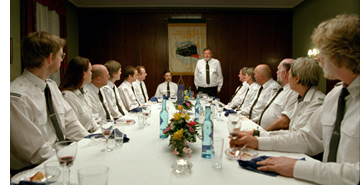 previous Kitchen Stories (2003) and Factotum (2005). It’s a character study of a fastidious train engineer striving to cope with retirement; the film plays out in an episodic series of encounters that eventually lead to Horten’s acceptance of his new life. The comedy of eccentricity proceeds in leisurely, continually entertaining scenes. Apart from its mainly quiet tone and somewhat slow pace, it presents no art-cinema challenges to the audience. Norway has chosen it as its candidate for this year’s foreign-language Oscar, and Sony Classic Pictures has announced that it will release the film in the U.S. in early 2009.
Many critics have treated Terence Davies’ Of Time and the City as if it were a sort of elegiac cinematic salute to his native city of Liverpool. Despite the fact that, following the undeserved commercial failure of his excellent adaptation of The House of Mirth (2000), Davies has not made any films, he clearly retains his popularity among aficionados. In fact, however, there is plenty of criticism interspersed with the new film’s lyrical passages. Davies deplores what has become of Liverpool since his childhood there and doesn’t hesitate to assess blame, and he includes harsh comments on religion and on British royalty. He has said that he modeled his documentary on those of Humphrey Jennings, and in particular Listen to Britain (1942), though Jennings’ films had none of the bitterness on display here. Given, however, that Davies was bullied in his school, grew up gay in a more intolerant era, and has had a stunted filmmaking career, such bitterness is hardly surprising.
During Davies’s youth, brick row-houses encouraged communities among the working-class families 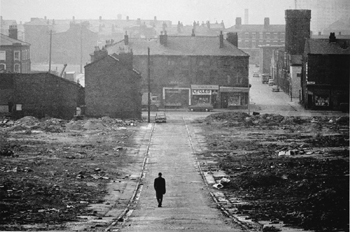 necessary to Liverpool’s industries. Using moving and still footage from the era set to classical music, the director manages to create a poignant sense of the grim conditions these people endured. Modern footage shows these old row-houses in ruins—yet shows the council apartment blocks that replaced them to be in almost equally ramshackle shape. Davies contrasts these with some of the few remaining glorious buildings of Liverpool, mainly columned government spaces through which he cranes his camera. He also filmed candid footage of children, perhaps hinting at the one hope for the future, perhaps displaying those whose youthful memories of Liverpool are now being formed in a far less attractive city.
Of Time and the City marks a welcome comeback, one which I hope will lead to more films by Davies.
DB here:
A miscellany
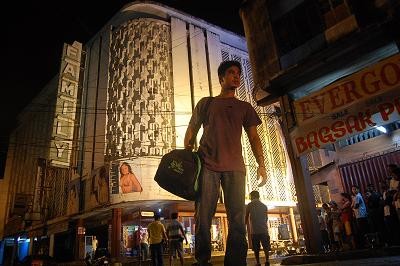
The Dragons and Tigers programs continued to bring forth very impressive items. Jia Zhang-ke’s 24 City offered a meditation on newly industrializing China, in the vein of last year’s Useless. Aditya Assarat’s Wonderful Town was a prototypical “art movie” that handled a doomed love affair with sensitivity and suspense.
Especially engaging was the new offering from Brillante Mendoza, whose Slingshot I admired at Vancouver last year. In Serbis (“Service”), the Family film theatre lives up to its name only with respect to its management. For here, in the sweltering Philippines town of Angeles, the Pineda family screens porn. The movies attract mostly gay men, who service one another in the auditorium, the toilets, and the stairways. While the matriarch Nanay Flor fights a legal battle, she runs the lives of her employees and kinfolk in a milieu teetering on the edge of confusion. The Pinedas live in the theatre, so that the youngest boy must thread his way to school through a maze of transvestite hookers.
Mendoza confines the action almost entirely to the movie house. That premise recalls Tsai Ming-liang’s Goodbye Dragon Inn, but Serbis has none of that film’s nostalgia for classic cinema. Here movie exhibition is an extension of the sex trade, exuberant in its tawdriness, steeped in heat and sweat, prey to randy projectionists and stray goats. Almodovar might make something more elegant out of the situation, but Mendoza’s careening camera yanks us from vignette to vignette, from the complaints of the operatic Nanay Flor to her loafing husband to the lusty projectionist with a boil on his buttock. Crowded with vitality, the film can spare its last moments for a burst of reaction shots that imply a whole new layer of comic-melodramatic turpitude.
In other strands of the festival, I enjoyed Nik Sheehan’s lively documentary FlicKeR, which tells the tale of Brion Gyson, friend to the Beats and especially Burroughs. But the real star is Gyson’s Dream Machine. A turntable that spins a slotted cylinder around a lightbulb, the gadget—reminiscent of the Zootrope and other precinematic toys—proved mesmerizing to artists and countercultural fellow travelers. Marianne Faithful, Iggy Pop, and other worthies attest to the hypnotic power of the Machine, which triggered a drug-free high. Sheehan fills in a patch of important cultural history and may inspire others to tickle their alpha waves with a homemade Dreamer.
Almost exactly halfway through Steve McQueen’s Hunger lies a long dialogue scene in which IRA prisoner Bobby Sands explains to a priest why he has to launch a hunger strike. Over cigarettes the two men debate the cost of pushing tactics to this extreme. Running nearly twenty minutes and relying almost entirely on a protracted profile shot, it’s the first extended conversation in what is largely a film of bits of behavior and glimpses of a harrowing place.
 Hunger starts by showing the morning routine of a guard at Maze Prison. He washes up. Stiff along a wall, he smokes a cigarette. He painstakingly folds up the tinfoil that wraps his lunch. McQueen’s oblique approach to the subject is maintained when we see a new prisoner brought in. Through him we learn of the cell walls whorled with excrement, the unannounced beatings, and the charade of providing tidy clothes for the prisoners to wear on visitors’ day.
Comparisons with Bresson’s A Man Escaped are inevitable. McQueen is less rigorous and original pictorially, assembling shots based on current image schemas (planimetric framings, selective focus, extreme close-ups, artily off-center compositions, handheld shots for scenes of violence). And he can underscore points a bit too much, as with the repeated shots of the guard’s scabbed knuckles. Still, compared with Schnabel’s conventionally daring Diving Bell and the Butterfly, the film is willing to be unusually hard on us. Through his nameless prisoners, McQueen treats both brutality and fortitude matter-of-factly. His experience with gallery-installation video seems to have encouraged him to let sheer duration do its job. A patient shot stationed at the end of the corridor waits while a guard, proceeding steadily toward us, clears puddles of urine with a push-broom.
Once Sands passes through his revolutionary catechism, the stakes are clear. The rest of the film returns to the dry, nearly dialogue-free atmosphere of the opening as Sands’ strike ravages his body. The objectivity of the opening yields to Sands’ hallucinatory recollections of his childhood as a long-distance runner. Some may see these images, including birds in flight, as clichéd sympathy-getters, but McQueen’s handling is pretty unsensational. Hunger’s quasi-geometrical structure, the sidelong introduction of horrific material, and the almost clinical treatment of Sands’ deterioration invite us to feel, but they also urge us to think about the price of sacrifice to a cause.
Genre crossovers
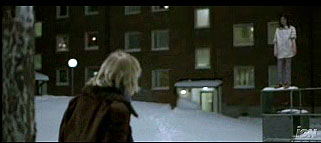
Some people consider the “festival movie” a genre in itself–the somber psychological drama with little external action, shot at a slow pace. The stereotype is all too often accurate, but festivals play genre pictures too. Usually these are impure genre pictures, more self-consciously artful or ambitious than multiplex crowd-pleasers. Vancouver had its share of such crossover items.
Hansel and Gretel, a South Korean horror film, played with a classic premise: the happenstance that brings someone from the normal world into a peculiar, isolated household. In this case, a superficial young man lost in a forest stumbles into the House of Happy Children. Here three kids seem to rule their passive, saccharine parents. The situation recalls Joe Dante’s episode of the Twilight Zone film, and during the Q & A director Yim Phil-sung acknowledged the influence of that movie, as well as Night of the Hunter. Brisk, fast-paced, and boasting remarkable sets—dazzlingly lit, jammed with toys and sweets, and ineradicably sinister—Hansel and Gretel could earn cult following in America. Rob Nelson has more here.
Artier, and scarier, was Let the Right One In, a Swedish film by Tomas Alfredson. Adapting Chekhov’s precept that the gun on the mantle in Act 1 has to go off in Act 3, the film begins with the boy Oskar playing with a knife at his window. Later we’ll learn that his stabbing is a fantasy rehearsal for dealing with the bullies who torment him at school. He meets Eli, a girl who comes out only at night, and their adolescent friendship/ love affair on the jungle gym of a housing block is intertwined with a series of vampire attacks on a small town. The tautly constructed script develops in gory directions that I found both unexpected and inevitable. The wintry widescreen cinematography is handsome and precise, and may well look better on 35mm than on the somewhat contrasty digital version available for the festival. It will have a limited opening in the U. S. later this month.
After School, by Uchida Kenji, is an agreeable thriller—somewhat overbusy and implausible in its plotting, but offered with a modesty and assurance that make it worth a watch. The basic situation, of a missing salaryman who may be having an affair, gains suspense by initially restricting our viewpoint to a shabby private detective. Uchida has fun with one of those misleading openings so common nowadays: you think you understand it from the get-go, but when it’s replayed it takes on a new meaning (and explains the title). The final shot, from a surveillance camera trained on an elevator, is a nicely oblique reminder of what seemed at the time a throwaway moment.
 Variety characterizes Il Divo’s genre as “Biopic, Foreign, Political, Drama,” which covers all the bases. Giulio Andreotti, long-time Italian politico, is the subject of the movie, described by an ironic friend as “one-half of the current Italian film renaissance.” The movie surveys Andreotti’s career after the Red Brigades’ murder of Aldo Moro, which triggered a wave of investigations, tribunals, and assassinations, and it concentrates on years after 1995, when Andreotti was accused of links to the Mafia. The first half-hour feels like a single montage sequence, with murders and huddled meetings whisked past us thanks to rapid cutting, swooping camera movements, and pulsating music. (The eclectic score ranges from Sibelius to Gammelpop.) Imagine the sinuous opening of Magnolia, with machine guns.
When director Paolo Sorrentino settles down to to presenting straightforward scenes, his florid technique persists (he never met a crane shot he didn’t like), but the action is dominated by Toni Servillo’s lead performance, which is weirdly showoffish in its own way. Servillo’s Andreotti is a rigid, buttoned-up fussbudget, an impassive mole of a man; only his epigrams (“Trees need manure to grow”) suggest a mind inside. The maniacally contained performance is as stylized as a turn by Lon Chaney, and as hard to keep your eyes off. Then again, given the glimpses of Andreotti in this report on the Italian response to Il Divo, the portrayal seems only a little exaggerated.
Of course there can be a straightforward genre picture here and there at the festival. The most disappointing instance I saw was The Girl at the Lake, an Italian whodunit that is only a notch or so above a TV movie. More entertaining was Welcome to the Sticks, the fish-out-of-water comedy that has become the top-grossing French film of recent years. A postal supervisor is assigned to a remote village where, he’s convinced, the hicks and the freezing cold will make him miserable. Instead he finds warm-hearted people and plenty of fun. The problem is to keep his wife from finding out how much he’s enjoying himself.
The item is hammered and planed to the Hollywood template. Plot lines: love affairs, both primary and secondary, complicated by work. Structure: four parts, with a neat epilogue that wraps everything up. Motifs: traffic cops, carillon bells, and food, often treated as running gags. Style: overall, less cutting than we might find in Hollywood (8.7 seconds average shot length), but still huge close-ups for extended passages of dialogue. In all, Wecome to the Sticks is sitcom fare that provided, I have to admit, a nice break from a lot of misery on display in the more orthodox festival offerings.
Turning Japanese
In our first communiqué, I talked about films by Kitano and Wakamatsu. I want to add comments on two more Japanese movies I saw, both of exceptional quality.
In All Around Us, Hashigushi Ryosuke (Like Grains of Sand, 1995) tells the story of a fraught marriage. The happy-go-lucky Kanao settles into a job as a courtroom artist for TV news, while Shozo, who works in publishing, is a believer in strict rules for their relationship. Their efforts to have a child end unhappily, and Shozo finds her life unraveling. Domestic troubles, amplified by tumult in Shozo’s extended family, play out while every day Kanao covers soul-destroying criminal cases, many involving assaults on children.
The mix of tender sentiments and extreme violence (offscreen, but evoked through chilling testimony) give the film a typically Japanese flavor. Hashigushi filters much of the courtroom horrors through Kanao’s point of view, so that while a defendant berates himself for not killing more people, Kanao watches a mother, and the close-up of her bandaged wrist concentrates all her grief.
The tact of Hashigushi’s handling is on display in a late sequence. As Shozo struggles out of her depression, her family gathers for what apparently will be her grandfather’s final moments. The adults assemble to discuss the situation while children play in a room behind them. Kanao shows them sketches that they take to be of the father in his final moments.
During their discussion, the adults are distracted by the children shattering an urn in the background.
Here Hashigushi uses staging techniques I’ve discussed in On the History of Film Style and Figures Traced in Light. Kanao’s display of his sketch favors us; it is centered and frontal. Then, after blocking the children’s play for some time, Hashigushi reveals it—centered and exposed as the adults in the foreground turn to look.
Then most of the family leaves. Hashigushi tracks in slowly to the mother’s confession of her misdeeds, and he ends the shot with a close-up of Shoko.
In a film in which the camera moves seldom and without much fanfare, this creates a simple, powerful impact and refocuses the drama on the psychologically fragile Shoko.
The film I’ve admired most across the festival is, predictably, Still Walking by Kore-eda Hirokazu. It relies on a simple situation. Grandpa and grandma celebrate a son’s death anniversary by a visit from the families of their son and daughter. Across a little more than a day, memories resurface and old tensions are replayed.
Everything unfolds quietly, and the pace is steady: none of the histrionics, both dramaturgical and stylistic, of the Danish Celebration and other psychodramas of dysfunctional families. Still Walking is a classic Japanese “home drama” in the Ozu mold. The conflicts will be muffled and nothing is likely to break the placid surface.
In a stream of vignettes Kore-eda brings each family member to life, displaying an easy mastery in shifting attention from one to another. Gradually he assembles a group portrait of a domineering father, a good-humored mother, a slightly daffy daughter, a son always compared unfavorably to his elder brother, and in-laws striving to be well-received by the grandparents without alienating their spouses. The spirit of Ozu, particularly Tokyo Story and Early Summer, hovers over specifics: a dead brother is invoked, the family poses for a picture, and the patriarch, a retired doctor, has a clinic in his home.
Kore-eda doesn’t get as much credit as he deserves; he’s often overshadowed by extroverts like Miike Takeshi. That’s partly because his is an art of quietness, shown perhaps in its most extreme form in his first feature, Maborosi (1995). At the time I thought it was only one, albeit exquisitely wrought, version of the “Asian minimalism” that sprang up in Taiwan, Japan, China, and even a bit in Hong Kong. I suspect that this trend was largely due to Hou Hsiao-hsien’s masterpieces like Summer with Grandfather, Dust in the Wind, and City of Sadness. A Japanese critic told me that indeed Maborosi was criticized as being too Hou-like.
Now, after After Life, Distance, Nobody Knows, and Hana, Kore-eda has moved to the forefront of Japanese cinema. It seems to me that he maintains the classic shomin-geki tradition of showing the quiet joys and sadness of middle-class life while also plumbing the resources of “minimalist” mise-en-scene.
In Still Walking he works in an engaging, unfussy way. He lets us get to know and like his characters, feeling neither superior nor inferior to them. He builds up his plot more through motifs than dramatic action; a good example is the pop song that the mother loved and that gives the movie its title. The technique, spare but not austere, enforces the relaxed pacing. The film has only around 375 shots in its 111 minutes. While there are plenty of reaction shots and close-ups (the first shot shows women’s hands scraping radishes), some scenes play out in long takes rich in detail.
For example, in a three-minute shot early in the film, most of the family is gathered around a table.
The brother-in-law, a used-car salesman, goes out to the garden to play with the children.
Now the family members discuss the dead brother’s widow, who doesn’t come to family gatherings.
When the father declares that a widow with a child is harder to marry off, he is obtusely insulting his son Ryota’s new wife. Kore-eda marks the disruption with a cut to a reverse angle.
This generates another long take, in which Ryo’s wife Yukari deflates the tension by saying she was lucky to get him. The women then rise and clear the foreground, somewhat as the brother-in-law had by going into the garden. As the family talks, we can see him in the distance helping the kids break open a melon.
Ryo talks about his job restoring paintings. It’s clear that the father disapproves of it, wishing that Ryo, like the deceased brother, had taken up medicine. Kore-eda keeps the garden action as a secondary point of interest by having Ryo glance off occasionally.
But Ryo’s explanation of his job is cut off by the father’s abrupt rise and walk to the doorway, ordering the kids to stay away from one plant.
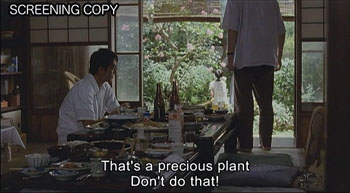
When the father returns to the table, the nearly two-minute long shot is replaced by a series of singles as Ryo tries to explain his work.
These shots employ one of Ozu’s staging tactics, settling two characters not directly opposite one another but one space apart. The camera seats us across from each one. As a result, the men can be posed frontally, while now we can watch where their glances go—most often, downward. The new setups let us see that the father and son don’t look at each other much.
Instead of moving to these singles right away, as most directors today would, Kore-eda has saved them as a way to articulate the next, more intense phase of the drama. It is arguably a less ostentatious way to raise the tension than the prolonged track inward that Hashigushi uses in All Around Us. (Then again, Hashigushi employs that technique at a climactic moment, while this scene we are still rather early in Kore-eda’s film.) The point is the simplicity and delicacy with which Kore-eda deploys traditional elements of craft.
It wouldn’t be fair to offer a more intensive analysis of this trim work, since it has yet to be widely seen. In the best of all worlds, it will get an American theatrical release.
In all, another wonderful Vancouver festival. See you there next year?
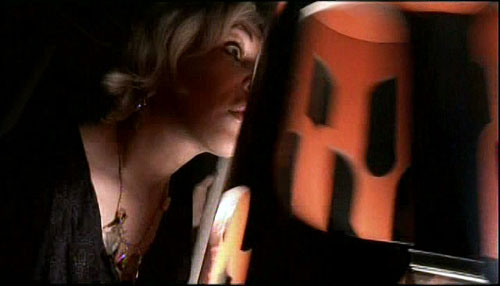
FlicKeR.