





Archive for the 'Narrative strategies' Category
Watching a movie, page by page
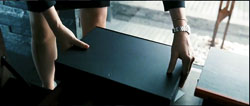
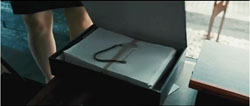
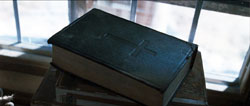
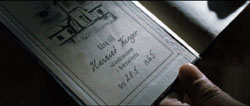
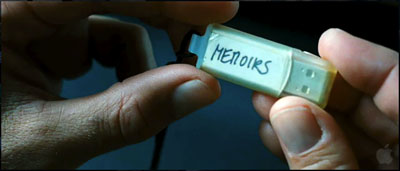
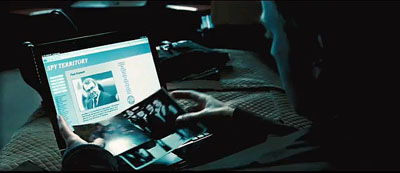
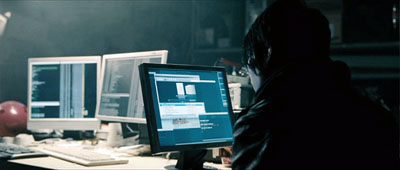
The Ghost Writer (above); The Girl with the Dragon Tattoo (below).
DB here:
Aristotle said, quite reasonably, that every plot has a beginning, a middle, and an end. But that doesn’t mean that every plot consists of three acts. Aristotle doesn’t mention act divisions in the Poetics for the good reason that classical Greek plays didn’t have them. The three-act play is just one convention that emerged in the history of storytelling.
As early as 20 BCE Horace was suggesting, “Let no play be either shorter or longer than five acts.” Influenced by this edict, Renaissance editors and playwrights adhered to five acts for many years. We have, of course, plays in two acts (Alan Ayckbourn’s Norman Conquest cycle) and four acts (Pygmalion, The Admirable Crichton, many of Chekhov’s). TV dramas are routinely divided into a teaser and four acts, broken up by commercials. All of those plots have beginnings, middles, and ends, so it’s silly to think that only the three-act structure can fulfill Aristotle’s dictum.
As early as the seventeenth century, the Spanish playwright Lope de Vega recommended three acts as best. In Europe, the format came into its own during the nineteenth century, evidently dislodging the five-act one. One reason may have been that three parts are architecturally simple, sturdy, and easily visualized. Around 1820 Hegel remarked: “Three such acts for every kind of drama is the number that will adapt itself most readily to intelligible theory.” What such a theory might look like was sketched by Lope, who anticipates modern advice manuals.
In the first act set forth the case. In the second weave together the events, in such wise that until the middle of the third act one may hardly guess the outcome. Always trick expectancy.
So proponents of the three-act screenplay formula should revise their pedigree. They’re actually pushing the Lope-Hegel tradition—which admittedly sounds less impressive than dropping the name of Aristotle.
Three acts, more or less
Despite the historical misunderstandings, there’s some reason to think that Hollywood screenwriters, and now filmmakers across the world, have followed a rough three-“act” scheme. Where they got this idea and when it started is still hard to say, but it’s been at the core of nearly every screenplay manual since the 1980s. Kristin and I have looked at this format from an academic perspective, and our views are outlined briefly on this site here and here and here. For more detailed arguments you can read her Storytelling in the New Hollywood and Storytelling in Film and Television and my The Way Hollywood Tells It.
In those places we’ve argued that Hollywood feature films tend to fall into chunks of 20-30 minutes. As a result a movie may display three parts, or four, or more (if the film is very long) or even two (if it’s unusually short). When the film has four parts, it tends to split the long second act that the manuals recommend into two.
A four-parter usually goes like this. A Setup lays down the circumstances and establishes the primary characters’ goals. The Complicating Action is a sort of counter-setup, modifying the original goals or creating new ones. At about the midpoint, there emerges a Development section characterized by delays, subplots, and backstory. There follows the Climax, which resolves the action by decisively achieving or failing to achieve the protagonist’s goals. The film typically ends with a brief Epilogue that establishes a settled state, happy or unhappy. Each of these sections is demarcated by a turning point—a moment of crisis, usually involving an unforeseen twist or a major decision by the protagonist.
Two recent films, The Girl with the Dragon Tattoo and The Ghost Writer, offer good examples of how the four-part template governs plot structure. I won’t walk through each one here, but both seem to me to adhere quite closely to this model. Today I’m more curious about the original novels. We know that books are routinely reshaped for movie treatment. Is there a sense in which the plot structure of the originals fits the film formula?
Fiction as film
I ask because some fiction writers have come to believe in the enduring power of the three-act structure for all narratives. In The Weekend Novelist (1994), Robert J. Ray recommends that aspiring writers use it (although he breaks Act II into two parts around the midpoint). He finds the pattern enacted in his book’s primary model, the novel The Accidental Tourist. “We’re working with the structure of [Anne] Tyler’s Tourist because it is classical, three acts” (142). This, Ray claims, follows “Aristotle’s dictum of beginning, middle, and end” (141). Ray makes a comparable suggestion in The Weekend Novelist Writes a Mystery (1998), naming the three parts Setup, Complication, and Resolution; a midpoint again splits “Act II.1” from “Act II.2.”
Ray’s are the earliest instances I’ve found of explicitly applying screenwriting structure to prose fiction. Later ones would include Stephen Greenleaf’s 1996 article “A Mystery in Three Acts” and James Scott Bell’s 2004 book Plot and Structure. Bell argues somewhat grimly that life itself has three acts: childhood, “the middle where we spend most of our time,” and “a last act that wraps everything up” (23). Ridley Pearson, in the 2007 article “Getting Your Act(s) Together,” tells us that the “three-act structure, handed down to us from the ancient Greeks [!], is one that’s proven successful for thousands of years” (67). “Name a film or book you think rises above others, and chances are, if you go back and study it, the story line will fit into this form” (85). Brenda Janowitz recommends plotting a Harlequin romance as if it were a movie like Mean Girls.
But screenwriting adepts will notice one thing that these advisors neglect: the lengths of the parts. The book that popularized the three-act structure in film circles was Syd Field’s Screenplay of 1979. Not only did he lay out the template, but he indicated running times for each section. Act 1 should last about thirty minutes, Act 2 sixty minutes, and act three about thirty. Assuming that one minute of screen time equals a page of the screenplay, that means that a two-hour movie should run about 120 pages. Field’s metric proved very influential, with script readers, producers, and writers all striving to find plot points at twenty-five minutes and ninety minutes.
To be strictly parallel, then, a “three-act novel” should be divisible into parts having a page ratio of 1:2:1. The only manual I know that is willing to bite this bullet is Writing Fiction for Dummies (2009). (The title has a catchy ambiguity, no?) According to the authors, Act 1 takes up the first quarter of the book, Act 2 the middle half, and Act 3 the last quarter (p. 147).
In the film versions of The Girl with the Dragon Tattoo and The Ghost Writer, the segments and timings fit the four-part model fairly neatly. (Try it yourself, in the theatre or when the films come out on DVD.) But what happens when we look at published books? Will we find what Ray found in The Accidental Tourist—conformity to the formula? Are practicing novelists using the template? Are the timings, or rather the page-counts, of the books congruent with the film model?
First I’ll consider Robert Harris’ novel The Ghost, the source of The Ghost Writer. The next section looks at Stieg Larsson’s The Girl with the Dragon Tattoo. If you want to avoid spoilers, skim and skip accordingly.
Ghost writers in the sky
The opening chapters of The Ghost introduce the unnamed narrator, a professional writer who is on the verge of breaking up with his girlfriend. Hired to ghost-write ex-Prime Minister Adam Lang’s memoirs, he is replacing Lang’s aide McAra, who drowned under mysterious circumstances. The Ghost takes the job just as news media are floating the charge that Lang helped the US ship British citizens to black sites to be tortured. The Ghost travels to join Lang, who is staying in America with his secretary Amelia and his wife Ruth. At his hotel, the Ghost encounters a surly British man who asks him pointed questions about Lang. This setup lays out the affair between Amelia and Lang, Ruth’s sexual jealousy, and the mounting political pressure on Lang, along with the sinister Brit in the bar. The section ends on p. 83 of the 335-page Gallery paperback edition, almost exactly one-quarter of the book.
The complicating action arrives when the Ghost’s first sit-down with Lang the next day is interrupted by the announcement that Rycart, former Foreign Secretary in Lang’s government, has asked the Hague to investigate the PM for war crimes. Under pressure from protestors, Lang decides to go to Washington for appearances’ sake. In the meantime, the Ghost discovers a set of clues McAra has left behind: photos of Adam in his Cambridge days, records and news reports of his party activities, and a mysterious phone number that turns out to be Rycart’s. All this creates a counter-setup. There is something foul afoot.
The Ghost ruminates constantly on McAra, a writer who has become something of a ghost haunting his successor. Soon the digital file of McAra’s draft of the memoir vanishes from the Ghost’s email. Most fundamentally, he discovers that in the first interview Lang has lied to him about how he got into politics.
That was when I realized I had a fundamental problem with our former prime minister. He was not a psychologically credible character. In the flesh, or on the screen, playing the part of a statesman, he seemed to have a strong personality. But somehow, when one sat down to think about him, he vanished. This made it impossible for me to do my job. . . . I simply couldn’t make him up (162).
At this point the protagonist decides on a new goal: to investigate on his own. This transforms his official assignment, and it happens on p. 163—quite close to the midpont of the book.
The development section is filled out with the usual delays, false leads, counter-maneuvers, and backstory. The Ghost’s investigation brings him to an interrogation of an old man who suspects foul play in McAra’s death, a sexual encounter with Ruth, a meeting with a professor with apparent CIA connections, and a suspicious vehicle in the vicinity. The turning point comes with another decision. “The more I considered it, the more obvious it seemed that there was only one course of action open to me.” The Ghost phones Rycart and flies to New York to meet him. This passage concludes on p. 256.
The climax sporadically unravels the clues McAra has left behind. In their meeting Rycart and the Ghost conclude that Lang was recruited by Professor Emmett during their Cambridge days and became a US puppet. Rycart has taped his exchange with the Ghost and uses that to force him to return to confront Lang. On Lang’s private plane, the Ghost accuses him but Lang’s denials are disconcertingly sincere. On disembarking, he is killed by a suicide bomber—the crusty Brit who blames Lang for the death of his son in Iraq. Although he’s haunted by dreams of a drowning McAra (“You go on without me. . .”), the Ghost plows ahead with Lang’s now-posthumous memoirs. All seems to have been settled until the book launch, when the Ghost discovers another way to interpret the evidence. He returns home to check McAra’s manuscript, where he finds a coded message identifying Ruth as the one recruited by Emmett; she was the mole. This revelation that the first solution was wrong, a detective-story device going back at least to Trent’s Last Case of 1913, arrives on p. 330.
An epilogue of only five pages reports that the Ghost is on the run. If anything happens to him, his former girlfriend will publish his story. “Am I supposed to be pleased that you are reading this, or not? Pleased, of course, to speak at last in my own voice. Disappointed, obviously, that it probably means I’m dead.”
The result conforms fairly strongly to the triple ratio: Act 1 runs 83 pages, Act 2 runs 173 pages, Act 3 runs 79 pages. Using the four-part template, we get 83/80/93/74, with a five-page epilogue.
Not perfect symmetry, but that’s hardly to be expected. Novelists stretch or compress as needed, and they can make scene boundaries a little fuzzier than what we find in films. For such reasons, other analysts might shift my breakpoints a few pages fore or aft. In addition, many films make the climax section somewhat shorter than the others, so we won’t always get perfect symmetry in novels either. Still, The Ghost offers a reasonably close approximation to the sort of plot template that we find in many commercial movies.
Double duty
Stieg Larsson’s The Girl Who Played with Fire provides a somewhat different sort of plot. We have two protagonists and three lines of action—two mysteries plus a search for revenge—or rather four, if you count the prospect of a romance between the protagonists. The book is also much longer than The Ghost, running 644 pages in the Vintage paperback edition I have. You might therefore expect more large-scale parts. But . . . .
The setup lays out the three major lines of action. Journalist Mikael Blomkvist, misled by an informant, publishes a false news story about the dealings of the businessman Wennerström. After Blomkvist is sentenced to prison, the second line of action kicks in: Henrik Vanger asks him to find what happened to his brother’s granddaughter Harriet. Meanwhile the neopunk hacker Lisbeth Salander is introduced as a security analyst researching Blomkvist for Vanger. By p. 138 Blomkvist has decided to accept the Vanger assignment. This section is not far from being a quarter of the text, and it corresponds to a major break, the end of Part 1 (“Incentive”).
The next large-scale section complicates things on two levels. It plunges Blomkvist into the details of Vanger family history and Harriet’s disappearance, and it brings Lisbeth Salander’s life to a point of crisis. We learn her past as an orphan and a denizen of the streets and hacker subculture, living under the thumb of her guardian Bjurman. This section is rather long, about 150 pages, because it has to establish Lisbeth as a dual protagonist and show her stratagems for escaping Bjurman’s sexual exploitation. Blomkvist must also serve his short prison time in this segment.
I’d argue that the plot’s midpoint occurs on page 323, halfway through the book. Chapter 16 begins:
After six months of fruitless cogitation, the case of Harriet Vanger cracked open. In the first week of June, Blomkvist uncovered three totally new pieces of the puzzle. Two of them he found himself. The third he had help with.
These revelations propel Blomkvist into a lengthy investigation of serial murders, which requires him to hire Lisbeth as his research assistant. While the two follow up clues, they start an affair.
On p. 477, it seems to me, the climax begins. The investigation has cast suspicion on Martin Vanger, Harriet’s brother. Blomkvist hears Martin returning home. “That somehow brought matters to a head.” Blomkvist goes out to confront him. Two pages later Martin shows him into the basement. “Blomkvist had opened the door to hell.” Now scenes of Lisbeth’s research and return to the village alternate with scenes showing Blomkvist at the mercy of Martin in his torture chamber.
Because the central plot involves two mysteries, the climax is extended. I’d argue that the two mysteries, the serial killings and Harriet’s disappearance, are solved by page 560 or so. But there remains the matter of Blomkvist’s revenge on the plutocrat Wennerström, who had tricked him into printing a phony story.
That dangling plotline is tied up in the next chunk (pp. 562-628), which forms in effect a second climax. Thanks to Lisbeth’s research, Blomkvist and his partners prepare to publish an expose of Wennerström’s crimes in Millennium. The evening that Blomkvist goes on TV, public opinion shifts decisively in his favor, and as the translation has it, “Blomkvist’s appearance marked a turning point.” He has won, and so has Lisbeth, who has drained money from Wennerström’s offshore accounts.
The sixteen-page epilogue tells us that Wennerström, facing disgrace and jail, kills himself. By now the two protagonists have struggled up from below. Blomkvist redeems his reputation and becomes the toast of journalism. Lisbeth, poor and victimized by men, becomes independent and enjoys her stolen fortune. There remains only the question: Will the two unite romantically? A final scene replies with a very old plot devices that’s one of Larsson’s favorites: a chance encounter that triggers a misunderstanding.
So I’m proposing a 138-page setup, a 150-page Complicating Action, and a 154-page Development. If you consider my two climaxes a single stretch, you have a 149-page climax section. That makes the big parts roughly equal, with a tailpiece of 16 pages. Even though The Girl with the Dragon Tattoo has nearly twice the page-count of The Ghost and crams in two protagonists and several plotlines, it displays the symmetry we find in the more compact book. The chief difference is between a comparatively short climax and a protracted one—the same difference we often find in classically constructed films. For these novels, and I suspect many others, the three-act/ four-part template provides a solid architecture for the plot.
Miracles, critical fantasies, or just tradition?

I won’t try to align the parts articulated in the novels with those we find in the finished films. The congruences are fairly close, once you grant that both films compress scenes and lop off characters and plotlines that are developed in the novels. Instead, I want to close by asking some questions.
Would novelists admit to consciously adopting this structure? If they don’t, or if we think it’s implausible that they would, we’re confronted with the charge that we’re simply projecting this structure onto the books. Are we and the writers of manuals shoehorning these plots into the three-act/ four-part format? Could we come up with equally persuasive patterns if we set out looking for seven or seventeen or seventy “acts”?
To take the last question first: Probably not. I think my analyses carve the films and books at the joints, more or less. One reason I like Kristin’s analytical method is that it hinges on characters’ goals and their pivotal decisions or reactions. These tend to be emphatic, well-articulated moments in the plot; a lot, as we say, depends on them.
True, there is some room to argue about which ones might be most far-reaching. You can propose alternatives, and I can change my mind. But the rival candidates for goals and decisions and major turning points aren’t likely to be radically different. We agree on most structural conventions, and our differences tend to be fine-grained, not gross.
Still, this sort of analysis arouses skepticism, and rightly so. How can writers and filmmakers achieve this neat structure without conscious planning? Can you follow the rules without doing so deliberately? Kristin offers an explanation that emphasizes the intuitive search for proportion in the creative process. She invokes Vivaldi concerti, medieval altarpieces, daily comic strips, and even the Great Pyramid at Giza as examples of balance among parts in both high and popular arts.
The evident use of proportions in many narrative films provides one more indication of the enduring classicism of the mainstream Hollywood system. Presumably what practitioners have intuitively assumed to be the optimum range of lengths for each part was discovered early on. It has been passed down the generations of filmmakers as a result of the simple fact that most practitioners gain their basic skills by watching a great number of movies (Storytelling in the New Hollywood, 44).
I think that there’s still a lot to learn about these templates. How are they disseminated among filmmakers? Why are we unaware of these parts while watching the film? They don’t stand out like chapter divisions in a novel. Or do we sense them subliminally? And how widespread are they? Do we find them in classic studio cinema of the 1920s through the 1950s? (Kristin thinks so, as do most writers of screenplay manuals.) Do we find them in films from other cultures and periods? If so, perhaps filmmakers elsewhere have found them to be reliable ways to engage viewers. Possibly these models were spread with the circulation of American movies.
I’ll provide my own epilogue by noting that the novelists’ borrowing of screenplay structures is a recent instance of a long-term process: the “cinefication” of other media. Today we call successful novels “tentpoles” or “blockbusters” or “locomotives,” and we say they’re “released” rather than “published.” What used to be called a series of novels is now likely to be called a franchise. It may be that many novelists have absorbed the lessons of screenplay manuals. If you wanted your book to be bought by a producer, why not make it like a film beforehand?
More abstractly, we have artistic transfer and technical influence. For a long time critics have argued that literary modernists like Faulkner and Hemingway, along with more popular genre writers, have tried for “cinematic” styles and have sought to imitate the “camera eye” in their narration. Today perhaps we see a structural influence as well: rules of film plotting mapped onto prose fiction. The next page-turner you read may have been engineered to flow across your eyes at the brisk pace of a Hollywood movie.
Several of my references to classical theorizing about act divisions are taken from Oscar Lee Brownstein and Darlene M. Daubert, eds., Analytical Sourcebook of Concepts in Dramatic Theory (Westport, CT: Greenwood, 1981). For more on classical Greek drama’s structure, go here. You can read a brief summary of the history of act divisions in western drama here.
On the three-act screenplay structure as applied to independent films, see J. J. Murphy’s You and Me and Memento and Fargo. See also J. J.’s independent cinema blog.
Stephen Greenleaf’s “A Mystery in Three Acts” appeared in The Writer 109, 4 (April 1996). Ridley Pearson’s article “Getting Your Act(s) Together” appeared in Writer’s Digest 87, 2 (April 2007), 67-69, 85. For another application of three-act structure to the novel, go here. The author claims that “movies rather than books are easier to analyze in that the main plot points are visual.”
On The Ghost Writer, a useful interview with Robert Harris is here. An entry on Creative Loafing points out ambiguities and vague spots in the movie’s plot. A January 2008 draft of the script, which incorporates voice-over narration, is available here.
The most influential account of how American novelists adapted cinematic techniques is Claude-Edmonde Magny’s Age of the American Novel: The Film Aesthetic of Fiction between the Two Wars. See also Keith Cohen’s Film and Fiction: The Dynamics of Exchange.
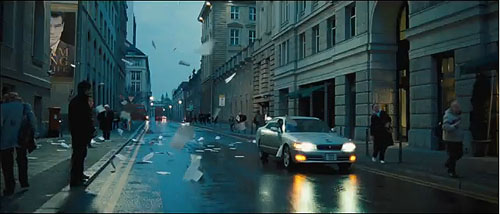
The Ghost Writer.
Tell, don’t show
Exodus.
DB here:
Watching the film adaptation of Stieg Larsson’s Girl with the Dragon Tattoo reminded me how common fragmentary flashbacks have become. Granted, we’re living in a period of flashback frenzy, one comparable to the delirious 1940s and 1960s. But the format of the flashbacks has changed a bit. The Girl with the Dragon Tattoo, like many other films, gives us mere glimpses of earlier events–literally, flashes back to the past.
The technique is actually quite old. American films of the 1910s often interrupted present-time scenes to remind us of actions we’ve already seen or been told about. But the fragmentary flashback waned during the heyday of sound cinema. There conversations did nearly all the work. Of course there were flashbacks, as I’ve discussed in an earlier entry. But those flashbacks tended to be extended scenes, not the jagged bursts we get now.
A cynic might say that today’s audiences are so thick-headed and impatient that simply mentioning what happened earlier isn’t enough. Viewers now would chafe at the long interrogations in The Maltese Falcon and The Big Sleep. The scenes would need to be split up by images showing what the characters were explaining. The new rule: Add redundancy, but dress it up in whipcrack visuals.
So are the flurries of mini-flashbacks there just because filmmakers doubt that viewers can follow a twisty intrigue given in dialogue? Not necessarily. I suspect that these flourishes are traceable to a piece of current screenwriting advice. It’s usually formulated as Show, don’t tell.
The very distinction has some ancient ancestry. Plato and Aristotle both distinguished between verbal narration, as in the Homeric epics, and theatrical presentation. Aristotle, always more interested in craft than Plato, went on to point out that the distinction couldn’t be absolute. Epic narration could include simulated conversations, for example. Aristotle did not, so far as I can tell, urge composers of epics to avoid “showing” or dramatists to avoid having characters report offstage action.
Today’s bias in favor of “showing” is probably traceable to the emergence of the modern novel. “Dramatize, dramatize!” Henry James (a failed playwright) advised the novelist. That is, make the action on the page seem vivid and palpable. It was Joseph Conrad, not D. W. Griffith, who first claimed that his purpose was “to make you see.” A major trend in the theory of prose fiction ca. 1900 was the effort to turn words on the page into a surrogate for visual storytelling; hence the very term “point of view” and James’ comparison of unfolding narrative to a “corridor” that we traverse. It remained for Percy Lubbock, in The Craft of Fiction (1921) to sum up this trend. “A novel is a picture,” he claimed, and he suggested that novels, either “panoramic” ones like Vanity Fair or “dramatic” ones like The Awkward Age, can make us forget that they are actually verbal contraptions:
The art of fiction does not begin until the novelist thinks of his story as a matter to be shown, to be so exhibited that it will tell itself.
Screenplay manuals have picked up on the general advice, even while modifying it to suit the particularities of film. Novices are advised to reduce dialogue to the minimum. Even a novel committed to “showing” will rely on conversation, but in cinema long stretches of dialogue, and especially, God forbid, monologue are uncinematic and run the risk of boring the audience. Cinema, the reasoning goes, is a visual medium, and whenever you can replace a word, or a string of them, by images you should try to do so. The aim is what we now call visual storytelling.
Now I’m all for presenting the story through pictures. Show, don’t tell can challenge the screenwriter and director to get story points across through imagery and character behavior rather than expository dialogue. One mark of filmmaking skill is to guide the audience to make inferences rather than simply take in bald information.The question is: How far to go?
In their urge to picture every bit of action, contemporary filmmakers may be missing a chance to exploit another resource of cinema: the sustained scene in which a character talks about a past event without any visual supplement. A long verbal account of the past has unique virtues.
In other words: Filmmakers, consider telling and not showing what’s told.
Talking it through
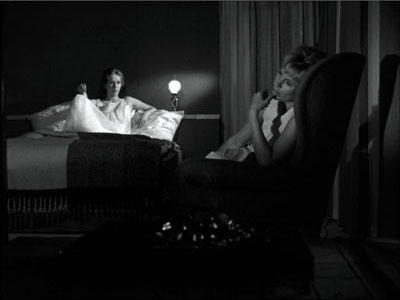
In Persona, the nurse Alma has grown more intimate with her patient Elisabeth, a famous actress who has frozen on stage and now refuses to speak. During their time together, Elisabeth’s treatment becomes therapy for Alma. Compelled to fill the silences, she gradually reveals more about herself. Tonight, a little drunk, Alma confesses something shocking. Once, while her lover was away, she and a girlfriend had sex with a couple of young men. Her telling of it makes her more and more distraught, until she breaks down weeping in Elisabeth’s arms.
In this nearly seven-minute monologue, Alma describes the incident. She mentions a few details, such as the weather on the isolated beach and the blue ribbon on her straw hat. Mostly, though, she simply describes what happened, in laconic but vivid sentences. The result is an anecdote of absorbing eroticism. Lacking any images of the events, we get to imagine the scene of sexual exchange. Bergman releases us from what James once called “weak specificity”: perhaps no imagery this side of pornography could be as arousing as this bare-bones account.
But the fairly neutral words are given emotional coloration through Alma’s manner of telling. Her reaction mixes astonishment at the pleasure, guilt at betraying her lover, and shame in telling it to Elisabeth. By the end, she collapses into weeping confusion; the incident has made her doubt what sort of person she is. Here Bibi Andersson’s performance is crucial, with trembling sincerity giving way to anguish and self-reproach.
In sum, by presenting this monologue wholly in the present, Bergman gives us two layers of action simultaneously, a charged sex scene and its long-range emotional consequences. But there’s more. Had he given us flashbacks, he could not preserve the flow of the present-time action. The staging and cutting during Alma’s confession use simple film techniques, but they add another layer to the scene.
The master shot, seen above, gives us the two women as Alma begins her tale. Then straightforward analytical editing isolates each woman.
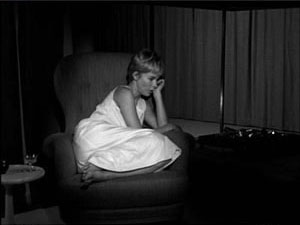
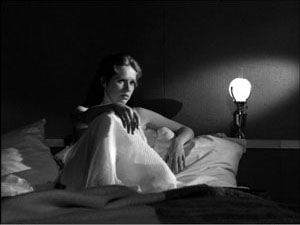
In a classic gesture of intensification, the next shots of Alma and Elisabeth are closer than the earlier ones. This pair of shots accompanies the highest point of what Alma is telling us—the first couplings.
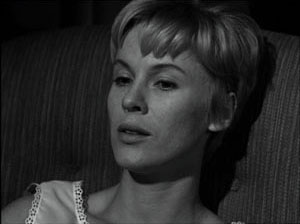
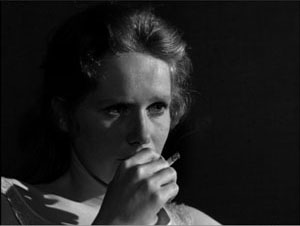
The tight shot of Alma, in which she describes achieving orgasm, lasts almost two minutes and is the lengthiest shot in the sequence. Then the action pauses as Alma nervously curls over to grab a cigarette, goes toward a distant window to light it, then settles on the sill to resume her story.
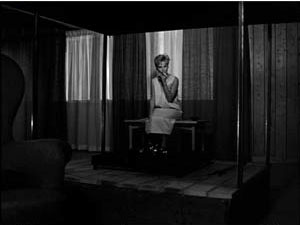
The earlier close shot of Elisabeth had hidden her reaction behind her hand. Now she watches Alma in a sort of enjoyment. Friendly empathy or triumph at eliciting a damaging admission? It’s hard to say. Alma retreats to another window and turns away, as if responding to Elisabeth’s smile.
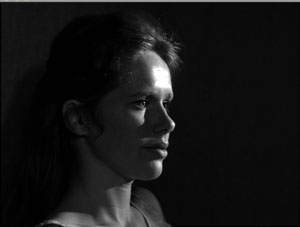
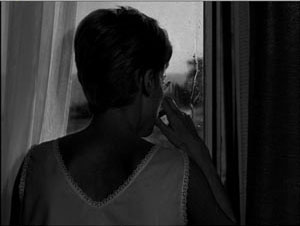
Alma finishes her tale by saying that that night, reunited with her lover, she had the most pleasurable sex of their relationship. Turning from the window, her face is angled in such a way that her confession seems at once indifferent to Elisabeth (the eyeline doesn’t seem angled toward the bed) and challenging to her: “Can you understand that?”
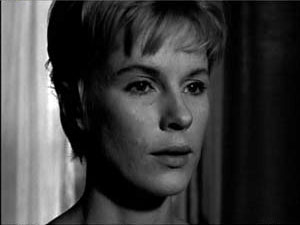
The next line of dialogue—“And I got pregnant of course”—introduces a rupture in the action’s space and time.
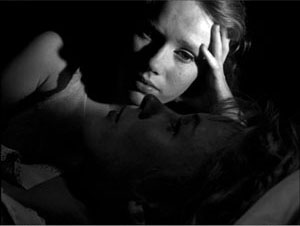
Now Alma is in bed with Elisabeth, as if her question had impelled her to the closest physical contact yet. As Alma twists in pathetic uncertainty, weeping, Elisabeth’s reaction is again initially suppressed (Alma’s arm blocks her patient’s eyes) before finally revealing Elizabeth’s face during the embrace. Yet the expression remains ambiguous—sympathetic, or victorious in having exposed her nurse’s inner life.
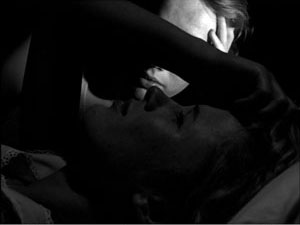
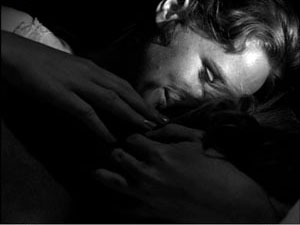
Later we will learn that Elisabeth’s caresses aren’t as affectionate as they might first appear. In any event, given the tenor of Alma’s revelation, it is hard not to see them as erotic gestures in the present, parallel to those Alma recounted.
By telling rather than showing, then, Bergman has been able to tell and show. Bergman lets Alma’s telling provide a sort of virtual flashback, while he also creates a ripening interchange between characters in the present. Instead of simply sandwiching fragments of the past into the present action, he has built up two smooth arcs of action, one that we imagine and one that is set before us in precise detail, with its own emotional modulation. The bliss of the past events is refracted through the pain of telling them.
Telling as therapy
Part of the rationale for telling rather than showing the beach orgy is, of course, the fact that much of it couldn’t be presented so literally on film; censors would object. More important is the fact that showing a heavy-breathing sexual encounter would be likely to undercut the developing revelation of Alma’s present feelings, the tension between the memory of uninhibited pleasure and the lingering shame and confusion.
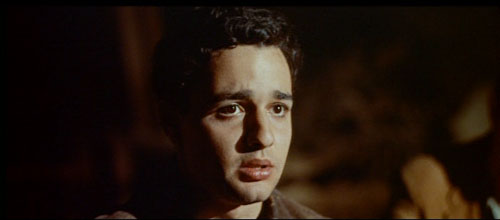
The issue of what should be shown comes up in another classic scene of confession, the moment in Exodus when the Jewish teenager Dov Landau admits that he was an accomplice in running a concentration camp. Again the result is a tearful breakdown. Here, however, a conversational partner coaxes out the truth by quietly corrosive questions.
Dov is trying to join the Irgun, a guerrilla band seeking to drive the British out of Palestine. The senior officer, Akiva Ben Canaan, lets the cocky youth expand on his boast that he began fighting Nazis in the Warsaw ghetto but then was captured and sent to Auschwitz. At first Akiva probes gently. How did the camp officials decide who would live? And what did the Nazis do to the girls? Dov starts to shift uneasily. How was the killing accomplished?
Like Bergman, Preminger employs the standard method of providing closer views as the tension rises. Dov starts to relax as Akiva provides softball questions, but then he has to confess that the bodies were dumped in mass graves. Who dug the graves? Dov admits that demolition squads used dynamite to blow out trenches. Akiva induces him to admit that this was Dov’s job.
In the course of all this, Akiva moves around the room and leans closer to Dov, but the boy remains motionless in the same setup. The fixed framing accentuates his subtly changing expressions across the scene.
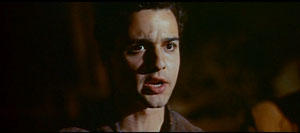
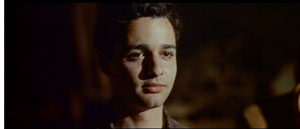
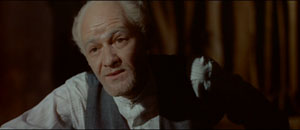
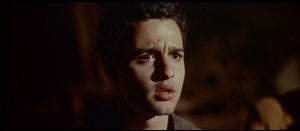
Akiva retells what Dov must have done: shave heads, collect bodies, harvest gold fillings. Dov crumples like a child under the admission (see the frame surmounting this entry), and like Alma at key points in her monologue hides his face in shame. “What could I do?”
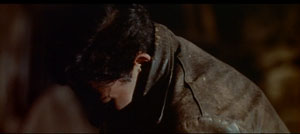
What else has he to confess? Dov won’t say, until he collapses again: “They used me . . . like you use a woman.”
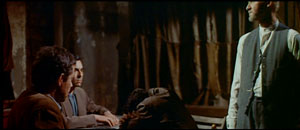
The distant framing here prepares for the scene’s final phase: the men rise and swear Dov into their group.
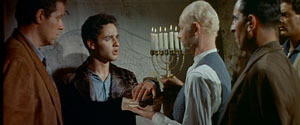
Today a filmmaker would be tempted to show at least some of what Dov tells us. We could get glimpses of life in the camp, along with subjectively distorted imagery of sexual abuse, perhaps from Dov’s point of view. But this could turn out to be James’ “weak specificity.” “Let the reader think the evil,” James advised. Accordingly, Preminger sticks obstinately to what Dov says and how Akiva’s softly voiced but damning interrogation brings out the truth.
Again, the scene’s power comes from the character’s emotional development during the telling. We can imagine the horrors that Dov faced as a boy, and our pity comes from empathizing with his changing expressions–bravado, ruffled concern, realization that he has been caught lying, revulsion at his betrayal and the sexual assault. That is, we sympathize through his response now, rather than through direct vision of what he encountered. We react to his reactions.
By the end, Dov seems dazed that his confession has been accepted. Partly this is surprise that he isn’t being rejected, but also it’s as if he has awakened from a dream–that of himself as a resistance hero. Akiva Ben Canaan forces him to confront what he had not faced. Once more, the confession becomes a talking cure.
As in Persona, the confession also characterizes the interlocutor. Akiva ‘s gentle manner fuses wisdom and severity, making him a quietly stern father confessor. He’s also a shrewd exponent of psychology, one who picks the moment of the boy’s greatest self-revulsion to declare that Dov is accepted into the Irgun. The confession has broken him; the Irgun will remake him. Having surrendered himself utterly he will prove a more loyal soldier than any recruit with an innocent past.
Again, the scene of telling has given us two continuous emotional arcs in two time frames, one concrete and one virtual: a past event we’re cued to imagine and a present stripping away of the teller’s defenses. People who complain that the dialogue scenes in Inglourious Basterds are overlong should consider the tradition of movies like Exodus and Persona.
Psycho babble
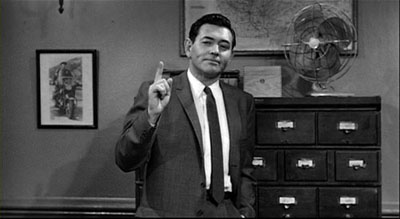
Persona and Exodus suggest two virtues of sustained recounting: arousing the viewer’s imagination, and providing an unbroken arc of present-time action that can generate sympathy through face, gesture, and voice. There’s one more advantage that isn’t perhaps so evident nowadays.
Current films give us “lying flashbacks” fairly often. But in the old days, with very few exceptions like courtroom films and tales like Rashomon, a flashback was veridical. In recounting a story action, a character might lie or make mistakes, but if the film’s narration showed us that action, we could trust that as the truth. As a result, many detective stories presented suspects’ versions of events through question and answer but climaxed in a flashback that showed us what really happened.
If, however, you want to induce doubt about what really happened, you might have the detective’s climactic explanation pricked by inconsistencies. This is what seems to me to be happening at the finale of Psycho. (Do I really have to warn about spoilers here?)
After Norman Bates has been captured, halted in another murder attempt, the psychiatrist Dr Richmond explains the young man’s split personality—part Norman, part Mrs. Bates, his mother. Richmond claims to have gotten the truth “from the mother.” At this point, he says, the Mom part of Norman has taken over wholly, a claim confirmed when we hear Norman speak in an old lady’s voice in the epilogue. Richmond goes on to claim that his questioning determined that Mother “killed the girl.” To get literal, it was as Mother that Norman murdered Marion Crane.
A contemporary film would very likely replay the murder so as to validate the psychiatrist’s analysis: Norman dressing up as his mother, assuming a cackling old-bat accent, killing Marion in images that fill in the silhouette that we saw in the shower sequence. We would see that Norman-as-Mother is the culprit.
But this visual confirmation of Richmond’s diagnosis would be made problematic by the epilogue that Hitchcock includes. In the final sequence we see Norman, staring out at the camera, and hear Mother’s voice declaring that her son committed the murders. According to her, Norman is the culprit; she wouldn’t hurt a fly. How then can Richmond declare that Mother told him that she killed the girl?
We might say that the doctor is extrapolating: the truth he took from the mother is that she is dissembling, shifting the guilt to Norman. But Richmond could have stated that was his reasoning, and he doesn’t. The incompatibility between his explanation and Mother’s soliloquy opens up the possibility that he has not probed to the depths of Norman’s madness.
Despite the fact that the psychiatrist’s analysis arrives at the moment when a conventional movie delivers the whole truth, the very last minutes of the film incline me to doubt Richmond’s ability to grasp the whole situation. It’s as if our parting vision of the character disturbs the smug certainties of the diagnosis.
I haven’t dived deeply into the Talmudic sea of Psycho commentary, so it’s likely that this issue has been hashed out extensively. Perhaps my construal won’t stand up. Take it, then, as a possible instance of the ways in which a verbal recounting, “unconfirmed” by a tangible flashback, can stand as only a candidate explanation rather than the whole truth. In general, telling and refusing to show can induce what Meir Sternberg calls “anticipatory caution,” a warning that the telling is only one, and not necessarily the most truthful, version of events.
Show, don’t tell is usually good advice. But I’m suggesting a codicil. Consider showing the telling. Fill it out. Pack it with actorly detail and psychological implication. Stage and shoot and cut it so as to create an engrossing, unfolding rhythm. That’s visual storytelling too, and it requires fine judgment. Who knows? More scenes relying on telling might also teach audiences to be a little patient.
The best modern account I know of the subtle differences between showing and telling, and the cases when the categories blur and fracture, can be found in Meir Sternberg’s Expositional Modes and Temporal Ordering in Fiction. I talk a little about the distinction in Chapter Two of Narration in the Fiction Film. See also The Way Hollywood Tells It for some comments on today’s vogue for unreliable flashbacks. And way back in 2006 Matt Zoller Seitz wrote a passionate attack on the idea of “Show, don’t tell” while defending the value of voice-over narration.
N. B. I’m not ignoring the possibility that film can present showing and telling in two simultaneous streams: imagery of the present situation accompanied, perhaps alongside, by continuing imagery of the past scene, as in Suddenly Last Summer. This can be a fruitful option, but it relieves the spectator of the obligation to imagine the past—an important advantage of the pure telling. There’s also the tricky matter of giving the two streams of information enough density. The past event needs to gain enough body to be more than a simple illustration, while the present-time telling could become merely a prop for the flashback. In the dual-presentation mode, the filmmaker risks dividing our attention and thinning the texture of each time frame, with the result that both lose vividness. That seems to me to happen in Suddenly Last Summer.
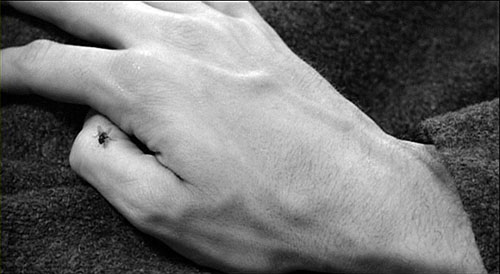
Psycho.
Daisies in the crevices
DB here:
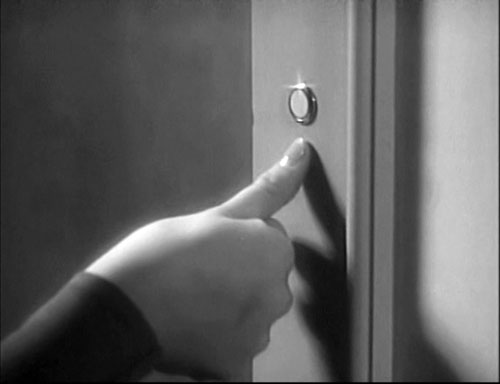
If you wanted a prototype of some unique visual pleasures of 1930s cinema, you could do worse than pick this innocuous image. It’s perfunctory in narrative terms, merely telling us that Sylvia Day is calling on Bill Smith. Beyond its plot function, though, it’s fun to see. We can enjoy the unfussy modern edge of the doorjamb, the curve of the manicured thumb, and soft highlights bringing out the hand and knuckles.
Above all, there is that starry gleam at the top of the doorbell. Who needs it? It’s just a doorbell. Why take so much trouble lighting a throwaway shot?
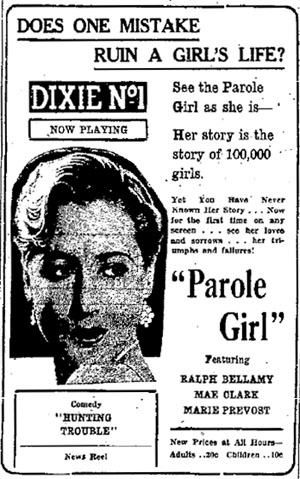
Add to this that Parole Girl (1933) is a program picture, and from Columbia, no less—the Poverty Row studio that had yet to break through with It Happened One Night (1934). We learn from Bernard F. Dick’s deeply-researched book on Harry Cohn that the budget for Parole Girl would have been about $250,000, when MGM B’s were running about $400,000. Why spend money on a shot like this?
Because that was the standard of good-looking moviemaking at the time. Most problems of converting to talkies had been solved, so films were regaining not only the fluent narration but the sparkling imagery of 1920s cinema. Under Cohn’s leadership, Columbia was trying to compete with the bigger studios’ movies, and looking classy was one way to do it. Recently I spent a day or so watching four titles, and I was reminded how pictorially sophisticated and refreshing low-end Hollywood can be. These movies also offer us an unusual window into what was already characteristic storytelling strategies of classical Hollywood. But there will be spoilers ahead too.
Welcome to 1933
As so often, I have TCM to thank. Since their Jean Arthur tribute of 2007, they have been running a generous number of Columbia titles (all restored by the master hand of Grover Crisp). By including less-known 1930s items along with classics like The Awful Truth and the Capra titles, they continue their mission of serving American film culture every hour.
Lea Jacobs has convinced me that it’s useful to think of studio releases in those days as filling a season running from Labor Day to Memorial Day rather than a calendar year. Studio heads planned budgets and production schedules according to that time frame, like network TV broadcasters now. Unlike today, summer was not a big release period, maybe because of the competition of other leisure activities, maybe because with air-conditioned movie houses people would come watch anything thrown on the screen. In any case, the big pictures were saved for fall, winter, and spring.
So my frame of reference is the 1932-33 season. Columbia ushered in the new year with its best-remembered film of the season, Capra’s Bitter Tea of General Yen (6 January). The studio probably considered Washington Merry-Go-Round (15 October), Virtue (25 October), and No More Orchids (15 November) to be A projects, but the large output of Westerns, the absence of historical pictures, and the relative dearth of stars in this output confirm the studio’s status as a Poverty Row company.
My movies come from the winter and spring of 1933. Each was shot in two to three weeks and each runs about seventy minutes.
Air Hostess (15 January, directed by Albert Rogell) tells of the daughter of a WWI ace who marries a reckless young pilot. Trying to build a new type of plane, he shops his business plans to a rich woman investor, who tries to seduce him.
In Child of Manhattan (4 February, directed by Edward Buzzell), a wealthy widower falls for a taxi dancer and takes her as his mistress. When she becomes pregnant, he marries her. But the baby dies soon after birth and the wife flees to Mexico for a divorce while the husband tries to track her down.
In Parole Girl (4 March, directed by Edward Cline), a department store executive sends a woman con artist to prison. She vows revenge. When she gets out, she seduces the executive, although he’s unaware of who she is.
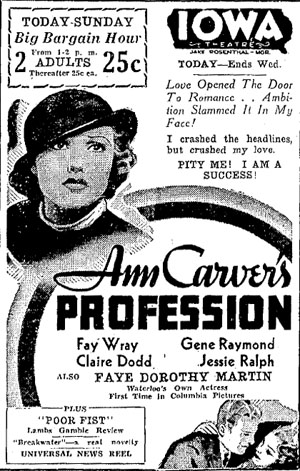
Ann Carver’s Profession (26 May 1933, directed by Buzzell) centers on a couple torn by career rivalry. After being a gridiron hero in college, the husband is failing as an architect. Meanwhile, his wife is becoming a celebrated trial lawyer. Eventually the husband leaves the household and takes up with a floozie, who winds up strangled. His wife must defend him against the murder charge.
For connoisseurs of naughty pre-Code movies, there are the usual attractions of double beds, extramarital sex, peekaboo negligees, and risqué dialogue. Child of Manhattan goes the farthest, perhaps because it’s an adaptation of a Preston Sturges play. “You’re a fascinating little witch,” says the millionaire. “Did you say witch?” the dancer asks. This is the same girl, played by perky Nancy Carroll, who thinks the man is trying to feel her up when he slips a thousand-dollar bill into her garter. Later she recalls her mother’s advice: “Never, ever walk upstairs in front of a gentleman.” And when she confesses to her Texan admirer in her mangled pronunciation, “I’m a courtesian,” he pauses and replies, “Well, religion doesn’t make any difference with me.”
Despite such pleasant moments, and two screenplays credited to Robert Riskin and Norman Krasna, these movies won’t win prizes for imaginative scripting. The tone is often uncertain, with comic banter clashing with scenes of melodramatic sacrifice. The long arm of coincidence becomes elastic. In Parole Girl, the heroine happens to meet the offending executive’s first wife in prison. During the taxi dancer’s stay in Mexico, she runs into the cowpoke who had wooed her aggressively in Manhattan. In Ann Carver’s Profession, the husband’s girlfriend accidentally strangles herself. Yes, you read that correctly.
Still, you have to give points for speed. Only Parole Girl has unusually quick cutting, at an average of 6.6 seconds per shot, but the overall pace of most of the plots is pretty rapid. (The exception is Child of Manhattan, whose lumbering dramatic rhythm is echoed in an average shot length of sixteen seconds.) Playing far-fetched action fast makes it less noticeable and more forgivable. Today any movie that can tell a moderately interesting story in a little more than an hour feels like a triumph. You can watch two of my pictures in the time it takes to groan your way through Funny People. And in these movies, the opening credits flash by in less than fifty seconds. Those were the days when crafts people under contract didn’t have to be acknowledged, and there were no executive producers.
Apart from Capra, whom do we remember as a Columbia director? Probably not my three guys. Albert Rogell, director of Air Hostess, began directing in the early 20s and worked for Columbia, Tiffany, Monogram, RKO, Universal, and Paramount. A prototypical B filmmaker, he signed over a hundred films in twenty-five years. Edward Buzzell was somewhat more prominent. After Ann Carver’s Profession, he left Columbia for Universal and eventually moved to MGM, where he directed (as if that were possible) the Marx Brothers in At the Circus (1939) and Go West (1940), as well as helming Song of the Thin Man (1947). Like Rogell, Edward Cline (Parole Girl) skipped among studios; like Buzzell, he landed on his feet with comedian comedy, steering W. C. Fields through You Can’t Cheat an Honest Man (1939), My Little Chickadee (1940), and other vehicles. In all, studio artisans, yes; auteurs, no.
Two Joes and a Ted
Parole Girl
If you’re interested in how Hollywood tells its tales, there’s a fair amount to chew on in these modest releases. The scripts tend to obey Kristin’s four-part model, adapted to very short running times, with the key turning point taking place midway through the film. Despite the coincidences, the characters’ goals and changes of heart tend to be planted early. In Ann Carver’s Profession, Ann’s intense ambition and Bill’s swaggering overconfidence prepare us for the crisis in their marriage, when each is unwilling to compromise.
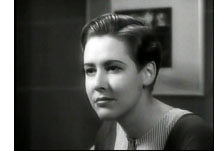 As for performances, perhaps the very speed of production forced actors to play naturally. True, Fay Wray is a bit arch as Ann Carver, but Gene Raymond as her husband moves convincingly from boisterousness to self-doubt. In Child of Manhattan, John Boles, trying to mingle with the little people, can be stiff, but Nancy Carroll has pep, and Buck Jones as her cowboy swain adds a welcome dose of naive gallantry. All three show how important distinct voices had already become: Boles mellifluous, Carroll up and down the scale, Jones slow and sincere. Reliable Columbia regular Ralph Bellamy shows up in Parole Girl, but more memorable is the performance, or rather presence, of Mae Clark. When she comes back from prison bent on vengeance, she’s a glowering figure in her stylishly chopped hairdo.
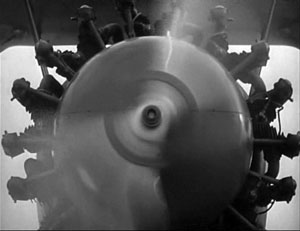
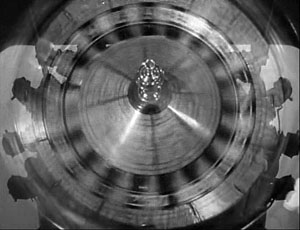
The films make fluent use of storytelling devices that predate the 1930s but are forever associated with that decade. Sequences are linked through headline montages and wipes, recently made possible by the optical printer. There are more elaborate techniques too, particular the visual or auditory hook connecting scenes. We’re not surprised to see commonplace instances, as when a note pad listing an apartment number dissolves to that number on the door. In Air Hostess, however, a spinning propeller gives way to a roulette wheel, and this association does a little more work, linking Ted Hunter’s reckless flying to his gambling and his general tendency to take risks.
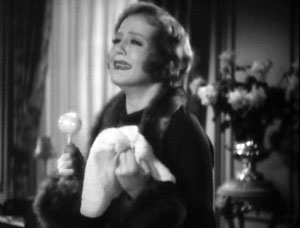
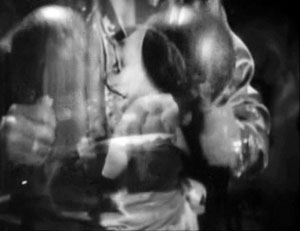
In Child of Manhattan, as Madeleine resolves to leave her husband after the death of her child, she tearfully shakes a baby rattle, and this dissolves to marimbas in a nightclub, swiftly turning her pathos into her effort to start a new life with a Mexican divorce.
But what is perhaps most striking about these films is their photography. Ten minutes into Air Hostess, the first one I watched, we get a lovely sustained track into a sunny airfield, our view guided by the walkway wheeled up to a plane door as passengers step out.
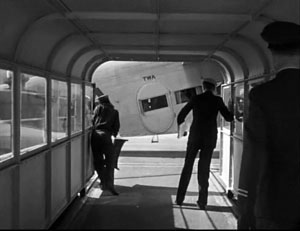
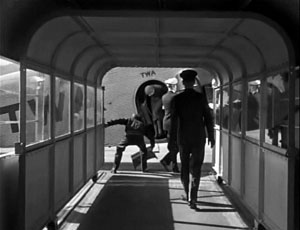
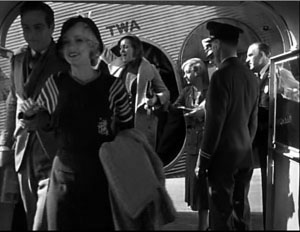
The relaxed play of light and shadow in this geometrical shot yields one of those fugitive visual delights that classic cinema so often supplies.
What’s it doing in a Columbia programmer? This Poverty Row studio realized that they could give their pinched budgets an upscale look with polished cinematography. Accordingly, you can argue that the biggest talents on the Columbia lot were the directors of photography. Our four films were shot by ace DP’s.
Joe August (Parole Girl) was the grand old man. He filmed some of the best-looking hits of the 1910s, including Ince’s Civilization (1916) and a great many William S. Hart movies (including Hell’s Hinges, 1916). In the 1920s and up to 1932 he worked at Fox on films by Ford, Hawks, and Milestone. At Columbia August would shoot Borzage projects like Man’s Castle (1933) before moving to RKO for Sylvia Scarlett (1936), Dance, Girl, Dance (1940), and the flamboyant All That Money Can Buy (aka The Devil and Daniel Webster, 1940).
Another Joe, somewhat younger, was no less gifted. Joseph Walker, the DP of Air Hostess came to Columbia early and soon teamed with Capra; he would shoot twenty movies with the director, including the splendid American Madness (1932), a particular favorite of mine. Walker stayed loyal to Columbia, shooting Only Angels Have Wings (1939), His Girl Friday (1940), Penny Serenade (1941), and on and on—returning to Capra for the independent production It’s a Wonderful Life (1947). Walker also patented an original zoom-lens design.
Ted, sometimes known as Teddy, Tetzlaff was another Columbia loyalist, and he certainly cranked them out. Hawks’ The Criminal Code was one of eleven movies Tetzlaff was credited with in calendar 1931. But by the spring of 1933 he seems already to have become a free lance, eventually working at Paramount on a string of classics (Easy Living, Remember the Night, Road to Zanzibar), then RKO (The Enchanted Cottage, Notorious), and occasional jobs back at Columbia. Tetzlaff became a director as well, remembered chiefly for the cult classic The Window (1949).
No wonder my four films dazzle, even on TV. According to Bob Thomas’s biography King Cohn, Columbia took special care to create a phosphorescent look through careful processing that enhanced the DPs’ efforts. Hence not only the sparkle on a door buzzer but glowing applications of then-standard edge lighting. Hence as well the use of striped shadows to suggest venetian blinds, a convention we associate with the forties but here in precise array (Child of Manhattan, Parole Girl).
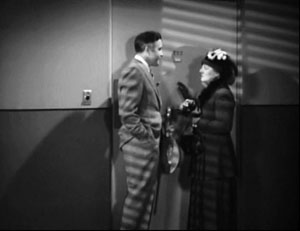
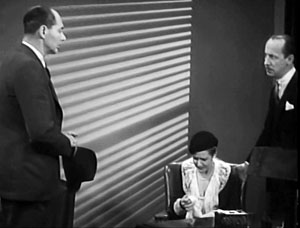
Trust Joe Walker to provide a little of that striped texture with a fuselage.
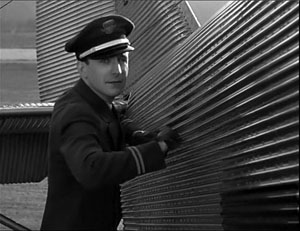
Hence too some striking depth. Here is the next-to-last shot of Walker’s work in Air Hostess, the sort of fancy aperture composition that crops up surprisingly often in the 1930s.
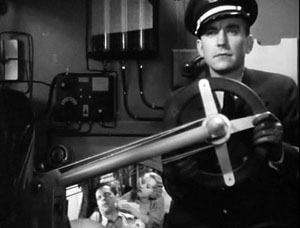
Tetzlaff, first in Child of Manhattan and then Ann Carver’s Profession, seems to be fooling around with faces and elbows.
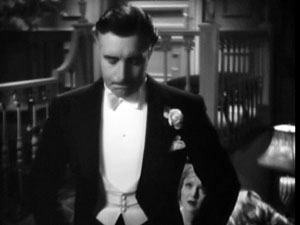
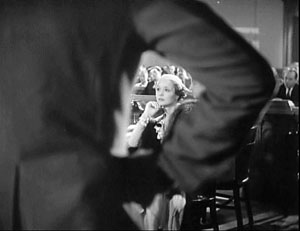
Probably the most visually and narratively complex of my films from spring 1933 is Ann Carver’s Profession. It’s possible that it was Columbia’s equivalent of an A production: Gene Raymond was a mid-range star known for a few Paramount and MGM pictures, and Fay Wray’s King Kong had premiered a week before filming started. Whatever the cause, Ann Carver has more complex plotting and more consistently inventive visuals than the three other titles.
From the very start, when gridiron hero Bill promises to provide for Ann the waitress, we get the sort of offhand flash that I like in 1930s movies. As Bill follows Ann into the kitchen, she’s framed in a swinging door and the camera moves closer to pick up their clinch.
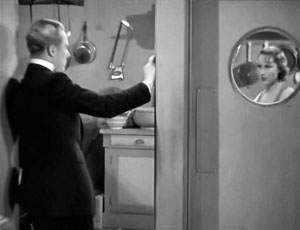
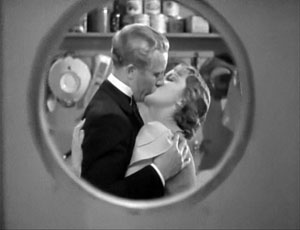
Once they’re married, the circle has become a rectangle, and trouble is on the way.
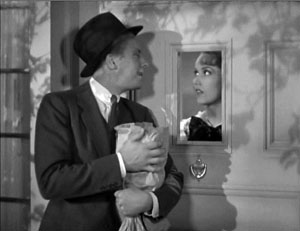
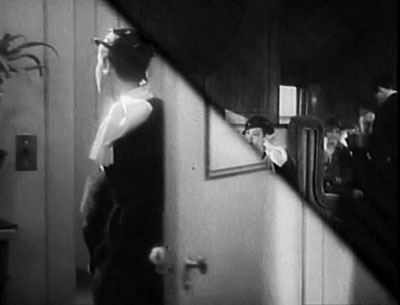
There are fancy mirror shots, pov constructions that lead characters to the wrong inferences, and examples of the big-foreground compositions that would come to prominence in the 1940s.
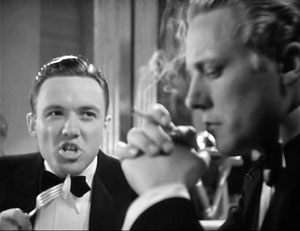
The trial recesses; crane up to the clock; spin the hands to cover a couple of hours; crane back to the trial resuming. Or start with Bill’s girlfriend, passed out and garroted by the necklace that has snagged on a leering chair carving. Dissolve to Bill’s night on the town, before ending that fuzzy montage with a dissolve back to the chair carving.
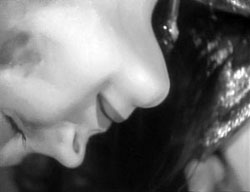
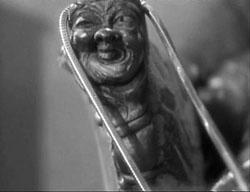
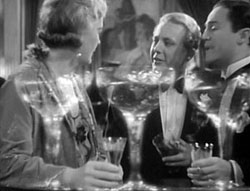
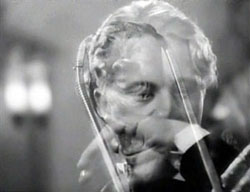
Bill didn’t kill her, but the pictorial logic makes him almost magically responsible, with the carving mocking him for what’s to come.
Above all there is one of the most laconic (and cheaply filmed) courtroom montages I’ve ever seen. A string of witnesses testifies, and after a newspaper pops out the first one, we get a fusillade of extreme close-ups, cut very quickly.
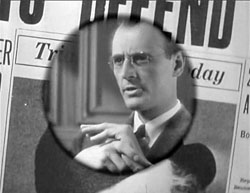
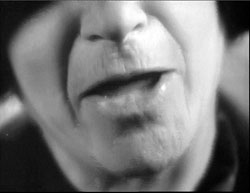
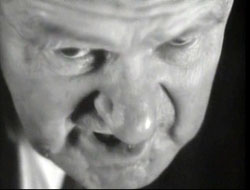
Just as striking is the coordinated sound montage, which reduces the testimony to clipped sentences, then phrases (“”Four-thirty!” “Quarter to five!” “Both of ‘em!”), then single words (“Drunk!” “Drunk!” “Strangulation!”), all damning Bill. Why take us through all the rigamarole—people sworn in and questioned at length—when you can give the essence of it in twenty-eight shots and twenty-five seconds?
My 1933 quartet contains no great film; perhaps none is worth more than one viewing. But what I learned from watching ordinary movies for our Classical Hollywood Cinema book is borne out by my soundings here. We can enjoy seeing a well-honed system steering us through a story, especially when gifted people like Teddy and the two Joes are shifting the gears. We can appreciate the opportunities for grace notes in what some call formula filmmaking. And we can see that this lowly studio, making films ignored in traditional histories, has something to teach filmmakers today: proud modesty. A film can radiate pride in being concise, in exercising a craft, and in telling a story that hurtles forward while shedding moments of casual beauty.
Most critical writing on early 1930s Columbia pictures focuses on Frank Capra, but there is good general background in Bernard F. Dick, The Merchant Prince of Poverty Row: Harry Cohn of Columbia Pictures (Lexington: University Press of Kentucky, 2009). My mention of budget levels comes from his discussion on pp. 119-120. An older, citation-free but still helpful biography is Bob Thomas, King Cohn (Beverly Hills: New Millennium, 2000). In-depth information on Joseph Walker as a Columbia cinematographer is available in Joseph McBride’s excellent biography Frank Capra: The Catastrophe of Success (New York: Simon and Schuster, 1992), 189-215. Walker’s engaging autobiography supplies nothing specific to these films, but he sprinkles technical information among its anecdotes. See Joseph Walker and Juanita Walker, The Light on Her Face (Los Angeles: ASC Press, 1984).
On 1934 as the end of naughtiness, see Tom Doherty’s Pre-Code Hollywood. For a skeptical account of the idea of Hollywood “before the Code,” see Richard Maltby, “More Sinned Against than Sinning [2003],” in Senses of Cinema here, and essays in “Rethinking the Production Code,” a special issue of The Quarterly Review of Film and Video 15, 4 (1995), ed. Lea Jacobs and Richard Maltby.
If you’re interested in more complicated narrative strategies in films of this period, try our entry “Grandmaster Flashback.” For another take on low-budget 1930s films, there’s our entry on Mr. Moto and Charlie Chan.
The ROW strikes again
The Time that Remains.
Kristin here:
Last year I remarked on how festivals like Vancouver are increasingly showing films from countries that have barely contributed to world cinema until recently. Not surprisingly, the trend continues. Yesterday I saw The Search (dir. Pema Tseden), the second feature to by made in Tibet by a team of Tibetans. (The first was also by Tseden.) It’s strongly reminiscent of Kiarostami’s best-known films, with a small film team traveling through the countryside trying to cast a movie based on a classic indigenous opera.
So far, however, most of the films I’ve seen have been from more established filmmaking regions.
Latin America
Latin American cinema continues to grow beyond Mexico, Brazil, and Peru, largely thanks to European co-productions and occasionally co-productions between countries within the region. For me, the first day of the festival concentrated on Latin America.
The first stop was Peru, with the surprise winner of this year’s Golden Bear at Berlin, Claudia Llosa’s The Milk of Sorrow. The plot concerns Fausta, a young woman whose mother, pregnant with her, was raped and tortured during era of the government’s war against the Shining Path insurgents (1980s-1990s).
Haunted by a fear of being raped herself, Fausta imitates a trick that a woman supposedly employed to fend off attackers. She places a potato in her vagina, hoping that the protruding shoots will repel a would-be rapist. Her terror of leaving home alone limits her freedom, though she manages to take a job as a maid to an eccentric female pianist. Her plight is ironically emphasized by the fact that her uncle is a wedding coordinator, and there are several scenes involving outgoing young women who are attuned to modern life and eager to marry.
The Milk of Sorrow is beautifully shot, with a minimal plot that proceeds at a languorous pace. It fits very much into the art cinema destined primarily for festival and big-city screenings.
 Two other two films of the day were distinctly more reminiscent of Hollywood in their pacing and strong plots. Sebastián Silva’s The Maid has a familiar plot, the repressed character who needs to learn to enjoy life and other people. Raquel has served the same family for decades and become obsessed about her own little domain of power, pampering one child she adores, annoying another, and running the household to suit herself. Eventually, when an outgoing second maid is hired, Raquel is surprised to find herself with a friend and begins to come out of her shell.
Stylistically there’s nothing of great interest. As with so many films these days, it was shot in real locales, mostly the interior of one large house, and so consists mostly of medium shots and lots of panning. It’s essentially an actor’s film, though, and I could easily imagine it being remade in English as a vehicle for someone like Meryl Streep. It effortlessly balances drama and humor and is continually entertaining. It also features the only unequivocally upbeat ending among the films I’m discussing here, which no doubt says something either about the state of the world or about what filmmakers assume festival programmers look for.
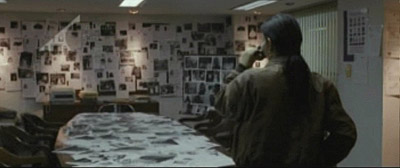
Equally skillful but miles away in tone is the Mexican feature Backyard, by Carlos Carrera. Focusing on the astonishingly frequent rape, torture, and murder of women in Juàrez, the film follows a lone female detective in a police force which refuses to arrest or prosecute any of the perpetrators. (Above, she is confronted with hundreds of photos of the dead and missing.) The reasons behind both the numerous murders and official indifference turns out to be a combination of circumstances: at least one serial killer with the means to pay off the police, the executive of a Japanese factory that doesn’t want bad publicity, and random abusive husbands and young punks who take advantage of the situation to dump their victims in the desert with impunity.
The story is handled in taut classical fashion, intercutting between the detective’s investigations and the story of one young factory girl factory who eventually becomes a victim. This is the stuff of CSI and other crime shows, but all based on a horrific real-life situation that goes beyond what any mainstream drama would dare to show and that continues to this day right, as the title emphasizes, in America’s backyard.
One of the best films we’ve seen so far is Lucrecia Martel’s third feature, The Headless Woman. Although I had admired her visually gorgeous La ciénaga (2001), I found it a bit obvious in its use of the central swamp metaphor to characterize the upper-middle class. The Headless Woman, though, is the epitome of subtlety, with the plot being a puzzle with easily missed clues doled out sparingly. (The Variety review considerably mis-describes what happens, and I suspect others do as well.)
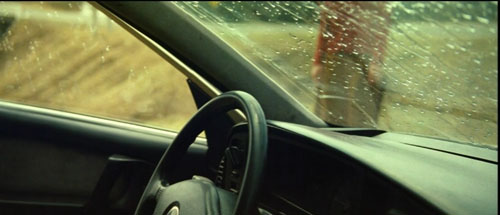
The opening is simple enough, with some boys playing in a dry concrete canal. Nearby, Veró, the woman of the title, helps her sister Josefina shoo a group of noisy kids into one car, while Veró takes off alone in the other. In a remarkable long take, she drives until the car lurches, causing her to bump her head on the windshield. Rather than cutting to what Veró hit, the camera stays with her as she sits, dazed. After a long pause she drives on, and a new framing allows us to briefly glimpse a large dead dog on the road in the distance. Soon the heroine stops and gets out of the car, walking out of focus as we stay in the car and the first heavy drops of a storm strike the windshield (below). One hint: even the exact moment when the rain starts becomes a clue to unraveling the action to come.
The rest of the film stays with Veró, who is present onscreen or off in every scene. We watch her uncertainty, caused by a concussion, but those around her barely notice, attributing her memory loss to tiredness or illness. Eventually Veró tells her husband that she thinks she has killed someone on the road. It would be unfair to reveal more, since experiencing the twists and implications of the plot should be up to the viewer.
Stylistically the film develops on Martel’s characteristic technique of shooting largely in tight shots filmed with highly selective focus. Often one must search for the one significant character. At other times, the camera lingers on Veró’s face, glancing vaguely around with a slight, defensive smile, pretending that nothing is wrong, as more significant actions by the other characters occur out of focus in the background. Often children swarm around, placing the thin thread of the central drama in the context of insignificant gestures of everyday life but making the clues all the harder to notice.
So well hidden is the plot that many viewers will mistakenly decide that it’s a film where nothing much happens. Those who engage with it will discover quite the opposite. But be warned, only a very alert viewer could figure out the plot correctly on a single viewing. I’ll admit I missed a crucial remark on the first pass.
(See also Jim Emerson’s take on The Headless Woman.)
The Middle East
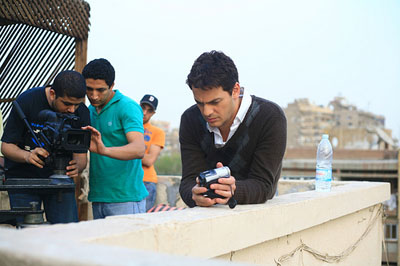
Ahmad Abdalla behind the camera shooting Heliopolis.
David and I both saw Heliopolis, he because it’s a network narrative and I because it’s an interesting district of Cairo that I know only slightly. Egypt may in the past have been the main supplier of mainstream entertainment movies for the Middle East, but Heliopolis is very much an indie, made by first-time director Ahmad Abdalla with a tiny crew shooting on location for a mere two weeks.
In a rare move for this kind of narrative, the characters from the various plotlines barely intersect. Instead, Heliopolis itself is the focus. It’s a suburb near the airport that tourists drive through on their way to the central city but seldom visit. Once an enclave of foreigners, it is now is one of the main districts for middle- and upper-middle-class Egyptians. The beauty of the old buildings, some now shells and threatened with demolition, contrasts with an increasingly westernized youth culture on the streets. Similarly the characters, all with their own aspirations, suffer disappointments in the end, creating a bittersweet tone that becomes generalized to the district.
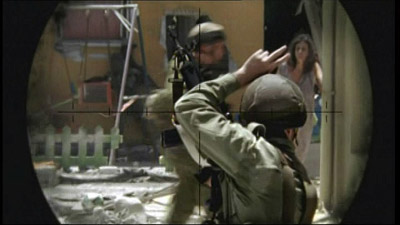
Lebanon, the Israeli film that won the top prize at the Venice Film Festival, tells a compressed story set during the first day of the Israeli-Lebanon war. It centers on a four-man team in a tank, all going into real combat for the first time. Director Samuel Maoz confines his camera to the interior of the tank for nearly all of the action, limiting our knowledge to the characters’ viewpoints (above). What we see of the war appears through the crosshairs of the mens’ scopes, though the director does not cue us to identify consistently with any of the individual team members.
The increasingly fetid interior of the tank becomes tangibly apparent as the men’s stubbly faces gleam with sweat and grime. At intervals Maoz cuts to grotesquely lyrical details of the tank’s surfaces, with oil oozing into dials or down the walls and filthy liquid on the floor rippling with the machine’s vibrations.
Many of the conventions of the men-at-war film are present, including the young man being killed just as his message assuring his parents of his safety is delivered and the novice gunner who fails to fire when he should but then kills an innocent passerby. But such conventions are renewed through the claustrophobia of the setting and the refusal to hold back in showing the confusion, terror, and savagery of war. Only the opening and closing shots, whether consciously or not an echo of Dovzhenko, offer a hint of peace.
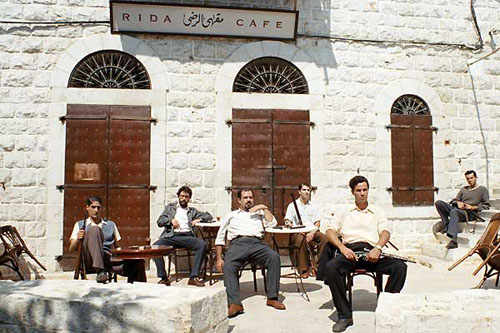
As an admirer of Elia Suleiman’s Divine Intervention, I anticipated most seeing his new film, The Time that Remains: Chronicle of a Present Absentee. It did not disappoint, though it is less ingratiating than the earlier film. Where Divine Intervention is largely based on subtle, ironic comedy played out primarily in Tati-esque long shots, The Time that Remains mixes long stretches of pure drama with the irony. I’ve read tepid reviews that reflect a lack of patience in figuring out what Suleiman was up to this time.
There are no Arrafat-face balloons flying over Jerusalem or fantasy ninja-revenge scenes here. Instead, apparently working with a larger budget, Suleiman ambitiously sets parts of his film in 1948 and other key years of the struggle between Palestinians and Israelis. His father appears as a constant participant in that struggle (seen in dark trousers in the frame at the top). The child Elia shows up partway through and becomes a silent witness to much of this. (As in Divine Intervention, the director plays himself but never speaks.) He acts more as a sympathizer than as an active participant in the conflict, going into exile as a young man and, as we know returning at intervals to make films that comment on the political situation. Hence the “present absentee” of the title.
The older scenes include staged skirmishes and chases, with genuine suspense, before the film settles into the modern era and the humorous, sometimes blackly humorous, life of Suleiman’s aging family and neighbors. As the earlier film dealt with his father’s final illness, the new one lingers over his mother’s.
Despite the drama, there are some characteristically hilarious moments. An unarmed Palestinian man takes out his garbage and paces during a cellphone conversation, ignoring all the while an enormous tank whose gun-turret swivels to cover his every move from a few feet away. Young Palestinians dance to loud music, seen through the glass walls of a discotheque. An Israeli jeep stops outside, vainly trying to make a curfew warning heard over the din, and the soldiers inside unwittingly start bobbing their heads slightly in time to the music.
We’re off to another day of film-viewing and will post again soon.
The Headless Woman.