




Archive for the 'Narrative strategies' Category
You the filmmaker: Control, choice, and constraint
DB here:
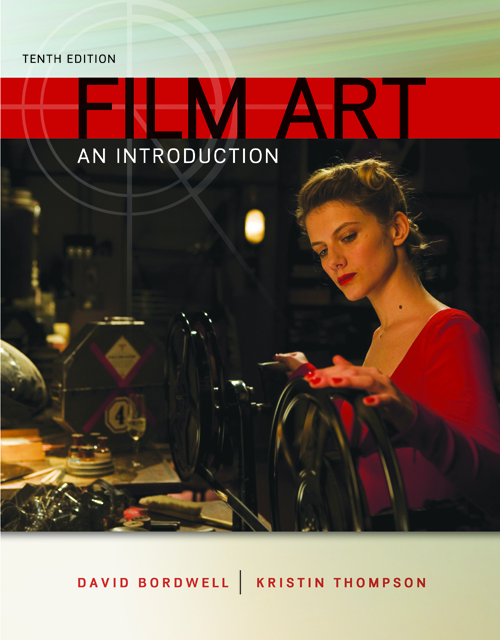
The tenth edition of our textbook, Film Art: An Introduction will be available in early July. It has so many new features that it’s our most extensive revision in at least a decade.
Kristin has already written about one of our major additions: supplemental film extracts from the Criterion Collection, with voice-over commentary and other sorts of analysis. (Go here for a sample.) These will be accessible to professors for incorporation into their syllabi. More of them may also become generally available on the Criterion website.
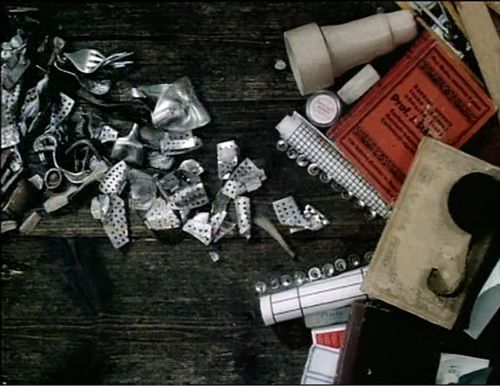
The text has been extensively rewritten, aiming at maximal clarity and freshness. There are many local changes too, with updated examples from a variety of films both old and new. Regular readers will notice that we have made two replacements: Koyaanisqatsi is now our example of associational form, and Švankmajer’s Dimensions of Dialogue is our example of experimental animation. Regretfully, we had to drop our earlier examples, Bruce Conner’s A Movie and Robert Breer’s Fuji, because they are available only in 16mm, and most teachers and readers don’t have access to them. On the other hand, we enjoyed analyzing the new items and think that they serve their purpose very well.
Today I’m going to point out some of the broader changes, while also considering the book’s overall approach.
Parts and wholes
When Film Art appeared in 1979, it was the first textbook in English written by people who had received Ph.D.s in film studies. Specifically, FA emerged from my teaching a lecture-and-discussion course called “Introduction to Film” to several hundred students each semester for many years.
In the mid-seventies, there were almost no film studies textbooks, and none of them seemed to us to reflect the directions of current research. As a result, the first edition of FA included topics that were emerging in the field, such as narrative theory and conceptions of ideology. It also suggested a coherent, comprehensive view of cinematic art, from avant-garde and documentary cinema to mainstream film and “art cinema.”
The book has changed since then, but its approach has remained consistent in two primary respects. For one thing, it tries to survey the basic techniques of the medium in a systematic fashion. Here the key word is “systematic.” It seemed to us that we might go beyond simple mentioning this or that technique—editing, or acting, or sound—and instead treat each technique in a more logical and thorough way. But film aesthetics wasn’t yet conceived in this way, so to a considerable extent the textbook had to offer some original ideas.
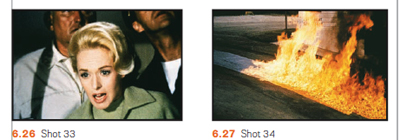
For example, most people thought of editing primarily as a means of advancing the film’s story. That’s certainly accurate up to a point, but we tried to go up a level of abstraction. We suggested that the change from shot to shot had implications for what was represented (the space shown in the shots, the time of the action presented), as well as for the sheer graphic and rhythmic qualities onscreen, independent of what was shown. That created four dimensions that the filmmaker could control, and we illustrated how Hitchcock shaped all of them in a sequence from The Birds.
Nobody before had surveyed editing’s possibilities in this multidimensional way. The result was that we were able to trace out several expressive options. We analyzed the 180-degree system for presenting story space, and Film Art became the first film appreciation textbook to explain this. We also laid out ways in which shots could manipulate the order, duration, and frequency of story action. We also considered sheerly graphic and rhythmic possibilities of editing, not all of which are tied to narrative purposes. Similarly, we tried to show that sound, another familiar technique, could be understood as a bundle of systematic options relating to sound quality, locations in space, relation to time, and other factors.
In sum, very often the array technical options had an inner logic. This urge to cover all bases helped us notice options that usually escaped critics. So by concentrating on the graphic dimension of editing, we noticed that some filmmakers tried to create pictorial carryovers from shot to shot, a device we called the “graphic match.”
A second core principle of the book was the idea that we ought to think about films as wholes. There’s a strong tendency in film criticism, in both print and the net, to fasten on memorable single sequences for study. There’s nothing wrong with this, of course, but we think it needs to be balanced by considering how all the sequences in a film fit together. That led us to consider various types of large-scale form, both narrative and non-narrative.
Again, this was new to the field. We showed students how to divide films into parts and then trace patterns of progression and coherence across them. This is a valuable skill for both intelligent viewers and people who might want to work in filmmaking. We showed how the distinction between story and plot could help explain large-scale narrative construction. We suggested that issues of point-of-view and range of character knowledge exemplified broader principles of narration, the ways films pass information along on a moment-by-moment basis. And although most film courses show narrative films (mine did too), we wanted students to think about other large-scale organizational principles too, such as rhetorical argument and associational form. Again, thinking about these more general possibilities led us to consider creative options that hadn’t been the province of introductory texts, such as rhetorical documentary and poetic experimental cinema.
These two efforts—comprehensive study of techniques and a holistic emphasis on total form—weren’t FA’s only salient points. We tried to incorporate more familiar elements from genre studies and historical research. But they did set the book apart, and do still. I believe that we made contributions to our understanding of film aesthetics. One measure of these contributions is the extent to which FA has been regarded as not only a textbook but an original contribution to film aesthetics. Another sign is the fact that other textbooks have relied, sometimes to a startling degree, upon FA for concepts, organization, and examples.
Categories, categories

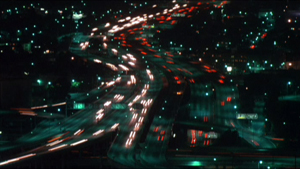
Associational form: Koyaanisqatsi.
Still, we did encounter objections.
Some readers worried that FA’s layout of logical categories took away some of the magic and mystery: Art dies under dissection. Some also protested that filmmakers didn’t use the categories and terms we invoked. These concerns have, I think, waned a bit over the years, but I’ll address them anyhow.
First, as to the need for categories. As a genre, the textbook in art theory has a very old ancestry. Aristotle’s Poetics, a survey of what we’d now call literary art, bristles with categories—drama vs. epic, comedy vs. tragedy, types of plots, etc. In the visual and musical arts, from the Middle Ages into the Renaissance, writers tried to systematically understand the principles of artists’ practice. Leon Battista Alberti’s treatise on painting tried to show that as an activity, painting had many “parts,” such as drawing, color, and light.
This classificatory urge continued through the centuries, and it continues today. Pick up a book on the visual arts today and you’ll see chapters on composition, color, texture, and the like. The same goes for music; an introductory book will survey rhythm, harmony, melody, musical forms, and so on. There’s no escaping some sort of categorizing if we want to understand any subject, and this goes as well for art traditions.
The categories governing centuries-old arts are largely taken for granted. But film is a newish medium, and film studies a still-young academic discipline, so there remains a lot of exploratory thinking to be done. In the late 1970s, Film Art undertook some of that exploration.
A lot of thinking about film employs categories that are very abstract and general (say, “realism” versus “non-realism”). Our frame of reference tries to be more concrete, more fitted to the particularity of what films actually look and sound like. Whenever we could, we incorporated filmmakers’ explicit concepts into our analyses. FA, for instance, was the first appreciation textbook to introduce the principles of continuity editing that were craft routines among directors and cinematographers.
At other times, we tried to synthesize ideas that were circulating in the filmmaking community. For example, for several decades filmmakers and critics have been saying that editing is getting faster, close-ups are getting more prominent, and camera movements are becoming more salient, even aggressive. From studying hundreds of films, we came to the conclusion that these trends are part of a new approach to film style, and we dubbed that “intensified continuity.” That term aims to capture the idea that for the most part these techniques are in accord with traditional continuity editing, but they sharpen and heighten its effect.
Occasionally we tried to clarify concepts. Most notoriously, we borrowed from French film theory the distinction between “diegetic” and “nondiegetic” sound because all the other terms (“source music,” “narrative music,” etc.) seemed to us ambiguous or inexact. As with most categories, individual films can play with or override this distinction, but it’s a plausible point of departure because traditionally the distinction is respected.
Contrary to some objections, then, we often worked with ideas used by practicing filmmakers. Where traditional terminology seemed inadequate to those ideas, we created our own. And some effects we may notice in movies may have no currently accepted names. In some cases, as in the graphic match, the phenomenon may not even have been identified. We haven’t tried to conjure up fancy labels; we’ve just tried to point to the ways some films work. Anyhow, the term doesn’t matter much, but the concept does.
So one way to think about the categories of form and style in FA is to see them as bringing out principles underlying filmmakers’ practical decisions. A director may choose to do something on the basis of intuition, but we can backtrack and reconstruct the choice situation she faced. If we want to survey the possibilities of the medium, one way to do it is to build categories that show the expressive options available, even if filmmakers don’t sit down and brood on each one.
Thinking like a filmmaker
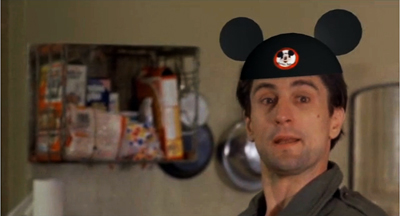
Walt Disney’s Taxi Driver (Bryan Boyce).
Categories are inevitable, and they allow us to consider creative choices systematically. Making this second point explicit is the most important overall revision in the new version of Film Art.
Previous editions took the perspective of the film viewer. This is reasonable: Teachers want to enhance their students’ skills in noticing and appreciating things in the movies. But from the start FA also indicated that the things we discussed also mattered to filmmakers. As the years went by, we incorporated more comments and ideas from screenwriters, cinematographers, sound designers, directors, and other artisans—often as marginal quotes that, we hoped, would reinforce or counter something in the main text.
Now, though, we’ve shifted the perspective more strongly toward the filmmaker—or rather, toward getting the viewer to think like a filmmaker.
Until recently, most of our readers hadn’t tried their hand at making movies. But with the rise of digital media, a great many young people have begun making their own films. Some of these are variants of home movies, records of concerts or parties or a night out. But many of these DIY films are more thoroughly worked over. They’re planned, shot, and cut with considerable care. Posted on YouTube or Vimeo, they exist as creative efforts in cinema no less than the films that get released to theatres or TV. If you doubt it, look at lipdubs, or meticulous mashups like Bryan Boyce’s.
So, we thought, many students are now able to consider film art as practicing filmmakers. For one thing, that means they’re more aware of the techniques we explain. (Probably nothing in Film Art is as tough as mastering Final Cut Pro.) Moreover, the very act of making films has made students sensitive to alternative ways of doing anything. Accordingly, this edition emphasizes that the resources of the film medium that we survey constitute potential creative choices which yield different effects.
Take an example. We can explain the idea of restricted versus unrestricted narration abstractly. Restricted narration ties you to a limited range of knowledge about the story action; unrestricted narration expands that range, often presenting action that no single character could know about. Filmmakers intuitively make choices along this spectrum even if they don’t use the terminology. Then again, sometimes they do. A while back we quoted the director of Cloverfield:
The point of view was so restricted, it felt really fresh. It was one of the things that attracted me [to this project]. You are with this group of people and then this event happens and they do their best to understand it and survive it, and that’s all they know.
In Stanley Kubrick’s Spartacus, the hero and three other captives are chosen to fight in the arena. They sit sealed in the holding pen while we hear Crassus and his elite colleagues chatting pleasantly about their trivial affairs.
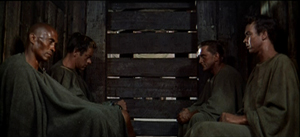
When the combat starts, we’re still confined to the shed. Crixus and Galeno are summoned out, and the door slides shut, leaving Spartacus and Draba alone.
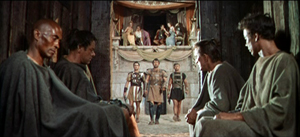
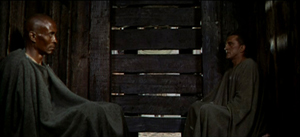
The director has already made several important choices, notably contrasting the carefree chatter of the rulers with the grim prospects of the gladiators (the latter underscored by relentless music). But now there’s a big fork in the road: To show the first combat, or not?
Kubrick chooses not to. We hear the call, “Those who are about to die salute you!” We hear swords clashing, and Spartacus peers outside through the slats. We see only what he sees.
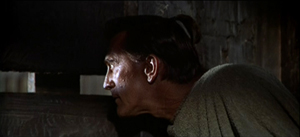
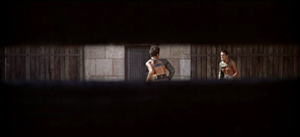
Draba studies Spartacus, who closes his eyes to shut out the spectacle outside.
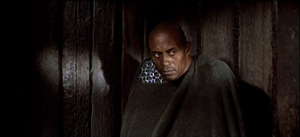
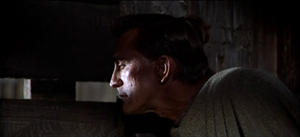
The two men share a look, but Spartacus turns his gaze away, as if unwilling to confront the cost of killing this man who has done him no harm.
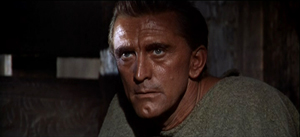
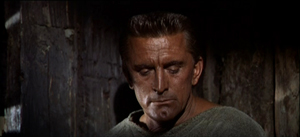
This stretch of the scene is too detailed and varied for me to replay in full, but it’s all confined to the two men in the shed—their reactions to what they hear and what Spartacus sees, and the development of a mix of wary appraisal and desperation. No words are spoken.
The fight outside concludes, and at the climactic moment Kubrick cuts to a new angle that puts Draba and Spartacus in the same frame, realizing that their time has come. The door slides open again, and the men step out.
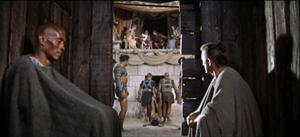
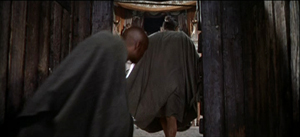
The exchange of glances has been just ambiguous enough to make us wonder whether the two will really try to kill one another. Restricting us to the holding pen gives us a moment to watch them pondering their fates and enhances the suspense about the outcome of their fight.
Every instant presents the director with a choice that can shape the viewer’s experience. When the men go out, Kubrick must decide on what to show us next. Most daringly, he could keep us in the shed and let us glimpse the fight from there. But that would be a very unusual option in American commercial cinema. Instead, the next shots expand our range of knowledge by shifting us to a different character’s reaction. Before showing us the arena, we get a shot of Virinia, the slave just bought by Crassus. As a result, she is marked as important before we get a general shot of the arena.
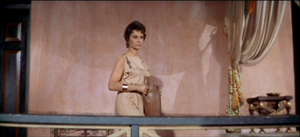
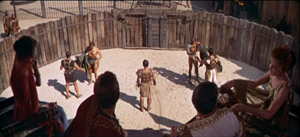
Eventally, a master shot ties together all the characters before we move to the next phase of the scene.
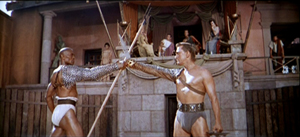
As Darba and Spartacus start their fight, you can argue that the effect of it is even stronger because we haven’t seen the earlier match. Restricted presentation of the first combat, seen only through Spartacus’s eyes, throws the emphasis on this one.
By shifting our attention to filmmakers’ areas of choice, we haven’t really abandoned thinking from the standpoint of the spectator. The two views complement each other. In effect, we’re reverse-engineering: thinking like a filmmaker sharpens our sense of how the spectator’s experience can be shaped. From either perspective, we need concepts, categories, and terminology.
To futz or not to futz?
Undercover Man (1949).
Once we notice the concrete results of creative choices by director, cinematographer, editor, and others, we’re inclined to compare how filmmakers have pursued different options, and how these decisions yield different effects. So you might contrast Kubrick’s treatment of the combat with the free-for-all in Ridley Scott’s Gladiator. There the period of waiting is short, and all the emphasis is put on the bloody combat.
Film Art uses the comparative method often, again to illustrate the range of choice available to the filmmaker. Let’s take some instances that have implications for both narration and sound. Telephone conversations are a staple of filmic storytelling. In such a scene, you as a director face a decision tree. Whatever you choose leads to other choices.
Should you show both characters in the conversation, or only one? A passage from The Big Clock presents both options, one after the other.
This illustration suggests that if the character on the other line plays a significant role in the story, you may want to show him or her. Max isn’t as important as Stroud’s wife and son. Once you’ve decided to cut back and forth, you’ll still have to decide when to cut—at what points to show us characters’ reactions. You might want to replay this clip to see how the cutting pattern highlights certain responses.
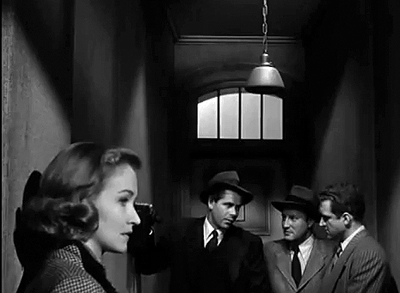
Alternatively, you can stick with one character and conceal the other party, even if that character is important. Here’s an example from Joseph H. Lewis’s Undercover Man.
Unlike Max in the Big Clock scene, this caller is an important character, a prospective snitch. By not showing him on the other end of the line, Lewis concentrates our attention on the federal agents and builds a little suspense. He goes even further: By not cutting in to Warren as he talks, the direction emphasizes the reactions of Judy, Warren’s wife. Her response is highlighted when she turns slightly into profile, registering her realization that her husband has to leave her on a dangerous mission sooner than she expected.
Sticking with one character triggers another choice about telephone talk: Do you let us hear the other party or not? So far, all our examples have suppressed the voice of the person on the other end of the line. But of course you could let the viewer hear that.
There’s a new problem coming up, though. You need to make it clear that the voice is coming through the receiver, not from someone outside the frame. So a convention has arisen: Words coming through the phone line are distorted, in a process called “futzing.” Here’s an example of subdued futzing from I Walk Alone.
And here’s a case from The Blue Dahlia illustrating the difference between the two sorts of sound even more sharply. Here it’s especially important to let the audience know that what’s being heard is a recording.
This isn’t to say that every choice is absolutely fixed. You can experiment. This is what King Vidor did in H. M. Pulham, Esq. Pulham gets a call, and though we stay with him, the voice isn’t futzed; the effect is a bit unnerving.
Vidor explains:
We were breaking with tradition. When the sound men took over, it became the cliché to put all telephone voices through some sort of filtering device. This made it sound distorted and weird. It occurred to me, why should the audience strain to listen? The person with the receiver up there on the screen doesn’t strain to hear the voice. There isn’t any kind of mechanical distortion. I thought we should just direct it to sound the way it sounded to the person.
The film’s plot concerns Pulham’s regrets about the missed opportunities of his youth. When he gets calls from old friends, their voices seem unusually immediate, more vital and “present” for him than the people in the life he’s leading now.
These creative options show how even small stylistic decisions affect narration and the viewer’s response. Presenting both characters on the phone creates more unrestricted narration, and this allows us to gauge reactions to the action. By showing only one character, you concentrate on that person and the people around them.
If you suppress the words spoken on the other end of the line, you maintain some uncertainty about what’s happening, and you don’t share with us what the listener knows. In contrast, if you let us hear what the listener hears, you tie us to their range of knowledge and perhaps create a bond with them. And as Vidor suggests, you can try to create a deeper subjectivity by letting us hear the speaker as the listener does.
Although Vidor’s experiment wasn’t taken up, directors have continued to try different ways of rendering phone conversations. It would be fun to compare Larry Cohen’s two “phone” scripts, Cellular and Phone Booth, in these terms—not least because of the eerie sound design applied to the mysterious caller harassing the hero of Phone Booth.
Choice and change in history
Un Chien andalou (1928); Blue Velvet (1986).
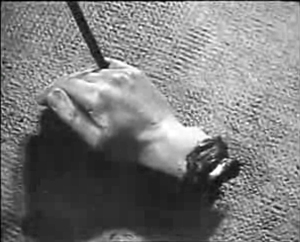
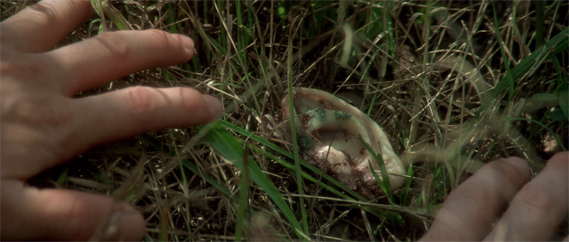
In such ways, the categories we survey can be thought of as a range of possible options facing filmmakers. But all of them aren’t available to every filmmaker. As every filmmaker knows, you choose within constraints, and some of those constraints are the result of history.
As in earlier editions, Film Art concludes with a chapter surveying artistic trends across film history. But now we’ve tried to integrate the idea of thinking like a filmmaker into that section, emphasizing the interplay of choice and constraint. Most obviously, budgets limit choices. Other constraints might be technological; not all filmmakers have been able to film in color, or to use advanced special effects. Some constraints involve matters of fashion: some acting styles and staging methods aren’t widely acceptable today. In our final chapter we show how certain traditions and schools of filmmaking confronted the constraints of their period and place. Sometimes filmmakers worked within those constraints, and sometimes they overcame them by trying something different.
At the same time, we break with our previous editions by weaving recent films into the history chapter. We try to show that the expressive choices made by filmmakers long ago have returned in our time. The earliest short films, based on novelty and surprise events, have successors in YouTube videos. Contemporary filmmakers draw on techniques favored by German Expressionism and French Impressionism. (Recent examples on the blog are here and here.) Current Iranian films owe a good deal to Italian Neorealism, while the Dogme filmmakers tried to revive some of the insolent force of the French New Wave. It isn’t just a matter of influence, either. Contemporary filmmakers face problems of storytelling and style that others have faced before. The choices our filmmakers make often recall those made in the past.
We’re very proud of this edition of Film Art. We hope that the changes will whet the interests of teachers, students, film lovers, and that generic “curious general reader”—who, we persist in believing, isn’t mythical.
Just to be clear: Our Spartacus example doesn’t appear in the book. Our layout of choices about handling phone conversations does, but with different examples. Thanks to Kevin Lee and Jim Emerson for advice on video embedding.
King Vidor’s remarks about H. M. Pulham, Esq. are taken from Nancy Dowd and David Shepard, King Vidor: A Directors Guild of America Oral History (Scarecrow, 1988), 188. A library of futzed sound clips is here. For a more detailed study of how phone conversations may be presented through both sound and image, see Michel Chion’s Film, A Sound Art, trans. Claudia Gorbman (New York: Columbia University Press, 2009), 365-371. (An outline of his typology is here, in French.) Chion’s research is a good example of showing how a systematic set of principles can underlie the practical decisions facing filmmakers.
Alert reader Chris Freitag has steered me to a recent and fine lipdub here. It exemplifies how competition within a genre can spur innovation. More specifically, how to create a new sort of lipdub? Well, how about proposing marriage?
Instructors interested in obtaining a desk copy of Film Art: An Introduction can visit this website.
Dimensions of Dialogue (1982).
P.S. 27 June: Some correspondence I’ve just gotten reminds me of two things I neglected to mention in the entry. First, this edition of Film Art contains a great deal more material on digital cinema, from production and postproduction through to distribution and exhibition. We’ve woven digital technology into sections on various techniques, particularly cinematography, and we’ve added material on 3D cinema.
Second, our decision to replace our sections on A Movie and Fuji doesn’t mean that those discussions will vanish forever. For some years we’ve been putting up older Film Art material as pdf files on this wing of the site. Later this summer we’ll be doing the same with the Movie and Fuji sections of the book. Instructors who want their students to read that material are welcome to send them there, where the essays can be downloaded.
I Love a Mystery: Extra-credit reading
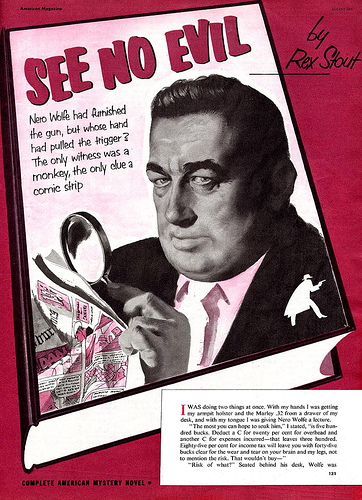
Thornton Utz illustration for Rex Stout novella from American Magazine, 1951. Obtained from the excellent site Today’s Inspiration.
DB here:
Over the next few months, I’ll be traveling with a talk on Hollywood cinema of the 1940s. The ideas I’ll propose are destined for a book about narrative norms during that period. Mystery fiction is important to that lecture, but I don’t have room there to supply much background about the relevant conventions. So I’m sketching in this background here, for people who might hear the talk somewhere or who might just be curious. Consider this as another experiment on the blog, using the web to supplement a lecture.
Although the lecture is mostly about cinema, this entry is mostly about novels and plays. But I’ll mention film here and there, and you’ll notice that some of the books and plays I mention were adapted for the screen.
A mega-genre
The first half of the twentieth century saw an explosive expansion in genres built around mystery and suspense. The most obvious genre is the detective story. In the wake of Conan Doyle’s Sherlock Holmes tales, a great many writers developed and elaborated on the idea of the master sleuth, the genius of observation and reason. Central to this tradition was the puzzle that could be solved by careful noting of clues and meticulous reasoning about them, supplemented by a good knowledge of human nature or local customs. The author needs to keep us in the dark about both the crime and the detective’s chain of reasoning; hence point-of-view figures like Watson, who can be appropriately confounded, relay the detective’s cryptic hints, and marvel at the final revelations.
Readers quickly learned the conventions, so writers had to innovate constantly. Sometimes a writer was original on more than one front. For example, R. Austin Freeman created a revamped Holmes surrogate in a scientific criminologist, Dr. Thorndyke, while also creating a new narrative structure: that of the “inverted” tale. The first section of the story follows the criminal who commits the crime; the second part details how Thorndyke, using evidence and inference, solves it.
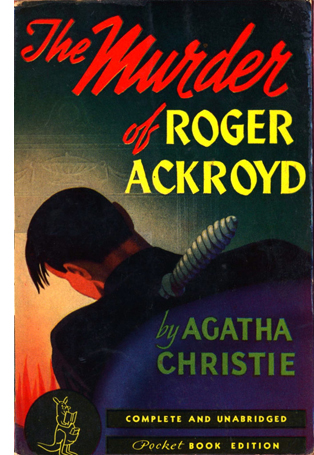 Historians of the detective story have a standard account that goes like this. The puzzle-centered plot developed to its apogee in the 1920s and 1930s, chiefly in Britain, and was picked up in the United States. In books like The Murder of Roger Ackroyd (Agatha Christie, 1926), The Canary Murder Case (S. S. Van Dine, 1927), The Unpleasantness at the Bellona Club (Dorothy L. Sayers, 1928), The Poisoned Chocolates Case (Anthony Berkeley, 1929), The Egyptian Cross Mystery (Ellery Queen, 1932), and The Crooked Hinge (John Dickson Carr, 1938), the crimes are deeply puzzling, even fantastical, and the solutions ever more recherché.
It’s hard for us to conceive today how massively popular these puzzle books were. Van Dine’s first novels were bestsellers comparable to Jonathan Kellerman’s books today. Just as important, the detective story was granted quasi-literary status. Magazines and newspapers that wouldn’t dream of reviewing romance or adventure fiction devoted space to detective stories, sometimes even setting up separate columns or sections for reviews. It was believed, rightly or wrongly, that whodunits had a more intellectual readership than Westerns or science fiction.
At about the same time, according to the standard account, a counter-current was swelling. In the pulp magazines of the 1920s, the “hard-boiled” detective emerged as an alternative to the master sleuth. The prototype is Dashiell Hammett’s Continental Op in stories through the late 1920s, to be followed by Sam Spade in The Maltese Falcon (1930). Strikingly, Hammett and other hard-boiled writers don’t wholly abandon the basic idea of solving a mystery through some sort of reasoning. The differences have to do with realism. The crimes, however, aren’t usually fantastical ones like the Locked-Room problem; the killings tend to be mundane. If the white-glove detective’s only real opponent is a master criminal like Professor Moriarty, the hard-boiled detective faces off against organized crime, or at least people who commit murder outside upper-crust parlors and remote country houses. Clues are less likely to be physical, and more psychological, depending on bits of behavior or flashes of temperament. Raymond Chandler and others took the hard-boiled initiative into the 1940s, and the brute detective, who solves crimes with boldness, insolence, and a pair of fists, occasionally supplemented by torture, found bestseller status in Mickey Spillane’s I, the Jury (1947) and subsequent novels.
I’d argue that some writers could blend the master-mind detective and the tough guy. Erle Stanley Gardner’s Perry Mason was one such hybrid, though leaning closer to the hard-boiled model. Rex Stout solved the problem neatly by creating two detectives: the insolent legman Archie Goodwin serves as a hard-boiled Watson to sedentary Nero Wolfe. But on the whole, historians tend to assume that the Holmesian superman and the puzzle-dominated plot were swept aside by the rise of the tough-guy detective solving mysteries that were grittier and more “realistic” than what had preoccupied Golden Age writers.
Two other major developments are typically highlighted by historians. There was the police procedural, perhaps initiated by Lawrence Treat’s V as in Victim (1945), and explored with great ingenuity in the novels of Ed McBain. There was also what Julian Symons has called the “crime novel,” the story of psychological suspense, with Patricia Highsmith’s Strangers on a Train (1950) serving as a good example. Both of these genres have proven popular to this day (CSI as a procedural, the films of De Palma as psychological thrillers).
A tree and its branches
Like most histories hovering fairly far above the ground, the standard account traces some main contours of the landscape but misses some interesting byways. By taking Doyle as the prototype, this account tends to identify mystery fiction with detective plots in the Holmes mold. But mysteries come up in other forms.
The standard account has trouble accommodating the development of the spy genre, which often involves solving a crime, but less through abstract reasoning than by putting the hero through hairbreadth adventures. Think for instance of The 39 Steps, both the 1915 novel and the 1935 film.
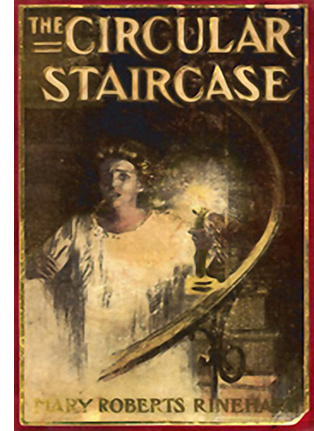 More seriously, by identifying solving mysteries with the activities of professional, overwhelmingly male, detectives historians have neglected the powerful and popular tradition of the revived Gothic or “sensation” novel of the mid-nineteenth century. This is typified by Wilkie Collins’ Woman in White (1859-1860) as much as by The Moonstone (1868), often considered the first detective novel (largely because a detective figures as one of the characters, even though he doesn’t solve the mystery). Collins’ novels, along with those of Mary E. Braddock, updated the Gothic format through more complex plotting and multiple points of view. In the next century, Mary Roberts Rinehart, with The Circular Staircase (1908), has to be considered as important as Freeman. Rinehart’s plot introduces the crucial conventions of the mysterious house, the curious and brave woman who explores it, and the threats lurking behind placid domesticity. While the classic white-glove sleuth isn’t usually in much danger, The Circular Staircase and other updated sensation novels make the investigating figure a woman in peril. The sensation novel replaces cool rationality with fear and desperation.
Jane Eyre is an obvious source for Rinehart and her successors, and perhaps the association with women’s writing in general made historians and practitioners of the Golden Age mock the revived Gothic as too feminine, too far removed from the bluff masculine camaraderie of 221 B Baker Street. The Gothicists had their revenge: Daphne Du Maurier’s Rebecca (1938) outsold every other mystery novel of its time and sustained a cycle of new sensation novels by Mabel Seeley (The Chuckling Fingers, 1941), Charlotte Armstrong (The Chocolate Cobweb, 1948), and Hilda Lawrence (The Pavilion, 1946). The genre is maintained today by Mary Higgins Clark, Nicci French, and many other writers.
So mystery and detection formed a broader tradition than literary historians sometimes acknowledge. Another marginal form was the suspense thriller. Again, we can point to a woman: Marie Belloc Lowndes, author of The Lodger (1913). An early instance of the serial-killer plot, it’s also a tour de force of point-of-view; unlike the film versions, it restricts itself quite rigorously to what certain secondary characters know. Choices about narration and viewpoint are no less crucial to the thriller than to the Great Detective tradition.
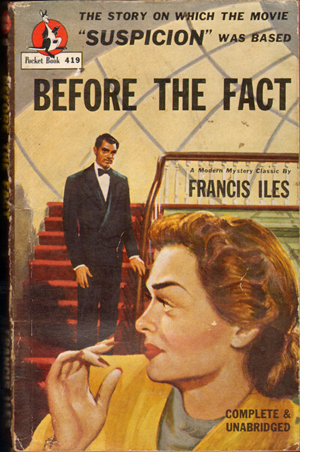 The psychological thriller was revived during the Golden Age, sometimes by practitioners of the puzzle-story. Anthony Berkeley Cox, writing as Anthony Berkeley, noted in The Second Shot (1930):
I personally am convinced that the days of the old crime puzzle pure and simple, relying entirely upon plot, and without any added attractions of character, style, or even humour, are, if not numbered, at any rate in the hands of the auditors. . . The puzzle element will no doubt remain, but it will become a puzzle of character rather than apuzzle of time, place, motive, and opportunity. The question will be not “Who killed the old man in the bathroom?” but “What on earth induced X, of all people, to kill the old man in the bathroom?”
Cox went on to test his premises in Malice Aforethought (1931) and Before the Fact (1932). Both trace the schemes of wife-killers, but the first novel is told from the husband’s standpoint and the second from the wife’s. The latter book opens:
Some women give birth to murderers, some go to bed with them, and some marry them. Lina Aysgarth had lived with her husband for nearly eight years before she realized that she was married to a murderer.
There followed other domestic-crime psychological novels, notably Richard Hull’s The Murder of My Aunt (1934).
Sometimes suspense thrillers have a solid mystery at their center; this is common when the protagonist is a potential victim. Other thriller plots in effect present the first half of a Freeman “inverted” story, concentrating on the criminal’s execution of a crime and the resulting efforts to escape punishment. Both possibilities were on display in British stage plays of the 1920s and 1930s. In a sense Cox was beaten to the punch by Rope (1929), Blackmail (1929), and Payment Deferred (1931). Later examples are Night Must Fall (1935) and the woman-in-peril dramas Kind Lady (1935) and Gaslight (1938). Many of these plays were made into films.
The novel of suspense really came into its own in the 1940s, when it started to incorporate abnormal psychology. Patrick Hamilton, author of Rope and Gaslight, provided an influential novel as well, Hangover Square (1941). Cornell Woolrich and David Goodis, who mined this nightmarish vein, achieved posthumous cult status because, again, of the spell of film noir. Other suspenseful students of mania were Dorothy B. Hughes (In a Lonely Place, 1947), Charlotte Armstrong (The Unsuspected, 1945; Mischief, 1951, filmed as Don’t Bother to Knock), and Elizabeth Sanxay Holding (The Blank Wall, 1947, source of The Reckless Moment). Chandler called Sanxay Holding “the top suspense writer of them all.” We shouldn’t ignore the influence of Simenon’s romans durs, which were being translated and respectfully reviewed throughout the war years.
Yet another new wrinkle on the mystery thriller was the genre of courtroom novels. The Bellamy Trial (1927), which begins when the trial does and restricts itself almost completely to what transpires in the courtroom, popularized the pattern. Stage plays of the 1920s adopted the pattern too. The format proved irresistible for early talkies, as in adaptations of The Bellamy Trial (1929) and Thru Different Eyes (1929) and the radio-inspired Trial of Vivienne Ware (1932). Cox, who seemed to try his hand at every current trend, gave his own twist to the juridical mystery in Trial and Error (1937).
Most of these novels focused on the trial proceedings from the perspective of the defendant, but a few concentrated on those sitting in judgment. The Jury (1935), by Gerald William Bullett, characterizes the jurors singly before they gather and then shows the trial from their standpoints before taking us into the jury room to hear the arguments. Bullett’s novel finds an equally engrossing complement in Raymond Postgate’s Verdict of Twelve (1940). There were also Eden Philpotts’ The Jury (1927) and George Goodchild and C. E. Bechhofer Roberts’ The Jury Disagree (1934). We can immediately recognize the teleplay and film Twelve Angry Men as an updating of this minor line.
Merging and markets
The family tree of mystery, then, grew many branches in the 1920s and 1930s—the pure puzzle, the hard-boiled investigation, the spy story, the revised Gothic or sensation novel, and the suspense thriller, often of a psychological cast. Unsurprisingly, the genres began to mingle. Cox was perhaps the writer most interested in hybrids, but John Dickson Carr tried his hand at the thriller as well (The Burning Court, 1937), as did Agatha Christie in And Then There Were None (aka Ten Little Indians, 1940).
The process sped up during the 1940s, when writers began blending crime-solving with psychological suspense. We can get a sense of how the protagonist-in-peril side of the thriller melded smoothly with the enigma-based investigation by looking at the jacket copy of a fairly ordinary entry, Alarum and Excursion (1944):
Bit by bit, a gesture here, a sound there, Nick Matheny pieced together the awesome puzzle of the accident that had sent him to a sanitarium with traumatic amnesia. One by one he reconstructs, he probes the cirumstances of the explosion in his factory, the disappearance of his weak but beloved son, his wife’s strange attitude toward the new management of the business, and the status of the new synthetic fuel formula, which was so urgently needed.
As the dreadful picture unfolds itself, Nick escapes from the sanitarium to ferret out the sinister changes that have disrupted his business and brought his active life to an abrupt close.
Virginia Perdue, author of He Fell Down Dead, skillfully handles the difficult flash backs in this unusual psychological drama. There are many scenes where the tricks of thought, the tenseness of apprehension, the visions through the deserted streets of blacked-out memory poignantly work their stealth upon the mind of the reader.
Alarum and Excursion wasn’t adapted into a film, but reading this spoiler-filled jacket copy you can easily imagine the movie.
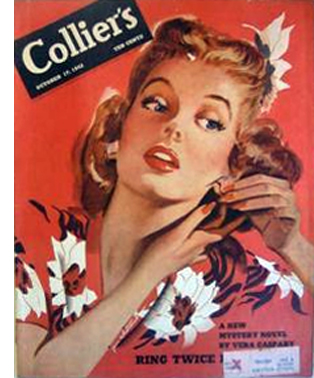 One more factor needs to be mentioned: the publication venues. Everybody knows that the hard-boiled tradition has its roots in Black Mask and other pulp magazines of the 1920s. What’s less often emphasized is the “slick-paper” market of the 1930s and 1940s. The Saturday Evening Post, Ladies’ Home Journal, Good Housekeeping, Cosmopolitan (rather different from what it is now), The American Magazine, and many other weekly magazines ran a great deal of fiction, both short stories and serialized novels. The high-paying slick market showcased soft-boiled mysteries involving Perry Mason and Nero Wolfe and welcomed suspense fiction too. Major suspense authors of the 1940s, such as Charlotte Armstrong and Vera Caspary, would garner tens of thousands of dollars in serialization rights. On the right is the cover of Collier’s for 17 October 1942, announcing the first installment of Ring Twice for Laura, later known simply as Laura.
As mystery genres proliferated, their popularity soared. Contrary to what historians imply, the puzzle novel with a brilliant sleuth was far from defunct. Christie’s Poirot and Sayers’ Wimsey retained their fame into the 1940s, significantly outselling Hammett and Chandler. Ellery Queen’s novels are not read much today, so it’s hard to imagine a time when over a million copies of them were in print. More generally, the public’s appetite for mystery novels and radio plays was intense. In 1940, 40 % of all titles published were mysteries, and in 1945, an average four radio shows devoted to mystery were broadcast every day, each drawing about ten million listeners.
Small wonder, then, that Hollywood came calling. Curiously, the master detectives popular with the reading public wound up in B-film series (Charlie Chan, Ellery Queen) or remained unexploited in the 40s (Nero Wolfe, Perry Mason). What came to the fore, as being more suitable for the dynamic medium of film, were the hard-boiled heroes of Hammett and Chandler. Because the rise of hard-boiled adaptations fed clearly into film noir, they have attracted the most attention. But mutating alongside them, and becoming at least as lucrative, were the films shaped by the updated Gothic and the psychological thriller. Variety noticed the trend in fall of 1944.
Plain murder as a film frightener is passé. Been done too long in the same old way. Theatregoers actually can yawn in the face of manslaughter as it’s been perpetrated for the whodunits during the past year or more. . . . The newer type of horror pictures, invested with psychological implications, deal with mental states rather than melodramatic events. . . . The typical tale in the new genre crawls with living horror, is eerie with something impending, and socks its suspense thrill well along toward the middle of the story instead of doing the crime victim in at the beginning and then building a whodunit and a detective quiz as the element of suspense.
The piece doesn’t respect today’s genre distinctions. Apart from using the term “horror” in a way we wouldn’t, the author lumps together suspense thrillers like The Lodger, Hangover Square, The Uninvited, and The Suspect; the Gothic Gaslight (“a perfect example of the new approach”); and spy thrillers The Mask of Dimitrios and The Ministry of Fear. Even Jane Eyre is included, without irony. (Surprisingly, Double Indemnity from spring 1944 isn’t mentioned.) Still, the article acknowledges that mystery had strong audience appeal and that while the classic whodunit had had its day on the movie screen, films could be given new energy by other literary trends.
Mystery as artifice
Mystery is the only genre I know that makes narrative strategies as such central to its identity. A musical, a Western, or a science-fiction saga can be presented in linear fashion, telling us everything step by step, and still retain a genre identity. But a mystery plot can’t be presented straightforwardly. The writer must manipulate plot structure and narration to some degree.
A mysterious situation or plot action is one whose causes are to some degree unknown. In the detective formula, both refined and hard-boiled: A person has been murdered; what led up to it? In the Gothic: There are sinister goings-on in the house; what’s causing them? In the suspense thriller: Someone wants to harm me; who and why? (And will I escape?) To generate mysteries, the plot-maker must suppress key information. That can be done by opening late in the story (say, after the crime has been committed), by employing flashbacks (often launched from a climactic moment), or by restricting the range of knowledge (via a Watson or a string of eyewitnesses). More subtle options involve ellipses, such as those in The Murder of Roger Ackroyd and the diary portion of The Beast Must Die (1938).
At the level of prose style, clues can be buried in descriptions or offhand remarks. The narration can creatively mislead us from the start, in the title (The Murder of My Aunt, The Murderer Is a Fox) or the diabolical opening sentence of Carr’s “The House in Goblin Wood.” And sometimes you get pure showing off. The first chapter of The Rynox Murder Mystery (1931) is entitled “Epilogue,” and the last chapter is entitled “The Prologue.” In addition, the book is broken not into parts and chapters but “reels” and “sequences,” a device creating a small meta-mystery (gratuitously, so far as I can tell.)
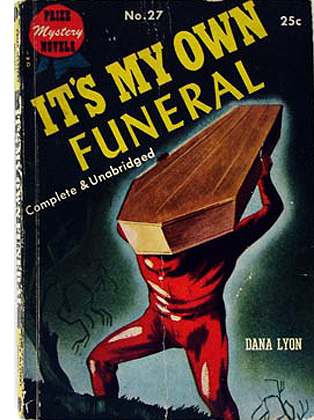 Given the proliferation and mixing of genres and the constant demand for innovation (echoed in Variety’s crack about things “being done too long in the same old way”), 1940s mystery writers were pressed to find new storytelling gimmicks. Everything had not been done, at least not yet. Historians of the detective story routinely praise the ingenuity of Christie and company in the 1930s, but the 1940s saw a positively baroque expansion of options. A dead detective pursues the investigation as a ghost. Another wakes up trapped in a coffin and starts telling us how he got there. Pat McGerr distinguished her work by replacing the question Whodunit? with others, such as: We know who’s guilty, but who’s been murdered?
In the suspense mode as well, we find efforts to create novelty at the level of narration. With the emerging interest in psychoanalysis, the thriller began to probe the protagonist’s inner life and hidden traumas, producing not only the hallucinatory visions of Woolrich and Goodis but the crazy-lady divagations seen in The Snake Pit (1947), Devil Take the Blue-Tail Fly (1948), and Patricia Highsmith’s early short story, “The Heroine” (1945). As in the purer tale of detection, a great deal depended on feints and fake-outs at the level of the prose. The cleverly misleading narration of Ira Levin’s A Kiss Before Dying (1953) turns on the use of a pronoun.
Hollywood filmmakers borrowed plentifully from the new genres, particularly the psychological thrillers that could appeal to women. Significantly, Rinehart’s pioneering 1908 novel was remade as The Spiral Staircase (1945), and Warner Brothers redid Collins’ classic Woman in White in 1948. Moreover, I think, filmmakers tried to find cinematic counterparts for the genre’s restricted narration, dream and fantasy passages, misleading exposition, and shrewd ellipses (e.g., Possessed, 1947; Mildred Pierce, 1945; Fallen Angel, 1945). The diversity of mystery fiction inspired Hollywood writers and directors to create a Golden Age of the mystery film, and the innovations of the period left a legacy for filmmakers ever since.
These genres had a wider impact too. That’s what I’ll concentrate on in my presentation, “I Love a Mystery: Narrative Innovation in 1940s Hollywood.”
The two major histories of mystery fiction are Howard Haycraft, Murder for Pleasure: The Life and Times of the Detective Story (1941) and Julian Symons, Mortal Consequences: A History from the Detective Story to the Crime Novel (1972). Both are very much worth reading, as is Leroy Lad Panek’s idiosyncratic An Introduction to the Detective Story. The best study of the 1920s-1930s puzzle tradition is Panek’s Watteau’s Shepherds: The Detective Novel in Britain 1914-1940. On A. B. Cox, see Malcolm J. Turnbull, Elusion Aforethought: The Life and Writing of Anthony Berkeley Cox.
The Variety article I quote bears the misleading title, “New Trend in Horror Pix; Laugh with the Horror.” It’s in the issue of 16 October 1944, p. 143.
Unlike The Rynox Murder Mystery, Cameron McCabe’s Face on the Cutting-Room Floor (1937) blends moviemaking and murder in a thoroughgoing, albeit wacko, fashion.
Other entries on this blog have dealt with some of my mystery favorites, especially Ellery Queen and Rex Stout.
P. S. 11 June: Mystery expert Mike Grost has kindly reminded me of his encyclopedic site, A Guide to Classic Mystery and Detection. By discussing authors both famous and forgotten, he displays the great diversity of this mega-genre.

In cognito (we trust)
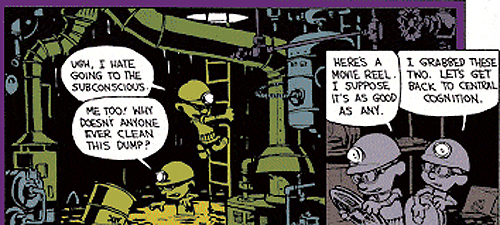
From Calvin & Hobbes, 10 April 1994.
DB here:
Every year at about this time, I trumpet the upcoming convening of the Society for Cognitive Studies of the Moving Image. This year’s powwow is held at picturesque Sarah Lawrence College, under the auspices of Professor Malcolm Turvey, no stranger to this blog. The final day of it will take place at NYU’s Cinema Studies Department. I had to miss last year’s conference for health reasons, but I’ll be there this year with a paper on 1940s Hollywood narrative.
Some earlier blog entries sketch out my take on what’s interesting about the group’s work. You can find treatment of the 2008 Madison gathering here and here; the 2009 Copenhagen event here and here with an epilogue about Lars von Trier and Asta Nielsen; and afterthoughts on the 2010 Roanoke meeting here. Last year, because I couldn’t go, I offered a web essay, here. This discusses my current thinking about the cognitive research framework.
This year, although I’m going, I’m again offering a new web essay. It’s about how models of mind (Gestalt, psychoanalytic, cognitive, etc.) have shown up in film theory and criticism. The piece is organized chronologically, and it tries to tie ideas about the psychology of cinema to a history of filmmaking: the theories I discuss emerge as responses to changes in form, style, and theme. The essay will eventually be reprinted in Art Shimamura’s anthology, Psychocinematics: Exploring Cognition at the Movies, forthcoming from Oxford University Press. Art’s collection gathers many cutting-edge essays from SCSMI members.
A sideways note: I learned recently that my old book, Narration in the Fiction Film (1985), sold 470-some copies last year. That’s a lot for an old academic study, especially one with many used copies in circulation. I infer from this (good cognitivists make inferences) that some instructors are using it in courses. I’m grateful, naturally, but I want to signal that I’ve altered some of the views I expressed in that book. If a professor is using my book to exemplify the cognitive perspective on narrative, I’d urge him or her to consider as well the web essay I already mentioned, “Common Sense + Film Theory = Common-Sense Film Theory?” In addition, my most recent answers to questions about filmic storytelling, in which narration is treated as one aspect of a larger process, can be found in “Three Dimensions of Film Narrative,” in the collection Poetics of Cinema. In other words: I hope I’ve learned something since 1985.
The week following the SCSMI gathering, UCLA is hosting Visual Narrative: An Interdisciplinary Workshop on 20-22 June. This very promising event hosts presentations and commentaries from linguists, philosophers, and a couple of SCSMI star psychologists. Dan Levin has already made appearances in this blog (notably here), and Tim Smith, Continuity Boy, has contributed our perennially popular guest entry, “Watching You Watch THERE WILL BE BLOOD.” The distinguished philosopher of art George Wilson, author of Narration in Light, will also be there. Thanks to Rory Kelly, one of the Workshop’s organizers, for tipping me off.
After SCSMI (from which, or about which, I hope to blog), we’re off to Bologna, so expect more of our usual reportage from Cinema Ritrovato, that frenzy of movies and movie lovers. Coming up next, though, there’s Bette Davis to reckon with.
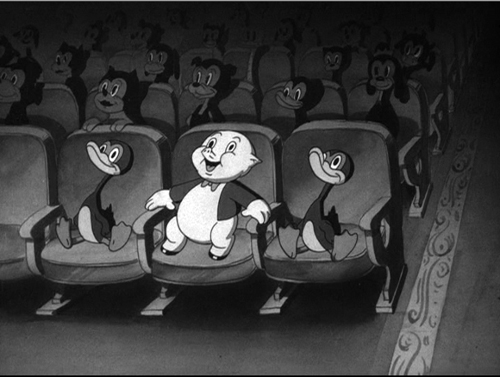
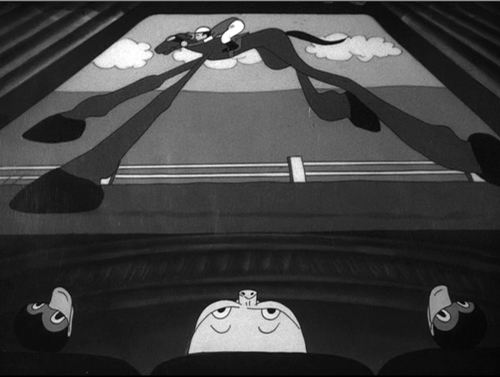
Cognition is important, but so is perception, as every front-row sitter knows. From The Film Fan (1939, Warner Bros., Bob Clampett).
FILM ART: AN INTRODUCTION reaches a milestone, with help from the Criterion Collection
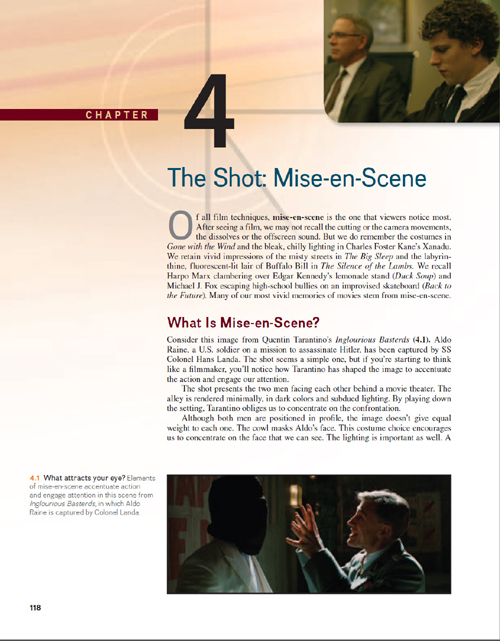
[UPDATE, March 8, 2016: Film Art has now appeared in its eleventh edition, which, among other things, includes additional online Connect Film examples based on the partnership with the Criterion Collection mentioned below. For more information, see here.]
Somehow round numbers seem significant. This summer, Film Art: An Introduction is due to be published in its tenth edition.
We first set out to write the book in 1977, and it appeared in 1979. We’ve been gratified that it has retained an audience of teachers, students, and general readers over the ensuing decades. During that period, we’ve revised it to keep up with changes in filmmaking, in film studies, and in our own sense of what makes cinema a distinct artistic medium. At the outset we wanted to represent many eras of film history, a wide range of international films, and such important categories as documentary, experimental, and animated films. Our revisions over the years have tried to keep these goals in mind. At the same time, we realize that one way to engage students with ideas about film is to pay some attention to films they know, to enable them to look and listen to familiar movies in new ways.
We think we’ve stayed loyal to these purposes across nine editions. But with the fateful number ten we think we’ve stepped up to a new level. We’ve made many changes to the book that we find exciting; more about these below. The most dramatic development, however, comes through our new online partnership with The Criterion Collection.
Most teachers are familiar with Criterion and its high-end series of DVD and Blu-ray releases of classic and important contemporary films. In 1984, Criterion pioneered the genre of supplements, working at the time with laserdiscs. The team are 100% cinephiles, and they continue to set the standard for a rich array of bonus materials, all the making-of films, interviews, and documents that are of such interest to fans, scholars, students, and aspiring filmmakers. Now, with Criterion’s kind cooperation, we have produced a series of online examples tied to Film Art that will use scenes from several of their classics.
Film Art was the first introductory film textbook to use frame enlargements rather than publicity photographs as illustrations. Other textbooks have since imitated this approach, since it’s a vital tool when teaching students to analyze films. Nevertheless, even whole pages full of frames can’t fully convey the effects of techniques such as camera movement, graphic matches, staging in depth, and sound. The next logical step would be to use examples with scenes from movies, adding graphics and voiceover commentaries to clarify the points being made.
Problems of clearing rights and questions concerning the limits of fair use have made it difficult for textbook authors to supply adequate, high-quality moving-image examples on DVDs or online. The Criterion Collection has allowed us to make this big next step. We’re extremely proud of this new partnership, and we’re grateful to Peter Becker, Kim Hendrikson, Tyson Kubota, Giles Sherwood, and the rest of the Criterion Collection team for their generosity and help. Peter has written a blog about the new arrangement.
Online examples using clips from Criterion Collection films
The result is an hour-long set of twenty examples called Connect Film. Seventeen of these center around excerpts from film classics from the 1930s to the 1980s. David and I wrote the scripts and recorded the commentary tracks. The production, direction, editing, and special graphics were done professionally by Erik Gunneson, a filmmaker and Faculty Associate here at the University of Wisconsin-Madison.The Criterion scenes are presented as moving images rather than still frames; it’s as if the sort of examples we use in Film Art have sprung to life. Erik has also produced three original demonstration videos laying out basics of lighting, camera lens length and movement, and continuity editing.
So why not check out one of our examples? Criterion has posted “”Elliptical Editing in Vagabond (1985),” in its entirety, on its YouTube page. Go here or watch it at the bottom of this post.
Chapter 4 Mise-en-scene
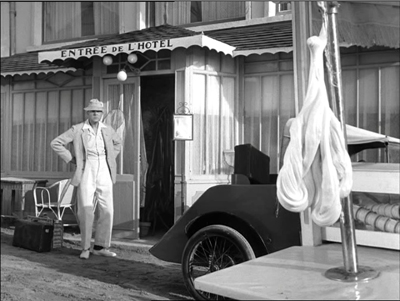
Film Lighting Demonstration This video clearly contrasts the results of side-, back-, and other types of light, as well as the principles of the three-point lighting system.
Light sources in Ashes and Diamonds (1958) The three sources of the light in the opening of the famous church scene are described and also indicated by colored arrows.
Available Lighting in Breathless (1960) This example starts with an extract from an interview with cinematographer Raoul Coutard, produced by the Criterion Collection. Coutard describes shooting without supplemental light in the lengthy bedroom scene, followed by an illustrative clip.
Staging in Depth in M. Hulot’s Holiday (1953; above) A scene of M. Hulot nervously watching a descending lump of saltwater taffy. The clip is run, then repeated with commentary discussing the comic possibilities of deep-space staging.
Color Motifs in The Spirit of the Beehive (1973) Yellow is associated with the bees in this film, but also with the malaise of Spain in the wake of its Civil War. The scene in which the color comes to be associated with the bees is shown, with still frames and commentary discussing other shots where yellow is prominent.
Chapter 5 Cinematography
Lens Length and Camera Movement Demonstration video contrasting the effects of long, medium, and short lenses. Erik also illustrates different types of camera movement.
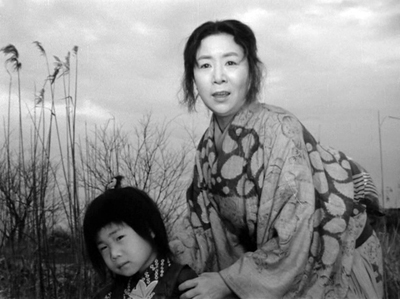
Tracking Shots Structure a Scene in Ugetsu (1953; above) A wife and son bid farewell to a departing boat. Using a split-screen technique, we lay out the shots and show how camera movements are used to add to the ominous, poignant effect of the scene.
Tracking Shot to Reveal in The 400 Blows (1959) While the tracking shots in the Ugetsu example follow the characters’ movements, a scene from The 400 Blows shows how the camera can create other effects by moving on its own.
Style Creates Parallelism in Day of Wrath (1943) Similar camera movements prompt us to compare two scenes.
Staging and Camera Movement in a Long Take from The Rules of the Game (1939) In a scene that is rarely examined in this much-analyzed film, we trace out how a busy scene in a hallway, as guests head for their bedrooms, lays out the setting and highlights minor characters.
Chapter 6 Editing
Editing with Graphic Matches in Seven Samurai (1954) We use this example in discussing graphic matches in Film Art, but it’s hard to get a sense of the patterning from stills, So this clip shows the scene in its context and then replays the series of matches, freezing and laying them out across the screen.
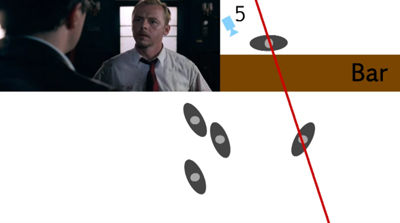
Shifting the Axis of Action in Shaun of the Dead (2004; above) Erik uses stills and overhead diagrams to show how the axis of action can be shifted when characters turn their heads and when new characters join the conversation.
Crossing the Axis of Action in Early Summer (1951) A friendly argument between Noriko and two of her friends employs cuts that consistently move back and forth across the axis of action. An overhead diagram marks the camera positions shot by shot.
Crosscutting in M (1930) Through a first run-through and then a replay with freeze-frames, we study how editing compares gangsters meeting and police meeting.
Elliptical Editing in Vagabond (1985) The enigmatic heroine lives her nomadic life, moving from place to place and meeting a variety of people, rich and poor. In a scene depicting her hitchhiking from near a convent to arrive in a barn, we show how the editing propels our interest but leaves out items of narrative information that increases the mystery of her character.
Jump Cuts in Breathless (1960) Some of the most familiar jump cuts from Breathless are illustrated in Film Art. This example uses a later scene in a cab which uses an unusually large number of such cuts. How many? Let’s count and see.
Chapter 7 Sound
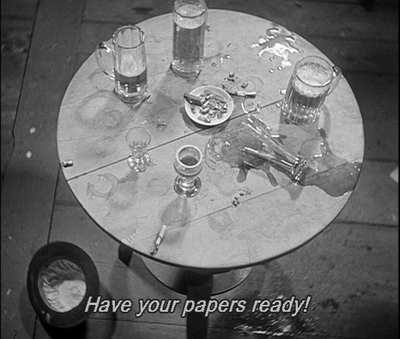
Sound Mixing in Seven Samurai (1954) Our text describes the rich sound mix of the final battle of Seven Samurai, with rain, horses’ hoof-beats, men’s shouts, and other sound effects–all without music. Description, though, goes only so far. Now we can let readers listen for themselves.
Contrasting Rhythms of Sound and Image in M. Hulot’s Holiday (1953) Jacques Tati manages to create a double joke when musical tempo clashes with figure movement.
Offscreen Sound in M (1931; above) Even at the dawn of sound, Fritz Lang found inventive ways to avoid static dialogue scenes. Police raid a basement tavern, and even when there’s little movement onscreen we hear bustling activity outside the frame. Some shots, like this one, recall camera angles from earlier scenes.
Chapter 10 Animation
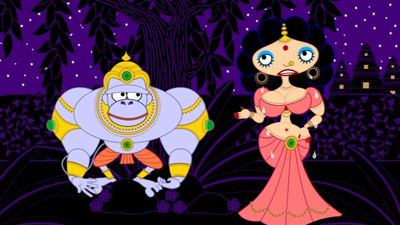
What Comes Out Must Go in: 2D Computer Animation Most of us are curious about computer animation, not least because it offers tools that amateurs and would-be filmmakers can learn to use. We show how independent filmmakers can get high-quality results in My Dog Tulip (Paul and Sandra Fierlinger, 2010) and Sita Sings the Blues (Nina Paley, 2008; above).
Instructors can stream any of these items in their classes, or students can watch them on their own.
Decisions, decisions
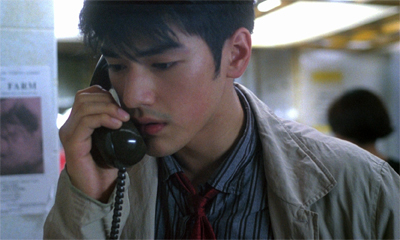
Chungking Express: To hear the voice on the line, or not?
Central as the Criterion extracts are, we’ve made other changes. We’ve done a top-to-bottom rewrite of the text, trying to make it more conversational, more like our blogging. We’ve updated our account of digital filmmaking and we’ve incorporated new information on digital distribution and exhibition–the sort of matters you can find in more detail in David’s Pandora series (which started here).
We’ve tried to make film art tangible for students by asking them to imagine alternative approaches to storytelling and technique. In keeping with this angle of approach, we’ve highlighted decision-making processes: the concrete choices faced by directors, cinematographers, editors, and other creative workers. One of the salient features of Film Art since the beginning has been its effort to blend the point of view of the critic or analyst with the point of view of the filmmaker. Here’s a passage from the first chapter.
Films are designed to create experiences for viewers. To gain an understanding of film as an art, we should ask why a film is designed the way it is. When a scene frightens or excites us, when an ending makes us laugh or cry, we can ask how the filmmakers have achieved those effects.
It helps to imagine that we’re filmmakers too. Throughout this book, we’ll be asking you to put yourself in the filmmaker’s shoes. This shouldn’t be a great stretch. You’ve taken still photos with a camera or a mobile phone. Very likely you’ve made some videos, perhaps just to record a moment in your life—a party, a wedding, your cat creeping into a paper bag. And central to filmmaking is the act of choice. You may not have realized it at the moment, but every time you framed a shot, shifted your position, told people not to blink, or tried to keep up with a dog chasing a Frisbee, you were making choices.
If you take the next step and make a more ambitious, more controlled film, you’re doing the same thing. You might compile clips into a YouTube video, or document your friend’s musical performance. Again, at every stage you make design decisions, based on how you think this image or that sound will affect your viewers’ experience. What if you start your music video with a black screen that gradually brightens as the music fades in? That will have a different effect than starting it with a sudden cut to a bright screen and a blast of music.
At each instant, the filmmaker can’t avoid making creative decisions about how viewers will respond. Every moviemaker is also a movie viewer, and the choices are considered from the standpoint of the end user. Filmmakers constantly ask themselves: If I do this, as opposed to that, how will viewers react?
Even if the reader never makes a movie, we think that getting comfortable with this framework can sensitize us to the power of cinema as an art form.
Of course, we also want to understand the finished film. We need to look at how the choices coalesce into patterns of meaning and effect. This is the holistic bent that the book has always had: we try to understand the choices in the context of the whole film and its purposes. To a large extent film form and film style are the terms we as analysts apply to the patterns of choices that shape our experience.
That emphasis on pattern is something that carries through all of our Film Art editions. It’s valuable to notice techniques or story twists in isolation, but we gain as well from seeing them as parts of larger patterns of organization. Such patterns and processes are highlighted in the case-study analyses in each chapter, as well as in the collection of analyses in Chapter 11. Likewise, Chapter 12 tries to trace some major strategies of form and style across history. The variety of films we consider allows us to spotlight some traditions that are less widely known than the Hollywood one–from France, Italy, Germany, Japan, Hong Kong, and other territories. Cinema is a global art, and we try to recognize that.
Over forty years we’ve learned a great deal about cinema from films and the people who make them. For this reason it’s been stirring to meet many filmmakers from North America, Europe, Asia, and the Middle East who tell us that they have learned something from Film Art. We offer the new edition in that spirit of common learning: to better understand a medium that we all love.