




Archive for the 'Hollywood: The business' Category
Annies to Oscars: this year’s animated features
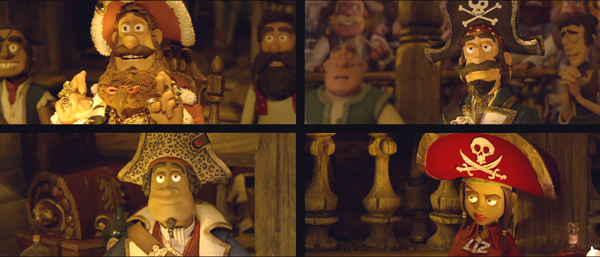
Awards scene in The Pirates! Band of Misfits.
Kristin here:
On February 1, the Annie Awards were given out. These are the honors bestowed by the International Animated Film Society. Up for best animated feature were the five Oscar nominees in the same category–Brave, Frankenweenie, ParaNorman, The Pirates! Band of Misfits, and Wreck-It Ralph–plus three others–Hotel Transylvania, Rise of the Guardians, and The Rabbi’s Cat. Rather to my surprise, Wreck-It Ralph took the top honor.
This seems like a good occasion to follow up on some of my entries on animation posted here years ago and to present some comments on the five Oscar nominees.
Mainstream fare
Remember when entertainment journalists were suggesting that there were getting to be too many big-studio animated features in the market each year? Remember when supposedly there just wasn’t that much demand and that cartoons were starting to eat into each other’s box-office takings? No? I do, partly because back on January 23, 2007, I blogged on the subject. I said at the time, “The ‘too many toons’ issue looks to me like a tempest in a teapot.”
For one thing, animated features were actually doing very well at the box-office:
In 2006, the ten highest domestic box-office grossers included four CGI hits: Cars, #2, Ice Age: The Meltdown, #7, Happy Feet, #8, and Over the Hedge, #10. On the worldwide chart, these four films rank high as well: Ice Age: The Meltdown, #3, Cars, #5, Happy Feet, #10, and Over the Hedge, #11. In the domestic market, 6 other toons make the top 100. So, 4 out of 10 toons are in the top ten, while 6 out of 90 live-action films make that short-list. I’m no math whiz, but that looks like 40% versus 6.6% to me.
Since 2006, animated features have increased in number, as witnessed by the fact that the Academy of Motion Picture Arts and Sciences upped the number of nominees in that Oscar category from three to five for the 2010 awards. Actually, the rules are more complicated than that:
All submissions sent to the Academy will be screened by the Animated Feature Film Award Screening Committee(s). After the screenings, the committee(s) will vote by secret ballot to nominate from 2 to 5 motion pictures for this award. In any year in which 8 to 12 animated features are released in Los Angeles County, either 2 or 3 motion pictures may be nominated. In any year in which 13 to 15 films are released, a maximum of 4 motion pictures may be nominated. In any year in which 16 or more animated features are released, a maximum of 5 motion pictures may be nominated.
The 2010 and 2012 Oscars each had five nominees in the category, while for 2011 there were again only three. This year there are again five, and it seems likely that this will continue to be the case.
In 2012all but one Hollywood studio had at least one animated feature among its five top-grossing films. So much for such films crowding each other out of the market. Totals below are worldwide and include the grosses only to December 31:
Sony: Hotel Transylvania, #4 ($313.2 million, still in release; $324.3 million as of Feb. 3)
Warner Bros.: none
Fox: Ice Age: Continental Drift, #1 ($897.3 million)
Disney: Brave, #2 ($538.3 Million)
Disney: Wreck-It Ralph, #3 ($283.6 million, still in release; $376.6 million as of Feb. 3)
Universal: Dr. Seuss’ The Lorax, #3 ($349.6 million)
Paramount: Madagascar 3: Europe’s Most Wanted, #1 ($743.3 million)
Paramount: Rise of the Guardians, #3 ($261.2 million, still in release; $297.8 million as of February 3)
The first six of these films were in the 20 top-grossing American films of 2012; Rise of the Guardians was #30.
(These figures are from “Studio figures hit sky high” by Ian Sandwell, in the January 25, 2013 issue of Screen International. Unfortunately the charts of studio hits aren’t in the online version of the article.)
People no longer suggest that there are too many animated films. In fact, they’re a predictable mainstay of the studios, partly because they have proven themselves capable of generating lucrative franchises, just like those big action-packed CGI fantasy and sci-fi films. People are now suggesting that maybe there are too many of those in the market, cannibalizing each other’s grosses.
The Return of Handmade Animation
In recent years, some members of the industry, the punditry, and the general audience have complained that small, independent films and even foreign fare have elbowed their way into the live-action categories. The best-picture category was reportedly increased from five titles to up to ten slots specifically to make sure that some blockbusters would make the list and draw in a larger audience for the televised Oscar ceremony. Still, The Hurt Locker beating Avatar has been pointed to innumerable times in order to claim that the Academy voters are out of touch with the broad popular audience’s tastes.
Wait a minute. The box-office charts are themselves in touch with the broad audience’s tastes as expressed by tickets sold. The Oscars are supposed to be about honoring the year’s best films, not the biggest earners, aren’t they? This year’s best-picture nominees again reflect the Academy’s willingness to cast a somewhat wide net, with a very low-budget film (Beasts of the Southern Wild) and a foreign one (Amour) sitting cheek-by-jowl with hits like Django Unchained and Les Misérables. Despite the expansion in the number of nominees, the really big hits that also garnered critical acclaim, notably The Dark Knight Rises and Skyfall, didn’t make the list.
The same phenomenon has crept into the animated-feature list. Only two of the nominees come from those six that were in the top-twenty box-office hits: Brave and Wreck-It Ralph. The other three were all box-office disappointments to some extent: Frankenweenie, ParaNorman, and The Pirates! Band of Misfits. (Or, to call it by its funnier British release title: The Pirates! In an Adventure with Scientists!)
These three were all created via stop-motion animation. In contrast, all the hits in the list above were CGI, as was the mid-level grosser, Rise of the Guardians.
This is not to say that the three stop-motion film completely avoided computer effects. As Iain Blair pointed out recently in Variety, they made use of new technologies. ParaNorman worked innovatively with 3D laser printing to create huge numbers of slightly different faces for the puppets. (More on that below)
The Pirates! mainly used puppets, but there digital effects done in-house, creating water, fire, smoke, fog, and so on, including the whale. Basically, Aardman’s using special effects in a puppet film the way live-action films use them. (A 3D printer was used to create different mouths to achieve variety of expression, a technique somewhat comparable to that used for ParaNorman.)
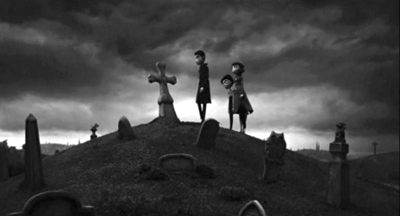
While Frankenweenie used puppets and miniature sets, it also included digital technology, like scenes done against greenscreens with clouds and background vistas added as effects:
So why were the three films made mostly by hand all less successful than the year’s big CGI toons? I would have thought that most people can’t tell the difference, and those who can don’t care. The characters in most CGI animation are basically imitations of puppets, and good stop-motion animation can look nearly as smooth as the digital equivalent. I doubt that audiences are consciously avoiding puppet-based films.
On the basis of these three films, one might almost believe that stop-motion films are become the art-house fare of the animated sector of the industry. I don’t think that’s the case, though. It’s probably just an odd coincidence likely to be limited to 2012. If anything, I suspect that the dominance of the list of nominees by stop-motion films reflects the Academy’s animation wing’s appreciation of the work and skill that goes into such painstaking work. They clearly took note of films that used this technique, including The Pirates!, which was released way back in April. Which is not to say that CGI-based animation involves less work or skill. It just isn’t quite so vivid and obvious.
The Pirates! was unquestionably a failure in the USA. This harks back to my entry kvetching that Flushed Away was sunk by DreamWorks, for lack of trying to turn Aardman into a recognizable brand like Pixar. Now Sony has done the same with The Pirates! In 2011, Sony also released Arthur Christmas to poor business; it’s a hilarious and charming film, well worth a watch. I suspect The Pirates! has little chance for an Oscar, especially without the magical Nick Park name. (Park has won five Oscars on six nominations. He couldn’t win six, since Creature Comforts and A Grand Day Out were nominated opposite each other!) But suppose The Pirates! did win. It would join Wallace & Gromit in The Curse of the Were-Rabbit, that other DreamWorks “flop” that won Best Animated Feature. It made 71% of its worldwide gross outside North America.
Moving on to the other two stop-motion films: One thing that struck me last year after watching previews for ParaNorman, Frankenweenie, and Hotel Transylvania was that there were a surprising number of kids’ films based on horror-film premises. Some kids can take comic-scary stuff, some can’t. The ParaNorman DVD has garnered 246 five- and four-star reviews on its amazon.com page, but also 76 one- and two-star comments, mainly complaining that the film is too scary for young children. Frankenweenie probably aroused similar reactions. No doubt many parents anticipated this problem and didn’t take their kids to see these films. (I haven’t seen Hotel Transylvania, which has done better at the box-office, but it doesn’t seem to have the kind of morbid fascination with dead people and animals that the other two do.)
This year’s nominees
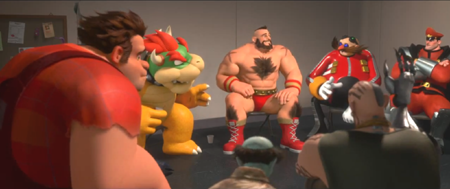
Wreck-It Ralph
I’ve seen all five of the features nominated for the animation Oscar this year. I try and see the big animated films of each year. I’ve been doing that for years now, and in late 2006 I posted an entry about why that is:
Among the new films I’ve seen in the past couple of years, I find that a significant proportion are animated. I don’t think that’s because I prefer animated films but because these days they are among the best work being created by the mainstream industry.
Why would that be? There are probably a lot of reasons, but let me offer a few.
Animated films, whether executed with CGI or drawings, demand meticulous planning in a way that live-action films don’t. David has written here about directors’ heavy dependence on coverage in contemporary shooting. Coverage means that many filmmakers don’t really know until they get into the editing room how many shots a scene will contain, which angles will be used, when the cuts will come, and other fairly crucial components of the final style. This is true even despite the fact that filmmakers increasingly have storyboarded their films (mainly for big action scenes) or created animatics using relatively simple computer animation.
People planning animated films don’t have the luxury of lots of coverage, and that’s probably a good thing. Storyboards for animated films mean a lot more, because it’s a big deal to depart from them. Every shot and cut has to be thought out in advance, because whole teams of people have to create images that fit together—and they don’t create coverage. There aren’t many directors in Hollywood who think their scenes out that carefully. Steven Spielberg, yes, and maybe a few others.
A similar thing happens with the soundtrack. In animated films, the voices are recorded before the creation of the images. That’s been true since sound was innovated in the late 1920s. Pre-recording means that images of moving lips can be matched to the dialogue far more precisely than if actors watched finished images and tried to speak at exactly the right time to mesh with their characters’ mouths. The lengthy fiddling possible with ADR isn’t an option. Most stars are used to recording their entire performances within a few days, picking up their fees, and moving on to more time-consuming live-action shooting.
I think the same remains true, though I would now credit David Fincher with planning his films down to each shot and cut. Still, even the increased use of pre-viz doesn’t seem to keep directors from shooting scenes from multiple angles and in many takes, encouraging a looseness in the editing.
Interestingly, Peter Ramsey, director of Rise of the Guardians, got his start as a storyboard artist for directors that included both Spielberg and Fincher. Ramsey was quoted in a recent Hollywood Reporter story on Rise of the Guardians, discussing that phase of his career: “You start learning to tell stories economically with the camera, connecting ideas on screen with the camera, blocking things so that they are simple but still dynamic.” I think that sort of planning still accounts for the excellence of such a high proportion of animated films.
That’s also why some of this year’s nominated animated films were among the best I saw last year. If David and I were in the habit of making up ten-best lists for current years, The Pirates! and Wreck-It Ralph would undoubtedly be on mine, right alongside films like Holy Motors and Leviathan. But we don’t, so I’ll just offer a few comments, starting with the film I would most like to see win the Oscar and ending with the one that least deserves it.
The Pirates! should win. It has the technical virtuosity that all Aardman features share. It also has a breakneck pace of clever and witty action and jokes.
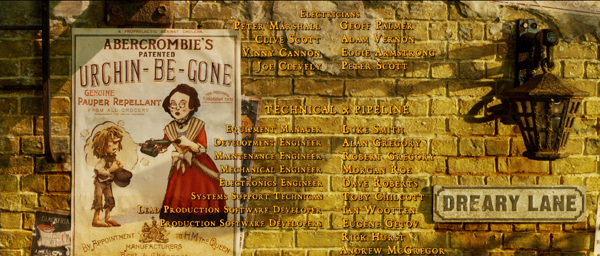
The main plot premise has four pirates vying for the Pirate of the Year award, and the ceremony itself is handled as a parody of Oscar-style shows, down to the split-screen views of nominees in the audience (see top). Aardman films are known for putting jokey items in the sets, to be noticed or not. This time there are so many posters, objects, street and shop signs, and other throwaway gags that the filmmakers felt obliged to reprise them during the final credits!
One thing I noticed in watching the DVD, however, is that a lot of these small posters and maps and so on are not big enough to be read, at least on an ordinary-sized video monitor. Academy voters who didn’t see the film in theaters but watch it on screeners are likely to miss a lot of what makes The Pirates! so funny. Below is one frame of some of the larger items, from the Blu-ray version:
For me, a hair’s breadth behind The Pirates! comes Wreck-It Ralph. Besides winning the Annie for best feature, Wreck-It Ralph also won for in the feature categories for best direction, animated effects in an animated film, voice acting (Alan Tudyk as King Candy), and writing. Wreck-It Ralph has the same rapid-fire humor and inventiveness that characterizes The Pirates! without seeming derivative of Aardman’s approach. The notion of an old-style video-game villain trying to become a hero is original, with Ralph attending AA-style 12-step sessions with other villains (see top of this section). Pulling several characters from different games into the same plotline works well, too. Not being a gamer, I’m sure I missed a great many allusions to real games, but apparently a supplement on the Blu-ray disc will provide that information.
And another hair’s breadth behind Wreck-It Ralph comes ParaNorman, which won Annies in the feature categories for character animation and character design. The filmmakers innovated new 3D laser-printing technology that allowed them to make thousands of separate replacement faces so that the characters’ expressions could be changed frame by frame.
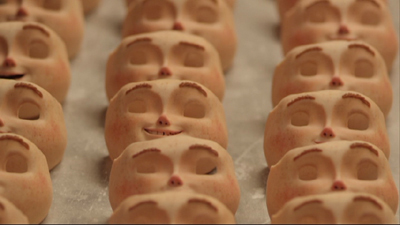
These replacement faces incorporated the color during the printing process, so that features like pink cheeks and freckles no longer had to be hand-painted and thus could be used more freely. (Even the most carefully applied pink applied by hand would shimmer from frame to frame.) As the making-of documentary Peeping through the Veil points out, Coraline, made with a similar face-replacement technique but with hand-painted color, could only use 13 freckles on the heroine’s face, with no pink on the cheeks. In ParaNorman, Norman’s friend Neil (some of whose replacement faces are shown in the illustration above) has innumerable freckles, as well as a pink nose and cheeks–all of which stay exactly in place.
The laser-printed faces also are translucent, allowing for subsurface light-particle scattering, allowing the puppets to have an appearance of realistic human skin (comparable to what was done digitally to create a believable Gollum in The Lord of the Rings and The Hobbit). The effect is particularly noticeable in the many backlit shots, where light passes through Norman’s prominent ears:
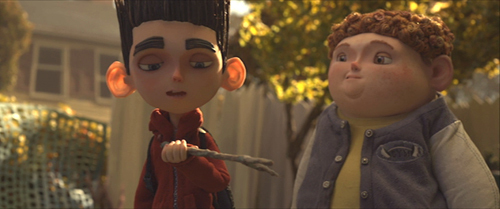
The effect of the new facial technology is a remarkably expressive set of characters.
The film’s premise is that Norman can see and interact with dead people, which makes him an outcast at his school, victimized by bullies and avoided by the rest of his classmates. The exception is Neil, equally bullied for his chubbiness and eccentricities. The setting is a New England town that exploits its history of witch-hunting for touristic purposes. As a threat from a real witch’s curse threatens the town, its modern inhabitants prove just as intolerant and prone to mindless violence as their ancestors. Confronted with the ghosts of past witch-hunters, they whip out their guns and become a mob. The whole thing is treated with grotesque stylization in the settings, character designs, and action. It’s highly entertaining, though certainly there are gruesome moments too strong for some children. But the result is a lesson in tolerance that softens the grotesquery.
I’d be pleased if any of these three films won the Oscar.
Distinctly behind these three comes Brave. Our regular readers know that we’re big admirers of Pixar. I’ve posted about Cars; we chatted about Ratatouille; David described a visit by Bill Kinder, Pixar’s Director of Editorial and Post-Production, to our campus; and their films frequently feature in our general discussions of animation. They have their own category in the menu at the right.
Brave represents a distinct recovery for Pixar after the disappointing Cars 2. I’m a fan of the original Cars, but it seems to me that the filmmakers made a huge mistake by turning Mater, so hilarious in the original, into a pathetic figure and Lightning McQueen, so charming to begin with, into a nasty guy who is barely in the film. Brave was definitely better, though I thought it a bit thin. It needed a subplot, maybe involving the mischievous triplet brothers, to flesh it out. Famously including Pixar’s first female lead character, it seemed to me to present an all-too-obvious story of a girl striving to do what everyone tells her girls don’t do (compete successfully with the guys, resist an arranged marriage). Are we really still at that early stage of creating “positive images” for girls? Having just seen Hayao Miyazaki’s extraordinary Nausicaä of the Valley of the Winds for the first time (in a 35mm print as part of the currently touring Miyazaki retrospective), I watched a princess of roughly the same age doing all sorts of daring things to save her country from ecological and military disasters, with none of the other characters ever mentioning that girls are supposed to leave such actions to the boys. It’s just not an issue, but Nausicaä is a pretty positive image. That in a film from 1984. The desire to be politically correct seems to have made the Pixar screenwriters rein in their imaginations a bit.
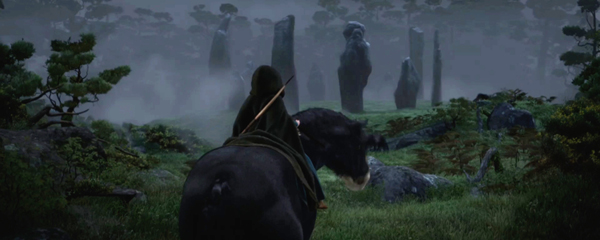
That said, it’s still a thoroughly entertaining film. Perhaps the most obvious strength is its sumptuous, evocative depictions of Scottish landscapes (see bottom). It’s no surprise that Brave won the Annie for best production design in a feature (as well as best editing).
I’m looking forward to Monsters University. Maybe it will have to inventiveness and density that we associate with the best Pixar films.
Fifth comes Frankenweenie. I enjoyed it, but it seemed to betray its origins as a short. Moreover, the logic of its premises escapes me. The early section that shows Victor’s love for his dog Sparky, Sparky’s death, and Victor’s resurrection of him using lightning à la Dr. Frankenstein is consistently amusing. Victor’s appropriation of household gadgets to rig his laboratory in the attic wittily captures the 1930s Universal horror films without trying to stick too closely to them. But then his creepy “friend” Edgar (read Igor) wants to try the experiment on a dead goldfish, which is resurrected–but invisible. This invisibility is never really explained, but it contradicts what happened with Sparky. Other kids try their luck or accidentally turn a rat and other dead animals into monsters, a tactic that seems designed to pad out the plot and generate danger to the community. These creations of monsters all seem to involve the same simple lightning strike that brought back Sparky, so why is he the same loving, cheery pet as before?
There’s also a sense that Tim Burton is drawing on auteurist tropes that have become distinctly familiar. We have a black-and-white film about the interaction of the living and the dead, as with Corpse Bride. Again there’s a character that resembles a classic figure from horror films of yesterday. In Edward Scissorhands it was Vincent Price, played by himself. In Ed Wood it was Bela Lugosi, played by Martin Landau. Here Landau is back to channel a similar figure, the teacher Mr. Rzyukruski, modeled on Price:
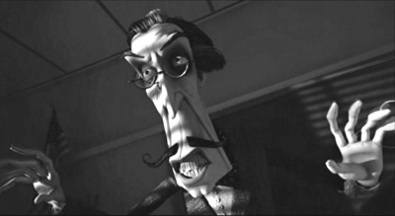
Again, Frankenweenie is an entertaining film, and the combination of smooth stop-motion animation and the CGI backgrounds make for an eerie combination, as in the pet-cemetery scene illustrated above. But it’s not Oscar-worthy. It didn’t win any Annies, but sadly, neither did The Pirates!
One last note. People complain, or at least point out, that a lot of live-action features these days are quite long, well over two hours in many cases. Yet animated features manage to tell their quick-paced, eventful tales succinctly: Brave (93 minutes), Frankenweenie (87 minutes), ParaNorman (92 minutes), The Pirates! Band of Misfits (88 minutes), and Wreck-It Ralph (108 minutes). This, of course, is partly for the benefit of the children in the audience, and partly because animation is so complex and expensive. Still, an adult walking out of any of these films can feel he or she has seen a movie satisfyingly packed with incident that moves along at a lively pace. Live-action directors might want to take a look at just how these films achieve that feeling.
Brave.
A dose of DOS: Trade secrets from Selznick
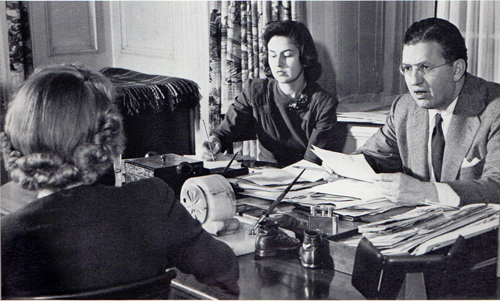
David O. Selznick dictating a memo in 1941. Secretaries are Virginia Olds (back to camera) and Frances Inglis.
DB here:
Tucked neatly within over 4500 archive boxes in Austin, Texas, are tens of thousands of items of information about how the Hollywood studio system worked. The trick is to find the ones you’re looking for…and the ones you didn’t know you should be looking for.
Those archive boxes are housed at the Harry Ransom Research Center at the University of Texas. This magnificent research library holds cultural records of inestimable value, from Whitman and Poe manuscripts to the papers of David Foster Wallace. Among the Center’s impressive film collections, the jewel in the crown is the David O. Selznick papers—a vast trove of material related to the career of the man who produced, some would say over-produced, Gone with the Wind, Rebecca, Spellbound, Duel in the Sun, and other classics of the Hollywood system.
Selznick has been studied from many angles, partly because his collection provides exceptionally full accounts of his activities. He kept, it seems, nearly everything, most famously memoranda. While chainsmoking cigarettes, swallowing amphetamines, writing amateur poetry, and revising scripts and visiting sets and critiquing rehearsals and watching rushes and retaking scenes and checking on rivals’ films, Selznick found time to dictate a blizzard of memos.
From his youth he loved to write memos–“I could sell an idea much better in written form than I could verbally”–and he became adept at dictating them. The results were precise, punchy, and often eloquent. Usually signed DOS (the O being a middle initial he bestowed upon himself), these communiqués could be lapidary (a one-liner asking if the cast is protected from sunburn) or epic. After getting Selznick’s dense, eight-page telegram explaining why Since You Went Away’s nearly three hours could not be reduced, a colleague replied: IF I WERE YOU I WOULD MAKE NO FURTHER CUTS IN SYWA. YOU MIGHT TAKE ABOUT TEN MINUTES OUT OF YOUR TELEGRAM.
In his later years Selznick contemplated publishing a collection called Memo Strikes Back. After he died in 1965, his son encouraged film historian Rudy Behlmer to make a compilation. The result, Memo from David O. Selznick (1972), is a superb collage portrait of the man’s personality and creative years. In the 1980s, the Ransom Center acquired the papers that Behlmer worked through, along with physical artifacts, including costumes from GWTW.
Me-mos, they were called by many, since they seemed to reflect the compulsive micromanaging of their creator. Directors and staff smarted under Selznick’s insistence that he control every creative decision. But for those of us coming afterward, Selznick’s criticisms, complaints, demands, reminiscences, agonies of frustration, and I-told-you-sos help us grasp the concrete problems of filmmaking.
Last week I went to Austin hoping to get some information about how Hollywood creators of the 1940s regarded the task of storytelling. DOS delivered as he did on the screen: splashily.
Paper traces
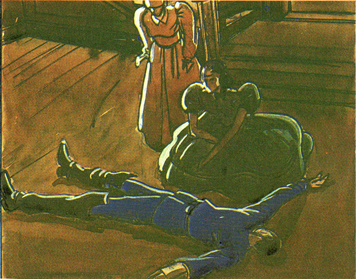
William Cameron Menzies production sketch for Gone with the Wind.
Most commentary on movies stops with the films as we find them. Critics who concentrate on producing interpretations are particularly inclined to play down primary-document research. “We already know,” a famous English critic once told me, “all we need to know.”
In my youth I mostly agreed. Criticism starts with watching and listening closely to what’s happening on the screen. But it doesn’t have to end there. That’s because doing systematic research into film depends on asking questions. And if we’re going beyond a single movie and asking questions about craft, norms, preferred practices, and regulative principles shaping a filmic tradition–in short, questions of film poetics–evidence from practitioners can help a lot.
Hollywood, for instance, has produced a rich array of published materials–interviews, trade coverage, promotion, technical papers–that offer evidence of what filmmakers thought they were doing. You have to read them with a jaundiced eye and be alert for rhetoric, but there’s still a lot to be found in Hollywood’s public presentation of its doings. There’s an even richer lode of unpublished script drafts, production memos, correspondence, transcripts of meetings, court cases, and the like. Mountains of such material remain locked up in studio files. This is what makes the paper collections at major universities, at the Margaret Herrick Library of the Academy, at the Museum of Modern Art, and at other institutions precious to those of us studying film history.
Collections like these are grist for the perpetual flow of celebrity biographies and accounts of Hollywood as a business. What, though, can they tell us about the history of film form and style?
Like some published material, these items can suggest how aware filmmakers were of their creative choices. When I was teaching, and the class focused on details of framing or cutting, some students were skeptical. “This is reading too much in,” they’d say. “The director couldn’t have intended that!” And it’s true that sometimes things we think were carefully planned came about through accident or sudden inspiration. Still, in other cases a document shows that filmmakers were consciously aiming at fine-grained effects.
Moreover, archive documents can indicate the array of creative options available—the extent to which one artistic choice is preferred over alternatives that wouldn’t work as well. If filmmaking is problem-solving, we learn about the costs and benefits of competing solutions. We gain a better sense of what can and can’t be done within a tradition when we glimpse filmmakers struggling to decide between expressive possibilities.
Yet another benefit of paging through archival documents is the recognition that we can’t neatly separate filmmaking as business from filmaking as an art. We commonly imagine a studio producer ordering a director to take the cheapest option, to trim costs in every way. Surely this happened a lot. Surprisingly often, though, the suits did and still do invest a lot in artistic effects, even innovative ones. When writing our book The Classical Hollywood Cinema: Film Style and Mode of Production to 1960, we were struck by the power of the idea of the “quality film,” that mixture of novelty, showmanship, and high production values that justifies time and resources. A flamboyant crane shot, a complicated lighting scheme, a gorgeous musical score, flashy special effects—in the Hollywood tradition and others, these are appeals worth paying for, even if not every viewer appreciates them.
Perhaps above all, studying records can call our attention to aspects of the film that your initial impression didn’t pick out. A critic can’t notice everything. Examining collections such as Selznick’s, or those housed in our Wisconsin Center for Film and Theater Research, have taught me that what appears effortless or perfunctory on the screen can be the product of intense thought, protracted debate, and hours of hard work. Once you re-tune your attention, even minor moments can be worth thinking about, if only because the filmmakers labored patiently over them.
Getting what you pay for
Since You Went Away (1944).
Selnick was a fussbudget on a scale that makes Schulz’s Lucy look laid-back. He sought control over every aspect of the film, from purchase of material through production, post-production, publicity, and distribution. Gone with the Wind’s volcanic success seemed to confirm the wisdom of his endless tracking of every detail. Because that tracking is made explicit, not to say vehement, in his memos and other correspondence, we get glimpses of Hollywood’s artistic strategies large and small.
Start small. In The Classical Hollywood Cinema: Film Style and Mode of Production, I wrote about the “rule of three”–the guideline that presses filmmakers to state important story information three times, preferably with variations (serious/ funny/ pathetic). I gleaned that precept from reading published work, and I could check it by studying the films. Still, further evidence is always welcome, so it’s nice to see a transcript of a story conference during the prolonged rewriting of Portrait of Jennie (1949). The hero, the painter Eben Adams, comes to a coastal town in search of his dream-girl, and DOS suggests:
In every scene he is to ask: “Do you remember a girl named Jennie Appleton?” Use rule of three–two [townfolk] do not remember her–the third one does. . . “Remember her well. . . pretty young thing with dark hair.”
More recently, I’ve been wondering whether studio screenwriters of the 1930s and 1940s were consciously adhering to something like today’s notion of a three-act structure. I’ve found scattered evidence from memos elsewhere that refer to a movie’s “first act” or “last act,” but nothing that indicates a commitment to an overarching three-part layout.
I haven’t found clear-cut evidence in DOS’s papers either, but in another story conference on Jennie, Broadway showman Jed Harris is reported as saying: “The second act–he must get the picture back because that’s all he’ll ever have of her.” In the finished film, Eben doesn’t search for the portrait, but Harris’s remark indicates that he had some sort of multiple-act structure in the back of his mind. He adds later: “The picture at this point is about 1/3 gone, and from here you have the machinery of trying to stop what is impossible to stop.” Far from definitive evidence, but teasing.
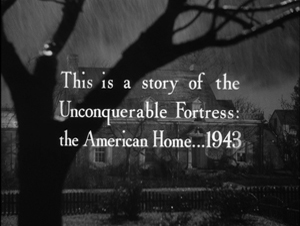
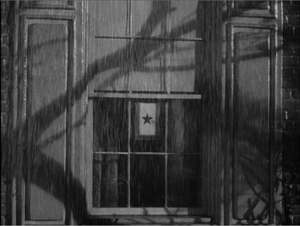
Now consider a medium-size example. Kristin and I have argued that many Hollywood films have a symmetrical opening-and-closing structure, often presented as an epilogue that mirrors the beginning. More recently I suggested that this bookend structure often displays an advance/ retreat pattern. At the start, the camera may move into a space or a character may come toward us; at the end, the camera may retreat and/or the characters may turn away or walk into the distance. On Since You Went Away (1944), Selznick sweated over ways to frame this panorama of the American home front. Early on he decided to start his film with an exterior view of the Hilton family home. This image dissolves to a closer view showing a star in the window, which indicates that a member of the family is in the armed forces.
Eventually Selznick decided to end the film by pulling back from a miniature of the house, with a single camera movement replacing the two unmoving shots that started things off. Anne is joyfully embracing her two daughters; they’re inserted as a matte into the upstairs window.
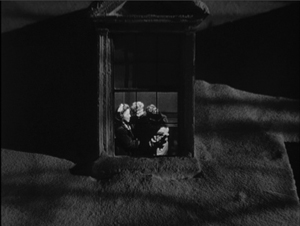
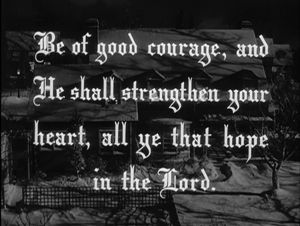
Selznick considered redoing the opening as a slow camera movement in to the window, but only if the miniature was good enough. Perhaps it wasn’t. And at one point he wanted the final shot to start with the star in the window, at least for purposes of the preview screening, “to parallel that at the beginning of the picture.” Again, that wasn’t accomplished, but his playing with possibilities reflects his tradition’s commitment to symmetrical openings and closings.
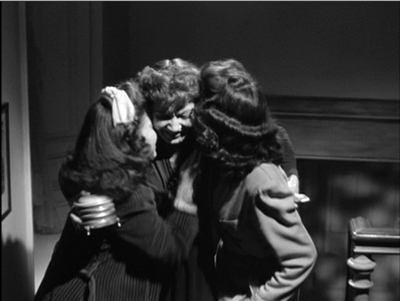
It would have been far cheaper simply to have ended the film on the three-shot of the women, shown at the top of this section. But Selznick wanted “a nice rounded feeling” in his epilogue, and he was prepared to pay for it. True, he was exceptionally finicky, but going to a lot of trouble and expense to get this formal rhyme was not unusual in studio practice. The hardheaded film business is willing to invest in vivid, emotionally gripping artistry identified with quality moviemaking.
Stylistic trends
Portrait of Jennie (1949).
In broad terms, it’s fair to say that American studio films of the 1940s display a more self-conscious use of long takes, sustained camera movements, and deep-focus cinematography than we find in other eras. (Actually, it’s a trend we find throughout the world at the time, for reasons that aren’t well understood.) But these new techniques didn’t replace traditional analytical editing. They worked within it. Continuity cutting, established in America in the late 1910s, remained the dominant stylistic framework for filmmakers.
Citizen Kane‘s fixed single-shot scenes in depth were very unusual in cinema of the period. More commonly, deep-focus shots, like moving-camera shots, served as establishing framings or otherwise became part of conventionally edited sequences. This middling or compromise style can be found in dozens of films of the forties, and Selznick seems to have more or less consciously gone along with it.
He worried about what he called “cuttiness,” the tendency to break every scene into brief single shots of the players. Often, he suggested, a well-handled two-shot would work better. He told his editor on Since You Went Away to avoid “the conventional treatment of close-ups and reactions.”
It most definitely is not necessary always to treat every one of our scenes with dead center close-ups, and direct cuts or over-the-shoulder angles, when an intimate scene is played between two people.
He goes on to tell a second-unit director that a scene of a couple in a car could be played in one or two setups, perhaps in a single shot “if we could get an interesting composition on the two of them rather than a dead center two-shot on individuals.”
Selznick saw Hitchcock as an editing-biased director and so after signing him to make Rebecca (1940), he warned him and other members of the team to avoid over-cutting. Again, the preference was for a tight two-shot.
The new scene between the girl and Mrs. Danvers on the arrival at Manderley (Script Scenes 130A, 130N and 131) may be very cutty as described in the script, and perhaps ought to be protected in a close two-shot of ‘I’ [the heroine] and Mrs. Danvers, or some other angle that will keep us from playing it in too many short cuts.
In most cases, however, Selznick gave himself an out by treating faster cutting as an alternative. He consistently wanted coverage, as he indicates immediately for the Rebecca scene just mentioned.
However, I suggest we make the short cuts also, as this may be the best way of playing it after all. If we use the camera to move up to Mrs. Danvers for the finish, which is the way I think it should be used, then perhaps the first shot of her should be retaken also.
As the last sentence indicates, Selznick sometimes opts for camera movement to avoid cuttiness. Perhaps the American Hitchcock’s interest in tracking shots that follow characters, particularly glamorous women, through the set stemmed from Selznick’s belief in the power of occasional camera movements. He notes that a tracking shot introducing Alida Valli in The Paradine Case (1948) is too bumpy, asking why the staff couldn’t manage “something as simple as going up to a woman’s face, and then pulling back from it across a set, without the camera shaking in the manner of early silent pictures.”
Yet these longish takes aren’t to be the dominant stylistic approach. Sustained takes often block off choices in post-production. Producers, then and now, want coverage, and you didn’t have to be a micromanager like Selznick to want your directors to give you options for rebuilding scenes in the cutting room. We see this when Selznick objects to John Cromwell’s playing entire scenes in lengthy shots.
This is of course nonsense, since as often as not an incomplete take is better than the identical portion of a complete take. . . . It seems folly to spend hours getting a complete scene instead of just picking up those sections of the beginning or middle or end that have been fluffed.
Some directors resisted by shooting long takes without coverage. Hitchcock did this in one sequence of The Paradine Case and then promoted this “three and a half-minute take” to the Hollywood community, perhaps to make it harder for Selznick to change it. Nonetheless, Selznick cut the scene up. Once freed from Selznick, of course, Hitchcock was able to pursue the long-take option to extremes with Rope (1948) and Under Capricorn (1949).
Despite wanting flexibility in editing, producers can be seduced by the prospect of “pre-cutting” a film–planning the shots so exactly that the film can be “pre-visualized.” The director can thus avoid taking shots that won’t be used. Selznick was proud of William Cameron Menzies’ precise production planning on Gone with the Wind, and this made him believe in the power of the storyboard. When he rewrote a script, which was often, he was inclined to have artists immediately prepare fresh drawings of sets and shots.
Hitchcock had promoted himself as someone who drafted a film on paper so thoroughly that shooting became efficient and predictable. Selznick was therefore startled when Hitchcock proposed a long shooting schedule for Rebecca. “In view of the many speeches he has made to me about how he pre-cuts a script, so as to shoot only necessary angles, it is a mystery to me as to how he could spend even 42 days.”
During shooting, DOS became furious with the pace of production, declaring Hitchcock “the slowest director we have had.” Hitchcock, he believed, was spending more time getting his few angles than directors who shot in normal fashion. Yet Selznick remained susceptible to the dream of pre-cutting. Some years later, he predicted that Since You Went Away wouldn’t take much time in the editing room because the scenes “will be camera-cut to an extra-ordinary degree, and putting it together should take no time at all.” The film’s editing occupied several months.
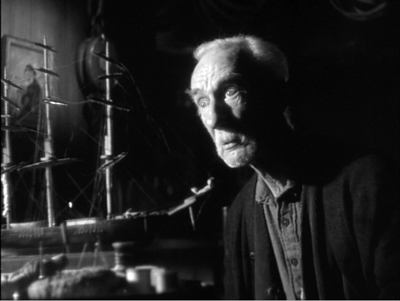
Selznick, then, was attracted to current trends of longish takes and the fluid camera, but like nearly all his peers he saw these as subordinate to the overarching demands of analytical editing, whether through traditional protection coverage or through “pre-cutting.” Something similar seems to have governed his interest in depth staging and deep-focus cinematography. Peppered throughout the memos I examined are his concern for “foreground pieces,” props that can enliven a shot. A miniature sailing ship in Portrait of Jennie, he suggests, is too big for its placement in the shots as taken. “It would have been a far better foreground piece for another angle.” So it became such a piece, as the still surmounting this section indicates.
Of Since You Went Away DOS notes:
I think that lately we have been overlooking chances for good foreground and background planes in our set-ups. I don’t want to over-do this but of a lot of our shots could be much more interesting in this regard.
In particular he emphasizes the bronzed baby shoes introduced in the film’s opening, as the camera glides through the Hilton family parlor picking up traces of the departed father. A later scene, in which Anne writes a letter to her husband Tim, seemed the ideal chance to re-use that prop. “Photographically, I thought it would be much more interesting with the shadow of the shoes, or using the shoes as foreground pieces.” This composition, if it was shot, didn’t appear in the final film, but it shows once again that filmmakers can be aware of broader trends of their period, and that they’re willing to go to considerable trouble to join them.
A striking example of the insistence on participating in the deep-focus trend appears in the files around Spellbound. After arriving in America, Hitchcock occasionally produced some big-foreground depth images, as below in Shadow of a Doubt (1943), and in Notorious (1946).
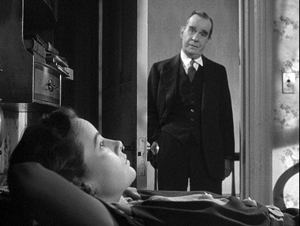
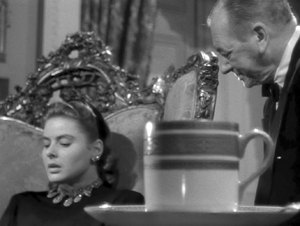
Such compositions were rare in most films Hitchcock did under Selznick, but in Spellbound Selznick realized the value of keeping up-to-date. The most famous big foreground in the film (and in all Hitch’s work) is seen at the climax, when Dr. Murchison trains his revolver on Constance as she edges out of his office.
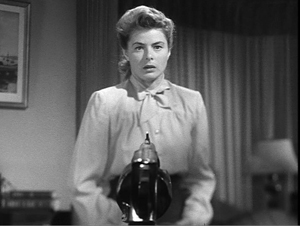
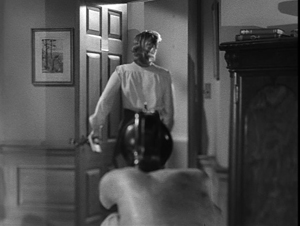
This bizarre shot is somewhat anticipated by a less aggressive setup. Constance hears over the radio that the police have tracked J. B. to Manhattan, and she goes into the next room to pack to follow him. The action is handled in a canonical post-Kane composition.
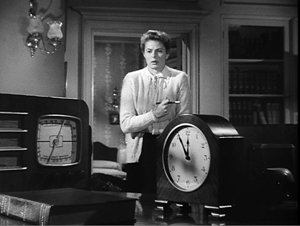
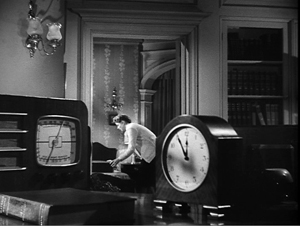
The production records make me wonder whether this shot (presumably using a larger-than-life clock and radio) was filmed under Hitchcock’s supervision. It may have replaced an even more complex shot that cinematographer George Barnes objected to. (I’m still gathering information on this.) In any event, Selznick realized that a minor transitional scene could be dynamized by a flamboyant, difficult-to-achieve image: a throwaway mark of quality.
Pendulum swings of innovation
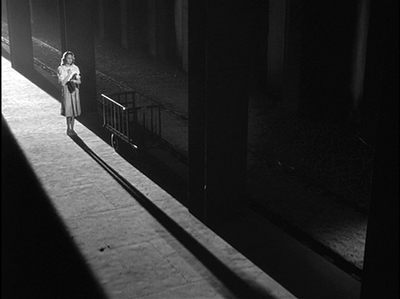
Since You Went Away.
I’ll save other things I found for future work. Let me finish by talking about how Selznick’s “directing at a distance” shows a craftsman’s concern for novelty and pictorial storytelling.
Hitchcock famously shot the Old Bailey scenes of The Paradine Case with several cameras in an immense set. Selznick may have okayed this tactic on this occasion because it would speed up Hitchcock’s schedule. (Selznick had hoped it would take only one day; it took three for principal photography and several more for pick-up inserts.) But both before and after Paradine, Selznick was interested in extending multiple-camera shooting beyond its normal uses.
Multiple-camera coverage of ordinary scenes had a heyday in the early years of sound, but afterward it was usually reserved for unrepeatable action (fires, stunts, cars going off cliffs) or very big scenes. Selznick had deployed several cameras, including the lightweight Eyemos, during the dance at the airplane hangar in Since You Went Away. Like Welles, he also considered using the tactic for ordinary dramatic scenes. He writes in 1947:
I have long felt that sooner or later, probably when economic necessity dictates, this method of shooting will come into vogue, with far more time spent on rehearsal, far less time on shooting, enormous savings and better quality. I know that for years I have been discussing with Hitchcock my feeling that we could take a film of a particular type, thoroughly rehearse it, and shoot it in a week–and this is just what Hitch is planning to do on The Rope [sic].
Selznick anticipated the practice of multiple-camera television production. It’s intriguing to think of Hitchcock taking this idea and simply substituting one camera for many, creating another technical stunt that could be publicized.
DOS was sensitive to conventions and often sought to refresh them. For one back-projected scene of Portrait of Jennie, he advises Dieterle “to avoid the awful-looking, head-on, two-shot process setups and angle camera in different ways: perhaps with lower cameras, one shooting across Adams at Spinney and the other shooting across Spinney at Adams.” This echoes his concern for finding unusual angles on the process arrangement in Since You Went Away‘s driving scene. He likewise encouraged unusual staging, recalling
the love scene between Freddie March and Janet Gaynor in A Star Is Born, the one in which he takes her home the first night, after the kitchen scene, where the entire scene is played on Freddie’s back; and the love scene in Nothing Sacred in the crate after Carole Lombard has fished Freddie March out of the river. Both of these treatments enormously enhanced the value of these scenes, which shot conventionally would not have been necessarily so effective.
In the first instance, the conversation is handled by an unusually prolonged over-the-shoulder shot that doesn’t show March replying to Gaynor. In the second, the romantic dialogue is emphasized by the darkness of the crate and our inability to see either actor clearly.
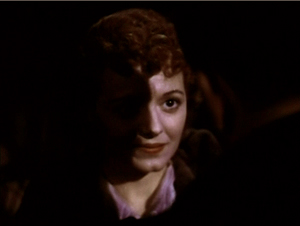
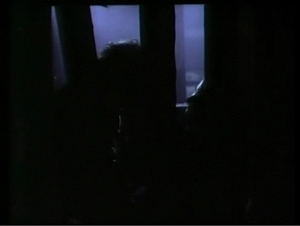
Yet Selznick worried about becoming too “arty” as well. During the filming of Since You Went Away he confessed:
I feel that I am at least partially responsible for our increasing tendency to play scenes on people’s backs. . . . In Jane’s attack upon the colonel after the breakfast scene, we are on neither one principal nor the other, but on the colonel’s back and Jane’s back . . . In the church scene there has been talk of playing it on the three backs, but I have tried in the script to indicate that we should not do this.
Stark lighting is of course common in 1940s cinema generally, but Selznick favored it in the 1930s as well, in the shots above and more famously in Gone with the Wind. By the 1940s, Since You Went Away and Portrait of Jennie include scenes steeped in rich shadow areas, cast shadows, and silhouettes.
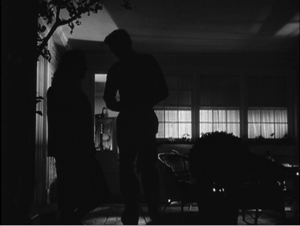
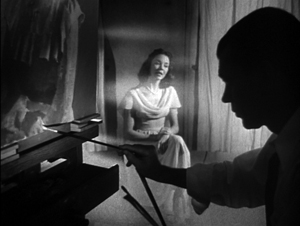
But here, as elsewhere, DOS’s urge for innovation was curbed by anxiety about going too far. In a memo to Cromwell on Since You Went Away, he wrote that “all of us (mostly myself) are overdoing the silhouette business. . . . Let’s from now on all use this silhouette effect very sparingly, and only when it’s absolutely indispensable to our mood.”
Perhaps what I’ve called his middle-of-the road approach was less a balance and more of a pendulum swing between extremes. He could sometimes foreswear the grand, almost monumental look of many scenes and demand something quieter. At the end of the day when Anne’s husband has left for war, she looks at his unmade bed.
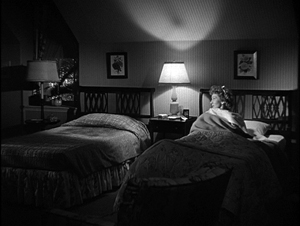
She leaps up and wriggles into it, covering her face with the blankets, and starts to cry.
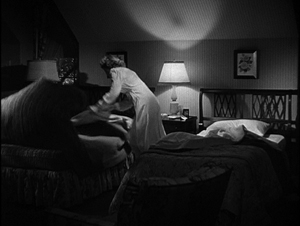
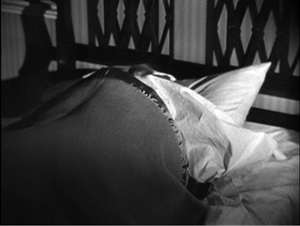
Commentators often fasten on the twin-beds convention as an example of the naive timidity of studio-era Hollywood. Yet every convention offers opportunities for expression. When Anne rises, the sight of one rumpled bed and one pristine one brings home the husband’s absence in a simple, powerful image, and her plunging into it directly conveys her longing to be in his arms.
I’m absolutely positive that this gag will not get over unless we see the two beds in the clear, one made up and one not made up, before she hops into the other bed. I think these two beds constitute good storytelling.
When the hard-bitten Ben Hecht saw Since You Went Away, he cabled Selznick: “It made me cry like a fool.”
You can certainly argue that Selznick the fussbudget was his own worst enemy. His micromanagement raised his budgets and drove away his collaborators. As the production values grew more inflated, it was hard to recoup costs, let alone turn big profits. Ten years after Gone with the Wind premiered, Selznick’s fiefdom lay in ruins. He withdrew from production, millions of dollars in debt. He wrote in a confidential 1948 memo:
In the final analysis it is my fault for two reasons: (1) my production methods; (2) my tolerance through the years of the wastefulness. . . . The most successful series of pictures ever made in the history of the business has produced profits which are perhaps not more than twenty per cent of what they should be.
Ideas matter in any domain, even in studying Hollywood. And not just the ideas of critics, historians, and theorists. The practicing artisans of the studio system had rich ideas about preferred ways to build plots, to shoot and cut scenes, to mix sound and add music. These norms were seldom stated outright. Were Selznick less interfering, less prone to hesitate between alternatives, less obsessed with minute details, we would not know as much about the workings of the system he sought to rule. He distilled into typescript and double carbons many notions that ordinarily went unstated. His plump files teem with ideas about how films were made, and how their creator thought they should affect audiences. Thanks to institutions like the Ransom Center, his work is preserved to enlighten us about filmmakers’ secrets, even the secrets they don’t know they know.
I’m very grateful to Emilio Banda and the rest of the staff at the Harry Ransom Center, who helped me during my visit. Thanks also to Steve Wilson, Curator of Film there, for advice. And of course thanks to my family–Diane, Darlene, Kewal, Kamini, Megan, and Sanjeev–who made our trip to Austin so enjoyable.
My quotations come from the memos I examined, as well as from other items in Rudy Behlmer’s Memo from David O. Selznick. I also drew on Ronald Haver’s David O. Selznick’s Hollywood (Knopf, 1980), the initial edition of which is surely the most gorgeous book ever published about the American film industry. Haver’s study is not only spectacularly illustrated but deeply researched, and it, like Behlmer’s, is indispensable for the study of the studio system. The Menzies production sketch is taken from the Haver volume.
No less indispensable is Leonard J. Leff’s Hitchcock & Selznick (Weidenfeld and Nicolson, 1987). After sifting through both the Selznick collection in Austin and the Hitchcock collection at the Academy’s Margaret Herrick Library, Leff produced a detailed account of the two men’s creative work. Hitchcock’s long take in The Paradine Case is promoted in Bart Sheridan, “Three and a Half Minute Take…,” American Cinematographer 27, 9 (September 1948), 304-305, 314.
Paul Ramaeker offers a subtle account of Portrait of Jennie as a “supernatural romantic melodrama” at The Third Meaning.
For more on 1940s stylistic norms, see The Classical Hollywood Cinema, chapter 27, and On the History of Film Style, chapter 6. The first essay in my Poetics of Cinema discusses Hitchcock in relation to trends of the period, concentrating on Rope and long-take options. On Citizen Kane and rationales for deep-focus cinematography, you can go here. I mention a bit about the fashion for the “fluid camera” in 1940s Hollywood in this entry.
William Cameron Menzies served as art director and more for Gone with the Wind, and he and was pressed into service ad hoc for later DOS projects. I think he may have influenced the shadow-drenched style of Since You Went Away and Portrait of Jennie. I wrote about Menzies’ work, and again about deep-space work in 1940s Hollywood, here and here. See also David Cairns’ enlightening essay in The Believer.
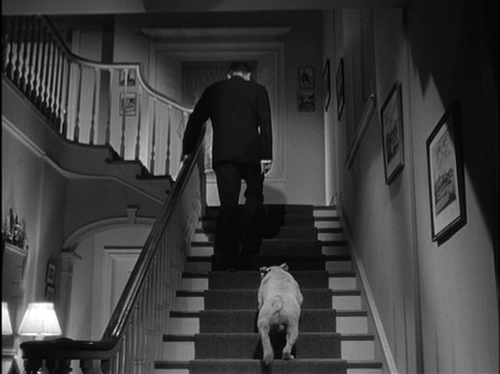
Since You Went Away: “I think that Miss Keon had better start preparing a script of retakes and additional scenes. I think we missed a wonderful opportunity in the Christmas scene in not having a shot from the angle of the family, or from the bottom of the stairs, of the Colonel going up the stars with Soda behind him.”
The wayward charms of Cinerama
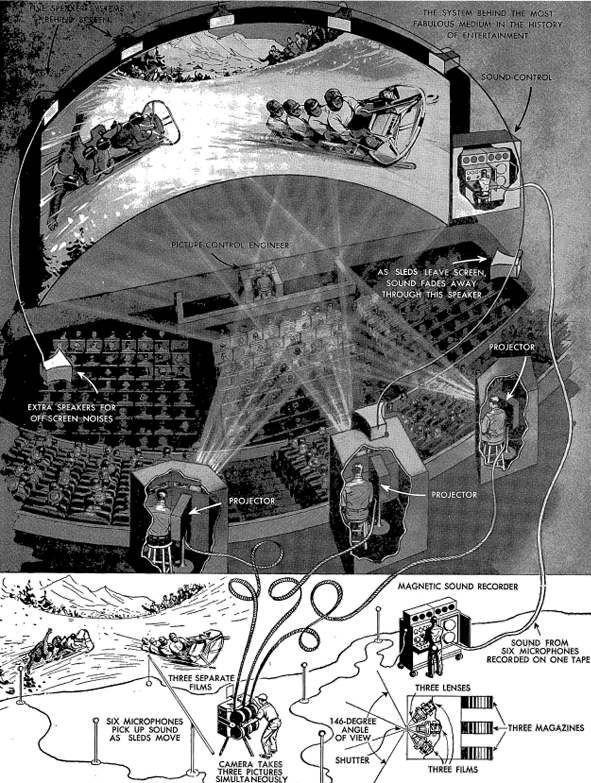
From Cinerama Holiday souvenir book, 1955.
DB here:
Two slumbering potential giants stirred in the last months of 1952, and as 1953 got underway the motion picture industry was faced with the greatest upheaval since sound films revolutionized the industry nearly 26 years ago.
Winfield Andrus, “3-D Finding Its Place,” The 1953 Film Daily Yearbook (New York 1953), 147.
Andrus was referring to 3D and to Cinerama, two technical marvels that promised to revive American filmgoing in the postwar era. In the short term, that didn’t happen. 3D died quickly, and Cinerama remained a novelty before expiring in 1962. But eventually 3D became viable, as the last decade has shown. Moreover, Cinerama’s impact was felt throughout the 1950s. Studios competed with it by introducing other widescreen formats, stereophonic sound, and extravagant roadshow productions. Cinerama, people are starting to point out, was a prototype of what Imax has become. Just as we’re now more interested in classic 3D (see my entry on the reissued Dial M for Murder), we ought to take another look at Cinerama in its more or less pure state.
Devoted aficionados like John Harvey of the New Neon Cinema in Dayton have kept Cinerama alive in theatres, and the challenge has been taken up by other venues. One of the most passionate advocates has been David Frohmaier, whose documentary Cinerama Adventure graced our Wisconsin Film Festival some years back. That documentary showed up on the 2008 DVD release of How the West Was Won, and it’s an essential, affectionate introduction to this most ungainly of film formats.
Now Frohmaier has brought us the 1952 film that started it all. This Is Cinerama has just been released by Flicker Alley, one of our most exacting and adventurous DVD publishers. The whole meticulous package–the film itself, presented in Frohmaier’s Smilebox display, along with an abundance of extras—offers a good chance to think about what Cinerama amounted to.
Cinerama had its ups and downs over a decade. Control of the technology and the venues shifted unpredictably, as did the revenues and profits. But I think that Cinerama’s unique accomplishment lies partly in its unintended consequences. Seeking to become the most realistic form of cinema yet known, Cinerama demonstrates how enjoyably un-realistic, even surrealistic, movies can be.
One hell of a demo
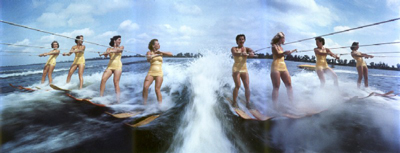
When This Is Cinerama opened at the Broadway Theatre in Manhattan on 30 September 1952, it presented itself as the ultimate package of new entertainment technologies. It was of course in color, which was still something of a rarity in motion pictures. It used stereophonic sound, with five speakers behind the screen and two in the auditorium. The screen itself was a wonder: it was seventy-five feet wide and about 23 feet high, bent in a 146-degree arc. That made the display span fifty feet. Later, some screens would be nearly a hundred feet long and over thirty feet high.
All who saw the film felt that this was an immersive experience. The goal, claimed Cinerama’s inventor Fred Waller, was to approximate what our eyes take in, including peripheral vision. Indeed, Waller claimed that our sense of depth in the world and an image depended on peripheral information. Anyone who has been in a wraparound theme-park attraction can attest to the fact that an image stretching to the edges of sight can provide a pretty compelling illusion, especially if the images carry us forward. You can undergo this illusion in Disney’s Circle-Vision 360°.
Cinerama’s colossal screen size and deep curve dictated a new approach to image-making. No standard 35mm frame could fill such a wide display without losing resolution. The scale of the show demanded three projectors, each trained on one-third of the screen. The image became a triptych, with thin overlaps or “blend lines” demarcating the panels. Naturally, all three had to be exactly aligned and kept in strict synchronization. If one film reel lost frames through a mishap, for future shows projectionists snipped the corresponding frames out of the other two reels.
The projectors were initially housed in separate booths, with a projectionist in charge of each. A fourth booth was given to the sound mixer (off to the right side in the above diagram), who oversaw the multiple track playback at each performance. Yet another staff member was in charge of monitoring the whole performance. Interestingly, the projectors were said to be placed level with the screen, in order to avoid any keystoning distortions of the display. But the diagram above, along with the Cinerama displays I’ve seen, position the projectors fairly high in the auditorium.
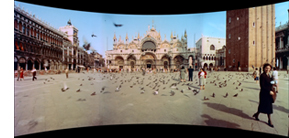 The image looked something like the still on the right. Even in this tiny image you can see slight differences between the panels and vignetting along the joins. Projectionists had to ensure that the three panels yielded comparable illumination and color temperature. Each projector’s gate had a little gadget known as a “jiggolo” that ran rapidly along the edges of the frame to blur the blend lines.
To gain resolution, each frame on the film strip used about twice the image area of conventional film. Surprisingly, the image area wasn’t much wider than normal film but it was 1 1/2 times the normal height (that is, 6 perforations high rather than the usual 4). To allow more frame space, the soundtrack was played on a separate magnetic film reel. The resulting images yielded very high resolution.
These sprawling images came from three cameras interlocked into a single bulky unit. The lenses were angled at 48 degrees to one another, turned inward to cross at a precise focal point. The camera lenses, all purpose-made, had a focal length of 27mm–another factor that would yield some striking pictorial effects. All three lenses shared a common shutter and had interlocked diaphragms to ensure comparable exposure. Because flicker would be disturbing on such a wide display, particularly on the edge panels, the film ran at 26 frames per second rather than the usual 24. The aspect ratio varied between 2.6:1 and 2.77:1.
This Is Cinerama was what we’d today call a demo. Lowell Thomas, one of the backers of the process, noted that if they’d told a story with actors, the emphasis would be taken off Cinerama itself, which was “a major event in the history of entertainment.” “The logical thing,” Thomas remarked, “was to make Cinerama the hero.”
The result was a travelogue (a word Thomas hated). After Thomas’ prologue, the film proper opens with the famous ride on a plunging rollercoaster. Then come episodes devoted to the canals of Venice, some church choral music, Scottish pipers, Viennese boy choristers, Spanish dancers, and an excerpt from Aida performed at La Scala. During the intermission Thomas inserts another demo, this time of the surround-sound effects. (We have to remember that stereophonic sound was a big novelty at that point; stereo LPs came later.) The bulk of the second part is spent at the Cypress Gardens leisure park, providing images of handsome men and women at play and climaxing in some exciting water-skiing. This is sort of double product placement–not only promoting the park but also water skis, another Fred Waller invention. The film ends with an awe-inspiring flight crisscrossing America, from New York and the Pentagon to the Golden Gate Bridge, and back to the rugged terrain of the West and Southwest.
 In an essay for Cahiers du cinéma, the late Chris Marker pointed out that the film amounts to a religious-popular spectacle. For all the globe-trotting of the first part, the last half is a paean to the splendor that is the postwar USA. The last word spoken, or rather sung, in the film is “America.” Indeed, as many have pointed out, the word Cinerama is an anagram for American. I’ve sometimes wondered about the logo, that peculiarly zigzagged string of letters. It suggests a crumpled snippet of film, with squarish frames like our vertical panels, and its bumpiness evokes the ups and downs of a roller coaster. But there’s no mistaking the logo’s recurring color scheme of red, white, and blue.
Party like it’s 1952

As a novelty, This Is Cinerama succeeded, running for over two years in New York. The system was installed in big-city theatres around the country. At a time when the average price of a movie ticket was $.46, the high-end seats for a Cinerama feature cost $2.80, or $24.34 in today’s currency. The Cinerama organization produced four more episodic travel-centered pictures: Cinerama Holiday (1955), The Seven Wonders of the World (1956), Search for Paradise (1957), and Cinerama South Sea Adventure (1958). Another picture made in a rival three-panel technology, Windjammer (1958), wound up in Cinerama venues as well. By 1957, Variety announced, the first three releases had grossed $60 million worldwide.
The problem was that on those grosses, profits came to only $6 million. Eighty percent of the box office take was used up in operation of the theatres.Morever, the complexity and cost of a Cinerama system meant that very few venues existed; by 1959, there were about twenty screens in the US and another eight or ten abroad, and not all were operating. In addition, overall US movie attendance was dropping, from about 47 million weekly in 1954 to 32 million in 1959.
New management succeeded in opening many more Cinerama theatres on a franchise basis, but the company needed fresh product as well. A coproduction deal was struck with MGM to use the process on fictional features. The results were The Wonderful World of the Brothers Grimm (1962) and How the West Was Won (London premiere, 1962; US release, 1963). To expand the audience, these films were also released in anamorphic widescreen to non-Cinerama venues.
Both films won large audiences, but they failed to make a profit. Soon the company’s theatres began exhibiting 70mm film releases under the Cinerama brand. The films were shown on curved screens, but with single-lens projection. The first of these releases was It’s a Mad, Mad, Mad, Mad World (1963); eventually even 2001: A Space Odyssey (1967) would be exhibited in “Cinerama.” In the course of these years, the company was acquired by Pacific Theatres, where it still resides. Classic triptych Cinerama was gone.
I never saw it in its prime.
I did see How the West in its original anamorphic release, and that has stayed with me for a couple of reasons. First, I was moved by it. It’s kitsch in many ways, but there are several exciting and touching scenes. Moreover, even as a squeaky-voiced teen I recognized something genuinely weird about the way it looked. Its imagery haunted me, though I didn’t have ways to understand them. Many years later, writing portions of a book that became The Classical Hollywood Cinema, I couldn’t watch any of the Cinerama travelogues in archives. I had to content myself with watching pink, cropped 16mm anamorphic copies of How the West Was Won. In all, it was very hard to get a sense of what the thing looked like (let alone sounded like).
Not until 2003 did I see both This Is Cinerama and How the West Was Won in the three-panel format, during a conference on widescreen cinema held at the National Media Museum in Bradford, England. That experience was wonderful, and it left me wanting to study the films more closely.
Now I can, and you can too. David Strohmaier has devised a transformation that captures the shape of a Cinerama projection. He calls it the Smilebox. The Flicker Alley DVD of This Is Cinerama is in Smilebox, as you see from my Venetian image above. Warner Bros’ 2008 Blu-ray release of How the West Was Won provides both a Smilebox version and a wider-than-CinemaScope letterbox version.
Through painstaking restoration by Greg Kimble and others, the films look clean and bright. Digital cleanup has regularized the color values from panel to panel and nearly eliminated the blend lines. The result conforms to what the makers would surely have preferred–a greater sense of uniform tonality, light, and space across the frame than surviving Cinerama images have.
For anybody interested in the history of American cinema, the Flicker Alley DVD is essential. It provides a long-missing chapter in the development of widescreen filmmaking. This Is Cinerama is a documentary that is also a document of postwar American pride, of film technology, and of the movie business. But I think it represents even more. For the most part neither Smilebox nor digital restoration has removed the peculiarities that, perhaps perversely, fascinate me about this unique format.
Nice big image you got here. Be a shame if anything happened to it.
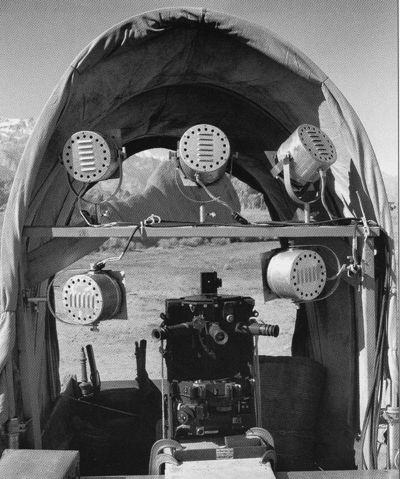
Cinerama camera in a mock covered wagon for How the West Was Won.
Like any picture-making process, Cinerama captures the three-dimensional world on a two-dimensional surface. Unusually in the history of cinema, it does it with a semicircular array of cameras. The images from those cameras are projected on a corresponding semicircular surface, in the hope that they will simulate not only the spatial layout in front of those three lenses but also the way the world looks to us.
Fred Waller thought that his invention provided greater realism, because our vision subtends a horizontal arc wider than that of conventional camera lenses. Fred fell a few degrees short, though. Claiming that we take in about 160 degrees, he thought that 146 degrees was a good approximation, but our visual field is actually a bit wider than 180 degrees. (Without turning our head, we can roll our eyes.) More important, though, is the assumption that a faithful image of the world should try to capture the curvature of the image as it passes through the cornea to the retina. We see a bowed world, many have claimed, so our pictures should present the way things look.
Yet there’s a difference between visual sensation and visual perception. Even if the light from the world hits our photoreceptors in a partial or distorted way, what we see is regular and unified. On our retinas, near things loom large and distant things look tiny, but we’ve evolved to adjust to the distortions in early stages of vision and see things in normal size. A person ten feet away is twice as large on our retina as somebody twenty feet off, but that’s not the way they look. We don’t see our retinal image, any more than we see the wildly misshapen image of the world projected to brain areas. The eye is a part of the brain, and the brain reworks the stimulus–cleans it, enhances it, corrects it, straightens it out, and gives it a stability that isn’t there in the raw input.
For the most part, normal camera lenses approximate the way the world looks to us after our brain has processed visual signals. Most images show straight-edged walls and sidewalks, railroad tracks meeting at the horizon, proportional human beings. When Cinerama or other nonstandard image-making technologies present distortions to our eyes, we take them for what they are: not “what we really see” but rather pictorial displays creating distinct effects of their own.
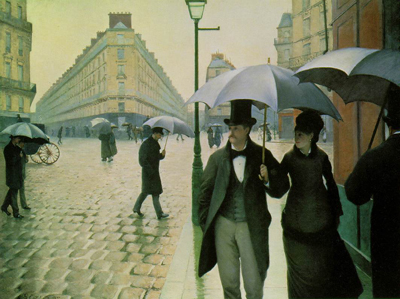
Hence the irregular appeals of Cinerama. Suppose we’re not interested in seeing the world as it registers on our sensory system. Suppose we’re interested in exploring uncommon pictorial effects. If we suppose all that, we can have the sort of fun watching Cinerama that we get from this 1877 picture by Caillebotte (Paris Street, Rainy Day), a virtuoso reworking of geometric space.
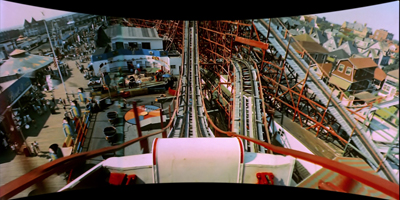
Take image sharpness. In the 2003 Bradford shows, I was overwhelmed by just how precisely distant objects registered. This was partly due to the greater resolution of a bigger image area, partly to the use of wide-angle lenses with breathtaking depth of field in brilliant sunlight. I can’t illustrate some of the most dazzling effects here, including the sight of a very distant bathing beauty racing through a crowd and up to the foreground in the Cypress Garden sequence of This Is Cinerama. But if you have a large home theatre monitor or projected display, you might be able to spot her. Here I’ll just mention how the farthest stretches of the famous roller-coaster stand out crisply, and in big-screen projection, the people in the far distance do too.
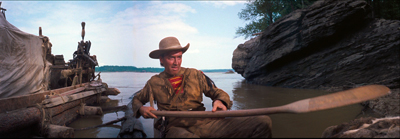
Such short-focal-length lenses distort the visual field in predictable ways. For one thing, they make horizontal lines bow upward or downward. For this reason, Cinerama DPs were at pains to keep the horizon near the center of the shot and to avoid or cover contours parallel to the horizon. Linus Rawling’s canoe oar bends disconcertingly in the central panel even before it hits the blend line and shoots off on its own.
Verticals can get distorted as well. On the edges of each panel, human figures can look bulged, pinched, or oddly torqued.
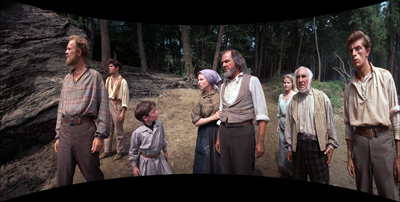
Cinerama’s triptych format complicates perspective effects by welding three wide-angle images together. When presenting built environments, often each panel displays its own distinct vanishing point–sometimes central, sometimes angular, sometimes both. The results recall the Caillebotte picture, all acute angles and avenues flung out to left and right.

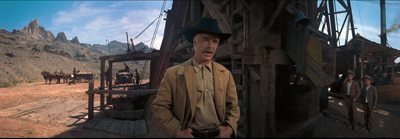
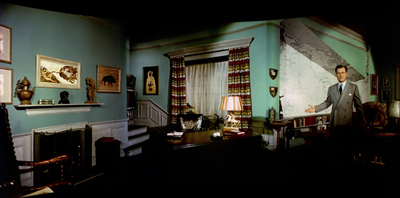
One cinematographer tells us that “special sets had to be built with curves and bends to rectify the false perspective inherent in three-camera systems.” But often we get contorted interiors. Dr. Caligari might feel at home in Lowell Thomas’ office.
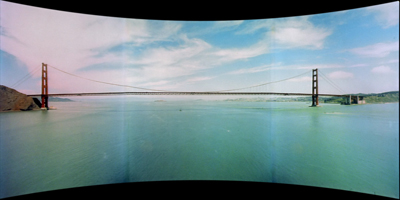
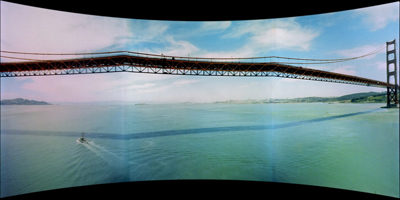
The blend lines add their own constraints. From a distance, the Golden Gate looks very planar, but as our plane swoops nearer, the horizon remains flat while the bridge develops a couple of kinks.
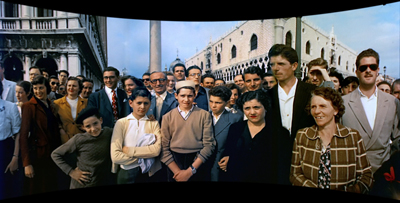
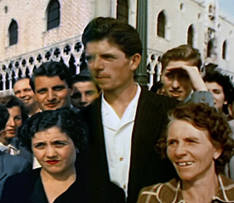
For staged action, veteran cinematographer William Daniels warned that “We invariably consider the blend lines first, then plot and stage the action to suit the camera setup.” Most obviously, directors had to keep people away from the panel joins. We can see the unfortunate result in this image from This Is Cinerama. The gent on the far right is at once pinched and bulged, and the building in the B and C panels gets the Caillebotte treatment. Worse, a young Venetian man’s head on the blend line undergoes an unfortunate warping.
When a figure moves from panel to panel, the wide-angle distortions combine with the panel edges to create a faceted, almost cubistic space. Here’s the first anomaly I spotted when watching How the West Was Won as a kid in 1963.
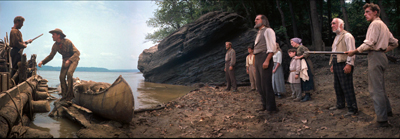
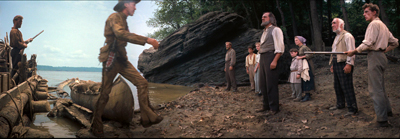
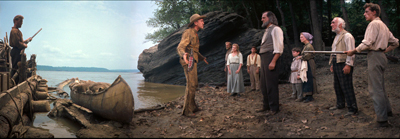
As Linus is walking toward Mr. Prescott, James Stewart seems to stride diagonally forward a bit (in the A panel). After he pivots, he grows very large as he starts to walk straight (the B panel). , then stride diagonally into depth (the third panel). Each wide-angle lens makes people swell or shrink as they come to or from the camera, and with the creases supplied by the blend lines, scenes like this become attractively odd. With the panels ironed out, we see people taking strangely roundabout paths to one another.
The effect is even more noticeable in big action scenes, when horizontal movements that are really parallel seem to peel off from one another. During the Indian chase, the wagons are fleeing alongside one another, as a back-projection shows. But the more dynamic angle on the wagon teams creates an image that hits you like a cold shower.
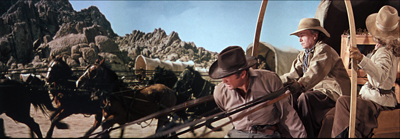
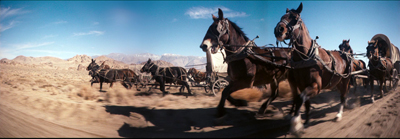
To the audience in front of a curved screen, the movement in the second shot would have looked somewhat (but not entirely, I think) more linear. For us, we see a perspective we’ve never seen before, with wagons diverging from one another but neither getting smaller or larger. And how about the dizzy swerve that the pathway in panel C takes when it reappears in panel A?
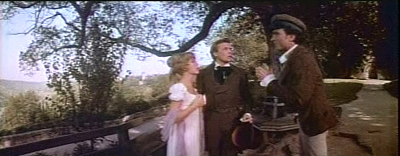
The angled-triptych format obliged actors to adjust their performances in counterintuitive ways. “An actor in a side panel,” wrote Daniels, “cannot look directly at one in the center panel when speaking to him, but must cheat a little–direct his eyes a little behind the one in the center.” Here’s an example from The Wonderful World of the Brothers Grimm that stands out when seen in the flat format. Wilhelm is speaking to Greta from the C panel, but it seems that Laurence Harvey didn’t cheat his body quite enough. He seems to be speaking past her, an effect not helped by the disproportionate size of his body.
This Is Cinerama is obsessed with centering its action, but sometimes the center seems strangely off-kilter. With the water-skiing women shown earlier, the three cameras create a sort of hollow viewing station. Why do the flanking skiiers seem to be moving at angles to the central trio? Why do the ropes of the central skiiers fly off (jaggedly) to one side, rather than expand directly towards us, like train tracks?
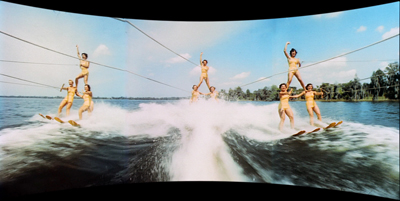
As with the wagon teams, you have to imagine diagonal actions as rotated inward to parallel one another during projection. What you see is not what you’d get in the theatre. But also, what you see is something you’ve never seen in a movie before.
Most of these effects are heightened by the inability of the three-eyed monster to record close-ups. Because of the short focal length, the camera unit sat very near the actors: for a shot from the waist up, the central lens was between one-and-a-half and three feet away. Putting the camera so close necessitated lights being attached to the camera unit. But normally close-ups were avoided, so the human figures never dominate their locales. These movies are, more than most, about space–however buckled and bizarre that space might be.
Because of the panels, panning shots were to be avoided, but certain kinds of camera movement forward were welcomed. The signature Cinerama shot is the shot plunging toward the vanishing point–a boat rushing through the water, an aerial view banking toward the horizon. Even though the blend lines made shapes and edges wrinkle, this gigantic, embracing image streaming toward viewers gave a compelling illusion that they were hurtling forward.
The distortions are less visible from a perfect vantage point in a Cinerama auditorium–presumably, as close as you can get. Distortions on the display edges would be minimized by peripheral vision, which isn’t good at registering detail. Presumably some of the curvilinear shapes, like Linus’ oar, and those kinks across the blend lines, would be less egregious if viewed straight on. Watching from the front row in Bradford, I recall seeing these distortions, but they didn’t seem as vivid.
Naturally, not everybody in the auditorium has a perfect vantage point. In the original screenings, people who had sat on the sides complained that movement on the nearest flanking panel seemed to flow upward. Smilebox, which respects the overall geometry of the display, still yields disparities. Linus’ oar still curves, though not as pronouncedly.
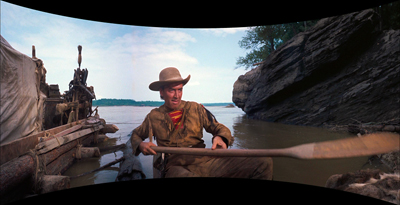
My images here, and yours on your home screen, are unavoidably mapping a curved display onto a flat surface, so there will still be anomalies. If you want to try cutting down on them, sit close to the Smilebox display. I prefer to sit back and enjoy their weirdness.
They’re features, not bugs
What about the films themselves? Arguably no great film was made in the format, but all the releases probably have some admirers. I want to end by talking about the two I find most appealing.
Cinerama’s travelogues were episodic, designed to show off features of the process in different filming situations. The two fiction features had to highlight the process and tell a coherent, engaging story. They too tend toward the episodic, but they handle that option in different ways. And stylistically, both work against the official “rules” of the new format.
The Wonderful World of the Brothers Grimm, an entertaining family film, employs a frame story. The brothers are assigned to write the family history of the local Duke. Jacob, an expert linguist, does his job dutifully, but Wilhelm plays hooky to find and write up fairy tales he hears. His zeal to collect stories leads to the loss of their commissioned manuscript, and he falls ill, during which several fairy-tale characters come to visit him. Eventually Jacob is honored by the Royal Academy, but it’s Wilhelm who gets enduring glory by being swarmed over by hordes of children anxious to hear his latest tale. Within this overarching plot, three of the stories are enacted using various special effects, including puppet animation. Some of these shots appear to have been shot in a non-Cinerama format and “paneled” afterward.)
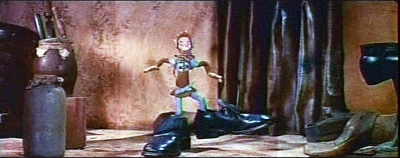
It’s tempting to ascribe the frame story’s direction to Hollywood veteran Henry Levin and the embedded fantasies to co-director George Pal. To the connoisseur of Cinerama, those fantasy passages offer some delights. If anybody told Pal about the rules for shooting in the format, he ignored them. The fairy tales give us whirling camera movements, bumpy subjective shots, and frequent assaults on the audience in the manner of 3D. During a wild coach ride, the coachman hurls himself to and from the camera. Later, a knight’s bumbling servant slays a dragon in lunging close-up.
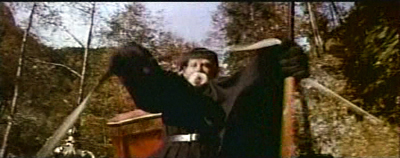
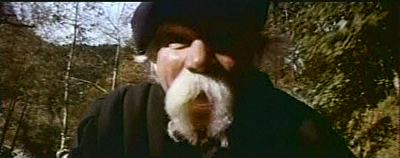
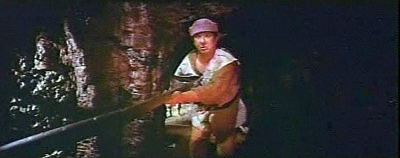
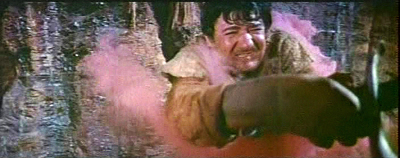
You can even take certain passages as sly parodies of the brand. The Woodsman in the first tale has hitched a ride on the back of the coach, and he stoops to look underneath. Cut to his point-of-view: an upside-down version of a signature Cinerama shot.
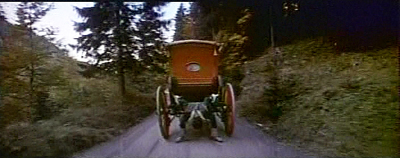
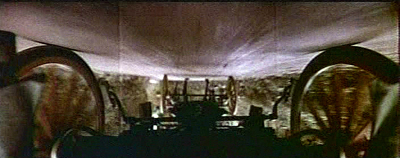
Whoever directed the frame story scenes, however, was fairly bold too, moving his actors in zigzag patterns more flamboyant than the blocking of How the West Was Won. And instead of the small, high sets recommended for the format, Wonderful World shoots in throne rooms and palace salons that seem to stretch on forever. In smaller sets, like the brothers’ cottage, their friend’s bookshop, and especially the lair of a witch, the compositions take advantage of crannies and oddly angled planes that enhance the exaggerated distances.
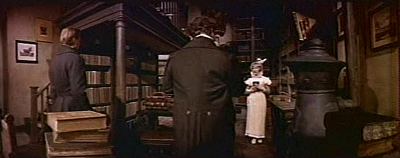
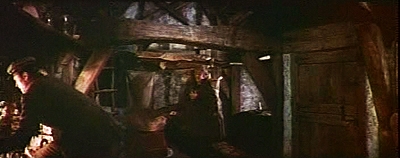
As in German Expressionist cinema, the distortions seem to suit an atmosphere of fantasy. There’s even a massive violation of one of the basic rules of Cinerama: avoid tilting the camera. High and low angles were likely to exaggerate any distortions in the panels. Yet Levin, or Pal, or both occasionally throw in expressive angles, most strikingly a low angle showing Wilhelm’s family and friends ascending to his sickroom.
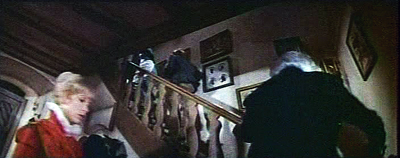
The Wonderful World of the Brothers Grimm solves the problem of the episode film by giving us a frame story. How the West Was Won solves it by a more threaded structure. A family saga creates branching stories that show three generations of kin participating in the winning of the frontier. The story acknowledges, briefly, the conquest of indigenous peoples–the “liberal Westerns” of the 1950s haven’t been ignored–but slavery doesn’t play a significant role. This is a story of white people.
The Prescott clan sets out on the Erie Canal, but on the rivers all but two of them lose their lives. The warm, slightly romantic Eve settles with the trapper Linus Rawlings on a farm in Ohio, while her sister Lilith ventures west. Eve’s son Zeb joins the Union forces in Civil War and later moves west with the railroad, eventually becoming a marshall. Lilith joins a wagon train, takes up with a gambler, inherits a worthless mine in California, and reunites with her lover on a riverboat. They become entrepreneurs investing in the railroad system. Near the end of the century, Lilith loses her fortune and joins Zeb, now retired, and his wife and children. But before they can settle down on Lilith’s inherited Arizona ranch, Zeb has to settle a score with a bandit who intends to rob a train. The film falls into sections specified in the credits–The Rivers, The Plains, and so on–but not in the film, though the parts usually end with fades.
Marker might note that How the West Was Won revives the piety and chauvinism on display in This Is Cinerama. The Prescott women found a kind of holy family, bound, as one song puts it, “for the Promised Land.” Some writers thumb through the phone book to get names for their characters, but screenwriter James R. Webb seems to have favored the Old Testament. Eve, living up to the positive side of her name, becomes the first woman of the new land. In forcing Linus to become a farmer, she helps turn the wilderness into a garden. Lilith, whose name associates her with sexuality and demonic possession, becomes a dance-hall girl and eventually a millionairess, but she has no children. At the end she returns to her nephew, Zebulon, named for her father; in the Old Testament he is the founder of a tribe. And Zeb has named his daughter Eve. The family abides in an endless cycle, its members replacing one another and its history intertwined with the full flowering of the United States.
The film ends with the sort of God’s-eye views that conclude This Is Cinerama, but emphasizing the modern West, with its dams, roads, cities, even whorls of traffic. Interestingly, in the place of the forward rush of the earlier film, these aerial shots pull us backward, the classic mark of the end of a story. But the finale of the epilogue carries us forward once more, under the Golden Gate Bridge and into a sunburst over the Pacific. Since women have played a central role, no surprise that the final lyrics of the choral accompaniment celebrate heroes as “every mother’s son.” This country has reached its natural limit; beyond is heaven, and the chorus tells us, here at last is the Promised Land.
Most scenes are handled briskly, but with little nuance beyond what the actors bring to the story. The spectacle remains appealing, the music infectious, and the imagery always impressive–especially when it’s a little whacked out, as in my examples above and many other scenes of the film. Like The Wonderful World of the Brothers Grimm, this has shown that Cinerama can be edited rapidly. This Is Cinerama has only a little more than two hundred shots, but Wonderful World has a thousand, and How the West Was Won has over eleven hundred. The chapters of the latter yield some striking results: most average between eight and nine seconds, but John Ford’s Civil War segment averages nearly fifteen seconds, while the climactic Outlaws segment averages about five seconds.
That climactic sequence, directed like most of the film, by Henry Hathaway, makes splendid and varied use of the format. Despite a heavy reliance on back projection and several shots that seem not to have been made in the three-camera process, this monumental remake of The Great Train Robbery is a showcase for how Cinerama could create exciting action through staging and editing. To the advantages of Cinerama–forward drive, looming landscapes, and immersive sound–Hathaway and editor Harold Kress add percussive cuts of logs sliding this way and that, along with painful stunts, including one showing a man flung off a train and into a cactus.
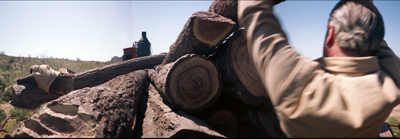

By contrast, the Civil War sequence shows how a director can triumph over an inflexible format by relying on expressive stasis. Ford the pictorialist will carve striking compositions out of the constraints of Cinerama. He exploits the depth of the 27mm lenses, sometimes stationing all his figures in the central zone, as if he’s trying to preserve the 1.37 aspect ratio. At other moments he confines the action to a single flanking panel.
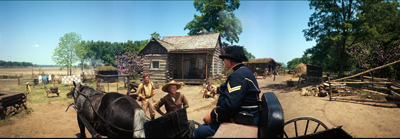

Sometimes Ford simply ignores the triptych format in order to split the frame in half or, say, two-fifths. He also gives his actors postures, props, and gestures that allow them to underplay. With Ford, even fresh-minted junior stars like Carroll Baker and George Peppard can give performances of gravity.
Ford’s creative choices stand out most strongly in two scenes set on the farm. In the first, Linus Rawlings has gone off to battle, and his son Zeb is itching to follow. Eve, now old, accepts with weary sadness that he will have his way. There’s a Griffithian two shot of Eve and Zeb on the porch, her arms dangling wearily and her right hand rising and falling as she asks Zeb about whether he’ll get a uniform. The hell with Cinerama, Pappy seems to say: Just fill up half the frame with the cabin to keep us fastened on the couple.
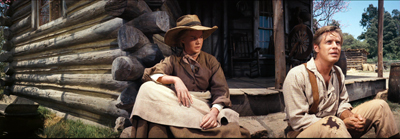
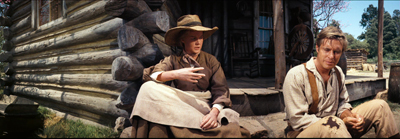
After a quick embrace, Eve dashes into the house. A porch shot that is virtually a Fordian doorway framing shows Zeb leaping with joy before he turns, sees something in the house, and halts in his tracks. Ford needn’t show us Eve’s grief. This is the most tactful shot in the whole film.
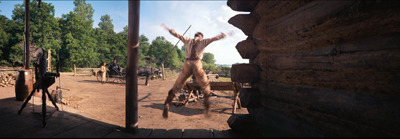
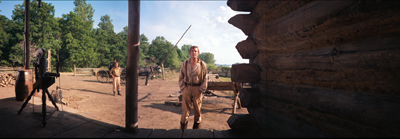
Soon enough Ford will recall this scene. Zeb has left for the war. Eve, kneeling at the family plot, prays to her father before slipping behind the rail. Her face is hidden, but her hands again express her resignation, and prefigure her death. She was never the same, her other son will say, after Zeb left.


These homestead passages are echoed by a scene at the end of the Civil War segment. Back from the war, Zeb learns of his mother’s death from his brother Jeremiah. The two sit on the porch sharing a dipper of water and recalling their father. Zeb rises to go, they shake hands, and we get another muted Fordian moment. Why move your actors when you can pose them?
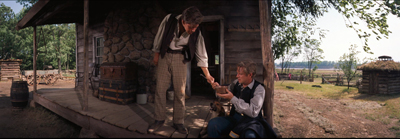
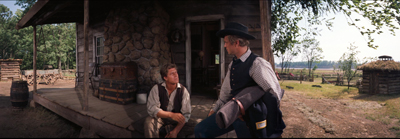
Now the old director, a master of depth since the 1910s, bends this newfangled format to his own ends. Zeb leaves the frame, comes back in the far distance, and is finally blocked by the farmhouse, leaving Jeremiah quietly weeping.
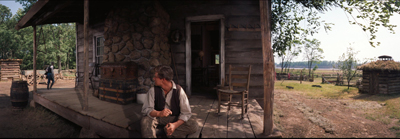
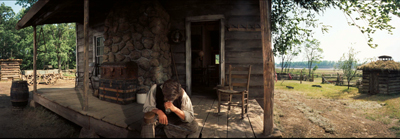
That’s how you handle this busy, noisy new contraption, Ford seems to say. Dwell on moments of stillness and pathos. Use handshakes, embraces, a drooping black shawl. Keep the action in a well-defined zone. And treat this as a silent movie.
The most comprehensive account of Cinerama’s development is Thomas Erffmaier’s 1985 Northwestern Ph. D. thesis, The History of Cinerama: A Study of Technological Innovation and Industrial Management. Also invaluable are John Belton’s Widescreen Cinema (Harvard University Press, 1992) and Robert E. Carr and R. M. Hayes’ Wide Screen Movies (McFarland, 1988), usefully supplemented by Daniel J. Sherlock’s emendations here. A good older work is Michael Z. Wysotsky, Wide-Screen Cinema and Stereophonic Sound (Focal Press, 1971). Sheldon Hall and Steve Neale put This Is Cinerama into the context of postwar blockbusters in Epics, Spectacles, and Blockbusters: A Hollywood History (Wayne State University Press, 2010), Chapter 7. On the Web, restorer and cinematographer Greg Kimble provides a thorough and well-illustrated account of Cinerama at In 70mm.
Chris Marker’s “Le Cinérama” appeared in Cahiers du cinéma no. 27 (October 1953): 34-37.
Cinerama grew out of Fred Waller’s experiments with gunnery-training displays during World War II, as Strohmaier documents in Cinerama Adventure. Waller discusses this work in “Cinerama Goes to War,” New Screen Techniques, ed. Martin Quigley, jr. (Quigley, 1953), 119-126. This collection includes other pieces of value on Cinerama, 3D, CinemaScope, and other new technologies. It would be interesting to know if Waller’s efforts influenced, or were influenced by, psychologist J. J. Gibson’s comparable wartime experiments with aerial training films. Gibson’s ideas about how we grasp space through “optical flow” and centered perspective have obvious parallels with the Cinerama process. Waller was said to have been influenced by another psychologist, Adelbert Ames, Jr., one of the founders of 1950s “New Look” psychology. Waller’s belief that our peripheral vision was more important than stereopsis in determining depth echoes Ames’ hypothesis that convergence and binocular disparity were overrated as depth cues.
Greg Kimble provides a thorough overview of the making of How the West Was Won in a 1983 article for American Cinematographer, available here. I’ve drawn as well on William Daniels’ article “Cinerama Goes Dramatic,” American Cinematographer 43, 1 (January 1962): 28-29, 50-54. Also useful was Darrin Scott, “Panavision’s Progress,” American Cinematographer 41, 5 (May 1960): 302, 304, 320-322, 324. My quotation about readjusted sets comes from Scott’s piece.
Three-panel Cinerama features can be seen occasionally today at the Pictureville Cinema in Bradford, the Cinerama Dome in Los Angeles, and the Seattle Cinerama.
Simultaneously with This Is Cinerama, Flicker Alley has published a lavish Smilebox version of Windjammer, also prepared by David Strohmaier. That’s a whole other story.
P.S. 5 October: You never can tell. Jim Emerson forwards me this Indiewire report by Len Maltin on a new short made in three-panel Cinerama.
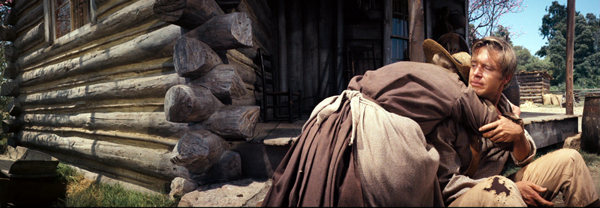
How the West Was Won.
TIFF: More than movies
Audiences gather for screenings at the Bell Lightbox, hub of the Toronto International Film Festival.
DB here:
Around midnight tonight, the crowds packing the Toronto International Film Festival will disperse, leaving the city full of memories of another extraordinary year. I’ve been back in Madison for this last week, but my few days at TIFF remain on my mind. This is partly because along with the films came a lot of ideas, opinions, and information. At any festival, fraternizing with audiences, critics, and programmers is one fine way to get that stimulation. It happened after some of the Wavelengths section’s short-film programs. Here are Raymond Phatanavirangoon and Bob Koehler outside the Art Gallery of Toronto, where their Devo retro-stylings raised our conversation to a new level.
More structured sessions delivered too. Out of my 4-plus days at the Toronto International Film Festival, I set aside about one and a half for industry panels and filmmaker Q & A’s. Let me tell you a little of what I learned.
From Assayas to Asia
TIFF: Where programmers meet stardom.
The talkfests I attended shed light on both film artistry and film business-making. Central to the first area was the master class with Olivier Assayas, hosted by Brad Deane.
Assayas, a charming fellow, talked fluently about how Something in the Air (discussed here) bears traces of his youth. During the 1970s, high-school kids were “footsoldiers of the cultural war of the time.” He recalled his affinities with the artistic side of the counterculture, as opposed to the extremes of the political activists, some of whom, being aligned with Maoism, refused to recognize the Cultural Revolution as “disaster on a demented level.” Yet this shouldn’t be taken as apolitical aestheticism; Assayas has been a vigorous advocate for the work of Situationist Guy Debord.
 Assayas was refreshingly detailed about his working methods. He writes only one draft of his screenplay, partly because he wants to protect the “digressive” aspects of his story. (This tendency is apparent, and enjoyable, in Something in the Air.) Since his films are difficult to classify within standard genres, he needs to cobble together creative financing for each project. But the script becomes obsolete when he casts the film and visits locations. By embodying the characters, the actors create beings “more powerful than what I’ve written.” Working with them, he refuses to supply background on the characters’ psychology. “I look to them to understand the characters.” This hands-off approach yields striking results in the new film, where nearly all the cast is non-professional.
Assayas doesn’t undertake elaborate rehearsals, instead coming to the set each morning and describing the shots they’ll make. He wants to take account of the evolution of the film as it’s been developing. He doesn’t fully block the shots. He sketches each one in longish takes that, as the actors expand on the action, “add layers” to what he’d initially planned. Alternatively, he cuts up the long takes and combines pieces of them. For Something in the Air, he relied on stable and wide framings, partly in reaction to trends toward handheld shots and close-ups, partly because he used the crane to create a “floating,” more lyrical circulation through the space.
 Artistry, mixed with business sense, was apparent in one of the panels at the Asian Film Summit’s day of meetings. Colin Geddes hosted a session on Asian genre cinema, and several producers and directors shared thoughts on action cinema as an international genre. Fanboy blood pulsed high.
Eli Roth (left), another kid who grew up with Kung-Fu Theatre on TV, was bowled over years later by Korean and Japanese thrillers like Sympathy for Mr. Vengeance. Now Roth is producer and co-writer of The Man with the Iron Fist, directed by RZA–who is, according to Roth, letter-perfect on his kung-fu film knowledge. “We wanted to do a movie like we saw as kids on Saturday afternoon.” But production values in the genre have swollen since the old days. The project is using the Hengtian studio’s vast replica of the Forbidden City. RZA, Roth says, expected The Last Emperor to be a kung-fu movie, so this is his attempt to make things right.
Tom Quinn, Co-President of the Weinstein Company’s RADiUS division, had similar affinities. As he pointed out, East Asian countries have strong local markets and so can build a base in genre cinema. With quantity comes quality. While working at Goldwyn and Magnolia, Quinn handled US distribution for The Host, Pulse, Tears of the Black Tiger, and most recently 13 Assassins, along with many other titles. Ong-Bak, on view at TIFF in 2004, was a particular triumph for him, yielding over a million dollars in its first weekend of release and eventually garnering $4.5 million in the US. Even the heavy piracy of Ong-Bak Quinn takes as a positive sign, “a validation of the film’s value.”

Bill Kong, a legendary Hong Kong producer and a force behind Crouching Tiger, Hidden Dragon, along with Stephen Fung, director of Tai Chi 0 (above), filled out the panel. Overall, the discussion ranged widely, but one question kept cropping up. Why is it that Western films are widely popular in Asia, but Asian cinema is almost completely a niche market in the West? I didn’t hear a clear answer (though I’d start an answer with Western racial prejudice).
Kong noted that Asian filmmakers don’t have high expectations about penetrating the US market, but other panelists were more hopeful about crossover projects. Quinn pointed out that the festival circuit built an audience, and Roth thinks that Tarantino has been a major player in making Asian film more popular, especially with the Kill Bill duet. The fact that Russell Crowe plays a major part in The Man with the Iron Fist suggests that things may be changing.
Bigger than Bollywood

Mira Nair.
The East/West dynamic was also the focus of two other panels. “India: Lessons from Bollywood and the Independents” brought together a nearly all-female group of experts to discuss local financing and wider distribution. All were agreed that it was necessary to convince the world that Indian cinema was bigger than Bollywood. As director Dibakar Banarjee put it: “We need to open the third eye.”
The local industry has a certain comfortable inertia. A film might cost only $150,000, but it can collect 90% of its production costs upon its opening run, said Shailja Gupta, who has been both a director and production executive. Foreign distribution is a major risk at this budget level. So how does a project, particularly an independent film, get international traction?
Coproductions are an obvious path, and while they are still rare, the trend is emerging. The Indian government’s National Film Development Corporation Ltd. has helped with coproductions since 2006, says Nina Lath Gupta, NDFC Managing Director. Such enterprises are rare and mostly involve France or Germany. By establishing the Film Bazaar in 2007, the NDFC acknowledged the importance of marketing as well as financing, and this is getting local filmmakers acquainted with the need to think more globally.
 Another path to the overseas market was suggested by Guneet Monga (right). She is a producer on the network narrative Peddlers and the two-part gangster saga Gangs of Wasseypur; both earned very good buzz at TIFF. Monga pointed out that sales agents can help shape projects for international distribution.Working with Elle Driver, she was able to generate three versions of Gangs, targeted for different regions. Moreover, sales agents can help a film by avoiding the old practice of selling it as a single package. Instead, the agent can pre-sell it with a minimum guarantee and negotiate territorial rights further down the line.
Mira Nair, distinguished director of Salaam Bombay and Monsoon Wedding, has long enjoyed worldwide exposure, of course. She shared her thoughts on how filmmakers could follow their visions and still, as she put it, “put bums on seats.” That’s accomplished by not worrying about distribution but devoting energies to creative choices–such as she undertook in The Reluctant Fundamentalist, her first foray into the thriller genre.
During the India panel, moderator Meenakshi Shedde asked if China might become a coproduction partner for local films. This is currently not happening, but the question reflects the significance of the People’s Republic on the global film scene. Earlier in the day, a panel on “Financing Between Asia and the West,” moderated by Patrick Frater, concentrated mostly on China as the leading edge of the region. Once more, the question of coproductions was central.
“Coproduction is a reality now for global filmmaking,” declared Peter Shiao, CEO of Orb Media Group. But the power of China in the new media landscape has created a false optimism among Western entrepreneurs. Shiao warned newcomers that coproductions can’t be fulfilled in good faith with perfunctory gestures, such as including a Chinese actor in a secondary role. (The Expendables 2 was mentioned in this connection.) Aspiring filmmakers need to grasp and follow the China Coproduction Film Office regulations straightforwardly.
Solid coproductions are rare, agreed Bruno Wu, founder and chair of many top Chinese media groups. He pointed out that what works in China won’t necessarily work in the rest of the world, but what works in the rest of the world is likely to work in China. So the Chinese investor needs to look at projects that will play internationally. He gave as examples his firms’ deals with Justin Lin and John Woo, who have reliably won global audiences. Along similar lines, Stuart Ford, founder and CEO of IM Global, suggested that a good alternative to coproduction involves soliciting equity investment from China for Western films. For example, Chinese investors in Paranoia, a $40 million production, acquired mainland distribution rights as part of the deal.
The soundness of investing in Western films seems borne out by local box-office figures. Seventy percent of China’s market receipts come from English-language imports; the several hundred domestic films produced earn only twenty percent. And theatrical receipts provide, according to Peter Shiao, ninety percent of a film’s earnings. Windows in the Western sense don’t exist, and there’s no legitimate home video market. Gradually local filmmakers are experimenting with Western ancillary tactics; Painted Skin: The Resurrection recently tried out apps and games.
China-based Video on Demand is more promising. In a few years, Wu expects there to be several million addressable HD cable homes, and providing entertainment on demand might provide a way around the national quota system for film import. There is no quota restraining VOD distribution, and as it takes hold, it might reduce piracy.
A killer app? (as in killing off business?)
Jonathan Sehring and Winnie Lau at the VOD panel at TIFF, 9 September 2012.
Speaking of VOD, in early September I signed up. I did it partly because there was one title I needed to see immediately: Keanu Reeves’ Side by Side, the documentary about the digital vs. film controversy. More abstractly, I had been learning a little about VOD when I recast and expanded my blogs on digital exhibition for Pandora’s Digital Box, and I was curious about how VOD worked in practice.
After a period of turmoil, the US film industry has integrated VOD into its system of non-theatrical ancillaries. Before, we had DVD and Blu-ray, both rental and retail, along with movie channels like HBO and Sundance available on subscription cable. Eventually movies would show up on basic-cable channels. There was also “pay per view” via cable, a one-off transaction now known as Pay TV VOD.
Now, the internet has expanded the options.
*Electronic Sell-Through (EST) allows the consumer to download a film and own it. This service is available through iTunes, Amazon, and other outlets.
*iVOD (internet VOD) is a one-off rental, to be run immediately or within a specified time period. To check the 1.77 aspect ratio on Dial M for Murder, I rented it for 24 hours on iTunes.
*Subscription VOD (SVOD), which you get with Netflix, Hulu, Amazon, and other providers. This option provides a library of titles available at any time for a monthly fee. SVOD is comparable to cable-television subscriptions, and it’s becoming very popular, as all-you-can-eat options tend to be.
In addition, another option hovers over the business:
*Premium VOD (PVOD) consists of a one-off rental available sooner than the traditional home-video window. The transmission would be via cable or satellite, not the Net, and the price point has typically been $30 for one viewing. The studios tried out PVOD with DirecTV in 2011, with apparently unencouraging results. Worse, last year’s Tower Heist fracas, during which Universal planned to put the film on PVOD 30 days after theatrical release, triggered threats of boycotts from exhibitors. PVOD, however, is likely to reappear at some point because it can offset losses from the declining DVD market.
No surprise, then, that one industry panel was called “VOD Killed the DVD Star.” The session assembled major players in that domain to discuss the present situation and the prospects for the future.
Much of the panel’s time was devoted to explaining why filmmakers needed to be flexible about accepting VOD as a legitimate complement to or substitute for theatrical release. VOD, they insisted, shouldn’t be seen as a dumping ground for weak or narrow-interest films. The reason: The consumer is king, and consumers want everything on demand.
Winnie Lau, Executive Vice-President for Sales and Acquisitions at Fortissimo, said that companies now recognized that consumers should be able to see a film on whatever platform they want. Given the high costs of a theatrical release, that option isn’t justifiable for many films. Philip Knatchbull, CEO of Curzon Artificial Eye, put the case more strongly, declaring that with the consumer in control, notions like windows and “on demand” are losing their usefulness. His view suits a company that, like IFC, has integrated video and theatrical distribution with theatre ownership and HD delivery. There are, he suggested, only home cinema and public cinema, and everyone in the film value chain should be aiming to reach millions of screens.
Tom Quinn of RADiUS was working for Magnolia when in 2005 Mark Cuban experimented with a multiple-platform release of Bubble. “His vision,” Quinn recalled, “was to make films available whenever people liked.” The Bubble experiment was problematic because it came out on film and on DVD simultaneously, but Quinn said that “the hotel VOD numbers were through the roof.” This summer, after twelve months of preparation, RADiUS has issued its first VOD titles, and Bachelorette, released earlier in September, won notice for earning about half a million dollars in its first weekend.
 The prototype of longer-term VOD success is the later career of Edward Burns. Burns, who had his first success with the breakout indie movie The Brothers McMullen (1995), was lively and articulate. “VOD helped me stay in business.” He knew firsthand the slow rollout that characterized 35mm platform release in the 1990s, along with the months of press tours. In the years that followed, he realized that his movies–basically, as he put it, people bullshitting with one another around a kitchen table–had shrinking theatrical prospects. In 2007, he offered Purple Violets exclusively on iTunes. This came around the time that IFC and Magnolia were experimenting with day-and-date releasing on different platforms.
Burns was satisfied with the results and built a production model around VOD. The cast and crew work for free and collectively own the film. Budgets can be low; he claimed last year that Newlyweds cost only $100,000. Payments are deferred, and if a film breaks through, everyone makes money. His last three films, he reported, did. He compared the business model to that of an indie band. VOD gets his work to the people who watch HBO, Showtime, AMC. “That’s our audience.”
Burns is an unusual instance, since as one panelist pointed out, he has established his own brand. Still, other VOD releases can break out. The most widely publicized example is Margin Call, with about $4.5 million on VOD. Jonathan Sehring, President of IFC and Sundance Selects, was a pioneer of alternative platforms, and he remarked that 4 Months, 3 Weeks, and 2 Days did better on VOD than in theatrical release (where it grossed $1.2 million). In a recent interview, Sehring indicates that the recent IFC release About Cherry as doing as well as Bachelorette on VOD and other revenue streams.
It seems, then, that these and other industry decision-makers see VOD as offering two avenues, depending on the film. VOD can provide a new window, to be added before or after or during theatrical release. Alternatively, VOD can replace theatrical, as it has done for Burns (who will still occasionally give a film like the upcoming Fitzgerald Family Christmas brief theatrical play). With this option, many films, both domestic and imported, will never see a theatrical release but they might make money on the less costly VOD platform.

The problem for the second strategy is finding a way to make the film stand out from the thousands of titles available in cable and VOD libraries. A theatrical release provides the “shop window,” as Knatchbull called it, but without that, the film needs other salient features–big stars or cult buzz–to attract the home viewer.
Despite the panel’s title, the guests didn’t predict that VOD would displace discs. In fact a couple of panelists agreed that DVD and Blu-ray would be around quite a while. Quinn (left) confessed that as someone who grew up with VHS he would always be collecting his favorite films on physical media.
There’s something else to consider: some dramatic disparities between VOD and DVD consumption. The differences are spelled out in a recent IHS Screen Digest report.
On one hand, the VOD audience has grown rapidly. The report counted transactions–buying a movie in any form–and came up with striking figures for the world’s top five regions.
2007: DVD retail and rental: 2.7 billion transactions; online VOD in all forms: 14.8 million transactions.
2011: DVD retail and rental: 2.58 billion transactions; online VOD in all forms: 1.4 billion transactions (nearly all SVOD).
The Screen Digest team estimates that 2012 will see an even bigger burst in online VOD, totaling 3.4 billion transactions, with nearly all that via subscription. (I’m in there somewhere.) By contrast, physical media sales and rentals are predicted to fall further, to 2.4 billion transactions.
The disparity lies in “monetization.” We have some access to weekend box office grosses, but almost none to income from DVD and VOD, so comparison is difficult. Still, everyone knows that DVD purchase and rental, along with pay TV licensing, yield the bulk of film revenues. In another research report, Screen Digest estimates that in the US the 2012 surge in VOD will yield only $1.72 billion. DVD will yield $11.1 billion, nearly ten times the VOD transactions. Even with the declining retail and rental prices of discs, VOD yields much less per transaction than DVD does, especially with subscription services leveling out the cost to consumers.
So did VOD kill, or at least wound, the DVD star? When measured in transactions, yes. In revenues, no. Moguls pay off their Ferraris in dollars, not transactions, so it seems that VOD would have to expand colossally, or raise prices, or both, to come close to achieving the returns of DVD.
It’s conceivable that VOD will cannibalize other windows, if you’ll excuse the mixed metaphor. DVD transactions were going downhill before the rise of VOD, but perhaps VOD will accelerate that plunge. iTunes already charges up to $20 for EST downloads of a new release. As consumers become used to storing their movie and TV collections digitally, the convenience of EST could hurt DVD sales.
Moreover, VOD has always threatened the theatrical market. That’s why exhibitors cried foul when Premium VOD was tried. But box-office grosses overall remain robust because ticket prices are constantly rising and 3D and Imax rely on upcharges. These revenues offer studios a good reason to maintain strict windows, at least for their most successful releases. Still, studios are very likely to continue to press for PVOD. And indie distributors have embraced VOD release exuberantly. Foreign and indie titles released on VOD before or during the theatrical run may steal business from art houses.
In sum, VOD might shake up the other platforms quite a bit. If your analogy is the music business, theatrical and DVD formats stand in for albums, while VOD is the online force that lowers consumers’ sense of a fair price point. There’s some discussion of raising prices for some iVOD and Pay TV VOD offerings to parity with theatrical ticket prices. I wonder if consumers will sit still for that. As a novice VOD’er who likes going out to see movies big, I probably wouldn’t. Unless Hulu’s Criterion library discovered a lost Mizoguchi.
Assayas’ autobiography A Post-May Adolescence has just been published in English translation. It includes two essays on Debord. At the same time, an anthology of critical essays on Assayas, edited by Kent Jones, has appeared in the sterling Austrian Film Museum series.
Patrick Frater reports on the TIFF Asian Film Summit at Film Business Asia.
My statistics on the progress of VOD come from “Movie Consumption Stabilizes,” IHS Screen Digest (April 2012): 95-98, and “Online Movie Consumption in the US,” IHS Screen Digest (May 2012): 116. See also Andrew Wallenstein’s Variety story, where we learn that Netflix’s subscription model is beating the pants off the competition. Thanks to David Hancock of IHS Screen Digest for further information.
As before, thanks to my Toronto hosts Cameron Bailey, Brad Deane, Christoph Straub, Andrew McIntosh, Andrea Picard, and all their colleagues.
TIFF leaves an indelible mark: The ankle of Crystal Decker, Marketing Manager of Well Go USA Entertainment, US distributor of Tai Chi 0.
P.S. 17 September: Thanks to Anuj Mehta for correction of a misspelled name.