





Archive for the 'Film history' Category
It’s the 80s, stupid
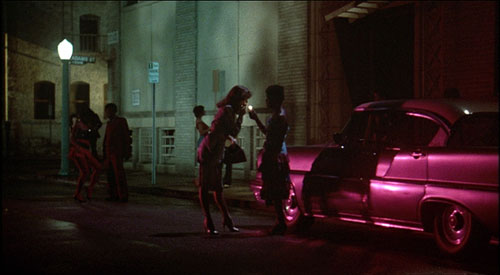
Choose Me.
DB here:
In an earlier post, I proposed that film historians can’t safely assume that decades mark off meaningful periods. Yet I can’t help succumbing to the temptation myself. It happens every time I hear about how the 1970s were the last great decade in American film.
We’re often told that back then, countercultural forces gave us movies of restless auteur ambition like Five Easy Pieces and Nashville and Mean Streets and Shampoo. Meanwhile, The Godfather, Jaws, American Graffiti, and even Star Wars not only rejuvenated the studio system but also reflected something of their directors’ temperaments, providing Hollywood with an enduring new mythology. So far, so plausible.
Then, the story goes, came the age of the blockbuster. Thereafter, moviemaking was simply selling out, winning the weekend, building franchises, and catering to disposable teenage income. Like big hair and padded shoulders and Wham!, the films of the 1980s are apparently something to be ashamed of.
The glorious burnout
This judgment is spelled out most fully in Peter Biskind’s Easy Riders and Raging Bulls, a celebration of and postmortem on the Movie Brats era of the 1960s-1970s. Biskind doesn’t try to make a critical case for the films of the period; he assumes that everyone counts these movies as edgy masterpieces. He’s more interested in the sensational lifestyle of the filmmakers. Filling his pages with gossip about alcohol, cocaine, backbiting, squabbles, and the horizontal mambo, he could hardly deny that his favorite directors were somewhat self-destructive. He justifies their escapades by treating them as driven artists fighting a corrupt system—mavericks, in fact. (Yes, he uses the word.) This idealization occasionally leads to mawkishness that Biskind would castigate if he saw it on the screen:
Hal Ashby did die just after Christmas, on a raw, rainy Tuesday. . . .The papers said it was liver and colon cancer, but it could just as well have been a broken heart. (1)
Forgiving the flaws of these all-too-human directors, Biskind spares no sympathy for the producers who focused on the bottom line. With rising budgets and distribution costs, the studios’ cynical leaders chose to play safe with megapictures that purveyed “smarmy, feel-good pap.” (2)
It’s a good, simple story, and the problem is the simplicity. The top-grossing movies of the 1970s include Love Story, Fiddler on the Roof, The Sting, The Towering Inferno, Rocky, Grease, Smoky and the Bandit, and Star Trek: The Motion Picture. These aren’t exactly testaments to personal expression. The megapicture mentality we associate with the 1980s was already present in some of these, as well as in The Poseidon Adventure, Earthquake, and Superman. The four-quadrant movie was taking shape well before Heaven’s Gate brought auteur ambitions crashing to earth.
Further, not every 1980s movie aimed to be a blockbuster. I tried to argue in The Way Hollywood Tells It that just as in the classic studio era, we have to look for creativity beyond the titles that dominate the best-10 and top-grosser list. In addition, there are always filmmakers whose sensibilities naturally match the demands of big-budget projects: David Lean and Anthony Mann managed it in the 1960s, Spielberg and Lucas in the 1970s. In the 1980s several directors were able to make strong, original megapictures.
So you can make a good case that the 1980s gave America a burst of first-rate films and remarkable new talent. At all levels, from ambitious prestige items to dazzling genre pictures, the decade is nothing to be sneezed at. The maw of home video had to be fed, so the demand was for product of all sorts. Videotape rental expanded specialty niches and cult markets. Filmmakers could finance projects through video and foreign presales, and investors took chances at many levels. The era saw a revival of ambitious independent films, which played alongside program pictures, Oscar bait, and summer blockbusters. Romantic comedy, action movies, and science fiction enjoyed a strong run. And many of the people we still consider genuine movie stars—Tom Hanks, Julia Roberts, Glenn Close, Harrison Ford, Mel Gibson, and Tom Cruise—are ineluctably creatures of the 80’s.
My defense doesn’t spring from generational bias. I don’t have the excuse of adolescent nostalgia that makes Tom Shone write:
What a grand piece of historical luck it was to be in your early teens when Raiders of the Lost Ark came out—when Spielberg and Lucas were in their prime and the very act of going to the movies seemed to come with its own brassily rousing John Williams score. Later on, we would learn to cuss and curse the infantilization of the American film industry, just like everyone else, but back then we were too busy infantilizing it to notice. (2)
So here are some assorted, more or less objective reasons to consider this decade as making a remarkable contribution to U. S. film history.
New talents, old genres
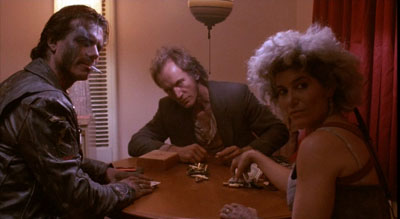
Near Dark.
Put aside two highly influential 1980s films, E. T.—The Extraterrestrial and Raiders of the Lost Ark, since Biskind would consider them feel-good pap. Put aside Raging Bull, which he grants canonical status as the capstone masterwork of the 1970s generation. Even granting all this, most major 1970s directors didn’t vanish in the megapicture decade.
Scorsese’s underrated King of Comedy was a portrait of a social type, the obstinate, delusional nerd; we all knew one, but we hadn’t seen him on the screen before. Altman moved from Popeye, a sort of anti-musical and anti-comic-book movie, to intimate theatre pieces like Streamers and Secret Honor and Fool for Love.
From Jonathan Demme we had Melvin and Howard and Something Wild; from Clint Eastwood, Pale Rider and Bird; from Paul Schrader, American Gigolo, Cat People, Mishima, and the Bressonian Patty Hearst. Coppola, supposedly a marked man after Apocalypse Now, gave us another anti-musical (One from the Heart) and a robust biopic (Tucker: The Man and His Dream). De Palma outraged his audience with Dressed to Kill, Blow Out, and Scarface. John Carpenter’s B-movie sensibility was given full throttle in Escape from New York, The Thing, and Big Trouble in Little China. And arguably David Cronenberg hit his stride with Scanners, Videodrome, The Dead Zone, The Fly, and Dead Ringers. Maybe we should just call the 80’s the Cronenberg Years.
Veteran directors also got in their licks. Sidney Lumet had a remarkable run; if you bet on Serpico, I see you The Verdict and raise you Prince of the City. Sergio Leone offered Once Upon a Time in America, a film that looks more ambitious on each viewing. John Huston checked in with Prizzi’s Honor and The Dead, Sam Fuller with The Big Red One.
Biskind castigates the 1980s for parvenu producers like Don Simpson and Michael Eisner, but he doesn’t mention all the new directors who emerged. Some allied themselves with independent companies or mini-majors, others worked through the studios, but in any case it’s strange to overlook Michael Mann, Oliver Stone, Tim Burton, the Coens, Spike Lee, Robert Zemeckis, James Cameron, George Miller, Barry Levinson, John Sayles, Gus Van Sant, Jim Jarmusch, Katherine Bigelow, David Mamet, Steven Soderbergh, et al. Just cherry-picking their films yields up Thief, Manhunter, Salvador, Platoon, Wall Street, Born on the Fourth of July, Pee-Wee’s Big Adventure, Beetlejuice, Batman, Blood Simple, Raising Arizona, She’s Gotta Have It, School Daze, Do The Right Thing, Used Cars, Diner, Tin Men, The Abyss, Return of the Secaucus Seven, Matewan, Mala Noche, Drugstore Cowboy, Stranger than Paradise, Down by Law, Mystery Train, Near Dark, House of Games, Things Change, sex, lies and videotape. Not many dribs of feel-good pap in this bunch.
There was a lot of bloated Oscar bait, I grant you. Is anybody, anywhere on the globe watching Gandhi or Chariots of Fire or Driving Miss Daisy at the moment? But we had Amadeus, an intelligent biopic, as well as Tender Mercies and Coal Miner’s Daughter and Rain Man.
The 1980s kept genres firmly at the center of Hollywood. Instead of working against genre conventions, as many Movie Brats had done (not all; remember Bogdanovich), many of the most talented Eighties directors found ways to do what they wanted in and through genres. In this sense, they were more like Hawks and Ford and other classical filmmakers. The “personal” mainstream film wasn’t a contradiction in terms.
Take science fiction. Blade Runner, which became as influential as Metropolis and 2001, pushed to an extreme the premise of Alien: The future will be rusty, drippy, and stygian. Blade Runner also expanded teenage vocabularies by at least one word (can you say dystopian?). Handed another cult science-fiction story, David Lynch turned Dune into a pageant of hallucinatory grotesques. Voices float unbidden in the air, and boils never looked so glistening. Today, these overstuffed genre pieces repay viewing more than Out of Africa does.
Granted, the 80s gave us plenty of earnest clunkers in the drama department, perhaps most notably The Color Purple. But we also have Body Heat, Never Cry Wolf, Fatal Attraction, Witness, Kiss of the Spider Woman, The Accused, Terms of Endearment, The Right Stuff, Field of Dreams, River’s Edge, Places in the Heart, The Big Chill, and other sturdy efforts.
If you admire Ishtar, then add it to this list. Ditto the parboiled stylings of Alan Parker: Pink Floyd The Wall, Birdy, Angel Heart, and Mississippi Burning. And if you grew up on John Hughes movies, there’s no more to be said by me. You probably still love Sixteen Candles, The Breakfast Club, and the rest. Okay, maybe we should consider it the Hughes decade.
Laughs and bullets

Fantasy comedy flourished in the period, from a masterpiece of dark humor like Beetlejuice to amiable fare like Ghostbusters, Big, Splash, and All of Me. Add to this list Gremlins, sort of the down-and-dirty E. T.; I dare you to watch this or the 1990 sequel without laughing. Farce was also on the agenda, with the output of Mel Brooks (Spaceballs) and the Zucker-Abrams team (Airplane! Top Secret!), and one-offs like A Fish Called Wanda. Saturday Night Live continued to breed new stars. Bill Murray, today an axiom of the independent cinema, made his debut in the period. And after The Adventures of Pluto Nash (2002) and Meet Dave (2008), it’s heartening to remember Eddie Murphy’s appeal in 48 HRS, Beverly Hills Cop, Trading Places, and Coming to America.
On the romantic comedy front, we had Victor/ Victoria, Mystic Pizza, Desperately Seeking Susan, Broadcast News, Moonstruck, Bull Durham, and one of the supreme achievements in the genre, Tootsie. I never met anybody who didn’t like Tootsie.
Speaking of romantic comedy, every era has its favorite perky blonde. Long ago it was Doris Day; today it’s Reese Witherspoon. In between came Goldie Hawn, who gave us Private Benjamin and, mixing it up with Chevy Chase, two trim comedies Foul Play (okay, 1978) and my own favorite, Seems Like Old Times, a frothy revival of the screwball tradition. Her mantle was picked up by Meg Ryan in When Harry Met Sally, and she continued to deliver pert-and-lovable through the 1990s.
Movies centering on kids, like WarGames and The Karate Kid and Stand by Me, proved unexpectedly enjoyable to grownups too. Back to the Future was an intricate Oedipal fable, coarsened but also complicated in the second installment and sweetened in the third. Coppola’s flirtation with teenage art movies gave us The Outsiders and Rumble Fish. Fame is probably a part of every Gen-Xer’s childhood too, as are other musicals like Flashdance, Dirty Dancing, Hairspray, and the 1989 resurrection of Disney animation, The Little Mermaid.
With the new attractiveness of the global market, the demands of home video, and increasingly sophisticated special effects, the 1980s brought the really violent action movie into its own. I’m not ready to defend Rambo and its clones, not even the indifferently directed Lethal Weapon. But I will stick up for Fort Apache—The Bronx, The Terminator, Robocop, Aliens, Predator, and The Untouchables, the last of which has given us many lines appropriate to President-elect Obama’s Chicago-based campaign. (“Brings a knife to a gunfight.” “They send one of yours to the hospital, you send one of theirs to the morgue.”) Road Warrior probably counts as an import, but we ought to treat Mad Max Beyond Thunderdome as a Hollywood release. This sequel transposes the earlier film’s grimly amusing chases and stunts into full-out slapstick, while giving us one of the most touching finales of any film of its day.
I save for last the obligatory mention of Die Hard, the Jaws of the 1980s: a perfectly engineered entertainment.
Middlebrow, semi-highbrow
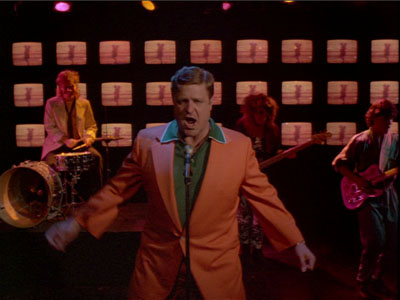
I don’t automatically despise middlebrow culture (a subject, I hope, for a future blog). But many cinephiles do, so I’m probably in the minority in my esteem for another prototypical 80s director, Ron Howard. Like Zemeckis, he started his climb with a something a little naughty, the mortuary comedy Night Shift. Thereafter he tried to update Hollywood genres in ingeniously middlebrow fashion, from Cocoon and Gung Ho to Parenthood, probably his best film of the decade.
Hollywood films have long blended art-cinema experimentation and genre conventions; it’s what a lot of people found exciting about The Conversation and The Godfather Part II and the seventies work of Altman. That sort of blending continued in the 1980s. The most obvious examples came from David Lynch, with The Elephant Man (surreal visions plus disfigured hero) and Blue Velvet (the Hardy Boys meet sadomasochism). Another merger of art movie and genre movie was The Stunt Man, a three-card-monte affair about moviemaking. Want a postmodern musical? David Byrne’s True Stories treated avant-garde art as of a piece with down-home kitsch. The music track is infectious, with the lip-sync sequence on “Wild, Wild Life” capturing the sense that everyone can be famous for, well, not fifteen minutes but about ten seconds.
I’m venturing onto disputed terrain here, but I vote for Alan Rudolph’s Choose Me as an intelligent blend of Euroart neuroticism and off-kilter romantic comedy. The first shot, a long take craning down the side of a bar sign and along a street filled with hustlers sometimes dancing and sometimes not, accompanied by Teddy Pendergrass’s music, remains a tingling moment of bravado. The interruptive flashbacks (or are they visions?) and some tricky pan shots play daringly with character motivations. I also admire Trouble in Mind and The Moderns, but I realize that making a case for them would probably be pushing my luck.
When was the last time Woody Allen made a really good movie? Hard to say, but recall three 1980s titles: Hannah and Her Sisters, Zelig, and Crimes and Misdemeanors. They show that Allen could take chances with adventurous narrative strategies, while mixing in mordant dialogue, social satire, surprisingly bitter comedy, and earned pathos. Consider Radio Days the cherry on top.
There are plenty of other worthwhile items: My Favorite Year, The Dream Team, Valley Girl, Adventures in Babysitting, Excalibur, Earth Girls Are Easy, The Abyss, This Is Spinal Tap, D. C. Cab, The Princess Bride, Total Recall, Day of the Dead, Monkey Shines, Streets of Fire, Housekeeping, Purple Rain, Koyaanisqatsi, The Thin Blue Line, and on and on. Few are perfect, but most offer genuine pleasures, and some are as imaginative and bold as the canonized films of the 1970s, albeit in different registers.
Not every film on my list will convince everybody, but I think there are enough solid achievements to show that the blockbuster era didn’t suffocate creative filmmaking in the U.S. In some cases it enhanced it.
Come to think of it, the American cinema always renews itself. Take the 90s. There’s My Cousin Vinny and . . . .
(1) Biskind, Easy Riders and Raging Bulls: How the Sex-Drugs-and-Rock’n’Roll Generation Saved Hollywood (New York: Simon and Schuster, 1998), 438.
(2) Biskind, Easy Riders, 404.
(3) Tom Shone, Blockbuster: How Hollywood Learned to Stop Worrying and Love the Summer (New York: Free Press, 2004), 11. Shone’s book is the best antidote I’ve found to the overreaching attacks on 1980s cinema. For a dauntingly comprehensive filmography, see Robert A. Nowlan and Gwendolyn Wright Nowlan, The Films of the Eighties (Jefferson, NC: McFarland, 1991).
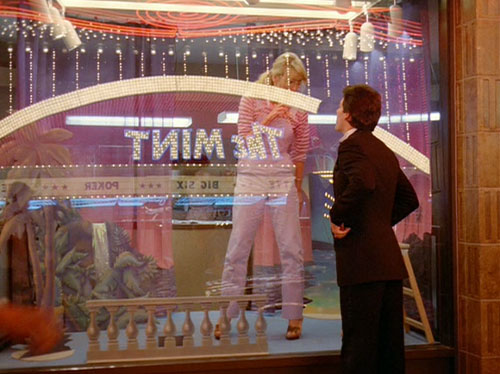
One from the Heart.
Gradation of emphasis, starring Glenn Ford
DB here:
Charles Barr’s 1963 essay “CinemaScope: Before and After” has become a classic of English-language film criticism. (1) It proffers a lot of intriguing ideas about widescreen film, but one idea that Barr floated has more general relevance. I’ve found it a useful critical tool, and maybe you will too.
Grading on a curve
Barr called the idea gradation of emphasis. Here’s what he says:
The advantage of Scope [the 2.35:1 ratio] over even the wide screen of Hatari! [shot in 1.85:1] is that it enables complex scenes to be covered even more naturally: detail can be integrated, and therefore perceived, in a still more realistic way. If I had to sum up its implications I would say that it gives a greater range for gradation of emphasis. . . The 1:1.33 screen is too much of an abstraction, compared with the way we normally see things, to admit easily the detail which can only be really effective if it is perceived qua casual detail.
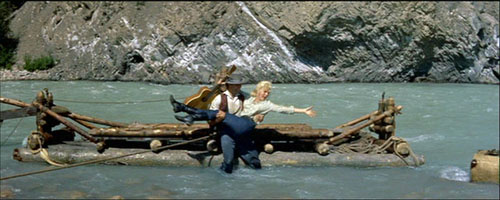
The locus classicus exemplifying this idea comes in River of No Return (1954). When Kay is lifted off the raft, she loses her grip on her wickerwork bag and it’s carried off by the current. (See the frame surmounting this entry.) Kay and her boyfriend Harry are rescued by the farmer Matt. As all three talk in the foreground, the camera catches the bundle drifting off to the right.
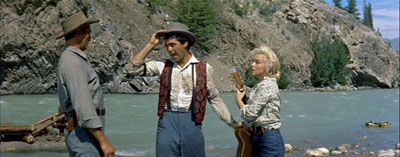
Even when the men turn to walk to the cabin, Preminger gives us a chance to see the bundle still drifting downstream, centered in the frame.
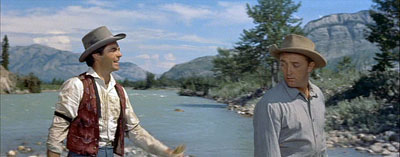
The point of this shot, Barr and V. F. Perkins argued, is thematic. As Kay moves from the mining camp to the wilderness, she will lose more and more of her dance-hall trappings and be ready to accept a new life with Matt and Mark. The last shot of the film shows her final traces of her old life cast away.
Cutting in to Kay’s floating bag would have been heavy-handed; if you stress a secondary element too much, it becomes primary. Barr reminds us that any film shot can include the most important information, as well as information of lesser significance. A film can achieve subtle effects by incorporating details in ways that make them subordinate as details and yet noticeable to the viewer. Or at least the alert viewer.
In Poetics of Cinema, I wrote an essay on staging options in early CinemaScope, and Barr’s idea helped me illuminate some of the strategies I discuss. (For earlier comments on Barr on Scope and River of No Return, see my article elsewhere on this site.) Today I want to consider how the notion of gradation of emphasis has a more general usefulness.
Barr contrasts the open, fluid possibilities of CinemaScope with two other stylistic approaches, both found in the squarer 1.33 format. The first approach is the editing-driven one he finds in silent film. This tends to make each shot into a single “word,” and meaning arises only when shots are assembled. Barr associates this approach with Griffith and Eisenstein. The second approach, only alluded to, is that of depth staging and deep-focus shooting, typically associated with sound cinema of the late 1930s and into the 1950s.
Both of these approaches, montage and single-take depth, lack the subtle simplicity of Scope’s gradation of emphasis.
There are innumerable applications of this [technique] (the whole question of significant imagery is affected by it): one quite common one is the scene where two people talk, and a third watches, or just appears in the background unobtrusively—he might be a person who is relevant to the others in some way, or who is affected by what they say, and it is useful for us to be “reminded” of his presence. The simple cutaway shot coarsens the effect by being too obvious a directorial aside (Look who’s watching) and on the smaller [1.33] screen it’s difficult to play off foreground and background within the frame: the detail tends to look too obviously planted. The frame is so closed-in that any detail which is placed there must be deliberate—at some level we both feel this and know it intellectually.
To see Barr’s point, consider a shot like this one from Framed (1947).
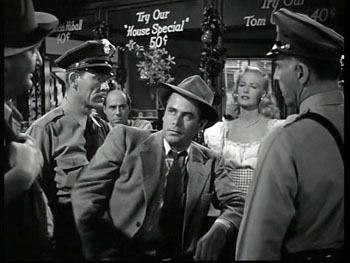
The shot, rather typical of 1940s depth staging, displays an almost fussy precision about fitting foreground and background together. That bartender, for instance, stands squeezed into just the right spot. (2) Barr claims that we sense a certain contrivance when primary and secondary centers of interest are jammed into the 1.33 frame like this.
We don’t sense the same contrivance in the widescreen format, he suggests. Barr assumes, I think, that the sheer breadth of any Scope frame will include areas of little consequence, whereas that’s comparatively rare in a 1.33 composition. This is an intriguing hunch, but uninformative patches of the frame may not be intrinsic to the Scope technology. Perhaps the fairly neutral and inexpressive uses of Scope that dominate the early 1950s, the sense of empty and insignificant acreage stretching out on all sides, make us expect that little of importance will be found there. Accordingly, directors can create a sense of discovery when we spot a significant detail in this stretch of real estate.
Anyhow, Barr indicates that if static deep-space staging made the frame too constrained, 1930s and 1940s directors who combined depth with camera movement created more spacious and fluid framings. He suggests that Mizoguchi, Renoir, and others anticipated the possibilities of Scope.
Greater flexibility was achieved long before Scope by certain directors using depth of focus and the moving camera (one of whose main advantages, as Dai Vaughan pointed out in Definition 1, is that it allows points to be made literally “in passing”). Scope as always does not create a new method, it encourages, and refines, an old one (pp. 18-19).
Barr believes that Scope positively encouraged gradation of emphasis, and that widescreen directors of the 1950s and 1960s have made the most fruitful use of the strategy. But he allows directors of all periods utilized gradation of emphasis, even in the standard 1.33 format. This is, I believe, a powerful idea.
Before Scope: Making the grade
Barr’s discussion of silent cinema, relying on notions of editing associated with Griffith and Soviet directors like Eisenstein, is done with a broad brush, but it’s typical of the period in which he was writing. We didn’t know much about silent filmmaking until archivists started to exhume important work in the 1970s. It’s no exaggeration to say that we haven’t really begun to understand the first twenty-five years of cinema until fairly recently.
In a way, the staging-driven tradition of the 1910s, which I’ve often mentioned on this site (here and here and here), exemplifies some things that Barr would approve of. Directors of that period made extraordinary use of the frame and compositional patterning. They staged action laterally, in depth, or both. They let shots ripen slowly or burst with new information. This approach to using the full frame (with only occasionally cut-in elements) has come to be called the tableau style, emphasizing its similarity to composition of a painting—although we shouldn’t forget that these films are moving paintings, and the compositions are constantly changing. The result is that emphasis tends to be modulated and distributed among several points of interest.
Central to this strategy, I think, was camera distance. American directors tended to set the camera moderately close, cutting figures off at the knees or hips, and by taking up more frame space, the foreground actors tended to limit the area available for depth arrangement or for significant detail.
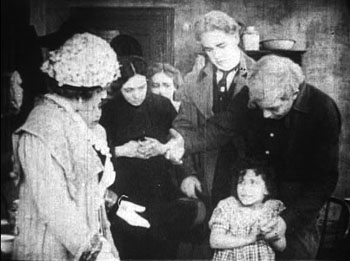
This shot from Thanhouser’s The Cry of the Children (1912) is a rough 1910s equivalent of the crammed shot from Framed above. (See also the tightly composed shots from DeMille’s Kindling (1915) here.)
The European directors, by contrast, tended to let the scene play out in more distant shots, creating spacious framings of a sort that would be reinstituted in early CinemaScope. Consider this shot from Holger-Madsen’s Towards the Light (Mod Lyset, 1919) and another from Island in the Sun (1957).
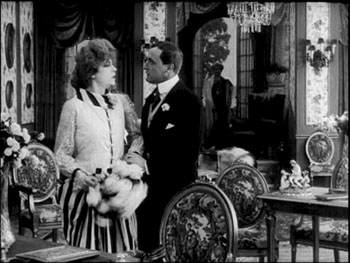
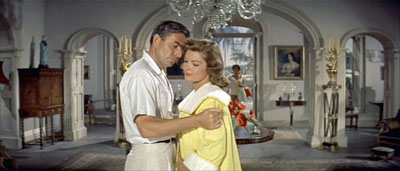
Both, it seems to me, have the type of open composition and the foreground/ background interplay that Barr praises in his article.
We can go back further. The Lumière brothers’ cameramen made fiction films as well as documentaries, and we occasionally find moments that suggest early efforts at gradation of emphasis. In Le Faux cul-de-jatte (1897), an apparent amputee is begging in the foreground while in the distance a man is walking down the street.
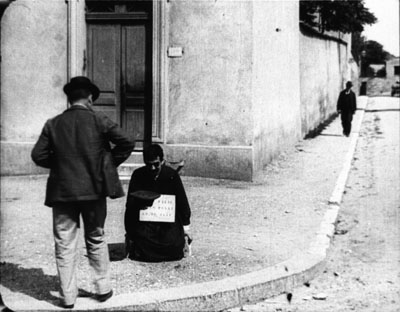
A cop crosses the street from off right and follows the pedestrian.
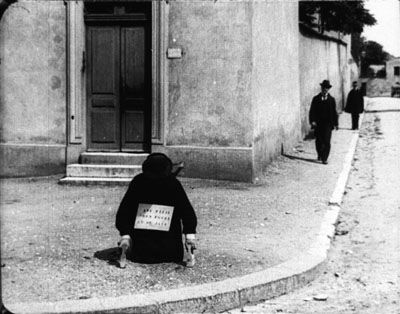
As the foreground fills up, the man we’ve seen in the distance gives the beggar some money.
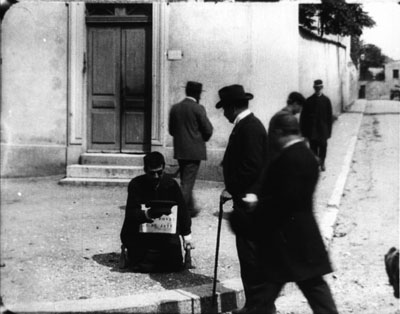
As he goes out left, the cop is still approaching, and a vagrant dog appears.
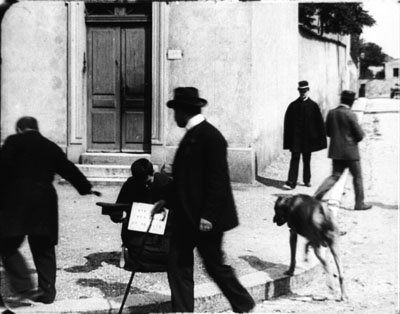
The cop comes to the beggar, partially blocking the dog, who takes care of other business. (Not everything in this movie is staged.)
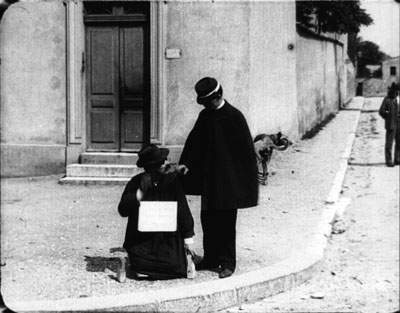
The cop checks the beggar’s papers and finds them to be suspect. The fake amputee jumps up and races off in the distance, with the cop pursuing.
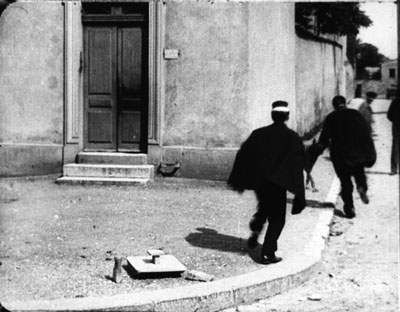
As with many staged Lumière shorts, several figures converge in the foreground in order to create a culminating piece of action. Here the distant man and the cop, both secondary centers of interest, serve as a kind of timer, assuring us that something will happen when they meet at the beggar.
These are just some quick examples. We should continue to study the ways in which, with minimal use of editing, early filmmakers found ingenious ways to create gradation of emphasis. (2)
Some uses of grading
Barr, like most critics writing for the British journal Movie, was sensitive to the ways in which technique has implications for character psychology and broader thematic meanings. Kay’s bundle is one point along a series of changes in her character and her situation. But gradation of emphasis can serve more straightforward narrative purposes as well.
Consider our old friends, surprise and suspense. In the original 3:10 to Yuma (1957) Dan Evans is confronting the ruthless outlaw Ben Wade.
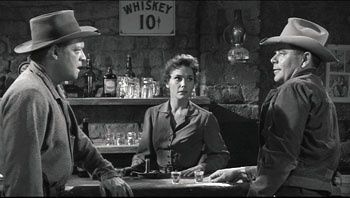
We get a string of reverse shots.
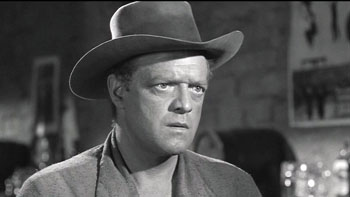
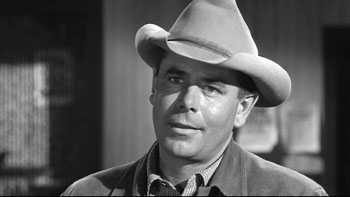
Then in one shot of Wade, without warning, a shadowy figure emerges out of focus in the left background.
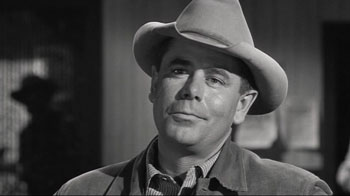
Now we realize that Evans has been diverting Wade from the fact that the sheriff’s posse is surrounding him. Now we wait for Wade to discover it; how will he react?
While we’re on Glenn Ford, another nice example occurs in Framed. Mike Lambert has been romancing a woman named Paula, but we know that she and her lover Steve are plotting to fake Steve’s death and substitute Mike’s body.
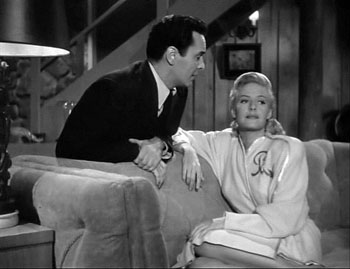
She brings Mike to Steve’s elegant country house, having presented Steve as someone she knows only slightly. When Mike goes into the bathroom to wash up, we notice something important behind him.
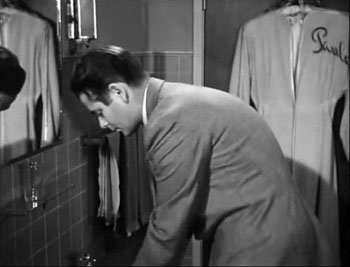
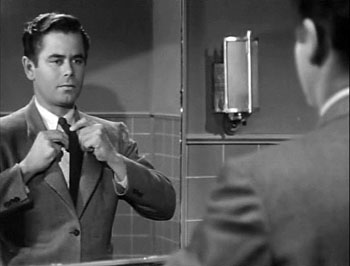
With Mike at the sink, we have plenty of time to recognize Paula’s robe. Director Richard Wallace prolongs the suspense by giving us a new shot of Mike in the mirror, with the robe no longer visible.
But when Mike turns to leave, a pan following him brings him face to face with what we saw, accentuated by a track forward.
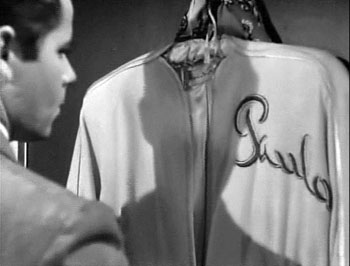
We get Mike’s reaction shot, followed by a cut to Steve and Paula downstairs, suspecting nothing. “So far, so good,” says Steve, looking upward at the bathroom.
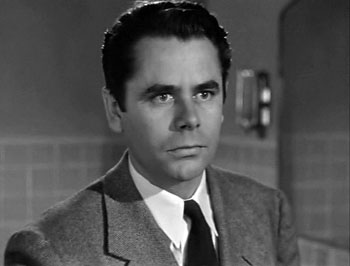
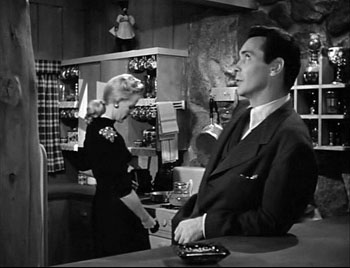
The rest of the scene will play out with Mike aware that they’re deceiving him. As often happens with suspense, we know more than any one character: We know the couple’s scheme and Mike doesn’t, but they don’t (yet) know that Mike is now on his guard.
This isn’t as subtle a case as River of No Return, but I suspect that it’s more typical of the way Hollywood filmmakers use gradation of emphasis. Paula’s bathrobe is a good example of what I called in The Classical Hollywood Cinema the strategy of priming: planting a subsidiary element in the frame that will take on a major role, even if initially its presence isn’t registered strongly. My example in CHC was a coat rack in the Dean Martin/ Jerry Lewis comedy The Caddy (1953). In effect, the distant pedestrian in the Lumière film is an early example of priming.
Howard Hawks adopts the Lumière technique in order to sustain a flow of dialogue in Twentieth Century (1934). Here the foreground conversation is accompanied by a procession of people emerging in the distance and stepping up to take part.
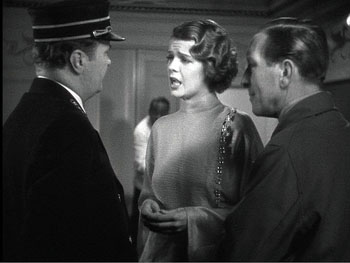
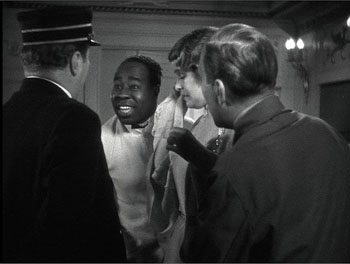
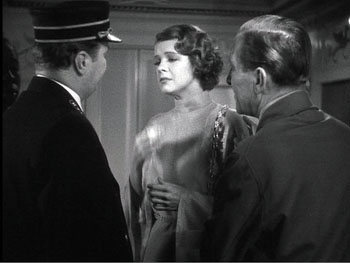
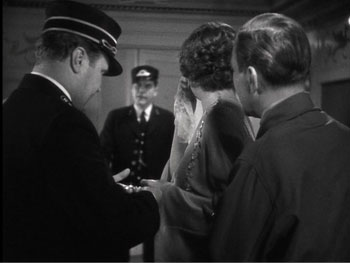
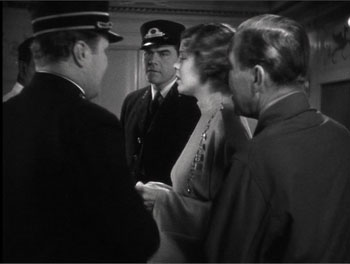
The shot concludes, as does the shot of Faux cul-de-jattes, with a retreat from the camera.
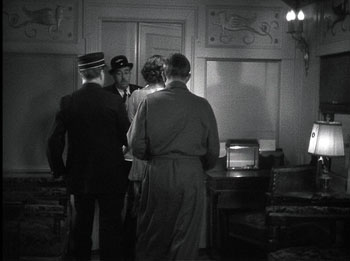
The priming of secondary elements here, the summoning of the train attendant and the conductor, obeys Alexander Mackendrick’s dictum that the director ought to construct each shot so as to prepare for what will come next.
As Barr indicates, the idea of gradation shades insensibly off into general matters of cinematic expression. In The Devil Thumbs a Ride (1947), the bank robber has hitched a ride with an unassuming civilian, and they stop for gas. When the attendant shows a picture of his little girl, the robber gratuitously insults her. (“With those ears she’ll probably fly before she can walk.”)
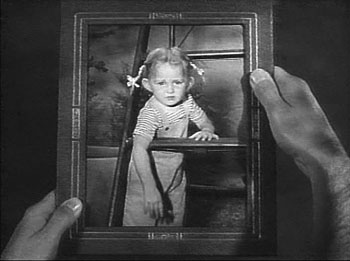
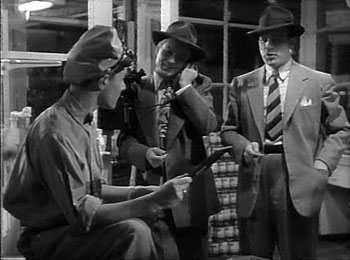
Later, the station attendant hears a radio broadcast describing the fugitive. First he has his head cocked as he listens attentively, but then his gaze drifts to the picture of his little girl.
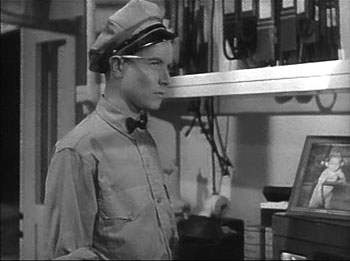
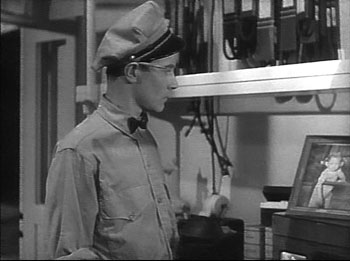
The attendant is the center of dramatic interest, but when he looks at the picture, so do we (primed by the view of it earlier). Instantly we understand that the attendant’s resolve to call the police springs partly from an urge to get even with the man who insulted his daughter. A minor instance, surely, but it illustrates Barr’s point that the notion of gradation of emphasis leads us to consider “the whole question of significant imagery.”
The more the merrier
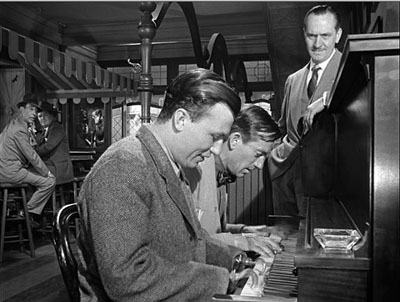
Barr seems to favor a plain style; he prefers Preminger’s quiet framings to the rococo imagery of Aldrich’s Vera Cruz (1954). Presumably the famous shot above from Wyler’s Best Years of Our Lives (1946) would be too obviously composed for Barr’s taste.
But there is merit in considering how a secondary center of interest can vie for supremacy. André Bazin declared Wyler’s shot a bold stroke exactly because its self-conscious precision created a tension between what was primary and what was subordinate. (3) The action in the foreground is of dramatic interest because Homer has learned to play the piano, and this represents a phase of his coming to terms with his wartime disability. Yet the most consequential action is taking place in the distant phone booth, where Fred breaks up with Al’s daughter Peggy. The gradation of emphasis is inverted, and we wait in suspense to find out what happens. Bazin taught us to recognize that what appears to be primary may actually be creatively distracting us from the scene’s principal action. (4)
A director can also turn a primary center of interest into something secondary, but powerful. In one sequence of Eisenstein’s Ivan the Terrible I (1944), the apparently dying tsar is being prayed over by churchmen. Ever suspicious, he peers out from under the book, using only one eye.
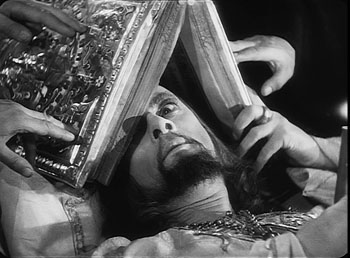
As the scene develops, Prince Kurbsky meets Ivan’s wife and tries to seduce her. In the background an icon’s eye glares out, as if Ivan is watching them.
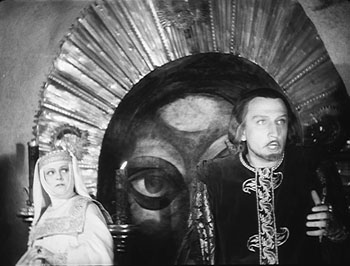
The single eye, which is a motif we find in other Eisenstein films, becomes a significant one throughout both parts of Ivan. More generally, this device manifests Eisenstein’s conception of polyphonic montage, which explored how the filmmaker can control all the various aspects of his images and make them weave throughout the film—promoting one at one moment, demoting it at another. (5)
Barr’s essay assumes that Eisenstein’s montage stripped each image down to a single meaning. In fact, though, Eisenstein wanted to multiply the sensuous and intellectual implications of each shot by weaving objects, gestures, body parts, musical motifs, and the like into an ongoing stylistic fabric. Each shot’s gradation of emphasis can suggest thematic parallels, deepen the drama, or heighten emotional expression, just as a complex score enhances an operatic scene.
Tati as well likes to create an interplay between primary and subsidiary centers of interest. Or rather, he sometimes abolishes our sense of what is primary and what isn’t. The crowded compositions of Play Time (1967) often bury their gags in a welter of inessential details. During the lengthy scene in the Royal Garden restaurant, a minor running gag involves the dyspeptic manager. He has just mixed some headache medicine with mineral water, but the action is easily lost within the tumultuous image. Even the soundtrack cues us only slightly, with a bit of fizz among the music and crowd noise.
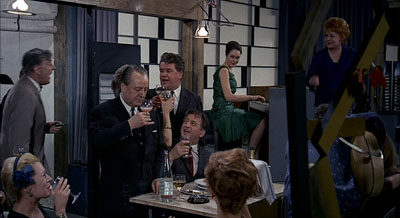
As the manager lowers the glass, Hulot thinks it’s pink champagne being offered to him.
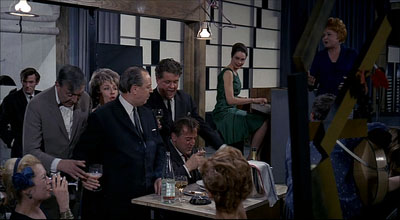
Rolling the stuff in his mouth, Hulot realizes his mistake as he earns a stare from the manager.
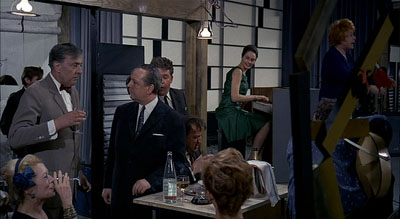
There is so much competing sound and activity in the shot that some viewers simply don’t notice this bit at all. In Play Time, gradation of emphasis is often flattened out, leaving us to rummage around the composition for the gag.
Some final notes
Barr was not particularly interested in the mechanics of how we come to notice something in the shot, be it primary or secondary in value. In On the History of Film Style, I suggested that many aspects of technique work to call attention to any element in the field. The filmmaker can put a something in motion, turn it to face us, light it more brightly, make it a vivid color, center it in the frame, have it advance to the foreground, have other characters look at it, and so on. These tactics can work together in a complex choreography. In Figures Traced in Light, I argued that they depend on the fact that we scan the frame actively; the techniques guide our visual exploration. (6)
You can see this guidance at work in most of the examples I’ve mentioned. In River of No Return, we are coaxed into noticing Kay’s bundle because we’re cued by movement (the bundle falls and drifts off), performance (she shouts, “My Things!” and stretches out her arm), music (we hear a chord as the bundle splashes), and framing (Preminger’s camera pans slightly as the trunk drifts away). The critic can refine our sense of the effects that a film arouses, but it’s one task of a poetics of cinema, as I conceive it, to examine the principles and processes that filmmakers activate in achieving those effects.
Finally, we might ask: To what extent do we find gradation of emphasis in current filmmaking? Today’s American cinema relies heavily on editing, using a style I’ve called intensified continuity. Each shot tends to mean just one thing, and once we get it we’re rushed on to the next. The unforced openness of the wide frame that Barr celebrated has been largely banned, in favor of tight singles—even in the 2.40 anamorphic format. It seems that most filmmakers are no longer concerned with gradation of emphasis within their shots.
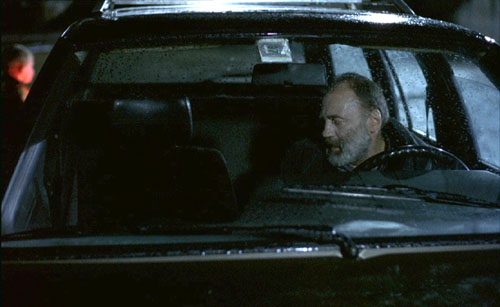
To find this strategy surviving at its richest, I think we have to look overseas. If you want names: Angelopoulos, Tarr, Kore-eda, Jia, Hou. (7)
(1) It was published in Film Quarterly, vol. 16, no. 4 (Summer, 1963), 4-24. Unfortunately, it’s not available free online, nor is a complete version available in anthologies, so far as I know. If you have access to online journal databases, you can find it. Otherwise, off to the library w’ye!
(2) In the Poetics of Cinema piece (pp. 303-307), I argue that some early uses of Scope tried to approximate such tightly organized composition, despite technological barriers to focusing several planes of action.
(3) See André Bazin, “William Wyler, or the Jansenist of Directing,” in Bazin at Work: Major Essays and Reviews from the Forties and Fifties, ed. Bert Cardullo, trans. Cardullo and Alain Piette (New York: Routledge, 1997), 14-16.
(4) Actually the phone booth is primed for our notice by earlier shots in Butch’s tavern. See On the History of Film Style, 225-228.
(5) For more on Eisenstein’s idea of polyphonic montage, see my Cinema of Eisenstein (New York: Routledge, 2005) and Kristin’s Eisenstein’s Ivan the Terrible: A Neoformalist Analysis (Princeton: Princeton University Press, 1981).
(6) For some empirical evidence of this guided scanning, see the work of Tim Smith at his website and in this entry on this site.
(7) I discuss some of these alternatives in On the History of Film Style and the last chapter of Figures Traced in Light.
Eternity and a Day.
PS 15 Nov. Two more items. First, if the ideas floated here intrigue you, you might want to take a look at an earlier entry on this site, called “Sleeves.”
Second, I had planned to include one more example, but forgot it. In Lumet’s Before the Devil Knows You’re Dead, Andy Hanson’s life is unraveling. We follow him back to his apartment, and as he enters on the extreme left, his wife Gina is visible sitting on the extreme right, her back to us.
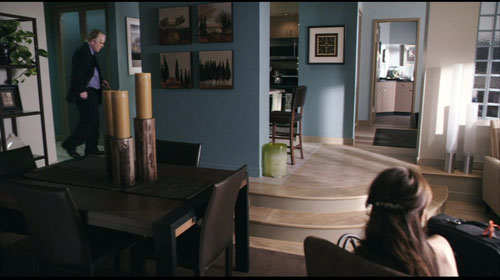
Gina forms a secondary center of attention, but the key to the upcoming action is revealed in a third point of interest: the black suitcase pressed against the right frame edge. The shot tells us, more obliquely than one showing her leaving the bedroom with the case, that she is planning to leave him. Lumet’s image, reminiscent of the framing of the trunk in River of No Return, shows that gradation of emphasis isn’t completely dead in American cinema. The orange scrap of yarn, knotted to the handle for baggage identification, is a nice touch of realism as well as a welcome color accent that further draws the suitcase to our notice.
13 days without movies? Not desirable, but possible

DB yet again:
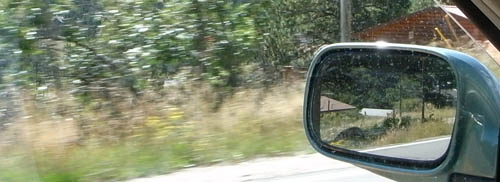
Our road trip started back on the twelfth of September. We drove to Iowa City and ate at our grad school hangout, Hamburg Inn no. 2. (We even remember Hamburg Inn no. 1, long since vanished.) We pressed on through Nebraska to Denver, for a meeting of the Amarna Research Foundation, which helps support the Egyptian expedition on which Kristin works. She gave a presentation about the unique composite statuary of the Amarna era containing a new hypothesis that Barry Kemp, head of the expedition, found promising. After enjoying the hospitality of ARF president Bill Petty and his wife Nancy, we visited the Rocky Mountain National Park.
After a long day’s drive west, we overnighted in Elko, Nevada, where we learned that Barack Obama was scheduled to give a stump speech the next morning. We hung around and joined an enthusiastic group from all over northern Nevada to hear what he had to say.

After shaking hands with Barack, we moved on, rolling through Utah and into Oregon and Crater Lake National Park. Then up the coast highway to Seattle, where our nephew Sanjeev works for Microsoft and lives with his wife Maggie. We did some nifty touristic things in Seattle, and then with Sanjeev and Maggie we pressed on to Vancouver for its annual film festival.
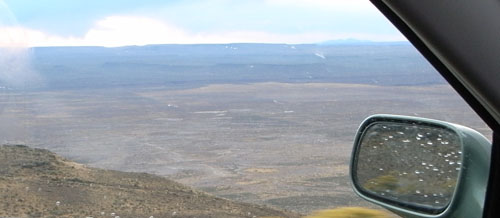
During our westward passage through Grand Island (neither grand nor apparently an island), Craig, Elko, Klamath Falls, Coos Bay, Tillamook, and Tumwater, we saw many intriguing things. There was, for instance, the perfect rainbow in the bleakly beautiful northwestern Nevada desert.

In a little Colorado town, we found the toilet seat with fishing lures embalmed within.

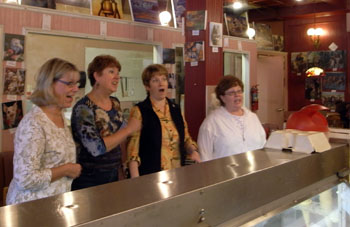
In Snoqualmie Falls, Washington, while we downed burgers and malts at the Candy Factory & Café, four red-hot mamas came in and spontaneously started singing 1940s swing, Andrews-sisters style.
Yet such roadside attractions can’t compensate for our trip’s biggest drawback. We didn’t see a single complete film, not even on the free HBO available in motels. We used our late evenings to wolf down Subway subs and scan the Internets for news of lipstick, pigs, and less important things like the free fall of the U. S. economy.
Still, even without watching movies we did run across many traces of cinema. So don’t worry: This isn’t a travel entry, but rather an offhand effort to note the ways film keeps crossing our path, sometimes in surprising ways.
Movies everywhere
For instance, Bill Petty, an ardent Egyptomane, has created a home theatre unlike any other. The Pharaohs surely look with envy on this screening room.
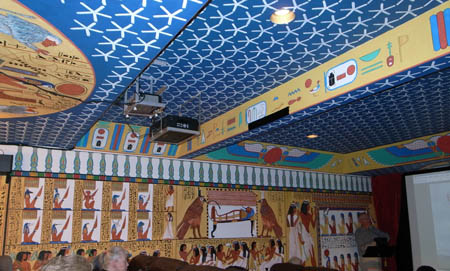
In this venue, Bill showed us his home-made mashup of the Lon Chaney Phantom of the Opera with the Andrew Lloyd Webber score. That was the closest we got to movie viewing on the trip.
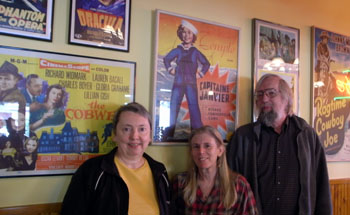
Also in Denver, we ate breakfast with Diane Waldman, old friend and film prof at University of Denver, and her husband Neil. We of course wound up in a restaurant with movie posters.
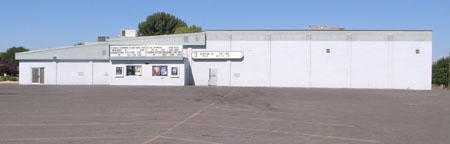
Passing through Vernal, Colorado, we spotted the most austere multiplex we’d ever seen.
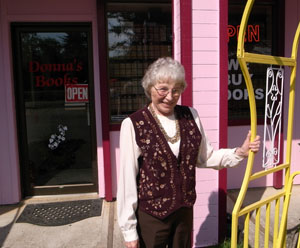
Then there was Donna Kupp’s Books in Reedsport, Oregon. Donna has an excellent collection of classic paperbacks and magazines.
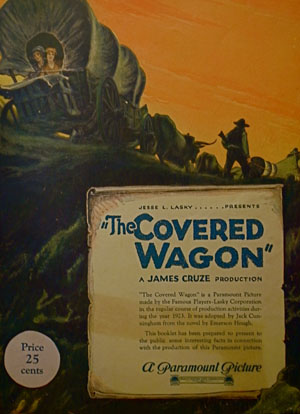
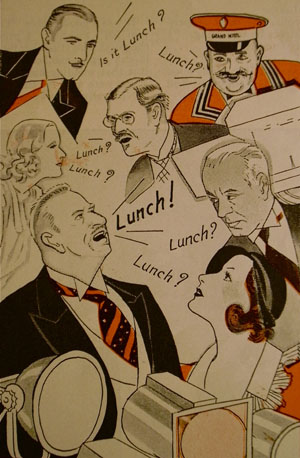
The high points of our purchases were an original souvenir program for The Covered Wagon and a pretty issue of Photoplay from 1932, which featured a gossipy story about the making of Grand Hotel.
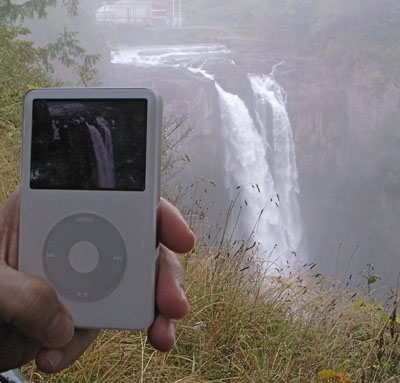
The ladies’ big-band quartet wasn’t our reason for stopping in Snoqualmie, of course. You know why. The town was the shooting location of Twin Peaks. Hence this inevitable snapshot.
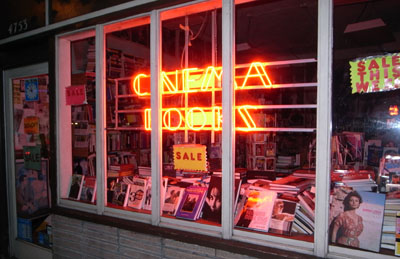
In Seattle, we discovered Stephanie Ogle’s outstanding Cinema Books on Roosevelt Way, N. E. This store is stuffed to the rafters with film items old and new–books, magazines, posters, and stills. Kristin even autographed some copies of her books.
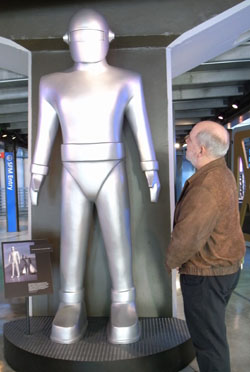
We picked up several items there. Earlier that day, we visited Paul Allen’s lively Science-Fiction Museum. Sumptuous exhibits, but we weren’t allowed to photograph them. We did, however, get a chance to study a clone of the alien from The Day the Earth Stood Still.
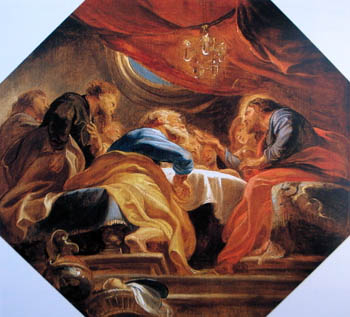
As usual, a trip to an art museum provokes me to think of cinema. You don’t need much nudging to see this Rubens prototype for a Last Supper ceiling as a steep low-angle Welles or Hitchcock shot.
Less obviously, Abraham Janssens’ Origin of the Cornucopia (c. 1619) suggests a wide-angle lens at work. The three dryads stuffing the cornucopia are monumental, and monumentally skewed.
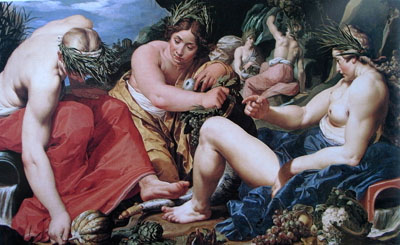
The stretched arm of the dryad on the left and the tipped knee of the one on the right seem to bulge right out of the picture plane. Check the hands, which thrust out of the picture and loom larger than the ladies’ heads. In particular, though you can’t see this in reproduction, the thumbnail of the figure on the right is a little blob of paint sitting on the painting’s surface, accentuating the sense that this hand is pointing right at us. Such images remind us that 2-D and 3-D are not so easy to keep distinct.
Our road trip confirms that movies are everywhere, waiting in the corners of our lives, ready to be activated with barely any prompting. Nonetheless, these are all merely teases, snacks making us eager for the banquet to come in Vancouver.
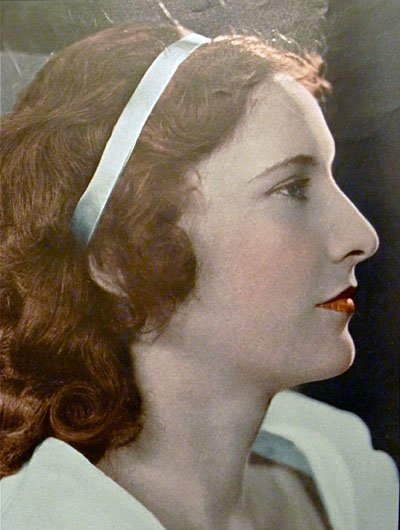
For Jim Emerson: Barbara Stanwyck, from Photoplay (Oct 1932).
Lucky ’13
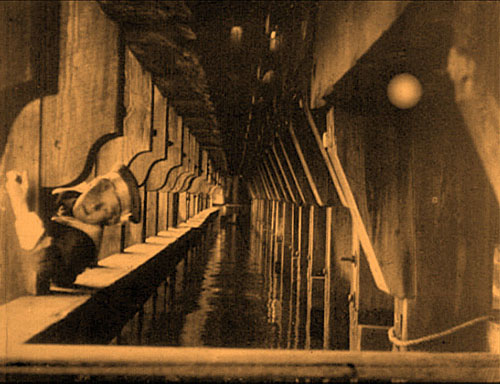
The Mysterious X (1913).
Each film is interlocked with so many other films. You can’t get away. Whatever you do now that you think is new was already done in 1913.
Martin Scorsese, quoted in Scorsese by Ebert (University of Chicago Press, 2008), 219.
DB here:
Most historical events don’t abide by clocks and calendars. Seldom does a trend begin neatly on one date and end, full stop, on another. Changes have vague origins and diffuse destinies. When Kristin and I, along with others, argued for 1917 as the best point to date the consolidation of the Hollywood style of storytelling, we realized that it’s a useful approximation but not as exact as a Tokyo subway timetable.
It’s just as hard to argue that a year constitutes a meaningful unit in itself. Who expects anything but tax laws to change drastically at midnight on 31 December? Yet evidently our minds need benchmarks. Film historians, while being aware that trends are slippery and dating is approximate, have long spotlighted certain years as particularly significant.
Take 1939, which has become a sort of emblem of the peak achievements of Hollywood’s Golden Age. We had Gone with the Wind, The Wizard of Oz, Only Angels Have Wings, Stagecoach, Gunga Din, Wuthering Heights, Dark Victory, Young Mr. Lincoln, Beau Geste, Mr. Smith Goes to Washington, Ninotchka, The Roaring ‘20s, and Destry Rides Again. I’d watch any of those, except Gone with the Wind, right now—something I find it hard to say about most Hollywood movies I’ve seen in 2008.
Another strong year is 1960, with La Dolce Vita, L’Avventura, Rocco and His Brothers, The Apartment, Elmer Gantry, Spartacus, Psycho, Exodus, The Magnificent Seven, Shadows, Late Autumn (Ozu), and The Bad Sleep Well (Kurosawa). Arguably, 1960 was owned by the French, who gave us Breathless, Shoot the Piano Player, Paris nous appartient, Les Bonnes femmes, Le Trou (Becker), Moi un noir (Rouch), and Letter from Siberia (Marker). (See Postscript.)
Let’s go back still further. Researchers sometimes split the silent-film period in two, with the first stretch, usually called “early cinema,” running up to 1915 or so. (1) The second phase then runs roughly from 1915 to 1928. (2) So for many historians the year 1915 functions as a tacit pivot-point, and it is remembered not only for The Birth of a Nation but also for Regeneration, The Tramp, Kindling, The Cheat, Les Vampires, Daydreams (Yevgenii Bauer), and several William S. Hart films. But another year holds a special place in the minds of silent film aficionados.
Over a decade ago, the annual Days of the Silent Cinema festival (Il Giornate del cinema muto), took 1913 as its focus. (3) It was an extraordinary year. Denmark produced Atlantis (August Blom) and The Mysterious X (Benjamin Christensen). From France we had L’Enfant de Paris (Leonce Perret), Germinal (Albert Capellani), and Louis Feuillade’s Fantomas series. Germany gave us Urban Gad’s Engelein and Filmprimadonna and Franz Hofer’s obsessively symmetrical The Black Ball. The staggering set of Italy’s Love Everlasting (Ma l’amor mio non muore!, Mario Caserini) was matched by the breadth of Enrico Guazzoni’s Quo vadis? In Russia Bauer released Twilight of a Woman’s Soul. American audiences saw Traffic in Souls (George Loane Tucker) and Death’s Marathon and The Mothering Heart, from a guy named Griffith. Several historians would argue that 1913 marked the first major achievements of film as an artform.
Two outstanding films of that annus mirabilis have recently been issued on US DVD. One is a striking accomplishment, the other a flat-out masterpiece. Both discs belong in the collections of everyone who’s serious about cinema.
Your call is important to us
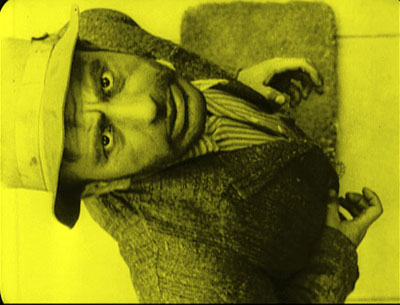
A wife and her baby are alone in an isolated house when a tramp breaks in. As the wife tries to keep the invader at bay, her husband happens to telephone and learn what’s happening. He scrambles to return home. He steals an idle car, and its owner, accompanied by police, race after him. We cut rapidly between the besieged mother and the husband’s frantic drive, as he is in turn pursued. Just as the tramp is about to attack the wife, the husband bursts in, followed by the police. The family is saved.
This is the story of the 1913 one-reel film, Suspense, co-directed by Lois Weber and Phillips Smalley. If the plot sounds familiar, it’s probably because you know that one of D. W. Griffith’s most famous films, The Lonely Villa (1909) tells the same basic tale.There are still earlier versions, including one, The Physician of the Castle (Le Médécin du chateau, 1908), which may have inspired Griffith. The ultimate source seems to be a 1902 play by André de Lord, Au téléphone (translated here).
So Weber and Smalley are reviving an old idea. Their task is to make it fresh. How they do so has been studied in depth by Charlie Keil in his book Early American Cinema in Transition: Story, Style, and Filmmaking, 1907-1913.I can’t match Keil’s subtlety, and it’s better that you see the film first, so I’ll drop only some hints, pointers, and comments.
We’re inclined to say that The Lonely Villa influenced Suspense. But maybe we can capture the situation in a more illuminating way. The art historian E. H. Gombrich has suggested that we can often trace the relationship between artworks in terms of schema and revision. (4) A schema is a pattern that we find in an artwork, one that a later artist can borrow. Most often, later artists copy the schema straightforwardly. This is the usual way we think of influence. But instead of replicating the schema, the next artist can revise it. She can elaborate on it, strip it to its essence, drop parts and add others, whatever—in order to achieve new purposes or evoke fresh responses.
In The Lonely Villa, Griffith uses crosscutting to build suspense. He cuts among the thuggish vagrants trying to break in, the wife and daughters trying to hold them off, and the father learning by phone of the situation and then plunging after them with a policeman. The obvious pattern here is the principle of alternation between different lines of action, all taking place at the same time and converging in a last-minute rescue.
So Smalley and Weber inherit the crosscutting schema, but they go beyond simply copying it. They find ways to revise it, some quite surprising. These revisions aim to create more tension and to dynamize the situation.
The obvious option, at least to us today, would be to use more shots than Griffith does; we think that increasing the cutting pace builds up excitement. Interestingly, however, Suspense uses only a couple of more shots than The Lonely Villa within a comparable running time. (5) We usually expect that American films become more rapidly cut as the 1910s go on, but this isn’t the case here. Shortly, I’ll suggest why.
Smalley and Weber recast Griffith’s parallel editing in several ways. For instance, The Lonely Villa prolongs the phone conversation between husband and wife, building suspense through the husband’s instruction to use his revolver on the thugs. Suspense, by contrast, doesn’t dwell on the telephone conversation but devotes more time (and shots) to the chase along the highway. That’s because Weber and Smalley have complicated the chase by having the husband pursued by the irate motorist and the police, something that doesn’t happen in the Griffith film.
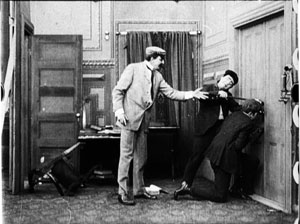
Just as important, Smalley and Weber revise the crosscutting schema through framings that are quite bold for 1913. For example, Griffith’s tramps break into the house in long shot, and they move laterally across the frame.
But Weber and Smalley’s tramp sneaks steadily up the stairs, into a menacing extreme close-up.
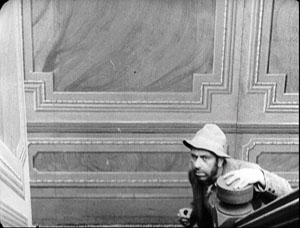
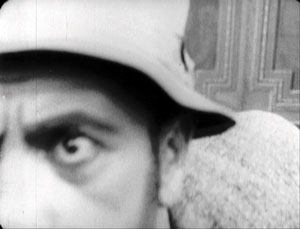
Elsewhere, Suspense gives us close views of the wife and of the door as the tramp breaks in. There are oblique angles on the back door of the house, and virtually Hitchcockian point-of-view shots when the wife sees the tramp breaking in and he looks straight up at her.
What struck me most forcibly on watching the film again was the way in which Weber and Smalley’s daring framings serve as equivalents for parallel editing. In effect, they revise the crosscutting schema by putting several actions into a single frame. The most evident, and the most famous, instances are the triangulated split-screen shots. They cram together three lines of action: the wife on the phone, the husband on the phone, and the tramp’s efforts to break into the house (here, finding the key under the mat). (6)
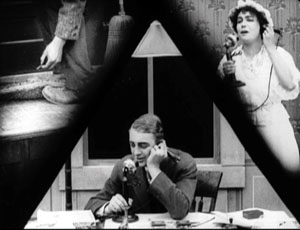
Split-screen effects like this were common enough in early cinema, especially for rendering telephone conversations. Eileen Bowser points out that the three-frame division was one variant, with a landscape separating the two callers. (7) Her example is from College Chums (1907).
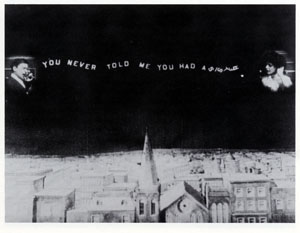
But my sense is that in early cinema the split-screen effect was used principally for exposition or comedy, not for suspense. Smalley and Weber have made this framing substitute for crosscutting: instead of giving us three shots, we get one, showing the plot advancing along different lines of action. These splintered frames function much like Brian De Palma’s multiple-frame imagery in Sisters, Blow-Out, and other films. There’s also the nice touch of the conical lampshade over the husband’s head, providing a fulcrum for the composition.
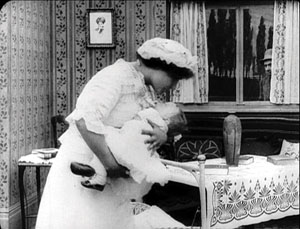
Earlier in the film, instead of crosscutting between the tramp outside and the wife indoors, Suspense gives us both in the same shot, with the tramp peeking in behind her.
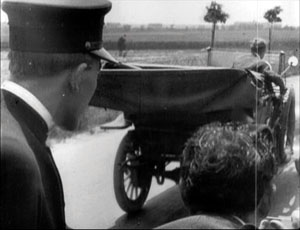
A more ingenious revision of the crosscutting schema comes during the shots on the road. Instead of cutting between the father in the stolen car and the police pursuing him, Suspense packs them into the same frame. This is done not only in long shot but also in striking depth compositions.
Flashiest of all are the shots showing the pursuers reflected in the rear-view mirror of the father’s car as he races ahead of them.
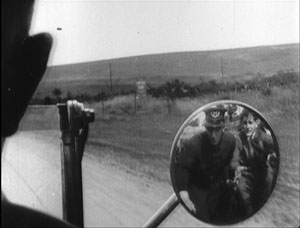
Again, a single framing has done duty for two shots, one of the father looking back and another showing the cops coming closer to him. By compressing several lines of action into a single frame, our 1913 film doesn’t need to use significantly more shots than the 1909 one.
These are just a few of the imaginative ways in which Weber and Smalley have recast their standard situation. I could have considered as well the unobtrusive use of the knife as a multi-purpose prop, the echoed shots of mirrors, and the shrewd employment of repetitions in the intertitles.
It would take an early-cinema specialist like Keil to trace out all the connections between Suspense and other films of its era. One among many would be the fact that Griffith wasn’t exactly standing still between 1909, the year of The Lonely Villa, and 1913. For instance, his Battle at Elderbush Gulch, made about the same time as Suspense (though released in 1914), displays far more rapid cutting than Weber and Smalley attempt. Griffith also employed a swelling advance to the foreground, like that of the tramp shot I showed above, in The Musketeers of Pig Alley (1912).
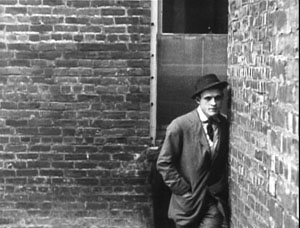
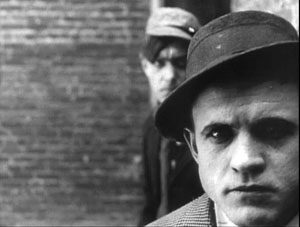
Here, Smalley and Weber seem to have replicated a schema that was believed to ratchet up tension, the so-called looming effect.
The very title of the film exhibits self-consciousness about its artistic purpose. By 1913, it seems, American filmmakers were confident enough in their skills to announce their aims. We want, the title seems to say, to arouse you, to make you wait, hanging there, for the resolution. We know how to tell a twelve-minute story cinematically. The film seems uncannily to anticipate all those one-word titles that Hitchcock invoked to unsettle us–Suspicion, Spellbound, Psycho, Frenzy. As in a Hitchcock movie, the fact that we are pretty certain how Suspense will turn out doesn’t seem to dissipate our anxiety. (For more on this paradox of suspense, see this entry.)
Tunnel vision
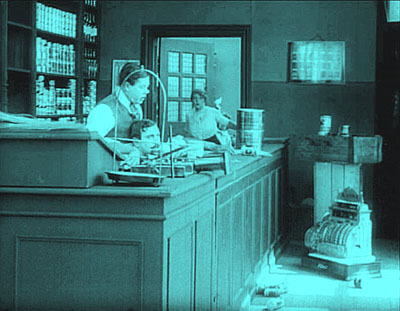
It was during the Pordenone 1913 season that the full brilliance of Victor Sjöström’s Ingeborg Holm hit me. I had seen the film a couple of times before and found it deeply moving in its restrained treatment of a poignant situation. The film traces the dissolution of a family. Sven Holm is doing a brisk retail business, but his health problems, along with a thieving clerk, plunge the family into poverty. When Holm dies, his wife Ingeborg must take the children into the poorhouse, and from there they are boarded out to foster families. Her plight worsens over the years, and its sorrowful depths are revealed when her son, now grown, returns to visit her.
Ingeborg Holm has long been recognized as a milestone in European film, not least for its effect on improving Sweden’s treatment of the poor. (8) The acting style is muted and delicate, with no mugging or arm-waving. For long periods, the main actors turn from the audience. (9) Just as impressive are the poised compositions, sustained in unhurried long takes. These give what is essentially a bourgeois tragedy a kind of majestic relentlessness. Watching, I remembered what Dreyer had admired in Sjöström’s Ingmar’s Sons (1918):
The film people here at home shook their heads because Sjöström had really a boldness to let his farmers walk heavily and soberly as farmers do. Yes, they used up an eternity to come from one end of the room to the other. (10)
But sitting in the Cinema Verdi in 1993, I spotted yet another level of artistry. Knowing the story of Ingeborg Holm, I was able to watch the shots unfold. I could study how Sjöström was unobtrusively moving characters so that they became shifting centers of interest. Although he didn’t cut in to close-ups, he harmonized his actors’ movements so that at one point you noticed Ingeborg, at another her husband. Performers spread themselves across the frame, arrayed themselves in depth, turned from or toward the camera. Most subtly of all, one actor might mask another one, driving our attention to other parts of the frame. Sjöström could sustain this intricate play of blocking and revealing for minutes on end.
My favorite example of this tactic is the three-minute passage showing Ingeborg’s daughter and son taken away by new mothers. You can read the whole discussion on pp. 191-195 in On the History of Film Style (1997), but here is an excerpt, with stills intercalated. (These stills, grabbed from the DVD, lack a little on the left. The film has been printed and reprinted so many times, and now fitted to the TV monitor, that it has lost some information along that edge.)
Ingeborg’s entry with her children from the rear doorway establishes the trajectory that will be followed during the scene, as foster mothers come in and take away the children. (Again, the scene is built around movements toward and away from the camera.) In a brilliant stroke, Sjöström immediately plants the young son in the foreground, back to us. The boy will stand there immobile for this first phase of the scene, occasionally serving to block the superintendent.
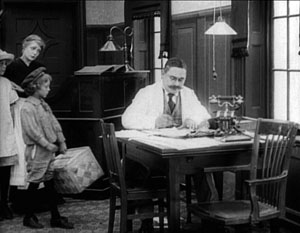
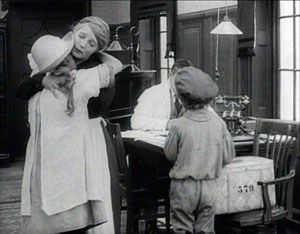
Ingeborg buries her face in her daughter’s shoulder at the precise moment the foster mother enters from the rear left. She passes behind Ingeborg, and as she is momentarily blocked, the superintendent twitches into visibility, handing the woman a document to sign.
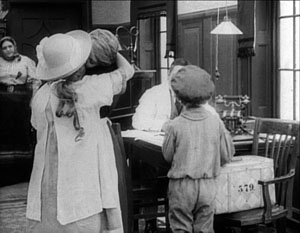
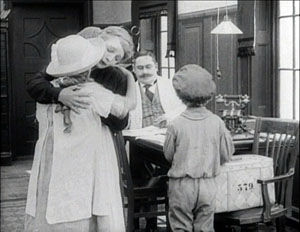
During the signing, when the woman is briefly obscured, the superintendent shifts position again and Ingeborg lifts her face once more. Then Ingeborg and her daughter move slightly leftward as the foster mother comes forward.
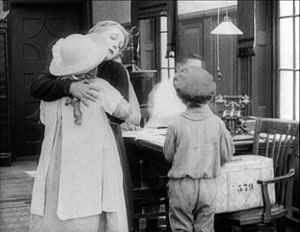
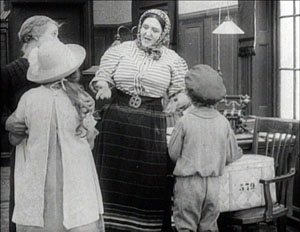
This phase of the scene concludes with the departure of the daughter and the embrace of Ingeborg and her son in the foreground, once more concealing the superintendent.
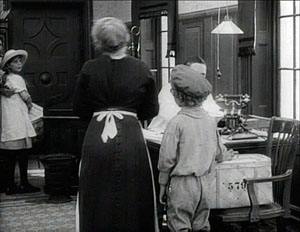
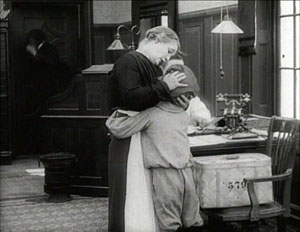
Granted, I picked one of the film’s most exactingly staged scenes, but there are several other examples. Consider the climax, when the adult son comes to visit Ingeborg: the camera position and staging ask us to recall the scene I’ve just mentioned. Or take a look at the handling of the space behind the counter in the various scenes in the Holms’ shop. One instance surmounts this section.
This choreography is hard to catch on the fly: by the time you notice a change, what prepared for it has gone. To understand the overall dynamic, we must reverse-engineer the effects, moving backward from the result to the conditions. As I studied the film, it became clear that creating shifting centers of interest was basic to the scenes’ effects. All the finesse of acting, both solo and ensemble, would come to little if we weren’t primed to watch the most important area of the shot. Directors of the 1910s became supremely skilful in guiding our eye from one major story point to another within the fixed frame.
Some of the tactics of guiding our attention could be borrowed from other arts. Painting and theatre supplied certain schemas, like placing an item in the center of the picture format and turning faces toward the viewer. But some tactics for directing our eye relied on capacities that were as “specifically cinematic” as cutting was argued to be. Theatre is staged for many sightlines, but cinema is staged for a single one, that of the camera lens. That fact allowed directors to organize the unfolding action in depth, prompting the viewer to notice things at many distances from the camera.
It also allowed a precise blocking and revealing of information that would not work on the stage. In a live theatre performance, the slight shifts we detect in the Ingeborg Holm scene would be apparent to only very few viewers; people sitting in other vantage points wouldn’t see them. For another example of this phenomenon, go elsewhere on this blogsite.
There’s a more basic explanation of what’s going on. Cinematic space is a result of optical perspective, like the space of classic painting. The actors may seem to be standing in a cubical space, but in fact they move within a tipped-over pyramid, with the tip resting at the camera lens. They work inside a ground area that’s the shape of a slice of pie. Here’s a reminder from The Black Ball.
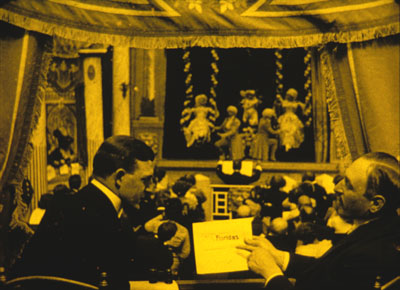
When there are figures close to the camera, as here, they fill up more of the frame, indicating that the field of view has narrowed. Filmmakers of the 1910s had discussed this property of their “cinematic stage,” so as researchers we can confirm that the control of position and timing we observe on screen results from the firm intentions of the makers. They might have echoed Uccello, the Renaissance artist who bent over his drawings late at night and exclaimed: “How sweet a thing is this perspective!”
Suddenly the tableau tradition made sense to me. Directors had to organize both the two-dimensional composition and the tapering three-dimensional playing space in front of the camera. The purpose was to create ever-changing centers of interest, laterally and in depth, flowing along with the key moments in the unfolding action.
By studying the same tactics in Feuillade, Bauer, and others, I found that these principles offered a fruitful way to understand much of what was happening in the films of the tableau era. The dynamic of schema and repetition/revision was at work as well, since I found earlier, more rudimentary uses of these principles; these were then refined during the 1910s. Moreover, the idea helped me generalize beyond that era and analyze later directors, including Mizoguchi Kenji and Hou Hsiao-hsien, who also used staging to shape the viewer’s experience. The results can be found in On the History of Film Style and Figures Traced in Light. Those books largely owe their existence to that flash of awareness kindled by Ingeborg Holm. (11)
We can’t reconstruct Sjöström’s stylistic development with much confidence. (12) His first directed film, The Gardener (Trädgärdsmästaren, 1912) survives, but I saw it before I knew how to watch 1910s movies in this way, so I can’t comment on it. Of the twenty-six films he made from 1912 to 1917, nearly all have been lost. Apart from Ingeborg, I have managed to see Havsagamar (The Sea Vultures, 1916). This retains aspects of the tableau tradition, but virtually no scenes display the intricate staging of his 1913 masterpiece.
In the late 1910s, judging by the films we have, Sjöström seems to have moved quickly toward continuity editing in the American vein. (13) The Girl from Stormycroft (Tösen frän Stormyrtorpet, 1917) contains extended passages of analytical editing, and the scenes display a freedom of camera setup one seldom sees in European cinema of the period. Sjöström clearly understands the principles of continuity down to the smallest detail. For instance, he not only uses the frame-edge cut (the cut that lets a character exit one shot and enter another, as the body crosses the frameline); he accelerates it. Our heroine leaves the kitchen, and in the shot’s final frame she hits the right edge. Another director would have had her exit the frame entirely and held the kitchen shot a little longer, to give her time to get to the next room. But Sjöström simply cuts to her already in another room, completing her trajectory.
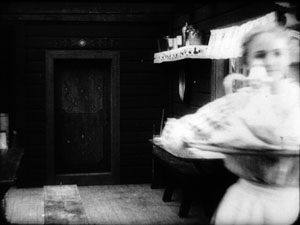
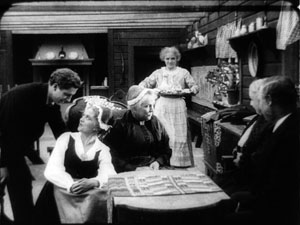
Sjöström presumes that the constant pace of her approach and the vector of her movement will smooth the shot-change. It does, but few directors of that day would had such confidence that our mind would create continuity of motion.
During this summer’s archive viewing, I spent some time studying Sjöström’s cutting in The Girl from Stormycroft and subsequent films. I may offer some more thoughts later. For now I’ll just say that in these early years we seldom encounter such a versatile director, one who mastered the tableau tradition and then moved, with apparently little effort, to nuanced continuity editing. More generally, examining his technique isn’t a dry exercise. We never lose by studying craftsmanship. Sjöström’s films succeed because his style carefully guides our moment-by-moment apprehension of the heart-rending stories he has chosen to tell.
Have I convinced you to surrender your credit-card number? Suspense is available in a dazzling Flicker Alley collection, Saved from the Flames, compiled from the French series Retour de flame. Ingeborg Holm comes with a tinted print of the estimable Terje Vigen (A Man There Was) on a DVD from Kino. The latter disc includes vibrant scores from Donald Sosin and David Drazin.
(1) For the purposes of the outstanding Encyclopedia of Early Cinema (New York: Routledge, 2005), the editor Richard Abel considers that the early cinema constitutes the period from film’s invention ca. 1894 to the mid-1910s.
(2) Silent films were still made into the 1930s, notably in Russia and Japan—a situation that shows the rough-and-ready quality of period divisions.
(3) For an informative series of articles around the 1913 theme, see Griffithiana no. 50 (May 1994).
(4) Gombrich proposes these ideas at various points in Art and Illusion: A Study in the Psychology of Pictorial Representation, new ed. (Princeton: Princeton University Press, 2000). The book is a milestone in twentieth-century humanistic inquiry.
(5) The Lonely Villa (1909) has, in the version I’ve seen, 54 shots in a 750-foot reel (that is, about twelve and a half minutes at 16 frames per second). Suspense has nearly the same number of shots, 56, in about the same running time.
(6) Sharp-eyed readers will recognize one of these shots as Fig. 5.82 in Film Art: An Introduction, 8th ed. (New York: McGraw-Hill, 2008), 187.
(7) Eileen Bowser, The Transformation of Cinema 1907-1915, vol. 2 of History of the American Cinema (New York: Scribners, 1990), 65.
(8) For more background on the film, see Jan Olsson, “‘Classical’ vs. ‘Pre-Classical’: Ingeborg Holm and Swedish Cinema in 1913,” Griffithiana no. 50 (May 1994), 113-123.
(9) Kristin wrote about this technique in “The International Exploration of Cinematic Expressivity,” in Film and the First World War, ed. Karel Dibbets and Bert Hogenkamp (Amsterdam: Amsterdam University Press, 1995), 65-85. She also discusses it in our Film History: An Introduction, 2d ed. (New York: McGraw-Hill, 2002), 67.
(10) Carl Dreyer, “A Little on Film Style,” Dreyer in Double Reflection, ed. and trans. Donald Skoller (New York: Dutton, 1973), 133.
(11) I was probably primed for this by lectures presented by Yuri Tsivian, who has long been studying mirrors in 1910s cinema and calculating how they revealed offscreen space.
(12) Detailed information on Sjöström’s relation to the film industry in these years can be found in John Fullerton’s epic Ph. D. thesis, The Development of a System of Representation in Swedish Film, 1912-1920 (University of East Anglia, 1994). See also Fullerton, “Contextualising the Innovation of Deep Staging in Swedish Film,” Film and the First World War, ed. Dibbets and Hogenkamp, 86-96.
(13) Several people have analyzed Sjöström’s editing. Ben Brewster and Lea Jacobs’ Theatre to Cinema: Stage Pictorialism and the Early Feature Film (Oxford: Oxford University Press, 1997), 133-136 shows how cutting supports the acting in a crucial scene of Ingmar’s Sons. Tom Gunning’s essay “‘A Dangerous Pledge’: Victor Sjöström’s Unknown Masterpiece, Mästerman,” in John Fullerton and Jan Olsson’s anthology Nordic Explorations: Film before 1930(Sydney: John Libbey, 1999), 204-231, argues that Sjöström’s cutting gives his characters a degree of psychological opacity. Most recently, in an unpublished paper Jonah Horwitz discusses patterns of performance, composition, and editing in Terje Vigen (1917).
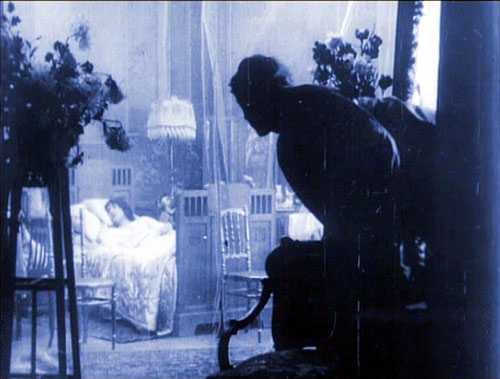
Twilight of a Woman’s Soul (1913).
PS 31 August: Some corrections. David Cairns writes to point out that the triangle at the top of the frame in the Suspense split-screen isn’t a lamp but simply the shade behind the father’s head, cropped by the masking. Wishful thinking on my part, I’m afraid. By the way, David has an intriguing movie giveaway going on his site.
Roland-François Lack corrects dates on two of my Greatest French Hits from 1960: “The great Marker from that year is Description d’un combat, not Lettre de Sibérie (1958), and likewise Rouch’s Moi un noir is from 1958.” Thanks to him and David. To my original list, I should probably have added Cocteau’s Testament d’Orphée, released in 1960.