

Archive for the 'Film comments' Category
Picks from the pile
Or rather, two piles. One stack of consumer durables that I brought home from seven weeks in what we Americans call Yurrp, and another stack of things that came while I was gone.
DVDs of course stand out. Apart from items scooped up in Bologna, here are a few highlights. Some are quite old, some very recent, but all were new to me.
The Magnificent Ambersons, on a Region 2 disc from Montparnasse, in cooperation with Cahiers du cinéma. The squarish box houses a slim booklet, a remastered copy, and bonus documents: interviews with Bill Krohn and Jean Douchet, and a 51-minute conversation between Welles and Bogdanovich. Plus the original trailer.
Engineer Prite’s Project, Kuleshov’s first film from 1918. It’s from Absolut Medien in collaboration with Hyperkino, which we wrote about last year. German subtitles only. Comes with a 54-minute documentary by Semyon Raitburt on the Kuleshov effect.
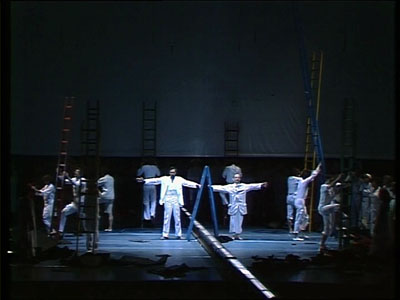
Another German release, but with English subs: Finally, the 1983 Stuttgart production of Philip Glass and Constance de Jong’s gorgeous Satyagraha. For once PoMo staging enhances the story. In the hammering opening of the second act, the mocking laughter of the South African whites comes from a vast row of beer swillers. The pre-HD imagery is a little soft, but my ancient Beta off-air copy can finally be laid to rest. From Arthaus Musik.
Absolut Medien also gives us The New Babylon, one of the greatest but least-known Soviet Montage films. The original Shostakovich score has been used, and the German reconstruction has English subtitles. Apparently a UK edition is on the way. The film is hard to cope with digitally: Lots of fog, smoke, and steam; diffuse photography; shots with significant action in out-of-focus planes. Still, it’s a big improvement on the bargain French edition in circulation. Tom Paulus, a real gentleman, surrendered the last copy in Bruges to me.
The venturesome French company Carlotta has launched an Oshima collection, though it doesn’t seem to appear on the Carlotta website! I found three must-have items at Fnac: A Treatise on Japanese Bawdy Songs, Japanese Summer: Double Suicide, and best of all Three Resurrected Drunkards. The last is a bizarre masterpiece mixing a boy band up with the Vietnam war and Japanese discrimination against Koreans. About 40 minutes in, Oshima provides the most anxiety-provoking reel change in cinema. All Region 2.
Now for some books and journals:
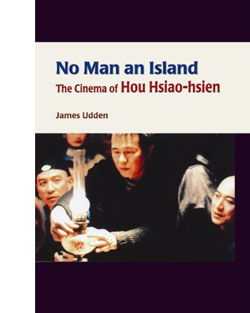 James Udden, one of my last dissertators before I retired, has written the first book-length study of Hou Hsiao-hsien in English. No Man an Island: The Cinema of Hou Hsiao-hsien puts Hou firmly in the context of Taiwanese film history and culture. It offers some provocative suggestions, particularly in arguing that it’s misleading to consider Hou an essentially Chinese director. Jim, who lived in Taiwan and speaks Mandarin, spent many years watching Chinese films from all eras, and he balances this breadth with close study of each Hou film. From Hong Kong University Press.
Eva Laass has just published a wide-ranging study of current narrative strategies in Broken Taboos, Subjective Truths: Forms and Functions of Unreliable Narration in Contemporary American Cinema. She examines Forrest Gump, Thank You for Smoking, Natural Born Killers, Fight Club, and other works in the light of several questions. What different forms of narrative unreliability can be distinguished? Why have unreliably narrated films become so popular in recent years? Which needs do they meet in American culture? Although available from Amazon.de, the book is in English.
I met Steven Jacobs, a brilliant young art historian with wide-ranging expertise, at the Bruges Zomerfilmcollege some years ago. This year he gave me a copy of his 2007 book, The Wrong House: The Architecture of Alfred Hitchcock. Drawing on research in production documents, it’s a careful and imaginative analysis of the master’s use of interior spaces, including discussion of his “staircase complex.” Steven has even reconstructed floor plans for some movies. He is interviewed about the book, in Dutch, here.
For Paolo Gioli admirers, the forty-fifth Pesaro festival catalogue should be welcome. A retrospective of Gioli films is accompanied by essays, an extensive interview with Giacomo Daniele Fragapane, and a detailed, annotated filmography. Everything is bilingual Italian/ English. You can download the catalogue as a pdf here. I hope to post my contribution, with some extra frames, on this site in the next month or so.
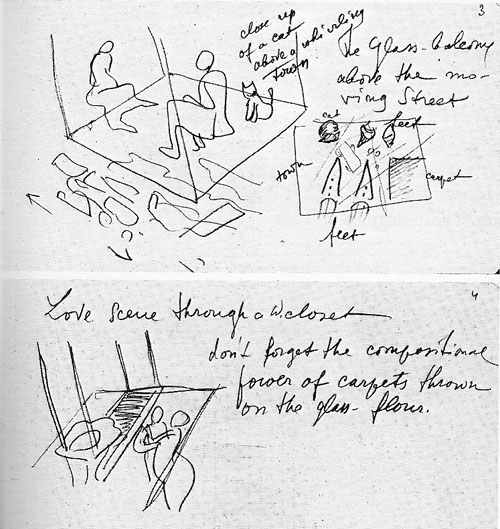
One of Eisenstein’s most ambitious projects was The Glass House (1927-1930). Inspired by skyscrapers, he envisaged a movie set in a high-rise apartment building of the future, with transparent walls and ceilings. He savored the idea of juxtaposing action in different layers (akin to the sequence in M. Giffard’s apartment in Tati’s Play Time). Some of the results can be seen surmounting this entry: a cat curled above a moving street, intertwined lovers seen through a bathroom floor. Another sketch shows a dying woman in the foreground and elevators carrying oblivious people past her.
The bold project is documented in a lovely French volume edited by Alexandre Laumonier and translated by Valérie Pozner and Michail Maiatsky. Glass House contains diary extracts, working notes, and sketches, all thoroughly annotated by François Albera. In a synoptic essay, Albera discusses the role of architecture in Eisenstein’s thinking.
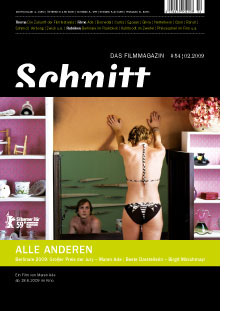
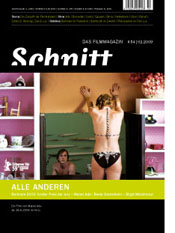 Everyone seems to be talking about the roles of film festivals these days, and a current roundup of opinion can be found in the Cologne-based magazine Schnitt. The magazine is published in German, but for the festival symposium in issue 54, the editors provide English versions of essays by Marco Müller (Venice), Cameron Bailey (Toronto), and many other festmachers. Some radical ideas floating around here, including the suggestion by Lars Henrik Gass (Oberhausen) that subsidies for national film industries, and their festivals, may have to end. (His essay is available in English here.)
In the wake of my homage to the Geneva Theatre/ Smith Opera House, Karen Colizzi Noonan kindly sent me some issues of Marquee, the journal of the Theatre Historical Society of America. Marquee is going strong after forty years, and it remains a lavish production, with big stills and in-depth research. The Society, which is currently updating the standard source book Great American Movie Theaters, holds an annual meeting that includes theatre tours. If you’re at all interested in American film history, you should visit the Society’s website.
There were other items on the two piles, but I have to go. My eyes and ears have some work to do. I’ll leave you with the most unexpected development, film-book-wise, I have encountered upon my return.
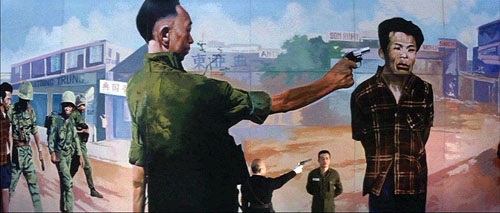
Three Resurrected Drunkards.
Where in the world is M. Hulot?
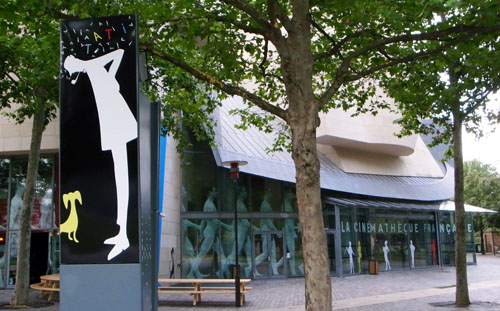
Early last month I posted an entry on Jacques Tati’s friend and long-time artistic collaborator, Jacques Lagrange. I mentioned that there is currently an exhibition on Tati at the Cinémathèque Française-though it closes August 2. On my last day in Europe David and I took the fast train from Brussels to Paris to see it. It was our first visit to the Cinémathèque since it moved into its handsome, surprisingly restrained Frank Gehry building, on the corner of the Rue de Bercy and the Rue Jean Renoir.
I have to confess to being a little disappointed. The exhibition seems to follow the current belief among curators that such events are meant more to be clever and entertaining than informative.
To be sure it was fun to ride up to the fifth floor, where the Cinémathèque’s exhibition space is, in an elevator that played the garbled loudspeaker voice from the opening of Les vacances de M. Hulot and had the meaningless escape-plan diagram from Play Time hanging on its wall. It was a treat to enter through a hallway that had all the original skyscraper-based posters from the travel agency in Play Time lining it. But beyond that, I couldn’t see much rhyme or reason to the layout.
Some of the objects on display were replicas of props and set elements from the films, while others were the originals, with not much labeling to tell which was which. The original fish from the fountain in Mon oncle was there in a central location, but the rest of the real props were in a small room on the side. There glass cases occupied a wall, so that the highest ones were almost impossible to see.
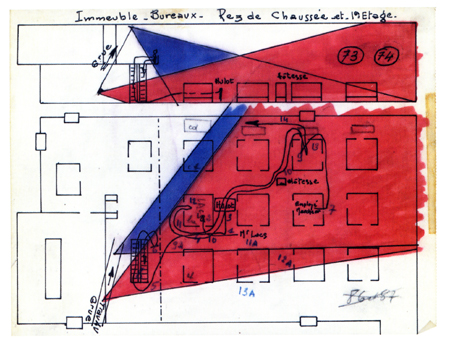
We skipped a lot of the reproductions and the video clips and spent time studying some small, traditional flat cases with script pages, old family photos, and, most intriguingly, pages of plans for the shooting of Mon oncle and Play Time. These were not like traditional sorts of scripts or production schedules, and we tried to figure out the meaning of the columns and color-coding. (At left, a plan for the movements of Hulot and the camera down the escalator and among the cubicles in Play Time.) Unfortunately these documents were arranged in a collage fashion, so that one page overlapped another and one couldn’t read the entirety of any of them. About the best one can say as a result is that it’s good to know that all this material was saved, so that a researcher might someday be able to make sense of it all.
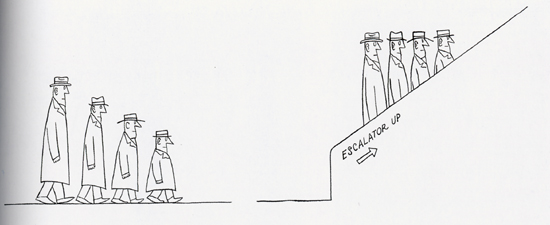
A surprising amount of the exhibition was given over to artworks inspired by Tati, including some new ones apparently done for this event. Some captured the spirit of the filmmaker fairly well, while others didn’t, but they seemed to diffuse the focus of the whole. There were earlier artworks as well, whether to suggest that they influenced Tati or simply to relate him to some sort of zeitgeist was unclear. It was fascinating to note how much the work of the great American cartoonist Saul Steinberg shared what we think of as a Tatian sense of humor. (See below for a specimen.) Whether Tati knew Steinberg’s work is another matter. And I doubt that Play Time’s grim little eating scene, with its green, neon-lit faces, owes anything to Edward Hopper’s “Nighthawks” painting (the one in the diner at night) or that the comparison tells us much about either.
These and other comparisons in the exhibition owe much to the curators’ decision to stress the overused concept of “modernity.” Tati and the modern, what a concept! The films have the distinct advantage of being utterly clear in their implications about society, and it seemed to me that the exhibition plays a lot with the notion of the Tatian sensibility without a systematic coverage of the man’s work.
The co-curator of the exhibition and designer of the catalogue, Macha Makeïeff, appears in a four-minute online interview (no English subtitles). That interview takes place in the exhibition space, so those who can’t make it to Paris in the next week and a half can get a glimpse of it.
The catalogue reflects the content of the exhibition, though interestingly, there are no pictures of the original props and costumes from the display. (Maybe there was some sort of legal restriction imposed by Tati’s estate.) Some of the replicas show up, as do a very few of the original documents that so intrigued us 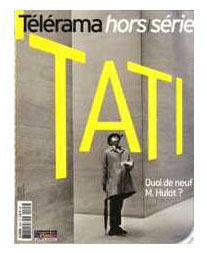 (printed very small). There’s the requisite section where filmmakers write about their admiration for the Master. These include David Lynch (who might conceivably be said to reflect a Tatian influence only in The Straight Story) and more obvious students of his work, Elia Suleiman and Otar Iosseliani.
There are a few designs by Lagrange and Pierre Etaix reproduced, and some other interesting and useful items. Still, one would actually be better off buying the special issue of Télérama issued in conjunction with the exhibition. (The Play Time plan illustrated above comes from it, not the catalogue.) It reproduces more of the original objects and documents from the exhibition than the catalogue does, and it consists of a lot of short articles and far more historical photos than the exhibition contains. Apart from everything else, it reproduces a picture from Tati’s quietly hilarious and lengthy fashion-photo shoot for the September, 1979 issue of French Vogue. The special issue is available online from fnac.
So, all in all, we were glad we went. That’s partly because there were some gems to be found in the exhibition, such as some footage of the false-perspective buildings of Tativille being built and moved. In addition, we had a lovely day in Paris.
[July 23: Two colleaguess have taken exception to my statement that David Lynch’s work displays little influence from Tati. Jonah Horwitz, currently a graduate student in film here at the University of Wisconsin-Madison, makes these cogent remarks via email:
I think the Tati influence–really just a PLAYTIME influence– is evident in the way he stages gags, often in ELS with ample “dead time” between actions, or an eternity spent waiting for a gag to reach fruition. (I would even argue that the Tati influence can be detected in Lynch’s subtly disorienting long shots, in general.) There are definitely examples in STRAIGHT STORY, but also in a variety of other things he’s done, features, television, and experimental shorts alike.
An example of a pretty obviously PLAYTIME-derived gag (I’d even call it an homage) of this sort is in the final episode of TWIN PEAKS, which Lynch directed. Audrey Horne has locked herself to the bars of a bank vault as an act of civil disobedience. A decrepit bank manager responds to her request for a glass of water. In two lengthy ELSs, interrupted by a reaction shot of Audrey, Lynch makes us wait and watch as the manager waddles from one end of the expansive bank lobby (made to seem even larger by the wide-angle lens) to a water fountain at the other–and back again.
Jonathan Rosenbaum has blogged on the subject here, with additional cogent remarks.
Jonathan also refers on my claim that the title of Tati’s masterpiece is Play Time rather than Playtime, as it is usually written. He’s undecided on that issue. My opinion is based on the way the title is written in the credits and posters, with a capital T and the hint of a space between the words. In my analysis of the film (in Breaking the Glass Armor), I wrote “The difference is not negligible, since the separation puts more emphasis upon the implications of the two words (especially “time”), while retaining the meaning of the single term” (p. 250, footnote). Of course, it’s possible that the title is really PlayTime, but that sort of capitalization of an internal letter in a single word was still pretty rare in those days (apart from CinemaScope), and once it did come into vogue in the eBay, PayPal age, I doubt Tati would have resorted to it.
I forget just when it happened, but years ago Leonard Maltin’s Movie Guide (which tends to be quite careful in its attempts to make all titles match the way they appear in a film’s credits) changed its spelling from Playtime to two words. At the same time, it sensibly upped the number of stars awarded the film from two and a half to four. I am happy to see what I assume is my influence there. Perhaps more people have decided to watch the film on the basis of those one and a half extra stars.
Jonathan adds, “For me, the cinching argument either way would be how Tati spelled the title himself. I’m sorry that I never thought to ask him, during the brief period in 1973 when I worked for him.”
David and I never met Tati, but we did receive a letter from him. In 1974 we had hopes to bringing him to Madison for a visit. He replied (10 October 1974) that he was currently involved in a lawsuit with his producers and could not make a commitment. Alas, we were never able to lure him here, but in the letter he mentions “Playtime,” spelling it as one word. My own belief is that when the film came out no one had noticed that the title was supposed to be two words, and Tati simply adopted what was then the universal way of referring to the film. Perhaps it wasn’t important enough to him to make an issue of. As I pointed out in the entry on Lagrange, his sketch for the hat-watering gag clearly has the title as two words. The best evidence on the subject, however, is presumably the way the title is spelled on the final script, which I’ve never seen. Maybe the capital T on “Time” was just a whim of the designer’s, but whatever the case, I still think it makes more sense as two words.]
The Bologna beat goes on
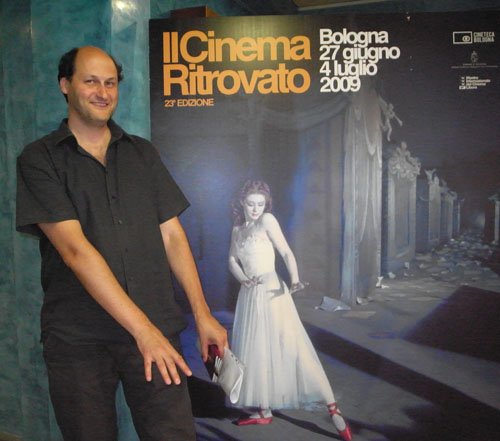
Guy Borlée, Festival Coordinator for Cinema Ritrovato, in a pas de deux with Moira Shearer.
DB here:
Like most film festivals, Cinema Ritrovato is many festivals. There’s so much on offer you can carve out your own mini-fests. You may meet a friend for lunch and learn that you two have seen none of the same movies. So here are some titles from my sampled version of Ritrovato.
1909 and a little later
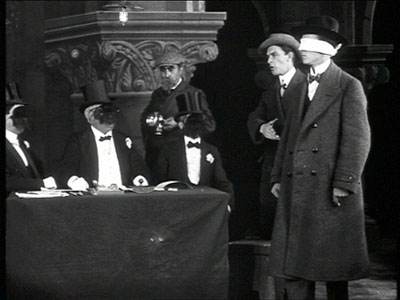
Le Trust (Feuillade, 1911).
As Kristin pointed out in our last entry, we spent a lot of time in the 100 Years Ago thread. Things were definitely changing on screens in 1909. True, you still had your costume picture with suspiciously insubstantial walls and props, your gimmicky special-effects comedies (e.g., The Electric Policeman), and your chase films with people falling over and getting up and running on, endlessly.
But you also had powerful movies like Capellani’s L’Assommoir, discussed by Kristin, and charming ones like Charles Kent’s Vitagraph Midsummer Night’s Dream. There were crime films like Tell Tale Blotter and An Attempt to Smash a Bank, with its peculiar slow reverse tracking shots linking the lobby and the banker’s office. There was Cowboy Millionaire, which presents the always-edifying spectacle of a buckaroo bringing his uncouth pals to the big city. There were wonderful Film d’Art items, not least Le Retour d’Ulysse, which had the most rapid editing pace of any 1909 film I clocked. There was even a lifelong romance told through the fate of two pairs of shoes (Roman d’une bottine et d’un escarpin).
Louis Feuillade was one of the finest directors of the 1910s, but most of his earlier work that I’ve seen doesn’t suggest his mature storytelling skills. Of the 1909 Feuillades on display in Bologna, the two I found most intriguing were La Possession de l’enfant, about a divorced wife who kidnaps and raises her child in poverty, and La Bouée, a touching tale about a fisherman’s family about to lose everything. But the cherry on the sundae for me was a pristine print of a 1911 Feuillade, part of Eric de Kuyper’s program of films about financial crises. My man Louis did not fail me.
In Le Trust, a businessman indulges in a bit of corporate espionage. He hires a detective (the sinister René Navarre) to kidnap an inventor and squeeze a secret formula out of him. The detective resorts to some unusual methods, such as hiring an actor to dress in drag and impersonate a rival’s wife. The inventor is kidnapped but outwits his captors with a trick that could have come straight out of Les Vampires. The plot’s outrageous surprises are played straight and brisk, and we can see Feuillade moving toward the compact, inventive staging of Fantomas and Tih-Minh. How could Le Trust not be my favorite movie of the week?
Tsars, Commissars, and Jews
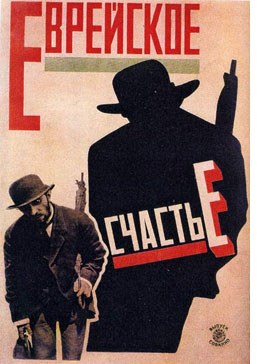 Given my fondness for Russian and Soviet film, Kinojudaica was a thread I followed fairly closely. This imaginative program, drawn from a larger package assembled by the Cinémathèque de Toulouse, ran from the 1910s to the early 1930s.
Véra Tcheberiak (1917) is probably more important for its subject matter than its fairly simple technique. The two-reel film was the third to treat a famous case of anti-semitic hysteria under the Tsar. In 1913, a Jew named Beilis was charged with ritual murder of a Christian child, and it became Russia’s Dreyfus affair.
More elegantly directed was Evgenii Bauer’s worldly, somewhat cynical Leon Drey (1915) which retains its fascination. (I wrote about its staging in an earlier entry.) But its intertitles still need to be restored.
Two later films were strongly marked by Soviet montage influence. In The Five Brides (Piat Nevest, 1929-1930), a shtetl is threatened with a pogrom by a gang of bandits. The band will spare the citizens if five virgins can be offered to their leaders. Director Aleksandr Soloviev accentuates this dramatic situation with every trick in the montage playbook: fast cutting, low angles, handheld shots, dynamic graphic conflict, and even explosions and bursting waves as Red partisans ride to the rescue. The final moments are missing, but there is plenty to savor, including an emotionally complex scene in which the elders decide to sacrifice their five virgins and suffocate a young man who is trying to stop them. The film was revised for Russian release, but we saw the original Ukrainian version.
No less engaging, though a little more formulaic, was Remember Their Faces (Zapomnite ikh litsa, 1931). A young Jewish worker devises a machine to speed the work of a tannery, but his efforts are blocked by saboteurs and anti-Semites. In a slap to the New Economic Policy, the chief villain is a private entrepreneur who wants to make the tannery uncompetitive. The scenes in which Beitchik is casually bullied by young thugs are quite strong. The final moments, when the bullies won’t even let Beitchik leave town unmolested, present the stirring image of the Komsomol youths marching to rescue him. Such support did not materialize behind the scenes: the film encountered censorship at every stage and was given a modest release.
Despite a 1927 Party directive ordering films treating anti-Semitism as a threat to socialism, both The Five Brides and Remember Their Faces encountered obstacles at every turn, largely on the grounds that the Party was given too small or too passive a role. In a fine book accompanying the series, Valérie Pozner supplies details of how the films were censored and suppressed.
Capra, company man
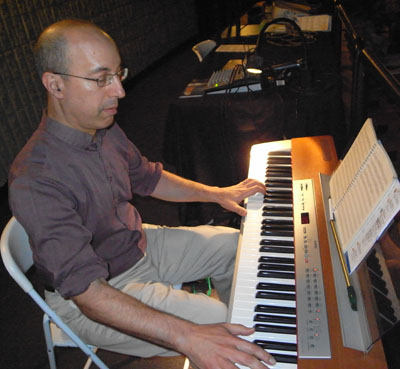
Donald Sosin gives us Scott Joplin’s “Wall Street Rag” (1909), uncannily appropriate today.
One of the highlights of this year’s Ritrovato was the Capra series, featuring his surviving silent work and several early sound pictures. We were also lucky to have Joe McBride, professor, critic, and UW alum, there to introduce many sessions.
I didn’t attend the talkies, having seen the batch except Rain or Shine (1930), but several of the silents grabbed my attention. Most seemed to be attempts by Columbia to hitch a ride on the bigger studios’ successes.
The Way of the Strong (1928) is a post-Underworld exercise in hoodlum redemption, graced by vigorous action, swift cutting (4.3 sec ASL by my count), and nice juggling of recurring props (mirrors, pistol barrels, a book devoted to great lovers). And the plug-ugly hero is truly ugly, none of your Hollywood fake-ugliness; a face only a blind girl could love. Submarine (1929) is a take on the What Price Glory plots analyzed by Lea Jacobs in her recent book. Two amiable sides of beef brawl and drink their way through navy life until a woman comes between them. The sexual rivalry is compelling, and the suspense during a stifling undersea rescue is admirably sustained. The Younger Generation (1929) owes something to the back-to-your-roots impulse of The Jazz Singer. Based on a Fannie Hurst story, it tells of a Jewish family that rises into society because of the son’s business acumen; in the process, class snobbery makes them increasingly unhappy.
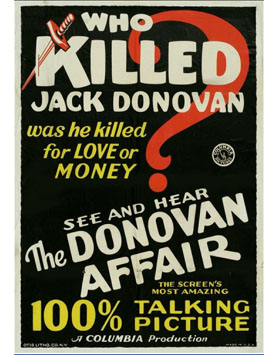 I leave aside the silent version of Rain or Shine, which I found underwhelming, so as to focus on the most curious thing I saw at the festival. The Donovan Affair is a Philovanceish murder mystery from a play by the ubiquitous Owen Davis. It was released in April 1929, and it isn’t particularly good. But it nags me.
The movie was made in both silent and sound versions. Our print was silent, but it had no intertitles. At first blush it seemed to be the sound version without its track, sort of a 000% talking picture. The print’s average shot length is 9.3 seconds—too long for most late silents, but typical of some early talkies. Yet this did not look like any 1929 American talkie I have seen.
It had silent-film lighting, some huge lip-sync close-ups, and very smooth cutting. Except for a couple of moments, it lacked the jerky reframings, the long-lens imagery, and multiple-camera coverage typical of shooting from booths, the common practice of early talkies (and the talking sequences of The Younger Generation). Capra’s setups sat well inside the action, as was the case in 1920s silents and as would be the case in single-camera sound films a few years later.
Crazy as it sounds, I had to wonder if we were seeing a copy of the silent version made before titles were inserted! This is very unlikely. But if this was indeed an early talkie version, Capra was able to shoot sound with a fluidity that directors at bigger firms didn’t display—and in a rented studio at that, if the AFI Catalogue is to be believed. On the road and away from my research base, I can’t investigate further, but if you know more about the Donovan Affair affair, feel free to correspond and I’ll add postscripts.
Whatever the provenance of that Library of Congress print, the other silent/ early sound Capras have been admirably buffed by Sony’s Grover Crisp and Rita Belda (another Wisconsinite). The prints’ sparkle and sheen prove that even a minor-league studio (which Columbia was then) could turn out gorgeous imagery, thanks in no small part to cinematographers like Joseph Walker and Ted Tetzlaff.
Miscellany
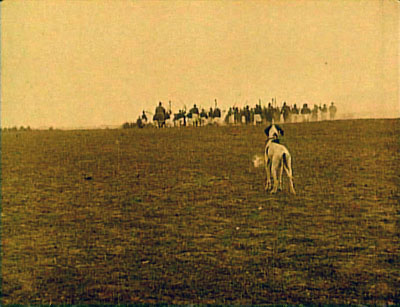
The Lewinsky Dog surveys the climactic battle in Karadjordje (1911).
Be Patient! Department: Anke Wilkening, who was among those announcing the discovery of a new Metropolis print last year, gave us an update on the restoration process. The archivists are nearly done integrating the Argentine footage into the whole. Next comes the cleanup phase—awkward because the original Argentine print was heavily scratched and what we have is a 16mm copy and cropped for sound at that.
So far, the restored footage is clearly making secondary characters like Josaphat and the “Thin One” more prominent. But even the Argentine print is lacking things known to us, as three clips illustrated. Getting everything in some order will take time. Anke promises another report next year.
Box sets routinely attract attention at Bologna’s annual DVD awards, and this year things went according to form. The top prize went to Joris Ivens, Wereldcineast, a vast assembly of rare work by the Dutch filmmaker. Another generous package, Flicker Alley’s Douglas Fairbanks set, won best silent-film box set. (We have an entry on it.) Two more big collections, GPO Film Unit Collection vol. 2 (BFI) and Treasures from American Archives IV (Film Foundation) triumphed in the Sound Film and Avant-Garde categories.
Other winners: the two Vampyr releases (Eureka and Criterion) and Berlin, Symphony of a Big City (Munich Filmmuseum) for their rich bonus materials; Vittorio De Seta’s documentary collection Il Mondo Perduto (Feltrinelli Real) and two studies of Pasolini’s La Rabbia (Raro) in the Rediscovery category. Cinema Ritrovato wisely acknowledges that DVD producers are contributing powerfully to research into film history and are making rarities available to viewers who live far from festivals, archives, and cinematheques.
Not heralded—in fact, just sitting on the counter at the ticket booth—were still other DVDs, this time from Serbia. Sharp-eyed Olaf Müller pointed them out to me, and I’m grateful he did. Two volumes from the “Film Pioneers” series include a set of newsreels and, happily, the 1943 Innocence Unprotected (which Makavejev “decorated” in his revised version of 1968). A third disc consists of Karadjordje; or, Life and Deeds of the Immortal Duke Karadjordie (1911). This is the first Serbian and Balkan feature, and is thus, as the box text indicates, “one of a kind.” Same goes for Cinema Ritrovato itself.


Gian Luca Farinelli and Peter von Bagh, two more we have to thank for a great festival.
Just in time for Bologna, the historical journal 1895 has published a splendid special number on Le Film d’Art, ed. Alain Carou and Béatrice le Pastre. Feuillade’s Le Trust is available on the Gaumont early years DVD set and will soon be released on a Kino set drawn generously from the Gaumont collection. Keep your eyes open for early Capra features on Turner Classic Movies; several have run there recently.
Back in Bologna
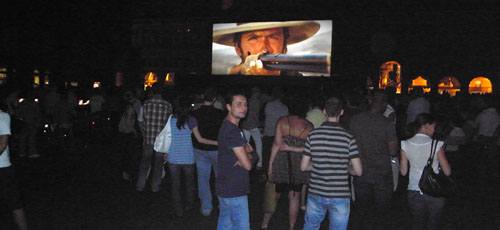
The newly restored version of The Good, the Bad, and the Ugly on the Piazza Maggiore.
Kristin here-
This year, the main complaint about Il Cinema Ritrovato, the annual festival held by the Cineteca Bologna, is that there’s too much to see. With three venues playing films against each other, plus the 10 pm screenings each evening in the Piazza Maggiore, there’s no way to see everything. Some people complain that the conflicts are becoming worse-but I remember these same complaints about the over-abundance of films coming in previous years as well. Yes, it’s frustrating at times, but being offered more films than one can watch is a problem a lot of people would love to have. Basically one either chooses a couple of threads to follow through or just goes to whatever appeals in any given time slot.
According to the 2009 festival’s newsletter, there were 810 attendees, including 557 from outside Italy.
This year there have been several main focuses: a retrospective of Frank Capra’s silent and early sound films; a portion of the Cinémathèque de Toulouse’s program of Jewish-themed Russian and Soviet cinema from the 1910s to the late 1940s; a selection of color films from the early years of the twentieth century to the 1960s; a survey of the work of Vittorio Cottafavi; the annual “100 years” program, this time from 1909; the sea films of Jean Epstein; the silent Maciste films; and many other items.
Even between the two of us, we could not take in nearly all of the riches on offer, so here’s some of what I managed to see, with David’s report to follow.
An annual hundredth birthday
Each year the festival has a thread of programs of films from one hundred years earlier. This tradition started in 2003, when Tom Gunning was asked to put together groups of films from 1903. Thereafter Mariann Lewinsky took over as programmer for these threads. In recent years, her choices have been supplemented by small groups of films chosen by individual national film archives. This year Tom programmed the 1909 Griffiths and a group of other U. S. titles.
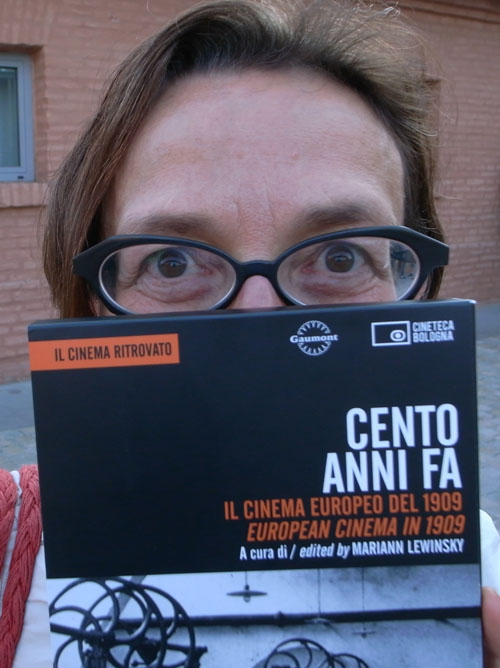
Maybe it’s just my impression, but the hundred-year packages seem to gain in prominence and popularity each year. Presumably in response to such popularity, the festival has just released a DVD with a selection of 22 shorts from this year’s 1909 program: Cento anni fa: Il cinema Europeo del 1909/European cinema in 1909 (running two hours and twenty minutes and presented below by Mariann). It contains only about a fifth of the roughly 100 films screened, but many of the others are available in online archives. DVDs of previous years’ programs are in the works, with 1907 soon to come. The DVD and other publications of the festival are available here.
I managed to see most of the 1909 programs but obviously can mention only a sampling. Undoubtedly the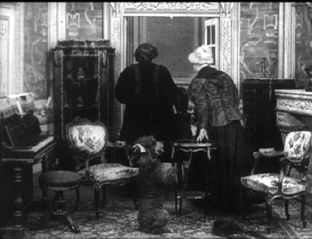 highlight for me and others I talked to was Albert Capellani’s L’Assommoir, notable for its skillful and intricate staging and splendid performances. It looked more like a film from 1912 or 1913. During the comedy, Un chien jaloux (a Gaumont one-reeler by an unknown director, left), pianist Donald Sosin had the audience in stitches by providing barks, whines, and growls as appropriate. (It’s included on the DVD, alas, without the sound effects.)
French director Alfred Machin contributed two excellent dramatic films, both involving windmills: Le Moulin maudit (also on the DVD) and, in the program of early color films, L’Ame des moulins. Comedy stars were represented by two Cretinetti films and a strange Max Linder film in which he becomes Amoreux de la femme à barbe (“Infatuated with the Bearded Lady”).
There were a great many documentaries giving glimpses into the world of 1909. Airplanes were much in 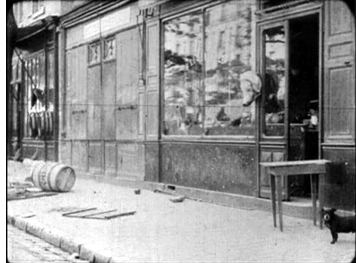 evidence, as were detailed depictions of industries in colonized countries. Mariann confessed herself to be fascinated by the random, unplanned events that intrude into both non-fiction and fiction films of this early period-particularly those shot in the street. As usual with early films, passers-by frequently come to a standstill and gawk at the camera. As she pointed out, the frequent intrusion of dogs into the frame reflected the reality of the time, when numerous homeless animals inhabited cities. We all became very aware of these animals, which David dubbed “Lewinsky dogs.” At the right, a little one that half-enters the end of one shot of a typical chase film, Les tribulations d’un charcutier (director unknown; also on the DVD).
Mariann watched a great number of 1909 films in order to make her selection. Her experience convinced her of what many of us feel, that this was a turning point for the development of film art, though perhaps not as dramatic a one as 1913. Apart from L’Assommoir, Griffith’s The Country Doctor could be pointed to as evidence that the year saw films of a greater complexity and beauty than had previously been released. Griffith may no longer be quite the lone giant of the pre-1920 era that film historians have portrayed. Still, there are touches in The Country Doctor that no other director could have conceived, such as the early shot of the central family strolling through a field of tall grass that hides everything except the doctor’s top hat floating above the stalks.
Reaching 1909 raises the question as to how long these 100-year anniversary programs can continue and what form they should take. With fiction films getting longer in years to come, particularly in Europe, there emerges a problem of including enough of them to give a sense of a single year without having the programs expand even more. Perhaps non-fiction films will figure as an increasing proportion of this thread-with more Lewinsky dogs inadvertently captured for posterity.
A garland of color films
Two programs of early color films demonstrated the various processes: hand-coloring with stencils, tinting, toning, and attempts at photographic color. The only really successful of the latter were two 1912 shorts using the Gaumont system, which provided images in sharp, reasonably true color.
I caught only a few of the features in the color thread. Victor Schertzinger’s Redskin (1929), in two-strip Technicolor, was a beautiful print. Despite its implausibly happy ending, this story was a sophisticated look not only at racial tensions between whites and Indians but also at equally divisive tensions among Indian tribes. Like the other occasional films of the early decades that show the action from the Indians’ standpoint (Griffith’s The Red Man’s View figured in the 1909 program) are remarkably sympathetic to their culture. The color portrays not only the beautiful desert landscapes of the American Southwest but also Navaho blankets and Pueblo sand paintings.
Toward the end of the week, when people asked me what my favorites had been so far, I forgot to mention Pandora and the Flying Dutchman, which had played way back on the opening Saturday. It has a reputation as a bizarre film, and I wasn’t expecting much beyond some glowing color images of two beautiful stars, Ava Gardner and James Mason. But I was pleasantly surprised by its well-handled fantasy tale of the Flying Dutchman visiting a contemporary Spanish seaside resort and finding his true love. In particular a lengthy flashback to the Dutchman’s original crime has a degree of stylization and intensity that allow it to avoid seeming absurd. The tale has an other-worldly quality that recalls some of Powell and Pressburger’s films-enhanced by the presence of cinematographer Jack Cardiff handling the Technicolor.
Unfortunately Track of the Cat (William A. Wellman, 1954) failed to similarly avoid a sense of the absurd in its overheated Tennessee William pastiche set on an isolated farm in the West. Lumbering dialogue lays out explicitly all the tensions among the members of the central family, exacerbated by the depredations of an elusive puma and a visit by the younger brother’s potential fiancée. The reason for its presence in the festival, though, was its color scheme. Wellman set out to make a “black and white film in color,” as the program describes it. Both the snowy landscapes and the interiors are dominated by white, black, and flesh tones, with the sole exception-the Robert Mitchum character’s bright red coat-disappearing from the action partway through.
Not only silents need restoring
Martin Scorsese’s influence hovers over the festival and the Cineteca Bologna. One of the two screening rooms in the Cineteca’s building is the Scorsese (the other being the Mastroianni). In recent years, films from the institution that Scorsese founded, the World Film Foundation, have been screened here. The WFF is dedicated to restoring and preserving films from countries whose archives might lack the resources to handle such major projects. This year’s presentations were Fred Zinnemann and Emilio Gómez Muriel’s Redes (The Wave, 1936), Shadi Abdel Salam’s Al Momia (known in English as The Night of Counting the Years, 1969), and Edward Yang’s A Brighter Summer Day (1991). The foundation also aided in the editing of Ingmar Bergman’s home movies into Images from the Playground (Stig Borkman, 2009).
I had seen The Night of Counting the Years in one of the faded 16mm copies that have long been the only form in which this Egyptian classic was available. The new copy is a vast improvement, finally revealing why this is considered perhaps the great Egyptian film. It is based around a true story from 1881, when a powerful tribe on the west bank at Luxor discovered a cave containing a huge cache of royal mummies and funerary goods that had been hidden away by ancient priests to preserve them after the extensive robbing of their original tombs. The tribe started selling items gradually on the illicit antiquities market, but one of its members revealed the location of the cache to the authorities, allowing them to salvage most of the mummies and their grave goods. The film was beautifully shot on location in the desert and temples of the west bank and provides a meditation on why the young man might have acted against the apparent best interests of himself and his family.
A 1991 Edward Yang film might not seem an obvious candidate for restoration, yet the complete version of A Brighter Summer Day was barely rescued from oblivion. The original negative does not exist, and the print materials on the shorter version were discovered to be moldy. Rescuing these and combining footage from both versions has resulted in a pristine new print of Yang’s greatest achievement. An in-depth look at Taiwanese society a decade after Chiang Kai-chek took over the island, it follows a middle-class boy drawn gradually into gang violence. The new version, which premiered at Cannes earlier this year, looked great on the big screen in the Arlecchino.
This and that
A brief tribute to Harry d’Abbadie d’Arrast included Laughter, the director’s first sound film. A romantic comedy, it stars Frederick March as a witty young composer aspiring to marry a wealthy society woman against her father’s wishes. The film has touches of Holiday and Design for Living, both films yet to be made. Laughter confirms d’Abbadie Arrast’s reputation as a good but lesser filmmaker in the Lubitsch mold.
 We all have reason to celebrate the fact that Georges Méliès’ films went into the European public domain this year. (The films have long been in the public domain in the U.S.) With obstacles to programming out of the way, the festival presented a program in homage, featuring twenty shorts presented by Serge Bromberg, who helped put together the extensive Méliès collection that came out in the U.S. and won the 2008 award for best DVD set here at the Cinema Ritrovato. (It came out in France earlier this year.) While all the films shown are on the DVDs, it was a treat to see them on the big screen. Bromberg provided a lively, if not entirely authentic, running commentary to “explain” the action of the final film, La Fée Carabosse.
Demonstrating that history repeats itself, Belgian film scholar Eric De Kuyper programmed a selection of titles dealing with financial speculation and crisis. These included perhaps the best of several items from Louis Feuillade shown during the week, Le Trust ou les batailles de l’argent (1911). It stars René Navarre, who would soon play Fantômas, as an unscrupulous detective, and the action is more in the thriller mode than a serious depiction of French finances. Also included was a 1916 German feature, Die Börsenkönigin (“The Queen of the Stock Exchange”), with a fine performance by Asta Nielsen as a woman more successful in finance than in love.
More to come from David, on Capra, DVD awards, and personalities glimpsed by a roving camera.
For our previous Cinema Ritrovato entries, see here for 2008 and here, here, and here for 2007. For a thorough discussion of dogs in early film, with comments by Mariann Lewinsky, see Luke McKernan‘s authoritative entry here. On the occasion of Edward Yang’s death in 2007, David offered an homage to him and A Brighter Summer Day here.