















Archive for the 'Film comments' Category
Propinquities
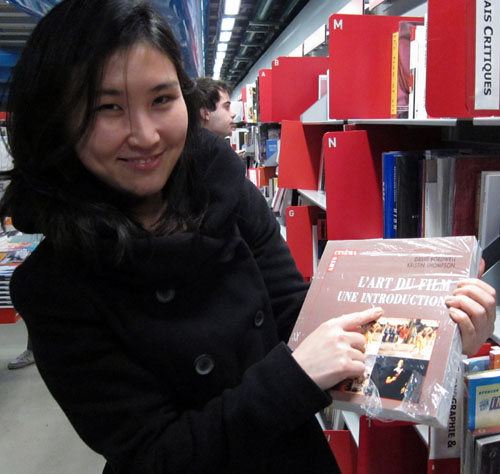
Jinhee Choi, Centre Pompidou, January 2010.
Propinquity: Nearness, closeness, proximity: a. in space: Neighborhood 1460. b. in blood or relationship: Near or close kinship, late ME. c. in nature, belief, etc.: Similarity, affinity 1586. In time: Near approach, nearness 1646. —Oxford Universal Dictionary
DB here:
In any art, tools and tasks matter. From the first edition of Film Art (1979) to the present, our introduction to film aesthetics starts with an overview of film production. How is production organized within the commercial industry, or within a more artisanal mode? What freedom and constraints are afforded within the institutions of filmmaking? How does current technology support or limit what the filmmaker can do? And how do filmmakers explain what they’re doing—not just as personal proclivities but as rhetorical “framings” that lead us to think of their work in a particular way?
Some would call this approach “formalism,” but that label doesn’t capture it. Traditionally formalism refers to studying an artwork intrinsically, as a self-sufficient object. In this sense, our perspective is anti-formalist: We look outside the movie to the proximate conditions that shape its form, style, subjects, and themes.
More literary-minded film scholars have sometimes been impatient with this perspective. Yet in the history of painting and music, it has yielded real advances in our knowledge. It continues to do so in film studies too, as I learned when we came back from Yurrrp to find some books awaiting us. (Kristin has already remarked on the stacks of DVDs that had accumulated.) Among these were books that illustrate the continuing value of situating film artistry in its most immediate context: the creative circumstances, the norms and preferred practices operating within traditions, the rationales that artists offer for their choices. Even better, the books were written by friends, so we have both intellectual and personal propinquity. I have always wanted to use the word propinquity in a piece of writing.
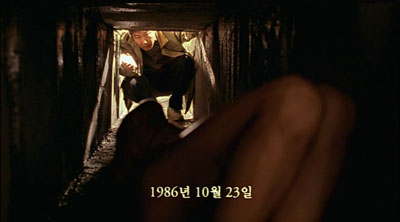
Memories of Murder (Bong Joon-ho).
Jinhee Choi’s The South Korean Film Renaissance: Local Hitmakers, Gobal Provocateurs is a wide-ranging survey of what some have called the “next Hong Kong”–a popular cinema of brash impact and technical polish, on display in JSA, Beat, Dirty Carnival, My Sassy Girl, and the like. But unlike Hong Kong, South Korea has a strong arthouse presence too, typified by Hong Sang-soo’s exercises in parallel narratives and thirtysomething social awkwardness. Between these poles stands what local critics called the “well-made” commercial film, as exemplified by Bong Joon-ho’s Memories of Murder.
Choi, a professor at the University of Kent, mixes analysis of cultural and industrial trends with consideration of crucial genres (notably the “high school film”) and major auteurs. She is the first scholar I know to explain changes in the Korean film industry as emerging from a dynamic among critics, filmmakers, private funding, and government sponsorship. A must, I would say, for anyone interested in current Asian film.
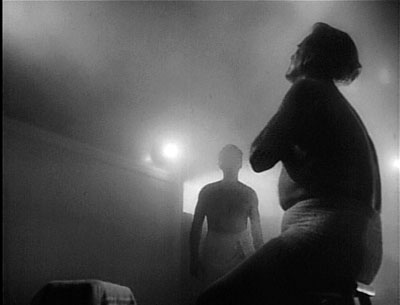
T-Men (Anthony Mann, cinematographer John Alton).
 The South Korean Film Renaissance is matched by a work of equal subtlety, Patrick Keating’s Hollywood Lighting: From the Silent Era to Film Noir. Keating has an MFA in cinematography from USC, and his Ph. D. work concentrated on classical American cinema. His book captures the craft of the great studio cameramen, following not only what they said they were doing (in interviews and in the trade papers) but also what they actually did. He homes in on the contradictory demands facing artists who, they claimed over and over, had to serve the story. How do you claim artistry if your contribution is unnoticeable? This problem becomes acute with film noir, where the style is expected to come forward to a significant degree.
Keating scrutinizes the films with unprecedented care, tracing not only cameramen’s distinctive styles but showing that originality was always in tension with the conventional lighting demands of various genres and situtations. Many big names are here—John Seitz, Gregg Toland, John Alton—but the book also examines innovations coming from solid craftsmen like Arthur Lundin, who lit Girl Shy and other Harold Lloyd films. You won’t look at a studio movie the same way after you’ve digested Keating’s richly illustrated analyses.
Both Jinhee and Patrick were students here, and I directed the dissertations that eventually became these books. So of course I’m biased. But I think that any outside observer would agree that these monographs show the value of studying how film artistry and the film industry intertwine.
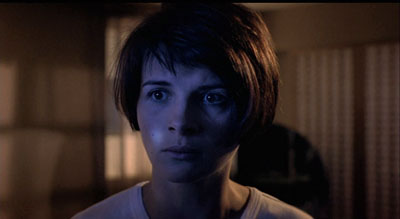
Blue (Krzysztof Kieslowski).
No less sensitive to the interplay of art and business is Patrick McGilligan’s Backstory 5: Interviews with Screenwriters of the 1990s. The collection is as illuminating as earlier installments have been. How could it not be, with career ruminations from Nora Ephron, John Hughes, David Koepp, Barry Levinson, John Sayles, et al.?
I’ve long found Pat’s Backstory volumes a treasury of information about Hollywood’s craft practices. Every conversation yields ideas about structure, style, and working methods. In this volume, for instance, Richard Lagravanese points out that scenes have become very short; with slower pacing in the studio days, scenes had time to breathe. And after claiming over and over that cinematic narration comes down to patterning story information, I was happy to read Tom Stoppard:
The whole art of movies and in plays is in the control of the flow of information to the audience. . . . how much information, when, how fast it comes. Certain things maybe have to be there three times.
In the studio days this last condition was called the Rule of Three: Say it once for the smart people, once for the average people, and once more for Slow Joe in the Back Row. Some things don’t change.
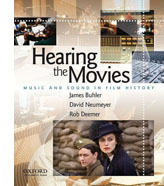 Pat McGilligan is also a Wisconsin alumnus, so to keep these notes from getting too incestuous, I’ll just mention that I know the distinguished musicologist David Neumeyer chiefly from his writing (though I have to confess I first met him when he visited . . . Madison). Along with coauthors James Buhler and Rob Deemer, David has published an excellent introduction to film sound. Hearing the Movies: Music and Sound in Film History is designed as a textbook, but it’s so well written that every movie lover would find it a pleasure to read.
The examples run from the silent era (including Lady Windermere’s Fan, a favorite of this site) to Shadowlands, and while music is at the center of concern, speech and effects aren’t neglected. There’s a powerful analysis of the noises during one sequence of The Birds, and the authors pick a vivid example from Kieslowski’s Blue (above), in which Julie is shown listening to a man running through her apartment building; we never see the action that triggers her apprehension.
The authors provide a compact history of sound film technology, including many seldom-discussed topics. For instance, 1950s stereophonic film demanded bigger orchestras and more swelling scores, while separation among channels permitted scoring to be heavier, without muffling dialogue. Throughout, Neumayer and his coauthors balance concerns of form and style with business initiatives, such as the growth of the market for soundtrack albums and CDs (a topic first explored by another Wisconsite, Jeff Smith, in his dissertation book). Once more we can arrive at fine-grained explanations of why films look and sound as they do by examining the craft practices and industrial trends that bring movies into being.
Watching back episodes of the American version of The Office recently, I’ve been struck by the premise it takes over from the UK original. This comedy of humors in Cubicle World is supposedly recorded in its entirety by an unseen film crew. I enjoy the clever way in which the show bends documentary techniques to the benefit of traditional fictional storytelling. The slightly rough handheld framings suggest authenticity, and the to-camera interviews permit maximal exposition by giving backstory or developing character or filling in missing action. The premise that an A and a B camera are capturing the doings at the Dunder Mifflin paper company permits classic shot/ reverse-shot cutting and matches on action.
The camera is uncannily prescient, always catching every gag and reaction shot; even private moments, like employees having sex, are glimpsed by these agile filmmakers. Above all, the camera coverage is more comprehensive than we can usually find in fly-on-the-wall filming. For instance, Dwight is preparing Michael for childbirth by mimicking a pregnant woman and Andy, behind him, tries to compete. Here are four successive shots, each one pretty funny.
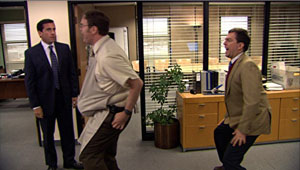
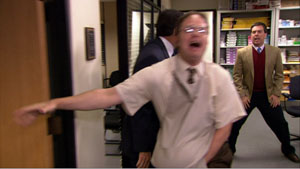
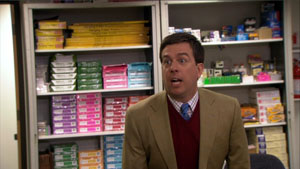
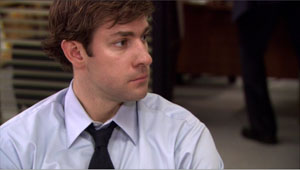
Somehow the cameramen manage to supply a smooth cut-in to Andy, and that’s followed by a reaction shot, from a fresh angle, showing Jim watching. The range of viewpoints, implausible in a real filming situations, is often smoothed over by sound that overlaps the cuts, as in both documentary and fictional moviemaking. (See our essay on High School here to see how a genuine documentary uses these techniques.)
Of course I’m not faulting the makers of The Office for not rigidly imitating documentary conditions. Any such blend of fictional and nonfictional techniques will involve judgments about how far to go, as I indicate in an earlier post on Cloverfield. It’s just to acknowledge that TV visuals have their own conventions, and these can be creatively shaped for particular effects. We ought to expect that those conventions would encourage close analysis as easily as film traditions do. Jeremy Butler’s new book Television Style offers the best case I know for the claim that there is a distinct, and valuable, aesthetic of television.
Following his own study Television: Critical Methods and Applications (third edition, 2007) and paying homage to John Caldwell’s pioneering Televisuality, Butler gets down to the details of how various TV genres use sound and image. Butler’s conception of genres is admirably broad, considering dramas, sitcoms, soap operas, and commercials, each with its own range of audiovisual conventions and production practices. His discussion of types of television lighting complements Keating’s analysis; put these together and you have some real advances in our understanding of key differences and overlaps between film and video.
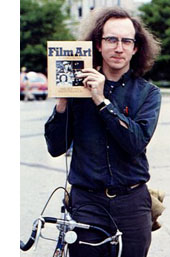 Kristin has met Jeremy, but I haven’t yet. In any case, Television Style shows that he’s a kindred spirit who’s made original contributions to this research tradition. Like Jinhee, Patrick, Pat, and David, he demonstrates that we can better grasp how media work if we study, patiently and in detail, the creative options open to film artists at specific points in history. He began thinking about these matters in 1979, as the photo attests.
None of this is to say that artistic norms or industrial processes are cut off from the wider culture. Rather, as becomes very clear in all of these books, cultural developments are often filtered through just those norms and institutions.
For example, everybody knows that in classical studio cinema, women were usually lit differently from men. But Keating notices that often women’s lighting varies across a movie, depending on story situations. He goes on to make a subtler point: there was a greater range in lighting men’s faces. Men could be lit in more varied ways according to the changing mood of the action, while lighting on women was a compromise between two craft norms: let the lighting suit the story’s mood, and endow women with a glamorous look. The fluctuations in the imagery stem from adjusting cultural stereotypes to the demands of Hollywood’s stylistic conventions.
Careful studies like these, alert to fine-grained qualities in the films and the conditions that create them, can advance our understanding of how movies work. Pursuing these matters takes us beyond both the movie in isolation and generalizations about the broader culture; we’re led to examine the filmmaker’s tasks and tools.
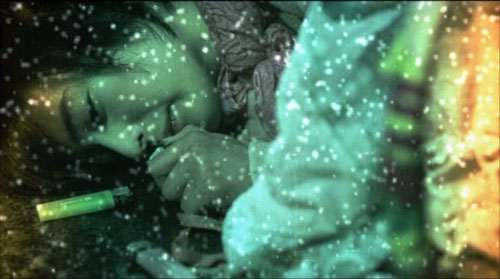
Resurrection of the Little Match Girl (Jang Sun-woo, 2002).
Sticky splices and hairy palms

Venusville (Fred Worden and Chris Langdon, 1973).
DB here:
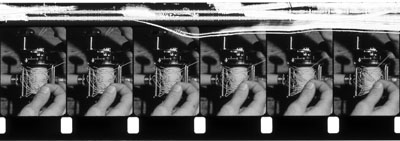
Just as CDs gave us a taste for sterile sound, the DVD has made us prize the clean image. We like sleek, hard-edged frames that look good on computer monitors and home-theatre screens. So who would put up with a shot like the one surmounting today’s entry?
 Mark Toscano, for one. He’s a film preservationist for the Academy of Motion Picture Arts and Sciences Film Archive. Among other tasks, he searches out and preserves experimental and avant-garde cinema, particularly work from West Coast filmmakers. And he savors shots like that hairy palm.
We normally think that someone preserving a film must at the minimum do a cleanup—remove all the specks, hairs, rips, and bad splices—before going on to more serious fixing, like correcting faded color. But what if the filmmaker left in the dirt and glue blobs deliberately? Or what if the filmmaker developed a fondness for the wear and tear that the movie accumulated over years of use? What’s a dutiful archivist to do?
The virtues of degradation
Mark is aware that archivists can have a big impact on film culture. By selecting films to save, they expand the canon and invite researchers to consider work that might otherwise be missed. “A curator’s enthusiasm can fuel new scholarship.” So part of Mark’s mission is to bring the inventiveness of lesser-known avant-garde filmmakers to new prominence.
Surprisingly, sometimes the archivist has to convince a filmmaker that work is worth saving. Robert Nelson had decided that most of his films were of little interest and in 1999 began redoing some and even destroying others. The scrapes you see on The Awful Backlash (above), a film about a tangled fishing reel, are the result of Nelson’s decision to rub out parts of the soundtrack.
Above all, a preservationist can widen the audience by programming collections like the one Mark brought to our Cinematheque last week. His Friday program was a feast of LA experimental film from the 1960s and 1970s. The menu ranged from gorgeous abstractions like Fred Worden’s Throbs (1972) and Pat O’Neill’s 7362 (1967) to exercises in dry wit like Morgan Fisher’s Turning Over (1975), about the momentous instant when a car’s odometer flips from 99,999 miles to 100,000. There was Kathy Rose’s Mirror People (1974), a sinister exercise in fairy-tale animation, headcomix-style, and Diana Wilson’s charming stop-frame still life Rose for Red (1980). One of the program’s implications was that on the Left Coast, avant-garde films were less cerebral than the official classics of the East Coast establishment. Films like David Wilson’s Stasis (1976) and Gary Beydler’s indescribable Pasadena Freeway Stills (1974) show that Structural Film could offer sheer entertainment. Mark’s notes on several of these titles can be found here.
The day before the screening, Mark gave a talk to our departmental colloquium called “Print (de)Generation.” He was paying ironic homage to our colleague J. J. Murphy’s 1974 classic, Print Generation (which Mark is restoring). But his title captures as well the problems of preserving films that don’t aim at pristine imagery.
If you assume that your job is to find the best existing form of the film and conserve that, what do you do with experimental work? Sometimes the films are designed to look messy. Sometimes they acquire a wear and tear that is like the patina on a sculpture or piece of furniture, when the signs of time’s passing become part of the texture of the piece.
Mark gave many examples of the decisions he faces in preserving the deliberate roughness of some work. Ben VanMeter (in spirit and approach, Mark feels, the most classically hippie West Coast filmmaker) corrugated the film strip of Acid Mantra; or, Rebirth of a Nation (1968). The legendary but little-seen Maltese Cross Movement (1967) by Keewatin Dewdney is a dazzling exercise in process structure, and the speckling on the images comes from creative choices. Shots were intercut with black frames—not black film frames, but frames dabbed with opaque paint. Inevitably, flakes of paint migrated across nearby footage.
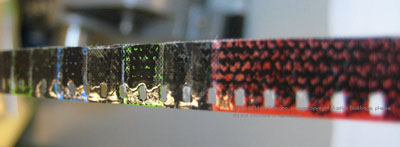
Brakhage’s films call for special delicacy. Mark showed lovely photos of film strips that Brakhage had painted upon, or welded together with thick splices that look like chain mail, as in the fourth reel of 23rd Psalm Branch (1967).
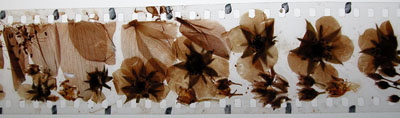
The Garden of Earthly Delights (1981) incorporates bits of grass, ferns, and insect wings.
How do you preserve such a thing? Brakhage endlessly revised some of his work, and came to appreciate the flaws that reprinting shooting and editing introduced into a film. When Mark called him about eradicating a hair that had crept into Flight (1974), Brakhage replied: “That hair is the axis around which the entire film revolves.” [Please see PS at bottom of post.]
Feelthy peectures
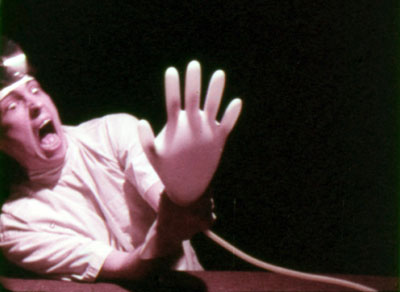
Mark’s talk highlighted Chris Langdon, a little-known Cal Arts filmmaker who worked with John Baldessari, Robert Nelson, and Fred Worden. Worden collaborated on Venusville, (1973), a deadpan satire on Structural Film. Shots of a palm tree tremble in front of us, while we hear puzzled comments from offscreen filmmakers. The image gets grubbier as the film proceeds, as if the viewers were looping it in their search for clues.
Langdon’s work vividly displays the West Coast impulse to hold nothing sacred. You would think that the endlessly self-ironizing Warhol was beyond teasing, but Bondage Boy (1973) makes a good try. We see a fellow wrapped in plastic and chains and struggling half-heartedly while assuming some fairly un-erotic postures. The soundtrack is “These Boots Are Made for Walking.” Langdon made fifteen to twenty films per year in a great many styles, and even created trailers for some of them, including Bondage Boy. She also came up with trailers for unmade films, as in Love Hospital Trailer (1975; above).
Mark’s passion and persistence brought Langdon’s films back to notice very recently, at a Redcat retrospective curated by Mark, Steve Anker, and Bérénice Reynaud. “I guess I was just a little incredulous that anyone would remember those films, and a little wary about it, to be honest,” said Langdon, who now prefers to be known as Inga. “But after a while, I thought it was pretty cool.” Scholars will be lining up to write about her work, with its wild humor and ties to Structural and Punk cinema.
You might not expect the Academy to preserve avant-garde cinema, but it’s a great testament to the institution that it cares so much about all kinds of film. Mark generously praised his colleagues Mike Pogorzelski and Joe Lindner (both Wisconsin alums), who support his efforts. In turn, we’re grateful to people like Mark who devote themselves to recovering films in a way that respects filmmakers and their work—especially when that work seems defaced or distressed. He teaches us that imperfections aren’t always faults. Everything in the world spoils eventually. Why shouldn’t artists acknowledge that? No surprise to learn that Mark owns few CDs but hundreds of LPs. He’s a master in bringing the Vinyl Aesthetic to film.
Mark Toscano keeps a blog titled “Preservation Insanity,” with more images of despoiled imagery, here.
Film preservation and restoration have formed a running thread for Kristin and me, from our trips to Bologna’s Cinema Ritrovato to our reportage on visits from archivists like Grover Crisp.
Currently there’s a blogathon on preservation sweeping the Internets. You can read about it at the Self-Styled Siren and Ferdy on Film, both of whom are keeping running tally on the entries. Please consider contributing to the National Film Preservation Foundation.
You can read more about the West Coast experimental tradition in David E. James, The Most Typical Avant-Garde: History and Geography of Minor Cinemas in Los Angeles (Berkeley: University of California Press, 2005) and Chapter 6 of Paul Arthur’s A Line of Sight: American Avant-Garde Film since 1965 (Minneapolis: University of Minnesota Press, 2005).
PS 19 February: Marilyn Brakhage posted this correction to the Frameworks listserv (ellipses in the original):
I’m glad to see Mark’s work getting some more, deserved attention. However, after reading the blog (which I can’t seem to respond to directly) just thought I’d mention — for the sake of historical accuracy — that the comment from David Bordwell that “Brakhage endlessly revised some of his work . . . ” is simply not true. When a work was done, it was done, and he moved on. He did not re-make/re-edit old work like some filmmakers do. . . . Perhaps Mr. Bordwell was thinking of the inevitable problems in print variation coming through the labs over the years (that the filmmaker, of necessity, had to adjust to), or the “translations” that resulted from blowing up 8 mm to 16 mm versions for distribution purposes. But I wouldn’t call that “revising” his work. (I’m sure he wanted the “translations” to be as true as possible to the original.) . . . And the hair that had “crept into Flight” was there from the beginning — accepted and used by Stan when he began to edit the film. It wasn’t something that happened over time.
I regret my misunderstanding of Mark’s remarks on the subject, and I’m grateful to Marilyn for setting the record straight.

Robert Nelson’s painted and resin-sealed cans of film. Another approach to preservation? Images courtesy Mark Toscano.
DVDs for these long winter evenings
Kristin here:
Coming back from a trip has pleasant and unpleasant consequences. Bills piled up, but so did stacks of packages, books and DVDs we forgot we had ordered or ones sent to us out of the blue.
The intrepid companies that rescue and issue silent films on DVD have been busy. All are past winners of awards in the Cinema Ritrovato festival’s annual ceremony, and obviously they are working hard to keep their standards up. (For a pdf listing all the winners since the awards began in 2004, click here.) Two of my favorite directors are represented.
Much More Méliès!
In 2008, Flicker Alley won “Best Box-Set” for its monumental collection “Georges Méliès: First Wizard of Cinema” (five DVDs with 173 films). Amazingly, 26 more films (or fragments, in one case very short) have been discovered since its issue. These will be released in the U.S. on February 16 on a single disc titled “Georges Méliès Encore.”
One of these, Le Manoir du Diables/The Haunted Castle, from 1896, contains something like 26 cuts, all stop-motion effects. I wouldn’t have thought such an elaborate production would have been possible so early in the history of cinema, but here it is. It’s also interesting for having been shot outdoors, with what looks like a flat gravel “floor.” The lighting changes dramatically at one point, with the sun in a different position after an obvious pause in filming, and for a time the shadow of a tree is visible in the right foreground. The set is also quite elaborate for such an early production. Watch for a moment when the actors bump into the set and cause it to wobble alarmingly.
I had long been intrigued by production photos and sketches from a lost Méliès film, L’omnibus des toqués ou Blances et Noirs/Off to Bloomingdale Asylum. (I have no idea why this English title was chosen, since it has nothing to do with the action. “Toqués” would translate roughly as “crazies.”) The thing that intrigued me was a strange, mechanical-looking horse that draws the omnibus of the title. Finally I got to see it, and it was worth the wait. The horse is good, to be sure. It pulls a small coach with five black-face minstrels sitting atop it.
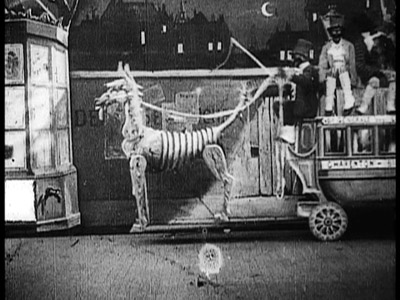
It’s not terribly apparent from the film, but a surviving Méliès sketch makes it obvious that the horse farts, driving the minstrels to jump off. The horse and coach depart, and the four minstrels begin an elaborate game of slapping and kicking each other in rhythm, each blow turning one into a white-clad pierrot figure and then back into a minstrel. It’s another of Méliès’ rapid-fire set of stop-motion substitutions, with the positions of the figures matched with astonishing precision. A tiny masterpiece in one minute and four seconds, counting the title card.
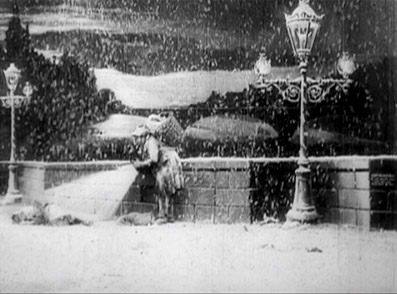
There’s a wide range of genres represented on the disc, including staging of news events, as in Éruption volcanique à la Martinique/ Eruption of Mount Pele (1902); chase films, like Le mariage de Victoire/ How Bridget’s Lover Escaped (1907); and even tear-jerking melodrama, like Détresse et charité/ The Christmas Angel (1904). The latter has an interesting stop-motion effect to add a white-painted stream of light as a rag-picker turns on his lantern to see the little beggar-girl asleep in the snow.
An otherwise surprisingly pedestrian 1905 film, L’ile de Calypso/ The Mysterious Island has one impressive moment, when a giant hand (Polyphemus having been transferred to Calypso’s island) emerges from the dark of a cave to threaten Ulysses (who is a bit hard to see, standing against the rocks at the right of the cave).
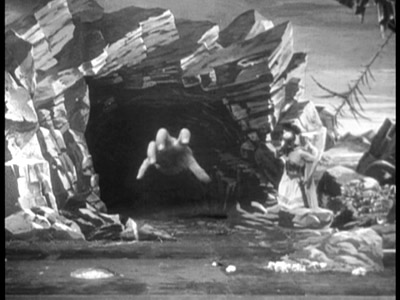
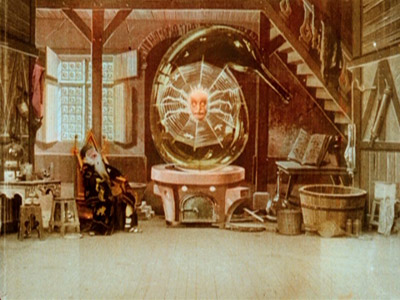
Was Méliès the first filmmaker to realize that leaving a large dark patch in part of set allowed things to be superimposed in that area without looking translucent? The best-known film to use the device is L’Homme à la tête en caoutchouc/ The Man with the Rubber Head (1902), but many other films use it, including some on this disc. A few of the films have hand-coloring, including the early L’hallucination de l’alchimiste/An Hallucinated Alchemist, where the alchemist of the title dreams of a giant spider.
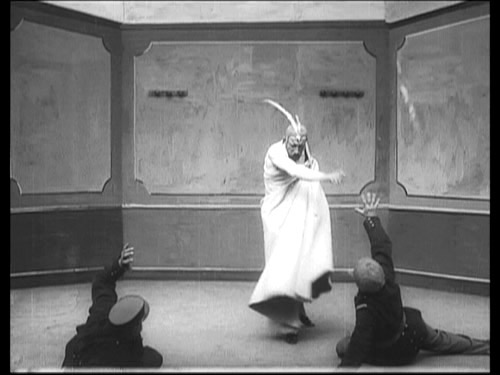
The state of preservation naturally varies enormously. One nearly pristine print is the amusing Satan en prison/Satan in Prison (1907). The title is vital, since the bulk of the action consists of a well-dressed man magically producing a series of items to furnish a bare room, culminating in his summoning up a charming lady to share his meal. Hearing the guards approaching, the man reverses the process, ending with a bare room when the two men enter. Finally he is revealed as one of Méliès’ favorite characters, Satan! (See frame surmounting this entry.)
I suppose we shall never have all of Méliès’ films, but there are now more than twice as many known to survive as when I was in graduate school. I look forward to a second encore.
Lubitsch, Lubitsch, Lubitsch
Another pleasant surprise among the heap of packages was Eureka!’s new boxed set of Ernst Lubitsch films from the years 1918-1921. If that sounds a bit familiar, that’s because this is the third such set to appear in just over three years. I’m not going to make a point-by-point comparison, but I’ll sketch some basic differences.
The German set, confusingly titled in English the “Ernst Lubitsch Collection,” came out in November, 2006 and is PAL, region-2 encoded. It contains five Lubitsch silents: Ich mochte kein Mann sein (1918), Die Austernprinzessin (1919), Sumurun (1920), Anna Boleyn (1921), and Die Bergkatze (1921). Its main bonus is a feature-length documentary, Ernst Lubitsch in Berlin—Von der Schönhauser Allee nach Hollywood. None is subtitled. The set won the Cinema Ritrovato’s prize as Best DVD of 2008.
The set was issued by the Munich company Transit Film, a government-owned 35mm distributor with a library of about 600 titles, drawn from across the history of German cinema. We’ve brought some of their prints to Madison for Cinematheque screenings. The sources of the films are primarily the Friedrich-Wilhelm-Murnau-Foundation and the Bundesarchiv-Filmarchiv. It also produces documentaries like the one on Lubitsch. (The website offers German, English, and French language options.) It has also put out several DVDs under the name “Transit Classics.”
In the U.S., from late 2006 into 2007, Kino Video brought these five titles out as four individual DVDs (pairing Die Austernprinzessin and Ich mochte kein Mann sein on one disc). Apparently, although Transit’s set didn’t include the 1919 comedy Die Puppe, it made it available, and in December 2007, Kino brought it out on a disc with the Ernst Lubitsch in Berlin documentary—and at the same time issued a boxed set of all six features plus the documentary on five DVDs, called “Lubitsch in Berlin.” (All Kino discs are NTSC region 1; given that they were transferred from PAL versions, they probably run about 4% faster than the Transit versions.)
Eureka!’s set is also entitled “Lubitsch in Berlin.” It contains the same set of films, including the documentary, all also licensed from Transit. These are here arranged over six DVDs. Its unique material is relatively slight, consisting mainly of short original sets of liner notes and an original score for Die Puppe. One advantage is that Eureka!, as usual, has retained the German intertitles and added subtitles to them. (The Kino versions, in contrast, replace the original intertitles with English ones, which has been their practice on some, if not all, of their other DVDs.) Some or all of these intertitles may have been replaced, perhaps reconstructed on the basis of censorship records, as is often the case with restorations. Still, many viewers would want access to the German text as well as the English versions. The Eureka! set is PAL, and it doesn’t seem to have region coding.
For those unfamiliar with Lubitsch’s German films, these are a good introduction. The four comedies all hold up well today. The first three are built around Ossi Oswalda, a boisterous blonde comic who seems to have inspired Lubitsch to move away from broad slapstick to a more stylized, eccentric approach. Pola Negri, after acting such roles as Carmen and Madame Dubarry in the director’s costume pictures, revealed her comic talents in Die Bergkatze, his last German comedy.
Overall my favorite of the group is Die Puppe, so I’m very glad it’s been added. Some might prefer Die Austernprinzessin, which is indeed hilarious. But it mainly has the wealthy heroine’s home as its comic milieu. Die Puppe seems denser, with more characters and three comedy-generating settings: the rich uncle’s home, the art-nouveau cartoon doll shop, and the monastery where the hero takes refuge. Plus there’s the famous prologue, where Lubitsch himself sets up the premise that the characters themselves are simply dolls brought to life. (See below.)
I chose Ich möchte kein Mann sein as one of the best films of 1918. See here for a brief description and a frame at the bottom of the entry.
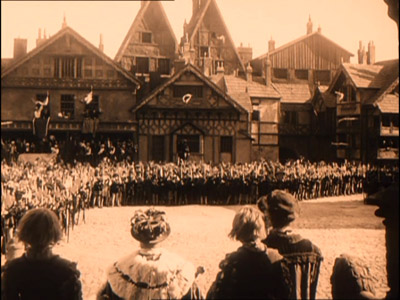
The conspicuous absence from this set is Madame Dubarry, the 1919 historical epic that made Lubitsch famous worldwide. Perhaps it’s not an ingratiating film at first viewing, but I found that it grew on me in repeated screenings. (I talk about some of its best scenes including one impressive long-take scene, in my book Herr Lubitsch Goes to Hollywood.) Anna Boleyn took on British history in an attempt to replicate the success of Madame Dubarry, but I have never been able to warm up to it. That’s probably partly because Henny Porten simply did not bring the vibrancy to the title role that Negri had in Madame Dubarry and perhaps partly because the increased budget let to an overemphasis on huge sets and crowds of extras (above). The characters in Madame Dubarry seem comfortable in their period costumes; the ones in Anna Boleyn don’t.
I chose Die Puppe as one of the best films of 1919. See here for a frame from it, and one that demonstrates why I admire Madame Dubarry. Perhaps restoration work on the latter is going on at this moment, so that another DVD will someday join these on the shelf.
The other film in the collection, Sumurun, is a quasi-Arabian-Nights tale, starring Pola Negri as a seductive member of a traveling troupe of entertainers. Lubitsch plays his last film role as the hunchback clown who dotes hopelessly on her. The performance isn’t all that different from some of his earlier ones, but perhaps seeing his rather exaggerated acting style in the context of a non-comic film led Lubitsch to doubt his own abilities. Given that he was far better as a director than as an actor, his decision to stay behind the camera was a boon to future generations. To me, Sumurun is fascinating because it shows the first real signs of Lubitsch’s awareness of Hollywood continuity editing, a set of techniques he would thoroughly master over the course of his next half-dozen films.
It can’t have been easy to put together a 109-minute documentary on Lubitsch’s life before his move to Hollywood. In working on my book, I discovered how surprisingly few photographs of him at work onset survive. The studios where he worked don’t survive, though there are shots of the giant Ufa Tempelhof sound stages that now stand where those studios were.
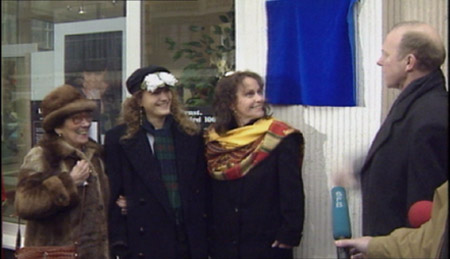
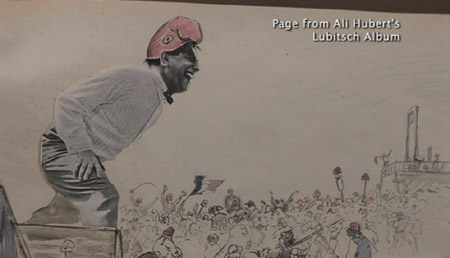
Several prominent historians are interviewed, including archivist Enno Patalas and historian Hans Helmut Prinzler, co-editors of Lubitsch (an extremely useful book, published by the Verlag C. J. Bucher i 1984) and archivist Jan-Christopher Horak (whose master’s thesis was on Lubitsch’s relation to Ufa). Lubitsch’s surviving family members, seen above at the unveiling of a “Lubitsch lived here” plaque, were interviewed: his niece Evy Bettelheim-Bentley (left), granddaughter Amanda Goodpaster (center), and daughter Nicola (right). Lubitsch’s theatrical career is well covered, and generous clips from the pre-1918 era demonstrate his move into comic acting for films. Audio interviews with Henny Porten and Emil Jannings include a charming anecdote she tells about how apologetic Jannings was after the scene in Kohlhiesels Töchter in which his character jerks a bench out from under her–an incident that left her with a bruised rump. In between scenes, directors who have been awarded the Ernst Lubitsch prize, such as Tom Tykwer, discuss the master. Perhaps the most interesting artifact shown is an album Lubitsch’s regular costume designer and friend Ali Hubert made for him, combining drawings with photos of Lubitsch and little poems; below he depicts Lubitsch directing Madame Dubarry. Ultimately Hubert gave it to the director as a gift.
The documentary feels a trifle thin at times, and it makes no real attempt to cover Lubitsch’s Hollywood career, presumably because of the difficulty of getting permission to use clips. But it certainly would be a useful teaching tool for introducing students to Lubitsch’s life before Hollywood.
(Thanks to Ben Brewster for helping determine some of the differences among these three Lubitsch boxes.)
The Man with a Movie Camera before The Man with a Movie Camera
In 2007, the Cinema Ritrovato awarded the “Edition Filmmuseum” series from the Filmmuseum Munchen its DVD award for “Best Series.” We’ve mentioned this series before, in relation to its Walter Ruttmann disc and its DVD of Robert Reinhert’s Nerven.
Now the Filmmuseum has issued a two-disc set offering two of Dziga Vertov’s silent feature documentaries, A Sixth Part of the World (1926) and The Eleventh Year (1928). The former is a poetic look at the various and farflung ethnic groups within the U.S.S.R., the population of which made up one sixth of the world. It was the first of Vertov’s films to be strongly praised, seeming to justify his theory of the Kino-Eye.
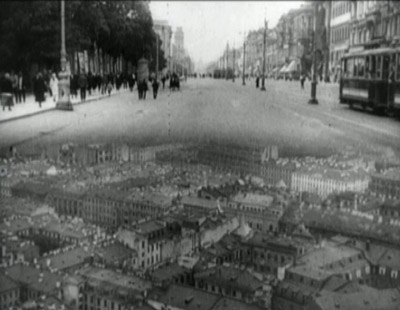
Those expecting anything as experimental as Man with a Movie Camera might be disappointed. There are some of the familiar camera tricks, such as split-screen effects:
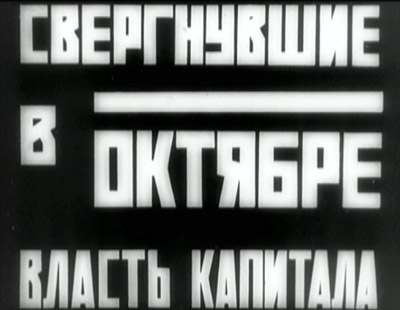
The typography of the intertitles reflects the constructivist style of the 1920s:
The discs have optional English subtitles.
Having seen these films during my research, I haven’t watched the discs in their entirety. The quality looks as good as can be expected. Michael Nyman’s music is certainly not authentic to the period, but what I heard of it sounded strangely appropriate to the images and effective as accompaniment.
The discs also include an interesting bonus, a German propaganda short, Im Schatten der Maschine, by Albrecht Viktor Blum, which used footage from The Eleventh Year to make a film critical of the technical progress which Vertov was praising in his own movie. (Since The Eleventh Year had not yet appeared in Germany, Vertov was actually accused of plagiarizing from Blum rather than the other way round.)
Another bonus is a 14-minute documentary, Vertov in Blum: An Investigation (optional German or English narration). This fascinating short begins by demonstrating that Vertov himself and possibly others almost certainly cannibalized footage from The Eleventh Year for Man with a Movie Camera and other films. It goes on to hypothesize that the final montage in Im Schatten der Maschine may consist of footage that Vertov later removed from The Eleventh Year‘s negative. Side by side comparison of prints using Final Cut Pro revealed matching shots between the two films, highlighted in yellow here:
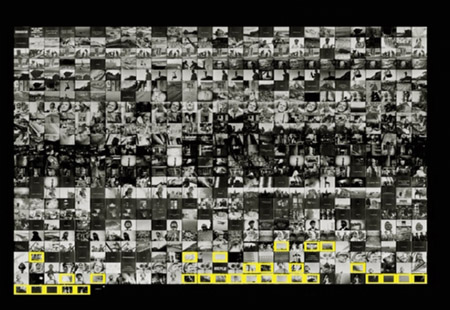
Blum’s film culls shots and even edited passages primarily from late in Vertov’s film, but it continues beyond the end of the surviving version of The Eleventh Year. Some of those shots have been traced to other, later Vertov films, and the archival sleuths are still comparing prints and looking for the rest. They may have found the missing ending from The Eleventh Year; at least, the evidence makes that idea very plausible. Whether they are right or not, though, the short demonstrates the painstaking work often necessary in the restoration of films.
These companies and archives have certainly not been resting on their laurels. It will be exciting to see what the upcoming Cinema Ritrovato’s awards will highlight.
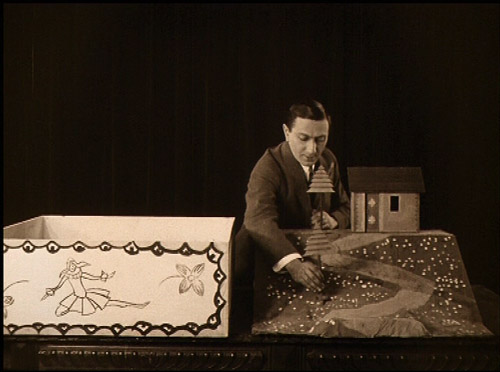
Light is a law
DB here:
What do we see when we look around us? A world teeming with creatures and things. We tend to ignore what enables us to see all that: light. To a great extent, that bias is wired into our perceptual systems. An orange looks the same color to us in sunshine and in shade. But photograph it, and you’ll see that actually it throws off very different wavelengths in the two situations. We evolved, it seems, to mute all the variations in light we encounter. Psychologists call this “the primacy of object perception.”
It takes an artist to shift from the what to the how, to notice how different patterns of illumination can alter the shape and texture of an object. A painter, a photographer, and a cinematographer must learn to see light itself.
This was the core message of Steven Poster, an outstanding Director of Photography who came to visit Madison last weekend. Steven is probably most famous for working with Richard Kelly on Donnie Darko, Southland Tales, and The Box, but he has shot dozens of feature films, shorts, television movies, and pilots. He also has several Madison connections; he hung around the campus in his college years, saw Jules and Jim for the first time in the Memorial Union, and built a production house in Chicago with Mik Derks, who now works for Wisconsin Public Television.
Steven gave a workshop on cinematography that bristled with energy (five hours with only a brief break) and followed that with a screening of The Box, accompanied by a Q & A. Across a single packed Saturday, he took students and faculty on an adventure in seeing.
Seeing the light
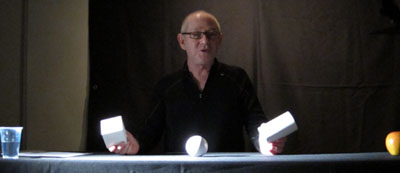
Steven started as a still photographer at about age ten, and his ideas of visual design are very much allied with classic image-making. (He carried a Leica with him on his visit, and a display of his photos is currently mounted in a campus gallery.) He has a modernist bent too. He credits his years as a student at Southern Illinois University with introducing him to the ideas of the Bauhaus. He plunged more deeply into Bauhaus ideas at the Illinois Institute of Technology, where Mies van der Rohe and Moholy-Nagy taught.
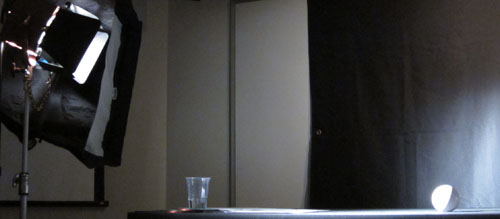
Later in his career, he studied at the Los Angeles Art Center College of Design. A turning point in his understanding came in Charles Potts’ photography course, when Potts began the semester by announcing softly, “Light is a law.” Steven’s talk for us, he explained modestly, was a “profoundly simple subset” of Potts’ course. Put it another way: In the Bauhaus spirit, he showed how simple principles yield subtle results. Armed with only a white ball, a white cube, and a white cylinder, he gave us a tutorial in the delicate modulations of vision.
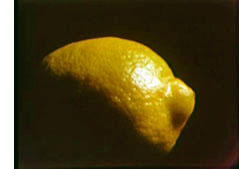 There are, Steven suggested, basically only two kinds of light: direct and indirect (or diffuse). Sunshine yields direct light; a cloudy day yields diffuse light. And when light falls on an object, the encounter has five components. The object gains a highlight, the bright region that suggests the direction of the light source. The object also acquires a shadow area. Between the highlight and the shadow is the boundary, or core—an important hint about the quality of the source light. (If the core has a crisp edge, the light is hard; if the core is a mild transition, the light is softer.) The fourth component is the shadow that the object casts on another surface. Finally, there is the specular or incident highlight, a spot of reflected light within the lit region. A specular highlight is a cue for texture as well as shape and light source. As Steven spoke, I kept thinking about Hollis Frampton’s Lemon (1969), a masterfully simple demonstration of many of these principles: slightly changing light reveals a prototypical shape (what other things have the outline of a lemon?) and a surface that is both shiny and bumpy.
By varying the type of light (direct or indirect) and the angle and distance of the source, Steven showed how these five components can be manipulated to bring out expressive qualities of the object. The cube, for example, can gain sharper contours through sidelong lighting, and illuminating the background can bring out its volume. Likewise, an object’s shadow area can be controlled through fill light—though Steven warned about over-filling, which can work against the precision provided by the key light. Another example is the way in which shooting glass or metal with pinpoint sources yields a scatter of specular reflections. If those aren’t wanted, as in some car commercials, the DP can use broad, diffuse illumination. This “liquid light” brings out contours through a softer gleam.
Of course a shot typically combines many objects, so the task of controlling how light hits them, and how they are arranged in relation to each other, becomes much more complicated. The shapes, textures, and emotional qualities of the elements have to be harmonized. “Elegant” was a word Steven used frequently: the composition, like the light, should be clear and well-defined. Needless to say, the result on screen can be grasped at a glance, but achieving such clarity needs painstaking control.
So seeing the light involves grasping everything around you, from landscapes and furniture to people’s faces and clothing, within the framework of highlights, shadow, core, and the like. This alone is enough to change your visual habits. But there’s more. By and large Steven made his adjustments without checking the monitor displaying what the camera was taking in. Standing almost anywhere, he could shift the light, tune the fill, and “wrap” the object, and on the monitor we could see the effect click into place. That skill demands more than a change in how to look at things. It’s an eye-body coordination that takes years of expert practice, an acquiescence to the law of light.
Behind the scenes
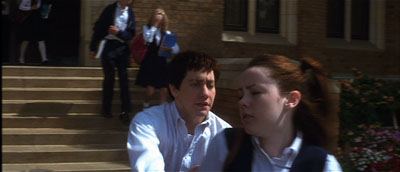
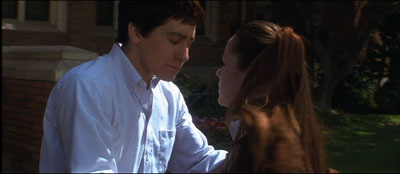
The discussion following this demo ranged across many aspects of cinematography, and Steven filled in abstract points with examples from his experience. My notes run to eleven pages, but this sampling should give you an idea of his stimulating presence.
*A problem-solution dynamic emerged in one shot in Donnie Darko, above. We need to see Donnie’s face when he catches up with Gretchen, but the day was sunny and at first the faces display somewhat harsh shadows. But when the couple move toward a kiss, the solution came from their clothes: Donnie’s shirt and Gretchen’s blouse provide softer bounce light on his face.
*Steven stressed the need for complete trust and frankness between director and DP. “I won’t take a job if the director won’t look me in the eye.” Once that bond is established, the DP’s job is to protect the director and work to fulfill his or her vision. “My job is to protect the director.”
*Filmmaking is an intensely physical job, and so two concerns have to be paramount: safety and health. “No film is worth getting somebody hurt,” Steven remarked, so he insists that every crew member is a safety officer, looking out for everyone’s well-being. At the same time, filmmaking demands stamina, discipline, and a clear head, so everyone needs to have a healthy regimen and cultivate a certain “inner life” that keeps job pressures in perspective.
*Steven had much to say about the video assist. He suggested that it has led to directors using more close views, because such shots read better on small monitors. (I made a similar suggestion in The Way Hollywood Tells It.) Steven fights what he calls the “loss of scope” on video displays by presenting the digital dailies in full-size projection, as in the film-based days. “It reminds everybody that we’re making a big movie,” and it encourages directors not to overuse close-ups.
*Steven is happy with the digital intermediate process. As a cinematographer who wants to control all aspects of the image, he welcomes all the adjustments he can make in postproduction, especially thanks to the Lustre grading program. “It’s like being back in the darkroom again.”
*On Donnie, a low-budget film, Kelly and Steven were forced to shoot the family dinner scenes in a single night. To save time, they used “block shooting.” For each actor, a basic setup was established and all the actor’s lines from both scenes were taken at one time. It was faster to have the actor change clothes for the later scene than to shift the camera position and relight the setups.
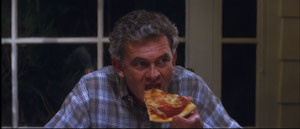
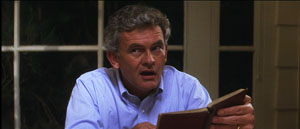
*Speaking of table scenes, they pose a lot of problems. Even Steven finds such scenes “the hardest.” “Where’s the [180-degree] line in this situation? I’ve seen fights break out on sets about it.”
*At one point Steven talked about prominent objects in a scene, such as candelabra and ketchup bottles. If you use symmetrical reverse shots, those objects can jump distractingly from one side of the screen to the other. Steven tries to make sure that such eye-catchers appear in only one of the setups, not both. The coffee cup in this scene of Southland Tales is hidden in the reverse angles.
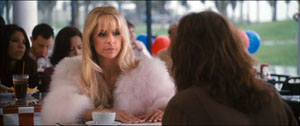

Steven’s point reminded me that Ozu breaks this rule of thumb and playfully lets his objects jump around the frame from cut to cut. Indeed, he often rearranged the props to heighten this peripheral dance. In one scene of Late Autumn, the tabasco sauce bottle pivots consistently, but the French’s mustard jar changes position.
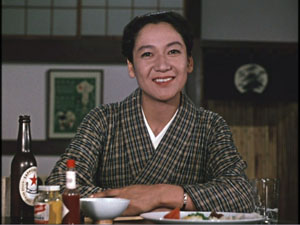
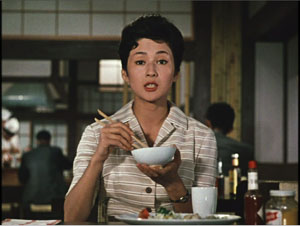
*Steven thinks that 3-D will succeed this time, chiefly because of the push for 3-D television. The technique probably won’t work for all stories, and the format poses some technical problems. But the software is getting better, and filmmakers, such as Cameron in Avatar, are starting to avoid the gimmick of obects thrusting out of the screen. It’s better, Steven thinks, to let the depth recede into the movie’s world, making the screen a window. I recalled that this was the strategy used in Coraline, Up, and other films of last year, so perhaps this will become the dominant way that 3-D will be used.
*Steven urged students to get broad general educations and not become movie nerds. They should study history, political science, art, and literature. He pointed out that Werner Herzog, his friend and neighbor, insists in his Rogue Film School that literary classics are the basis of a film education.
*Steven has long been an advocate of unionization. As President of Local 600 of the International Cinematographers Guild, he explained how the Guild now welcomes members, especially women and people of color. I thought it was salutary to give students a taste of the practicalities of professional life by explaining what the Guild had accomplished.
*Steven did additional photography on Blade Runner, and he learned a great deal while gaining deep respect for Jordan Cronenweth, DP on the movie. Steven rewatches the film often, and each time he finds something new. On the last pass, he saw that in the search of Kowalski’s apartment, flickering streaks of light coming from inside the desk drawer call attention to the newspaper that Deckard finds there.
Back in 1980-1982, when Kristin and I were doing research on The Classical Hollywood Cinema, we found that Charles G. Clarke, Linwood Dunn, William Hornbeck, Stanley Cortez, and other professionals whom we interviewed were intellectuals, eager to explain the ideas informing their creative decisions. Steven Poster’s career is another outstanding example of how theory and practice work together, often unobtrusively, to conjure up the enthralling world on screen. I can’t imagine a film researcher, or just a movie lover, not wanting to know filmmakers’ craft and the principles informing it. Once you’ve visit the kitchen, movies gain a whole new flavor.
This blog has intersected with primary Bauhaus shapes before. I discuss “the dinner-table conundrum” in the first few pages of Figures Traced in Light. One of the best analyses I’ve read on illumination in the visual arts is E. H. Gombrich’s “Light, Form and Texture in Fifteenth-Century Painting North and South of the Alps,” in The Heritage of Apelles: Studies in the Art of the Renaissance (Ithaca: Cornell University Pres, 1976), 19-35. For more on Ozu’s penchant for letting brightly lit objects jump around the composition, see this chapter of my Ozu and the Poetics of Cinema. The Lustre program was devised for The Lord of the Rings, and Kristin discusses its origins and influence in The Frodo Franchise, pp. 280-281.
Special thanks to Steven for his visit, the Wisconsin Union Directorate for arranging it, and Erik Gunneson, Joel Ninmann, Justin Daering, and J. J. Murphy for setting up the workshop.

Blade Runner.



