







Archive for the 'Film comments' Category
Paris-Berlin-Brussels express
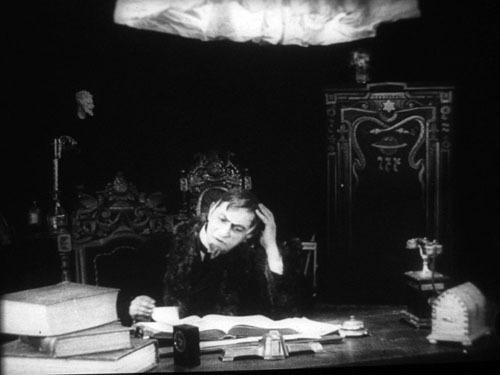
Doktor Satansohn.
Our trip to Europe has come to an end, and so we finish with a post scanning some highlights.
The magic lantern learns new tricks
DB here:
What am I seeing? Many avant-garde films pose this question. Mainstream fiction film and documentary cinema have mostly relied on the idea that the image should be recognizable as “what it is.” But one strain of experimental film has worked to delay or even prevent us from making out what’s in front of the camera.
Sometimes we lose our bearings only briefly, as when we eventually identify pot lids in Ballet Mécanique or bits of sunlit linoleum in Brakhage films. Sometimes language points out what’s really there. The titles of Joris Ivens’ Rain and the Eames’ Blacktop: The Washing of a School Play Yard allow us to enjoy the ways that ordinary sights can yield unexpected abstraction. Sometimes we toggle back and forth, as when in Ken Jacobs’ Tom, Tom, the Piper’s Son recognizable human figures, however grainy, jump into sheer blotchiness and then back into something like legibility. But other times we can’t ever tell what we’re seeing. Brakhage’s Fire of Waters offers one of the best examples I know, with its jagged bursts of light in a smoky void.
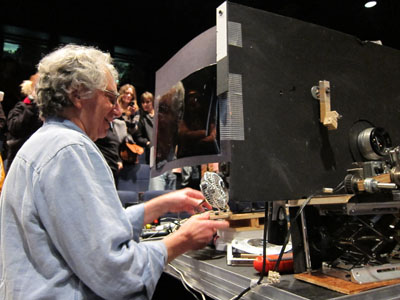
What am I seeing? The uncertainty was doubled during my visit to Ken Jacobs’ Nervous Magic Lantern performance at the Cinémathèque Française. I say “doubled” because at least with Fire of Waters and Tom, Tom I knew I was watching a film. With this display, What am I seeing? started as a question about the format itself. Was it a film, a video, or something else?
Then the question became the customary one. Off-white textures—pebbly, dribbly, stalagmite-like—swim in and out of focus. Some are viscous and globular, some are like tangled foliage. They seem to spiral, but actually (I put up a finger to measure) they barely move. The effect of movement is given by pulsations of pure black, breaking the lyrical effect of the surfaces with a harshness that becomes aggressive. Aggressive as well is the soundtrack, blocks of sound from subway platforms and traffic and kitsch Latin percussion, all played at high volume. The surfaces just keep shifting and not shifting, sort of rotating while jabbing out at us, lovely and anxiety-inducing at the same time.
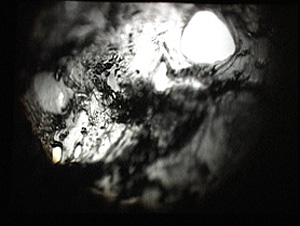
At the end of the performance, people crowded around the cardboard booth in the middle of the theatre. As Ken and Flo Jacobs packed up, they showed how they had generated the effects. What had I been seeing? Neither a film nor a video but a true magic-lantern display, assembled on the spot. But what had I been seeing? Something created with home-made equipment of a startling simplicity. (Strapping tape was involved.) Our magicians explained their tricks, like magic-lantern operators of earlier centuries explaining the science behind their shows. But I think it’s best that you not know until after you have a chance to see what they create.
In earlier entries (here and here) Kristin and I have praised Jacobs’ films for showing how very slight adjustments in technique or technology can create disturbing cinematic illusions. In this vein, the first item on the Cinémathèque program, a video called Gift of Fire, turned Louis Le Prince’s brief 1888 street scene into a 3D movie. (The homage was appropriate because Le Prince experimented with multiple-lens cameras.) The Nervous Magic Lantern performance generated a different sort of illusion, one conjuring up micro-landscapes and otherworldly vortices. In all, Jacobs makes us realize how many evocative effects are still to be discovered by tinkering with images thrown on a screen.
Detour to Berlin
KT here:
As David mentioned in last week’s entry, I took a week in the middle of our visit to Europe for research at the Ägyptisches Museum in Berlin. The staff there welcomed me into their storerooms, and I spent the days looking at fragments and the records of their discovery and the nights downloading and backing up my photos. No time for filmgoing. The most I managed was a trip to the well-stocked arts bookshop Bücherbogen, which has one of the best selections of film books to be found in Germany. Our old friend, experimental filmmaker Carlos Bustamente, met me there, and we had a quick cup of tea–most welcome on a cold morning when the results of the biggest snowfall in decades were still blanketing many sidewalks and roads.
I did note one film-related phenomenon, however. Every day I took the S-Bahn from Savignyplatz to Friedrichstrasse. The tracks pass directly across the street from the Theater des Westens (that is, the western part of Berlin). It was playing Der Schuh des Manitu, a musical version of the 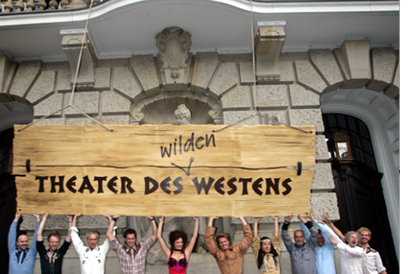 highly successful 2001 German film of the same name. (I hope the publicity photo at the left was taken in warmer weather than I experienced.) I mentioned the film here, in reference to the fact that every major producing country, and some minor ones as well, turn out their own local comedies, films that don’t travel well but are very popular locally.
By now it’s a familiar phenomenon in the U.S. for successful Hollywood films to be turned into stage musicals. It wasn’t always so. Back in the 1950s and 1960s, films were made of popular musicals, sometimes successfully, as with My Fair Lady, and sometimes not, as with Mame. But now the trend is the other way, with everything from Shrek to Hairspray getting the Broadway treatment.
It’s interesting to know that the same thing goes on abroad, though I’m not sure how prevalent such adaptations are. Der Schuh des Manitu, directed by Michael “Bully” Herbig, remains the highest grossing German film. Herbig doesn’t act in the stage play, as he did in the film, but he served as a creative advisor. The musical is a hit, having premiered on December 7, 2008 and it is expected to continue until at least the autumn of this year. There are several clips from both the film and the musical on YouTube. This one, at 8 minutes, gives a generous dose of the show. There are no subtitles.
I had only a couple of days back in Paris before we headed for Brussels for the final week of our trip. The German theme continued, since a few of the 1910s films David needed to see at the Cinematek here were German. The one I most wanted to see was Edmund Edel’s 1916 feature, Doktor Satansohn. Its main claim to fame is probably the fact that Ernst Lubitsch plays the title role. My book with Lubitsch started with his 1918 move to features, when he began to concentrate more on directing and less on acting. By 1920, with Sumurun, he appeared onscreen for the last time; being discontented with his performance as the tragic clown, he decided it was time to move behind the camera for good.
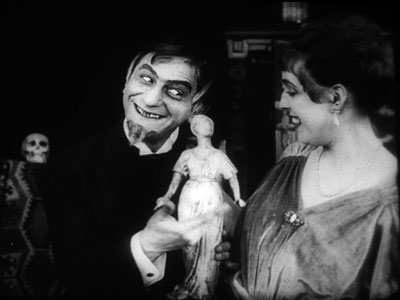
In the short films he starred in before 1918, Lubitsch often played a brash, ambitious Jewish youth, as in Der Stoltz der Firma (“The Pride of the Firm,” 1914). In Doktor Satansohn he’s a physician with a magical machine that transforms older women into beautiful young ones. We’re first introduced to a couple and the wife’s mother. When the latter makes a pass at her son-in-law and is rejected, she seeks the doctor’s help. His machine works by capturing the wife’s essence in a statuette and making the mother look like her daughter. Problem is, every time she’s about to kiss the husband, the doctor pops up with his devilish leer, visible only to the “wife.” David and I decided that the film is a comedy, though perhaps one only Germans of the day would find truly amusing. For one thing, the title character is clearly a Jewish caricature, one played to the hilt by Lubitsch. He decorates his machine with the Star of David and a Hebrew inscription (not to mention vipers and an image of Saturn).
Stylistically it’s a fairly conventional film for its day, though the black background of the doctor’s office, with its stylized youth machine and satyr-like bust, gives a hint of Expressionism to come. (See our topmost image.) Inevitably near the end there comes the moment beloved of historians of pre-World War II German cinema. The real daughter, released from her imprisonment in the statuette, confronts her double in the doctor’s waiting room. The Doppelgänger motif strikes again.
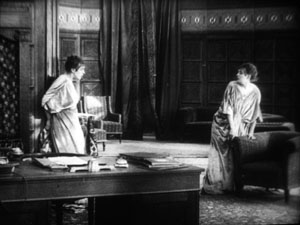
I wonder if German films actually have more Doppelgängers in them than appear in other national cinemas. Do they really reflect the disturbed soul of the nation? Or did the possibilities of filmic special effects draw moviemakers to try and multiply single figures? Georges Méliès and Buster Keaton used in-camera techniques to multiple their own figures in virtuoso displays. I recall being impressed by The Parent Trap‘s duplication of Hayley Mills when I saw it as a kid, and the whole notion of a single actor playing twins and other lookalike relations is a common enough convention. In Doktor Satanssohn, the doubled figure appears only in this one shot, and it’s the leering Lubitsch, delighted with his own nastiness, who walks off with the picture.
The 1910s, again, and still
DB again:
We saw Doktor Satansohn while I was studying staging and cutting strategies of the 1910s, thanks to the remarkable holdings of the Royal Film Archive of Belgium, also known as the Cinematek. My comments on last summer’s visit are here.
Another German film, in a choppy Russian print, vouchsafed a new glimpse of Asta Nielsen. In Totentanz (Urban Gad, 1912), she plays a guitarist-dancer who must take to the stage to support her infirm husband. She attracts the devotion of a composer, and soon she feels attracted to him. Torn between desire and duty, she snaps during a rehearsal of his latest piece, “Totentanz.” In a chilling gesture, she uses his dagger to slice her lute strings.
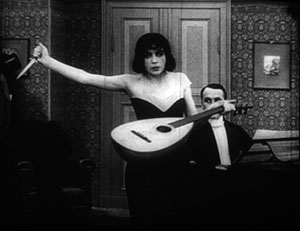
Soon the two are locked in a violent erotic struggle, and a stabbing ensues. In all, melodrama as ripe as one could want.
As ever, I was happy to have my hypotheses about tableau staging confirmed by several of the titles I saw. A minor French bedroom farce, Le Paradis (M. G. Leprieur, 1914 or 1915), had a brief passage of the sort of blocking and revealing we find in many films of the period. The painter Raphael Delacroix (no kidding) is pretending to be the lover of Claire Taupin to deflect the advances of randy M. Pontbichot. But Claire is actually the mistress of M. Grésillon. . . .
First, very frontal staging strings out Pontbichot, Raphael, and Claire. The older man relents in his pursuit of her.
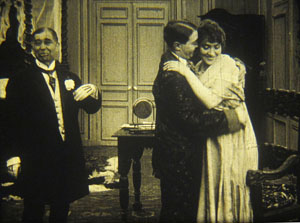
In the vivid depth characteristic of the tableau tradition, Pontbichot withdraws. But his position accentuates that central door, which starts to open.
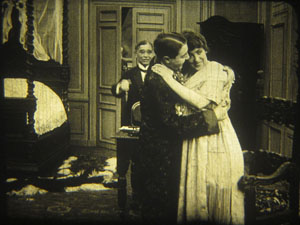
Most remarkably, Pontbichot ducks almost entirely behind the couple, giving pride of place to M. Grésillon’s arrival in the center of the shot.
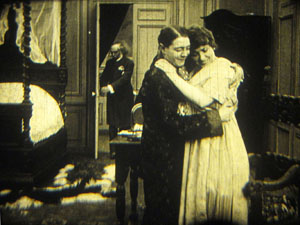
Pontbichot slides out in time to register Grésillon’s outraged reaction to finding his mistress in another man’s arms.
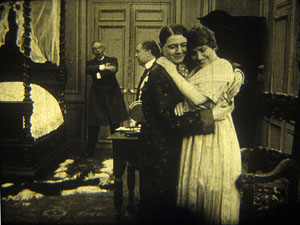
Grésillon rushes to the frontal plane, furious. As ever, a thrust to the foreground creates a major spatial/ dramatic event.
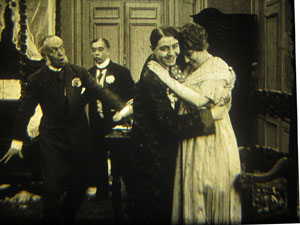
Although the Le Paradis passage is ABC compared to the emotionally powerful patterns of staging we find in Ingeborg Holm (1913), it illustrates how even average films could resort to the blocking/ revealing tactic within the deep-space geometry of the tableau.
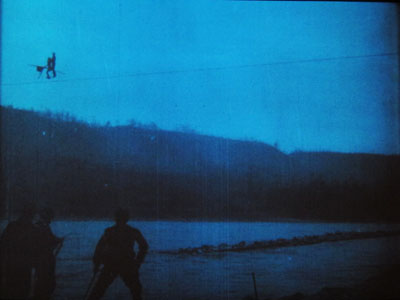
More flamboyant was Il Jockey della Morte (1915), an Italian circus film made by the Dane Alfred Lind. Its bold lighting and varied angles on the Big Top recalled the Danish films of a few years before. Halfway through, Lind launches a dazzling chase that features leaps from a tall bridge and bicycling stunts on a cable stretched across a river.
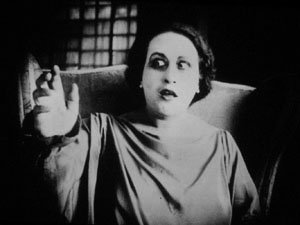
Another Italian film, this time a diva vehicle, suggests that by 1917 1923 (see below) the tableau style was already giving way had given way to scenes organized around close shots. (See below.) L’Ombra (Mario Almirante) starred Italia Almirante Manzini as a lively, trusting wife who becomes paralyzed. While her husband betrays her with her younger protégée, she gradually recovers bodily movement. Yes, a paralyzed diva seems a contradiction in terms, but one small-scale scene shows a remarkable range of emotions. Berta’s hands start twitching, one lifts up, and she stares wildly, as if it were an alien being.
In an earlier scene, Berta had asked that a mirror facing her be tipped upward so that she would never see herself sitting immobile. This shot pays off now, when the hand ascends almost magically into the bit of reflection she can see.
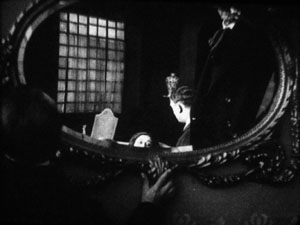
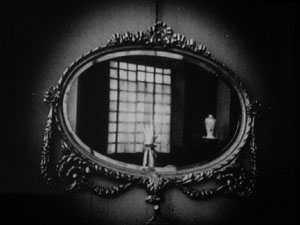
When the hand descends, her astonishment turns into joy. She experimentally shoves the hands together, as if asserting her control.
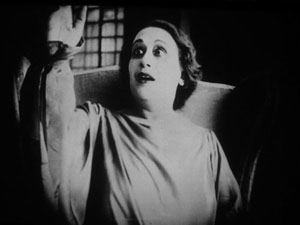
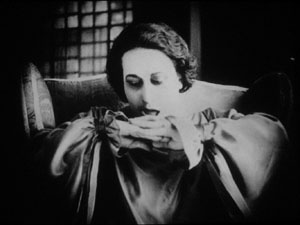
In the end, she kisses her hands as if they were pampered children.
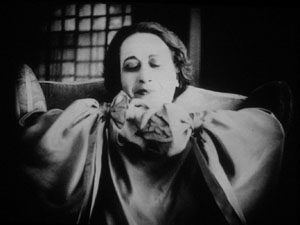
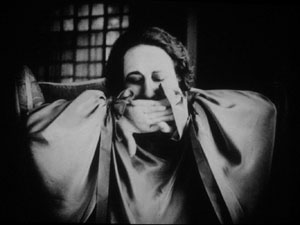
Manzini runs through many more micro-emotions than I’ve indicated here, but this sample is typical of the ways in which L’Ombra avoides the long-shot choreography of only a few years before and builds a performance out of face, body, and arms in a close framing. The mirror-shot motif shows that fairly careful filmic construction was emerging at this point too.
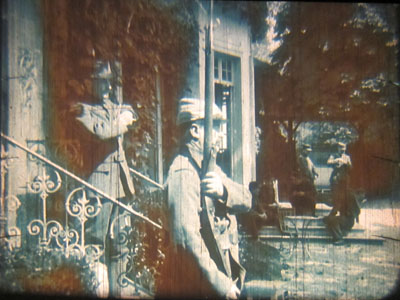
During my stay, I learned more about tinting and toning from the ever-helpful Noël Desmet. On the seldom-seen World War I drama L’Empreinte de la patrie (M. Dumeny, 1915), some images had curious oscillating patches of rusty brown. Noël explained that when Prussian Blue toning was combined with rose tinting, the chemicals eventually reacted to alter the pink cast. An example is shown at the top of this section, though the blue is more saturated in the original.
Once we get back to Madison, I’ll have to sort out all that I’ve learned from these movies. Onward and upward with the 1910s!
For more on Jacobs’ Nervous Magic Lantern, see Scott Foundas’ interview here. The Youtube clip doesn’t do the spectacle justice. If you must know something of Jacobs’ tools, the Dailymotion video from the performance I saw offers some clues. My notions about 1910s staging are laid out in On the History of Film Style and Figures Traced in Light. You can also find several discussions in earlier entries on this site. Just execute a search on tableau.
Now is a good time to thank Noël Desmet and Marianne Winderickx, both of whom are retiring from the archive in March. The research that Kristin and I have done over the years owes an enormous lot to them, and of course to the Director of the Cinematek Gabrielle Claes.
P.S. 15 November 2013: Ivo Blom has pointed out that the version of L’Ombra I saw wasn’t from 1917 but rather from 1923. Hence the corrections above. Thanks very much to Ivo! Go here for his blog and information about his newest publication on silent Italian cinema.
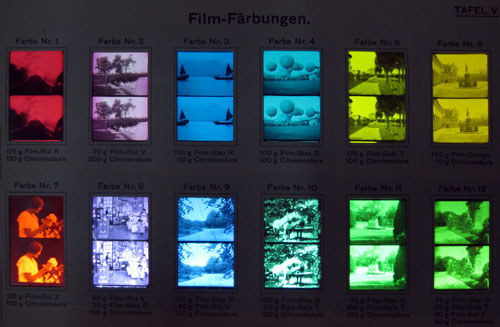
A tinting and toning sample card from the early 1920s. Courtesy Noël Desmet.
2-4-6-8, whose lipdub do we appreciate?
DB here:
“There is really no such thing as Art. There are only artists.” I tend to interpret the disarming opening of Ernst Gombrich’s Story of Art as a protest against the idea that art has an essence that unfolds through history. Those of us in film studies can spot the heritage of this Hegelian idea in one standard story that is told about how editing came to be a dominant technique. According to the formula, editing is “essentially cinematic,” but this essence didn’t reveal itself immediately. It emerged in phases, thanks to the insights of brilliant creators (Méliès, Porter, Griffith, the Russians). Understanding cinema’s history, according to this view, means tracking how film revealed its inherent nature.
In saying that Art doesn’t exist, Gombrich isn’t trying for an elaborate philosophical argument. He’s suggesting a way of understanding art history. His abrupt two sentences suggest that the historian shouldn’t presume that any art has an essence, a secret core that dictates how its history unfolds. He proposes seeing continuity and change in what we call the arts as springing from concrete activities of individuals and groups. Cinema’s history then becomes an account of the creative decisions of filmmakers faced with particular demands and problems. Some of those decisions can converge across the community. The results are trends, such as the increased use of editing, which have real consequences but which are aren’t the result of some secret, essential process.
Once we try to analyze art in terms of what creative communities have sought and achieved, we can ask how artists tend to behave. Across his career, Gombrich stressed that artists are sensitive to their circumstances. What tasks are assigned to the artists? What are the traditions and current fashions? What are the tastes of patrons? What constraints are put on the art-maker? How is art taught? How can the ambitious artist achieve distinction? (“What is there for me to do?”) What are the tricks of the trade at any moment? How do artists borrow from one another? And how might they compete with one another?
We often underrate competition as a stimulus to creativity. Gombrich notes that “the Dutch masters vied with each other, trying to outdo their rivals in certain accomplishments.”
Stressing the relevance of traditions not only implies an attention to the way art feeds on art; it should also make us aware of the cumulative nature of any such skill. What happens in such a hothouse atmosphere is that ambition leads to competition and frequently also to specialization, as it notoriously did in Holland.
In cinema, we might profitably consider competition as one source of the diversity within a tradition. I suspect that the great Soviet directors of the 1920s not only shared ideas but also competed by testing ever farther-out ideas about cutting. They also specialized in the manner Gombrich suggests by cultivating particular effects or genres: Pudovkin’s character-driven pathos, Eisenstein’s dynamic crowd effects, Kuleshov’s exploration of popular genres, Dovzhenko’s boldly elliptical storytelling. I’ve often thought that the Warner Bros. cartoonists probably walked out of the first screenings of Disney’s Snow White and the Seven Dwarfs (1937) with heavy hearts. How could they match that? They didn’t try. Instead, they cultivated something quite different: raucous, cynical, high-speed farce. And today, doesn’t it seem likely that Avatar took its final form as an effort to go beyond the CGI efforts of earlier directors—to prove that the director of Terminator II and The Abyss was still the King of the World of SPFX?
Boys and their long-take toys
One of the most visible arenas of cinematic competition is the sustained tracking shot following several characters. It requires a sort of virtuosity, or at least logistical skill, in coordinating everything—the speed and consistency of the movement, the passage of people in and out of the shot, the consistency of framing and focus, the timing of new information. Once somebody has executed such a shot, the challenge is thrown down to others. Can you make yours longer or fancier?
In The Way Hollywood Tells It, I noted that Brian De Palma saw just such a challenge in Raging Bull’s famous tracking shot from the dressing room to the prizefight ring. “I thought I was pretty good at doing those kind of shots, but when I saw that I said, ‘Whoa!’ And that’s when I started using those very complicated shots with the Steadicam.” This sort of schoolyard one-upsmanship is probably what Christine Vachon had in mind when she called the single-take scene a “macho” choice.
There are some longer-term trends as well. Elaborate takes used at the start of a film can be found in the 1930s and 1940s (e.g., Ride the Pink Horse, 1947), but Welles laid down a clear marker in the opening of Touch of Evil (1957). Thereafter, starting a movie with an intricate, sustained camera movement became something of an emblem of directorial ambition.
Already, however, Dreyer, Ophuls, and Mizoguchi had used long takes, usually with camera movement, as building blocks of a film’s overall design. With Rope (1948) Hitchcock raised the possibility of making an entire film out of even fewer such shots, an initiative continued by the Hungarian Miklós Jancsó, who developed the choreography of such shots to a new level by incorporating crowds, zooms, and rack-focus passages. Béla Tarr and Gus van Sant have been modern exponents of the technique.
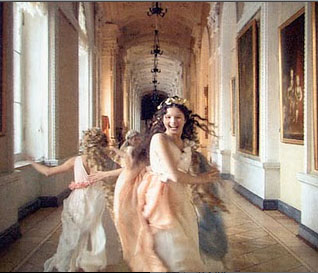
It was probably inevitable that somebody would try to make a feature-length film consisting of a single moving shot. Josh Becker’s Running Time (1997) renders a heist in what purports to be one take; there are cuts, but they’re pretty well disguised. Sokurov’s Russian Ark (2002; above) uses video technology to create a feature out of one genuine take, “a single breath” as he called it. At the same time, Sokurov added the condition that the shot would be an exploration of a labyrinthine space, in this case the Hermitage, and a trip through different eras of Russian history.
My lipdub can lick your lipdub
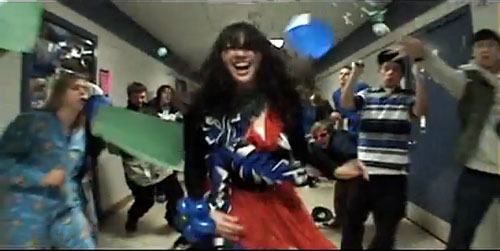
Perhaps it was Russian Ark, or maybe just TV walk-and-talks, that inspired the recent cycle of single-take video lipdubs. In these the camera moves through a locale and picks up one person after another, all lip-synching the soundtrack. September’s massively popular lipdub from l’Université de Quebec à Montréal may have furnished the prototype. In the US, a pair of current examples neatly illustrates how borrowing and competition among moviemakers can yield intriguing results.
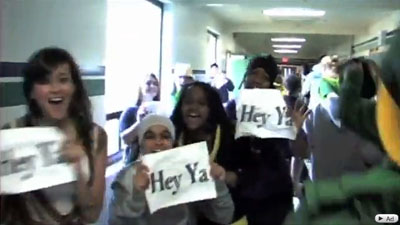
As you probably know, Shorecrest High School in Shoreline, Washington, mounted a very complicated lipdub—one take coasting through the school, picking up dozens of teens lipsynching to Outkast’s “Hey Ya!” before they all assemble in a theatre for a final shout-out. There are some somersaults too, which make any movie better. It is here.
But high school rivalries resurfaced. Shorewood High School, traditionally at odds with Shorecrest in sports and band, struck back with a lipdub of Hall and Oates’ “You Make My Dreams Come True.” The new entry raised the stakes by shooting the action backward, somersaults included. Here it is.
There’s no shortage of backwards videos, but the Shorewood clip plays in clever ways with our biases in perceiving movement. Because we’re wired to grasp motion as advancing in time, we can’t easily reconstruct the actual movement that the figures executed. After seeing the film many times, I still found it hard to visualize the actual progression of the shoot, starting from the assembled crowd and ending on the young woman running backward to the vehicle that pulls away. (A forward version is here.) Moreover, both forward and backward motion have an uncanny symmetry, so that it’s hard to detect the latter except through subtle cues like the way garments fall or a gait with a special snap. Even the moments that flaunt the reverse-motion device, such as things originally tossed down into the frame, seem instead to fly up and into the hands of bystanders.
The stakes have been raised. What will Shorecrest come up with? A radical change of angle? (An entire lipdub done from a very high or low vantage point?) Or maybe a more demanding location? (With spring coming, I’d vote for a miniature-golf course.) Anyhow, my imagination is more limited than the filmmakers’. All that matters for my purposes is that the very fact of competition gave birth to a pair of ingenious and sprightly movies.
If you’re thinking that I wrote this simply to give everyone who Googles “Gombrich lipdup” at least one result, you miss my point. Just as Gombrich was never shy about using advertising imagery and children’s drawings to illustrate some basic principles of visual psychology, so we ought to notice any examples that vividly show how artists strategize in order to create something new within a tradition. Which is to say: Yes, I consider the young filmmakers of Shorecrest and Shorewood artists. Why not?
Gombrich’s essay on Dutch painting first appeared as “Mysteries of Dutch Painting,” New York Review of Books 30, 17 (10 November 1983), 13-17. It is reprinted in his Reflections on the History of Art (London: Phaidon, 1987). Shorewood has supplied a sort of making-of bonus here, with some more challenges to Shorecrest thrown in. To see the genre coopted by politicians (who apparently can’t get all their cohorts together in the same space), go here (thanks to Camilla Lugan). Maybe US politicos could get some more support if they tried bopping like this? They could hardly look sillier than they do already.
PS 31 January: Jason Mittell of Middlebury College has alerted me to his students’ lively long-take lipdub on the virtues of recycling.
PPS 1 February: Yogesh Raut writes that another historical precedent for the dueling lipdubs would be one older than the Quebec one I cited.
In your recent entry on lipdub videos you cite a video made in 2009 by students in Quebec as “the prototype.” I think a more likely candidate is this video made by a company called Connected Ventures and first uploaded in April 2007:
While there have obviously been a ton of similar videos made since then, I think the folks at CV (who I have no connection with) probably deserve a little hat tip as innovators. Of course, it’s possible that they were copying someone else, but in general they seem to be recognized as the starters of the craze (see here, for example).
It’s good to learn this. There are probably other precedents as well. I’d just say that a prototype need not be the first work in a genre tradition; rather, it’s a fully developed, typical instance. We take Little Caesar as a prototypical gangster film, but it’s not the first. The Connected Ventures project is indeed a single take, and it follows various people lip-synching. But it doesn’t explore a building in a targeted way, making the revelation of new space add visual variety, and the walking characters seldom pass us from group to group in tight choreography (it relies more on loose pans). Like other early efforts in a genre, it seems simpler and rougher than later entries. I suppose that supports my point that competition can spur filmmakers to surpass their peers; it seems that later lipdub adepts took up the challenge to make the single take more intricate. Still, I should probably have called the Canadian video “a prototype” rather than “the prototype.” Many thanks to Yogesh for calling my attention to a particularly early work in the genre.
2 May 2010: Tonight’s Simpsons episode, “To Surveille, with Love,” opens with a single-take lipdub pastiche/ parody showing Springfield’s citizens moving to Ke$ha’s Tik Tok video. Next morning: It’s here.
French fortuities
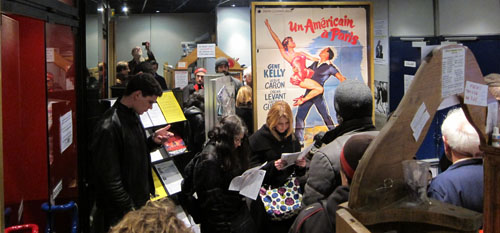
DB here:
What is it about French doors and French books? I have no trouble opening a door in other countries, but here it’s hard to tell whether to push or pull. Yes, I know a door swings toward its hinged side, but sometimes the hinges seem hidden. Yes, there are often instructions on the door (POUSSEZ, TIREZ), but often there aren’t. And it’s not just me. French people ahead of me in a queue seem just as baffled. Yesterday, a kind lady helping me at the Bibliothèque Nationale made a mistake when opening her own office door. I also note that some doors have handwritten instructions (POUSSEZ, TIREZ) taped awkwardly to the glass. I’ve even seen one sporting a tired Post-It.
As for books, over the years I’ve fretted over a lack of coordination on two matters. First, in what direction will you print the book title on the spine? The French do it either way, top to bottom or bottom to top. Second, where does the table of contents go? Usually at the back, but not always.
Don’t get me wrong; this isn’t an anti-French diatribe. I’ve loved Paris since my first trip here in 1970. Some people come here to eat, to wander through a glorious city, to visit museums. I do some of those things too, but mostly I’ve come over the years to do research, explore bookshops, and to watch movies. It makes me boring company, I know—I don’t sit much in cafes reading newspapers and watching passersby—but it makes me happy. And Paris is about nothing if not happiness.
My first two lectures at the École Normale Supérieure seem to have gone reasonably well; I’ve got one more to give next Monday. At other times, while Kristin does Egyptological research in Berlin, I’ve done what I usually do in this city.
Landscapes and portraits
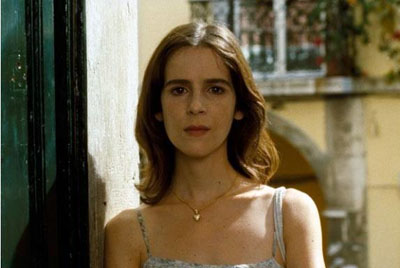
Eugene, or Eugène, Green is one of the most rigorously—some might say rigidly—formalist of contemporary filmmakers, and his moves are on display in La Réligieuse portugaise (The Portuguese Nun, 2009). It’s another movie about the making of a movie. Julie, a young Parisian with Portuguese roots, comes to Lisbon to shoot a film based on a seventeenth-century epistolary novel. Although the plot involves the passionate romance between a military officer and a nun, the project will apparently consist mostly of Julie’s voice-over and include only a couple of scenes showing her with the officer.
Green’s film exemplifies that process Dwight Macdonald described in Antonioni: the Talkies become the Walkies. Julie drifts around the city, meeting a little boy, a man contemplating suicide, and a nun. She returns at intervals to terraces that afford her a view of the gleaming city on the bay. Through a mysterious process, she comes to change her life and perhaps get a glimpse of what is holy about ordinary existence.
The first Green film I saw was Le Monde vivant (2003) and it’s still my favorite: a fable about medieval gallantry played out in a contemporary landscape, with knights and ladies and monsters wearing today’s casual clothes. I also like Le Pont des Arts (2004), though its resolute dedication to the values of High Art can put populists off.
Filming handsome women and beautiful men, Green subjects them to a regimen of geometrical framing and cutting. La Réligieuse portugaise opens with what seem to be standard establishing shots, but soon we realize that they present symmetrical pans across city views, and the shots are themselves embedded in an ABAB editing pattern. The opening not only sets up the location but announces, at one remove, the visual style.
Most noticeable is Green’s minimalist formula for a conversation. After seeing the actors in a full shot, often in profile, we get over-the-shoulder views. No surprise there, or in the tight ¾ singles that follow. But then we get straight-on facial close-ups, far more strictly patterned than comparable passages in, say, Demme’s Manchurian Candidate. Moreover, each line of dialogue is delivered whole in each shot; I didn’t detect any sound overlap at a cut. Each character is locked into his or her own image-sound module, and the scene strings these together.
The film’s trailer barely hints at the story but announces the modularity of Green dialogue. Like the opening, it introduces us to the visual scheme rather than the dramatic nexus.
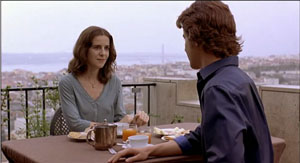
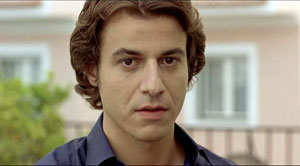
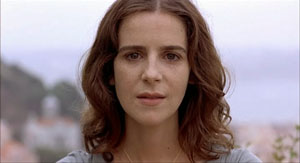
Eventually you get used to these to-camera exchanges (the climactic one between Julie and the nun seems to last nearly a reel). So Green varies the format by supplying some other angles and even moments when characters turn from a scene to look enigmatically out at us—a sort of logical extension of the to-camera device. This could be a suffocating style, but I think that the prolonged landscape views give the movie a chance to breathe in a different rhythm. And Green has a certain humor about his cookie-cutter technique. He plays the director of the film, and his camera positions in that project never seem to replicate those in the movie we’re watching. Still, his crew is usually shot staring straight out at us.
The hieratic style seems to fit a movie which is, like Green’s others, about mysterious and even mystical forces inhabiting our world. Maybe the visual approach is too simple, and the plot’s quasi-resolution borders on the simplistic, but I’ve always liked films that apply strict structures to ordinary dramatic material in the hopes that something evocative will flash out. Ozu of course does this best, and in ways that Green may have picked up on; he’s usually compared to Bresson and Oliveira, but his dialogue patterns seem to owe a lot to the Japanese master. La Réligieuse portuguese is a little precious and unashamedly pretentious, but those qualities didn’t stop me from enjoying it.
Agora-phobia, apocalyptic visions, and dotty murders
I’d have welcomed a little Greenian simplicity and rigor in Agora, Alejandro Amenabar’s secular-humanist sword-and-sandal account of political and religious struggles in Alexandria in the early Christian era. It boasts the standard stuff: wailing pseudo-World-Music score, now-you-see-it-now-you-don’t cutting, glimpses of physiognomically challenged bystanders gaping at their betters, brawny heroes fighting for both Big Ideas and the love of a woman, swooping helicopterish CGI views of landscapes, handheld scenes of mass carnage, and overexplicit performances. Rachel Weisz reads her dialogue Special Delivery, often supplying two or three facial expressions per line.
She plays Hypatia, a philosopher-teacher who, in the movie’s version, anticipates the discovery of planetary orbits by a few hundred years. I’m all for a story centered on a smart scientist who happens to be a woman, and it’s a provocative dig at today’s fundamentalists to reverse costume-picture conventions and make early Christians the dogmatic oppressors. But Hypatia’s quest is literalized in a graphic motif that nobody can miss, and it’s embedded in a commonplace romantic tale of spurned lovers who don’t share her commitment to higher things, like the mathematics of conic sections. She is a political idealist surrounded by political opportunists, and the result can only be martyrdom. There are good middlebrow costume pictures, but Agora isn’t one of them.
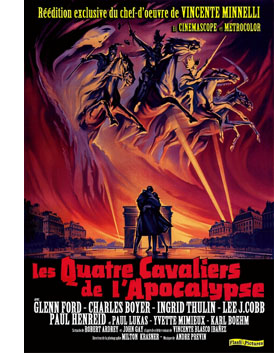 You want ersatz history done right, go to Hollywood. Minnelli’s 4 Horsemen of the Apocalypse (1962) updates the old Metro property from World War I to the Big War. I saw it on 16mm long ago, before I came to appreciate Minnelli, and didn’t want to give it a go on DVD, so I was happy to see a newish copy in 35mm at the Filmothèque in the Latin Quarter. The theatre was minuscule, and the lobby was crammed with viewers anxious to escape the cold (see above). But both the Red and the Blue screening rooms were cozy, and a front-row seat afforded me a perfect view.
I found the first half-hour or so of 4 Horsemen to be freighted with fairly clunky exposition laying out family relations. The high point is Lee J. Cobbs’ characteristically scenery-gobbling performance as the patriarch, culminating in his crazed vision of the night riders in the sky during a thunderstorm. Once the plot moves to Paris and Julio (Glenn Ford) falls in love with Marguerite (a weakly dubbed Ingrid Thulin), the drama gets going. Julio starts as an It’s-not-my-fight hero who, unable to flee with the married woman he loves and sickened by the depredations of the Gestapo, becomes a Resistance conspirator.
In general, I thought that the old actors—Paul Heinreid, Paul Lukas, and Charles Boyer—gave the movie most of its body and pathos. In particular, Lukas and Boyer evoke each man’s sorrow at choosing the wrong path in history, both personal and political. 4 Horsemen, made when old Hollywood was in its death throes, still had a sheen that films would lose in a few years. The scenes in the Paris Métro are shot quite close with Panavision lenses, which enables Minnelli to avoid big establishing shots and create tight, clever alignments of Julio on the platform with his woman Resistance courier. These sequences have a concise precision that American cinema would soon lose. Granted, narrative point of view skips around awkwardly, perhaps because of cutting in post-production. We probably need more of the daughter , although that would have the unfortunate consequence of giving us more of Yvette Mimieux. Nonetheless, Amenabar could study how to present motifs by noting the casual way cigarettes and lighters thread through the plot.
4 Horsemen goes rewardingly wacko at certain points, particularly in the red-soaked montages that stretch 1940s stock footage to CinemaScope proportions. (Truffaut fiddled with the same distortions, more expressively, in Jules et Jim, released at almost exactly the same time). Unhappily, these sequences are nothing like as delirious as the climactic stretch of Some Came Running. In sum, for me, mid-range Minnelli; but that’s pretty good. If Tarantino didn’t watch this in preparation for Inglourious Basterds, he should have.
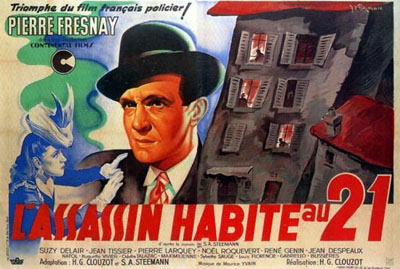
Cited in that same Tarantino movie is an Occupation classic I’d never seen: Clouzot’s first feature, L’Assassin habite au 21. Of course it was playing, thanks to the attention focused on Clouzot’s unfinished L’Enfer project. L’Assassin‘s opening sequence is a flamboyant piece of work, and it includes what might be the first appearance of that strange tracking shot we start to see in 1970s horror films. You know the shot, in which the framing oscillates between objective and subjective views, now exploring, now stalking. After this flashy start, L’Assassin devolves into black comedy, putting on display a gallery of murder suspects, all eccentrics and grotesques living in the same pension. (In a metacinematic jab, it’s the “Pension des Mimosas,” citing one of the most celebrated French films of the 1930s.) Not as sour and cynical as Le Corbeau, the movie has a mordant charm, which extends to the sneakily misleading title.

Finally, two lucky encounters. Between Four Horsemen and L’Assassin, I had a couple of hours so I slipped into a bookshop. Who should be there but James Ellroy, signing the French translation of Blood’s a Rover? Since I’m a fan, especially of the L.A. Quartet, I had to get an autographed copy. We chatted a little about his sentences, about his mother’s Wisconsin origins, and about filmmaker Ben Meade, some of whose work (Das Bus, Bazaar Bizarre) has involved Ellroy. While Ellroy signed books, he sang, “C’est si bon.”
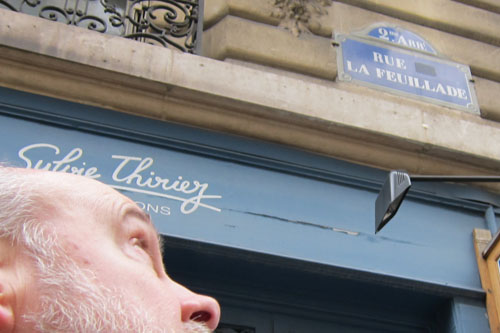
Another encounter, this one a bit of a stretch. Tuesday I went to the Bibliothèque to reserve some scenarios of Louis Feuillade films. Wandering in the neighborhood, I came upon a tiny, appropriately named street. Not my guy, though they may have been related; this La Feuillade was a military officer of apparently mixed accomplishments. But I’ll take whatever fortuities I can get.
Tell, don’t show
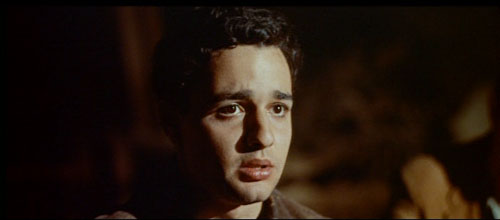
Exodus.
DB here:
Watching the film adaptation of Stieg Larsson’s Girl with the Dragon Tattoo reminded me how common fragmentary flashbacks have become. Granted, we’re living in a period of flashback frenzy, one comparable to the delirious 1940s and 1960s. But the format of the flashbacks has changed a bit. The Girl with the Dragon Tattoo, like many other films, gives us mere glimpses of earlier events–literally, flashes back to the past.
The technique is actually quite old. American films of the 1910s often interrupted present-time scenes to remind us of actions we’ve already seen or been told about. But the fragmentary flashback waned during the heyday of sound cinema. There conversations did nearly all the work. Of course there were flashbacks, as I’ve discussed in an earlier entry. But those flashbacks tended to be extended scenes, not the jagged bursts we get now.
A cynic might say that today’s audiences are so thick-headed and impatient that simply mentioning what happened earlier isn’t enough. Viewers now would chafe at the long interrogations in The Maltese Falcon and The Big Sleep. The scenes would need to be split up by images showing what the characters were explaining. The new rule: Add redundancy, but dress it up in whipcrack visuals.
So are the flurries of mini-flashbacks there just because filmmakers doubt that viewers can follow a twisty intrigue given in dialogue? Not necessarily. I suspect that these flourishes are traceable to a piece of current screenwriting advice. It’s usually formulated as Show, don’t tell.
The very distinction has some ancient ancestry. Plato and Aristotle both distinguished between verbal narration, as in the Homeric epics, and theatrical presentation. Aristotle, always more interested in craft than Plato, went on to point out that the distinction couldn’t be absolute. Epic narration could include simulated conversations, for example. Aristotle did not, so far as I can tell, urge composers of epics to avoid “showing” or dramatists to avoid having characters report offstage action.
Today’s bias in favor of “showing” is probably traceable to the emergence of the modern novel. “Dramatize, dramatize!” Henry James (a failed playwright) advised the novelist. That is, make the action on the page seem vivid and palpable. It was Joseph Conrad, not D. W. Griffith, who first claimed that his purpose was “to make you see.” A major trend in the theory of prose fiction ca. 1900 was the effort to turn words on the page into a surrogate for visual storytelling; hence the very term “point of view” and James’ comparison of unfolding narrative to a “corridor” that we traverse. It remained for Percy Lubbock, in The Craft of Fiction (1921) to sum up this trend. “A novel is a picture,” he claimed, and he suggested that novels, either “panoramic” ones like Vanity Fair or “dramatic” ones like The Awkward Age, can make us forget that they are actually verbal contraptions:
The art of fiction does not begin until the novelist thinks of his story as a matter to be shown, to be so exhibited that it will tell itself.
Screenplay manuals have picked up on the general advice, even while modifying it to suit the particularities of film. Novices are advised to reduce dialogue to the minimum. Even a novel committed to “showing” will rely on conversation, but in cinema long stretches of dialogue, and especially, God forbid, monologue are uncinematic and run the risk of boring the audience. Cinema, the reasoning goes, is a visual medium, and whenever you can replace a word, or a string of them, by images you should try to do so. The aim is what we now call visual storytelling.
Now I’m all for presenting the story through pictures. Show, don’t tell can challenge the screenwriter and director to get story points across through imagery and character behavior rather than expository dialogue. One mark of filmmaking skill is to guide the audience to make inferences rather than simply take in bald information.The question is: How far to go?
In their urge to picture every bit of action, contemporary filmmakers may be missing a chance to exploit another resource of cinema: the sustained scene in which a character talks about a past event without any visual supplement. A long verbal account of the past has unique virtues.
In other words: Filmmakers, consider telling and not showing what’s told.
Talking it through
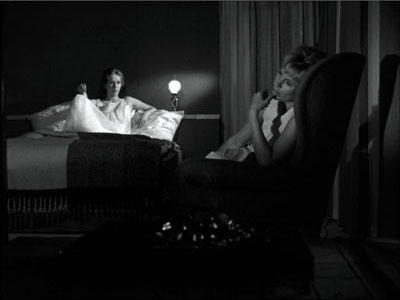
In Persona, the nurse Alma has grown more intimate with her patient Elisabeth, a famous actress who has frozen on stage and now refuses to speak. During their time together, Elisabeth’s treatment becomes therapy for Alma. Compelled to fill the silences, she gradually reveals more about herself. Tonight, a little drunk, Alma confesses something shocking. Once, while her lover was away, she and a girlfriend had sex with a couple of young men. Her telling of it makes her more and more distraught, until she breaks down weeping in Elisabeth’s arms.
In this nearly seven-minute monologue, Alma describes the incident. She mentions a few details, such as the weather on the isolated beach and the blue ribbon on her straw hat. Mostly, though, she simply describes what happened, in laconic but vivid sentences. The result is an anecdote of absorbing eroticism. Lacking any images of the events, we get to imagine the scene of sexual exchange. Bergman releases us from what James once called “weak specificity”: perhaps no imagery this side of pornography could be as arousing as this bare-bones account.
But the fairly neutral words are given emotional coloration through Alma’s manner of telling. Her reaction mixes astonishment at the pleasure, guilt at betraying her lover, and shame in telling it to Elisabeth. By the end, she collapses into weeping confusion; the incident has made her doubt what sort of person she is. Here Bibi Andersson’s performance is crucial, with trembling sincerity giving way to anguish and self-reproach.
In sum, by presenting this monologue wholly in the present, Bergman gives us two layers of action simultaneously, a charged sex scene and its long-range emotional consequences. But there’s more. Had he given us flashbacks, he could not preserve the flow of the present-time action. The staging and cutting during Alma’s confession use simple film techniques, but they add another layer to the scene.
The master shot, seen above, gives us the two women as Alma begins her tale. Then straightforward analytical editing isolates each woman.
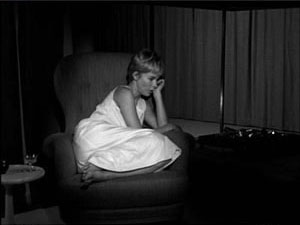
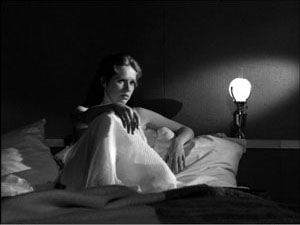
In a classic gesture of intensification, the next shots of Alma and Elisabeth are closer than the earlier ones. This pair of shots accompanies the highest point of what Alma is telling us—the first couplings.
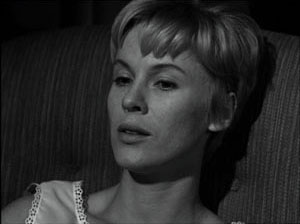
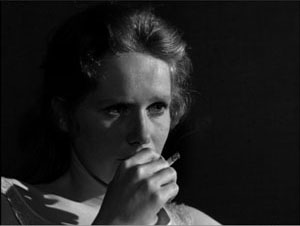
The tight shot of Alma, in which she describes achieving orgasm, lasts almost two minutes and is the lengthiest shot in the sequence. Then the action pauses as Alma nervously curls over to grab a cigarette, goes toward a distant window to light it, then settles on the sill to resume her story.
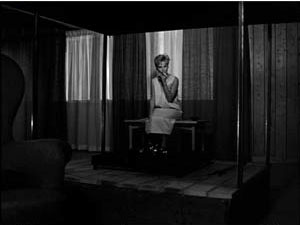
The earlier close shot of Elisabeth had hidden her reaction behind her hand. Now she watches Alma in a sort of enjoyment. Friendly empathy or triumph at eliciting a damaging admission? It’s hard to say. Alma retreats to another window and turns away, as if responding to Elisabeth’s smile.
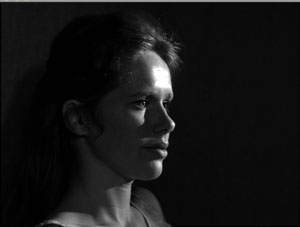
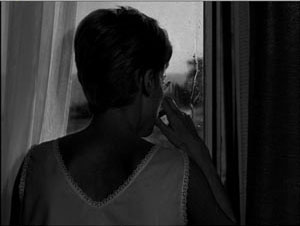
Alma finishes her tale by saying that that night, reunited with her lover, she had the most pleasurable sex of their relationship. Turning from the window, her face is angled in such a way that her confession seems at once indifferent to Elisabeth (the eyeline doesn’t seem angled toward the bed) and challenging to her: “Can you understand that?”
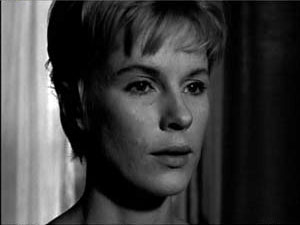
The next line of dialogue—“And I got pregnant of course”—introduces a rupture in the action’s space and time.
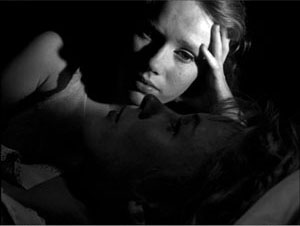
Now Alma is in bed with Elisabeth, as if her question had impelled her to the closest physical contact yet. As Alma twists in pathetic uncertainty, weeping, Elisabeth’s reaction is again initially suppressed (Alma’s arm blocks her patient’s eyes) before finally revealing Elizabeth’s face during the embrace. Yet the expression remains ambiguous—sympathetic, or victorious in having exposed her nurse’s inner life.
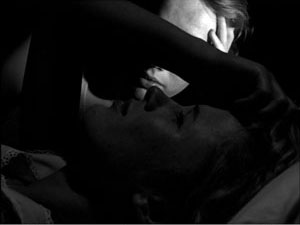
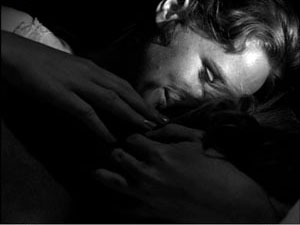
Later we will learn that Elisabeth’s caresses aren’t as affectionate as they might first appear. In any event, given the tenor of Alma’s revelation, it is hard not to see them as erotic gestures in the present, parallel to those Alma recounted.
By telling rather than showing, then, Bergman has been able to tell and show. Bergman lets Alma’s telling provide a sort of virtual flashback, while he also creates a ripening interchange between characters in the present. Instead of simply sandwiching fragments of the past into the present action, he has built up two smooth arcs of action, one that we imagine and one that is set before us in precise detail, with its own emotional modulation. The bliss of the past events is refracted through the pain of telling them.
Telling as therapy
Part of the rationale for telling rather than showing the beach orgy is, of course, the fact that much of it couldn’t be presented so literally on film; censors would object. More important is the fact that showing a heavy-breathing sexual encounter would be likely to undercut the developing revelation of Alma’s present feelings, the tension between the memory of uninhibited pleasure and the lingering shame and confusion.
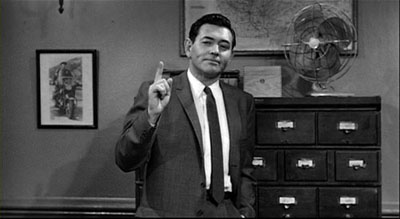
The issue of what should be shown comes up in another classic scene of confession, the moment in Exodus when the Jewish teenager Dov Landau admits that he was an accomplice in running a concentration camp. Again the result is a tearful breakdown. Here, however, a conversational partner coaxes out the truth by quietly corrosive questions.
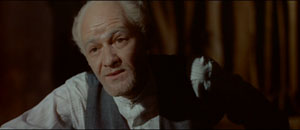
Dov is trying to join the Irgun, a guerrilla band seeking to drive the British out of Palestine. The senior officer, Akiva Ben Canaan, lets the cocky youth expand on his boast that he began fighting Nazis in the Warsaw ghetto but then was captured and sent to Auschwitz. At first Akiva probes gently. How did the camp officials decide who would live? And what did the Nazis do to the girls? Dov starts to shift uneasily. How was the killing accomplished?
Like Bergman, Preminger employs the standard method of providing closer views as the tension rises. Dov starts to relax as Akiva provides softball questions, but then he has to confess that the bodies were dumped in mass graves. Who dug the graves? Dov admits that demolition squads used dynamite to blow out trenches. Akiva induces him to admit that this was Dov’s job.
In the course of all this, Akiva moves around the room and leans closer to Dov, but the boy remains motionless in the same setup. The fixed framing accentuates his subtly changing expressions across the scene.
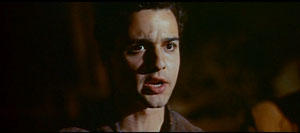
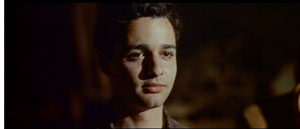
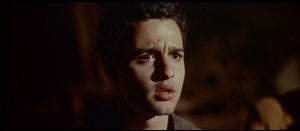
Akiva retells what Dov must have done: shave heads, collect bodies, harvest gold fillings. Dov crumples like a child under the admission (see the frame surmounting this entry), and like Alma at key points in her monologue hides his face in shame. “What could I do?”
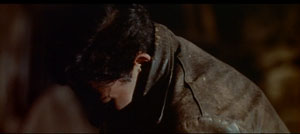
What else has he to confess? Dov won’t say, until he collapses again: “They used me . . . like you use a woman.”
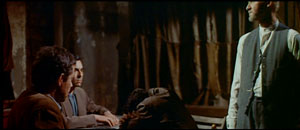
The distant framing here prepares for the scene’s final phase: the men rise and swear Dov into their group.
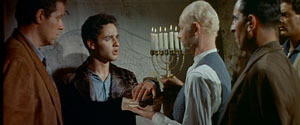
Today a filmmaker would be tempted to show at least some of what Dov tells us. We could get glimpses of life in the camp, along with subjectively distorted imagery of sexual abuse, perhaps from Dov’s point of view. But this could turn out to be James’ “weak specificity.” “Let the reader think the evil,” James advised. Accordingly, Preminger sticks obstinately to what Dov says and how Akiva’s softly voiced but damning interrogation brings out the truth.
Again, the scene’s power comes from the character’s emotional development during the telling. We can imagine the horrors that Dov faced as a boy, and our pity comes from empathizing with his changing expressions–bravado, ruffled concern, realization that he has been caught lying, revulsion at his betrayal and the sexual assault. That is, we sympathize through his response now, rather than through direct vision of what he encountered. We react to his reactions.
By the end, Dov seems dazed that his confession has been accepted. Partly this is surprise that he isn’t being rejected, but also it’s as if he has awakened from a dream–that of himself as a resistance hero. Akiva Ben Canaan forces him to confront what he had not faced. Once more, the confession becomes a talking cure.
As in Persona, the confession also characterizes the interlocutor. Akiva ‘s gentle manner fuses wisdom and severity, making him a quietly stern father confessor. He’s also a shrewd exponent of psychology, one who picks the moment of the boy’s greatest self-revulsion to declare that Dov is accepted into the Irgun. The confession has broken him; the Irgun will remake him. Having surrendered himself utterly he will prove a more loyal soldier than any recruit with an innocent past.
Again, the scene of telling has given us two continuous emotional arcs in two time frames, one concrete and one virtual: a past event we’re cued to imagine and a present stripping away of the teller’s defenses. People who complain that the dialogue scenes in Inglourious Basterds are overlong should consider the tradition of movies like Exodus and Persona.
Psycho babble
Persona and Exodus suggest two virtues of sustained recounting: arousing the viewer’s imagination, and providing an unbroken arc of present-time action that can generate sympathy through face, gesture, and voice. There’s one more advantage that isn’t perhaps so evident nowadays.
Current films give us “lying flashbacks” fairly often. But in the old days, with very few exceptions like courtroom films and tales like Rashomon, a flashback was veridical. In recounting a story action, a character might lie or make mistakes, but if the film’s narration showed us that action, we could trust that as the truth. As a result, many detective stories presented suspects’ versions of events through question and answer but climaxed in a flashback that showed us what really happened.
If, however, you want to induce doubt about what really happened, you might have the detective’s climactic explanation pricked by inconsistencies. This is what seems to me to be happening at the finale of Psycho. (Do I really have to warn about spoilers here?)
After Norman Bates has been captured, halted in another murder attempt, the psychiatrist Dr Richmond explains the young man’s split personality—part Norman, part Mrs. Bates, his mother. Richmond claims to have gotten the truth “from the mother.” At this point, he says, the Mom part of Norman has taken over wholly, a claim confirmed when we hear Norman speak in an old lady’s voice in the epilogue. Richmond goes on to claim that his questioning determined that Mother “killed the girl.” To get literal, it was as Mother that Norman murdered Marion Crane.
A contemporary film would very likely replay the murder so as to validate the psychiatrist’s analysis: Norman dressing up as his mother, assuming a cackling old-bat accent, killing Marion in images that fill in the silhouette that we saw in the shower sequence. We would see that Norman-as-Mother is the culprit.
But this visual confirmation of Richmond’s diagnosis would be made problematic by the epilogue that Hitchcock includes. In the final sequence we see Norman, staring out at the camera, and hear Mother’s voice declaring that her son committed the murders. According to her, Norman is the culprit; she wouldn’t hurt a fly. How then can Richmond declare that Mother told him that she killed the girl?
We might say that the doctor is extrapolating: the truth he took from the mother is that she is dissembling, shifting the guilt to Norman. But Richmond could have stated that was his reasoning, and he doesn’t. The incompatibility between his explanation and Mother’s soliloquy opens up the possibility that he has not probed to the depths of Norman’s madness.
Despite the fact that the psychiatrist’s analysis arrives at the moment when a conventional movie delivers the whole truth, the very last minutes of the film incline me to doubt Richmond’s ability to grasp the whole situation. It’s as if our parting vision of the character disturbs the smug certainties of the diagnosis.
I haven’t dived deeply into the Talmudic sea of Psycho commentary, so it’s likely that this issue has been hashed out extensively. Perhaps my construal won’t stand up. Take it, then, as a possible instance of the ways in which a verbal recounting, “unconfirmed” by a tangible flashback, can stand as only a candidate explanation rather than the whole truth. In general, telling and refusing to show can induce what Meir Sternberg calls “anticipatory caution,” a warning that the telling is only one, and not necessarily the most truthful, version of events.
Show, don’t tell is usually good advice. But I’m suggesting a codicil. Consider showing the telling. Fill it out. Pack it with actorly detail and psychological implication. Stage and shoot and cut it so as to create an engrossing, unfolding rhythm. That’s visual storytelling too, and it requires fine judgment. Who knows? More scenes relying on telling might also teach audiences to be a little patient.
The best modern account I know of the subtle differences between showing and telling, and the cases when the categories blur and fracture, can be found in Meir Sternberg’s Expositional Modes and Temporal Ordering in Fiction. I talk a little about the distinction in Chapter Two of Narration in the Fiction Film. See also The Way Hollywood Tells It for some comments on today’s vogue for unreliable flashbacks. And way back in 2006 Matt Zoller Seitz wrote a passionate attack on the idea of “Show, don’t tell” while defending the value of voice-over narration.
N. B. I’m not ignoring the possibility that film can present showing and telling in two simultaneous streams: imagery of the present situation accompanied, perhaps alongside, by continuing imagery of the past scene, as in Suddenly Last Summer. This can be a fruitful option, but it relieves the spectator of the obligation to imagine the past—an important advantage of the pure telling. There’s also the tricky matter of giving the two streams of information enough density. The past event needs to gain enough body to be more than a simple illustration, while the present-time telling could become merely a prop for the flashback. In the dual-presentation mode, the filmmaker risks dividing our attention and thinning the texture of each time frame, with the result that both lose vividness. That seems to me to happen in Suddenly Last Summer.
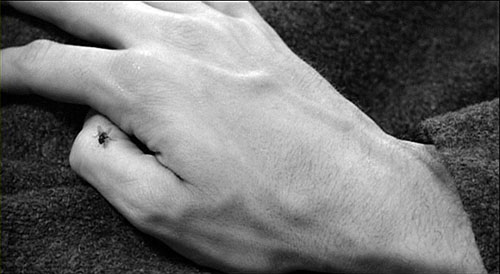
Psycho.