







Archive for the 'Film comments' Category
The Omnivoyeur’s dilemma
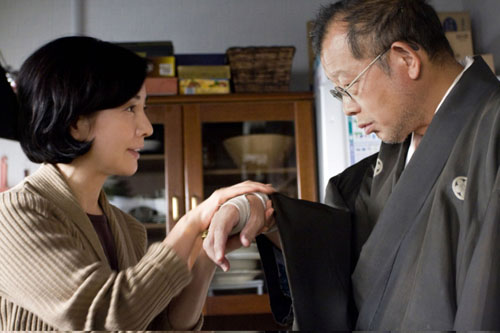
Otouto.
DB here:
Any major film festival is really many festivals. You meet someone who tells you about all the films they’ve been seeing, and the overlap with your dance card is virtually nil. You’ve both been in the same town, and probably hit the same venues, but you’ve been to different festivals.
Then there are certain syndromes. You convince yourself you need to see 3-5 films a day. Otherwise, what’s the point of traveling all this way? Soon you realize, horribly, that after a couple of days of this regimen, you can’t recall what you’ve seen. Some early afternoon, Festival Amnesia will set in, and you can’t remember what you saw that morning. Was it that ambitious but ultimately unsatisfying little romance from the Bosporus? Or the Chinese movie about moping teenagers trying to leave their dingy village? What were the names of those movies, anyhow?
My own symptoms are getting acute. Twice in recent years, I have found myself in front of a film suddenly realizing that I had seen it at another festival. I had forgotten the title. At least I caught my mistake with the first shots, but I expect that in time I will obliviously sit through the whole movie twice—probably liking it on the first pass and declaring it disappointing on the second.
Then there’s Viewer’s Remorse. Watching 3-5 titles a day, you inevitably encounter some stinkers. You take this philosophically until you meet someone else, who rhapsodizes about the string of masterpieces they’ve seen. Suddenly you realize that you have backed losers. Your friend has had a transformative festival experience, and you might as well have been flossing. Worse, your carefully picked mediocrities swell in your mind, blotting out the good films you managed to catch by dumb luck. Panicked, you thumb through the schedule to see if the great things you’ve missed are playing a second time.
They aren’t.
So film festivals aren’t by any means the sweet deal they may at first seem. Even putting aside queueing, officious door staff, racing between venues, and projection problems, there are plenty of features to make people like me more neurotic than we already are.
But I can’t complain about my latest visit to Hong Kong. True, breathing problems put me out of commission some days and eventually forced me to return home early. My biggest regrets were missing the Zanussi films and the two Angelopolous films, The Weeping Meadow and The Dust of Time. (Watch: Somebody will tell me they are all masterpieces.) Still, I managed to see a fair amount in two mini-festivals I carved out of Filmart and the festival proper.
Turning Japanese, yet again
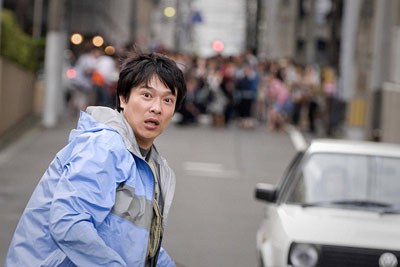
Golden Slumber.
Parade, from director Isao Yukisada, is an ensemble picture about Tokyo twentysomethings sharing a flat. Their love affairs and marathon viewings of soap operas are disrupted when Satoru, a male prostitute, crashes there one night and winds up hanging around with them. With his blank passivity and ambisexual good looks he arouses their curiosity and, as usual in such movies, winds up changing everyone’s lives. The film was pretty good at portraying the way the kids keep life intriguing by conjuring up mysteries about their neighbors. (Is the man next door running a brothel?) The plot ran out of steam, I thought, but I enjoyed seeing a movie in that sober style that apparently only the Japanese can now pull off: only about 400 shots in nearly two hours, with an unassertive fixed camera that gave the characters room to breathe.
Also about a young cohort, but more action-driven, was Golden Slumber, by Nakamura Yoshihiro. He directed Fish Story (2008), a favorite of mine from last year’s festival. This one is about a hapless young man pulled into a plot to assassinate the prime minister. Threaded with glimpses of his college days, when he and his pals worked in a fireworks shop and became connoisseurs of fast food, the plot follows his efforts to avoid arrest and find how he was framed. Like a lot of contemporary Asian films, Golden Slumber sounds a note of nostalgia not only for long-lost innocence but also for kids’ self-consciously retro tastes in popular culture—in this case, the Beatles song “Golden Slumbers” (“Once there was a way to get back home . . . .”). Less zany than Fish Story, whose story pivoted around how an obscure album prepared for the end of the world, this seemed to me finally quite agreeable, thanks to its likably awkward hero and its lovelorn ending.
Longtime readers of this blog won’t be surprised that one favorite of my personal Japanese mini-fest was Yamada Yoji’s tear-jerker Otouto (aka Ototo, “Younger Brother”), a remake of a 1960 Ichikawa film. A widow who ekes out a living as a pharmacist is about to marry off her beautiful daughter. But during the wedding dinner her ne’er-do-well brother pops up and turns the ceremony into a catastrophe. Japanese movies are very good at evoking social embarrassment, and the disruption caused by Tetsuro makes you wriggle in your seat. He could have been simply a lovable loser, but he’s not that likable, let alone lovable, and his waywardness brings misfortunes on his sister’s family. In this movie about how you must love your relations no matter what, Yamada shows the classic resignation to family ties that has characterized the films from the Shochiku studio since the 1920s.
As usual with Yamada, the direction is crystalline in a way you hardly ever see now: calm framings, unhurried pacing, longish takes (about 12 seconds on average), and lighting and composition that etch every object in relief. When Ginko the mother peels an apple, the skin curls off in a long ribbon, and it’s as fascinating as a car chase in any other movie. In a film in which the camera seldom moves, a handheld shot regains some of its original power. Maybe I’m what Groucho called a sentimental old fluff, but like Kabei–Our Mother, Otouto shows that some cinematic traditions are still worth something.
For the real Shochiku flavor, experts will tell you, you need to return to the 1930s, and the festival did so with its small retrospective of Shimazu Yasujiro. A prolific director of comedies and dramas (he made over a hundred silent films), Shimazu built a reputation in the 1920s with family dramas like Father (1923). Most of his films are lost, and he died in 1945, so he didn’t benefit from the postwar revival of the industry and its growing renown in the West. His most famous work is probably the ingratiating Our Neighbor Mis Yae (1934), which features in the retrospective.
The remaining Shimazu films don’t seem to me to reveal the stylistic consistency we find in Ozu or Mizoguchi or Shimizu. There are flamboyant pictorial touches in First Steps Ashore (1932), a drama of sailors and prostitutes with stark lighting and cluttered sets influenced by The Docks of New York.
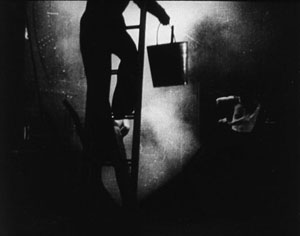
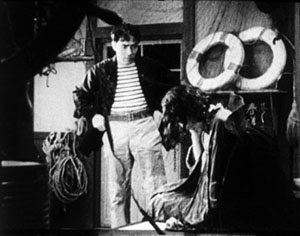
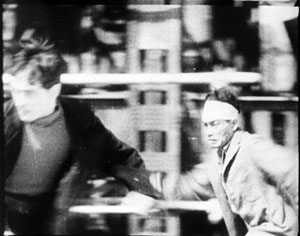
A fight scene is rendered in a long-lens shot that looks very modern, though the technique had already been seen in Japanese swordplay films.
Perhaps most original are the variants Shimazu works on a picturesque divider in a waterfront bar, which becomes a fascinating grid that sorts out faces.
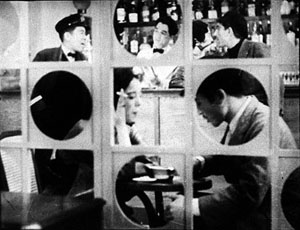
Having been trained by this cheese-grater divider, we are given the tougher task of spotting the seaman peering from the distance at our stoker hero and the taxi dancer he rescues. (Not so easy to see in my still: He’s watching from the square and circle aligned horizontally behind the hero’s lips and chin.)
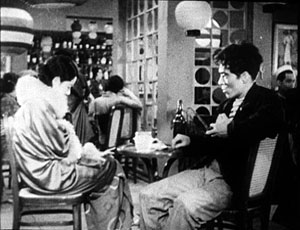
This “game of vision,” where we must strain to see action that’s blocked by bits of setting or furnishing, is characteristic of Japanese film then and since.
Okoto and Sasuke (1935) and Lights of Asakusa (1937), the two Shimazus I caught during my stay, aren’t as visually tricky as First Steps Ashore, but they display Shimazu’s characteristic interest in marginal characters (a blind woman in Okoto, stage performers in Asakusa). Both films close with a self-sacrificing retreat from the world. Later films, including the wonderful Brother and His Younger Sister (1939), would give this retreat a positive ideological spin. Disgusted by office politics, a young man takes his sister and mother to Manchuria to start anew, and the finale shows a clump of earth clinging to the plane wheels, as if a bit of Japan’s very soil would sanctify the empire’s new outpost.
Fei Mu, Film Poet
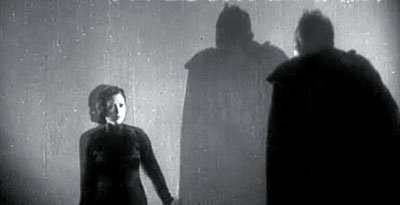
Nightmares in Spring Chamber.
A second mini-festival during my Hong Kong stay centered on Chinese film history. I’ve mentioned the Patrick Lung Kong titles in an earlier entry. The other prime figure was Fei Mu, celebrated as one of China’s best filmmakers. His Spring in a Small Town (1948) is often considered the greatest of all Chinese films, and it’s not an unreasonable judgment.
Unfortunately, only about half of Fei’s output survives. The earliest film we have is Song of China (aka Filial Piety, 1935), a paean to Confucian virtues. Parents permit their son to move to the city, but the son falls prey to self-indulgence and a temperamental wife. Even when he holds a banquet to honor his parents it is merely an excuse for what the father calls “revelry and gambling.” Soon the daughter is being seduced by a city slicker and told that “parental consent is a timeworn tradition.” This lesson in traditional morality is filmed quite fluently, with telling use of tracking shots, especially during the banquet, and sudden bursts of angular montage.
On Stage and Backstage (1937), from a Fei Mu script, is a 37-minute comedy. A troublesome diva refuses to come to a performance unless she’s paid, but the manager can’t afford it. So a street performer is brought in to substitute for the star in a performance of Farewell My Concubine. While the production is shot frontally and with little depth, director Zhou Yihua contrasts that area of action with the backstage milieu by means of layered compositions and lateral tracking shots through tangles of ropes and props. I enjoyed this charming film when I saw it during my first trip to Hong Kong, and its appeal held up well for me.
I came home too soon to catch Bloodshed on Wolf Mountain (1936), usually considered a strong work, and the little-seen Children of the World (1940). Other films in the series included The Show Must Go on (1952) from a Fei script and Romance in the Boudoir (1960), from Fei’s brother Louis; I already discussed the latter here. There were also two Chinese Opera films. A Wedding in the Dream (1948), China’s first color film, stars the legendary Mei Lanfang, the Peking Opera performer best known in the west who became friends with Chaplin and Eisenstein.
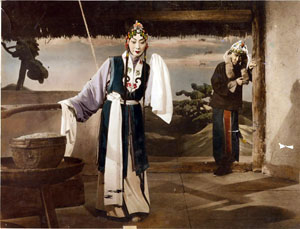
This image from Wedding in the Dream is a posed production still; the film itself, a straightforward record of Mei’s performance, survives in dreadfully worn condition. I found Murder in the Oratory (1937) more intriguing. A man is urged by his mother to murder his wife, the daughter of the man who killed his father. From the start, when an opera stage dissolves into a fully three-dimensional space, you realize that this will be an experiment in creating something halfway between canned theatre and a “filmic” treatment. So we get all the trappings of an opera performance, including stylized movement and singing, but with the camera weaving among the characters and furnishings, finding unusual angles, and even assuming characters’ optical viewpoints.
Far different is another title I enjoyed on my first visit to Hong Kong in 1995. Nightmares in Spring Chamber (1937) is an episode in the portmanteau film Lianhua Symphony. This 13-minute allegory of Japan’s imperial ambitions shows a maniacal frock-coated Japanese pursuing innocent Chinese girls through a vast bare villa. He cackles over a spinning globe and captures one girl, but she’s rescued by the other, a surrogate for the Chinese soldier we glimpse occasionally. Full of canted angles, hallucinatory visions, under lighting, looming shadows, and other trappings of German Expressionism, and accompanied by snatches of Debussy and the Danse macabre, it’s a far cry from the other items in the series, and it suggests a director of considerable versatility.
Last year the Festival premiered the restoration of the rerelease of Fei’s 1940 Confucius, which I wrote about then. This year a second restoration inserted titles to cover the gaps and put some scrappy scenes into their proper order. In addition, a very informative book, Fei Mu’s Confucius, accompanied the screenings. The essays explicate the film from several angles, including its relation to Confucian doctrine, to classic poetry and painting, and to other Fei Mu works.
Thanks to retrospectives like this one, we can see how much Fei’s official masterwork owes to his earlier efforts. There are touches of lighting and staging in these films that are more subtly developed in Spring in a Small Town, and the stately pacing of Confucius is here put to more mundane subject matter. Still, nothing I saw matches the quiet erotic boldness of this milestone of world cinema, which anticipates so much of what we find in Antonioni and other postwar European filmmakers.
So much to see, and even less time than I’d planned: Film festivals somehow manage to leave you unsatisfied and yet feeling full. A nice dilemma to have.
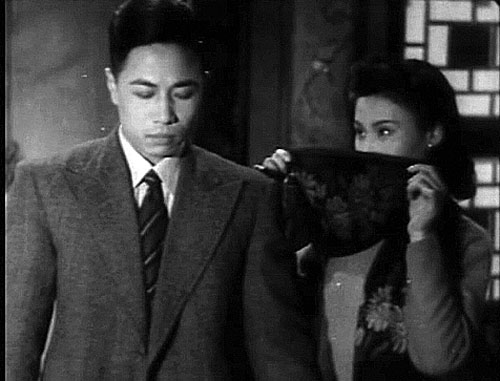
Spring in a Small Town.
Foreground, background, playground
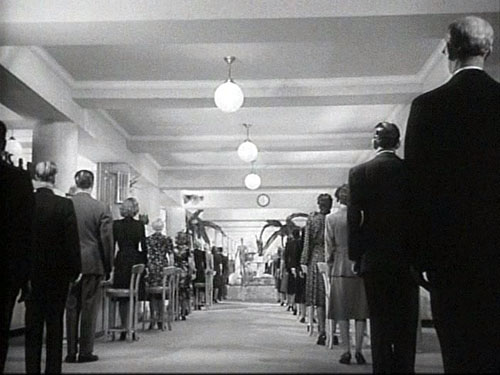
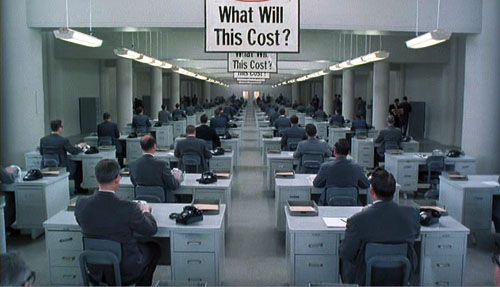
The Devil and Miss Jones (1941); The Hudsucker Proxy (1994)
DB here:
I’ve been waiting for thirty years for Alice in Wonderland. No, not the theatrical release of Tim Burton’s version. That interests me only mildly. I’m referring to the DVD release of the 1933 Paramount picture. I saw it on TV as a kid, and remembered it only dimly. But it bobbed up on my horizon in the summer of 1981 when I was doing research on our book The Classical Hollywood Cinema.
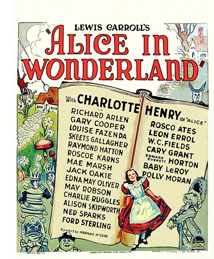 I was in the old Academy library in Los Angeles studying the emergence of certain compositional schemas. I can’t recall what put me on the track, but I requested the shooting script of Alice. What came was Farciot Edouart’s copy, over six hundred pages teeming with sketches for each shot. And a lot of those shots had a startling similarity to good old Citizen Kane.
I was reluctant to attribute pioneering spirit to director Norman Z. McLeod. Instead, I realized that these images’ somewhat freaky look owed more to one of the strangest talents in Hollywood history.
I tried to see Alice in Wonderland, but I couldn’t track down a print. So for years I’ve been waiting to find if it confirmed what I saw on those typescript pages. In the meantime, for the CHC book and thereafter, I’ve bided my time, sporadically looking in on the career of one of Hollywood’s most eccentric creators. He’s the subject of a new web essay I’ve just posted here (or click on the top item under “Essays” on the left sidebar). Today’s blog entry is a teaser trailer for that.
Deep thinkers
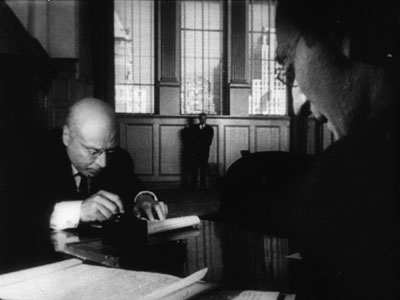
It’s commonplace now to say that Citizen Kane (1941) pioneered vigorous depth imagery, both through staging and cinematography. Many of the film’s shots set a big head or object in the foreground against a dramatically important element in the distance, both kept in fairly good focus. But where did this image schema come from?
The standard answer used to be: The genius of Gregg Toland and Orson Welles. In the 1980s, however, I wanted to explore the possibility that something like the deep-focus look had been a minor option on the Hollywood menu for some time. Once you look, it’s not hard to find Kane-ish images in 1920s studio films, from Greed (1924) to A Woman of Affairs (1929).
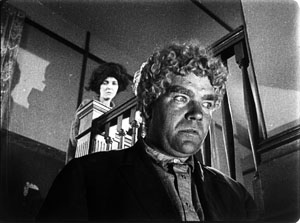
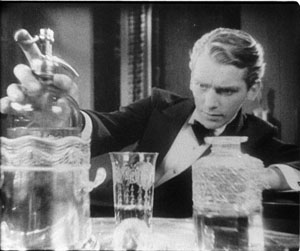
During the 1930s, William Wyler cultivated such imagery in some films shot with Toland, such as Dead End (1937), and some films shot by other DPs, such as Jezebel (1938). In turn, Toland had undertaken comparable depth experiments in films with other directors. Moreover, yet other directors, notably John Ford, had used this sort of imagery in films shot by Toland and others, such as George Barnes, Toland’s mentor. There are plenty of non-auteur instances too. (See my post on 1933 Columbia films.) We also find similar imagery in films from outside America. Here’s a stunner from Eisenstein’s Bezhin Meadow (banned 1937).
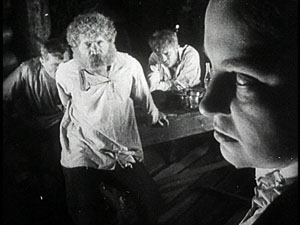
You see how complicated it gets.
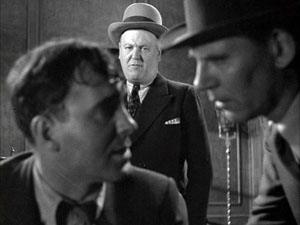
What I concluded in Chapter 27 of CHC was that Toland and Welles didn’t invent the depth technique. They fine-tuned it and popularized it. Their predecessors, in the US and elsewhere, had staged the action in aggressive depth and used many of the same compositional layouts. But the wide-angle lenses then in use couldn’t always maintain crisp focus in both planes (below, American Madness, 1932).
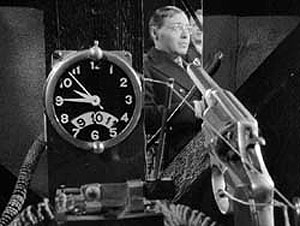
Welles and Toland found ways to keep both close and far-off planes in sharp focus. They deployed arc lamps, coated lenses, and faster film stock. Although it wasn’t publicized at the time, we now know that some of the most famous “deep-focus” shots were also accomplished through back-projection, matte work, double exposure, and other special effects, not through straight photography. Again, though, this tactic was anticipated in earlier films. One of my favorite examples comes from a matte shot in Mr. Moto’s Gamble (1935).
Menzies seems to have planned for similar fakery. In the script for Alice in Wonderland we find: “CLOSE UP, leg of mutton. The room and characters in the background are on a transparency.”
The flashy depth compositions of the 1920s and 1930s were typically one-off effects, used to heighten a particular moment. Welles and Toland pushed further by making the depth look central to Kane’s overall design and by featuring such imagery in fixed long takes. The prominence of Kane may have encouraged several 1940s filmmakers, such as Anthony Mann, to make the depth schema part of their repertoire. But as the style was diffused across the industry, the hard-edged foregrounds became absorbed into dominant patterns of cutting and spatial breakdown. The static long takes of Kane remained a rare option, perhaps because they dwelt on their own virtuosity.
Digging up films made around the time of Kane, I found many filmmakers experimenting with the look that Toland and Welles highlighted. You can see touches of it in The Maltese Falcon (1941) and All That Money Can Buy (1941). Above all, there are two remarkable movies directed by, of all people, Sam Wood. Our Town (1940) turns Wilder’s play (itself surprisingly melancholy) into a Caligariesque exercise.
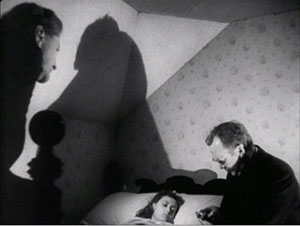
Several shots anticipate the low-slung depth, bulging foregrounds and all, that became the hallmark of Citizen Kane a year later.
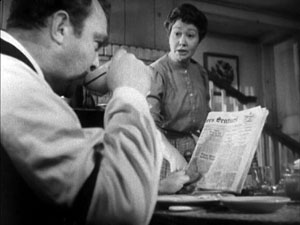
Our Town also uses postproduction techniques that yield depth-of-field effects you couldn’t get in camera.
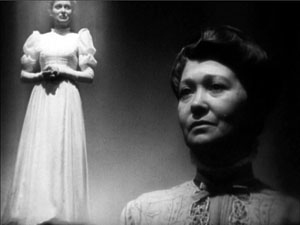
Perhaps even more startling is Wood’s Kings Row (1942), with deep-focus imagery that occasionally rivals Kane‘s.
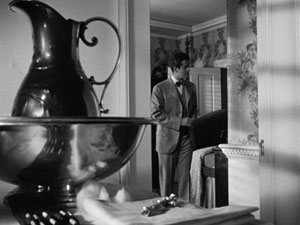
From the evidence I was encountering, it seemed that Welles and Toland’s accomplishment was to synthesize and push further some deep-space schemas that were already circulating in ambitious Hollywood circles. Connecting some dots, I realized that one of the earliest champions of aggressive imagery in general, not just big foregrounds and deep backgrounds, was William Cameron Menzies.
Menzies frenzies
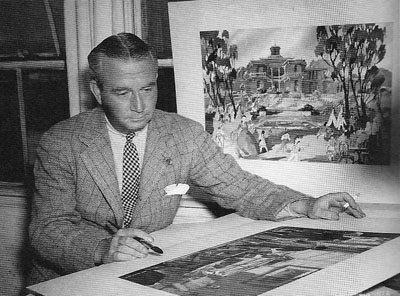
Menzies started out as an art director, most famously for United Artists. He designed sets for Mary Pickford’s Rosita (1923, directed by Lubitsch) and several Fairbanks films, notably The Thief of Bagdad (1924). He won the first Academy Award for set design and went on to a noteworthy career—most famously as production designer for Gone with the Wind (1939). He also directed films, such as Things to Come (1936) and Invaders from Mars (1953). Most significant for my purposes, he was production designer for Our Town, Kings Row, and three other films of the early 1940s directed by Sam Wood. And he designed the 1933 Alice in Wonderland. The drawings I saw in Edouart’s script were by Menzies or his assistants.
Menzies was one of the chief importers of German Expressionist visuals to the US. Although his early efforts leaned toward Art Nouveau effects, by the end of the 1920s he was cultivating a dark, contorted look keyed to the harsh geometry of city landscapes.
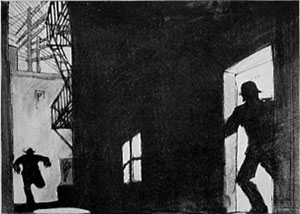
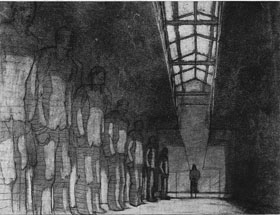
Since the late 1920s, Menzies had explored the possibility of steep depth compositions. He didn’t usually employ a big foreground, but he did favor overwhelming perspective–either abnormally centered or abnormally decentered. Here is his sketch for Roland West’s Alibi (1929) and the shot from the finished film.
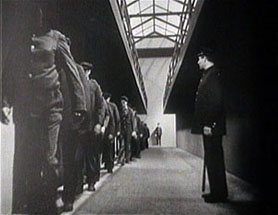
Menzies loved slashing diagonals created by architectural edges and worm’s-eye viewpoints. The harrowing opening of Things to Come is full of such flashy imagery.
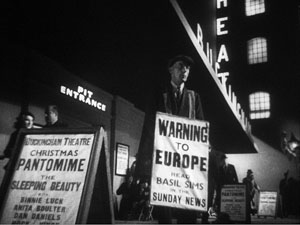
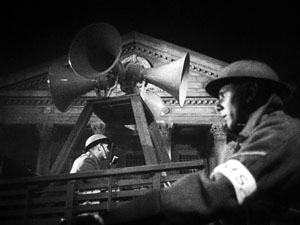
Menzies calmed his style down for GWTW, although the sequences he directed bear traces of his inclinations. And in his work for other directors he managed to slip in a few odd shots. Here, for instance, is a typically maniacal central perspective view from H. C. Potter’s Mr. Lucky (1943). Squint at this image and you’ll see that it’s weirdly symmetrical across both horizontal and vertical axes.
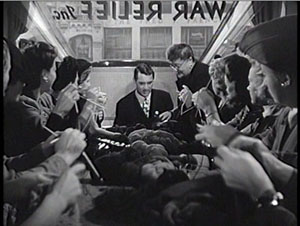
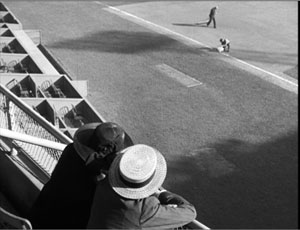
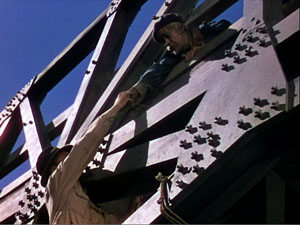
When he met Sam Wood, it seems, Menzies found a director ready to let his imagination roam further. In these collaborations, we get depth shots à la Welles and Toland, but also skewed perspectives. Pride of the Yankees (1943/44) searches for ways to make a baseball stadium look like a Lissitzky abstraction.
Menzies subjects the partisans of For Whom the Bell Tolls (1944) to his sharp diagonals as well.
Alice, we hardly knew ye
What then of Alice in Wonderland? Back in the early 1980s, I wasn’t permitted to photocopy or photograph script pages. Here is one of the few sketches I later found for the film. Alice crawls into the mirror with looming armchairs in the foreground.
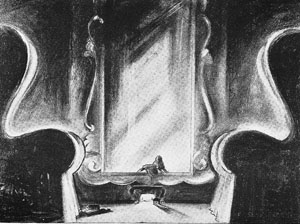
Surely, I thought, the film would be an early example of the depth aesthetic that would be developed by Welles, Wyler, and Wood/ Menzies. Alas, the film has nothing like those imperious armchairs.
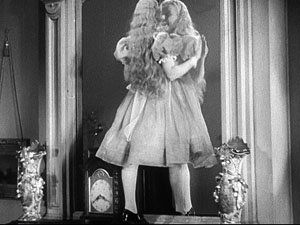
In fact, Alice proves a huge disappointment on the pictorial front. Menzies expended all his ingenuity on the special effects, coordinated by Paramount master Farciot Edouart. Although the spfx are not in the league of that other big 1933 effects-film King Kong, they are pretty solid for the time. It’s just that this remains a painfully arch, flatly filmed exercise.
But I look on the bright side. Menzies created some memorable movies, both on his own and with other directors. (Of his directed films, not only Things to Come but Address Unknown, 1944, remain of interest today.) Perhaps most important, his stylistic boldness may have encouraged other filmmakers to try something fresh. Most immediately there is Since You Went Away (1944), a big Selznick production that bears traces of the Menzies touch.
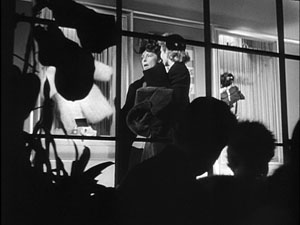
More broadly, Menzies represents a strand in American cinema that never really disappeared. His frantic Piranesian perspectives, canting the camera and filling the frame with grids, whorls, and cylinders, are still in use. And his head-on, wide-angle grotesquerie looks ahead to the Coen brothers. This shot of a department-store manager in The Devil and Miss Jones (1941) could come from any of their films.
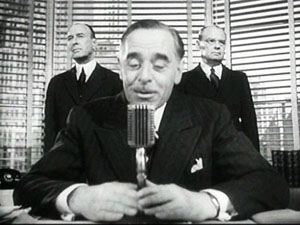
Menzies’ films, though mostly not celebrated as classics, gave American cinema the permission to be peculiar. Meet me in the sidebar for a closer look at one of Hollywood’s most eccentric creators. Special thanks to Meg Hamel for going beyond the call of duty in posting that essay.
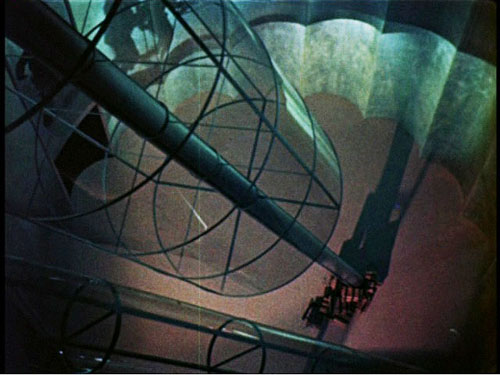
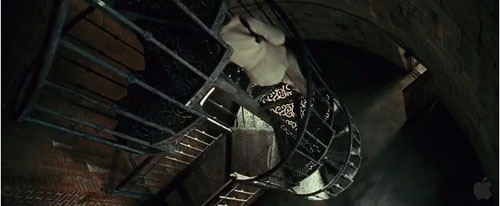
Invaders from Mars (1953); Shutter Island (2010).
Hopscotching through history
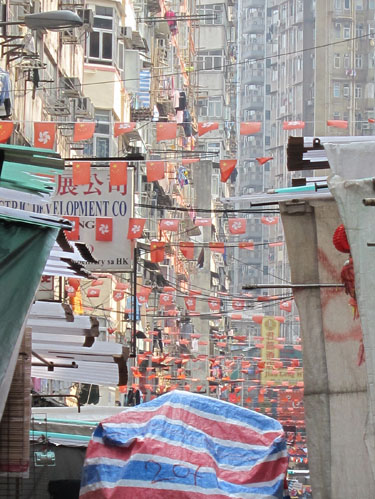
Temple Street, Hong Kong.
DB here:
Thanks to the Film Festival and screenings at the Film Archive, I’ve skipped gratefully through nearly a hundred years of local film history.
The Roast Duck legend, cooked at last?
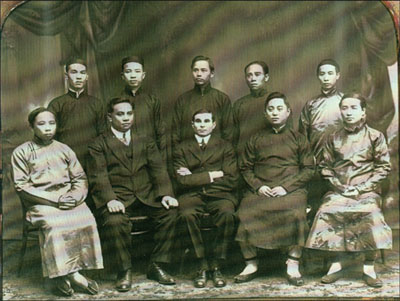
First things, or rather first films, first. Last year local authorities declared 2009 to be the centenary of Hong Kong cinema. The long-standing claim (repeated in my Planet Hong Kong) was that To Steal a Roast Duck, aka The Trip of the Roast Duck, was made in 1909 and was the first locally produced fiction film. The controversy arose because the claim was based on later recollections of filmmakers. No fiction films from that era survived. We had no contemporary evidence that the Roast Duck was made in that year or that it was the first anything. Perhaps it wasn’t even made at all? In a blog entry last year, I summed up the arguments.
Now, thanks to the persistence of Frank Bren and Law Kar, we can come to more reliable conclusions. At a conference in December, scholars from around the world gathered at the Hong Kong Film Archive to discuss early Chinese cinema. One of the results was further revelations about the territory’s first film.
We know that at some point the Ukrainian-American entrepreneur Benjamin Brodsky came to Hong Kong and set up a film unit. (The picture above shows him surrounded by nine Chinese co-directors of the company he founded in November 1914.) An earlier Brodsky company made Roast Duck, among other films. But when?
At the conference Law Kar announced the discovery of a 1914 Moving Picture World interview with Roland Van Velzer, a photographer recruited from New York by Brodsky. During his stay in what he called “that queer land” of Hong Kong, Van Velzer shot four films in 1914.
We did a first native drama, entitled “The Defamation of Choung Chow.” With my experience and guidance the picture turned out well and when shown in public proved to be a wonderful drawing card. . . . The reason of its great popularity was because it was a Chinese piece entirely. . . . We made three other subjects during my stay there. These were: “The Haunted Pot,” The Sanpan Man’s Dream” and “The Trip of the Roast Duck,” the latter a rough “chase” picture. All of these pictures had phenomenal runs at the native theaters.
According to Van Velzer, then, the first film, made and shown in 1914, was what is now known as Chuang Tzi Tests His Wife. Roast Duck was evidently the fourth film made by the team that year.
Brodsky is significant not merely because he supported talent in producing the colony’s first fictional films. He also made long documentaries about China and Japan that played in the US. He seems to have been a colorful guy. In his barnstorming circus days, he once purged a lion with castor oil. Full details are here in an article by Bren and Kar. In the meantime, we can look forward to a more plausible centenary of Hong Kong film in 2014.
Social conscience, modern stylings
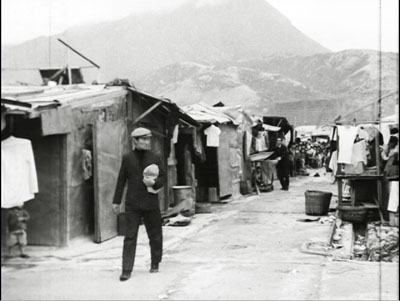
The Story of a Discharged Prisoner.
Hop ahead to the 1960s. Although the local language of Hong Kong is Cantonese, movies in Mandarin rule the market, with Shaw Brothers providing gaudily colored costume pictures, musicals, romantic dramas and comedies, and of course rather violent swordplay exercises. By contrast films made by Cantonese companies under tiny budgets look threadbare. Yet a few filmmakers tried to make Cantonese cinema more vigorous and innovative, and the most influential was Patrick Lung Kong.
Lung Kong was born in 1935, and by the time he was thirty he had performed in virtually every production role, from screenwriting and producing to publicity and distribution. Well-known as an actor since 1958, he graduated to directing in1966 with Prince of Broadcasters. His second film, The Story of a Discharged Prisoner (1967) was a landmark in local cinema, expressing sympathy for an ex-convict who tries to avoid being pulled back into crime. Lung Kong goes on to make many of the socially critical films of the period: Teddy Girls (1969), Hiroshima 28 (1974), and Mitra (1976). He ceased directing in 1981 but continued to work as an actor and distributor. He now lives in New York City, but he came back for the retrospective that the Film Archive has mounted.
I had seen some Lung Kong films in earlier visits to Hong Kong, but the retrospective will allow us to assess his career as a whole. Virtually none of his films are available on DVD, and none, as far as I know, with English subtitles. Particularly important, apart from the works I’ve mentioned, are his heavily censored film about a plague striking Hong Kong, Yesterday Today Tomorrow (1970) and the bitter domestic drama Pei Shih (1972).
When he started in the industry, he says, “I ran into these acquaintances who taunted me by saying how I was trying my hand at making Cantonese chaan pin [shabby films]. That was very insulting to the film profession in general…so I promised myself to go in and change things when the opportunity arose.” For him, change meant both modernizing Cantonese film technique and tackling social problems.
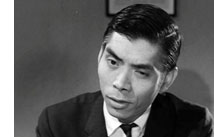 Lung Kong’s cinema, all agree, has a strong moralizing bent. He focuses on social problems—juvenile delinquency, nuclear war, prostitution, the exploitation of women in marriage. The films mix sensationalism, partly as audience bait, and social criticism. The Story of a Discharged Prisoner, reimagined by Tsui Hark and John Woo as A Better Tomorrow (1986), is at once a gangster tale and a harsh comment on the poverty that drives men to crime. Lung himself, armed with calisthenic eyebrows, plays the police officer hounding the protagonist. The Prince of Broadcasters begins as a pointed critique of popular culture, where schoolgirls fasten obsessively on a playboy radio personality. The film devolves into a more traditional thwarted-lovers plot when the protagonist reforms through his (mostly) chaste relationship with a wealthy girl.
Lung’s film style is self-consciously 1960s modern, with zooms, calculated compositions, and handheld passages. He cuts fast, avoids dissolves, and offers fairly complex traveling shots. Looking at the cheap sets and listening to the awkward sound (including snippets of classical music and The Great Escape grabbed from LPs), one becomes aware of what a Cantonese director of the day was up against. So if the technique seems at times forced, you can at least admire Lung’s attempt to give his films a contemporary gloss.
The films were of crucial importance for local culture of the 1960s and have had continuing influence on younger directors. A very informative book of essays and interviews, produced to the usual handsome standards of the Film Archive, is in Chinese but includes a disk with a digital pdf of English translations. Two of the texts can be found here.
Jean Christophe in Macau
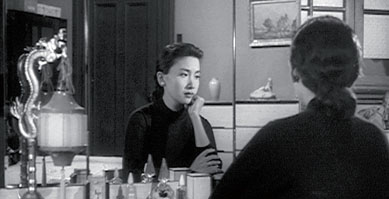
Another hop. I know nothing about Louis Fei, except that he was the brother of Fei Mu, whom I’ll be talking about in an upcoming entry. Romance in the Boudoir (1960) recasts the core situation of Fei Mu’s masterpiece Spring in a Small Town (1948). The situation, drawn from Romain Rolland’s novel Jean Christophe, is simple: A woman in a loveless marriage is visited by her former lover. In this version, her husband is a miserly doctor who wants the lover, Qin, to help him get a hospital post. Qin’s presence in the household rekindles the old romance and the couple hover on the edge of adultery.
Romance in the Boudoir is a bold piece of work. It opens with a prologue showing husband and wife trudging through Macau, utterly distant from each other. On the soundtrack we hear a woman singing about marriage as a prison. When Qin arrives, a parallel sequence traces him from the harbor to the household as a male vocalist sings of his weariness and broken heart. These melodic soliloquies will be evoked later in the film, when Qin and Suxuan stretch out by the fireplace and start to sing as the camera circles them.
Louis Fei makes maximal use of the house set, letting the vast staircase dominate the action on both floors. Repeated setups from the top of the stairs show the bannister cutting diagonally into the frame, pointing like an arrow to the climactic moment at the front door in the distance. Over everything hovers erotic tension, lasting several minutes during one scene when the former lovers tentatively touch one another before recoiling and then drawing toward one another again. If the doctor is somewhat caricatural, the portrayals of the wife and lover show a great subtlety, and the use of props, notably a glass of milk, is nicely modulated. This film shows how comparative large budgets enabled the Mandarin-language companies to make films of a high production standard, both in script and execution.
Dragons on fire
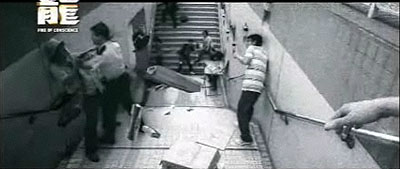
Now jump to 2010. Dante Lam is the hot new action director on the local scene, after the success of Beast Stalker (2008) and The Sniper (2009). Actually, like most overnight successes, he’s been at it awhile. He made an admirer of me with Jiang Hu: The Triad Zone (2000), which has one of the most graceful passages of graphic cutting (involving a red umbrella) that I’ve seen in recent Hong Kong film.
He’s back with the first big action film of the season, tagged with the barely adequate English title Fire of Conscience. The action scenes are better than the plot, which is better than the eternal impassivity of Leon Lai, a pictorial cipher in nearly every role he assumes. Still, you have to reckon with a film that includes not only a thrilling car chase, a truly scary gunfight in a restaurant, and grenades tossed around pretty casually but also a pregnant woman locked in a car slowly filling with carbon monoxide. The topper comes in the very last few shots, which provide as gruesome a flashback image as I’ve seen in quite some time and justifies the key line, “Save for revenge, what else is there?”
Visually, Fire of Conscience never surpasses the bravado of the black-and-white CGI opening, during which the camera coasts through a snapshot of action and lets clues float and scatter around the frozen characters. (It’s admittedly gimmicky, but more hypnotic than the comparable Watchmen opening.) Still, it’s exciting genre fare. What hath Ben Brodsky wrought?
Photo of Brodsky and colleagues by courtesy of Mr. Ronald Borden. The interview with R. F. Van Velzer was published in Hugh Hoffman, “Film Conditions in China,” Moving Picture World (25 July 1914), 577. Thanks to Frank Bren and Law Kar for this information, and to Tony Slide for calling attention to the article. The quotation from Lung Kong is from Clarence Tsui, “Scenes of the Crime,” South China Morning Post (22 March 2010), C1.
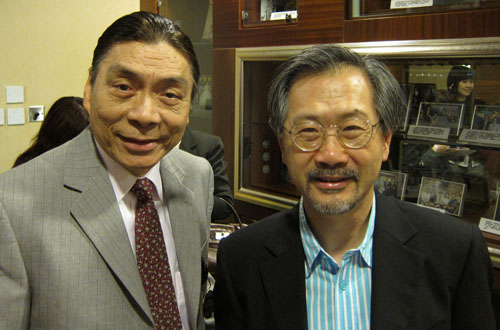
Patrick Lung Kong, with Sam Ho of the Hong Kong Film Archive.
Film criticism: Always declining, never quite falling
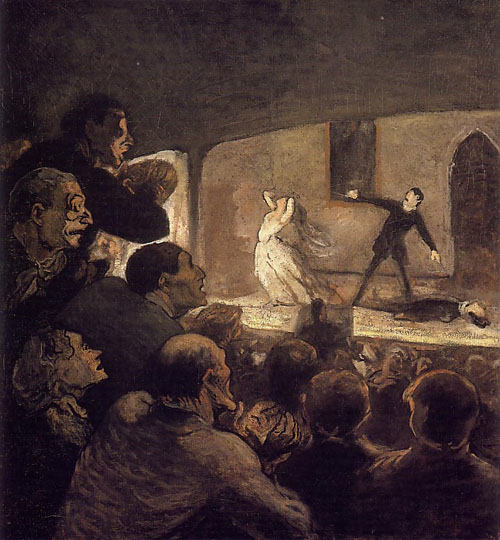
Daumier, Le mélodrame (1860-64)
DB here:
Before the Internets, did people fret as much about movie criticism as they do now? The dialogue has become as predictable as a minuet at Versailles.
Film criticism is dead.
No, it’s not! It’s alive and well on the Web.
Hah! Call that criticism? Nobody can be a movie critic unless they (a) write for print publication; (b) have been doing it for x years; (c) are a member of a critics’ professional society; and/ or (d) get paid for it.
Well, the track record of the official movie critics isn’t that great. Most of their writings are forgotten the minute they’re published.
Infinitely more awful is what you read on the Net. At least print critics kept up standards; there were gatekeepers (also called editors) and a literate public.
The result being….? When has a print critic of recent years equaled the greats of the past—Agee, Farber, Sarris, Kael?
Same thing goes for the Net. Blogs and websites don’t show me anything like that level of achievement. What I see is amateur hour.
Yeah? Well, bloggers and netwriters have passion!
But not a passion for using Spellcheck.
So if print criticism is so valuable, how come all those professional critics are getting fired?
Film criticism is dead.
Repeat as often as you like.
I thought I had watched this rondelay often enough from the wallflower section, but I got dragged onto the dance floor by Tom Doherty. In his piece for the Chronicle of Higher Education, Tom offered another eulogy for serious film criticism. Dead again, as Jim Emerson notes; killed by those wretched netizens.
To watch their backs and retain their 401(k)’s, most print critics have been forced into sleeping with the enemy. As a form of ancillary outreach, blogs, podcasts, and chat-room discussions have become a required part of the job description for print reviewers. Or maybe the print part of the gig is now the ancillary outreach.
Feeling the same heat, academic critics have also plunged into the brash new world. The film-studies panjandrum David Bordwell—think Knowles with chops in postmodern theory—runs one of the most closely watched blogs at David Bordwell’s Website on Cinema (http://davidbordwell.net/blog). The impact of the academic bloggers on Hollywood’s box-office gross is negligible (sorry, David), but the online work of the digital hordes is already making a substantial contribution to film scholarship—in the spirited parry and thrust of the dialogues, in the instant retrieval of past research, and in the factoid jackpots provided by the film databases.
I’m sure Tom means to be complimentary, but just to get mundane: No heat forced Kristin and me to the Web. I set up a bare-bones site in 2000, including a vitae and a statement about what studying film meant to me, because people were sometimes writing me asking for such information. Then, inspired by Philip Steadman’s stylish site extending the arguments in his book Vermeer’s Camera, I used mine to supplement my books, putting in corrections, second thoughts, and pictures. Then I began to write longish essays that build on things in the books.
When I retired in 2006, Kristin and I decided to recast the site as a supplement to our best-known book, Film Art: An Introduction. Our publisher McGraw-Hill funded an upgrade. But our efforts quickly went beyond spinning off the textbook. We treated Observations as our own magazine, with no pesky editors to tell us that a piece was too long or had too many stills. It offered a way to get our ideas out to a new audience, or maybe a bigger one. Just as important, after years spent writing books, I enjoy the recreation of writing shorter pieces. When you’re 62, sprints look better than marathons. Actually, because I’m a compulsive overwriter, some of my blog-sprints are like marathons.
Unhappily, none of this enhanced our 401(k)s.
Some other quibbles: Tom intended “panjandrum” as praise, but as many friends have pointed out, I’m probably the last person you’d associate with PoMo. I’m stuck in pre-post-modernism. Still, Tom is right on one point. My efforts to erode the box-office takings of Babel, The Departed, and The Dark Knight failed utterly. On the other hand, I may have considerably boosted Cloverfield’s first-dollar gross.
Nothing if not critical
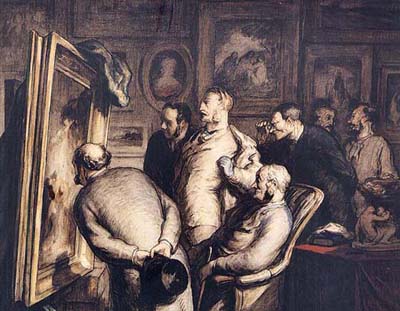
Daumier, Les critiques (1862)
Tom’s piece, its place of publication, the comments on it, and his reply to those comments invite me to revive some points I made around this season in 2008 and 2009. (Is it a rite of spring?)
Film criticism takes many forms. Tom identifies criticism with being paid to review movies that have just come out. This is a form of arts journalism, and like all journalism it is being squeezed by the decline in advertising revenue. So yes, print-based paid reviewing is waning.
But criticism includes more activities than rapid-response reviewing. It includes what we might call haute journalism, as practiced in literary quarterlies, film magazines like Cineaste and Cinema Scope, and even occasionally in the New York Review of Books (which just got around to noticing Sokurov’s 2005 The Sun). There’s also reseach-based criticism, published in specialized venues like Cinema Journal and in semi-specialized journals like Film Quarterly (which seems to be moving toward haute journalism). And of course academics have written whole volumes of film criticism—through-composed books, not collections of published reviews.
Each of these modes of criticism has its own conventions. I try to characterize them here. I think Tom should have made some of these distinctions, because it doesn’t help film culture to encourage readers of the Chronicle to limit their conception of criticism to what they get in The New Yorker or Salon.
Insofar as we think of criticism as evaluation, we need to distinguish between taste (preferences, educated or not) and criteria for excellence. I may like a film a lot, but that doesn’t make it good. For arguments, go here again. Criteria are intersubjective standards that we can discuss; taste is what you feel in your bones. A critical piece that merits serious thinking tends to appeal to criteria that readers can recognize, and dispute if they choose.
Enough with the love, already. My only real quarrel with Gerry Peary’s film For the Love of Movies is that it seems to place “love of cinema” at the center of the critical activity. But everybody loves film. The real question is: What does this love lead to? Gossip? Infighting and insults? A desire to take chances and watch films you might hate? A desire to stretch and nuance one’s viewing? An urge to learn something subtle about cinema more generally?
Opinions need balancing with information and ideas. The best critics wear their knowledge lightly, but it’s there. To be able to compare films delicately, to trace their historical antecedents, to explain the creative craft of cinema to non-specialists: the critical essay is an ideal vehicle for such information. The critic is, in this respect, a teacher.
Which means that the critic traffics in ideas too. A critic of lasting value offers a vision of cinema, of the arts more generally, of society or politics or something beyond the individual movie. For Sarris, the key idea was directorial authorship. For Parker Tyler, it was the idea that popular culture spasmodically threw up surrealistic material. For Farber it was the prospect that the studio system nurtured films, or moments, that hinted at speed, harshness, and darkness. Sontag clung to the hope that cinema could carry on the program of post-World-War-II modernism. For Ebert, what seems central is the belief that cinema can yield humane wisdom that forms a guide for living. Beyond our shores there were Arnheim, Bazin, Eisenstein (yes, he wrote film criticism), the Cahiers and Positif crews, and many more. Their powerful and provocative ideas yielded new ways to think about any movie.
Last year I moderated an Ebertfest panel consisting of a dozen or so critics. A student from the audience said he wanted to be a critic too. Instead of advising him to get into a more financially rewarding form of endeavor, like selling consumer electronics off the back of a truck, the panelists encouraged him. This form of altruism, in which you help people to become your competitor, is alarmingly common in the arts.
A moderator doesn’t get to talk much, so I couldn’t respond. What I wanted to say was: Forget about becoming a film critic. Become an intellectual, a person to whom ideas matter. Read in history, science, politics, and the arts generally. Develop your own ideas, and see what sparks they strike in relation to films.
Writing style is overrated. Many people think that good reviewing amounts to personal opinions whipped up in frothy prose. Perhaps the snazzy styles of Farber and Kael have led people to weight style too much. Granted, the Web has revealed that a lot of people are excellent writers, and without the Web they would probably never have found an audience. Although lively writing is always welcome, it gets heft and endurance through its arguments, and that comes back to ideas and information as much as opinion.
Hollywood, still declining
As often happens, a current controversy sends me backward, and to books. Ezra Goodman’s Fifty-Year Decline and Fall of Hollywood was published in the momentous year 1960, as was Beth Day’s This Was Hollywood. Both wrote finis to the glory days of American studio cinema. But if Day was nostalgic, Goodman was sour, and racy.
He worked as reporter, publicist, and reviewer, most notably for Time. By 1960, he must have felt he never needed an LA job again, so he castigates every specimen of Hollywoodite, from press agents to stars. Buddy Adler, who for a while ran production at Twentieth Century-Fox was no more than “a dutiful office boy.” Humphrey Bogart had “as a result of four marriages, innumerable bouts with the bottle, and a paucity of food and sleep developed what was described as a look of intelligent depravity. . . .”
Goodman includes a long chapter on film reviewers, which launches with a decidedly contemporary ring:
It has been said that there are sometimes more clichés in movie reviews than in the movies they are discussing. Sample review phrases: “sure-fire,” “stunning,” “taut with suspense,” “lavish and exciting,” “sumptuous,” “captures the imagination,” “moving,” “significant drama,” “sheer screen artistry,” “uncommonly good performance,” “dramatic urgency,” “enormous compulsion,” “spectacular finish,” and once in a while, “ineptly directed,” “singularly dull.”
Fifty years later, Goodman would have to add jaw-dropping, adrenalin-charged, mind-bending, hellish/ hellacious, resonance/ resonate, lush, dark, incredible, intensely personal, pitch-perfect, and our two all-purpose adjectives of praise, amazing and terrific. You’d think that we were staggering around astounded all the time.
Yet reading Fifty-Year Decline and Fall confirms my hunch that we have made progress. I would say that the best film writing in all registers–daily/ weekly reviewing, haute journalism, “think pieces,” personal essays, research studies, whether on the web or off– is much better today than it was in Goodman’s era. Then the New York Times had Bosley Crowther; now it has Dargis and Scott. Richard Schickel has hurt his reputation with some insulting remarks he made recently, but read his book on Fairbanks, His Picture in the Papers, or his scathing The Disney Version, and you’ll find a keen eye and a nonconformist intelligence. Riding above the oceanic fizz of infotainment, there are many sharp writers both journalistic and academic. Start clicking our link-list for examples.
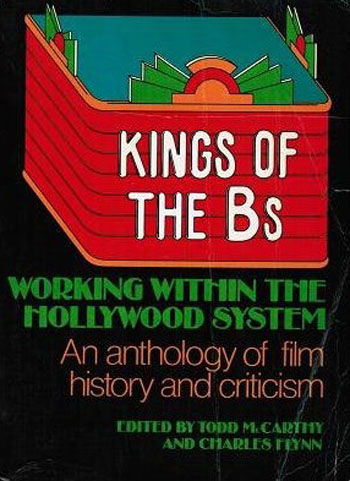
Which makes it all the more lamentable that two of our finest writers have lost their platform. Todd McCarthy’s work for Variety long exemplified the virtues I’ve itemized. He writes a brisk prose that isn’t showoffish. His reviews, often in a few deft words, situate the film historically; he’s one of those guys who has simply seen and read everything. He has as well a guiding idea of cinema—roughly, I think, the premise that straightforward classical storytelling is an inexhaustible resource—but he doesn’t deploy it as a bludgeon. McCarthy’s respect for studio history and the tradition of expressive narrative can be found in his and Charles Flynn’s indispensible collection Kings of the Bs (where you can see what a Republic budget sheet looked like) and in his biography of Howard Hawks. There are also his documentaries on filmmaking (e.g., Visions of Light) and film culture (Man of Cinema: Pierre Rissient), which allow him the leisure to probe subjects in depth.
Or consider Derek Elley. He is one of the most knowledgeable writers on Asian cinema, and his reviews skillfully tie a new film to a trend or earlier work by the same director. Few critics have his ability to supply a translation of a Chinese film’s original title, or to explain a crucial local custom. By dismissing McCarthy and Elley as contract writers, Variety has dealt a blow to informative, thoughtful film writing, whether you call it criticism or not.
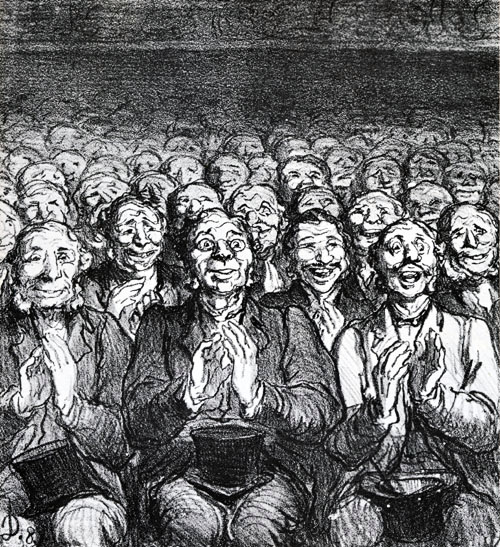
Daumier, One says that the Parisians. . . (1864)



