




Archive for the 'Film comments' Category
Seduced by structure
Mysteries of Lisbon.
DB here:
If you’re hungry to learn about the ways films can tell stories, a festival provides a feast. A huge array of narrative strategies is spread out for your delectation. You won’t like every movie you see, but thinking about the mechanics of each one can deepen your experience of it, as well as your appreciation for just how wide cinema’s resources can be. You also get to see how more unusual approaches to storytelling are often imaginative revisions of more traditional strategies.
We can usefully think about narrative from three angles. We can study the story world that a film conjures up: the characters, places, and actions we encounter. We can analyze plot structure, the distinct parts that are put together sequentially. They might be scenes or sequences or larger-scale parts, like the Hollywood screenwriters’ “acts.” We can also analyze narration, the patterned, moment-by-moment process of presenting the story world and the plot structure. Think of a narrative as like a building. The building’s furnishings correspond to the story world, and the architectural design of the building, plan and elevation, is like plot structure. Our real-time pathway through the building, from the front doorway into its depths, corresponds to narration.
The Vancouver International Film Festival that Kristin and I have been visiting offers a banquet of storytelling devices—some quite traditional, some fairly fresh. I’ll just survey some aspects of structure that I found intriguing.
The longest distance between points
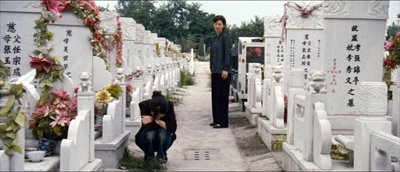
The Chinese blockbuster Aftershock, centering on the 1976 earthquake that struck Tangshan, has earned some complaints about weepiness and jokes about “Afterschlock.” Perhaps melodrama makes many critics uncomfortable. They seem more at home with comedy and noirish crime stories, perhaps because the emotions stirred by these are bracketed by a degree of intellectual distance. But tell a story about a happy family split apart by a catastrophe; show a mother forced to choose between saving her son and saving her daughter; show that the girl miraculously escapes death; present her raised by a pair of new parents; and dwell on the fact that her mother, living elsewhere, expects never to see her again—do all this, and you court mockery.
Well, mockery from everybody except the hundreds of thousands of people who have always enjoyed these situations. Aftershock is now the biggest box-office success in Chinese film history (presumably using today’s currency standards). Whatever the film owes to Chinese traditions, it is easily understandable in a Western context. Stories based on pseudo-orphans, separated siblings, and parents forced to give up children have long been sure-fire. Les Deux orphelines, an 1874 play, is one strong prototype. This pathetic tale of two sisters torn apart in post-revolutionary Paris was adapted by many directors, including Griffith (Orphans of the Storm, 1921). Feuillade developed similar motifs in Les Deux gamines (1921), L’Orpheline (1921), and Parisette (1922). A mother’s loss of her children through accident or social oppression is another stock situation, seen in sublime form in Mizoguchi’s Sansho the Bailiff. The obligation to pick a child to save is at the core of Sophie’s Choice, a more highbrow melodrama. Likewise, the discovery of unexpected kinship forms the climax of many stories, from Oedipus Rex to Twelfth Night and beyond.
You may call these conventions hackneyed, but it would be better to call them tried and true—proven effective by centuries of deployment, counting on emotions aroused by ties of love and blood. Such situations would be good candidates for narrative universals, which can be reshaped by local cultural pressures.
The premise of a fragmented family bears chiefly on the story world. The filmmaker still must choose how to structure the plot. For Aftershock, director Feng Xiaogang and his collaborators settled on the time-honored route: parallel stories across the years, shown by means of crosscutting. After the quake, scenes of the mother and son alternate with scenes showing the girl’s rescue and her life with her adopted parents, both soldiers in the People’s Liberation Army. For about the first sixty minutes, the segments are rather long, but after that shorter scenes from each plot line are intercut. The son moves off to a separate life, but his success as an entrepreneur is given short shrift. The plot concentrates on the daughter’s college career, her sometimes stormy relation with her foster parents, and her unexpected pregnancy. In the meantime, the mother survives, turning aside a kindly suitor in order to preserve her faithfulness to the husband who saved her life.
Narrationally, the alternation between the separated characters gives us superior knowledge. We know, as the mother and brother do not, that the daughter survives; we also know that she nurses a bitter memory of hearing her mother choose the rescue of her brother. Likewise, we know that the mother has tormented herself for decades over her forced choice. Thus the recriminations that will burst out after they rediscover one another will require some healing, which is provided in the plot’s last phase. Melodrama depends on mistakes, and they must be corrected. In a telling image of two sets of schoolbooks (not previously shown to us), we and the daughter realize that over the years the mother has been thinking of her as if she were still alive.
The dual structure can also tease us with suspense. At the hour mark, we learn that both the brother and the daughter are in Hangzhou, without each other’s knowledge. The brother even encounters the foster father. It’s the sort of coincidence that leads us to expect a reunion. Coincidences, I mentioned in an earlier entry, are fascinating narrative devices, and here the fortuitous convergence doesn’t actually pay off. But it does prepare us for the genuine reunion that will take place an hour or so later, when an earthquake hits Sichuan in 2008.
There’s a lot more to be said about Aftershock; I was struck by the fact that the children are left in the collapsing apartment because the parents have sneaked off to have sex in the husband’s truck. (So is the whole arc of suffering the punishment for a little carnality?) But just sticking with structure, we find that a cluster of ancient plot devices, fed into the established technique of crosscutting, can still find purchase in a contemporary film. In films like Aftershock, as in Hollywood’s romantic comedies and horror films and historical adventures, very old narrative conventions live on. Suitably spruced up with CGI, they still provide pleasure.
Sometimes, however, you get the sense that filmmakers in other cultures are borrowing conventions of recent Western films. This seems the case in City of Life from the United Arab Emirates. Faisal is a spoiled playboy who spends his nights with his pal Khalfan, a fistfight-prone club-hopper. Natalia is a Romanian flight attendant who gets romantically involved with an advertising man. Basu is a taxidriver with an uncanny resemblance to a Bollywood star, and so he tries to supplement his earnings by appearing in a nightclub. As all of them move through Dubai, their lives intertwine.
We have, in short, what I’ve called a network narrative. Mostly the plot lines are juxtaposed through crosscutting, but sometimes the characters in one line of action encounter those in another. Faisal is at a club on the same night as Natalia is there, with her boyfriend and her roommate. Objects circulate as well. Natalia pays Basu for a cab ride, and Basu preserves her €20 note until he has hit rock bottom. At the midpoint, an ad campaign links Natalia’s boyfriend, Faisal’s father, and Basu’s job. Many of the conventions of the “small world” network format are included, with one character remarking that Dubai is a small city. Our old friend the traffic accident (shot and cut with exceptional vividness) plays a crucial role. A refuse collector threads through the plot, turning up at unexpected times and providing an ironic coda.
Director Ali F. Mostafa mobilizes a lot of contemporary techniques, including fast motion and rapid cutting (3.6 seconds average shot length). The editing sometimes extends the crosscutting principle by flipping back and forth between two successive scenes, creating little flashforwards. For instance, when the adman Guy phones Natalia to introduce himself, we cut to them talking in a bar and then back to her listening to his sweet talk.

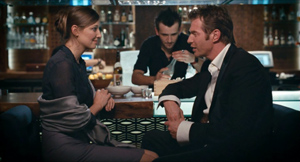

The anticipatory cuts lead us to expect that Guy is calling to ask her out, and Natalia will accept. This sort of cross-stitching can be found in The Godfather and other films of the late 1960s and early 1970s, and it has shown up sporadically since, but it’s rare enough to still look modern.
In cinema, network narratives can occasionally be found before the 1990s, but they’ve become far more common. I count nearly 150 films of the last twenty years employing the structure. In literature, of course, such plots go back quite far, and they formed the basis of nineteenth-century novels by the likes of Balzac, Dickens, Zola, and George Eliot. Television soap operas and ensemble series like Hill Street Blues showed that modern media’s long-form formats fit well with network storytelling. So cinema has caught up, adjusting the template to feature-length plots. City of Life shows that artists from emerging filmmaking nations can use this structure to enter a festival circuit dominated by Western norms of construction. At the same time, those artists can tailor this structure to their own ends—in this case, it seems to me, presenting Dubai as a city of emigrants ruled by a feckless leisure class.
The theatre of memory
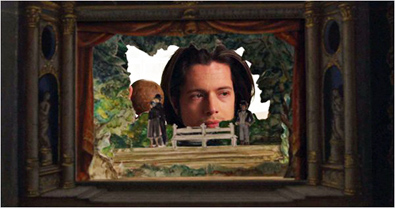
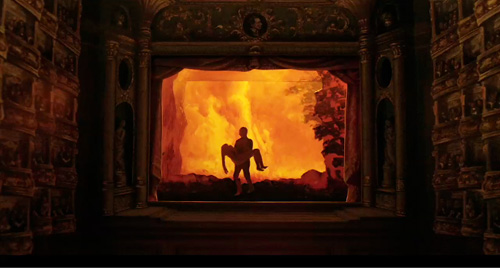
What happens, though, when conventions of sprawling nineteenth-century novels aren’t squeezed so drastically into the usual feature length? I had a chance to find out from Vancouver’s screening of Raul Ruiz’s four-and-a-half-hour Mysteries of Lisbon. Based on an 1854 novel by Camilo Castelo Branco, a fictioneer as prolific as Ruiz himself, the film doesn’t trim off the exfoliating plot lines that we enjoy in three-deckers from the period. This being a Ruiz film, there is as well a tangible pleasure in the artifice of storytelling. The film acknowledges that all the handy coincidences, buried pasts, multiple identities, and revelations of kinship are there for our delectation.
Orphans again: João is being raised in a church school, but he has no idea of his parentage. Early on, kindly Father Dimis tells him that his mother is Angela, the countess of Santa Barbara, but her brutal husband is not his father. We are soon embarked on the extended flashback that traces the doomed love affair that results in the birth of the young hero, now named Pedro. In the course of that tale, we meet two more suspicious characters, the gypsy Salino Cabra and the hired assassin Heliodoros.
This recounted history is only the first of a cascade of flashbacks, issuing from several characters, and these gradually show deep connections among persons tied to Pedro’s past. Secondary characters in one story become protagonists of another. The young hero is gradually displaced as the center of the action by war, secret romances, rivalries, duels, and infidelities. Like Pasolini in his Trilogy of Life, Ruiz is happiest when opening up a plot detour that will eventually become a new main road.
By the end, our young hero has become something of a nullity, an empty center around which aristocratic ecstasies and follies have swirled. He’s something like the Dubai of City of Hope: a point of intersection of many fates. He’s also a passive observer of scale-model dramas played out on his toy theatre stage. His voice-over narration has enwrapped the whole film, and our last glimpse of him is as merely a narrator. Pedro seems finally to realize that his entire existence has served simply to gather other people in a tangle of doomed passions.
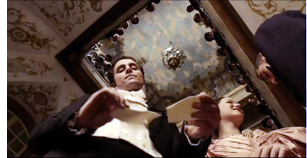 Mysteries of Lisbon has a rich, high-thread-count look, but it’s not your usual prestige costume drama. The long takes cling to characters as they flirt their way across a ballroom, and the camera slips through walls in the manner of old-fashioned cinema. There are the usual Ruiz flourishes of hallucinatory deep focus (achieved through split-focus diopters), characters floating rather than walking, and the occasional peculiar angle. But the film remains calm and lustrous, culminating in a slow tread into pure light.
Ruiz’s appetite for narrative is almost gluttonous; he supposedly wrote over a hundred plays in six years, and he’s made about as many films. He once told me that he thought that Postmodernism was simply a revival of the Baroque in modern dress. From Mysteries of Lisbon, it’s clear that he sees in many older narrative traditions affinities with our tastes today. Network narratives? They’ve been done, and maybe better, centuries ago. Follow the lacy tendrils of classic family-origins plots, and you’ll find a pattern as intricate as anything in Short Cuts or Pulp Fiction. More story ahead: there’s a six-hour television version.
Rumination on ruination
Ruiz understands that modernist narrative techniques, including unreliable narrators and fancy time-switches, depend upon a long tradition in at least two ways. First, very often the tradition got there first; scholars like Meir Sternberg and Robert Alter have demonstrated complex plays with chronology and point of view in the Bible and the Greek classics. Secondly, unusual plot structures may ring unexpected variations on more conventional ones. Case in point: reversed plot sequence.
Again, this seems to be something of a modern trend. The locus classicus appears to be Harold Pinter’s 1978 play Betrayal, in which, scene by scene, the plot proceeds in reverse chronology. This was filmed in 1983 and gave birth to a famous Seinfeld episode. As you know, Memento, Irreversible, and other recent films have taken up reverse-chronology plotting. Actually, however, there are several earlier instances, notably the 1934 Kaufman and Hart play Merrily We Roll Along (turned into a musical by Stephen Sondheim) and W. R. Burnett’s 1934 novel, Goodbye to the Past. Other examples, some going back quite far, are listed here.
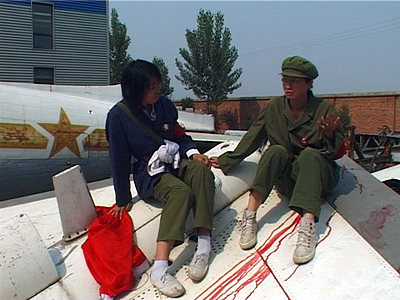
Rumination, a film by Xu Ruotao in the Dragons & Tigers young directors competition at Vancouver, turns the structure to political ends. Reduced to the bare bones, the film shows a teacher, his wife, and their son caught up in the Chinese Cultural Revolution. The father falls in with a gang of Red Guard youths rampaging through the countryside. The son trails the gang at a distance and occasionally interferes with their acts of violence. These story events are arranged in blocks, with each cluster of scenes associated with a specific year. The blocks proceed backward in time, from 1976 to 1966. After a prologue, the film shows scenes of the waning of the Revolution; before the epilogue, we get a stalwart young man announcing the Revolution’s birth.
The scenes are fairly episodic and independent, so I didn’t detect the backwards structure for quite a while. But my uncertainty had another source. Xu introduces each year’s scenes with a date that is, except for one instance, not the year of the actions shown. In fact, while the segments move in reverse order, the years’ designations move in chronological order.
The opening 1976 section is labeled 1966, the 1975 section is labeled 1967, and so on up to the end, with the 1966 action designated as 1976. So we see the father’s reunion with his wife, a moment of clumsy embrace, long before he decides to leave home. As you’d expect, there’s one year in which the action and the tag coincide, 1971, and that is the only one built out of photos and film clips from the period. The year is privileged, Xu explains, because that was the year of the mysterious plane-crash death of Lin Biao, a military hero and Cultural Revolution leader who was accused of plotting Mao’s assassination.
In my viewing, the misleading dates helped conceal the reverse chronology. Confronted with so many discrete episodes of unidentified characters sprinting through the countryside, beating passersby and stealing chickens, I took the default option and assumed that the segments were chronological. Moreover, the film’s scenes play out almost entirely in overcast landscapes and decrepit factories, a landscape in which I couldn’t detect any indications of change from year to year. Watching Ruination a second time, I saw the reversal more clearly, but I also thought that some segments tease us into thinking along chronological lines. An early scene shows the father getting up in the morning (a conventional way to start a plot), saluting Chairman Mao’s statue, and reading from the Little Red Book. Yet this scene is set in 1975, after the father has returned to his wife from his Red Guard period.
Moreover, there’s some evidence that the son actually matures across the film, even though the scenes show him objectively getting younger. By the end of the plot (the earliest moment in story time) he seems to have transformed himself into a strapping young Red Guard. Supporting this construal is the fact that in the Q & A after the showing, Xu mentioned that one influence on his film’s design was The Curious Case of Benjamin Button!
Xu explained that the tragedy of the Cultural Revolution could not be comprehended through normal storytelling techniques. I suspect that viewers familiar with the relevant events and the film’s slogans, iconography, and oblique citations (even to Godard) could follow the backwards sequencing. But I suspect that those viewers would need a sense of the historical chronology to grasp the 3-2-1 order of the plot. It seems to me that Xu, known until now as a painter, has shown how an innovative approach to plot structure relies on conventional responses even as it thwarts them.
Hahaha indeed
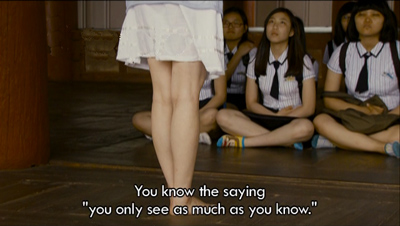
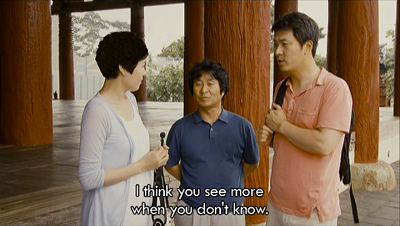
Hong Sangsoo has been one of the leading experimenters with narrative in today’s Asian cinema. My two favorites, The Power of Kangwon Province (1998) and The Virgin Stripped Bare by Her Bachelors (2000) have engaged the viewer in playful puzzlement about how story lines can collide or slip sideways, how our memory of earlier scenes’ action can be tested and found faulty. I haven’t been deeply engaged by his recent forays into more straightforward drama/comedy, such as The Woman on the Beach (2006), but his two latest features, both from this year and both on display in Vancouver, completely satisfied my hunger for intriguing plot structures.
It’s an unspoken convention of recounted-flashback tales that even though the events are told by A, B learns everything that we do—everything, that is, that we can see or hear in the flashback. But Hahaha decouples the verbal recounting from the visual presentation. Here listener B definitely does not grasp what we witness happening onscreen in the tale as told.
Hahaha is a parallel-protagonist tale. Two pals meet for some drinking before one, Munkyung, leaves South Korea for Canada. Through a series of flashbacks, they regale each other with their recent adventures, mostly amorous. The plot is structured as two alternating streams, crosscutting one man’s tale with the other’s and usually returning to the framing situation of their drinking bout. But because we can see what each one recounts, we come to realize that both stories are populated by the same people, notably the tempting female tour guide Seongok. And those people have their own relationships, which we must piece together out of the glimpses we get in each man’s tale.
Neither Munkyung nor his pal Jungshik has a clue that they are part of a fairly tight circle. The result, as usual with Hong, is a comedy of ironic misunderstanding and the puncturing of male pretension. Hahaha can also be seen as his response to the rise of network narratives. Characters in such a film don’t usually realize the larger mosaic they’re part of; the intersecting lives in City of Life transform one another unwittingly. Normally that lack of awareness isn’t the main point of the film. Here it is, and it’s wrung for classic humor at the protagonists’ expense.
In Oki’s Movie, Hong gives us another fractured plot, but now in the form of four short films. They center on three characters: Song, a film director turned professor; his student Jingu; and Oki, the woman both men are interested in. The raggedy credits of each short suggest handmade movies, but what we see in each one is the polished style familiar from Hong himself, including his current interest in abrupt zooms.
The four-part structure is far from transparent. It might be taken as a series of episodes from the trio’s lives. The first film, “Specters of the New World,” which presents Jingu as a professor himself, would have to take place in the present, and the following three would then be presenting flashbacks to the Jingu-Oki-Song triangle. In that case, the first segment would prove that Jingu did not wind up with Oki, as he’s married to another woman.
Perhaps, though, all four films are free hypothetical variations on the central situation. I’m not sure that we can easily arrange the events in the second, third, and fourth episodes chronologically. The films could be presenting successive groups of events, or events scattered across a single time span and then selectively gathered around one of the central characters. The first episode is largely organized around Jingu’s range of knowledge; the second is confined to professor Song; and the third is explicitly presented as Oki’s own thoughts. Earlier Hong films have offered us contrasting, even incompatible plots built out of a core group of characters. Oki’s Movie may be using the framing conceit of student films (none of which is plausible as a student film) to give us a suite of variants on the love triangle.
The idea of ambiguous variation is made explicit in the final mini-film, “Oki’s Movie.” It’s a sustained exercise in—yes, again—crosscutting. This episode alternates two excursions to Mount Acha, one with each man. Shot by shot, we see different courtship styles and we hear her differing reactions to her two lovers. Was she dating both men at once? When did the two excursions take place? Which one occurred first? As these questions are juggled, we get a rapid checklist of Oki’s attitudes, in voice-over, toward both these minor-key losers.
In both Hahaha and Oki’s Movie, Hong takes what’s offered by tradition—in this case, the romantic comedy and the conventions of flashbacks, crosscutting, and restricted narration—and creates a fresh structure. The play of novelty and norm is engrossing in itself, apart from the vagaries of the drama. Our appetite for narrative will always be whetted when directors find ways to whip up something new out of familiar ingredients.
For more on the three dimensions of film narrative, as well as discussion of the principles of network construction, see my Poetics of Cinema. There’s more discussion of flashbacks in film in this entry. On early narrative structure, see Meir Sternberg’s Poetics of Biblical Narrative and Robert Alter’s Art of Biblical Narrative, as well as Sternberg’s discussion of The Odyssey in Expositional Modes and Temporal Ordering in Fiction. For a sharp-eyed consideration of Oki’s Movie, see Andrew Tracy’s review at Cinema Scope.
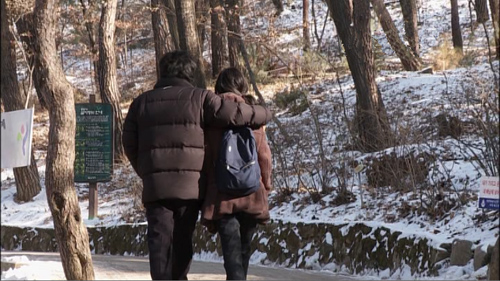
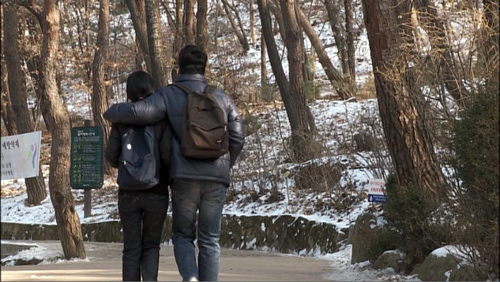
Oki’s Movie.
The Dragons & Tigers’ late-night roar
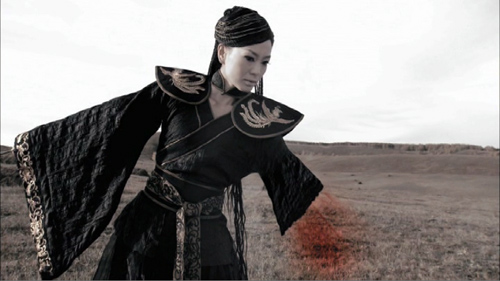
Thomas Mao.
DB here:
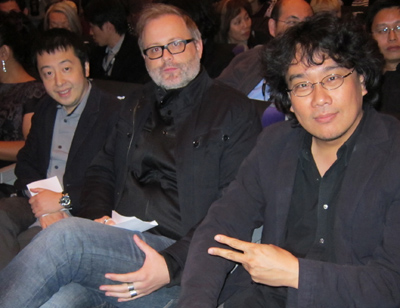
First, the news flash: Tonight was the awards ceremony for the Dragons & Tigers competition for young filmmakers here at Vancouver. A jury doesn’t get more distinguished: it consisted of (left to right) Jia Zhang-ke, Denis Côté, and Bong Joon-ho.
They awarded two special mentions, one to Phan Dang Di’s Don’t Be Afraid, Bi! (from Vietnam) and to Xu Ruotang’s Rumination (China). On the last-named, check the still at the end of this entry.
The grand prize went to the Japanese film Good Morning to the World!, by Hirohara Satoru.

More details here. Congratulations to the winners!
Beginners’ luck

My Film and My Story.
Vancouver is unusually hospitable to shorts and features by newcomers. Two of this year’s D & T offerings illustrate how talent, unlike youth, is not wasted on the young.
A cinémathèque featuring classic films is about to reopen, and the manager has hired some twentysomethings to help her get things into shape. The result a network narrative: romantic rivalries, coming-of-sexual-age crises, the race to set up the screening space, and even a ghost story are woven together as the big day approaches. The film is split into eight chapters, each given an emblematic movie title. Two petty thieves interview for a job under the aegis of “Stranger than Paradise,” and an apparent love triangle is christened “Jules and Jim.” The cinephilia shapes the plots too, as when one boy gets the courage to kiss another after watching Happy Together.
My Film and My Story was a group project of students at the Art and Design School of Konkuk University in Seoul. Their professor proposed that each student write a script about the opening of the cinematheque, and the results were integrated into a single feature-length story. There were seven student directors, one per episode; a producer contributed an extra chapter. Most directors were on the set all the time, making suggestions and trying to fit bits together. (“We fought a lot.”) The remarkable visual consistency—smooth cutting, tight framing, and well-modulated lighting—came from the single director of photography. As the title suggests, some of the tales are based on incidents in the lives of its makers.
The film, presented in Vancouver by two of the directors, Hong Youjin and Kim Taeho, is a lively charmer, with plenty of comedy and pathos. The characters are quickly introduced, and there are nice touches of movie-nut satire. One girl with big spectacles saves all her ticket stubs, takes notes on every movie (I can identify), and is annoyed when a boy drapes his leg over the seat in front of him. The episodes make tactful use of digital techniques, particularly in one shot that fuses past and present through the classic color/ black-and-white disparity.
My Film and My Story wasn’t in the official young-film competition, but Icarus Under the Sun was. For once the ragged style of handheld video justifies itself in a tale of a girl who quits school and heads for Tokyo to work in a seedy mahjong parlor. Haruo rooms with a flighty roommate and her boyfriend, but becomes more attached to the workers in the parlor and the owner, a nearly blind, taciturn man for whom she conceives an almost daughterly affection.
The plot barely rises above anecdote, but it’s continually engaging through its focus on the performance of Abe Saori, one of the two directors. Haruo explains that she is “addicted to walking,” and some of the best scenes involve conversations during late-night wanderings in the bitter cold.
Starting out fairly choppy, the narration accumulates weight and breadth as Haruo becomes engaged in her work. The shots throughout are held rather long, but about halfway through, the scenes start to be built out of exceptionally long takes. When another worker, the boy Aran, takes sick, Haruo calls on him and we get an almost suspenseful treatment of her arrival in his apartment, with him lying almost motionless in a heap in the foreground.
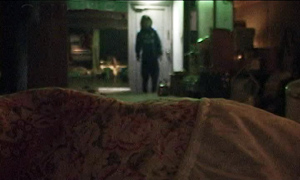
The shot lasts almost four minutes as she comes forward to talk with him. Their subsequent conversation is filmed in a tight, leisurely shot as they eat burgers and explain their backgrounds—virtually the only exposition we get about Haruo’s troubled past.

The dingy look of many scenes carries a documentary conviction that a more polished work would not. And the rough texture is actually the product of patient care. Abe and her codirector Takahashi Nazuki explained that they spent ten months in shooting and two to three months in editing. But it’s no mere technical exercise either, since Abe calls it both a fictional film and a documentary about her experiences. Like her protagonist she spurned conventional schooling and went to Tokyo to live on her own. Rooming with Takahashi, she decided to make the film “to know certain shadows” in her life. Icarus Under the Sun is actually the duo’s second film, and they have already finished a third, the more technically slick Soft-Boiled Egg (Hanjuku tamago.). Another thing about young directors: They have energy.
Expecting
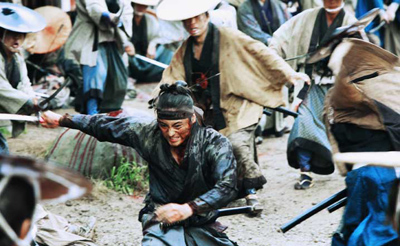
Takashi Miike’s 13 Assassins is not what you might expect. Unlike your typical Miike item, this one throws no curves. It is an old-fashioned, butt-stomping, gut-slashing swordplay movie, with swagger to spare. Adapted from a 1963 film, it’s Seven Samurai plus six, with explosives.
True, there’s a Miike signature moment early on that shows what Lord Noritsugu has done to a woman’s body in his quest for piquant entertainment. But this horrifying scene serves a very traditional purpose: To prove to swordmaster Shinzaemon Shimada (and us) that Noritsugu has failed his duty as a leader and must be assassinated. He isn’t merely brutal. He lives an aesthetic of exquisite savagery. He has turned droit de seigneur into performance art. A massacre, he says with a fetching smile, is fun. He is a handsome monster. We can hardly wait to watch him die—preferably like a dog, in the mud, in agony.
Thereafter all that we want from a chambara flows forth in abundance. Unsurprisingly, the plot is framed by the man-out-of-time motif. Noritsugu’s depraved tastes show that the samurai tradition and the Shogunate government have become decadent. This might be a warrior’s last chance to die nobly—but for what? What deserves a man’s loyalty? Hard times have convinced Shinzaemon that the samurai class must ultimately serve the people. But his old rival Hanbei, Noritsugu’s right-hand man, clings to the notion that the samurai serves his master, unswervingly. Hanbei goes to his death committed to traditional duty. But his commitment is proved unworthy when his lord has a little fun with his severed head.
Miike faced a choice. He could have provided each warrior a vivid backstory, differentiating and humanizing each one as Kurosawa did. Instead, given a two-hour running time, he concentrates on strategy: How can a baker’s dozen of fighters defeat Noritsugu’s troops, which will eventually swell to 200? The solution is to maneuver Noritsugu’s men into a village filled with traps that will give the assassins some advantages—surprise, rooftop ambushes, and a deployment of livestock as ordnance. Things are enlivened by a feral hunter, mocking the samurai code while wielding a mean slingshot. After supplying a sketch of each of the thirteen assassins, Miike spends his energy on action. The muddy, gory battle at the climax lasts forty-plus minutes, and is worth every penny of your admission. Magnet, the genre arm of Magnolia, has picked up 13 Assassins for early 2011 release, and you should start thanking them already.
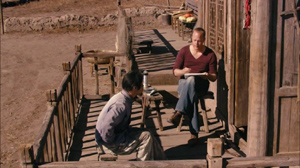
If Miike surprises by doing something normal, Zhu Wen’s Thomas Mao really does keep you guessing. It’s a pleasure to see a movie in which you can’t imagine what will come next.
At first, things seem to go by the numbers. To a remote Chinese farm comes the artist Thomas, to stay a short while and do some drawing. His wizened host Mao provides bed (after the geese are shooed out) and board (mostly corn on the cob). The trouble is that Thomas speaks no Chinese and Mao speaks no English. Every interchange is a pas de deux of misunderstanding. Thomas generously gives Mao some money. Mao refuses—not, as Thomas thinks, because he’s too proud but because Mao considers the amount insultingly small.
So we seem to have the small-scale cross-cultural comedy, making amusing points about people’s petty differences. Then the ghosts arrive.
At least, they might be ghosts. A phantom swordsman and swordswoman float around Mao’s farm and do battle, ultimately slashing off each other’s arms before disappearing, never to return.
There are aliens too, invading Mao’s cabin with pop-concert glow sticks. They’re totally unexpected, like the warriors, and their visit is even more transitory.
Eventually Thomas leaves, and the film starts over. The second part offers a sort of crazy-mirror image of what we’ve seen so far. Artist becomes model, model becomes artist, dog becomes Doggy. If you like the double-track story of Syndromes and a Century, you’ll probably like Thomas Mao, which is less rigorous but more funny. (The very title is part of the joke.) Zhu, who has reveled in comic byplay in Seafood and South of the Clouds, gives us that rare thing, a movie that is whimsical without being precious. You learn about contemporary Chinese painting in the bargain.

More whimsy, also not overbearing: When Liu Jiayin told me last spring that she was making a movie about a plastic fish, I didn’t know what to expect. The answer comes in the short film 607. Here the ballet of family hands seen in Liu’s Oxhide II becomes more playful. 607 is part of a promotional series of shorts by independent filmmakers, and it’s sponsored by a Beijing hotel, The Opposite House.
Mr. Fish, wielded by Liu’s father, swims around the tub, occasionally flirting with a mushroom provided by her mother. Eventually Mr. Fish is tempted by a hook (the curled finger of Liu herself). Will he fall for it? In all, you have to admire the coordination of three people shifting smoothly offscreen around the tub, each person’s hands sliding out of one part of the frame and popping in somewhere else—somewhere, I need hardly say, fairly unexpected.
PS 9 October: This entry has been corrected from its initial appearance. There I had written that Liu Jiayin’s 607 is one of three films she is making for the series commissioned by The Opposite House. Actually, the entire series consists of three films made by independent filmmakers. 607 is one of those and is complete in itself. Thanks to Shelly Kraicer for the correction.
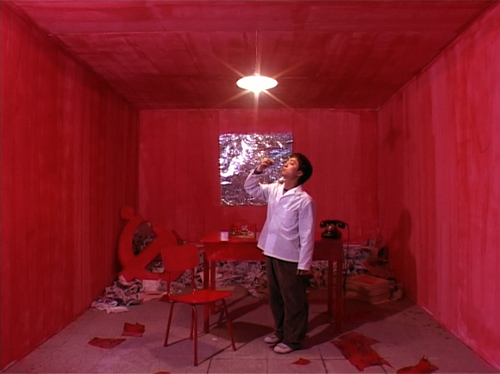
Rumination.
The buddy system
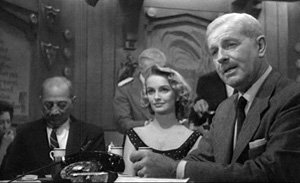
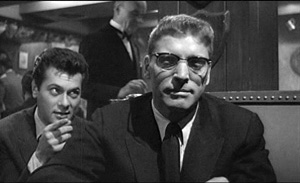
Sweet Smell of Success.
DB here:
Many of our friends write books, and what are friends for if not occasionally to promote each other’s books? Here’s an armload of titles, most of them recently published. They’re so good that even if the authors weren’t our friends and colleagues, I’d still recommend them.
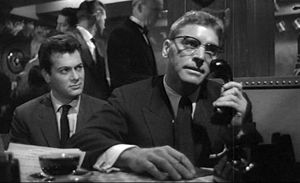
James Naremore has made major contributions to film studies since his fine monograph on Psycho, published way back in 1973. That book remains one of the most sensitive analyses of this much-discussed movie. Now he has another monograph, on the stealth classic Sweet Smell of Success. When I was coming up, Alexander Mackendrick wasn’t much appreciated, and this movie slipped under the radar. More recently it has emerged as one of the model films of the 1950s, and not just for James Wong Howe’s spectacular location cinematography. It’s a very brutal story, with Tony Curtis playing against type as venal press agent Sidney Falco and Burt Lancaster as J. J. Hunsecker, a monstrously vindictive newspaper columnist.
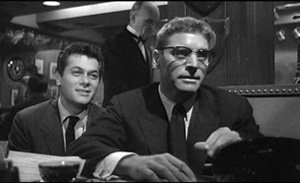
Jim’s book provides a scene-by-scene commentary but also more general analysis of production circumstances and directorial technique. An enlightening instance is what Mackendrick called “the ricochet”—when character A talks to character B but is aiming at character C. This allows the filmmaker great flexibility in framing and cutting, often showing C’s reactions while we hear the dialogue offscreen. In the shots surmounting this blog, Sidney is needling J. J. by asking the Senator if he approves of capital punishment. Jim’s book joins his work on Welles, Kubrick, and film noir as part of a subtle reassessment of American postwar cinema.
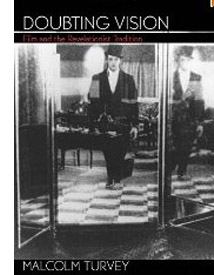 With the current revival of interest in André Bazin’s film theory, it’s fruitful to look again at the “classical” theoretical tradition in which he participated. “Classical” here refers to the very long period before the emergence of semiotic and psychoanalytic theories of cinema in the 1960s. The newer theories have somewhat beclouded our recognition of how imaginative and wide-ranging the old folks were. In Doubting Vision: Film and the Revelationist Tradition, Malcolm Turvey scrutinizes four thinkers who saw film as having the power to show us things beyond (or above, or below) surface reality. In the spirit of analytic philosophy, Turvey carefully lays out the positions of Béla Balázs, Jean Epstein, Siegfried Kracauer, and Dziga Vertov before asking whether their claims hold up.
I’m not giving much away by revealing that Malcolm thinks the revelationist tendency has its problems. But his purpose isn’t simply to reject the position. He treats it as an instance of what he calls “visual skepticism,” the idea that we ought to treat our ordinary intake of the world as something suspect. This idea, Malcolm argues, is central to modernism in the visual arts. He extends his critique of visual skepticism to more recent theorists as well, notably Gilles Deleuze, and he shows how his own ideas apply to films by Hitchcock, Brakhage, and other directors. Malcolm’s book is a model of theoretical clarity and probity, and a stimulating read as well.
Skepticism of another sort is central to Carl Plantinga’s Rhetoric and Representation in Nonfiction Film. One result of semiotic theory was to question whether a film could ever adequately represent reality. If a movie is only an assembly, however complex, of conventional signs, it can’t give us access to something out there. Even a documentary, some theorists argued, had no privileged access to the real world, let alone to general truths. “Every film is a fiction film” was a refrain often heard at the time. Carl tackles this assumption head-on by carefully arguing that just because a documentary is selective, or biased, or rhetorical, that doesn’t mean that it can’t affirm true propositions about our social lives.
Like Malcolm, Carl brings a philosopher’s training in conceptual analysis to debates about the ultimate objectivity of any documentary. In adopting a position of “critical realism” opposed to skepticism, Carl examines the realistic status of images and sounds, the way documentaries are structured, and filmmakers’ use of technique. He shows, convincingly to my mind, that a documentary may offer an opinion and still be objective and reliable to a significant degree. Carl’s 1997 book went out of print before it could be published in paperback. He has enterprisingly reissued it as a print-on-demand volume, and it’s available here.
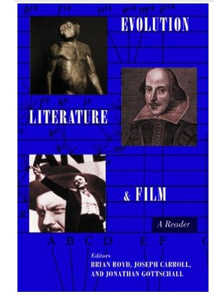 To take film theory in another direction, there’s Evolution, Literature, and Film, edited by Brian Boyd, Joseph Carroll, and Jonathan Gottschall. As a wider audience has become aware of the power of neo-Darwinian thinking, more and more scholars have been arguing that evolutionary theory can shed light on aesthetics. The most visible effort recently is Denis Dutton’s The Art Instinct.
For some years Brian, Joe, and Jonathan have been in the forefront of this trend, with many books and articles to their credit. Their anthology pulls together broad essays on biology, evolutionary psychology, and cultural evolution before turning to art as a whole and then focusing on literature and cinema. There are also pieces displaying evolutionary interpretations of particular works, and a finale that provides examples of quantitative studies of genre, gender variation, and sexuality, including an article called “Slash Fiction and Human Mating Psychology.”
Among the film contributors are other friends like Joe Anderson, a pioneer in this domain with his 1996 book The Reality of Illusion, and Murray Smith, who provides an acute piece called “Darwin and the Directors: Film, Emotion, and the Face in the Age of Evolution.” There are also essays of mine, drawn from Poetics of Cinema. In all, this book presents a persuasive case for an empirical, broadly naturalistic approach to the arts.
By the way, the same team is involved with an annual, The Evolutionary Review, edited by Alice Andrews and Joe Carroll. Its first issue offers articles on Facebook, musical chills, women as erotic objects in film, and Art Spigelman’s In the Shadow of No Towers (by Brian Boyd).
Some books emerge from conferences, and Tom Paulus and Rob King’s Slapstick Comedy is a good instance. Based on “(Another) Slapstick Symposium,” held at the Royal Film Archive of Belgium in 2006, the anthology brings together a host of experts who look back at madcap comedy in American silent film. There are essays on particular creators—Griffith, Sennett, Fatty, and Chaplin, inevitably—as well as pieces on slapstick parodies of other movies and the genre’s relation to modernity, also inevitably. Tom Gunning offers a fine analysis of Lloyd’s Get Out and Get Under (1920), concentrating on a complex string of gags around an automobile. The collection gathers work by some of the outstanding scholars of silent film while also, of course, making you want to see these crazy movies again.
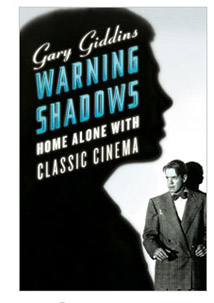 You also want to see all the movies lovingly evoked by Gary Giddins in Warning Shadows: Home Alone with Classic Cinema. As indicated in another blog entry, I find Giddins one of the best appreciative critics we’ve ever had. Any essay, indeed almost any sentence, cries out to be quoted. Here he is on Edward G. Robinson:
His round, thick-lipped, putty face could brighten like paternal sunshine or shut down in implacable contempt or stall with crafty desperation or pontificate with ingenuous wisdom; his short, stumpy, erect frame could sport a tailor-made as smartly as Cary Grant.
Some of the pieces in Giddins’ latest collection were designed to accompany DVDs, but they will outlast this evaporation-prone genre. Other reviews come from the New York Sun, which gave him freedom to mix and match his subjects: Young Mr. Lincoln and Lust for Life (both biopics), Lady and the Tramp and Miyazaki movies. The collection opens with Giddins’ thoughts on how changes in film exhibition, from nickelodeons to digital screens, have altered our relationship with the movies. This isn’t just nostalgia, because his survey allows him to celebrate the power of DVD to exhume forgotten titles. The standards for a film classic, he notes, “are gentler and more flexible” than those in appraising other arts. “The passing decades are a boon to the appreciation of stylistic nuance that gives certain melodramas and genre pieces the heft of individuality.”
Who was Segundo de Chomón? In the 1970s, I kept finding that films I thought were by Méliès turned out to bear this mysterious signature. You imagine a man in a cape and a floppy hat. Photographs show someone a little less operatic, but with a superb mustache. Today he’s far from a mystery, although many of his movies can’t be fully identified. Several scholars have followed his trail, none more thoroughly than Joan M. Minguet Batllori in Segundo de Chomón: The Cinema of Fascination.
Chomón started as a cinema man-of-all-work in Barcelona, translating film titles, distributing copies, and producing films for Pathé. After moving to Paris in 1905, he continued working for the company and established his fame with trick films. He returned to Barcelona to create a production company, but that failed. On he went to Italy, where he specialized in visual effects, most famously for Cabiria (1914).
In his Parisian Pathé years, he was in charge of all the studio’s trick films, which included not only stop-motion, superimpositions, and other effects but also marionettes and animation. Joan argues that he was a prime exponent of the “cinema of attractions,” Tom Gunning’s term for that early mode of filmmaking which aims to startle and enchant the audience. A famous instance is Kiriki, acrobats japonais (1907), which shows gravity-defying stunts.
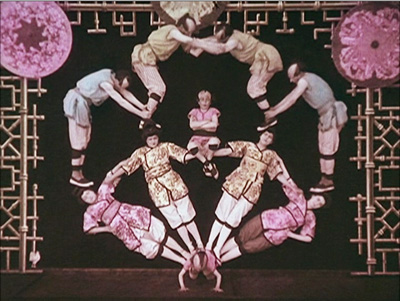
Chomón accomplished this by shooting from straight down, filming the performers on the floor. They had to simulate leaps and flips as they rolled along each other’s bodies, and then they had to slip perfectly into position. This English edition of Joan’s book on Chomón, full of information and providing a “provisional filmography” along with many pages of gorgeous color images, will be available soon here.
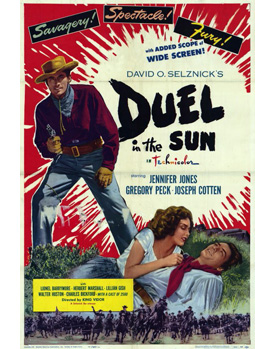 We recently noted the anniversary of our book on classic studio cinema, a 1985 project in which we bypassed talking about exhibition. That part of the industry has been a scholarly growth area in the years since, and one of the newest yields is Epics, Spectacles, and Blockbusters: A Hollywood History, by Sheldon Hall and Steve Neale. It’s a chronological account of Big Movies, from the earliest features to the digital era, and it concentrates on how such films have been marketed and shown. It explains how exhibition changed across the decades, and how we got the phenomenon of the “roadshow” movie, the film shown selectively (only certain cities), at intervals (perhaps only one matinee and one evening screening), and at more or less fixed prices. My middle-aged readers will remember roadshow releases like The Sound of Music (1965), although there were many before and even a few since.
Sheldon and Steve trace in unprecedented detail the cycles of blockbusters that have run throughout American cinema. In the process they refreshingly redefine the very idea. We don’t usually think of The Best Years of Our Lives as a Big Movie, but it runs three hours and was considered a “special” production, comparable to the more obvious sprawl of Duel in the Sun. The authors bring the story up to date by considering today’s event movies as a “Cinema of Spectacular Situations.” Yes, that category includes comic-book films, Inception, and, of course, the 3D sagas that may finally be wearing out their welcome. (My editorializing, not theirs.)
Japanese cinema is endlessly fascinating in all its eras; I’d argue that in toto it’s one of the three greatest national cinemas in film history. The postwar period is exceptionally interesting because of the American occupation (1945-1951) and its effects on Japanese film culture. This period has already provoked one of the best books we have on Japanese cinema, Kyoko Hirano’s Mr. Smith Goes to Tokyo, and it finds a worthy accompaniment in Hiroshi Kitamura’s Screening Enlightenment: Hollywood and the Cultural Reconstruction of Defeated Japan. Kyoko focused on how US policy shaped domestic filmmaking, while Hiroshi asks how the Occupation helped American studios penetrate the local market.
Over six hundred Hollywood movies poured into Japan during the period, and Hiroshi traces how local tastemakers as well as U.S. policymakers drew audiences to them. Young Japanese learned about the Academy Awards, assembled in movie-study clubs to discuss what they were seeing, and were urged to consider even a gangster tale like Cry of the City (1950) as demonstrating the humanistic side of democracy. A center of this activity was Eiga no tomo (“Friends of the Movies”), a magazine that went beyond entertainment news and tried to reshape the tastes of young people. In sharp prose and vivid evidence, Hiroshi captures the ways in which American cinema promised to help heal a devastated country.
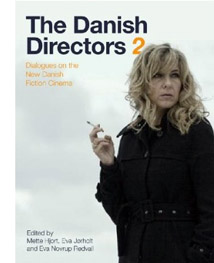 The Danish Directors, by Mette Hjort and Ib Bondebjerg, has become a standard companion to the most successful “small cinema” on the European scene. Now it has a successor in The Danish Directors 2: Dialogues on the New Danish Fictional Cinema, edited by Mette, Eva Jorholt, and Eva Novrup Redvall. Once again, we get lengthy, in-depth interviews covering the value of film education, the vagaries of funding, and filmmakers’ creative decision-making. Lone Scherfig, Christoffer Boe, Per Fly, Paprika Steen, and many other major figures are included. (Disclosure: The editors were kind enough to dedicate the book to me.)
While the first volume is a rich storehouse of information on Danish film in “the Dogma era,” the newest volume shows how directors (some of whom made Dogma projects) have gone beyond it. In preparing 1:1, a film about Danes and Arab immigrants living in a housing project, Annette K. Olesen had a full script but concealed it from the non-professional cast. After getting the performers comfortable with ordinary situations, she began staging scenes while encouraging improvisation. Screenwriter Kim Fupz Aakeson incorporated the improvised material into revisions of the script.
By contrast, the prolific director-screenwriter Anders Thomas Jensen (Adam’s Apples, The Green Butchers), relies on strong structure, with lean expositions and sharply defined climaxes. He appreciates clean filming technique too.
It’s easy to make something that’s ugly and handheld, but you have to take telling stories with images seriously. You have to take the language of film seriously. Many Danish directors have started doing this in recent years and it’s wonderful, because there was a time when everything looked Dogma-like and I found myself thinking, “It’s got to stop now.”
To those who think that Danish cinema is at risk of becoming a cinema of cozy liberal reassurance, this collection offers many salutary signs. Every director speaks of the need to keep innovating, to push ahead provocatively. Simon Staho, whose Day and Night seems to me one of the most adventurous Danish films of recent years, aims at utter purity: “My task is to figure out how to add as little as possible to the black screen. The damned problem is that you have to add image and sound!”
What makes all these books exciting to me is a willingness to test ideas–sometimes very general ones–about cinema and the wider world by examining film as a distinctive art form. Even the most conceptual books on this week’s shelf are firmly rooted in the particular choices that creators make and the concrete ways that viewers respond.
Next stop: Vancouver International Film Festival. Whoopee!
Day and Night.
What makes Hollywood run?
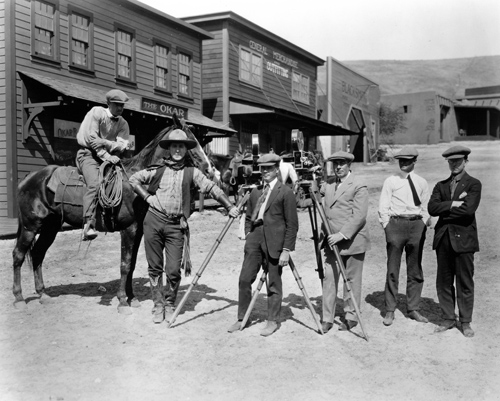
William S. Hart and crew at Inceville, 1910s.
DB here:
For decades most people had a sketchy idea of The Hollywood Studio Film. Boy meets girl, glamorous close-ups, spectacular dance numbers or battle scenes, happy endings, fade-out on the clinch. But even if such clichés were accurate, they didn’t cut very deep or capture a lot of other things about the movies. Could we go farther and, suspending judgments pro or con the Dream Factory, characterize U. S. studio filmmaking as an artistic tradition worth studying in depth? Could we explain how it came to be a distinctive tradition, and how that tradition was maintained?
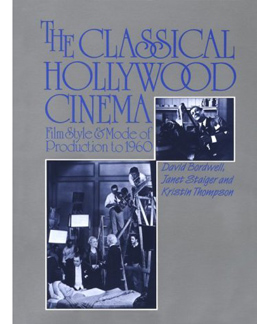
In 1985 Routledge and Kegan Paul of London published The Classical Hollywood Cinema: Film Style and Mode of Production to 1960. Kristin, Janet Staiger, and I wrote it. Since it’s rare for an academic film book to remain in print for twenty-five years, we thought we’d take the occasion of its anniversary to think about it again. Those thoughts can be found in the adjacent web essay, where we three discuss what we tried to do in the book, spiced with comments about areas of disagreement and more recent thoughts. This blog entry is just a teaser.
A touch of classical
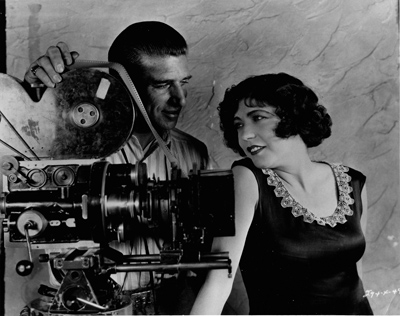
John Arnold, a Bell & Howell camera, and Renée Adorée in 1927.
The prospect of analyzing Hollywood as offering a distinctive approach to cinematic storytelling emerged slowly. The earliest generations of film historians tended to talk about the emergence of film techniques in a rather general way. For example, historians were likely to trace the development of editing as a general expressive resource, appearing in all sorts of movies. While they recognized that, say, the Soviet filmmakers made unusual uses of this technique, writers still tended to think of editing as either a fundamental film technique or a very specific one—e.g., Eisenstein’s personal approach to editing.
An alternative approach was to understand the history of film as an art as a stream of cinematic traditions, or modes of representation, within which filmmakers worked. From this angle, there was a Hollywood or “standard” or “mainstream” conception of editing, and this didn’t exhaust all the creative possibilities of the technique. But it went beyond the inclinations of any particular director. People had long recognized that there were group styles, like German Expressionism and Italian Neorealism, but it took longer to start to think of mainstream moviemaking as, in a sense, a very broad and fairly diverse group style.
In the late 1940s André Bazin and his contemporaries started to point out that different sorts of films had standardized their forms and styles quite considerably. Bazin attributed the success of Hollywood cinema to what he called “the genius of the system.” In my view, his phrase referred not to the studio system as a business enterprise but rather to an artistic tradition based on solid genres and a standardized approach to cinematic narration. This artistic system, he suggested, had influenced other cinemas, creating a sort of international film language.
The idea that there was a dominant filmmaking style, tied to American studio moviemaking, was developed in more depth during the 1960s and 1970s. Christian Metz’s Grande Syntagmatique of narrative film pointed toward alternative technical choices available in the “ordinary film.” Raymond Bellour’s analysis of The Birds, The Big Sleep, and other films pointed to a fundamental dynamic of repetition and difference governing American studio cinema. Somewhat in the manner of Roland Barthes’ S/z, Thierry Kuntzel’s essays explored M and The Most Dangerous Game looking for underlying representational processes that were characteristic of studio films. From a somewhat different angle, in the book Praxis du cinema and later essays Noël Burch traced out a dominant set of techniques that formed what he would eventually call the “Institutional Mode of Representation.” The Cahiers du cinéma critics famously posited different categories of filmic construction, each one tied to the representation of ideology. In English, Raymond Durgnat was an early advocate of studying what he called the “ancienne vague,” the conventional filmmaking that young directors were rebelling against.
The trend was given a new thrust by the British journal Screen, which disseminated the idea of a “classical narrative cinema,” a mode of representation characterized by distinctive dynamics of story, style, and ideology. Perhaps the most emblematic article of this sort was Stephen Heath’s in-depth analysis of Touch of Evil. Over the same years a new generation of film historians was studying early cinema with unprecedented care, and they too were finding a variety of modes of representation at work in filmmaking of the pre-1920 era.
The effect was to relativize our understanding of Hollywood. Mainstream U. S. commercial filmmaking wasn’t the cinema, merely one branch of film history, one way of making movies. Breaking a scene into a coherent set of shots, to take the earlier example, wasn’t Editing as such. It was one creative choice, although it had become the dominant one. And what made Hollywood’s brand of coherence the only option? Eisenstein, Resnais, Godard, and other filmmakers explored unorthodox alternatives.
Nearly all of the influential research programs of the period emphasized the film as a “text.” This wasn’t surprising, since several of the writers were working with concepts derived from literary semiotics and structuralism. At the same period, other scholars were developing ideas about Hollywood as a business enterprise. Douglas Gomery, Tino Balio, and a few others were showing that the studio system was just that—a system of industrial practices with its own strategies of organization and conduct. But most of those business studies did not touch on the way the movies looked and sounded, or the way they told their stories.
Could the two strains of research be integrated? Could one go more deeply into the films and extract some pervasive principles of construction? And could one go beyond the films and show how those principles of style and story connected to the film industry?
The prospect of integrating these various aspects—and, naturally, of finding out new things—intrigued us.
Secrets of the system
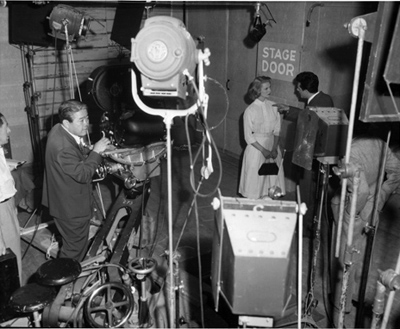
Main Street to Broadway (1953, MGM release). Cinematographer James Wong Howe on left.
The overall layout of CHC tried to answer these questions while weaving together a historical overview. Part One, written by me, provided a model or ideal type of a classical film, in its narrative and stylistic construction. Part Two, by Janet, outlined the development of the Hollywood mode of production until 1930. In Park Three, Kristin traced the origins and crystallization of the style, from 1909 to 1928. Part Four included chapters by all three authors on the role of technology in standardizing and altering classical procedures during the silent and early sound era. In Part Five Janet resumed her account of the mode of production, tracing changes from 1930 to 1960. The technology thread was brought up to date in Part Six, where I discussed deep-focus cinematography, Technicolor, and the emergence of widescreen cinema. Part seven, which Janet and I wrote together, pointed out implications of the study and suggested how Hollywood compared with alternative modes of film practice.
Clearly, CHC was several books in one. Janet could easily have written a free-standing account of the mode of production. Kristin could have done a book on silent film technique and technology. I could have focused on style and form, using sound-era technologies as test cases. The point of interspersing all these studies (and creating a slightly cumbersome string of authorial tags within sections) was to trace interdependences. For instance, Kristin examined the emerging stylistic standardization in the 1910s. Janet showed how that standardization was facilitated by a systematic division of labor and hierarchy of control, centered around the continuity script. At the same time, the organization of work was designed to permit novelties in the finished product, a process of differentiation that is important in any entertainment business.
 Moreover, once the stylistic menu was standardized, it reinforced and sometimes reshaped the mode of production. At every turn we found these mutual pressures, a mostly stable cycle among tools, artistic techniques, and business practices. Once the studios became established, they needed to outsource the development of new lighting equipment, camera supports, microphones, make-up, and other tools. A supply sector grew up, carrying names like Eastman, Bell & Howell, Mole-Richardson, Western Electric, and Max Factor. But the suppliers had to learn that they couldn’t innovate ad libitum. The filmmakers laid down conditions for what would work onscreen and what would fit into efficient craft routines. In turn, the routines could be adjusted if a new tool yielded artistic advantages. And the whole process was complicated by an element of trial and error. The film community often couldn’t say in advance what would work; it could only react to what the supply firms could provide.
In the late 1920s, for instance, sound recording made the camera heavier than the tripods of the silent era could bear. Supply firms engineered “camera carriages” that could wheel the beast from setup to setup. But this development occurred soon after filmmakers had noticed the expressive advantages of the “unleashed camera” in German films and some American ones. So the camera carriage became a dolly, redesigned to permit moving the camera while filming. It’s not that there weren’t moving-camera shots before, of course, but with the camera permanently on a mobile base, tracking and reframing shots could play a bigger role in a scene’s visual texture. Similarly, studio demands for ways of representing actors’ faces in close-ups forced Technicolor engineers back to their drawing boards again and again. Once the problem of rendering faces pleasant in color was solved, filmmakers could then redesign their sets and adjust their make-up to suit the vibrant three-strip process. And the interaction of work, tools, and style triggered larger cycles of activity. The need to pool information about stylistic demands and technological possibilities helped foster the growth of professional associations and the Academy of Motion Picture Arts and Sciences.
This give-and-take among the studios, the supply sector, and the stylistic norms had never been discussed before, and we couldn’t have done justice to it in separately published books. Nor could isolated studies have easily traced how industrial discourses—the articles in trade journals, the communication among the major players—helped weld the mode of production to artistic choices about filmic storytelling.
The Classical Hollywood Cinema was generously reviewed, in terms that made us feel our hard work had been worth it. Books we’ve written since haven’t been so widely acclaimed. (Nothing like peaking young.) We’re grateful to the reviewers who praised the book, and to the teachers and students who have strengthened their biceps by picking it up to read. Of course there are others who don’t consider the project worthwhile; the TLS reviewer called it “sludge.” Probably nothing we say in the accompanying essay will persuade those readers to take a second look. Without responding to all the criticisms the book received (that would take a book in itself), our accompanying essay tries to position this 1985 project within our current lines of thinking.
We studied how Hollywood routinized its work, but that doesn’t mean that we think division of labor is always alienating. It may produce a much better outcome than do the efforts of a solitary individual. For us, that’s what happened during this rewarding exercise in collaboration.
Our thinking was shaped by many sources; here are some of them.
For André Bazin on “the genius of the system,” see “La Politique des auteurs,” in The New Wave, ed. Peter Graham (New York: Doubleday, 1968), pp. 143, 154, and “The Evolution of the Language of Cinema,” in What Is Cinema? ed. and trans. Hugh Gray (Berkeley: University of California Press, 1967), pp. 23-40. Christian Metz explains the Grande Syntagmatique of the image track in “Problems of Denotation in the Fiction Film,” Film Language, trans. Michael Taylor (New York: Oxford University Press, 1974), 108-146. Raymond Bellour’s essays of the period are available in The Analysis of Film. Thierry Kuntzel’s essay on The Most Dangerous Game was translated into English as “The Film-Work 2,” Camera Obscura no. 5 (1980), 7-68. An important gathering of essays in this line of inquiry is Dominique Noguez, ed., Cinéma: Théorie, lectures (Paris: Klincksieck, 1973).
Noël Burch’s early ideas are set out in Theory of Film Practice, trans. Helen R. Lane (New York: Prager, 1973). Even more important to our project was Noël Burch and Jorge Dana, “Propositions,” Afterimage no. 5 (Spring 1974), 40-66, and Burch’s To the Distant Observer: Form and Meaning in Japanese Film (London: Scolar Press, 1979), available online here.
Raymond Durgnat’s series, “Images of the Mind,” deserves to be republished, preferably online. The most relevant installments for this entry are “Throwaway Movies,” Films and Filming 14, 10 (July 1968), 5-10; “Part Two,” Films and Filming 14, 11 (August 1968), 13-17; and “The Impossible Takes a Little Longer,” Films and Filming 14, 12 September 1968), 13-16. Stephen Heath’s analysis of Touch of Evil may be found in “Film and System: Terms of Analysis,” Screen 16, 1 (Spring 1975), 91-113 and 16, 2 (Summer 1975), 91-113.
Barry Salt’s Film Style and Technology: History and Analysis (London: Starword, 1983) works in comparable areas to CHC, though without our interest in industry-based sources of stability and change. The newest edition is here.
Tino Balio’s courses and his collection The American Film Industry (Madison: University of Wisconsin Press, 1976) had a substantial influence on us. He has been a wonderful friend and guide for us all since the 1970s. Our friendship with Douglas Gomery dates from our early days in Madison. Many conversations, along with his teaching in our program, shaped our thinking. A good summing up his of decades of work on the business and economics of Hollywood is The Hollywood Studio System: A History (London: British Film Institute, 2008).
Some of the stylistic traditions discussed in this entry are discussed in my On the History of Film Style. Several blog entries on this site fill in more details; click on the category “Hollywood: Artistic traditions.”
PS 26 September 2010: Douglas Gomery reminds me that the idea of sampling Hollywood films in an unbiased fashion–one feature of our method in CHC–was suggested to us by Marilyn Moon, economist extraordinaire. I’m happy to thank Marilyn, along with Joanne Cantor and Douglas himself, who helped us devise a sampling procedure.
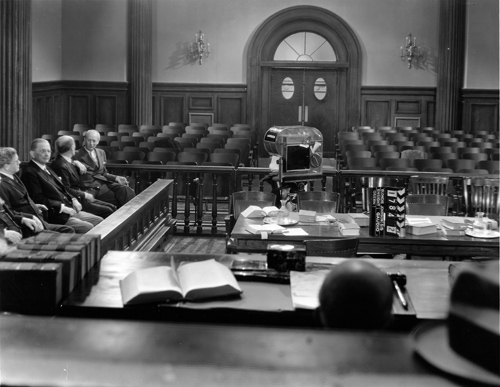
Actors and set for Blondie Johnson (Warners, 1933).