








Archive for the 'Film comments' Category
Venice 2017: Hunting Golden Lions
The Shape of Water.
Kristin here:
Much attention is generated each year around the Hollywood films that premiere at the big late-summer and autumn festivals, starting with Venice. This year several such films have been launched here in competition for the Leone d’Oro. David has already mentioned Downsizing, and I discuss two more below.
The Shape of Water will be released in the US on December 8, and Three Billboards outside Ebbing, Missouri on November 10. I’ve avoided giving away the endings, but there are definite SPOILERS below–though no bigger than those already present in reviews already published.
As I finish this entry, I am seated in the press room of the festival, surrounded by perhaps a couple of hundred others, all typing away like mad on their computers and tablets and turning out a great deal of coverage of the festival. The press room is a large, extremely high hall in the Casino , the second largest of the 1930s-era buildings used by the festival. It no longer functions as a casino, though there is still a pattern of clubs, hearts, diamonds, and spades on the ceiling in the press-conference room. When the festival is not on, these buildings are usually shut up and left to wait for the next year.
[September 9: Both films bagged one: The Shape of Water has just won the Golden Lion as best picture, and Three Billboards outside Ebbing, Missouri won Best Screenplay.]
The Shape of Water
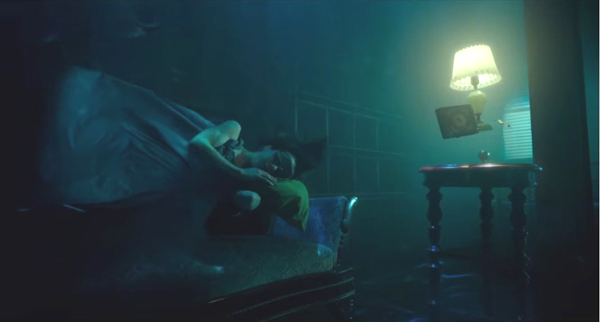
The pre-credits opening of Guillermo del Toro’s The Shape of Water shows the heroine Elisa calmly asleep, floating above a sofa in a somewhat shabbily furnished room entirely underwater (top). We hear a narrator wondering how to tell the story of “the princess without voice.” Elisa, who is a mute cleaning lady employed at a top-secret government lab in the cold-war early 1960s, is not and never becomes a princess in any literal sense. But the phrase marks the film as a fairy story in which the heroine and her true love will rescue each other. (Del Toro avoids the more obvious “Once upon a time …”)
The voice turns out to be that of Giles, a gay down-at-heels artist who is Elisa’s best friend and neighbor. He could not possibly know everything that happens, especially at the end, when his voice similarly describes the outcome. But such narrating figures are common enough, and we must make allowances in a fairy tale.
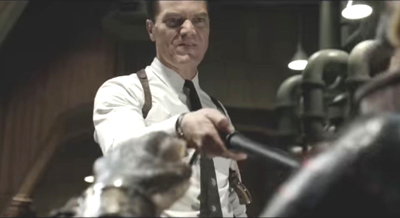
The other genres that del Toro draws upon are horror and science fiction, but both are definitely subservient to the fairy tale. The source of the horror is reversed here. The amphibious Creature who is brought to the lab and who becomes Elisa’s friend and eventual romantic partner is modeled on the Creature from the Black Lagoon, as del Toro readily admits, but here he is the victim, not the menace. The true monster is Richard Strickland, an agent who picked up “The Asset,” as he and the scientists at the lab call the creature, and he is determined to have him vivisected and disposed of–but not before he has adequate opportunity to torture the Creature with an electric cattle prod. This pastime loses Strickland two fingers, which are grafted back on but gradually go gangrenous, making him seem to degenerate into something monstrous.
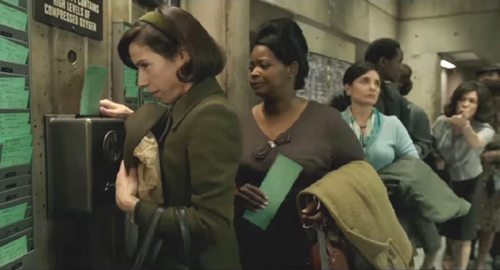
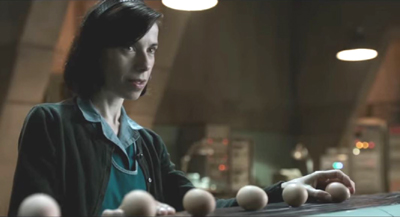
The script of The Shape of Water is elegantly crafted, with motifs wending through it, most obviously the water imagery that pervades the film, from the opening to the skittering drops of water that Elisa traces on the exterior of the bus window. Del Toro also sets up important plot points subtly and clearly. The routine of Elisa and Zelda punching in and out of work at a time clock (top of section) seems mainly a device for showing their friendship and Elisa’s somewhat loose attitude toward rigid deadlines. Later, however, the time on the punched cards ends up providing an important alibi during the investigation of the Creature’s mysterious disappearance from the lab.
Similarly, a comic scene in which janitors and cleaning ladies sneak a smoke while clustered in the blind spot of a nearby surveillance camera motivates Elisa’s later manipulation of such a camera to hide her activities during the rescue scene. The early scene of her boiling eggs to take in her brown-bag lunch leads to the episodes of her offering first a single egg and then multiple eggs to the Creature as she tries to make friends.
Despite all this, I found it implausible that Elisa, Zelda, and Giles, with a little help from the sympathetic scientist Hofstetler, could remove a major item from a top-secret lab. Here the fairy tale bumps up against the fact that it is set in a sci-fi world. Presumably we must simply assume that in a fairy tale such things can happen.
The music of the film is crucial to the fairy-tale atmosphere. It is entirely evocative of the late 1950s-early 1960s era, and not just in the brief scenes from real Hollywood musicals that would have been showing on TV at the time. At the press conference Alexandre Desplat (who also scored Suburbicon, competing here in Venice) said he wanted to emphasize emotions even while creating a musical flow like water, without emphatic moments. When del Toro, working as usual very quickly, showed Desplat a rough-cut of The Shape of Water a week after shooting ended, the composer referred to Nino Rota and Georges Delerue, two masters from the era of the story who were skilled at creating overtly charming soundtracks. The result is a buoyancy (to continue the water theme) that helps counteract the grimness and threat in many of the scenes.
Much has been made of the fact that del Toro has returned to his low-budget roots after Pacific Rim (at a reported $190 million budget) and Crimson Peak (mid-budget at around $55 million). The Shape of Water, according to del Toro, cost around $20 million–a remarkable figure, considering the quality of the CGI and the production design. This feat was achieved in part by the director foregoing his salary and paying for some of the conceptual artwork. (It seems likely that the cast took lower than usual fees in order to work with del Toro.)
Comparing The Shape of Water to del Toro’s masterpiece, Pan’s Labyrinth (made for a reported $19 million), is nearly universal among reviewers, and one can hardly avoid it, even though the earlier film is ultimately far darker. Perhaps it is closer to fairy tales in their original grim forms. As del Toro pointed out at the press conference, fairy tales often originated in times of war, famine, and pestilence and have been softened for modern readers. The Shape of Water never achieves the depths of queasy horror that some scenes of Pan’s Labyrinth contain. Still, it was assigned an R rating by the MPAA and is definitely a fairy tale for adults.
Three Billboards outside Ebbing, Missouri
The sharp dialogue in Martin McDonagh’s third feature is funny and poignant by turns. Frances’s McDormand’s tough, vengeful mother Mildred Hayes delivers much of it and drew applause a number of times during the press screening. She begins by hiring the three billboards of the title, seen in a dilapidated state in the foggy opening shots (see bottom). Her simple message appears in three parts: “Raped while dying/And still no arrests/Why, Chief Willoughby?”
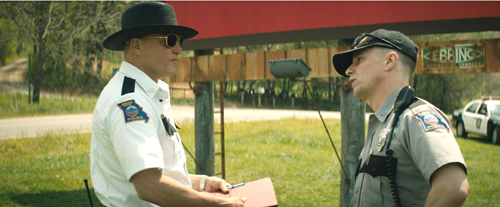
As Jason Dixon, a racist, violent, dim-witted police officer (in a scene-stealing performance by Sam Rockwell, above, with Woody Harrelson as Willoughby) observes as he drives by, this is a declaration of war. Mildred spends much of the film badgering, berating, and ultimately attacking the police for what she considers their neglect in investigating the months-old case of her daughter’s rape and murder. Most of the townspeople condemn her billboards tactic and side instead with the likeable, sensible Chief Willoughby, who is especially sympathetic given the fact that he is dying of cancer.
The “war” serves to give us yet another unsavory view of a southern town. Apart from Willoughby, who turns out not to be as inactive concerning the case or unsympathetic toward Mildred’s plight as we might think, most of the characters are unsympathetic to some degree. The other cops do little to stifle Dixon’s outbursts of violence, and Mildred’s ex-husband, who had beaten her and taken up with a pretty nineteen-year-old, disapproves of the billboard tactic. Her son just wants to put his sister’s death behind him.
Mildred herself has been pushed beyond reason by her grief, rejecting Willoughby’s protestation that his investigation has simply failed to turn up any clues, including any DNA matches among local men. Mildred’s response is to demand that he DNA test every male over eight in the town, the county, the state, the country, if necessary. When something is thrown at her car as she drops off her son at school, she actually attacks some kids who claim not to have seen who did it. Willoughby becomes the stabilizing force, and he’s not around long enough to help stave off the escalating conflict.
Three Billboards is a thoroughly entertaining film, but I think there is at least one problem involving the motivation for the presence of a mysterious stranger who becomes a suspect. On the whole the story works well, with some unexpected changes of heart among the characters and an ending that suggests the possibility of healing within the town. Perhaps this is also suggested by the choice of “Ebbing” for the fictitious Missouri town (which was represented by Sylva, Ashville, and other areas in North Carolina).
For those interested in Oscar buzz, I would not be surprised to see Frances McDormand and Sally Hawkins competing again each other in the Best Actress category. You probably did not hear that here first.
Many thanks to Peter Cowie, Alberto Barbera, Michela Lazzarin, and all of their colleagues for inviting and assisting us at this year’s Mostra.
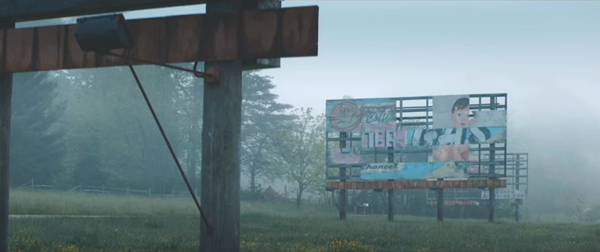
Three Billboards outside Ebbing, Missouri.
Venice 2017: Sensory Saturday; or, what puts the Virtual in VR?
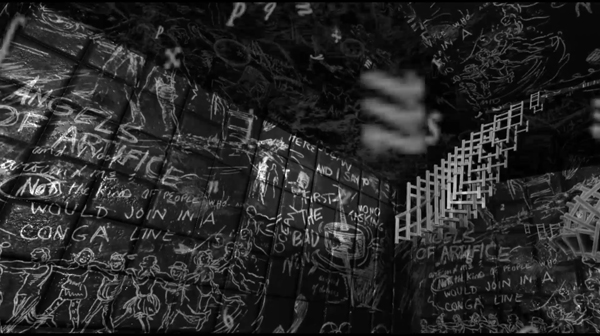
La Camera Insabbiata (2017) by Laurie Anderson and Hsin-chien Huang.
DB here (still at the Mostra):
Kristin and I are Virtual Reality novices, so when we got a chance to sample some pieces at Venice VR, we jumped. The demand was great for the 22 pieces on display, and you had to book each encounter separately in advance. The event was held on its own island, Lazzaretto Vecchio, which was startling in itself; the facility was once a hospital for plague victims.
We took in four pieces in one afternoon and may go back to see some others. We didn’t see exactly the same ones, so my report and speculations are limited to mine. Apart from being fairly wild, sometimes creepy, sensory experiences, they set me thinking about how VR seems to work as a medium.
Angels of artifice
My quartet was a varied assortment, each somewhat parallel to a film genre or narrative prototype. The first was Greenland Melting, by Catherine Upin, Julia Cort, Nonny de la Peña, and Raney Aronson-Rath. It’s part of a Frontline documentary series, and it follows the format, but with immersion. Presenters addressed the camera (me) and took me via helicopter to the glaciers so I could watch them heaving themselves into the sea.

The camera took me underwater as well, and I experimented with voluntarily bobbing under and above the waterline; it worked. Again, as in a film, the transitions between shots was managed through quick dissolves.
La Camera Isabbiata, by Laurie Anderson and Hsin-Chin Huang, is an installation running 20 minutes. It presents a fantasy landscape that you can move through. With two controllers, one in each hand, you choose one of several virtual domains to explore. As far as I could tell, all of them were based on cavernous arrays of blackboards chalked with graffiti. (See the image surmounting today’s entry.)
I first chose the sound domain, which asked me to speak. My words were not only played back to me, but then assumed vase or candy-bowl shapes of gleaming color.
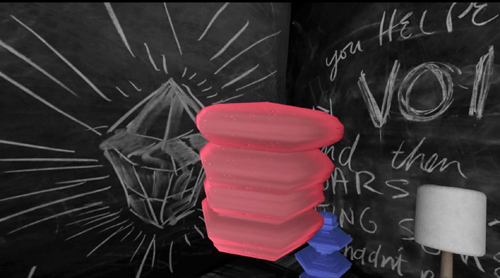
Getting bored with hearing myself and seeing my words made solid, I switched to flying.
Flying was most excellent. Once I figured out how the remotes governed direction, speed, and angle, I could steer a swift path through, over, and around those huge black surfaces. The sense of self-initiated optical flow was powerful, although there were no other cues (e.g., balance, air pressure) to mimic actual flight. But I could have fun playing with this a long time. This was pure subjective POV cinema, or first-person gameplay if you like, and everything was one single shot.
If La Camera Isabbiata put the onus on the user to initiate everything, Draw Me Close: A Memoir by Jordan Tannahill, made me respond to a situation. Once the goggles went on, I was guided to a black-and-white broken-line image of a woman on her sickbed. The artist’s voice-over presented the situation of his mother, dying of cancer, and me-as-him visiting her. Unseen by me, except as her avatar in the goggles, a performer filled the role of the mother, occasionally taking my hand and responding to my responses with more or less scripted comments.
I made my way to a cartoon bed and actually sat on it. The illustrated woman spoke to me, with Tannahill’s voice-over responding. On instructions, I went outside to fetch her paper, but coming back in I moved into a flashback of Tannahill (me) as a little boy playing with Mum. She chatted with me and I feebly responded, and followed her instructions to make colored marks on paper stretched out on the floor.
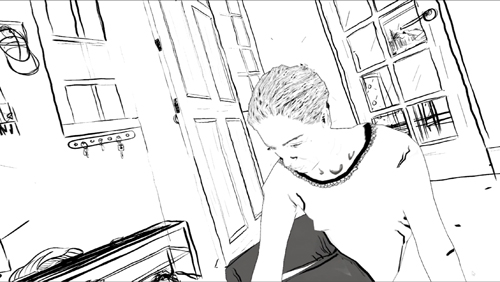
Later that night Tannahill’s narration guided me to a more unpleasant memory, one reminiscent of Terence Davies’ Distant Voice, Still Lives. It was a minimal narrative to match the images, but I could fill it thanks to the familiarity of the scenario and the tactility of furnishings (bed, door) and physical human contact.
The Deserted, a 55-minute piece, was frankly billed as “a film by Tsai Ming-liang.” A series of fixed long-shots joined by cuts shows a typical Tsai situation: a young man and his mother live in a ruined temple. He apparently administers electrotherapy to his back and chest; he floats in his bath with a fish; it rains in buckets and water comes seeping in to where you’re hovering. A woman in white, perhaps a ghost, appears at times, once in the man’s bathtub.
You make the choices in La Camera Isabbiata, and you role-play in Draw Me Close, but in The Deserted you’re locked down as a witness. No images from the piece seem to be available, but this, from a shot of a camera monitor, roughly indicates the film’s first shot (which isn’t as distorted as this looks).
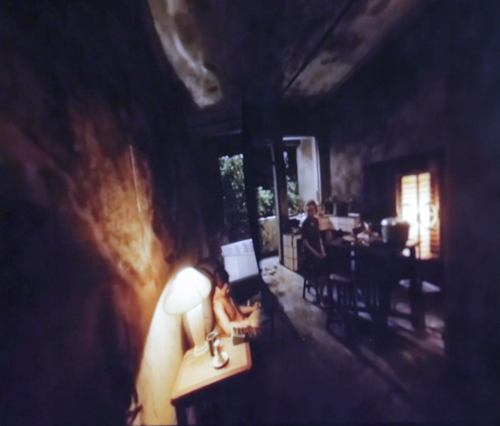
You can’t move to another spot, and you can’t even crane your neck to peek around corners. You can swivel your head to look 360 degrees horizontally and vertically. But nothing much happens behind your back or over your head. All the action, such as it is, takes place squarely in front of you. Given Tsai’s penchant for static long takes and deep areas of space, The Deserted isn’t putting you inside a real or virtual space; it’s putting you inside a Tsai film.
Reality has the most bandwidth
Since I’m no expert on VR, all I have are initial observations based on this sampling and on a bit of reading.
First observation: VR doesn’t have to be photorealistic to engage you. The image in Draw Me Close is quite impoverished in terms of real-world cues, and the shots of The Deserted are almost shockingly fuzzy. (Tsai, a fan of razor-sharp focus, would never let them in one of his film films.) Other pieces in Venice VR, visible on monitors while users were getting the full dose, are often quite cartoonish. Why are they then so compelling?
E. H. Gombrich suggested long ago that illusion can rely more on stimulation than simulation. That is, choose just a few sensory triggers and you’ll be aroused even if the image isn’t particularly lifelike. Baby geese can, if primed properly, take a box for their mothers, and frogs can snap at anything floating in a fly-ish sort of way around their heads. Outlines, it seems, are central for creatures like us, but they don’t have to be detailed. We also respond, fast and stupidly, to configurations that suggest faces.


Try not to see Jesus, or Janis Joplin, in the tortilla, or a stare on the wings of a Caligo butterfly.
As caricaturists and camouflagers know, a few distinctive features can suffice to summon up the target, and the same goes for the partial and degraded input we see in Draw Me Close and The Deserted. In addition, concepts play a role; our ideas about what to expect in certain surroundings, such as a household, help the illusion cohere. And the information needs to be consistent. When I turn my head in Tsai’s temple, nothing I see contradicts the other cues.
A second point: The VR experiences subtract on some channels of input and compensate on others. Normally, perceptual reality is massively redundant. Our sensory systems reinforce one another. Tilting your head sends signals about balance and vision, while sight and sound and touch and muscular activity offer mutually confirming information. And when things are uncertain, you can always test your environment by moving around.
But the VR systems I encountered impoverish the input on certain channels. Standing in the helicopter of Greenland Melting, I saw the passenger seat beside me as vividly three-dimensional, but when I tried to grab it for support, nothing was there. In The Deserted, I looked down and didn’t see my feet; in fact I was an eye in a bubble floating midway up the wall, where the camera was. And in neither of these pieces could I move voluntarily to poke around much in the space.
I could do that in La Camera Insabbiata, but it was an impoverished environment along other parameters. I could fly, but not touch any of the surfaces–which were without color or shadow, beyond a spotlight that shifted to follow my attention (presumably guided by eye-tracking software). I couldn’t land atop one one of the monoliths, or bump into an edge.
Reciprocally, Draw Me Close provided other sensory inputs: locomotion (though not wholly voluntary), touch (initiated by the performer playing Mum, and by the prop bed and door), and an array of skimpy visual-spatial cues. In principle, smell could have been included. Why not, then, go the whole hog and use a photorealistic rendering of the space and Tannahill’s mother? Perhaps a very faithful representation of Mum and the household would have raised the problem of the Uncanny Valley.
Just as important, we might ask: Since a performer is always required for the piece, why not simply play out the scenes with her and the user? Just go for reality, not virtual reality. I’m guessing that the move toward drawn imagery marks the project as stylized enough to be a media artifact, rather than a piece of interactive theatre. (Though it is partly that.) Here, I’m thinking, the impoverishment of information on certain channels was a deliberate aesthetic choice, rather than being obligated by computer processing power, though that would probably have been a factor too.
One of the biggest compensations for what’s missing in some channels would seem to be good old peripheral vision. This is a very strong cue to immersion, and it can override inputs that contradict it. I remember being in one of the Disney World attractions back in the 1980s, a wraparound theatre that put visitors at the center of a travelogue. Even though there were plenty of cues that you weren’t in front of Buckingham Palace–such as your awareness of people around you looking in different directions–if you concentrated on the filmed display, there was a compelling illusion that you were riding down the street toward the Palace.
Peripheral vision would seem to be a powerful sensory trigger for creatures like us. This was the insight that drove widescreen cinema and the curved screen of Cinerama. But efforts to activate peripheral vision maximally come at a cost. You lose the frame and thus a sense of significantly composed imagery. The Disney display had, as I recall, borders at top and bottom, but in modern VR those too are abolished. VR gives with one hand and takes away with the other, so to speak: Greater immersion yields less of the pictorial structuring that’s inherent in framing. Tsai’s film somewhat overcomes this problem by making the surrounding space neutral and fairly uninformative, but the result still loses the sharp dynamic of offscreen and onscreen space we find in his feature films.
One more thought, which seems more solid than the others. Some have asked whether VR can accommodate narrative. I had presumed so theoretically, but now I’m convinced. Greenland Melting told a real-world story, an alarming one at that. Draw Me Close had emotion-laden scenes, a crisis and climax, and a flashback. The Deserted presented a typical Tsai scenario of humid stasis–a thin narrative, but a narrative. (As often in Tsai, what we miss in psychology and causal density we get in slight spatial changes and pictorial surprises.) It wouldn’t be hard to “narrativize” the Camera Insabbiata soaring, either, say by prodding me to go on a cosmic scavenger hunt. I conclude that of course VR can deal with narrative.
John Landis worried that VR was too wedded to long takes to suit cinematic storytelling. That worry was in turn tied to the assumption that narratives must guide your attention. True! But it’s wrong to assume that only continuity editing can shape a film story. Our attention can be precisely guided through long takes. Indeed, to a degree the sort of open and exploratory attitude some find in VR was already there in locked-down long-take directors like Mizoguchi, Akerman, Hou, and Tsai. And they told stories, plenty of good ones.
Many thanks to Peter Cowie, Alberto Barbera, Michela Lazzarin, and all of their colleagues for inviting and assisting us. Special thanks to Andrea Vesentini for guiding us through the array of events at Venice VR.
For details on Venice VR, go here. Variety covers the Venice event in articles by Elsa Keslassy and Nick Vivarelli. Patrick Frater interviews Tsai on The Deserted here. I found this Wired piece a good VR primer, and Ty Burr offers an update in MIT Technology Review.
Gombrich’s key essay on simulation and stimulation is “Illusion and Art,” available without illustrations here. In full form it appeats in Illusion in Nature and Art, edited by Gombrich and Richard L. Gregory (Scribners, 1973), 193-243.
For discussions of how storytelling cinema guides attention within the shot, see the categories Film Technique: Staging and Tableau Staging.

Better than a cellphone? Viewers at Venice VR.
Venice 2017: Early days

DB here:
After the triumph of Rosita (more on that to come), the first full day of the Biennale launched with several press screenings and press conferences. The opening conference featured Festival President Paolo Baratta (below), Director Alberto Barbera, and jury heads including Annette Bening (below), Benoît Jacquot, and John Landis (below).

During that session, two subjects recurred: Netflix and Virtual Reality. Some Netflix films are playing out of competition: Our Souls at Night, with Robert Redford and Jane Fonda (who will get honorary Golden Lion awards); and Netflix’s first Italian production, Suburra. In addition, the Mostra will show all the episodes of Errol Morris’s Netflix series Wormwood. Barbera remarked that festivals must follow where auteurs lead. Now that so many filmmakers are directing telefilms and series “with the same attitude” they employ in theatrical features, festival progamming must take notice.
 Similarly with VR. Baratta pointed out that this medium is now being used by artists, and Venice has a historical and aesthetic obligation to keep up with moving-image explorations. Barbera added that for him VR was not the future of movies; it’s a new medium that will exist alongside them. Just as film didn’t kill theatre and television didn’t kill film, VR is likely to flourish on its own. It will likely have its dedicated venues, such as MK2’s VR theatre in Paris and similar spots in Amsterdam.
John Landis admitted that he was intrigued by VR and wanted to learn how to use it. Can it tell a full-length story? (Most VR pieces are short and situation-bound.) Can it focus the viewer’s attention—a key component of traditional visual narrative? Landis noticed that his experiences of VR gave the viewer great freedom of when and where to look. Could storytelling harness that freedom? It was good to see a filmmaker pondering these basic issues.
We saw the first screening of Alexander Payne’s Downsizing, a sharp and heartfelt satire on consumerism and ecology. Matt Damon and Kristen Wiig play a couple who decide to take advantage of a new technology that shrinks humans to 5-inch heights, and thus allows them to live more cheaply and reduce the strain on the planet.
The situation takes several unpredictable turns and in the face of impending disaster veers into a Capraesque optimism. Yet there’s a somberness here too, perhaps most akin to that in About Schmidt. Alexander mentioned Chekhov as an influence, and he admired the writer for realizing that emotional effects stand out against “a cold background.” The clinical scientific milieu of the downsizing operation and the arid cheerfulness of Leisureland, a sort of micro-EPCOT, provide that backdrop for the problems facing tiny Matt Damon.
In the press conference, Damon called Alexander’s direction meticulous and “sure-handed.” That shows in the film: No bouncy-camera grab-and-go, but precisely staged scenes. One sequence, that showing the medical mechanics of the downsizing process, is shot for shot as cogent and engaging a stretch of cinematic storytelling as I’ve seen in a long while. There’s also a good gag when Damon wakes up from the surgery and immediately…well, I can’t spoil it. Below, here are Jim Taylor, co-screenwriter; actor Hong Chau, who plays a Vietnames dissident; Payne; and Damon.

Our old friend Mark Johnson produced the film. It was encouraging to see the huge press turnout and the excellent reviews (Variety Hollywood Reporter, The Wrap) that Downsizing got. It goes immediately to Toronto.
Thanks to Peter Cowie, Alberto Barbera, Michela Lazzarin, and all of their colleagues for inviting and assisting us.
We have a blog entry devoted to Alexander Payne here, where he mentions his and Jim’s long-germinating plans for Downsizing. Kristin compares his work to Chekhov there too.
DUNKIRK Part 2: The art film as event movie
Dunkirk (2017).
DB here:
In some ways Christopher Nolan has become our Stanley Kubrick. Many directors have found ways to turn genre movies into art films; think of Wes Anderson and comedy, or Paul Thomas Anderson and melodrama. But seldom does the result become both a prestige picture and an event film.
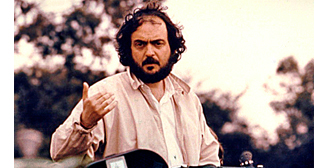 Kubrick managed it. After showing his commercial acumen with Spartacus, Lolita, and Dr. Strangelove (costume picture, controversial adaptation, satire) he was able to make 2001, a meditation on life and the cosmos in the trappings of science fiction. From then on, he could frame any project as both working in a familiar genre and offering a challenging narrative or theme. Thanks to shrewd marketing of both each project and his image, he invested his adaptations (A Clockwork Orange, Barry Lyndon, The Shining, Full Metal Jacket, Eyes Wide Shut) with a must-see aura. Whether or not the film was a top grosser, people said, this is a guy a studio wants to be in business with. Warners obliged.
Like Kubrick, Nolan moved from the independent realm to an assignment (Insomnia) before being entrusted with a big picture, the first of the Batman reboots. As he developed the Dark Knight trilogy, he made two films in the one-for-them, one-for-me mode (The Prestige, Inception). But Inception became his 2001, a genre hybrid (science-fiction/heist film) that proved that he could turn an eccentric “personal” project into a blockbuster. After The Dark Knight Rises, Interstellar showed that he could make an original genre film that was both prestigious (brainy, based on real science) and an event film. He became another director you want to be in business with. Warners obliged.
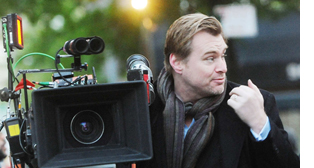 There are other affinities, surely. Both Kubrick and Nolan are often considered cerebral technicians, setting themselves gearhead problems with each project. They’re called cold as well. In Kubrick’s case, his detachment is best understood, as Jim Naremore has convincingly argued, as a commitment to the grotesque. Nolan, on the other hand, takes strong emotional situations as his premise but subordinates them to labyrinthine formal designs. For example, the conventional device of the dead wife justifies intricate plot structures in both Memento and Inception. Sensitive to the charge of coldness, in promoting every film Nolan emphasizes how his formal strategies aim to enhance emotion. But Kristin and I think that they’re of intrinsic interest, as she argues in relation to exposition in Inception.
True, Kubrick the former photographer is the more fastidious stylist. You can’t imagine him accepting that his film could be shown in three aspect ratios (as Dunkirk is). The Prestige shows that Nolan can be a precise pictorialist, but as I argue in our little book on his work he’s usually looser at the level of composition and cutting. What he’s interested in above all is narrative.
It’s rare to find any mainstream director so relentlessly focused on exploring a particular batch of storytelling techniques. Like Resnais, Godard, and Hong Sangsoo (a strange crew, I admit), Nolan zeroes in, from film to film, on a few narrative devices, finding new possibilities in what most directors handle routinely. He seems to me a very thoughtful, almost theoretical director in his fascination with turning certain conventions this way and that, to reveal their unexpected possibilities.
Specifically, I think, he’s interested in subjective storytelling, and how it interacts with a very traditional film technique: crosscutting. And he manages to make both fit within a genre framework.
Take Dunkirk. Spoilers ahead.
Field-stripping the war movie
In working on Reinventing Hollywood, I came to realize that the war film bristles with a lot of narrative possibilities. You can focus on a single protagonist, as Sergeant York and Hacksaw Ridge do. Or you can spread the protagonist function to two pals, three comrades, or an entire unit. Mission-team movies like Desperate Journey or The Guns of Navarone can be tightly plotted, but films about ongoing combat can be more episodic, stressing the long slog (The Story of G.I. Joe) or the need to respond to more or less random attacks (Battleground). In most variants, battles and strategy sessions alternate with relatively dead time when the grunts ponder their fate and talk about life back home. Letters from mom or photos of wives and girlfriends are a must.
One popular subgenre is the Big Maneuver movie. In The Longest Day the Allies’ landing at Normandy is given as a panorama across nations and a trip through the military hierarchy. The viewpoint sweeps from top brass on both the Allies’ and Axis side to lower-down infantrymen, partisans, and ordinary citizens. Although A Bridge Too Far stresses the generals’ debates about what turns out to be a failed strategy, it too spends time on lower-echelon officers.
In the Big Maneuver movie, certain scenes are conventional. We see briefing rooms fitted out with maps and models of the terrain. Because the cast is vast, officers are sometimes distinguished by titles (as well as being played by instantly recognizable stars).
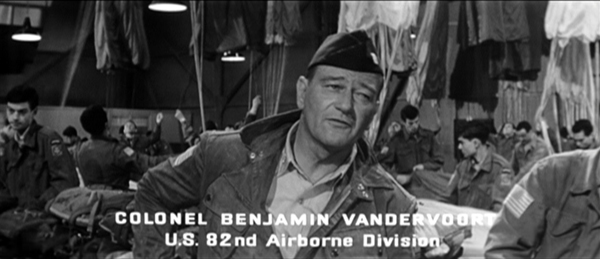
And when the film’s narration shifts to the grunts, we get quick characterizations that invoke their pasts. Early in The Longest Day, a rosary in an envelope reminds paratrooper Schultz of an incident at Fort Bragg.
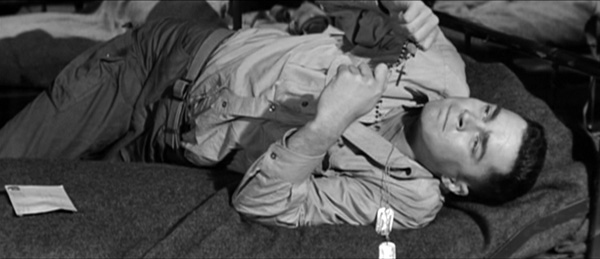
Later in the film we’ll find out what this incident was, and what it says about his character.
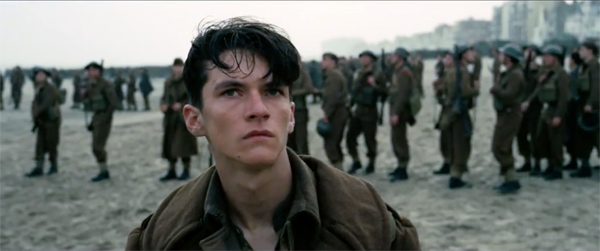
As many critics have noticed, Dunkirk adopts the framework of the Big Maneuver war movie but it strips away many of these conventions. The only map we can examine, as Kristin mentioned, is the one on the leaflets the Germans are circulating, and for our protagonist the leaflets’ biggest value is as toilet paper. Commander Bolton and Colonel Winnaut are the only brass we see, apart from a brief visit from a Rear Admiral. More important, they’re in the thick of it, not in some safe HQ reading dispatches and pushing toy ships around tabletops.
Just as important, Nolan has purged the characters of backstory. Tommy, Farrier, pilot Collins, the French boy posing as Gibson, and Alex, the angry soldier who attaches himself to Tommy, aren’t given family or memories, nor do they display tokens of home. We don’t even know how Tommy got those scars on his knuckles. Only Mr. Dawson has a bit of a past, and that’s given us late when we learn that his son, an RAF pilot, was killed–thus giving extra motivation to his patriotic urge to help in the evacuation.
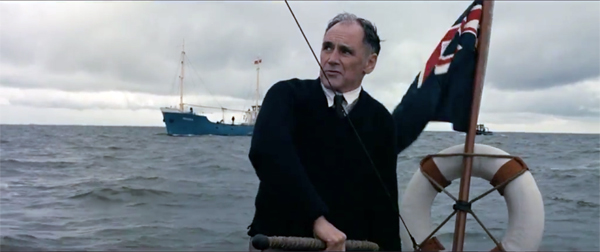
While critics complained of too much exposition in Inception, now Nolan gives almost none. In one sense, this laconic presentation is characteristic of the blank spaces we find in “art films,” where character motivation and psychology are often obscure. This is, by Hollywood standards, certainly a sparse war picture. Yet Nolan has spoken of this strategy as reworking a familiar structure. His film, he says, is all climax.
For me, this film was always going to play like the third act of a bigger film. There have been films that have done this in recent years, like George Miller’s last Mad Max film, Fury Road, or Alfonso Cuarón’s Gravity, where you’re dealing with things as the characters deal with them.
Kristin’s previous entry points out that in her model of classical plot structure, the film is actually both a Development and a Climax–that is, parts three and four. A Development section consists of obstacles and delays, which comprise most of the action of this film before the climactic bomber attack. Still, Nolan’s point is well-taken. In most climax sections (third acts), we know everything we need to know about the action. All the relevant motivations and backstory have been supplied in the earlier stretches, so we can concentrate solely on what happens next. In Dunkirk, we don’t see those prior sections, so we’re plunged into the prolonged suspense characteristic of climaxes.
The war movie as thriller
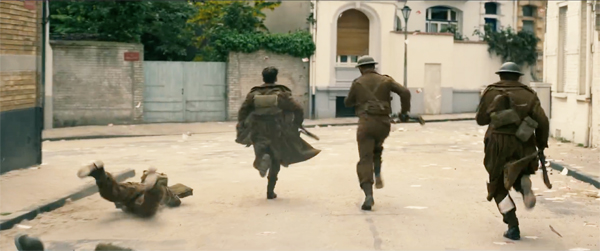
Granted, suspense is an ingredient of any war picture. Alongside GHQ debates about strategy, the Big Maneuver movie includes episodes aiming at momentary tension. The dive into the French village in The Longest Day offers the painful spectacle of men being shot down like a flock of geese, while A Bridge Too Far shows Urquhart (Sean Connery) trapped in a Dutch household as Nazis surround him.
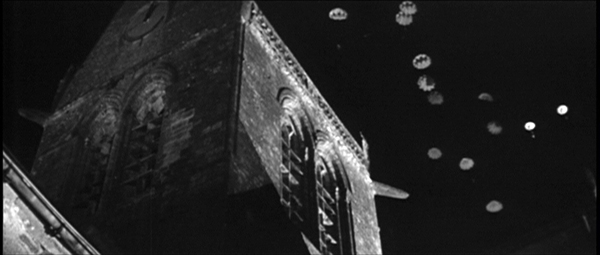
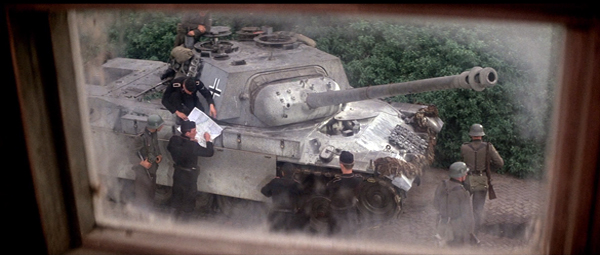
Nolan’s strategy, though, is to make virtually the entire film an exercise in suspense. He understands that pure suspense doesn’t require us to like or even know a lot about the characters. We can feel tension in relation to characters we don’t like (e.g., Bruno’s reaching for the lighter in Strangers on a Train) or characters we don’t know much about at all.
Dunkirk offers a cascade of primal dangers, an anthology of narrow escapes and last-minute rescues.
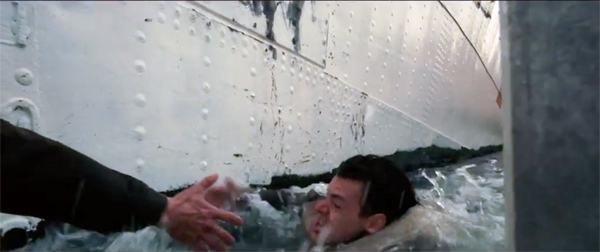
The whole film is a race against time, enclosing mini-races. Nolan plays on fears of being crushed, swallowed by darkness, blasted to bits, and shot out of the sky. How many ways can you drown–in a sinking ship, under a flaming oil slick, inside a Spitfire cockpit? The appeals are elemental and irresistible; a child of five could understand the dangers here. This catalogue of stark situations takes us straight back to silent cinema, to cliffhangers, Griffith rescues, and Lang’s dungeons filling with water. Nolan points out:
Dunkirk is all about physical process, all about tension in the moment, not backstories. It’s all about ‘Can this guy get across a plank over this hole?’
Those who want films to focus only on higher things, big ideas or subtle emotions, miss the visceral dimension of cinema. It’s led critics to avoid analyzing musicals, cop thrillers, Asian martial arts films, and Eisenstein’s action sequences. (Ritual invocations of The Body notwithstanding.) The Battleship Potemkin, Police Story, The Raid: Redemption, and much other excellent cinema happily passes The Plank Test.
Does this make the film superficial? Nolan explains that even in the absence of characterization, suspense triggers involuntary, universal responses. Consider Tommy trying to run across the plank.
We care about him. We don’t want him to fall down. We care about these people because we’re human beings and we have that basic empathy.
In creating the suspense, Nolan went, as he puts it, “in a more Hitchcock direction.” That entails, for reasons we’ve talked about here and here, playing between restricted and more unrestricted point of view. Not only do we not see the GHQ strategizing, we aren’t taken into the enemy camp. From the start, when gunfire drives Tommy down the Dunkirk streets, the attacks come from offscreen. Only at the very end will a couple of blurry Nazi-shaped figures appear behind the captured pilot Farrier.
In the end, the key for me was reading a lot of firsthand accounts of the people who were there. It became apparent to me that the subjective approach — really putting the audience on the beach with the characters, putting them in the cockpit of the plane, putting them on one of the boats coming across to help — that was going to be the way to tell the story and get across this much bigger picture.
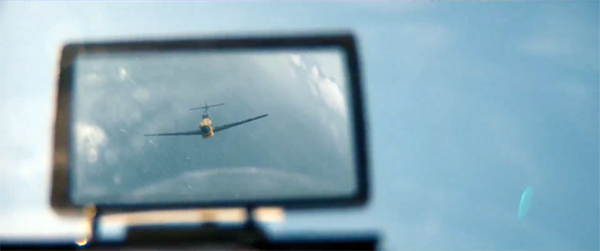
To drive home what it feels like to just barely get by, Nolan ties us tightly to Tommy the foot soldier, Mr. Dawson and his son Peter on their boat, and Farrier the Spitfire pilot, with side visits to Commander Bolton on the Mole. Sometimes he supplies optical POV shots, but more generally he simply confines us to what happens in these men’s ken. The result is both surprise–when the bullets or bombers appear–and suspense, when we cut between Tommy and other soldiers swamped below deck while Gibson struggles to open the hatch and free them.
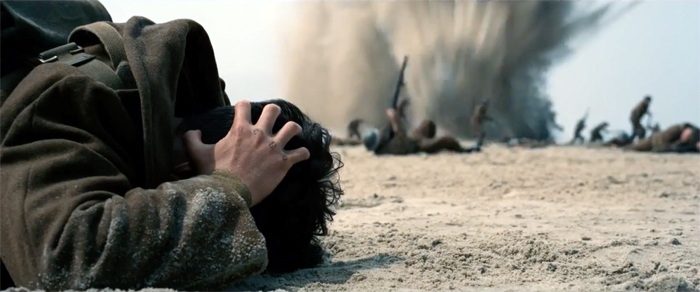
Even the clicking shut of a cabin latch–or not clicking it shut–generates tension, heightened by the ticking of Zimmer’s score. (At times I thought the pulse in my skull was synched up with the metronomic soundtrack.) The emblem of Nolan’s narrational strategy might be the pitiless shot surmounting today’s entry, showing Tommy flattened while bombs drop one by one behind him, coming inexorably closer to the foreground. Nolan turned superhero films, science-fiction films, and fantasy films into ticking-clock thrillers, and now he does it with a war movie.
The limiting of viewpoint links to some of Nolan’s perennial concern with subjectivity, I think, but it’s also there as a strain within the tradition of war fiction and film. Remarque’s novel All Quiet on the Western Front is like a diary, told in first-person present tense but with flashbacks in the past tense. Catch-22 is in long stretches tied to Yossarian’s jumbled memories of flight missions and hospital stays. Terrence Malick’s adaptation of The Thin Red Line, a film Nolan much admires, turns James Jones’ third-person novel into a lyrical fantasia on war as both a violation of nature and an extension of it, with flashbacks and brooding soliloquys. But in Dunkirk Nolan avoids the deeper registers of subjectivity he’s explored before–no memories, no dreams or fantasies, just brute happenings and the stubborn physical demands of earth and rock and water.
The viewpoint range isn’t as narrow as I’ve suggested, though. Nolan broadens his scope by cutting back and forth among the subjective stretches. Again, this is standard operating procedure in the Big Maneuver film. But that crosscutting was never like this.
Time out from battle
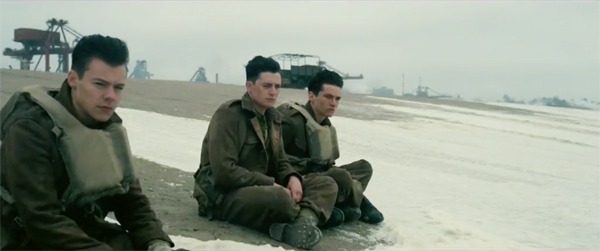
Dunkirk, sans credits, runs a little more than 99 minutes and consists of around 99 sequences. It’s very fragmentary. But then, so is a lot of war fiction. All Quiet consists of many fairly short scenes. Evelyn Scott’s vast novel The Wave (1929) surveys the US Civil War through over a hundred vignettes of the home front and the battlefront, involving characters mostly unaware of each other. William March’s Company K (1933) consists of 113 short segments, each bearing the name of one soldier and told in first-person by him (even if he dies in the course of the episode). Unlike what happens in The Wave, the men are mostly known to one another, and some actions are replayed through different viewpoints. A fancier sort of fragmentation goes on in Mailer’s The Naked and the Dead (1948), which interrupts its scenes with flashbacks (“The Time Machine”) and sections called “Chorus.”
T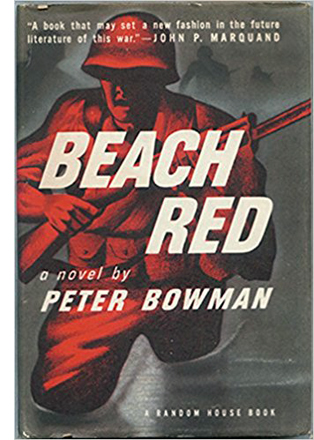 he war novel I’ve seen that’s closest to what Nolan gives us is Peter Bowman’s Beach Red (1946). The story tells of a US effort to capture a Japanese-held island. Bowman wanted, he explained to achieve “a sincere representation of a composite American soldier living from second to second and minute to minute because that is all he can be sure of.” This heightened sensitivity to duration led Bowman to try an unusual strategy.
His novel is in blank verse, in stanzas of varying length but all conforming to a strict pattern. Each line is equal to one second of story time. Each chapter consists of sixty lines, or one minute of story time. And the book has sixty chapters, representing the hour in which the forces take the beachhead. Like Nolan, Bowman wants a deep, visceral subjectivity, and he aims at this through a frankly mechanical layout of his text. The rigid pattern seeks to force the reader to sink into time. Bowman explains:
I have tried to create a mood of inexorable regularity that would correspond to the subtle tyranny of the military timetable. . . . I have attempted to do for the eye what the ticking of a clock accomplishes for the ear. . . the relentless inflexibility of time itself.
The aching inching forward of time is stressed thematically too, which includes reflections like “Would there be armies if clocks had never been invented?” The book ends with the second-person narration (“You”) dying. Soldier Whitney reports: “There is nothing moving but his watch.”
Like Bowman, Nolan is interested in both the psychology of time and the problem of representing it in his artistic medium. I maintained in our book on Nolan that he isn’t only interested in shuffling chronology. I think that he’s particularly keen on exploring what the technique of crosscutting does to story time.
He has explained that he got the idea from Graham Swift’s 1983 novel Waterland.
It opened my eyes to something I found absolutely shocking at the time. It’s structured with a set of parallel timelines and effortlessly tells a story using history–a contemporary story and various timelines that were close together in time (recent past and less recent past), and it actually cross cuts these timelines with such ease that, by the end, he’s literally sort of leaving sentences unfinished and you’re filling in the gaps.
Crosscutting would become a central artistic strategy for Nolan, a way of shaping his other storytelling choices.
Admittedly, what strikes you first about Memento is its flagrant exercise in reversing story order. But that 3-2-1 sequencing is accompanied by a counterpoint, that of chronologically advancing time, 1-2-3 in the present. Backwards-moving sequences are crosscut with forward-moving ones. Likewise, the structure of Following stems from treating phases of a single action as different story strands which can be crosscut. And the shuffling of order in The Prestige comes from intercutting stretches of two characters’ lives in complicated polyphony.
In his last three films, I think that Nolan, intuitively or deliberately, has hit upon an important feature of conventional crosscutting. Nearly all crosscutting in fictional cinema presumes different time spans, or rather different rates of change, in the crosscut lines of story action. We presume that overall the actions are simultaneous, but at a finer level, they proceed at different speeds. Some parts of the action in one line are skipped over, while other actions in another line are prolonged.
This disparity can be seen in some of Griffith’s classic sequences. In The Birth of a Nation, the black soldiers are inches away from breaking into the cabin’s parlor while the Ku Klux Klan is riding to the cabin, but the riders are miles away. If both strands were on the same clock, the Klan would arrive much too late.
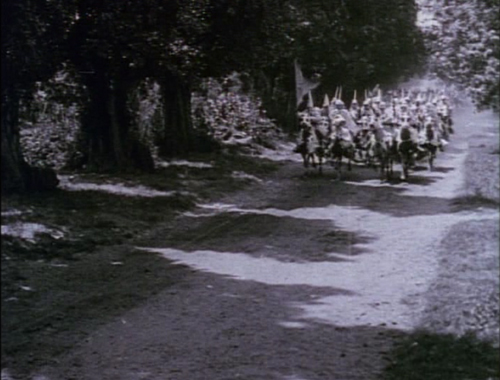
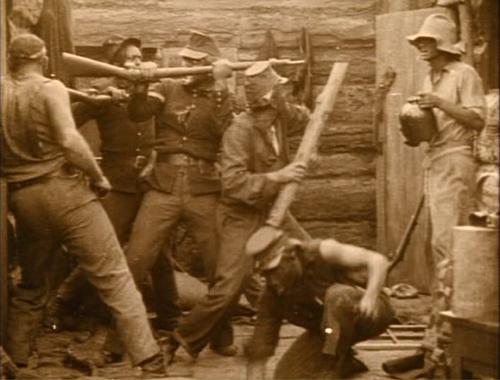
Crosscutting allows Griffth to skip over the distance that the Klan covers, so the riders arrive at the cabin “implausibly” fast. Correspondingly, the glimpses we get of the cabin stretch out the action “unrealistically.” To put it technically, we get ellipsis in one line of action, expansion in the other.
Nolan does the same thing in his crosscut sequences. Consider the passage in The Dark Knight when the judge opens the Joker’s fake message. One or two seconds in her timeline are stretched while Gordon’s conversation with Commissioner Loeb runs on a different clock, consuming several seconds. And when Harvey Dent talks with Rachel and is grabbed by Bruce, that action takes even longer.
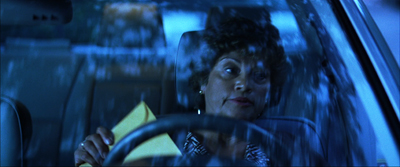
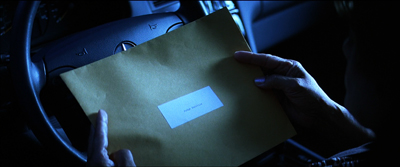
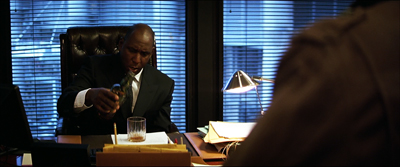
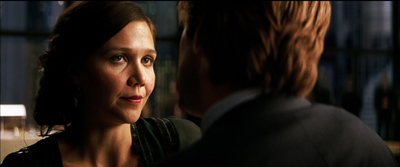
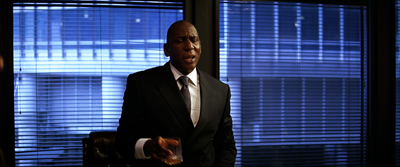
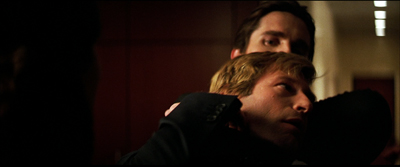
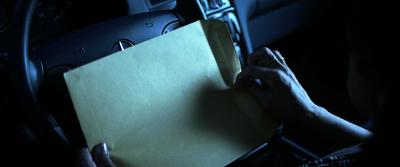
To speak of different clocks is a bit misleading; we can’t think that the judge turns over the envelope in super-slo-mo. But the idea of different rates of unfolding is useful because it reminds us that crosscutting aims to convey an overall impression of simultaneity. When we look closer, we realize that the action in one story line can be slowed or accelerated while another story line is onscreen.
Nolan’s interest in this quality of crosscutting is literalized in Inception, in which embedded dream actions unfold at different speeds on different levels. In Interstellar, cosmology motivates crosscutting between slow and fast rates of change. In the first planet the astronauts visit, one hour is equal to seven years on earth, so characters literally live at different rates. The pathos of the film depends upon the fact that Cooper returns, barely aged, to his daughter, to find an old woman on her deathbed. But the differential also allows Cooper to appear to her as the ghost that she saw in childhood and, in circular fashion, set him off on his mission.
The war movie as puzzle film
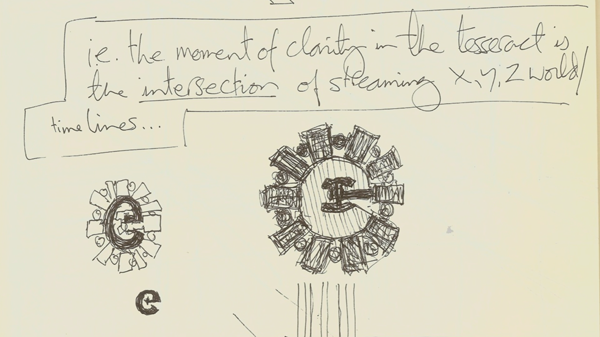
Nolan notes for Interstellar.
For Dunkirk, Nolan found another way to highlight the rate differences secreted within crosscutting. Like Bowman in Beach Red, he lays down crisp time markers. Farrier’s combat sortie lasts one hour; Dawson’s rescue efforts at sea last one day; and events around the breakwater (the Mole) are said to consume one week. The actual evacuation ran longer, but Tommy and his pal aren’t the last to leave.
These three stretches of action could have been presented as separate blocks. We might have been attached first, say, to Dawson and his boat to attain a pitch of excitement during the bombing of the minesweeper. Then we could flash back to Tommy at the start, in a long lead-up to being rescued by Dawson. Finally we could cover the same events yet again by starting with Farrier’s aerial combats and tracing his fate. The film could have concluded with an epilogue showing Tommy and his pal safely on the train.
Interestingly, Kubrick explored this creative option to a limited extent in The Killing, his 1955 adaptation of Lionel White’s Clean Break. As in the novel, one string of scenes sticks with one participant in a racetrack robbery. Then we jump back in time, guided by a voice-over narrator (“About an hour earlier…”) and follow another man leading up to the situation we’ve already seen. Tarantino did the same block-shifting in Reservoir Dogs, Pulp Fiction and Jackie Brown, and he (rightly) noticed it as a standard literary technique.
Novels go back and forth all the time. You read a story about a guy who’s doing something or in some situation and, all of a sudden, chapter five comes and it takes Henry, one of the guys, and it shows you seven years ago, where he was seven years ago and how he came to be and then like, boom, the next chapter, boom, you’re back in the flow of the action. . . . Flashbacks, as far as I’m concerned, come from a personal perspective. These [in Reservoir Dogs] aren’t, they’re coming from a narrative perspective. They’re going back and forth like chapters.
But Nolan avoided block construction and went for braiding. He splintered his story lines and crosscut them. Events that are mostly taking place at different times are, as it were, laid atop one another and offset. Crosscutting en décalage, we might say.
I’m struck by how bold this is. A more conventional choice would be to confine the action to a fairly brief stretch of time, say two hours, with the rescue fleet arriving at the climax. There might even have been an effort to handle the action as occurring in “real time,” that is, with the duration of the scenes matching their duration in the story. In any event, Nolan could have crosscut his four men–Farrier in the air, Dawson and others at sea, Bolton and Tommy around the Mole–at the points when their activities are roughly simultaneous. If Nolan wanted to include earlier incidents, such as Tommy’s escape from the Germans or his efforts to board the Red Cross ship, those could have been presented as personalized flashbacks. Instead, all that material appears in chronological scenes, but on three distinct time scales.
Nolan set himself enormous problems with this choice. He chose to show the time frames without recourse to an onscreen calendar or clock; after the three initial titles indicating the places and the time spans, we get no more explicit markers. Then Nolan faced the problem of how, on a finer-grained level, to gather these fragments into a whole. He had to create parallels, and, eventually, convergences.
So early in the film, Tommy and Gibson run a stretcher to the departing Red Cross ship.
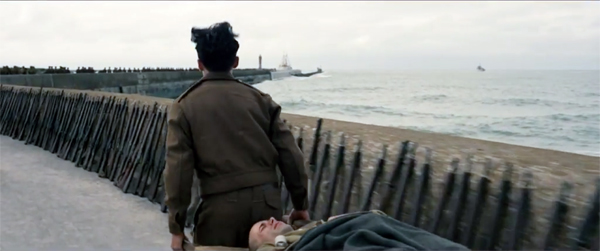
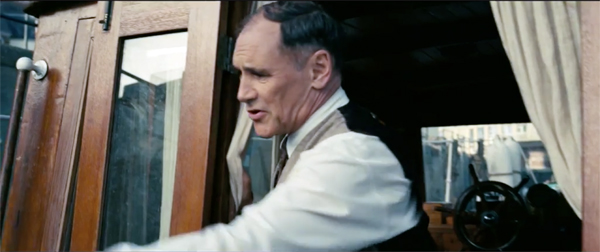
Cutting makes their urgency flow into that of Mr. Dawson hastening to cast off before the navy requisitions the Moonstone.
Forty-five seconds later Farrier’s team is sent to Dunkirk.
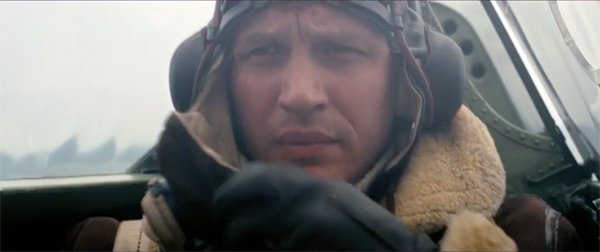
In story time, of course, these aren’t simultaneous at all. Tommy’s attempted escape happens days ahead of Mr. Dawson’s departure, which is hours ahead of Farrier’s mission. But Nolan, aided by Hans Zimmer’s endlessly propulsive score, has given all three primary roles in launching the film’s plot, the start of a time-gapped fugue.
That sort of primacy works at a higher pitch when two life-or-death situations are intercut. Tommy, Alex, and some other soldiers have rashly taken shelter in a fishing trawler, hoping that the tide will carry them away from the beach. But they get pinned inside by target fire. The tide has indeed pulled them out to sea, but the hold is taking on water–at the “same time” (not) that Collins, trapped in the cockpit of his ditched plane, is himself about to drown. The two scenes are intercut.
At the climax, the gestures of rescue are exuberantly crosscut: Dawson hauling on the oily survivors of the blasted minesweeper, the civilians helping the stranded soldiers clamber aboard their boats.
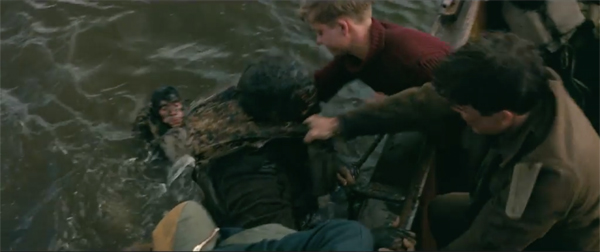
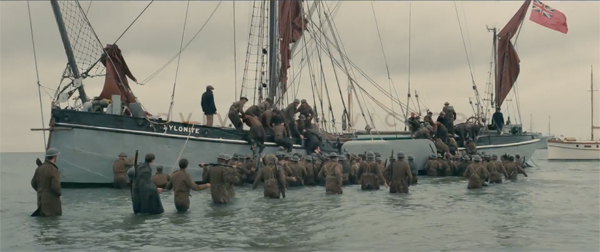
In this passage, Nolan daringly cuts single shots of Dawson’s Moonstone moving as if in sync with the impromptu flotilla, even though he’s some distance off; the crosscutting makes him visually one of the fleet near the Mole.
Crosscutting can also dial up the suspense by delaying the outcome of a line of action. Farrier’s dogfights are pretty much incessant, so cutting away from them to more placid action on the beach or in Dawson’s boat postpones their outcome. Nolan points to another advantage of intercutting the different periods:
You have three different intertwined storylines, and you have them peaking at different moments, so that the idea is that you always feel like you’re about to hit–when you’re hitting the climax of one episode of the story . . . then another one is halfway through and the other one is just beginning. So there’s always a payoff.
Nolan compares this to the “corkscrew” effect of the Shepard Tone in music, which David Julyan used in the drone soundtrack of The Prestige.
At other points, the crosscutting uses one line of action to explain another. While Tommy and Gibson take refuge in the second ship, the Shivering Soldier tells Dawson he refuses to return to Dunkirk because his ship was hit by a torpedo. Soon enough we see a torpedo rip open the ship and plunge Tommy, Gibson, and Alex into the night sea. And soon after that, when they try to clamber into a lifeboat, they’re told by an officer to stay in the water: it’s the Shivering Soldier, pre-PTSD. The contrast between his cool efficiency near the Mole and his spasm of cowardice on the Moonstone is another proof of war’s disastrous impact on warriors.
The lines of action, segregated by crosscutting, intersect eventually. Farrier’s teammate Collins ditches his plane and is rescued by Dawson; later Tommy will get on the Moonstone as well. These are staggered a bit in the film’s unfolding, having the effect of replays. At at least one point, though, I think that all three lines converge. One moment unites Farrier shooting down the German bomber, Dawson steering his ship away from the falling plane, and Tommy, dragged along underwater and hauled to the deck. Shortly the realms of Air and Mole converge when Bolton sees the German plane go down and his men cheer Farrier’s plane as it glides past.
After these moments are briefly pinned together (the script calls it the “confluence”), the time scales diverge again. The epilogue phase of the film resets each strand’s clock. The rescued men arrive at Dorset, and Tommy and Alex board a train at night. Back at the Mole, it’s still daylight and we can see Farrier’s plane burning in the distance. A day or so later in Dorset, the newspaper has published a tribute to George. Now we see Farrier days before, still within his allotted hour of story time, guide the plane down, step out, and set fire to it, as Tommy reads from Churchill’s speech.
Three viewings of the film weren’t enough for me to catch all the alignments, shifts, and echoes, the glimpses of things that take on importance only retrospectively. Early on, a distant shot of Collins’ downed plane briefly shows what turns out to be the Moonstone chugging towards it. On first viewing I was puzzled by Farrier’s view of a sinking private ship; only on the second pass did I realize that it’s the blue trawler that we’ll later see the young soldiers hiding in and fleeing from. And it’s likely, even with many pages of notes, that I’ve mistaken some of the juxtapositions that fly by. (The film averages about 3.3 seconds per shot, and sometimes we jump across story lines in a fusillade of alternations.) Like other puzzle films, the film demands rewatching and scrutiny, and it merits it.
In all, Nolan has taken the conventions of the war picture, its reliance on multiple protagonists, grand maneuvers, and parallel and converging lines of action, and subjected it to the sort of experimentation characteristic of art cinema. (As, in a way, Bowman’s time-grid in Beach Red anticipates the rigor of the Nouveau Roman.) Nolan exploits one feature of crosscutting: that it often runs its strands of action at different rates. He then lets us see how events on different time scales can mirror one another, or harmonize, or split off, or momentarily fuse. As a sort of cinematic tesseract, Dunkirk is an imaginative, engrossing effort to innovate within the bounds of Hollywood’s storytelling tradition.
The juxtapositions aren’t just fancy footwork, I think. In this film, because of the imminence of danger, heroism gets redefined as luck and endurance.
A cynic could call the movie Profiles in Cowardice. Tommy flees German bullets and instead of helping the French hold the barricades, he keeps running. The French boy steals boots and an identity in order to get off the beach sooner. He and Tommy try to slip on board a departing Red Cross ship as stretcher bearers. When that fails, they hide among the pilings. When the ship is hit, they leap into the water, the better to pretend to have been among the survivors and get a new ride. The Shivering Soldier wants to cut and run, and the soldiers who drift beyond the perimeter plan to use the blue trawler to carry them to safety, jumping the evacuation queue. All too often, despite acts of aid and comfort, it’s every man for himself.
At one point Alex claims “Survival’s not fair.” Too right. Mr. Dawson risks his and his son’s life to save a few men, while the lad George, who joined them on impulse and promised to be useful, dies before he can do much, accidentally killed by the Shivering Soldier. The closest the film comes to standard war-movie heroics is Farrier’s cutting down Stukkas. And he doesn’t make it back.
By plunging Tommy and his counterparts into almost unremitting peril, Nolan’s suspense tactics lower the bar for heroism, making us hope that they simply get away, somehow. Trapped on land and sea, you can’t fight dive bombers, U-boats, and marksmen squeezing in from the perimeter. At the end, the boys disembarking at Dorset are reassured that survival was enough. And thanks to Nolan’s crosscutting, individuals at different points in time are shown pulling together to make retreat its own victory.
I wrote nearly all this entry before I got a copy of the published screenplay. Reading Nolan’s conversation with his brother there enabled me to add the quotation about catching lines of action at different points (p. xxii). This conversation also considers the reasons Nolan omitted GHQ scenes (mentioning A Bridge Too Far) and adds comments about Hitchcock, early sound filming (some mistakes here), and The Thin Red Line (“maybe the best film ever made,” xiii). As far as I can tell, the screenplay is fairly close to the finished film until the climactic bombing of the minesweeper; at that point, the onscreen editing doesn’t completely match what’s on the page.
Speaking of climaxes, I should add that even though the film is in Nolan’s sense “all climax,” it also falls quite nicely into Kristin’s four-part structure. I think the midpoint comes when Tommy and his mates head to the blue trawler, starting a typical Development section.
My quotation from Tarantino comes from Jeff Dawson, Quentin Tarantino: The Cinema of Cool (New York: Applause, 1995), 69-70. The Nolan quotation about Waterland comes from Jeff Goldsmith, “The Architect of Dreams,” Creative Screenwriting (July/ August 2010), 18-26 (available, sort of, here).
On the tendency of war novels to play with time, it’s worth mentioning that Catch-22 may exemplify one weird possibility. The Yossarian plotline slips between past and present very fluidly, with some sentences containing several jumps to and fro. The Milo Minderbinder plot is linear, tracing Milo’s building of his empire in 1-2-3 order. But Milo’s progress appears at different moments in past and present in the Yossarian strand, so some critics have argued that the novel has a deliberately impossible time scheme. See Jan Solomon, “The Structure of Joseph Heller’s Catch-22” (1967) and, for rebuttal, Doug Gaukroger, “Time Structure in Catch-22“ (1970). Even if Catch-22 doesn’t actually do this, it remains a creative option that someone should try. Mr. Nolan?
Is the name of Dawson’s boat, the Moonstone, an homage to Wilkie Collins’ 1868 mystery novel? Collins tells the story through different character viewpoints and skips back and forth in time, using replays that gradually explain what’s going on. Mr. Nolan?
For more on block construction, especially in the work of Tarantino, see this entry. You can find more of our thoughts on Nolan’s work in our book Christopher Nolan: A Labyrinth of Linkages (with lots more about crosscutting). See also our blog entries on Inception (here and here), “Superheroes for Sale,” and “Niceties,” and our online article (originally in Film Art) on sound in The Prestige.
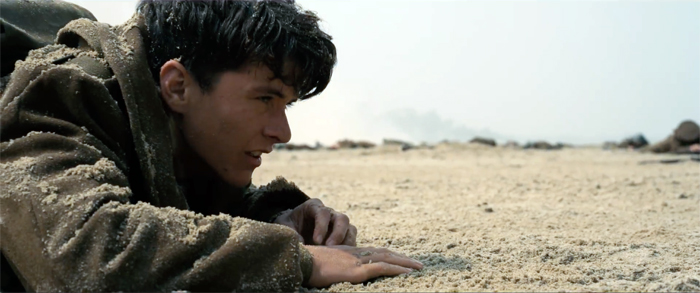
Dunkirk (2017).