





Archive for the 'Film comments' Category
From Hollywood to Atlanta to us
DB here:
Some day Ph. D. students will be writing dissertations on the contribution of Turner Classic Movies to US culture. I’d argue that Ted’s baby is as important to our collective sense of cinema history as the establishment of the Museum of Modern Art Film Department was.
As a movie fan, I’m overwhelmed by the chance to see so many of my favorites for the cost of monthly cable. As a film researcher, I find myself feeling as if a film archive dumped a dozen movies on my front lawn every morning. In 1990, my colleagues and I would’ve killed for the opportunity to see this stuff, and now it’s whizzed to us at home. “Seven Brides for Seven Brothers again?” some of us sigh. We are so spoiled.
 To refresh his core MGM-RKO-WB titles, Turner showcases items from Columbia, Paramount, Goldwyn, and other studios. The channel has become an eternal college course in cinema, with no exams or papers and all viewers happy to earn a perpetual Incomplete.
Why mention TCM now? Because I’m especially wrought up by what’s on offer over the waning days of January. Every day boasts many classics, so I’ll mostly skip mentioning all the fine standbys that they’re running. Here are more offbeat things I’m up for, most of which I haven’t seen.
Overturning centuries of Western tradition, TCM defines a new day as starting at 6:00 AM. Sounds reasonable to me. But check for local playing times.
Jan 21: Stolen Moments (1920): I don’t get Rudolph Valentino’s appeal, but any film from this era demands a look.
Munchhausen (1943) A textbook classic from the Nazi cinema.
Jan. 22: The Legend of Lylah Clare (1968): Trashy premise + Kim Novak + Robert Aldrich = must-see.
Jan. 23: A cornucopia. I’ll just keep the recorder going all day for:
The Black Book (1949): As oddball a film as Anthony Mann ever made, with John Alton’s pitch-black scenes turning the French Revolution into a noir nightmare. Forget the commercial DVD, evidently ripped from a 16mm print; the TCM version should look better.
Gangster Story (1959): Walter Matthau starred and directed this NYC low-budgeter.
The Guilty Generation (1931): From Rowland V. Lee, endless supplier of B’s.
The Criminal Code (1931): Excellent Hawks with Karloff. Bogdanovich paid tribute to this in Targets.
A string of Boston Blackie films, from 1941-1942: I remember this popular B series from TV syndication in my childhood. Fast-paced and punchy, with direction by Robert Florey, Edward Dmytryk, Michael Gordon, and the prolific Lew Landers.
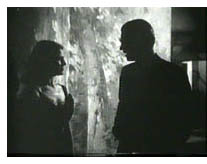 Angels over Broadway (1940; on right): Mostly shot in one nightclub set (in the Astoria studio?), a murky drama signed by Ben Hecht and Lee Garmes. Douglas Fairbanks Jr., Thomas Mitchell, and a young Rita Hayworth fill out sober long takes.
The King Steps Out (1936): Hard-to-see von Sternberg.
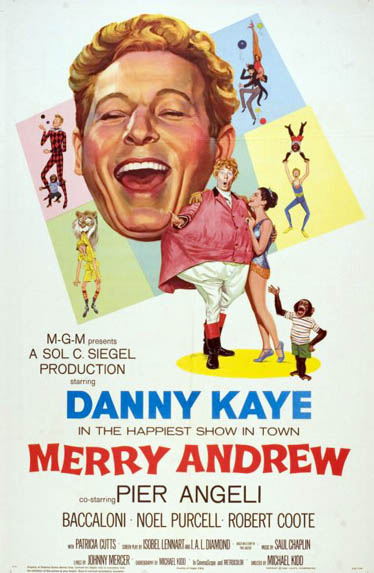
Jan. 24: Of course you’ll watch La Strada, Detective Story, The Big Carnival, etc. if you haven’t seen them. Me, I’m poised to record Merry Andrew (1958), a CinemaScope vehicle featuring Danny Kaye as an Oxbridge archaeologist. The film contains another unexorcizable ghost from my childhood, the song “Everything is Tickety-Boo.” What’s tickety-boo? Canadians know.
Jan. 25: Lots of prime stuff, including Experiment in Terror, Anatomy of a Murder, Dead Heat on a Merry-Go-Round, The Caddy, and several classic MGM musicals.
Jan. 26: A day devoted mostly Paul Newman and Paris, but there’s also:
The Killer Is Loose (1956): Boetticher. Say no more.
To Paris with Love (1955): Robert Hamer, director of the Ealing classic Kind Hearts and Coronets, gave us this, starring Alec Guinness, one of cinema’s finest and most modest actors.
A drive-in horror double bill courtesy William Beaudine: Billy the Kid vs. Dracula (1966) and Jesse James Meets Frankenstein’s Daughter (1966).
Jan. 27: Of course you’ll see, if you haven’t, Gunga Din, The Yearling, The Naked Spur, The Manchurian Candidate (kinda overrated, methinks), The Spy Who Came in from the Cold (kinda underrated), The Quiet American, etc. But there’s also:
The Last of the Mohicans (1935): This, rather close to Michael Mann’s later version, I remember as being pretty solid.
A Bullet for Joey (1955): Edward G and George Raft in their sunset years; can it be bad? Okay, it can, but I’m still going to check it out.
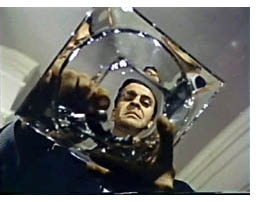 Jan. 28: Among much good stuff, including the still poignant Umbrellas of Cherbourg, I’ll be targeting Dragnet (1954), a nifty, seldom seen feature by that unique genius Jack Webb. How often do we get an ashtray’s-eye-view of a scene? Does this cablecast portend a DVD release?
Jan. 29: It’s teen dance music till prime time: Bop Girl, Rock around the Clock, Don’t Knock the Rock, Don’t Knock the Twist, Don’t Rock the Twist, Don’t Twist My Rock, etc. Might just as well keep the recorder rolling… and rocking!
Today’s outstanding piece of esoterica is The Show (1927). Every year or so I’ve been writing TCM to ask them to play this strange item from the agreeably warped Tod Browning. Let’s just say that John Gilbert plays Cock Robin and Renee Adoree plays Salome, with Lionel Barrymore chewing the scenery as the villain. Other attractions include cuckoldry, decapitation, and murderous iguanas. With a new score from TCM’s highly laudable Young Composers competition.
Jan. 30: Of course you’ve seen Ford’s stunning Arrowsmith, Pressburger’s Life and Death of Colonel Blimp, This Happy Breed, Shane, His Girl Friday, etc. But don’t forget:
The Clairvoyant (1935): the relentlessly prolific Maurice Elvey, doyen of Brit good taste, directs Claude Rains (ditto) and Fay Wray.
Strike Me Pink (1936): Eddie Cantor isn’t for all tastes, but I want to give this one a chance.
Raffles (1939): I’m a sucker for gentleman-thief stories, and with Gregg Toland as cinematographer, Sam Wood may indulge his Gothic streak, so memorable in Our Town and Kings Row.
Jan. 31: Not as strong a day as yesterday, but I’ll be checking on This Could Be the Night (1957), helmed, as they say, by Robert Wise and starring the radiant Jean Simmons (another adolescent fascination of mine), and Mitchell Liesen’s The Mating Season (1950), written by Charles Brackett and starring the fascinatingly blank Gene Tierney.
February, devoted to Oscar pictures, doesn’t contain so many marginal items, but still it’s a cornucopia of outstanding movies.
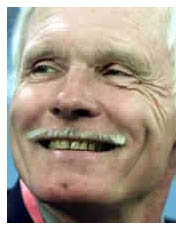
Controversial as he is, Ted Turner has proven a generous mogul, both politically and cinematically. Forget colorization! That was a bogus issue, and anyhow, for every colorized title a spanking fine-grain positive was made for archival preservation. Turner has done more than any single person to sustain and publicize the American film heritage, and he’s made it available to everyone within reach of cable. You can read more about Ted in Ken Auletta’s brisk and chatty biography.
Dorothy’s rainbow comes to earth at TCM. Watch regularly. Check the website for extra stuff, and browse the 150,000 film database. Buy the monthly program guide; it’s only twelve bucks. While you soak up the pleasure, pause to pity the cinephiles overseas. Their version of TCM, hedged by rights holder restrictions, offers mere crumbs from our bursting banquet table.
PS: Since I first posted this, film historian Doug Gomery has pointed out that Turner hasn’t controlled TCM in 12 years, but both Time-Warner bosses Gerry Levin and Dick Parsons have kept it going. We owe them thanks for refusing to ‘AMC’ it with commercial breaks and dopey gimmicks. Fortunately it makes money for TW. Long may TCM prosper.
PPS as of 23 Jan.: Lee Tsiantis of the Turner Entertainment Group adds that credit also belongs to Jeff Bewkes, who among other duties oversees the channel. So a big thanks to him as well.
Updates and outtakes (in which we try, perhaps in vain, to catch up with ourselves)
Exiled
Kristin writes:
“The Hobbit Film: New Developments” (January 13, 2007)
In this entry I discussed Bob Shaye’s recent claim that Peter Jackson would never get a chance to direct The Hobbit for New Line. I mentioned that one of the factors involved in the negotiations about who would direct is that the production rights will eventually revert to producer Saul Zaentz. I didn’t know the length of the option on those rights, which New Line currently holds. The January issue of the fantasy/sci fic magazine Locus says that the rights will revert to Zaentz in 2009.
Zaentz had owned the rights since the mid-1970s and sold them to Miramax in early 1997. Miramax had the two-film version of The Lord of the Rings in pre-production for about 18 months and then sold the rights to New Line in August of 1998. I don’t know what the source of Locus’ information is, but a twelve-month option would seem pretty plausible.
If that information is correct, New Line only has about two years to get the actual making of the film underway. It takes years for any big film to lumber into production in Hollywood these days, so the studio doesn’t have a lot of room to wiggle.
“By Annie Standards” (December 14, 2006)
Here I talked about methods for publicizing animated features. One way, I suggested, would be to foster audience interest in the various animation awards other than the Oscars. I remarked, “Under Academy rules, only three animated features can be nominated in any year unless sixteen or more such features are released that year. Then the number of nominations jumps to five, but so far that hasn’t happened. It may finally happen this year, if all sixteen features currently under consideration qualify under Academy rules.”
Close, but not close enough. On January 11, Variety announced that one film, Luc Besson’s Arthur and the Invisibles, had been disqualified as an animated feature. To qualify, a film must have at least 75% animated footage, and Arthur has too much live action.
With the number of qualifying features down to fifteen, only three can be nominated. Probably Cars will win, as I predicted in the original entry. It just won the Golden Globe in the newly established Animated Film category.
“Snakes, No, Borat, Yes: Not All Internet Publicity Is the Same” (January 7, 2007)
Here I suggested some reasons why Snakes on a Plane failed at the box office and Borat: Cultural Learnings of America for Make Benefit Glorious Nation of Kazakhstan succeeded, despite the fact that both garnered considerable fan-generated publicity on the internet. I mentioned that Sacha Baren Cohen had appeared on talk shows in character as Borat rather than in persona proper: “Each appearance by “Borat,” supposedly there to talk about the film, ended up being a hilarious performance by Cohen, ad-libbing on everything around him—the chairs, the coffee mugs, the cameras, the audience. Spectators ended up with one impression about the film: it was about this incredibly funny guy doing incredibly funny things.”
Trying to correct the widespread assumption that Borat was an improvised film, the January 8-14 issue of Variety ran a story about how Cohen worked with three scriptwriters, Peter Baynham, Dan Mazer, and Anthony “Ant” Hines: “The scribes even concoct Cohen’s dialogue for his promo appearances on ‘The Tonight Show’ and ‘Live With Regis and Kelly.’” Although Cohen presumably ad-libs to meet specific circumstances of each talk show, the publicity appearances are even more controlled by Cohen than I had assumed.
I also remarked that it is difficult to judge the degree to which the film manipulated the scenes of Borat’s encounters with real people. Especially in terms of editing and sound techniques, there was clearly much opportunity for this manipulation. The same Variety story goes on to say, “Much of the script had to be altered depending on how situations unravel. This means the writers ultimately end up producing the equivalent of multiple scripts, much of which ends up on the cutting room floor.” I’m not sure how chunks of scripts can end up on the cutting-room floor, but the point is that the filmmakers were carefully stitching the “documentary” scenes together on the script level and presumably would do so through stylistic means as well.
David writes:
Back to the Hotel
The Uchoten Hotel (aka Suite Dreams, blogged here) has acquired yet another English-language title: Hotel Avanti. It made it to #93 on Variety‘s list of the world’s 100 top-grossing films, with $51 million box office in Japan and none yet recorded overseas.
Speaking of Variety‘s list, the highest-grossing non-English language item turns out to be Bong Joon-ho’s Korean hit The Host (#59 at $84 million), due out in the US any month now. Only ten non-English-speaking films made the top 100, and of those, three were European (including Volver) but all the rest were Asian: Chinese (Fearless), Korean (The Host and King and Clown), and Japanese (Tales from Earthsea, Umizaru 2 Limit of Love, Hotel Avanti, and Japan Sinks–no rude remarks, please).
The entire list is in the 15-21 January hard copy of Variety, p. 15, but evidently it isn’t yet available on the paper’s site.
More on Johnnie To
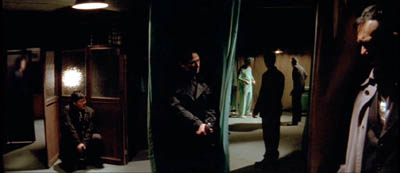
In an earlier blog I praised Johnnie To as a director who shot and cut PTU smoothly and crisply. I waited through the fall, hoping somehow to see To’s latest, Exiled, on the big screen at one festival or another. No such luck. So last night I broke down and watched the DVD. Making full use of the widescreen format, To shows that classic technique can be at once rigorous and imaginative.
Exiled was more visually engaging than any US film I can recall last year, including Miami Vice. It immediately became my Best Film of 2006 That I Saw in 2007. (Runner-up: Children of Men.) I visited Milkyway while the film was being shot, and I hope to blog about the result in a future entry.
At Large on the Internets
On this very site, I’ve posted a new essay on action movies.
Annie Frisbie interviewed me for the Zoom-In podcast here. Annie is also blogging/reviewing Sundance films here.
Fox Independent visited Madison and posted videos on its site. The setup and the interview with filmmaker and teacher Erik Gunneson are here. An interview with me is here.
Shot-consciousness
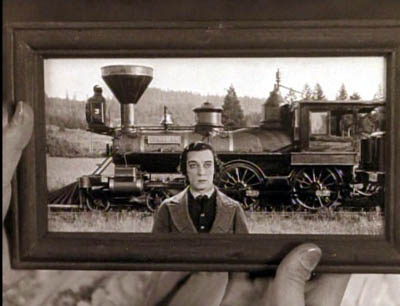
Most professional critics seem uninterested in the film shot as a shot. They might notice when the images call flagrant attention to themselves, as in Zhang Yimou’s recent films, or in those protracted walk-and-talk Steadicam takes. On the whole, though, reviewers prefer to talk about plot and acting.
Granted, it’s hard to be aware of shots, especially if you get engrossed in the story. But if we want to be fully alert to how movies work on us, we should keep our eyes open. Back in 1968, I read The Moving Image by Robert Gessner, one of the first teachers of cinema studies in the US. There Gessner offered a sturdy piece of advice: Be shot-conscious.
About twenty years later, trying to be shot-conscious and all, I started to notice a certain type of image becoming more common, especially in European and Asian films. Then it started to appear in US films as well, especially indie items. Now it’s very common everywhere, though it’s still not the predominant sort of shot.
Here’s a fairly early example, from R. W. Fassbinder’s Katzelmacher (1969).
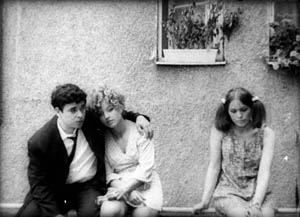
How to characterize it? The camera stands perpendicular to a rear surface, usually a wall. The characters are strung across the frame like clothes on a line. Sometimes they’re facing us, so the image looks like people in a police lineup. Sometimes the figures are in profile, usually for the sake of conversation, but just as often they talk while facing front.
Sometimes the shots are taken from fairly close, at other times the characters are dwarfed by the surroundings. In either case, this sort of framing avoids lining them up along receding diagonals. When there is a vanishing point, it tends to be in the center. If the characters are set up in depth, they tend to occupy parallel rows.
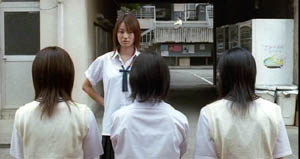
Linda Linda Linda (2005)
No one to my knowledge had noticed this sort of shot, let alone named it. I started to call it mug-shot framing, but I found that art historian Heinrich Wölfflin had called it planar or planimetric composition. I went with “planimetric” because that term suggests the rectangular geometry so often seen in these shots.
What’s striking is that such imagery is quite rare before, say, 1960. We can find some examples, principally in silent comedy and especially the films of Buster Keaton (himself a pretty geometrical director). But in the 1960s, we find Antonioni and Godard using planimetric shots fairly often.
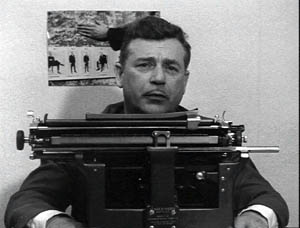
Vivre sa vie (1962)
This image design became more popular from the 1970s onward. Why? In On the History of Film Style and Figures Traced in Light, I tried to trace out some sources and functions of it. Briefly, I think that the planimetric shot emerged from filmmakers’ growing reliance on long lenses, which tend to create a flatter-looking, more cardboardy space than wide-angle lenses do. A telephoto shot makes an image seem less voluminous. It seems to be made of slices of space lined up one behind another.
Filmmakers began using long lenses for many purposes, often because of the demands of filming on location. And some directors realized that long-lens optics offered fresh resources for staging and composition.
For instance, the planimetric scheme is well-suited to a “painterly” or strongly pictorial approach to cinema. In Figures, I discuss two directors who made planimetric shots central to their style. Hou Hsiao-hsien saw very deeply into the possibilities of these shots; I think he learned it from his early skill at shooting on the street with long lenses. You can find more about that here. By contrast, Angelopoulos used the planimetric image in conjunction with architecture and landscape to create a sort of de-dramatized spectacle, a spare grandeur reminiscent of icon painting.
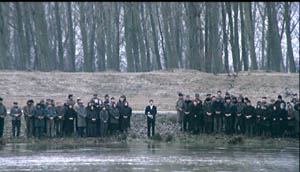
The Suspended Step of the Stork (1991)
The functions of the planimetric image can vary a lot. Often it’s used to suggest stasis and passivity, as in the Katzelmacher instance. Kitano Takeshi picks up on this sense of torpor in certain shots of Sonatine, which suggests that being a gangster means having a lot of time to kill just hanging out.
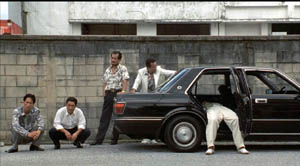
Kitano’s use of the image also suggests a kind of childish simplicity or naïve cinema. Unlike Hou and Angelopoulos, Kitano uses the planimetric schema as if it were just the most basic way to film anything. Line up your characters and shoot ’em, as if they were figures in South Park or Cathy.

Kitano has compared himself to the kamishibai man, the street performer who narrates stories for children by flipping through illustrated cards, and Kitano’s paintings are more sophisticated, often planimetric versions of those drawings.
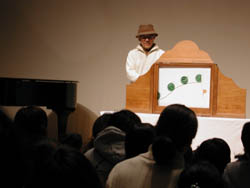
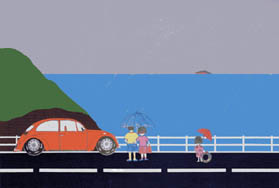
The planimetric schema can suggest something more oppressive too. That’s one purpose, I think, of certain shots in Terence Davies’ remarkable Distant Voices, Still Lives. The film’s stylistic system is quite rigorous in its use of straight-on compositions, and it’s worth more attention than I can give it here. For now I’ll just mention that the first part presents tableaux of unhappiness that suggest bleak family portraits.
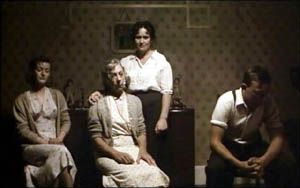
Here and more generally, the planimetric image often carries the connotations of a posed photograph. Possibly the dry, rectilinear imagery of Walker Evans and the wide-eyed attitudes of Diane Arbus’s portraits have contributed to the sense of stiff ceremony such shots sometimes have.

Walker Evans, Roadside Stand Near Birmingham (1936)
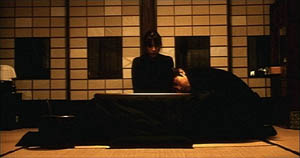
Asian filmmakers combined the planimetric image with very long takes. In Kore-eda Hirokazu’s Maborosi, Yumiko’s husband comes home drunk, a slip from his usual reliable habits. She has just been remembering her previous husband, dead in a bike accident. The rocklike stability of the shot, aided by the grid backing the characters, throws every gesture into relief, particularly when Yumiko’s face lifts slightly into and out of shadow in the course of the action.
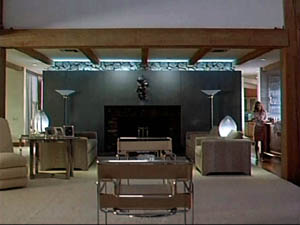
In the 1990s US indie filmmakers adapted this staging strategy. In Safe, Todd Haynes uses it to suggest the hard-edged sterility of the wife’s suburban life, which surrounds her with cubical furniture.
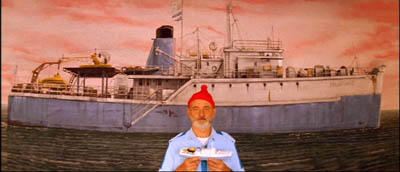
Wes Anderson used the image schema occasionally in Bottle Rocket but came to rely on it more and more. (He tended to use wide-angle rather than longer lenses, though; note the bulging effect in the Life Aquatic shot below.)
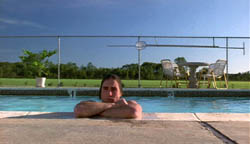
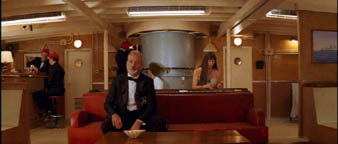
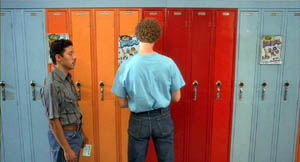
For Anderson, as for Keaton and Kitano, the static, geometrical frame can evoke a deadpan comic quality. This comes out as well in Jared Hess’s Napoleon Dynamite.
Initially, this scheme also helped filmmakers distinguish their work from Hollywood. Mainstream American films tend to film players in 3/4 views, except for certain situations, such as a theatrical performance or a scene showing a mammoth image display.
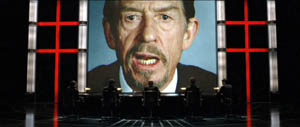
V for Vendetta (2005)
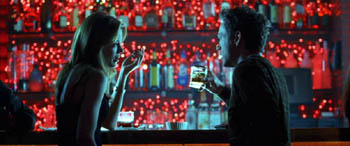
Some American directors seem to have used the planimetric shot decoratively, as a nifty one-off touch, as here in Kiss Kiss Bang Bang.
Many overseas directors who rely on this schema adjust their cutting accordingly. In Figures I called it compass-point editing. The usual tactic is to follow one planimetric shot with a reverse shot that’s also planimetric. In the first four shots of Kitano’s A Scene at the Sea, the camera angle switches either 180 degrees or zero degrees.
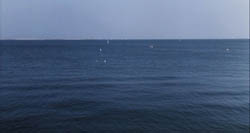
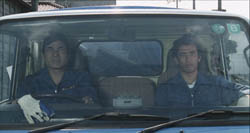
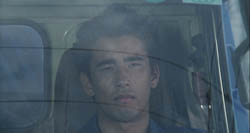

When I asked Kitano why he cut this way, he gestured toward me, then at himself. “When we are speaking, this is the way we look toward each other. It’s the most natural way to show a conversation.” Apparently this is why over-the-shoulder shots are pretty rare in Kitano’s films.
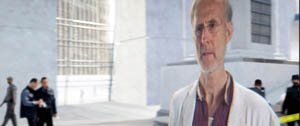
Planimetric shot/ reverse shot is seldom used in Hollywood films, and it seems to be reserved for certain confrontational situations, or institutional scenes (e.g., doctor/ patient conversations). It can sometimes suggest an unnerving or unnatural encounter, as in I, Robot. The detective Spooner is calling on his old friend Dr. Lanning, and their dialogue is shot in to-camera medium-shots.
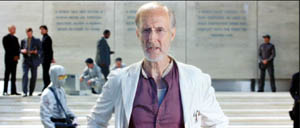
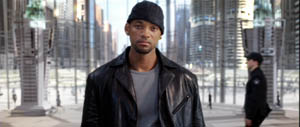
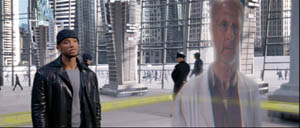
At the climax of the conversation, the camera takes up a 3/4 position and arcs around Lanning, revealing him to be only a hologram, presenting his dying message to Spooner. The planimetric image is motivated as suitable for a flat, virtual presence.
Proyas has cleverly prepared us for this subterfuge by ending the previous scene with an unremarkable planimetric framing on Spooner as elevator doors close on him.
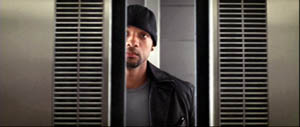
This shot leads directly to the initial shot of Dr. Lanning above, apparently addressing us, in a sort of shot/ reverse shot cut across two scenes.
As we might expect, Godard, who helped disseminate the schema, is all up for upsetting it, in Vivre sa vie and Made in USA. The first shot below teases us to read the flat background as a high-angle vista; the second carries the idea of a conversation in a planimetric frame to a beautiful absurdity.
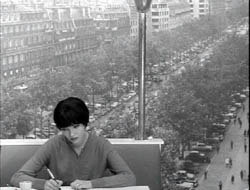
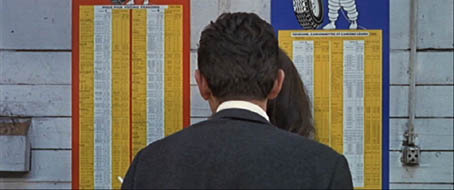
My quick survey doesn’t exhaust the various forms and uses of this strategy. I just wanted to show how shot-consciousness can lead us to notice when filmmakers take up new pictorial tools and modify them for particular purposes.
Uncle Walt the artist
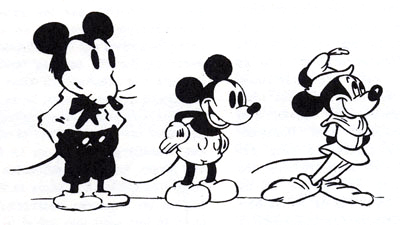
From Robert Benayoun, Le Dessin animé après Walt Disney.
The epos of Chaplin is the Paradise Lost of today. The epos of Disney is Paradise Regained.
Sergei Eisenstein
DB here:
 I’m not qualified to write a comprehensive or penetrating review of Neal Gabler’s biography Walt Disney: The Triumph of the American Imagination. For that you can go to Mike Barrier, one of our finest historians of US animation. Barrier’s own Disney biography will come out this spring, with apparently little overlap with Gabler’s.
I found Gabler’s book a thorough, somewhat cautious bio, even-handed about Disney and judicious about such controversial matters as Walt’s reputation as an anti-Semite. A lot of it reads like a notecard book, with quotes, paraphrases, and commentary dutifully snipped and pasted in, packing each paragraph. Chronology, not concept, rules. Still, I learned a lot.
Gabler’s book reminded me how much I admire Disney films. The attachment started–as for most of us–in childhood. Peter Pan (1953) was the first one I remember seeing in a theatre, but when I saw a reissue of Snow White later, parts looked so familiar that it must have impressed itself on me at an earlier time. Of course it still scared the hell out of me.
In 1973, when I was doing dissertation research in New York City, I attended a massive Disney retrospective at MoMA. As a twenty-five-year-old bearded guy among moms and kids, I felt obscurely criminal just being there, like a character in a Patricia Highsmith novel. But what I saw, in excellent prints, showed me that Disney was important on both cultural and artistic levels. So I designed a Disney unit into my first Introduction to Film course, taught here at University of Wisconsin–Madison to 300-400 souls whom fate cast my way.
I wanted to talk about film’s relation to society, and Disney was a touchstone for all my students. No matter where they came from, they knew Mickey, Donald, Snow White, Fantasia, and the rest. I showed early films, like Flowers and Trees, The Band Concert, and The Old Mill, as well as a True-Life Adventure nature doc, and the extraordinary Trip through the Disney Studio which was originally attached to The Reluctant Dragon. Students were able to see, I hope, how the ideology at work in Disney films could shape a conception of the world, of American life, and of their childhood.
Our assigned reading was Richard Schickel’s The Disney Version (1969); it’s a coruscating study, perfectly crystallizing that era’s feelings about Disney’s debasement of popular culture. At about the same time, Armand Mattelart’s Marxist critique How to Read Donald Duck was informing most film academics’ study of Disney. As Gabler indicates, intellectuals fell out of love with Disney in the 1940s. He handled labor disputes at the studio in a high-handed, paranoid way. He also seemed to personify the blandness of postwar consensus culture, and Disneyland became the theme-park equivalent of Norman Rockwell Americana. Even though hippies were turning on to re-releases of Alice in Wonderland and Fantasia, most cultural critics treated Disney pretty roughly. My friends and I goggled at Wally Wood’s 1967 Realist cartoon showing Walt’s whole gang engaging in a panoply of naughty sexual encounters.
Today the academic study of Disney is well-established, producing far too much for me to keep up with. A lot of it is cultural critique. For something funnier and even more scurrilous, see Carl Hiaasen’s Team Rodent. Despite all there is to read about Walt’s empire and its cultural consequences, I want something else as well.
Even when I was conducting my Disney Demystification Exercise, I tried to point out that these cartoons were artistically very strong. I still admire the powerfully emotional storytelling that, like that found in other fairy tales, preys so mercilessly on childhood fears. Schickel claims that after screenings of Snow White at Radio City Music Hall, the seats had to be cleaned because the Witch had scared kids into emptying their bladders.
Then too there’s the dynamism and grace of the animation, which remains unsurpassed. For Sergei Eisenstein Disney exemplified the contagious power of expressive movement on the screen. Many have disdained “Mickey-Mousing,” the close matchup between a film image and the accompanying music. But Eisenstein saw this as “synchronization of senses,” a primal, visceral unity that could move the spectator involuntarily. He sought this subconscious synchronization in his own sound films, and Alexander Nevsky and Ivan the Terrible show the strong influence of Disney.
Eisenstein was well aware of the delusional aspects of Disney, claiming that the cartoons lulled people into forgetting the harm done by capitalism. But as an artist, Disney was unique:
I’m sometimes frightened when I watch his films. Frightened because of some absolute perfection in what he does. This man seems to know not only the magic of all technical means, but also all the most secret strands of human thought, images, ideas, feelings…. He creates somewhere in the realm of the very purest and most primal depths.[1]
Disney’s art seems magical, but if it’s not a miracle, we ought to be able to study it systematically. How?
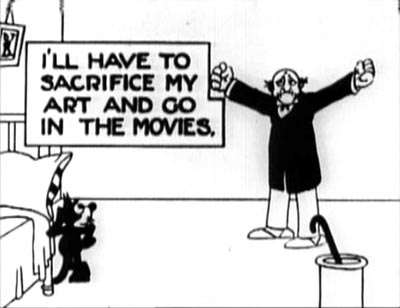 Felix in Hollywood (1923)
For the Jung at heart
Gabler’s is a sturdy, readable volume teeming with fascinating background material. As an EEG of the ups and downs of the studio, it’s extremely valuable. Gabler also aims to give a portrait of Disney the visionary, a man of boundless Protestant energy who sought to take animated film to ever higher levels. I think the portrait is disappointing, though, in its reliance on conventional psychobiography and Zeitgeist explanations.
Disney, Gabler claims, was dominated by a psychological drive to create a world wholly of his own. He was a control freak. “It had always been about control, about crafting a better reality than the one outside the studio, and about demonstrating that one had the capacity to do so. That was what Walt Disney provided to America–not escape, as so many analysts would surmise, but control and the vicarious empowerment that accompanied it.”
Commentators have long noted that Disney expanded the films’ fantasy world in his theme park. Just as films idealized reality, “so would Disneyland, the creation of a wounded man who expunged what he saw as the darker passages of his past by devising a better world of his imagination, though one that was obviously colored by the images of Hollywood.”
One has to wonder whether this characterization is particular to Uncle Walt. Lots of artists, from architects and topiary gardeners to designers of world’s fairs, have sought to create imaginary worlds over which they rule. Balzac, Faulkner, Lewis Carroll, and J. R. R. Tolkien conjured up imaginary realms populated by dozens of their own creatures. Graphic artist Ho Che Anderson writes:
For the control freak, there are few places better than comics. . . . Pick up a pen and piece of paper and you too can effectively play God. I suspect this love of God-play is the blood that keeps the hearts of many a cartoonist beating.[2]
Moreover, is the desire to build a parallel world necessarily a sign of a wounded past, or dark imaginings? Maybe it’s just one awesome creative challenge for ambitious artists. Granted, Disney took this impulse in a particular direction, toward a vision of life combining technical progress (the multiplane camera, Tomorrowland) with idealized notions of small-town community. But then we have to explain those idiosyncratic factors too.
Gabler goes the psychological route, but we could balance this account with cultural factors in Disney’s immediate milieu. There was the rise of the Technocracy movement. There was Hollywood’s belief that filmmaking would progress through new technologies. There was growing evidence during and after World War II that America’s might would be built on new machines. (One of the most hair-raising movies I saw at the 1973 MoMA Disney fest was Victory through Air Power, an educational short arguing for investment in airborne warfare.) Disney was, along many dimensions, a techie impresario, the Steve Jobs of his day, complete with his unique reality-distortion field.
The other big-picture explanation Gabler offers is a Zeitgeist model. Disney represents the American imagination. By tapping into Jungian archetypes, his 1930s films could both “capture and then soothe the national malaise.” More generally: “In both Disney’s imagination and the American imagination, one could assert one’s will on the world . . . . Indeed, in a typically American formulation, nothing but goodness and will mattered.” Disney’s desire to retreat into a controlled world echoes his country’s self-absorped conception of itself.
Despite these claims, Gabler doesn’t dwell much on the ways the studio seized what he calls “the American psyche,” perhaps because he senses that such explanations tend to be uninformative. One can grab almost any cluster of traits, find them in American popular art, and assert them as quintessentially American. This is how mainstream journalists make current Hollywood releases worth writing about: treating them not as artworks with distinctive appeals and a place in traditions and histories, but as reflections of whatever immediate social trends the writer chooses to pick out.
I won’t extend my criticism of Zeitgeist explanations here; it’s developed in the first essay in my forthcoming Poetics of Cinema. I’ll just say that I think we need more precise explanations than we get from easy juxtapositions of this or that film and some collective mood, sentiment, fantasy, or anxiety that we postulate as existing out there. Is there an American psyche? I’m not convinced.
An alternative to psychological speculation and Zeitgeist thinking is to look for more immediate causal connections. For example, Gabler traces how, around 1932, Disney began a new division of labor among his staff. He created a fairly strict set of specialties (story, gags, continuity sketches) and a chain of command in which head animators would become directors, overseeing particular projects. What’s the explanation of this change of policy? For Gabler, the new rationalization reflects not only the need to manage a bigger staff but also Walt’s effort in “reinventing and perfecting the system under which animations were produced.”
Gabler doesn’t mention that reorganizing the division of labor was going on throughout Hollywood at the same time. Most major studios were moving from a central producer system (this parallels the previous Disney lineup, with Walt at the top) to what Janet Staiger has called the producer-unit system, in which each man was charged with several productions.[3] Mentioning this doesn’t take away from Disney’s resourcefulness, but it does indicate that models for organizing his company were emerging right under his nose.
Similar issues could be examined by looking at Disney’s place in the overall ecology of Hollywood, as the premiere supplier of short subjects. His firm, Douglas Gomery argues, kept RKO afloat for many years. Gomery’s Hollywood Studio System: A History gives a cogent account of Disney’s role in the industry, and he goes somewhat beyond Gabler in tracing the studio’s emergence as in the 1950s as the prototype of modern conglomerate filmmaking.
Life in the cel
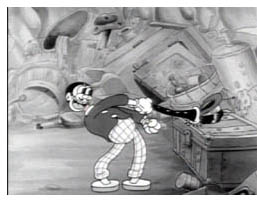 For Gabler, what made Walt reorganize production, and indeed what made him do nearly everything, was his obsessive pursuit of “quality” animation. But this quality itself remains fairly mysterious.
Gabler indicates that Disney moved away from the “rubber-hose” style of most cartoons, with their balloon heads, swollen paunches, and elastic arms and legs. (Even the clarinet goes limp in Harman-Ising’s A Great Big Bunch of You, from 1932, shown here.) Floppy limbs were fairly easy to animate. Gabler briskly summarizes Team Disney’s well-known innovations in naturalism, such as the studio’s emphasis on anatomy and life drawing, the breakdown of gestures, complex perspectives, and the rotoscoping of human figures.
Yet Gabler, a former movie critic for television, oddly doesn’t engage with the result of the technical innovations. He summarizes how journalists, critics, and academics have interpreted the movies’ cultural impact, but what he thinks about them as movies, rather than social or psychological symptoms, is almost completely suppressed. Does he admire Snow White or Dumbo or Pinocchio? Does he hate them? Has he studied them in preparation for the book? You will find more sensitive appreciation and critique in Leonard Maltin’s The Disney Films than in all of Gabler’s doorstop tome.
Gabler implicitly acknowledges the technical achievements of Snow White, Pinocchio, Fantasia, Dumbo, and Bambi, but after that he merely chronicles release after release with deadpan indifference. For example, he offers us nothing on the brilliant character animation of Song of the South (1946)–a film no longer in circulation because of its racial stereotyping.
Gabler follows tradition in suggesting that the UPA studio movies challenged Disney’s hyperrealism, but Disney was already moving toward something quite stylized. Gabler doesn’t observe the zesty play with color and line of Melody Time‘s “Blame It on the Samba” episode (1948). Eisenstein would have been pleased to see that the handling of Donald and Jose literalizes the metaphor feeling blue.
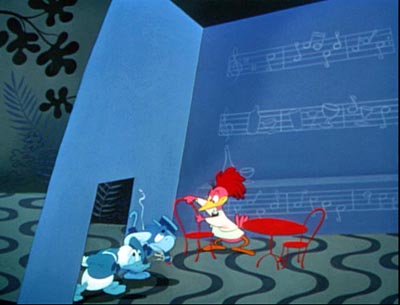
Working with lower budgets in the 1940s, the animators let their imaginations run wild. What a pleasure it must have been for Ward Kimball to come up with the funhouse nuttiness of the Serape song in The Three Caballeros (1945).
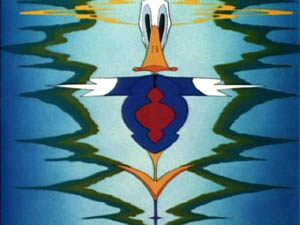

Kimball must have been quite a character; his parody book Art Afterpieces doesn’t spare the studio’s creatures. More generally, when Disney animators turned to illustrating pop music, they didn’t abandon the wilder sides of Fantasia.
There would be several fruitful ways to study the Art of Uncle Walt. One would require what I call rhapsodic criticism, writing that tries to evoke the movie’s look and feel through energetic, sensuous description. (This is, I think, what Susan Sontag meant in calling for “an erotics of art.”) Here is Don Crafton on the Felix the Cat cartoons:
Perhaps the most appealing aspect of Felix was his use of expressive body parts–a tail that forms gratuitous curlicues when he walks, or ears that click together like scissors. . . . He can mold himself into a mantel clock and have his nose mistakenly wound up; his tail can be an umbrella, a sword, or a clarinet, or Chaplin’s cane. He can use the tail as a bow to play a tune on his whiskers, then take one of the rising notes and use it for a doorkey. His skin is detachable. In Felix Trifles with Time (1925), a tailor flays him, then outfits a client with his pelt. When the man goes swimming, “naked” Felix retrieves his hide from the beach. [4]
In brief compass Crafton brings Felix alive for us. You don’t have to love Disney to write this way about his films; you do need a good eye, some pluck and gusto, plus a gift for language. Nothing like this is to be found in Gabler’s book.
Another way to get closer to Disney’s art is to just look at things more analytically. How does Disney create that expressive movement that Eisenstein admired? Partly, it seems, through having his figures move all over, and at the same instant. Reacting to a line of dialogue, a character can twist his waist, arch his back, swivel his shoulders, lift his head, arch his eyebrows, and raise a forefinger–all in a second or two. Two successive frames from Melody Time show Johnny Appleseed’s guardian angel in action, working his legs, arms, shoulders, jaw, and eyeballs simultaneously.
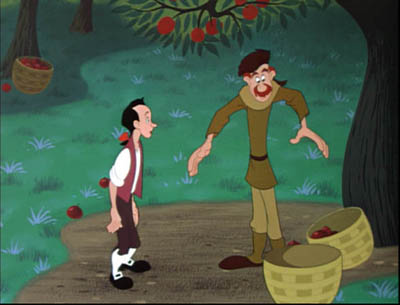
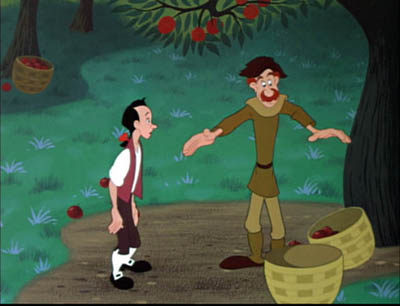
This is far from the minimal animation to which we became accustomed in the TV era. Treating gesture as a taut, rolling movement helps give Disney characters their unique volume and springiness, so different from the flabby postures of the rubber-hose style.
Or consider pacing, at which the Disney cartoons excel. Most studio animation of the period, constrained by smaller budgets than Disney had, speeded up production by filming each frame twice. That way only 12 cel drawings were needed for the 24 frames that consumed a second of film. One way Disney achieved expressive action, and the high quality to which Gabler refers, was to devote single frames–and cels–to details of particular movements. This choice, though expensive, allowed for exact adjustments in rhythm.
Sometimes there’s more than one movement per frame. You can occasionally find this strategy at work in other studios’ cartoons too, as Kristin has explained in an essay she mentions elsewhere in our blog. But Disney’s animators certainly used the technique with great panache. When Johnny, balancing on a branch, is caught in a rain of apples, he sweeps them up with lighting speed–a deft swirl made possible by multiplying character poses on each cel. If that means giving Johnny many arms and even detaching his hands, so be it.
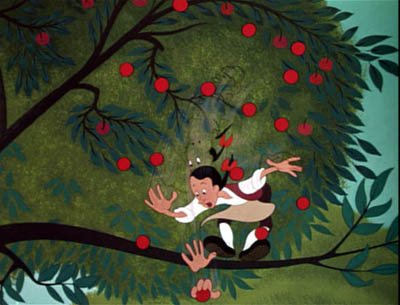
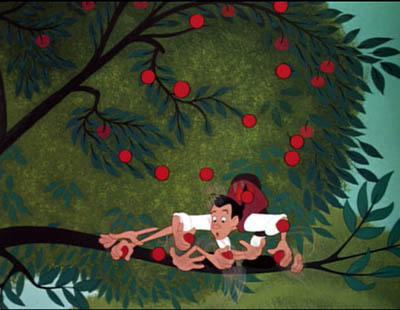
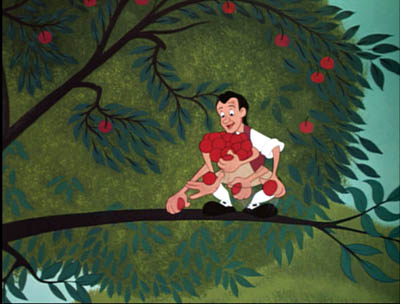
Johnny’s arms and hands proliferate more quickly and widely as he scoops up the apples, but their number is reduced as he gathers them in to his chest, so the rhythm accelerates and decelerates. Through trial and error Disney’s animators learned that rather strange single images will look exactly right on the screen; these men were practical perceptual psychologists.
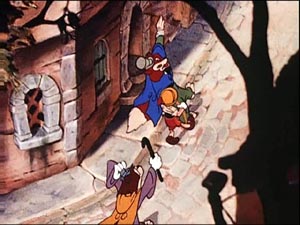
There are so many aspects of Disney’s art that need attention: the skill with line and contour; the sort of soft caricature that some consider cutesy but has enormous bounce and vibrancy; the ingenious use of color; and of course, Eisenstein’s “synchronization of senses” between image and music. There’s also Disney’s appropriation of developing live-action techniques, as in the proto-Wellesian crane shot in Pinocchio
One could also study the studio’s borrowing of high-art motifs and styles. Instead of dismissing the 1940s and early 1950s Disneys as greeting-card kitsch, we can note that they evidently borrowed from the likes of WPA landscape art, American regionalist painting, and the naive-art look of Grandma Moses. (Her painting A Beautiful World, 1948 resembles Disney’s Johnny Appleseed of the same year.)


I’m a duffer in animation matters, so I’ve merely indicated some areas that intrigue me. The key source on the studio’s craft practice remains the gorgeous book The Illusion of Life: Disney Animation (1981, rev. 1995), by two of the great Nine Old Men, Frank Thomas and Ollie Johnson. And I expect lots of discoveries in years to come from experts like Barrier, Maureen Furness, Paul Welles, Norman M. Klein, and many others. Since Gabler draws heavily on the research of others, often without naming names, he might have borrowed a bit more from scholars of animation aesthetics.
In fact, you could argue that without the artistic imagination displayed by Disney and his brilliant staff, these films couldn’t have captivated the American imagination. Whatever that is.
[1] Eisenstein on Disney, ed. Jay Leyda, trans. Alan Upchurch (Calcutta: Seagull, 1986), 2.
[2] “Career Tips for Control Freaks,” in The Education of a Comics Artist, ed. Michael Dooley and Steven Heller (New York: Allworth, 2005), 124-125.
[3] Janet Staiger, “The Producer-Unit System: Management by Specialization after 1931, in David Bordwell, Janet Staiger, and Kristin Thompson, The Classical Hollywood Cinema: Film Style and Mode of Production to 1960 (New York: Columbia University Press, 1985), 320.
[4] Donald Crafton, Before Mickey: The Animated Film 1898-1928 (Chicago: University of Chicago Press, 1993; orig. 1982), 327, 328.